EP3709302B1 - Procédé d'estimation - Google Patents
Procédé d'estimation Download PDFInfo
- Publication number
- EP3709302B1 EP3709302B1 EP20162215.6A EP20162215A EP3709302B1 EP 3709302 B1 EP3709302 B1 EP 3709302B1 EP 20162215 A EP20162215 A EP 20162215A EP 3709302 B1 EP3709302 B1 EP 3709302B1
- Authority
- EP
- European Patent Office
- Prior art keywords
- probability
- representative value
- interval
- value
- difference
- Prior art date
- Legal status (The legal status is an assumption and is not a legal conclusion. Google has not performed a legal analysis and makes no representation as to the accuracy of the status listed.)
- Active
Links
Images


Classifications
-
- G—PHYSICS
- G06—COMPUTING OR CALCULATING; COUNTING
- G06N—COMPUTING ARRANGEMENTS BASED ON SPECIFIC COMPUTATIONAL MODELS
- G06N7/00—Computing arrangements based on specific mathematical models
- G06N7/01—Probabilistic graphical models, e.g. probabilistic networks
-
- G—PHYSICS
- G16—INFORMATION AND COMMUNICATION TECHNOLOGY [ICT] SPECIALLY ADAPTED FOR SPECIFIC APPLICATION FIELDS
- G16B—BIOINFORMATICS, i.e. INFORMATION AND COMMUNICATION TECHNOLOGY [ICT] SPECIALLY ADAPTED FOR GENETIC OR PROTEIN-RELATED DATA PROCESSING IN COMPUTATIONAL MOLECULAR BIOLOGY
- G16B40/00—ICT specially adapted for biostatistics; ICT specially adapted for bioinformatics-related machine learning or data mining, e.g. knowledge discovery or pattern finding
- G16B40/30—Unsupervised data analysis
-
- G—PHYSICS
- G16—INFORMATION AND COMMUNICATION TECHNOLOGY [ICT] SPECIALLY ADAPTED FOR SPECIFIC APPLICATION FIELDS
- G16B—BIOINFORMATICS, i.e. INFORMATION AND COMMUNICATION TECHNOLOGY [ICT] SPECIALLY ADAPTED FOR GENETIC OR PROTEIN-RELATED DATA PROCESSING IN COMPUTATIONAL MOLECULAR BIOLOGY
- G16B40/00—ICT specially adapted for biostatistics; ICT specially adapted for bioinformatics-related machine learning or data mining, e.g. knowledge discovery or pattern finding
-
- G—PHYSICS
- G16—INFORMATION AND COMMUNICATION TECHNOLOGY [ICT] SPECIALLY ADAPTED FOR SPECIFIC APPLICATION FIELDS
- G16B—BIOINFORMATICS, i.e. INFORMATION AND COMMUNICATION TECHNOLOGY [ICT] SPECIALLY ADAPTED FOR GENETIC OR PROTEIN-RELATED DATA PROCESSING IN COMPUTATIONAL MOLECULAR BIOLOGY
- G16B20/00—ICT specially adapted for functional genomics or proteomics, e.g. genotype-phenotype associations
-
- G—PHYSICS
- G16—INFORMATION AND COMMUNICATION TECHNOLOGY [ICT] SPECIALLY ADAPTED FOR SPECIFIC APPLICATION FIELDS
- G16B—BIOINFORMATICS, i.e. INFORMATION AND COMMUNICATION TECHNOLOGY [ICT] SPECIALLY ADAPTED FOR GENETIC OR PROTEIN-RELATED DATA PROCESSING IN COMPUTATIONAL MOLECULAR BIOLOGY
- G16B30/00—ICT specially adapted for sequence analysis involving nucleotides or amino acids
- G16B30/10—Sequence alignment; Homology search
-
- G—PHYSICS
- G16—INFORMATION AND COMMUNICATION TECHNOLOGY [ICT] SPECIALLY ADAPTED FOR SPECIFIC APPLICATION FIELDS
- G16B—BIOINFORMATICS, i.e. INFORMATION AND COMMUNICATION TECHNOLOGY [ICT] SPECIALLY ADAPTED FOR GENETIC OR PROTEIN-RELATED DATA PROCESSING IN COMPUTATIONAL MOLECULAR BIOLOGY
- G16B45/00—ICT specially adapted for bioinformatics-related data visualisation, e.g. displaying of maps or networks
-
- G—PHYSICS
- G16—INFORMATION AND COMMUNICATION TECHNOLOGY [ICT] SPECIALLY ADAPTED FOR SPECIFIC APPLICATION FIELDS
- G16C—COMPUTATIONAL CHEMISTRY; CHEMOINFORMATICS; COMPUTATIONAL MATERIALS SCIENCE
- G16C20/00—Chemoinformatics, i.e. ICT specially adapted for the handling of physicochemical or structural data of chemical particles, elements, compounds or mixtures
- G16C20/30—Prediction of properties of chemical compounds, compositions or mixtures
-
- G—PHYSICS
- G16—INFORMATION AND COMMUNICATION TECHNOLOGY [ICT] SPECIALLY ADAPTED FOR SPECIFIC APPLICATION FIELDS
- G16C—COMPUTATIONAL CHEMISTRY; CHEMOINFORMATICS; COMPUTATIONAL MATERIALS SCIENCE
- G16C20/00—Chemoinformatics, i.e. ICT specially adapted for the handling of physicochemical or structural data of chemical particles, elements, compounds or mixtures
- G16C20/80—Data visualisation
-
- C—CHEMISTRY; METALLURGY
- C12—BIOCHEMISTRY; BEER; SPIRITS; WINE; VINEGAR; MICROBIOLOGY; ENZYMOLOGY; MUTATION OR GENETIC ENGINEERING
- C12N—MICROORGANISMS OR ENZYMES; COMPOSITIONS THEREOF; PROPAGATING, PRESERVING, OR MAINTAINING MICROORGANISMS; MUTATION OR GENETIC ENGINEERING; CULTURE MEDIA
- C12N15/00—Mutation or genetic engineering; DNA or RNA concerning genetic engineering, vectors, e.g. plasmids, or their isolation, preparation or purification; Use of hosts therefor
- C12N15/09—Recombinant DNA-technology
-
- C—CHEMISTRY; METALLURGY
- C12—BIOCHEMISTRY; BEER; SPIRITS; WINE; VINEGAR; MICROBIOLOGY; ENZYMOLOGY; MUTATION OR GENETIC ENGINEERING
- C12Q—MEASURING OR TESTING PROCESSES INVOLVING ENZYMES, NUCLEIC ACIDS OR MICROORGANISMS; COMPOSITIONS OR TEST PAPERS THEREFOR; PROCESSES OF PREPARING SUCH COMPOSITIONS; CONDITION-RESPONSIVE CONTROL IN MICROBIOLOGICAL OR ENZYMOLOGICAL PROCESSES
- C12Q1/00—Measuring or testing processes involving enzymes, nucleic acids or microorganisms; Compositions therefor; Processes of preparing such compositions
- C12Q1/68—Measuring or testing processes involving enzymes, nucleic acids or microorganisms; Compositions therefor; Processes of preparing such compositions involving nucleic acids
-
- G—PHYSICS
- G16—INFORMATION AND COMMUNICATION TECHNOLOGY [ICT] SPECIALLY ADAPTED FOR SPECIFIC APPLICATION FIELDS
- G16B—BIOINFORMATICS, i.e. INFORMATION AND COMMUNICATION TECHNOLOGY [ICT] SPECIALLY ADAPTED FOR GENETIC OR PROTEIN-RELATED DATA PROCESSING IN COMPUTATIONAL MOLECULAR BIOLOGY
- G16B25/00—ICT specially adapted for hybridisation; ICT specially adapted for gene or protein expression
- G16B25/20—Polymerase chain reaction [PCR]; Primer or probe design; Probe optimisation
-
- G—PHYSICS
- G16—INFORMATION AND COMMUNICATION TECHNOLOGY [ICT] SPECIALLY ADAPTED FOR SPECIFIC APPLICATION FIELDS
- G16C—COMPUTATIONAL CHEMISTRY; CHEMOINFORMATICS; COMPUTATIONAL MATERIALS SCIENCE
- G16C20/00—Chemoinformatics, i.e. ICT specially adapted for the handling of physicochemical or structural data of chemical particles, elements, compounds or mixtures
- G16C20/70—Machine learning, data mining or chemometrics
Definitions
- the present disclosure relates to a technique for quantitative determination of a material stored in a container.
- a method of creating a quantified nucleic acid reference material a method of performing limiting dilution of a DNA (deoxyribo nucleic acid) solution, or a method of dispensing cells containing DNAs using ink-jet is used, for example.
- the limiting dilution method is known to provide a diluted concentration that obeys a Poisson distribution. Such a distribution can be approximated to a normal distribution if the concentration is relatively high. However, if the concentration is low (in particular, if the copy number of nucleic acid molecules is 1 to 100), the right side (i.e., positive side) of the distribution becomes relatively long. Further, there is a relatively prominent tendency that the distribution becomes discrete.
- Japanese Patent Application No. 2018-096636 describes a method of dispensing cells using ink-jet. This method does not have a cell measurement accuracy of 100 % during dispensing, and the resulting concentration distribution is asymmetrical, with the right side longer than the left side due to aggregation of cells, for example. In addition, such a distribution is not a common distribution like a Poisson distribution that can be represented by a mathematical expression.
- concentration of the nucleic acid reference material included in the product.
- specification values representing the representative concentration (typically, a mean value is used) and variation in the concentration are important.
- a smaller specification value regarding variation means higher concentration accuracy.
- concentration distribution of a nucleic acid reference material may differ depending on a method of creating the material, and some concentration distribution may not be able to be represented using a common distribution.
- the normal distribution method is a method of estimating an interval in which the concentration of a reference material is in the range of the mean value ⁇ 2 ⁇ (where ⁇ is the standard deviation of the concentration distribution). This method assumes that the concentration distribution obeys a normal distribution and thus is said to be one of the parametric methods.
- a percentage-point method which is used to compute a process capability index, identifies a probability distribution function or a p % point and a (1 - p) % point on a probability distribution with a given shape.
- the p % point means a point where the probability of occurrence of a phenomenon having a given value or less is p %.
- the 2.275 % point and the 97.725 % point on a standard normal distribution correspond to - 2 and + 2, respectively.
- p (1 - ⁇ ) ⁇ 100/2.
- Percentage points can be used irrespective of the shape of a probability distribution. Thus, percentage points can be used to determine a concentration in a non-parametric way. When the way of thinking a process capability index based on the percentage-point method is used, for example, it is possible to determine an interval in which the probability that the concentration is within the range of a non-normal distribution is 95.45 %, which is equivalent to the mean value ⁇ 2 ⁇ on a normal distribution, for example.
- WO 2006/030822 describes the following technique as a technique of correcting unevenness in a data distribution of a DNA chip: "[U]nevenness in data on a DNA chip is adequately detected and, if possible, corrected.
- the DNA chip is divided into small regions.
- the values of data forming the array data are standardized (step 300).
- the mean value of the standardized data values or the standard deviation of the median is calculated for each small region (step 310).
- the presence or absence of unevenness in the data on the DNA chip is detected on the basis of an increase in the standard deviation (step 310)" (see Abstract).
- Japanese Unexamined Patent Application Publication No. 2004-257809 describes a technique of, based on an object of "providing a standard plastic material prepared by dispersing a known amount of a known element in a plastic base material, the standard plastic material having a predetermined thickness and being capable of providing an accurate analysis result, and a production method therefor," "irradiating a plurality of portions of the standard plastic material with predetermined exciting beams to suppress variation in the intensity of fluorescent X rays generated from the element to less than or equal to 10 % of the relative standard deviation" (see Abstract).
- the computation result for a low-concentration reference material sample may greatly deviate from the actual concentration. This occurs when the actual concentration distribution is bilaterally asymmetrical and a relatively large part of the distribution is not within the range of the mean value ⁇ 2 ⁇ , for example. Alternatively, even when the actual concentration distribution concentrates in a range narrower than the mean value ⁇ 2 ⁇ , the computation result will greatly deviate from the actual concentration.
- the representative value of the concentration distribution has a decimal point and numbers following the decimal point, but the concentration of a low-concentration reference material sample is represented by an integer value (that is, the copy number of molecules). Thus, it would be unnatural to present the numbers following the decimal point as the values of the product specifications. Such problems are difficult to be solved with the technique described in Japanese Patent Application No. 2018-096636 .
- the aforementioned percentage-point method is a non-parametric method. Thus, it can also be used for concentration distributions other than normal distributions. Meanwhile, the method determines percentage points that are bilaterally symmetrical irrespective of a distribution (for example, the 2.25 % point and the 97.75 % point). Thus, when the actual concentration distribution is an asymmetrical, discrete distribution, an increase in the percentage on one side of the distribution is sharp (Example in Table 1: the 37.07 % point follows the 0.43 % point), and thus, the computation result may include a redundant interval.
- WO 2006/030822 the representative value and the standard deviation of a probability distribution are used, and the data distribution is evaluated based on the premise that the probability distribution is bilaterally symmetrical.
- the method is considered to have problems similar to Japanese Patent Application No. 2018-096636 in terms of the shape of the non-parametric probability distribution.
- Japanese Unexamined Patent Application Publication No. 2004-257809 is also considered to have similar problems to Japanese Patent Application No. 2018-096636 as it uses the relative standard deviation of a probability distribution.
- FIG. 1 is a perspective view of a reference material sample 1 according to an embodiment of the present disclosure.
- the reference material sample 1 includes one or more containers 11 (also referred to as wells) on a plate.
- Each container 11 stores a reference material that has been quantified in advance.
- the container 11 can store a predetermined number of DNA molecules each having a target base sequence for use in an analytical operation. In such a case, storing a predetermined number of copied DNA molecules in each container 11 can create the reference material sample 1. Material samples other than the DNA molecules will be described later.
- FIG. 2A is a graph illustrating an exemplary concentration distribution of the reference material contained in the reference material sample 1.
- the graph illustrates the probability distribution of the copy number of DNA molecules stored in a single container 11.
- the probability that 9 DNA molecules are stored in a single container 11 is the highest, and the probability that 10 DNA molecules is stored is the second highest.
- the probabilities of the other numbers of DNA molecules are significantly lower than that of the 9 or 10 DNA molecules.
- 10 can be determined as the representative value, for example.
- a target probability is set in advance.
- the reference material sample 1 was produced so that the probability that 9 to 12 copies of DNA molecules are stored in a single container 11 would become 95.45 %, for example.
- Such numerical values can be presented as the product specifications of the reference material sample 1.
- a probability distribution such as the one illustrated in FIG. 2A has the following characteristics. As seen in FIG. 2A , the shape of the distribution is not bilaterally symmetrical about the representative value as the center. In particular, a low-concentration sample (for which the concentration is represented by the copy number of molecules) tends to have a longer distribution on its lower-probability portion on the right side (i.e., the side of a greater copy number). Further, since the reference material sample 1 has been created by copying DNA molecules, the abscissa axis of the concentration distribution represents the copy number. That is, the concentration distribution is a discrete distribution. According to such characteristics, the concentration distribution of the low-concentration sample represented by the copy number of molecules appears very different from a normal distribution.
- FIG. 2B is a schematic diagram for comparing the probability distribution of FIG. 2A with a normal distribution.
- a method based on a normal distribution is used for a sample with a concentration distribution such as the one illustrated in FIG. 2A .
- the following inconvenience occurs.
- an interval in which the concentration is in the range of ⁇ 2 ⁇ for example, based on a normal distribution
- the product specifications of the reference material sample 1 1.
- a major part of the actual concentration distribution is not in compliance with the normal distribution on the left side (i.e., the side of a smaller copy number), in particular. Therefore, display of the concentration based on a normal distribution is not considered to be appropriate as the product specifications.
- the following case would cause inconveniences.
- the actual concentration distribution that is included in the range of ⁇ 2 ⁇ on the normal distribution may become smaller than the original target probability.
- the target probability may be met within a range narrower than ⁇ 2 ⁇ on the normal distribution.
- the range of ⁇ 2 ⁇ on the normal distribution is presented as the product specifications, it follows that a range greater than the target probability is presented as the product specifications. That is, an excessively wide concentration interval is presented as the product specifications.
- the representative value and the interval of ⁇ 2 ⁇ on the normal distribution are not necessarily integers, whereas the representative value and the interval on the actual concentration distribution are integers, thus causing a mismatch between the two.
- the present embodiment provides a technique for solving the foregoing inconveniences. That is, the present embodiment aims at adequately computing and displaying the product specifications of the reference material sample 1 according to the actual concentration distribution even when the concentration distribution is bilaterally asymmetrical and discrete. Accordingly, it is considered that the product specifications of, in particular, a low-concentration sample that is represented by the copy number of molecules, for example, can be presented more adequately than is conventionally done.
- FIG. 3 is a flowchart illustrating the procedures for computing the product specifications of the reference material sample 1 in the present embodiment.
- the flowchart of FIG. 3 can be carried out either manually or through implementation of each step with hardware, such as a circuit device, or implementation of each step with software and execution of the step with an arithmetic unit. Each step in FIG. 3 will be described below.
- a target probability for the reference material sample 1 is set.
- a target probability equal to that of ⁇ 2 ⁇ on a normal distribution is set, for example, such a target probability is 95.45 %. It is also possible to set other appropriate target probabilities.
- the representative value on the concentration distribution of the reference material sample 1 is computed. Specifically, the actual concentration distribution of the reference material sample 1 is measured or computed in advance to obtain a concentration distribution such as the one illustrated in FIG. 2A . The following description is also based on FIG. 2A . Then, the representative value on the concentration distribution is determined. For the representative value, an appropriate value may be selected according to the shape of the distribution as described below, or an appropriate value may be selected according the intended use of the reference material sample 1. The representative value may also be selected using other appropriate criteria.
- An interval [the representative value - a, the representative value + b] is set as an initial interval to execute the following steps.
- the representative value is the one computed in step S302, and is 10 in the example of FIG. 2A .
- Symbols a and b are integers greater than or equal to zero, and need not be the same numerical value.
- Step S304 Supplementary notes
- the previous width w may be changed.
- the width w may be initially set large to allow for a general search, and then gradually set smaller to allow for a more detailed search.
- the first probability computed in step S305 is compared with the second probability computed in step S306. If the first probability is greater than or equal to the second probability, the process proceeds to step S307-2, and if not, the process proceeds to step S307-3.
- the interval set in step S305 is fixed (S307-2). If the first probability is less than the second probability, it means that extending the interval rightward will allow a more portion of the actual concentration distribution to be included. Therefore, in such a case, the interval set in step S306 is fixed (S307-3).
- Steps S304 to S307 are repeated until the cumulative probability computed in step S305 or S306 becomes greater than or equal to the target probability.
- the flowchart ends at a time point when the cumulative probability becomes greater than or equal to the target probability.
- the product specifications computed according to the flowchart of FIG. 3 can be displayed as the product specifications of the reference material sample 1.
- a label describing the product specifications can be attached to the reference material sample 1 so that the product specifications can be displayed. That is, the reference material sample 1 includes a display portion displaying the product specifications.
- Table 1 illustrates an example of the actual concentration distribution of the reference material sample 1, which correspond to the real values in FIG. 2A .
- product specifications computed according to the procedures described with reference to FIG. 3 and product specifications computed with a conventional method are compared using the reference material sample 1 of Table 1.
- Table 2 illustrates the results of the product specifications computed with each method.
- the representative value of the normal distribution method is the mean value.
- the probability ⁇ is 95.45 %. Thus, an interval was identified through a search for the 2.275 % point and the 97.725 % point.
- each method is found to achieve the target probability ⁇ .
- the fixed interval of the normal distribution method has a decimal value.
- the cumulative probability of an interval of the closest integers [8, 12] within the interval of the computation result is displayed.
- the computation result of the present embodiment has the narrowest interval width of all the other methods.
- the present embodiment is deemed to display the properties of the reference material sample 1 most accurately.
- the probability of the copy number being less than the lower limit value 9 is 0.43 %, but a percentage point with a lower probability of 2.275 % was searched for.
- a redundant interval width of 2.275 % - 0.43 % 1.845 % was secured.
- the interval width of the estimation result is greater than that of the present embodiment.
- the shape of the probability distribution greatly differs from that of the Poisson distribution.
- the interval width of the estimation result is significantly greater than that of the present embodiment.
- an interval that is bilaterally symmetrical about the representative value is the estimation result.
- the interval on the left side is larger than that of the present embodiment.
- Table 3 illustrates another example of the actual concentration distribution of the reference material sample 1.
- product specifications computed according to the procedures described with reference to FIG. 3 and product specifications computed with a conventional method are compared using the reference material sample 1 of Table 3.
- Table 4 illustrates the results of the product specifications computed with each method.
- the representative value of the normal distribution method is the mean value.
- the probability of the mode 5 is obviously higher than those of the other intervals. Thus, the mode 5 was selected as the representative value.
- the target probability ⁇ is 95.45 %. Thus, an interval was identified through a search for the 2.275 % point and the 97.725 % point.
- the present embodiment and the percentage-point method A are found to achieve the target probability ⁇ .
- the interval width is 3, which is the smallest of all.
- the shape of the probability distribution greatly differs from that of the Poisson distribution. For this reason, it is considered that the interval width of the estimation result is significantly greater than that of the present embodiment.
- the fixed interval has decimal values. Thus, an interval of the closest integers [4, 7] within the interval of the computation result is the substantial estimation result.
- an interval that is bilaterally symmetrical about the representative value is the estimation result. Thus, an interval on the left side, in particular, is large and an interval on the right is insufficient, and for this reason, it is considered that the cumulative probability does not satisfy the target probability ⁇ .
- Table 5 illustrates the results obtained by computing the product specifications of the reference material sample 1, which has been created with the limiting dilution method, using each method. Unlike Tables 1 to 4, the reference material sample 1 has been created with the limiting dilution method. Thus, the concentration distribution obeys a Poisson distribution. In Table 5, examples in which a single container 11 stores an average of 1 to 10000 DNA molecules were used. Since the concentration distribution obeys a Poisson distribution, there is no difference between the percentage-point methods A and B. Thus, such methods are collectively referred to as a "percentage-point method" in Table 5.
- Target Probability ⁇ Average Copy Number (Representative Value) Method Estimated Interval Interval Width Probability within Interval 1 Present Embodiment [0, 3] 3 98.10 % Percentage-Point Method [0, 3] 3 98.10 % Normal Distribution Method [-1, 3] 4 100 % 10 Present Embodiment [4, 16] 12 96.26 % Percentage-Point Method [4, 17] 13 97.54 % Normal Distribution Method [3.68, 16.32] 12.65 96.26 % 100 Present Embodiment [81, 120] 39 95.47 % 95.45 % Note:This corresponds to ⁇ 2 ⁇ of the normal distribution.
- Percentage-Point Method [81, 120] 39 95.47 % Normal Distribution Method [80, 120] 40 95.99 % 1000 Present Embodiment [937, 1063] 126 95.54 % Percentage-Point Method [937, 1064] 127 95.70 % Normal Distribution Method [936.75, 1063.25] 126.49 95.54 % 10000 Present Embodiment [9801, 10200] 399 95.45 % Percentage-Point Method [9801, 10200] 399 95.45 % Normal Distribution Method [9800, 10200] 400 95.50 %
- each method is found to achieve the target probability ⁇ .
- the interval width of the present embodiment is the smallest.
- the present embodiment can also be advantageously used when the concentration distribution obeys a typical Poisson distribution.
- the interval width according to the present embodiment is smaller than those of the normal distribution method and the percentage-point method by one.
- the interval width of the present embodiment is smaller than that of the other method by 2.5 to 25 %. This can confirm that the present embodiment is particularly advantageous for a low-concentration sample containing an average of 100 molecules or less.
- the reference material sample 1 includes a display portion that displays the product specifications computed according to the procedures described with reference to FIG. 3 .
- the product specifications (a) the representative value of the concentration distribution and (b) the lower limit value and the upper limit value representing an interval on the probability distribution can be displayed.
- the target probability ⁇ may also be displayed.
- the target probability ⁇ need not be displayed on the display portion if the numerical value can be known without the display portion such as when the value is determined as the industry standard, for example. Displaying the product specifications via the display portion will allow a user to know the correct specifications of the reference material sample 1.
- the initial interval is widened to a side with a higher cumulative probability while being gradually widened to the right or left side by the variable width w.
- Setting the variable width w according to the properties of the probability distribution can, for a given shape of the probability distribution, estimate with high accuracy the minimum interval for which the cumulative probability is greater than or equal to the target probability ⁇ . Accordingly, product specifications with higher accuracy than those of conventional methods can be presented for a low-concentration sample containing 100 molecules or less, in particular.
- the amount y of the reference material is influenced by other amounts (for example, the concentration x 1 of the solution and the volume x 2 of the solution dispensed).
- a representative value of a new sample as well as an interval having a probability greater than or equal to 95.45 % can be easily estimated according to the following procedures.
- the result is that the representative value is 15 copies/wells and the estimated interval is [10.30, 14.42].
- the estimated interval is represented by integers, it becomes an interval of the minimum integers [10, 15] that can totally include the estimated interval.
- the absolute value of the difference between the representative value R y of the amount y and the lower limit tolerance is A y
- the absolute value of the difference between the upper limit tolerance and the representative value R y is B y
- the absolute value of the difference between the representative value R xi of each of the amounts x 1 , x 2 ,..., x n and the lower limit tolerance is A x1 , A x2 ,..., A xn
- the absolute value of the difference between the upper limit tolerance and the representative value R xi is B x1 , B x2 ,..., B xn
- the values of A y , B y , and R y can be estimated with the following formulae.
- R y f R x 1 R x 2 ⁇ R xn
- the aforementioned embodiment illustrates an example in which the amount of the reference material contained in the reference material sample is estimated and displayed. Instead, the average amount of each sample of the reference material contained in the reference material sample may also be estimated and displayed. In such a case, the measurement result of the average amount of the reference material has measurement uncertainty according to a probability distribution.
- the representative value of the average amount of each sample as well as an interval having a probability greater than or equal to 95.45 % can be easily estimated according to the following procedures.
- the result is that the representative value is 10 copies/wells and the estimated interval is [7.59, 13.21].
- the estimated interval is represented by integers, it becomes an interval of the minimum integers [7, 14] that can totally include the estimated interval.
- the absolute value of the difference between the representative value R y of the amount y of the material and the lower limit tolerance is A y
- the absolute value of the difference between the upper limit tolerance and the representative value R y is B y
- the absolute value of the difference between the representative value R ym of the mean value of the amount y of the material and the lower limit tolerance is A ym
- the absolute value of the difference between the representative value R ym and the upper limit tolerance is B ym
- the number of samples of the material is N y
- the values of A ym , B ym , and R ym can be estimated with the following formulae.
- a ym A y N y
- B ym B y N y
- R ym R y
- the average amount y of the nucleic acid dispensed into each well is influenced by the concentration x 1 of the solution, the volume x 2 of the solution dispensed, and a deviation x 3 attributed to a Poisson distribution.
- R ym f R xm 1 R xm 2 ⁇ R xmn
- the uncertainty of the average quantitative result y is influenced by variation x 1 in the quantitative results of the samples for quantitative determination, variation x 2 in the designated amounts of the reference material used to create the calibration curve, and variation x 3 in the amplification results of the designated amounts of the reference material for creation of the calibration curve.
- the representative value of y is the mean value of the quantitative results and thus is known. Since the relationship between y and x 1 to x 3 cannot be represented by a formula, ay/ax; is typically regarded as 1.
- each relative value with respect to the representative value R xm is illustrated in Table 7.
- Each value can be determined according to the following procedures.
- the representative value of y is 7.03
- the estimated interval of y is [5.35, 9.33].
- each relative value with respect to the representative value R Z is illustrated in Table 8.
- Each value can be determined according to the following procedures.
- a xm /R xm and B xm /R xm with respect to the variation x 2 in the designated amounts of the reference material used to create the calibration curve are 0.034 and 0.125, respectively.
- Table 9 illustrates A Z /R Z , B Z /R Z , and N Z obtained by performing an inverse operation on the copy number of nucleic acids of each reference material using the created calibration curve.
- a xm /R xm and B xm /R xm with respect to the variation x 3 in the amplification results of the designated amounts of the reference material for creation of the calibration curve are 0.085 and 0.094, respectively.
- the absolute value of the difference between the representative value R Z1 , R Z2 ,..., R Zn of each of the mean values and the lower limit tolerance is A Z1 , A Z2 ,..., A Zn
- the absolute value of the difference between the representative value R Z1 , R Z2 ,..., R Zn and the upper limit tolerance is B Z1 , B Z2 ,..., B Zn
- the number of the material samples is Nzi, N Z2 ,..., N Zn
- the values of A xm /R xm and B xm /R xm can be estimated with the following formulae.
- the present embodiment has been described above using a low-concentration sample as an example of a reference material with a discrete, bilaterally asymmetrical concentration distribution.
- the reference material sample 1 created by copying DNA molecules corresponds to such a sample.
- the present embodiment can also be advantageously used for a concentration distribution that is not discrete and a concentration distribution that is bilaterally symmetrical as described with reference to Computation Example 3.
- the aforementioned embodiment illustrates a nucleic acid reference material sample as an exemplary material sample having containers 11 each storing a quantified material
- the present embodiment is also applicable to a material sample having containers storing other quantified materials. That is, although the aforementioned embodiment illustrates an example in which copied nucleic acid molecules are stored in each container 11, the material stored in each container 11 is not necessarily limited to copied nucleic acid molecules.
- the present embodiment is also applicable to other material samples because it is applicable to any probability distributions. Further, the present embodiment is also applicable to probability distributions other than concentration probability distributions.
- the target base sequences of molecules stored in each container 11 may be either the same or different. Further, the target base sequence of each molecule stored in a single container 11 may be either the same or different. For material samples other than DNA molecules, the material composition may also be either the same or different among the containers 11.
- the display portion may be configured in different ways.
- a piece of paper such as a manual of a product describing its specifications, may be displayed by being packed together with the reference material sample 1.
- the product specifications may be displayed by being presented over a network. The product specifications may also be displayed using any other appropriate methods.
- information displayed on the display portion may be expressed with any method as long as it can identify product specifications.
- the lower limit and the upper limit of an interval may be displayed like an "interval [8, 12]," or information that can identify an interval according to some procedures may be presented. This is also true of the target probability ⁇ and the representative value.
- the reference material sample 1 can be created by ejecting molecules of a material (for example, DNA molecules) into the containers 11 from an ink-jet apparatus (i.e., liquid droplet ejection apparatus), for example (see Japanese Patent Application No. 2018-096636 ).
- the representative value can be computed using the properties of the ink-jet apparatus in step S302. For example, using properties, such as a single liquid droplet ejection amount and the concentration of a material contained in the liquid droplet, is considered.
Landscapes
- Engineering & Computer Science (AREA)
- Physics & Mathematics (AREA)
- Life Sciences & Earth Sciences (AREA)
- Theoretical Computer Science (AREA)
- Health & Medical Sciences (AREA)
- Bioinformatics & Cheminformatics (AREA)
- Medical Informatics (AREA)
- Bioinformatics & Computational Biology (AREA)
- Data Mining & Analysis (AREA)
- General Health & Medical Sciences (AREA)
- Biotechnology (AREA)
- Biophysics (AREA)
- Evolutionary Biology (AREA)
- Spectroscopy & Molecular Physics (AREA)
- Software Systems (AREA)
- Artificial Intelligence (AREA)
- Evolutionary Computation (AREA)
- Chemical & Material Sciences (AREA)
- Computing Systems (AREA)
- Public Health (AREA)
- Bioethics (AREA)
- Computer Vision & Pattern Recognition (AREA)
- Databases & Information Systems (AREA)
- Epidemiology (AREA)
- General Physics & Mathematics (AREA)
- Analytical Chemistry (AREA)
- Crystallography & Structural Chemistry (AREA)
- Proteomics, Peptides & Aminoacids (AREA)
- General Engineering & Computer Science (AREA)
- Mathematical Physics (AREA)
- Probability & Statistics with Applications (AREA)
- Computational Mathematics (AREA)
- Pure & Applied Mathematics (AREA)
- Mathematical Analysis (AREA)
- Genetics & Genomics (AREA)
- Molecular Biology (AREA)
- Algebra (AREA)
- Mathematical Optimization (AREA)
- Apparatus Associated With Microorganisms And Enzymes (AREA)
- Measuring Or Testing Involving Enzymes Or Micro-Organisms (AREA)
Claims (6)
- Procédé d'estimation mis en oeuvre par ordinateur pour estimer une quantité d'une matière quantifiée injectée dans un récipient par un appareil d'éjection de gouttelettes de liquide, la quantité de matière ayant une variation selon une distribution de probabilité, et une probabilité que la quantité de matière se situe dans une plage d'une tolérance limite inférieure à une tolérance limite supérieure sur la distribution de probabilité étant supérieure ou égale à une probabilité cible, le procédé d'estimation comprenant :le calcul de la distribution de probabilité, le calcul de la distribution de probabilité comprenant le calcul de la distribution de probabilité à l'aide d'une propriété de performance de l'appareil d'éjection de gouttelettes de liquide configuré pour injecter le matériau dans le récipient,une première étape consistant à définir la probabilité cible ;une deuxième étape consistant à calculer la valeur représentative de la quantité de matériau sur la distribution de probabilité ;une troisième étape consistant à définir un intervalle d'une limite inférieure à une limite supérieure comprenant la valeur représentative sur la distribution de probabilité ;une quatrième étape consistant à définir une largeur variable de l'intervalle ;une cinquième étape consistant à augmenter une taille de l'intervalle de la largeur variable depuis la valeur représentative vers la limite inférieure, et à calculer une première probabilité que la quantité de matériau se trouve dans l'intervalle avec la taille augmentée ;une sixième étape consistant à augmenter la taille de l'intervalle de la largeur variable depuis la valeur représentative vers la limite supérieure, et à calculer une deuxième probabilité que la quantité de matériau se trouve dans l'intervalle avec la taille augmentée ; etune septième étape consistant à fixer la taille de l'intervalle défini à la cinquième étape si la première probabilité est supérieure ou égale à la deuxième probabilité, ou à fixer la taille de l'intervalle défini à la sixième étape si la première probabilité est inférieure à la deuxième probabilité,dans lequel :la quatrième étape, la cinquième étape, la sixième étape et la septième étape sont répétées jusqu'à ce que la probabilité que la quantité de matériau se trouve dans l'intervalle devienne supérieure ou égale à la probabilité cible,la tolérance limite inférieure est la limite inférieure de l'intervalle à un instant où la probabilité que la quantité de matériau se trouve dans l'intervalle devient supérieure ou égale à la probabilité cible, etla tolérance limite supérieure est la limite supérieure de l'intervalle à un instant où la probabilité que la quantité de matière se trouve dans l'intervalle devient supérieure ou égale à la probabilité cible ; etle matériau étant constitué de molécules d'acide nucléique.
- Procédé d'estimation selon la revendication 1, dans lequel à conditionqu'une quantité y du matériau est influencée par d'autres quantités x1, x2,..., xn,
 qu'une valeur absolue d'une différence entre une valeur représentative Ry de la quantité y et la tolérance limite inférieure est Ay,qu'une valeur absolue d'une différence entre la tolérance limite supérieure et la valeur représentative Ry est By,qu'une valeur absolue d'une différence entre une valeur représentative Rxi de chacune des quantités x1, x2,..., xn et la tolérance limite inférieure est Axi, Ax2,..., Axn, etqu'une valeur absolue d'une différence entre la tolérance limite supérieure et la valeur représentative Rxi est Bx1, Bx2,..., Bxn,les valeurs de Ay, By et Ry sont estimées avec les formules suivantes.
- Procédé d'estimation selon la revendication 1, dans lequel à conditionqu'une valeur absolue d'une différence entre une valeur représentative Ry d'une quantité y du matériau et la tolérance limite inférieure est Ay,qu'une valeur absolue d'une différence entre la tolérance limite supérieure et la valeur représentative Ry est By,qu'une valeur absolue d'un écart entre une valeur représentative Rym d'une valeur moyenne de la quantité y du matériau et la tolérance limite inférieure est Aym,qu'une valeur absolue d'une différence entre la valeur représentative Rym et la tolérance limite supérieure est Bym, etque le nombre d'échantillons du matériau est Ny,les valeurs de Aym, Bym et Rym sont estimées avec les formules suivantes.

- Procédé d'estimation selon la revendication 1, dans lequel à conditionqu'une quantité y du matériau est influencée par d'autres quantités x1, x2,..., xn,
 qu'une valeur absolue d'un écart entre une valeur représentative Rym d'une valeur moyenne de la quantité y et la tolérance limite inférieure est Aym,qu'une valeur absolue d'une différence entre la valeur représentative Rym et la tolérance limite supérieure est Bym,qu'une valeur absolue d'une différence entre une valeur représentative Rxm1, Rxm2,..., Rxmn d'une valeur moyenne de chacune des quantités x1, x2,..., xn et la tolérance limite inférieure est Axm1, Axm2,... , Axmn etqu'une valeur absolue d'une différence entre la valeur représentative Rxm1, Rxm2,..., Rxmn et la tolérance limite supérieure est Bxm1, Bxm2,..., Bxmn,les valeurs de Aym, Bym et Rym sont estimées avec les formules suivantes.
- Procédé d'estimation selon la revendication 1, dans lequel à conditionqu'une quantité y du matériau est influencée par d'autres quantités x1, x2,..., xn,
 qu'une valeur absolue d'un écart entre une valeur représentative Rym d'une valeur moyenne de la quantité y et la tolérance limite inférieure est Aym,qu'une valeur absolue d'une différence entre la valeur représentative Rym et la tolérance limite supérieure est Bym,qu'une valeur absolue d'une différence entre une valeur représentative Rxm1, Rxm2,..., Rxmn d'une valeur moyenne de chacune des quantités x1, x2,..., xn et la tolérance limite inférieure est Axm1, Axm2,... , Axmn etqu'une valeur absolue d'une différence entre la valeur représentative Rxm1, Rxm2,..., Rxmn et la tolérance limite supérieure est Bxm1, Bxm2,..., Bxmn,les valeurs de Aym, Bym et Rym sont estimées avec les formules suivantes.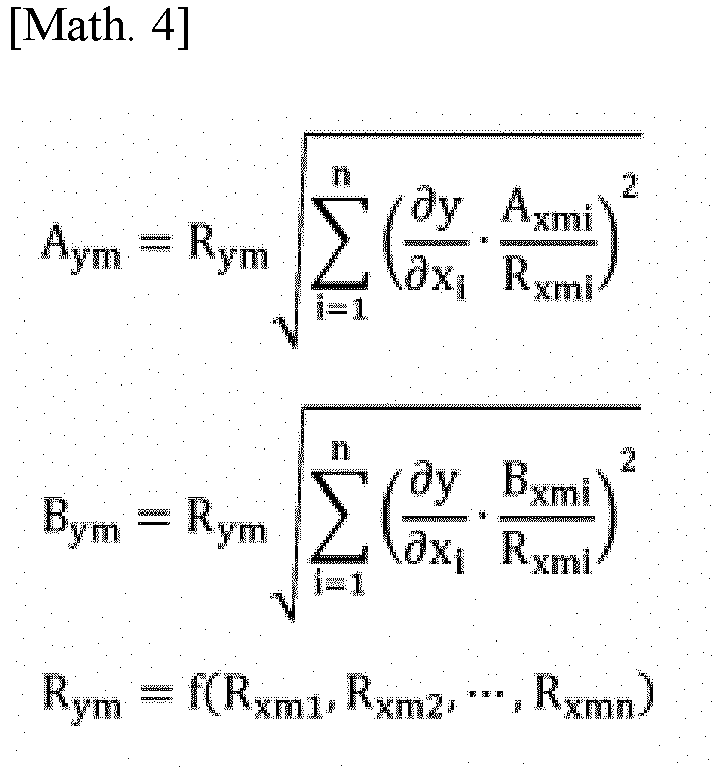
- Procédé d'estimation selon la revendication 5, dans lequel pour une pluralité de types d'échantillons de matériaux ayant des valeurs moyennes différentes des quantités x, à conditionqu'une valeur absolue d'un écart entre une valeur représentative Rz1, Rz2,..., Rzn de chacune des valeurs moyennes et la tolérance limite inférieure est Az1, Az2,..., Azn,qu'une valeur absolue d'une différence entre la valeur représentative Rz1, Rz2,..., Rzn et la tolérance limite supérieure est Bz1, Bz2,..., Bzn, etle nombre d'échantillons de matériau est Nz1, Nz2,..., Nzn,les valeurs de Axm/Rxm et Bxm/Rxm sont estimées avec les formules suivantes.

Applications Claiming Priority (3)
| Application Number | Priority Date | Filing Date | Title |
|---|---|---|---|
| JP2019046887 | 2019-03-14 | ||
| JP2019232236 | 2019-12-24 | ||
| JP2020015263A JP2021097658A (ja) | 2019-03-14 | 2020-01-31 | 物質サンプル、表示方法、推定方法 |
Publications (2)
| Publication Number | Publication Date |
|---|---|
| EP3709302A1 EP3709302A1 (fr) | 2020-09-16 |
| EP3709302B1 true EP3709302B1 (fr) | 2024-02-14 |
Family
ID=69804537
Family Applications (1)
| Application Number | Title | Priority Date | Filing Date |
|---|---|---|---|
| EP20162215.6A Active EP3709302B1 (fr) | 2019-03-14 | 2020-03-10 | Procédé d'estimation |
Country Status (3)
| Country | Link |
|---|---|
| US (1) | US20200293934A1 (fr) |
| EP (1) | EP3709302B1 (fr) |
| CN (1) | CN111696620A (fr) |
Family Cites Families (7)
| Publication number | Priority date | Publication date | Assignee | Title |
|---|---|---|---|---|
| JP4154689B2 (ja) | 2003-02-25 | 2008-09-24 | 学校法人明治大学 | プラスチック標準物質およびその製造方法 |
| JPWO2006030822A1 (ja) | 2004-09-14 | 2008-05-15 | 株式会社東京大学Tlo | 遺伝子発現データの処理方法、および、処理プログラム |
| US10209246B2 (en) * | 2012-06-26 | 2019-02-19 | Curiosity Diagnostics Sp. Z.O.O. | Method for performing quantitation assays |
| US10415084B2 (en) * | 2013-06-27 | 2019-09-17 | Quark Biosciences Taiwan, Inc. | Multiplex slide plate device and operation method thereof |
| JP6778851B2 (ja) | 2016-12-15 | 2020-11-04 | パナソニックIpマネジメント株式会社 | 熱交換器およびそれを用いた冷凍システム |
| CN108491606B (zh) * | 2018-03-13 | 2019-03-12 | 东南大学 | 一种材料强度分布获取方法 |
| CN109461473B (zh) * | 2018-09-30 | 2019-12-17 | 北京优迅医疗器械有限公司 | 胎儿游离dna浓度获取方法和装置 |
-
2020
- 2020-03-10 EP EP20162215.6A patent/EP3709302B1/fr active Active
- 2020-03-11 CN CN202010165041.1A patent/CN111696620A/zh active Pending
- 2020-03-13 US US16/818,188 patent/US20200293934A1/en not_active Abandoned
Also Published As
| Publication number | Publication date |
|---|---|
| EP3709302A1 (fr) | 2020-09-16 |
| CN111696620A (zh) | 2020-09-22 |
| US20200293934A1 (en) | 2020-09-17 |
Similar Documents
| Publication | Publication Date | Title |
|---|---|---|
| Beauchamp et al. | Metrological tools for the reference materials and reference instruments of the NIST material measurement laboratory | |
| Ramezani et al. | Maximum likelihood estimation of asymmetric jump-diffusion processes: Application to security prices | |
| US20140278143A1 (en) | Method for performing quantitation assays | |
| Olivieri | A down-to-earth analyst view of rotational ambiguity in second-order calibration with multivariate curve resolution− a tutorial | |
| US12450388B2 (en) | Identifying and mitigating disparate group impact in differential-privacy machine-learned models | |
| Zabell et al. | A proposal to improve calibration and outlier detection in high-throughput mass spectrometry | |
| EP3709302B1 (fr) | Procédé d'estimation | |
| Kreinovich et al. | On-line algorithms for computing mean and variance of interval data, and their use in intelligent systems | |
| Tellinghuisen et al. | qPCR data analysis: Better results through iconoclasm | |
| Müller-Gronbach et al. | Variable subspace sampling and multi-level algorithms | |
| Mrkvička et al. | Monte Carlo testing in spatial statistics, with applications to spatial residuals | |
| Bonett | Robust confidence interval for a ratio of standard deviations | |
| US20220411858A1 (en) | Random emulsification digital absolute quantitative analysis method and device | |
| Sombultawee | The stochastic volatility option pricing model: Evidence from a highly volatile market | |
| EP3757561B1 (fr) | Analyseur automatisé et procédé d'analyse automatique | |
| EP3724654B1 (fr) | Procédé pour l'analyse de composants à petites molécules d'un mélange complexe, et appareil et produit de type programme informatique associés | |
| US20160328514A1 (en) | Transcript Determination Method | |
| Jafari et al. | Balanced scaling as a pretreatment step in Multivariate Curve Resolution analysis of noisy data | |
| JP2021097658A (ja) | 物質サンプル、表示方法、推定方法 | |
| Rebafka et al. | Bootstrap-based tolerance intervals for application to method validation | |
| Da Fonseca et al. | A linear-rational multi-curve term structure model with stochastic spread | |
| Avaro et al. | Highly parallel simulation tool for the design of isotachophoresis experiments | |
| Rogers | Bermudan options by simulation | |
| Bülow et al. | Confidence interval comparison: Precision of maximum likelihood estimates in LLOQ affected data | |
| Dimitrov et al. | Almost-Exact Simulation Scheme for Heston-type Models: Bermudan and American Option Pricing |
Legal Events
| Date | Code | Title | Description |
|---|---|---|---|
| PUAI | Public reference made under article 153(3) epc to a published international application that has entered the european phase |
Free format text: ORIGINAL CODE: 0009012 |
|
| STAA | Information on the status of an ep patent application or granted ep patent |
Free format text: STATUS: REQUEST FOR EXAMINATION WAS MADE |
|
| 17P | Request for examination filed |
Effective date: 20200310 |
|
| AK | Designated contracting states |
Kind code of ref document: A1 Designated state(s): AL AT BE BG CH CY CZ DE DK EE ES FI FR GB GR HR HU IE IS IT LI LT LU LV MC MK MT NL NO PL PT RO RS SE SI SK SM TR |
|
| AX | Request for extension of the european patent |
Extension state: BA ME |
|
| STAA | Information on the status of an ep patent application or granted ep patent |
Free format text: STATUS: EXAMINATION IS IN PROGRESS |
|
| 17Q | First examination report despatched |
Effective date: 20220302 |
|
| GRAP | Despatch of communication of intention to grant a patent |
Free format text: ORIGINAL CODE: EPIDOSNIGR1 |
|
| STAA | Information on the status of an ep patent application or granted ep patent |
Free format text: STATUS: GRANT OF PATENT IS INTENDED |
|
| INTG | Intention to grant announced |
Effective date: 20230927 |
|
| GRAS | Grant fee paid |
Free format text: ORIGINAL CODE: EPIDOSNIGR3 |
|
| GRAA | (expected) grant |
Free format text: ORIGINAL CODE: 0009210 |
|
| STAA | Information on the status of an ep patent application or granted ep patent |
Free format text: STATUS: THE PATENT HAS BEEN GRANTED |
|
| P01 | Opt-out of the competence of the unified patent court (upc) registered |
Effective date: 20231208 |
|
| AK | Designated contracting states |
Kind code of ref document: B1 Designated state(s): AL AT BE BG CH CY CZ DE DK EE ES FI FR GB GR HR HU IE IS IT LI LT LU LV MC MK MT NL NO PL PT RO RS SE SI SK SM TR |
|
| REG | Reference to a national code |
Ref country code: GB Ref legal event code: FG4D |
|
| REG | Reference to a national code |
Ref country code: CH Ref legal event code: EP |
|
| REG | Reference to a national code |
Ref country code: DE Ref legal event code: R096 Ref document number: 602020025513 Country of ref document: DE |
|
| REG | Reference to a national code |
Ref country code: IE Ref legal event code: FG4D |
|
| PGFP | Annual fee paid to national office [announced via postgrant information from national office to epo] |
Ref country code: DE Payment date: 20240320 Year of fee payment: 5 Ref country code: GB Payment date: 20240321 Year of fee payment: 5 |
|
| REG | Reference to a national code |
Ref country code: LT Ref legal event code: MG9D |
|
| REG | Reference to a national code |
Ref country code: NL Ref legal event code: MP Effective date: 20240214 |
|
| PG25 | Lapsed in a contracting state [announced via postgrant information from national office to epo] |
Ref country code: IS Free format text: LAPSE BECAUSE OF FAILURE TO SUBMIT A TRANSLATION OF THE DESCRIPTION OR TO PAY THE FEE WITHIN THE PRESCRIBED TIME-LIMIT Effective date: 20240614 |
|
| PG25 | Lapsed in a contracting state [announced via postgrant information from national office to epo] |
Ref country code: LT Free format text: LAPSE BECAUSE OF FAILURE TO SUBMIT A TRANSLATION OF THE DESCRIPTION OR TO PAY THE FEE WITHIN THE PRESCRIBED TIME-LIMIT Effective date: 20240214 |
|
| PG25 | Lapsed in a contracting state [announced via postgrant information from national office to epo] |
Ref country code: GR Free format text: LAPSE BECAUSE OF FAILURE TO SUBMIT A TRANSLATION OF THE DESCRIPTION OR TO PAY THE FEE WITHIN THE PRESCRIBED TIME-LIMIT Effective date: 20240515 |
|
| REG | Reference to a national code |
Ref country code: AT Ref legal event code: MK05 Ref document number: 1657759 Country of ref document: AT Kind code of ref document: T Effective date: 20240214 |
|
| PG25 | Lapsed in a contracting state [announced via postgrant information from national office to epo] |
Ref country code: HR Free format text: LAPSE BECAUSE OF FAILURE TO SUBMIT A TRANSLATION OF THE DESCRIPTION OR TO PAY THE FEE WITHIN THE PRESCRIBED TIME-LIMIT Effective date: 20240214 Ref country code: RS Free format text: LAPSE BECAUSE OF FAILURE TO SUBMIT A TRANSLATION OF THE DESCRIPTION OR TO PAY THE FEE WITHIN THE PRESCRIBED TIME-LIMIT Effective date: 20240514 Ref country code: NL Free format text: LAPSE BECAUSE OF FAILURE TO SUBMIT A TRANSLATION OF THE DESCRIPTION OR TO PAY THE FEE WITHIN THE PRESCRIBED TIME-LIMIT Effective date: 20240214 |
|
| PG25 | Lapsed in a contracting state [announced via postgrant information from national office to epo] |
Ref country code: ES Free format text: LAPSE BECAUSE OF FAILURE TO SUBMIT A TRANSLATION OF THE DESCRIPTION OR TO PAY THE FEE WITHIN THE PRESCRIBED TIME-LIMIT Effective date: 20240214 |
|
| PG25 | Lapsed in a contracting state [announced via postgrant information from national office to epo] |
Ref country code: AT Free format text: LAPSE BECAUSE OF FAILURE TO SUBMIT A TRANSLATION OF THE DESCRIPTION OR TO PAY THE FEE WITHIN THE PRESCRIBED TIME-LIMIT Effective date: 20240214 |
|
| PG25 | Lapsed in a contracting state [announced via postgrant information from national office to epo] |
Ref country code: RS Free format text: LAPSE BECAUSE OF FAILURE TO SUBMIT A TRANSLATION OF THE DESCRIPTION OR TO PAY THE FEE WITHIN THE PRESCRIBED TIME-LIMIT Effective date: 20240514 Ref country code: NO Free format text: LAPSE BECAUSE OF FAILURE TO SUBMIT A TRANSLATION OF THE DESCRIPTION OR TO PAY THE FEE WITHIN THE PRESCRIBED TIME-LIMIT Effective date: 20240514 Ref country code: NL Free format text: LAPSE BECAUSE OF FAILURE TO SUBMIT A TRANSLATION OF THE DESCRIPTION OR TO PAY THE FEE WITHIN THE PRESCRIBED TIME-LIMIT Effective date: 20240214 Ref country code: LT Free format text: LAPSE BECAUSE OF FAILURE TO SUBMIT A TRANSLATION OF THE DESCRIPTION OR TO PAY THE FEE WITHIN THE PRESCRIBED TIME-LIMIT Effective date: 20240214 Ref country code: IS Free format text: LAPSE BECAUSE OF FAILURE TO SUBMIT A TRANSLATION OF THE DESCRIPTION OR TO PAY THE FEE WITHIN THE PRESCRIBED TIME-LIMIT Effective date: 20240614 Ref country code: HR Free format text: LAPSE BECAUSE OF FAILURE TO SUBMIT A TRANSLATION OF THE DESCRIPTION OR TO PAY THE FEE WITHIN THE PRESCRIBED TIME-LIMIT Effective date: 20240214 Ref country code: GR Free format text: LAPSE BECAUSE OF FAILURE TO SUBMIT A TRANSLATION OF THE DESCRIPTION OR TO PAY THE FEE WITHIN THE PRESCRIBED TIME-LIMIT Effective date: 20240515 Ref country code: FI Free format text: LAPSE BECAUSE OF FAILURE TO SUBMIT A TRANSLATION OF THE DESCRIPTION OR TO PAY THE FEE WITHIN THE PRESCRIBED TIME-LIMIT Effective date: 20240214 Ref country code: ES Free format text: LAPSE BECAUSE OF FAILURE TO SUBMIT A TRANSLATION OF THE DESCRIPTION OR TO PAY THE FEE WITHIN THE PRESCRIBED TIME-LIMIT Effective date: 20240214 Ref country code: BG Free format text: LAPSE BECAUSE OF FAILURE TO SUBMIT A TRANSLATION OF THE DESCRIPTION OR TO PAY THE FEE WITHIN THE PRESCRIBED TIME-LIMIT Effective date: 20240214 Ref country code: AT Free format text: LAPSE BECAUSE OF FAILURE TO SUBMIT A TRANSLATION OF THE DESCRIPTION OR TO PAY THE FEE WITHIN THE PRESCRIBED TIME-LIMIT Effective date: 20240214 |
|
| PGFP | Annual fee paid to national office [announced via postgrant information from national office to epo] |
Ref country code: FR Payment date: 20240408 Year of fee payment: 5 |
|
| PG25 | Lapsed in a contracting state [announced via postgrant information from national office to epo] |
Ref country code: PT Free format text: LAPSE BECAUSE OF FAILURE TO SUBMIT A TRANSLATION OF THE DESCRIPTION OR TO PAY THE FEE WITHIN THE PRESCRIBED TIME-LIMIT Effective date: 20240614 Ref country code: PL Free format text: LAPSE BECAUSE OF FAILURE TO SUBMIT A TRANSLATION OF THE DESCRIPTION OR TO PAY THE FEE WITHIN THE PRESCRIBED TIME-LIMIT Effective date: 20240214 |
|
| PG25 | Lapsed in a contracting state [announced via postgrant information from national office to epo] |
Ref country code: SE Free format text: LAPSE BECAUSE OF FAILURE TO SUBMIT A TRANSLATION OF THE DESCRIPTION OR TO PAY THE FEE WITHIN THE PRESCRIBED TIME-LIMIT Effective date: 20240214 Ref country code: PT Free format text: LAPSE BECAUSE OF FAILURE TO SUBMIT A TRANSLATION OF THE DESCRIPTION OR TO PAY THE FEE WITHIN THE PRESCRIBED TIME-LIMIT Effective date: 20240614 Ref country code: PL Free format text: LAPSE BECAUSE OF FAILURE TO SUBMIT A TRANSLATION OF THE DESCRIPTION OR TO PAY THE FEE WITHIN THE PRESCRIBED TIME-LIMIT Effective date: 20240214 Ref country code: LV Free format text: LAPSE BECAUSE OF FAILURE TO SUBMIT A TRANSLATION OF THE DESCRIPTION OR TO PAY THE FEE WITHIN THE PRESCRIBED TIME-LIMIT Effective date: 20240214 |
|
| PG25 | Lapsed in a contracting state [announced via postgrant information from national office to epo] |
Ref country code: DK Free format text: LAPSE BECAUSE OF FAILURE TO SUBMIT A TRANSLATION OF THE DESCRIPTION OR TO PAY THE FEE WITHIN THE PRESCRIBED TIME-LIMIT Effective date: 20240214 |
|
| PG25 | Lapsed in a contracting state [announced via postgrant information from national office to epo] |
Ref country code: SM Free format text: LAPSE BECAUSE OF FAILURE TO SUBMIT A TRANSLATION OF THE DESCRIPTION OR TO PAY THE FEE WITHIN THE PRESCRIBED TIME-LIMIT Effective date: 20240214 |
|
| PG25 | Lapsed in a contracting state [announced via postgrant information from national office to epo] |
Ref country code: EE Free format text: LAPSE BECAUSE OF FAILURE TO SUBMIT A TRANSLATION OF THE DESCRIPTION OR TO PAY THE FEE WITHIN THE PRESCRIBED TIME-LIMIT Effective date: 20240214 Ref country code: CZ Free format text: LAPSE BECAUSE OF FAILURE TO SUBMIT A TRANSLATION OF THE DESCRIPTION OR TO PAY THE FEE WITHIN THE PRESCRIBED TIME-LIMIT Effective date: 20240214 |
|
| PG25 | Lapsed in a contracting state [announced via postgrant information from national office to epo] |
Ref country code: SK Free format text: LAPSE BECAUSE OF FAILURE TO SUBMIT A TRANSLATION OF THE DESCRIPTION OR TO PAY THE FEE WITHIN THE PRESCRIBED TIME-LIMIT Effective date: 20240214 |
|
| PG25 | Lapsed in a contracting state [announced via postgrant information from national office to epo] |
Ref country code: SM Free format text: LAPSE BECAUSE OF FAILURE TO SUBMIT A TRANSLATION OF THE DESCRIPTION OR TO PAY THE FEE WITHIN THE PRESCRIBED TIME-LIMIT Effective date: 20240214 Ref country code: SK Free format text: LAPSE BECAUSE OF FAILURE TO SUBMIT A TRANSLATION OF THE DESCRIPTION OR TO PAY THE FEE WITHIN THE PRESCRIBED TIME-LIMIT Effective date: 20240214 Ref country code: RO Free format text: LAPSE BECAUSE OF FAILURE TO SUBMIT A TRANSLATION OF THE DESCRIPTION OR TO PAY THE FEE WITHIN THE PRESCRIBED TIME-LIMIT Effective date: 20240214 Ref country code: EE Free format text: LAPSE BECAUSE OF FAILURE TO SUBMIT A TRANSLATION OF THE DESCRIPTION OR TO PAY THE FEE WITHIN THE PRESCRIBED TIME-LIMIT Effective date: 20240214 Ref country code: DK Free format text: LAPSE BECAUSE OF FAILURE TO SUBMIT A TRANSLATION OF THE DESCRIPTION OR TO PAY THE FEE WITHIN THE PRESCRIBED TIME-LIMIT Effective date: 20240214 Ref country code: CZ Free format text: LAPSE BECAUSE OF FAILURE TO SUBMIT A TRANSLATION OF THE DESCRIPTION OR TO PAY THE FEE WITHIN THE PRESCRIBED TIME-LIMIT Effective date: 20240214 |
|
| REG | Reference to a national code |
Ref country code: CH Ref legal event code: PL |
|
| REG | Reference to a national code |
Ref country code: DE Ref legal event code: R097 Ref document number: 602020025513 Country of ref document: DE |
|
| PG25 | Lapsed in a contracting state [announced via postgrant information from national office to epo] |
Ref country code: LU Free format text: LAPSE BECAUSE OF NON-PAYMENT OF DUE FEES Effective date: 20240310 |
|
| PG25 | Lapsed in a contracting state [announced via postgrant information from national office to epo] |
Ref country code: MC Free format text: LAPSE BECAUSE OF FAILURE TO SUBMIT A TRANSLATION OF THE DESCRIPTION OR TO PAY THE FEE WITHIN THE PRESCRIBED TIME-LIMIT Effective date: 20240214 |
|
| PG25 | Lapsed in a contracting state [announced via postgrant information from national office to epo] |
Ref country code: MC Free format text: LAPSE BECAUSE OF FAILURE TO SUBMIT A TRANSLATION OF THE DESCRIPTION OR TO PAY THE FEE WITHIN THE PRESCRIBED TIME-LIMIT Effective date: 20240214 Ref country code: LU Free format text: LAPSE BECAUSE OF NON-PAYMENT OF DUE FEES Effective date: 20240310 |
|
| PG25 | Lapsed in a contracting state [announced via postgrant information from national office to epo] |
Ref country code: IT Free format text: LAPSE BECAUSE OF FAILURE TO SUBMIT A TRANSLATION OF THE DESCRIPTION OR TO PAY THE FEE WITHIN THE PRESCRIBED TIME-LIMIT Effective date: 20240214 |
|
| REG | Reference to a national code |
Ref country code: BE Ref legal event code: MM Effective date: 20240331 |
|
| PLBE | No opposition filed within time limit |
Free format text: ORIGINAL CODE: 0009261 |
|
| STAA | Information on the status of an ep patent application or granted ep patent |
Free format text: STATUS: NO OPPOSITION FILED WITHIN TIME LIMIT |
|
| PG25 | Lapsed in a contracting state [announced via postgrant information from national office to epo] |
Ref country code: IT Free format text: LAPSE BECAUSE OF FAILURE TO SUBMIT A TRANSLATION OF THE DESCRIPTION OR TO PAY THE FEE WITHIN THE PRESCRIBED TIME-LIMIT Effective date: 20240214 |
|
| PG25 | Lapsed in a contracting state [announced via postgrant information from national office to epo] |
Ref country code: BE Free format text: LAPSE BECAUSE OF NON-PAYMENT OF DUE FEES Effective date: 20240331 |
|
| 26N | No opposition filed |
Effective date: 20241115 |
|
| PG25 | Lapsed in a contracting state [announced via postgrant information from national office to epo] |
Ref country code: IE Free format text: LAPSE BECAUSE OF NON-PAYMENT OF DUE FEES Effective date: 20240310 |
|
| PG25 | Lapsed in a contracting state [announced via postgrant information from national office to epo] |
Ref country code: IE Free format text: LAPSE BECAUSE OF NON-PAYMENT OF DUE FEES Effective date: 20240310 Ref country code: BE Free format text: LAPSE BECAUSE OF NON-PAYMENT OF DUE FEES Effective date: 20240331 Ref country code: CH Free format text: LAPSE BECAUSE OF NON-PAYMENT OF DUE FEES Effective date: 20240331 |
|
| PG25 | Lapsed in a contracting state [announced via postgrant information from national office to epo] |
Ref country code: SI Free format text: LAPSE BECAUSE OF FAILURE TO SUBMIT A TRANSLATION OF THE DESCRIPTION OR TO PAY THE FEE WITHIN THE PRESCRIBED TIME-LIMIT Effective date: 20240214 |
|
| PG25 | Lapsed in a contracting state [announced via postgrant information from national office to epo] |
Ref country code: CY Free format text: LAPSE BECAUSE OF FAILURE TO SUBMIT A TRANSLATION OF THE DESCRIPTION OR TO PAY THE FEE WITHIN THE PRESCRIBED TIME-LIMIT; INVALID AB INITIO Effective date: 20200310 |
|
| PG25 | Lapsed in a contracting state [announced via postgrant information from national office to epo] |
Ref country code: HU Free format text: LAPSE BECAUSE OF FAILURE TO SUBMIT A TRANSLATION OF THE DESCRIPTION OR TO PAY THE FEE WITHIN THE PRESCRIBED TIME-LIMIT; INVALID AB INITIO Effective date: 20200310 |
|
| REG | Reference to a national code |
Ref country code: DE Ref legal event code: R119 Ref document number: 602020025513 Country of ref document: DE |
|
| GBPC | Gb: european patent ceased through non-payment of renewal fee |
Effective date: 20250310 |
|
| PG25 | Lapsed in a contracting state [announced via postgrant information from national office to epo] |
Ref country code: TR Free format text: LAPSE BECAUSE OF FAILURE TO SUBMIT A TRANSLATION OF THE DESCRIPTION OR TO PAY THE FEE WITHIN THE PRESCRIBED TIME-LIMIT Effective date: 20240214 |
|
| PG25 | Lapsed in a contracting state [announced via postgrant information from national office to epo] |
Ref country code: DE Free format text: LAPSE BECAUSE OF NON-PAYMENT OF DUE FEES Effective date: 20251001 |
|
| PG25 | Lapsed in a contracting state [announced via postgrant information from national office to epo] |
Ref country code: GB Free format text: LAPSE BECAUSE OF NON-PAYMENT OF DUE FEES Effective date: 20250310 |
|
| PG25 | Lapsed in a contracting state [announced via postgrant information from national office to epo] |
Ref country code: FR Free format text: LAPSE BECAUSE OF NON-PAYMENT OF DUE FEES Effective date: 20250331 |