EP3713435B1 - Modulares bekleidungssystem und verwendung davon - Google Patents
Modulares bekleidungssystem und verwendung davon Download PDFInfo
- Publication number
- EP3713435B1 EP3713435B1 EP18833393.4A EP18833393A EP3713435B1 EP 3713435 B1 EP3713435 B1 EP 3713435B1 EP 18833393 A EP18833393 A EP 18833393A EP 3713435 B1 EP3713435 B1 EP 3713435B1
- Authority
- EP
- European Patent Office
- Prior art keywords
- module
- subject
- fastening elements
- garment system
- type
- Prior art date
- Legal status (The legal status is an assumption and is not a legal conclusion. Google has not performed a legal analysis and makes no representation as to the accuracy of the status listed.)
- Active
Links
Images









Classifications
-
- A—HUMAN NECESSITIES
- A63—SPORTS; GAMES; AMUSEMENTS
- A63B—APPARATUS FOR PHYSICAL TRAINING, GYMNASTICS, SWIMMING, CLIMBING, OR FENCING; BALL GAMES; TRAINING EQUIPMENT
- A63B21/00—Exercising apparatus for developing or strengthening the muscles or joints of the body by working against a counterforce, with or without measuring devices
- A63B21/40—Interfaces with the user related to strength training; Details thereof
- A63B21/4023—Interfaces with the user related to strength training; Details thereof the user operating the resistance directly, without additional interface
- A63B21/4025—Resistance devices worn on the user's body
-
- A—HUMAN NECESSITIES
- A61—MEDICAL OR VETERINARY SCIENCE; HYGIENE
- A61F—FILTERS IMPLANTABLE INTO BLOOD VESSELS; PROSTHESES; DEVICES PROVIDING PATENCY TO, OR PREVENTING COLLAPSING OF, TUBULAR STRUCTURES OF THE BODY, e.g. STENTS; ORTHOPAEDIC, NURSING OR CONTRACEPTIVE DEVICES; FOMENTATION; TREATMENT OR PROTECTION OF EYES OR EARS; BANDAGES, DRESSINGS OR ABSORBENT PADS; FIRST-AID KITS
- A61F13/00—Bandages or dressings; Absorbent pads
- A61F13/06—Bandages or dressings; Absorbent pads specially adapted for feet or legs; Corn-pads; Corn-rings
- A61F13/08—Elastic stockings; for contracting aneurisms
- A61F13/085—Openable readjustable
-
- A—HUMAN NECESSITIES
- A61—MEDICAL OR VETERINARY SCIENCE; HYGIENE
- A61H—PHYSICAL THERAPY APPARATUS, e.g. DEVICES FOR LOCATING OR STIMULATING REFLEX POINTS IN THE BODY; ARTIFICIAL RESPIRATION; MASSAGE; BATHING DEVICES FOR SPECIAL THERAPEUTIC OR HYGIENIC PURPOSES OR SPECIFIC PARTS OF THE BODY
- A61H1/00—Apparatus for passive exercising; Vibrating apparatus; Chiropractic devices, e.g. body impacting devices, external devices for briefly extending or aligning unbroken bones
- A61H1/006—Apparatus for applying pressure or blows for compressive stressing of a part of the skeletal structure, e.g. for preventing or alleviating osteoporosis
-
- A—HUMAN NECESSITIES
- A63—SPORTS; GAMES; AMUSEMENTS
- A63B—APPARATUS FOR PHYSICAL TRAINING, GYMNASTICS, SWIMMING, CLIMBING, OR FENCING; BALL GAMES; TRAINING EQUIPMENT
- A63B21/00—Exercising apparatus for developing or strengthening the muscles or joints of the body by working against a counterforce, with or without measuring devices
- A63B21/40—Interfaces with the user related to strength training; Details thereof
- A63B21/4001—Arrangements for attaching the exercising apparatus to the user's body, e.g. belts, shoes or gloves specially adapted therefor
- A63B21/4007—Arrangements for attaching the exercising apparatus to the user's body, e.g. belts, shoes or gloves specially adapted therefor to the chest region, e.g. to the back chest
-
- A—HUMAN NECESSITIES
- A63—SPORTS; GAMES; AMUSEMENTS
- A63B—APPARATUS FOR PHYSICAL TRAINING, GYMNASTICS, SWIMMING, CLIMBING, OR FENCING; BALL GAMES; TRAINING EQUIPMENT
- A63B21/00—Exercising apparatus for developing or strengthening the muscles or joints of the body by working against a counterforce, with or without measuring devices
- A63B21/40—Interfaces with the user related to strength training; Details thereof
- A63B21/4001—Arrangements for attaching the exercising apparatus to the user's body, e.g. belts, shoes or gloves specially adapted therefor
- A63B21/4011—Arrangements for attaching the exercising apparatus to the user's body, e.g. belts, shoes or gloves specially adapted therefor to the lower limbs
-
- A—HUMAN NECESSITIES
- A61—MEDICAL OR VETERINARY SCIENCE; HYGIENE
- A61H—PHYSICAL THERAPY APPARATUS, e.g. DEVICES FOR LOCATING OR STIMULATING REFLEX POINTS IN THE BODY; ARTIFICIAL RESPIRATION; MASSAGE; BATHING DEVICES FOR SPECIAL THERAPEUTIC OR HYGIENIC PURPOSES OR SPECIFIC PARTS OF THE BODY
- A61H2201/00—Characteristics of apparatus not provided for in the preceding codes
- A61H2201/16—Physical interface with patient
- A61H2201/1602—Physical interface with patient kind of interface, e.g. head rest, knee support or lumbar support
- A61H2201/165—Wearable interfaces
Definitions
- the present invention is in the field of medical and sport devices, particularly in the field of garment devices. More specifically, the present invention relates to a modular garment system. The invention is also in the field of physical medicine and rehabilitation and relates to the use of a modular garment system for rehabilitation and training of a subject in need thereof.
- compression garments originates from compression therapy for treating subjects with lower limb diseases concerning venous, lymphatic and arterial vessels.
- Such therapy comprises applying a known amount of pressure to promote return of venous blood to the heart and provide support to the circulatory system.
- Compression clothing are provided in different forms based on the subject's needs and/or sport discipline.
- lower body compression clothing such as knee-high socks, shorts, and full-length tights are the most common types of compression garments ( Bringard et al. 2006, Int. J. Sports Med. 27(5):373-378 ; Scanlan et al. 2008, Int. J. Sports Physiol. Perform. 3(4):424-438 ).
- Compression garments are also available in different degrees of compression depending on the body area intended to cover and the purposed effect aimed to obtain. Accordingly, a lot of efforts have been made in terms of engineering to develop new materials and design capable to satisfy more demanding needs.
- the U.S. patent No. 4,215,687 describes a body or limb encircling therapeutic device which applies a compressive force on or support to the body or limb.
- the device comprises a plurality of body or limb encircling bands, each individually tightened to apply the desired pressure to the body or limb, and an anchoring tape having an interlocking fabric material on one side maintaining adjacent bands of the therapeutic device in their proper edge-to-edge relationship.
- the U.S. patent application No. US2011/0009793A1 describes an adjustable compression garment comprising a first fabric portion that is moveable relative to a second fabric portion and positioned on a torso portion or a limb portion of the garment.
- a fastening arrangement includes a first fastener device connected to the first fabric portion and a second fastening device connected to the second fabric portion.
- the fastening device is configured such that the degree of compression provided by the first fabric portion may be increased without disconnecting the first fastener device from the second fastener device.
- a modular compression garments comprising a plurality of bands, wherein each band is designed to provide a predetermined level of compression at maximal stretch is also described in the U.S. patent application No. US2007/0179421A1 .
- Every compression garment should possess is its capability to fit with a subject's body and provide an appropriate degree of compression. In this regard, if compression is not optimized, then the garment is not capable of doing what it is proposed to do, regardless of whether that compression can make any physiological difference to the subject wearing such garment.
- a first aspect of the present invention relates to a modular garment system, the system comprising:
- a second aspect of the present invention relates to a kit for rehabilitation and/or training of a subject, the kit comprising:
- a modular garment system intended to provide enhanced physical performance and efficient rehabilitation in a subject wearing at least one module of such modular garment system.
- the modular garment system of the present invention offers a unique combination of features as evidenced hereinafter in different aspects and embodiments.
- a first advantage provided by the garment system of the present invention lies in its modularity, which can be translated in providing a highly-customized solution to a subject in need thereof.
- a modular garment system comprising:
- the use of a single module of the modular garment system can be sufficient for obtaining improved physical performance and/or rehabilitative results in a subject wearing said single module.
- the use of two modules of said modular garment system provides a superior effect in a subject wearing said modules when performing physical and/or rehabilitative activities.
- module refers to the provision of removable and/or attachable single module (unit) in a garment system, which may be removed and/or applied according to the subject's needs.
- module also refers to the possibility of adapting, modifying and/or modulating the forces exerted by the individual modules and/or the complete modular system (i.e., the system composed by the jacket-like, trouser-like modules, and, optionally, with a hood-like module), which are controlled by means of the characteristics of the fabric and structural elements, by means of the fastening elements of first and second type, based on the specific needs required by the subject wearing the modular garment system disclosed herein.
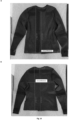
- the term “jacket-like module” refers to any garment that is structurally conformed to cover at least one region of the subject's body above the waist and below the neck. Therefore, the “jacket-like module” can comprise garments such as a jacket, a sleeveless jacket, e.g. a gilet, a shoulder sleeve, a sleeve or a combination thereof. In case of the use of the jacket-like module alone, this module can be produced with a sort of pant, short or inguinal support, which would act as a distal anchorage point.
- Additional anchorage points lie at the neck and at the hands level (for example, thumb hole, finger glove, and/or any method that binds the distal point of the jacket sleeve to the hand/wrist, so as to prevent the rise of the fabric).
- This arrangement is intended to maintain the modules in the correct position and to ensure that these modules can exert and modulate the required forces, to be able to carry out any movement without loss of tension.
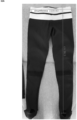
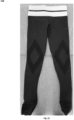
- the term "trouser-like module” refers to any garment that is structurally conformed to cover at least one region of the subject's body below the waist and above the ankle. Therefore, the "trouser-like module" can comprise garments such as tights, leggings and shorts.
- the trouser-like module if used alone, can also be produced with shoulder straps and a hole that allows distal anchoring of the heel. These are intended as proximal and distal anchorage points to ensure that these modules exert the required forces.
- the pant, the shorts, the inguinal support for the jacket-like module, and the shoulder straps for the trouser-like module can be produced as extension of the individual modules or they could be joined to the modules through the fasteners of the first type (1), being removable.
- the inguinal support and the shoulder straps are not necessary when using and wearing the complete modular garment system since jacket-like and trouser-like module are joined by the fastening elements of first type (1).
- the modular garment system according to the present invention optionally comprises a hood-like module.
- hood-like module is required when the muscles of head and neck of a subject necessitate to be solicited.
- the terms "jacket-like”, “trouser-like” and “hood-like” refer to wearable garment products, tightly worn to a subject's body, preferably adjacently to the skin.
- the term "subject” refers to a human subject. Said subjects can be healthy subjects or subjects affected by postural and/or muscle disorders.
- the garment system can also be produced in a single module (e.g., a jumpsuit, with a Velcro placed longitudinally from the pubis area to the neck to allow easy dressing). In this configuration, the forces can be modulated by special fastening elements that can be anchored to different fastening elements of the first type (1) and second type (2).
- the modular garment system according to the present invention comprises a preferred combination of modules that are essential for achieving the desired results in terms of improved physical performance and/or efficient recovery in a subject wearing such modular garment system.
- Each module can be actively connected with an adjacent module by means of fastening elements.
- Each module is characterized by the presence of at least two fastening elements.
- said at least two fastening elements comprise
- the fastening elements of second type (2) are positioned in region of the subject's body wherein they mimic proximal and distal attachments of the muscles and/or muscular chains and/or fascial chains.
- the position and configuration of the fastening elements of second type (2) also depends on the subject's specific requirement.
- the modular garment system according to the first aspect of the present invention is capable of generating a system of compression forces on the subject's body covered by at least one module. These compression forces are generated by opportunely adhering said fastening elements of first type (1) to each other.
- the jacket-like module may comprise two fastening elements of first type (1) arranged to adhere to each other and therefore, determining the closure of the jacket-like module on the body of a subject.
- said two fastening elements of first type (1) are arranged in a frontal position of said jacket-like module.
- the jacket-like module can further comprise one or more additional fastening elements of first type (1) arranged in a lower portion of said jacket-like module and intended to adhere to the upper portion of the trouser-like module, when it is required its presence in the modular garment system, wherein said upper portion of the trouser-like module may comprise one or more fastening elements of first type (1).
- a first type of compression and/or resistance and/or tension force on the subject's body is generated by wearing at least one of the module of the modular garment system according to the present invention.
- a further compression and/or resistance and/or tension force can be generated by combining fastening elements of first (1) type.
- An additional compression and/or resistance and/or tension force can be generated by combining fastening elements of first (1) and second (2) type comprised in each module of the modular garment system disclosed herein with an elastic band (3).
- the modular garment system may further comprise an elastic band (3).
- Said elastic band (3) may comprise one or more fastening elements of second type (2) that are intended to adhere to the fastening elements of first (1) and/or second type (2) comprised in the jacket-like module and/or trouser-like module, if required, for generating a system of tension forces on the body of the subject covered by said elastic band (3).
- said elastic band (3) comprises at least one region arranged to contact said at least one fastening element of first (1) and/or second type (2).
- said elastic band (3) is made by any elastic fabric comprising, but not limited to, elastic Velcro, Elastam or a combination thereof.
- said elastic band (3) is made by a composition of elastic fabric comprising Velcro and Elastam, wherein the percentage of Velcro ranges from 5 to 50%, preferably from 15 to 45%, more preferably from 20 to 40%. Ideally, the percentage of Velcro corresponds to 30% of the composition.
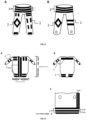
- the elastic band depicted in Figure 4 represents a non-limiting particular example.
- suitable elastic band can be exemplified as a single elastic band element that connects one or more fastening element of first (1) and/or principally of second type (2) positioned in the same module and/or in a second module, e.g. the jacket-like module and/or trouser-like module.
- the fastening elements of first (1) and second (2) types can be stripes, buttons, clips or other elements which allow the module to preserve its elastic properties to the maximum.
- the fastening elements of first type (1) provide a solid anchorage point as they are intended to connect the jacket-like module with the trousers-like module and therefore also define the desired compression/tension/resistance force to be exerted on the subject when said subject is in anatomical position.
- the fastening elements of second (2) type are intended to increase the compression/tension/resistance force both at the global level and/or in specific body's segments, thus allowing to oppose a resistance or offer a facilitation to the movement.
- the area covered by the fastening element of first type (1) and/or second type (2) on each module of the modular garment system of the present invention ranges from 5 to 60%, preferably from 10 to 50%, more preferably from 30 to 40%.
- the inventor has found that in order to achieve the proper compression/tension/resistance forces on the subject's body wearing the modular garment system, the area covered by the fastening element of first type (1) and/or second type (2) on each module should not exceed 50% to avoid or minimize generating area in each module wherein the elasticity is reduced.
- compression refers to a force or system of forces that the fabric of the modular garment system applies to different body's area of a subject wearing said system.
- said “compression” is applied to the body's area of a subject predominantly in transverse direction and to a lesser extent in longitudinal direction. This distribution of forces provides beneficial effects to the lymphatic and venous systems of a subject wearing the modular garment system according to the invention.
- the term “longitudinal” refers to the imaginary anatomical plane which divides the body into right and left parts (vertical axis).
- the term “transversal” refers to the imaginary anatomical plane that divides the body into superior and inferior parts (horizontal axis). Therefore, when the terms “longitudinal” and “transversal” are used to define a direction, said direction is oriented according to the corresponding axis.
- tension refers to a force or system of forces that the fabric of the modular garment system applies to different body's area of a subject wearing said system. Said force or system of forces is also intended to provide a support to the movement.
- said "tension” or “resistance” is applied to the body's area predominantly in longitudinal direction and to a lesser extent in transverse direction. This distribution of forces creates a tension or resistance to the subject's movement, which in a long-term period determines an improvement of the muscle strength, tone and trophism of the resistance in a subject wearing the system according to the invention.
- An increment of the tension provides with a resistance to the movement of a subject wearing the module garment system, it also offers support to movement according to the subject's needs.
- fastening elements of first type (1) from a first module e.g. the jacket-like module
- fastening elements of first type (1) from the same module e.g. the trouser-like module
- fastening elements of second type (2) from the same module and/or from a second module e.g. the trouser-like module.
- fastening elements of first type (1) from the same and/or different modules can be directly connected each other
- fastening elements of second type (2) from the same and/or different modules are indirectly connected by means of the elastic band (3).
- a longitudinal elongation in the range 0-10 cm induces a longitudinal force per unit of transverse length in the range 0-15 N/cm to be multiplied by the total transverse length considered.
- a longitudinal elongation in the range 10-20 cm induces a longitudinal force per unit of transverse length in the range 15-30 N/cm to be multiplied by the total transverse length considered.
- a longitudinal elongation in the range 20-30 cm induces a longitudinal force per unit of transverse length in the range 30- 45 N/cm to be multiplied by the total transverse length considered.
- a longitudinal elongation in the range 30-40 cm induces a longitudinal force per unit of transverse length in the range 45-65 N/cm to be multiplied by the total transverse length considered.
- a longitudinal elongation in the range 40-50 cm induces a longitudinal force per unit of transverse length in the range 65-100 N/cm to be multiplied by the total transverse length considered (see Figures 5 and 6 ).
- the fastening elements comprised in a modular garment system of the present invention are made by elastic fabric.
- the elastic fabric is selected from the group comprising elastic Velcro, Elastam or a combination thereof.
- the elastic fabric is capable of returning to its original shape and length after being stretched.
- the composition of different fabrics characterizing a single module may also influence the tensile properties of said module and thus, contribute on the resultant compression/tension exerted by said module on the subject's body.
- the amount of each fabric within the composition may affect the resulting compression of a single garment module on the subject's body covered by said module.
- the degree of compression is classified by several standards. In general, low compression refers to pressure of less than 20 mm Hg or class 1; medium compression to pressure of 20-30 mm Hg or class 2; high compression to pressure of greater than 30 mm Hg, or class 3 or higher.
- each garment module should also satisfy specific prerequisite in order to support the stress due to the movement of the subject's body and the compression generated by each module. Therefore, in the context of the present invention said fabric is characterized by several properties comprising elasticity, breathability, lightness, stretchability and for being non-allergenic and nonsensitizing.
- each module of the modular garment system disclosed herein is made by fabrics being elastic, breathable, lightweight, adherent, hypoallergenic and adaptable to a subject's body.
- each module of the modular garment system of the present invention is removably mounted to said garment system.
- the fastening elements are intended to act on the muscle tone, muscular force, resistance, muscle mass, fascial system and, more in general, on the skeletal muscular system.
- the present modular garments system is suitable for being used in subjects affected by postural disorders, such as kyphosis, scoliosis, lordosis and similar disorders.
- the present modular garment system is also suitable for being used in subjects affected by muscle disorder such as muscle weakness.
- the inventor has found that by using the modular garment system according to the present invention the altered center of pressure (COP) of a subject having postural disorder can be corrected and aligned with his barycenter.
- COP center of pressure
- the term “subject” refers to a subject wearing at least one module of the garment system.
- the term “parameters” refers to measurable parameters characterizing a physical activity of a subject. Examples of parameters, without limitation, may comprise wall squat jump, standing long jump, long jump with feet together. As used herein, the term “physical performance” refers to a measurable result of any physical activity performed by a subject.
- kits for rehabilitation and/or training of a subject comprising:
- Each module of the modular garment system when worn by a subject in standard anatomical position, applies a compression/tension force of 0 N (Newton). Any movement of the subject from this standard anatomical position triggers a system of compression/tension forces, which provide resistance or assistance to the movement. These forces tend to increment as the length of the fabric increases. The precise control of these forces is ensured by the presence of fastening elements of first (1) and second types (2).
- Figure 5(A) shows physical properties of a fabric sample (20cm*10cm of only fabric, only Elastam without Velcro) measured by an electric dynamometer (Hounsfield HTE).
- the graph depicted in Figure 5(A) initially exhibits a non-linear trend, which then evolve into a quadratic trend. Therefore, when an extension is applied in longitudinal sense to the fabric sample, this corresponds to an increment of compression/tension forces.
- a jacket without fastening elements of first (1) second type (2) having a circumference of 95cm, elongated of 40cm and anchored to the fastening elements of first type (1), produces on the subject a longitudinal force of at least 2485,295 N, when the subject wearing the jacket is in standard anatomical position. 26,161 N/cm ⁇ 95cm 2485,295 N
- Figure 5(B) shows the response of the fabric in terms of force N/cm exerted in a transverse direction following a transversal elongation. It is seen how much transverse force exerts the fabric (without Velcro) following a transversal elongation.
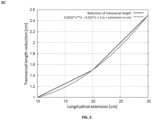
- Figure 5(C) shows the fabric response in terms of force N/cm exerted in the transverse direction following a longitudinal elongation. The transverse force exerted by the fabric (without Velcro) is seen following a longitudinal extension.
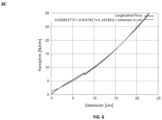
- Figure 6(C) shows that the forces analyzed are those of a trouser segment comprising a Velcro placed proximally and transversely.
- Velcro 30% Elastam 70% it is analyzed the longitudinal force exerted by the fabric (with 30% Velcro transversely positioned) following a longitudinal extension.
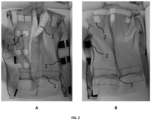
- Figure 7 (A-B) shows the fabric response to stress.
- the tested fabric sample size, 20 * 10cm
- Figure 7A shows the fabric response to stress.
- Figure 7B shows the fabric response to stress.
- the tested fabric sample size, 20 * 10cm
- the length of the fabric sample measures 20.7cm, having a 3.5% deformity and a recovery of 96.5%.
- the fabric sample measures 20.3cm and after 48h said fabric sample measures 20.1cm ( Figure 7A ).
- the length of the fabric sample measures 21.5cm, having a deformity of 7.5% and a recovery of 92.5%. After 24h, the fabric sample measures 20.7cm and after 48h measures 20.5cm ( Figure 7B ).
- the modular garment system according to the present invention has been tested on a group of subjects, regular sportsmen, having no medical conditions that would affect the experimental results. As matter of example, the following tests have been performed on a 31-years old subject.
- the following tests have been performed in the time frame of one month, organized in 12 workout sessions of 60 minutes each.
- the subject performed a warm up session comprising the following exercises: walking preparatory for the run (skipping, butt-kicks, heel-toe walking), running (repeatedly on 10, 20 and 30 meters), barbell and dumbbell workouts.
- the workout sessions have been set up without focusing on a specific body area to further appreciate the results obtained by the subject wearing the modular garment system according to the present invention.
- the loading phase does not exceed 30 minutes.
- the subject performed stretching based on Meziere's postures, one minute for each posture, for 5-6 minutes; the recovery phase lasts 10-20 seconds among the same exercises and 1-2 minutes among the different series.
- Table 1 shows the results in terms of improved performance of a subject wearing the jacket-like module and the trouser-like module of the modular garment system according to the present invention.
- Table 1 shows the results in terms of improved performance of a subject wearing the jacket-like module and the trouser-like module of the modular garment system according to the present invention.
- Table 1 shows the results in terms of improved performance of a subject wearing the jacket-like module and the trouser-like module of the modular garment system according to the present invention.
- Performance of a subject without wearing the garment system of the present invention before
- the same subject wearing the garment system of the present invention after measured in terms of explosive power and reactive strength tests.
- FIG. 10 Static and isobaric static analyses of a standing subject (in static position) without wearing the modular garment system according to the present invention are shown in Figure 10 .
- Center of pressure (COP) indicated by the letter C, corresponding to the projection onto the supporting base of the body center of gravity, shows a moderate unilateral overload indicating an unbalanced pressure load on the heel.
- the center of foot pressure (COF) in each lower limb indicated by the letters S (left) and D (right) shows a misaligned position over the COP.
- Such non-physiological condition involves rotating attitudes: left limb COF is placed before the COP and right limb COF placed after the COP.
- Max High-Pressure Point, indicated by the letter M) has been detected on the right forefoot area, which may indicate the local overload on a single lower limb in presence of other high-pressure points).
- the load percentage on the single lower limb shows a moderate overload on the left lower limb.
- the load distribution between the forefoot and the backfoot of the left and right lower limbs is within the physiological values.
- the surfaces of the two feet were revealed to be non-uniform with an unbalanced load distribution on the left foot. An evident surface difference can be appreciated between the two forefeet, which is greater for the left foot. An evident surface difference can also be appreciated between the two back feet, which is greater for the left foot.
- Maximum loading points (grey) are not detected on the right foot. Overload area are detected on both forefoot. Average loading points (light grey) are not detected on right back feet.
- Max High-Pressure Point, indicated by the letter M) has been detected on the right forefoot area, which may indicate the local overload on a single lower limb in presence of other high-pressure points).
- the load percentage on each lower limb shows an excessive overload on the right lower limb.
- the load distribution between the forefoot and the backfoot of the left and right lower limb is within the physiological values.
- the surface of the two feet were measured with similar distribution. A slight surface difference can be appreciated between the two forefeet, which is greater for the right foot. A slight surface difference can also be appreciated between the two back feet, which is greater for the left foot.
- Maximum loading points grey
- Overload area are detected on the right forefoot.
- Average loading points are detected on both back feet, but more evident on the left foot.
- the load percentage on each lower limb shows a moderate overload on the right lower limb.
- the load distribution between the forefoot and the backfoot of the left and right lower limb is within the physiological values.
- a non-uniform surface pressure of the two feet have been found, being greater for the right foot. Between the two front feet can be also appreciated an excessive surface difference, being greater for the right front foot.
- Maximum loading points grey
- Average loading points (light grey) are not detected on the back of right foot.
- the load percentage on each lower limb shows a moderate overload on the left lower limb.
- the load distribution between the forefoot and the backfoot of the left and right lower limb is within the physiological values.
- a non-uniform surface pressure of the two feet have been found, being greater for the left feet.
- Between the two forefeet can be appreciate a noticeable surface difference, being greater for the left lower limb.
- Between the two back feet can be also appreciated an excessive surface difference, being greater for the left lower limb.
- Maximum loading points (grey) are detectable on both feet, but they are predominant for the left one.
- Average loading points (light grey) are detected on the back of both feet, but mostly on the left foot.
- the use of the modular garment system according to the present invention provides beneficial effect in a subject affected by postural disorders as evidenced in Figures 11 and 13 .
- the system of compression and resistance/tension forces exerted on the body of a subject wearing the present modular garment system attempts to keep different body segments closer to the body's longitudinal axis either when the subject is in anatomical position or when the subject performs movements altering said anatomical position.
- the present modular garment system provides a stabilizing effect along different body sectors in said subject.
- a subject affected by postural disorders shows a misalignment of the COP with his barycenter ( Figure 10).
- Figures 11 shows that the COP of a subject wearing the modular garment system disclosed herein is almost aligned with his barycenter.
- the stabilizing effect can be also appreciated in terms of better load distribution on lower limbs in a subject wearing the present modular garment system (see Figures 12 and 13 ).
Landscapes
- Health & Medical Sciences (AREA)
- Life Sciences & Earth Sciences (AREA)
- General Health & Medical Sciences (AREA)
- Physical Education & Sports Medicine (AREA)
- Orthopedic Medicine & Surgery (AREA)
- Biophysics (AREA)
- Public Health (AREA)
- Animal Behavior & Ethology (AREA)
- Veterinary Medicine (AREA)
- Rheumatology (AREA)
- Epidemiology (AREA)
- Pain & Pain Management (AREA)
- Rehabilitation Therapy (AREA)
- Pulmonology (AREA)
- Engineering & Computer Science (AREA)
- Biomedical Technology (AREA)
- Heart & Thoracic Surgery (AREA)
- Vascular Medicine (AREA)
- Professional, Industrial, Or Sporting Protective Garments (AREA)
Claims (6)
- Ein modulares Bekleidungssystem, wobei das System umfasst:a. ein jackenartiges Modul, undb. ein hosenartiges Modul,wobei jedes der Module mindestens zwei Befestigungselemente umfasst, die so konfiguriert sind, dass sie der Bewegung des Körpers einer Person, der von den mindestens zwei Befestigungselementen berührt wird, einen Widerstand entgegensetzen und auf den Körper der Person, der von den mindestens zwei Befestigungselementen berührt wird, eine Kompression ausüben,wobei die mindestens zwei Befestigungselemente aus einem elastischen Stoff bestehen, der aus der Gruppe ausgewählt ist, die elastischen Klettverschluss, Elastam oder eine Kombination davon umfasst,wobei die mindestens zwei Befestigungselemente Folgendes umfassena. mindestens ein Befestigungselement des ersten Typs (1), undb. mindestens ein Befestigungselement des zweiten Typs (2),wobei das mindestens eine Befestigungselement des ersten Typs (1) in einem überlappenden Bereich zwischen zwei benachbarten Modulen und in einem überlappenden Bereich innerhalb desselben Moduls angeordnet ist, undwobei das mindestens eine Befestigungselement des zweiten Typs (2) in einem Bereich des Moduls angeordnet ist, der einen Skelettmuskel des Körpers der Person berührt.
- Das modulare Bekleidungssystem nach Anspruch 1, wobei das System ferner ein elastisches Band (3) umfasst.
- Ein modulares Bekleidungssystem nach den Ansprüchen 1 und 2, wobei das elastische Band (3) mindestens einen Bereich umfasst, der so angeordnet ist, dass er das mindestens eine Befestigungselement des zweiten Typs (2) berührt.
- Das modulare Bekleidungssystem nach einem der Ansprüche 1 bis 3, wobei jedes der Module aus einem Stoff besteht, der elastisch, atmungsaktiv, leicht, haftend, hypoallergen und an den Körper einer Person anpassbar ist, wobei der Stoff, elastischen Klettverschluss, Elastam oder eine Kombination davon umfasst.
- Das modulare Bekleidungssystem nach einem der Ansprüche 1 bis 4, wobei jedes der Module abnehmbar an dem modularen Bekleidungssystem angebracht ist.
- Ein Bausatz für die Rehabilitation und/oder das Training einer Person, wobei der Bausatz Folgendes umfasst:a. ein modulares Bekleidungssystem nach einem der Ansprüche 1 bis 5b. ein elastisches Band (3), undc. optional, ein kapuzenartiges Modul,wobei das elastische Band (3) an dem modularen Bekleidungssystem mittels Befestigungselementen des zweiten Typs (2) befestigt ist, die an dem Band (3) angeordnet sind und entsprechende Befestigungselemente des ersten (1) und zweiten (2) Typs berühren, die an dem jackenartigen Modul und dem hosenartigen Modul angeordnet sind.
Applications Claiming Priority (2)
| Application Number | Priority Date | Filing Date | Title |
|---|---|---|---|
| EP17203619 | 2017-11-24 | ||
| PCT/EP2018/082453 WO2019101972A1 (en) | 2017-11-24 | 2018-11-23 | Modular garment system and use thereof |
Publications (2)
| Publication Number | Publication Date |
|---|---|
| EP3713435A1 EP3713435A1 (de) | 2020-09-30 |
| EP3713435B1 true EP3713435B1 (de) | 2024-01-24 |
Family
ID=60452548
Family Applications (1)
| Application Number | Title | Priority Date | Filing Date |
|---|---|---|---|
| EP18833393.4A Active EP3713435B1 (de) | 2017-11-24 | 2018-11-23 | Modulares bekleidungssystem und verwendung davon |
Country Status (3)
| Country | Link |
|---|---|
| US (1) | US20200330816A1 (de) |
| EP (1) | EP3713435B1 (de) |
| WO (1) | WO2019101972A1 (de) |
Family Cites Families (5)
| Publication number | Priority date | Publication date | Assignee | Title |
|---|---|---|---|---|
| US4215687A (en) * | 1978-05-02 | 1980-08-05 | Shaw Frank D | Body or limb encircling therapeutic device |
| US4961418A (en) * | 1987-03-26 | 1990-10-09 | Mclaurin Smith Mark | Heat retaining fabric and physical therapy appliances |
| CA2297593A1 (en) * | 1999-01-29 | 2000-07-29 | Active Ortho Research And Development Inc. | Pelvic brace |
| US7942838B2 (en) * | 2004-03-22 | 2011-05-17 | Farrow Medical Innovations, Inc. | Compression garment |
| US8597222B2 (en) * | 2009-06-12 | 2013-12-03 | Under Armour, Inc. | Garment with adjustable compression |
-
2018
- 2018-11-23 US US16/766,068 patent/US20200330816A1/en not_active Abandoned
- 2018-11-23 EP EP18833393.4A patent/EP3713435B1/de active Active
- 2018-11-23 WO PCT/EP2018/082453 patent/WO2019101972A1/en not_active Ceased
Also Published As
| Publication number | Publication date |
|---|---|
| EP3713435A1 (de) | 2020-09-30 |
| WO2019101972A1 (en) | 2019-05-31 |
| US20200330816A1 (en) | 2020-10-22 |
Similar Documents
| Publication | Publication Date | Title |
|---|---|---|
| Kraemer et al. | Influence of compression garments on vertical jump performance in NCAA Division I volleyball players | |
| Kraemer et al. | Influence of a compression garment on repetitive power output production before and after different types of muscle fatigue | |
| US6186970B1 (en) | Protective clothing for regions of lower limb | |
| Power et al. | An acute bout of static stretching: effects on force and jumping performance | |
| Hadzic et al. | The isokinetic strength profile of quadriceps and hamstrings in elite volleyball players | |
| US10143245B2 (en) | Antigravity whole body exercise garments | |
| EP2250913B1 (de) | Sportschutzkleidung | |
| Han et al. | Effects of kinesiology taping on repositioning error of the knee joint after quadriceps muscle fatigue | |
| Vogrin et al. | Acute effects of tissue flossing around the upper thigh on neuromuscular performance: A study using different degrees of wrapping pressure | |
| Chen et al. | Acute effects of static active or dynamic active stretching on eccentric-exercise-induced hamstring muscle damage | |
| Zakas et al. | Effect of two acute static stretching durations of the rectus femoris muscle on quadriceps isokinetic peak torque in professional soccer players | |
| JP2004238789A (ja) | 運動支援タイツ | |
| Hong et al. | Effect of kinesio taping on the isokinetic muscle function in football athletes with a knee injury | |
| Anbarasi et al. | Analysis of lower extremity muscle flexibility among Indian classical Bharathnatyam dancers | |
| EP3713435B1 (de) | Modulares bekleidungssystem und verwendung davon | |
| Choi | Activation of the vastus medialis oblique and vastus lateralis muscles in asymptomatic subjects during the sit-to-stand procedure | |
| Vinken | Short-term effects of elastic taping on gymnast’s jumping performance | |
| Mostafaloo | The effect of one session massage in the lower limb muscle on flexibility, power and agility tests performance in soccer players | |
| TWM479031U (zh) | 機能運動服 | |
| Jeong et al. | Effects of a Complex Exercise Program on the Distance between Knees and Balance in Individuals in their 20s with Genu Varum | |
| Kılıç et al. | The effects of Kinesio tape application on functional performance measurements in young female basketball players with chronic ankle instability | |
| AU2010100900A4 (en) | Antigravity Whole Body Exercisers | |
| Choi et al. | Relationship between Kinesiotaping and compression wear for postural balance in healthy men: a cross-sectional study | |
| Dhumale et al. | Effect of Closed Kinetic Chain Exercise With Customized Knee Brace on Pain and Functional Performance in Patients With Bilateral Medial Compartment Knee Osteoarthritis | |
| JP7689359B2 (ja) | 関節サポーター |
Legal Events
| Date | Code | Title | Description |
|---|---|---|---|
| STAA | Information on the status of an ep patent application or granted ep patent |
Free format text: STATUS: UNKNOWN |
|
| STAA | Information on the status of an ep patent application or granted ep patent |
Free format text: STATUS: THE INTERNATIONAL PUBLICATION HAS BEEN MADE |
|
| PUAI | Public reference made under article 153(3) epc to a published international application that has entered the european phase |
Free format text: ORIGINAL CODE: 0009012 |
|
| STAA | Information on the status of an ep patent application or granted ep patent |
Free format text: STATUS: REQUEST FOR EXAMINATION WAS MADE |
|
| 17P | Request for examination filed |
Effective date: 20200623 |
|
| AK | Designated contracting states |
Kind code of ref document: A1 Designated state(s): AL AT BE BG CH CY CZ DE DK EE ES FI FR GB GR HR HU IE IS IT LI LT LU LV MC MK MT NL NO PL PT RO RS SE SI SK SM TR |
|
| AX | Request for extension of the european patent |
Extension state: BA ME |
|
| DAV | Request for validation of the european patent (deleted) | ||
| DAX | Request for extension of the european patent (deleted) | ||
| STAA | Information on the status of an ep patent application or granted ep patent |
Free format text: STATUS: EXAMINATION IS IN PROGRESS |
|
| 17Q | First examination report despatched |
Effective date: 20210706 |
|
| GRAP | Despatch of communication of intention to grant a patent |
Free format text: ORIGINAL CODE: EPIDOSNIGR1 |
|
| STAA | Information on the status of an ep patent application or granted ep patent |
Free format text: STATUS: GRANT OF PATENT IS INTENDED |
|
| INTG | Intention to grant announced |
Effective date: 20230905 |
|
| GRAS | Grant fee paid |
Free format text: ORIGINAL CODE: EPIDOSNIGR3 |
|
| GRAA | (expected) grant |
Free format text: ORIGINAL CODE: 0009210 |
|
| STAA | Information on the status of an ep patent application or granted ep patent |
Free format text: STATUS: THE PATENT HAS BEEN GRANTED |
|
| AK | Designated contracting states |
Kind code of ref document: B1 Designated state(s): AL AT BE BG CH CY CZ DE DK EE ES FI FR GB GR HR HU IE IS IT LI LT LU LV MC MK MT NL NO PL PT RO RS SE SI SK SM TR |
|
| REG | Reference to a national code |
Ref country code: GB Ref legal event code: FG4D |
|
| REG | Reference to a national code |
Ref country code: CH Ref legal event code: EP |
|
| REG | Reference to a national code |
Ref country code: IE Ref legal event code: FG4D |
|
| REG | Reference to a national code |
Ref country code: DE Ref legal event code: R096 Ref document number: 602018064588 Country of ref document: DE |
|
| REG | Reference to a national code |
Ref country code: LT Ref legal event code: MG9D |
|
| REG | Reference to a national code |
Ref country code: NL Ref legal event code: MP Effective date: 20240124 |
|
| PG25 | Lapsed in a contracting state [announced via postgrant information from national office to epo] |
Ref country code: NL Free format text: LAPSE BECAUSE OF FAILURE TO SUBMIT A TRANSLATION OF THE DESCRIPTION OR TO PAY THE FEE WITHIN THE PRESCRIBED TIME-LIMIT Effective date: 20240124 |
|
| PG25 | Lapsed in a contracting state [announced via postgrant information from national office to epo] |
Ref country code: NL Free format text: LAPSE BECAUSE OF FAILURE TO SUBMIT A TRANSLATION OF THE DESCRIPTION OR TO PAY THE FEE WITHIN THE PRESCRIBED TIME-LIMIT Effective date: 20240124 |
|
| PG25 | Lapsed in a contracting state [announced via postgrant information from national office to epo] |
Ref country code: IS Free format text: LAPSE BECAUSE OF FAILURE TO SUBMIT A TRANSLATION OF THE DESCRIPTION OR TO PAY THE FEE WITHIN THE PRESCRIBED TIME-LIMIT Effective date: 20240524 |
|
| PG25 | Lapsed in a contracting state [announced via postgrant information from national office to epo] |
Ref country code: LT Free format text: LAPSE BECAUSE OF FAILURE TO SUBMIT A TRANSLATION OF THE DESCRIPTION OR TO PAY THE FEE WITHIN THE PRESCRIBED TIME-LIMIT Effective date: 20240124 |
|
| REG | Reference to a national code |
Ref country code: AT Ref legal event code: MK05 Ref document number: 1651442 Country of ref document: AT Kind code of ref document: T Effective date: 20240124 |
|
| PG25 | Lapsed in a contracting state [announced via postgrant information from national office to epo] |
Ref country code: RS Free format text: LAPSE BECAUSE OF FAILURE TO SUBMIT A TRANSLATION OF THE DESCRIPTION OR TO PAY THE FEE WITHIN THE PRESCRIBED TIME-LIMIT Effective date: 20240424 Ref country code: HR Free format text: LAPSE BECAUSE OF FAILURE TO SUBMIT A TRANSLATION OF THE DESCRIPTION OR TO PAY THE FEE WITHIN THE PRESCRIBED TIME-LIMIT Effective date: 20240124 |
|
| PG25 | Lapsed in a contracting state [announced via postgrant information from national office to epo] |
Ref country code: ES Free format text: LAPSE BECAUSE OF FAILURE TO SUBMIT A TRANSLATION OF THE DESCRIPTION OR TO PAY THE FEE WITHIN THE PRESCRIBED TIME-LIMIT Effective date: 20240124 |
|
| PG25 | Lapsed in a contracting state [announced via postgrant information from national office to epo] |
Ref country code: AT Free format text: LAPSE BECAUSE OF FAILURE TO SUBMIT A TRANSLATION OF THE DESCRIPTION OR TO PAY THE FEE WITHIN THE PRESCRIBED TIME-LIMIT Effective date: 20240124 |
|
| PG25 | Lapsed in a contracting state [announced via postgrant information from national office to epo] |
Ref country code: RS Free format text: LAPSE BECAUSE OF FAILURE TO SUBMIT A TRANSLATION OF THE DESCRIPTION OR TO PAY THE FEE WITHIN THE PRESCRIBED TIME-LIMIT Effective date: 20240424 Ref country code: NO Free format text: LAPSE BECAUSE OF FAILURE TO SUBMIT A TRANSLATION OF THE DESCRIPTION OR TO PAY THE FEE WITHIN THE PRESCRIBED TIME-LIMIT Effective date: 20240424 Ref country code: LT Free format text: LAPSE BECAUSE OF FAILURE TO SUBMIT A TRANSLATION OF THE DESCRIPTION OR TO PAY THE FEE WITHIN THE PRESCRIBED TIME-LIMIT Effective date: 20240124 Ref country code: IS Free format text: LAPSE BECAUSE OF FAILURE TO SUBMIT A TRANSLATION OF THE DESCRIPTION OR TO PAY THE FEE WITHIN THE PRESCRIBED TIME-LIMIT Effective date: 20240524 Ref country code: HR Free format text: LAPSE BECAUSE OF FAILURE TO SUBMIT A TRANSLATION OF THE DESCRIPTION OR TO PAY THE FEE WITHIN THE PRESCRIBED TIME-LIMIT Effective date: 20240124 Ref country code: FI Free format text: LAPSE BECAUSE OF FAILURE TO SUBMIT A TRANSLATION OF THE DESCRIPTION OR TO PAY THE FEE WITHIN THE PRESCRIBED TIME-LIMIT Effective date: 20240124 Ref country code: ES Free format text: LAPSE BECAUSE OF FAILURE TO SUBMIT A TRANSLATION OF THE DESCRIPTION OR TO PAY THE FEE WITHIN THE PRESCRIBED TIME-LIMIT Effective date: 20240124 Ref country code: BG Free format text: LAPSE BECAUSE OF FAILURE TO SUBMIT A TRANSLATION OF THE DESCRIPTION OR TO PAY THE FEE WITHIN THE PRESCRIBED TIME-LIMIT Effective date: 20240124 Ref country code: AT Free format text: LAPSE BECAUSE OF FAILURE TO SUBMIT A TRANSLATION OF THE DESCRIPTION OR TO PAY THE FEE WITHIN THE PRESCRIBED TIME-LIMIT Effective date: 20240124 |
|
| PG25 | Lapsed in a contracting state [announced via postgrant information from national office to epo] |
Ref country code: PL Free format text: LAPSE BECAUSE OF FAILURE TO SUBMIT A TRANSLATION OF THE DESCRIPTION OR TO PAY THE FEE WITHIN THE PRESCRIBED TIME-LIMIT Effective date: 20240124 Ref country code: PT Free format text: LAPSE BECAUSE OF FAILURE TO SUBMIT A TRANSLATION OF THE DESCRIPTION OR TO PAY THE FEE WITHIN THE PRESCRIBED TIME-LIMIT Effective date: 20240524 |
|
| PG25 | Lapsed in a contracting state [announced via postgrant information from national office to epo] |
Ref country code: SE Free format text: LAPSE BECAUSE OF FAILURE TO SUBMIT A TRANSLATION OF THE DESCRIPTION OR TO PAY THE FEE WITHIN THE PRESCRIBED TIME-LIMIT Effective date: 20240124 Ref country code: PT Free format text: LAPSE BECAUSE OF FAILURE TO SUBMIT A TRANSLATION OF THE DESCRIPTION OR TO PAY THE FEE WITHIN THE PRESCRIBED TIME-LIMIT Effective date: 20240524 Ref country code: PL Free format text: LAPSE BECAUSE OF FAILURE TO SUBMIT A TRANSLATION OF THE DESCRIPTION OR TO PAY THE FEE WITHIN THE PRESCRIBED TIME-LIMIT Effective date: 20240124 Ref country code: LV Free format text: LAPSE BECAUSE OF FAILURE TO SUBMIT A TRANSLATION OF THE DESCRIPTION OR TO PAY THE FEE WITHIN THE PRESCRIBED TIME-LIMIT Effective date: 20240124 |
|
| PG25 | Lapsed in a contracting state [announced via postgrant information from national office to epo] |
Ref country code: DK Free format text: LAPSE BECAUSE OF FAILURE TO SUBMIT A TRANSLATION OF THE DESCRIPTION OR TO PAY THE FEE WITHIN THE PRESCRIBED TIME-LIMIT Effective date: 20240124 |
|
| PG25 | Lapsed in a contracting state [announced via postgrant information from national office to epo] |
Ref country code: SM Free format text: LAPSE BECAUSE OF FAILURE TO SUBMIT A TRANSLATION OF THE DESCRIPTION OR TO PAY THE FEE WITHIN THE PRESCRIBED TIME-LIMIT Effective date: 20240124 |
|
| PG25 | Lapsed in a contracting state [announced via postgrant information from national office to epo] |
Ref country code: CZ Free format text: LAPSE BECAUSE OF FAILURE TO SUBMIT A TRANSLATION OF THE DESCRIPTION OR TO PAY THE FEE WITHIN THE PRESCRIBED TIME-LIMIT Effective date: 20240124 Ref country code: EE Free format text: LAPSE BECAUSE OF FAILURE TO SUBMIT A TRANSLATION OF THE DESCRIPTION OR TO PAY THE FEE WITHIN THE PRESCRIBED TIME-LIMIT Effective date: 20240124 |
|
| REG | Reference to a national code |
Ref country code: DE Ref legal event code: R097 Ref document number: 602018064588 Country of ref document: DE |
|
| PG25 | Lapsed in a contracting state [announced via postgrant information from national office to epo] |
Ref country code: SK Free format text: LAPSE BECAUSE OF FAILURE TO SUBMIT A TRANSLATION OF THE DESCRIPTION OR TO PAY THE FEE WITHIN THE PRESCRIBED TIME-LIMIT Effective date: 20240124 |
|
| PG25 | Lapsed in a contracting state [announced via postgrant information from national office to epo] |
Ref country code: SM Free format text: LAPSE BECAUSE OF FAILURE TO SUBMIT A TRANSLATION OF THE DESCRIPTION OR TO PAY THE FEE WITHIN THE PRESCRIBED TIME-LIMIT Effective date: 20240124 Ref country code: SK Free format text: LAPSE BECAUSE OF FAILURE TO SUBMIT A TRANSLATION OF THE DESCRIPTION OR TO PAY THE FEE WITHIN THE PRESCRIBED TIME-LIMIT Effective date: 20240124 Ref country code: RO Free format text: LAPSE BECAUSE OF FAILURE TO SUBMIT A TRANSLATION OF THE DESCRIPTION OR TO PAY THE FEE WITHIN THE PRESCRIBED TIME-LIMIT Effective date: 20240124 Ref country code: EE Free format text: LAPSE BECAUSE OF FAILURE TO SUBMIT A TRANSLATION OF THE DESCRIPTION OR TO PAY THE FEE WITHIN THE PRESCRIBED TIME-LIMIT Effective date: 20240124 Ref country code: DK Free format text: LAPSE BECAUSE OF FAILURE TO SUBMIT A TRANSLATION OF THE DESCRIPTION OR TO PAY THE FEE WITHIN THE PRESCRIBED TIME-LIMIT Effective date: 20240124 Ref country code: CZ Free format text: LAPSE BECAUSE OF FAILURE TO SUBMIT A TRANSLATION OF THE DESCRIPTION OR TO PAY THE FEE WITHIN THE PRESCRIBED TIME-LIMIT Effective date: 20240124 |
|
| PLBE | No opposition filed within time limit |
Free format text: ORIGINAL CODE: 0009261 |
|
| STAA | Information on the status of an ep patent application or granted ep patent |
Free format text: STATUS: NO OPPOSITION FILED WITHIN TIME LIMIT |
|
| 26N | No opposition filed |
Effective date: 20241025 |
|
| PG25 | Lapsed in a contracting state [announced via postgrant information from national office to epo] |
Ref country code: SI Free format text: LAPSE BECAUSE OF FAILURE TO SUBMIT A TRANSLATION OF THE DESCRIPTION OR TO PAY THE FEE WITHIN THE PRESCRIBED TIME-LIMIT Effective date: 20240124 |
|
| REG | Reference to a national code |
Ref country code: CH Ref legal event code: PL |
|
| PG25 | Lapsed in a contracting state [announced via postgrant information from national office to epo] |
Ref country code: MC Free format text: LAPSE BECAUSE OF FAILURE TO SUBMIT A TRANSLATION OF THE DESCRIPTION OR TO PAY THE FEE WITHIN THE PRESCRIBED TIME-LIMIT Effective date: 20240124 |
|
| PG25 | Lapsed in a contracting state [announced via postgrant information from national office to epo] |
Ref country code: LU Free format text: LAPSE BECAUSE OF NON-PAYMENT OF DUE FEES Effective date: 20241123 |
|
| REG | Reference to a national code |
Ref country code: CH Ref legal event code: PL |
|
| GBPC | Gb: european patent ceased through non-payment of renewal fee |
Effective date: 20241123 |
|
| PG25 | Lapsed in a contracting state [announced via postgrant information from national office to epo] |
Ref country code: CH Free format text: LAPSE BECAUSE OF NON-PAYMENT OF DUE FEES Effective date: 20241130 |
|
| REG | Reference to a national code |
Ref country code: BE Ref legal event code: MM Effective date: 20241130 |
|
| PG25 | Lapsed in a contracting state [announced via postgrant information from national office to epo] |
Ref country code: BE Free format text: LAPSE BECAUSE OF NON-PAYMENT OF DUE FEES Effective date: 20241130 Ref country code: GB Free format text: LAPSE BECAUSE OF NON-PAYMENT OF DUE FEES Effective date: 20241123 |
|
| PG25 | Lapsed in a contracting state [announced via postgrant information from national office to epo] |
Ref country code: IE Free format text: LAPSE BECAUSE OF NON-PAYMENT OF DUE FEES Effective date: 20241123 |
|
| PGFP | Annual fee paid to national office [announced via postgrant information from national office to epo] |
Ref country code: DE Payment date: 20251114 Year of fee payment: 8 |
|
| PGFP | Annual fee paid to national office [announced via postgrant information from national office to epo] |
Ref country code: IT Payment date: 20251125 Year of fee payment: 8 |
|
| PGFP | Annual fee paid to national office [announced via postgrant information from national office to epo] |
Ref country code: FR Payment date: 20251126 Year of fee payment: 8 |
|
| PG25 | Lapsed in a contracting state [announced via postgrant information from national office to epo] |
Ref country code: HU Free format text: LAPSE BECAUSE OF FAILURE TO SUBMIT A TRANSLATION OF THE DESCRIPTION OR TO PAY THE FEE WITHIN THE PRESCRIBED TIME-LIMIT; INVALID AB INITIO Effective date: 20181123 |
|
| PG25 | Lapsed in a contracting state [announced via postgrant information from national office to epo] |
Ref country code: CY Free format text: LAPSE BECAUSE OF FAILURE TO SUBMIT A TRANSLATION OF THE DESCRIPTION OR TO PAY THE FEE WITHIN THE PRESCRIBED TIME-LIMIT; INVALID AB INITIO Effective date: 20181123 |