EP3713667B1 - Verfahren zur behandlung durch akustischen wellen - Google Patents
Verfahren zur behandlung durch akustischen wellen Download PDFInfo
- Publication number
- EP3713667B1 EP3713667B1 EP18800682.9A EP18800682A EP3713667B1 EP 3713667 B1 EP3713667 B1 EP 3713667B1 EP 18800682 A EP18800682 A EP 18800682A EP 3713667 B1 EP3713667 B1 EP 3713667B1
- Authority
- EP
- European Patent Office
- Prior art keywords
- vessel
- liquid
- waves
- duct
- piezoelectric element
- Prior art date
- Legal status (The legal status is an assumption and is not a legal conclusion. Google has not performed a legal analysis and makes no representation as to the accuracy of the status listed.)
- Active
Links
Images



Classifications
-
- B—PERFORMING OPERATIONS; TRANSPORTING
- B01—PHYSICAL OR CHEMICAL PROCESSES OR APPARATUS IN GENERAL
- B01J—CHEMICAL OR PHYSICAL PROCESSES, e.g. CATALYSIS OR COLLOID CHEMISTRY; THEIR RELEVANT APPARATUS
- B01J19/00—Chemical, physical or physico-chemical processes in general; Their relevant apparatus
- B01J19/08—Processes employing the direct application of electric or wave energy, or particle radiation; Apparatus therefor
- B01J19/10—Processes employing the direct application of electric or wave energy, or particle radiation; Apparatus therefor employing sonic or ultrasonic vibrations
-
- C—CHEMISTRY; METALLURGY
- C02—TREATMENT OF WATER, WASTE WATER, SEWAGE, OR SLUDGE
- C02F—TREATMENT OF WATER, WASTE WATER, SEWAGE, OR SLUDGE
- C02F1/00—Treatment of water, waste water, or sewage
- C02F1/34—Treatment of water, waste water, or sewage with mechanical oscillations
- C02F1/36—Treatment of water, waste water, or sewage with mechanical oscillations ultrasonic vibrations
-
- B—PERFORMING OPERATIONS; TRANSPORTING
- B01—PHYSICAL OR CHEMICAL PROCESSES OR APPARATUS IN GENERAL
- B01J—CHEMICAL OR PHYSICAL PROCESSES, e.g. CATALYSIS OR COLLOID CHEMISTRY; THEIR RELEVANT APPARATUS
- B01J2219/00—Chemical, physical or physico-chemical processes in general; Their relevant apparatus
- B01J2219/08—Processes employing the direct application of electric or wave energy, or particle radiation; Apparatus therefor
- B01J2219/0873—Materials to be treated
- B01J2219/0877—Liquid
-
- Y—GENERAL TAGGING OF NEW TECHNOLOGICAL DEVELOPMENTS; GENERAL TAGGING OF CROSS-SECTIONAL TECHNOLOGIES SPANNING OVER SEVERAL SECTIONS OF THE IPC; TECHNICAL SUBJECTS COVERED BY FORMER USPC CROSS-REFERENCE ART COLLECTIONS [XRACs] AND DIGESTS
- Y02—TECHNOLOGIES OR APPLICATIONS FOR MITIGATION OR ADAPTATION AGAINST CLIMATE CHANGE
- Y02W—CLIMATE CHANGE MITIGATION TECHNOLOGIES RELATED TO WASTEWATER TREATMENT OR WASTE MANAGEMENT
- Y02W10/00—Technologies for wastewater treatment
- Y02W10/30—Wastewater or sewage treatment systems using renewable energies
- Y02W10/37—Wastewater or sewage treatment systems using renewable energies using solar energy
Definitions
- the invention relates to a method for treating products using acoustic waves. More particularly, the invention relates to the use of a device or system for the treatment and/or decontamination of solid and/or liquid products, such as, for example, polluted water.
- the Ecophyto plan initiated in 2008 aimed to reduce the use of phytosanitary products.
- the new Ecophyto plan reaffirms the objective of reducing the use of phytosanitary products in France by 50% in ten years, following a two-stage trajectory.
- Organic farming, by banning synthetic chemicals, thus helps prevent and preserve water quality. It is based on above all on a set of agronomic and sanitary techniques and on a global approach to the production system. All these agronomic practices also contribute to significantly reducing the risks of leaching.
- a 2003 INRA study thus ranked Organic Agriculture as being the most favorable to quality water.
- the National Drug Residue Plan aims to assess the potential risk associated with the presence of drug-related molecules in water, the possible consequences for the ecosystem and humans, and to initiate actions to reduce drug dispersion in water.
- drugs are molecules manufactured to be highly biologically active. They also belong to families with very diverse chemical structures. When a drug is taken by a person or administered to an animal, some of it is not fully utilized or is broken down in the body. These "drug residues" are excreted in feces and urine, thus reaching wastewater systems or the environment.
- domestic wastewater also contains organic matter or suspended solids (SS) as well as pesticide and/or drug residues.
- SS suspended solids
- water from agri-food processes is only very partially treated, and water relatively laden with organic matter and pesticides enters the domestic water system.
- organic matter and pesticides enters the domestic water system.
- the high organic matter content of fruit and vegetable washing water is a barrier to water recycling.
- the use of filters is possible but quickly leads to clogging, which favors the use of open circuits and therefore large quantities of water.
- WO 2015/089186 discloses a device and method for acoustic wave treatment in which a liquid contained in an open elongated tank, the cross-section of which has a progressive narrowing towards the opening located on the upper part of said tank, is subjected to waves of frequency of 500 kHz and higher, focused in the vicinity of the opening of the tank and exiting into a conduit containing the treated sample.
- the document EP3009405 describes a device for treating water by adsorption on granular activated carbon (GAC).
- GAC granular activated carbon
- the method describes a treatment step during which the water to be treated is brought into contact with an adsorbent powder material in order to reduce its content of organic matter and pollutants such as pesticides, endocrine disruptors, industrial residues and drug residues.
- aquatic pollution directly impacts other sectors such as fishing and oyster farming, sometimes weakening them irreversibly even though they represent a significant economic and social burden.
- the Applicant has developed new equipment and new technology, respectful of the environment for treatment optimized use of solid and liquid products, preferably polluted water, while limiting the undesirable effects observed in the prior art.
- Such implemented technology is advantageously called “green”, that is to say without the addition of chemical contaminants, without discharge into the environment and without the production of by-products harmful to health.
- the invention therefore has as its first subject a method according to claim 1.
- the invention relates to a method using at least one device for treating products using acoustic waves.
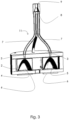
- the present invention relates to a device 1 comprising an elongated tank 2 closed at one of its ends on which is mounted a piezoelectric element 6 capable of emitting waves in a liquid 4.
- the elongated tank 2 according to the invention is preferably in the form of a parabola. This open elongated tank 2 is thus an acoustic focusing reactor.
- the wall 10 of the tank 2 and possibly of the conduit 7 are made of hard materials, capable of reflecting the waves, and are preferably shaped so as to focus the waves at a point located in the vicinity of the central part of the opening 3 of the tank or in the central part of the conduit 7.
- hard material is meant a material sufficiently hard to reflect waves while absorbing minimal energy.
- the hard material is chosen from stainless steel, borosilicate glass, quartz, or a metal having an impedance break with respect to the treated fluid and compatible with the fluid to be treated.
- the duct 7 is made of suitable dimensions and material, the duct 7 is the seat of acoustic propagation.
- This duct can be a rigid circular tube of constant circular section or of variable section.
- the diameter of the tube is preferably between 1 mm and 200 mm, more preferably between 4 mm and 50 mm.
- the conduit 7 may be made of a so-called flexible or elastic material, that is to say that the diameter of the tube varies with the pressure in the tube, or rigid, in which case the diameter of the tube is independent of the internal pressure.
- the propagation speed is lower and thus the wavelength in the conduit 7 is reduced.
- the piezoelectric element 6 acoustic waves are generated in the tank 2 which is necessarily filled with a liquid 4.
- the piezoelectric element 6 is preferably a piezoelectric ceramic or a set of piezoelectric ceramics.
- the family of piezoelectric ceramics includes many elements, such as barium titanates (BaTiO3) or lead zirconate titanates (PZT or LZT for Lead Zirconate Titanate), which are the most widespread and which alone have five to six different compositions.
- the ceramics used are PZT (Lead Zirconate Titanate) ceramics such as PZT-4, PZT-5 or PZT-8 ceramics.
- the ceramics used are ceramics intended for acoustic emission with a quality factor greater than 500 such as PZT-5.
- the piezoelectric element 6, which is preferably one or a set of piezoelectric ceramics, can be arranged on the outer and/or inner walls of the tank 2.
- Piezoelectric ceramics can be present on any type of wall, both horizontal and vertical walls.
- the piezoelectric element can be embodied by any system capable of generating acoustic waves of predefined frequencies, for example mono crystals or composite ceramics.
- the device which is the subject of the invention comprises a liquid 4 which is preferably water and which allows the propagation or diffusion of waves in the tank 2 and in the conduit 7.
- the liquid 4 is carried into the tank 2 by one or more flow circuits 5.
- the treatment liquid 4 is water, fresh or saline. More preferably, the liquid 4 is fresh water.
- usable fresh water mention may be made of drinking water such as mineral water, spring water or osmosis water.
- the water used in the device 1 according to the invention is drinking water.
- the water of the treatment liquid may contain one or more other treatment agent(s) chosen from detergents and/or disinfectants.
- Detergents are agents whose mode of action is physical or physicochemical.
- the waves generated in the liquid 4 by the piezoelectric element are focused in the vicinity of the opening 3 of the tank 2.
- This acoustic focusing which starts in the parabola is extended in the conduit 7 or outlet tube.
- Acoustic waves correspond to a propagation of mechanical disturbances in an elastic medium.
- the elastic medium is materialized by the liquid 4.
- Acoustic waves propagate in liquid 4 at speed c (which in water is about 1500m/s). Acoustic waves are temporally periodic (frequency f) and generate local disturbances in speed, pressure and temperature.
- the mechanical effects (pressure and speed variations) of US (ultrasonic) waves are used to stress the solid/liquid interfaces; this is the case for cleaning.
- the pressure is maximum and the velocity is zero, the area of liquid very close to the solid surface is called the acoustic boundary layer.
- this boundary layer As soon as this boundary layer is crossed, the influence of the wall disappears, so that in the boundary layer there is a very strong velocity and pressure gradient. All particles adhering to solid walls are strongly stressed and can be detached. It should be noted that the thickness of this boundary layer is inversely proportional to the frequency of the wave. This principle is notably used for cleaning walls.
- Each ceramic 6 is powered by an independent generator set to the resonance frequency of the ceramic.
- each ceramic 6 of each device 1 of the system 11 has its own resonance frequency. Two ceramics from the same manufacturing batch do not have the same resonance frequency.
- the adjustment module of the piezoelectric element 6, which is preferably a piezoelectric ceramic is a power electronic card.
- each piezoelectric ceramic is preferably powered by a power electronic card providing it with an alternating voltage corresponding to its own vibration mode.
- the piezoelectric element 6 of the device 1 produces in the tank 2, waves with a frequency greater than 100 kHz, preferably greater than 200 kHz. More preferably, the frequency of the waves is greater than 500 kHz. Particularly advantageously, the frequency of the waves produced in the enclosure is between 1 MHz and 5 MHz. Such high-frequency ultrasounds greater than 1 MHz are also called megasounds.
- the frequency of the ultrasound or ultrasonic waves generated by the piezoelectric element 6 is fundamental. Indeed, the principle of the treatment (e.g. stimulation, transformation and/or decontamination) by using the device 1 according to the invention is based on the mechanical effects of the acoustic wave.
- the first effect of the presence of acoustic waves is to promote the dissolution of soluble products. Indeed, the particle speed of the acoustic wave renews the liquid in contact with the soiled part.
- the Applicant was able to demonstrate that it was possible to adapt the frequency of the acoustic wave according to conduit 7, i.e. according to the evacuation piping of the reactor or device 1. Thus, the fluid passes entirely through the acoustic focusing zones.
- conduit 7 of the device which is the subject of the invention can be designed and adapted so that the generated acoustic wave propagates according to modes characteristic of the conduit 7.
- the conduit 7 in which the fluid flows after acoustic focusing is a waveguide.
- a good reflector like steel has an impedance of 45 ⁇ 10 6 .
- Air with an impedance of 400 is also an excellent reflector.
- These impedances are to be compared to the impedance of water which is 1.5 ⁇ 10 6 .
- the coupling between the fluid inside the conduit (tube also called waveguide) and the wall of the tube is an impermeability condition, which requires that the radial velocity of the fluid is equal to the normal velocity of the wall (radial displacement).
- This coupling makes it possible to couple the deformation of the duct to the radial wave number “kr”.
- This condition allows, for a given frequency f, to fix a series of possible wave numbers.
- the waves in the tube will be propagative or evanescent.
- the conduit (tube also called waveguide) has a diameter between 4 mm and 50 mm.
- the conduit can be a multi-layer tube of various materials, in particular metal, plastic or glass.
- the inner layer is compatible with the fluid.
- the composition of the other layers is arbitrary.
- the conduit or tube can be a simple steel tube, or a thin plastic tube only capable of resisting the pressure of the fluid.
- the impedance break is ensured by the steel tube alone, in the case of the thin plastic tube the impedance break is ensured by the presence of air outside the tube.
- the device according to the invention can be applied to different industrial fields.
- the Applicant was able to demonstrate that, for so-called “strong cavitation", the bubble contains the gaseous phase of the liquid supporting the acoustic wave.
- the bubble subjected to variations in acoustic pressure, oscillates and then implodes. At the time of implosion, very intense pressures are generated, as well as strong temperature increases. Light emissions can then be observed.
- This "strong cavitation” is to be compared to "weak cavitation” for which the bubble is made up of dissolved gases present in the liquid 4. In this case there is no light radiation.
- the use of very high frequency ultrasound, preferably megasound, makes it possible to have a very wide range of acoustic power without reaching strong cavitation.
- the device which is the subject of the invention makes it possible to control the presence of strong cavitation, thanks to the characteristic acoustic signature of strong cavitation.
- the Applicant was thus able to demonstrate that megasonic wave treatment is particularly suitable for fragile substrates or products.
- the device 1 envisaged implements very high frequency ultrasound, preferably megasound, without ever reaching strong cavitation.
- the present invention also relates to a system 11 comprising at least two devices 1 according to the invention.
- This system 11 further comprises a flow collector 9 which corresponds to the different outlets 8 of the different conduits 7 of the devices according to the invention.
- the device according to the invention is used for treatment by acoustic waves.
- treatment means the modification of the liquid or solid product to be treated, for example cleaning, stimulation, decontamination, sterilization, solubilization or mineralization.
- the invention also relates to the use of a device or system according to the invention, for the treatment of liquid and/or solid products.
- the Applicant was able to demonstrate that the device according to the invention also allowed for production adapted to chemistry.
- compatible materials such as pyrex, quartz or metals covered with compatible coatings.
- the device or the associated system can be used for the treatment of foods of animal origin.
- the device is particularly suitable for brining foods, preferably brining foods of animal origin, even more preferably ham.
- the Applicant was able to demonstrate that the use of brine in a tank or in an enclosure, followed by treatment of the food by the system according to the invention, makes it possible in particular to reduce the brining time.
- the invention also relates to the use of a system according to the invention, for brining food inserted into an enclosure, preferably food of animal origin.
- the Applicant was also able to demonstrate that the system used in the subject of the invention allows the modification of the metabolism of an organism, an organ or a tissue, preferably the ex vivo modification when the organism, the organ or the tissue is inserted into an enclosure.
- An organism according to the invention is a complex, organized system, which is the product of successive variations during evolution. It is made up of one or more cells (of a unicellular or multicellular organism).
- an organ is a set of specific tissues of an organism capable of fulfilling one or more specific functions.
- a living tissue is the intermediate level of organization between the cell and the organ.
- a tissue forms a functional whole, that is to say that its cells contribute to the same function.
- the organism, organ or tissue is of animal or plant origin.
- the Applicant was able to show that the system made it possible to create tearing forces on plants in the boundary layer of certain plants.
- the system according to the invention can therefore be used to modify the exchanges between organisms, organs or tissues and a treatment liquid.
- the system used in the method which is the subject of the invention thus allows the modification of the metabolism of an organism, an organ or a tissue, preferably the ex vivo modification when the organism, the organ or the tissue is inserted into an enclosure, said modification allowing for example the neosynthesis of primary and/or secondary metabolites.
- the system according to the invention can thus advantageously be used to modify the metabolism of organisms, organs or tissues either by stimulating or by repressing the synthesis of cellular compounds.
- the system which is the subject of the invention can be used to modify the metabolism of an organism, an organ or a tissue by stimulation of its growth.
- the organism is a plant organism
- the organ is a plant organ
- the tissue is a plant tissue.
- the device which is the subject of the invention can also be used to increase the defenses of a plant organism, a plant organ or a plant tissue, against infection by a pathogenic agent which is preferably a fungus.
- the Applicant was able to demonstrate that the treatment of roots by the device according to the invention stimulates plant growth and increases the defenses of the leaves against infection by a pathogenic fungus. These two examples show that the effects of the treatment are not limited to the treated organ, but induce a global systemic response of the plant and a modification of the metabolism.
- the liquid 4 is a treatment liquid allowing the treatment of the solid product.
- the liquid 4 is a liquid to be treated making it possible to treat both the solid product and the product to be treated introduced into the flow circuit 5.
- Example 1 Cleaning an endoscope contaminated by bacteria, viruses and fungi:
- Cleaning is done by circulating bactericidal, sporicidal and virucidal products.
- the processing time for one cycle is 30 minutes and there are three cycles.
- the Applicant superimposes a propagating acoustic wave on this circulation.
- the internal walls of the endoscope will be subjected to strong pressure variations and a strong velocity gradient due to the acoustic boundary layer.
- the frequency and acoustic power are adapted to the acoustic properties of the waveguide formed by the endoscope tube, because the modes capable of propagating in the tube depend on the diameter and flexibility of its wall.
- the device according to the invention can also be used advantageously for the preparation of mixtures.
- the products to be mixed or reacted are introduced into tank 2 before the focusing zone. Then the acoustics concentrated in pipe 7 act as a catalyst. At the tube outlet, the final product is obtained.
- the device is also suitable for producing stable colloidal solutions.
Landscapes
- Chemical & Material Sciences (AREA)
- Engineering & Computer Science (AREA)
- Organic Chemistry (AREA)
- Mechanical Engineering (AREA)
- Health & Medical Sciences (AREA)
- Chemical Kinetics & Catalysis (AREA)
- Toxicology (AREA)
- General Health & Medical Sciences (AREA)
- Environmental & Geological Engineering (AREA)
- Water Supply & Treatment (AREA)
- Hydrology & Water Resources (AREA)
- Life Sciences & Earth Sciences (AREA)
- Physical Water Treatments (AREA)
- Cleaning By Liquid Or Steam (AREA)
- Cleaning Or Drying Semiconductors (AREA)
- Physical Or Chemical Processes And Apparatus (AREA)
Claims (10)
- Verfahren zum Behandeln einer Flüssigkeit (4) durch hochfrequente Schallwellen in einer Vorrichtung (1) eines Systems (11), umfassend mindestens zwei Vorrichtungen (1) zum Behandeln durch Schallwellen, die Vorrichtungen mindestens umfassend:- einen länglichen, offenen Tank (2), dessen Querschnitt eine zunehmende Verengung in Richtung einer Öffnung (3), die sich auf dem oberen Teil des Tanks befindet, aufweist, und- ein piezoelektrisches Element (6), wobei der Tank mit einer Flüssigkeit (4) gefüllt ist, wobei das piezoelektrische Element (6) geeignet ist, Wellen in der Flüssigkeit (4) auszusenden, wobei die Wellen in der Nähe der Öffnung (3) des Tanks fokussiert werden und in eine Leitung (7) austreten,dadurch gekennzeichnet, dass die Auslässe (8) der unterschiedlichen Leitungen (7) der Vorrichtungen (1), die einen Durchmesser, der zwischen 4 mm und 50 mm liegt, aufweisen, in einem Abflusssammler (9) zusammenlaufen und dadurch, dass die erzeugten Wellen in jeder Vorrichtung (1) durch das piezoelektrische Element (6) in dem Tank (2) und/oder in der Leitung (7) eine Frequenz höher als 100 kHz aufweisen.und dadurch gekennzeichnet, dass es die folgenden Schritte umfasst, gemäß denen:- eine zu behandelnde Flüssigkeit (4) in den Tank (2) der Vorrichtung durch einen Flusspfad (5) eingeleitet wird;- hochfrequente Schallwellen, höher als 100 kHz, vorzugsweise höher als 200 kHz, in dem Tank (2) durch das piezoelektrische Element (6) generiert werden;- die Schallwellen sich in dem Tank (2) ausbreiten und an einem Punkt, der sich in der Nähe des mittleren Teils der Öffnung (3) des Tanks befindet, fokussiert werden und in die Leitung (7) austreten; wobei die Wellen das Behandeln der Flüssigkeit (4) ermöglichen; und- die so behandelte Flüssigkeit in dem Auslass der Leitung (7) oder in dem Auslass des Abflusssammlers (9) zurückerhalten wird.
- Verfahren nach Anspruch 1, dadurch gekennzeichnet, dass die Flüssigkeit (4) Folgendes ist:- eine zu behandelnde Flüssigkeit und/oder- eine Behandlungsflüssigkeit, die das Behandeln eines Feststofferzeugnisses ermöglicht, das sich in dem Tank (2), in dem und/oder an dem Auslass der Leitung (7) befindet.
- Verfahren nach einem der Ansprüche 1 oder 2,
dadurch gekennzeichnet, dass die in der Vorrichtung (1) durch das piezoelektrische Element (6) in dem Tank (2) und/oder in der Leitung (7) erzeugten Wellen eine Frequenz höher als 200 kHz aufweisen. - Verfahren nach Anspruch 3, dadurch gekennzeichnet, dass die in der Vorrichtung (1) durch das piezoelektrische Element (6) in dem Tank (2) und/oder in der Leitung (7) erzeugten Wellen eine Frequenz, die zwischen 1 MHz und 5 MHz liegt, aufweisen.
- Verfahren nach einem der vorstehenden Ansprüche,
dadurch gekennzeichnet, dass die Wände des Tanks (2) und der Leitung (7) in der Vorrichtung (1) aus hartem Material sind, das geeignet ist, die Wellen zu reflektieren, und vorzugsweise ausgebildet sind, um zu veranlassen, dass sich die Wellen in einem Punkt, der sich in der Nähe des mittleren Teils der Öffnung (3) des Tanks und/oder in dem mittleren Teil der Leitung (7) befindet, fokussieren. - Verfahren nach einem der vorstehenden Ansprüche,
dadurch gekennzeichnet, dass der Tank (2) der Vorrichtung (1) eine Form eines Rotationsparaboloids aufweist, dessen Schwerpunkt sich in der Nähe des mittleren Teils der Öffnung (3) des Tanks befindet. - Verfahren nach einem der vorstehenden Ansprüche,
dadurch gekennzeichnet, dass das System (11) zum Reinigen und/oder Dekontaminieren von Flüssig- und/oder Feststofferzeugnissen verwendet wird. - Verfahren nach einem der vorstehenden Ansprüche,
dadurch gekennzeichnet, dass das System (11) zum Behandeln von Flüssig- und/oder Feststofferzeugnissen verwendet wird, vorzugsweise zum:- Mineralisieren von löslichen Erzeugnissen in der Flüssigkeit (4), auch Trägerflüssigkeit genannt;- Zerstören von Wirkstoffen wie Pestiziden oder Medikamenten vor dem Abstoßen in das Abwasser; oder- Behandeln von Wasser, um es "trinkbar" zu machen. - Verfahren nach einem der vorstehenden Ansprüche,
dadurch gekennzeichnet, dass das System (11) verwendet wird zum:- Extrahieren von Wirkstoffen;- Löslichmachen oder Homogenisieren von Flüssig- und/oder Feststofferzeugnissen in der Flüssigkeit 4;- Herstellen einer Emulsion;- Zubereiten von Kolloiden und/oder chemischen Verbindungen. - Verfahren zum Behandeln eines Feststofferzeugnisses, das sich in dem Tank (2), in und/oder an dem Auslass der Leitung (7) einer Vorrichtung (1) eines Systems (11) befindet, umfassend mindestens zwei Vorrichtungen (1) zum Behandeln der Vorrichtungen durch Schallwellen, mindestens umfassend:- einen länglichen, offenen Tank (2), dessen Querschnitt eine zunehmende Verengung in Richtung einer Öffnung (3), die sich auf dem oberen Teil des Tanks befindet, aufweist, und- ein piezoelektrisches Element (6), wobei der Tank mit einer Flüssigkeit (4) gefüllt ist, wobei das piezoelektrische Element (6) geeignet ist, Wellen in der Flüssigkeit (4) auszusenden, wobei die Wellen in der Nähe der Öffnung (3) des Tanks fokussiert werden und in eine Leitung (7) austreten,dadurch gekennzeichnet, dass die Auslässe (8) der unterschiedlichen Leitungen (7) der Vorrichtungen (1), die einen Durchmesser, der zwischen 4 mm und 50 mm liegt, aufweisen, in einem Abflusssammler (9) zusammenlaufen und dadurch, dass die erzeugten Wellen in jeder Vorrichtung (1) durch das piezoelektrische Element (6) in dem Tank (2) und/oder in der Leitung (7) eine Frequenz höher als 100 kHz aufweisen,durch hochfrequente Schallwellen, dadurch gekennzeichnet, dass es die folgenden Schritte umfasst, gemäß denen:- eine Flüssigkeit (4) in den Tank (2) einer Vorrichtung (1) des Systems (11) durch einen Flusspfad (5) eingeleitet wird;- hochfrequente Schallwellen, höher als 100 kHz, vorzugsweise höher als 200 kHz, in dem Tank (2) durch das piezoelektrische Element (6) generiert werden;- die Schallwellen sich in dem Tank (2) ausbreiten und an einem Punkt, der sich in der Nähe des mittleren Teils der Öffnung (3) des Tanks befindet, fokussiert werden und in die Leitung (7) austreten; wobei die Wellen das Behandeln des Feststofferzeugnisses ermöglichen; und- das so behandelte Feststofferzeugnis zurückerhalten wird.
Applications Claiming Priority (2)
| Application Number | Priority Date | Filing Date | Title |
|---|---|---|---|
| FR1771244A FR3073752B1 (fr) | 2017-11-22 | 2017-11-22 | Dispositif et procede de traitement par des ondes acoustiques |
| PCT/EP2018/081808 WO2019101694A1 (fr) | 2017-11-22 | 2018-11-19 | Dispositif et procede de traitement par des ondes acoustiques |
Publications (4)
| Publication Number | Publication Date |
|---|---|
| EP3713667A1 EP3713667A1 (de) | 2020-09-30 |
| EP3713667C0 EP3713667C0 (de) | 2025-03-26 |
| EP3713667B1 true EP3713667B1 (de) | 2025-03-26 |
| EP3713667B8 EP3713667B8 (de) | 2025-05-21 |
Family
ID=61258537
Family Applications (1)
| Application Number | Title | Priority Date | Filing Date |
|---|---|---|---|
| EP18800682.9A Active EP3713667B8 (de) | 2017-11-22 | 2018-11-19 | Verfahren zur behandlung durch akustischen wellen |
Country Status (6)
| Country | Link |
|---|---|
| US (1) | US20200360890A1 (de) |
| EP (1) | EP3713667B8 (de) |
| CA (1) | CA3081638A1 (de) |
| ES (1) | ES3031357T3 (de) |
| FR (1) | FR3073752B1 (de) |
| WO (1) | WO2019101694A1 (de) |
Families Citing this family (1)
| Publication number | Priority date | Publication date | Assignee | Title |
|---|---|---|---|---|
| CN112657446A (zh) * | 2020-12-17 | 2021-04-16 | 张琳 | 一种超声波管式反应器 |
Family Cites Families (7)
| Publication number | Priority date | Publication date | Assignee | Title |
|---|---|---|---|---|
| US2880663A (en) * | 1957-12-20 | 1959-04-07 | Reflectone Corp | Apparatus for treating articles |
| FR2721839B1 (fr) * | 1994-07-04 | 1996-10-25 | Imra Europe Sa | Dispositif de pulverisation, notamment d'eau sous forme de micro-goutelettes, apte a fonctionner dans un milieu non stationnaire |
| US6818128B2 (en) * | 2002-06-20 | 2004-11-16 | The Halliday Foundation, Inc. | Apparatus for directing ultrasonic energy |
| US8459121B2 (en) * | 2010-10-28 | 2013-06-11 | Covaris, Inc. | Method and system for acoustically treating material |
| EP2872234A1 (de) * | 2012-07-16 | 2015-05-20 | Flodesign Sonics Inc. | Verbesserte trennung von mehrkomponenten-flüssigkeiten durch ultraschall-akustophorese |
| US9786266B2 (en) * | 2013-12-10 | 2017-10-10 | Covaris, Inc. | Method and system for acoustically treating material |
| FR3027021A1 (fr) | 2014-10-13 | 2016-04-15 | Veolia Water Solutions & Tech | Procede de traitement d'eau par adsorption sur charbon actif et clarification, et installation correspondante. |
-
2017
- 2017-11-22 FR FR1771244A patent/FR3073752B1/fr active Active
-
2018
- 2018-11-19 CA CA3081638A patent/CA3081638A1/fr active Pending
- 2018-11-19 WO PCT/EP2018/081808 patent/WO2019101694A1/fr not_active Ceased
- 2018-11-19 EP EP18800682.9A patent/EP3713667B8/de active Active
- 2018-11-19 ES ES18800682T patent/ES3031357T3/es active Active
- 2018-11-19 US US16/766,137 patent/US20200360890A1/en not_active Abandoned
Also Published As
| Publication number | Publication date |
|---|---|
| WO2019101694A1 (fr) | 2019-05-31 |
| FR3073752B1 (fr) | 2020-05-22 |
| EP3713667B8 (de) | 2025-05-21 |
| EP3713667C0 (de) | 2025-03-26 |
| EP3713667A1 (de) | 2020-09-30 |
| ES3031357T3 (en) | 2025-07-08 |
| CA3081638A1 (fr) | 2019-05-31 |
| FR3073752A1 (fr) | 2019-05-24 |
| US20200360890A1 (en) | 2020-11-19 |
Similar Documents
| Publication | Publication Date | Title |
|---|---|---|
| Seridou et al. | Disinfection applications of ozone micro-and nanobubbles | |
| Barjasteh et al. | Recent progress in applications of non-thermal plasma for water purification, bio-sterilization, and decontamination | |
| Zhou et al. | Microplasma bubbles: reactive vehicles for biofilm dispersal | |
| EP0912445B1 (de) | Vorrichtung und prozess zur behandlung eines flüssigen mediums | |
| Secondes et al. | Removal of emerging contaminants by simultaneous application of membrane ultrafiltration, activated carbon adsorption, and ultrasound irradiation | |
| Farid et al. | Hybrid nanobubble-forward osmosis system for aquaculture wastewater treatment and reuse | |
| Patil et al. | Degradation of methyl parathion using hydrodynamic cavitation: effect of operating parameters and intensification using additives | |
| EP1222540A1 (de) | Verfahren und system für konsistente gruppenbetriebsdaten in einem server-cluster mit einem quorum von repliken | |
| Rosales Pérez et al. | The evolution of sonochemistry: From the beginnings to novel applications | |
| Rahdar et al. | Efficiency of sono-nano-catalytic process of magnesium oxide nano particle in removal of penicillin G from aqueous solution | |
| RU2738259C2 (ru) | Система и способ обработки жидкости | |
| WO2006132157A1 (ja) | バラスト水の処理装置および処理方法 | |
| WO2010035421A1 (ja) | 水処理装置 | |
| WO2018134181A1 (fr) | Dispositif et procede de traitement par des ondes acoustiques de haute frequence | |
| EP3713667B1 (de) | Verfahren zur behandlung durch akustischen wellen | |
| JP2005535439A (ja) | 水、特に船舶用水の処理方法及び装置 | |
| JP2006007184A (ja) | バラスト水の処理方法及び装置 | |
| Kesari et al. | Physical methods in wastewater treatment | |
| JP2005342626A (ja) | バラスト水処理方法及び装置、該装置を搭載した船舶 | |
| CN107827201A (zh) | 一种具有自清洁功能的船舶压载水紫外杀菌装置 | |
| ES2309549T3 (es) | Procedimiento para la desinfeccion de fluidos. | |
| EP1167297B1 (de) | Verfahren zur physikalisch-chemischen Behandlung von Wasser eines Schwimmbeckens | |
| WO2000058224A1 (en) | Reactor for cleaning and disinfection of aquatic media | |
| Dang et al. | Impact of sonication on the algal organic matter characteristics of Anabaena circinalis, Microcystis aeruginosa, and Chlorella vulgaris | |
| JP4488165B2 (ja) | 湖沼等閉鎖水域に発生・生存するアオコの殺藻・成長抑制方法及びアオコの殺藻・成長抑制装置 |
Legal Events
| Date | Code | Title | Description |
|---|---|---|---|
| STAA | Information on the status of an ep patent application or granted ep patent |
Free format text: STATUS: UNKNOWN |
|
| STAA | Information on the status of an ep patent application or granted ep patent |
Free format text: STATUS: THE INTERNATIONAL PUBLICATION HAS BEEN MADE |
|
| PUAI | Public reference made under article 153(3) epc to a published international application that has entered the european phase |
Free format text: ORIGINAL CODE: 0009012 |
|
| STAA | Information on the status of an ep patent application or granted ep patent |
Free format text: STATUS: REQUEST FOR EXAMINATION WAS MADE |
|
| 17P | Request for examination filed |
Effective date: 20200513 |
|
| AK | Designated contracting states |
Kind code of ref document: A1 Designated state(s): AL AT BE BG CH CY CZ DE DK EE ES FI FR GB GR HR HU IE IS IT LI LT LU LV MC MK MT NL NO PL PT RO RS SE SI SK SM TR |
|
| AX | Request for extension of the european patent |
Extension state: BA ME |
|
| DAV | Request for validation of the european patent (deleted) | ||
| DAX | Request for extension of the european patent (deleted) | ||
| STAA | Information on the status of an ep patent application or granted ep patent |
Free format text: STATUS: EXAMINATION IS IN PROGRESS |
|
| 17Q | First examination report despatched |
Effective date: 20211214 |
|
| GRAP | Despatch of communication of intention to grant a patent |
Free format text: ORIGINAL CODE: EPIDOSNIGR1 |
|
| STAA | Information on the status of an ep patent application or granted ep patent |
Free format text: STATUS: GRANT OF PATENT IS INTENDED |
|
| INTG | Intention to grant announced |
Effective date: 20241108 |
|
| GRAS | Grant fee paid |
Free format text: ORIGINAL CODE: EPIDOSNIGR3 |
|
| GRAA | (expected) grant |
Free format text: ORIGINAL CODE: 0009210 |
|
| STAA | Information on the status of an ep patent application or granted ep patent |
Free format text: STATUS: THE PATENT HAS BEEN GRANTED |
|
| RAP3 | Party data changed (applicant data changed or rights of an application transferred) |
Owner name: AVIGNON UNIVERSITE Owner name: CHING, GIL |
|
| RIN1 | Information on inventor provided before grant (corrected) |
Inventor name: SALLANON, HUGUETTE Inventor name: CHARLES, FLORENCE Inventor name: CHING, GIL |
|
| AK | Designated contracting states |
Kind code of ref document: B1 Designated state(s): AL AT BE BG CH CY CZ DE DK EE ES FI FR GB GR HR HU IE IS IT LI LT LU LV MC MK MT NL NO PL PT RO RS SE SI SK SM TR |
|
| REG | Reference to a national code |
Ref country code: GB Ref legal event code: FG4D Free format text: NOT ENGLISH |
|
| REG | Reference to a national code |
Ref country code: CH Ref legal event code: EP |
|
| REG | Reference to a national code |
Ref country code: DE Ref legal event code: R096 Ref document number: 602018080499 Country of ref document: DE |
|
| REG | Reference to a national code |
Ref country code: IE Ref legal event code: FG4D Free format text: LANGUAGE OF EP DOCUMENT: FRENCH |
|
| REG | Reference to a national code |
Ref country code: CH Ref legal event code: PK Free format text: RECTIFICATION B8 |
|
| RAP4 | Party data changed (patent owner data changed or rights of a patent transferred) |
Owner name: AVIGNON UNIVERSITE Owner name: CHING, GIL |
|
| U01 | Request for unitary effect filed |
Effective date: 20250411 |
|
| U07 | Unitary effect registered |
Designated state(s): AT BE BG DE DK EE FI FR IT LT LU LV MT NL PT RO SE SI Effective date: 20250423 |
|
| PG25 | Lapsed in a contracting state [announced via postgrant information from national office to epo] |
Ref country code: RS Free format text: LAPSE BECAUSE OF FAILURE TO SUBMIT A TRANSLATION OF THE DESCRIPTION OR TO PAY THE FEE WITHIN THE PRESCRIBED TIME-LIMIT Effective date: 20250626 |
|
| REG | Reference to a national code |
Ref country code: ES Ref legal event code: FG2A Ref document number: 3031357 Country of ref document: ES Kind code of ref document: T3 Effective date: 20250708 |
|
| PG25 | Lapsed in a contracting state [announced via postgrant information from national office to epo] |
Ref country code: NO Free format text: LAPSE BECAUSE OF FAILURE TO SUBMIT A TRANSLATION OF THE DESCRIPTION OR TO PAY THE FEE WITHIN THE PRESCRIBED TIME-LIMIT Effective date: 20250626 |
|
| PG25 | Lapsed in a contracting state [announced via postgrant information from national office to epo] |
Ref country code: HR Free format text: LAPSE BECAUSE OF FAILURE TO SUBMIT A TRANSLATION OF THE DESCRIPTION OR TO PAY THE FEE WITHIN THE PRESCRIBED TIME-LIMIT Effective date: 20250326 |
|
| PG25 | Lapsed in a contracting state [announced via postgrant information from national office to epo] |
Ref country code: GR Free format text: LAPSE BECAUSE OF FAILURE TO SUBMIT A TRANSLATION OF THE DESCRIPTION OR TO PAY THE FEE WITHIN THE PRESCRIBED TIME-LIMIT Effective date: 20250627 |
|
| PG25 | Lapsed in a contracting state [announced via postgrant information from national office to epo] |
Ref country code: SM Free format text: LAPSE BECAUSE OF FAILURE TO SUBMIT A TRANSLATION OF THE DESCRIPTION OR TO PAY THE FEE WITHIN THE PRESCRIBED TIME-LIMIT Effective date: 20250326 |
|
| PG25 | Lapsed in a contracting state [announced via postgrant information from national office to epo] |
Ref country code: PL Free format text: LAPSE BECAUSE OF FAILURE TO SUBMIT A TRANSLATION OF THE DESCRIPTION OR TO PAY THE FEE WITHIN THE PRESCRIBED TIME-LIMIT Effective date: 20250326 |
|
| PG25 | Lapsed in a contracting state [announced via postgrant information from national office to epo] |
Ref country code: SK Free format text: LAPSE BECAUSE OF FAILURE TO SUBMIT A TRANSLATION OF THE DESCRIPTION OR TO PAY THE FEE WITHIN THE PRESCRIBED TIME-LIMIT Effective date: 20250326 |
|
| PG25 | Lapsed in a contracting state [announced via postgrant information from national office to epo] |
Ref country code: IS Free format text: LAPSE BECAUSE OF FAILURE TO SUBMIT A TRANSLATION OF THE DESCRIPTION OR TO PAY THE FEE WITHIN THE PRESCRIBED TIME-LIMIT Effective date: 20250726 |
|
| U20 | Renewal fee for the european patent with unitary effect paid |
Year of fee payment: 8 Effective date: 20251127 |
|
| PGFP | Annual fee paid to national office [announced via postgrant information from national office to epo] |
Ref country code: GB Payment date: 20251126 Year of fee payment: 8 |
|
| PG25 | Lapsed in a contracting state [announced via postgrant information from national office to epo] |
Ref country code: CZ Free format text: LAPSE BECAUSE OF FAILURE TO SUBMIT A TRANSLATION OF THE DESCRIPTION OR TO PAY THE FEE WITHIN THE PRESCRIBED TIME-LIMIT Effective date: 20250326 |
|
| PLBE | No opposition filed within time limit |
Free format text: ORIGINAL CODE: 0009261 |
|
| STAA | Information on the status of an ep patent application or granted ep patent |
Free format text: STATUS: NO OPPOSITION FILED WITHIN TIME LIMIT |
|
| REG | Reference to a national code |
Ref country code: CH Ref legal event code: L10 Free format text: ST27 STATUS EVENT CODE: U-0-0-L10-L00 (AS PROVIDED BY THE NATIONAL OFFICE) Effective date: 20260211 |
|
| 26N | No opposition filed |
Effective date: 20260105 |
|
| PGFP | Annual fee paid to national office [announced via postgrant information from national office to epo] |
Ref country code: ES Payment date: 20260203 Year of fee payment: 8 |