EP3713890B1 - Material mit einer einzigen funktionellen schicht mit silber und einer absorbierenden schicht - Google Patents
Material mit einer einzigen funktionellen schicht mit silber und einer absorbierenden schicht Download PDFInfo
- Publication number
- EP3713890B1 EP3713890B1 EP18829898.8A EP18829898A EP3713890B1 EP 3713890 B1 EP3713890 B1 EP 3713890B1 EP 18829898 A EP18829898 A EP 18829898A EP 3713890 B1 EP3713890 B1 EP 3713890B1
- Authority
- EP
- European Patent Office
- Prior art keywords
- layer
- layers
- less
- substrate
- glazing
- Prior art date
- Legal status (The legal status is an assumption and is not a legal conclusion. Google has not performed a legal analysis and makes no representation as to the accuracy of the status listed.)
- Active
Links
Images


Classifications
-
- C—CHEMISTRY; METALLURGY
- C03—GLASS; MINERAL OR SLAG WOOL
- C03C—CHEMICAL COMPOSITION OF GLASSES, GLAZES OR VITREOUS ENAMELS; SURFACE TREATMENT OF GLASS; SURFACE TREATMENT OF FIBRES OR FILAMENTS MADE FROM GLASS, MINERALS OR SLAGS; JOINING GLASS TO GLASS OR OTHER MATERIALS
- C03C17/00—Surface treatment of glass, not in the form of fibres or filaments, by coating
- C03C17/34—Surface treatment of glass, not in the form of fibres or filaments, by coating with at least two coatings having different compositions
- C03C17/36—Surface treatment of glass, not in the form of fibres or filaments, by coating with at least two coatings having different compositions at least one coating being a metal
-
- C—CHEMISTRY; METALLURGY
- C03—GLASS; MINERAL OR SLAG WOOL
- C03C—CHEMICAL COMPOSITION OF GLASSES, GLAZES OR VITREOUS ENAMELS; SURFACE TREATMENT OF GLASS; SURFACE TREATMENT OF FIBRES OR FILAMENTS MADE FROM GLASS, MINERALS OR SLAGS; JOINING GLASS TO GLASS OR OTHER MATERIALS
- C03C17/00—Surface treatment of glass, not in the form of fibres or filaments, by coating
- C03C17/34—Surface treatment of glass, not in the form of fibres or filaments, by coating with at least two coatings having different compositions
- C03C17/36—Surface treatment of glass, not in the form of fibres or filaments, by coating with at least two coatings having different compositions at least one coating being a metal
- C03C17/3602—Surface treatment of glass, not in the form of fibres or filaments, by coating with at least two coatings having different compositions at least one coating being a metal the metal being present as a layer
- C03C17/3605—Coatings of the type glass/metal/inorganic compound
-
- C—CHEMISTRY; METALLURGY
- C03—GLASS; MINERAL OR SLAG WOOL
- C03C—CHEMICAL COMPOSITION OF GLASSES, GLAZES OR VITREOUS ENAMELS; SURFACE TREATMENT OF GLASS; SURFACE TREATMENT OF FIBRES OR FILAMENTS MADE FROM GLASS, MINERALS OR SLAGS; JOINING GLASS TO GLASS OR OTHER MATERIALS
- C03C17/00—Surface treatment of glass, not in the form of fibres or filaments, by coating
- C03C17/34—Surface treatment of glass, not in the form of fibres or filaments, by coating with at least two coatings having different compositions
- C03C17/36—Surface treatment of glass, not in the form of fibres or filaments, by coating with at least two coatings having different compositions at least one coating being a metal
- C03C17/3602—Surface treatment of glass, not in the form of fibres or filaments, by coating with at least two coatings having different compositions at least one coating being a metal the metal being present as a layer
- C03C17/3613—Coatings of type glass/inorganic compound/metal/inorganic compound/metal/other
-
- C—CHEMISTRY; METALLURGY
- C03—GLASS; MINERAL OR SLAG WOOL
- C03C—CHEMICAL COMPOSITION OF GLASSES, GLAZES OR VITREOUS ENAMELS; SURFACE TREATMENT OF GLASS; SURFACE TREATMENT OF FIBRES OR FILAMENTS MADE FROM GLASS, MINERALS OR SLAGS; JOINING GLASS TO GLASS OR OTHER MATERIALS
- C03C17/00—Surface treatment of glass, not in the form of fibres or filaments, by coating
- C03C17/34—Surface treatment of glass, not in the form of fibres or filaments, by coating with at least two coatings having different compositions
- C03C17/36—Surface treatment of glass, not in the form of fibres or filaments, by coating with at least two coatings having different compositions at least one coating being a metal
- C03C17/3602—Surface treatment of glass, not in the form of fibres or filaments, by coating with at least two coatings having different compositions at least one coating being a metal the metal being present as a layer
- C03C17/3626—Surface treatment of glass, not in the form of fibres or filaments, by coating with at least two coatings having different compositions at least one coating being a metal the metal being present as a layer one layer at least containing a nitride, oxynitride, boronitride or carbonitride
-
- C—CHEMISTRY; METALLURGY
- C03—GLASS; MINERAL OR SLAG WOOL
- C03C—CHEMICAL COMPOSITION OF GLASSES, GLAZES OR VITREOUS ENAMELS; SURFACE TREATMENT OF GLASS; SURFACE TREATMENT OF FIBRES OR FILAMENTS MADE FROM GLASS, MINERALS OR SLAGS; JOINING GLASS TO GLASS OR OTHER MATERIALS
- C03C17/00—Surface treatment of glass, not in the form of fibres or filaments, by coating
- C03C17/34—Surface treatment of glass, not in the form of fibres or filaments, by coating with at least two coatings having different compositions
- C03C17/36—Surface treatment of glass, not in the form of fibres or filaments, by coating with at least two coatings having different compositions at least one coating being a metal
- C03C17/3602—Surface treatment of glass, not in the form of fibres or filaments, by coating with at least two coatings having different compositions at least one coating being a metal the metal being present as a layer
- C03C17/3642—Surface treatment of glass, not in the form of fibres or filaments, by coating with at least two coatings having different compositions at least one coating being a metal the metal being present as a layer the multilayer coating containing a metal layer
-
- C—CHEMISTRY; METALLURGY
- C03—GLASS; MINERAL OR SLAG WOOL
- C03C—CHEMICAL COMPOSITION OF GLASSES, GLAZES OR VITREOUS ENAMELS; SURFACE TREATMENT OF GLASS; SURFACE TREATMENT OF FIBRES OR FILAMENTS MADE FROM GLASS, MINERALS OR SLAGS; JOINING GLASS TO GLASS OR OTHER MATERIALS
- C03C17/00—Surface treatment of glass, not in the form of fibres or filaments, by coating
- C03C17/34—Surface treatment of glass, not in the form of fibres or filaments, by coating with at least two coatings having different compositions
- C03C17/36—Surface treatment of glass, not in the form of fibres or filaments, by coating with at least two coatings having different compositions at least one coating being a metal
- C03C17/3602—Surface treatment of glass, not in the form of fibres or filaments, by coating with at least two coatings having different compositions at least one coating being a metal the metal being present as a layer
- C03C17/3644—Surface treatment of glass, not in the form of fibres or filaments, by coating with at least two coatings having different compositions at least one coating being a metal the metal being present as a layer the metal being silver
-
- C—CHEMISTRY; METALLURGY
- C03—GLASS; MINERAL OR SLAG WOOL
- C03C—CHEMICAL COMPOSITION OF GLASSES, GLAZES OR VITREOUS ENAMELS; SURFACE TREATMENT OF GLASS; SURFACE TREATMENT OF FIBRES OR FILAMENTS MADE FROM GLASS, MINERALS OR SLAGS; JOINING GLASS TO GLASS OR OTHER MATERIALS
- C03C17/00—Surface treatment of glass, not in the form of fibres or filaments, by coating
- C03C17/34—Surface treatment of glass, not in the form of fibres or filaments, by coating with at least two coatings having different compositions
- C03C17/36—Surface treatment of glass, not in the form of fibres or filaments, by coating with at least two coatings having different compositions at least one coating being a metal
- C03C17/3602—Surface treatment of glass, not in the form of fibres or filaments, by coating with at least two coatings having different compositions at least one coating being a metal the metal being present as a layer
- C03C17/3649—Surface treatment of glass, not in the form of fibres or filaments, by coating with at least two coatings having different compositions at least one coating being a metal the metal being present as a layer made of metals other than silver
-
- C—CHEMISTRY; METALLURGY
- C03—GLASS; MINERAL OR SLAG WOOL
- C03C—CHEMICAL COMPOSITION OF GLASSES, GLAZES OR VITREOUS ENAMELS; SURFACE TREATMENT OF GLASS; SURFACE TREATMENT OF FIBRES OR FILAMENTS MADE FROM GLASS, MINERALS OR SLAGS; JOINING GLASS TO GLASS OR OTHER MATERIALS
- C03C17/00—Surface treatment of glass, not in the form of fibres or filaments, by coating
- C03C17/34—Surface treatment of glass, not in the form of fibres or filaments, by coating with at least two coatings having different compositions
- C03C17/36—Surface treatment of glass, not in the form of fibres or filaments, by coating with at least two coatings having different compositions at least one coating being a metal
- C03C17/3602—Surface treatment of glass, not in the form of fibres or filaments, by coating with at least two coatings having different compositions at least one coating being a metal the metal being present as a layer
- C03C17/3657—Surface treatment of glass, not in the form of fibres or filaments, by coating with at least two coatings having different compositions at least one coating being a metal the metal being present as a layer the multilayer coating having optical properties
- C03C17/366—Low-emissivity or solar control coatings
-
- C—CHEMISTRY; METALLURGY
- C03—GLASS; MINERAL OR SLAG WOOL
- C03C—CHEMICAL COMPOSITION OF GLASSES, GLAZES OR VITREOUS ENAMELS; SURFACE TREATMENT OF GLASS; SURFACE TREATMENT OF FIBRES OR FILAMENTS MADE FROM GLASS, MINERALS OR SLAGS; JOINING GLASS TO GLASS OR OTHER MATERIALS
- C03C17/00—Surface treatment of glass, not in the form of fibres or filaments, by coating
- C03C17/34—Surface treatment of glass, not in the form of fibres or filaments, by coating with at least two coatings having different compositions
- C03C17/36—Surface treatment of glass, not in the form of fibres or filaments, by coating with at least two coatings having different compositions at least one coating being a metal
- C03C17/3602—Surface treatment of glass, not in the form of fibres or filaments, by coating with at least two coatings having different compositions at least one coating being a metal the metal being present as a layer
- C03C17/3681—Surface treatment of glass, not in the form of fibres or filaments, by coating with at least two coatings having different compositions at least one coating being a metal the metal being present as a layer the multilayer coating being used in glazing, e.g. windows or windscreens
-
- C—CHEMISTRY; METALLURGY
- C08—ORGANIC MACROMOLECULAR COMPOUNDS; THEIR PREPARATION OR CHEMICAL WORKING-UP; COMPOSITIONS BASED THEREON
- C08J—WORKING-UP; GENERAL PROCESSES OF COMPOUNDING; AFTER-TREATMENT NOT COVERED BY SUBCLASSES C08B, C08C, C08F, C08G or C08H
- C08J7/00—Chemical treatment or coating of shaped articles made of macromolecular substances
- C08J7/04—Coating
- C08J7/06—Coating with compositions not containing macromolecular substances
-
- E—FIXED CONSTRUCTIONS
- E06—DOORS, WINDOWS, SHUTTERS, OR ROLLER BLINDS IN GENERAL; LADDERS
- E06B—FIXED OR MOVABLE CLOSURES FOR OPENINGS IN BUILDINGS, VEHICLES, FENCES OR LIKE ENCLOSURES IN GENERAL, e.g. DOORS, WINDOWS, BLINDS, GATES
- E06B3/00—Window sashes, door leaves, or like elements for closing wall or like openings; Layout of fixed or moving closures, e.g. windows in wall or like openings; Features of rigidly-mounted outer frames relating to the mounting of wing frames
- E06B3/66—Units comprising two or more parallel glass or like panes permanently secured together
- E06B3/6612—Evacuated glazing units
-
- E—FIXED CONSTRUCTIONS
- E06—DOORS, WINDOWS, SHUTTERS, OR ROLLER BLINDS IN GENERAL; LADDERS
- E06B—FIXED OR MOVABLE CLOSURES FOR OPENINGS IN BUILDINGS, VEHICLES, FENCES OR LIKE ENCLOSURES IN GENERAL, e.g. DOORS, WINDOWS, BLINDS, GATES
- E06B3/00—Window sashes, door leaves, or like elements for closing wall or like openings; Layout of fixed or moving closures, e.g. windows in wall or like openings; Features of rigidly-mounted outer frames relating to the mounting of wing frames
- E06B3/66—Units comprising two or more parallel glass or like panes permanently secured together
- E06B3/67—Units comprising two or more parallel glass or like panes permanently secured together characterised by additional arrangements or devices for heat or sound insulation or for controlled passage of light
- E06B3/6715—Units comprising two or more parallel glass or like panes permanently secured together characterised by additional arrangements or devices for heat or sound insulation or for controlled passage of light specially adapted for increased thermal insulation or for controlled passage of light
-
- C—CHEMISTRY; METALLURGY
- C03—GLASS; MINERAL OR SLAG WOOL
- C03C—CHEMICAL COMPOSITION OF GLASSES, GLAZES OR VITREOUS ENAMELS; SURFACE TREATMENT OF GLASS; SURFACE TREATMENT OF FIBRES OR FILAMENTS MADE FROM GLASS, MINERALS OR SLAGS; JOINING GLASS TO GLASS OR OTHER MATERIALS
- C03C2217/00—Coatings on glass
- C03C2217/20—Materials for coating a single layer on glass
- C03C2217/21—Oxides
- C03C2217/212—TiO2
-
- C—CHEMISTRY; METALLURGY
- C03—GLASS; MINERAL OR SLAG WOOL
- C03C—CHEMICAL COMPOSITION OF GLASSES, GLAZES OR VITREOUS ENAMELS; SURFACE TREATMENT OF GLASS; SURFACE TREATMENT OF FIBRES OR FILAMENTS MADE FROM GLASS, MINERALS OR SLAGS; JOINING GLASS TO GLASS OR OTHER MATERIALS
- C03C2217/00—Coatings on glass
- C03C2217/20—Materials for coating a single layer on glass
- C03C2217/21—Oxides
- C03C2217/216—ZnO
-
- C—CHEMISTRY; METALLURGY
- C03—GLASS; MINERAL OR SLAG WOOL
- C03C—CHEMICAL COMPOSITION OF GLASSES, GLAZES OR VITREOUS ENAMELS; SURFACE TREATMENT OF GLASS; SURFACE TREATMENT OF FIBRES OR FILAMENTS MADE FROM GLASS, MINERALS OR SLAGS; JOINING GLASS TO GLASS OR OTHER MATERIALS
- C03C2217/00—Coatings on glass
- C03C2217/20—Materials for coating a single layer on glass
- C03C2217/21—Oxides
- C03C2217/22—ZrO2
-
- C—CHEMISTRY; METALLURGY
- C03—GLASS; MINERAL OR SLAG WOOL
- C03C—CHEMICAL COMPOSITION OF GLASSES, GLAZES OR VITREOUS ENAMELS; SURFACE TREATMENT OF GLASS; SURFACE TREATMENT OF FIBRES OR FILAMENTS MADE FROM GLASS, MINERALS OR SLAGS; JOINING GLASS TO GLASS OR OTHER MATERIALS
- C03C2217/00—Coatings on glass
- C03C2217/20—Materials for coating a single layer on glass
- C03C2217/21—Oxides
- C03C2217/23—Mixtures
-
- C—CHEMISTRY; METALLURGY
- C03—GLASS; MINERAL OR SLAG WOOL
- C03C—CHEMICAL COMPOSITION OF GLASSES, GLAZES OR VITREOUS ENAMELS; SURFACE TREATMENT OF GLASS; SURFACE TREATMENT OF FIBRES OR FILAMENTS MADE FROM GLASS, MINERALS OR SLAGS; JOINING GLASS TO GLASS OR OTHER MATERIALS
- C03C2217/00—Coatings on glass
- C03C2217/20—Materials for coating a single layer on glass
- C03C2217/25—Metals
- C03C2217/251—Al, Cu, Mg or noble metals
- C03C2217/254—Noble metals
- C03C2217/256—Ag
-
- C—CHEMISTRY; METALLURGY
- C03—GLASS; MINERAL OR SLAG WOOL
- C03C—CHEMICAL COMPOSITION OF GLASSES, GLAZES OR VITREOUS ENAMELS; SURFACE TREATMENT OF GLASS; SURFACE TREATMENT OF FIBRES OR FILAMENTS MADE FROM GLASS, MINERALS OR SLAGS; JOINING GLASS TO GLASS OR OTHER MATERIALS
- C03C2217/00—Coatings on glass
- C03C2217/20—Materials for coating a single layer on glass
- C03C2217/25—Metals
- C03C2217/261—Iron-group metals, i.e. Fe, Co or Ni
-
- C—CHEMISTRY; METALLURGY
- C03—GLASS; MINERAL OR SLAG WOOL
- C03C—CHEMICAL COMPOSITION OF GLASSES, GLAZES OR VITREOUS ENAMELS; SURFACE TREATMENT OF GLASS; SURFACE TREATMENT OF FIBRES OR FILAMENTS MADE FROM GLASS, MINERALS OR SLAGS; JOINING GLASS TO GLASS OR OTHER MATERIALS
- C03C2217/00—Coatings on glass
- C03C2217/20—Materials for coating a single layer on glass
- C03C2217/28—Other inorganic materials
- C03C2217/281—Nitrides
-
- C—CHEMISTRY; METALLURGY
- C03—GLASS; MINERAL OR SLAG WOOL
- C03C—CHEMICAL COMPOSITION OF GLASSES, GLAZES OR VITREOUS ENAMELS; SURFACE TREATMENT OF GLASS; SURFACE TREATMENT OF FIBRES OR FILAMENTS MADE FROM GLASS, MINERALS OR SLAGS; JOINING GLASS TO GLASS OR OTHER MATERIALS
- C03C2218/00—Methods for coating glass
- C03C2218/10—Deposition methods
- C03C2218/15—Deposition methods from the vapour phase
- C03C2218/154—Deposition methods from the vapour phase by sputtering
- C03C2218/156—Deposition methods from the vapour phase by sputtering by magnetron sputtering
-
- E—FIXED CONSTRUCTIONS
- E06—DOORS, WINDOWS, SHUTTERS, OR ROLLER BLINDS IN GENERAL; LADDERS
- E06B—FIXED OR MOVABLE CLOSURES FOR OPENINGS IN BUILDINGS, VEHICLES, FENCES OR LIKE ENCLOSURES IN GENERAL, e.g. DOORS, WINDOWS, BLINDS, GATES
- E06B9/00—Screening or protective devices for wall or similar openings, with or without operating or securing mechanisms; Closures of similar construction
- E06B9/24—Screens or other constructions affording protection against light, especially against sunshine; Similar screens for privacy or appearance; Slat blinds
- E06B2009/2417—Light path control; means to control reflection
Definitions
- the invention relates to a material comprising a transparent substrate coated with a stack of thin layers comprising a single functional silver-based metallic layer and an absorbent layer.
- the invention also relates to glazing comprising the material.
- the functional silver-based metallic layers have advantageous electrical conduction and reflection properties of infrared (IR) radiation, hence their use in so-called “solar control” glazing aimed at reducing the quantity of incoming solar energy and/or in so-called “low-emission” glazing aimed at reducing the quantity of energy dissipated to the outside of a building or vehicle.
- IR infrared
- dielectric coatings dielectric layers
- These dielectric layers also make it possible to protect the silver layer from chemical or mechanical attacks.
- one solution consists of increasing the thickness of the functional silver-based metallic layer until the desired level of energy transmission is obtained. This nevertheless results in an increase in light reflection up to levels considered aesthetically undesirable, in particular greater than 25% or even 27%.
- Another proposed solution consists of introducing absorbent material in the form of an absorbent layer into the stack.
- the objective is to reduce energy transmission while limiting the increase in light reflection to an acceptable level.
- US 2011/261442 A1 describes a material comprising a glass coated with a stack of thin layers comprising, starting from the substrate: a lower coating comprising a dielectric layer, an absorbent layer, a dielectric layer, a single functional metallic layer based on silver and an upper coating comprising two dielectric layers.
- the solar factor “FS” corresponds to the ratio in % between the total energy entering the room through the glazing and the incident solar energy.
- the aim of the invention is to overcome the drawbacks of the prior art, by developing a new type of stack with a single functional layer, a stack which gives the double glazing incorporating it, a high selectivity in particular greater than 1.45, or even greater than 1.5, a light reflection on the exterior and interior side less than 25%, a color relatively neutral in transmission and blue in reflection on the exterior and interior side.
- the invention relates to a material comprising a transparent substrate coated with a stack of thin layers according to claim 1.
- the absorbing layer absorbs solar radiation in the visible part of the spectrum.
- the invention also relates to multiple glazing comprising at least one material according to the invention and at least one second substrate, the material and the second substrate are separated by at least one interposed gas blade.
- the stack is positioned on face 2.
- the absorption of light energy in a stack of thin layers depends both on the nature of the absorbing layer, thickness and material constituting it, but also on the position where the layer absorbent is located in the stack.
- the local amplitude of the electric field at a layer of the stack depends on its position in the stack which functions as an interference filter.
- the absorption of light energy varies proportionally to the amplitude of this electric field.
- the absorbing layer is placed at a location in the stack where the amplitude of the electric field for a given wavelength is large, the absorption of this wavelength will be greater compared to a stack comprising the same absorbent layer placed in a location where the amplitude of the electric field is lower.
- the intensity of the electric field for the short visible wavelengths corresponding to blue is particularly large near the substrate and decreases significantly. very important when we get closer to the silver layer.
- These short wavelengths are of the order of 400 to 450 nm.
- the applicant thus shows that it is possible to selectively increase or reduce the absorption properties of the stack for certain wavelengths. To do this, it is possible to advantageously select the position of the absorbing layer by placing it at a location in the stack where the amplitude of the electric field for this wavelength is large or small.
- the absorbent layer is advantageously separated from the metallic functional layer by one or more dielectric layers in order to avoid any degradation of the functional layer or the absorbent layer.
- the present invention makes it possible to obtain a high selectivity S, in particular greater than 1.45, or even greater than 1.5, a solar factor (FS), less than 45%, neutral colors in transmission and a bluish appearance in exterior and interior reflection.
- a high selectivity S in particular greater than 1.45, or even greater than 1.5
- a solar factor (FS) less than 45%
- neutral colors in transmission and a bluish appearance in exterior and interior reflection.
- the stack is deposited by cathode sputtering assisted by a magnetic field (magnetron process). According to this advantageous embodiment, all the layers of the stack are deposited by cathode sputtering assisted by a magnetic field.
- the thicknesses mentioned in this document are physical thicknesses and the layers are thin layers.
- thin layer is meant a layer having a thickness of between 0.1 nm and 100 micrometers.
- absorbent layer within the meaning of the present invention, is meant a layer made of a material having an n/K ratio over the entire visible wavelength range (from 380 nm to 780 nm) between 0 and 5, excluding these values and having an electrical resistivity in the bulk state (as known in the literature) greater than 10 -6 ⁇ .cm.
- n denotes the real refractive index of the material at a given wavelength and k represents the imaginary part of the refractive index at a given wavelength; the ratio n/k being calculated at a given wavelength which is identical for n and for k.
- the light absorption therefore the absorption of solar radiation in the visible part of the spectrum, due to the absorbing layer, measured by depositing only this absorbing layer enclosed between its two dielectric layers on ordinary clear glass of 4 mm d
- the thickness, measured on the glass side is between 5% and 45%, preferably between 10% and 35%.
- the solar absorbing layer may essentially be in metallic form. Although essentially in metallic form, the metal can show traces of nitriding due to the deposition atmosphere polluted by nitrogen from neighboring deposition areas.
- the absorbent layer is a metal chosen from palladium, niobium, tungsten, stainless steel, titanium, chromium, molybdenum, zirconium, nickel, tantalum, zinc, alloys such as NiCr , NiCrW, WTa, WCr, NbZr, TaNiV, CrZr and NbCr.
- the absorbent layer can be a nitride or a sub-nitride, that is to say a sub-stoichiometric nitrogen nitride.
- the layer absorbing solar radiation is a nitride chosen from TiN, NiCrWN, NiVN, TaN, CrN, ZrN, CrZrN, TiAIN, TiZrN, WN, SiZrN and SiNiCrN.
- the absorbent layer can be chosen from layers based on Ti, TiN, Nb, NbN, Ni, NiN, Cr, CrN, NiCr, NiCrN.
- the absorbent layer is a layer of titanium nitride TiN or a metallic layer of nickel and chromium alloy NiCr.
- the stack comprises a single absorbent layer.
- the upper covering does not include an absorbent layer.
- the thickness of the absorbent layer is, in increasing order of preference, from 0.2 to 9 nm, from 0.3 to 5 nm, from 0.35 to 3 nm, from 0.35 to 0.45 nm.
- the stack comprises a single functional metallic layer based on silver.
- This type of stack is also called “functional single-layer stack”. This means that the stack does not include any other functional silver-based layer.
- a metallic functional layer based on silver comprises at least 95.0%, preferably at least 96.5% and better still at least 98.0% by mass of silver relative to the mass of the functional layer.
- the silver-based functional metal layer comprises less than 1.0% by mass of metals other than silver relative to the mass of the silver-based functional metal layer.
- the functional silver-based metallic layer may also comprise doping elements chosen, for example, from copper, palladium, gold or platinum.
- each of these doping elements represents less than 15%, less than 10%, less than 5%, less than 1%, less than 0.5% by mass of the functional silver-based metal layer.
- the maximum proportions of doping element depend on the nature of the doping element.
- the functional metal layer based on silver comprises less than 5%, preferably less than 1.0%, or even less than 0.5% by mass of doping elements.
- the thickness of the silver-based functional layer is, in increasing order of preference, from 5 to 25 nm, from 10 to 20 nm, from 12 to 19 nm, from 14 to 18 nm.
- the metallic functional layer based on silver can be protected by a layer described as a blocking layer.
- the stack of thin layers further comprises at least one blocking layer located in contact with and above the metallic functional layer.
- the blocking layers are chosen from metal layers based on a metal or a metal alloy, metal nitride layers, metal oxide layers and metal oxynitride layers of one or more elements chosen from titanium, nickel, chromium, tantalum and niobium such as Ti, TiN, TiOx, Nb, NbN, Ni, NiN, Cr, CrN, NiCr, NiCrN.
- metal nitride layers metal oxide layers and metal oxynitride layers of one or more elements chosen from titanium, nickel, chromium, tantalum and niobium such as Ti, TiN, TiOx, Nb, NbN, Ni, NiN, Cr, CrN, NiCr, NiCrN.
- the blocking layers are preferably chosen from metallic layers, in particular from an alloy of nickel and chromium (NiCr) or titanium.
- the blocking layers although deposited in metallic form and presented as being metallic layers, are in practice oxidized layers because their primary function is to oxidize during the deposition of the stack in order to protect the functional layer. According to the invention, the blocking layers are not absorbent layers.
- the stack of thin layers comprises at least one functional layer and at least two coatings comprising at least one dielectric layer, so that each functional layer is placed between two coatings.
- the stack is located on at least one of the faces of the transparent substrate.
- coating as used herein is meant that there may be a single layer or multiple layers of different materials within the coating.
- the thickness of a lower or upper coating corresponds to the sum of the thicknesses of the layers constituting it.
- the lower and upper coatings have a thickness greater than 15 nm, preferably between 15 and 100 nm, 20 and 70 nm and better still between 30 and 60 nm.
- dielectric layer within the meaning of the present invention, it should be understood that from the point of view of its nature, the material is “non-metallic”, that is to say it is not a metal. In the context of the invention, this term designates a material having an n/k ratio over the entire visible wavelength range (from 380 nm to 780 nm) equal to or greater than 5.
- the dielectric layers can be layers described as wetting layers.
- wetting layer is meant a layer of a material capable of stabilizing the interface with the functional layer. These wetting layers are generally based on zinc oxide.
- the zinc oxide layer can optionally be doped with at least one other element, such as aluminum.
- the zinc oxide is crystallized.
- the layer based on zinc oxide comprises, in increasing order of preference, at least 90.0%, at least 92%, at least 95%, at least 98.0% by mass of zinc relative to the mass of elements other than oxygen in the zinc oxide-based layer.
- the lower coating comprises a dielectric layer based on zinc oxide located directly in contact with the metallic layer based on silver.
- This dielectric layer based on zinc oxide can be located directly in contact with the absorbent layer.
- Dielectric layers can also be chosen based on their refractive index.
- the lower coating and/or the upper coating comprises at least one high-index layer based on metal oxide, having a refractive index greater than 2.20, preferably between 2.3 and 2 ,7, and a thickness greater than 5 nm.
- the lower coating comprises at least one high-index layer in contact with the substrate.
- the lower covering comprises at least one high-index layer in contact with the absorbent layer.
- the refractive index values given in this document are the values measured as usual at the wavelength of 550 nm.
- These high index layers preferably have a physical thickness of between 10 and 20 nm. This high index layer makes it possible to maximize the high light transmission in the visible range of the stack and has a favorable effect on obtaining neutral colors, both in transmission and reflection.
- Such high-index layers based on metal oxide are chosen from such as layers of titanium oxide, niobium oxide or layers of an alloy obtained from titanium and niobium.
- the stack of thin layers may optionally include a protective layer.
- the protective layer is preferably the last layer of the stack, that is to say the layer furthest from the coated substrate of the stack (before heat treatment). These layers generally have a thickness of between 0.5 and 10 nm, preferably 1 and 5 nm.
- This protective layer can be chosen from a layer of titanium, zirconium, hafnium, silicon, zinc and/or tin, this or these metals being in metallic, oxidized or nitrided form.
- the protective layer is based on zirconium oxide and/or titanium oxide, preferably based on zirconium oxide, titanium oxide or titanium and zirconium oxide.
- the transparent substrates according to the invention are preferably made of a rigid mineral material, such as glass, or organic based on polymers (or polymer).
- the substrate is preferably a sheet of glass or glass ceramic.
- the substrate is preferably transparent, colorless (it is then a clear or extra-clear glass) or colored, for example blue, gray or bronze.
- the glass is preferably of the soda-lime-silico type, but it can also be of borosilicate or alumino-borosilicate type glass.
- the substrate is made of glass, in particular silico-soda-lime or of polymeric organic material.
- the substrate advantageously has at least one dimension greater than or equal to 1 m, or even 2 m and even 3 m.
- the thickness of the substrate generally varies between 0.5 mm and 19 mm, preferably between 0.7 and 9 mm, in particular between 2 and 8 mm, or even between 4 and 6 mm.
- the substrate can be flat or curved, or even flexible.
- the invention also relates to glazing comprising at least one material according to the invention.
- the glazing can be in the form of monolithic glazing or single glazing, laminated glazing or multiple glazing.
- Monolithic glazing has 2 faces, face 1 is outside the building and therefore constitutes the exterior wall of the glazing, face 2 is inside the building and therefore constitutes the interior wall of the glazing.
- Double glazing has 4 faces, face 1 is outside the building and therefore constitutes the exterior wall of the glazing, face 4 is inside the building and therefore constitutes the interior wall of the glazing, faces 2 and 3 being inside the double glazing.
- the glazing is preferably chosen from multiple glazing, in particular double glazing or triple glazing, comprising at least one material according to the invention and at least one second substrate, the material and the second substrate are separated by at least one blade of interposed gas, said glazing creating a separation between an exterior space and an interior space.
- These glazings are mounted on a building or a vehicle.
- the stack is positioned in the glazing preferably on face 2 so that the incident light coming from the outside passes through the lower dielectric coating before passing through the functional metal layer.
- Stacks of thin layers defined below are deposited on clear soda-lime glass substrates with a thickness of 4 mm.
- the most satisfactory materials in relation to this parameter are the metallic layers of nickel and chromium and the layers of titanium nitride.
- FIG. 1 The dependence between the amplitude of the electric field and the position of the absorbing layer is illustrated by the figure 1 .
- This figure represents the amplitude of the electric field (E 2 in arbitrary units) at different lengths as a function of the distance from the substrate (in nm) for a typical stack in which the succession of layers starting from the substrate is described on the upper abscissa
- the typical stack includes, starting from the substrate, the following sequence of layers: TiO 2 / ZnO / Ag / ZnO / TiO 2 / SnZnO / SiN / a (Air).
- the electric field is minimum for all wavelengths at the silver layer because the stacks are optimized to minimize absorption in the silver layer. A high TL light transmission is thus obtained.
- Absorption (all wavelengths combined) is less effective if the absorbing layer is placed close to the silver layer. This means that if the absorbent layer is placed close to the silver layer, a greater thickness will be required to achieve the level of absorption that would be obtained if the absorbent layer was placed close to the substrate.
- the absorption in the blue part of the spectrum (about 450 nm) is high and the absorption in the red part of the spectrum is relatively lower (about 700 nm).
- the absorption is of the same order of magnitude for all visible wavelengths (450 nm, 550 nm and 700 nm). Therefore, by placing the absorbent layer at this position relative to the substrate, more red than blue is selectively absorbed. The absorption selectivity of red compared to blue is better. This helps avoid a color shift toward red.
- the intensity of the electric field and therefore the absorption for the short visible wavelengths corresponding to blue is particularly large near the substrate. and decreases very significantly when we get closer to the silver layer.
- These short wavelengths are of the order of 400 to 450 nm.
- the absorption in the blue-green part of the visible is weaker and in particular relatively weaker compared to the absorption in the red.
- the typical stack includes, starting from the substrate, the following sequence of layers: TiO 2 (19.5 nm) / ZnO (5 nm) / Ag (17.8 nm) / Ti (0.3 nm) / ZnO (5 nm ) / TiO 2 (16.5 nm) / SnZnO (10.5 nm) / Si 3 N 4 (14 nm) / TiO 2 (1 nm).
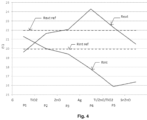
- FIG. 2 illustrates the influence of the position of the absorbent layer on the color variation.
- FIG. 3 illustrates the color variations on the green-red axis.
- the absorbent layer in a typical stack described above (II.2), the Lab colors in transmission or reflection.
- the thickness of the absorbent layer is chosen so that, regardless of the position considered, the solar factor of the material mounted in double glazing with the stack on face 2 is approximately 44%.
- dotted lines “b*rext ref”, “b*t ref”, “a*rext ref” and “a*t ref” respectively represent the values of b*Rext, b*T, a*Rext, a* T of the typical (or reference) stack not including an absorbent layer.
- the curves b*t, b*Rext, a*t and a*Rext respectively represent the values of b*t, b*Rext, a*t and a*Rext as a function of the position of the absorbent layer in the stack .
- the yellow shift is much greater when the absorbent layer is placed in direct contact with the substrate, and minimal when the absorbent layer is placed in direct contact with the silver layer.
- the dotted lines “Rext ref” and “Rint ref” respectively represent the Rext and Rint values of the typical (or reference) stack not including an absorbent layer.
- the “Rext” and “Rint” curves respectively represent the values of Rext and Rint as a function of the position of the absorbent layer in the stack.
- Table 2 lists the materials and physical thicknesses in nanometers (unless otherwise noted) of each layer or coating that constitutes the stacks according to their positions with respect to the substrate carrying the stack (last line at the bottom of the table). Table 2 Comp. 1 Inv. 1 Inv. 2 Inv. 3 Inv.
- Table 3 below lists the main optical characteristics measured when the materials are part of structural double glazing: 4-16-4 (Ar - 90%). The stack is positioned on face 2. Face 1 of the glazing being the outermost face of the glazing, as usual. Table 3: Double glazing structure 4-16-4 (Ar - 90%) mounted with stacking on face 2 Target value Comp.1 Inv. 1 Inv. 2 Inv. 3 Inv.
- the comparative example comp.1 does not make it possible to obtain the desired bluish appearance. Indeed, as previously explained, the presence of the absorbing layer near the substrate significantly absorbs the short visible wavelengths corresponding to blue.
Landscapes
- Chemical & Material Sciences (AREA)
- Engineering & Computer Science (AREA)
- Organic Chemistry (AREA)
- Chemical Kinetics & Catalysis (AREA)
- Materials Engineering (AREA)
- Life Sciences & Earth Sciences (AREA)
- General Chemical & Material Sciences (AREA)
- Geochemistry & Mineralogy (AREA)
- Structural Engineering (AREA)
- Civil Engineering (AREA)
- Health & Medical Sciences (AREA)
- Medicinal Chemistry (AREA)
- Polymers & Plastics (AREA)
- Inorganic Chemistry (AREA)
- Laminated Bodies (AREA)
- Surface Treatment Of Glass (AREA)
- Architecture (AREA)
Claims (15)
- Material, umfassend ein transparentes Substrat, das mit einer Stapelung von Dünnschichten beschichtet ist, umfassend ausgehend von dem Substrat:- eine untere Beschichtung, umfassend:- mindestens eine dielektrische Schicht,- mindestens eine absorbierende Schicht, die die Solarstrahlung in dem sichtbaren Teil des Spektrums absorbiert, die eine Dicke zwischen 0,2 und 9 nm aufweist,- mindestens eine dielektrische Schicht,- eine einzige metallische funktionelle Schicht auf Basis von Silber,- gegebenenfalls eine Sperrschicht,- eine obere Beschichtung, die mindestens eine dielektrische Schicht vorweist,- gegebenenfalls eine Schutzschicht,dadurch gekennzeichnet, dass- die absorbierende Schicht von dem Substrat und der funktionellen Schicht durch eine oder mehrere dielektrische Schichten getrennt ist,- die Dicke von allen dielektrischen Schichten, die zwischen der absorbierenden Schicht und der metallischen funktionellen Schicht eingefügt sind, zwischen 3 und 18 nm liegt,wenn das Material in einer Doppelverglasung mit einer Konfiguration verwendet wird: 4-16(Ar-90 %)-4, das heißt eine Konfiguration, die aus einem Material, umfassend ein Substrat, und einem anderen Glassubstrat von 4 mm besteht, wobei die zwei Substrate durch einen Zwischenlagengasspalt aus 90 % Argon und 10 % Luft mit einer Dicke von 16 mm getrennt sind, wobei die Stapelung auf einer Fläche 2 positioniert ist, die Fläche 1 die äußerste Fläche der Verglasung ist, es eine Lichttransmission größer als oder gleich 50 % aufweist.
- Material nach Anspruch 1, dadurch gekennzeichnet, dass, wenn das Material in einer Doppelverglasung mit der auf der Fläche 2 positionierten Stapelung montiert ist, die Doppelverglasung aufweist:- eine Selektivität größer als 1,45,- eine interne und externe Lichtreflexion geringer als 25 %,- einen Wert b* an externer Reflexion geringer als -5,- einen Wert b* an interner Reflexion geringer als -5.
- Material nach Anspruch 1 oder 2, dadurch gekennzeichnet, dass die Dicke von allen dielektrischen Schichten, die zwischen der absorbierenden Schicht und dem Substrat eingefügt sind, größer als 11 nm ist.
- Material nach einem der vorstehenden Ansprüche,
dadurch gekennzeichnet, dass die absorbierende Schicht ausgewählt ist aus:- metallischen Schichten auf Basis eines Metalls oder einer metallischen Legierung,- Schichten aus metallischem Nitrid, und- Schichten aus metallischem Oxynitrid,einem oder mehreren Elementen, die aus Palladium, Niob, Wolfram, rostfreiem Stahl, Titan, Chrom, Molybdän, Zirkonium, Nickel, Tantal, Zink ausgewählt sind. - Material nach einem der vorstehenden Ansprüche,
dadurch gekennzeichnet, dass die untere Beschichtung eine dielektrische Schicht auf Basis von Zinkoxid umfasst, die sich direkt in Kontakt mit der metallischen Schicht auf Basis von Silber befindet. - Material nach einem der vorstehenden Ansprüche,
dadurch gekennzeichnet, dass die untere Beschichtung eine Hochindexschicht auf Basis von Metalloxid umfasst, die einen Brechungsindex größer als 2,20 und eine Dicke größer als 5 nm aufweist. - Material nach einem der vorstehenden Ansprüche,
dadurch gekennzeichnet, dass die untere Beschichtung mindestens die Sequenz von in der folgenden Reihenfolge abgeschiedenen Schichten umfasst:- mindestens eine Schicht mit hohem Brechungsindex, aus Material mit Brechungsindex größer als oder gleich 2,20, wobei die physische Dicke der Schicht mit hohem Brechungsindex oder die Summe der physischen Dicken der Schichten mit hohem Brechungsindex zwischen 10 und 40 nm liegt,- mindestens eine absorbierende Schicht,- mindestens eine Zinkoxidschicht. - Material nach einem der vorstehenden Ansprüche,
dadurch gekennzeichnet, dass die obere Beschichtung mindestens eine Hochindexschicht auf Basis von Metalloxid umfasst, die einen Brechungsindex größer als 2,20 und eine Dicke größer als 5 nm aufweist. - Material nach einem der vorstehenden Ansprüche,
dadurch gekennzeichnet, dass die obere Beschichtung mindestens die Sequenz von in der folgenden Reihenfolge oberhalb der funktionellen Schicht abgeschiedenen Dünnschichten umfasst:- mindestens eine Sperrschicht,- mindestens eine Schicht auf Basis von Zinkoxid,- mindestens eine Schicht mit hohem Brechungsindex, aus Material mit Brechungsindex größer als oder gleich 2,20, wobei die physische Dicke der Schicht mit hohem Brechungsindex oder die Summe der physischen Dicken der Schichten mit hohem Brechungsindex zwischen 10 und 40 nm liegt,- mindestens eine dielektrische Schicht, die einen Brechungsindex geringer als 2,20 und eine Dicke größer als 5 nm aufweist, die sich über der Hochindexschicht befindet. - Material nach einem der vorstehenden Ansprüche,
dadurch gekennzeichnet, dass die Hochindexschichten auf Basis von Metalloxid aus Titanoxid-, Nioboxidschichten oder Schichten einer aus Titan und Niob erhaltenen Legierung ausgewählt sind. - Material nach einem der vorstehenden Ansprüche,
dadurch gekennzeichnet, dass das Substrat aus Glas, insbesondere Kalknatronsilikatglas, oder aus polymerem organischem Material besteht. - Mehrfachverglasung, umfassend mindestens ein Material nach einem der vorstehenden Ansprüche und mindestens ein zweites Substrat, wobei das Material und das zweite Substrat durch mindestens einen Zwischenlagengasspalt getrennt sind.
- Mehrfachverglasung nach Anspruch 12, dadurch gekennzeichnet, dass, die Verglasung eine Doppelverglasung ist, die mit der auf der Fläche 2 positionierten Stapelung aufweist:- eine Selektivität größer als 1,45,- eine interne und externe Lichtreflexion geringer als 25 %,- einen Wert b* an externer Reflexion b*Rext geringer als -5,- einen Wert b* an interner Reflexion b*Rint geringer als -5.
- Verglasung nach einem der Ansprüche 12 bis 13,
dadurch gekennzeichnet, dass sie eine interne und externe Lichtreflexion geringer als 24 % aufweist. - Verglasung nach einem der Ansprüche 12 bis 14,
dadurch gekennzeichnet, dass sie aufweist:- eine bei einer Transmission neutrale Farbe, mit einem b*T geringer als 6,- eine bei der Reflexion blaue Farbe mit einem b*Rext und bRint geringer als -6 und gegebenenfalls einem a*Rext und einem a*Rint geringer als 5.
Priority Applications (1)
| Application Number | Priority Date | Filing Date | Title |
|---|---|---|---|
| EP24190730.2A EP4442664A3 (de) | 2017-11-20 | 2018-11-19 | Material mit einer einzigen funktionellen schicht auf silberbasis und einer absorbierenden schicht |
Applications Claiming Priority (2)
| Application Number | Priority Date | Filing Date | Title |
|---|---|---|---|
| FR1760922A FR3073840B1 (fr) | 2017-11-20 | 2017-11-20 | Materiau comprenant une seule couche fonctionnelle a base d'argent et une couche absorbante |
| PCT/FR2018/052904 WO2019097192A1 (fr) | 2017-11-20 | 2018-11-19 | Materiau comprenant une seule couche fonctionnelle a base d'argent et une couche absorbante |
Related Child Applications (1)
| Application Number | Title | Priority Date | Filing Date |
|---|---|---|---|
| EP24190730.2A Division EP4442664A3 (de) | 2017-11-20 | 2018-11-19 | Material mit einer einzigen funktionellen schicht auf silberbasis und einer absorbierenden schicht |
Publications (2)
| Publication Number | Publication Date |
|---|---|
| EP3713890A1 EP3713890A1 (de) | 2020-09-30 |
| EP3713890B1 true EP3713890B1 (de) | 2024-08-07 |
Family
ID=63963053
Family Applications (2)
| Application Number | Title | Priority Date | Filing Date |
|---|---|---|---|
| EP24190730.2A Pending EP4442664A3 (de) | 2017-11-20 | 2018-11-19 | Material mit einer einzigen funktionellen schicht auf silberbasis und einer absorbierenden schicht |
| EP18829898.8A Active EP3713890B1 (de) | 2017-11-20 | 2018-11-19 | Material mit einer einzigen funktionellen schicht mit silber und einer absorbierenden schicht |
Family Applications Before (1)
| Application Number | Title | Priority Date | Filing Date |
|---|---|---|---|
| EP24190730.2A Pending EP4442664A3 (de) | 2017-11-20 | 2018-11-19 | Material mit einer einzigen funktionellen schicht auf silberbasis und einer absorbierenden schicht |
Country Status (10)
| Country | Link |
|---|---|
| US (1) | US11174196B2 (de) |
| EP (2) | EP4442664A3 (de) |
| KR (1) | KR20200081501A (de) |
| CN (1) | CN111566063A (de) |
| CO (1) | CO2020006142A2 (de) |
| ES (1) | ES2990149T3 (de) |
| FR (1) | FR3073840B1 (de) |
| MX (1) | MX2020005190A (de) |
| PL (1) | PL3713890T3 (de) |
| WO (1) | WO2019097192A1 (de) |
Families Citing this family (8)
| Publication number | Priority date | Publication date | Assignee | Title |
|---|---|---|---|---|
| GB201910980D0 (en) * | 2019-08-01 | 2019-09-18 | Pilkington Group Ltd | coated Substrate |
| GB201910976D0 (en) * | 2019-08-01 | 2019-09-18 | Pilkington Group Ltd | Toughenable coated substrate |
| FR3101278B1 (fr) * | 2019-09-30 | 2023-11-24 | Saint Gobain | Vitrage feuillete a basse transmission lumineuse et haute selectivite |
| FR3124180B1 (fr) | 2021-06-18 | 2024-02-16 | Saint Gobain | Vitrage comprenant un revetement fonctionnel et un element absorbant |
| FR3124114B1 (fr) * | 2021-06-18 | 2024-07-19 | Saint Gobain | Vitrage comprenant un revetement fonctionnel et un element absorbant d’ajustement colorimetrique |
| FR3133057B1 (fr) * | 2022-02-25 | 2024-05-24 | Saint Gobain | Matériau comprenant un revêtement contrôle solaire |
| CN117088620A (zh) * | 2023-08-24 | 2023-11-21 | 信义玻璃(江苏)有限公司 | 三银中透高性能低辐射节能镀膜玻璃及应用 |
| FR3164943A1 (fr) | 2024-07-25 | 2026-01-30 | Saint-Gobain Glass France | Vitrage comprenant un revetement fonctionnel et une couche absorbante |
Citations (4)
| Publication number | Priority date | Publication date | Assignee | Title |
|---|---|---|---|---|
| DE19922162A1 (de) | 1999-05-12 | 2000-11-30 | Fraunhofer Ges Forschung | Optisches transparentes Schichtsystem auf transparentem Material und Verfahren zur Herstellung |
| CN1931764A (zh) | 2006-10-19 | 2007-03-21 | 林嘉宏 | 可钢化低辐射镀膜玻璃及其生产方法 |
| WO2010072974A1 (fr) | 2008-12-22 | 2010-07-01 | Saint-Gobain Glass France | Substrat muni d'un empilement a proprietes thermiques et a couches absorbantes |
| CN203864111U (zh) | 2013-12-21 | 2014-10-08 | 揭阳市宏光镀膜玻璃有限公司 | 一种新型低辐射玻璃 |
Family Cites Families (7)
| Publication number | Priority date | Publication date | Assignee | Title |
|---|---|---|---|---|
| DE3027256A1 (de) * | 1980-07-18 | 1982-02-18 | Robert Bosch Gmbh, 7000 Stuttgart | Mehrschichtsystem fuer waermeschutzanwendungen und verfahren zu seiner herstellung |
| FR2940271B1 (fr) | 2008-12-22 | 2011-10-21 | Saint Gobain | Substrat muni d'un empilement a proprietes thermiques et a couche(s) absorbante(s) |
| US9028956B2 (en) * | 2010-04-22 | 2015-05-12 | Centre Luxembourgeois De Recherches Pour Le Verre Et La Ceramique S.A. (C.R.V.C.) | Coated article having low-E coating with absorber layer(s) |
| US8337988B2 (en) * | 2010-04-22 | 2012-12-25 | Centre Luxembourgeois De Recherches Pour Le Verre Et La Ceramique S.A. (C.R.V.C.) | Coated article having low-E coating with absorber layer(s) |
| DE102011114669B3 (de) * | 2011-09-30 | 2012-10-18 | Arcon Flachglas-Veredlung Gmbh & Co. Kg | Schichtsystem für Sonnenschutzglas, Sonnenschutzglas und Verfahren zur Herstellung von Sonnenschutzglas |
| FR2995888B1 (fr) * | 2012-09-21 | 2016-12-02 | Saint Gobain | Substrat muni d'un empilement a proprietes thermiques et a couche absorbante. |
| FR3021310B1 (fr) * | 2014-05-23 | 2022-11-18 | Saint Gobain | Substrat muni d'un empilement a couche metallique partielle, vitrage et procede. |
-
2017
- 2017-11-20 FR FR1760922A patent/FR3073840B1/fr active Active
-
2018
- 2018-11-19 PL PL18829898.8T patent/PL3713890T3/pl unknown
- 2018-11-19 MX MX2020005190A patent/MX2020005190A/es unknown
- 2018-11-19 ES ES18829898T patent/ES2990149T3/es active Active
- 2018-11-19 EP EP24190730.2A patent/EP4442664A3/de active Pending
- 2018-11-19 EP EP18829898.8A patent/EP3713890B1/de active Active
- 2018-11-19 CN CN201880086934.8A patent/CN111566063A/zh active Pending
- 2018-11-19 WO PCT/FR2018/052904 patent/WO2019097192A1/fr not_active Ceased
- 2018-11-19 KR KR1020207017607A patent/KR20200081501A/ko not_active Withdrawn
- 2018-11-19 US US16/765,336 patent/US11174196B2/en active Active
-
2020
- 2020-05-19 CO CONC2020/0006142A patent/CO2020006142A2/es unknown
Patent Citations (4)
| Publication number | Priority date | Publication date | Assignee | Title |
|---|---|---|---|---|
| DE19922162A1 (de) | 1999-05-12 | 2000-11-30 | Fraunhofer Ges Forschung | Optisches transparentes Schichtsystem auf transparentem Material und Verfahren zur Herstellung |
| CN1931764A (zh) | 2006-10-19 | 2007-03-21 | 林嘉宏 | 可钢化低辐射镀膜玻璃及其生产方法 |
| WO2010072974A1 (fr) | 2008-12-22 | 2010-07-01 | Saint-Gobain Glass France | Substrat muni d'un empilement a proprietes thermiques et a couches absorbantes |
| CN203864111U (zh) | 2013-12-21 | 2014-10-08 | 揭阳市宏光镀膜玻璃有限公司 | 一种新型低辐射玻璃 |
Also Published As
| Publication number | Publication date |
|---|---|
| CN111566063A (zh) | 2020-08-21 |
| KR20200081501A (ko) | 2020-07-07 |
| EP4442664A2 (de) | 2024-10-09 |
| FR3073840B1 (fr) | 2020-07-17 |
| US20200354266A1 (en) | 2020-11-12 |
| WO2019097192A1 (fr) | 2019-05-23 |
| EP3713890A1 (de) | 2020-09-30 |
| EP4442664A3 (de) | 2025-01-22 |
| FR3073840A1 (fr) | 2019-05-24 |
| PL3713890T3 (pl) | 2024-11-25 |
| CO2020006142A2 (es) | 2020-08-10 |
| ES2990149T3 (es) | 2024-11-29 |
| US11174196B2 (en) | 2021-11-16 |
| BR112020009862A2 (pt) | 2020-11-03 |
| MX2020005190A (es) | 2020-12-03 |
Similar Documents
| Publication | Publication Date | Title |
|---|---|---|
| EP3713890B1 (de) | Material mit einer einzigen funktionellen schicht mit silber und einer absorbierenden schicht | |
| EP3867060B1 (de) | Verglasung mit einer funktionellen beschichtung und einer absorbierenden beschichtung mit kolorimetrischer einstellung | |
| EP2577368B2 (de) | Sonnenschutzverglasung mit niedrigem g-wert | |
| EP3319917B1 (de) | Substrat mit einem stapel mit wärmeeigenschaften | |
| EP3319919B1 (de) | Substrat mit einem stapel mit wärmeeigenschaften | |
| EP3873863B1 (de) | Material mit einem substrat versehen mit einem stapel aus dünnschichten mit thermischen eigenschaften | |
| EP3655371B1 (de) | Material mit einem stapel mit wärmeeigenschaften | |
| EP3172175B2 (de) | Zierglasscheibe | |
| EP3129329B1 (de) | Substrat mit einem stapel mit thermischen eigenschaften | |
| WO2020079373A1 (fr) | Vitrage comprenant un revetement fonctionnel et un revetement d'ajustement colorimetrique | |
| EP3762342A1 (de) | Mit einem stapel mit wärmeeigenschaften versehenes material | |
| EP3917895B1 (de) | Substrat mit einem stapel mit thermischen eigenschaften und einer absorbierenden schicht | |
| FR3072957A1 (fr) | Substrat muni d'un empilement a proprietes thermiques | |
| EP4037901B1 (de) | Verbundverglasung mit geringer lichtdurchlässigkeit und hoher selektivität und herstellungsverfahren | |
| EP3826973B1 (de) | Material mit einem substrat mit einem stapel mit thermischen eigenschaften | |
| EP4214172B1 (de) | Material mit einem substrat mit einem stapel aus dünnschichten mit thermischen eigenschaften | |
| EP4433434A1 (de) | Material beschichtet mit einer funktionsschicht mit einer hochindexschicht | |
| EP4291539B1 (de) | Transparentes substrat mit einer beschichtung aus einem dünnschichtstapel | |
| EP4452882B1 (de) | Transparentes substrat mit einem funktionellen stapel aus dünnen schichten | |
| EP3319920B1 (de) | Material mit einer vielzahl von dünnen schichten | |
| FR3148023A1 (fr) | Substrat transparent muni d’un empilement fonctionnel de couches minces |
Legal Events
| Date | Code | Title | Description |
|---|---|---|---|
| STAA | Information on the status of an ep patent application or granted ep patent |
Free format text: STATUS: UNKNOWN |
|
| STAA | Information on the status of an ep patent application or granted ep patent |
Free format text: STATUS: THE INTERNATIONAL PUBLICATION HAS BEEN MADE |
|
| PUAI | Public reference made under article 153(3) epc to a published international application that has entered the european phase |
Free format text: ORIGINAL CODE: 0009012 |
|
| STAA | Information on the status of an ep patent application or granted ep patent |
Free format text: STATUS: REQUEST FOR EXAMINATION WAS MADE |
|
| 17P | Request for examination filed |
Effective date: 20200622 |
|
| AK | Designated contracting states |
Kind code of ref document: A1 Designated state(s): AL AT BE BG CH CY CZ DE DK EE ES FI FR GB GR HR HU IE IS IT LI LT LU LV MC MK MT NL NO PL PT RO RS SE SI SK SM TR |
|
| AX | Request for extension of the european patent |
Extension state: BA ME |
|
| DAV | Request for validation of the european patent (deleted) | ||
| DAX | Request for extension of the european patent (deleted) | ||
| STAA | Information on the status of an ep patent application or granted ep patent |
Free format text: STATUS: EXAMINATION IS IN PROGRESS |
|
| 17Q | First examination report despatched |
Effective date: 20220301 |
|
| 17Q | First examination report despatched |
Effective date: 20220302 |
|
| GRAP | Despatch of communication of intention to grant a patent |
Free format text: ORIGINAL CODE: EPIDOSNIGR1 |
|
| STAA | Information on the status of an ep patent application or granted ep patent |
Free format text: STATUS: GRANT OF PATENT IS INTENDED |
|
| INTG | Intention to grant announced |
Effective date: 20240321 |
|
| GRAS | Grant fee paid |
Free format text: ORIGINAL CODE: EPIDOSNIGR3 |
|
| GRAA | (expected) grant |
Free format text: ORIGINAL CODE: 0009210 |
|
| STAA | Information on the status of an ep patent application or granted ep patent |
Free format text: STATUS: THE PATENT HAS BEEN GRANTED |
|
| AK | Designated contracting states |
Kind code of ref document: B1 Designated state(s): AL AT BE BG CH CY CZ DE DK EE ES FI FR GB GR HR HU IE IS IT LI LT LU LV MC MK MT NL NO PL PT RO RS SE SI SK SM TR |
|
| REG | Reference to a national code |
Ref country code: GB Ref legal event code: FG4D Free format text: NOT ENGLISH |
|
| REG | Reference to a national code |
Ref country code: CH Ref legal event code: EP |
|
| REG | Reference to a national code |
Ref country code: DE Ref legal event code: R096 Ref document number: 602018072878 Country of ref document: DE |
|
| REG | Reference to a national code |
Ref country code: IE Ref legal event code: FG4D Free format text: LANGUAGE OF EP DOCUMENT: FRENCH |
|
| REG | Reference to a national code |
Ref country code: LT Ref legal event code: MG9D |
|
| REG | Reference to a national code |
Ref country code: ES Ref legal event code: FG2A Ref document number: 2990149 Country of ref document: ES Kind code of ref document: T3 Effective date: 20241129 |
|
| REG | Reference to a national code |
Ref country code: NL Ref legal event code: MP Effective date: 20240807 |
|
| PG25 | Lapsed in a contracting state [announced via postgrant information from national office to epo] |
Ref country code: NO Free format text: LAPSE BECAUSE OF FAILURE TO SUBMIT A TRANSLATION OF THE DESCRIPTION OR TO PAY THE FEE WITHIN THE PRESCRIBED TIME-LIMIT Effective date: 20241107 |
|
| REG | Reference to a national code |
Ref country code: AT Ref legal event code: MK05 Ref document number: 1710782 Country of ref document: AT Kind code of ref document: T Effective date: 20240807 |
|
| PG25 | Lapsed in a contracting state [announced via postgrant information from national office to epo] |
Ref country code: PT Free format text: LAPSE BECAUSE OF FAILURE TO SUBMIT A TRANSLATION OF THE DESCRIPTION OR TO PAY THE FEE WITHIN THE PRESCRIBED TIME-LIMIT Effective date: 20241209 Ref country code: NL Free format text: LAPSE BECAUSE OF FAILURE TO SUBMIT A TRANSLATION OF THE DESCRIPTION OR TO PAY THE FEE WITHIN THE PRESCRIBED TIME-LIMIT Effective date: 20240807 Ref country code: FI Free format text: LAPSE BECAUSE OF FAILURE TO SUBMIT A TRANSLATION OF THE DESCRIPTION OR TO PAY THE FEE WITHIN THE PRESCRIBED TIME-LIMIT Effective date: 20240807 Ref country code: GR Free format text: LAPSE BECAUSE OF FAILURE TO SUBMIT A TRANSLATION OF THE DESCRIPTION OR TO PAY THE FEE WITHIN THE PRESCRIBED TIME-LIMIT Effective date: 20241108 |
|
| PG25 | Lapsed in a contracting state [announced via postgrant information from national office to epo] |
Ref country code: LV Free format text: LAPSE BECAUSE OF FAILURE TO SUBMIT A TRANSLATION OF THE DESCRIPTION OR TO PAY THE FEE WITHIN THE PRESCRIBED TIME-LIMIT Effective date: 20240807 |
|
| PG25 | Lapsed in a contracting state [announced via postgrant information from national office to epo] |
Ref country code: AT Free format text: LAPSE BECAUSE OF FAILURE TO SUBMIT A TRANSLATION OF THE DESCRIPTION OR TO PAY THE FEE WITHIN THE PRESCRIBED TIME-LIMIT Effective date: 20240807 Ref country code: IS Free format text: LAPSE BECAUSE OF FAILURE TO SUBMIT A TRANSLATION OF THE DESCRIPTION OR TO PAY THE FEE WITHIN THE PRESCRIBED TIME-LIMIT Effective date: 20241207 |
|
| PG25 | Lapsed in a contracting state [announced via postgrant information from national office to epo] |
Ref country code: HR Free format text: LAPSE BECAUSE OF FAILURE TO SUBMIT A TRANSLATION OF THE DESCRIPTION OR TO PAY THE FEE WITHIN THE PRESCRIBED TIME-LIMIT Effective date: 20240807 |
|
| PG25 | Lapsed in a contracting state [announced via postgrant information from national office to epo] |
Ref country code: RS Free format text: LAPSE BECAUSE OF FAILURE TO SUBMIT A TRANSLATION OF THE DESCRIPTION OR TO PAY THE FEE WITHIN THE PRESCRIBED TIME-LIMIT Effective date: 20241107 |
|
| PG25 | Lapsed in a contracting state [announced via postgrant information from national office to epo] |
Ref country code: RS Free format text: LAPSE BECAUSE OF FAILURE TO SUBMIT A TRANSLATION OF THE DESCRIPTION OR TO PAY THE FEE WITHIN THE PRESCRIBED TIME-LIMIT Effective date: 20241107 Ref country code: PT Free format text: LAPSE BECAUSE OF FAILURE TO SUBMIT A TRANSLATION OF THE DESCRIPTION OR TO PAY THE FEE WITHIN THE PRESCRIBED TIME-LIMIT Effective date: 20241209 Ref country code: NO Free format text: LAPSE BECAUSE OF FAILURE TO SUBMIT A TRANSLATION OF THE DESCRIPTION OR TO PAY THE FEE WITHIN THE PRESCRIBED TIME-LIMIT Effective date: 20241107 Ref country code: NL Free format text: LAPSE BECAUSE OF FAILURE TO SUBMIT A TRANSLATION OF THE DESCRIPTION OR TO PAY THE FEE WITHIN THE PRESCRIBED TIME-LIMIT Effective date: 20240807 Ref country code: LV Free format text: LAPSE BECAUSE OF FAILURE TO SUBMIT A TRANSLATION OF THE DESCRIPTION OR TO PAY THE FEE WITHIN THE PRESCRIBED TIME-LIMIT Effective date: 20240807 Ref country code: IS Free format text: LAPSE BECAUSE OF FAILURE TO SUBMIT A TRANSLATION OF THE DESCRIPTION OR TO PAY THE FEE WITHIN THE PRESCRIBED TIME-LIMIT Effective date: 20241207 Ref country code: HR Free format text: LAPSE BECAUSE OF FAILURE TO SUBMIT A TRANSLATION OF THE DESCRIPTION OR TO PAY THE FEE WITHIN THE PRESCRIBED TIME-LIMIT Effective date: 20240807 Ref country code: GR Free format text: LAPSE BECAUSE OF FAILURE TO SUBMIT A TRANSLATION OF THE DESCRIPTION OR TO PAY THE FEE WITHIN THE PRESCRIBED TIME-LIMIT Effective date: 20241108 Ref country code: FI Free format text: LAPSE BECAUSE OF FAILURE TO SUBMIT A TRANSLATION OF THE DESCRIPTION OR TO PAY THE FEE WITHIN THE PRESCRIBED TIME-LIMIT Effective date: 20240807 Ref country code: AT Free format text: LAPSE BECAUSE OF FAILURE TO SUBMIT A TRANSLATION OF THE DESCRIPTION OR TO PAY THE FEE WITHIN THE PRESCRIBED TIME-LIMIT Effective date: 20240807 |
|
| PG25 | Lapsed in a contracting state [announced via postgrant information from national office to epo] |
Ref country code: DK Free format text: LAPSE BECAUSE OF FAILURE TO SUBMIT A TRANSLATION OF THE DESCRIPTION OR TO PAY THE FEE WITHIN THE PRESCRIBED TIME-LIMIT Effective date: 20240807 Ref country code: SM Free format text: LAPSE BECAUSE OF FAILURE TO SUBMIT A TRANSLATION OF THE DESCRIPTION OR TO PAY THE FEE WITHIN THE PRESCRIBED TIME-LIMIT Effective date: 20240807 |
|
| PG25 | Lapsed in a contracting state [announced via postgrant information from national office to epo] |
Ref country code: EE Free format text: LAPSE BECAUSE OF FAILURE TO SUBMIT A TRANSLATION OF THE DESCRIPTION OR TO PAY THE FEE WITHIN THE PRESCRIBED TIME-LIMIT Effective date: 20240807 |
|
| PG25 | Lapsed in a contracting state [announced via postgrant information from national office to epo] |
Ref country code: SK Free format text: LAPSE BECAUSE OF FAILURE TO SUBMIT A TRANSLATION OF THE DESCRIPTION OR TO PAY THE FEE WITHIN THE PRESCRIBED TIME-LIMIT Effective date: 20240807 |
|
| REG | Reference to a national code |
Ref country code: DE Ref legal event code: R026 Ref document number: 602018072878 Country of ref document: DE |
|
| PLBI | Opposition filed |
Free format text: ORIGINAL CODE: 0009260 |
|
| 26 | Opposition filed |
Opponent name: AGC GLASS EUROPE Effective date: 20250430 |
|
| REG | Reference to a national code |
Ref country code: CH Ref legal event code: PL |
|
| PG25 | Lapsed in a contracting state [announced via postgrant information from national office to epo] |
Ref country code: MC Free format text: LAPSE BECAUSE OF FAILURE TO SUBMIT A TRANSLATION OF THE DESCRIPTION OR TO PAY THE FEE WITHIN THE PRESCRIBED TIME-LIMIT Effective date: 20240807 |
|
| PLAB | Opposition data, opponent's data or that of the opponent's representative modified |
Free format text: ORIGINAL CODE: 0009299OPPO |
|
| PG25 | Lapsed in a contracting state [announced via postgrant information from national office to epo] |
Ref country code: LU Free format text: LAPSE BECAUSE OF NON-PAYMENT OF DUE FEES Effective date: 20241119 |
|
| PLAX | Notice of opposition and request to file observation + time limit sent |
Free format text: ORIGINAL CODE: EPIDOSNOBS2 |
|
| REG | Reference to a national code |
Ref country code: CH Ref legal event code: PL |
|
| PG25 | Lapsed in a contracting state [announced via postgrant information from national office to epo] |
Ref country code: CH Free format text: LAPSE BECAUSE OF NON-PAYMENT OF DUE FEES Effective date: 20241130 |
|
| R26 | Opposition filed (corrected) |
Opponent name: AGC GLASS EUROPE Effective date: 20250430 |
|
| REG | Reference to a national code |
Ref country code: BE Ref legal event code: MM Effective date: 20241130 |
|
| PG25 | Lapsed in a contracting state [announced via postgrant information from national office to epo] |
Ref country code: SE Free format text: LAPSE BECAUSE OF FAILURE TO SUBMIT A TRANSLATION OF THE DESCRIPTION OR TO PAY THE FEE WITHIN THE PRESCRIBED TIME-LIMIT Effective date: 20240807 |
|
| PG25 | Lapsed in a contracting state [announced via postgrant information from national office to epo] |
Ref country code: BE Free format text: LAPSE BECAUSE OF NON-PAYMENT OF DUE FEES Effective date: 20241130 |
|
| PGFP | Annual fee paid to national office [announced via postgrant information from national office to epo] |
Ref country code: FR Payment date: 20250930 Year of fee payment: 8 |
|
| PG25 | Lapsed in a contracting state [announced via postgrant information from national office to epo] |
Ref country code: IE Free format text: LAPSE BECAUSE OF NON-PAYMENT OF DUE FEES Effective date: 20241119 |
|
| PLBB | Reply of patent proprietor to notice(s) of opposition received |
Free format text: ORIGINAL CODE: EPIDOSNOBS3 |
|
| PGFP | Annual fee paid to national office [announced via postgrant information from national office to epo] |
Ref country code: DE Payment date: 20250930 Year of fee payment: 8 |
|
| PGFP | Annual fee paid to national office [announced via postgrant information from national office to epo] |
Ref country code: GB Payment date: 20251001 Year of fee payment: 8 |
|
| PG25 | Lapsed in a contracting state [announced via postgrant information from national office to epo] |
Ref country code: IT Free format text: LAPSE BECAUSE OF NON-PAYMENT OF DUE FEES Effective date: 20241119 |
|
| PGFP | Annual fee paid to national office [announced via postgrant information from national office to epo] |
Ref country code: TR Payment date: 20251106 Year of fee payment: 8 |
|
| PGFP | Annual fee paid to national office [announced via postgrant information from national office to epo] |
Ref country code: CZ Payment date: 20251107 Year of fee payment: 8 |
|
| PGFP | Annual fee paid to national office [announced via postgrant information from national office to epo] |
Ref country code: PL Payment date: 20251011 Year of fee payment: 8 Ref country code: BG Payment date: 20251016 Year of fee payment: 8 |
|
| PGFP | Annual fee paid to national office [announced via postgrant information from national office to epo] |
Ref country code: RO Payment date: 20251027 Year of fee payment: 8 |
|
| PGFP | Annual fee paid to national office [announced via postgrant information from national office to epo] |
Ref country code: ES Payment date: 20251211 Year of fee payment: 8 |
|
| PG25 | Lapsed in a contracting state [announced via postgrant information from national office to epo] |
Ref country code: HU Free format text: LAPSE BECAUSE OF FAILURE TO SUBMIT A TRANSLATION OF THE DESCRIPTION OR TO PAY THE FEE WITHIN THE PRESCRIBED TIME-LIMIT; INVALID AB INITIO Effective date: 20181119 |
|
| PG25 | Lapsed in a contracting state [announced via postgrant information from national office to epo] |
Ref country code: CY Free format text: LAPSE BECAUSE OF FAILURE TO SUBMIT A TRANSLATION OF THE DESCRIPTION OR TO PAY THE FEE WITHIN THE PRESCRIBED TIME-LIMIT; INVALID AB INITIO Effective date: 20181119 |
|
| PG25 | Lapsed in a contracting state [announced via postgrant information from national office to epo] |
Ref country code: IT Free format text: LAPSE BECAUSE OF NON-PAYMENT OF DUE FEES Effective date: 20241119 |
|
| PGFP | Annual fee paid to national office [announced via postgrant information from national office to epo] |
Ref country code: IT Payment date: 20251022 Year of fee payment: 8 |
|
| PGRI | Patent reinstated in contracting state [announced from national office to epo] |
Ref country code: IT Effective date: 20250331 |