EP3714976A1 - Support de chromatographie à échange d'anions hydrophile - Google Patents
Support de chromatographie à échange d'anions hydrophile Download PDFInfo
- Publication number
- EP3714976A1 EP3714976A1 EP20162423.6A EP20162423A EP3714976A1 EP 3714976 A1 EP3714976 A1 EP 3714976A1 EP 20162423 A EP20162423 A EP 20162423A EP 3714976 A1 EP3714976 A1 EP 3714976A1
- Authority
- EP
- European Patent Office
- Prior art keywords
- condensation
- alkylamine
- layer
- anion exchange
- stationary phase
- Prior art date
- Legal status (The legal status is an assumption and is not a legal conclusion. Google has not performed a legal analysis and makes no representation as to the accuracy of the status listed.)
- Granted
Links
Images






Classifications
-
- B—PERFORMING OPERATIONS; TRANSPORTING
- B01—PHYSICAL OR CHEMICAL PROCESSES OR APPARATUS IN GENERAL
- B01J—CHEMICAL OR PHYSICAL PROCESSES, e.g. CATALYSIS OR COLLOID CHEMISTRY; THEIR RELEVANT APPARATUS
- B01J41/00—Anion exchange; Use of material as anion exchangers; Treatment of material for improving the anion exchange properties
- B01J41/08—Use of material as anion exchangers; Treatment of material for improving the anion exchange properties
-
- B—PERFORMING OPERATIONS; TRANSPORTING
- B01—PHYSICAL OR CHEMICAL PROCESSES OR APPARATUS IN GENERAL
- B01D—SEPARATION
- B01D15/00—Separating processes involving the treatment of liquids with solid sorbents; Apparatus therefor
- B01D15/08—Selective adsorption, e.g. chromatography
- B01D15/10—Selective adsorption, e.g. chromatography characterised by constructional or operational features
- B01D15/20—Selective adsorption, e.g. chromatography characterised by constructional or operational features relating to the conditioning of the sorbent material
-
- B—PERFORMING OPERATIONS; TRANSPORTING
- B01—PHYSICAL OR CHEMICAL PROCESSES OR APPARATUS IN GENERAL
- B01D—SEPARATION
- B01D15/00—Separating processes involving the treatment of liquids with solid sorbents; Apparatus therefor
- B01D15/08—Selective adsorption, e.g. chromatography
- B01D15/26—Selective adsorption, e.g. chromatography characterised by the separation mechanism
- B01D15/36—Selective adsorption, e.g. chromatography characterised by the separation mechanism involving ionic interaction, e.g. ion-exchange, ion-pair, ion-suppression or ion-exclusion
- B01D15/361—Ion-exchange
- B01D15/363—Anion-exchange
-
- B—PERFORMING OPERATIONS; TRANSPORTING
- B01—PHYSICAL OR CHEMICAL PROCESSES OR APPARATUS IN GENERAL
- B01J—CHEMICAL OR PHYSICAL PROCESSES, e.g. CATALYSIS OR COLLOID CHEMISTRY; THEIR RELEVANT APPARATUS
- B01J41/00—Anion exchange; Use of material as anion exchangers; Treatment of material for improving the anion exchange properties
- B01J41/04—Processes using organic exchangers
- B01J41/05—Processes using organic exchangers in the strongly basic form
-
- B—PERFORMING OPERATIONS; TRANSPORTING
- B01—PHYSICAL OR CHEMICAL PROCESSES OR APPARATUS IN GENERAL
- B01J—CHEMICAL OR PHYSICAL PROCESSES, e.g. CATALYSIS OR COLLOID CHEMISTRY; THEIR RELEVANT APPARATUS
- B01J41/00—Anion exchange; Use of material as anion exchangers; Treatment of material for improving the anion exchange properties
- B01J41/08—Use of material as anion exchangers; Treatment of material for improving the anion exchange properties
- B01J41/12—Macromolecular compounds
- B01J41/13—Macromolecular compounds obtained otherwise than by reactions only involving unsaturated carbon-to-carbon bonds
-
- B—PERFORMING OPERATIONS; TRANSPORTING
- B01—PHYSICAL OR CHEMICAL PROCESSES OR APPARATUS IN GENERAL
- B01J—CHEMICAL OR PHYSICAL PROCESSES, e.g. CATALYSIS OR COLLOID CHEMISTRY; THEIR RELEVANT APPARATUS
- B01J41/00—Anion exchange; Use of material as anion exchangers; Treatment of material for improving the anion exchange properties
- B01J41/20—Anion exchangers for chromatographic processes
-
- B—PERFORMING OPERATIONS; TRANSPORTING
- B01—PHYSICAL OR CHEMICAL PROCESSES OR APPARATUS IN GENERAL
- B01J—CHEMICAL OR PHYSICAL PROCESSES, e.g. CATALYSIS OR COLLOID CHEMISTRY; THEIR RELEVANT APPARATUS
- B01J47/00—Ion-exchange processes in general; Apparatus therefor
- B01J47/016—Modification or after-treatment of ion-exchangers
-
- G—PHYSICS
- G01—MEASURING; TESTING
- G01N—INVESTIGATING OR ANALYSING MATERIALS BY DETERMINING THEIR CHEMICAL OR PHYSICAL PROPERTIES
- G01N30/00—Investigating or analysing materials by separation into components using adsorption, absorption or similar phenomena or using ion-exchange, e.g. chromatography or field flow fractionation
- G01N30/02—Column chromatography
- G01N2030/022—Column chromatography characterised by the kind of separation mechanism
- G01N2030/027—Liquid chromatography
-
- G—PHYSICS
- G01—MEASURING; TESTING
- G01N—INVESTIGATING OR ANALYSING MATERIALS BY DETERMINING THEIR CHEMICAL OR PHYSICAL PROPERTIES
- G01N30/00—Investigating or analysing materials by separation into components using adsorption, absorption or similar phenomena or using ion-exchange, e.g. chromatography or field flow fractionation
- G01N30/02—Column chromatography
- G01N30/50—Conditioning of the sorbent material or stationary liquid
- G01N30/52—Physical parameters
- G01N2030/524—Physical parameters structural properties
- G01N2030/525—Physical parameters structural properties surface properties, e.g. porosity
-
- G—PHYSICS
- G01—MEASURING; TESTING
- G01N—INVESTIGATING OR ANALYSING MATERIALS BY DETERMINING THEIR CHEMICAL OR PHYSICAL PROPERTIES
- G01N30/00—Investigating or analysing materials by separation into components using adsorption, absorption or similar phenomena or using ion-exchange, e.g. chromatography or field flow fractionation
- G01N30/02—Column chromatography
- G01N30/50—Conditioning of the sorbent material or stationary liquid
- G01N30/52—Physical parameters
-
- G—PHYSICS
- G01—MEASURING; TESTING
- G01N—INVESTIGATING OR ANALYSING MATERIALS BY DETERMINING THEIR CHEMICAL OR PHYSICAL PROPERTIES
- G01N30/00—Investigating or analysing materials by separation into components using adsorption, absorption or similar phenomena or using ion-exchange, e.g. chromatography or field flow fractionation
- G01N30/96—Investigating or analysing materials by separation into components using adsorption, absorption or similar phenomena or using ion-exchange, e.g. chromatography or field flow fractionation using ion-exchange
Definitions
- Chromatography is a widely used analytical technique for the chemical analysis and separation of molecules. Chromatography involves the separation of one or more analyte species from other matrix components present in a sample.
- a stationary phase of a chromatography column is typically selected so that there is an interaction with the analyte. Such interactions can be ionic, hydrophilic, hydrophobic, or a combination thereof.
- the stationary phase can be derivatized with ionic moieties that ideally will bind to ionic analytes and matrix components with varying levels of affinity.
- a mobile phase is percolated through the stationary phase and competes with the analyte and matrix components for binding to the ionic moieties.
- the mobile phase or eluent are terms used to describe a liquid solvent or buffer solution that is pumped through a chromatography column.
- the analyte and matrix components will elute off of the stationary phase as a function of time and then be subsequently detected at a detector.
- Examples of some typical detectors are a conductivity detector, a UV-VIS spectrophotometer, and a mass spectrometer.
- chromatography has developed into a powerful analytical tool that is useful for creating a healthier, cleaner, and safer environment where complex sample mixtures can be separated and analyzed for various industries such as water quality, environmental monitoring, food analysis, pharmaceutical, and biotechnology.
- An anion exchange stationary phase comprises negatively charged substrate particles, a base condensation polymer layer attached to the negatively charged substrate particles, one or more alkylamine condensation polymer layers covalently attached to base condensation polymer layer at the quaternary amine of that layer, and an optional terminating condensation layer covalently attached to the alkylamine condensation polymer layer.
- the base condensation polymer layer comprises quaternary amines, polyethylene oxides, and hydroxy groups; wherein at least a portion of the hydroxy groups are spaced from the quaternary amines by two carbons.
- the alkylamine condensation polymer layers comprise polyethylene oxides, hydroxy groups; wherein at least a portion of the hydroxy groups are spaced from the quaternary amines by two carbons, and quaternary amines.
- the terminating condensation layer comprises polyethylene oxides, hydroxy groups; wherein at least a portion of the hydroxy groups are spaced from the quaternary amines by two carbons, and quaternary amines, wherein the quaternary amine comprises two alkyl alcohols, wherein the alcohols are spaced from the quaternary amines by two carbons.
- An anion exchange stationary phase is formed by forming a base condensation layer by reacting polyethylene glycol diglycidyl ether with a primary amine on negatively charged substrate particles. Then forming one or more alkylamine polymer condensation layers on the base condensation layer by conducting one or more reaction cycles.
- the reaction cycle comprises treating with polyethylene glycol diglycidyl ether followed by treating with alkylamine.
- An anion exchange stationary phase is formed by forming a base condensation layer by reacting polyethylene glycol diglycidyl ether with a primary amine on negatively charged substrate particles. Then forming one or more alkylamine polymer condensation layers on the base condensation layer by conducting one or more reaction cycles.
- the reaction cycle comprises treating with polyethylene glycol diglycidyl ether followed by treating with alkylamine.
- a terminating condensation layer is on the alkylamine polymer condensation layers by treating with polyethylene glycol diglycidyl ether followed by treating with tertiary amine comprising two alkyl alcohols and an alkyl group.
- An anion exchange stationary phase is formed by forming a base condensation layer by reacting polyethylene glycol diglycidyl ether with a primary amine on negatively charged substrate particles. Then forming one or more alkylamine polymer condensation layers on the base condensation layer by conducting one or more reaction cycles.
- the reaction cycle comprises treating with polyethylene glycol diglycidyl ether followed by treating with alkylamine.
- a terminating condensation layer is formed on the alkylamine polymer condensation layers by treating with polyethylene glycol diglycidyl ether followed by treating with a primary or secondary amine, followed by treating with an epoxide.
- An anion exchange stationary phase comprising a negatively charged substrate particles, a base condensation polymer layer attached to the negatively charged substrate particles, one or more alkylamine condensation polymer layers, and a terminating condensation layer.
- the anion exchange stationary phase may be used in chromatography to separate polarizable, hydrophobic anions and polythionates.
- polarizable, hydrophobic anions are p-toluenesulfonic acid, 2-naphthalenesulfonic acid, 1-naphthol-4-sulfonic acid, naphthalene-trisulfonic acid, FDC Yellow #5, FDC Yellow #6, and FDC Red #40.
- chromatography of samples containing perchlorate and sulfate elute perchlorate before the sulfate, permitting them to be detected before the detector is saturated by the sulfate.
- Polarizable hydrophobic analyte anions that have a negatively charged component and a hydrophobic component can be difficult to separate on anion exchange chromatography columns. Such analytes tend to stick to anion exchange chromatography columns and not elute off of the column making ion exchange chromatographic analysis difficult and sometimes impossible. Moreover, polarizable hydrophobic analytes that have polyanionic charge such as polythionates can be even more difficult to elute off of an anion exchange chromatography column.
- the anion exchange stationary phases described herein makes separation of these polarizable hydrophobic analytes possible.
- the negatively charged substrate particles can be any inert polymeric substrate particle that is chemically stable under the intended conditions of use (e.g., pH 0 to 14).
- the polymeric particle may be based on a divinylbenzene (DVB) crosslinking monomer and a support resin monomer where the support resin monomer may be an ethylvinylbenzene (EVB) monomer, a styrene monomer, and a combination thereof.
- the mole percent of DVB can be 55% and EVB can be 45%.
- the support resin particles may have a diameter ranging from about 1 micron to about 20 microns, such as from about 2 microns to about 10 microns, and from about 3 microns to about 7 microns.
- the support resin particles may have a surface area ranging from about 20 m 2 /g to about 800 m 2 /g, such as from about 20 m 2 /g to about 500 m 2 /g, from about 20 m 2 /g to about 100 m 2 /g, and from about 20 m 2 /g to about 30 m 2 /g.
- the support resin particles may have a pore size ranging from about 100 angstroms to about 5000 angstroms, such as about 500 angstroms to about 5000 angstroms, about 500 angstroms to about 4000 angstroms, about 500 angstroms to about 3000 angstroms, about 500 angstroms to about 2000 angstroms, about 1000 angstroms to about 4000 angstroms, about 1000 angstroms to about 3000 angstroms, and about 1000 angstroms to about 2000 angstroms.
- the negatively charged substrate particles may include one or more super macroporous particles (SMP).
- SMP can be obtained from commercial sources, including Agilent PLRP-s1000A and Waters Styragel HR4-HR6.
- the super macroporous particles can have a diameter of 4-6 ⁇ m, a surface area of 20-30 m 2 /g, pore sizes of 1000 ⁇ -2000 ⁇ , and a crosslinking mole percent of 55% of the divinylbenzene and a mole percent of 45% of the ethylvinylbenzene.
- the polymeric substrate particles may be based on other vinylaromatic monomers such as alpha-methylstyrene, chlorostyrene, chloromethylstyrene, vinyltoluene, vinylnaphthalene, and combinations thereof.
- the polymeric substrate particles may also be based on unsaturated monomers, and copolymers of the above vinylaromatic monomers and unsaturated monomers.
- such monomers are copolymerized with a vinylaromatic crosslinking monomer such as divinylbenzene but other vinylaromatic crosslinking monomers such as trivinylbenzene, divinylnaphthalene, and combinations thereof may also be used.
- the polymeric substrate particles can be sulfonated to create a negative charge at least on the surface of the particle.
- particles made with 45% DVB and 55% EVB can be sulfonated by treating the particles with glacial acetic acid and concentrated sulfuric acid.
- the polymeric substrate is grafted with acrylic acid and a water soluble free radical initiator to introduce negatively charge carboxylate groups as described in U.S. Patent No. 9,132,364 , that process is incorporated by reference.
- a base condensation polymer layer is attached to the negatively charged substrate particles by reacting polyethylene glycol diglycidyl ether with a primary amine in the presences of the negatively charged substrate particles.
- the base condensation polymer is attached to the negatively charged substrate particles by electrostatic interaction.
- the negatively charged substrate particle can be contained as a packed bed in a reaction column.
- a solution of the polyethylene glycol diglycidyl ether and the primary amine can be flowed through the reaction column to form the base condensation polymer layer on the negatively charged substrate particle.
- the base condensation layer is formed in a reaction slurry, where the polyethylene glycol diglycidyl ether is reacted with a primary amine in the presences of the negatively charged substrate particles.
- the solid substrate particles may be washed and then used in the subsequent steps.
- alkylamine in the base condensation polymer layer examples include, but are not limited to methyl, ethyl, propyl, butyl, pentyl, and hexyl.
- the alkylamine in the base condensation polymer layer is methyl amine.
- the alkylamine in the base condensation polymer layer is ethyl amine.
- the polyethylene glycol diglycidyl ether reacts with the amine to form polyethylene oxide.
- the molecular weight of the polyethylene oxide moiety is from about 150 to about 1000, such as about 150 to about 800, about 150 to about 600, about 150 to about 500, about 200 to about 800, about 200 to about 600, about 300 to about 800, about 300 to about 600, and about 400 to about 600.
- the molecular weight of this polymer moiety is the number average molecular weight in units of grams per mole.
- the molecular weight of the polyethylene oxide moiety is about the same as that of the polyethylene glycol diglycidyl ether used to form it.
- the mole ratio of polyethylene glycol diglycidyl ether to the primary amine is about 1:1. In some embodiments, the ratio of polyethylene glycol diglycidyl ether to the primary amine is greater or less to make the base condensation polymer layer more or less crosslinked.
- One or more alkylamine polymer condensation layers are attached to the base condensation polymer layer.
- a first alkylamine polymer condensation layer is formed by conducting a reaction cycle of reacting the base condensation polymer layer with polyethylene glycol diglycidyl ether followed by treating with alkylamine.
- a second alkylamine polymer condensation layer may be formed on the first alkylamine polymer condensation layer by a second reaction cycle. Additional layers may be formed by conducting additional reaction cycles.
- FIGURES 3 and 4 An illustration of the first reaction cycle is shown in FIGURES 3 and 4 , where FIGURE 3 shows the product after treatment with polyethylene glycol diglycidyl ether and FIGURE 4 shows the product after treatment with alkylamine.
- the alkylamine polymer condensation layers are formed by passing a solution of the polyethylene glycol diglycidyl ether and the primary amine a reaction column containing the base condensation polymer layer. In some embodiments, the alkylamine polymer condensation layers are formed in a slurry with the base condensation polymer layer.
- the alkylamine in the alkylamine polymer condensation layer is selected from methyl amine, ethyl amine, ammonia, ethanol amine, 1-amino-2,3-propanediol, and glucamine. In some embodiments the alkylamine in the alkylamine polymer condensation layer is methyl amine. In some embodiments the alkylamine in the alkylamine polymer condensation layer is ethyl amine. In some embodiments, the alkylamine is not required to be the same in each alkylamine polymer condensation layer. In some embodiments, the alkylamine is a mixture of alkylamines.
- the polyethylene glycol diglycidyl ether reacts with the amine to form polyethylene oxide.
- the molecular weight of the polyethylene oxide moiety is from about 150 to about 1000, such as about 150 to about 800, about 150 to about 600, about 150 to about 500, about 200 to about 800, about 200 to about 600, about 300 to about 800, about 300 to about 600, and about 400 to about 600.
- the molecular weight of this polymer moiety is the number average molecular weight.
- the molecular weight of the polyethylene oxide moiety is about the same as that of the polyethylene glycol diglycidyl ether used to form it.
- the mole ratio of polyethylene glycol diglycidyl ether to the primary amine is about 1:1. In some embodiments, the ratio of polyethylene glycol diglycidyl ether to the primary amine is greater or less to make the base condensation polymer layer more or less crosslinked.
- the terminating condensation layer is similar to the alkylamine polymer condensation layer except it is the outer layer. It is formed by reacting the alkylamine polymer condensation layer with polyethylene glycol diglycidyl ether followed by treating with alkylamine. The alkylamine does not need to be the same alkylamine used in the forming of the alkylamine polymer condensation layers.
- the terminating condensation layer is formed by passing a solution of the polyethylene glycol diglycidyl ether and the primary amine a reaction column containing the one or more alkylamine polymer condensation layers. In some embodiments, the terminating condensation layer is formed in a slurry with the one or more alkylamine polymer condensation layers.
- the alkylamine used in forming the terminating condensation layer is a tertiary amine.
- tertiary amines include but are not limited to methyl diethanolamine (MDEA), dimethylethanolamine, N,N'-dimethyl-1-amino-2,3-propanediol, and N,N'-dimethylglucamine.
- MDEA methyl diethanolamine
- the tertiary amine is MDEA.
- the tertiary amine is formed by a reaction with a primary amine that is subsequently treated to form a tertiary amine, such as by ethylene oxide or glycidol.
- the alkylamine comprises one or more hydroxyl groups that are separated from the amine by two carbons. In some embodiments, the alkylamine comprises two hydroxyl groups that are separated from the amine by two carbons.
- the polyethylene glycol diglycidyl ether reacts with the amine to form polyethylene oxide.
- the molecular weight of the polyethylene oxide moiety is from about 150 to about 1000, such as about 150 to about 800, about 150 to about 600, about 150 to about 500, about 200 to about 800, about 200 to about 600, about 300 to about 800, about 300 to about 600, and about 400 to about 600.
- the molecular weight of this polymer moiety is the number average molecular weight.
- the molecular weight of the polyethylene oxide moiety is about the same as that of the polyethylene glycol diglycidyl ether used to form it.
- the mole ratio of polyethylene glycol diglycidyl ether to the primary amine is about 1:1. In some embodiments, the ratio of polyethylene glycol diglycidyl ether to the primary amine is greater or less to make the base condensation polymer layer more or less crosslinked.
- FIGURE 1 shows various chemical structures of reagents that can be used in forming condensation polymers and condensation reaction products for anion exchange resins.
- the reagents in FIGURE 1 are polyethylene glycol diglycidyl ether 102, methylamine 104, methyl diethanolamine (MDEA)106.
- FIGURE 2 shows a schematic representation of a base condensation polymer layer 200 attached to a negatively charged substrate particle.
- the base condensation polymer includes quaternary amines, polyethylene oxides, and hydroxy groups.
- the base condensation polymer layer 200 may be formed from a primary amine and polyethylene glycol diglycidyl ether, such as methyl amine 104 and polyethylene glycol diglycidyl ether 102 (see Figure 1 ). Although the base polymer layer is depicted as linear, it is possible for some of the amine groups to be quaternized and form either branched or crosslinked portions.
- the base layer 200 can be formed in the presence of a negatively charged polymeric particle where the base layer associates and/or partially binds with the negatively charged polymeric particle, as illustrated in Figure 2 .
- R may be an alkyl group such as, for example, methyl, ethyl, propyl, butyl, pentyl, and hexyl.
- the term y may be values ranging from about 2 to about 20, such as about 6 to about 12.
- the term x may values ranging from about 10 to about 100, such as about 20 to about 40.
- FIGURE 3 shows a schematic of a first polyethylene diepoxide covalently attached to the base condensation polymer and forming a pendant epoxide group to form a first polyethylene oxide diepoxide condensation reaction product. This is the product formed from the first step of the reaction cycle to form the alkylamine polymer condensation layer.
- FIGURE 4 shows a schematic of an amine group covalently attached to the pendant epoxide groups of the first polyethylene oxide diepoxide condensation reaction product to form a first amine condensation reaction product. This is the product formed from the second step of the reaction cycle to form the alkylamine polymer condensation layer.
- FIGURE 5 shows a schematic of a second polyethylene diepoxide covalently attached to the amine group of the first amine condensation reaction product to form a second polyethylene oxide diepoxide condensation reaction product. This is the product formed from the first step of a second reaction cycle to form the alkylamine polymer condensation layer, or it is the product formed from the first step in forming the terminating condensation layer.
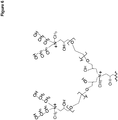
- FIGURE 6 shows a schematic of a methyl diethanolamine (MDEA) covalently attached to the pendant epoxide groups of the second polyethylene oxide diepoxide condensation reaction product to form a MDEA condensation reaction product.
- MDEA methyl diethanolamine
- This is the product formed from the second step in forming the terminating condensation layer.
- the alkylamine used was MDEA.
- the squiggle can represent adjacent chemical moieties, such as, the base condensation polymer 200 and at least a portion of one or more alkylamine condensation polymer layers.
- FIGURE 7 shows a schematic of an amine group covalently attached to the pendant epoxide groups of the second polyethylene oxide diepoxide condensation reaction product to form a second amine condensation reaction product. This is the product formed from the second step of a second reaction cycle to form a second alkylamine polymer condensation layer.
- FIGURE 8 shows a schematic of a third polyethylene diepoxide covalently attached to the amine group of the second amine condensation reaction product to form a third polyethylene oxide diepoxide condensation reaction product. This is the product formed from the first step of a third reaction cycle to form a third alkylamine polymer condensation layer, or it is the product formed from the first step in forming the terminating condensation layer.
- FIGURE 9 shows a schematic of an amine group covalently attached to the pendant epoxide groups of the third polyethylene oxide diepoxide condensation reaction product to form a third amine condensation reaction product. This is the product formed from the second step in forming the terminating condensation layer.
- the alkylamine used was methyl amine.
- a hydroxy group that is spaced apart from a quaternary amine by a two carbon spacer makes the hydroxy group more acidic.
- a hydroxy group separated from the quaternary amine anion exchange site by a two carbon spacer may be referred to as a beta position or a beta hydroxy group
- the pKa of a beta hydroxy group is believed to be about 13.9, which makes it about 100 times more acidic than a hydroxy group not close to a quaternary amine group.
- a model compound choline can be used to illustrate the increased acidity of a beta hydroxy group with respect to a quaternary amine.
- the hydroxy group of choline has a pKa of 13.9, which is much lower than ethanol, which does not have a proximate quaternary amine.
- the hydroxy group of ethanol has a pKa of 15.9.
- the deprotonated and negatively charged beta hydroxy group is stabilized by the proximate positive charge of the quaternary amine group, and thus, results in an increased acidity.
- the deprotonated hydroxy group can act as a stronger reactant for opening the epoxide ring of a glycidol group and also for influencing the binding of anions to the quaternary amine anion exchange site.
- amine means, unless otherwise stated, a primary, secondary, tertiary, or quaternary amine. It is a nitrogen attached to at least one alkyl group.
- the one or more alkyl group may be substituted with hydroxyl groups (e.g., -CH 2 CH 2 OH,-CH 2 CH 2 CH 2 OH, -CH 2 CHCH 2 OH, and -CH 2 CH 2 CHCH 2 OH).
- an alcohol is spaced from a quaternary amine by two carbon atoms, it means that there are two covalently connected carbon atoms between the nitrogen and the alcohol (e.g., H 2 NCH 2 CH 2 OH, HN(CH 2 CH 2 OH) 2 , N(CH 2 CH 2 OH) 3 , H 2 NCH 2 CHOHCH 3 , HN(CH 2 CHOHCH 3 ) 2 )
- alkyl by itself or as part of another substituent, means, unless otherwise stated, a straight or branched chain, or cyclic hydrocarbon radical, or combination thereof, which may be fully saturated, mono- or polyunsaturated and can include di- and multivalent radicals, having the number of carbon atoms designated (i.e., C 1 -C 10 means one to ten carbons).
- saturated hydrocarbon radicals include, but are not limited to, groups such as methyl, ethyl, n- propyl (e.g., -CH 2 -CH 2 -CH 3 ,-CH 2 -CH 2 -CH 2 -), isopropyl, n-butyl, t-butyl, isobutyl, sec- butyl, cyclohexyl, (cyclohexyl)methyl, cyclopropylmethyl, homologs and isomers of, for example, n-pentyl, n-hexyl, n-heptyl, n-octyl, and the like.
- groups such as methyl, ethyl, n- propyl (e.g., -CH 2 -CH 2 -CH 3 ,-CH 2 -CH 2 -CH 2 -), isopropyl, n-butyl, t-butyl, isobutyl, sec-
- An unsaturated alkyl group is one having one or more double bonds or triple bonds.
- unsaturated alkyl groups include, but are not limited to, vinyl, 2-propenyl, crotyl, 2- isopentenyl, 2- (butadienyl), 2,4-pentadienyl, 3-(1,4-pentadienyl), ethynyl, 1 - and 3- propynyl, 3-butynyl, and the higher homologs and isomers.
- alkyl unless otherwise noted, is also meant to include those derivatives of alkyl defined in more detail below, such as "heteroalkyl”.
- Alkyl groups that are limited to hydrocarbon groups are termed "homoalkyl".
- alkyl can also mean "alkylene” or "alkyldiyl” as well as alkylidene in those cases where the alkyl group is a divalent radical.
- alkylene or "alkyldiyl” by itself or as part of another substituent means a divalent radical derived from an alkyl group, as exemplified, but not limited, by-CH 2 CH 2 CH 2 - (propylene or propane-1 ,3-diyl), and further includes those groups described below as “heteroalkylene”.
- an alkyl (or alkylene) group will have from 1 to about 30 carbon atoms, preferably from 1 to about 25 carbon atoms, more preferably from 1 to about 20 carbon atoms, even more preferably from 1 to about 15 carbon atoms and most preferably from 1 to about 10 carbon atoms.
- a “lower alkyl”, “lower alkylene” or “lower alkyldiyl” is a shorter chain alkyl, alkylene or alkyldiyl group, generally having about 10 or fewer carbon atoms, about 8 or fewer carbon atoms, about 6 or fewer carbon atoms or about 4 or fewer carbon atoms.
- an alkylidene group will have from 1 to about 30 carbon atoms, preferably from 1 to about 25 carbon atoms, more preferably from 1 to about 20 carbon atoms, even more preferably from 1 to about 15 carbon atoms and most preferably from 1 to about 10 carbon atoms.
- a “lower alkyl” or “lower alkylidene” is a shorter chain alkyl or alkylidene group, generally having about 10 or fewer carbon atoms, about 8 or fewer carbon atoms, about 6 or fewer carbon atoms or about 4 or fewer carbon atoms.
- alkoxy alkylamino and “alkylthio” (or thioalkoxy) are used in their conventional sense, and refer to those alkyl groups attached to the remainder of the molecule via an oxygen atom, an amino group, or a sulfur atom, respectively.
- heteroalkyl by itself or in combination with another term, means, unless otherwise stated, a stable straight or branched chain, or cyclic hydrocarbon radical, or combinations thereof, consisting of the stated number of carbon atoms and at least one heteroatom selected from the group consisting of O, N, Si, S and B, and wherein the nitrogen and sulfur atoms may optionally be oxidized and the nitrogen heteroatom may optionally be quaternized.
- the heteroatom(s) O, N, B, S and Si may be placed at any interior position of the heteroalkyl group or at the position at which the alkyl group is attached to the remainder of the molecule.
- heteroalkylene by itself or as part of another substituent means a divalent radical derived from heteroalkyl, as exemplified, but not limited by, -CH 2 -CH 2 -S-CH 2 -CH 2 - and -CH 2 -S-CH 2 -CH 2 -NH-CH 2 -.
- heteroatoms can also occupy either or both of the chain termini (e.g., alkyleneoxy, alkylenedioxy, alkyleneamino, alkylenediamino, and the like).
- chain termini e.g., alkyleneoxy, alkylenedioxy, alkyleneamino, alkylenediamino, and the like.
- no orientation of the linking group is implied by the direction in which the formula of the linking group is written.
- the formula -CO 2 R'- optionally represents both -C(O)OR' and -OC(O)R'.
- cycloalkyl and “heterocycloalkyl”, by themselves or in combination with other terms, represent, unless otherwise stated, cyclic versions of “alkyl” and “heteroalkyl”, respectively. Additionally, for heterocycloalkyl, a heteroatom can occupy the position at which the heterocycle is attached to the remainder of the molecule. Examples of cycloalkyl include, but are not limited to, cyclopentyl, cyclohexyl, 1 -cyclohexenyl, 3-cyclohexenyl, cycloheptyl, and the like.
- heterocycloalkyl examples include, but are not limited to, 1-(1 ,2,5,6-tetrahydropyridyl), 1-piperidinyl, 2-piperidinyl, 3-piperidinyl, 4-morpholinyl, 3-morpholinyl, tetrahydrofuran- 2-yl, tetrahydrofuran-3-yl, tetrahydrothien-2-yl, tetrahydrothien-3-yl, 1 -piperazinyl, 2- piperazinyl, and the like.
- halo or halogen
- haloalkyl by themselves or as part of another substituent, mean, unless otherwise stated, a fluorine, chlorine, bromine, or iodine atom.
- terms such as “haloalkyl,” are meant to include monohaloalkyl and polyhaloalkyl.
- halo(C 1 -C 4 )alkyl is mean to include, but not be limited to, trifluoromethyl, 2,2,2-trifluoroethyl, 4-chlorobutyl, 3-bromopropyl, and the like.
- aryl means, unless otherwise stated, a polyunsaturated, aromatic, substituent that can be a single ring or multiple rings (preferably from 1 to 3 rings), which are fused together or linked covalently.
- heteroaryl refers to aryl groups (or rings) that contain from one to four heteroatoms selected from N, O, S, Si and B, wherein the nitrogen and sulfur atoms are optionally oxidized, and the nitrogen atom(s) are optionally quaternized.
- a heteroaryl group can be attached to the remainder of the molecule through a heteroatom.
- Non-limiting examples of aryl and heteroaryl groups include phenyl, 1 -naphthyl, 2-naphthyl, 4-biphenyl, 1 -pyrrolyl, 2-pyrrolyl, 3-pyrrolyl, 3-pyrazolyl, 2-imidazolyl, 4-imidazolyl, pyrazinyl, 2-oxazolyl, 4- oxazolyl, 2-phenyl-4-oxazolyl, 5-oxazolyl, 3-isoxazolyl, 4- isoxazolyl, 5-isoxazolyl, 2- thiazolyl, 4-thiazolyl, 5-thiazolyl, 2-furyl, 3-furyl, 2-thienyl, 3- thienyl, 2-pyridyl, 3- pyridyl, 4-pyridyl, 2-pyrimidyl, 4-pyrimidyl, 5-benzothiazolyl, purinyl, 2-benzimidazolyl, 5-indo
- aryl when used in combination with other terms (e.g., aryloxy, arylthioxy, arylalkyl) includes both aryl and heteroaryl rings as defined above.
- arylalkyl is meant to include those radicals in which an aryl group is attached to an alkyl group (e.g., benzyl, phenethyl, pyridylmethyl and the like) including those alkyl groups in which a carbon atom (e.g., a methylene group) has been replaced by, for example, an oxygen atom (e.g., phenoxymethyl, 2- pyridyloxymethyl, 3-(1-naphthyloxy)propyl, and the like).
- alkyl group e.g., benzyl, phenethyl, pyridylmethyl and the like
- an oxygen atom e.g., phenoxymethyl, 2- pyridyloxymethyl, 3-(1-na
- R', R", R'" and R" each preferably independently refer to hydrogen, substituted or unsubstituted heteroalkyl, substituted or unsubstituted aryl, e.g., aryl substituted with 1 -3 halogens, substituted or unsubstituted alkyl, alkoxy or thioalkoxy groups, or arylalkyl groups.
- each of the R groups is independently selected as are each R', R", R'" and R"" groups when more than one of these groups is present.
- R' and R" are attached to the same nitrogen atom, they can be combined with the nitrogen atom to form a 5-, 6-, or 7- membered ring.
- -NR'R is meant to include, but not be limited to, 1-pyrrolidinyl and 4-morpholinyl.
- alkyl is meant to include groups including carbon atoms bound to groups other than hydrogen groups, such as haloalkyl (e.g., -CF 3 and -CH 2 CF 3 ) and acyl (e.g., -C(O)CH 3 , -C(O)CF 3 ,-C(O)CH 2 OCH 3 , and the like).
- substituents for the aryl and heteroaryl groups are generically referred to as "aryl group substituents.”
- Supermacroporous (SMP, 25g) resin was dispersed in 125g of glacial acetic acid. Sulfuric acid (500g of conc.) was added and mixed thoroughly and sonicated in a water bath at room temperature for 60 minutes. The reaction mixture was poured into ⁇ 1000g of ice. Once the reaction reached room temperature, the reaction mixture was filtered, and the resin washed with DI water until the washing showed a pH close to neutral. The resin was isolated for further functionalization.
- a 9 ⁇ 250 mm (diameter x length) reaction column was packed with 4.0 ⁇ m diameter SMP resin particles with surface sulfonation 25 m 2 /g wide-pore resin (DVB/EVB).
- the base condensation layer was applied to a packed column by flowing a polyethylene glycol diglycidyl ether-methylamine solution mixture (26% (wt/wt%) with respect to polyethylene glycol diglycidyl ether: 4% (wt/wt %) with respect to methylamine) at 0.5 mL/minute through the column at 69 °C for 60 minutes to form a base condensation polymer.
- the reagent solutions were prepared in deionized water. Next, the following reagents were flowed at 0.5 mL/minute through the column at 69 °C.
- the anion exchange resin was removed from the reaction column into a container and dispersed with physical force. 200 grams of 0.05 M NaOH was mixed with 20 grams of the anion exchange resin (1:10 ratio of resin to 0.05M NaOH, wt/wt %) in the container. The mixture was then sonicated to disperse the resin particles at room temperature for 2 minutes and then sieved and filtered. Next, the filter cake was washed with deionized water. The resulting filter cake formed a cleaned-up resin that was packed into 2 x 250 mm chromatography columns.
- a 9 ⁇ 250 mm (diameter x length) reaction column was packed with 4.0 ⁇ m diameter SMP resin particles with surface sulfonation 25 m 2 /g wide-pore resin (DVB/EVB).
- the base condensation layer was applied to a packed column by flowing a polyethylene glycol diglycidyl ether-methylamine solution mixture (26% (wt/wt%) with respect to polyethylene glycol diglycidyl ether: 4% (wt/wt %) with respect to methylamine) at 0.5 mL/minute through the column at 69 °C for 60 minutes to form a base condensation polymer.
- the reagent solutions were prepared in deionized water. Next, the following reagents were flowed at 0.5 mL/minute through the column at 69 °C.
- the anion exchange resin was removed from the reaction column into a container and dispersed with physical force. 200 grams of 0.05 M NaOH was mixed with 20 grams of the anion exchange resin (1:10 ratio of resin to 0.05M NaOH, wt/wt %) in the container. The mixture was then sonicated to disperse the resin particles at room temperature for 2 minutes and then sieved and filtered. Next, the filter cake was washed with deionized water. The resulting filter cake formed a cleaned-up resin that was packed into 2 x 250 mm chromatography columns.
- a 9 ⁇ 250 mm (diameter x length) reaction column was packed with 4.0 ⁇ m diameter SMP resin particles with surface sulfonation 25 m 2 /g wide-pore resin (DVB/EVB).
- the base condensation layer was applied to a packed column by flowing a polyethylene glycol diglycidyl ether-methylamine solution mixture (26% (wt/wt%) with respect to polyethylene glycol diglycidyl ether: 4% (wt/wt %) with respect to methylamine) at 0.5 mL/minute through the column at 69 °C for 60 minutes to form a base condensation polymer.
- the reagent solutions were prepared in deionized water. Next, the following reagents were flowed at 0.5 mL/minute through the column at 69 °C.
- the anion exchange resin was removed from the reaction column into a container and dispersed with physical force. 200 grams of 0.05 M NaOH was mixed with 20 grams of the anion exchange resin (1:10 ratio of resin to 0.05M NaOH, wt/wt %) in the container. The mixture was then sonicated to disperse the resin particles at room temperature for 2 minutes and then sieved and filtered. Next, the filter cake was washed with deionized water. The resulting filter cake formed a cleaned-up resin that was packed into 2 x 250 mm chromatography columns.
- a chromatography column of was installed into a Thermo Scientific Dionex ICS-5000 + ion chromatography system (commercially available from Thermo Fisher Scientific, Sunnyvale, California).
- a pump was used to pump deionized water into a Thermo Scientific Dionex EGC 500 KOH cartridge (Thermo Fisher Scientific, Sunnyvale, California) for generating a KOH eluent to a predetermined concentration.
- a temperature regulator was used to maintain a column temperature of 30 °C.
- a Dionex AERS 500 suppressor (Thermo Fisher Scientific, Sunnyvale, California) was used along with a Thermo Scientific conductivity detector.
- the Dionex AERS 500 suppressor typically uses a constant current to electrolyze water for regenerating the suppressor. The details for each analysis are given below.
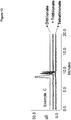
- Example C of Figure 13 showed a distorted peak for dithionate because the capacity of the ion exchange resin is too low.
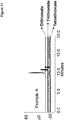
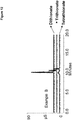
- the chromatograms of Figure 11 using the ion exchange resin of Example A required a higher eluent concentration than the chromatograms of Figure 12 using the ion exchange resin of Example B providing for simpler and more cost effective separation.
- the ion exchange resin of Example A required an additional reaction cycle than the ion exchange resin of Example B making Example B easier to manufacture.
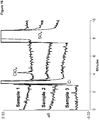
- Example B Chromatography was performed using extracts of soil samples containing chlorine and sulfate on Example B. Only in Sample 1 was perchlorate detected. The ratio of chlorine to perchlorate is estimated to be ⁇ 4000:1 and sulfate to perchlorate is estimated to be ⁇ 2000:1. Chromatography conditions for Example B Column Type Flow Rate (mL/min) Injection Volume ( ⁇ L) Time (minutes) KOH Concentration (mM) AERS Format (mm) / Current (mA) 2X150 mm Prototype 0.25 2.5 0-10 4 2/6
Landscapes
- Chemical & Material Sciences (AREA)
- Chemical Kinetics & Catalysis (AREA)
- Organic Chemistry (AREA)
- Analytical Chemistry (AREA)
- Addition Polymer Or Copolymer, Post-Treatments, Or Chemical Modifications (AREA)
- Solid-Sorbent Or Filter-Aiding Compositions (AREA)
- Medicinal Preparation (AREA)
- Physics & Mathematics (AREA)
- Health & Medical Sciences (AREA)
- Life Sciences & Earth Sciences (AREA)
- Biochemistry (AREA)
- General Health & Medical Sciences (AREA)
- General Physics & Mathematics (AREA)
- Immunology (AREA)
- Pathology (AREA)
Applications Claiming Priority (1)
| Application Number | Priority Date | Filing Date | Title |
|---|---|---|---|
| US16/370,314 US20200309744A1 (en) | 2019-03-29 | 2019-03-29 | Hydrophilic anion exchange chromatography media |
Publications (2)
| Publication Number | Publication Date |
|---|---|
| EP3714976A1 true EP3714976A1 (fr) | 2020-09-30 |
| EP3714976B1 EP3714976B1 (fr) | 2022-03-02 |
Family
ID=69804671
Family Applications (1)
| Application Number | Title | Priority Date | Filing Date |
|---|---|---|---|
| EP20162423.6A Active EP3714976B1 (fr) | 2019-03-29 | 2020-03-11 | Support de chromatographie à échange d'anions hydrophile |
Country Status (3)
| Country | Link |
|---|---|
| US (1) | US20200309744A1 (fr) |
| EP (1) | EP3714976B1 (fr) |
| CN (1) | CN111744232B (fr) |
Citations (2)
| Publication number | Priority date | Publication date | Assignee | Title |
|---|---|---|---|---|
| EP2683480A1 (fr) * | 2011-03-11 | 2014-01-15 | Dionex Corporation | Revêtement de surface d'échange anionique hyperbranché à liaison électrostatique préparé par polymérisation par condensation au moyen de coupleurs d'amine tertiaire pour une sélectivité améliorée vis-à-vis des anions divalents |
| US9132364B2 (en) | 2010-02-26 | 2015-09-15 | Dionex Corporation | High capacity ion chromatography stationary phases and method of forming |
Family Cites Families (5)
| Publication number | Priority date | Publication date | Assignee | Title |
|---|---|---|---|---|
| JPS5939347A (ja) * | 1982-08-27 | 1984-03-03 | Mitsubishi Chem Ind Ltd | 表面官能型陰イオン交換樹脂およびその製法 |
| US9486799B2 (en) * | 2012-09-11 | 2016-11-08 | Dionex Corporation | Glycidol functionalized anion exchange stationary phases |
| US9610576B2 (en) * | 2012-09-27 | 2017-04-04 | Agilent Technologies, Inc. | Hydrolytically stable ion-exchange stationary phases and uses thereof |
| US10379090B2 (en) * | 2016-06-17 | 2019-08-13 | Dionex Corporation | Charge reversible ion exchange resins, chromatography column, method, and system thereof |
| CN107626288B (zh) * | 2017-09-29 | 2019-07-09 | 武汉大学 | 季胺碱功能化阴离子交换有机聚合物毛细管电色谱整体柱及其制备与应用 |
-
2019
- 2019-03-29 US US16/370,314 patent/US20200309744A1/en not_active Abandoned
-
2020
- 2020-03-11 EP EP20162423.6A patent/EP3714976B1/fr active Active
- 2020-03-27 CN CN202010229551.0A patent/CN111744232B/zh active Active
Patent Citations (2)
| Publication number | Priority date | Publication date | Assignee | Title |
|---|---|---|---|---|
| US9132364B2 (en) | 2010-02-26 | 2015-09-15 | Dionex Corporation | High capacity ion chromatography stationary phases and method of forming |
| EP2683480A1 (fr) * | 2011-03-11 | 2014-01-15 | Dionex Corporation | Revêtement de surface d'échange anionique hyperbranché à liaison électrostatique préparé par polymérisation par condensation au moyen de coupleurs d'amine tertiaire pour une sélectivité améliorée vis-à-vis des anions divalents |
Non-Patent Citations (2)
| Title |
|---|
| AKIRA IGUCHI: "The Separation of Polythionates with Anion-Exchange Resins", BULLETIN OF THE CHEMICAL SOCIETY OF JAPAN, vol. 31, no. 5, 1 January 1958 (1958-01-01), JP, pages 597 - 600, XP055186445, ISSN: 0009-2673, DOI: 10.1246/bcsj.31.597 * |
| POHL CHRISTOPHER A ED - DASGUPTA PURNENDU: "Novel method for manipulation of anion-exchange selectivity by derivatizing hydroxyl groups in the proximity of quaternary nitrogen ion-exchange sites with glycidol", TALANTA, vol. 177, 20 September 2017 (2017-09-20), pages 18 - 25, XP085254995, ISSN: 0039-9140, DOI: 10.1016/J.TALANTA.2017.09.042 * |
Also Published As
| Publication number | Publication date |
|---|---|
| EP3714976B1 (fr) | 2022-03-02 |
| CN111744232A (zh) | 2020-10-09 |
| CN111744232B (zh) | 2022-04-19 |
| US20200309744A1 (en) | 2020-10-01 |
Similar Documents
| Publication | Publication Date | Title |
|---|---|---|
| EP2745903B1 (fr) | Séparation de glycanes par chromatographie en phase liquide mode mixte | |
| EP2895266B1 (fr) | Phases stationnaires échangeuses d'anions fonctionnalisées par glycidol | |
| CN107522809B (zh) | 电荷可逆离子交换树脂、色谱柱、方法和其系统 | |
| Hsieh et al. | Novel vinylene-based covalent organic framework as a promising adsorbent for the rapid extraction of beta-agonists in meat samples | |
| EP3714976B1 (fr) | Support de chromatographie à échange d'anions hydrophile | |
| EP3542902B1 (fr) | Phases stationnaires d'échange d'anions à base de couche d'hydroxyalkylamine réticulée et de glycidol | |
| Tani et al. | Separation of inorganic anions and cations on titania by use of acetic acid-sodium acetate and bicine-sodium hydroxide buffers | |
| EP3603808B1 (fr) | Phases stationnaires d'échange d'anions basées sur une couche polymère de polyalkylpolyamine | |
| EP3479900B1 (fr) | Phases stationnaires d'échange d'ions pour analyse d'ions polyvalents | |
| US10773254B2 (en) | Anion exchange stationary phases based on crosslinked hydroxyalkylamine layer and glycidol | |
| JP2011053174A (ja) | 陽イオンの分析法 | |
| Zatirakha et al. | Novel stationary phases for ion chromatography and hydrophilic interaction liquid chromatography | |
| Siergiej et al. | Preparation and characterization of Kel-F ion-exchange HPLC packings | |
| EP3816623B1 (fr) | Colonnes de chromatographie à gradient longitudinal | |
| US10766026B2 (en) | Anion exchange stationary phases based on crosslinked hydroxyalkylamine layer and glycidol | |
| Matsuura et al. | Separation of sulfuric acid and monosaccharides with a strong-base anion exchange resin containing polystyrenesulfonate as polymeric counter ion to reduce tailing of sulfuric acid | |
| JPS60102947A (ja) | ホウ素同位体の分離濃縮方法 | |
| Pohl | Ion Chromatography Columns | |
| DE102011107197A1 (de) | Ionenaustauschermaterial mit hoher Salztoleranz | |
| Jen | Displacement chromatography for preparative protein purification: development and optimization |
Legal Events
| Date | Code | Title | Description |
|---|---|---|---|
| PUAI | Public reference made under article 153(3) epc to a published international application that has entered the european phase |
Free format text: ORIGINAL CODE: 0009012 |
|
| STAA | Information on the status of an ep patent application or granted ep patent |
Free format text: STATUS: THE APPLICATION HAS BEEN PUBLISHED |
|
| AK | Designated contracting states |
Kind code of ref document: A1 Designated state(s): AL AT BE BG CH CY CZ DE DK EE ES FI FR GB GR HR HU IE IS IT LI LT LU LV MC MK MT NL NO PL PT RO RS SE SI SK SM TR |
|
| AX | Request for extension of the european patent |
Extension state: BA ME |
|
| STAA | Information on the status of an ep patent application or granted ep patent |
Free format text: STATUS: REQUEST FOR EXAMINATION WAS MADE |
|
| 17P | Request for examination filed |
Effective date: 20210329 |
|
| RBV | Designated contracting states (corrected) |
Designated state(s): AL AT BE BG CH CY CZ DE DK EE ES FI FR GB GR HR HU IE IS IT LI LT LU LV MC MK MT NL NO PL PT RO RS SE SI SK SM TR |
|
| GRAP | Despatch of communication of intention to grant a patent |
Free format text: ORIGINAL CODE: EPIDOSNIGR1 |
|
| STAA | Information on the status of an ep patent application or granted ep patent |
Free format text: STATUS: GRANT OF PATENT IS INTENDED |
|
| INTG | Intention to grant announced |
Effective date: 20210910 |
|
| GRAS | Grant fee paid |
Free format text: ORIGINAL CODE: EPIDOSNIGR3 |
|
| GRAA | (expected) grant |
Free format text: ORIGINAL CODE: 0009210 |
|
| STAA | Information on the status of an ep patent application or granted ep patent |
Free format text: STATUS: THE PATENT HAS BEEN GRANTED |
|
| AK | Designated contracting states |
Kind code of ref document: B1 Designated state(s): AL AT BE BG CH CY CZ DE DK EE ES FI FR GB GR HR HU IE IS IT LI LT LU LV MC MK MT NL NO PL PT RO RS SE SI SK SM TR |
|
| REG | Reference to a national code |
Ref country code: GB Ref legal event code: FG4D |
|
| REG | Reference to a national code |
Ref country code: CH Ref legal event code: EP Ref country code: AT Ref legal event code: REF Ref document number: 1471812 Country of ref document: AT Kind code of ref document: T Effective date: 20220315 |
|
| REG | Reference to a national code |
Ref country code: DE Ref legal event code: R096 Ref document number: 602020001996 Country of ref document: DE |
|
| REG | Reference to a national code |
Ref country code: IE Ref legal event code: FG4D |
|
| REG | Reference to a national code |
Ref country code: LT Ref legal event code: MG9D |
|
| REG | Reference to a national code |
Ref country code: NL Ref legal event code: MP Effective date: 20220302 |
|
| PG25 | Lapsed in a contracting state [announced via postgrant information from national office to epo] |
Ref country code: SE Free format text: LAPSE BECAUSE OF FAILURE TO SUBMIT A TRANSLATION OF THE DESCRIPTION OR TO PAY THE FEE WITHIN THE PRESCRIBED TIME-LIMIT Effective date: 20220302 Ref country code: RS Free format text: LAPSE BECAUSE OF FAILURE TO SUBMIT A TRANSLATION OF THE DESCRIPTION OR TO PAY THE FEE WITHIN THE PRESCRIBED TIME-LIMIT Effective date: 20220302 Ref country code: NO Free format text: LAPSE BECAUSE OF FAILURE TO SUBMIT A TRANSLATION OF THE DESCRIPTION OR TO PAY THE FEE WITHIN THE PRESCRIBED TIME-LIMIT Effective date: 20220602 Ref country code: LT Free format text: LAPSE BECAUSE OF FAILURE TO SUBMIT A TRANSLATION OF THE DESCRIPTION OR TO PAY THE FEE WITHIN THE PRESCRIBED TIME-LIMIT Effective date: 20220302 Ref country code: HR Free format text: LAPSE BECAUSE OF FAILURE TO SUBMIT A TRANSLATION OF THE DESCRIPTION OR TO PAY THE FEE WITHIN THE PRESCRIBED TIME-LIMIT Effective date: 20220302 Ref country code: ES Free format text: LAPSE BECAUSE OF FAILURE TO SUBMIT A TRANSLATION OF THE DESCRIPTION OR TO PAY THE FEE WITHIN THE PRESCRIBED TIME-LIMIT Effective date: 20220302 Ref country code: BG Free format text: LAPSE BECAUSE OF FAILURE TO SUBMIT A TRANSLATION OF THE DESCRIPTION OR TO PAY THE FEE WITHIN THE PRESCRIBED TIME-LIMIT Effective date: 20220602 |
|
| REG | Reference to a national code |
Ref country code: AT Ref legal event code: MK05 Ref document number: 1471812 Country of ref document: AT Kind code of ref document: T Effective date: 20220302 |
|
| PG25 | Lapsed in a contracting state [announced via postgrant information from national office to epo] |
Ref country code: PL Free format text: LAPSE BECAUSE OF FAILURE TO SUBMIT A TRANSLATION OF THE DESCRIPTION OR TO PAY THE FEE WITHIN THE PRESCRIBED TIME-LIMIT Effective date: 20220302 Ref country code: LV Free format text: LAPSE BECAUSE OF FAILURE TO SUBMIT A TRANSLATION OF THE DESCRIPTION OR TO PAY THE FEE WITHIN THE PRESCRIBED TIME-LIMIT Effective date: 20220302 Ref country code: GR Free format text: LAPSE BECAUSE OF FAILURE TO SUBMIT A TRANSLATION OF THE DESCRIPTION OR TO PAY THE FEE WITHIN THE PRESCRIBED TIME-LIMIT Effective date: 20220603 Ref country code: FI Free format text: LAPSE BECAUSE OF FAILURE TO SUBMIT A TRANSLATION OF THE DESCRIPTION OR TO PAY THE FEE WITHIN THE PRESCRIBED TIME-LIMIT Effective date: 20220302 |
|
| PG25 | Lapsed in a contracting state [announced via postgrant information from national office to epo] |
Ref country code: NL Free format text: LAPSE BECAUSE OF FAILURE TO SUBMIT A TRANSLATION OF THE DESCRIPTION OR TO PAY THE FEE WITHIN THE PRESCRIBED TIME-LIMIT Effective date: 20220302 |
|
| PG25 | Lapsed in a contracting state [announced via postgrant information from national office to epo] |
Ref country code: SM Free format text: LAPSE BECAUSE OF FAILURE TO SUBMIT A TRANSLATION OF THE DESCRIPTION OR TO PAY THE FEE WITHIN THE PRESCRIBED TIME-LIMIT Effective date: 20220302 Ref country code: SK Free format text: LAPSE BECAUSE OF FAILURE TO SUBMIT A TRANSLATION OF THE DESCRIPTION OR TO PAY THE FEE WITHIN THE PRESCRIBED TIME-LIMIT Effective date: 20220302 Ref country code: RO Free format text: LAPSE BECAUSE OF FAILURE TO SUBMIT A TRANSLATION OF THE DESCRIPTION OR TO PAY THE FEE WITHIN THE PRESCRIBED TIME-LIMIT Effective date: 20220302 Ref country code: PT Free format text: LAPSE BECAUSE OF FAILURE TO SUBMIT A TRANSLATION OF THE DESCRIPTION OR TO PAY THE FEE WITHIN THE PRESCRIBED TIME-LIMIT Effective date: 20220704 Ref country code: EE Free format text: LAPSE BECAUSE OF FAILURE TO SUBMIT A TRANSLATION OF THE DESCRIPTION OR TO PAY THE FEE WITHIN THE PRESCRIBED TIME-LIMIT Effective date: 20220302 Ref country code: CZ Free format text: LAPSE BECAUSE OF FAILURE TO SUBMIT A TRANSLATION OF THE DESCRIPTION OR TO PAY THE FEE WITHIN THE PRESCRIBED TIME-LIMIT Effective date: 20220302 Ref country code: AT Free format text: LAPSE BECAUSE OF FAILURE TO SUBMIT A TRANSLATION OF THE DESCRIPTION OR TO PAY THE FEE WITHIN THE PRESCRIBED TIME-LIMIT Effective date: 20220302 |
|
| PG25 | Lapsed in a contracting state [announced via postgrant information from national office to epo] |
Ref country code: IS Free format text: LAPSE BECAUSE OF FAILURE TO SUBMIT A TRANSLATION OF THE DESCRIPTION OR TO PAY THE FEE WITHIN THE PRESCRIBED TIME-LIMIT Effective date: 20220702 Ref country code: AL Free format text: LAPSE BECAUSE OF FAILURE TO SUBMIT A TRANSLATION OF THE DESCRIPTION OR TO PAY THE FEE WITHIN THE PRESCRIBED TIME-LIMIT Effective date: 20220302 |
|
| REG | Reference to a national code |
Ref country code: DE Ref legal event code: R097 Ref document number: 602020001996 Country of ref document: DE |
|
| REG | Reference to a national code |
Ref country code: BE Ref legal event code: MM Effective date: 20220331 |
|
| PLBE | No opposition filed within time limit |
Free format text: ORIGINAL CODE: 0009261 |
|
| STAA | Information on the status of an ep patent application or granted ep patent |
Free format text: STATUS: NO OPPOSITION FILED WITHIN TIME LIMIT |
|
| PG25 | Lapsed in a contracting state [announced via postgrant information from national office to epo] |
Ref country code: MC Free format text: LAPSE BECAUSE OF FAILURE TO SUBMIT A TRANSLATION OF THE DESCRIPTION OR TO PAY THE FEE WITHIN THE PRESCRIBED TIME-LIMIT Effective date: 20220302 Ref country code: LU Free format text: LAPSE BECAUSE OF NON-PAYMENT OF DUE FEES Effective date: 20220311 Ref country code: IE Free format text: LAPSE BECAUSE OF NON-PAYMENT OF DUE FEES Effective date: 20220311 Ref country code: FR Free format text: LAPSE BECAUSE OF NON-PAYMENT OF DUE FEES Effective date: 20220502 Ref country code: DK Free format text: LAPSE BECAUSE OF FAILURE TO SUBMIT A TRANSLATION OF THE DESCRIPTION OR TO PAY THE FEE WITHIN THE PRESCRIBED TIME-LIMIT Effective date: 20220302 |
|
| 26N | No opposition filed |
Effective date: 20221205 |
|
| PG25 | Lapsed in a contracting state [announced via postgrant information from national office to epo] |
Ref country code: SI Free format text: LAPSE BECAUSE OF FAILURE TO SUBMIT A TRANSLATION OF THE DESCRIPTION OR TO PAY THE FEE WITHIN THE PRESCRIBED TIME-LIMIT Effective date: 20220302 Ref country code: BE Free format text: LAPSE BECAUSE OF NON-PAYMENT OF DUE FEES Effective date: 20220331 |
|
| PG25 | Lapsed in a contracting state [announced via postgrant information from national office to epo] |
Ref country code: IT Free format text: LAPSE BECAUSE OF FAILURE TO SUBMIT A TRANSLATION OF THE DESCRIPTION OR TO PAY THE FEE WITHIN THE PRESCRIBED TIME-LIMIT Effective date: 20220302 |
|
| PG25 | Lapsed in a contracting state [announced via postgrant information from national office to epo] |
Ref country code: MK Free format text: LAPSE BECAUSE OF FAILURE TO SUBMIT A TRANSLATION OF THE DESCRIPTION OR TO PAY THE FEE WITHIN THE PRESCRIBED TIME-LIMIT Effective date: 20220302 Ref country code: CY Free format text: LAPSE BECAUSE OF FAILURE TO SUBMIT A TRANSLATION OF THE DESCRIPTION OR TO PAY THE FEE WITHIN THE PRESCRIBED TIME-LIMIT Effective date: 20220302 |
|
| PG25 | Lapsed in a contracting state [announced via postgrant information from national office to epo] |
Ref country code: HU Free format text: LAPSE BECAUSE OF FAILURE TO SUBMIT A TRANSLATION OF THE DESCRIPTION OR TO PAY THE FEE WITHIN THE PRESCRIBED TIME-LIMIT; INVALID AB INITIO Effective date: 20200311 |
|
| PG25 | Lapsed in a contracting state [announced via postgrant information from national office to epo] |
Ref country code: MT Free format text: LAPSE BECAUSE OF FAILURE TO SUBMIT A TRANSLATION OF THE DESCRIPTION OR TO PAY THE FEE WITHIN THE PRESCRIBED TIME-LIMIT Effective date: 20220302 |
|
| PGFP | Annual fee paid to national office [announced via postgrant information from national office to epo] |
Ref country code: CH Payment date: 20250401 Year of fee payment: 6 |
|
| PG25 | Lapsed in a contracting state [announced via postgrant information from national office to epo] |
Ref country code: TR Free format text: LAPSE BECAUSE OF FAILURE TO SUBMIT A TRANSLATION OF THE DESCRIPTION OR TO PAY THE FEE WITHIN THE PRESCRIBED TIME-LIMIT Effective date: 20220302 |
|
| REG | Reference to a national code |
Ref country code: CH Ref legal event code: U11 Free format text: ST27 STATUS EVENT CODE: U-0-0-U10-U11 (AS PROVIDED BY THE NATIONAL OFFICE) Effective date: 20260401 |
|
| PGFP | Annual fee paid to national office [announced via postgrant information from national office to epo] |
Ref country code: GB Payment date: 20260225 Year of fee payment: 7 |
|
| PGFP | Annual fee paid to national office [announced via postgrant information from national office to epo] |
Ref country code: DE Payment date: 20260217 Year of fee payment: 7 |