EP3715510A2 - Tissu pelucheux tissé et son procédé de production - Google Patents
Tissu pelucheux tissé et son procédé de production Download PDFInfo
- Publication number
- EP3715510A2 EP3715510A2 EP20165761.6A EP20165761A EP3715510A2 EP 3715510 A2 EP3715510 A2 EP 3715510A2 EP 20165761 A EP20165761 A EP 20165761A EP 3715510 A2 EP3715510 A2 EP 3715510A2
- Authority
- EP
- European Patent Office
- Prior art keywords
- weft
- yarns
- warp
- portions
- fabric
- Prior art date
- Legal status (The legal status is an assumption and is not a legal conclusion. Google has not performed a legal analysis and makes no representation as to the accuracy of the status listed.)
- Pending
Links
Images






Classifications
-
- D—TEXTILES; PAPER
- D03—WEAVING
- D03D—WOVEN FABRICS; METHODS OF WEAVING; LOOMS
- D03D13/00—Woven fabrics characterised by the special disposition of the warp or weft threads, e.g. with curved weft threads, with discontinuous warp threads, with diagonal warp or weft
- D03D13/004—Woven fabrics characterised by the special disposition of the warp or weft threads, e.g. with curved weft threads, with discontinuous warp threads, with diagonal warp or weft with weave pattern being non-standard or providing special effects
-
- D—TEXTILES; PAPER
- D02—YARNS; MECHANICAL FINISHING OF YARNS OR ROPES; WARPING OR BEAMING
- D02G—CRIMPING OR CURLING FIBRES, FILAMENTS, THREADS, OR YARNS; YARNS OR THREADS
- D02G3/00—Yarns or threads, e.g. fancy yarns; Processes or apparatus for the production thereof, not otherwise provided for
- D02G3/02—Yarns or threads characterised by the material or by the materials from which they are made
-
- D—TEXTILES; PAPER
- D02—YARNS; MECHANICAL FINISHING OF YARNS OR ROPES; WARPING OR BEAMING
- D02G—CRIMPING OR CURLING FIBRES, FILAMENTS, THREADS, OR YARNS; YARNS OR THREADS
- D02G3/00—Yarns or threads, e.g. fancy yarns; Processes or apparatus for the production thereof, not otherwise provided for
- D02G3/44—Yarns or threads characterised by the purpose for which they are designed
-
- D—TEXTILES; PAPER
- D03—WEAVING
- D03D—WOVEN FABRICS; METHODS OF WEAVING; LOOMS
- D03D15/00—Woven fabrics characterised by the material, structure or properties of the fibres, filaments, yarns, threads or other warp or weft elements used
- D03D15/50—Woven fabrics characterised by the material, structure or properties of the fibres, filaments, yarns, threads or other warp or weft elements used characterised by the properties of the yarns or threads
- D03D15/54—Woven fabrics characterised by the material, structure or properties of the fibres, filaments, yarns, threads or other warp or weft elements used characterised by the properties of the yarns or threads coloured
-
- D—TEXTILES; PAPER
- D03—WEAVING
- D03D—WOVEN FABRICS; METHODS OF WEAVING; LOOMS
- D03D27/00—Woven pile fabrics
- D03D27/02—Woven pile fabrics wherein the pile is formed by warp or weft
-
- D—TEXTILES; PAPER
- D03—WEAVING
- D03D—WOVEN FABRICS; METHODS OF WEAVING; LOOMS
- D03D1/00—Woven fabrics designed to make specified articles
-
- D—TEXTILES; PAPER
- D03—WEAVING
- D03D—WOVEN FABRICS; METHODS OF WEAVING; LOOMS
- D03D15/00—Woven fabrics characterised by the material, structure or properties of the fibres, filaments, yarns, threads or other warp or weft elements used
- D03D15/50—Woven fabrics characterised by the material, structure or properties of the fibres, filaments, yarns, threads or other warp or weft elements used characterised by the properties of the yarns or threads
- D03D15/56—Woven fabrics characterised by the material, structure or properties of the fibres, filaments, yarns, threads or other warp or weft elements used characterised by the properties of the yarns or threads elastic
-
- D—TEXTILES; PAPER
- D10—INDEXING SCHEME ASSOCIATED WITH SUBLASSES OF SECTION D, RELATING TO TEXTILES
- D10B—INDEXING SCHEME ASSOCIATED WITH SUBLASSES OF SECTION D, RELATING TO TEXTILES
- D10B2501/00—Wearing apparel
Definitions
- the technical field of the present invention relates to a woven fabric that has imitates natural fur, i.e. has a furry appearance, and to a method of producing such fabric.
- the present invention relates to a woven fabric that is used to produce clothing articles and garments.
- a preferred type of fabric of the invention is a denim fabric or a fabric having a denim look; in a preferred embodiment at least part of the yarns are indigo dyed.
- Denim is referred to in the following description, but the invention is not limited to the production of denim fabrics only.
- the invention comprises also a method of production of a woven fabric having a furry appearance as above mentioned.
- a fabric having a furry appearance can also be created using specialized knitting or weaving machines which are not common for denim production. Another option is to use a highly specialized manual manufacturing process which is expensive and needs long production times and cannot easily be adapted to industrial production in high volumes. There is therefore the need of providing an improved fabric that imitates fur, i.e. has a furry appearance, and method of producing the same in an economic way that is simple to implement on existing looms and weaving machines..
- An aim of the invention is to solve the above problems and to provide a woven fabric imitating fur that is created using common machines such as dobby machines or jacquard machines using particularly designed weaving reports.
- Denim is a popular fabric that is produced by weaving weft and warp yarns in a twill design. Weaves that are employed for denim manufacture vary depending on the area of application. Fine denim fabrics are normally composed of plain weaves. However, denim fabrics that are conventionally used under slightly rougher conditions are made using a twill weave, namely a weave characterized by a diagonal pattern.
- a further aim of the invention is thus to provide a woven fabric, including indigo dyed fabrics, having a furry appearance and suitable to give a general appearance of fur, i.e. a furry appearance while providing at the same time a look that reminds the user of indigo denim.
- An embodiment of the invention provides a woven fabric having a fur-like look, the woven fabric having warp yarns and weft yarns, said fabric having a front side and a back side, said warp and weft yarns being woven together in a weaving pattern, the weaving pattern comprising a base and at least one of warp or weft over portions and/or at least one of warp or weft under portions, whereby at least one of the warp or weft yarns are extending over a number of weft or warp yarns and below a number of weft or warp yarns to provide said warp or weft over portions in said front side and/or warp or weft under portions in said back side and wherein the warp over portions or the warp under portions are long, i.e. they have a length comprised between 8 and 3000 yarns. Similarly, the weft over portions or the weft under portions are long, i.e. they have a length comprised between 25 and 3000 yarns
- An advantage of this embodiment is that it makes possible to have very long over portions on the warp side or on the weft side, namely on the front side of the fabric, such over portion being suitable for creating a furry appearance to the final product without requiring any special machine or process.
- the invention further comprises a method of preparing a fabric according to claim 10.
- the method includes the steps of weaving warp yarns or weft yarns following a pattern comprising a base and warp or weft over portions and/or warp or weft under portions, whereby said warp and weft yarns are woven together in a weaving pattern, the weaving pattern comprising a structural base of the fabric and at least one of warp or weft over portions and/or at least one of warp or weft under portions, whereby at least one of the warp or weft yarns are extending over a number of weft or warp yarns and below a number of weft or warp yarns to provide said warp or weft over portions in said front side and/or warp or weft under portions in said back side and wherein the warp over portions or the warp under portions have a length comprised between 8 and 3000 yarns, preferably 8-300 yarns and the weft over portions or the weft under portions have
- the warp and/or weft over or under portions have a length of 30 to 450 yarns, more preferably of 40 or 45 to 400 yarns.
- the fabric is provided with warp over portions or warp under portions (or both) having a length of 30 to 450 yarns and the weft yarns have weft under portions with a length of less than 25 yarns.
- the fabric has warp and/or weft over portions of the above stated length provided at least on the front side of the fabric, possibly only on the front side of the fabric; a garment obtained from the fabric of this embodiment will be provided with the long over portions at least (possibly only) on the front side of the garment, i.e. the visible side of the garment.
- the back of the fabric is the side intended to be in contact with the wearer's body.
- at least the warp yarns provided with the said long over portions (on the front side) are dyed, more preferably ring dyed; a suitable dye is black, indigo or another indigoid dye.
- the fabrics may also be a white fabric ready for dyeing or ecru fabric or any suitable color.
- the fabric of the invention has alternated first and second warp yarns or first and second weft yarns or both.
- the first yarns i.e. the first warp and/or weft yarns, have long over portions or under portions.
- the first yarns may have long over portions and long under portions; the long overportions and underportions may be provided in a same first yarn.
- These yarns provide the part of the fabric that imitates a fur, i.e. that gives a furry look to the garment.
- the second yarns have short over and under portions, e.g. portions floating, i.e. extending, over 1 to 3 or 4 yarns.
- the second yarns provide a base structure of the fabric.
- the base structure of the fabric is thus comprising a weaving of warps and wefts supporting the long over portions and under portions. It should be noticed that the fabric of the invention may have long over portions only warpwise; in such an embodiment the weft yarns are all second weft yarns, i.e. they concur to form a fabric base structure with the second warp yarns.
- first yarns are woven to be adjacent to one or more second yarns.
- first and second yarns are alternated with a ratio "number of first yarns/number of second yarns" in the range 3/1 to 1/3, preferably 2/1 to 1/1.
- the length of the over portions in a same first yarn may be different.
- a yarn over portion may be e.g. long 20; the successive over portion may be long e.g. 15 and the following over portion may be long e.g. 30.
- the same may apply to the under portions of one yarn.
- Such feature may improve the natural look of the fabric.
- a feature that may provide a furry look to the fabric is the fact that the fabric may be woven with a twill arrangement. With "twill arrangement" it is meant that at least the second weft yarn floats across the second warp yarns in a progression of interlacings to the right or left, forming a pattern of distinct diagonal lines (a so-called wale).
- the over and under portions may have a discontinuity.
- at least part of the long overportions or at least part of the long underportions or at least part of both in the first yarns have a discontinuity.
- the long portions of the first yarns are made of two portions that extend from the fabric base structure.
- the discontinuity is typically obtained by cutting the over/underportions.
- a suitable cutting means is a laser device for use in textiles.
- the over or under portions are broken or cut in any way which will be discussed more in detail in the following description.
- the over or under portions are whole, i.e. they are not cut.
- the warp long overportions are located on the front side of the fabric and are cut in two parts projecting from the fabric body; in this embodiment the back side of the fabric may have no long weft underportions or may have long weft undeportions that are whole, i.e. they are not cut.
- the cutting process can be performed using any known cutting machine, even including the use of knife or may be obtained by the use of any type of suitable chemical treatment. Also laser cutting can be performed alternatively. It is possible to perform the cutting process on the fabric during the finishing process or it is possible to be perform the cutting process on the garment or apparel obtained from the fabric. According to one embodiment, the cutting or breaking of the under or over portions is carried out before or during the washing treatment of the garment. Furthermore, chemical treatments for the fabric can be used for cutting and/or breaking the fibres. Possible chemical treatments are described in more detail in the following description.
- an imitation fur fabric (and garment) may be obtained by using an inexpensive woven fabric having the claimed ranges of long overportions (and underportions).
- the overportions in the finished fabric are cut, they curl in a fur-like look that may be further enhanced by additional treatments.
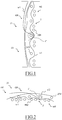
- the invention will now be described with initial reference to Figure 1 wherein a woven fabric 10 is depicted.
- the woven fabric 10 is obtained by crossing warp yarns w1, w2 and weft yarns 2, 2BS, 2FS, in a weaving pattern whereby the warp yarns w2 are extending over and below a number of weft yarns 2, 2BS, 2FS, to provide, with respect to the weft yarns 2, 2BS, 2FS, correspondent over portions and, eventually, under portions.
- Warp yarns w1 are interlaced with weft yarns 2, 2BS, 2FS, to provide a structural base portion of the fabric 10.
- under portions refer to portions being formed when warp yarns pass under a number of weft yarns 2, 2BS, 2FS, at the back side BS of the fabric
- over portions refer to portions of warp yarn w1, w2 that are formed when the warp yarns w1, w2 pass along the front side FS of the fabric and define connection portions.
- the length of an over portion is measured by referring to the numbers of weft yarns 2, 2BS, 2FS, that is passed by the warp between two changes.
- the length of the over portions can be for the warp direction from 4 mm to 1400 mm, preferably 4-140 mm, most preferably 18 mm to 70 mm; for the weft direction from 8 mm to 1100 mm, preferably 8-110 mm, most preferably 12mm to 50 mm.
- Figure 2 is a section view of a fabric according to another embodiment of the invention, globally indicated with the numerical reference 20, showing over portions on the weft direction.
- the woven fabric 20 is obtained by crossing weft yarns w'1, w'2 and warp yarns 2', BS', 2FS', in a weaving pattern whereby the weft yarns w'2 are extending over and below a number of warp yarns 2', BS', 2FS', to provide, with respect to the warp yarns 2', BS', 2FS' correspondent over portions and, eventually, under portions.
- Weft yarns w'1 are interlaced with warp yarns 2', BS', 2FS', to provide a structural base portion of the fabric 20.
- under portions refer to portions being formed when weft yarns pass under a number of warp yarns 2', BS', 2FS', at the back side BS' of fabric 20
- over portions refer to portions of weft yarns w'2 that are formed when the weft yarns w'2 pass along the front side FS' of fabric 20 and define connection portions.
- the length of an over portion is measured by referring to the numbers of warp yarns 2', BS', 2FS', that is passed by the weft between two changes.
- the warp over portions OP or the warp under portions have a length comprised between 8 and 3000 and the weft over portions OP' or the weft under portions have a length comprised between 25 and 3000.
- weave patterns can be conventionally displayed using weave symbols.
- an integer number expressing a length such as the above mentioned numbers 8, 25 and 3000 indicates the count number of warp (or weft) yarns that are passed over (or under) by an over portion (or an under portion) of a weft (or warp) yarn, respectively.
- the warp or weft over portions have a length comprised between 30 to 450 yarns, preferably of 40 or 45 to 400 yarns more preferably in the range of 40 and 100 yarns.
- the length in millimeters of the over portions can be for the warp direction from 4 mm to 1400 mm preferably 4 to 140 mm, more preferably, 18 mm to 70 mm; for the weft direction the length may be in the range of from 8 mm to 1100 mm, preferably 8 to 110 mm, more preferably 12 mm to 50 mm.
- the fabric may be realized by using one warp yarn w2 for the mentioned over portions and the following warp yarn w1 is used for a regular weave pattern such as 1/1, 2/1 (such as the one depicted in figures 1 and 2 ) or 3/1 and so on.
- two warp yarns w2 can be used for the over portions and a following warp w1 for a regular weave pattern to hold together the whole fabric construction therefore defining a base for the fabric.
- some warp yarns w2 are used to create the over portions and some warp yarns w1 are used in a regular weave pattern to hold together the fabric. The same is valid for fabric 20 of figure 2 in which warp yarns have been substituted with weft yarns and vice versa.
- the fabric disclosed may be a standard rigid (non stretch) fabric or, in a variant embodiment, it may be a stretch fabric or a bi-stretch fabric whereby at least some of the warp and/or weft or both warp and weft yarns are elastic.
- the fabric disclosed may be black or white (ready for dyeing), ecru, or of other colors, or of any overdyed color with different dyestuffs such as sulphur dyes, reactive dyes, pigment, direct dyestuff.
- dyestuffs such as sulphur dyes, reactive dyes, pigment, direct dyestuff.
- weft direction yarns may be black, overdye or weft yarn dyed indigo.
- Yarns of any fiber, natural or man-made can be used for the present invention.
- warp/weft yarns that are used for the base of the fabric they may be from Ne 0.5 to Ne 400, most preferably Ne 7 to Ne 50.
- the warp or weft yarns used for the over portions may be from Ne 0.5 to Ne 400, preferably 0.5 to 40, more preferably Ne 2 to Ne 15 or Ne 4 to Ne 15. Warp numbers may be different than each other or can be equal.
- Yarns may be one ply or multiply.
- Yarns can be any natural or man made fibres.
- Splittable yarns are not used in the present invention for the first warp or weft yarns, i.e.
- a yarn for the present invention may also be obtained by cutting a plurality of stripes from a film, e.g. glittered stripes obtained from a glittered film.
- One yarn of this kind is e.g. known in the art and is commercially available from Lurex.
- Some other examples of constructions may provide for warp direction over portions of length from 4 mm to 1400 mm, preferably 4 to 140 mm, most preferably from 18 mm to 70 mm.
- the over portions may be long from 8 mm to 1100 mm, preferably 8-110 mm, most preferably from 12 mm to 50 mm.
- Figure 3 is a weaving report, or scheme, of an embodiment of the fabric of the invention.
- Figure 3 weaving report is a 12x84 construction representing the warp direction single front face fur design. For clarity such construction has been represented in two semi-reports, the construction of Figure 3 being provided with a warp having a long (length is 79 weft yarns) over portion and two short over portions (length 1) and three short under portions (length 1) for odd-numbered warps and 28 over portions (of length 2) and 28 under portions (of length 1) for even numbered warps.
- the scheme is 79/1/1/1/1 (bottom to top) for odd-numbered warps and 2/1 for even numbered warps.
- the weft has two long under portions (length 5) and two short over portions (length 1) except for picks 10, 24, 38, 52, 66 and 80 where the weft has one under portion of length 5, two under portions of length 2 and three over portions of length 1 and therefore a scheme of 5/1/2/1/1/2/1.
- the weft has one under portion of length 5, one under portion of length 4, one over portion of length 2 and one over portion of length 1, the scheme being 4/2/5/1 and for picks 14, 28, 42, 56, 70 and 84, the weft has one under portion of length 5, one under portion of length 4 one over portion of length 2 and one over portion of length 1 with a scheme of 5/2/4/1.
- Figure 3 For the construction of Figure 3 , as an example:
- Figure 4 is a weaving report of an alternative embodiment of the fabric of the invention again representing the warp direction single front face fur design.
- Figure 4 weaving report is a 12x101 construction that for reasons of clarity has been represented in two semi-reports.
- the construction of Figure 4 is provided with a warp having a long (length 100) over portion and one short under portion (length 1) for warps numbered 1, 2, 4, 5, 7, 8, 10, and 11 with a scheme 100/1.
- the construction of Figure 4 is provided with warps having 51 over portions of length 1 and 50 under portions of length 1 with a scheme of 1/1.
- the weft has two long under portions (length 5) and two short over portions (length 1) with a scheme of 5/1/5/1 except for picks 9 and 23 which has two long under portions (of length 4) and two short over portions (length 2) with a scheme 4/2/4/2. Also for picks 13 and 17, the weft has two long under portions (of length 3), two short under portions (length 1) and four short over portions of length 1 with a scheme of 3/1//1/1/3/1/1/1.
- Figure 5 is a weaving report of still another embodiment of the fabric of the invention; again representing the warp direction single front face fur design.
- Figure 5 weaving report is a 16x101 construction that for reasons of clarity has been represented in two semi-reports.
- the construction of Figure 5 is provided with a warp having a long (length 100) over portion and one short under portion (length 1) for odd-numbered warps 1, 3, 5, 7, 9, 11, 13 and 15 with a scheme 100/1.
- the construction of Figure 5 is provided with warps having 25 over portions of length 3 and 35 under portions of length 1 with a scheme of 3/1.
- Figure 5 follows basically a twill scheme, with two weft under portions of length 7 and two weft over portions of length 1 with a scheme of 7/1/7/1 with the exception of pick 3 and 101 having each two under portions of length 3, two under portions of length 2, two over portions of length 2 and two over portions of length 1, with a scheme of 1/3/1/2/2/3/1/2/1.
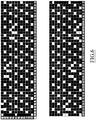
- Figure 6 is a weaving report in the weft direction of another embodiment of the fabric of the invention representing weft direction on the single back side denim fur design.
- Figure 6 weaving report is a 12x84 construction that for reasons of clarity has been represented in two semi-reports.
- the construction of Figure 6 is provided with a weft having a long (length 79) under portion, two short under portions (length 1) and two short over portion (length 1) for odd-numbered picks 1, 3, 5, 7, 9, and 11 with a scheme 79/1/1/1/1.
- Figure 6 For even-numbered picks 2, 4, 6, 8, 10 and 12, the construction of Figure 6 is provided with wefts having 28 under portions of length 2 and 28 over portions of length 1 with a scheme of 2/1.
- the construction of Figure 6 follows basically a twill scheme and is provided with a warp having two long (length 5) over portions and two short under portions (length 1) with a scheme of 5/1/5/1.
- warps 3, 17, 31, 45, 59 and 73 show warps provided with two long over portions (respectively of length 4 and 5) and two short under portions (respectively of length 2 and 1) with a scheme of 4/1/5/2.
- Warps 5, 19, 33, 47, 61 and 75 are provided with two short over portions of length 2, a long over portion of length 5 and three under portions of length 1 with a scheme of 2/1/5/1/2/1b.
- Warps 15, 29, 43, 57 and 71 are provided with two long over portions (respectively of length 4 and 5) and two short under portions (respectively of length 2 and 1) with a scheme of 5/1/4/2.
- Figure 7 is a further weaving report in the weft direction of another embodiment of the fabric of the invention representing weft direction on the single back side denim fur design.
- Figure 7 weaving report is a 12x84 construction that for reasons of clarity has been represented in two semi-reports.
- Figure 7 The construction of Figure 7 is provided with a weft having a long (length 83) under portion and one short over portion (length 1) for picks 1, 2, 4, 5, 7, 8, 10 and 11 with a scheme 83/1.
- the construction of Figure 7 is provided with wefts having 42 over portions of length 1 and 42 under portions of length 1 with a scheme of 1/1.
- Figure 7 follows basically a twill scheme and is provided with a warp having two long (length 5) over portions and two short under portions (length 1) with a scheme of 5/1/5/1.
- warps 64 and 76 show warps provided with two long over portions (length 4) and two short under portions (length 2) with a scheme of 4/2/4/2and warps 68 and 72 show with two long over portions (length 3), two short over portions (length 1) and four short under portions (length 1) with a scheme of 3/1/1/1/3/1/1/1.
- Figure 8 weaving report is a 17x101 construction that for reasons of clarity has been represented in two semi-reports representing a weft direction single back denim fur design.
- the construction of Figure 8 is provided with a weft having a long (length 100) under portion and one short over portion (length 1) for odd-numbered picks 3, 5, 7, 9, 11, 13, 15, and 17 with a scheme 100/1.
- the construction of Figure 8 is provided with wefts having 25 under portions of length 3 and 25 over portions of length 1 with a scheme of 3/1.
- Figure 8 follows basically a twill scheme and shows warps provided with two long over portions (respectively of length 7 and 8) and two short under portions (length 2 and 1) with a scheme of 7/1/8/1, with the exception of warps 1 which show a scheme of 3/2/1/3/2/2/1/3 and 99 which show a scheme of 4/1/2/2/3/1/2/2.
- Figure 9 is another weaving report in the weft direction of a further embodiment of the fabric of the invention representing weft direction on the front side denim fur design.
- Figure 9 weaving report is a 12x84 construction that for reasons of clarity has been represented in two semi-reports.
- Figure 9 The construction of Figure 9 is provided with a weft having a long (length 79) over portion, two short over portions (length 1) and three short-under portions of (length1) for odd-numbered picks 1, 3, 5, 7, 9 and 11 with a scheme of 79/1/1/1/1/1.
- the weft is provided with 28 over portions of length 1 and 28 under portions of length 2 with a scheme of 2/1.
- Figure 9 shows warps provided with four short over portions (of length 1), two long under portions (of length 3) and two short under portions (of length 1) with a scheme of 1/1/1/3/1/1/1/3.
- warps 1, 15, 29, 43, 57 and 71 are provided with one over portion of length 2 and three over portions of length 1, one under portion of length 3, one under portion of length 2 and two under portions of length 2 with a scheme of 2/1/1/3/1/1/1/2
- Warps 17, 31, 45, 59 and 73 are provided with one over portion of length 2 and three over portions of length 1, one under portion of length 3, one under portion of length 2 and two under portions of length 1 with a scheme of 2/1/1/3//1/1/1/2 and warps 5, 19, 33, 47, 61 and 75 are provided with one over portion of length 3 and two over portions of length 1, two under portions of length 3 and one under portion of length 1 with a scheme of 3/3/1/1/1/3.
- Warp 2 has a scheme of 1/3/1/1/1/3/1/1.
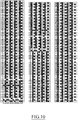
- Figure 10 is still another weaving report of a further embodiment of the fabric of the invention.
- Figure 10 weaving report is a 12x208 construction that for reasons of clarity has been represented in three portions. This fabric has warps doing overportions and underportions at the same time with different lengths of over/under portions in a same warp.
- Figure 10 The construction of Figure 10 is provided with a warp having a long (length 93) over portion, one shorter over portion of length 8, three short (binding) over portions of length 1, a long (length 92) under portion, one under portions of length 9 and three short under portions of length 1 for picks numbered 1, 4, 7 and 10 with a scheme of 1/1/9/1/93/1/1/8/1/92.
- Figure 10 The construction of Figure 10 is also provided with a warp having a long (length 89) over portion, one over portion of length 12, two short over portions of length 1, a long (length 88) under portion, one under portion of length 14, one under portion of length 2 and one short under portion of length 1 for picks numbered 2, 5, 8 and 11 with a scheme of 1/2/12/1/89/14/1/88.
- Figure 10 The construction of Figure 10 is also provided with a warp yarns, i.e. second warp yarns, having 104 short over portions of length 1, and 104 short under portions of length 1 for picks numbered 3, 6, 9 and 12 with a scheme of 1/1.
- the warp yarns are arranged to provide alternated second warp yarns and first warp yarns in a ratio 1 ⁇ 2, i.e. there are two first warp yarns for every second warp yarns.
- the construction of Figure 10 is also provided with a weft having two over portions of length 2, two over portions of length 1, two under portions of length 2 and two under portions of length 1 for odd-numbered wefts with a scheme of 1/1/2/2/1/1/2/2.
- the construction of Figure 10 is provided with a weft having two over portions of length 2, two over portions of length 1, two under portions of length 2 and two under portions of length 1 with a scheme of 2/2/1/1/2/2/1/1.
- the construction presents one over portion of length 5, one over portion of length 6, and two under portion of length 1, with a scheme of 6/1/5/1.
- the construction presents two under portions of length 5, two over portions of length 2 and one over portion of length 1 with a scheme of 5/2/5/1.
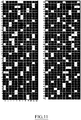
- Figure 11 is another weaving report of a further embodiment of the fabric of the invention.
- Figure 11 weaving report is a 12x84 construction that for reasons of clarity has been represented in two semi-reports.
- the construction of Figure 11 is designed in order to have both warp and weft yarns to create over portions.
- pick 1 of the construction of Figure 11 has eight over portions of length 5, four over portions of length 4, four over portions of length 2, four under portions of length 2 and twelve under portions of length 1 with a scheme of 4/2/5/1/4/2/5/1/5/2/4/1/5/2/4/1/5/1/5/1/2/1/2/1/5/1/5/1/2/1/2/1.
- Pick 2 has two long over portions respectively of lengths 38 and 40, two short over portions of length 1 and four short under portions of length 1 with a scheme of 38/1/1/1/1/40/1.
- Pick 3 has eleven over portions of length 5, three over portions of length 4, three under portions of length 2 and eleven under portions of length 1 with a scheme of 5/1/4/2/5/1/5/1/5/1/5/2/4/1/5/1/51/5/1/4/2/5/1/5/1/5/1.
- Pick 4 has two long over portions respectively of lengths 60 and 18, one over portion of length 1, one under portion of length 3 and two under portions of length 1 with a scheme of 60/3/1/1/18/1.
- Pick 5 has seven over portions of length 5, six over portions of length 4, one over portion of length 3, seven under portions of length 2 and eight under portions of length 1 with a scheme of 3/2/5/1/4/2/4/2/5/2/4/1/5/1/4/2/5/1/5/1/5/1/2/1/2/1/5/2/4/2.
- Pick 6 has two long over portions of length 36 and length 42, two over portions of length 1, one under portion of length 2 and two under portions of length 1 with a scheme of 36/42/1/2/1/1.
- Pick 7 has ten over portions of length 5, three over portions of length 4, two over portions of length 2, three under portions of length 2 and twelve under portions of length 1 with a scheme of 5/1/4/2/5/1/5/1/5/1/4/2/5/1/5/2/4/1/5/1/5/1/5/1/2/1/2/1/5/1.
- Pick 8 has two over portion of length 25 and length 50), one over portion of length 2, two over portions of length 1, one under portion of length 2 and two under portions of length 1 with a scheme of 75/2/1/1/1/1/2/1.
- Pick 9 has eight over portions of length 5, six over portions of length 4, six under portions of length 2 and eight under portions of length 1 with a scheme of 2/5/1/4/2/4/2/5/1/5/1/5/2/4/1/5/1/5/1/5/2/4/1/4/2/4.
- Pick 10 has (two over portion of length 11 and length 64), one over portion of length 2, two over portions of length 1, one under portion of length 2 and three under portions of length 1 with a scheme of 75/2/1/1/1/1/2/1.
- Pick 11 has nine over portions of length 5, four over portions of length 4, one under portion of length 3, six under portions of length 2 and eight under portions of length 1 with a scheme of 5/1/4/2/5/1/5/2/3/2/5/1/5/2/4/1/5/1/5/2/4/1/5/1/5/1.
- Pick 12 has two long over portions respectively of lengths 52 and 26, two over portions of length 1 and four under portions of length 1 with a scheme of 52/1/26/1/1/1/1/1.
- Figure 12 is a photograph of an embodiment of the fabric of the invention on the warp direction and figure 13 is photograph of the embodiment of the fabric of the invention of figure 12 after rinse wash.
- a fabric in a state similar to the fabric of the section of figure 1 .
- the initial lengths of, e.g., first and second warp yarns, w1 and w2 are the same, due to the very different weaving report of said yarns the free-floating of the, e.g., overportions of first warps w1 are longer than the distance (on the fabric) between the start and the end of the said overportions. This is due to the short over/under portions of second warp yarns w2.
- the difference is increased by the finishing treatment, so as to reach on average 10-50% difference in length to provide a curved and/or undulated aspect of the overportions.
- Figure 14 is a photograph of another embodiment of the fabric of the invention of figure 2 on the weft direction after finishing treatment and Figure 15 is a photograph of the embodiment of the fabric of the invention after a cutting process.
- the cutting i.e. the process of dividing the over (or under) portions in two parts, results in a furry appearance that may be also increased by additional mechanical treatments.
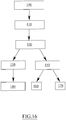
- Figure 16 is a flowchart of a method according to the invention.
- the method starts with the yarns (block 100) that are subjected to a weaving process (block 110), for example using a dobby loom or other similar textile machine.
- a weaving process block 110
- warp yarns and weft yarns are weaved following a pattern whereby the warp yarns are extending over a number of weft yarns and below a number of weft yarns to provide warp over portions in said front side and warp under portions in said back side and wherein the warp over portions have a length comprised between 8 and 3000 yarns, preferably 8 to 300 yarns.
- the overportions or underportions of the first warp yarns or of the first weft yarns have a discontinuity, i.e. are divided into two portions, e.g. obtained by laser cutting the first yarns.
- the two portions of the original over or under portions extend from the fabric at two locations that are spaced by a distance (e.g. measured in number of warps or wefts over which the over/underportion floats before being cut) corresponding to the original length of the over or underportions.
- the said portions may extend (i.e. float), when integral, for a length of 8 to 3000 warp or weft yarns.
- the warp over portions extend over weft yarns so as to have a length comprised between 40 and 100 yarns.
- warp under portions can be provided instead of warp over portions. Warp over portions are preferred to impart the required furry appearance to the final fabric.
- warp yarns and weft yarns are weaved following a pattern whereby the weft yarns are extending over a number of warp yarns and below a number of warp yarns to provide weft over portions in said front side and weft under portions in said back side and wherein the weft over portions have a length comprised between 25 and 3000, preferably 25 to 300 yarns. In some embodiments, the weft over portions have a length comprised between 40 and 100. In a similar manner, instead of weft over portions, weft under portions can be provided.
- the woven fabric is the subjected to a finishing process (block 120).
- the finished fabric may be subjected to a cutting process (block 130).
- the cutting process can be performed with any suitable machine with a knife or laser or using any type of chemical application for cutting. In general, the cutting process is used to improve or increase the fur-like look of the final product. Cutting can be made in different ways by using different machines. Laser cutting can be used in particular after a laundry process (block 150). In a further alternative embodiment, after a laundry process (block 150) no cutting is performed (block 170).
- the fabric may be subjected to a laundry process (block 140).
- a laundry process (block 150) is performed before cutting.
- a cutting process is performed (block 160).
- the cutting process can be performed in a wide variety of ways, namely using:
- Burn-out chemical agents can be used. Burn-out agents are strong acids as compounds which split off strong acids and which, in a subsequent heat treatment, destroy the cellulosic fibres. Heat treatment temperature can be 120-200 C°, preferably 140-180 C°. Suitable examples of burn-out agents are sulphuric acid and amino sulphonic acid, sodium bisulphate, aluminium sulphate, aluminium chloride, magnesium chloride, dibutylnapthalenesulphonic acid and p-toluenesulphonic acid, methanesulphonic acid and sulphonic acids from among arenemonosulphonic or arenedisulphonic acids.
- burn-out agents are the alkali metal salts of sulphonic acids, particular the sodium or potassium salts in combination with sulphuric acid.
- burn-out agents are sodium bisulphate, aluminium sulphate, p-tallenesulphonic acid, methane-sulhonic acid and alkylnaphtnalene sulphonic acids possibly mixed with sulphuric acid.
- the fabric is printed with the burn-out agent as customary in the form of a burn-out paste.
- Print can be full print or designed print.
- the amount of burn-out agent to be used in the burn-out pastes increases with the cellulose content of the blend fabric.
- Active burn out agents such as, for example, sodium bisulphate or hydrogensulphate may be 20-350 gr/kg, and preferably 50 to 250 gr/kg. These quantities are normally required to obtain acceptable burn-out style fabrics at the amounts of burn-out paste customarily used and to destroy cellulosic fibres.
- Active burn-out agents such as, sulphonic acids require as a rule burn-out agent concentrations in the burn-out pastes of 3 to 160 gr/kg, preferably to 40 to 140 gr/kg.
- the burn-out pastes in addition to the burn-out agents also contain water, thickeners and auxiliaries dispersing agent, wetting agent, carrier, glycerol).
- suitable thickeners are starch degradation products such as dextrin, nonionic starch derivatives, such as British gum, types of gum, such as gum arabic, locust bean gum ether thickener and guar derivatives.
Landscapes
- Engineering & Computer Science (AREA)
- Textile Engineering (AREA)
- Mechanical Engineering (AREA)
- Woven Fabrics (AREA)
- Treatment Of Fiber Materials (AREA)
Applications Claiming Priority (1)
| Application Number | Priority Date | Filing Date | Title |
|---|---|---|---|
| EP19165322 | 2019-03-26 |
Publications (2)
| Publication Number | Publication Date |
|---|---|
| EP3715510A2 true EP3715510A2 (fr) | 2020-09-30 |
| EP3715510A3 EP3715510A3 (fr) | 2020-10-14 |
Family
ID=65991674
Family Applications (1)
| Application Number | Title | Priority Date | Filing Date |
|---|---|---|---|
| EP20165761.6A Pending EP3715510A3 (fr) | 2019-03-26 | 2020-03-26 | Tissu pelucheux tissé et son procédé de production |
Country Status (5)
| Country | Link |
|---|---|
| US (1) | US12460325B2 (fr) |
| EP (1) | EP3715510A3 (fr) |
| JP (1) | JP7440193B2 (fr) |
| CN (1) | CN113853458B (fr) |
| WO (1) | WO2020193675A1 (fr) |
Citations (2)
| Publication number | Priority date | Publication date | Assignee | Title |
|---|---|---|---|---|
| GB191503015A (en) | 1915-02-24 | 1916-02-24 | Fritz Schultz | Improvements in or relating to Tent and like Poles. |
| US5609935A (en) | 1990-10-09 | 1997-03-11 | Toray Industries, Inc. | Fur-like piled fabric and method for production thereof |
Family Cites Families (24)
| Publication number | Priority date | Publication date | Assignee | Title |
|---|---|---|---|---|
| JP3401641B2 (ja) * | 2000-08-18 | 2003-04-28 | セイザ産業株式会社 | オパール加工パイル布帛及びその製造方法 |
| US6799581B2 (en) * | 2002-09-25 | 2004-10-05 | L&N Sales And Marketing, Inc. | Ponytail holder with low friction interior portion |
| JP4139732B2 (ja) * | 2003-05-15 | 2008-08-27 | 株式会社日立製作所 | 液晶パネル製造用ラビング布材 |
| ES2324785T3 (es) * | 2003-05-23 | 2009-08-14 | Voith Patent Gmbh | Materiales textiles de formacion de alto lizo. |
| JP2007534850A (ja) * | 2004-02-20 | 2007-11-29 | フェデラル−モーグル パワートレイン インコーポレイテッド | 低摩擦プルテープ |
| KR100556084B1 (ko) * | 2004-07-14 | 2006-03-07 | 김하진 | 인조모피의 제조방법 |
| JP2008031583A (ja) * | 2006-07-28 | 2008-02-14 | Suminoe Textile Co Ltd | 立毛布帛の縁部の処理方法とそれを用いた立毛布帛 |
| US10221506B2 (en) * | 2010-02-26 | 2019-03-05 | Sanko Tekstil Isletmeleri San. Ve Tic. A.S. | Method of making woven fabric that performs like a knitted fabric |
| CA2775538A1 (fr) * | 2011-04-28 | 2012-10-28 | Steve Ialenti | Materiel de vetements sport resistant aux coupures |
| CA2854452A1 (fr) * | 2011-11-04 | 2013-05-10 | David E. Ronner | Materiau en tissu |
| CN202323243U (zh) * | 2011-11-28 | 2012-07-11 | 杨永发 | 双面圈绒织物 |
| ES2731952T3 (es) * | 2013-07-30 | 2019-11-19 | Sanko Tekstil Isletmeleri San Ve Tic As | Prenda de vestir que tiene un aspecto alterable, uso de un tejido de calada para tal artículo y procedimiento de producción de tal artículo |
| EP2832907B2 (fr) * | 2013-07-31 | 2022-10-26 | Sanko Tekstil Isletmeleri San. Ve Tic. A.S. | Tissu extensible tissé et son procédé de production |
| CN105813491B (zh) * | 2013-12-02 | 2019-10-01 | 英威达技术有限公司 | 具有不连续弹性聚合物成分的体形增强衣 |
| JP6562952B2 (ja) * | 2014-05-09 | 2019-08-21 | ザ ノース フェイス アパレル コーポレイションThe North Face Apparel Corp. | 複数のゾーンの単一の織られた生地構築体 |
| WO2016007830A2 (fr) * | 2014-07-11 | 2016-01-14 | Vf Jeanswear, L.P. | Fibre contenant de la jade, fil et tissu rafraîchissant évacuant l'humidité |
| WO2016045712A1 (fr) * | 2014-09-23 | 2016-03-31 | Sanko Tekstil Isletmeleri San. Ve Tic. A.S. | Tissu tissé ayant l'aspect d'un tissu scuba, et son procédé de fabrication |
| US11021814B2 (en) * | 2016-02-10 | 2021-06-01 | Sanko Tekstil Isletmeleri San. Ve Tic. A.S. | Fleece fabric and method for producing the same |
| PL3205755T3 (pl) * | 2016-02-10 | 2020-05-18 | Sanko Tekstil Isletmeleri San. Ve Tic. A.S. | Tkanina polarowa i sposób jej wytwarzania |
| EP4033019B1 (fr) * | 2016-04-11 | 2024-09-18 | Calik Denim Tekstil San. Ve Tic. A.S. | Tissu tissé et son procédé de production |
| ES2648804B1 (es) * | 2016-07-05 | 2018-10-22 | Francisco SELVA SARZO | Venda fascial adhesiva |
| CN109641317B (zh) * | 2016-08-19 | 2021-08-06 | 利惠商业有限公司 | 服装的激光整理 |
| US11241054B2 (en) * | 2016-12-13 | 2022-02-08 | Levi Strauss & Co. | Multiple apparel products by using fabric templates and laser finishing |
| US11578457B2 (en) * | 2016-12-13 | 2023-02-14 | Levi Strauss & Co. | Fabric with enhanced response characteristics for laser finishing |
-
2020
- 2020-03-25 US US16/830,168 patent/US12460325B2/en active Active
- 2020-03-26 EP EP20165761.6A patent/EP3715510A3/fr active Pending
- 2020-03-26 JP JP2021557198A patent/JP7440193B2/ja active Active
- 2020-03-26 CN CN202080024533.7A patent/CN113853458B/zh active Active
- 2020-03-26 WO PCT/EP2020/058467 patent/WO2020193675A1/fr not_active Ceased
Patent Citations (2)
| Publication number | Priority date | Publication date | Assignee | Title |
|---|---|---|---|---|
| GB191503015A (en) | 1915-02-24 | 1916-02-24 | Fritz Schultz | Improvements in or relating to Tent and like Poles. |
| US5609935A (en) | 1990-10-09 | 1997-03-11 | Toray Industries, Inc. | Fur-like piled fabric and method for production thereof |
Also Published As
| Publication number | Publication date |
|---|---|
| JP7440193B2 (ja) | 2024-02-28 |
| JP2022529210A (ja) | 2022-06-20 |
| WO2020193675A1 (fr) | 2020-10-01 |
| CN113853458A (zh) | 2021-12-28 |
| CN113853458B (zh) | 2024-04-30 |
| US12460325B2 (en) | 2025-11-04 |
| US20200308731A1 (en) | 2020-10-01 |
| EP3715510A3 (fr) | 2020-10-14 |
Similar Documents
| Publication | Publication Date | Title |
|---|---|---|
| US5487936A (en) | Textile fabrics of differential weave comprising multifilament threads wherein individual filaments have a linear density of one decitex or less | |
| TWI392777B (zh) | Pull the stitch printed cloth | |
| CN101503840A (zh) | 三层提花毛巾及其织造工艺 | |
| CN101265632B (zh) | 剪花布的制造方法 | |
| JP2024045109A (ja) | 織布およびその製造方法 | |
| CN104060488A (zh) | 一种烂花透漏风格效应牛仔布的加工方法 | |
| GB2287966A (en) | Woven fabrics with coloured effects | |
| US12460325B2 (en) | Woven furry fabric and a method of production thereof | |
| CN1019212B (zh) | 经花双面长毛绒织物 | |
| HK40035860A (en) | A woven furry fabric and a method of production thereof | |
| WO2018123532A1 (fr) | Structure de fibre | |
| CN220468303U (zh) | 立体感波纹牛仔面料以及服装 | |
| CN108642647A (zh) | 一种压皱仿大提花面料及其制作工艺 | |
| CN223316855U (zh) | 一种具有非印花立体图案的真牛仔面料 | |
| JP7591258B2 (ja) | タオル製品及びその製造方法 | |
| CN112210871A (zh) | 一种双面异花毛巾 | |
| CN117071145B (zh) | 一种印经织物及其制作织造方法 | |
| CN223892977U (zh) | 一种正面纬浮渐变不规则牛仔面料 | |
| CN218291243U (zh) | 一种可降解涤纶色织面料 | |
| CN223723325U (zh) | 一种色彩跳跃段染效果的毛巾织物 | |
| CN219099456U (zh) | 一种花纹面料结构 | |
| JP2645645B2 (ja) | 生地およびその製造方法 | |
| JP3057306U (ja) | うずら織り着物地 | |
| KR100957451B1 (ko) | 불규칙한 이색조의 편직물 및 그 직조방법 | |
| KR200347672Y1 (ko) | 번아웃 가공용 벨벳직물 |
Legal Events
| Date | Code | Title | Description |
|---|---|---|---|
| PUAI | Public reference made under article 153(3) epc to a published international application that has entered the european phase |
Free format text: ORIGINAL CODE: 0009012 |
|
| STAA | Information on the status of an ep patent application or granted ep patent |
Free format text: STATUS: THE APPLICATION HAS BEEN PUBLISHED |
|
| PUAL | Search report despatched |
Free format text: ORIGINAL CODE: 0009013 |
|
| AK | Designated contracting states |
Kind code of ref document: A2 Designated state(s): AL AT BE BG CH CY CZ DE DK EE ES FI FR GB GR HR HU IE IS IT LI LT LU LV MC MK MT NL NO PL PT RO RS SE SI SK SM TR |
|
| AX | Request for extension of the european patent |
Extension state: BA ME |
|
| AK | Designated contracting states |
Kind code of ref document: A3 Designated state(s): AL AT BE BG CH CY CZ DE DK EE ES FI FR GB GR HR HU IE IS IT LI LT LU LV MC MK MT NL NO PL PT RO RS SE SI SK SM TR |
|
| AX | Request for extension of the european patent |
Extension state: BA ME |
|
| RIC1 | Information provided on ipc code assigned before grant |
Ipc: D03D 15/08 20060101ALI20200904BHEP Ipc: D03D 27/02 20060101ALI20200904BHEP Ipc: D03D 15/00 20060101ALI20200904BHEP Ipc: D03D 13/00 20060101AFI20200904BHEP |
|
| STAA | Information on the status of an ep patent application or granted ep patent |
Free format text: STATUS: REQUEST FOR EXAMINATION WAS MADE |
|
| 17P | Request for examination filed |
Effective date: 20210413 |
|
| RBV | Designated contracting states (corrected) |
Designated state(s): AL AT BE BG CH CY CZ DE DK EE ES FI FR GB GR HR HU IE IS IT LI LT LU LV MC MK MT NL NO PL PT RO RS SE SI SK SM TR |
|
| REG | Reference to a national code |
Ref country code: HK Ref legal event code: DE Ref document number: 40035860 Country of ref document: HK |
|
| STAA | Information on the status of an ep patent application or granted ep patent |
Free format text: STATUS: EXAMINATION IS IN PROGRESS |
|
| 17Q | First examination report despatched |
Effective date: 20220607 |
|
| P01 | Opt-out of the competence of the unified patent court (upc) registered |
Effective date: 20230419 |