EP3715928B1 - Câble doté d'une couche la plus extérieure semiconductrice - Google Patents
Câble doté d'une couche la plus extérieure semiconductrice Download PDFInfo
- Publication number
- EP3715928B1 EP3715928B1 EP20162931.8A EP20162931A EP3715928B1 EP 3715928 B1 EP3715928 B1 EP 3715928B1 EP 20162931 A EP20162931 A EP 20162931A EP 3715928 B1 EP3715928 B1 EP 3715928B1
- Authority
- EP
- European Patent Office
- Prior art keywords
- cable
- conductive layer
- semi
- jacket
- external semi
- Prior art date
- Legal status (The legal status is an assumption and is not a legal conclusion. Google has not performed a legal analysis and makes no representation as to the accuracy of the status listed.)
- Active
Links
Images

Classifications
-
- H—ELECTRICITY
- H01—ELECTRIC ELEMENTS
- H01B—CABLES; CONDUCTORS; INSULATORS; SELECTION OF MATERIALS FOR THEIR CONDUCTIVE, INSULATING OR DIELECTRIC PROPERTIES
- H01B1/00—Conductors or conductive bodies characterised by the conductive materials; Selection of materials as conductors
- H01B1/14—Conductive material dispersed in non-conductive inorganic material
- H01B1/18—Conductive material dispersed in non-conductive inorganic material the conductive material comprising carbon-silicon compounds, carbon or silicon
-
- G—PHYSICS
- G02—OPTICS
- G02B—OPTICAL ELEMENTS, SYSTEMS OR APPARATUS
- G02B6/00—Light guides; Structural details of arrangements comprising light guides and other optical elements, e.g. couplings
- G02B6/44—Mechanical structures for providing tensile strength and external protection for fibres, e.g. optical transmission cables
- G02B6/4401—Optical cables
- G02B6/4415—Cables for special applications
-
- C—CHEMISTRY; METALLURGY
- C08—ORGANIC MACROMOLECULAR COMPOUNDS; THEIR PREPARATION OR CHEMICAL WORKING-UP; COMPOSITIONS BASED THEREON
- C08K—Use of inorganic or non-macromolecular organic substances as compounding ingredients
- C08K3/00—Use of inorganic substances as compounding ingredients
- C08K3/02—Elements
- C08K3/04—Carbon
- C08K3/041—Carbon nanotubes
-
- C—CHEMISTRY; METALLURGY
- C08—ORGANIC MACROMOLECULAR COMPOUNDS; THEIR PREPARATION OR CHEMICAL WORKING-UP; COMPOSITIONS BASED THEREON
- C08K—Use of inorganic or non-macromolecular organic substances as compounding ingredients
- C08K5/00—Use of organic ingredients
- C08K5/0008—Organic ingredients according to more than one of the "one dot" groups of C08K5/01 - C08K5/59
- C08K5/0041—Optical brightening agents, organic pigments
-
- G—PHYSICS
- G02—OPTICS
- G02B—OPTICAL ELEMENTS, SYSTEMS OR APPARATUS
- G02B6/00—Light guides; Structural details of arrangements comprising light guides and other optical elements, e.g. couplings
- G02B6/44—Mechanical structures for providing tensile strength and external protection for fibres, e.g. optical transmission cables
- G02B6/4401—Optical cables
- G02B6/4415—Cables for special applications
- G02B6/4416—Heterogeneous cables
-
- G—PHYSICS
- G02—OPTICS
- G02B—OPTICAL ELEMENTS, SYSTEMS OR APPARATUS
- G02B6/00—Light guides; Structural details of arrangements comprising light guides and other optical elements, e.g. couplings
- G02B6/44—Mechanical structures for providing tensile strength and external protection for fibres, e.g. optical transmission cables
- G02B6/4401—Optical cables
- G02B6/4429—Means specially adapted for strengthening or protecting the cables
- G02B6/44384—Means specially adapted for strengthening or protecting the cables the means comprising water blocking or hydrophobic materials
-
- G—PHYSICS
- G02—OPTICS
- G02B—OPTICAL ELEMENTS, SYSTEMS OR APPARATUS
- G02B6/00—Light guides; Structural details of arrangements comprising light guides and other optical elements, e.g. couplings
- G02B6/46—Processes or apparatus adapted for installing or repairing optical fibres or optical cables
- G02B6/56—Processes for repairing optical cables
- G02B6/562—Processes for repairing optical cables locatable, e.g. using magnetic means
-
- H—ELECTRICITY
- H01—ELECTRIC ELEMENTS
- H01B—CABLES; CONDUCTORS; INSULATORS; SELECTION OF MATERIALS FOR THEIR CONDUCTIVE, INSULATING OR DIELECTRIC PROPERTIES
- H01B1/00—Conductors or conductive bodies characterised by the conductive materials; Selection of materials as conductors
- H01B1/20—Conductive material dispersed in non-conductive organic material
- H01B1/24—Conductive material dispersed in non-conductive organic material the conductive material comprising carbon-silicon compounds, carbon or silicon
-
- H—ELECTRICITY
- H01—ELECTRIC ELEMENTS
- H01B—CABLES; CONDUCTORS; INSULATORS; SELECTION OF MATERIALS FOR THEIR CONDUCTIVE, INSULATING OR DIELECTRIC PROPERTIES
- H01B7/00—Insulated conductors or cables characterised by their form
- H01B7/17—Protection against damage caused by external factors, e.g. sheaths or armouring
- H01B7/18—Protection against damage caused by wear, mechanical force or pressure; Sheaths; Armouring
- H01B7/1875—Multi-layer sheaths
-
- H—ELECTRICITY
- H01—ELECTRIC ELEMENTS
- H01B—CABLES; CONDUCTORS; INSULATORS; SELECTION OF MATERIALS FOR THEIR CONDUCTIVE, INSULATING OR DIELECTRIC PROPERTIES
- H01B7/00—Insulated conductors or cables characterised by their form
- H01B7/17—Protection against damage caused by external factors, e.g. sheaths or armouring
- H01B7/18—Protection against damage caused by wear, mechanical force or pressure; Sheaths; Armouring
- H01B7/1875—Multi-layer sheaths
- H01B7/188—Inter-layer adherence promoting means
-
- H—ELECTRICITY
- H01—ELECTRIC ELEMENTS
- H01B—CABLES; CONDUCTORS; INSULATORS; SELECTION OF MATERIALS FOR THEIR CONDUCTIVE, INSULATING OR DIELECTRIC PROPERTIES
- H01B7/00—Insulated conductors or cables characterised by their form
- H01B7/36—Insulated conductors or cables characterised by their form with distinguishing or length marks
- H01B7/361—Insulated conductors or cables characterised by their form with distinguishing or length marks being the colour of the insulation or conductor
-
- H—ELECTRICITY
- H01—ELECTRIC ELEMENTS
- H01B—CABLES; CONDUCTORS; INSULATORS; SELECTION OF MATERIALS FOR THEIR CONDUCTIVE, INSULATING OR DIELECTRIC PROPERTIES
- H01B9/00—Power cables
- H01B9/02—Power cables with screens or conductive layers, e.g. for avoiding large potential gradients
-
- H—ELECTRICITY
- H01—ELECTRIC ELEMENTS
- H01B—CABLES; CONDUCTORS; INSULATORS; SELECTION OF MATERIALS FOR THEIR CONDUCTIVE, INSULATING OR DIELECTRIC PROPERTIES
- H01B9/00—Power cables
- H01B9/02—Power cables with screens or conductive layers, e.g. for avoiding large potential gradients
- H01B9/027—Power cables with screens or conductive layers, e.g. for avoiding large potential gradients composed of semi-conducting layers
-
- C—CHEMISTRY; METALLURGY
- C08—ORGANIC MACROMOLECULAR COMPOUNDS; THEIR PREPARATION OR CHEMICAL WORKING-UP; COMPOSITIONS BASED THEREON
- C08K—Use of inorganic or non-macromolecular organic substances as compounding ingredients
- C08K3/00—Use of inorganic substances as compounding ingredients
- C08K3/18—Oxygen-containing compounds, e.g. metal carbonyls
- C08K3/20—Oxides; Hydroxides
- C08K3/22—Oxides; Hydroxides of metals
- C08K2003/2237—Oxides; Hydroxides of metals of titanium
- C08K2003/2241—Titanium dioxide
-
- C—CHEMISTRY; METALLURGY
- C08—ORGANIC MACROMOLECULAR COMPOUNDS; THEIR PREPARATION OR CHEMICAL WORKING-UP; COMPOSITIONS BASED THEREON
- C08K—Use of inorganic or non-macromolecular organic substances as compounding ingredients
- C08K3/00—Use of inorganic substances as compounding ingredients
- C08K3/01—Use of inorganic substances as compounding ingredients characterized by their specific function
- C08K3/014—Stabilisers against oxidation, heat, light or ozone
-
- C—CHEMISTRY; METALLURGY
- C08—ORGANIC MACROMOLECULAR COMPOUNDS; THEIR PREPARATION OR CHEMICAL WORKING-UP; COMPOSITIONS BASED THEREON
- C08K—Use of inorganic or non-macromolecular organic substances as compounding ingredients
- C08K3/00—Use of inorganic substances as compounding ingredients
- C08K3/01—Use of inorganic substances as compounding ingredients characterized by their specific function
- C08K3/016—Flame-proofing or flame-retarding additives
-
- G—PHYSICS
- G01—MEASURING; TESTING
- G01R—MEASURING ELECTRIC VARIABLES; MEASURING MAGNETIC VARIABLES
- G01R31/00—Arrangements for testing electric properties; Arrangements for locating electric faults; Arrangements for electrical testing characterised by what is being tested not provided for elsewhere
- G01R31/12—Testing dielectric strength or breakdown voltage ; Testing or monitoring effectiveness or level of insulation, e.g. of a cable or of an apparatus, for example using partial discharge measurements; Electrostatic testing
- G01R31/1227—Testing dielectric strength or breakdown voltage ; Testing or monitoring effectiveness or level of insulation, e.g. of a cable or of an apparatus, for example using partial discharge measurements; Electrostatic testing of components, parts or materials
- G01R31/1263—Testing dielectric strength or breakdown voltage ; Testing or monitoring effectiveness or level of insulation, e.g. of a cable or of an apparatus, for example using partial discharge measurements; Electrostatic testing of components, parts or materials of solid or fluid materials, e.g. insulation films, bulk material; of semiconductors or LV electronic components or parts; of cable, line or wire insulation
- G01R31/1272—Testing dielectric strength or breakdown voltage ; Testing or monitoring effectiveness or level of insulation, e.g. of a cable or of an apparatus, for example using partial discharge measurements; Electrostatic testing of components, parts or materials of solid or fluid materials, e.g. insulation films, bulk material; of semiconductors or LV electronic components or parts; of cable, line or wire insulation of cable, line or wire insulation, e.g. using partial discharge measurements
-
- G—PHYSICS
- G02—OPTICS
- G02B—OPTICAL ELEMENTS, SYSTEMS OR APPARATUS
- G02B6/00—Light guides; Structural details of arrangements comprising light guides and other optical elements, e.g. couplings
- G02B6/44—Mechanical structures for providing tensile strength and external protection for fibres, e.g. optical transmission cables
- G02B6/4479—Manufacturing methods of optical cables
- G02B6/4482—Code or colour marking
-
- H—ELECTRICITY
- H01—ELECTRIC ELEMENTS
- H01B—CABLES; CONDUCTORS; INSULATORS; SELECTION OF MATERIALS FOR THEIR CONDUCTIVE, INSULATING OR DIELECTRIC PROPERTIES
- H01B11/00—Communication cables or conductors
- H01B11/22—Cables including at least one electrical conductor together with optical fibres
-
- H—ELECTRICITY
- H01—ELECTRIC ELEMENTS
- H01B—CABLES; CONDUCTORS; INSULATORS; SELECTION OF MATERIALS FOR THEIR CONDUCTIVE, INSULATING OR DIELECTRIC PROPERTIES
- H01B7/00—Insulated conductors or cables characterised by their form
- H01B7/17—Protection against damage caused by external factors, e.g. sheaths or armouring
- H01B7/28—Protection against damage caused by moisture, corrosion, chemical attack or weather
- H01B7/282—Preventing penetration of fluid, e.g. water or humidity, into conductor or cable
-
- H—ELECTRICITY
- H01—ELECTRIC ELEMENTS
- H01B—CABLES; CONDUCTORS; INSULATORS; SELECTION OF MATERIALS FOR THEIR CONDUCTIVE, INSULATING OR DIELECTRIC PROPERTIES
- H01B9/00—Power cables
- H01B9/005—Power cables including optical transmission elements
Definitions
- the present disclosure relates to a cable, such as an electrical cable or
- electrical cables for power transmission or distribution may vary according to the intended applications.
- electrical cables may be categorized as low voltage (LV), medium voltage (MV), or high voltage (HV).
- low voltage is used to indicate a voltage up to 1 kV
- medium voltage is used to indicate a voltage of from 5 kV to 46 kV
- high voltage is used to indicate a voltage greater than 46 kV.
- the cable generally comprises a transmissive core and a jacket having at least an outermost polymeric layer.
- the transmissive core is an insulated core comprising, from interior to exterior, at least one electrical electrically conductive element, an electrical insulation system, and a metallic screen. Additional layers may also be present.
- the electrical insulation system generally comprises an inner semi-conductive layer, an electrically insulating layer and an outer semi-conductive layer.
- the transmissive core comprises at least one optical waveguide
- the cable comprises a plurality of protecting layers under the jacket and surrounding the transmissive core.
- WO 2017/084709 discloses an electric power cable.
- US 2010/0078194 discloses a medium or high voltage cable comprising a conductive core, an inner semiconductive layer, an insulating layer, an outer semiconductive layer, neutral conductors and a jacket, in which at least one of the inner semiconductive layer, the outer semiconductive layer and the jacket comprises a carbon nanotube composition.
- KR 2016 0121873 discloses an electrical cable with an external semi-conductive layer comprising a conductive filler in an amount between 20% and 40% by weight.
- Jacket integrity tests are important because any defect in and/or damage to the jacket of the cable constitutes a discontinuity in the polymeric layer, which can ultimately cause electrical failure as the transmissive cores are no longer protected by the jacket as originally designed.
- the presence of a cut in the jacket of the cable represents a preferential route for the entry of water or moisture to the interior (i.e. towards the core) of the cable, which can cause significant problems including short circuit and corrosion of the metal conductors.
- one jacket integrity test is known as the DC withstand test and may be conducted according to methods known in the art, such as the ICEA (Insulated Cable Engineers Association, Inc.) Standard S-108-720-2004 for Extruded Insulation Power Cables Rated Above 46 Through 345 kV (Section E5.2), 2004.
- ICEA Insulated Cable Engineers Association, Inc.
- S-108-720-2004 Extruded Insulation Power Cables Rated Above 46 Through 345 kV (Section E5.2), 2004.
- a semi-conductive layer that may be made either of graphite or of an extruded semi-conductive compound
- the second electrode is represented by the metal component arranged in a radially internal position relative to the jacket to be tested, such as the metal screen.
- a DC voltage of about 150 V/mil (6kV/mm) and up to a maximum of 24kV is applied between the metallic screen and the applied semi-conductive layer.
- the jacket has a defect and/or damage such as to create an electrically conductive path in the thickness of the jacket between the electrodes in the test, a short-circuit condition will exist and an overcurrent will be produced.
- the establishment of the overcurrent condition thus enables a person skilled in the art to confirm the presence of damage to and/or a defect in the jacket of the cable.
- the DC withstand test of the jacket is performed directly at the production plant after the process for producing the cable. Sometimes, the DC withstand test is also repeated once the cable has been installed, so as to check for any evidence of damage produced in the outer jacket due to the laying operations of the cable. Repeating the testing once the cable has been installed can be highly desirable, especially in the case of underground installations in which the cable is placed directly in the ground without the aid of conduits to contain it.
- Graphite has traditionally been used for the outer semi-conductive layer because it can be easily removed at one end of the cable, as required for conducting the DC withstand test.
- graphite may offer problems during maintenance testing because the graphite is messy and it may have rubbed off during installation.
- a thin layer of semi-conductive polymeric material may alternatively be extruded over the jacket.
- the jacket and the outer semi-conductive layer are both generally black and, thus hardly distinguishable.
- the jacket is usually black to aid with sunlight resistance.
- the semi-conductive layer is usually black, as a common and cheap way for making a semi-conductive layer is to add carbon black (defeating any other colorants) to a polyethylene material.
- US 9 064 618 discloses an electrical cable having a semi-conductive material extruded around and in contact with an outermost layer of a cable jacket.
- the semi-conductive layer can be of a color other than black and may be at least a material selected from the group of conductive polymers consisting essentially of polyaniline, polypyrrole and polyacetylene, which are per se conductive materials.
- a jacket integrity test can also be applied to optical cables.
- Optical cables can equally suffer performance decline or impairment in case of damage to the outer jacket, for example because of water penetration.
- Optical cables can be successfully tested by, for example, the above-mentioned jacket integrity standard when they comprise at least one metallic element in a radially internal position with respect to the outer jacket, such as armour, strength elements or tube housing optical waveguides.
- the electrically conductive polymers proposed by US 9 064 618 can be disadvantageous in terms of costs (they are generally more expensive with respect to a non-conductive polyethylene polymer loaded with carbon black) and in terms of compatibility with the base polymer material typically used for the jacket (e.g. low density polyethylene (LDPE), medium density polyethylene (MDPE), high density polyethylene (HDPE), polyvinyl chloride (PVC)).
- LDPE low density polyethylene
- MDPE medium density polyethylene
- HDPE high density polyethylene
- PVC polyvinyl chloride
- the compatibility of the materials of the jacket and the external semi-conductive layer is important, for example, to attain a suitable adhesion during the extrusion process of the semi-conductive layer over the jacket.
- an object of the present disclosure is that of providing a cable with an external semi-conductive layer, which has reduced cost and improved compatibility of the materials of the jacket and the external semi-conductive layer, and that enables the provision of an external semi-conductive layer of the color requested by the standard and/or by the customer.
- the Applicant also observes that, in general, it is useful that the different elements of a cable are visually distinguishable from each other.
- an ancillary object of the present disclosure is that of providing a cable with an external semi-conductive layer visually distinguishable from the jacket, even when the latter is black. Accordingly, in a first aspect the present disclosure relates to a cable according to claim 1.
- the cable of the present disclosure is an electrical cable for power transmission or distribution and the transmissive core is an insulated core comprising an electrically conductive element surrounded by an electrical insulating system and a metallic screen.
- the electrical insulating system comprises an inner semi-conductive layer, an insulating layer and an outer semi-conductive layer.
- the cable of the present disclosure is an optical cable for telecommunication
- the transmissive core comprises at least one optical waveguide
- the cable comprises a plurality of protecting layers under the jacket and surrounding the transmissive core, of which at least one is metallic.
- protecting layers are polymeric coating, buffer, polymeric or metal tube, water-blocking filler, metallic water barrier, flame retardant polymeric layer, fire-resistant glass or mica layers, metal armour in form of wires or optionally corrugated sheath.
- the optical waveguide comprises a glass core and a glass cladding.
- a base polymer material made, for example, of an ethylene homopolymer, ethylene copolymer or PVC enables to obtain a cable which has reduced cost (thanks to the fact that such a base polymer material is cheaper with respect to the electrically conductive polymers used by US 9 064 618 ) and improves the affinity between outer jacket and external semi-conductive layer, as the base polymer material of the latter is the same or similar or anyway chemically compatible with the base polymer material typically used in the art to make the jacket.
- the carbon nanotubes as electrically conductive filler can be used in a minimal percentage that, on the one side, is sufficient to provide the base polymer material of the external semi-conductive layer with the required electrical conductivity for integrity tests and, on the other side, does not affect the natural color thereof.
- the base polymer material of the external semi-conductive layer of the present disclosure can be made suitably conductive while keeping its natural color which, in the case of polyethylene material, is substantially transparent.
- the external semi-conductive layer colored, by adding a colorant to the base polymer material.
- the expression "transparent" in connection with a material of a cable layer is used to indicate that the material enables one to see through it, in particular to see the color of the underlying layer through it.
- the electrically conductive filler comprises carbon nanotubes in an amount of at least 0.05wt% with respect to the total weight of the semi-conductive layer composition.
- the electrically conductive filler comprises carbon nanotubes in an amount of 0.5wt% at most.
- this amount of carbon nanotubes can be sufficiently high to provide a semi-conductive layer with the electrical conductivity required, for example, to perform an integrity test, and at the same time could maintain the natural appearance or coloring of the base polymer material visually perceivable.
- an amount of 20-25wt%, with respect to the weight of the semi-conductive composition is required. Such an amount completely changes the natural appearance or the coloring of the base polymer material of a semi-conductive layer by blackening it.
- the external semi-conductive layer of the present cable has an electrical conductivity of at least 10 -2 S/cm (corresponding to a resistivity of 1 ⁇ ⁇ m) as measured, for example, according IEC 60093, 2 nd ed, 1980 (volume resistivity).
- the external semi-conductive layer of the present cable can have an electrical conductivity of 10 -1 S/cm (corresponding to resistivity of 10 -1 ⁇ ⁇ m) at most.
- the electrically conductive filler consists of carbon nanotubes only.
- the electrically conductive filler of the present disclosure is devoid of carbon black. This to avoid altering, and in particular, blackening, the natural appearance or the coloring of the base polymer material of the semi-conductive layer.
- the electrically conductive filler comprises an amount of carbon nanotubes suitable to provide a conductivity of at least 10 -2 S/cm (corresponding to a resistivity of 1 ⁇ ⁇ m).
- the electrically conductive filler comprises an amount of carbon nanotubes adapted to achieve a conductivity of 10 -1 S/cm (corresponding to resistivity of 10 -1 ⁇ ⁇ m) at most.
- the Applicant observed that the above values of conductivity are suitable to perform a jacket integrity test wherein a DC voltage of about 150 V/mil (6kV/mm) and up to a maximum of 24kV is applied between the metallic screen and the external semi-conductive layer to verify the integrity of the jacket.
- a thickness of the semi-conductive layer is up to 20% of a combined thickness of the jacket and the semi-conductive layer.
- the external semi-conductive layer of the cable is different in color from the outermost polymeric layer of the jacket, thus visually distinguishable therefrom.
- the external semi-conductive layer can have the appearance of the natural base polymer material (substantially transparent in the case of polyethylene, white in the case of PVC or in case of polyethylene charged with a filler), while the jacket can be black (to aid with sunlight resistance) or of any other color (e.g. to meet customer and/or law requirements, like in the case of MV cables).
- the external semi-conductive layer can be colored while the jacket can be left uncolored (as hidden from the sunlight) or colored in a different color.
- the external semi-conductive layer is of a color other than black.
- the external semi-conductive layer also comprises a colorant.
- a colorant the above cited amount of carbon nanotubes is sufficiently low to guarantee that the color imparted to the base polymer material by the colorant is maintained and not blackened by the electrically conductive filler.
- the external semi-conductive layer comprises the colorant in an amount of at least 0.01 wt%, with respect to the total weight of the semi-conductive layer composition.
- the external semi-conductive layer comprises the colorant in an amount of 2.5 wt% at most, for example of from 0.015 wt% to 1.2 wt%, with respect to the total weight of the semi-conductive layer composition.
- Colorants suitable for the polymeric material of the external semi-conductive layer can be readily selected by the skilled person. See, for example, Fundamentals of Color and Additives, Utilization of Color & Additive Concentrates, Clariant International Ltd, 2013.
- the jacket underlying the external semi-conductive layer can be of any color.
- the external semi-conductive layer is transparent because of the lack of any coloring agent in a material per se transparent, like polyethylene, the color of the jacket is visible from the outside and can be that required by the customer and/or by the standard.
- the jacket and the external semi-conductive layer are of substantially the same color.
- the carbon nanotubes may be single walled or few walled (e.g. 2 or 3 walls).
- the Applicant notes that with respect to multi walled (e.g. more than 3 walls) carbon nanotubes, single walled or few walled carbon nanotubes can display higher conductivity values at the same concentration.
- the external semi-conductive layer can include UV additives to improve sunlight resistance for the cable, with the provision that it preserves the color of the external semi-conductive layer unchanged.
- UV additives for sunlight resistance are based on titanium dioxide.
- the base polymer material of the external semi-conductive layer according to the present disclosure is per se non-electrically conductive.
- the base polymer material of the external semi-conductive layer may be selected from: polyethylene (for example, high density polyethylene, HDPE), ethylene propylene rubber (EPR), ethylene vinyl acetate (EVA) or a mixture thereof, such polymers or polymer mixtures being possibly low smoke zero halogen (LS0H) material, charged with an inorganic non-halogenated flame retardant filler, like magnesium hydroxide.
- the base polymer material of the external semi-conductive layer is made of PVC.
- the jacket is substantially dielectric even when made of a material containing a filler.
- the jacket is made of a polymer material selected from low density polyethylene (LDPE), medium density polyethylene (MDPE), high density polyethylene (HDPE), polyvinyl chloride (PVC), or a LS0H material.
- LDPE low density polyethylene
- MDPE medium density polyethylene
- HDPE high density polyethylene
- PVC polyvinyl chloride
- the jacket is monolayered with the outermost polymeric layer being its only layer.
- the jacket may have two or more polymeric layers, one being an innermost polymeric layer and another being the outermost polymeric layer.
- the cable can be an electrical DC or AC cable.
- the cable is terrestrial.
- the terrestrial cable can be at least in part buried, optionally in a pipe, or positioned in vaults or tunnels.
- an electrical cable 110 comprises an insulated cable core (as transmissive, insulated core) comprising a conductor 12 (as electrically conductive element), an extruded inner semi-conductive layer 14 encircling the conductor 12, an extruded electrical insulating layer 16 surrounding the inner semi-conductive layer 14, an extruded outer semi-conductive layer 18, and a metallic screen 20.
- Additional components such as water swellable conductive or non-conductive tapes or yarns, rip cords, and the like may be included in the insulated cable core, as is known in the art.
- the optional water swellable tape or yarn may be capable of acting as a barrier to the penetration of water into the insulated core of the cable.
- Conductor 12 may be a conductor of the electrical type or of the mixed electrical/optical type.
- An electrical type conductor may be made of copper, aluminum, or aluminum alloy.
- Inner semi-conductive layer 14, the electrical insulating layer 16 and the outer semi-conductive layer 18 encircling conductor 12 may be made of any polymeric material known to those skilled in the art for semi-conductive shields and typically extruded over conductor 12, for example, polyolefins (homopolymers or copolymers of various olefins), olefin/ethylenically unsaturated ester copolymers, polyesters, polyethers, polyether/polyester copolymers, and blends thereof.
- polyethylene such as linear low-density polyethylene (LLDPE); polypropylene (PP); propylene/ethylene thermoplastic copolymers; ethylene-propylene rubbers (EPR) or ethylene-propylene-diene rubbers (EPDM); natural rubbers; butyl rubbers; ethylene/vinyl acetate (EVA) copolymers; ethylene/methyl acrylate (EMA) copolymers; ethylene/ethyl acrylate (EEA) copolymers; ethylene/butyl acrylate (EBA) copolymers; ethylene/a-olefin copolymers, and the like.
- PE polyethylene
- LLDPE linear low-density polyethylene
- PP polypropylene
- EPR ethylene-propylene rubbers
- EPDM ethylene-propylene-diene rubbers
- EVA ethylene/vinyl acetate copolymers
- EMA ethylene/methyl acrylate
- EAA ethylene/ethyl
- An exemplary thickness for electrical insulating layer 16 can be from 3 to 30 mm.
- Metallic screen 20 is formed around outer semi-conductive layer 18 and may be copper concentric neutral wires, aluminum, steel, lead, or copper or aluminum laminated tape, or both.
- Metallic screen 20 can be a tape, which is longitudinally folded or spirally wound to form a circumferentially and longitudinally continuous layer, in a manner well known in the art.
- Metallic screen 20 may be a continuous tubular component or a metal sheet folded on itself and welded or sealed to form the tubular component.
- Electrical cable 110 further includes a jacket 22 formed around the transmissive core.
- Jacket 22 is made of a polymeric material and may be formed through pressure extrusion.
- Jacket 22 serves to protect the cable from environmental, thermal, and mechanical hazards and substantially encapsulates the insulated cable core.
- Jacket thickness may depend on factors such as cable rating and conductor size and is identified in industry specifications, as well known to those skilled in the art. As a general guide, the thickness of jacket 22 may be in the range of 1.78-4.57 mm.
- electrical cable 110 further includes an external semi-conductive layer 24 also applied by extrusion to surround and directly contacting the jacket 22.
- the external semi-conductive layer 24 is made of a composition comprising an electrically conductive filler, as from the present disclosure, that enables it to be used for performing a jacket integrity test, such as the above mentioned DC withstand test, on jacket 22.
- composition of the semi-conductive layer 24 comprises a base polymer material wherein carbon nanotubes as electrically conductive filler are dispersed.
- a color difference between the jacket 22 and the external semi-conductive layer 24 helps to make the two layers distinguishable from each other to a field technician.
- the technician can readily detect the boundary between the semi-conductive layer 24 and the different material underlying it.
- the thickness of the external semi-conductive layer 24 may be up to 20% of the overall thickness of the combined thickness of layers 24 and 22.
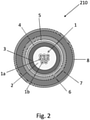
- FIG.2 show a cross-sectional view of an optical cable according to the present disclosure.
- the optical cable 210 comprises a plurality of optical fibers 1.
- Each optical fiber 1 comprises an optical waveguide 1a (as transmissive core comprising a glass core and a glass cladding) surrounded by one or more polymeric coatings 1b.
- the plurality of optical fibers 1 is housed in a tube 3 which can be of metallic or polymeric material.
- the tube 3 also contains a water-blocking compound 2, typically a gel.
- the tube 3 is surrounded by an aramid yarn layer 4 surrounded, in turn by a polyethylene layer 5.
- a steel tape armour 6 surrounds the polyethylene layer 5.
- the polymeric coating/s 1b of the optical fibers 1, the tube 3, the aramid yarn layer 4, the polyethylene layer 5 and the steel tape armour 6 are protecting layers according to the present disclosure.
- a jacket 7 is provided made, for example, of LS0H material and surrounded by an external semi-conductive layer 8 according to the present disclosure.
- the present description also applies to the case wherein the jacket of the cable has two or more polymeric layers.
- the electrical cable or the optical cable according to the present disclosure may be manufactured based on cable manufacturing techniques known to those skilled in the art.
- the insulated cable core of the electrical cable may be formed using conventional processes with materials, layers, and thicknesses chosen to comply with voltage requirements and needs of the particular application for the cable.
Landscapes
- Physics & Mathematics (AREA)
- General Physics & Mathematics (AREA)
- Optics & Photonics (AREA)
- Chemical & Material Sciences (AREA)
- Medicinal Chemistry (AREA)
- Organic Chemistry (AREA)
- Health & Medical Sciences (AREA)
- Chemical Kinetics & Catalysis (AREA)
- Dispersion Chemistry (AREA)
- Polymers & Plastics (AREA)
- Spectroscopy & Molecular Physics (AREA)
- Inorganic Chemistry (AREA)
- Engineering & Computer Science (AREA)
- Materials Engineering (AREA)
- Nanotechnology (AREA)
- Insulated Conductors (AREA)
- Compositions Of Macromolecular Compounds (AREA)
- Laminated Bodies (AREA)
- Conductive Materials (AREA)
Claims (14)
- Câble (110, 210) comprenant :- une âme transmissive (1a, 12, 14, 16, 18, 20) ;- une gaine (7, 22) encerclant l'âme transmissive (1a, 12, 14, 16, 18, 20), la gaine (7, 22) ayant au moins une couche polymère la plus externe ; et- une couche semi-conductrice externe (8, 24) autour de et en contact direct avec la couche polymère la plus externe de la gaine (7, 22), la couche semi-conductrice externe (8, 24) étant constituée d'une composition comprenant un matériau polymère de base et une charge de remplissage électriquement conductrice, dans lequel la charge de remplissage électriquement conductrice comprend des nanotubes de carbone et le câble (110, 210) est :- un câble électrique (110) et l'âme transmissive est une âme isolée comprenant un élément électriquement conducteur (12) encerclé par un système isolant électrique (14, 16, 18) et une grille métallique (20), le système isolant électrique (14, 16, 18) comprenant une couche semi-conductrice interne (14), une couche isolante (16) et une couche semi-conductrice externe (18), ou- un câble optique (210), l'âme transmissive comprenant au moins un guide d'onde optique (la), et le câble (210) comprend une pluralité de couches protectrices (1b, 3, 4, 5, 6) encerclant l'âme transmissive (la), dont au moins l'une est métallique, la pluralité de couches protectrices (3, 4, 5, 6) étant encerclée par la gaine (7),
caractérisé en ce que la charge de remplissage électriquement conductrice est constituée de nanotubes de carbone uniquement dans une quantité allant jusqu'à 0,5 % en poids par rapport au poids total de la composition de couche semi-conductrice, et la couche semi-conductrice externe (8, 24) est d'une couleur autre que le noir. - Câble (110, 210) selon la revendication 1, dans lequel la couche semi-conductrice externe (8, 24) possède l'aspect du matériau polymère de base naturel.
- Câble (110, 210) selon la revendication 1, dans lequel la couche semi-conductrice externe (8, 24) est transparente.
- Câble (110, 210) selon la revendication 1, dans lequel la couche semi-conductrice externe (8, 24) comprend un colorant.
- Câble (110, 210) selon la revendication 1, dans lequel la gaine (7, 22) est noire ou d'une quelconque autre couleur.
- Câble (110, 210) selon la revendication 1, dans lequel la charge de remplissage électriquement conductrice comprend des nanotubes de carbone dans une quantité d'au moins 0,05 % en poids par rapport au poids total de la composition de couche semi-conductrice.
- Câble (110, 210) selon la revendication 1, dans lequel la couche semi-conductrice externe (8, 24) possède une conductivité d'au moins 10-2 S/cm.
- Câble (110, 210) selon la revendication 4, dans lequel la couche semi-conductrice externe (8, 24) comprend le colorant dans une quantité d'au moins 0,01 % en poids par rapport au poids total de la composition de couche semi-conductrice.
- Câble (110, 210) selon la revendication 4, dans lequel la couche semi-conductrice externe (8, 24) comprend le colorant dans une quantité d'au plus 2,5 % en poids par rapport au poids total de la composition de couche semi-conductrice.
- Câble (110, 210) selon la revendication 1, dans lequel la couche semi-conductrice (8, 24) est d'une couleur différente de la couche polymère la plus externe de la gaine (7, 22).
- Câble (110, 210) revendication 1, dans lequel les nanotubes de carbone sont à paroi unique ou à peu de parois.
- Câble (110, 210) selon la revendication 1, dans lequel une épaisseur de la couche semi-conductrice externe (8, 24) mesure jusqu'à 20 % d'une épaisseur combinée de la gaine (7, 22) et de la couche semi-conductrice externe (8, 24).
- Câble (110, 210) selon la revendication 1, dans lequel la couche semi-conductrice externe (8, 24) comporte des additifs UV.
- Câble (110, 210) selon la revendication 1, dans lequel le matériau polymère de base de la couche semi-conductrice externe (8, 24) est sélectionné parmi : le polyéthylène, le caoutchouc éthylène-propylène, l'éthylène-acétate de vinyle ou un mélange de ceux-ci, facultativement chargé avec une charge de remplissage ignifuge inorganique non halogénée ; ou dans lequel le matériau polymère de base de la couche semi-conductrice externe (8, 24) est le poly(chlorure de vinyle).
Applications Claiming Priority (1)
| Application Number | Priority Date | Filing Date | Title |
|---|---|---|---|
| IT102019000004699A IT201900004699A1 (it) | 2019-03-29 | 2019-03-29 | Cable with semi-conducting outermost layer |
Publications (2)
| Publication Number | Publication Date |
|---|---|
| EP3715928A1 EP3715928A1 (fr) | 2020-09-30 |
| EP3715928B1 true EP3715928B1 (fr) | 2022-02-09 |
Family
ID=66776819
Family Applications (1)
| Application Number | Title | Priority Date | Filing Date |
|---|---|---|---|
| EP20162931.8A Active EP3715928B1 (fr) | 2019-03-29 | 2020-03-13 | Câble doté d'une couche la plus extérieure semiconductrice |
Country Status (7)
| Country | Link |
|---|---|
| US (1) | US11651870B2 (fr) |
| EP (1) | EP3715928B1 (fr) |
| CN (2) | CN121545834A (fr) |
| AU (1) | AU2020201912B2 (fr) |
| CA (1) | CA3077001C (fr) |
| ES (1) | ES2912724T3 (fr) |
| IT (1) | IT201900004699A1 (fr) |
Families Citing this family (4)
| Publication number | Priority date | Publication date | Assignee | Title |
|---|---|---|---|---|
| US20250273364A1 (en) * | 2022-04-27 | 2025-08-28 | Habia Cable Aktiebolag | A multi-layered lightweight high-voltage electrical cable, a method of stripping an electrical cable, and a kit |
| CN115116667B (zh) * | 2022-06-30 | 2024-07-12 | 齐鲁电缆有限公司 | 一种信号传输监控数据检测一体型动力电缆 |
| CN117936181A (zh) * | 2024-02-20 | 2024-04-26 | 成都川缆电缆有限公司 | 耐腐蚀长寿命环保型高压电缆 |
| EP4704117A1 (fr) * | 2024-08-26 | 2026-03-04 | NKT (Sweden) AB | Câble d'alimentation avec gaine pouvant être rayée |
Family Cites Families (22)
| Publication number | Priority date | Publication date | Assignee | Title |
|---|---|---|---|---|
| US5018825A (en) * | 1989-06-14 | 1991-05-28 | Bicc Public Limited Company | Overhead optical transmission system |
| US5042903A (en) * | 1990-07-30 | 1991-08-27 | Westinghouse Electric Corp. | High voltage tow cable with optical fiber |
| US6599961B1 (en) * | 2000-02-01 | 2003-07-29 | University Of Kentucky Research Foundation | Polymethylmethacrylate augmented with carbon nanotubes |
| US20040109652A1 (en) * | 2002-12-04 | 2004-06-10 | Alcatel | Fiber optic cables with a hydrogen absorbing material |
| CN1762029A (zh) * | 2003-03-27 | 2006-04-19 | 陶氏环球技术公司 | 可剥离粘附的电缆组合物 |
| US7399794B2 (en) * | 2004-04-28 | 2008-07-15 | University Of South Florida | Polymer/carbon nanotube composites, methods of use and methods of synthesis thereof |
| CN101283027A (zh) * | 2005-08-08 | 2008-10-08 | 卡伯特公司 | 包含纳米管的聚合物组合物 |
| CN101090586B (zh) * | 2006-06-16 | 2010-05-12 | 清华大学 | 纳米柔性电热材料及包括该纳米柔性电热材料的加热装置 |
| US7496258B1 (en) * | 2007-11-09 | 2009-02-24 | Schlumberger Technology Corporation | Hydrocarbon monitoring cable |
| FR2942673B1 (fr) * | 2009-02-27 | 2011-04-01 | Nexans | Cable electrique a haute tension |
| US9064618B2 (en) | 2010-05-27 | 2015-06-23 | Prysmian Power Cables And Systems Usa, Llc | Electrical cable with semi-conductive outer layer distinguishable from jacket |
| FR2972560A1 (fr) * | 2011-03-08 | 2012-09-14 | Nexans | Cable electrique a moyenne ou haute tension |
| US9784049B2 (en) * | 2013-12-28 | 2017-10-10 | Trican Well Service, Ltd. | Carbon fiber based tubing encapsulated cable |
| CN104297875B (zh) * | 2014-10-13 | 2017-07-07 | 中天科技海缆有限公司 | 一种高压光电复合缆用等电位光纤单元及其制备方法 |
| CN104387828B (zh) * | 2014-11-26 | 2016-09-21 | 东风商用车有限公司 | 一种碳系导电涂料及其制备方法 |
| CN104403397B (zh) * | 2014-11-26 | 2017-07-28 | 东风商用车有限公司 | 车用碳纳米管复合底漆及其制备、使用方法 |
| KR20160121873A (ko) * | 2015-04-13 | 2016-10-21 | 엘에스전선 주식회사 | 전력 케이블 |
| CN104893180A (zh) * | 2015-06-13 | 2015-09-09 | 合肥和安机械制造有限公司 | 一种碳纳米管基聚合物共混彩色电缆料及其制备方法 |
| WO2017084709A1 (fr) * | 2015-11-19 | 2017-05-26 | Abb Hv Cables (Switzerland) Gmbh | Câble d'alimentation électrique et procédé de production de câble d'alimentation électrique |
| WO2018120048A1 (fr) * | 2016-12-30 | 2018-07-05 | 德尔福派克电气系统有限公司 | Câble de blindage ayant un élément de blindage électromagnétique fait d'un matériau composite |
| KR102468594B1 (ko) * | 2017-07-07 | 2022-11-17 | 엘에스전선 주식회사 | 케이블용 개재 및 이를 구비한 해저 케이블 |
| US10788622B2 (en) * | 2018-10-03 | 2020-09-29 | Ofs Fitel, Llc | Optically conductive hybrid cable |
-
2019
- 2019-03-29 IT IT102019000004699A patent/IT201900004699A1/it unknown
-
2020
- 2020-03-13 EP EP20162931.8A patent/EP3715928B1/fr active Active
- 2020-03-13 ES ES20162931T patent/ES2912724T3/es active Active
- 2020-03-17 AU AU2020201912A patent/AU2020201912B2/en active Active
- 2020-03-24 CA CA3077001A patent/CA3077001C/fr active Active
- 2020-03-27 CN CN202511756350.5A patent/CN121545834A/zh active Pending
- 2020-03-27 CN CN202010226899.4A patent/CN111755148A/zh active Pending
- 2020-03-27 US US16/833,233 patent/US11651870B2/en active Active
Also Published As
| Publication number | Publication date |
|---|---|
| CN121545834A (zh) | 2026-02-17 |
| IT201900004699A1 (it) | 2020-09-29 |
| BR102020006083A2 (pt) | 2020-10-13 |
| CN111755148A (zh) | 2020-10-09 |
| ES2912724T3 (es) | 2022-05-27 |
| US11651870B2 (en) | 2023-05-16 |
| CA3077001C (fr) | 2026-02-24 |
| US20200312488A1 (en) | 2020-10-01 |
| EP3715928A1 (fr) | 2020-09-30 |
| AU2020201912B2 (en) | 2025-02-20 |
| CA3077001A1 (fr) | 2020-09-29 |
| AU2020201912A1 (en) | 2020-10-15 |
Similar Documents
| Publication | Publication Date | Title |
|---|---|---|
| EP2577683B1 (fr) | Câble électrique avec couche extérieure semi-conductrice qui peut être distinguée de la gaine | |
| EP3715928B1 (fr) | Câble doté d'une couche la plus extérieure semiconductrice | |
| US10606005B1 (en) | Optical cables having an inner sheath attached to a metal tube | |
| US20100044068A1 (en) | Subsea umbilical | |
| AU2008360212B2 (en) | Optical earth cable for underground use | |
| KR20210081956A (ko) | 해저 케이블 | |
| AU2019261727B9 (en) | Fire resistant signalling cable for railway applications | |
| AU8859598A (en) | Optical fibre cable having high tracking resistance | |
| RU167142U1 (ru) | Кабель силовой, не распространяющий горение, с секторными жилами и изоляцией из сшитого полиэтилена | |
| CN209880229U (zh) | 一种防水可直埋光伏电缆 | |
| KR102499648B1 (ko) | 초고압 직류 전력케이블의 중간접속시스템 | |
| RU164397U1 (ru) | Кабель силовой трёхжильный с изоляцией из сшитого полиэтилена | |
| BR102020006083B1 (pt) | Cabo | |
| RU215269U1 (ru) | Взрывобезопасный герметизированный силовой кабель | |
| RU216407U1 (ru) | Кабель контрольный взрывобезопасный | |
| KR102186584B1 (ko) | 가공 케이블용 구리-마일라 테이프 및 그 제조 방법 | |
| CN211294724U (zh) | 一种混合缆 | |
| Bayer et al. | Chemical-moisture barrier cable-concept and practice | |
| RU57954U1 (ru) | Электрический кабель | |
| JP2024108134A (ja) | 3芯から3つの単芯へのhvまたはehv海底電力ケーブルシステム | |
| RU66594U1 (ru) | Судовой кабель | |
| Voltz et al. | IEEE 1242-Guide for Specifying and Selecting Cable for Petrochemical Plants-what's in it and how will it help you |
Legal Events
| Date | Code | Title | Description |
|---|---|---|---|
| PUAI | Public reference made under article 153(3) epc to a published international application that has entered the european phase |
Free format text: ORIGINAL CODE: 0009012 |
|
| STAA | Information on the status of an ep patent application or granted ep patent |
Free format text: STATUS: THE APPLICATION HAS BEEN PUBLISHED |
|
| AK | Designated contracting states |
Kind code of ref document: A1 Designated state(s): AL AT BE BG CH CY CZ DE DK EE ES FI FR GB GR HR HU IE IS IT LI LT LU LV MC MK MT NL NO PL PT RO RS SE SI SK SM TR |
|
| AX | Request for extension of the european patent |
Extension state: BA ME |
|
| STAA | Information on the status of an ep patent application or granted ep patent |
Free format text: STATUS: REQUEST FOR EXAMINATION WAS MADE |
|
| 17P | Request for examination filed |
Effective date: 20210323 |
|
| RBV | Designated contracting states (corrected) |
Designated state(s): AL AT BE BG CH CY CZ DE DK EE ES FI FR GB GR HR HU IE IS IT LI LT LU LV MC MK MT NL NO PL PT RO RS SE SI SK SM TR |
|
| GRAP | Despatch of communication of intention to grant a patent |
Free format text: ORIGINAL CODE: EPIDOSNIGR1 |
|
| STAA | Information on the status of an ep patent application or granted ep patent |
Free format text: STATUS: GRANT OF PATENT IS INTENDED |
|
| RIC1 | Information provided on ipc code assigned before grant |
Ipc: C08K 5/00 20060101ALN20210811BHEP Ipc: C08K 3/016 20180101ALN20210811BHEP Ipc: C08K 3/014 20180101ALN20210811BHEP Ipc: H01B 9/00 20060101ALN20210811BHEP Ipc: G01R 31/12 20200101ALN20210811BHEP Ipc: H01B 7/36 20060101ALN20210811BHEP Ipc: C08K 3/04 20060101ALI20210811BHEP Ipc: H01B 1/24 20060101ALI20210811BHEP Ipc: H01B 9/02 20060101ALI20210811BHEP Ipc: G02B 6/44 20060101AFI20210811BHEP |
|
| INTG | Intention to grant announced |
Effective date: 20210906 |
|
| RIN1 | Information on inventor provided before grant (corrected) |
Inventor name: DE RAI, LUCA GIORGIO MARIA |
|
| GRAS | Grant fee paid |
Free format text: ORIGINAL CODE: EPIDOSNIGR3 |
|
| GRAA | (expected) grant |
Free format text: ORIGINAL CODE: 0009210 |
|
| STAA | Information on the status of an ep patent application or granted ep patent |
Free format text: STATUS: THE PATENT HAS BEEN GRANTED |
|
| AK | Designated contracting states |
Kind code of ref document: B1 Designated state(s): AL AT BE BG CH CY CZ DE DK EE ES FI FR GB GR HR HU IE IS IT LI LT LU LV MC MK MT NL NO PL PT RO RS SE SI SK SM TR |
|
| REG | Reference to a national code |
Ref country code: GB Ref legal event code: FG4D |
|
| REG | Reference to a national code |
Ref country code: CH Ref legal event code: EP Ref country code: AT Ref legal event code: REF Ref document number: 1467857 Country of ref document: AT Kind code of ref document: T Effective date: 20220215 |
|
| REG | Reference to a national code |
Ref country code: DE Ref legal event code: R096 Ref document number: 602020001775 Country of ref document: DE |
|
| REG | Reference to a national code |
Ref country code: IE Ref legal event code: FG4D |
|
| REG | Reference to a national code |
Ref country code: LT Ref legal event code: MG9D |
|
| REG | Reference to a national code |
Ref country code: NL Ref legal event code: MP Effective date: 20220209 |
|
| REG | Reference to a national code |
Ref country code: AT Ref legal event code: MK05 Ref document number: 1467857 Country of ref document: AT Kind code of ref document: T Effective date: 20220209 |
|
| PG25 | Lapsed in a contracting state [announced via postgrant information from national office to epo] |
Ref country code: SE Free format text: LAPSE BECAUSE OF FAILURE TO SUBMIT A TRANSLATION OF THE DESCRIPTION OR TO PAY THE FEE WITHIN THE PRESCRIBED TIME-LIMIT Effective date: 20220209 Ref country code: RS Free format text: LAPSE BECAUSE OF FAILURE TO SUBMIT A TRANSLATION OF THE DESCRIPTION OR TO PAY THE FEE WITHIN THE PRESCRIBED TIME-LIMIT Effective date: 20220209 Ref country code: PT Free format text: LAPSE BECAUSE OF FAILURE TO SUBMIT A TRANSLATION OF THE DESCRIPTION OR TO PAY THE FEE WITHIN THE PRESCRIBED TIME-LIMIT Effective date: 20220609 Ref country code: NO Free format text: LAPSE BECAUSE OF FAILURE TO SUBMIT A TRANSLATION OF THE DESCRIPTION OR TO PAY THE FEE WITHIN THE PRESCRIBED TIME-LIMIT Effective date: 20220509 Ref country code: NL Free format text: LAPSE BECAUSE OF FAILURE TO SUBMIT A TRANSLATION OF THE DESCRIPTION OR TO PAY THE FEE WITHIN THE PRESCRIBED TIME-LIMIT Effective date: 20220209 Ref country code: LT Free format text: LAPSE BECAUSE OF FAILURE TO SUBMIT A TRANSLATION OF THE DESCRIPTION OR TO PAY THE FEE WITHIN THE PRESCRIBED TIME-LIMIT Effective date: 20220209 Ref country code: HR Free format text: LAPSE BECAUSE OF FAILURE TO SUBMIT A TRANSLATION OF THE DESCRIPTION OR TO PAY THE FEE WITHIN THE PRESCRIBED TIME-LIMIT Effective date: 20220209 Ref country code: BG Free format text: LAPSE BECAUSE OF FAILURE TO SUBMIT A TRANSLATION OF THE DESCRIPTION OR TO PAY THE FEE WITHIN THE PRESCRIBED TIME-LIMIT Effective date: 20220509 |
|
| PG25 | Lapsed in a contracting state [announced via postgrant information from national office to epo] |
Ref country code: PL Free format text: LAPSE BECAUSE OF FAILURE TO SUBMIT A TRANSLATION OF THE DESCRIPTION OR TO PAY THE FEE WITHIN THE PRESCRIBED TIME-LIMIT Effective date: 20220209 Ref country code: LV Free format text: LAPSE BECAUSE OF FAILURE TO SUBMIT A TRANSLATION OF THE DESCRIPTION OR TO PAY THE FEE WITHIN THE PRESCRIBED TIME-LIMIT Effective date: 20220209 Ref country code: GR Free format text: LAPSE BECAUSE OF FAILURE TO SUBMIT A TRANSLATION OF THE DESCRIPTION OR TO PAY THE FEE WITHIN THE PRESCRIBED TIME-LIMIT Effective date: 20220510 Ref country code: FI Free format text: LAPSE BECAUSE OF FAILURE TO SUBMIT A TRANSLATION OF THE DESCRIPTION OR TO PAY THE FEE WITHIN THE PRESCRIBED TIME-LIMIT Effective date: 20220209 Ref country code: AT Free format text: LAPSE BECAUSE OF FAILURE TO SUBMIT A TRANSLATION OF THE DESCRIPTION OR TO PAY THE FEE WITHIN THE PRESCRIBED TIME-LIMIT Effective date: 20220209 |
|
| PG25 | Lapsed in a contracting state [announced via postgrant information from national office to epo] |
Ref country code: IS Free format text: LAPSE BECAUSE OF FAILURE TO SUBMIT A TRANSLATION OF THE DESCRIPTION OR TO PAY THE FEE WITHIN THE PRESCRIBED TIME-LIMIT Effective date: 20220609 |
|
| PG25 | Lapsed in a contracting state [announced via postgrant information from national office to epo] |
Ref country code: SM Free format text: LAPSE BECAUSE OF FAILURE TO SUBMIT A TRANSLATION OF THE DESCRIPTION OR TO PAY THE FEE WITHIN THE PRESCRIBED TIME-LIMIT Effective date: 20220209 Ref country code: SK Free format text: LAPSE BECAUSE OF FAILURE TO SUBMIT A TRANSLATION OF THE DESCRIPTION OR TO PAY THE FEE WITHIN THE PRESCRIBED TIME-LIMIT Effective date: 20220209 Ref country code: RO Free format text: LAPSE BECAUSE OF FAILURE TO SUBMIT A TRANSLATION OF THE DESCRIPTION OR TO PAY THE FEE WITHIN THE PRESCRIBED TIME-LIMIT Effective date: 20220209 Ref country code: EE Free format text: LAPSE BECAUSE OF FAILURE TO SUBMIT A TRANSLATION OF THE DESCRIPTION OR TO PAY THE FEE WITHIN THE PRESCRIBED TIME-LIMIT Effective date: 20220209 Ref country code: DK Free format text: LAPSE BECAUSE OF FAILURE TO SUBMIT A TRANSLATION OF THE DESCRIPTION OR TO PAY THE FEE WITHIN THE PRESCRIBED TIME-LIMIT Effective date: 20220209 Ref country code: CZ Free format text: LAPSE BECAUSE OF FAILURE TO SUBMIT A TRANSLATION OF THE DESCRIPTION OR TO PAY THE FEE WITHIN THE PRESCRIBED TIME-LIMIT Effective date: 20220209 |
|
| REG | Reference to a national code |
Ref country code: DE Ref legal event code: R097 Ref document number: 602020001775 Country of ref document: DE |
|
| PG25 | Lapsed in a contracting state [announced via postgrant information from national office to epo] |
Ref country code: MC Free format text: LAPSE BECAUSE OF FAILURE TO SUBMIT A TRANSLATION OF THE DESCRIPTION OR TO PAY THE FEE WITHIN THE PRESCRIBED TIME-LIMIT Effective date: 20220209 Ref country code: AL Free format text: LAPSE BECAUSE OF FAILURE TO SUBMIT A TRANSLATION OF THE DESCRIPTION OR TO PAY THE FEE WITHIN THE PRESCRIBED TIME-LIMIT Effective date: 20220209 |
|
| REG | Reference to a national code |
Ref country code: BE Ref legal event code: MM Effective date: 20220331 |
|
| PLBE | No opposition filed within time limit |
Free format text: ORIGINAL CODE: 0009261 |
|
| STAA | Information on the status of an ep patent application or granted ep patent |
Free format text: STATUS: NO OPPOSITION FILED WITHIN TIME LIMIT |
|
| 26N | No opposition filed |
Effective date: 20221110 |
|
| PG25 | Lapsed in a contracting state [announced via postgrant information from national office to epo] |
Ref country code: LU Free format text: LAPSE BECAUSE OF NON-PAYMENT OF DUE FEES Effective date: 20220313 Ref country code: IE Free format text: LAPSE BECAUSE OF NON-PAYMENT OF DUE FEES Effective date: 20220313 |
|
| PG25 | Lapsed in a contracting state [announced via postgrant information from national office to epo] |
Ref country code: SI Free format text: LAPSE BECAUSE OF FAILURE TO SUBMIT A TRANSLATION OF THE DESCRIPTION OR TO PAY THE FEE WITHIN THE PRESCRIBED TIME-LIMIT Effective date: 20220209 Ref country code: BE Free format text: LAPSE BECAUSE OF NON-PAYMENT OF DUE FEES Effective date: 20220331 |
|
| REG | Reference to a national code |
Ref country code: CH Ref legal event code: PL |
|
| PG25 | Lapsed in a contracting state [announced via postgrant information from national office to epo] |
Ref country code: LI Free format text: LAPSE BECAUSE OF NON-PAYMENT OF DUE FEES Effective date: 20230331 Ref country code: CH Free format text: LAPSE BECAUSE OF NON-PAYMENT OF DUE FEES Effective date: 20230331 |
|
| PG25 | Lapsed in a contracting state [announced via postgrant information from national office to epo] |
Ref country code: MK Free format text: LAPSE BECAUSE OF FAILURE TO SUBMIT A TRANSLATION OF THE DESCRIPTION OR TO PAY THE FEE WITHIN THE PRESCRIBED TIME-LIMIT Effective date: 20220209 Ref country code: CY Free format text: LAPSE BECAUSE OF FAILURE TO SUBMIT A TRANSLATION OF THE DESCRIPTION OR TO PAY THE FEE WITHIN THE PRESCRIBED TIME-LIMIT Effective date: 20220209 |
|
| PG25 | Lapsed in a contracting state [announced via postgrant information from national office to epo] |
Ref country code: HU Free format text: LAPSE BECAUSE OF FAILURE TO SUBMIT A TRANSLATION OF THE DESCRIPTION OR TO PAY THE FEE WITHIN THE PRESCRIBED TIME-LIMIT; INVALID AB INITIO Effective date: 20200313 |
|
| PG25 | Lapsed in a contracting state [announced via postgrant information from national office to epo] |
Ref country code: MT Free format text: LAPSE BECAUSE OF FAILURE TO SUBMIT A TRANSLATION OF THE DESCRIPTION OR TO PAY THE FEE WITHIN THE PRESCRIBED TIME-LIMIT Effective date: 20220209 |
|
| PGFP | Annual fee paid to national office [announced via postgrant information from national office to epo] |
Ref country code: ES Payment date: 20250401 Year of fee payment: 6 |
|
| PG25 | Lapsed in a contracting state [announced via postgrant information from national office to epo] |
Ref country code: TR Free format text: LAPSE BECAUSE OF FAILURE TO SUBMIT A TRANSLATION OF THE DESCRIPTION OR TO PAY THE FEE WITHIN THE PRESCRIBED TIME-LIMIT Effective date: 20220209 |
|
| PGFP | Annual fee paid to national office [announced via postgrant information from national office to epo] |
Ref country code: GB Payment date: 20260327 Year of fee payment: 7 |
|
| PGFP | Annual fee paid to national office [announced via postgrant information from national office to epo] |
Ref country code: DE Payment date: 20260327 Year of fee payment: 7 |
|
| PGFP | Annual fee paid to national office [announced via postgrant information from national office to epo] |
Ref country code: IT Payment date: 20260319 Year of fee payment: 7 |
|
| PGFP | Annual fee paid to national office [announced via postgrant information from national office to epo] |
Ref country code: FR Payment date: 20260325 Year of fee payment: 7 |