EP3716100A1 - Dispositif de classification, procédé de classification, programme, et support d'enregistrement d'informations - Google Patents
Dispositif de classification, procédé de classification, programme, et support d'enregistrement d'informations Download PDFInfo
- Publication number
- EP3716100A1 EP3716100A1 EP18880401.7A EP18880401A EP3716100A1 EP 3716100 A1 EP3716100 A1 EP 3716100A1 EP 18880401 A EP18880401 A EP 18880401A EP 3716100 A1 EP3716100 A1 EP 3716100A1
- Authority
- EP
- European Patent Office
- Prior art keywords
- target
- attribute parameter
- attribute
- classification device
- feature map
- Prior art date
- Legal status (The legal status is an assumption and is not a legal conclusion. Google has not performed a legal analysis and makes no representation as to the accuracy of the status listed.)
- Withdrawn
Links
Images






Classifications
-
- G—PHYSICS
- G06—COMPUTING OR CALCULATING; COUNTING
- G06F—ELECTRIC DIGITAL DATA PROCESSING
- G06F16/00—Information retrieval; Database structures therefor; File system structures therefor
- G06F16/50—Information retrieval; Database structures therefor; File system structures therefor of still image data
- G06F16/55—Clustering; Classification
-
- G—PHYSICS
- G06—COMPUTING OR CALCULATING; COUNTING
- G06F—ELECTRIC DIGITAL DATA PROCESSING
- G06F18/00—Pattern recognition
- G06F18/20—Analysing
- G06F18/24—Classification techniques
-
- G—PHYSICS
- G06—COMPUTING OR CALCULATING; COUNTING
- G06N—COMPUTING ARRANGEMENTS BASED ON SPECIFIC COMPUTATIONAL MODELS
- G06N3/00—Computing arrangements based on biological models
- G06N3/02—Neural networks
- G06N3/04—Architecture, e.g. interconnection topology
-
- G—PHYSICS
- G06—COMPUTING OR CALCULATING; COUNTING
- G06N—COMPUTING ARRANGEMENTS BASED ON SPECIFIC COMPUTATIONAL MODELS
- G06N3/00—Computing arrangements based on biological models
- G06N3/02—Neural networks
- G06N3/04—Architecture, e.g. interconnection topology
- G06N3/045—Combinations of networks
-
- G—PHYSICS
- G06—COMPUTING OR CALCULATING; COUNTING
- G06N—COMPUTING ARRANGEMENTS BASED ON SPECIFIC COMPUTATIONAL MODELS
- G06N3/00—Computing arrangements based on biological models
- G06N3/02—Neural networks
- G06N3/04—Architecture, e.g. interconnection topology
- G06N3/0464—Convolutional networks [CNN, ConvNet]
-
- G—PHYSICS
- G06—COMPUTING OR CALCULATING; COUNTING
- G06N—COMPUTING ARRANGEMENTS BASED ON SPECIFIC COMPUTATIONAL MODELS
- G06N3/00—Computing arrangements based on biological models
- G06N3/02—Neural networks
- G06N3/08—Learning methods
- G06N3/084—Backpropagation, e.g. using gradient descent
-
- G—PHYSICS
- G06—COMPUTING OR CALCULATING; COUNTING
- G06N—COMPUTING ARRANGEMENTS BASED ON SPECIFIC COMPUTATIONAL MODELS
- G06N3/00—Computing arrangements based on biological models
- G06N3/02—Neural networks
- G06N3/08—Learning methods
- G06N3/09—Supervised learning
-
- G—PHYSICS
- G06—COMPUTING OR CALCULATING; COUNTING
- G06T—IMAGE DATA PROCESSING OR GENERATION, IN GENERAL
- G06T7/00—Image analysis
- G06T7/0002—Inspection of images, e.g. flaw detection
- G06T7/0012—Biomedical image inspection
-
- G—PHYSICS
- G06—COMPUTING OR CALCULATING; COUNTING
- G06V—IMAGE OR VIDEO RECOGNITION OR UNDERSTANDING
- G06V10/00—Arrangements for image or video recognition or understanding
- G06V10/70—Arrangements for image or video recognition or understanding using pattern recognition or machine learning
- G06V10/764—Arrangements for image or video recognition or understanding using pattern recognition or machine learning using classification, e.g. of video objects
-
- G—PHYSICS
- G06—COMPUTING OR CALCULATING; COUNTING
- G06V—IMAGE OR VIDEO RECOGNITION OR UNDERSTANDING
- G06V10/00—Arrangements for image or video recognition or understanding
- G06V10/70—Arrangements for image or video recognition or understanding using pattern recognition or machine learning
- G06V10/82—Arrangements for image or video recognition or understanding using pattern recognition or machine learning using neural networks
-
- G—PHYSICS
- G06—COMPUTING OR CALCULATING; COUNTING
- G06N—COMPUTING ARRANGEMENTS BASED ON SPECIFIC COMPUTATIONAL MODELS
- G06N20/00—Machine learning
- G06N20/10—Machine learning using kernel methods, e.g. support vector machines [SVM]
-
- G—PHYSICS
- G06—COMPUTING OR CALCULATING; COUNTING
- G06T—IMAGE DATA PROCESSING OR GENERATION, IN GENERAL
- G06T2207/00—Indexing scheme for image analysis or image enhancement
- G06T2207/10—Image acquisition modality
- G06T2207/10024—Color image
-
- G—PHYSICS
- G06—COMPUTING OR CALCULATING; COUNTING
- G06T—IMAGE DATA PROCESSING OR GENERATION, IN GENERAL
- G06T2207/00—Indexing scheme for image analysis or image enhancement
- G06T2207/20—Special algorithmic details
- G06T2207/20081—Training; Learning
-
- G—PHYSICS
- G06—COMPUTING OR CALCULATING; COUNTING
- G06T—IMAGE DATA PROCESSING OR GENERATION, IN GENERAL
- G06T2207/00—Indexing scheme for image analysis or image enhancement
- G06T2207/20—Special algorithmic details
- G06T2207/20084—Artificial neural networks [ANN]
-
- G—PHYSICS
- G06—COMPUTING OR CALCULATING; COUNTING
- G06T—IMAGE DATA PROCESSING OR GENERATION, IN GENERAL
- G06T2207/00—Indexing scheme for image analysis or image enhancement
- G06T2207/30—Subject of image; Context of image processing
- G06T2207/30004—Biomedical image processing
- G06T2207/30088—Skin; Dermal
-
- G—PHYSICS
- G06—COMPUTING OR CALCULATING; COUNTING
- G06V—IMAGE OR VIDEO RECOGNITION OR UNDERSTANDING
- G06V2201/00—Indexing scheme relating to image or video recognition or understanding
- G06V2201/03—Recognition of patterns in medical or anatomical images
Definitions
- the present disclosure relates to a classification device, a classification method, a program, and a non-transitory information recording medium appropriate for classification of targets using a neural network on the basis of a target image that captures each target and at least one attribute parameter associated with the target.
- pooling layers (partial sampling layers) are disposed between the convolution layers as required to convolve local data on an image in a hierarchical manner, thereby achieving classification of the image at a high accuracy.
- the convolution layers and the pooling layers are alternately disposed in general existing techniques.
- recent studies have focused on a technique for performing learning and determination mainly with the convolution layers, without a pooling layer or using a reduced number of pooling layers as required.
- a large number of images of targets are prepared in advance, and some of the images of which classification results have already been provided are selected as supervision data and learned by the convolution neural network.
- an image to be classified (image of which a classification result has not yet provided) is input to the convolution neural network, from which a feature map (represented by a binary, scalar, vector, or matrix value) is output and used for classification.
- a graphic processing unit (GPU) suitable for image processing and serving as a coprocessor is widely used to perform rapid learning and determination under the control of a central processing unit (CPU) included in a computer.
- CPU central processing unit
- Patent Literature 1 discloses a method for diagnosis of skin diseases using a skin image. Specifically, the disclosed method involves providing a first convolution network with a first image generated by a first conversion to the skin image, providing a second convolution network with a second image generated by a second conversion to the skin image, and conducting determination based on integration of the values output from the two convolution networks.
- a doctor or medical technician takes a photograph of corneal endothelial cells of a patient and measures properties, such as a density and an area of the corneal endothelial cells and a rate of occurrence of hexagonal cells, by a manual operation or a combination of manual operation and semiautomatic operation using a computer, in order to determine whether the patient needs an intraocular surgery, such as cataract surgery.
- the doctor determines the level of risk of intraocular surgery for the patient and the necessity of the intraocular surgery in consideration of the measured properties.
- the convolution neural network seems to be effective for such determination of the level of risk in a symptom of a patient based on a photograph of a part where the symptom is likely to occur.
- the doctor diagnoses a disease and determines the level of risk not only based on visual observation of a diseased area or a photograph thereof but also in integrated consideration of various attribute parameters of the patient, such as age, sex, height, weight, degree of obesity, and bone density.
- Patent Literature 1 uses integration of the values output from the two convolution neural networks. This technique appears to readily achieve integration of an image of a target and attribute parameters of the target.
- Patent Literature 1 Unexamined Japanese Patent Application Publication No. 2017-45341
- the libraries named TensorFlow and Keras for allowing a GPU to achieve the neural network have a library function named Concatenate for simply concatenating a plurality of output values.
- Concatenate is incapable of sufficient adjustment of weights used in concatenation of the values and cannot contribute to highly-accurate classification.
- a technique for classifying targets using a neural network on the basis of a target image that captures each target and at least one attribute parameter associated with the target is in strong demand.
- the disclosure which has been accomplished to solve the above problems, is related to a classification device, a classification method, a program, and a non-transitory information recording medium for classifying targets using a neural network on the basis of a target image that captures each target and at least one attribute parameter associated with the target.
- a classification device receives a target image that captures a target and at least one attribute parameter associated with the target, and classifies the target using a neural network.
- the neural network includes a convolution operator configured to convolve individual elements of a provided feature map and the received at least one attribute parameter.
- the disclosure can provide a classification device, a classification method, a program, and a non-transitory information recording medium for classifying targets using a neural network on the basis of a target image that captures each target and at least one attribute parameter associated with the target.
- FIG. 1 is an explanatory diagram illustrating a schematic configuration of a classification device according to an embodiment of the disclosure. This schematic configuration will now be described with reference to FIG. 1 .
- a classification device 101 is equipped with a receiver 102, a neural network unit 103, and a classifier 104.
- This classification device 101 is typically achieved by execution of a program by a computer.
- This computer is connected to various output devices and input devices and thus transmits and receives information to and from these devices.
- the program executed in the computer may be distributed and sold by a server communicably connected to the computer.
- the program may be stored on a non-transitory information recording medium, such as a compact disk read only memory (CD-ROM), a flash memory, or an electrically erasable programmable ROM (EEPROM), and this information recording medium may be distributed and sold, for example.
- CD-ROM compact disk read only memory
- EEPROM electrically erasable programmable ROM
- the program is installed in a non-transitory information recording medium, such as a hard disk, a solid state drive, a flash memory, or an EEPROM, included in a computer.
- a non-transitory information recording medium such as a hard disk, a solid state drive, a flash memory, or an EEPROM
- This computer can achieve an information processing system according to the embodiment.
- the CPU of the computer loads the program from the non-transitory information recording medium into a random access memory (RAM) and interprets and executes the codes contained in the program, under the management of the operating system (OS) of the computer.
- OS operating system
- explicit loading of the program into the RAM may be unnecessary in an architecture in which the non-transitory information recording medium can be mapped in a memory space accessible by the CPU.
- the RAM can temporarily store various types of data required in the process of execution of the program.
- the computer is equipped with a GPU as described above, which should preferably contribute to rapid operations of various image processing.
- the computer uses the GPU and libraries, such as TensorFlow, and thereby performs the learning and classifying functions in various AI calculations, under the control of the CPU.
- the information processing system may be configured by a dedicated electronic circuit instead of a general-purpose computer.
- the program may also serve as a material for generating an electronic circuit diagram or a timing chart.
- the electronic circuit that satisfies the specification defined in the program is composed of a field programmable gate array (FPGA) or an application specific integrated circuit (ASIC) in this case.
- FPGA field programmable gate array
- ASIC application specific integrated circuit
- classification device 101 is achieved by execution of the program by the computer, in order to facilitate an understanding.
- the receiver 102 receives an image of a target to be classified and at least one attribute parameter associated with the target input to the receiver 102.
- the neural network unit 103 includes at least one convolution layer, typically a plurality of convolution layers (not shown). As described above, a pooling layer is disposed between two convolution layers as required (not shown).
- the feature map When a feature map is input to each convolution layer, the feature map is convolved to generate a new feature map.
- the feature map output from the convolution layer is subject to a sampling operation to generate a new feature map.
- the resulting feature map is transferred to another convolution layer. This convolution operation is repeatedly executed.
- the convolution of a plurality of elements involves calculation of the linear sum.
- the coefficients of the linear sum are automatically adjusted by backpropagation at the learning stage in the neural network.
- a convolution operator 105 for another completion operation is provided before, after, or during the above-described repetition of the convolution (and pooling) operation, so as to convolve the individual elements of the feature map M and the received at least one attribute parameter.
- the convolution of the individual pixels of the image representing the feature map M and at least one attribute parameter yields a feature map N having the size identical to the original image.
- the convolution of the individual elements M[i 1 , i 2 , ..., i L ] of a feature map M having L dimensions and the A number of attribute parameters p 1 , p 2 , ..., and p A provides a new feature map N having L dimensions.
- the obtained image data and the attribute parameters of the target are integrally embedded in the feature map resulting from the convolution operation.
- weight coefficients w 0 , w 1 , w 2 , ..., and w A used in the integration of the image data and the attribute parameters are automatically adjusted by backpropagation at the learning stage in the neural network.
- the weights in integration of multiple types of information are thus appropriately determined using the leaning data prepared in advance. This point is one of the characteristics of the embodiment.
- the classifier 104 classifies targets on the basis of an output from the neural network unit 103. Specifically, the classifier 104 classifies targets on the basis of the feature value (binary, scalar, vector, or matrix value) finally output from the neural network unit 103.
- the classification device 101 is characterized in that the individual elements of an input feature map and input attribute parameters are convolved in a convolution layer in a certain step and then transferred to the subsequent step.
- the other configurations may be identical to those of various known techniques related to convolution neural networks.
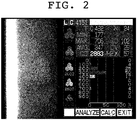
- FIG. 2 is a substitute photograph for the figure for illustrating an exemplary medical photograph of corneal endothelial cells in a healthy subject.
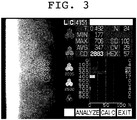
- FIG. 3 is an explanatory diagram illustrating the medical photograph of the corneal endothelial cells in the healthy subject in a monochrome mode.
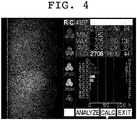
- FIG. 4 is a substitute photograph for the figure for illustrating an exemplary medical photograph of corneal endothelial cells in a diseased subject.
- FIG. 5 is an explanatory diagram illustrating the medical photograph of the corneal endothelial cells in the diseased subject in a monochrome mode.
- the left part of each image is composed of a photograph capturing corneal endothelial cells and the right part is composed of an image including text data, such as capturing date and time and subject number.
- some of the cells are provided with white dots at the centers of the cells and with white lines along the boundaries between the cells.
- a doctor or medical technician has drawn the white dots at the centers of the cells and then drawn the white lines with reference to the white dots using a testing apparatus that conducts image recognition for the boundaries between the cells.
- the testing apparatus calculates information, such as a density and an area of corneal endothelial cells and a rate of occurrence of hexagonal cells, based on these white lines.
- the calculated information is rendered as text data in the right part of the image.
- the photograph in the left part has a pixel size of approximately 300 ⁇ 480 dots.
- small image segments having a pixel size of 56 ⁇ 56 dots are extracted from the area of the image that does not include white lines or dots.
- the extracted image segments are used as target images in learning and determination.
- FIG. 6 is a substitute photograph for the figure for illustrating an exemplary target image of a healthy subject.
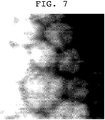
- FIG. 7 is an explanatory diagram illustrating the target image of the healthy subject in a monochrome mode.
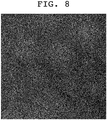
- FIG. 8 is a substitute photograph for the figure for illustrating an exemplary target image of a diseased subject.
- FIG. 9 is an explanatory diagram illustrating the target image of the diseased subject in a monochrome mode.
- target images alone used in this embodiment are not always clear.
- the embodiment is characterized in that such unclear target images can also be used for classification of subjects with a sufficient accuracy.
- the size and number of target images may be appropriately varied depending on the applied usage.
- the age of a subject is used as a single attribute parameter p 1 .
- a numerical value representing the age is the age itself in the simplest procedure.
- a certain range of ages may be represented by a digit in the tens place of the ages, for example.
- the years of age may be replaced with the months or days of age counted from the birthday.
- attribute parameters such as height and weight
- scalar values such as height and weight
- pixel values in general, 0 to 255 or 0 to 65535
- the attribute parameter may be represented using category numbers such that the value 0 indicates male and the value 1 indicates female, for example.
- attribute parameters p h , p h+1 , p h+2 , ..., and p h+B-1 (h indicates an appropriate positive constant) are prepared.
- Each of the target images has two dimensions provided that the images are depicted in gray scale.
- the convolution operation in the library using a GPU can achieve rapid calculation of the linear sum of the pixel values of the pixel at a focused site and its surrounding pixels for each site in the image.
- the amount of a single displacement of the focused site is called a stride, and the size of a subarea including the pixel at the focused site and its surrounding pixels is called a kernel size.
- An array of coefficients of linear sum corresponding to the subarea for receiving the convolution operation is called a kernel or convolution kernel.
- a kernel including an array of weight coefficients w 0 and w 1 should be prepared. Then, an intermediate image K composed of an arrangement of the individual pixels M[x,y] and the attribute parameters p 1 should be generated such that the kernel is applied to the individual pixels M[x,y] and the attribute parameters p 1 .
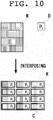
- FIG. 10 is an explanatory diagram illustrating an exemplary application of a kernel C to the intermediate image K generated from the feature map M.
- the image M which is an input feature map, has a pixel size of 3 ⁇ 4 dots and has pixel values represented by hatching, in order to facilitate an understanding.
- the image M is divided into vertical strip-like image segments, between which pixels D having the attribute parameter p 1 as the pixel value are inserted.
- the convolution kernel C has a width of 2 dots and a height of 1 dot, as illustrated as M in this figure.
- the stride is defined to have the size identical to the convolution kernel, that is, a horizontal length of 2 dots and a vertical length of 1 dot.
- Each of the thick lines in this figure surrounds a group of pixels that provides a single feature value of the feature map N generated by application of the kernel C with this stride.
- This operation is a general convolution operation executed in image processing. The use of the library contributes to rapid learning and determination.
- FIG. 11 is an explanatory diagram illustrating another exemplary application of the kernel C to the intermediate image K generated from the feature map M.
- FIG. 11 illustrates the relationship between the image M, the intermediate image K, and the kernel C, as in the above example.
- the size of the convolution kernel C and the stride should be defined to be a width (horizontal length) of 1 dot and a height (vertical length) of 2 dots.
- any index may be used in the interposing process of the A number of attribute parameters into the feature map having the L dimensions.
- the following explanation focuses on an exemplary case of using the first index in the interposing process.
- FIG. 12 is an explanatory diagram illustrating still another exemplary application of the kernel C to the intermediate image K generated from the feature map M.
- FIG. 12 illustrates the intermediate image K and the kernel C as in the above examples, in the case of using the first index of the two-dimensional feature map M having a size of 3 ⁇ 4 dots in the interposing process of the pixels D each having two attribute parameters.
- the feature map may also be an RGB image (three-primary-color image).
- the feature map is expressed in three dimensions. Specifically, the X-axis direction in the image is a first dimension, the Y-axis direction is a second dimension, and the direction of RGB color channels is a third dimension.
- the libraries TensorFlow and Keras support convolution operations in the color channel (third index) direction as well as the X-axis (horizontal, first index) direction and the Y-axis (vertical, second index) direction.
- Examples of convolution operations in the color channel direction include an operation for converting an RGB image into a gray scale image.
- the rapid learning and determination are available also when using the third index in the convolution operation.
- the rapid learning and determination can be achieved by applying the gray scale image to any of the RGB channel, filling the pixels in the other channels with the values of the attribute parameters, and then executing the convolution operation in the RGB direction.
- the time-axis direction may be introduced as an index following the third index.
- a convolution operation in the time-axis direction is effective to extract features of a moving image using an AI library.
- This configuration also demands a rapid library responsible for a convolution operation for an index following the third index.
- This library enables a doctor to conduct various types of diagnosis by observing a variation with time in a diseased area with reference to different images of the identical subject taken at certain time intervals.
- the attribute parameters should be arranged in the time-axis direction and then convolved in the time-axis direction.
- FIG. 13 is an explanatory diagram illustrating an exemplary configuration of image filters in the neural network according to the embodiment. This exemplary configuration is aimed at learning and determination of the level of risk of intraocular surgery on the basis of a photograph of corneal endothelial cells in a subject and the age of the subject. The configuration will now be described with reference to FIG. 13 .
- the target image M is received by the receiver 102.
- the interposing layer 201 interposes at least one attribute parameter at certain intervals into the target image M to generate an intermediate image K.
- the convolution layer 202 convolves the resulting intermediate image K using a kernel, of which the size and stride are equal to A+1 (A indicates the number of attribute parameters) for the index used in the interposing process, and are equal to 1 for the other indexes.
- This operation yields a feature map N, in which the target image M and the attribute parameter are embedded, and which has the size identical to the target image M. That is, the functions of the convolution operator 105 are performed by the interposing layer 201 and the convolution layer 202.
- the following layers have the same configuration as those of general convolution neural networks for classification.
- the figure illustrates an extremely simple and rapid configuration.
- the configuration includes a convolution layer 251a, a pooling layer 252a, a convolution layer 251b, a pooling layer 252b, a smoothing layer 253, a fully connected layer 254a, and a fully connected layer 254b in sequence.
- the output from the fully connected layer 254b may be any of binary, scalar, and vector values.
- binary value the two values respectively correspond to a high risk and low risk of intraocular surgery.
- scalar value the scalar value indicates a level of risk and is determined to be high or low in comparison to a threshold.
- vector value a hyperplane for classification of vector values should be obtained using a support vector machine or the like.
- the learning stage involves backpropagation based on comparison between the level of risk of intraocular surgery and the output from the fully connected layer 254b to automatically adjust the weight coefficients in each of the layers including the convolution layer 202 of the convolution operator 105.
- This configuration can achieve the learning function leading to comprehensive evaluation of the target image and the age.
- the fully connected layer 254b is provided with the target image and the attribute parameter of the subject and then outputs a value related to the level of risk of intraocular surgery.
- the configuration ranging from the convolution layer 251a to the fully connected layer 254b may be arbitrarily varied depending on, for example, the usage, performance of the calculator, tendency in trial experiments, and experience of the designer.
- This embodiment is characterized in that a general neural network or the like for image recognition can be applied in the original state like a library to the configuration of the layers related to the process after the convolution operation of the individual pixels of the target image and the attributed parameter.
- the convolution operation of the target image and the attribute parameter is performed in the initial layer, and the resulting image is then transferred to the subsequent layer in the above-described example.
- the attribute parameter may be convolved into an intermediate target map generated by convolution and pooling operations to the target image.
- the convolution operator 105 including the interposing layer 201 and the convolution layer 202 can be disposed between any two adjacent layers in the neural network.
- the layer for convolving the feature values of the feature map and the attribute parameter is thus inserted between any two adjacent layers in the neural network, to thereby achieve learning and determination based on integration of the target image and the attribute parameter.
- the portion between the layers to receive the convolution layer and the configuration of the other layers can be defined depending on results of preliminary experiments or the like.
- the convolution layer 202 may execute a convolution operation of the individual elements of the feature map and the attribute parameter by generating a library with the GPU or the like, without explicit generation of the intermediate image K by the interposing layer 201.
- the learning and classification were performed based on target images extracted from photographs of corneal endothelial cells of subjects and the ages of the subjects.
- the subjects were 51 people in total in ages ranging from 34 to 88 years old and were composed of 25 negative (low-risk) people and 26 positive (high-risk) people.
- the photograph of corneal endothelial cells of each subject was an 8-bit gray scale image having a size of approximately 300 ⁇ 480 dots.
- One to twenty target images each having a size of 56 ⁇ 56 dots were extracted from a relatively unclear area of each photograph without a white line or dot drawn by a doctor or medical technician.
- the number of sets of the target images and the ages was 661 in total.
- the above-described classification device 101 was caused to learn 528 leaning data sets (approximately 80% of the whole sets) selected from the whole sets at random. The rate of accuracy of classification was then acquired using the rest 133 data sets (approximately 20% of the whole sets) as classifying data sets. This trial was repeated 100 times.
- results were compared to those of an existing classification technique A based only on target images without referring to ages, and those of an existing classification technique B based on feature maps and ages concatenated using the Concatenate function in a neural network.
- a convolution operation of an age into a target image was executed in the initial layers (in the interposing layer 201 and the convolution layer 202), and the operations in the subsequent layers (from the convolution layer 251a to the fully connected layer 254b) was achieved by the neural network having the configuration identical to that of the existing technique A.
- the pixel columns (or pixel rows) of the feature map M and the columns (or rows) of the attribute parameter D are alternately arranged in the interposing layer 201 to yield the intermediate image K.
- the process of the alternate arrangement is followed by further addition of the columns (or rows) of the attribute parameter D in a protruding manner.
- This protruding area is called a padded area, while the original area including the alternate arrangement of the pixels derived from the feature map M and the pixels derived from the attribute parameter D is called an unpadded area.
- the arrangement in the unpadded area has wide variations depending on what element is located at the position within the kernel for a pixel of the feature map (the left position in the example in the figure) and at the position within the kernel for the attribute parameter (the right position in the example in the figure).
- the arrangement also has wide variations depending on the number of rows of added attribute parameters.
- FIG. 14 is an explanatory diagram illustrating an exemplary padding process. The following explanation refers to the example illustrated in FIG. 14 .
- a classification experiment was conducted using this exemplary padding process under the above-described specification of experiment based on photographs of corneal endothelial cells and the ages.
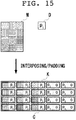
- FIG. 15 is an explanatory diagram illustrating another exemplary padding process. The following explanation refers to the example illustrated in FIG. 15 .
- the padded area K[(A+1)i 1 +1, i 2 , ..., i L ] to K[(A+1)i 1 +A, i 2 , ..., i L ] may also be filled with a constant other than 0 or a random number, for example, instead of the attribute parameters p 1 to p A and 0.
- the pixel values of the feature map M may be redundantly added or added after thinning.
- the value e may be the mean value of each attribute parameter of subjects in learning data.
- the resulting accuracy rate was 91.3%.
- the following explanation focuses on a conceivable procedure of acquiring a weighted mean value e for each subject in the case where a plurality of attribute parameters is assigned to the subject.
- learning is performed without the padding process to acquire weights w 0 , w 1 , w 2 , ..., and w A in a kernel C.
- the padding of repetition of e, p 1 , p 2 , ..., and p A is conducted. This process corresponds to the padding of repetition of the ages of the subjects (accuracy rate of 88.67% to 88.89%) in the above exemplary experiment.
- the mean value E of the weighted mean values e may be calculated for all the subjects in the leaning data, followed by the padding of repetition of e, p 1 , p 2 , ..., and p A .
- This process corresponds to the padding of repetition of the mean age of the subjects in the learning data and the ages of the subjects (accuracy rate of 91.3%) in the above exemplary experiment.
- the discrimination performance can further be improved by padding the value derived from the attribute parameter at the position within the kernel in the padded area, which position corresponds to the position of the feature value derived from the feature map in the unpadded area.
- padding procedures may be selected appropriately for the target to provide the highest accuracy rate, after conducting preliminarily experiments as required, depending on the usage or the like.
- the disclosure is applied to a combination of a photograph of corneal endothelial cells in a subject and the age of the subject, as a specific example.
- the classification device 101 may be applied to any diagnosis and determination based on a combination of a medical photograph and various attribute parameters of a patient.
- the classification device 101 may also contribute to matching of couples in a marriage agency or prediction of future popularity of a candidate of show-business celebrities, such as actors and models.
- the classification device 101 is effective in these fields because a face photograph of a target person and the attribute parameters (for example, age, sex, and height) of the person are the important factors.
- a classification device includes: a receiver configured to receive a target image that captures a target and at least one attribute parameter associated with the target; and a classifier configured to classify the target using a neural network.
- the neural network includes a convolution operator configured to convolve individual elements of a provided feature map and the received at least one attribute parameter.
- the feature map provided to the neural network may be the received target image.
- the convolution operator may apply a convolution kernel to an intermediate map with a stride having a size corresponding to the size of the convolution kernel and the size of predetermined intervals, the intermediate map being configured by interposing at least one attribute element at the predetermined intervals between feature elements included in the provided feature map, the at least one attribute element respectively having the received at least one attribute parameter as an element value.
- the convolution kernel may be used in convolution of one of the feature elements included in the feature map and the at least one attribute element.
- one of a width and a height of the size of the convolution kernel may be equal to 1 and another of the width and the height may be equal to the value calculated by adding 1 to the number of the at least one attribute element.
- the convolution operator may further execute padding to at least one side of a circumference of the provided feature map, and the convolution operator may execute padding of an element at a position corresponding to the feature element in each subarea corresponding to the convolution kernel to be applied in a padded area, the padded element having a value derived from the attribute parameter.
- the received at least one attribute parameter may be a single attribute parameter, and the value derived from the attribute parameter may indicate a value of the received attribute parameter.
- the received at least one attribute parameter may include a plurality of attribute parameters, and the value derived from the attribute parameter may indicate a simple mean value or a weighted mean value of the received attribute parameters.
- the classification device may perform learning without the padding to acquire a kernel, execute the padding of the weighted mean value reflecting weights provided by the acquired kernel, and then perform learning again.
- a classification method includes: a receiving step of receiving a target image that captures a target and at least one attribute parameter associated with the target by a classification device; and a classifying step of classifying the target by the classification device using a neural network.
- a receiving step of receiving a target image that captures a target and at least one attribute parameter associated with the target by a classification device includes: a receiving step of receiving a target image that captures a target and at least one attribute parameter associated with the target by a classification device; and a classifying step of classifying the target by the classification device using a neural network.
- the neural network individual elements of a provided feature map and the received at least one attribute parameter are convolved.
- a program causes a computer to: receive a target image that captures a target and at least one attribute parameter associated with the target; and classify the target using a neural network.
- the neural network includes a convolution operator configured to convolve individual elements of a provided feature map and the received at least one attribute parameter.
- a program causes a computer to: obtain a feature map associated with a target and at least one attribute parameter associated with the target, and convolve individual elements of the obtained feature map and the obtained at least one attribute parameter and thereby generate a new feature map.
- This program may be stored on a non-transitory computer-readable information recording medium to be distributed and sold.
- the program may also be distributed and sold via a transitory transmission medium, such as a computer communication network.
- the disclosure can provide a classification device, a classification method, a program, and a non-transitory information recording medium for classifying targets using a neural network on the basis of a target image that captures each target and at least one attribute parameter associated with the target.
Landscapes
- Engineering & Computer Science (AREA)
- Theoretical Computer Science (AREA)
- Physics & Mathematics (AREA)
- General Physics & Mathematics (AREA)
- Evolutionary Computation (AREA)
- Health & Medical Sciences (AREA)
- General Health & Medical Sciences (AREA)
- Artificial Intelligence (AREA)
- Software Systems (AREA)
- Computing Systems (AREA)
- Data Mining & Analysis (AREA)
- General Engineering & Computer Science (AREA)
- Life Sciences & Earth Sciences (AREA)
- Computer Vision & Pattern Recognition (AREA)
- Databases & Information Systems (AREA)
- Mathematical Physics (AREA)
- Computational Linguistics (AREA)
- Molecular Biology (AREA)
- Biomedical Technology (AREA)
- Biophysics (AREA)
- Medical Informatics (AREA)
- Multimedia (AREA)
- Evolutionary Biology (AREA)
- Bioinformatics & Computational Biology (AREA)
- Bioinformatics & Cheminformatics (AREA)
- Nuclear Medicine, Radiotherapy & Molecular Imaging (AREA)
- Radiology & Medical Imaging (AREA)
- Quality & Reliability (AREA)
- Image Analysis (AREA)
- Information Retrieval, Db Structures And Fs Structures Therefor (AREA)
Applications Claiming Priority (2)
| Application Number | Priority Date | Filing Date | Title |
|---|---|---|---|
| JP2017223696A JP6345332B1 (ja) | 2017-11-21 | 2017-11-21 | 分類装置、分類方法、プログラム、ならびに、情報記録媒体 |
| PCT/JP2018/041174 WO2019102844A1 (fr) | 2017-11-21 | 2018-11-06 | Dispositif de classification, procédé de classification, programme, et support d'enregistrement d'informations |
Publications (2)
| Publication Number | Publication Date |
|---|---|
| EP3716100A1 true EP3716100A1 (fr) | 2020-09-30 |
| EP3716100A4 EP3716100A4 (fr) | 2021-08-04 |
Family
ID=62635800
Family Applications (1)
| Application Number | Title | Priority Date | Filing Date |
|---|---|---|---|
| EP18880401.7A Withdrawn EP3716100A4 (fr) | 2017-11-21 | 2018-11-06 | Dispositif de classification, procédé de classification, programme, et support d'enregistrement d'informations |
Country Status (5)
| Country | Link |
|---|---|
| US (1) | US11263494B2 (fr) |
| EP (1) | EP3716100A4 (fr) |
| JP (1) | JP6345332B1 (fr) |
| CN (1) | CN111465941A (fr) |
| WO (1) | WO2019102844A1 (fr) |
Families Citing this family (7)
| Publication number | Priority date | Publication date | Assignee | Title |
|---|---|---|---|---|
| DE102018213056A1 (de) * | 2018-08-03 | 2020-02-06 | Robert Bosch Gmbh | Verfahren und Vorrichtung zum Ermitteln einer Erklärungskarte |
| EP4025114B1 (fr) * | 2019-09-06 | 2025-07-30 | Carl Zeiss Meditec, Inc. | Procédés d'apprentissage machine pour créer des antécédents de champ visuel dérivés de structures |
| EP4349266A4 (fr) | 2021-05-28 | 2025-05-07 | Riken | Dispositif d'extraction de caractéristique, procédé d'extraction de caractéristique, programme et support d'enregistrement d'informations |
| US12001520B2 (en) * | 2021-09-27 | 2024-06-04 | Adobe Inc. | Generating simulated images that enhance socio-demographic diversity |
| CN114693646B (zh) * | 2022-03-31 | 2023-04-11 | 中山大学中山眼科中心 | 一种基于深度学习的角膜内皮细胞活性因子的分析方法 |
| JP2024005549A (ja) * | 2022-06-30 | 2024-01-17 | 国立大学法人山口大学 | タイムラプス画像判別器とタイムラプス画像判別器の学習方法と胚判別装置と胚判別方法 |
| US12530796B2 (en) * | 2023-08-03 | 2026-01-20 | Rapsodo Pte. Ltd. | Spin estimation for marked objects |
Family Cites Families (9)
| Publication number | Priority date | Publication date | Assignee | Title |
|---|---|---|---|---|
| JP3974946B2 (ja) | 1994-04-08 | 2007-09-12 | オリンパス株式会社 | 画像分類装置 |
| US7418123B2 (en) * | 2002-07-12 | 2008-08-26 | University Of Chicago | Automated method and system for computerized image analysis for prognosis |
| MY156153A (en) | 2009-12-01 | 2016-01-15 | Bruker Nano Inc | Method and apparatus of operating a scanning probe microscope |
| JP6433805B2 (ja) * | 2015-02-09 | 2018-12-05 | 国立大学法人鳥取大学 | 運動機能診断装置及び方法、並びにプログラム |
| JP6528608B2 (ja) | 2015-08-28 | 2019-06-12 | カシオ計算機株式会社 | 診断装置、及び診断装置における学習処理方法、並びにプログラム |
| US9858496B2 (en) * | 2016-01-20 | 2018-01-02 | Microsoft Technology Licensing, Llc | Object detection and classification in images |
| CN106529578A (zh) * | 2016-10-20 | 2017-03-22 | 中山大学 | 一种基于深度学习的车辆品牌型号精细识别方法与系统 |
| CN107292256B (zh) * | 2017-06-14 | 2019-12-24 | 西安电子科技大学 | 基于辅任务的深度卷积小波神经网络表情识别方法 |
| CN107239803A (zh) * | 2017-07-21 | 2017-10-10 | 国家海洋局第海洋研究所 | 利用深度学习神经网络的海底底质自动分类方法 |
-
2017
- 2017-11-21 JP JP2017223696A patent/JP6345332B1/ja active Active
-
2018
- 2018-11-06 EP EP18880401.7A patent/EP3716100A4/fr not_active Withdrawn
- 2018-11-06 CN CN201880075400.5A patent/CN111465941A/zh active Pending
- 2018-11-06 US US16/763,417 patent/US11263494B2/en not_active Expired - Fee Related
- 2018-11-06 WO PCT/JP2018/041174 patent/WO2019102844A1/fr not_active Ceased
Also Published As
| Publication number | Publication date |
|---|---|
| JP2019095980A (ja) | 2019-06-20 |
| CN111465941A (zh) | 2020-07-28 |
| US20210073595A1 (en) | 2021-03-11 |
| WO2019102844A1 (fr) | 2019-05-31 |
| JP6345332B1 (ja) | 2018-06-20 |
| US11263494B2 (en) | 2022-03-01 |
| EP3716100A4 (fr) | 2021-08-04 |
Similar Documents
| Publication | Publication Date | Title |
|---|---|---|
| US11263494B2 (en) | Classification device, classification method, program, and information recording medium | |
| Mishra et al. | Diabetic retinopathy detection using deep learning | |
| CN110197493B (zh) | 眼底图像血管分割方法 | |
| CN109584254B (zh) | 一种基于深层全卷积神经网络的心脏左心室分割方法 | |
| CN109829894A (zh) | 分割模型训练方法、oct图像分割方法、装置、设备及介质 | |
| CN112017185B (zh) | 病灶分割方法、装置及存储介质 | |
| Singh et al. | A novel hybridized feature selection strategy for the effective prediction of glaucoma in retinal fundus images | |
| CN107665491A (zh) | 病理图像的识别方法及系统 | |
| US20220036140A1 (en) | Classification device, classification method, program, and information recording medium | |
| CN110321968B (zh) | 一种超声图像分类装置 | |
| CN113139627B (zh) | 纵隔肿物识别方法、系统及装置 | |
| CN110210543A (zh) | 图像分类系统、方法、设备和存储介质 | |
| CN109390053A (zh) | 眼底图像处理方法、装置、计算机设备和存储介质 | |
| Ali et al. | xCViT: Improved Vision Transformer Network with Fusion of CNN and Xception for Skin Disease Recognition with Explainable AI. | |
| CN114926396A (zh) | 一种精神障碍类磁共振图像初步筛查模型构建方法 | |
| CN114842270B (zh) | 一种目标图像的分类方法、装置、电子设备及介质 | |
| CN113610842B (zh) | 基于CAS-Net的OCT图像视网膜脱离和劈裂自动分割方法 | |
| CN110827283A (zh) | 基于卷积神经网络的头颈血管分割方法及装置 | |
| CN121305207A (zh) | 青光眼多模态辅助诊断装置及电子设备 | |
| Wijerathna et al. | Brain tumor detection using image processing | |
| CN119599950A (zh) | 基于mri影像中腰椎区域的检测方法、装置及设备 | |
| HK40027724A (en) | Classification device, classification method, program, and information recording medium | |
| CN117934497A (zh) | 一种基于cnn和注意力机制的颅内血肿分割方法 | |
| Kodumuru et al. | Diabetic Retinopathy Screening Using CNN (ResNet 18) | |
| CN120599331B (en) | Multi-granularity cataract classification method and system based on lesion perception |
Legal Events
| Date | Code | Title | Description |
|---|---|---|---|
| STAA | Information on the status of an ep patent application or granted ep patent |
Free format text: STATUS: THE INTERNATIONAL PUBLICATION HAS BEEN MADE |
|
| PUAI | Public reference made under article 153(3) epc to a published international application that has entered the european phase |
Free format text: ORIGINAL CODE: 0009012 |
|
| STAA | Information on the status of an ep patent application or granted ep patent |
Free format text: STATUS: REQUEST FOR EXAMINATION WAS MADE |
|
| 17P | Request for examination filed |
Effective date: 20200520 |
|
| AK | Designated contracting states |
Kind code of ref document: A1 Designated state(s): AL AT BE BG CH CY CZ DE DK EE ES FI FR GB GR HR HU IE IS IT LI LT LU LV MC MK MT NL NO PL PT RO RS SE SI SK SM TR |
|
| AX | Request for extension of the european patent |
Extension state: BA ME |
|
| REG | Reference to a national code |
Ref country code: HK Ref legal event code: DE Ref document number: 40027724 Country of ref document: HK |
|
| DAV | Request for validation of the european patent (deleted) | ||
| DAX | Request for extension of the european patent (deleted) | ||
| A4 | Supplementary search report drawn up and despatched |
Effective date: 20210702 |
|
| RIC1 | Information provided on ipc code assigned before grant |
Ipc: G06F 17/00 20190101AFI20210628BHEP Ipc: G06K 9/62 20060101ALI20210628BHEP Ipc: G06N 3/02 20060101ALI20210628BHEP |
|
| STAA | Information on the status of an ep patent application or granted ep patent |
Free format text: STATUS: EXAMINATION IS IN PROGRESS |
|
| 17Q | First examination report despatched |
Effective date: 20230512 |
|
| STAA | Information on the status of an ep patent application or granted ep patent |
Free format text: STATUS: THE APPLICATION IS DEEMED TO BE WITHDRAWN |
|
| 18D | Application deemed to be withdrawn |
Effective date: 20251202 |