EP3716191A1 - Verfahren und vorrichtung zur warenabrechnung und elektronische vorrichtung - Google Patents
Verfahren und vorrichtung zur warenabrechnung und elektronische vorrichtung Download PDFInfo
- Publication number
- EP3716191A1 EP3716191A1 EP19759924.4A EP19759924A EP3716191A1 EP 3716191 A1 EP3716191 A1 EP 3716191A1 EP 19759924 A EP19759924 A EP 19759924A EP 3716191 A1 EP3716191 A1 EP 3716191A1
- Authority
- EP
- European Patent Office
- Prior art keywords
- checkout
- shopping cart
- client
- payment code
- server
- Prior art date
- Legal status (The legal status is an assumption and is not a legal conclusion. Google has not performed a legal analysis and makes no representation as to the accuracy of the status listed.)
- Withdrawn
Links
Images


Classifications
-
- G—PHYSICS
- G06—COMPUTING OR CALCULATING; COUNTING
- G06Q—INFORMATION AND COMMUNICATION TECHNOLOGY [ICT] SPECIALLY ADAPTED FOR ADMINISTRATIVE, COMMERCIAL, FINANCIAL, MANAGERIAL OR SUPERVISORY PURPOSES; SYSTEMS OR METHODS SPECIALLY ADAPTED FOR ADMINISTRATIVE, COMMERCIAL, FINANCIAL, MANAGERIAL OR SUPERVISORY PURPOSES, NOT OTHERWISE PROVIDED FOR
- G06Q30/00—Commerce
- G06Q30/06—Buying, selling or leasing transactions
- G06Q30/0601—Electronic shopping [e-shopping]
- G06Q30/0641—Electronic shopping [e-shopping] utilising user interfaces specially adapted for shopping
-
- G—PHYSICS
- G06—COMPUTING OR CALCULATING; COUNTING
- G06Q—INFORMATION AND COMMUNICATION TECHNOLOGY [ICT] SPECIALLY ADAPTED FOR ADMINISTRATIVE, COMMERCIAL, FINANCIAL, MANAGERIAL OR SUPERVISORY PURPOSES; SYSTEMS OR METHODS SPECIALLY ADAPTED FOR ADMINISTRATIVE, COMMERCIAL, FINANCIAL, MANAGERIAL OR SUPERVISORY PURPOSES, NOT OTHERWISE PROVIDED FOR
- G06Q20/00—Payment architectures, schemes or protocols
- G06Q20/08—Payment architectures
- G06Q20/20—Point-of-sale [POS] network systems
- G06Q20/208—Input by product or record sensing, e.g. weighing or scanner processing
-
- G—PHYSICS
- G06—COMPUTING OR CALCULATING; COUNTING
- G06Q—INFORMATION AND COMMUNICATION TECHNOLOGY [ICT] SPECIALLY ADAPTED FOR ADMINISTRATIVE, COMMERCIAL, FINANCIAL, MANAGERIAL OR SUPERVISORY PURPOSES; SYSTEMS OR METHODS SPECIALLY ADAPTED FOR ADMINISTRATIVE, COMMERCIAL, FINANCIAL, MANAGERIAL OR SUPERVISORY PURPOSES, NOT OTHERWISE PROVIDED FOR
- G06Q30/00—Commerce
- G06Q30/06—Buying, selling or leasing transactions
- G06Q30/0601—Electronic shopping [e-shopping]
-
- G—PHYSICS
- G06—COMPUTING OR CALCULATING; COUNTING
- G06Q—INFORMATION AND COMMUNICATION TECHNOLOGY [ICT] SPECIALLY ADAPTED FOR ADMINISTRATIVE, COMMERCIAL, FINANCIAL, MANAGERIAL OR SUPERVISORY PURPOSES; SYSTEMS OR METHODS SPECIALLY ADAPTED FOR ADMINISTRATIVE, COMMERCIAL, FINANCIAL, MANAGERIAL OR SUPERVISORY PURPOSES, NOT OTHERWISE PROVIDED FOR
- G06Q20/00—Payment architectures, schemes or protocols
- G06Q20/08—Payment architectures
- G06Q20/20—Point-of-sale [POS] network systems
-
- G—PHYSICS
- G06—COMPUTING OR CALCULATING; COUNTING
- G06Q—INFORMATION AND COMMUNICATION TECHNOLOGY [ICT] SPECIALLY ADAPTED FOR ADMINISTRATIVE, COMMERCIAL, FINANCIAL, MANAGERIAL OR SUPERVISORY PURPOSES; SYSTEMS OR METHODS SPECIALLY ADAPTED FOR ADMINISTRATIVE, COMMERCIAL, FINANCIAL, MANAGERIAL OR SUPERVISORY PURPOSES, NOT OTHERWISE PROVIDED FOR
- G06Q20/00—Payment architectures, schemes or protocols
- G06Q20/08—Payment architectures
- G06Q20/20—Point-of-sale [POS] network systems
- G06Q20/201—Price look-up processing, e.g. updating
-
- G—PHYSICS
- G06—COMPUTING OR CALCULATING; COUNTING
- G06Q—INFORMATION AND COMMUNICATION TECHNOLOGY [ICT] SPECIALLY ADAPTED FOR ADMINISTRATIVE, COMMERCIAL, FINANCIAL, MANAGERIAL OR SUPERVISORY PURPOSES; SYSTEMS OR METHODS SPECIALLY ADAPTED FOR ADMINISTRATIVE, COMMERCIAL, FINANCIAL, MANAGERIAL OR SUPERVISORY PURPOSES, NOT OTHERWISE PROVIDED FOR
- G06Q20/00—Payment architectures, schemes or protocols
- G06Q20/08—Payment architectures
- G06Q20/20—Point-of-sale [POS] network systems
- G06Q20/202—Interconnection or interaction of plural electronic cash registers [ECR] or to host computer, e.g. network details, transfer of information from host to ECR or from ECR to ECR
-
- G—PHYSICS
- G06—COMPUTING OR CALCULATING; COUNTING
- G06Q—INFORMATION AND COMMUNICATION TECHNOLOGY [ICT] SPECIALLY ADAPTED FOR ADMINISTRATIVE, COMMERCIAL, FINANCIAL, MANAGERIAL OR SUPERVISORY PURPOSES; SYSTEMS OR METHODS SPECIALLY ADAPTED FOR ADMINISTRATIVE, COMMERCIAL, FINANCIAL, MANAGERIAL OR SUPERVISORY PURPOSES, NOT OTHERWISE PROVIDED FOR
- G06Q20/00—Payment architectures, schemes or protocols
- G06Q20/30—Payment architectures, schemes or protocols characterised by the use of specific devices or networks
- G06Q20/32—Payment architectures, schemes or protocols characterised by the use of specific devices or networks using wireless devices
- G06Q20/322—Aspects of commerce using mobile devices [M-devices]
-
- G—PHYSICS
- G06—COMPUTING OR CALCULATING; COUNTING
- G06Q—INFORMATION AND COMMUNICATION TECHNOLOGY [ICT] SPECIALLY ADAPTED FOR ADMINISTRATIVE, COMMERCIAL, FINANCIAL, MANAGERIAL OR SUPERVISORY PURPOSES; SYSTEMS OR METHODS SPECIALLY ADAPTED FOR ADMINISTRATIVE, COMMERCIAL, FINANCIAL, MANAGERIAL OR SUPERVISORY PURPOSES, NOT OTHERWISE PROVIDED FOR
- G06Q20/00—Payment architectures, schemes or protocols
- G06Q20/30—Payment architectures, schemes or protocols characterised by the use of specific devices or networks
- G06Q20/32—Payment architectures, schemes or protocols characterised by the use of specific devices or networks using wireless devices
- G06Q20/327—Short range or proximity payments by means of M-devices
- G06Q20/3276—Short range or proximity payments by means of M-devices using a pictured code, e.g. barcode or QR-code, being read by the M-device
-
- G—PHYSICS
- G06—COMPUTING OR CALCULATING; COUNTING
- G06Q—INFORMATION AND COMMUNICATION TECHNOLOGY [ICT] SPECIALLY ADAPTED FOR ADMINISTRATIVE, COMMERCIAL, FINANCIAL, MANAGERIAL OR SUPERVISORY PURPOSES; SYSTEMS OR METHODS SPECIALLY ADAPTED FOR ADMINISTRATIVE, COMMERCIAL, FINANCIAL, MANAGERIAL OR SUPERVISORY PURPOSES, NOT OTHERWISE PROVIDED FOR
- G06Q20/00—Payment architectures, schemes or protocols
- G06Q20/30—Payment architectures, schemes or protocols characterised by the use of specific devices or networks
- G06Q20/32—Payment architectures, schemes or protocols characterised by the use of specific devices or networks using wireless devices
- G06Q20/327—Short range or proximity payments by means of M-devices
- G06Q20/3278—RFID or NFC payments by means of M-devices
-
- G—PHYSICS
- G07—CHECKING-DEVICES
- G07G—REGISTERING THE RECEIPT OF CASH, VALUABLES, OR TOKENS
- G07G1/00—Cash registers
- G07G1/0036—Checkout procedures
- G07G1/0045—Checkout procedures with a code reader for reading of an identifying code of the article to be registered, e.g. barcode reader or radio-frequency identity [RFID] reader
-
- G—PHYSICS
- G07—CHECKING-DEVICES
- G07G—REGISTERING THE RECEIPT OF CASH, VALUABLES, OR TOKENS
- G07G1/00—Cash registers
- G07G1/0036—Checkout procedures
- G07G1/0045—Checkout procedures with a code reader for reading of an identifying code of the article to be registered, e.g. barcode reader or radio-frequency identity [RFID] reader
- G07G1/0081—Checkout procedures with a code reader for reading of an identifying code of the article to be registered, e.g. barcode reader or radio-frequency identity [RFID] reader the reader being a portable scanner or data reader
-
- G—PHYSICS
- G07—CHECKING-DEVICES
- G07G—REGISTERING THE RECEIPT OF CASH, VALUABLES, OR TOKENS
- G07G1/00—Cash registers
- G07G1/12—Cash registers electronically operated
- G07G1/14—Systems including one or more distant stations co-operating with a central processing unit
Definitions
- Implementations of the present specification relate to the field of Internet technologies, and in particular, to product checkout methods and apparatuses, and electronic devices.
- Implementations of the present specification provide product checkout methods and apparatuses, and electronic devices.
- a product checkout method includes the following: scanning, by a client, a product barcode to enter a shopping cart interface, where the shopping cart interface is used to display product information obtained through barcode scanning; sending, by the client, a checkout request to a server when obtaining a checkout instruction, where the checkout request carries the product information of a shopping cart; generating, by the checkout server, a payment code based on the product information of the shopping cart when receiving the checkout request, and pushing the payment code to a checkout terminal; and displaying, by the checkout terminal, the received payment code, so that the client scans the payment code to complete payment.
- a product checkout method includes the following: scanning, by a client, a product barcode to enter a shopping cart interface, where the shopping cart interface is used to display product information obtained through barcode scanning; sending, by the client, a checkout request to a server when obtaining a checkout instruction, where the checkout request carries the product information of a shopping cart; and generating, by the server, a payment code based on the product information of the shopping cart when receiving the checkout request, and pushing the payment code to the client, so that the client displays the payment code for payment.
- a product checkout apparatus configured for a client to scan a product barcode to enter a shopping cart interface, where the shopping cart interface is used to display product information obtained through barcode scanning; a sending unit, configured for the client to send a checkout request to a server when obtaining a checkout instruction, where the checkout request carries the product information of a shopping cart; a generation unit, configured for the checkout server to generate a payment code based on the product information of the shopping cart when receiving the checkout request, and push the payment code to a checkout terminal; and a checkout unit, configured for the checkout terminal to display the received payment code, so that the client scans the payment code to complete payment.
- a product checkout apparatus includes the following: a scanning unit, configured for a client to scan a product barcode to enter a shopping cart interface, where the shopping cart interface is used to display product information obtained through barcode scanning; a sending unit, configured for the client to send a checkout request to a server when obtaining a checkout instruction, where the checkout request carries the product information of a shopping cart; and a generation unit, configured for the server to generate a payment code based on the product information of the shopping cart when receiving the checkout request, and push the payment code to the client, so that the client displays the payment code for payment.
- an electronic device including: a processor; and a memory, configured to store an instruction executable by the processor, where the processor is configured to implement the product checkout method according to any one of the previous implementations.
- the present specification provides a product checkout solution.
- a customer can add desired products to a shopping cart by scanning barcodes of the products through a client, so that the customer can complete self-service product selection.
- a server can generate a payment code and send the payment code to a checkout terminal.
- the customer can complete product payment by using the client to scan the payment code displayed by the checkout terminal.
- the customer can complete shopping by using the client, and can complete fast payment by using the checkout terminal, thereby greatly reducing a checkout time.
- shopping experience is better because the customer is not monitored in real time.
- For a merchant only the checkout terminal needs to be disposed, and there is no need to invest a large amount of money.
- Such practice can greatly reduce operation costs and needs for market access, thereby facilitating popularization of self-service shops.
- server processing efficiency can be improved, and a response time can be reduced.
- first, second, and third are used in the present specification to describe various information, the information is not limited by these terms. These terms are only used to differentiate between information of the same type. For example, without departing from the scope of the present specification, first information can also be referred to as second information, and similarly, second information can also be referred to as first information. Depending on the context, for example, the word “if” used here can be explained as “while”, “when”, or “in response to determining”.
- a large quantity of cameras and devices configured to support unattended checkout need to be installed in the shops. For example, behavior of a customer in a shop needs to be monitored in real time, and a product selected by the customer needs to be recognized. In addition, an identity of the customer needs to be determined based on a facial recognition technology, so as to automatically complete payment by connecting to the customer's fund account during checkout. It can be figured out that, for the customer, privacy experience is poor because the customer is monitored in real time. For a merchant, high operation costs are needed, and needs for market access are excessively high and popularization is unavailable. On the other hand, to avoid missing a product selected by the customer and therefore causing a loss to the shop, images captured by a camera need to be recognized in real time, and a calculation amount of an image recognition system is very large.
- the method can include the following steps:
- Step 110 A client scans a product barcode to enter a shopping cart interface, where the shopping cart interface is used to display product information obtained through barcode scanning.
- the client can be a customer terminal that combines software and hardware, for example, a smartphone with a shopping application (APP) installed. After starting the shopping APP, the customer can start a scanning device in the shopping APP to scan a product barcode.
- the client can be a shopping applet in a certain APP, for example, a shopping applet in an e-wallet APP.
- the applet can be an open system provided in the APP, and a third party can independently develop, based on the development system, some applets that can be mounted on the APP.
- the customer can implement all or some functions for shopping by using the applet, for example, adding products or performing checkout.
- the client can be an HTML5 page. After starting the HTML5 page and scanning a product barcode by using a scanning device, the customer can enter a shopping cart interface.
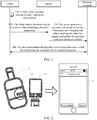
- a client 13 can scan a product barcode 12 attached on a product 11, so that the client 13 can enter a shopping cart interface 14.
- an agreement needs to be signed if the customer enters the shopping cart interface for the first time.
- an agreement signing page and agreement declaration content can be displayed in the client. If the customer agrees, the customer can choose to confirm the agreement so as to enter the shopping cart interface.
- Step 120 The client sends a checkout request to a server when obtaining a checkout instruction, where the checkout request carries the product information of a shopping cart.
- the customer can scan different product barcodes at multiple times to add products to the shopping cart.
- the shopping cart interface can further provide buttons for operating product information. For example, in FIG. 3 , for each added product, the customer can delete the product, increase or decrease a product quantity, and add a comment, etc. and can further, for example, clear the shopping cart by one tap.
- a portal to an online shopping mall can further be added to the shopping cart interface.
- the customer can select products through the online shopping mall in addition to scanning product barcodes.
- the customer can tap an online shopping mall button provided on the shopping cart interface to enter the online shopping mall.
- the customer can select a desired product and a product quantity, and add the product to the shopping cart.
- the customer can generate a checkout instruction by tapping a checkout button on the shopping cart interface, and then the client can send a checkout request to the server when the client obtains the checkout instruction.
- Step 130 The checkout server generates a payment code based on the product information of the shopping cart when receiving the checkout request, and pushes the payment code to a checkout terminal.
- the product information can include at least a product name, a product unit price, and a product quantity.
- the server can calculate a total price of all products based on unit prices and quantities of all the products, and generate a payment code (for example, a two-dimensional payment code) for the customer to perform payment.
- the product information can further include a product image and a product description, etc.
- step 110 can specifically include the following: scanning, by the client, the product barcode to enter the shopping cart interface, and sending current location information to the server; and step 130 can specifically include the following: determining, by the server based on the location information of the client when receiving the checkout request, a shop in which the client is currently located; and generating, by the server, the payment code based on the product information of the shopping cart, and pushing the payment code to a checkout terminal in the determined shop.
- the location information can be a location recorded by a positioning apparatus of a terminal of the client, and the location can be coordinate information representing a geographical location.
- a common positioning apparatus can uses a U.S. GPS satellite navigation system, a European "Galileo” satellite navigation system, a Russian GLONASS satellite navigation system, or a Chinese “Beidou” satellite navigation system, etc. or a similar combination.
- Such coordinate information for positioning is also referred to as mobile positioning.
- the location information can be obtained by a network device through conversion based on signal characteristics of the terminal of the client.
- the location information can be a location obtained by a network operator based on a base station coverage principle through positioning calculation of a base station by using signals of the terminal.
- the terminal In the latter positioning calculation, the terminal generally measures downlink pilot signals of different base stations to obtain time of arrival (TOA) of downlink pilots of different base stations or a time difference of arrival (TDOA) between downlink pilots of different base stations.
- TOA time of arrival
- TDOA time difference of arrival
- a location of the terminal can be calculated generally by using a trigonometric formula estimation algorithm based on the measurement result and with reference to coordinates of the base station. An actual location estimation algorithm needs to consider a case with multiple base stations (three or more).
- the location information can also be a relatively precise location jointly positioned and obtained by using assistant positioning of a base station in combination with the positioning apparatus in the terminal.
- the location information of the client can be used to determine a specific shop in which the current customer is located.
- the checkout request further carries location information of the client; and step 130 can specifically include the following: determining, by the server based on the location information of the client when receiving the checkout request, a shop in which a customer is located; and generating, by the server, the payment code based on the product information of the shopping cart, and pushing the payment code to a checkout terminal in the determined shop.
- a difference between the current implementation and the previous implementation lies in that a time for the client to send the location information is different.
- the location information is sent after the product barcode is scanned.
- the location information is sent after the checkout request is received.
- step 110 can specifically include the following: scanning, by the client, the product barcode to enter the shopping cart interface, and establishing short-range wireless communication with a current shop and obtaining a shop identifier; where the checkout request further carries the shop identifier; and step 130 can specifically include the following: determining, by the server based on the shop identifier when receiving the checkout request, a shop in which a customer is located; and generating, by the server, the payment code based on the product information of the shopping cart, and pushing the payment code to a checkout terminal in the determined shop.
- the client after scanning the product barcode, the client needs to establish short-range wireless communication with the current shop, so as to obtain the pushed shop identifier.
- a specific shop can be determined based on the shop identifier, that is, a one-to-one mapping relationship exists between a shop name and the shop identifier.
- step 120 can specifically include the following: establishing, by the client when obtaining the checkout instruction, short-range wireless communication with a current shop and obtaining a shop identifier; and sending, by the client, the checkout request to the server, where the checkout request carries the shop identifier; and step 130 can specifically include the following: determining, by the server based on the shop identifier when receiving the checkout request, a shop in which a customer is located; and generating, by the server, the payment code based on the product information of the shopping cart, and pushing the payment code to a checkout terminal in the determined shop.
- a difference between the current implementation and the previous implementation lies in that a time for the client to establish short-range wireless communication with the current shop and obtain the shop identifier is different.
- the client establishes short-range wireless communication with the current shop and obtains the shop identifier after the product barcode is scanned.
- the client establishes short-range wireless communication with the current shop and obtains the shop identifier after the checkout instruction is obtained.
- the establishing short-range wireless communication with a current shop and obtaining a shop identifier specifically includes the following: after scanning a two-dimensional code that is used to establish short-range wireless communication and that is provided by the checkout terminal, establishing, by the client, short-range wireless communication with the checkout terminal, and obtaining a shop identifier pushed by the checkout terminal.
- the short-range wireless communication can include Bluetooth, infrared, a wireless local area network, Wi-Fi, ultra-wideband communication, ZigBee, or near field communication, etc.
- Step 140 The checkout terminal displays the received payment code, so that the client scans the payment code to complete payment.
- FIG. 4 is a schematic diagram of an example checkout terminal.
- a screen 21 is disposed on the checkout terminal, and can display the received payment code.
- the customer can use the client to scan the payment code to complete payment.
- the checkout terminal can be disposed on a dedicated checkout channel in the shop. The customer can leave quickly after performing payment successfully by using the checkout terminal, thereby improving checkout efficiency.
- the checkout terminal can further be provided with an infrared sensing device 23. When the customer stands in front of the checkout terminal, the customer can be sensed by the infrared sensing device 23, so as to activate the checkout terminal from a sleep state.
- the customer can send the checkout request to the server only after the checkout terminal is activated, so that the checkout terminal can display the payment code. As such, it can be ensured that a payment code scanned by the customer is a payment code needed by the customer for payment.
- the present specification provides a product checkout solution.
- a customer can add desired products to a shopping cart by scanning barcodes of the products through a client, so that the customer can complete self-service product selection.
- a server can generate a payment code and send the payment code to a checkout terminal.
- the customer can complete product payment by using the client to scan the payment code displayed by the checkout terminal.
- the customer can complete shopping by using the client, and can complete fast payment by using the checkout terminal, thereby greatly reducing a checkout time.
- shopping experience is better because the customer is not monitored in real time.
- For a merchant only the checkout terminal needs to be disposed, and there is no need to invest a large amount of money.
- Such practice can greatly reduce operation costs and needs for market access, thereby facilitating popularization of self-service shops.
- server processing efficiency can be improved, and a response time can be reduced.
- the implementation shown in FIG. 1 can further include the following: performing, by the checkout terminal, risk detection when receiving the payment code scanned by the client to perform payment; and notifying a shop staff member when there is a risk.
- the checkout terminal can generally report an alarm imperceptible by the customer, for example, notify a shop staff member for the shop staff member to manually re-check products of the customer with the risk.
- the risk detection can include the following: obtaining and recognizing products that are to be actually checked out by a customer and that are photographed by a photographing device; and determining that there is a risk when the products to be actually checked out by the customer are different from products in the shopping cart; or determining that there is no risk when the products to be actually checked out by the customer are the same as products in the shopping cart.
- FIG. 4 is a schematic diagram of an example checkout terminal.
- a photographing device 22, for example, a camera is disposed on the checkout terminal.
- the checkout terminal can upload an obtained product image to the server or a third-party image recognition server for recognition, so as to obtain a returned recognized product.
- the checkout terminal can locally recognize the actually checked-out products of the customer that are photographed by the photographing device.
- the products can be recognized based on an existing general image recognition technology, and details are omitted for simplicity in the present specification.
- the checkout terminal in FIG. 4 can further be provided with a storage 25 for placing products. In actual applications, the customer can place selected products in the storage 25, so that the photographing device 22 can captures image of the products, and the checkout terminal can obtain and recognize the products to be actually checked out by the customer.
- the products to be actually checked out by the customer are the same as the products in the shopping cart, it is determined whether a specified product exists in the products to be actually checked out by the customer; and it is determined that there is a risk when the specified product exists in the products to be actually checked out by the customer.
- shops can specify some special products, such as expensive products (for example, tobacco and wine).
- expensive products for example, tobacco and wine.
- the checkout terminal can recognize products to be actually checked out by the customer, so as to avoid a risk that the products to be actually checked out by the customer are different from the selected products in the shopping cart, thereby effectively ensuring benefits of shops.
- the risk detection can include the following: obtaining a first total weight, detected by a weighing device, of products to be actually checked out by a customer; calculating a second total weight based on weights and a quantity of products in the shopping cart; and determining that there is a risk when an absolute value of a difference between the first total weight and the second total weight exceeds a threshold; or determining that there is no risk when an absolute value of a difference between the first total weight and the second total weight does not exceed a threshold.
- a shop can input a weight of each product in advance. As such, it can be determined whether there is a risk by comparing the first total weight of the products to be actually checked out by the customer with the second total weight of the products in the shopping cart. Generally, in an ideal state, when the first total weight is the same as the second total weight, it can be considered that the actually checked-out products are the same as the products in the shopping cart, and correspondingly, the threshold can be 0. Certainly, in actual applications, the weighing device may generate a weighing error. Therefore, the threshold can be an empirical value greater than 0, for example, 500 grams or 1 kilogram.
- the storage 25 of the checkout terminal is further provided with a weighting device, and therefore can have a weighting function.
- the checkout terminal can detect whether there is a risk based on a total weight of the products to be actually checked out by the customer, so as to avoid a risk that the products to be actually checked out by the customer are different from the selected products in the shopping cart, thereby effectively ensuring benefits of shops.
- the risk detection can include the following: recognizing products corresponding to radio frequency identification tags on products to be actually checked out by a customer; and determining that there is a risk when the products corresponding to the radio frequency identification tags are different from products in the shopping cart; or determining that there is no risk when the products corresponding to the radio frequency identification tags are the same as products in the shopping cart.
- the radio frequency identification is a communications technology that can identify a specific target by using a radio signal and read and write related data, without a need to establish mechanical or optical contact between an identification system and the specific target.
- RFID tag can be attached on each product.
- an RFID tag scanning device 24 can further be disposed in the checkout terminal. When the customer places the products to be actually checked out into the storage 25, the RFID tag scanning device 24 can recognize a product corresponding to each RFID tag. As such, the checkout terminal can compare recognized products with the products in the shopping cart. It is determined that there is a risk when the product corresponding to the RFID tag is different from a product in the shopping cart; or it is determined that there is no risk when the product corresponding to the RFID tag is the same as a product in the shopping cart.
- the method can include the following steps:
- Step 310 A client scans a product barcode to enter a shopping cart interface, where the shopping cart interface is used to display product information obtained through barcode scanning.
- Step 320 The client sends a checkout request to a server when obtaining a checkout instruction, where the checkout request carries the product information of a shopping cart.
- Step 330 The server generates a payment code based on the product information of the shopping cart when receiving the checkout request, and pushes the payment code to the client, so that the client displays the payment code for payment.
- the current implementation is similar to the implementation shown in FIG. 1 . For specific same steps, reference can be made to detailed description in the implementation shown in FIG. 1 .
- the current implementation differs from the implementation in FIG. 1 in that the server generates and then pushes the payment code to the client.
- a merchant does not need to dispose a checkout terminal, and can still use a manual collection method.
- the customer can display the payment code, so that a shop staff member can scan the payment code by using a scanning device for collection, so as to complete checkout.
- the present specification further provides implementations of product checkout apparatuses.
- the apparatus implementations can be implemented by software, hardware, or a combination of hardware and software.
- Software implementation is used as an example.
- the product checkout apparatus is formed by reading a corresponding computer program instruction in a non-volatile memory to a memory by a processor of a device accommodating the apparatus.
- a hardware structure of the device accommodating the product checkout apparatus in the present specification can include a processor, a network interface, a memory, and a non-volatile memory.
- the device accommodating the apparatus in the implementation can generally further include other hardware based on actual product checkout functions, and details are not omitted for simplicity.
- FIG. 6 is a module diagram illustrating a product checkout apparatus, according to an implementation of the present specification.
- the apparatus corresponds to the implementation shown in FIG. 1 .
- the apparatus includes the following: a scanning unit 410, configured for a client to scan a product barcode to enter a shopping cart interface, where the shopping cart interface is used to display product information obtained through barcode scanning; a sending unit 420, configured for the client to send a checkout request to a server when obtaining a checkout instruction, where the checkout request carries the product information of a shopping cart; a generation unit 430, configured for the checkout server to generate a payment code based on the product information of the shopping cart when receiving the checkout request, and push the payment code to a checkout terminal; and a checkout unit 440, configured for the checkout terminal to display the received payment code, so that the client scans the payment code to complete payment.
- a scanning unit 410 configured for a client to scan a product barcode to enter a shopping cart interface, where the shopping cart interface is used to display product information
- the scanning unit 410 specifically includes the following: a scanning subunit, configured for the client to scan the product barcode to enter the shopping cart interface, and send current location information to the server; and the generation unit 430 specifically includes the following: a determining subunit, configured for the server to determine, based on the location information of the client when receiving the checkout request, a shop in which the client is currently located; and a generation subunit, configured for the server to generate the payment code based on the product information of the shopping cart, and push the payment code to a checkout terminal in the determined shop.
- the scanning unit 410 specifically includes the following: a scanning subunit, configured for the client to scan the product barcode to enter the shopping cart interface, and establish short-range wireless communication with a current shop and obtain a shop identifier; where the checkout request further carries the shop identifier; and the generation unit 430 specifically includes the following: a determining subunit, configured for the server to determine, based on the shop identifier when receiving the checkout request, a shop in which a customer is located; and a generation subunit, configured for the server to generate the payment code based on the product information of the shopping cart, and push the payment code to a checkout terminal in the determined shop.
- a scanning subunit configured for the client to scan the product barcode to enter the shopping cart interface, and establish short-range wireless communication with a current shop and obtain a shop identifier
- the checkout request further carries the shop identifier
- the generation unit 430 specifically includes the following: a determining subunit, configured for the server to determine, based on the shop identifier when receiving the checkout
- the checkout request further carries location information of the client; and the generation unit 430 specifically includes the following: a determining subunit, configured for the server to determine, based on the location information of the client when receiving the checkout request, a shop in which a customer is located; and a generation subunit, configured for the server to generate the payment code based on the product information of the shopping cart, and push the payment code to a checkout terminal in the determined shop.
- the sending unit 420 specifically includes the following: an establishment subunit, configured for the client to establish, when obtaining the checkout instruction, short-range wireless communication with a current shop and obtaining a shop identifier; and a sending subunit, configured for the client to send the checkout request to the server, where the checkout request carries the shop identifier; and the generation unit 430 specifically includes the following: a determining subunit, configured for the server to determine, based on the shop identifier when receiving the checkout request, a shop in which a customer is located; and a generation subunit, configured for the server to generate the payment code based on the product information of the shopping cart, and push the payment code to a checkout terminal in the determined shop.
- the establishing short-range wireless communication with a current shop and obtaining a shop identifier specifically includes the following: after scanning a two-dimensional code that is used to establish short-range wireless communication and that is provided by the self-service terminal, establishing, by the client, short-range wireless communication with the checkout terminal, and obtaining a shop identifier pushed by the checkout terminal.
- the apparatus further includes the following: a detection subunit, configured for the checkout terminal to perform risk detection when receiving the payment code scanned by the client to perform payment; and a notification subunit, configured to notify a shop staff member when there is a risk.
- the risk detection subunit specifically includes the following: an acquisition subunit, configured to obtain and recognize products that are to be actually checked out by a customer and that are photographed by a photographing device; and a risk determining subunit, configured to determine that there is a risk when the products to be actually checked out by the customer are different from products in the shopping cart.
- the apparatus further includes the following: a determining subunit, configured to determine, when the products to be actually checked out by the customer are the same as the products in the shopping cart, whether a specified product exists in the products to be actually checked out by the customer; and the risk determining subunit, configured to determine that there is a risk when the specified product exists in the products to be actually checked out by the customer.
- the risk detection subunit specifically includes the following: an acquisition subunit, configured to obtain a first total weight, detected by a weighing device, of products to be actually checked out by a customer; a calculation subunit, configured to calculate a second total weight based on weights and a quantity of products in the shopping cart; and a risk determining subunit, configured to determine that there is a risk when an absolute value of a difference between the first total weight and the second total weight exceeds a threshold.
- the risk detection subunit specifically includes the following: a recognition subunit, configured to recognize products corresponding to radio frequency identification tags on products to be actually checked out by a customer; and a risk determining subunit, configured to determine that there is a risk when the products corresponding to the radio frequency identification tags are different from products in the shopping cart.
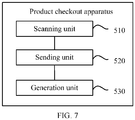
- FIG. 7 is a module diagram illustrating a product checkout apparatus, according to an implementation of the present specification.
- the apparatus corresponds to the implementation shown in FIG. 5 .
- the apparatus includes the following: a scanning unit 510, configured for a client to scan a product barcode to enter a shopping cart interface, where the shopping cart interface is used to display product information obtained through barcode scanning; a sending unit 520, configured for the client to send a checkout request to a server when obtaining a checkout instruction, where the checkout request carries the product information of a shopping cart; and a generation unit 530, configured for the server to generate a payment code based on the product information of the shopping cart when receiving the checkout request, and push the payment code to the client, so that the client displays the payment code for payment.
- a scanning unit 510 configured for a client to scan a product barcode to enter a shopping cart interface, where the shopping cart interface is used to display product information obtained through barcode scanning
- a sending unit 520 configured for the client to send a checkout request to
- the system, apparatus, module, or unit illustrated in the previous implementations can be implemented by using a computer chip or an entity, or can be implemented by using a product having a certain function.
- a typical implementation device is a computer, and the computer can be a personal computer, a laptop computer, a cellular phone, a camera phone, a smartphone, a personal digital assistant, a media player, a navigation device, an email receiving and sending device, a game console, a tablet computer, a wearable device, or any combination of these devices.
- FIG. 6 describes a schematic diagram of internal function modules and a structure of the product checkout apparatus.
- the product checkout apparatus can be an electronic device, including: a processor; and a memory, configured to store an instruction executable by the processor, where the processor is configured to implement the following method: scanning, by a client, a product barcode to enter a shopping cart interface, where the shopping cart interface is used to display product information obtained through barcode scanning; sending, by the client, a checkout request to a server when obtaining a checkout instruction, where the checkout request carries the product information of a shopping cart; generating, by the checkout server, a payment code based on the product information of the shopping cart when receiving the checkout request, and pushing the payment code to a checkout terminal; and displaying, by the checkout terminal, the received payment code, so that the client scans the payment code to complete payment.
- the scanning, by a client, a product barcode to enter a shopping cart interface specifically includes the following: scanning, by the client, the product barcode to enter the shopping cart interface, and sending current location information to the server; and the generating, by the server, a payment code based on the product information of the shopping cart when receiving the checkout request, and pushing the payment code to a checkout terminal specifically includes the following: determining, by the server based on the location information of the client when receiving the checkout request, a shop in which the client is currently located; and generating, by the server, the payment code based on the product information of the shopping cart, and pushing the payment code to a checkout terminal in the determined shop.
- the scanning, by a client, a product barcode to enter a shopping cart interface specifically includes the following: scanning, by the client, the product barcode to enter the shopping cart interface, and establishing short-range wireless communication with a current shop and obtaining a shop identifier; where the checkout request further carries the shop identifier; and the generating, by the server, a payment code based on the product information of the shopping cart when receiving the checkout request, and pushing the payment code to a checkout terminal specifically includes the following: determining, by the server based on the shop identifier when receiving the checkout request, a shop in which a customer is located; and generating, by the server, the payment code based on the product information of the shopping cart, and pushing the payment code to a checkout terminal in the determined shop.
- the checkout request further carries location information of the client; and the generating, by the server, a payment code based on the product information of the shopping cart when receiving the checkout request, and pushing the payment code to a checkout terminal specifically includes the following: determining, by the server based on the location information of the client when receiving the checkout request, a shop in which a customer is located; and generating, by the server, the payment code based on the product information of the shopping cart, and pushing the payment code to a checkout terminal in the determined shop.
- the sending, by the client, a checkout request to a server when obtaining a checkout instruction specifically includes the following: establishing, by the client when obtaining the checkout instruction, short-range wireless communication with a current shop and obtaining a shop identifier; and sending, by the client, the checkout request to the server, where the checkout request carries the shop identifier; and the generating, by the server, a payment code based on the product information of the shopping cart when receiving the checkout request, and pushing the payment code to a checkout terminal specifically includes the following: determining, by the server based on the shop identifier when receiving the checkout request, a shop in which a customer is located; and generating, by the server, the payment code based on the product information of the shopping cart, and pushing the payment code to a checkout terminal in the determined shop.
- the establishing short-range wireless communication with a current shop and obtaining a shop identifier specifically includes the following: after scanning a two-dimensional code that is used to establish short-range wireless communication and that is provided by the self-service terminal, establishing, by the client, short-range wireless communication with the checkout terminal, and obtaining a shop identifier pushed by the checkout terminal.
- the method further includes the following: performing, by the checkout terminal, risk detection when receiving the payment code scanned by the client to perform payment; and notifying a shop staff member when there is a risk.
- the risk detection specifically includes the following: obtaining and recognizing products that are to be actually checked out by a customer and that are photographed by a photographing device; and determining that there is a risk when the products to be actually checked out by the customer are different from products in the shopping cart.
- the method further includes the following: when the products to be actually checked out by the customer are the same as the products in the shopping cart, determining whether a specified product exists in the products to be actually checked out by the customer; and determining that there is a risk when the specified product exists in the products to be actually checked out by the customer.
- the risk detection specifically includes the following: obtaining a first total weight, detected by a weighing device, of products to be actually checked out by a customer; calculating a second total weight based on weights and a quantity of products in the shopping cart; and determining that there is a risk when an absolute value of a difference between the first total weight and the second total weight exceeds a threshold.
- the risk detection specifically includes the following: recognizing products corresponding to radio frequency identification tags on products to be actually checked out by a customer; and determining that there is a risk when the products corresponding to the radio frequency identification tags are different from products in the shopping cart.
- FIG. 7 describes a schematic diagram of internal function modules and a structure of the product checkout apparatus.
- the product checkout apparatus can be an electronic device, including: a processor; and a memory, configured to store an instruction executable by the processor, where the processor is configured to implement the following method: scanning, by a client, a product barcode to enter a shopping cart interface, where the shopping cart interface is used to display product information obtained through barcode scanning; sending, by the client, a checkout request to a server when obtaining a checkout instruction, where the checkout request carries the product information of a shopping cart; and generating, by the server, a payment code based on the product information of the shopping cart when receiving the checkout request, and pushing the payment code to the client, so that the client displays the payment code for payment.
- the processor can be a central processing unit (CPU), or can be another general-purpose processor, a digital signal processor (DSP), an application-specific integrated circuit (ASIC), etc.
- the general-purpose processor can be a microprocessor, or the processor can be any conventional processor, etc.
- the previous memory can be a read-only memory (ROM), a random access memory (RAM), a flash memory, a hard disk, or a solid-state disk.
Landscapes
- Business, Economics & Management (AREA)
- Accounting & Taxation (AREA)
- Engineering & Computer Science (AREA)
- General Physics & Mathematics (AREA)
- Physics & Mathematics (AREA)
- Strategic Management (AREA)
- General Business, Economics & Management (AREA)
- Theoretical Computer Science (AREA)
- Finance (AREA)
- Computer Networks & Wireless Communication (AREA)
- Development Economics (AREA)
- Economics (AREA)
- Marketing (AREA)
- Cash Registers Or Receiving Machines (AREA)
Applications Claiming Priority (2)
| Application Number | Priority Date | Filing Date | Title |
|---|---|---|---|
| CN201810170622.7A CN108520447A (zh) | 2018-03-01 | 2018-03-01 | 商品结算方法及装置和电子设备 |
| PCT/CN2019/073359 WO2019165866A1 (zh) | 2018-03-01 | 2019-01-28 | 商品结算方法及装置和电子设备 |
Publications (2)
| Publication Number | Publication Date |
|---|---|
| EP3716191A1 true EP3716191A1 (de) | 2020-09-30 |
| EP3716191A4 EP3716191A4 (de) | 2020-10-14 |
Family
ID=63433406
Family Applications (1)
| Application Number | Title | Priority Date | Filing Date |
|---|---|---|---|
| EP19759924.4A Withdrawn EP3716191A4 (de) | 2018-03-01 | 2019-01-28 | Verfahren und vorrichtung zur warenabrechnung und elektronische vorrichtung |
Country Status (6)
| Country | Link |
|---|---|
| US (1) | US20200294022A1 (de) |
| EP (1) | EP3716191A4 (de) |
| CN (1) | CN108520447A (de) |
| SG (1) | SG11202006079VA (de) |
| TW (1) | TW201937420A (de) |
| WO (1) | WO2019165866A1 (de) |
Families Citing this family (8)
| Publication number | Priority date | Publication date | Assignee | Title |
|---|---|---|---|---|
| CN108520447A (zh) * | 2018-03-01 | 2018-09-11 | 阿里巴巴集团控股有限公司 | 商品结算方法及装置和电子设备 |
| CN109544831A (zh) * | 2018-11-21 | 2019-03-29 | 奕铭(大连)科技发展有限公司 | 一种商场自动结算系统 |
| CN109727404A (zh) * | 2018-11-27 | 2019-05-07 | 广州市科传计算机科技股份有限公司 | 自助收银重量监察方法和系统 |
| CN111047393A (zh) * | 2019-11-18 | 2020-04-21 | 深圳市灵智数字科技有限公司 | 信息添加、信息生成方法以及信息处理系统、电子设备 |
| CN113298544A (zh) * | 2020-04-07 | 2021-08-24 | 阿里巴巴集团控股有限公司 | 商品结算的数据处理方法、装置和结算设备 |
| TWI817094B (zh) * | 2021-03-15 | 2023-10-01 | 東元電機股份有限公司 | 購物用無人載物車之控制系統 |
| US20240394764A1 (en) * | 2023-05-24 | 2024-11-28 | Razorpay Inc. | Simultaneous transactions on shared display devices using scannable codes |
| CN118116140B (zh) * | 2024-04-01 | 2024-08-27 | 上海商睿智能科技有限公司 | 一种用于pos机的信息交互方法及系统 |
Family Cites Families (16)
| Publication number | Priority date | Publication date | Assignee | Title |
|---|---|---|---|---|
| US20120203695A1 (en) * | 2011-02-09 | 2012-08-09 | American Express Travel Related Services Company, Inc. | Systems and methods for facilitating secure transactions |
| US10586227B2 (en) * | 2011-02-16 | 2020-03-10 | Visa International Service Association | Snap mobile payment apparatuses, methods and systems |
| CN102542443A (zh) * | 2011-12-02 | 2012-07-04 | 惠州Tcl移动通信有限公司 | 一种在线支付方法及相应的设备 |
| EP2800041A4 (de) * | 2011-12-30 | 2015-09-09 | Mozido Corfire Korea Ltd | System und verfahren zum bezahlen |
| US20130254114A1 (en) * | 2012-03-23 | 2013-09-26 | Ncr Corporation | Network-based self-checkout |
| EP3108425A4 (de) * | 2014-02-21 | 2017-10-18 | Visa International Service Association | System und verfahren zum senden und empfangen von transaktionsinformationen |
| CN104732388A (zh) * | 2015-03-26 | 2015-06-24 | 深圳市亚略特生物识别科技有限公司 | 电子支付方法及系统 |
| CN104835033A (zh) * | 2015-05-14 | 2015-08-12 | 北京超赞捷通网络科技有限公司 | 基于移动定位技术的快速购物方法 |
| CN105608575A (zh) * | 2016-01-08 | 2016-05-25 | 赖三超 | 超市自助收银购物软件 |
| CN106980974A (zh) * | 2016-01-18 | 2017-07-25 | 西安涅槃软件科技有限公司 | 一种移动支付的方法和系统 |
| WO2017156247A1 (en) * | 2016-03-09 | 2017-09-14 | Mastercard International Incorporated | Systems and methods for use in facilitating payment account transactions |
| CN107103710A (zh) * | 2017-04-20 | 2017-08-29 | 南京工业职业技术学院 | 一种超市智能购物方法 |
| CN107221098A (zh) * | 2017-04-25 | 2017-09-29 | 深圳中兴网信科技有限公司 | 辅助购物方法、装置和智能购物车 |
| CN206961268U (zh) * | 2017-08-03 | 2018-02-02 | 深圳市爱贝信息技术有限公司 | 一种基于付款码的结算终端 |
| CN107578228A (zh) * | 2017-10-09 | 2018-01-12 | 唐嘉俊 | 基于二维码的智能收银方法、装置、设备以及存储介质 |
| CN108520447A (zh) * | 2018-03-01 | 2018-09-11 | 阿里巴巴集团控股有限公司 | 商品结算方法及装置和电子设备 |
-
2018
- 2018-03-01 CN CN201810170622.7A patent/CN108520447A/zh active Pending
- 2018-12-25 TW TW107146918A patent/TW201937420A/zh unknown
-
2019
- 2019-01-28 EP EP19759924.4A patent/EP3716191A4/de not_active Withdrawn
- 2019-01-28 WO PCT/CN2019/073359 patent/WO2019165866A1/zh not_active Ceased
- 2019-01-28 SG SG11202006079VA patent/SG11202006079VA/en unknown
-
2020
- 2020-05-29 US US16/888,494 patent/US20200294022A1/en not_active Abandoned
Also Published As
| Publication number | Publication date |
|---|---|
| SG11202006079VA (en) | 2020-07-29 |
| EP3716191A4 (de) | 2020-10-14 |
| WO2019165866A1 (zh) | 2019-09-06 |
| CN108520447A (zh) | 2018-09-11 |
| TW201937420A (zh) | 2019-09-16 |
| US20200294022A1 (en) | 2020-09-17 |
Similar Documents
| Publication | Publication Date | Title |
|---|---|---|
| US20200294022A1 (en) | Product checkout using a client device | |
| US20230017398A1 (en) | Contextually aware customer item entry for autonomous shopping applications | |
| EP3525156B1 (de) | Verfahren und vorrichtung zum bestimmen von auftragsinformationen | |
| US11295352B2 (en) | Method for displaying product information for electronic price tag, and electronic price tag | |
| JP6869340B2 (ja) | 注文情報決定方法および装置 | |
| EP3261043A1 (de) | Verfahren und vorrichtung zur anzeige von informationen und verfahren und vorrichtung zum pushen von informationen | |
| US20230076008A1 (en) | Decentralized Self-Service Checkouts | |
| JP7137594B2 (ja) | 情報処理端末、情報処理方法及びプログラム | |
| US9076157B2 (en) | Camera time out feature for customer product scanning device | |
| US20150262269A1 (en) | Customer selection determination system | |
| JP5913236B2 (ja) | 棚割支援装置、サーバおよびプログラム | |
| KR101420369B1 (ko) | 위치기반 서비스 제공 방법 및 서버 | |
| CN107633398A (zh) | 图像显示方法及装置和电子设备 | |
| CN110992084A (zh) | 基于智能购物车的购物方法、装置、设备及存储介质 | |
| US20140214599A1 (en) | Completing A Purchase Transaction At Various Locations | |
| CN112396647B (zh) | 称重方法、支付方法、信息获取方法及装置 | |
| HK1258946A1 (zh) | 商品结算方法及装置和电子设备 | |
| KR20170107854A (ko) | 이동 단말기 및 그의 동작 방법 | |
| KR20170020110A (ko) | 이동 단말기 및 그의 동작 방법 | |
| HK1248887A1 (zh) | 图像显示方法及装置和电子设备 | |
| HK1242023A1 (en) | Method and apparatus for determining order information | |
| HK1242023A (en) | Method and apparatus for determining order information | |
| HK1242022A (en) | Method and apparatus for determining order information | |
| HK1242022A1 (en) | Method and apparatus for determining order information | |
| HK1257385A1 (zh) | 图像识别方法及装置和电子设备 |
Legal Events
| Date | Code | Title | Description |
|---|---|---|---|
| STAA | Information on the status of an ep patent application or granted ep patent |
Free format text: STATUS: THE INTERNATIONAL PUBLICATION HAS BEEN MADE |
|
| PUAI | Public reference made under article 153(3) epc to a published international application that has entered the european phase |
Free format text: ORIGINAL CODE: 0009012 |
|
| STAA | Information on the status of an ep patent application or granted ep patent |
Free format text: STATUS: REQUEST FOR EXAMINATION WAS MADE |
|
| 17P | Request for examination filed |
Effective date: 20200624 |
|
| AK | Designated contracting states |
Kind code of ref document: A1 Designated state(s): AL AT BE BG CH CY CZ DE DK EE ES FI FR GB GR HR HU IE IS IT LI LT LU LV MC MK MT NL NO PL PT RO RS SE SI SK SM TR |
|
| AX | Request for extension of the european patent |
Extension state: BA ME |
|
| A4 | Supplementary search report drawn up and despatched |
Effective date: 20200916 |
|
| RIC1 | Information provided on ipc code assigned before grant |
Ipc: G07G 1/00 20060101ALI20200910BHEP Ipc: G06Q 30/06 20120101ALI20200910BHEP Ipc: G06Q 20/32 20120101AFI20200910BHEP Ipc: G06Q 20/20 20120101ALI20200910BHEP |
|
| RAP1 | Party data changed (applicant data changed or rights of an application transferred) |
Owner name: ADVANCED NEW TECHNOLOGIES CO., LTD. |
|
| STAA | Information on the status of an ep patent application or granted ep patent |
Free format text: STATUS: EXAMINATION IS IN PROGRESS |
|
| 17Q | First examination report despatched |
Effective date: 20210203 |
|
| DAV | Request for validation of the european patent (deleted) | ||
| DAX | Request for extension of the european patent (deleted) | ||
| STAA | Information on the status of an ep patent application or granted ep patent |
Free format text: STATUS: THE APPLICATION HAS BEEN WITHDRAWN |
|
| 18W | Application withdrawn |
Effective date: 20220114 |