EP3716509B1 - Verfahren und vorrichtung zur codierung, elektronische vorrichtung und speichermedium - Google Patents
Verfahren und vorrichtung zur codierung, elektronische vorrichtung und speichermedium Download PDFInfo
- Publication number
- EP3716509B1 EP3716509B1 EP18882160.7A EP18882160A EP3716509B1 EP 3716509 B1 EP3716509 B1 EP 3716509B1 EP 18882160 A EP18882160 A EP 18882160A EP 3716509 B1 EP3716509 B1 EP 3716509B1
- Authority
- EP
- European Patent Office
- Prior art keywords
- sequence
- coded
- code rate
- preset
- transmission code
- Prior art date
- Legal status (The legal status is an assumption and is not a legal conclusion. Google has not performed a legal analysis and makes no representation as to the accuracy of the status listed.)
- Active
Links
Images




Classifications
-
- H—ELECTRICITY
- H04—ELECTRIC COMMUNICATION TECHNIQUE
- H04L—TRANSMISSION OF DIGITAL INFORMATION, e.g. TELEGRAPHIC COMMUNICATION
- H04L1/00—Arrangements for detecting or preventing errors in the information received
- H04L1/004—Arrangements for detecting or preventing errors in the information received by using forward error control
- H04L1/0056—Systems characterized by the type of code used
- H04L1/0057—Block codes
-
- H—ELECTRICITY
- H04—ELECTRIC COMMUNICATION TECHNIQUE
- H04L—TRANSMISSION OF DIGITAL INFORMATION, e.g. TELEGRAPHIC COMMUNICATION
- H04L1/00—Arrangements for detecting or preventing errors in the information received
- H04L1/0001—Systems modifying transmission characteristics according to link quality, e.g. power backoff
- H04L1/0002—Systems modifying transmission characteristics according to link quality, e.g. power backoff by adapting the transmission rate
-
- H—ELECTRICITY
- H03—ELECTRONIC CIRCUITRY
- H03M—CODING; DECODING; CODE CONVERSION IN GENERAL
- H03M13/00—Coding, decoding or code conversion, for error detection or error correction; Coding theory basic assumptions; Coding bounds; Error probability evaluation methods; Channel models; Simulation or testing of codes
- H03M13/03—Error detection or forward error correction by redundancy in data representation, i.e. code words containing more digits than the source words
- H03M13/05—Error detection or forward error correction by redundancy in data representation, i.e. code words containing more digits than the source words using block codes, i.e. a predetermined number of check bits joined to a predetermined number of information bits
- H03M13/09—Error detection only, e.g. using cyclic redundancy check [CRC] codes or single parity bit
-
- H—ELECTRICITY
- H03—ELECTRONIC CIRCUITRY
- H03M—CODING; DECODING; CODE CONVERSION IN GENERAL
- H03M13/00—Coding, decoding or code conversion, for error detection or error correction; Coding theory basic assumptions; Coding bounds; Error probability evaluation methods; Channel models; Simulation or testing of codes
- H03M13/03—Error detection or forward error correction by redundancy in data representation, i.e. code words containing more digits than the source words
- H03M13/05—Error detection or forward error correction by redundancy in data representation, i.e. code words containing more digits than the source words using block codes, i.e. a predetermined number of check bits joined to a predetermined number of information bits
- H03M13/13—Linear codes
-
- H—ELECTRICITY
- H03—ELECTRONIC CIRCUITRY
- H03M—CODING; DECODING; CODE CONVERSION IN GENERAL
- H03M13/00—Coding, decoding or code conversion, for error detection or error correction; Coding theory basic assumptions; Coding bounds; Error probability evaluation methods; Channel models; Simulation or testing of codes
- H03M13/25—Error detection or forward error correction by signal space coding, i.e. adding redundancy in the signal constellation, e.g. Trellis Coded Modulation [TCM]
- H03M13/253—Error detection or forward error correction by signal space coding, i.e. adding redundancy in the signal constellation, e.g. Trellis Coded Modulation [TCM] with concatenated codes
-
- H—ELECTRICITY
- H04—ELECTRIC COMMUNICATION TECHNIQUE
- H04L—TRANSMISSION OF DIGITAL INFORMATION, e.g. TELEGRAPHIC COMMUNICATION
- H04L1/00—Arrangements for detecting or preventing errors in the information received
- H04L1/0001—Systems modifying transmission characteristics according to link quality, e.g. power backoff
- H04L1/0009—Systems modifying transmission characteristics according to link quality, e.g. power backoff by adapting the channel coding
- H04L1/001—Systems modifying transmission characteristics according to link quality, e.g. power backoff by adapting the channel coding applied to control information
-
- H—ELECTRICITY
- H04—ELECTRIC COMMUNICATION TECHNIQUE
- H04L—TRANSMISSION OF DIGITAL INFORMATION, e.g. TELEGRAPHIC COMMUNICATION
- H04L1/00—Arrangements for detecting or preventing errors in the information received
- H04L1/004—Arrangements for detecting or preventing errors in the information received by using forward error control
- H04L1/0041—Arrangements at the transmitter end
-
- H—ELECTRICITY
- H04—ELECTRIC COMMUNICATION TECHNIQUE
- H04L—TRANSMISSION OF DIGITAL INFORMATION, e.g. TELEGRAPHIC COMMUNICATION
- H04L1/00—Arrangements for detecting or preventing errors in the information received
- H04L1/004—Arrangements for detecting or preventing errors in the information received by using forward error control
- H04L1/0056—Systems characterized by the type of code used
-
- H—ELECTRICITY
- H04—ELECTRIC COMMUNICATION TECHNIQUE
- H04L—TRANSMISSION OF DIGITAL INFORMATION, e.g. TELEGRAPHIC COMMUNICATION
- H04L1/00—Arrangements for detecting or preventing errors in the information received
- H04L1/004—Arrangements for detecting or preventing errors in the information received by using forward error control
- H04L1/0056—Systems characterized by the type of code used
- H04L1/0064—Concatenated codes
-
- H—ELECTRICITY
- H04—ELECTRIC COMMUNICATION TECHNIQUE
- H04L—TRANSMISSION OF DIGITAL INFORMATION, e.g. TELEGRAPHIC COMMUNICATION
- H04L1/00—Arrangements for detecting or preventing errors in the information received
- H04L1/004—Arrangements for detecting or preventing errors in the information received by using forward error control
- H04L1/0072—Error control for data other than payload data, e.g. control data
- H04L1/0073—Special arrangements for feedback channel
Definitions
- the present application relates to the field of communication technologies, and particularly to a coding method and apparatus, an electronic device and a storage medium.
- Polar codes which is the control channel coding scheme in the eMBB (Enhanced Moblie Broad Band) scenario for the fifth generation mobile communication technology (5th-Generation, 5G), is a new coding scheme that can achieve the binary symmetric channel capacity, and has the excellent decoding performance.
- the polar code has a larger storage capacity and latency.
- the 5G technology defines that the maximum mother code length of the polar codes is 512 bits for the downlink transmission and is 1024 bits for the uplink transmission.
- Massive Multiple-Input Multiple-Output (Massive MIMO) technology the length of the information sequence of the Uplink Control Information (UCI) has increased dramatically.
- the UCI is of at most 543 bits, and the 5G may support the UCI of up to 16 carriers to be transmitted on an uplink carrier.
- the 8688 bits far exceeds the maximum mother code length (1024 bits) of the polar codes for the uplink transmission, so it is necessary to study how to code and transmit the UCI for multi-carrier aggregation.
- Fig. 1 is a method of performing polar coding on the segments of the UCI in the prior art. Firstly a CRC sequence is attached behind the UCI information sequence (information bits) to obtain the UCI payload, then the code block segmentation is performed on the UCI payload, the polar coding is performed on the payload divided into two segments, the rate matching operation is performed respectively on the coded blocks, and finally the code block concatenation is performed to get the final output.
- multiple segments of UCI may have only one CRC, or multiple segments need to be decoded to obtain the candidate paths every time the decoding is performed, and they need to be combined to use this CRC for checking.
- the first function stored in the sending end may include a sub-function related to the length of the sequence to be coded and the transmission code rate, where the sub-function is g(R).
- g(R) is a linear function or a non-linear function
- al is a first scaling factor
- K is the length of the sequence to be coded
- R is the transmission code rate of the sequence to be coded
- N is the target number.
- N ceiling (a1*K/(c2*(A i *R i +A i-1 R i-1 + ...... + A 1 R) + b2)).
- the target number N ceiling (a1*K/(c2*(A i *R i + A i-1 R i-1 + whil + A 1 R) + b2));
- a i to A 1 are preset constants, and the constants in A i to A 1 may be 0 or may not be 0, so the items corresponding to the constants being 0 do not exist, and the items corresponding to the constants not being 0 exist.
- the segmentation before the segmentation, it may be determined whether to segment the sequence to be coded according to the target number.
- the first code rate threshold and the preset value are stored in the sending end.
- the segmentation threshold corresponding to the transmission code rate may be determined according to the magnitudes of the transmission code rate and the first code rate threshold. If the transmission code rate is less than the preset first code rate threshold, it is determined that the segmentation threshold corresponding to the transmission code rate is the preset value.
- the segmentation threshold corresponding to the transmission code rate is determined according to the transmission code rate and the preset second function, it is possbile to determine the segmentation threshold according to the transmission code rate and a preset linear function c3*R + b3 or int (c3*R + b3) if the transmission code rate is not less than a preset second code rate threshold, where c3 is the maximum bit length to be coded, b3 is a preset third offset value, R is the transmission code rate, and int is rounding.
- the second code rate threshold R2 may be any value less than or equal to 1.
- the segmentation threshold is determined according to the transmission code rate and the preset linear function c3*R + b3 or int (c3*R + b3).
- the second code rate threshold is 1/5 or 2/5.
- R1 R2 and 0 ⁇ R1 ⁇ 1 and 0 ⁇ R2 ⁇ 1; when R ⁇ R1, the corresponding segmentation threshold is the preset value; when R ⁇ R1, the corresponding segmentation threshold is determined according to the linear function c3*R + b3 or int (c3*R + b3).
- R3 is 0 and R4 is 1, it may be considered that the corresponding segmentation threshold is determined according to the linear function c4*R + b4 or int (c4*R + b4) regardless of value of the transmission code rate.
- the code block segmentation if the CRC sequence is attached behind the UCI information sequence (information bits) to obtain the UCI payload and then the code block segmentation is performed on the UCI payload, there is a need to determine the target sequence according to the sequence to be coded when the sequence to be coded is the UCI information sequence.
- the target sequence is the UCI payload obtained after the CRC sequence is attached to the UCI information sequence (information bits); the sequence to be coded may be directly used as the target sequence when the sequence to be coded itself includes the UCI information sequence and the CRC sequence for checking.
- the code block segmentation is performed on the UCI information sequence (information bits) at first, where each segment is added with a CRC sequence of L bits, then the polar coding is performed on each segment of bit stream added with the CRC, the rate matching operation is performed respectively on coded code blocks, and finally the code blocks are concatenated to get the final output.
- the sequence to be coded when the sequence to be coded is the UCI information sequence, the sequence to be coded may be directly used as the target sequence, and the target sequence is segmented by using the target number; when the sequence to be coded itself includes the UCI information sequence and the CRC sequence for checking, the CRC sequence needs to be removed from the sequence to be coded, and the obtained UCI information sequence is used as the target sequence to thereby perform the segmentation.
- the segmentation when the segmentation is performed, it may be uniform segmentation or non-uniform segmentation; or may be uniform segmentation after zero padding.
- the uniform segmentation or the non-uniform segmentation or the uniform segmentation after zero padding may be performed on the sequence to be coded.
- the uniform segmentation or the non-uniform segmentation or the uniform segmentation after zero padding may be performed on the target sequence.
- Fig. 4 is a schematic diagram of a coding process provided by an embodiment of the present application. The process includes the following steps.
- S401 determining the target number of segments of a sequence to be coded according to the length of the sequence to be coded, the transmission code rate and a preset first function.
- S402 determining a theoretical length value according to the length of the sequence to be coded and the target number, and determining the segmentation threshold corresponding to the transmission code rate according to the transmission code rate.
- S403 determining whether the theoretical length value is greater than or equal to the segmentation threshold, if so, proceeding to S405; if not, proceeding to S404.
- S405 segmenting the sequence to be coded according to the target number.
- S406 coding each sub-sequence after segmenting, and concatenating the sub-sequences after coding.
- Fig. 8 is a structural diagram of a coding device provided by an embodiment of the present application.
- the device includes:
- the determining module 81 is further configured to determine a theoretical length value according to the length of the sequence to be coded and the target number; and determine the segmentation threshold corresponding to the transmission code rate according to the transmission code rate; the apparatus further includes:
- the determining module 81 is specifically configured to: determine a second number according to the target number and a preset first numerical value, and determine the ratio of the length of the sequence to be coded to the second number as the theoretical length value; or determine the second ratio of the length of the sequence to be coded to the target number, and determine the product of the second ratio and a preset second scaling factor as the theoretical length value.
- the apparatus further includes: an update module configured to adjust the target number.
- the determining module 81 is specifically configured to: determine that the segmentation threshold corresponding to the transmission code rate is a preset value if the transmission code rate is less than a preset first code rate threshold.
- the determining module 81 is specifically configured to: determine the segmentation threshold corresponding to the transmission code rate according to the transmission code rate and a preset second function.
- the determining module 81 is specifically configured to: determine the segmentation threshold according to the transmission code rate and a preset linear function c3*R + b3 or int (c3*R + b3) if the transmission code rate is not less than a preset second code rate threshold, where c3 is the maximum bit length to be coded, b3 is a preset third offset value, R is the transmission code rate, and int is rounding.
- the segmentation module 82 is specifically configured to: determine a target sequence according to the sequence to be coded; and segment the target sequence according to the target number, where the target sequence is an information sequence, or a sequence consisting of an information sequence and a CRC sequence.
- Fig. 9 is an electronic device provided by an embodiment of the present application.
- the electronic device includes: a memory 92 and a processor 91.
- the processor 91 is specifically configured to: determine the target number of segments of the sequence to be coded according to the length of the sequence to be coded, the transmission code rate and a preset first function.
- the processor 91 is further configured to: determine a theoretical length value according to the length of the sequence to be coded and the target number before segmenting the sequence to be coded according to the target number; determine the segmentation threshold corresponding to the transmission code rate according to the transmission code rate; determine whether the theoretical length value is greater than or equal to the segmentation threshold; in response to determining that the theoretical length value is greater than or equal to the segmentation threshold, proceed to a next step.
- the processor 91 is specifically configured to: determine a second number according to the target number and a preset first numerical value, and determine the ratio of the length of the sequence to be coded to the second number as the theoretical length value; or determine the second ratio of the length of the sequence to be coded to the target number, and determine the product of the second ratio and a preset second scaling factor as the theoretical length value.
- the processor 91 is further configured to: adjust the target number before segmenting the sequence to be coded according to the target number if the theoretical length value is less than the segmentation threshold.
- the processor 91 is specifically configured to: determine that the segmentation threshold corresponding to the transmission code rate is a preset value if the transmission code rate is less than a preset first code rate threshold.
- the processor 91 is specifically configured to: determine the segmentation threshold corresponding to the transmission code rate according to the transmission code rate and a preset second function.
- the processor 91 is specifically configured to: determine the segmentation threshold according to the transmission code rate and a preset linear function c3*R + b3 or int (c3*R + b3) if the transmission code rate is not less than a preset second code rate threshold, where c3 is the maximum bit length to be coded, b3 is a preset third offset value, R is the transmission code rate, and int is rounding.
- the processor 91 is specifically configured to: determine the segmentation threshold according to the transmission code rate and a preset linear function c4*R + b4 or int (c4*R + b4) if the transmission code rate is not less than a preset third code rate threshold and less than a preset fourth bit rate threshold, where c4 is the maximum bit length to be coded, b4 is a preset fourth offset value, R is the transmission code rate, and int is rounding.
- the processor 91 is specifically configured to: determine a target sequence according to the sequence to be coded; and segment the target sequence according to the target number, where the target sequence is an information sequence, or a sequence composed of an information sequence and a CRC sequence.
- the bus architecture may include any numbers of interconnected buses and bridges, and specifically link various circuits of one or more processors represented by the processor 91 and the memory represented by the memory 92.
- the bus architecture may further link various other circuits such as peripheral device, voltage regulator and power management circuit, which are all well known in the art and thus will not be further described again herein.
- the bus interface provides an interface.
- the processor 91 is responsible for managing the bus architecture and general processing, and the memory 92 may store the data used by the processor 91 when performing the operations.
- a computer readable storage medium where the computer readable storage medium stores a computer program executable by an electronic device, where the program, when running on the electronic device, causes the electronic device to perform the steps of:
- the g(R) c1*R + b1, where c1 is the maximum bit length to be coded, and b1 is a preset first offset value.
- the method before segmenting the sequence to be coded according to the target number, the method includes:
- determining a theoretical length value according to the length of the sequence to be coded and the target number includes:
- the first numerical value is 1.
- the method further includes: adjusting the target number.
- determining the segmentation threshold corresponding to the transmission code rate according to the transmission code rate includes: if the transmission code rate is less than a preset first code rate threshold, determining that the segmentation threshold corresponding to the transmission code rate is a preset value.
- the scaling factor is greater than 0 and less than or equal to 1.
- the offset value is greater than -150 and less than 200.
- the segmenting the sequence to be coded according to the target number includes:
- the segmentation includes:
- the embodiments of the present application provide a coding method and apparatus, an electronic device and a storage medium, so as to solve the problem of non-flexible segmentation of the sequence to be coded in the prior art.
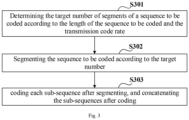
- the method includes: determining the target number of segments of a sequence to be coded according to the length of the sequence to be coded and the transmission code rate; segmenting the sequence to be coded according to the target number; coding each sub-sequence obtained after segmenting, and concatenating the sub-sequences after coding.
- the target number of segments of the sequence to be coded is determined according to the length of the sequence to be coded and the transmission code rate, and the sequence to be coded is segmented according to the target number.
- the sequence to be coded is flexibly segmented to improve the coding performance.
- These computer program instructions can also be stored in a computer readable memory which is capable of guiding the computer or another programmable data processing device to operate in a particular way, so that the instructions stored in the computer readable memory produce a manufacture including the instruction apparatus which implements the functions specified in one or more processes of the flow charts and/or one or more blocks of the block diagrams.
Landscapes
- Engineering & Computer Science (AREA)
- Computer Networks & Wireless Communication (AREA)
- Signal Processing (AREA)
- Physics & Mathematics (AREA)
- Probability & Statistics with Applications (AREA)
- Theoretical Computer Science (AREA)
- Quality & Reliability (AREA)
- Compression Or Coding Systems Of Tv Signals (AREA)
- Compression, Expansion, Code Conversion, And Decoders (AREA)
- Detection And Prevention Of Errors In Transmission (AREA)
Claims (13)
- Codierverfahren von Polarcodes, umfassend:Bestimmen (S301) einer Zielanzahl von Segmenten einer zu codierenden Sequenz gemäß einer Länge der zu codierenden Sequenz und einer Übertragungscoderate;Durchführen einer Segmentierung (S302) der zu codierenden Sequenz gemäß der Zielanzahl;Codieren (S303) jeder Teilsequenz, die nach der Segmentierung erhalten wurde, und Verketten der Teilsequenzen nach dem Codieren;wobei das Bestimmen einer Zielanzahl von Segmenten einer zu codierenden Sequenz gemäß einer Länge der zu codierenden Sequenz und einer Übertragungscoderate umfasst:Bestimmen der Zielanzahl von Segmenten der zu codierenden Sequenz gemäß der Länge der zu codierenden Sequenz, der Übertragungscoderate und einer voreingestellten ersten Funktion;dadurch gekennzeichnet, dass die voreingestellte erste Funktion umfasst:eine Ganzzahl N = a1*K/g(R), wobei g(R) eine lineare Funktion oder eine nichtlineare Funktion ist, a1 ein erster Skalierungsfaktor ist, K die Länge der zu codierenden Sequenz ist, R die Übertragungscoderate ist und N die Zielanzahl ist;wobei, wenn g(R) eine lineare Funktion ist, g(R) = c1*R + b1, wobei c1 eine maximale zu codierende Bitlänge ist und b1 ein voreingestellter Offsetwert ist; oderwenn g(R) eine nichtlineare Funktion ist, g(R) = c2*(Ai*Ri + Ai-1Ri-1+......+ A1R) + b2, wobei c2 eine maximale zu codierende Bitlänge ist, b2 ein voreingestellter zweiter Offsetwert ist, i eine voreingestellte Konstante nicht kleiner als 2 ist, Ai-A1 voreingestellte Konstanten sind und wenigstens ein Ai nicht Null ist.
- Verfahren nach Anspruch 1, das ferner Folgendes umfasst:Bestimmen eines theoretischen Längenwerts gemäß der Länge der zu codierenden Sequenz und der Zielanzahl;Bestimmen eines Segmentierungsschwellenwerts, der der Übertragungscoderate entspricht, gemäß der Übertragungscoderate;Bestimmen, ob der theoretische Längenwert größer oder gleich dem Segmentierungsschwellenwert ist;in Reaktion auf das Bestimmen, dass der theoretische Längenwert größer oder gleich dem Segmentierungsschwellenwert ist, Durchführen der Segmentierung der zu codierenden Sequenz gemäß der Zielanzahl.
- Verfahren nach Anspruch 2, wobei das Bestimmen eines theoretischen Längenwerts gemäß der Länge der zu codierenden Sequenz und der Zielanzahl umfasst:Bestimmen einer zweiten Anzahl gemäß der Zielanzahl und einem vorgegebenen ersten Zahlenwert und Bestimmen eines Verhältnisses der Länge der zu codierenden Sequenz zur zweiten Anzahl als theoretischen Längenwert; oderBestimmen eines zweiten Verhältnisses der Länge der zu codierenden Sequenz zur Zielanzahl und Bestimmen eines Produkts aus dem zweiten Verhältnis und einem voreingestellten zweiten Skalierungsfaktor als theoretischen Längenwert.
- Verfahren nach Anspruch 2, wobei, wenn der theoretische Längenwert kleiner ist als der Segmentierungsschwellenwert, das Verfahren vor Durchführung der Segmentierung an der zu codierenden Sequenz gemäß der Zielanzahl ferner umfasst:
Anpassen der Zielanzahl. - Verfahren nach Anspruch 2, wobei das Bestimmen eines Segmentierungsschwellenwerts, der der Übertragungscoderate entspricht, gemäß der Übertragungscoderate umfasst:
wenn die Übertragungscoderate kleiner ist als ein voreingestellter erster Coderatenschwellenwert, Bestimmen, dass der Segmentierungsschwellenwert, der der Übertragungscoderate entspricht, ein voreingestellter Wert ist. - Verfahren nach Anspruch 2, wobei das Bestimmen eines Segmentierungsschwellenwerts, der der Übertragungscoderate entspricht, gemäß der Übertragungscoderate umfasst:
Bestimmen des Segmentierungsschwellenwerts, der der Übertragungscoderate entspricht, gemäß der Übertragungscoderate und einer voreingestellten zweiten Funktion. - Verfahren nach Anspruch 6, wobei das Bestimmen des Segmentierungsschwellenwerts, der der Übertragungscoderate entspricht, gemäß der Übertragungscoderate und einer voreingestellten zweiten Funktion umfasst:
wenn die Übertragungscoderate nicht kleiner ist als ein voreingestellter zweiter Coderatenschwellenwert, Bestimmen des Segmentierungsschwellenwerts gemäß der Übertragungscoderate und einer voreingestellten linearen Funktion c3*R + b3 oder int (c3*R + b3), wobei c3 eine maximal zu codierende Bitlänge ist, b3 ein voreingestellter dritter Offsetwert ist, R die Übertragungscoderate ist und int eine Rundung ist. - Verfahren nach Anspruch 6, wobei das Bestimmen des Segmentierungsschwellenwerts, der der Übertragungscoderate entspricht, gemäß der Übertragungscoderate und einer voreingestellten zweiten Funktion umfasst:
wenn die Übertragungscoderate nicht kleiner ist als ein voreingestellter dritter Coderatenschwellenwert und kleiner ist als ein voreingestellter vierter Bitratenschwellenwert, Bestimmen des Segmentierungsschwellenwerts gemäß der Übertragungscoderate und einer voreingestellten linearen Funktion c4*R + b4 oder int (c4*R + b4), wobei c4 eine maximal zu codierende Bitlänge ist, b4 ein voreingestellter vierter Offsetwert ist, R die Übertragungscoderate ist und int eine Rundung ist. - Verfahren nach Anspruch 3, wobei der Skalierungsfaktor größer als 0 und kleiner als oder gleich 1 ist.
- Verfahren nach einem der Ansprüche 1, 7 oder 8, wobei der Offsetwert größer als -150 und kleiner als 200 ist.
- Verfahren nach Anspruch 1, wobei das Durchführen der Segmentierung an der zu codierenden Sequenz gemäß der Zielanzahl umfasst:Bestimmen einer Zielsequenz gemäß der zu codierenden Sequenz;Durchführen einer Segmentierung an der Zielsequenz gemäß der Zielanzahl, wobei die Zielsequenz eine Informationssequenz oder eine Sequenz ist, die aus einer Informationssequenz und einer CRC (Cyclic Redundancy Check, zyklische Redundanzprüfung) -Sequenz besteht.
- Verfahren gemäß Anspruch 1 oder 11, wobei die Segmentierung umfasst:einheitliche Segmentierung; oderuneinheitliche Segmentierung; odereinheitliche Segmentierung nach Nullauffüllung.
- Codiereinrichtung von Polarcodes, umfassend:ein Bestimmungsmodul (81), das ausgelegt ist zum Bestimmen einer Zielanzahl von Segmenten einer zu codierenden Sequenz gemäß einer Länge der zu codierenden Sequenz und einer Übertragungscoderate;ein Segmentierungsmodul (82), das ausgelegt ist zum Durchführen der Segmentierung an der zu codierenden Sequenz gemäß der Zielanzahl;ein Codiermodul (83), das ausgelegt ist zum Codieren jeder nach der Segmentierung erhaltenen Teilsequenz und zum Verketten der Teilsequenzen nach dem Codieren;wobei das Bestimmungsmodul ausgelegt ist zum Bestimmen einer Zielanzahl von Segmenten einer zu codierenden Sequenz gemäß einer Länge der zu codierenden Sequenz undeiner Übertragungscoderate durch:Bestimmen der Zielanzahl von Segmenten der zu codierenden Sequenz gemäß der Länge der zu codierenden Sequenz, der Übertragungscoderate und einer voreingestellten ersten Funktion;dadurch gekennzeichnet, dass die voreingestellte erste Funktion umfasst:eine Ganzzahl N = a1*K/g(R), wobei g(R) eine lineare Funktion oder eine nichtlineare Funktion ist, a1 ein erster Skalierungsfaktor ist, K die Länge der zu codierenden Sequenz ist, R die Übertragungscoderate ist und N die Zielanzahl ist;wobei, wenn g(R) eine lineare Funktion ist, g(R) = c1*R + b1, wobei c1 eine maximale zu codierende Bitlänge ist und b1 ein voreingestellter Offsetwert ist; oderwenn g(R) eine nichtlineare Funktion ist, g(R) = c2*(Ai*Ri + Ai-1Ri-1+......+ A1R) + b2, wobei c2 eine maximale zu codierende Bitlänge ist, b2 ein voreingestellter zweiter Offsetwert ist, i eine voreingestellte Konstante nicht kleiner als 2 ist, Ai-A1 voreingestellte Konstanten sind und mindestens ein Ai nicht Null ist.
Applications Claiming Priority (2)
| Application Number | Priority Date | Filing Date | Title |
|---|---|---|---|
| CN201711192729.3A CN109842458B (zh) | 2017-11-24 | 2017-11-24 | 一种编码方法、装置、电子设备和存储介质 |
| PCT/CN2018/103089 WO2019100795A1 (zh) | 2017-11-24 | 2018-08-29 | 一种编码方法、装置、电子设备和存储介质 |
Publications (4)
| Publication Number | Publication Date |
|---|---|
| EP3716509A1 EP3716509A1 (de) | 2020-09-30 |
| EP3716509A4 EP3716509A4 (de) | 2020-12-30 |
| EP3716509B1 true EP3716509B1 (de) | 2025-07-02 |
| EP3716509C0 EP3716509C0 (de) | 2025-07-02 |
Family
ID=66631285
Family Applications (1)
| Application Number | Title | Priority Date | Filing Date |
|---|---|---|---|
| EP18882160.7A Active EP3716509B1 (de) | 2017-11-24 | 2018-08-29 | Verfahren und vorrichtung zur codierung, elektronische vorrichtung und speichermedium |
Country Status (6)
| Country | Link |
|---|---|
| US (1) | US11476971B2 (de) |
| EP (1) | EP3716509B1 (de) |
| JP (1) | JP7039699B2 (de) |
| KR (1) | KR102365382B1 (de) |
| CN (1) | CN109842458B (de) |
| WO (1) | WO2019100795A1 (de) |
Families Citing this family (9)
| Publication number | Priority date | Publication date | Assignee | Title |
|---|---|---|---|---|
| US11343822B2 (en) * | 2018-01-12 | 2022-05-24 | Qualcomm Incorporated | Coded-bit allocation for uplink control information (UCI) segmentation |
| CN110768680B (zh) * | 2019-11-04 | 2024-03-29 | 重庆邮电大学 | 一种scl剪枝技术联合球型列表译码的方法及装置 |
| CN111757118B (zh) * | 2020-06-29 | 2023-04-21 | 北京百度网讯科技有限公司 | 视频转码处理方法、装置、设备和介质 |
| CN113438054B (zh) * | 2021-06-23 | 2022-08-16 | 杭州海康威视数字技术股份有限公司 | 数据传输方法及装置 |
| WO2024000564A1 (zh) * | 2022-07-01 | 2024-01-04 | 华为技术有限公司 | 一种通信方法及通信装置 |
| CN116016991A (zh) * | 2022-12-29 | 2023-04-25 | 杭州海康威视系统技术有限公司 | 一种视频分析方法、系统及存储介质 |
| WO2025059939A1 (zh) * | 2023-09-20 | 2025-03-27 | 华为技术有限公司 | 一种数据处理方法和装置 |
| CN121283563A (zh) * | 2024-07-04 | 2026-01-06 | 华为技术有限公司 | 一种分段方法及通信装置 |
| CN118445335B (zh) * | 2024-07-08 | 2024-09-20 | 山东惠通科技有限公司 | 一种智能物联网平台用的数据管理方法及系统 |
Family Cites Families (18)
| Publication number | Priority date | Publication date | Assignee | Title |
|---|---|---|---|---|
| US7986741B2 (en) * | 2007-09-28 | 2011-07-26 | Samsung Electronics Co., Ltd. | Method and apparatus of improved circular buffer rate matching for turbo-coded MIMO-OFDM wireless systems |
| KR101526990B1 (ko) | 2008-01-31 | 2015-06-11 | 엘지전자 주식회사 | 전송 블록 크기 결정 방법 및 이를 이용한 신호 전송 방법 |
| CN101667884A (zh) * | 2008-09-03 | 2010-03-10 | 中兴通讯股份有限公司 | 信道编码方法及装置、信道译码方法及装置 |
| US8259643B2 (en) | 2009-02-13 | 2012-09-04 | Samsung Electronics Co., Ltd. | Apparatus and method for codeword to layer mapping in MIMO transmission wireless systems |
| WO2011158921A1 (en) | 2010-06-14 | 2011-12-22 | Sharp Kabushiki Kaisha | User equipment, base station apparatus, communication system and mobile communication methods for uplink control information |
| WO2012057480A2 (ko) * | 2010-10-27 | 2012-05-03 | 엘지전자 주식회사 | 무선 통신 시스템에서 제어 정보를 송신하는 방법 및 이를 위한 장치 |
| US9380490B2 (en) * | 2010-11-08 | 2016-06-28 | Qualcomm Incorporated | System and method for uplink multiple input multiple output transmission |
| JP5195989B2 (ja) | 2011-09-09 | 2013-05-15 | 富士通株式会社 | 送信方法 |
| WO2014207895A1 (ja) | 2013-06-28 | 2014-12-31 | 富士通株式会社 | 基地局装置、移動局装置及び通信方法 |
| US10666394B2 (en) * | 2015-04-27 | 2020-05-26 | Sony Corporation | Information processing device, communication system, information processing method, and program |
| US10541781B2 (en) * | 2016-01-29 | 2020-01-21 | Intel IP Corporation | Rate matching using low-density parity-check codes |
| JP2019149589A (ja) * | 2016-07-08 | 2019-09-05 | シャープ株式会社 | 基地局装置、端末装置、通信方法、および、集積回路 |
| CN108289010B (zh) * | 2017-01-09 | 2022-04-15 | 中兴通讯股份有限公司 | 一种数据处理方法和装置 |
| CN108631941B (zh) * | 2017-03-24 | 2021-02-23 | 华为技术有限公司 | 通信方法和装置 |
| US11258536B2 (en) * | 2017-08-10 | 2022-02-22 | Samsung Electronics Co., Ltd. | Method and apparatus for encoding/decoding channel in communication or broadcasting system |
| CN109600194B (zh) * | 2017-09-30 | 2024-06-18 | 华为技术有限公司 | Polar编码方法和编码装置、译码方法和译码装置 |
| CN118353576A (zh) * | 2017-10-01 | 2024-07-16 | 大唐移动通信设备有限公司 | 一种极化编码方法、装置、电子设备及存储介质 |
| KR102428522B1 (ko) * | 2018-04-05 | 2022-08-03 | 삼성전자 주식회사 | 무선 통신 시스템에서 극 부호를 이용한 부호화 및 복호화를 위한 장치 및 방법 |
-
2017
- 2017-11-24 CN CN201711192729.3A patent/CN109842458B/zh active Active
-
2018
- 2018-08-29 KR KR1020207018258A patent/KR102365382B1/ko active Active
- 2018-08-29 JP JP2020528386A patent/JP7039699B2/ja active Active
- 2018-08-29 US US16/766,734 patent/US11476971B2/en active Active
- 2018-08-29 EP EP18882160.7A patent/EP3716509B1/de active Active
- 2018-08-29 WO PCT/CN2018/103089 patent/WO2019100795A1/zh not_active Ceased
Also Published As
| Publication number | Publication date |
|---|---|
| US11476971B2 (en) | 2022-10-18 |
| KR20200090877A (ko) | 2020-07-29 |
| EP3716509C0 (de) | 2025-07-02 |
| KR102365382B1 (ko) | 2022-02-18 |
| WO2019100795A1 (zh) | 2019-05-31 |
| EP3716509A1 (de) | 2020-09-30 |
| JP7039699B2 (ja) | 2022-03-22 |
| JP2021505028A (ja) | 2021-02-15 |
| EP3716509A4 (de) | 2020-12-30 |
| CN109842458B (zh) | 2020-10-20 |
| US20200389249A1 (en) | 2020-12-10 |
| CN109842458A (zh) | 2019-06-04 |
Similar Documents
| Publication | Publication Date | Title |
|---|---|---|
| EP3716509B1 (de) | Verfahren und vorrichtung zur codierung, elektronische vorrichtung und speichermedium | |
| US11394488B2 (en) | Polarized coding method and apparatus, electronic device, and storage medium | |
| EP3668153B1 (de) | Verfahren zur informationseinreichung und -verarbeitung, endgerät und netzwerkvorrichtung | |
| US10594439B2 (en) | Channel encoding method and apparatus in wireless communications to output a polar encoded bit sequence | |
| US11075653B2 (en) | Polar code encoding and decoding method and apparatus | |
| US10516505B2 (en) | Baseband processors, base station, user device, and methods thereof | |
| US20180198569A1 (en) | Control Information Sending Method, Control Information Receiving Method, User Equipment, and Network Device | |
| CN102104458B (zh) | 上行控制信息的传输方法和设备 | |
| US20200059253A1 (en) | Polar code rate matching method and apparatus | |
| US20190372599A1 (en) | Data processing method and device | |
| CN110138523B (zh) | 一种反馈码本确定方法及装置 | |
| CN110572239A (zh) | 极化码的编译码方法、装置及设备 | |
| US20200304151A1 (en) | CRC Interleaving Pattern for Polar Codes | |
| US10805045B2 (en) | Polar code encoding method and device and polar code decoding method and device | |
| US20200146036A1 (en) | Method and device for determining whether data is damaged | |
| US11405823B2 (en) | Data processing method, and terminal device and network device | |
| JP2018516004A (ja) | 電力制御方法、端末、および基地局 | |
| CN103368685B (zh) | 解速率匹配方法和装置 | |
| CN108809531B (zh) | 数据传输方法、终端和基站 | |
| US20190081732A1 (en) | Channel encoding method and apparatus in wireless communications | |
| US10200152B2 (en) | Method and device for transmitting data using LDPC code | |
| CN113574806A (zh) | 极化编码 | |
| US11218248B2 (en) | Channel encoding method and device |
Legal Events
| Date | Code | Title | Description |
|---|---|---|---|
| STAA | Information on the status of an ep patent application or granted ep patent |
Free format text: STATUS: THE INTERNATIONAL PUBLICATION HAS BEEN MADE |
|
| PUAI | Public reference made under article 153(3) epc to a published international application that has entered the european phase |
Free format text: ORIGINAL CODE: 0009012 |
|
| STAA | Information on the status of an ep patent application or granted ep patent |
Free format text: STATUS: REQUEST FOR EXAMINATION WAS MADE |
|
| 17P | Request for examination filed |
Effective date: 20200611 |
|
| AK | Designated contracting states |
Kind code of ref document: A1 Designated state(s): AL AT BE BG CH CY CZ DE DK EE ES FI FR GB GR HR HU IE IS IT LI LT LU LV MC MK MT NL NO PL PT RO RS SE SI SK SM TR |
|
| AX | Request for extension of the european patent |
Extension state: BA ME |
|
| A4 | Supplementary search report drawn up and despatched |
Effective date: 20201127 |
|
| RIC1 | Information provided on ipc code assigned before grant |
Ipc: H04L 1/00 20060101AFI20201123BHEP Ipc: H03M 13/13 20060101ALI20201123BHEP |
|
| DAV | Request for validation of the european patent (deleted) | ||
| DAX | Request for extension of the european patent (deleted) | ||
| RAP1 | Party data changed (applicant data changed or rights of an application transferred) |
Owner name: DATANG MOBILE COMMUNICATIONS EQUIPMENT CO., LTD. |
|
| STAA | Information on the status of an ep patent application or granted ep patent |
Free format text: STATUS: EXAMINATION IS IN PROGRESS |
|
| 17Q | First examination report despatched |
Effective date: 20220603 |
|
| GRAP | Despatch of communication of intention to grant a patent |
Free format text: ORIGINAL CODE: EPIDOSNIGR1 |
|
| STAA | Information on the status of an ep patent application or granted ep patent |
Free format text: STATUS: GRANT OF PATENT IS INTENDED |
|
| INTG | Intention to grant announced |
Effective date: 20250224 |
|
| GRAS | Grant fee paid |
Free format text: ORIGINAL CODE: EPIDOSNIGR3 |
|
| GRAA | (expected) grant |
Free format text: ORIGINAL CODE: 0009210 |
|
| STAA | Information on the status of an ep patent application or granted ep patent |
Free format text: STATUS: THE PATENT HAS BEEN GRANTED |
|
| AK | Designated contracting states |
Kind code of ref document: B1 Designated state(s): AL AT BE BG CH CY CZ DE DK EE ES FI FR GB GR HR HU IE IS IT LI LT LU LV MC MK MT NL NO PL PT RO RS SE SI SK SM TR |
|
| REG | Reference to a national code |
Ref country code: GB Ref legal event code: FG4D |
|
| REG | Reference to a national code |
Ref country code: CH Ref legal event code: EP |
|
| REG | Reference to a national code |
Ref country code: DE Ref legal event code: R096 Ref document number: 602018083302 Country of ref document: DE |
|
| REG | Reference to a national code |
Ref country code: IE Ref legal event code: FG4D |
|
| U01 | Request for unitary effect filed |
Effective date: 20250717 |
|
| U07 | Unitary effect registered |
Designated state(s): AT BE BG DE DK EE FI FR IT LT LU LV MT NL PT RO SE SI Effective date: 20250724 |
|
| PGFP | Annual fee paid to national office [announced via postgrant information from national office to epo] |
Ref country code: GB Payment date: 20250820 Year of fee payment: 8 |
|
| U20 | Renewal fee for the european patent with unitary effect paid |
Year of fee payment: 8 Effective date: 20250924 |
|
| PG25 | Lapsed in a contracting state [announced via postgrant information from national office to epo] |
Ref country code: IS Free format text: LAPSE BECAUSE OF FAILURE TO SUBMIT A TRANSLATION OF THE DESCRIPTION OR TO PAY THE FEE WITHIN THE PRESCRIBED TIME-LIMIT Effective date: 20251102 |
|
| PG25 | Lapsed in a contracting state [announced via postgrant information from national office to epo] |
Ref country code: NO Free format text: LAPSE BECAUSE OF FAILURE TO SUBMIT A TRANSLATION OF THE DESCRIPTION OR TO PAY THE FEE WITHIN THE PRESCRIBED TIME-LIMIT Effective date: 20251002 |
|
| PG25 | Lapsed in a contracting state [announced via postgrant information from national office to epo] |
Ref country code: HR Free format text: LAPSE BECAUSE OF FAILURE TO SUBMIT A TRANSLATION OF THE DESCRIPTION OR TO PAY THE FEE WITHIN THE PRESCRIBED TIME-LIMIT Effective date: 20250702 |
|
| PG25 | Lapsed in a contracting state [announced via postgrant information from national office to epo] |
Ref country code: GR Free format text: LAPSE BECAUSE OF FAILURE TO SUBMIT A TRANSLATION OF THE DESCRIPTION OR TO PAY THE FEE WITHIN THE PRESCRIBED TIME-LIMIT Effective date: 20251003 |
|
| PG25 | Lapsed in a contracting state [announced via postgrant information from national office to epo] |
Ref country code: CZ Free format text: LAPSE BECAUSE OF FAILURE TO SUBMIT A TRANSLATION OF THE DESCRIPTION OR TO PAY THE FEE WITHIN THE PRESCRIBED TIME-LIMIT Effective date: 20250702 |
|
| PG25 | Lapsed in a contracting state [announced via postgrant information from national office to epo] |
Ref country code: PL Free format text: LAPSE BECAUSE OF FAILURE TO SUBMIT A TRANSLATION OF THE DESCRIPTION OR TO PAY THE FEE WITHIN THE PRESCRIBED TIME-LIMIT Effective date: 20250702 |
|
| PG25 | Lapsed in a contracting state [announced via postgrant information from national office to epo] |
Ref country code: RS Free format text: LAPSE BECAUSE OF FAILURE TO SUBMIT A TRANSLATION OF THE DESCRIPTION OR TO PAY THE FEE WITHIN THE PRESCRIBED TIME-LIMIT Effective date: 20251002 |
|
| PG25 | Lapsed in a contracting state [announced via postgrant information from national office to epo] |
Ref country code: ES Free format text: LAPSE BECAUSE OF FAILURE TO SUBMIT A TRANSLATION OF THE DESCRIPTION OR TO PAY THE FEE WITHIN THE PRESCRIBED TIME-LIMIT Effective date: 20250702 |
|
| REG | Reference to a national code |
Ref country code: CH Ref legal event code: H13 Free format text: ST27 STATUS EVENT CODE: U-0-0-H10-H13 (AS PROVIDED BY THE NATIONAL OFFICE) Effective date: 20260324 |
|
| PG25 | Lapsed in a contracting state [announced via postgrant information from national office to epo] |
Ref country code: SM Free format text: LAPSE BECAUSE OF FAILURE TO SUBMIT A TRANSLATION OF THE DESCRIPTION OR TO PAY THE FEE WITHIN THE PRESCRIBED TIME-LIMIT Effective date: 20250702 |
|
| PG25 | Lapsed in a contracting state [announced via postgrant information from national office to epo] |
Ref country code: CH Free format text: LAPSE BECAUSE OF NON-PAYMENT OF DUE FEES Effective date: 20250831 |
|
| PG25 | Lapsed in a contracting state [announced via postgrant information from national office to epo] |
Ref country code: SK Free format text: LAPSE BECAUSE OF FAILURE TO SUBMIT A TRANSLATION OF THE DESCRIPTION OR TO PAY THE FEE WITHIN THE PRESCRIBED TIME-LIMIT Effective date: 20250702 |