EP3716577B1 - Cloud-dienstmigrationsverfahren und elektronische vorrichtung - Google Patents
Cloud-dienstmigrationsverfahren und elektronische vorrichtung Download PDFInfo
- Publication number
- EP3716577B1 EP3716577B1 EP18880836.4A EP18880836A EP3716577B1 EP 3716577 B1 EP3716577 B1 EP 3716577B1 EP 18880836 A EP18880836 A EP 18880836A EP 3716577 B1 EP3716577 B1 EP 3716577B1
- Authority
- EP
- European Patent Office
- Prior art keywords
- disk
- data
- instance
- new instance
- cloud service
- Prior art date
- Legal status (The legal status is an assumption and is not a legal conclusion. Google has not performed a legal analysis and makes no representation as to the accuracy of the status listed.)
- Active
Links
Images



Classifications
-
- G—PHYSICS
- G06—COMPUTING OR CALCULATING; COUNTING
- G06F—ELECTRIC DIGITAL DATA PROCESSING
- G06F3/00—Input arrangements for transferring data to be processed into a form capable of being handled by the computer; Output arrangements for transferring data from processing unit to output unit, e.g. interface arrangements
- G06F3/06—Digital input from, or digital output to, record carriers, e.g. RAID, emulated record carriers or networked record carriers
- G06F3/0601—Interfaces specially adapted for storage systems
- G06F3/0628—Interfaces specially adapted for storage systems making use of a particular technique
- G06F3/0646—Horizontal data movement in storage systems, i.e. moving data in between storage devices or systems
- G06F3/0647—Migration mechanisms
-
- G—PHYSICS
- G06—COMPUTING OR CALCULATING; COUNTING
- G06F—ELECTRIC DIGITAL DATA PROCESSING
- G06F3/00—Input arrangements for transferring data to be processed into a form capable of being handled by the computer; Output arrangements for transferring data from processing unit to output unit, e.g. interface arrangements
- G06F3/06—Digital input from, or digital output to, record carriers, e.g. RAID, emulated record carriers or networked record carriers
- G06F3/0601—Interfaces specially adapted for storage systems
- G06F3/0602—Interfaces specially adapted for storage systems specifically adapted to achieve a particular effect
- G06F3/0604—Improving or facilitating administration, e.g. storage management
-
- G—PHYSICS
- G06—COMPUTING OR CALCULATING; COUNTING
- G06F—ELECTRIC DIGITAL DATA PROCESSING
- G06F3/00—Input arrangements for transferring data to be processed into a form capable of being handled by the computer; Output arrangements for transferring data from processing unit to output unit, e.g. interface arrangements
- G06F3/06—Digital input from, or digital output to, record carriers, e.g. RAID, emulated record carriers or networked record carriers
- G06F3/0601—Interfaces specially adapted for storage systems
- G06F3/0628—Interfaces specially adapted for storage systems making use of a particular technique
- G06F3/0629—Configuration or reconfiguration of storage systems
- G06F3/0632—Configuration or reconfiguration of storage systems by initialisation or re-initialisation of storage systems
-
- G—PHYSICS
- G06—COMPUTING OR CALCULATING; COUNTING
- G06F—ELECTRIC DIGITAL DATA PROCESSING
- G06F3/00—Input arrangements for transferring data to be processed into a form capable of being handled by the computer; Output arrangements for transferring data from processing unit to output unit, e.g. interface arrangements
- G06F3/06—Digital input from, or digital output to, record carriers, e.g. RAID, emulated record carriers or networked record carriers
- G06F3/0601—Interfaces specially adapted for storage systems
- G06F3/0668—Interfaces specially adapted for storage systems adopting a particular infrastructure
- G06F3/067—Distributed or networked storage systems, e.g. storage area networks [SAN], network attached storage [NAS]
-
- H—ELECTRICITY
- H04—ELECTRIC COMMUNICATION TECHNIQUE
- H04L—TRANSMISSION OF DIGITAL INFORMATION, e.g. TELEGRAPHIC COMMUNICATION
- H04L67/00—Network arrangements or protocols for supporting network services or applications
- H04L67/01—Protocols
- H04L67/10—Protocols in which an application is distributed across nodes in the network
- H04L67/1095—Replication or mirroring of data, e.g. scheduling or transport for data synchronisation between network nodes
-
- H—ELECTRICITY
- H04—ELECTRIC COMMUNICATION TECHNIQUE
- H04L—TRANSMISSION OF DIGITAL INFORMATION, e.g. TELEGRAPHIC COMMUNICATION
- H04L67/00—Network arrangements or protocols for supporting network services or applications
- H04L67/01—Protocols
- H04L67/10—Protocols in which an application is distributed across nodes in the network
- H04L67/1097—Protocols in which an application is distributed across nodes in the network for distributed storage of data in networks, e.g. transport arrangements for network file system [NFS], storage area networks [SAN] or network attached storage [NAS]
-
- H—ELECTRICITY
- H04—ELECTRIC COMMUNICATION TECHNIQUE
- H04L—TRANSMISSION OF DIGITAL INFORMATION, e.g. TELEGRAPHIC COMMUNICATION
- H04L67/00—Network arrangements or protocols for supporting network services or applications
- H04L67/34—Network arrangements or protocols for supporting network services or applications involving the movement of software or configuration parameters
-
- G—PHYSICS
- G06—COMPUTING OR CALCULATING; COUNTING
- G06F—ELECTRIC DIGITAL DATA PROCESSING
- G06F9/00—Arrangements for program control, e.g. control units
- G06F9/06—Arrangements for program control, e.g. control units using stored programs, i.e. using an internal store of processing equipment to receive or retain programs
- G06F9/44—Arrangements for executing specific programs
- G06F9/455—Emulation; Interpretation; Software simulation, e.g. virtualisation or emulation of application or operating system execution engines
- G06F9/45533—Hypervisors; Virtual machine monitors
- G06F9/45558—Hypervisor-specific management and integration aspects
- G06F2009/4557—Distribution of virtual machine instances; Migration and load balancing
Definitions
- the disclosure relates to the field of cloud computing, and in particular, to methods, apparatuses, and electronic devices for cloud service migration.
- cloud servers e.g., Elastic Compute Services (ECSs)
- ECSs Elastic Compute Services
- a basic cloud computing service can provide services as conveniently and efficiently as commodity resources such as water, electricity, gas, and so on, delivering a wide variety of applications.
- ECSs Elastic Compute Services
- cloud service providers gradually expand and build new data centers, users start to have more robust requirements for selecting geographic regions when using cloud services.
- system architectures deployed based on cloud services continue to evolve and expand, there is also a need for re-adjusting cloud service distributions.
- migrating cloud services to priority promotion geo-areas to enhance user experiences.
- cloud service providers have not provided any comprehensive solution addressing these above-described needs related to migrating cloud services.
- AWS Amazon Web Services
- Amazon, Inc. of Seattle, Wash. only provides mirrored images of disks for servicing cloud services (e.g., disk mirroring). Users use these mirrored images to synchronize data via a mirroring image copy operation. Since the size of data on disks is generally in a magnitude of hundreds of gigabytes or even terabytes, it takes long to mirror the data, resulting in a prolonged service interruption. Further, except for the aspect of using mirroring to synchronize data, comprehensive migration of cloud services is not yet realized.
- US9201606 discloses a method including receiving a migration request to migrate a source data set stored at a source endpoint and having a first data format
- the disclosure provides a method and electronic device for cloud service migration to solve the technical problems of extended service interruption times and complex operations associated with cloud service migration in the prior art.
- the invention is defined by the independent claims. Further embodiments are defined by the dependent claims.
- the disclosure provides methods, apparatuses, and electronic devices for cloud service.
- the drawings in the following are some embodiments of the disclosure, which are described in detail below.
- FIG. 1 illustrates a process for cloud service migration according to some embodiments of the disclosure.
- the process of cloud service migration includes the following steps.
- the methods described herein may be performed by a cloud computing platform or similar system.
- Step S101 obtain a migration request related to a cloud service hosted in a source cluster.
- the cloud service refers to a cloud server (e.g., Elastic Compute Service (ECS)) that provides a basic cloud computing service.
- ECS Elastic Compute Service
- a user using the cloud server does not need to purchase hardware devices in advance. Instead, the user creates a required number of cloud server instances based on the service needs.
- the user may expand or reduce disk volumes, increase or decrease network bandwidth, and the like with regard to the cloud server based on the changes in the actual service. In some scenarios, the user may release the resources associated with the cloud servers that are no longer in use.
- a cloud server instance includes necessary server resource components such as a CPU, a memory, an operating system, a disk, a network bandwidth, etc.
- a cloud server instance is an operating entity provided by the cloud server to each user, each cloud server instance being a virtual machine.
- the user may, via management permissions associated with the cloud server instance, perform operations such as disk mounting, caching, image mirroring, environment deployment, and the like, on the cloud server instance.
- a geographic region is configured with one or more availability zones.
- an availability zone refers to one or more data centers within the same region, where infrastructure such as electricity supply, communication network, and so on are isolated from each other. As such, faults are isolated between availability zones, and the network delay of cloud server instances is less in the same availability zone. Whether to place cloud server instances in the same availability zone depends on the requirements of the disaster tolerability as well as network delay sensibility. If there are heightened requirements for disaster tolerability, cloud server instances are deployed in different availability zones of the same geographic region. If there are heightened requirements for network delay sensibility, cloud server instances are deployed in the same availability zone of the same geographic region.
- a data center in the availability zone is a cloud server cluster of a plurality of cloud servers. In one example, the plurality of cloud server clusters deployed in isolation from each other is in the same availability zone.
- the method for cloud service migration may be for migrating a cloud server across availability zones within the same geographic region, or for migrating a cloud server from an availability zone in one geographic region to an availability zone in another geographic region.
- a cloud server in a first cloud server cluster in a first availability zone is migrated to a second cloud server cluster in a second availability zone.
- the cloud server is migrated from a source cloud server cluster (source cluster) to a target cloud server cluster (target cluster).
- the number of cloud servers for migration is not fixed, determined based on the actual service requirements. For simplicity, only a single cloud server is illustrated for migration as an example, to which the migration of multiple cloud servers is similar and not described in detail herein.
- a migration request related to a cloud server hosted in the source cloud server cluster is obtained.
- the migration request includes a scheduled migration time to migrate the cloud server from the source cloud server cluster to the target cloud server cluster.
- the cloud server is migrated in a pre-scheduled manner.
- the scheduled migration time can be scheduled using a timer.
- the timer e.g., the lapse of time duration until the present time according to the timer reaches the scheduled point of time for migration
- the migration operation is performed to migrate the cloud server from the source cloud server cluster to the target cloud server cluster. As shown in FIG.
- a migration operation for the cloud server to be migrated.
- a timer is configured to expire at a scheduled migration time based on the time specified by the user.
- the timer is triggered (207) (e.g., the present time according to the timer reaches the scheduled migration time)
- the migration operation is started and performed (209, 211) to migrate the cloud server.
- the scheduled migration time may need to be modified (205) due to actual service requirements. For example, given that a user service provided by the cloud service hosted by the cloud server instance is busy, the scheduled migration time needs to be postponed. In this scenario, the scheduled migration time can be accordingly modified to a later time specified by the user. Similarly, given that the promotion on the user service provided by the cloud service hosted by the cloud server instance exceeds the expected results, the original plan of deploying a cloud server in one new availability zone can be accordingly adjusted to deploying the cloud server in a plurality of new availability zones.
- the migration task can also be modified to change the target cloud server cluster corresponding to the migration task from one target cloud server cluster to a plurality of target cloud server clusters, which is equivalent to adding a migration task of migrating the cloud server to the cloud server clusters in the newly allocated availability zones.
- Step S102 migrate, based on the scheduled migration time, disk data associated with an original instance of the cloud service to a disk where for servicing a new instance of the cloud service instantiated in the target cluster.
- step S101 a migration request for migrating a cloud server from the source cloud server cluster to the target cloud server cluster is obtained, and a migration time is determined based on a scheduled migration time included in the migration request.
- step S102 disk data associated with an original instance of the cloud server in the source cloud server cluster is migrated to a disk for servicing a new instance of the cloud server instantiated in the target cloud server cluster, based on the scheduled migration time.
- the following operations are performed before the disk data associated with the original instance of the cloud server in the source cloud server cluster is migrated to a disk for servicing a new instance of the cloud server instantiated in the target cloud server cluster.
- an instance e.g., a new instance of the cloud server is first instantiated in the target cloud server cluster.
- the migration operation for the cloud server is performed (209, 211) based on a trigger (207) associated with the scheduled migration time included in the migration request.
- the new instance of the cloud server is instantiated in the target cloud server cluster.
- the cloud server instance is a virtual computing environment, including necessary server resource components such as a CPU, a memory, an operating system, a disk, network bandwidth, and the like.
- resources used by the cloud server are classified into three categories: an instance, a network connection, and storage (e.g., disk).
- the following illustrates a migration process of the instance resources and network resources as an example to describe the configuration of in the new instance of the cloud server instantiated in the target cloud server cluster, and the configuration of resource components for of the new instance.
- an instance of a cloud server refers to a collected utilization of CPU and memory resources, the configuration of which is illustrated through its configuration. For example, for a configuration of ⁇ core: 2, memory: 2048 ⁇ indicates an instance being configured with a CPU of 2 cores and a memory of a size of 2 GB.
- the management of the cloud server is implemented by an upper-layer cloud control system, which includes the migration management on cloud servers as a necessary function.
- migration of the instance of the cloud server is implemented by the cloud control system releasing the original instance of the cloud server in the source cloud server cluster, transmitting an instantiation request to the target cloud server cluster with the same configuration based on the configuration information of the original instance of the cloud server, and configuring the instantiated new instance with the same configuration in the target cloud server cluster.
- the migration of the instance of the cloud server is completed (213) upon completion of the configuration.
- the scheduled migration time is deleted (215).
- the user intends the cloud service to support the user service on a larger scale.
- the new instance of the cloud server providing the cloud service needs to be configured with more resources.
- a configuration interface for configuring the new instance of the cloud server is provided. This way, the user submits the self-defined configuration information for the new instance via the configuration interface, after which the configuration information submitted by the user is obtained at the configuration interface.
- the new instance is configured based on the obtained configuration information to accommodate the requirements of the user service better.
- network migration is implemented by a routing advertisement process, which allocates and releases network port(s) associated with the cloud server by the cloud control system.
- a routing advertisement process includes allocating a network port for the cloud server in the target cloud server cluster, and based on the network configuration information transmitted by the cloud control system, releasing the cloud service from the network port at the source cloud server cluster, configuring the cloud service to the network port allocated in the target cloud server cluster, and completing the routing update and Address Resolution Protocol (ARP) advertisement.
- ARP Address Resolution Protocol
- the user keeps an IP address before and after the migration.
- the IP address is reachable in all availability zones within the geographic region.
- the user may choose to change the IP address, for which only a new relationship needs to be established to map between the IP address before the migration and the IP address after the migration.
- the migration of the IP address is only performed when the IP addresses belong within the same geographic region so as to ensure high efficiency in accessing the service.
- the original instance of the cloud server is terminated at the source server cluster.
- the new instance of the cloud server is then started based on the resource components, the new instance of the cloud server being able to provide the service to users.
- the following operations are performed before migrating the disk data associated with an original instance of the cloud server in the source cloud server cluster to a disk for servicing a new instance of the cloud server instantiated in the target cloud server cluster based on the scheduled migration time.
- the operations include stopping data operation(s) (including read and write operations) of the cloud service for the disk for servicing the original instance.
- the operations further include allocating the disk for servicing or the new instance at the target cloud server cluster, based on which the disk data associated with the original instance of the cloud server in the source cloud server cluster is migrated to the disk for servicing the new instance of the cloud server instantiated in the target cloud server cluster.
- the original instance of the cloud server and the new instance of the cloud server each has their own respective processing queues.
- Such processing queues include an original instance processing queue to which a data request (including a read or write request) including the data operation(s) of the cloud server for n the disk for servicing the original instance is to enqueued for processing; as well as a new instance processing queue to which a read or write request including the data operation(s) of the cloud server for the disk for servicing the new instance is enqueued for processing.
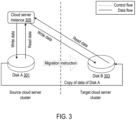
- FIG. 3 a flow diagram illustrating the migration of a disk for servicing cloud services according to some embodiments of the disclosure.
- disk A (301) is allocated in the source server cluster to service the cloud server that is to be migrated.
- the cloud server is configured to read data from and write data to disk A.
- disk A (301) is configured to stop all of the read and write operations. Further, the processing queue of the original instance stops processing the read and write requests enqueued therein. And, disk A (301) is marked with a to-be-deleted state.
- a disk B (303) for servicing the cloud server is allocated in the target cloud server cluster, after which disk B (303) is configured to start providing a read and write service. For example, a read or write request including a read or write operation for disk B (303) is enqueued to the processing queue of the new instance, and read and write operations of the new instance are all performed for disk B (303). Once the processing queue of the original instance stops dequeuing read/write requests therein for processing, a read/write request that is in the processing queue of the original instance and not completed in processing is transferred to the processing queue of the new instance for processing.
- the disk data associated with the original instance is copied to the disk for servicing the new instance via the execution of a background thread.
- a migration priority is configured for the disk data during migration, and migration of the disk data associated with the original instance is initiated with a configuration of a low migration priority. If a read/write operation is performed by the new instance during the migration, it is determined whether the data involved in the data request exists in the disk for servicing the new instance. In response to determining that the data does not exist on the disk for servicing the new instance of the cloud server, the migration priority of the data involved in the data request is set to a high migration priority. This way, in the process of migrating the disk data associated with the original instance to the disk for servicing the new instance of the cloud service instantiated in the target cluster, the migration is performed in descending order of the migration priorities.
- data on disk A (301) is copied to disk B (303) by the execution of a background thread.
- a read or write operation is performed on the new instance during such copying, it is determined whether the data involved in a read or write request, including the read or write operation, exists on disk B (303).
- the read or write operation included in the read or write request is performed for disk B. Otherwise, in response to the determination that the data associated with the new instance does not exist on disk B (303) (e.g., the required data has not yet been copied to disk B 303), the migration priority of the data associated with the new instance is changed from a low migration priority to a high migration priority.
- the data of the high migration priority (e.g., the data associated with the new instance) is copied from disk A (301) to disk B (303), upon the completion of which the read or write operation included in the read or write request is performed for disk B (303).
- This implementation is a basis for asynchronous data copying, which leads to no need to wait for the data on disk A (301) to be copied entirely to disk B (303) before the new instance of the cloud server can start providing the service, thereby reducing interruption time (e.g., downtime) associated with the user service.
- the copying of the data on disk A (301) to disk B (303) is performed by splitting the data on disk A (301) associated with the original instance into at least one data block, and the data on disk A (301) associated with the original instance is copied to disk B (303) for servicing the new instance in the form of such data blocks. Additionally, the data on disk A (301) is copied to disk B (303) by image mirroring. In one example, the data one disk A (301) is split into at least one data block, then a data mirroring image corresponding to each data block is created, and the data on disk A (301) is copied to disk B (303) via data mirroring.
- a flag bit marking whether a data block has been copied can be configured for the data block.
- the flag bit of the data block is marked as 1; if the data block has not been copied, the flag bit of the data block is marked as 0.
- the comparison used to determine the copying progress of the data on disk A (301) is encapsulated into a migration progress query interface, at which the user can obtain real-time copying progress of copying the data on disk A (301) to disk B (303).
- the size of the data on a disk is the magnitude of hundreds of gigabytes or terabytes.
- techniques utilized by current systems take hours to copy the disk data, which is mirrored into mirror images for copying.
- the technical solution of the disclosure provides a service interruption time of about two to three minutes, counting from the termination of the service provided by the original instance until the resuming of the provided service after the new instance of the cloud service is started.
- the technical solution of the disclosure provides more efficiency compared to hours of or longer service interruption time associated with current migration techniques.
- step S103 configure a data operation of the cloud service for the disk for servicing the original instance as the data operation for the disk for servicing the new instance.
- the original instance of the cloud service and the new instance of the cloud server each are configured with their respective processing queues.
- a data request (e.g., a request including a read or write request) including a data operation of the cloud server for the disk for servicing the original instance is enqueued to the processing queue of the original instance for processing.
- a read or write request that includes the data operation of the cloud server for the disk for servicing the new instance is enqueued to the processing queue of the new instance for processing.
- data operation(s) of the cloud server for a disk for servicing the original instance are configured as the data operation(s) for the disk for servicing the new instance such that to migrate the cloud service provided by the cloud server from the source cloud server cluster to the target cloud server cluster.
- the cloud server (305) (e.g., the original instance of the cloud server providing the cloud service) reads data from disk A (301) and writes data to disk A (301).
- disk A (301) stops all the read and write operations, and the processing queue of the original instance stops processing the read request and write requests enqueued therein. Further, disk A (301) is marked with a to-be-deleted state, and disk B (303) for servicing the cloud server is allocated in the target cloud server cluster.
- disk B (303) starts servicing read and write requests after being allocated, and a read request or a write request including a read operation or write operation for disk B (303) is enqueued to the processing queue of the new instance.
- the read operations and write operations of the new instance are all performed for disk B (303).
- the processing queue of the original instance stops processing the read requests and write requests enqueued therein, the read requests and write requests, that are still in the processing queue of the original instance and the processing of which is not yet complete, are transferred to the processing queue of the new instance for processing.
- the cloud server is migrated in a manner of "live migration" from the source cloud server cluster to the target cloud server cluster.
- the new instance is instantiated, and the disk for servicing the instance is allocated in the target cloud server cluster.
- the new instance and the disk for servicing the new instance are correspondingly configured, after the completion of which the new instance is started.
- the memory data associated with the original instance is copied to the memory associated with the execution of the new instance, and the execution state data related to the executing state(s) (e.g., CPU state, register state) of the original instance is further copied to the new instance until the execution state data related to the execution state of the original instance is less than a pre-configured threshold.
- the execution state data related to the executing state(s) e.g., CPU state, register state
- the read operation and write operations of the cloud server for the disk for servicing the original instance e.g., disk A 301
- the remaining execution state data is copied to the new instance
- data operations of the cloud server for the disk for servicing the original instance e.g., disk A 301 is configured as data operations for the disk for servicing the new instance (e.g., disk B 303), thereby realizing the migration of the cloud server.
- live migration techniques to migrate the cloud server service interruption times are shorter and can be controlled within the order of milliseconds or even microseconds, achieving more efficient migration of the cloud server.
- the cloud service migration solution provides that, in the process of migrating the cloud server from the source cloud server cluster to the target cloud server cluster, based on a scheduled migration time that is specified by a user and included in the migration request, the cloud server is migrated from the source cloud server cluster to the target cloud server cluster based on the scheduled migration time.
- Data operation(s) of the cloud service for a disk in the source cloud server cluster is re-configured as data operation(s) for a disk in the target cloud server cluster to provide the service by a new instance in the target cloud server cluster.
- the cloud server is migrated from the source cloud server cluster to the target cloud server cluster with simple implementation, as well as reduced service interruption times caused by the interruption of the service provided by a cloud service instance, achieving more efficient and convenient migration.
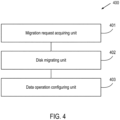
- FIG. 4 is a block diagram illustrating an example apparatus for cloud service migration according to some embodiments of the disclosure.
- the cloud service migration apparatus is substantially similar to the method for cloud service migration described above, and the details are not repeated herein for simplicity.
- the apparatus (400) for service migration includes a migration request obtaining unit (401), a disk migrating unit (402), and a data operation configuring unit (403).
- the migration request obtaining unit (401) is configured to obtain a migration request related to a cloud service hosted in a source cluster, the migration request including a scheduled migration time to migrate the cloud service from the source cluster to a target cluster.
- the disk migrating unit (402) is configured to migrate, based on the scheduled migration time, the disk data associated with an original instance of the cloud service to a disk for servicing a new instance of the cloud service instantiated in the target cluster, based on a migration priority order of the disk data.
- the data operation configuring unit (403) is configured to configure data operation(s) of the cloud service for a disk for servicing the original instance as data operation(s) for the disk for servicing the new instance.
- the apparatus (400) for cloud service migration further includes a new instance instantiating unit, a configuration unit, and a new instance starting unit.
- the new instance instantiating unit is configured to instantiate the new instance of the cloud service in the target server cluster.
- the configuration unit is configured to configure the new instance and resource components associated with the new instance.
- the new instance starting unit is configured to stop the original instance at the source server cluster; and start the new instance based on the resource components.
- the configuration unit includes one or both of a first new instance configuring subunit and a second new instance configuring subunit.
- the first new instance configuring subunit is configured to configure, based on the configuration information of the original instance, the new instance in the target cluster using the same configuration as the configuration information.
- the second new instance configuring subunit is configured to configure the new instance based on the configuration information obtained through a pre-configured configuration interface.
- the resource components include a disk. In some other embodiments, the resource components further include at least one of the following: a CPU, a memory, an operating system, and network connection.
- the configuration unit includes a network port allocating subunit, and a network port migrating subunit.
- the network port allocating subunit is configured to allocate a network port in the target cluster.
- the network port migrating subunit is configured to release the cloud service from a network port at the source cluster; configure the cloud service to the network port allocating at the target cluster; and perform routing update.
- the configuration unit includes a data operation stopping subunit, and a disk allocating subunit.
- the data operation stopping subunit is configured to stop the data operations of the cloud service for the disk for servicing the original instance.
- the disk allocating subunit is configured to allocate the disk for servicing the new instance in the target cluster.
- the data operation configuring unit (403) includes one or both of a first copying subunit and a second copying subunit.
- the first copying subunit is configured to split the disk data associated with the original instance into at least one data block, and to copy the disk data associated with the original instance to the disk for servicing the new instance in the form of data blocks.
- the second copying subunit is configured to split the disk data associated with the original instance into at least one data block, create a data mirroring image corresponding to each data block, and copy the disk data associated with the original instance to the disk for servicing the new instance via data mirroring.
- the data block is configured with a flag bit for marking whether the data block has been copied.
- already-copied data is compared with the disk data associated with the original instance based on the flag bit to determine a copying progress for the disk data associated with the original instance.
- the original instance and the new instance are each configured with their respective processing queues.
- a data request including a data operation of the cloud service for the disk for servicing the original instance is enqueued to the processing queue of the original instance; and a data request including a data operation of the cloud service for the disk for servicing the new instance is enqueued to the processing queue of the new instance.
- a data request including a data operation of the cloud service for the disk for servicing the new instance is enqueued to the processing queue of the new instance. Further, a data request, that remains in the processing queue of the original instance and the processing for which is not completed, is transferred to the processing queue of the new instance for processing.
- a migration priority of the disk data is determined by the following steps. First, determining whether the data involved in the data request exists in the disk for servicing the new instance. In response to determining that the data involved in the data request does not exist in the disk for servicing the new instance, configuring a migration priority of the data involved in the data request to a high migration priority.
- the apparatus (400) further includes a determining subunit, which is executed in the process of processing a data request in the processing queue of the new instance.
- the determining subunit is configured to determine whether the data involved in the data request exists in the disk for servicing the new instance. In response to determining that the data involved in the data request exists in the disk for servicing the new instance, the determining subunit is configured to perform a data operation included in the data request based on the disk for servicing the new instance. Otherwise, in response to determining that the data involved in the data request does not exist in the disk for servicing the new instance, the determining subunit is configured to preferentially migrate the data of the high migration priority from the disk for servicing the original instance to the disk for servicing the new instance, and perform a data operation included in the data request based for the disk for servicing the new instance upon the completion of the migration.
- the source cluster and the target cluster are configured in different availability zones.
- the cloud service is configured as a cloud server for providing a cloud computing service.
- the source cluster is configured as a cloud server cluster of at least one cloud server
- the target cluster is configured as a cloud server cluster of at least one cloud server.
- FIG. 5 is a block diagram of an example electronic device for cloud service migration according to some embodiments of the present disclosure. As the functionalities of the electronic device are substantially similar to the above-described methods for cloud service migration, the details of which are not repeated herein.
- the electronic device for cloud service migration includes a memory (501), and a processor (502).
- the memory (501) is configured to store computer-executable instructions.
- the processor (502) is configured to read and execute the computer-executable instructions stored in the memory (501) to cause the electronic device (500) to perform the operations including the following steps.
- Step one obtaining a migration request related to a cloud service hosted in a source cluster, the migration request including a scheduled migration time to migrate the cloud service from the source cluster to a target cluster.
- Step two migrating, based on the scheduled migration time, the disk data associated with an original instance of the cloud service to a disk for servicing a new instance of the cloud service instantiated in the target cluster, the migration of the disk data being performed based on a migration priority order of the disk data.
- Step three configuring data operation(s) of the cloud service for a disk for servicing the original instance as data operation(s) for the disk for servicing the new instance.
- the processor (502) before configuring data operation(s) of the cloud service for a disk for servicing the original instance as data operation(s) for the disk for servicing the new instance, is further configured to execute the following computer-readable instructions: instantiating the new instance in the target cluster; configuring the new instance and resource components associated with the new instance; stopping the original instance at the source cluster, and starting the new instance based on the resource components.
- the configuring of the new instance and resource components associated with the new instance is implemented by configuring, based on the configuration information of the original instance, the new instance in the target cluster using the same configuration as the configuration information; or configuring the new instance based on the configuration information obtained through a pre-configured configuration interface.
- the resource components include a disk. In other embodiments, the resource components further include at least one of the following: a CPU, a memory, an operating system, and a network connection.
- the configuring of the new instance and resource components associated with the new instance includes: allocating a network port in the target cluster; releasing the cloud service from a network port of the source cluster; configuring the cloud service to the network port allocated at the target cluster; and performing routing update.
- the configuring of the new instance and resource components associated with the new instance includes: stopping the data operation of the cloud service for the disk for servicing the original instance; allocating the disk for servicing the new instance in the target cluster; and after the allocation of the disk for servicing the new instance is completed, executing the instructions to migrate, based on the scheduled migration time, the disk data associated with an original instance of the cloud service to a disk for servicing a new instance of the cloud service instantiated in the target cluster, and to configure data operation(s) of the cloud service for a disk for servicing the original instance as data operation(s) for the disk for servicing the new instance.
- the migrating of the disk data associated with an original instance of the cloud service to a disk for servicing a new instance of the cloud service instantiated in the target cluster is implemented by splitting the disk data associated with the original instance into at least one data block, and copying the disk data associated with the original instance to the disk for servicing the new instance in the form of data blocks; or splitting the disk data associated with the original instance into at least one data block, creating a data mirroring image corresponding to each data block, and copying the disk data of the original instance to the disk of the new instance via data mirroring.
- the data block is configured with a flag bit for marking whether the data block has been copied.
- already-copied data is compared with the disk data associated with the original instance based on the flag bit to determine copying progress for the disk data associated with the original instance.
- the original instance and the new instance are each configured with their respective processing queues.
- a data request including a data operation of the cloud service for the disk for servicing the original instance is enqueued to the processing queue of the original instance
- a data request including a data operation of the cloud service for the disk for servicing the new instance is enqueued to the processing queue of the new instance.
- a data request including a data operation of the cloud service for the disk for servicing the new instance is enqueued to the processing queue of the new instance, and a data request that remains in the processing queue of the original instance and the processing of which is not yet complete is transferred to the processing queue of the new instance for processing.
- a migration priority of the disk data is determined by determining whether the data involved in the data request exists in the disk for servicing the new instance; in response to determining that the data involved in the data request does not exist in the disk for servicing the new instance, configuring a migration priority of the data involved in the data request to a high migration priority; and in the process of migrating the disk data associated with the original instance to the disk for servicing the new instance of the cloud service instantiated in the target cluster, performing the migration in a descending order of migration priorities.
- the processing of a data request in the processing queue of the new instance includes the following operations: determining whether the data involved in the data request exists in the disk for servicing the new instance; in responseto determining that the data involved in the data request exists in the disk for servicing the new instance, performing a data operation included in the data request for the disk for servicing the new instance; in response to determining that the data involved in the data request does not exist in the disk for servicing the new instance, migrating the data of the high migration priority from the disk for servicing the original instance to the disk for servicing the new instance, and performing a data operation included in the data request for the disk for servicing the new instance upon the completion of the migration.
- the source cluster and the target cluster are configured in different availability zones.
- the cloud service is configured as a cloud server for providing a cloud computing service.
- the source cluster includes a cloud server cluster of at least one cloud server
- the target cluster includes a cloud server cluster of at least one cloud server.
- the computing device includes one or a plurality of processors (CPUs), input/output interfaces, network interfaces, and memories.
- processors CPUs
- input/output interfaces network interfaces
- memories volatile and non-volatile memories
- the memory may include a computer-readable medium in the form of a non-permanent memory, a random access memory (RAM) or non-volatile memory or the like, such as read-only memory (ROM) or a flash memory (flash RAM).
- RAM random access memory
- ROM read-only memory
- flash RAM flash memory
- the computer-readable medium includes permanent and non-permanent, movable and non-movable media that can achieve information storage by means of any methods or techniques.
- the information may be computer-readable instructions, data structures, modules of programs, or other data.
- Examples of a storage medium of a computer include, but are not limited to, a phase change memory (PRAM), a static random access memory (SRAM), a dynamic random access memory (DRAM), other types of random access memories (RAMs), a read-only memory (ROM), an electrically erasable programmable read-only memory (EEPROM), a flash memory or other memory technologies, a compact disk read-only memory (CD-ROM), a digital versatile disc (DVD) or other optical storages, a cassette tape, a magnetic tape/magnetic disk storage or other magnetic storage devices, or any other non-transmission medium, and can be used to store information accessible by a computing device.
- the computer-readable medium does not include non-transitory computer-readable media (transitory media), such as
- embodiments of the disclosure may be provided as a method, a system, or a computer program product. Therefore, the disclosure may use the form of a full hardware embodiment, a full software embodiment, or an embodiment combining software and hardware. Moreover, the disclosure may use the form of a computer program product implemented on one or a plurality of computer-usable storage media (including, but not limited to, a magnetic disk memory, a CD-ROM, an optical memory, and so on) containing computer-usable program code therein.
- computer-usable storage media including, but not limited to, a magnetic disk memory, a CD-ROM, an optical memory, and so on
Landscapes
- Engineering & Computer Science (AREA)
- Theoretical Computer Science (AREA)
- Human Computer Interaction (AREA)
- Physics & Mathematics (AREA)
- General Engineering & Computer Science (AREA)
- General Physics & Mathematics (AREA)
- Computer Networks & Wireless Communication (AREA)
- Signal Processing (AREA)
- Information Retrieval, Db Structures And Fs Structures Therefor (AREA)
Claims (11)
- Cloud-Dienst-Migrationsverfahren, umfassend:Erhalten (S101) einer Migrationsanfrage wegen eines Cloud-Dienstes in einem Quell-Cluster, wobei die Migrationsanfrage eine geplante Migrationszeit zum Migrieren des Cloud-Dienstes von dem Quell-Cluster zu einem Ziel-Cluster umfasst;Migrieren (S102), entsprechend der geplanten Migrationszeit, von Daten der Festplatte einer Originalinstanz des Cloud-Dienstes zu einer Festplatte einer neuen Instanz des Cloud-Dienstes, die in dem Ziel-Cluster erzeugt wird, wobei die Migration der Daten der Festplatte auf der Basis einer Migrations-Prioritätsreihenfolge der Daten der Festplatte ausgeführt wird; undKonfigurieren (S103) einer Datenoperation des Cloud-Dienstes auf einer Festplatte der Originalinstanz als eine Datenoperation auf der Festplatte der neuen Instanz;wobei vor dem Ausführen des Schritts des Konfigurierens einer Datenoperation des Cloud-Dienstes auf einer Festplatte der Originalinstanz als eine Datenoperation auf der Festplatte der neuen Instanz, die folgenden Operationen ausgeführt werden:Erzeugen der neuen Instanz in dem Ziel-Cluster;Konfigurieren der neuen Instanz und von Ressourcenkomponenten der neuen Instanz; undBeenden der Originalinstanz des Quell-Clusters, und Initiieren der neuen Instanz auf der Basis der Ressourcenkomponenten;wobei die Originalinstanz und die neue Instanz jeweils mit jeweiligen entsprechenden Verarbeitungs-Warteschlangen bereitgestellt werden, wobei eine Datenanfrage, die die Datenoperation des Cloud-Dienstes auf der Festplatte der Originalinstanz umfasst, zu der Verarbeitungs-Warteschlange der Originalinstanz hinzugefügt wird, und wobei eine Datenanfrage, die die Datenoperation des Cloud-Dienstes auf der Festplatte der neuen Instanz umfasst, zu der Verarbeitungs-Warteschlange der neuen Instanz hinzugefügt wird, wobei, nachdem der Schritt des Konfigurierens einer Datenoperation des Cloud-Dienstes auf einer Festplatte der Originalinstanz als eine Datenoperation auf der Festplatte der neuen Instanz ausgeführt wird, eine Datenanfrage, die die Datenoperation des Cloud-Dienstes auf der Festplatte der neuen Instanz umfasst, zu der Verarbeitungs-Warteschlange der neuen Instanz hinzugefügt wird, und eine Datenanfrage, für die eine Verarbeitung in der Verarbeitungs-Warteschlange der Originalinstanz nicht beendet ist, an die Verarbeitungs-Warteschlange der neuen Instanz zur Verarbeitung gesendet wird; undwobei eine Migrationspriorität der Festplattendaten auf folgende Weise bestimmt wird:Bestimmen, ob Daten, die in die Datenanfrage involviert sind, in der Festplatte der neuen Instanz vorliegen, und falls dies nicht der Fall ist, Setzen einer Migrationspriorität der Daten, die in die Datenanfrage involviert sind, auf eine hohe Migrationspriorität; undwährend des Prozesses des Migrierens der Daten der Festplatte der Originalinstanz zu der Festplatte der neuen Instanz des Cloud-Dienstes, die in dem Ziel-Cluster erzeugt wird, Ausführen der Migration in einer absteigenden Reihenfolge der Migrationspriorität.
- Cloud-Dienst-Migrationsverfahren nach Anspruch 1, wobei das Konfigurieren der neuen Instanz und der Ressourcenkomponenten der neuen Instanz auf folgende Weise implementiert wird:Konfigurieren, gemäß Konfigurationsinformationen der Originalinstanz, der neuen Instanz in dem Ziel-Cluster gemäß derselben Konfiguration wie den Konfigurationsinformationen; und/oderKonfigurieren der neuen Instanz gemäß den Konfigurationsinformationen, die durch eine voreingestellte Konfigurationsschnittstelle erhalten werden.
- Cloud-Dienst-Migrationsverfahren nach Anspruch 1, wobei die Ressourcenkomponenten die Festplatte umfassen, und wobei die Ressourcenkomponenten weiter zumindest eines der Folgenden umfassen:
eine CPU, einen Speicher, ein Betriebssystem oder ein Netzwerk. - Cloud-Dienst-Migrationsverfahren nach Anspruch 3, wobei das Konfigurieren der neuen Instanz und der Ressourcenkomponenten der neuen Instanz umfasst:Erzeugen einer Netzwerkschnittstelle in dem Ziel-Cluster; undFreigeben des Cloud-Dienstes von einer Netzwerkschnittstelle des Quell-Clusters, und Konfigurieren des Cloud-Dienstes zu der Netzwerkschnittstelle des Ziel-Clusters und Ausführen einer Verlaufsaktualisierung.
- Cloud-Dienst-Migrationsverfahren nach Anspruch 3, wobei das Konfigurieren der neuen Instanz und der Ressourcen-Komponenten der neuen Instanz umfasst:Anhalten der Datenoperation des Cloud-Dienstes der Festplatte der Originalinstanz;Erzeugen der Festplatte der neuen Instanz in dem Ziel-Cluster; undnachdem die Erzeugung der Festplatte der neuen Instanz beendet ist, Ausführen des Schritts des Migrierens, gemäß der geplanten Migrationszeit, von Festplattendaten einer Originalinstanz des Cloud-Dienstes zu einer Festplatte einer neuen Instanz des Cloud-Dienstes, die in dem Ziel-Cluster erzeugt wird, und Ausführen des Schritts des Konfigurierens einer Datenoperation des Cloud-Dienstes auf einer Festplatte der Originalinstanz als eine Datenoperation auf der Festplatte der neuen Instanz.
- Cloud-Dienst-Migrationsverfahren nach Anspruch 1, wobei das Migrieren von Festplattendaten einer Originalinstanz des Cloud-Dienstes zu einer Festplatte einer neuen Instanz des Cloud-Dienstes, die in dem Ziel-Cluster erzeugt wird, auf folgende Weise implementiert wird:Aufteilen der Festplattendaten der Originalinstanz in mindestens einen Datenblock, und Kopieren der Festplattendaten der Originalinstanz zu der Festplatte der neuen Instanz in der Form von Datenblöcken; und/oderAufteilen der Festplattendaten der Originalinstanz in mindestens einen Datenblock und Erzeugen eines Datenabbilds, das jedem Datenblock entspricht, und Kopieren der Festplattendaten der Originalinstanz zur Festplatte der neuen Instanz in der Form von Datenabbildern.
- Cloud-Dienst-Migrationsverfahren nach Anspruch 6, wobei der Datenblock mit einem Markierungsbit versehen ist, um zu markieren, ob der Datenblock kopiert worden ist, und wobei während des Prozesses des Kopierens der Festplattendaten der Originalinstanz zur Festplatte der neuen Instanz, bereits kopierte Daten mit den Festplattendaten der Originalinstanz auf der Basis des Markierungsbits verglichen werden, und ein Kopierfortschritt der Festplattendaten der Originalinstanz gemäß einem Vergleichsergebnisses erzielt wird.
- Cloud-Dienst-Migrationsverfahren nach Anspruch 1, wobei in einem Prozess der Verarbeitung einer Datenanfrage in der Verarbeitungs-Warteschlange der neuen Instanz, die folgenden Operationen durchgeführt werden:Bestimmen, ob Daten, die in die Datenanfrage involviert sind, in der Festplatte der neuen Instanz vorliegen, und falls ja, Ausführen einer Datenoperation, die in der Datenanfrage eingeschlossen ist, auf der Basis der Festplatte der neuen Instanz; undfalls nicht, Migrieren der Daten mit der hohen Migrationspriorität von der Festplatte der Originalinstanz zu der Festplatte der neuen Instanz, und Ausführen einer Datenoperation, die in der Datenanfrage enthalten ist, auf der Basis der Festplatte der neuen Instanz nach Beendigung der Migration.
- Cloud-Dienst-Migrationsverfahren nach einem der Ansprüche 1 bis 8, wobei der Quell-Cluster und der Ziel-Cluster in unterschiedlich verfügbaren Bereichen liegen.
- Cloud-Dienst-Migrationsverfahren nach einem der Ansprüche 1 bis 8, wobei sich der Cloud-Dienst auf einen Cloud-Server zur Bereitstellung eines Cloud-Computing-Dienstes bezieht, wobei sich der Quell-Cluster auf einen Cloud-Server bezieht, der aus mindestens einem Cloud-Server besteht, und wobei sich der Ziel-Cluster auf einen Cloud-Server bezieht, der aus mindestens einem Cloud-Server besteht.
- Elektronische Vorrichtung, die umfasst:einen Speicher und einen Prozessor, wobeider Speicher von einem Computer ausführbare Befehle speichert, die, wenn sie von dem Prozessor ausgeführt werden, den Prozessor veranlassen, das Verfahren nach einem der vorhergehenden Ansprüche auszuführen.
Applications Claiming Priority (2)
| Application Number | Priority Date | Filing Date | Title |
|---|---|---|---|
| CN201711186691.9A CN109842636A (zh) | 2017-11-24 | 2017-11-24 | 云服务迁移方法、装置以及电子设备 |
| PCT/CN2018/115383 WO2019100984A1 (zh) | 2017-11-24 | 2018-11-14 | 云服务迁移方法、装置以及电子设备 |
Publications (3)
| Publication Number | Publication Date |
|---|---|
| EP3716577A1 EP3716577A1 (de) | 2020-09-30 |
| EP3716577A4 EP3716577A4 (de) | 2021-06-23 |
| EP3716577B1 true EP3716577B1 (de) | 2024-10-09 |
Family
ID=66630886
Family Applications (1)
| Application Number | Title | Priority Date | Filing Date |
|---|---|---|---|
| EP18880836.4A Active EP3716577B1 (de) | 2017-11-24 | 2018-11-14 | Cloud-dienstmigrationsverfahren und elektronische vorrichtung |
Country Status (5)
| Country | Link |
|---|---|
| US (1) | US11861203B2 (de) |
| EP (1) | EP3716577B1 (de) |
| JP (1) | JP7624167B2 (de) |
| CN (1) | CN109842636A (de) |
| WO (1) | WO2019100984A1 (de) |
Families Citing this family (27)
| Publication number | Priority date | Publication date | Assignee | Title |
|---|---|---|---|---|
| CN110324184B (zh) * | 2019-06-26 | 2021-06-25 | 深圳前海微众银行股份有限公司 | 服务扩容与迁移方法、装置、系统、设备及可读存储介质 |
| US11748130B2 (en) * | 2019-06-28 | 2023-09-05 | Intel Corporation | Virtualization and multi-tenancy support in graphics processors |
| JP7375375B2 (ja) * | 2019-08-28 | 2023-11-08 | 富士フイルムビジネスイノベーション株式会社 | 情報処理装置、情報処理システム、及び情報処理プログラム |
| CN110825494A (zh) * | 2019-11-01 | 2020-02-21 | 北京京东尚科信息技术有限公司 | 物理机调度方法及装置、计算机可存储介质 |
| CN111813760B (zh) * | 2020-05-29 | 2024-03-26 | 阿里巴巴集团控股有限公司 | 数据迁移方法以及装置 |
| CN112083889B (zh) * | 2020-09-14 | 2025-06-03 | 腾讯科技(深圳)有限公司 | 数据迁移方法、装置、设备及可读存储介质 |
| CN112286904B (zh) * | 2020-09-30 | 2025-03-21 | 北京大米科技有限公司 | 集群迁移方法、装置及存储介质 |
| CN112333242B (zh) * | 2020-10-13 | 2022-08-12 | 北京京东尚科信息技术有限公司 | 一种基于状态迁移的专有云重建及校验方法及装置 |
| CN114442907B (zh) * | 2020-11-04 | 2024-07-05 | 华为技术有限公司 | 数据迁移方法和装置、服务器、网络系统 |
| CN112565431A (zh) * | 2020-12-08 | 2021-03-26 | 西藏宁算科技集团有限公司 | 基于用户访问量的跨地域集群迁移方法、装置及电子设备 |
| CN112698792B (zh) * | 2021-01-14 | 2021-09-10 | 腾讯科技(深圳)有限公司 | 分布式存储系统的数据迁移方法、装置及电子设备 |
| CN113093995B (zh) * | 2021-04-12 | 2023-05-26 | 深圳软通动力信息技术有限公司 | 一种云盘数据的迁移方法和系统 |
| CN113128909A (zh) * | 2021-05-13 | 2021-07-16 | 瑞麟天下节能技术(北京)有限公司 | 一种基于电力资源的服务器管理方法 |
| CN114385309B (zh) * | 2021-12-02 | 2026-03-17 | 阿里巴巴(中国)有限公司 | 数据迁移方法、数据快照方法及装置 |
| CN114615263A (zh) * | 2022-02-10 | 2022-06-10 | 深圳市小满科技有限公司 | 集群在线迁移方法、装置、设备及存储介质 |
| CN114338692B (zh) * | 2022-02-17 | 2023-11-10 | 上海玄翎科技有限公司 | 一种基于分片集群扩容的数据平衡方法与设备 |
| KR20240167659A (ko) * | 2022-03-18 | 2024-11-27 | 엘지전자 주식회사 | 에지 및 클라우드 간 협업 시스템 및 방법 |
| CN114816764B (zh) * | 2022-05-27 | 2024-12-20 | 中国工商银行股份有限公司 | 资源的迁移方法、装置、处理器及电子设备 |
| CN117997898A (zh) * | 2022-10-31 | 2024-05-07 | 北京有竹居网络技术有限公司 | 多云服务的处理方法、装置、电子设备、存储介质及系统 |
| CN116319354B (zh) * | 2023-01-30 | 2023-11-28 | 杭州优云科技有限公司 | 基于云实例迁移的网络拓扑更新方法 |
| KR102543749B1 (ko) * | 2023-02-17 | 2023-06-14 | 주식회사 헤카톤에이아이 | 데이터 레이크 이관을 위한 인공지능 기반 자동화 시스템 |
| CN116185993A (zh) * | 2023-02-28 | 2023-05-30 | 浙江网商银行股份有限公司 | 数据迁移方法以及装置 |
| US12443627B2 (en) * | 2023-06-05 | 2025-10-14 | ZipRecruiter, Inc. | Clustering based entity matching using multiple queues |
| CN116775612B (zh) * | 2023-06-27 | 2025-11-18 | 中国建设银行股份有限公司 | 一种数据迁移系统、方法、装置、设备及介质 |
| CN116582453B (zh) * | 2023-07-06 | 2023-09-15 | 北京志凌海纳科技有限公司 | 一种多业务集群场景下的监控数据迁移方法和系统 |
| CN117389993A (zh) * | 2023-10-23 | 2024-01-12 | 国网河南省电力公司信息通信分公司 | 一种用于电力云的信创数据库迁移校验方法 |
| CN118069173B (zh) * | 2024-04-25 | 2024-06-25 | 中国科学院空天信息创新研究院 | 一种应用系统无侵入迁移上云方法及系统 |
Family Cites Families (44)
| Publication number | Priority date | Publication date | Assignee | Title |
|---|---|---|---|---|
| US5680640A (en) * | 1995-09-01 | 1997-10-21 | Emc Corporation | System for migrating data by selecting a first or second transfer means based on the status of a data element map initialized to a predetermined state |
| US20070234107A1 (en) | 2006-03-31 | 2007-10-04 | International Business Machines Corporation | Dynamic storage data protection |
| GB0606639D0 (en) * | 2006-04-01 | 2006-05-10 | Ibm | Non-disruptive file system element reconfiguration on disk expansion |
| US8108912B2 (en) | 2008-05-29 | 2012-01-31 | Red Hat, Inc. | Systems and methods for management of secure data in cloud-based network |
| US8738872B2 (en) | 2009-04-03 | 2014-05-27 | Peter Chi-Hsiung Liu | Methods for migrating data in a server that remains substantially available for use during such migration |
| JP5284905B2 (ja) * | 2009-08-12 | 2013-09-11 | 富士通株式会社 | データ移行方法、及びプログラム |
| US8984269B2 (en) * | 2011-02-28 | 2015-03-17 | Red Hat, Inc. | Migrating data among cloud-based storage networks via a data distribution service |
| US8909734B2 (en) | 2012-02-07 | 2014-12-09 | International Business Machines Corporation | Migrating data between networked computing environments |
| JP5942511B2 (ja) * | 2012-03-19 | 2016-06-29 | 富士通株式会社 | バックアップ装置,バックアップ方法,およびバックアッププログラム |
| US9292330B2 (en) * | 2012-11-29 | 2016-03-22 | International Business Machines Corporation | Replacing virtual machine disks |
| CN103139221B (zh) * | 2013-03-07 | 2016-07-06 | 中国科学院软件研究所 | 一种可信虚拟平台及其构建方法、平台之间数据迁移方法 |
| US20140280977A1 (en) | 2013-03-15 | 2014-09-18 | Servicemesh, Inc. | Systems and methods for evaluating computing resources |
| JP6186787B2 (ja) * | 2013-03-25 | 2017-08-30 | 富士通株式会社 | データ転送装置、データ転送システム、データ転送方法及びプログラム |
| US9648134B2 (en) * | 2013-05-20 | 2017-05-09 | Empire Technology Development Llc | Object migration between cloud environments |
| US9201606B1 (en) * | 2013-05-20 | 2015-12-01 | Ca, Inc. | System and method for automating data migrations between heterogeneous architectures |
| CN103458050A (zh) * | 2013-09-16 | 2013-12-18 | 浪潮电子信息产业股份有限公司 | 一种基于云计算的电子阅览室搭建方法 |
| CN103581331B (zh) * | 2013-11-13 | 2018-04-03 | 中国科学院计算技术研究所 | 虚拟机在线迁移方法与系统 |
| CN103605561A (zh) * | 2013-11-28 | 2014-02-26 | 中标软件有限公司 | 一种云计算集群系统及其在线迁移物理服务器的方法 |
| CN105095317B (zh) * | 2014-05-23 | 2018-09-21 | 中国银联股份有限公司 | 分布式数据库服务管理系统 |
| US9542108B2 (en) * | 2014-06-30 | 2017-01-10 | Scale Computing, Inc. | Efficient migration of virtual storage devices to a remote node using snapshots |
| CN104283951B (zh) * | 2014-09-29 | 2018-03-27 | 华为技术有限公司 | 一种实例迁移的方法、装置及系统 |
| CN105528368B (zh) * | 2014-09-30 | 2019-03-12 | 北京金山云网络技术有限公司 | 一种数据库迁移方法及装置 |
| US9672054B1 (en) * | 2014-12-05 | 2017-06-06 | Amazon Technologies, Inc. | Managing virtual machine migration |
| JP6979264B2 (ja) * | 2014-12-30 | 2021-12-08 | エヌエイチエヌ コーポレーション | クラウドサービス提供方法およびシステム |
| US9600320B2 (en) | 2015-02-11 | 2017-03-21 | International Business Machines Corporation | Mitigation of virtual machine security breaches |
| US9575797B2 (en) | 2015-03-20 | 2017-02-21 | International Business Machines Corporation | Virtual machine migration between hypervisor virtual machines and containers |
| CN104750541B (zh) * | 2015-04-22 | 2018-01-16 | 成都睿峰科技有限公司 | 一种虚拟机迁移方法 |
| CN106302623B (zh) | 2015-06-12 | 2020-03-03 | 微软技术许可有限责任公司 | 承租人控制的云更新 |
| US9612865B2 (en) | 2015-06-15 | 2017-04-04 | International Business Machines Corporation | Managed services coordinator |
| US20170024260A1 (en) | 2015-07-21 | 2017-01-26 | Cisco Technology, Inc. | Workload migration across cloud providers and data centers |
| US9600331B1 (en) | 2015-08-24 | 2017-03-21 | International Business Machines Corporation | Virtual machine placement in a cloud computing environment based on factors including optimized processor-memory affinity |
| JP6925321B2 (ja) | 2015-08-27 | 2021-08-25 | フォグホーン システムズ, インコーポレイテッドFoghorn Systems, Inc. | エッジインテリジェンスプラットフォーム、およびインターネット・オブ・シングス・センサストリームシステム |
| US10514986B2 (en) | 2015-09-30 | 2019-12-24 | Commvault Systems, Inc. | Dynamic triggering of block-level backups based on block change thresholds and corresponding file identities in a data storage management system |
| US9832277B2 (en) * | 2015-11-13 | 2017-11-28 | Western Digital Technologies, Inc. | Systems and methods for adaptive partitioning in distributed cache memories |
| US20170235647A1 (en) | 2016-02-12 | 2017-08-17 | Commvault Systems, Inc. | Data protection operations based on network path information |
| US10684924B2 (en) | 2016-02-18 | 2020-06-16 | Commvault Systems, Inc. | Data restoration operations based on network path information |
| JP6663478B2 (ja) * | 2016-02-24 | 2020-03-11 | 株式会社日立製作所 | データ移行方法及び計算機システム |
| US10565067B2 (en) | 2016-03-09 | 2020-02-18 | Commvault Systems, Inc. | Virtual server cloud file system for virtual machine backup from cloud operations |
| CN105897866B (zh) * | 2016-03-29 | 2019-03-29 | 新浪网技术(中国)有限公司 | 一种基于IaaS云平台的云主机迁移方法及装置 |
| JP6819131B2 (ja) | 2016-08-18 | 2021-01-27 | 富士通株式会社 | 情報処理装置、情報処理方法、情報処理プログラムおよび情報処理システム |
| US10542100B2 (en) | 2016-09-16 | 2020-01-21 | Oracle International Corporation | Systems and methodologies for defining and scheduling custom actions as cloud operations |
| CN106790713B (zh) * | 2017-03-08 | 2019-09-20 | 中国人民解放军国防科学技术大学 | 云计算环境下的跨数据中心虚拟机迁移方法 |
| US10776329B2 (en) | 2017-03-28 | 2020-09-15 | Commvault Systems, Inc. | Migration of a database management system to cloud storage |
| CN107018193A (zh) * | 2017-04-01 | 2017-08-04 | 济南浪潮高新科技投资发展有限公司 | 一种基于共享存储的vtpm迁移系统及方法 |
-
2017
- 2017-11-24 CN CN201711186691.9A patent/CN109842636A/zh active Pending
-
2018
- 2018-11-14 EP EP18880836.4A patent/EP3716577B1/de active Active
- 2018-11-14 US US16/765,755 patent/US11861203B2/en active Active
- 2018-11-14 WO PCT/CN2018/115383 patent/WO2019100984A1/zh not_active Ceased
- 2018-11-14 JP JP2020527993A patent/JP7624167B2/ja active Active
Also Published As
| Publication number | Publication date |
|---|---|
| US11861203B2 (en) | 2024-01-02 |
| CN109842636A (zh) | 2019-06-04 |
| US20200293216A1 (en) | 2020-09-17 |
| EP3716577A4 (de) | 2021-06-23 |
| WO2019100984A1 (zh) | 2019-05-31 |
| JP7624167B2 (ja) | 2025-01-30 |
| EP3716577A1 (de) | 2020-09-30 |
| JP2021504795A (ja) | 2021-02-15 |
Similar Documents
| Publication | Publication Date | Title |
|---|---|---|
| US11861203B2 (en) | Method, apparatus and electronic device for cloud service migration | |
| JP2021504795A5 (de) | ||
| US11855904B2 (en) | Automated migration of compute instances to isolated virtual networks | |
| US10095645B2 (en) | Presenting multiple endpoints from an enhanced PCI express endpoint device | |
| CN108293041B (zh) | 分布式系统、资源容器的分配方法、资源管理器及应用控制器 | |
| CN109726005B (zh) | 用于管理资源的方法、服务器系统和计算机可读介质 | |
| CN107580083A (zh) | 一种容器ip地址分配的方法和系统 | |
| CN113296926B (zh) | 一种资源分配方法、计算设备及存储介质 | |
| CN105700961A (zh) | 业务容器创建方法及装置 | |
| US11343141B2 (en) | Methods and apparatus to migrate physical server hosts between virtual standard switches and virtual distributed switches in a network | |
| WO2015196931A1 (zh) | 基于磁盘io的虚拟资源分配方法及装置 | |
| JP2016042374A (ja) | ネットワークのセグメント化によるネイティブクラウドコンピューティング | |
| US11474857B1 (en) | Accelerated migration of compute instances using offload cards | |
| CN114253656A (zh) | 用于微服务工作负载的覆盖式容器存储驱动器 | |
| CN108351810A (zh) | 用于虚拟化图形处理的扩展 | |
| CN106569874B (zh) | 存储设备的操作方法及物理服务器 | |
| CN115344350A (zh) | 云服务系统的节点设备及资源处理方法 | |
| EP4109255A1 (de) | Planung in einem containerorchestrierungssystem unter verwendung von hinweisen der hardware-topologie | |
| US20240028375A1 (en) | Control plane lifecycle management with dpu devices | |
| CN106933646B (zh) | 一种创建虚拟机的方法及装置 | |
| CN104281587A (zh) | 一种建立连接的方法及装置 | |
| CN110347473B (zh) | 一种跨数据中心分布的虚拟化网元虚拟机分配方法及装置 | |
| CN110046138B (zh) | 一种iSCSI目标器多实例处理方法及分布式存储系统 | |
| CN109756356B (zh) | 设备升级方法及装置 | |
| JP2017142647A (ja) | リソース管理装置及びリソース管理方法 |
Legal Events
| Date | Code | Title | Description |
|---|---|---|---|
| STAA | Information on the status of an ep patent application or granted ep patent |
Free format text: STATUS: THE INTERNATIONAL PUBLICATION HAS BEEN MADE |
|
| PUAI | Public reference made under article 153(3) epc to a published international application that has entered the european phase |
Free format text: ORIGINAL CODE: 0009012 |
|
| STAA | Information on the status of an ep patent application or granted ep patent |
Free format text: STATUS: REQUEST FOR EXAMINATION WAS MADE |
|
| 17P | Request for examination filed |
Effective date: 20200609 |
|
| AK | Designated contracting states |
Kind code of ref document: A1 Designated state(s): AL AT BE BG CH CY CZ DE DK EE ES FI FR GB GR HR HU IE IS IT LI LT LU LV MC MK MT NL NO PL PT RO RS SE SI SK SM TR |
|
| AX | Request for extension of the european patent |
Extension state: BA ME |
|
| DAV | Request for validation of the european patent (deleted) | ||
| DAX | Request for extension of the european patent (deleted) | ||
| A4 | Supplementary search report drawn up and despatched |
Effective date: 20210527 |
|
| RIC1 | Information provided on ipc code assigned before grant |
Ipc: H04L 29/08 20060101AFI20210520BHEP Ipc: G06F 3/06 20060101ALI20210520BHEP |
|
| STAA | Information on the status of an ep patent application or granted ep patent |
Free format text: STATUS: EXAMINATION IS IN PROGRESS |
|
| 17Q | First examination report despatched |
Effective date: 20220419 |
|
| P01 | Opt-out of the competence of the unified patent court (upc) registered |
Effective date: 20230418 |
|
| REG | Reference to a national code |
Ref country code: DE Ref legal event code: R079 Free format text: PREVIOUS MAIN CLASS: H04L0029080000 Ipc: G06F0003060000 Ref document number: 602018075351 Country of ref document: DE |
|
| GRAP | Despatch of communication of intention to grant a patent |
Free format text: ORIGINAL CODE: EPIDOSNIGR1 |
|
| STAA | Information on the status of an ep patent application or granted ep patent |
Free format text: STATUS: GRANT OF PATENT IS INTENDED |
|
| RIC1 | Information provided on ipc code assigned before grant |
Ipc: H04L 67/00 20220101ALI20240416BHEP Ipc: G06F 9/455 20180101ALI20240416BHEP Ipc: H04L 67/1095 20220101ALI20240416BHEP Ipc: G06F 3/06 20060101AFI20240416BHEP |
|
| INTG | Intention to grant announced |
Effective date: 20240502 |
|
| GRAS | Grant fee paid |
Free format text: ORIGINAL CODE: EPIDOSNIGR3 |
|
| GRAA | (expected) grant |
Free format text: ORIGINAL CODE: 0009210 |
|
| STAA | Information on the status of an ep patent application or granted ep patent |
Free format text: STATUS: THE PATENT HAS BEEN GRANTED |
|
| AK | Designated contracting states |
Kind code of ref document: B1 Designated state(s): AL AT BE BG CH CY CZ DE DK EE ES FI FR GB GR HR HU IE IS IT LI LT LU LV MC MK MT NL NO PL PT RO RS SE SI SK SM TR |
|
| REG | Reference to a national code |
Ref country code: CH Ref legal event code: EP |
|
| REG | Reference to a national code |
Ref country code: DE Ref legal event code: R096 Ref document number: 602018075351 Country of ref document: DE |
|
| REG | Reference to a national code |
Ref country code: IE Ref legal event code: FG4D |
|
| REG | Reference to a national code |
Ref country code: LT Ref legal event code: MG9D |
|
| REG | Reference to a national code |
Ref country code: NL Ref legal event code: MP Effective date: 20241009 |
|
| REG | Reference to a national code |
Ref country code: AT Ref legal event code: MK05 Ref document number: 1731305 Country of ref document: AT Kind code of ref document: T Effective date: 20241009 |
|
| PG25 | Lapsed in a contracting state [announced via postgrant information from national office to epo] |
Ref country code: NL Free format text: LAPSE BECAUSE OF FAILURE TO SUBMIT A TRANSLATION OF THE DESCRIPTION OR TO PAY THE FEE WITHIN THE PRESCRIBED TIME-LIMIT Effective date: 20241009 |
|
| PG25 | Lapsed in a contracting state [announced via postgrant information from national office to epo] |
Ref country code: NL Free format text: LAPSE BECAUSE OF FAILURE TO SUBMIT A TRANSLATION OF THE DESCRIPTION OR TO PAY THE FEE WITHIN THE PRESCRIBED TIME-LIMIT Effective date: 20241009 |
|
| PG25 | Lapsed in a contracting state [announced via postgrant information from national office to epo] |
Ref country code: IS Free format text: LAPSE BECAUSE OF FAILURE TO SUBMIT A TRANSLATION OF THE DESCRIPTION OR TO PAY THE FEE WITHIN THE PRESCRIBED TIME-LIMIT Effective date: 20250209 Ref country code: PT Free format text: LAPSE BECAUSE OF FAILURE TO SUBMIT A TRANSLATION OF THE DESCRIPTION OR TO PAY THE FEE WITHIN THE PRESCRIBED TIME-LIMIT Effective date: 20250210 Ref country code: HR Free format text: LAPSE BECAUSE OF FAILURE TO SUBMIT A TRANSLATION OF THE DESCRIPTION OR TO PAY THE FEE WITHIN THE PRESCRIBED TIME-LIMIT Effective date: 20241009 |
|
| PG25 | Lapsed in a contracting state [announced via postgrant information from national office to epo] |
Ref country code: FI Free format text: LAPSE BECAUSE OF FAILURE TO SUBMIT A TRANSLATION OF THE DESCRIPTION OR TO PAY THE FEE WITHIN THE PRESCRIBED TIME-LIMIT Effective date: 20241009 |
|
| PG25 | Lapsed in a contracting state [announced via postgrant information from national office to epo] |
Ref country code: BG Free format text: LAPSE BECAUSE OF FAILURE TO SUBMIT A TRANSLATION OF THE DESCRIPTION OR TO PAY THE FEE WITHIN THE PRESCRIBED TIME-LIMIT Effective date: 20241009 |
|
| PG25 | Lapsed in a contracting state [announced via postgrant information from national office to epo] |
Ref country code: ES Free format text: LAPSE BECAUSE OF FAILURE TO SUBMIT A TRANSLATION OF THE DESCRIPTION OR TO PAY THE FEE WITHIN THE PRESCRIBED TIME-LIMIT Effective date: 20241009 |
|
| PG25 | Lapsed in a contracting state [announced via postgrant information from national office to epo] |
Ref country code: NO Free format text: LAPSE BECAUSE OF FAILURE TO SUBMIT A TRANSLATION OF THE DESCRIPTION OR TO PAY THE FEE WITHIN THE PRESCRIBED TIME-LIMIT Effective date: 20250109 |
|
| PG25 | Lapsed in a contracting state [announced via postgrant information from national office to epo] |
Ref country code: LV Free format text: LAPSE BECAUSE OF FAILURE TO SUBMIT A TRANSLATION OF THE DESCRIPTION OR TO PAY THE FEE WITHIN THE PRESCRIBED TIME-LIMIT Effective date: 20241009 Ref country code: GR Free format text: LAPSE BECAUSE OF FAILURE TO SUBMIT A TRANSLATION OF THE DESCRIPTION OR TO PAY THE FEE WITHIN THE PRESCRIBED TIME-LIMIT Effective date: 20250110 Ref country code: AT Free format text: LAPSE BECAUSE OF FAILURE TO SUBMIT A TRANSLATION OF THE DESCRIPTION OR TO PAY THE FEE WITHIN THE PRESCRIBED TIME-LIMIT Effective date: 20241009 |
|
| PG25 | Lapsed in a contracting state [announced via postgrant information from national office to epo] |
Ref country code: PL Free format text: LAPSE BECAUSE OF FAILURE TO SUBMIT A TRANSLATION OF THE DESCRIPTION OR TO PAY THE FEE WITHIN THE PRESCRIBED TIME-LIMIT Effective date: 20241009 |
|
| PG25 | Lapsed in a contracting state [announced via postgrant information from national office to epo] |
Ref country code: RS Free format text: LAPSE BECAUSE OF FAILURE TO SUBMIT A TRANSLATION OF THE DESCRIPTION OR TO PAY THE FEE WITHIN THE PRESCRIBED TIME-LIMIT Effective date: 20250109 |
|
| REG | Reference to a national code |
Ref country code: CH Ref legal event code: PL |
|
| PG25 | Lapsed in a contracting state [announced via postgrant information from national office to epo] |
Ref country code: SM Free format text: LAPSE BECAUSE OF FAILURE TO SUBMIT A TRANSLATION OF THE DESCRIPTION OR TO PAY THE FEE WITHIN THE PRESCRIBED TIME-LIMIT Effective date: 20241009 |
|
| PG25 | Lapsed in a contracting state [announced via postgrant information from national office to epo] |
Ref country code: MC Free format text: LAPSE BECAUSE OF FAILURE TO SUBMIT A TRANSLATION OF THE DESCRIPTION OR TO PAY THE FEE WITHIN THE PRESCRIBED TIME-LIMIT Effective date: 20241009 |
|
| PG25 | Lapsed in a contracting state [announced via postgrant information from national office to epo] |
Ref country code: DK Free format text: LAPSE BECAUSE OF FAILURE TO SUBMIT A TRANSLATION OF THE DESCRIPTION OR TO PAY THE FEE WITHIN THE PRESCRIBED TIME-LIMIT Effective date: 20241009 |
|
| REG | Reference to a national code |
Ref country code: DE Ref legal event code: R097 Ref document number: 602018075351 Country of ref document: DE |
|
| PG25 | Lapsed in a contracting state [announced via postgrant information from national office to epo] |
Ref country code: LU Free format text: LAPSE BECAUSE OF NON-PAYMENT OF DUE FEES Effective date: 20241114 |
|
| REG | Reference to a national code |
Ref country code: CH Ref legal event code: PL |
|
| PG25 | Lapsed in a contracting state [announced via postgrant information from national office to epo] |
Ref country code: EE Free format text: LAPSE BECAUSE OF FAILURE TO SUBMIT A TRANSLATION OF THE DESCRIPTION OR TO PAY THE FEE WITHIN THE PRESCRIBED TIME-LIMIT Effective date: 20241009 |
|
| PG25 | Lapsed in a contracting state [announced via postgrant information from national office to epo] |
Ref country code: CH Free format text: LAPSE BECAUSE OF NON-PAYMENT OF DUE FEES Effective date: 20241130 |
|
| PG25 | Lapsed in a contracting state [announced via postgrant information from national office to epo] |
Ref country code: RO Free format text: LAPSE BECAUSE OF FAILURE TO SUBMIT A TRANSLATION OF THE DESCRIPTION OR TO PAY THE FEE WITHIN THE PRESCRIBED TIME-LIMIT Effective date: 20241009 |
|
| PG25 | Lapsed in a contracting state [announced via postgrant information from national office to epo] |
Ref country code: SK Free format text: LAPSE BECAUSE OF FAILURE TO SUBMIT A TRANSLATION OF THE DESCRIPTION OR TO PAY THE FEE WITHIN THE PRESCRIBED TIME-LIMIT Effective date: 20241009 |
|
| PG25 | Lapsed in a contracting state [announced via postgrant information from national office to epo] |
Ref country code: CZ Free format text: LAPSE BECAUSE OF FAILURE TO SUBMIT A TRANSLATION OF THE DESCRIPTION OR TO PAY THE FEE WITHIN THE PRESCRIBED TIME-LIMIT Effective date: 20241009 |
|
| PG25 | Lapsed in a contracting state [announced via postgrant information from national office to epo] |
Ref country code: IT Free format text: LAPSE BECAUSE OF FAILURE TO SUBMIT A TRANSLATION OF THE DESCRIPTION OR TO PAY THE FEE WITHIN THE PRESCRIBED TIME-LIMIT Effective date: 20241009 |
|
| PLBE | No opposition filed within time limit |
Free format text: ORIGINAL CODE: 0009261 |
|
| STAA | Information on the status of an ep patent application or granted ep patent |
Free format text: STATUS: NO OPPOSITION FILED WITHIN TIME LIMIT |
|
| REG | Reference to a national code |
Ref country code: BE Ref legal event code: MM Effective date: 20241130 |
|
| PG25 | Lapsed in a contracting state [announced via postgrant information from national office to epo] |
Ref country code: SE Free format text: LAPSE BECAUSE OF FAILURE TO SUBMIT A TRANSLATION OF THE DESCRIPTION OR TO PAY THE FEE WITHIN THE PRESCRIBED TIME-LIMIT Effective date: 20241009 |
|
| 26N | No opposition filed |
Effective date: 20250710 |
|
| PG25 | Lapsed in a contracting state [announced via postgrant information from national office to epo] |
Ref country code: BE Free format text: LAPSE BECAUSE OF NON-PAYMENT OF DUE FEES Effective date: 20241130 |
|
| PG25 | Lapsed in a contracting state [announced via postgrant information from national office to epo] |
Ref country code: IE Free format text: LAPSE BECAUSE OF NON-PAYMENT OF DUE FEES Effective date: 20241114 |
|
| PGFP | Annual fee paid to national office [announced via postgrant information from national office to epo] |
Ref country code: DE Payment date: 20251124 Year of fee payment: 8 |
|
| PGFP | Annual fee paid to national office [announced via postgrant information from national office to epo] |
Ref country code: GB Payment date: 20251126 Year of fee payment: 8 |
|
| PGFP | Annual fee paid to national office [announced via postgrant information from national office to epo] |
Ref country code: FR Payment date: 20251126 Year of fee payment: 8 |
|
| PG25 | Lapsed in a contracting state [announced via postgrant information from national office to epo] |
Ref country code: HU Free format text: LAPSE BECAUSE OF FAILURE TO SUBMIT A TRANSLATION OF THE DESCRIPTION OR TO PAY THE FEE WITHIN THE PRESCRIBED TIME-LIMIT; INVALID AB INITIO Effective date: 20181114 |
|
| PG25 | Lapsed in a contracting state [announced via postgrant information from national office to epo] |
Ref country code: CY Free format text: LAPSE BECAUSE OF FAILURE TO SUBMIT A TRANSLATION OF THE DESCRIPTION OR TO PAY THE FEE WITHIN THE PRESCRIBED TIME-LIMIT; INVALID AB INITIO Effective date: 20181114 |