EP3716628A1 - Procédé et appareil de codage et de décodage de vidéo volumétrique - Google Patents
Procédé et appareil de codage et de décodage de vidéo volumétrique Download PDFInfo
- Publication number
- EP3716628A1 EP3716628A1 EP19305417.8A EP19305417A EP3716628A1 EP 3716628 A1 EP3716628 A1 EP 3716628A1 EP 19305417 A EP19305417 A EP 19305417A EP 3716628 A1 EP3716628 A1 EP 3716628A1
- Authority
- EP
- European Patent Office
- Prior art keywords
- layout
- sequence
- atlas
- scenes
- scene
- Prior art date
- Legal status (The legal status is an assumption and is not a legal conclusion. Google has not performed a legal analysis and makes no representation as to the accuracy of the status listed.)
- Withdrawn
Links
Images


Classifications
-
- H—ELECTRICITY
- H04—ELECTRIC COMMUNICATION TECHNIQUE
- H04N—PICTORIAL COMMUNICATION, e.g. TELEVISION
- H04N19/00—Methods or arrangements for coding, decoding, compressing or decompressing digital video signals
- H04N19/50—Methods or arrangements for coding, decoding, compressing or decompressing digital video signals using predictive coding
- H04N19/597—Methods or arrangements for coding, decoding, compressing or decompressing digital video signals using predictive coding specially adapted for multi-view video sequence encoding
-
- G—PHYSICS
- G06—COMPUTING OR CALCULATING; COUNTING
- G06T—IMAGE DATA PROCESSING OR GENERATION, IN GENERAL
- G06T17/00—Three-dimensional [3D] modelling for computer graphics
-
- G—PHYSICS
- G06—COMPUTING OR CALCULATING; COUNTING
- G06T—IMAGE DATA PROCESSING OR GENERATION, IN GENERAL
- G06T9/00—Image coding
- G06T9/001—Model-based coding, e.g. wire frame
-
- H—ELECTRICITY
- H04—ELECTRIC COMMUNICATION TECHNIQUE
- H04N—PICTORIAL COMMUNICATION, e.g. TELEVISION
- H04N19/00—Methods or arrangements for coding, decoding, compressing or decompressing digital video signals
- H04N19/10—Methods or arrangements for coding, decoding, compressing or decompressing digital video signals using adaptive coding
- H04N19/134—Methods or arrangements for coding, decoding, compressing or decompressing digital video signals using adaptive coding characterised by the element, parameter or criterion affecting or controlling the adaptive coding
- H04N19/146—Data rate or code amount at the encoder output
- H04N19/147—Data rate or code amount at the encoder output according to rate distortion criteria
-
- H—ELECTRICITY
- H04—ELECTRIC COMMUNICATION TECHNIQUE
- H04N—PICTORIAL COMMUNICATION, e.g. TELEVISION
- H04N19/00—Methods or arrangements for coding, decoding, compressing or decompressing digital video signals
- H04N19/10—Methods or arrangements for coding, decoding, compressing or decompressing digital video signals using adaptive coding
- H04N19/169—Methods or arrangements for coding, decoding, compressing or decompressing digital video signals using adaptive coding characterised by the coding unit, i.e. the structural portion or semantic portion of the video signal being the object or the subject of the adaptive coding
- H04N19/177—Methods or arrangements for coding, decoding, compressing or decompressing digital video signals using adaptive coding characterised by the coding unit, i.e. the structural portion or semantic portion of the video signal being the object or the subject of the adaptive coding the unit being a group of pictures [GOP]
-
- H—ELECTRICITY
- H04—ELECTRIC COMMUNICATION TECHNIQUE
- H04N—PICTORIAL COMMUNICATION, e.g. TELEVISION
- H04N19/00—Methods or arrangements for coding, decoding, compressing or decompressing digital video signals
- H04N19/46—Embedding additional information in the video signal during the compression process
-
- H—ELECTRICITY
- H04—ELECTRIC COMMUNICATION TECHNIQUE
- H04N—PICTORIAL COMMUNICATION, e.g. TELEVISION
- H04N19/00—Methods or arrangements for coding, decoding, compressing or decompressing digital video signals
- H04N19/50—Methods or arrangements for coding, decoding, compressing or decompressing digital video signals using predictive coding
- H04N19/593—Methods or arrangements for coding, decoding, compressing or decompressing digital video signals using predictive coding involving spatial prediction techniques
-
- G—PHYSICS
- G06—COMPUTING OR CALCULATING; COUNTING
- G06T—IMAGE DATA PROCESSING OR GENERATION, IN GENERAL
- G06T15/00—Three-dimensional [3D] image rendering
- G06T15/08—Volume rendering
-
- G—PHYSICS
- G06—COMPUTING OR CALCULATING; COUNTING
- G06T—IMAGE DATA PROCESSING OR GENERATION, IN GENERAL
- G06T19/00—Manipulating three-dimensional [3D] models or images for computer graphics
-
- G—PHYSICS
- G06—COMPUTING OR CALCULATING; COUNTING
- G06T—IMAGE DATA PROCESSING OR GENERATION, IN GENERAL
- G06T2200/00—Indexing scheme for image data processing or generation, in general
- G06T2200/04—Indexing scheme for image data processing or generation, in general involving 3D image data
-
- G—PHYSICS
- G06—COMPUTING OR CALCULATING; COUNTING
- G06T—IMAGE DATA PROCESSING OR GENERATION, IN GENERAL
- G06T2207/00—Indexing scheme for image analysis or image enhancement
- G06T2207/10—Image acquisition modality
- G06T2207/10028—Range image; Depth image; 3D point clouds
Definitions
- the present principles generally relate to the domain of three-dimensional (3D) scene and volumetric video content.
- the present document is also understood in the context of the encoding, the formatting and the decoding of data representative of the texture and the geometry of a 3D scene for a rendering of volumetric content on end-user devices such as mobile devices or Head-Mounted Displays (HMD).
- end-user devices such as mobile devices or Head-Mounted Displays (HMD).
- Immersive video also called 360° flat video
- Rotations only allow a 3 Degrees of Freedom (3DoF) experience.
- 3DoF video may quickly become frustrating for the viewer who would expect more freedom, for example by experiencing parallax.
- 3DoF may also induce dizziness because of a user never only rotates his head but also translates his head in three directions, translations which are not reproduced in 3DoF video experiences.
- Volumetric video (also known as 6 Degrees of Freedom (6DoF) video) is an alternative to 3DoF video.
- 6DoF 6 Degrees of Freedom
- the user can also translate his head, and even his body, within the watched content and experience parallax and even volumes.
- Such videos considerably increase the feeling of immersion and the perception of the scene depth and prevent from dizziness by providing consistent visual feedback during head translations.
- the content is created by the means of dedicated sensors allowing the simultaneous recording of color and depth of the scene of interest.
- the use of rig of color cameras combined with photogrammetry techniques is a way to perform such a recording, even technical difficulties remain.
- 3DoF videos comprise a sequence of images resulting from the un-mapping of texture images (e.g. spherical images encoded according to latitude/longitude projection mapping or equirectangular projection mapping)
- 6DoF video frames embed information from several points of views. They can be viewed as a temporal series of point clouds resulting from a three-dimension capture.
- Two kinds of volumetric videos may be considered depending on the viewing conditions.
- a first one i.e. complete 6DoF
- a second one aka. 3DoF+
- This second context is a valuable trade-off between free navigation and passive viewing conditions of a seated audience member.
- a technical approach for the encoding of volumetric video is based on the projection of the 3D scene onto a multiplicity of 2D images, called patches, packed into atlases which can be further compressed using conventional video encoding standards (e.g., HEVC). Patches are packed in an atlas following the organization of a given layout.
- the atlas is encoded in the data stream in association with metadata describing its layout; that is a description of the location, the shape and the size of each patch within the atlas.
- metadata have a non-negligible size as an atlas may comprises several hundreds of patches.
- obtaining atlas layouts steps are iterated while the number of patches of the second atlas layout is lower than or equal to the number of patches of the first atlas layout, the first sequence of 3D scenes becoming the second sequence of 3D scene of the preceding iteration.
- the method stores the obtained first atlas layouts at each iteration.
- a layout is selected among the stored layouts and atlases for the last first sequence of 3D scenes are generated according to this selected atlas layout.
- a given number is set to be the maximal number of atlases generated according to a same atlas layout. In this case, the iterations of the method end when the second sequence comprises more than this given number of 3D scenes.
- the selecting of a layout among several is performed on the basis of a rate-distortion optimization criterion.
- generated atlases are encoded as one variable-size intra-period in a video data stream.
- the present principles also relate to a device comprising a memory storing instructions to cause a processor to implement the steps of the method.
- the present principles also relate to a video data stream generated by such a device.
- 3D scenes are projected onto a multiplicity of 2D images, called patches, packed into atlases according to a layout.
- a same layout organizing patches in atlases is used for a varying number of successive atlases encoding successive 3D scenes of the sequence.
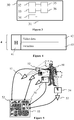
- Figure 1 shows a three-dimension (3D) model 10 of an object and points of a point cloud 11 corresponding to 3D model 10.
- 3D model 10 and the point cloud 11 may for example correspond to a possible 3D representation of an object of the 3D scene comprising other objects.
- Model 10 may be a 3D mesh representation and points of point cloud 11 may be the vertices of the mesh. Points of point cloud 11 may also be points spread on the surface of faces of the mesh.
- Model 20 may also be represented as a splatted version of point cloud 11, the surface of model 10 being created by splatting the points of the point cloud 11.
- Model 10 may be represented by a lot of different representations such as voxels or splines.
- Figure 1 illustrates the fact that a point cloud may be defined with a surface representation of a 3D object and that a surface representation of a 3D object may be generated from a point of cloud.
- projecting points of a 3D object (by extension points of a 3D scene) onto an image is equivalent to projecting any representation of this 3D object, for example a point cloud, a mesh, a spline model or a voxel model.
- a point cloud may be represented in memory, for instance, as a vector-based structure, wherein each point has its own coordinates in the frame of reference of a viewpoint (e.g. three-dimensional coordinates XYZ, or a solid angle and a distance (also called depth) from/to the viewpoint) and one or more attributes, also called component.
- a viewpoint e.g. three-dimensional coordinates XYZ, or a solid angle and a distance (also called depth) from/to the viewpoint
- attribute also called component
- An example of component is the color component that may be expressed in various color spaces, for example RGB (Red, Green and Blue) or YUV (Y being the luma component and UV two chrominance components).
- the point cloud is a representation of a 3D scene comprising objects. The 3D scene may be seen from a given viewpoint or a range of viewpoints.
- the point cloud may be obtained by many ways, e.g.:
- Figure 2 shows a non-limitative example of the encoding, transmission and decoding of data representative of a sequence of 3D scenes.
- the encoding format that may be, for example and at the same time, compatible for 3DoF, 3DoF+ and 6DoF decoding.
- Sequence of 3D scenes 20 is provided to an encoder 21.
- the encoder 21 takes one 3D scenes or a sequence of 3D scenes as input and provides a bit streams representative of the input.
- the bit stream may be stored in a memory 22 and/or on an electronic data medium and may be transmitted over a network 22.
- the bit stream representative of a sequence of 3D scenes may be read from a memory 22 and/or received from a network 22 by a decoder 23. Decoder 23 is inputted by said bit stream and provides a sequence of 3D scenes, for instance in a point cloud format.
- Encoder 21 may comprise several circuits implementing several steps. In a first step, encoder 21 projects each 3D scene onto at least one 2D picture. 3D projection is any method of mapping three-dimensional points to a two-dimensional plane. As most current methods for displaying graphical data are based on planar (pixel information from several bit planes) two-dimensional media, the use of this type of projection is widespread, especially in computer graphics, engineering and drafting.
- Projection circuit 211 provides at least one two-dimensional frame 2111 for a 3D scene of sequence 20. Frame 2111 comprises color information and depth information representative of the 3D scene projected onto frame 2111. In a variant, color information and depth information are encoded in two separate frames 2111 and 2112.
- Metadata 212 are used and updated by projection circuit 211. Metadata 212 comprise information about the projection operation (e.g. projection parameters) and about the way color and depth information is organized within frames 2111 and 2112 as described in relation to figures 5 to 7 . According to the present principles, 3D scenes are projected onto a multiplicity of 2D images, called patches, packed into atlases. A same layout organizing patches in atlases is used for a varying number of successive atlases encoding successive 3D scenes of the sequence.
- a video encoding circuit 213 encodes sequence of frames 2111 and 2112 as a video. Pictures of a 3D scene 2111 and 2112 (or a sequence of pictures of the 3D scene) is encoded in a stream by video encoder 213. Then video data and metadata 212 are encapsulated in a data stream by a data encapsulation circuit 214.
- Encoder 213 is for example compliant with an encoder such as:
- Decoder 23 comprises different circuits implementing different steps of the decoding. Decoder 23 takes a data stream generated by an encoder 21 as an input and provides a sequence of 3D scenes 24 to be rendered and displayed by a volumetric video display device, like a Head-Mounted Device (HMD). Decoder 23 obtains the stream from a source 22.
- source 22 belongs to a set comprising:
- Decoder 23 comprises a circuit 234 for extract data encoded in the data stream.
- Circuit 234 takes a data stream as input and provides metadata 232 corresponding to metadata 212 encoded in the stream and a two-dimensional video.
- the video is decoded by a video decoder 233 which provides a sequence of frames.
- Decoded frames comprise color and depth information.
- video decoder 233 provides two sequences of frames, one comprising color information, the other comprising depth information.
- a circuit 231 uses metadata 232 to un-project color and depth information from decoded frames to provide a sequence of 3D scenes 24. Sequence of 3D scenes 24 corresponds to sequence of 3D scenes 20, with a possible loss of precision related to the encoding as a 2D video and to the video compression.
- Figure 3 shows an example architecture of a device 30 which may be configured to implement a method described in relation with figure 8 .
- Encoder 21 and/or decoder 23 of figure 2 may implement this architecture.
- each circuit of encoder 21 and/or decoder 23 may be a device according to the architecture of Figure 3 , linked together, for instance, via their bus 31 and/or via I/O interface 36.
- Device 30 comprises following elements that are linked together by a data and address bus 31:
- the power supply is external to the device.
- the word « register » used in the specification may correspond to area of small capacity (some bits) or to very large area (e.g. a whole program or large amount of received or decoded data).
- the ROM 33 comprises at least a program and parameters. The ROM 33 may store algorithms and instructions to perform techniques in accordance with present principles. When switched on, the CPU 32 uploads the program in the RAM and executes the corresponding instructions.
- the RAM 34 comprises, in a register, the program executed by the CPU 32 and uploaded after switch-on of the device 30, input data in a register, intermediate data in different states of the method in a register, and other variables used for the execution of the method in a register.
- the implementations described herein may be implemented in, for example, a method or a process, an apparatus, a computer program product, a data stream, or a signal. Even if only discussed in the context of a single form of implementation (for example, discussed only as a method or a device), the implementation of features discussed may also be implemented in other forms (for example a program).
- An apparatus may be implemented in, for example, appropriate hardware, software, and firmware.
- the methods may be implemented in, for example, an apparatus such as, for example, a processor, which refers to processing devices in general, including, for example, a computer, a microprocessor, an integrated circuit, or a programmable logic device. Processors also include communication devices, such as, for example, computers, cell phones, portable/personal digital assistants ("PDAs”), and other devices that facilitate communication of information between end-users.
- PDAs portable/personal digital assistants
- the device 30 is configured to implement a method described in relation with figure 8 , and belongs to a set comprising:
- Figure 4 shows an example of an embodiment of the syntax of a stream when the data are transmitted over a packet-based transmission protocol.
- Figure 4 shows an example structure 4 of a volumetric video stream.
- the structure consists in a container which organizes the stream in independent elements of syntax.
- the structure may comprise a header part 41 which is a set of data common to every syntax elements of the stream.
- the header part comprises some of metadata about syntax elements, describing the nature and the role of each of them.
- the header part may also comprise a part of metadata 212 of figure 2 , for instance the coordinates of a central point of view used for projecting points of a 3D scene onto frames 2111 and 2112.
- the structure comprises a payload comprising an element of syntax 42 and at least one element of syntax 43.
- Syntax element 42 comprises data representative of the color and depth frames. Images may have been compressed according to a video compression method.
- Element of syntax 43 is a part of the payload of the data stream and may comprise metadata about how frames of element of syntax 42 are encoded, for instance parameters used for projecting and packing points of a 3D scene onto frames.
- metadata may be associated with each frame of the video or to group of frames (also known as Group of Pictures (GoP) in video compression standards).
- GoP Group of Pictures
- FIG. 5 illustrates the patch atlas approach with an example of 4 projection centers.
- 3D scene 50 comprises a character.
- center of projection 51 is a perspective camera and camera 53 is an orthographic camera.
- Cameras may also be omnidirectional cameras with, for instance a spherical mapping (e.g. Equi-Rectangular mapping) or a cube mapping.
- the 3D points of the 3D scene are projected onto the 2D planes associated with virtual cameras located at the projection centers, according to a projection operation described in projection data of metadata.
- projection of the points captured by camera 51 is mapped onto patch 52 according to a perspective mapping and projection of the points captured by camera 53 is mapped onto patch 54 according to an orthographic mapping.
- the clustering of the projected pixels yields a multiplicity of 2D patches, which are packed in a rectangular atlas 55.
- the organization of patches within the atlas defines the atlas layout.
- two atlases with identical layout one for texture (i.e. color) information and one for depth information.
- Two patches captured by a same camera or by two distinct cameras may comprise information representative of a same part of the 3D scene, like, for instance patches 54 and 56.
- a patch data comprises a reference to a projection data (e.g. an index in a table of projection data or a pointer (i.e. address in memory or in a data stream) to a projection data) and information describing the location and the size of the patch within the atlas (e.g. top left corner coordinates, size and width in pixels).
- Patch data items are added to metadata to be encapsulated in the data stream in association with the compressed data of the one or two atlases.
- the set of patch data items is also called the layout metadata in the present description.
- the location may be the top left coordinates of the patch rectangle in pixels of the atlas and its size described by a width and a height in pixels.
- the size of a patch is described in arc degrees corresponding to the solid angle of the 3D space, pointing on a projection center, comprising points projected onto that patch.
- patches are ellipses and/or polygons, described, for instance with Scalable Vector Graphics (SVG) instructions.
- SVG Scalable Vector Graphics
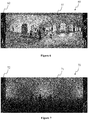
- Atlas 60 comprises a first part 61 comprising the texture information of the points of the 3D scene that are visible from a point of view and one or more second parts 62.
- the texture information of the first part 61 may for example be obtained according to an equirectangular projection mapping, an equirectangular projection mapping being an example of spherical projection mapping.
- the second parts 62 are arranged at the left and right borders of the first part 61 but the second parts may be arranged differently.
- Second parts 62 comprise texture information of parts of the 3D scene that are complementary to the part visible from the point of view.
- the second parts may be obtained by removing from the 3D scene the points that are visible from the first viewpoint (the texture of which being stored in the first part) and by projecting the remaining points according to the same point of view.
- the latter process may be reiterated iteratively to obtain at each time the hidden parts of the 3D scene.
- the second parts may be obtained by removing from the 3D scene the points that are visible from the point of view, for example a central point of view, (the texture of which being stored in the first part) and by projecting the remaining points according to a point of view different from the first point of view, for example from one or more second point of view of a space of view centred onto the central point of view (e.g. the viewing space of a 3DoF rendering).
- the first part 61 may be seen as a first large texture patch (corresponding to a first part of the 3D scene) and the second parts 62 comprises smaller textures patches (corresponding to second parts of the 3D scene that are complementary to the first part).
- Such an atlas has the advantage to be compatible at the same time with 3DoF rendering (when rendering only the first part 61) and with 3DoF+ / 6DoF rendering.
- FIG. 7 shows an example of an atlas 70 comprising the depth information of the points of the 3D scene of figure 6 , according to a non-limiting embodiment of the present principles.
- Atlas 70 may be seen as the depth image corresponding to texture image 60 of figure 6 .
- Atlas 70 comprises a first part 71 comprising the depth information of the points of the 3D scene that are visible from the central point of view and one or more second parts 62. Atlas 70 may be obtained in a same way as atlas 60 but contains the depth information associated with the points of the 3D scene instead of the texture information.
- Points of the scene to be encoded are points which are visible from this unique point of view, and only the texture information is needed to be encoded / decoded for the 3DoF rendering. There is no need to encode points of the scene that are not visible from this unique point of view for a 3DoF rendering as the user cannot access to them.
- the user may move the viewpoint everywhere in the scene.
- it is required to encode every point (depth and texture) of the scene in the bitstream as every point is potentially accessible by a user who can move his/her point of view.
- At the encoding stage there is no means to know, a priori, from which point of view the user will observe the 3D scene.
- the user may move the point of view within a limited space around a central point of view. This enables to experience parallax.
- Data representative of the part of the scene visible from any point of the space of view is to be encoded into the stream, including the data representative of the 3D scene visible according to the central point of view (i.e. the first parts 61 and 71).
- the size and shape of the space of view may for example be decided and determined at the encoding step and encoded in the bitstream.
- the decoder may obtain this information from the bitstream and the renderer limits the space of view to the space determined by the obtained information.
- the renderer determines the space of view according to hardware constraints, for example in relation to capabilities of the sensor(s) that detects the movements of the user. In such a case, if, at the encoding phase, a point visible from a point within the space of view of the renderer has not been encoded in the bitstream, this point will not be rendered.
- data e.g. texture and/or geometry
- data representative of every point of the 3D scene is encoded in the stream without considering the rendering space of view. To optimize the size of the stream, only a subset of the points of the scene may be encoded, for instance the subset of points that may be seen according to a rendering space of view.
- the parameters of the projection surfaces of figure 5 may change frequently over time, in order to adapt to the pose and geometry changes between 3D scenes of the sequence. These parameters are selected by the projection algorithm as a function of criteria to obey, like the number of patch or a rate of redundancy in projected information. From one 3D scene to its successor in the sequence, these parameters may change leading to a modification of the number and/or the size of patches and, transitively modifying the atlas structure and the related layout metdata. To limit these changes, the projection parameters are evaluated per small fixed-length segments of N consecutive frames (typically N is equal to 8). The transmitted un-projection parameters, including the layout metadata (i.e. patch data items) are therefore regularly updated every N frames.
- the encoding structure of the video streams made up of the sequence of depth and texture patch atlases is adapted accordingly, with aligned fixed size, N-frame long, closed GOPs. Doing so, the encoding efficiency is optimized by resetting the temporal predictions at each video content changes (i.e. patch atlases structure updates, which create "scene cuts" in the atlas videos).
- patch atlases structure updates which create "scene cuts" in the atlas videos.
- the number N of successive frames varies over time, depending on the temporal evolution of the scene geometry.
- Figure 8 illustrates a method 80 of encoding a sequence of 3D scenes in a data stream according to a non-limitative embodiment of the present principles.
- data are obtained from a source.
- a sequence of 3D scenes is obtained.
- Variables are initialized.
- a first sequence of consecutive 3D scenes is selected.
- a maximal size may be initialized too. So, 3D scenes of the first sequences goes from index i to index i+N-1, where i is the index of the first 3D scene of the first sequence.
- An index n is initialized to 0 for the purpose of the clarity of the present description.
- an atlas layout is built for the first sequence according to a known method.
- a set of patches is generated by projecting points of the 3D scenes onto projection surfaces as illustrated in Figure 5 . Patches are packed in N atlases according to a same layout. The number of patches packed in each atlas is called the size of the layout.
- the obtained layout is stored in a table S in a memory at index n.
- n is incremented.
- a second sequence of 3D scenes is built by appending the i+N scene of the sequence to the first sequence. That is, the upcoming 3D scene is added to the first sequence to form the second sequence. N is incremented also.
- a new atlas layout is built for the second sequence. This second layout is stored in the table of layouts at index n (which has been incremented).
- the size of the second layout S[n] is compared to the size of the first layout S[n-1]. If the number of patches of the second layout is lower than or equal to the number of patches of the first layout, then the method iterates at step 83. N and N are incremented, the second sequence becomes the first sequence and a new second sequence is set up by appending the next 3D scene to the new first sequence. An atlas layout is built for this new second sequence and is stored in table S. The method iterates while the size of S[n] is lower than or equal to S[n-1], In a variant, the iterations end when the second sequence comprises a number of 3D scenes which exceeds a given number, for example 9, 10, 128, 256 or 512. This given number may be defined in accordance to the maximal intra-period size of the codec selected to encode the atlases.
- table S comprises n+1 layouts.
- the last one i.e. the layout built for the last second sequence
- One of these layout is selected to be used to generate the n atlases for the last first sequence.
- the selected layout may be the last or the layout stored in the table.
- the method selects the atlas layout of patches generating texture and depth atlas videos with best compression properties.
- a distortion measure D is therefore required.
- An image-based criterion based on rendered images on user viewport(s) is preferred to a point-to-point distortion of compressed point cloud, as being closer to the user experience. More precisely a pixel-to-pixel distance metrics is evaluated between rendered frames before and after volumetric video compression, and averaged on those frames belonging to a path of pre-defined viewports. In other variants, other criteria may be considered according to the properties of the video stream which have to be guaranteed or optimized.
- a pseudo code of method 80 may be:
- the depth and texture atlas videos which are generated by the above described projection method can be encoded with any conventional video encoding standardized method, e.g. HEVC.
- Those atlas videos have specific properties, however, which are inherent to their generation process: in between two atlas structure updates, the video content is highly temporally correlated, as the frames consist of the same layout of patches (e.g. rectangular), comprising the partial projections of depth or texture.
- Atlas layout updates for a new group of input 3D scenes break the temporal consistency and can be described as "scene cuts". Such property can be exploited for an optimized compression efficiency by setting accordingly the adequate encoding parameters.
- a typical temporal organization of the different types (I ,P, B) of encoded picture is based on Group of Pictures (GOP).
- GOP Group of Pictures
- An intra period is usually made of several GOPs.
- the method according to the present principles aligns a variable GOP and intra period structure with the atlas updates, with a new intra period starting at each atlas update.
- Figure 9 shows an example structure for intra-periods for atlas layouts of varying lifetime N.
- an intra-period begins with a first fixed-size k-picture long GOP.
- k is equal to 8 or 10.
- the last GOP of the intra-period is of shortened length N modulo the fixed size, 8 in the example of figure 9 .
- Such a structure may be embedded in generic elements of ISOBMMF syntax, for example, to transmit un-projection parameters metadata of varying duration described according to the present principles.
- the un-projection parameters for a given patch-based projection surface including list of patches with their characteristics (i.e. patch data items) and associated atlas packing of patches (layout metadata), are defined as a metadata sample, with a structured sample format.
- the un-projection metadata samples are placed in a timed metadata track, with samples of varying duration.
- the two video tracks of atlas-based projection of depth and texture are combined in a track group.
- the un-projection metadata track is linked to the projected video track group through a track reference (i.e. with a 'cdtg' track reference).
- the duration of timed metadata samples not matching the duration of associated video samples, the synchronizing of a projected depth / texture video frame and the associated un-projection metadata at rendering side are resolved by parsing the sample decoding times.
- the implementations described herein may be implemented in, for example, a method or a process, an apparatus, a computer program product, a data stream, or a signal. Even if only discussed in the context of a single form of implementation (for example, discussed only as a method or a device), the implementation of features discussed may also be implemented in other forms (for example a program).
- An apparatus may be implemented in, for example, appropriate hardware, software, and firmware.
- the methods may be implemented in, for example, an apparatus such as, for example, a processor, which refers to processing devices in general, including, for example, a computer, a microprocessor, an integrated circuit, or a programmable logic device. Processors also include communication devices, such as, for example, Smartphones, tablets, computers, mobile phones, portable/personal digital assistants ("PDAs”), and other devices that facilitate communication of information between end-users.
- PDAs portable/personal digital assistants
- Implementations of the various processes and features described herein may be embodied in a variety of different equipment or applications, particularly, for example, equipment or applications associated with data encoding, data decoding, view generation, texture processing, and other processing of images and related texture information and/or depth information.
- equipment include an encoder, a decoder, a post-processor processing output from a decoder, a pre-processor providing input to an encoder, a video coder, a video decoder, a video codec, a web server, a set-top box, a laptop, a personal computer, a cell phone, a PDA, and other communication devices.
- the equipment may be mobile and even installed in a mobile vehicle.
- the methods may be implemented by instructions being performed by a processor, and such instructions (and/or data values produced by an implementation) may be stored on a processor-readable medium such as, for example, an integrated circuit, a software carrier or other storage device such as, for example, a hard disk, a compact diskette (“CD"), an optical disc (such as, for example, a DVD, often referred to as a digital versatile disc or a digital video disc), a random access memory (“RAM”), or a read-only memory (“ROM”).
- the instructions may form an application program tangibly embodied on a processor-readable medium. Instructions may be, for example, in hardware, firmware, software, or a combination.
- a processor may be characterized, therefore, as, for example, both a device configured to carry out a process and a device that includes a processor-readable medium (such as a storage device) having instructions for carrying out a process. Further, a processor-readable medium may store, in addition to or in lieu of instructions, data values produced by an implementation.
- implementations may produce a variety of signals formatted to carry information that may be, for example, stored or transmitted.
- the information may include, for example, instructions for performing a method, or data produced by one of the described implementations.
- a signal may be formatted to carry as data the rules for writing or reading the syntax of a described embodiment, or to carry as data the actual syntax-values written by a described embodiment.
- Such a signal may be formatted, for example, as an electromagnetic wave (for example, using a radio frequency portion of spectrum) or as a baseband signal.
- the formatting may include, for example, encoding a data stream and modulating a carrier with the encoded data stream.
- the information that the signal carries may be, for example, analog or digital information.
- the signal may be transmitted over a variety of different wired or wireless links, as is known.
- the signal may be stored on a processor-readable medium.
Landscapes
- Engineering & Computer Science (AREA)
- Multimedia (AREA)
- Signal Processing (AREA)
- Physics & Mathematics (AREA)
- General Physics & Mathematics (AREA)
- Theoretical Computer Science (AREA)
- Computer Graphics (AREA)
- Geometry (AREA)
- Software Systems (AREA)
- Compression Or Coding Systems Of Tv Signals (AREA)
- Testing, Inspecting, Measuring Of Stereoscopic Televisions And Televisions (AREA)
Priority Applications (5)
| Application Number | Priority Date | Filing Date | Title |
|---|---|---|---|
| EP19305417.8A EP3716628A1 (fr) | 2019-03-29 | 2019-03-29 | Procédé et appareil de codage et de décodage de vidéo volumétrique |
| CN202080037690.1A CN114270863B (zh) | 2019-03-29 | 2020-03-19 | 一种编码和解码立体视频的方法和装置 |
| PCT/EP2020/057700 WO2020200829A1 (fr) | 2019-03-29 | 2020-03-19 | Procédé et appareil pour le codage et le décodage de vidéo volumétrique |
| EP20711199.8A EP3949420A1 (fr) | 2019-03-29 | 2020-03-19 | Procédé et appareil pour le codage et le décodage de vidéo volumétrique |
| US17/441,051 US12069301B2 (en) | 2019-03-29 | 2020-03-19 | Method and apparatus for encoding and decoding volumetric video |
Applications Claiming Priority (1)
| Application Number | Priority Date | Filing Date | Title |
|---|---|---|---|
| EP19305417.8A EP3716628A1 (fr) | 2019-03-29 | 2019-03-29 | Procédé et appareil de codage et de décodage de vidéo volumétrique |
Publications (1)
| Publication Number | Publication Date |
|---|---|
| EP3716628A1 true EP3716628A1 (fr) | 2020-09-30 |
Family
ID=66102610
Family Applications (2)
| Application Number | Title | Priority Date | Filing Date |
|---|---|---|---|
| EP19305417.8A Withdrawn EP3716628A1 (fr) | 2019-03-29 | 2019-03-29 | Procédé et appareil de codage et de décodage de vidéo volumétrique |
| EP20711199.8A Pending EP3949420A1 (fr) | 2019-03-29 | 2020-03-19 | Procédé et appareil pour le codage et le décodage de vidéo volumétrique |
Family Applications After (1)
| Application Number | Title | Priority Date | Filing Date |
|---|---|---|---|
| EP20711199.8A Pending EP3949420A1 (fr) | 2019-03-29 | 2020-03-19 | Procédé et appareil pour le codage et le décodage de vidéo volumétrique |
Country Status (4)
| Country | Link |
|---|---|
| US (1) | US12069301B2 (fr) |
| EP (2) | EP3716628A1 (fr) |
| CN (1) | CN114270863B (fr) |
| WO (1) | WO2020200829A1 (fr) |
Cited By (1)
| Publication number | Priority date | Publication date | Assignee | Title |
|---|---|---|---|---|
| US20220167015A1 (en) * | 2019-03-29 | 2022-05-26 | InterDigital CE Patent Holgings, SAS | A method and apparatus for encoding and decoding volumetric video |
Families Citing this family (3)
| Publication number | Priority date | Publication date | Assignee | Title |
|---|---|---|---|---|
| CN114009054B (zh) * | 2019-06-28 | 2024-08-09 | 索尼集团公司 | 信息处理装置和方法、再现处理装置和方法 |
| US11838485B2 (en) * | 2020-04-16 | 2023-12-05 | Electronics And Telecommunications Research Institute | Method for processing immersive video and method for producing immersive video |
| JP7809720B2 (ja) * | 2021-04-07 | 2026-02-02 | インターディジタル・シーイー・パテント・ホールディングス・ソシエテ・パ・アクシオンス・シンプリフィエ | 光効果をサポートする容積ビデオ |
Citations (2)
| Publication number | Priority date | Publication date | Assignee | Title |
|---|---|---|---|---|
| EP3349182A1 (fr) * | 2017-01-13 | 2018-07-18 | Thomson Licensing | Procédé, appareil et flux de format vidéo immersif |
| WO2019055389A1 (fr) * | 2017-09-15 | 2019-03-21 | Interdigital Vc Holdings, Inc. | Procédés et dispositifs de codage et de décodage de trois degrés de liberté et flux vidéo compatible volumétrique |
Family Cites Families (8)
| Publication number | Priority date | Publication date | Assignee | Title |
|---|---|---|---|---|
| US8879826B2 (en) * | 2011-07-05 | 2014-11-04 | Texas Instruments Incorporated | Method, system and computer program product for switching between 2D and 3D coding of a video sequence of images |
| US9451232B2 (en) * | 2011-09-29 | 2016-09-20 | Dolby Laboratories Licensing Corporation | Representation and coding of multi-view images using tapestry encoding |
| JP6074509B2 (ja) * | 2012-09-29 | 2017-02-01 | 華為技術有限公司Huawei Technologies Co.,Ltd. | 映像符号化及び復号化方法、装置及びシステム |
| US9930363B2 (en) * | 2013-04-12 | 2018-03-27 | Nokia Technologies Oy | Harmonized inter-view and view synthesis prediction for 3D video coding |
| WO2015025309A1 (fr) * | 2013-08-20 | 2015-02-26 | Smarter Tv Ltd. | Système et procédé de traitement en temps réel de vidéo numérique à ultrahaute résolution |
| FI20165256A7 (fi) * | 2016-03-24 | 2017-09-25 | Nokia Technologies Oy | Laitteisto, menetelmä ja tietokoneohjelma videokoodaukseen ja -dekoodaukseen |
| US11297346B2 (en) * | 2016-05-28 | 2022-04-05 | Microsoft Technology Licensing, Llc | Motion-compensated compression of dynamic voxelized point clouds |
| EP3716628A1 (fr) * | 2019-03-29 | 2020-09-30 | InterDigital CE Patent Holdings | Procédé et appareil de codage et de décodage de vidéo volumétrique |
-
2019
- 2019-03-29 EP EP19305417.8A patent/EP3716628A1/fr not_active Withdrawn
-
2020
- 2020-03-19 WO PCT/EP2020/057700 patent/WO2020200829A1/fr not_active Ceased
- 2020-03-19 EP EP20711199.8A patent/EP3949420A1/fr active Pending
- 2020-03-19 US US17/441,051 patent/US12069301B2/en active Active
- 2020-03-19 CN CN202080037690.1A patent/CN114270863B/zh active Active
Patent Citations (2)
| Publication number | Priority date | Publication date | Assignee | Title |
|---|---|---|---|---|
| EP3349182A1 (fr) * | 2017-01-13 | 2018-07-18 | Thomson Licensing | Procédé, appareil et flux de format vidéo immersif |
| WO2019055389A1 (fr) * | 2017-09-15 | 2019-03-21 | Interdigital Vc Holdings, Inc. | Procédés et dispositifs de codage et de décodage de trois degrés de liberté et flux vidéo compatible volumétrique |
Cited By (2)
| Publication number | Priority date | Publication date | Assignee | Title |
|---|---|---|---|---|
| US20220167015A1 (en) * | 2019-03-29 | 2022-05-26 | InterDigital CE Patent Holgings, SAS | A method and apparatus for encoding and decoding volumetric video |
| US12069301B2 (en) * | 2019-03-29 | 2024-08-20 | Interdigital Ce Patent Holdings, Sas | Method and apparatus for encoding and decoding volumetric video |
Also Published As
| Publication number | Publication date |
|---|---|
| US20220167015A1 (en) | 2022-05-26 |
| EP3949420A1 (fr) | 2022-02-09 |
| WO2020200829A1 (fr) | 2020-10-08 |
| CN114270863A (zh) | 2022-04-01 |
| US12069301B2 (en) | 2024-08-20 |
| CN114270863B (zh) | 2025-12-23 |
Similar Documents
| Publication | Publication Date | Title |
|---|---|---|
| US11671596B2 (en) | Methods and apparatus for depth encoding and decoding | |
| US11979546B2 (en) | Method and apparatus for encoding and rendering a 3D scene with inpainting patches | |
| EP3562159A1 (fr) | Procédé, appareil et flux pour format vidéo volumétrique | |
| US12482141B2 (en) | Method and apparatus for encoding, transmitting and decoding volumetric video | |
| US20250024076A1 (en) | Volumetric video with auxiliary patches | |
| US20220377302A1 (en) | A method and apparatus for coding and decoding volumetric video with view-driven specularity | |
| US11968349B2 (en) | Method and apparatus for encoding and decoding of multiple-viewpoint 3DoF+ content | |
| US12069301B2 (en) | Method and apparatus for encoding and decoding volumetric video | |
| US11910054B2 (en) | Method and apparatus for decoding a 3D video | |
| US12464110B2 (en) | Method and apparatuses for delivering a volumetric video content | |
| US12212784B2 (en) | Different atlas packings for volumetric video | |
| US20220345681A1 (en) | Method and apparatus for encoding, transmitting and decoding volumetric video | |
| US20250317542A1 (en) | Method and apparatus for encoding and decoding volumetric content in and from a data stream | |
| US20220368879A1 (en) | A method and apparatus for encoding, transmitting and decoding volumetric video | |
| WO2020185529A1 (fr) | Procédé et appareil pour le codage et le décodage de vidéo volumétrique | |
| US12387417B2 (en) | Method and apparatus for encoding and decoding volumetric video |
Legal Events
| Date | Code | Title | Description |
|---|---|---|---|
| PUAI | Public reference made under article 153(3) epc to a published international application that has entered the european phase |
Free format text: ORIGINAL CODE: 0009012 |
|
| STAA | Information on the status of an ep patent application or granted ep patent |
Free format text: STATUS: THE APPLICATION HAS BEEN PUBLISHED |
|
| AK | Designated contracting states |
Kind code of ref document: A1 Designated state(s): AL AT BE BG CH CY CZ DE DK EE ES FI FR GB GR HR HU IE IS IT LI LT LU LV MC MK MT NL NO PL PT RO RS SE SI SK SM TR |
|
| AX | Request for extension of the european patent |
Extension state: BA ME |
|
| STAA | Information on the status of an ep patent application or granted ep patent |
Free format text: STATUS: THE APPLICATION IS DEEMED TO BE WITHDRAWN |
|
| 18D | Application deemed to be withdrawn |
Effective date: 20210331 |