EP3716652A1 - Dispositif d'aide auditive avec contrôle actif du bruit basé sur le bruit du vent - Google Patents
Dispositif d'aide auditive avec contrôle actif du bruit basé sur le bruit du vent Download PDFInfo
- Publication number
- EP3716652A1 EP3716652A1 EP20156331.9A EP20156331A EP3716652A1 EP 3716652 A1 EP3716652 A1 EP 3716652A1 EP 20156331 A EP20156331 A EP 20156331A EP 3716652 A1 EP3716652 A1 EP 3716652A1
- Authority
- EP
- European Patent Office
- Prior art keywords
- signal
- generated
- noise
- audio
- compensating
- Prior art date
- Legal status (The legal status is an assumption and is not a legal conclusion. Google has not performed a legal analysis and makes no representation as to the accuracy of the status listed.)
- Withdrawn
Links
Images

Classifications
-
- G—PHYSICS
- G10—MUSICAL INSTRUMENTS; ACOUSTICS
- G10K—SOUND-PRODUCING DEVICES; METHODS OR DEVICES FOR PROTECTING AGAINST, OR FOR DAMPING, NOISE OR OTHER ACOUSTIC WAVES IN GENERAL; ACOUSTICS NOT OTHERWISE PROVIDED FOR
- G10K11/00—Methods or devices for transmitting, conducting or directing sound in general; Methods or devices for protecting against, or for damping, noise or other acoustic waves in general
- G10K11/16—Methods or devices for protecting against, or for damping, noise or other acoustic waves in general
- G10K11/175—Methods or devices for protecting against, or for damping, noise or other acoustic waves in general using interference effects; Masking sound
- G10K11/178—Methods or devices for protecting against, or for damping, noise or other acoustic waves in general using interference effects; Masking sound by electro-acoustically regenerating the original acoustic waves in anti-phase
- G10K11/1785—Methods, e.g. algorithms; Devices
- G10K11/17853—Methods, e.g. algorithms; Devices of the filter
- G10K11/17854—Methods, e.g. algorithms; Devices of the filter the filter being an adaptive filter
-
- H—ELECTRICITY
- H04—ELECTRIC COMMUNICATION TECHNIQUE
- H04R—LOUDSPEAKERS, MICROPHONES, GRAMOPHONE PICK-UPS OR LIKE ACOUSTIC ELECTROMECHANICAL TRANSDUCERS; ELECTRIC HEARING AIDS; PUBLIC ADDRESS SYSTEMS
- H04R25/00—Electric hearing aids
- H04R25/50—Customised settings for obtaining desired overall acoustical characteristics
-
- H—ELECTRICITY
- H04—ELECTRIC COMMUNICATION TECHNIQUE
- H04R—LOUDSPEAKERS, MICROPHONES, GRAMOPHONE PICK-UPS OR LIKE ACOUSTIC ELECTROMECHANICAL TRANSDUCERS; ELECTRIC HEARING AIDS; PUBLIC ADDRESS SYSTEMS
- H04R25/00—Electric hearing aids
- H04R25/43—Electronic input selection or mixing based on input signal analysis, e.g. mixing or selection between microphone and telecoil or between microphones with different directivity characteristics
-
- G—PHYSICS
- G10—MUSICAL INSTRUMENTS; ACOUSTICS
- G10K—SOUND-PRODUCING DEVICES; METHODS OR DEVICES FOR PROTECTING AGAINST, OR FOR DAMPING, NOISE OR OTHER ACOUSTIC WAVES IN GENERAL; ACOUSTICS NOT OTHERWISE PROVIDED FOR
- G10K11/00—Methods or devices for transmitting, conducting or directing sound in general; Methods or devices for protecting against, or for damping, noise or other acoustic waves in general
- G10K11/16—Methods or devices for protecting against, or for damping, noise or other acoustic waves in general
- G10K11/175—Methods or devices for protecting against, or for damping, noise or other acoustic waves in general using interference effects; Masking sound
- G10K11/178—Methods or devices for protecting against, or for damping, noise or other acoustic waves in general using interference effects; Masking sound by electro-acoustically regenerating the original acoustic waves in anti-phase
- G10K11/1781—Methods or devices for protecting against, or for damping, noise or other acoustic waves in general using interference effects; Masking sound by electro-acoustically regenerating the original acoustic waves in anti-phase characterised by the analysis of input or output signals, e.g. frequency range, modes, transfer functions
- G10K11/17821—Methods or devices for protecting against, or for damping, noise or other acoustic waves in general using interference effects; Masking sound by electro-acoustically regenerating the original acoustic waves in anti-phase characterised by the analysis of input or output signals, e.g. frequency range, modes, transfer functions characterised by the analysis of the input signals only
- G10K11/17823—Reference signals, e.g. ambient acoustic environment
-
- G—PHYSICS
- G10—MUSICAL INSTRUMENTS; ACOUSTICS
- G10K—SOUND-PRODUCING DEVICES; METHODS OR DEVICES FOR PROTECTING AGAINST, OR FOR DAMPING, NOISE OR OTHER ACOUSTIC WAVES IN GENERAL; ACOUSTICS NOT OTHERWISE PROVIDED FOR
- G10K11/00—Methods or devices for transmitting, conducting or directing sound in general; Methods or devices for protecting against, or for damping, noise or other acoustic waves in general
- G10K11/16—Methods or devices for protecting against, or for damping, noise or other acoustic waves in general
- G10K11/175—Methods or devices for protecting against, or for damping, noise or other acoustic waves in general using interference effects; Masking sound
- G10K11/178—Methods or devices for protecting against, or for damping, noise or other acoustic waves in general using interference effects; Masking sound by electro-acoustically regenerating the original acoustic waves in anti-phase
- G10K11/1783—Methods or devices for protecting against, or for damping, noise or other acoustic waves in general using interference effects; Masking sound by electro-acoustically regenerating the original acoustic waves in anti-phase handling or detecting of non-standard events or conditions, e.g. changing operating modes under specific operating conditions
- G10K11/17833—Methods or devices for protecting against, or for damping, noise or other acoustic waves in general using interference effects; Masking sound by electro-acoustically regenerating the original acoustic waves in anti-phase handling or detecting of non-standard events or conditions, e.g. changing operating modes under specific operating conditions by using a self-diagnostic function or a malfunction prevention function, e.g. detecting abnormal output levels
-
- G—PHYSICS
- G10—MUSICAL INSTRUMENTS; ACOUSTICS
- G10K—SOUND-PRODUCING DEVICES; METHODS OR DEVICES FOR PROTECTING AGAINST, OR FOR DAMPING, NOISE OR OTHER ACOUSTIC WAVES IN GENERAL; ACOUSTICS NOT OTHERWISE PROVIDED FOR
- G10K11/00—Methods or devices for transmitting, conducting or directing sound in general; Methods or devices for protecting against, or for damping, noise or other acoustic waves in general
- G10K11/16—Methods or devices for protecting against, or for damping, noise or other acoustic waves in general
- G10K11/175—Methods or devices for protecting against, or for damping, noise or other acoustic waves in general using interference effects; Masking sound
- G10K11/178—Methods or devices for protecting against, or for damping, noise or other acoustic waves in general using interference effects; Masking sound by electro-acoustically regenerating the original acoustic waves in anti-phase
- G10K11/1787—General system configurations
- G10K11/17879—General system configurations using both a reference signal and an error signal
- G10K11/17881—General system configurations using both a reference signal and an error signal the reference signal being an acoustic signal, e.g. recorded with a microphone
-
- G—PHYSICS
- G10—MUSICAL INSTRUMENTS; ACOUSTICS
- G10L—SPEECH ANALYSIS TECHNIQUES OR SPEECH SYNTHESIS; SPEECH RECOGNITION; SPEECH OR VOICE PROCESSING TECHNIQUES; SPEECH OR AUDIO CODING OR DECODING
- G10L21/00—Speech or voice signal processing techniques to produce another audible or non-audible signal, e.g. visual or tactile, in order to modify its quality or its intelligibility
- G10L21/02—Speech enhancement, e.g. noise reduction or echo cancellation
- G10L21/0208—Noise filtering
-
- G—PHYSICS
- G10—MUSICAL INSTRUMENTS; ACOUSTICS
- G10L—SPEECH ANALYSIS TECHNIQUES OR SPEECH SYNTHESIS; SPEECH RECOGNITION; SPEECH OR VOICE PROCESSING TECHNIQUES; SPEECH OR AUDIO CODING OR DECODING
- G10L21/00—Speech or voice signal processing techniques to produce another audible or non-audible signal, e.g. visual or tactile, in order to modify its quality or its intelligibility
- G10L21/02—Speech enhancement, e.g. noise reduction or echo cancellation
- G10L21/0208—Noise filtering
- G10L21/0216—Noise filtering characterised by the method used for estimating noise
-
- H—ELECTRICITY
- H04—ELECTRIC COMMUNICATION TECHNIQUE
- H04R—LOUDSPEAKERS, MICROPHONES, GRAMOPHONE PICK-UPS OR LIKE ACOUSTIC ELECTROMECHANICAL TRANSDUCERS; ELECTRIC HEARING AIDS; PUBLIC ADDRESS SYSTEMS
- H04R1/00—Details of transducers, loudspeakers or microphones
- H04R1/08—Mouthpieces; Microphones; Attachments therefor
-
- G—PHYSICS
- G10—MUSICAL INSTRUMENTS; ACOUSTICS
- G10K—SOUND-PRODUCING DEVICES; METHODS OR DEVICES FOR PROTECTING AGAINST, OR FOR DAMPING, NOISE OR OTHER ACOUSTIC WAVES IN GENERAL; ACOUSTICS NOT OTHERWISE PROVIDED FOR
- G10K2210/00—Details of active noise control [ANC] covered by G10K11/178 but not provided for in any of its subgroups
- G10K2210/10—Applications
- G10K2210/108—Communication systems, e.g. where useful sound is kept and noise is cancelled
- G10K2210/1081—Earphones, e.g. for telephones, ear protectors or headsets
-
- G—PHYSICS
- G10—MUSICAL INSTRUMENTS; ACOUSTICS
- G10K—SOUND-PRODUCING DEVICES; METHODS OR DEVICES FOR PROTECTING AGAINST, OR FOR DAMPING, NOISE OR OTHER ACOUSTIC WAVES IN GENERAL; ACOUSTICS NOT OTHERWISE PROVIDED FOR
- G10K2210/00—Details of active noise control [ANC] covered by G10K11/178 but not provided for in any of its subgroups
- G10K2210/30—Means
- G10K2210/301—Computational
- G10K2210/3026—Feedback
-
- G—PHYSICS
- G10—MUSICAL INSTRUMENTS; ACOUSTICS
- G10K—SOUND-PRODUCING DEVICES; METHODS OR DEVICES FOR PROTECTING AGAINST, OR FOR DAMPING, NOISE OR OTHER ACOUSTIC WAVES IN GENERAL; ACOUSTICS NOT OTHERWISE PROVIDED FOR
- G10K2210/00—Details of active noise control [ANC] covered by G10K11/178 but not provided for in any of its subgroups
- G10K2210/30—Means
- G10K2210/301—Computational
- G10K2210/3027—Feedforward
-
- G—PHYSICS
- G10—MUSICAL INSTRUMENTS; ACOUSTICS
- G10L—SPEECH ANALYSIS TECHNIQUES OR SPEECH SYNTHESIS; SPEECH RECOGNITION; SPEECH OR VOICE PROCESSING TECHNIQUES; SPEECH OR AUDIO CODING OR DECODING
- G10L21/00—Speech or voice signal processing techniques to produce another audible or non-audible signal, e.g. visual or tactile, in order to modify its quality or its intelligibility
- G10L21/02—Speech enhancement, e.g. noise reduction or echo cancellation
- G10L21/0208—Noise filtering
- G10L21/0216—Noise filtering characterised by the method used for estimating noise
- G10L2021/02161—Number of inputs available containing the signal or the noise to be suppressed
- G10L2021/02165—Two microphones, one receiving mainly the noise signal and the other one mainly the speech signal
-
- H—ELECTRICITY
- H04—ELECTRIC COMMUNICATION TECHNIQUE
- H04R—LOUDSPEAKERS, MICROPHONES, GRAMOPHONE PICK-UPS OR LIKE ACOUSTIC ELECTROMECHANICAL TRANSDUCERS; ELECTRIC HEARING AIDS; PUBLIC ADDRESS SYSTEMS
- H04R2225/00—Details of deaf aids covered by H04R25/00, not provided for in any of its subgroups
- H04R2225/025—In the ear hearing aids [ITE] hearing aids
-
- H—ELECTRICITY
- H04—ELECTRIC COMMUNICATION TECHNIQUE
- H04R—LOUDSPEAKERS, MICROPHONES, GRAMOPHONE PICK-UPS OR LIKE ACOUSTIC ELECTROMECHANICAL TRANSDUCERS; ELECTRIC HEARING AIDS; PUBLIC ADDRESS SYSTEMS
- H04R2225/00—Details of deaf aids covered by H04R25/00, not provided for in any of its subgroups
- H04R2225/43—Signal processing in hearing aids to enhance the speech intelligibility
-
- H—ELECTRICITY
- H04—ELECTRIC COMMUNICATION TECHNIQUE
- H04R—LOUDSPEAKERS, MICROPHONES, GRAMOPHONE PICK-UPS OR LIKE ACOUSTIC ELECTROMECHANICAL TRANSDUCERS; ELECTRIC HEARING AIDS; PUBLIC ADDRESS SYSTEMS
- H04R2410/00—Microphones
- H04R2410/05—Noise reduction with a separate noise microphone
-
- H—ELECTRICITY
- H04—ELECTRIC COMMUNICATION TECHNIQUE
- H04R—LOUDSPEAKERS, MICROPHONES, GRAMOPHONE PICK-UPS OR LIKE ACOUSTIC ELECTROMECHANICAL TRANSDUCERS; ELECTRIC HEARING AIDS; PUBLIC ADDRESS SYSTEMS
- H04R2410/00—Microphones
- H04R2410/07—Mechanical or electrical reduction of wind noise generated by wind passing a microphone
-
- H—ELECTRICITY
- H04—ELECTRIC COMMUNICATION TECHNIQUE
- H04R—LOUDSPEAKERS, MICROPHONES, GRAMOPHONE PICK-UPS OR LIKE ACOUSTIC ELECTROMECHANICAL TRANSDUCERS; ELECTRIC HEARING AIDS; PUBLIC ADDRESS SYSTEMS
- H04R2460/00—Details of hearing devices, i.e. of ear- or headphones covered by H04R1/10 or H04R5/033 but not provided for in any of their subgroups, or of hearing aids covered by H04R25/00 but not provided for in any of its subgroups
- H04R2460/01—Hearing devices using active noise cancellation
Definitions
- the following description relates generally to a method for operating a hearing device, as well as to a hearing device adapted to perform the method. More specifically, the following description relates to a method for, and a hearing device adapted to perform, an active noise control in a windy environment.
- noise cancelling is an important issue because background noise interferes with the desired signal (processed audio from outer microphones or streaming signals, such as a telephone call or music, for example).
- ANC active noise control
- ANR active noise cancellation
- Active noise control can be used to reduce unwanted sound by adding a noise-countering sound specifically designed to cancel unwanted noise. Windy environments, however, can challenge the ANC system and may not only interfere with the noise reduction, but may even amplify the wind noise.
- the present invention provides a hearing device that includes an active noise control (ANC) system and a method for operating such hearing device.
- ANC active noise control
- the method for operating a hearing device with an active noise control (ANC) system may include capturing audio with a microphone system and generating an audio signal based on the captured audio.
- the method may further include generating a feed-forward (FF) compensating signal based on the captured audio.
- the method may further include monitoring an acoustic environment of the hearing device for presence of wind noise.
- the method may include mixing the audio signal with the generated FF compensating signal at a ratio of the generated FF compensating signal dependent on whether wind noise is detected to provide an acoustic output signal.
- the ratio of the mixing of the generated FF compensating signal with the audio signal may be set by adjusting an output level of the generated FF compensating signal or by weighting the mixing of the generated FF compensating signal relative to the audio signal.
- the output level of the generated FF compensating signal may be set to zero or the weighting of the generated FF compensating signal may be set to zero.
- the ratio of the mixing of the generated FF compensating signal with the audio signal may be set by reducing the output level of the generated FF compensating signal.
- the ratio of the mixing of the generated FF compensating signal with the audio signal may be set by weighting the mixing of the generated FF compensating signal in proportion to the detected wind noise, a desired ambient noise reduction, and a desired wind noise reduction.
- mixing the audio signal with the generated FF compensating signal may include giving the generated FF compensating signal a lower weight than the audio signal when wind is detected.
- the audio signal may be mixed with the reduced output level of the FF compensating signal when wind is detected.
- the method for operating a hearing device with an active noise control (ANC) system may further include capturing an ear-canal noise and generating an ear-canal noise signal with an ear-canal microphone, generating a feed-back (FB) compensating signal based on the ear-canal noise signal; and mixing the audio signal with the generated FB compensating signal to provide an acoustic output signal.
- ANC active noise control
- the FB compensating signal may be continuously generated when the output level of the generated FF compensating signal is adjusted or when weighting the mixing of the generated FF compensating signal relative to the audio signal.
- the ambient noise microphone may be arranged outside an ear canal of the user.
- the ear-canal microphone may be configured to be arranged inside an ear canal of the user.
- the adjusting the output level of the generated FF compensating signal may include substantially reducing the output level of the FF compensating signal.
- the adjusting the output level of the generated FF compensating signal may include reducing the output level of the FF compensating signal below a predetermined threshold.
- the adjusting the output level of the generated FF compensating signal may include substantially turning off the FF compensating signal.
- the adjusting the output level of the generated FF compensating signal may include turning off the FF compensating signal.
- the generating the FF compensating signal may include adaptive filtering, with filter parameters for the adaptive filtering being adjusted based on the audio signal.
- the generating the FB compensating signal may include adaptive filtering, with filter parameters for the adaptive filtering being adjusted based on the ear-canal noise signal.
- the microphone system may include a first microphone configured to capture a first audio and generate a first audio signal and a second microphone configured to capture a second audio and generate a second audio signal.
- the monitoring the acoustic environment of the hearing device for presence of wind noise may include determining a level of the wind noise based on a coherence between the first audio signal and the second audio signal.
- a level of the coherence between the first audio signal and the second audio signal may be determined between corresponding sub-bands of the first audio signal and the second audio signal.
- the monitoring the acoustic environment of the hearing device for presence of wind noise may include monitoring a ratio between energy levels in low frequency bands and a total signal energy of the audio signal and the ear-canal noise signal.
- a hearing device may include a microphone system configured to capture audio, a signal processor configured to generate an audio signal based on the captured audio; an active noise control (ANC) system configured to generate a feed-forward (FF) compensating signal based on the captured audio; a wind noise monitor configured to monitor an acoustic environment of the hearing device for presence of wind noise; and a mixer configured to mix the audio signal with the generated FF compensating signal at a ratio of the generated FF compensating signal dependent on whether wind noise is detected to provide an acoustic output signal.
- ANC active noise control
- FF feed-forward
- the ratio of the mixing of the generated FF compensating signal with the audio signal may be set by adjusting an output level of the generated FF compensating signal or by weighting the mixing of the generated FF compensating signal relative to the audio signal.
- the output level of the generated FF compensating signal may be set to zero or the weighting of the generated FF compensating signal may be set to zero.
- the ratio of the mixing of the generated FF compensating signal with the audio signal may be set by reducing the output level of the generated FF compensating signal.
- the ratio of the mixing of the generated FF compensating signal with the audio signal may be set by weighting the mixing of the generated FF compensating signal in proportion to the detected wind noise, a desired ambient noise reduction, and a desired wind noise reduction.
- mixing the audio signal with the generated FF compensating signal may include giving the generated FF compensating signal a lower weight than the audio signal when wind is detected.
- the audio signal may be mixed with the reduced output level of the FF compensating signal when wind is detected.
- the hearing device may further include an ear-canal microphone configured to capture an ear-canal noise and generate an ear-canal noise signal.
- the ANC system may be further configured to generate a feed-back (FB) compensating signal based on the ear-canal noise signal.
- the mixer may be further configured to mix the audio signal with the generated FB compensating signal to provide an acoustic output signal.
- FB feed-back
- the ANC system may be configured to continuously generate the FB compensating signal when the output level of the generated FF compensating signal is adjusted or when weighting the mixing of the generated FF compensating signal relative to the audio signal.
- the microphone system may be arranged outside an ear canal of the user.
- the ear-canal microphone may be configured to be arranged inside an ear canal of the user.
- the active noise control (ANC) system may be further configured to adjust the output level of the generated FF compensating signal by substantially reducing the output level of the generated FF compensating signal when wind noise is detected.
- the active noise control (ANC) system may be configured to adjust the output level of the generated FF compensating signal by reducing the output level of the generated FF compensating signal below a predetermined threshold when wind noise is detected.
- the active noise control (ANC) system may be configured to adjust the output level of the generated FF compensating signal by substantially turning off the FF compensating signal when wind noise is detected.
- the active noise control (ANC) system may be configured to adjust the output level of the generated FF compensating signal by turning off the FF compensating signal when wind noise is detected.
- the active noise control (ANC) system may include at least one adaptive filter, with filter parameters for the at least one adaptive filter being adjusted based on the audio signal.
- the active noise control (ANC) system may include at least one adaptive filter, with filter parameters for the at least one adaptive filter being adjusted based on the ear-canal noise signal.
- the microphone system of the hearing device may include a first microphone configured to capture a first audio and generate a first audio signal and a second microphone configured to capture a second audio and generate a second audio signal.
- the wind noise monitor may be further configured to determine a level of the wind noise based on a coherence between the first audio signal and the second audio signal.
- a level of the coherence between the first audio signal and the second audio signal may be determined between corresponding sub-bands of the first audio signal and the second audio signal.
- the wind noise monitor may be further configured to determine a level of the wind noise based on a ratio between energy levels in low frequency bands and a total signal energy of the audio signal and the ear-canal noise signal.
- the method for operating a hearing device with an active noise control (ANC) system may include capturing audio with a microphone system and generating an audio signal representing the captured audio.
- the method may further include generating a feed-forward (FF) compensating signal based on the audio signal.
- the method may further include capturing an ear-canal noise with an ear-canal microphone and generating an ear-canal noise signal representing the ear-canal noise.
- the method may include generating a feed-back (FB) compensating signal based on the ear-canal noise signal.
- the method may further include mixing the audio signal with the generated FF compensating signal and the generated FB compensating signal to provide an acoustic output signal.
- FF feed-forward
- the method may include monitoring an acoustic environment of the hearing device with the microphone system for presence of wind noise.
- the method may include turning off the FF compensating signal when wind is detected.
- the method may further include mixing the audio signal with the generated FB compensating signal to provide an acoustic output signal.
- Example embodiments that incorporate one or more aspects of the apparatus and methodology are described and illustrated in the drawings. These illustrated examples are not intended to be a limitation on the present disclosure. For example, one or more aspects of the disclosed embodiments can be utilized in other embodiments and even other types of devices. Moreover, certain terminology is used herein for convenience only and is not to be taken as a limitation.
- hearing devices such as hearing aids, hearing prostheses, cochlear implants, earphones, etc.
- hearing devices are specifically utilized by individuals to hear audio from another device or from the user's surroundings and may be used, for example in order to compensate hearing loss and/or improve hearing ability.
- a pair of hearing devices, one intended to be worn at the left and the other at the right ear of the user, which are linked to one another is referred to as a binaural hearing system.
- BTE behind-the-ear
- ITE in-the-ear
- CIC completely-in-canal
- hybrid designs consisting of an outside-the-ear part and an in-the-ear part, the latter typically including a receiver (i.e., a miniature loudspeaker), therefore commonly termed receiver-in-the-ear (RITE) or canal-receiver-technology (CRT) hearing devices.
- RITE receiver-in-the-ear
- CTR canal-receiver-technology
- other electro-mechanical output transducers such as a bone-anchored vibrator, a direct acoustic cochlear simulator (DACS) or cochlear implant (CI) can be employed instead of a receiver.
- DAS direct acoustic cochlear simulator
- CI cochlear implant
- Other uses of hearing devices pertain to augmenting the hearing of normal hearing persons, for instance by means of noise suppression, to the provision of audio signals originating from remote sources, e.g., within the context of audio communication,
- ANC Active Noise Cancelling
- a hearing device e.g., ear piece
- active noise control (ANC) functionality there are two mechanisms to actively reduce noise based on the superposition of an undesired signal with a phase inverted version (i.e., an anti-noise signal that is out of phase with the undesired noise signal).
- the first mechanism is a feed-forward (FF) ANC in which a microphone outside the ear canal (e.g., located in the concha) senses the noise.
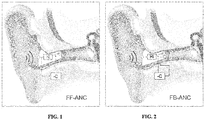
- FF ANC mechanism is schematically illustrated in FIG. 1 .
- the linear transfer function that represents the primary path from the outer microphone to the ear canal is known or calibrated. Typically, it mainly describes the acoustic path through a defined vent.
- the outer microphone signal can be matched in magnitude, inversed in phase, and played back through the loudspeaker in the ear canal.
- This phase-inversed signal can be added to the noise signal that enters the ear canal directly from outside.
- the noise signal can be reduced by the superposition of the two signals.
- FF-ANC the locations where the noise signal is sensed and reduced are different.
- the FF ANC mechanism can improve the intelligibility of speech by cancelling ambient noise before it reaches the ear canal of the user. Higher frequencies can help to improve speech intelligibility when making phone calls, for example.
- the second mechanism is a feed-back (FB) ANC, which is schematically illustrated in FIG. 2 .
- FB feed-back
- a microphone inside the ear canal e.g., located at the inner part of the ear piece next to the speaker
- the signal is played back from the loudspeaker with an inversed phase, which also results in noise reduction.
- FB-ANC the location where the noise signal is sensed and reduced is the same.
- Feedback systems usually have better performance at low frequencies ( ⁇ 100Hz) and do not reach the bandwidth of feed-forward systems.
- Feed-back systems can work up to 1 kHz and have a more flat ANC distribution with lower peak values.
- feed-forward systems show superior peak performances (typically up to 25dB) with a cone-shaped characteristic.
- both FF-ANC and FB-ANC run at the same time (so-called hybrid ANC).
- the performance of both mechanisms improves the overall ANC performance of the system.
- the hybrid ANC technology combines the advantages of the FF-ANC and FB-ANC systems. In some embodiments, it achieves ANC performance levels (>30dB) and widest bandwidth by having one ANC system compensate for the drawbacks of the other ANC system.
- the hybrid ANC systems can achieve superior ANC performance from 20Hz up to 3 kHz, which is not possible with a standalone feed-forward or feedback ANC system.
- Wind noise masks useful signals, such as speech for example, can interfere with the desired audio output, and can be annoyingly loud. Wind noise may reach magnitudes of 100 dB SPL (Sound Pressure Level) and higher. It is desirable that the wind noise level be reduced.
- Low-level wind noise (for example ⁇ 50 dB SPL) can be attenuated by a set amount (e.g., an amount between 6 dB and 12 dB), for example.
- Low-level wind noise can be attenuated by using an ANC system or by other methods, for example.
- the reduction due to ANC is typically in the range of 10 dB to 15 dB, and is independent from the intensity of wind noise level.
- the performed measurements indicate that, for many wind directions, FF-ANC has almost no effect (e.g., there is no difference between "ANC off” and "FF ANC").
- FF-ANC can even result in higher wind noise levels compared to the measurements with FF-ANC off.
- the performed measurements indicate that FB-ANC performance is not compromised by wind noise. This means that significant wind noise reduction can be achieved by using only FB-ANC or reduced FF-ANC.
- a method to operate a hearing device with active noise reduction technology in a windy environment can take advantage of the wind noise reduction when FB-ANC is active by continuously monitoring the acoustic environment for the presence of wind noise and situationally reducing or switching off the FF-ANC if wind noise is detected.
- FB-ANC is not switched off because its noise reduction performance is not affected by the turbulent nature of the wind.
- measured levels of noise with FF-ANC activated seem to always be higher or at least equal to the measured levels of noise with FF-ANC deactivated.
- the typical amplification of wind noise due to FF-ANC is in the range of 3 to 6 dB.
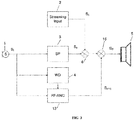
- FIG. 3 A schematic diagram of an example hearing device with an FF-ANC system configured to adapt to windy environments is illustrated in FIG. 3 .
- the hearing device can include an input microphone system 1 configured to capture an audio signal and convert the audio signal into an electrical input signal S I .
- the microphone system includes only one input microphone 1 in FIG. 3 , the microphone system can include either a single microphone or more than one input microphone and possibly other components for various reasons, some of which are described below.
- further receiving means for receiving signals may be present, such as a telecoil receiver, a receiving unit including an antenna for receiving wirelessly transmitted signals, etc.
- a streamed audio input signal S S (such as a phone call or music) can be received from a streaming input source 2 by a wired or wireless connection.
- the electrical input signal S I obtained from the input microphone 1 can be processed by a signal processor 3 to obtain an electrical output signal S O .
- a desired electrical input signal can be the electrical input signal S I obtained by the input microphone 1, the streamed audio input signal S S , or a mix of both input signals.
- the electrical output signal S O can be converted into an acoustic output signal by a receiver 5 and can be emitted into the remaining volume 7 between the user's eardrum and the in-the-ear-canal-component of the hearing device.
- the audio signal captured by the microphone system 1 can include a desired component and an undesired component, both of which may be included in the electrical input signal S I .
- the undesired component (“noise component”) may be ambient noise that compromises the quality of the desired component.
- the hearing device can further include an ANC circuitry 13 that can be configured to reduce the undesired component of the electrical signal and to provide the functionality of FF-ANC.
- the hearing device can further include a wind noise detector (“WD") 4 configured to determine a wind noise level present at the input microphone 1.
- Output from the wind noise detector (“WD") 4 can be provided to both the signal processor 3 and the ANC circuitry (e.g., compensation controller) 13, thereby situationally adapting the ANC circuitry 13 to provide and/or adjust the functionality of FF-ANC based on the detected wind noise level.
- the ANC circuitry e.g., compensation controller
- the input microphone 1 of the feed-forward ANC (FF ANC) topology circuit illustrated in FIG. 3 is arranged outside the ear canal (e.g., is located in the concha) and exposed to the exterior of the hearing device.
- the input microphone 1 is configured to sense and receive the audio signal, and convert the audio signal into the electrical input signal S I .
- the electrical input signal S I obtained from the input microphone 1 is fed to an auxiliary input of a compensation controller 13 where the noise component of the electrical input signal S I is processed by the compensation controller 13.
- the compensation controller 13 can filter the noise component of the electrical input signal S I , invert the noise component of the electrical input signal S I by generating a secondary wave with compressions and rarefactions equal in amplitude and 180 degree out of phase with the noise component of the electrical input signal S I , and then amplify the inverted signal S FFC .
- the amplified inverted signal S FFC can then be mixed at a mixer 15 (or summer) with the electrical output signal S O output by the signal processor 3, and the resulting compensated signal S C can be applied to the speaker 5 which can broadcast the resulting compensated signal S C into the ear canal, thereby substantially canceling the noise from the input microphone 1 before it reaches the ear canal of the user.
- an additional mixer 6 or summer can be added to the circuit illustrated in FIG. 3 to add the signals received from the signal processor 3 to the signals received from an external device, such as the streaming input source 2 or a communications network, for example.
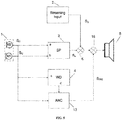
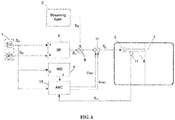
- FIG. 4 An example hearing device with a hybrid FF ANC and feed-back ANC (FB ANC) system is illustrated in FIG. 4 .
- the FB ANC topology circuit can use the same components as the ones described above for the feed-forward ANC circuit shown in FIG. 3 .
- the main difference is the location of a noise microphone 11, which is arranged inside the ear capsule.
- the hearing device can include a duct 8 that may be formed between the remaining volume 7 between the user's eardrum and the in-the-ear-canal-component of the hearing device, and the surrounding atmosphere.
- the duct 8 may be a vent of the in-the-ear-canal-component or it may be formed by the ear canal itself in the case of an open fitting.
- the receiver 5 can be configured to emit a compensation signal into the vent 8.
- the noise microphone 11 can be arranged inside the ear canal (e.g., can be located at the inner part of the ear piece next to the receiver 5) and configured to convert an acoustic signal in the portion of the vent 8, which is irradiated acoustically by the receiver 5, into an electrical noise signal S N .
- a compensation signal (or feedback canceling signal) S FBC that is fed to the receiver 5 can be obtained from the compensation controller 13 which can calculate the compensation signal from the electrical output signal S O .
- the electrical noise signal S N obtained from the noise microphone 11 can be fed to an auxiliary input of the compensation controller 13, where it can be processed by the compensation controller 13.
- the compensation controller 13 can filter the received electrical noise signal S N , invert the received electrical noise signal S N by generating a secondary wave with compressions and rarefactions equal in amplitude and 180 degree out of phase with the received electrical noise signal S N , and then amplify the inverted signal S FBC .
- the amplified inverted signal S FBC can be applied to the receiver 5 which can broadcast the compensation signal into the vent 8.
- the signal processor 3 may be a single digital signal processor or may be made up of different, potentially distributed processor units, preferably including at least one digital signal processor unit.
- the signal processor 3 can include one or more of a microprocessor, a microcontroller, a digital signal processor (DSP), an application specific integrated circuit (ASIC), a field-programmable gate array (FPGA), discrete logic circuitry, or the like.
- the signal processor 3 can further include memory and may store tables with predetermined values, ranges, and thresholds, as well as program instructions that cause the signal processor 3 to access the memory, execute the program instructions, and provide the functionality ascribed to it herein.
- the memory may include one or more volatile, nonvolatile, magnetic, optical, or electrical media, such as read-only memory (ROM), random access memory (RAM), electrically-erasable programmable ROM (EEPROM), flash memory, or the like.
- the signal processor 3 can further include one or more analog-to-digital (A/D) and digital-to- analog (D/A) converters for converting various analog inputs to the signal processor 3, such as analog input from the input and/or noise microphones 1 and 11, for example, in digital signals and for converting various digital outputs from the signal processor 3 to analog signals representing audible sound data which can be applied to the speaker 5, for example.
- A/D analog-to-digital
- D/A digital-to- analog
- the compensation controller 13 may be integrated with the signal processor 3 in a common unit, such as a digital signal processor, for example, which can potentially include analog signal processing and/or amplifying means. As an alternative, the compensation controller 13 may be a separate signal processor.
- the compensation controller 13 can include the functionality of an adaptive filter, for example. Signal processing parameters, such as filter coefficients of the adaptive filter, frequency-dependent gain settings, and parameters of the input sound data, etc., for example, can be adjusted based on the signals captured by the input microphone 1 and the noise microphone 11. Signal processing parameters, such as filter coefficients of the adaptive filter, for example can be stored in the memory of the signal processor 3 or in a separate memory of the compensation controller 13, if the compensation controller 13 is provided as a separate signal processor.
- the input signal of the adaptive filter can be the hearing device's desired electrical output signal S O shown in FIG. 3 and FIG. 4 .
- the electrical output signal S O can be filtered with a simulation of the error path and can used, together with the electrical input signal S I and the electrical noise signal S N of the input microphone 1 and the noise microphone 11, respectively, as an input for the adaptation of the filter coefficients.
- Alternative implementations of the compensation controller 13 based on principles other than adaptive filtering are possible.
- a signal processing structure can be adjusted based on the signal recorded by the input microphone 1 and the noise microphone 11.
- the compensation signal may be switched off if the desired signal is below a certain level, or different filtering methods may be chosen depending on the nature and/or dynamics of the incident acoustic signal, such as when wind noise is present, for example.
- These different signal processing structures can be stored in the memory of the signal processor 3 or in a separate memory of the compensation controller 13, if the compensation controller 13 is provided as a separate signal processor.
- the compensation controller 13 can be configured to make an adjustment to the feed-forward ANC compensation signal in response to receiving an external control signal that may be provided by another component coupled to the compensation controller 13, such as the wind detecting circuitry described herein, for example.
- the hearing device includes a wind noise detector (“WD") 4 configured to determine a wind noise level present at the input microphone 1.
- Wind noise can be detected and wind noise level can be estimated by various methods, some of which are described in US patent 9,456,286 and European patents EP 1 339 256 A2 and EP 1 519 626 A2 , for example, the entire contents of which are incorporated herein by reference. Briefly, wind noise can be detected based on a signal from a single microphone or by using two microphones, for example. Noise caused by air moving past the microphone or microphones, that is "wind”, can have a characteristic noise pattern or can reach an amplitude above a certain threshold such that the noise is deemed "wind noise”.
- wind noise can be detected based on comparing a value of a cross-correlation function against a predetermined threshold. If that value is lower than the threshold, wind noise is detected. Otherwise, the noise from wind can be assumed to be of very low amplitude or practically absent and, therefore, not deemed to be "wind noise".
- One method for detecting wind noise compares the output signals of two microphones.
- European patents EP 1 339 256 A2 and EP 1 519 626 A2 describe using frequency cues and/or correlation features between two microphone signals of a hearing device. A low correlation/coherence of the output signals of the two microphones can be an indicator of presence of wind noise.
- the microphone system 1 can include a pair of microphones M1 and M2.
- the microphones M1 and M2 may be spaced at a certain distance apart from each other to allow for an energy level difference between them.
- the signal from the microphone M1 can be applied to the wind noise detector ("WD") 4 to determine a wind noise level present at the hearing device.
- Wind noise estimation can, for example, be based on the amount of low frequency energy detected in the signal from the microphone M1.
- a Bayesian statistical estimation scheme may be used where the probability ratio between the probability that there is wind and the probability of a windless condition is computed. For the latter purpose, it is assumed that both conditions (i.e., wind vs. no wind) arise with a Gaussian probability distribution having the same variance but different mean values.
- Both training data and fine tuning can be used to estimate beforehand the variance and the two mean values in order to achieve an appropriate estimation of the wind noise level.
- the microphone system including two microphones can be the outer microphone 1 and an inner microphone, such as the ear-canal microphone 11, shown in FIG. 4 , for example.
- the outer microphone 1 and the ear-canal microphone 11 may be spaced at a certain distance apart from each other to allow for an energy level difference between them.
- the signal from the outer microphone 1 can be applied to the wind noise detector ("WD") 4 to determine a wind noise level present at the hearing device.
- Wind noise estimation can, for example, be based on the amount of low frequency energy detected in the signal from the outer microphone 1.
- the signals from the two microphones M1 and M2 can first be provided to the signal processor 3 (via the inputs a, b) where beamforming can be applied, which can result in a single beamformed signal.
- the beamformed signal can then be applied to the wind noise detector (“WD") 4 to determine the wind noise level present at the hearing device.
- WD wind noise detector
- Wind noise can be detected by monitoring the coherence between the two microphones M1 and M2, for example.
- An omnidirectional signal for example, from the microphone M1 as well as the beamformed signal (from the signal processor 3) can both be applied to the wind noise detector ("WD") 4, after which the wind noise detector (“WD”) 4 can determine the coherence between the two signals, thus yielding a measure of the wind noise level.
- a level of coherence may be determined between corresponding sub-bands of the two microphones M1 and M2. If there is a significant energy level difference, in particular in lower frequency sub-bands, the microphone acoustic signal sub-band with a higher energy level may likely have wind noise. When one of multiple microphone acoustic signals is characterized as having wind noise present, the sub-band containing the wind noise or the entire frame of the acoustic signal containing the wind noise may be discarded for the frame.
- the wind noise detection may include detection based on two-channel features (such as coherence) and independent one-channel detection, to decide which subset of the set of the microphones M1 and M2 is contaminated with wind noise.
- acoustic signals received from the microphone M1 and the microphone M2 can be converted to electrical signals, which can be processed through a frequency analysis circuit that may be part of the signal processor 3 shown in FIG. 5 , for example.
- the frequency analysis circuit can receive acoustic signals and may mimic the frequency analysis of the cochlea (e.g., cochlea domain), simulated by a filter bank.
- the frequency analysis circuit can separate each of the acoustic signals from the microphones M1 and M2 into two or more frequency sub-band signals.
- the frequency analysis circuit may generate cochlea domain frequency sub-bands or frequency sub-bands in other frequency domains, for example sub-bands that cover a larger range of frequencies.
- a sub-band signal can be the result of a filtering operation of an input signal, where the bandwidth of the filter is narrower than the bandwidth of the signal received by the frequency analysis circuit.
- the filter bank may be implemented by a series of cascaded, complex-valued, first-order Infinite Impulse Response (IIR) filters.
- IIR Infinite Impulse Response
- other filters such as the short-time Fourier transform (STFT), sub-band filter banks, modulated complex lapped transforms, cochlear models, wavelets, etc., can be used for the frequency analysis and synthesis.
- the samples of the frequency sub-band signals may be grouped sequentially into time frames (e.g., over a predetermined period of time), such as 4 ms, 8 ms, or some other length of time, for example.
- the sub-band frame signals can be provided from the frequency analysis circuit to a feature extraction circuit.
- the feature extraction circuit can compute frame energy estimations of the sub-band signals and inter-microphone level differences (ILD) between the acoustic signals from the microphones M1 and M2.
- the calculated frame energy estimations can be used by the wind noise detector ("WD") 4 to determine whether the acoustic signals from the microphones M1 and M2 include wind noise.
- WD wind noise detector
- the presence of wind noise can be detected using only the outer microphone 1.
- Methods using a single outer microphone consider several wind noise properties, such as high magnitudes, low auto-correlation, and energy content at very low frequencies.
- One such method is disclosed in EP 1339256 A2 , for example.
- the presence of wind noise can be detected by monitoring the ratio between low-frequency energy and high-frequency energy of the output signal from the outer microphone 1.
- the determined wind noise level can be sent from the wind noise detector ("WD") 4 to the ANC circuitry 13.
- the determined wind noise presence or level can be used by the ANC circuitry 13 to selectively provide and/or adjust the feed-forward (FF) compensating signal S FFC of the ANC circuitry 13 based on the detected wind presence and/or wind noise level.
- FF feed-forward
- the determined wind noise level can be sent from the wind noise detector ("WD") 4 to the ANC circuitry 13.
- the determined wind noise presence or level can be used by the ANC circuitry 13 to selectively provide and/or adjust the feed-forward (FF) compensating signal S FFC and/or the feed-back (FB) compensation signal S FBC of the ANC circuitry 13 based on the detected wind presence and/or wind noise level.
- FF feed-forward
- FB feed-back
- signal processing parameters such as filter coefficients of the adaptive filter, which may be stored in advance in the memory of the signal processor 3 or in a separate memory of the compensation controller 13, if the compensation controller 13 is provided as a separate signal processor, can be used by the signal processor 3 or by the compensation controller 13 to activate the feed-forward or feed-back ANC compensation circuit, or to adjust the feed-forward and feed-back ANC compensation signals S FFC and S FBC , for example.
- the feed-forward compensation signal S FFC may be turned off and the ANC compensation controller 13 may be configured to provide only the feed-back compensation signal S FBC .
- the level of the feed-forward compensation signal S FFC when wind noise is present, may be substantially turned off.
- substantially turned off in this context means reducing the level of the feed-forward compensation signal S FFC to a low enough level at which the feed-forward compensation signal S FFC does not make a contribution perceptible to the user.
- the ANC compensation controller 13 can be configured to make an adjustment to the feed-forward compensation signal S FFC in response to receiving an external control signal from the wind detector ("WD") 4, indicating that wind noise or a certain level of wind noise has been detected.
- WD wind detector
- the level of the feed-forward compensation signal S FFC may be reduced below a predetermined level.
- the predetermined level of the feed-forward compensation signal S FFC may be stored in advance in the memory of the signal processor 3 or in a separate memory of the compensation controller 13, if the compensation controller 13 is provided as a separate signal processor.
- the level of the feed-forward compensation signal S FFC when wind noise is present, may be substantially reduced.
- substantially reduced in this context means reducing the level of the feed-forward compensation signal S FFC to a level at which the performance of the FF-ANC path of the ANC system is still operational, but not detrimental, i.e., the feed-forward compensation signal S FFC continues to reduce the ambient noise and does not amplify the wind noise.
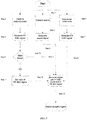
- FIG. 7 is a flowchart illustrating a method for operating a hearing device comprising with an active noise control (ANC) system in windy environments.
- the numbering of the steps in FIG. 7 does not necessarily represent the order of the steps. As shown in FIG. 7 , some of the steps may be performed in a different order or in parallel, for example.
- the method begins when sound is captured with a microphone system 1.
- the microphone system 1 can include two microphones M1 and M2, for example.
- capturing audio includes capturing sound that a user may desire to hear.
- Step 2 a sound signal is generated from the captured sound.
- the generated sound signal can be the electrical output signal S O from the input microphone 1 processed by the signal processor 3, as illustrated and described with reference to Figs. 3-6 above.
- the generated sound signal is provided as input to the mixer 15, where it may be mixed with the generated feed-forward (FF) compensating signal and/or with the generated feed-back (FB) compensating signal as discussed below for Steps 8, 10, and 12.
- FF feed-forward
- FB generated feed-back
- capturing audio includes the input microphone system 1 capturing ambient noise.
- the ANC compensation controller 13 generates a feed-forward (FF) compensating signal based on the ambient noise.
- an ear noise microphone 11 captures an ear-canal noise.
- the ANC compensation controller 13 generates a feed-back (FB) compensating signal.
- Step 8 the generated a feed-back (FB) compensating signal is mixed with the electrical output signal S O from the input microphone 1 processed by the signal processor 3, and, in Step 13, the resulting compensated signal is provided as an acoustic output signal to the receiver 5 which can broadcast the resulting compensated signal into the user's ear canal, thereby substantially canceling the noise from the ear noise microphone 11.
- FB feed-back
- the wind noise detector (“WD”) 4 monitors the acoustic environment of the hearing device for presence of wind noise.
- the wind noise detector (“WD") 4 can send a control signal to the ANC compensation controller 13 and to the signal processor 3 to send the electrical output signal S O from the input microphone 1 and the generated feed-forward (FF) compensating signal (without reduction, adjustment, or weighting), respectively, to the mixer 15 (shown in Figs. 3-6 ) where the electrical output signal S O and the generated feed-forward (FF) compensating signal can be mixed to produce a compensated output signal S C .
- the wind noise detector (“WD") 4 detects the presence of wind noise (path "YES")
- the wind noise detector (“WD") 4 sends a control signal to the ANC compensation controller 13 to set a ratio of the feed-forward (FF) compensating signal to the sound signal.
- the ratio of the feed-forward (FF) compensating signal to the sound signal can be set depending on whether wind noise is detected.
- the ratio of the feed-forward (FF) compensating signal to the sound signal can be set by the ANC compensation controller 13 (by setting the output level) or by the mixer 15 (by weighting some or all of the input signals from the ANC compensation controller 13 and the signal processor 3).
- the ANC compensation controller 13 can set the output level of (e.g., adjust) the feed-forward (FF) compensating signal before the feed-forward (FF) compensating signal is mixed with the electrical output signal S o from the input microphone 1 (as described with reference to Step 13 below).
- the output level of the feed-forward (FF) compensating signal can vary depending on how much wind noise is detected by the wind noise detector ("WD") 4.
- the ANC compensation controller 13 can reduce the output level of the feed-forward (FF) compensating signal before mixing the feed-forward (FF) compensating signal with the electrical output signal S o from the input microphone 1.
- the wind noise detector (“WD") 4 can send a control signal to the ANC compensation controller 13 to set the ratio of the feed-forward (FF) compensating signal to the sound signal by turning off (that is by not generating at all) the feed-forward (FF) compensating signal.
- the ANC system can be simplified by turning off feed-forward (FF) compensating signal completely, as opposed to reducing the feed-forward (FF) compensating signal below a threshold, as described with reference to Step 11 below.
- the ratio of the feed-forward (FF) compensating signal to the sound signal can be set by the mixer 15.
- the mixer 15 can weight the feed-forward (FF) compensating signal generated by the ANC compensation controller 13 relative to the audio signal in proportion to the captured sound signal, the detected wind noise, the desired ambient noise reduction, and the desired wind noise reduction, for example.
- the mixer 15 can then mix the electrical output signal S o from the input microphone 1 with the weighted feed-forward (FF) compensating signal and/or with the generated feed-back (FB) compensating signal.
- the mixer 15 can output the resulting mixed compensated signal S C as an acoustic output signal to the receiver 5 which can broadcast the resulting compensated signal into the user's ear canal.
- the ANC compensation controller 13 can reduce the output level of the feed-forward (FF) compensating signal when the wind noise detector detects the presence of wind noise.
- the ANC compensation controller 13 can periodically check whether the output level of the reduced feed-forward (FF) compensating signal is below a predetermined threshold FF ANC Max , for example.
- One or more predetermined thresholds FF ANC Max for the output level of the feed-forward compensation signal S FFC may be stored in advance in the memory of the signal processor 3 or in a separate memory of the compensation controller 13, if the compensation controller 13 is provided as a separate signal processor.
- the predetermined threshold FF ANC Max for the output level of the feed-forward compensation signal S FFC can correspond to a level at which the performance of the FF-ANC path of the ANC system is still operational, but not detrimental, i.e., the feed-forward compensation signal S FFC continues to reduce the ambient noise and does not amplify the wind noise.
- the wind noise detector (“WD") 4 can send a control signal to the ANC compensation controller 13 to turn off the feed-forward (FF) compensating signal to set the ratio of the feed-forward (FF) compensating signal to the sound signal by turning off (that is by not generating at all) the feed-forward (FF) compensating signal.
- the ANC system can be simplified by turning off feed-forward (FF) compensating signal completely, as opposed to reducing the output level of the feed-forward (FF) compensating signal below the threshold FF ANC Max .
- the ANC compensation controller 13 can set the ratio of the feed-forward (FF) compensating signal to the sound signal to be zero (i.e., no feed-forward (FF) compensating signal will be mixed with the electrical output signal S o ). This may be done, for example, by setting the output level of the FF compensating signal from the ANC compensation controller 13 to zero. Alternatively, the ANC compensation controller 13 can set the output level of the FF compensating signal to zero by not generating an FF compensating signal (i.e., no feed-forward (FF) compensating signal will be mixed with the electrical output signal S o ).
- FF feed-forward
- the ANC compensation controller 13 can continue to reduce the feed-forward (FF) compensating signal.
- the reduced feed-forward (FF) compensating signal can be mixed, at the mixer 15, with the electrical output signal S o from the input microphone 1 processed by the signal processor 3 and/or with the generated feed-back (FB) compensating signal, and, in Step 13, the resulting compensated signal can be provided as an acoustic output signal to the receiver 5 which can broadcast the resulting compensated signal into the user's ear canal, thereby substantially canceling the noise from the input microphone 1.
- the mixer 15 can weight the feed-forward (FF) compensating signal generated by the ANC compensation controller 13 relative to the audio signal in proportion to some or all of the input signals to the ANC compensation controller 13 and the signal processor 3, such as the captured sound signal, the detected wind noise, the desired ambient noise reduction, and the desired wind noise reduction, for example.
- the FF compensating signal can be given a lower weight than the audio signal when the wind noise detector detects the presence of wind noise.
- the mixer 15 can then mix the electrical output signal S o from the input microphone 1 with the weighted feed-forward (FF) compensating signal and/or with the generated feed-back (FB) compensating signal.
- the mixer 15 can set the weighting of the feed-forward (FF) compensating signal generated by the ANC compensation controller 13 to be zero (i.e., no feed-forward (FF) compensating signal will be mixed with the electrical output signal S o ).
- Step 13 the mixer 15 can output the resulting mixed compensated signal as an acoustic output signal to the receiver 5 which can broadcast the resulting compensated signal into the user's ear canal.
- the ANC compensation controller 13 can continue to generate the feed-back (FB) compensating signal.
- the ANC compensation controller 13 continuously generates the feed-back (FB) compensating signal while the output level of the feed-forward (FF) compensating signal is being reduced or while the generated FF compensating signal is being given a lower weight than the first audio signal while the FF compensating signal is being mixed with the audio signal.
- FB feed-back
- FF feed-forward
- the ANC compensation controller 13 can continuously generate the feed-back (FB) compensating signal without reducing the feed-back (FB) compensating signal or without giving the feed-back (FB) compensating signal a lower weight than the first audio signal while the output level of the feed-forward (FF) compensating signal is being reduced or while the generated FF compensating signal is being given a lower weight than the first audio signal while the FF compensating signal is being mixed with the audio signal.
- FB feed-back
- FF feed-forward
Landscapes
- Engineering & Computer Science (AREA)
- Acoustics & Sound (AREA)
- Physics & Mathematics (AREA)
- Multimedia (AREA)
- Signal Processing (AREA)
- Health & Medical Sciences (AREA)
- Otolaryngology (AREA)
- Neurosurgery (AREA)
- General Health & Medical Sciences (AREA)
- Computational Linguistics (AREA)
- Quality & Reliability (AREA)
- Audiology, Speech & Language Pathology (AREA)
- Human Computer Interaction (AREA)
- Circuit For Audible Band Transducer (AREA)
- Soundproofing, Sound Blocking, And Sound Damping (AREA)
Applications Claiming Priority (1)
| Application Number | Priority Date | Filing Date | Title |
|---|---|---|---|
| US16/369,901 US10586523B1 (en) | 2019-03-29 | 2019-03-29 | Hearing device with active noise control based on wind noise |
Publications (1)
| Publication Number | Publication Date |
|---|---|
| EP3716652A1 true EP3716652A1 (fr) | 2020-09-30 |
Family
ID=69528701
Family Applications (1)
| Application Number | Title | Priority Date | Filing Date |
|---|---|---|---|
| EP20156331.9A Withdrawn EP3716652A1 (fr) | 2019-03-29 | 2020-02-10 | Dispositif d'aide auditive avec contrôle actif du bruit basé sur le bruit du vent |
Country Status (5)
| Country | Link |
|---|---|
| US (1) | US10586523B1 (fr) |
| EP (1) | EP3716652A1 (fr) |
| CN (1) | CN111757231A (fr) |
| AU (1) | AU2020200560A1 (fr) |
| CA (1) | CA3069085A1 (fr) |
Cited By (2)
| Publication number | Priority date | Publication date | Assignee | Title |
|---|---|---|---|---|
| EP4210350A4 (fr) * | 2021-11-19 | 2023-12-13 | Shenzhen Shokz Co., Ltd. | Appareil acoustique ouvert |
| DK202270529A1 (en) * | 2022-10-31 | 2024-06-14 | Lizn Aps | Speech enhancement with active masking control |
Families Citing this family (14)
| Publication number | Priority date | Publication date | Assignee | Title |
|---|---|---|---|---|
| DK180471B1 (en) * | 2019-04-03 | 2021-05-06 | Gn Audio As | Headset with active noise cancellation |
| US11304001B2 (en) * | 2019-06-13 | 2022-04-12 | Apple Inc. | Speaker emulation of a microphone for wind detection |
| WO2021225100A1 (fr) * | 2020-05-07 | 2021-11-11 | ソニーグループ株式会社 | Dispositif de traitement de signal, programme de traitement de signal et procédé de traitement de signal |
| CN114501211B (zh) * | 2020-11-13 | 2025-08-29 | 炬芯科技股份有限公司 | 具有丽音通透性的主动降噪电路、方法、设备及存储介质 |
| CN112584266B (zh) * | 2020-11-23 | 2023-02-21 | 出门问问信息科技有限公司 | 一种信号处理方法、装置及耳机 |
| US11468875B2 (en) | 2020-12-15 | 2022-10-11 | Google Llc | Ambient detector for dual mode ANC |
| JP7814008B2 (ja) * | 2020-12-25 | 2026-02-16 | パナソニックIpマネジメント株式会社 | イヤフォンおよびイヤフォン制御方法 |
| CN114697783B (zh) * | 2020-12-25 | 2024-11-26 | 小鸟创新(北京)科技有限公司 | 耳机风噪识别方法及装置 |
| US11682411B2 (en) | 2021-08-31 | 2023-06-20 | Spotify Ab | Wind noise suppresor |
| CN115394275A (zh) * | 2021-12-23 | 2022-11-25 | 深圳市大十科技有限公司 | 一种可阻隔外部高声压级能量的听力保护方法 |
| CN115767367B (zh) * | 2022-11-29 | 2026-04-17 | 歌尔股份有限公司 | 一种改变音箱箱体结构形态的方法及音箱 |
| EP4440145A1 (fr) * | 2023-03-27 | 2024-10-02 | Sonova AG | Système auditif comprenant au moins un dispositif auditif |
| WO2025077750A1 (fr) * | 2023-10-10 | 2025-04-17 | 深圳市大十未来科技有限公司 | Structure d'écouteur comprenant une fonction d'annulation de bruit du vent et écouteur |
| US20250168572A1 (en) | 2023-11-21 | 2025-05-22 | Oticon A/S | Hearing device with active noise cancellation |
Citations (8)
| Publication number | Priority date | Publication date | Assignee | Title |
|---|---|---|---|---|
| EP1339256A2 (fr) | 2003-03-03 | 2003-08-27 | Phonak Ag | Procédé pour la fabrication des dispositifs acoustiques et pour la réduction des perturbations dues au vent |
| EP1519626A2 (fr) | 2004-12-07 | 2005-03-30 | Phonak Ag | Procédé et dispositif pour le traitement d'un signal acoustique |
| US9456286B2 (en) | 2012-09-28 | 2016-09-27 | Sonova Ag | Method for operating a binaural hearing system and binaural hearing system |
| EP3107312A1 (fr) * | 2014-12-31 | 2016-12-21 | Goertek Inc. | Casque d'écoute à réduction active du bruit, et procédé et système de commande de réduction du bruit appliqués à un casque d'écoute |
| US20170194020A1 (en) * | 2015-12-30 | 2017-07-06 | Knowles Electronics Llc | Voice-Enhanced Awareness Mode |
| US20180249266A1 (en) * | 2017-02-24 | 2018-08-30 | Bose Corporation | Off-head detection of in-ear headset |
| US20190069074A1 (en) * | 2017-08-31 | 2019-02-28 | Bose Corporation | Wind noise mitigation in active noise cancelling headphone system and method |
| US20190088245A1 (en) * | 2017-09-20 | 2019-03-21 | Bose Corporation | Parallel Active Noise Reduction (ANR) and Hear-Through Signal Flow Paths in Acoustic Devices |
Family Cites Families (12)
| Publication number | Priority date | Publication date | Assignee | Title |
|---|---|---|---|---|
| CN1886104A (zh) | 2003-11-26 | 2006-12-27 | 加利福尼亚大学董事会 | 有源噪声控制方法以及包含前馈和反馈控制器的设备 |
| DK1750483T3 (da) * | 2005-08-02 | 2011-02-21 | Gn Resound As | Høreapparat med vindstøjsundertrykkelse |
| EP2535891B1 (fr) | 2009-04-28 | 2013-07-31 | Bose Corporation | Réalisation de registres dans un circuit de réduction active de bruit |
| US8073151B2 (en) | 2009-04-28 | 2011-12-06 | Bose Corporation | Dynamically configurable ANR filter block topology |
| US8208650B2 (en) | 2009-04-28 | 2012-06-26 | Bose Corporation | Feedback-based ANR adjustment responsive to environmental noise levels |
| EP2574078B1 (fr) | 2009-04-28 | 2018-01-24 | Bose Corporation | Circuit du réduction active du bruit dynamiquement configurable et appareil personnel comprenant ce circuit |
| US8073150B2 (en) | 2009-04-28 | 2011-12-06 | Bose Corporation | Dynamically configurable ANR signal processing topology |
| US8532310B2 (en) | 2010-03-30 | 2013-09-10 | Bose Corporation | Frequency-dependent ANR reference sound compression |
| DE102010012941A1 (de) | 2010-03-26 | 2011-04-07 | Siemens Medical Instruments Pte. Ltd. | Verfahren und Hörgerät zur Windgeräuscherkennung |
| US9020160B2 (en) | 2012-11-02 | 2015-04-28 | Bose Corporation | Reducing occlusion effect in ANR headphones |
| FR3044197A1 (fr) | 2015-11-19 | 2017-05-26 | Parrot | Casque audio a controle actif de bruit, controle anti-occlusion et annulation de l'attenuation passive, en fonction de la presence ou de l'absence d'une activite vocale de l'utilisateur de casque. |
| US9949017B2 (en) * | 2015-11-24 | 2018-04-17 | Bose Corporation | Controlling ambient sound volume |
-
2019
- 2019-03-29 US US16/369,901 patent/US10586523B1/en active Active
-
2020
- 2020-01-21 CA CA3069085A patent/CA3069085A1/fr active Pending
- 2020-01-24 AU AU2020200560A patent/AU2020200560A1/en not_active Abandoned
- 2020-02-10 EP EP20156331.9A patent/EP3716652A1/fr not_active Withdrawn
- 2020-02-14 CN CN202010092136.5A patent/CN111757231A/zh active Pending
Patent Citations (8)
| Publication number | Priority date | Publication date | Assignee | Title |
|---|---|---|---|---|
| EP1339256A2 (fr) | 2003-03-03 | 2003-08-27 | Phonak Ag | Procédé pour la fabrication des dispositifs acoustiques et pour la réduction des perturbations dues au vent |
| EP1519626A2 (fr) | 2004-12-07 | 2005-03-30 | Phonak Ag | Procédé et dispositif pour le traitement d'un signal acoustique |
| US9456286B2 (en) | 2012-09-28 | 2016-09-27 | Sonova Ag | Method for operating a binaural hearing system and binaural hearing system |
| EP3107312A1 (fr) * | 2014-12-31 | 2016-12-21 | Goertek Inc. | Casque d'écoute à réduction active du bruit, et procédé et système de commande de réduction du bruit appliqués à un casque d'écoute |
| US20170194020A1 (en) * | 2015-12-30 | 2017-07-06 | Knowles Electronics Llc | Voice-Enhanced Awareness Mode |
| US20180249266A1 (en) * | 2017-02-24 | 2018-08-30 | Bose Corporation | Off-head detection of in-ear headset |
| US20190069074A1 (en) * | 2017-08-31 | 2019-02-28 | Bose Corporation | Wind noise mitigation in active noise cancelling headphone system and method |
| US20190088245A1 (en) * | 2017-09-20 | 2019-03-21 | Bose Corporation | Parallel Active Noise Reduction (ANR) and Hear-Through Signal Flow Paths in Acoustic Devices |
Cited By (3)
| Publication number | Priority date | Publication date | Assignee | Title |
|---|---|---|---|---|
| EP4210350A4 (fr) * | 2021-11-19 | 2023-12-13 | Shenzhen Shokz Co., Ltd. | Appareil acoustique ouvert |
| US12262167B2 (en) | 2021-11-19 | 2025-03-25 | Shenzhen Shokz Co., Ltd. | Open acoustic device |
| DK202270529A1 (en) * | 2022-10-31 | 2024-06-14 | Lizn Aps | Speech enhancement with active masking control |
Also Published As
| Publication number | Publication date |
|---|---|
| AU2020200560A1 (en) | 2020-10-15 |
| US10586523B1 (en) | 2020-03-10 |
| CN111757231A (zh) | 2020-10-09 |
| CA3069085A1 (fr) | 2020-09-29 |
Similar Documents
| Publication | Publication Date | Title |
|---|---|---|
| US10586523B1 (en) | Hearing device with active noise control based on wind noise | |
| EP3005731B2 (fr) | Procédé de fonctionnement d'un dispositif auditif et dispositif auditif | |
| CN110662152B (zh) | 双耳主动阻塞消除的双耳听力设备系统 | |
| US8855343B2 (en) | Method and device to maintain audio content level reproduction | |
| US10327071B2 (en) | Head-wearable hearing device | |
| US8229127B2 (en) | Active noise cancellation in hearing devices | |
| US7483831B2 (en) | Methods and apparatus for maximizing speech intelligibility in quiet or noisy backgrounds | |
| EP2106163B1 (fr) | Appareil et procédé pour la détection dynamique et pour l'atténuation de la rétroaction acoustique périodique | |
| US20140093094A1 (en) | Method and device for personalized voice operated control | |
| WO2009136953A1 (fr) | Procédé et dispositif destinés au contrôle de la gestion acoustique de microphones multiples | |
| WO2008137870A1 (fr) | Procédé et dispositif de contrôle de gestion acoustique de multiples microphones | |
| US8693717B2 (en) | Method for compensating for an interference sound in a hearing apparatus, hearing apparatus, and method for adjusting a hearing apparatus | |
| US10966032B2 (en) | Hearing apparatus with a facility for reducing a microphone noise and method for reducing microphone noise | |
| Kumar et al. | Acoustic Feedback Noise Cancellation in Hearing Aids Using Adaptive Filter | |
| US20220210581A1 (en) | Hearing aid comprising a feedback control system | |
| CN115702789A (zh) | 用于借助听力仪器创建被测试人员的听力图的方法 | |
| AU2006200957A1 (en) | Hearing device and method for wind noise supression | |
| JP2004048207A (ja) | 補聴装置 | |
| CN113709644A (zh) | 用于运行听力设备的方法和听力设备 | |
| US12250521B2 (en) | Method for operating a hearing instrument and hearing instrument | |
| Ngo | Digital signal processing algorithms for noise reduction, dynamic range compression, and feedback cancellation in hearing aids |
Legal Events
| Date | Code | Title | Description |
|---|---|---|---|
| PUAI | Public reference made under article 153(3) epc to a published international application that has entered the european phase |
Free format text: ORIGINAL CODE: 0009012 |
|
| STAA | Information on the status of an ep patent application or granted ep patent |
Free format text: STATUS: THE APPLICATION HAS BEEN PUBLISHED |
|
| AK | Designated contracting states |
Kind code of ref document: A1 Designated state(s): AL AT BE BG CH CY CZ DE DK EE ES FI FR GB GR HR HU IE IS IT LI LT LU LV MC MK MT NL NO PL PT RO RS SE SI SK SM TR |
|
| AX | Request for extension of the european patent |
Extension state: BA ME |
|
| STAA | Information on the status of an ep patent application or granted ep patent |
Free format text: STATUS: THE APPLICATION IS DEEMED TO BE WITHDRAWN |
|
| 18D | Application deemed to be withdrawn |
Effective date: 20210331 |