EP3718573A1 - Points polymères chromophores à émission à bande étroite - Google Patents
Points polymères chromophores à émission à bande étroite Download PDFInfo
- Publication number
- EP3718573A1 EP3718573A1 EP20166712.8A EP20166712A EP3718573A1 EP 3718573 A1 EP3718573 A1 EP 3718573A1 EP 20166712 A EP20166712 A EP 20166712A EP 3718573 A1 EP3718573 A1 EP 3718573A1
- Authority
- EP
- European Patent Office
- Prior art keywords
- alkyl
- substituted
- narrow
- polymer
- band
- Prior art date
- Legal status (The legal status is an assumption and is not a legal conclusion. Google has not performed a legal analysis and makes no representation as to the accuracy of the status listed.)
- Pending
Links
- 0 **1(*)*2=C(*)c3ccccc3C2=C(*)C2=C(C=CC=C3)C3=C(*)*12 Chemical compound **1(*)*2=C(*)c3ccccc3C2=C(*)C2=C(C=CC=C3)C3=C(*)*12 0.000 description 18
- RWGFKTVRMDUZSP-UHFFFAOYSA-N CC(C)c1ccccc1 Chemical compound CC(C)c1ccccc1 RWGFKTVRMDUZSP-UHFFFAOYSA-N 0.000 description 1
- IFTRQJLVEBNKJK-UHFFFAOYSA-N CCC1CCCC1 Chemical compound CCC1CCCC1 IFTRQJLVEBNKJK-UHFFFAOYSA-N 0.000 description 1
Images














































Classifications
-
- A—HUMAN NECESSITIES
- A61—MEDICAL OR VETERINARY SCIENCE; HYGIENE
- A61K—PREPARATIONS FOR MEDICAL, DENTAL OR TOILETRY PURPOSES
- A61K49/00—Preparations for testing in vivo
- A61K49/001—Preparation for luminescence or biological staining
- A61K49/0013—Luminescence
- A61K49/0017—Fluorescence in vivo
- A61K49/0019—Fluorescence in vivo characterised by the fluorescent group, e.g. oligomeric, polymeric or dendritic molecules
-
- C—CHEMISTRY; METALLURGY
- C08—ORGANIC MACROMOLECULAR COMPOUNDS; THEIR PREPARATION OR CHEMICAL WORKING-UP; COMPOSITIONS BASED THEREON
- C08G—MACROMOLECULAR COMPOUNDS OBTAINED OTHERWISE THAN BY REACTIONS ONLY INVOLVING UNSATURATED CARBON-TO-CARBON BONDS
- C08G75/00—Macromolecular compounds obtained by reactions forming a linkage containing sulfur with or without nitrogen, oxygen, or carbon in the main chain of the macromolecule
- C08G75/32—Polythiazoles; Polythiadiazoles
-
- A—HUMAN NECESSITIES
- A61—MEDICAL OR VETERINARY SCIENCE; HYGIENE
- A61K—PREPARATIONS FOR MEDICAL, DENTAL OR TOILETRY PURPOSES
- A61K49/00—Preparations for testing in vivo
- A61K49/001—Preparation for luminescence or biological staining
- A61K49/0063—Preparation for luminescence or biological staining characterised by a special physical or galenical form, e.g. emulsions, microspheres
- A61K49/0065—Preparation for luminescence or biological staining characterised by a special physical or galenical form, e.g. emulsions, microspheres the luminescent/fluorescent agent having itself a special physical form, e.g. gold nanoparticle
- A61K49/0067—Preparation for luminescence or biological staining characterised by a special physical or galenical form, e.g. emulsions, microspheres the luminescent/fluorescent agent having itself a special physical form, e.g. gold nanoparticle quantum dots, fluorescent nanocrystals
-
- C—CHEMISTRY; METALLURGY
- C08—ORGANIC MACROMOLECULAR COMPOUNDS; THEIR PREPARATION OR CHEMICAL WORKING-UP; COMPOSITIONS BASED THEREON
- C08G—MACROMOLECULAR COMPOUNDS OBTAINED OTHERWISE THAN BY REACTIONS ONLY INVOLVING UNSATURATED CARBON-TO-CARBON BONDS
- C08G79/00—Macromolecular compounds obtained by reactions forming a linkage containing atoms other than silicon, sulfur, nitrogen, oxygen, and carbon with or without the latter elements in the main chain of the macromolecule
-
- C—CHEMISTRY; METALLURGY
- C09—DYES; PAINTS; POLISHES; NATURAL RESINS; ADHESIVES; COMPOSITIONS NOT OTHERWISE PROVIDED FOR; APPLICATIONS OF MATERIALS NOT OTHERWISE PROVIDED FOR
- C09B—ORGANIC DYES OR CLOSELY-RELATED COMPOUNDS FOR PRODUCING DYES, e.g. PIGMENTS; MORDANTS; LAKES
- C09B69/00—Dyes not provided for by a single group of this subclass
- C09B69/10—Polymeric dyes; Reaction products of dyes with monomers or with macromolecular compounds
- C09B69/105—Polymeric dyes; Reaction products of dyes with monomers or with macromolecular compounds containing a methine or polymethine dye
-
- G—PHYSICS
- G01—MEASURING; TESTING
- G01N—INVESTIGATING OR ANALYSING MATERIALS BY DETERMINING THEIR CHEMICAL OR PHYSICAL PROPERTIES
- G01N33/00—Investigating or analysing materials by specific methods not covered by groups G01N1/00 - G01N31/00
- G01N33/48—Biological material, e.g. blood, urine; Haemocytometers
- G01N33/50—Chemical analysis of biological material, e.g. blood, urine; Testing involving biospecific ligand binding methods; Immunological testing
- G01N33/58—Chemical analysis of biological material, e.g. blood, urine; Testing involving biospecific ligand binding methods; Immunological testing involving labelled substances
- G01N33/582—Chemical analysis of biological material, e.g. blood, urine; Testing involving biospecific ligand binding methods; Immunological testing involving labelled substances with fluorescent label
-
- G—PHYSICS
- G01—MEASURING; TESTING
- G01N—INVESTIGATING OR ANALYSING MATERIALS BY DETERMINING THEIR CHEMICAL OR PHYSICAL PROPERTIES
- G01N33/00—Investigating or analysing materials by specific methods not covered by groups G01N1/00 - G01N31/00
- G01N33/48—Biological material, e.g. blood, urine; Haemocytometers
- G01N33/50—Chemical analysis of biological material, e.g. blood, urine; Testing involving biospecific ligand binding methods; Immunological testing
- G01N33/58—Chemical analysis of biological material, e.g. blood, urine; Testing involving biospecific ligand binding methods; Immunological testing involving labelled substances
- G01N33/585—Chemical analysis of biological material, e.g. blood, urine; Testing involving biospecific ligand binding methods; Immunological testing involving labelled substances with a particulate label, e.g. coloured latex
- G01N33/587—Nanoparticles
-
- H—ELECTRICITY
- H10—SEMICONDUCTOR DEVICES; ELECTRIC SOLID-STATE DEVICES NOT OTHERWISE PROVIDED FOR
- H10K—ORGANIC ELECTRIC SOLID-STATE DEVICES
- H10K85/00—Organic materials used in the body or electrodes of devices covered by this subclass
- H10K85/10—Organic polymers or oligomers
-
- H—ELECTRICITY
- H10—SEMICONDUCTOR DEVICES; ELECTRIC SOLID-STATE DEVICES NOT OTHERWISE PROVIDED FOR
- H10K—ORGANIC ELECTRIC SOLID-STATE DEVICES
- H10K85/00—Organic materials used in the body or electrodes of devices covered by this subclass
- H10K85/10—Organic polymers or oligomers
- H10K85/111—Organic polymers or oligomers comprising aromatic, heteroaromatic, or aryl chains, e.g. polyaniline, polyphenylene or polyphenylene vinylene
- H10K85/113—Heteroaromatic compounds comprising sulfur or selene, e.g. polythiophene
-
- H—ELECTRICITY
- H10—SEMICONDUCTOR DEVICES; ELECTRIC SOLID-STATE DEVICES NOT OTHERWISE PROVIDED FOR
- H10K—ORGANIC ELECTRIC SOLID-STATE DEVICES
- H10K85/00—Organic materials used in the body or electrodes of devices covered by this subclass
- H10K85/10—Organic polymers or oligomers
- H10K85/111—Organic polymers or oligomers comprising aromatic, heteroaromatic, or aryl chains, e.g. polyaniline, polyphenylene or polyphenylene vinylene
- H10K85/115—Polyfluorene; Derivatives thereof
-
- H—ELECTRICITY
- H10—SEMICONDUCTOR DEVICES; ELECTRIC SOLID-STATE DEVICES NOT OTHERWISE PROVIDED FOR
- H10K—ORGANIC ELECTRIC SOLID-STATE DEVICES
- H10K85/00—Organic materials used in the body or electrodes of devices covered by this subclass
- H10K85/10—Organic polymers or oligomers
- H10K85/151—Copolymers
-
- B—PERFORMING OPERATIONS; TRANSPORTING
- B82—NANOTECHNOLOGY
- B82Y—SPECIFIC USES OR APPLICATIONS OF NANOSTRUCTURES; MEASUREMENT OR ANALYSIS OF NANOSTRUCTURES; MANUFACTURE OR TREATMENT OF NANOSTRUCTURES
- B82Y30/00—Nanotechnology for materials or surface science, e.g. nanocomposites
-
- B—PERFORMING OPERATIONS; TRANSPORTING
- B82—NANOTECHNOLOGY
- B82Y—SPECIFIC USES OR APPLICATIONS OF NANOSTRUCTURES; MEASUREMENT OR ANALYSIS OF NANOSTRUCTURES; MANUFACTURE OR TREATMENT OF NANOSTRUCTURES
- B82Y40/00—Manufacture or treatment of nanostructures
-
- G—PHYSICS
- G01—MEASURING; TESTING
- G01N—INVESTIGATING OR ANALYSING MATERIALS BY DETERMINING THEIR CHEMICAL OR PHYSICAL PROPERTIES
- G01N21/00—Investigating or analysing materials by the use of optical means, i.e. using sub-millimetre waves, infrared, visible or ultraviolet light
- G01N21/62—Systems in which the material investigated is excited whereby it emits light or causes a change in wavelength of the incident light
- G01N21/63—Systems in which the material investigated is excited whereby it emits light or causes a change in wavelength of the incident light optically excited
- G01N21/64—Fluorescence; Phosphorescence
- G01N21/6428—Measuring fluorescence of fluorescent products of reactions or of fluorochrome labelled reactive substances, e.g. measuring quenching effects, using measuring "optrodes"
- G01N2021/6439—Measuring fluorescence of fluorescent products of reactions or of fluorochrome labelled reactive substances, e.g. measuring quenching effects, using measuring "optrodes" with indicators, stains, dyes, tags, labels, marks
-
- H—ELECTRICITY
- H10—SEMICONDUCTOR DEVICES; ELECTRIC SOLID-STATE DEVICES NOT OTHERWISE PROVIDED FOR
- H10K—ORGANIC ELECTRIC SOLID-STATE DEVICES
- H10K50/00—Organic light-emitting devices
- H10K50/10—OLEDs or polymer light-emitting diodes [PLED]
- H10K50/11—OLEDs or polymer light-emitting diodes [PLED] characterised by the electroluminescent [EL] layers
Definitions
- An alternative fluorescent nanoparticle is dye doped latex spheres, which exhibit improved brightness and photostability as compared to single fluorescent molecules because of multiple dye molecules per particle and the protective latex matrix.
- fluorescence semiconducting polymer dots have attracted interest because of their fluorescence brightness and photostability as compared to Qdots and dye-loaded latex beads.
- the use of fluorescent polymer dots as fluorescent probes also can confer other useful aspects.
- surface functionalization has been achieved by a co-condensation scheme where amphiphilic polymer molecules bearing functional groups were blended with semiconducting polymers to form Pdots with surface reactive groups. Bioconjugation has been demonstrated by reacting the functional groups with biomolecules, and the Pdot-bioconjugates can specifically and effectively label biomolecules for cellular imaging, bioorthogonal labeling, and in vivo tumor targeting.
- the present invention provides chromophoric polymers that can form, for example, highly fluorescent chromophoric polymer dots with narrow-band emissions.
- the present invention also provides design considerations in synthesizing these chromophoric polymers, preparation methods for forming the relative polymer dots, and biological applications using the unique properties of narrow-band emissions. Chromophoric polymer dots with narrow-band emissions bring forward unique properties of highly fluorescent nanoparticle bioconjugates for a wide range of fluorescence-based applications.
- the present invention provides chromophoric polymer dots with narrow-band emissions.
- the emission wavelength of the polymer dots can vary from ultraviolet to near infrared region.
- the full width at half maximum (FWHM) of the emission band is less than 70 nm. In some embodiments, the FWHM is less than about 65 nm. In some embodiments, the FWHM is less than about 60 nm. In some embodiments, the FWHM is less than about 55 nm. In some embodiments, the FWHM is less than about 50 nm. In some embodiments, the FWHM is less than about 45 nm. In some embodiments, the FWHM is less than about 40 nm. In some embodiments, the FWHM is less than about 35 nm.
- the FWHM is less than about 30 nm. In some embodiments, the FWHM is less than about 25 nm. In some embodiments, the FWHM is less than about 20 nm. In some embodiments, the FWHM is less than about 10 nm. In some embodiments, the FWHM of the polymer dots described herein can range between about 5 nm to about 70 nm, from about 10 nm to about 60 nm, from about 20 nm to about 50 nm, or from about 30 nm to about 45 nm.
- the narrow-band emissive Pdots include at least one chromophoric polymer.
- the narrow-band emissive Pdots can also include a narrow-band emissive unit covalently attached to the chromophroic polymer, where the narrow-band emissive unit gives narrow-band emissions.
- the narrow-band emissive unit can be incorporated into the polymer backbone.
- the narrow-band emissive unit can also be covalently attached to the side chain, or terminal unit of the polymer.
- the narrow-band emissive Pdots can also include chromophoric polymer dots doped with inorganic materials, where the inorganic materials give narrow-band emissions.
- the narrow-band emissive Pdots can include only chromophoric polymers, where the chromophoric polymers give narrow-band emissions.
- the emission FWHM of the above Pdots is less than 70 nm. In certain embodiments, the FWHM is less than 60nm, less than 50nm, less than 40nm, less than 30nm, or less than 20nm.
- the narrow-band emissive Pdots include chromophoric polymer dots chemically cross-linked with other narrow-band species such as dyes (e.g., polymer or small molecule dyes).
- the narrow-band emissive Pdots can include only chromophoric polymers that give narrow-band emissions.
- the emission FWHM of the above Pdots is less than 70 nm. In certain embodiments, the FWHM is less than 60nm, less than 50nm, less than 40nm, less than 30nm, or less than 20nm.
- the narrow-band emissive polymer dots include at least one narrow-band emissive chromophoric polymers.
- the narrow-band emissive polymers in good solvents may exhibit broad emissions or narrow emissions. However, their nanoparticle form gives narrow-band emissions.
- the emission FWHM of the above Pdots is less than 70 nm. In certain embodiments, the FWHM is less than 60nm, less than 50nm, less than 40nm, less than 30nm, or less than 20nm.
- the narrow-band emissive polymers for making Pdots can include narrow-band monomers.
- the narrow-band emissive polymer dots can also include any other monomers.
- the narrow-band monomers can be energy acceptors so that the final Pdots can exhibit narrow-band emissions.
- the narrow-band emissive chromophoric polymers in good solvents may exhibit broad emissions or narrow emissions. However, their nanoparticle form gives narrow-band emissions.
- the emission FWHM of the above Pdots is less than 70 nm. In certain embodiments, the FWHM is less than 60nm, less than 50nm, less than 40nm, less than 30nm, or less than 20nm.
- the narrow-band emissive polymers for making Pdots include boron-dipyrromethene (4,4-difluoro-4-bora-3a,4a-diaza-s-indacene, BODIPY) based monomers and their derivatives as narrow-band monomers.
- BODIPY monomers and their derivatives include but are not limited to their alkyl derivatives, aryl derivatives, alkyne derivatives, aromatic derivatives, alkoxide derivatives, aza derivatives, BODIPY extended systems and BODIPY analogues.
- the narrow-band emissive polymers can also include any other monomers.
- the BODIPY based-monomers can be energy acceptors so that the final Pdots can exhibit narrow-band emissions.
- the narrow-band emissive chromophoric polymers in good solvents may exhibit broad emissions or narrow emissions. However, their nanoparticle form gives narrow-band emissions.
- the emission FWHM of the above Pdots is less than 70 nm. In certain embodiments, the FWHM is less than 60nm, less than 50nm, less than 40nm, less than 30nm, or less than 20nm.
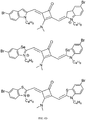
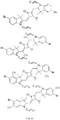
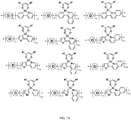
- the narrow-band emissive polymers for making Pdots include squaraine and their derivatives as narrow-band monomers.
- Squaraine derivatives include but are not limited to their alkyl derivatives, aryl derivatives, alkyne derivatives, aromatic derivatives, alkoxide derivatives, aza derivatives, their extended systems and analogues.
- the narrow-band emissive polymers can also include any other monomers.
- the squaraine and their derivatives can be energy acceptors so that the final Pdots can exhibit narrow-band emissions.
- the narrow-band emissive chromophoric polymers in good solvents may exhibit broad emissions or narrow emissions. However, their nanoparticle form gives narrow-band emissions.
- the emission FWHM of the above Pdots is less than 70 nm. In certain embodiments, the FWHM is less than 60nm, less than 50nm, less than 40nm, less than 30nm, or less than 20nm.
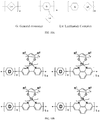
- the narrow-band emissive polymers for making Pdots include metal complexes and their derivatives as narrow-band monomers.
- Metal complexes and their derivatives include but are not limited to their alkyl derivatives, aryl derivatives, alkyne derivatives, aromatic derivatives, alkoxide derivatives, aza derivatives, their extended systems and analogues.
- the narrow-band emissive polymers can also include any other monomers.
- the metals can be any metal such as Na, Li, Zn, Mg, Fe, Mn, Co, Ni, Cu, In, Si, Ga, Al, Pt, Pd, Ru, Rh, Re, Os, Ir, Ag, Au and so on.
- the metal complexes can be energy acceptors so that the final Pdots can exhibit narrow-band emissions.
- the narrow-band emissive chromophoric polymers in good solvents may exhibit broad emissions or narrow emissions. However, their nanoparticle form gives narrow-band emissions.
- the emission FWHM of the above Pdots is less than 70 nm. In certain embodiments, the FWHM is less than 60nm, less than 50nm, less than 40nm, less than 30nm, or less than 20nm.
- the narrow-band emissive polymers for making Pdots include porphyrin, metalloporphyrin, and their derivatives as narrow-band monomers.
- Porphyrin, metalloporphyrin, and their derivatives include but are not limited to their alkyl derivatives, aryl derivatives, alkyne derivatives, aromatic derivatives, alkoxide derivatives, aza derivatives, their extended systems and analogues.
- the metals in the metalloporphyrins can be any metal such as Na, Li, Zn, Mg, Fe, Mn, Co, Ni, Cu, In, Si, Ga, Al, Pt, Pd, Ru, Rh, Re, Os, Ir, Ag, Au and so on.
- the narrow-band emissive polymers can also include any other monomers.
- the porphyrin, metalloporphyrin and their derivatives can be energy acceptors so that the final Pdots can exhibit narrow-band emissions.
- the narrow-band emissive chromophoric polymers in good solvents may exhibit broad emissions or narrow emissions. However, their nanoparticle form gives narrow-band emissions.
- the emission FWHM of the above Pdots is less than 70 nm. In certain embodiments, the FWHM is less than 60nm, less than 50nm, less than 40nm, less than 30nm, or less than 20nm.
- the narrow-band emissive polymers for making Pdots include phthalocyanine and its derivatives as narrow-band monomers.
- Phthalocyanine derivatives include but are not limited to their alkyl derivatives, aryl derivatives, alkyne derivatives, aromatic derivatives, alkoxide derivatives, aza derivatives, their extended systems and analogues.
- the metals in the phthalocyanine derivatives can be any metal such as Na, Li, Zn, Mg, Fe, Mn, Co, Ni, Cu, In, Si, Ga, Al, Pt, Pd, Ru, Rh, Re, Os, Ir, Ag, Au and so on.
- the narrow-band emissive polymers can also include any other monomers.
- the phthalocyanine derivatives can be energy acceptors so that the final Pdots can exhibit narrow-band emissions.
- the narrow-band emissive chromophoric polymers in good solvents may exhibit broad emissions or narrow emissions. However, their nanoparticle form gives narrow-band emissions.
- the emission FWHM of the above Pdots is less than 70 nm. In certain embodiments, the FWHM is less than 60nm, less than 50nm, less than 40nm, less than 30nm, or less than 20nm.
- the narrow-band emissive polymers for making Pdots include Lanthanide complexes and their derivatives as narrow-band monomers.
- Lanthanide complexes and their derivatives include but are not limited to their alkyl derivatives, aryl derivatives, alkyne derivatives, aromatic derivatives, alkoxide derivatives, aza derivatives, their extended systems and analogues.
- the narrow-band emissive polymers can also include any other monomers.
- the Lanthanide complexes and their derivatives can be energy acceptors so that the final Pdots can exhibit narrow-band emissions.
- the narrow-band emissive chromophoric polymers in good solvents may exhibit broad emissions or narrow emissions.
- the emission FWHM of the above Pdots is less than 70 nm. In certain embodiments, the FWHM is less than 60nm, less than 50nm, less than 40nm, less than 30nm, or less than 20nm.
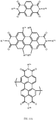
- the narrow-band emissive polymers for making Pdots include perylene and its derivatives as narrow-band monomers.
- Perylene derivatives include but are not limited to their alkyl derivatives, aryl derivatives, alkyne derivatives, aromatic derivatives, alkoxide derivatives, aza derivatives, their extended systems and analogues.
- the narrow-band emissive polymers can also include any other monomers.
- the perylene derivatives can be energy acceptors so that the final Pdots can exhibit narrow-band emissions.
- the narrow-band emissive chromophoric polymers in good solvents may exhibit broad emissions or narrow emissions. However, their nanoparticle form gives narrow-band emissions.
- the emission FWHM of the above Pdots is less than 70 nm. In certain embodiments, the FWHM is less than 60nm, less than 50nm, less than 40nm, less than 30nm, or less than 20nm.
- the narrow-band emissive polymers for making Pdots include cyanine and its derivatives as narrow-band monomers.
- Cyanine derivatives include but are not limited to their alkyl derivatives, aryl derivatives, alkyne derivatives, aromatic derivatives, alkoxide derivatives, aza derivatives, their extended systems and analogues.
- the narrow-band emissive polymers can also include any other monomers.
- the cyanine derivatives can be energy acceptors so that the final Pdots can exhibit narrow-band emissions.
- the narrow-band emissive chromophoric polymers in good solvents may exhibit broad emissions or narrow emissions. However, their nanoparticle form gives narrow-band emissions.
- the emission FWHM of the above Pdots is less than 70 nm. In certain embodiments, the FWHM is less than 60nm, less than 50nm, less than 40nm, less than 30nm, or less than 20nm.
- the narrow-band emissive polymers for making Pdots include rhodamine and its derivatives as narrow-band monomers.
- Rhodamine derivatives include but are not limited to their alkyl derivatives, aryl derivatives, alkyne derivatives, aromatic derivatives, alkoxide derivatives, aza derivatives, their extended systems and analogues.
- the narrow-band emissive polymers can also include any other monomers.
- the rhodamine derivatives can be energy acceptors so that the final Pdots can exhibit narrow-band emissions.
- the narrow-band emissive chromophoric polymers in good solvents may exhibit broad emissions or narrow emissions. However, their nanoparticle form gives narrow-band emissions.
- the emission FWHM of the above Pdots is less than 70 nm. In certain embodiments, the FWHM is less than 60nm, less than 50nm, less than 40nm, less than 30nm, or less than 20nm.
- the narrow-band emissive polymers for making Pdots include coumarin and its derivatives as narrow-band monomers.
- Coumarin derivatives include but are not limited to their alkyl derivatives, aryl derivatives, alkyne derivatives, aromatic derivatives, alkoxide derivatives, aza derivatives, their extended systems and analogues.
- the narrow-band emissive polymers can also include any other monomers.
- the coumarin derivatives can be energy acceptors so that the final Pdots can exhibit narrow-band emissions.
- the narrow-band emissive chromophoric polymers in good solvents may exhibit broad emissions or narrow emissions. However, their nanoparticle form gives narrow-band emissions.
- the emission FWHM of the above Pdots is less than 70 nm. In certain embodiments, the FWHM is less than 60nm, less than 50nm, less than 40nm, less than 30nm, or less than 20nm.
- the narrow-band emissive polymers for making Pdots include xanthene and its derivatives as narrow-band monomers.
- Xanthene derivatives include but are not limited to their alkyl derivatives, aryl derivatives, alkyne derivatives, aromatic derivatives, alkoxide derivatives, aza derivatives, their extended systems and analogues.
- the narrow-band emissive polymers can also include any other monomers.
- the xanthene derivatives can be energy acceptors so that the final Pdots can exhibit narrow-band emissions.
- the narrow-band emissive chromophoric polymers in good solvents may exhibit broad emissions or narrow emissions. However, their nanoparticle form gives narrow-band emissions.
- the emission FWHM of the above Pdots is less than 70 nm. In certain embodiments, the FWHM is less than 60nm, less than 50nm, less than 40nm, less than 30nm, or less than 20nm.
- the present invention provides functionalized chromophoric polymer dot.
- the functionalized Pdot include a narrow-band emissive Pdot and a functional group that is physically or chemically attached to the Pdot.
- the present invention discloses a bioconjugate of the polymer dots with narrow-band emissions.
- the bioconjugate is formed by the attachment of a biomolecule to one or more functional groups of the narrow-band emissive chromophoric polymer dot.
- the attachment may be direct or indirect.
- these chromophoric polymer dots can be formed using nanoprecipitation.
- the nanoprecipitation method involves the introduction of a solution of a polymer in a good solvent into a poor solvent, where the solubility collapse the polymer into a nanoparticle form.
- the chromophoric polymer with narrow-band emissions can be prepared using the mini-emulsion method.
- Embodiments of the present invention relate to a novel class of fluorescent probe, referred to as narrow-band emissive chromophoric polymer dots, and their biomolecular conjugates for a variety of applications, including but not limited to flow cytometry, fluorescence activated sorting, immunofluorescence, immunohistochemistry, fluorescence multiplexing, single molecule imaging, single particle tracking, protein folding, protein rotational dynamics, DNA and gene analysis, protein analysis, metabolite analysis, lipid analysis, FRET based sensors, high throughput screening, cell detection, bacteria detection, virus detection, biomarker detection, cellular imaging, in vivo imaging, bioorthogonal labeling, click reactions, fluorescence-based biological assays such as immunoassays and enzyme-based assays, and a variety of fluorescence techniques in biological assays and measurements.
- flow cytometry fluorescence activated sorting
- immunofluorescence immunohistochemistry
- fluorescence multiplexing single molecule imaging
- single particle tracking protein folding
- the present invention is based at least in-part on the fact that fluorescent Pdots based on semiconducting polymers typically possess broad emission spectra with FWHM larger than 70 nm. Such a broad-band emission can be a significant drawback for fluorescence techniques in biology.
- the present invention provides compositions and methods to obtain next-generation Pdots with narrow-band emissions.
- the present invention provides compositions and methods that allow bioconjugation to polymer dots while also maintaining their narrow-band emissions.
- the properties of the narrow-band emissive polymers and polymer dots can be dependent on the polymer structures. Therefore, the polymer backbone (main chain), side chains, terminal units, and substituted groups can be varied to obtain specific properties.
- the optical properties of the narrow-band polymer and polymer dots can be tuned by varying the structures of the polymer backbone (main chain). For example, the absorption and fluorescence emission can be red-shifted by increasing the conjugation length of the polymer backbone, or the absorption and fluorescence emission can be blue-shifted by decreasing the conjugation length of the polymer backbone.
- the inclusion of BT monomer can increase the photostability of the resulting polymer dot compared with polymers that do not have BT in their polymer backbone.
- the optical properties of the narrow-band emissive polymer and polymer dots can be modified by varying the side chains, terminal units, and substituent groups.
- the fluorescence emission wavelength can be tuned by attaching chromophoric units to the side-chains and/or termini.
- the emission bandwidth, fluorescence quantum yield, fluorescence lifetime, photostability, and other properties can also be modified by varying the polymer side-chain and/or terminal units in addition to the polymer backbone.
- fluorescence quantum yield can be increased in some polymer dots by attaching bulky side-chain groups to minimize inter-chain interactions in polymer dots.
- anti-fade agents such as derivatives of butylated hydroxytoluene, trolox, carotenoids, ascorbate, reduced glutathione, propyl gallate, propionic acid stearyl ester, hydroxyquinone, p-phenylenediamine, triphenylamine, beta mercaptoethanol, trans-stilbene, imidazole, Mowiol, or combinations thereof, or any other combinations of anti-fade agents known in the art, to the polymer via side chains, terminal units, backbone, and/or substituent groups, can increase quantum yield, photostability, or both.
- anti-fade agents such as derivatives of butylated hydroxytoluene, trolox, carotenoids, ascorbate, reduced glutathione, propyl gallate, propionic acid stearyl ester, hydroxyquinone, p-phenylenediamine, triphenylamine, beta mercaptoethanol, trans-stilbene, imid
- anti-fade agents generally act as anti-oxidants to reduce oxygen, and/or act as scavengers of reactive oxygen species, and/or act to suppress photogenerated hole polarons within the polymer dot.
- the anti-fade agent is hydrophobic in nature so as not to adversely affect the packing and/or colloidal stability of the polymer dot.
- the absorption, emission peak, emission bandwidth, fluorescence quantum yield, fluorescence lifetime, photostability, and other properties of the narrow-band emissive polymer and polymer dots can also be modified by substituent groups on the polymers.
- the degree of electron-donating or electron-withdrawing capability of the substituent groups can be used to tune the optical properties.
- the two-photon absorption cross sections can be increased by modular structures such as donor-pi-donor or donor-acceptor-donor units.
- the colloidal properties of the polymer dots can be improved by varying the polymer backbone (main chain), side chains, terminal units, and substitutent groups.
- the polymer dots can include hydrophobic functional groups in the side-chains, terminal units, and/or substitutent groups.
- the polymer dots can include hydrophilic functional groups in the side-chains, terminal units, and/or substitutent groups. The length, size, and nature of the hydrophobic/hydrophilic side chains can modify the chain-chain interactions, and control the packing of the polymers, and affect the colloidal stability and size of the polymer dots.
- hydrophobic/hydrophilic side chains can also affect the absorption, emission peak, emission bandwidth, fluorescence quantum yield, fluorescence lifetime, photostability, and other properties of the narrow-band emissive polymer and polymer dots.
- a large number of very hydrophilic functional groups can reduced the brightness of the polymer dots, and/or broaden the emission spectrum, and/or also adversely affect their colloidal stability and non-specific binding properties.
- chromophoric polymer nanoparticle or “chromophoric polymer dot” refers to a structure comprising one or more polymers (e.g., chromophoric polymers) that have been formed into a stable sub-micron sized particle.
- the chromophoric polymer nanoparticles or chromophoric polymer dots of the present invention can, e.g., include a single polymer or a plurality of polymers that can be, e.g., chemically crosslinked and/or physically blended.
- Polymer dot and “Pdot” can be used interchangeably to represent “chromophoric nanoparticle” or "chromophoric polymer dot”.
- the chromophoric polymer dots provided herein may be formed by any method known in the art, including without limitation, methods relying on precipitation, methods relying on the formation of emulsions (e.g. mini or micro emulsion), and methods relying on condensation. Pdots described herein are different and distinct from nanoparticles formed from an aggregate of polyelectrolytes.
- polymer is a molecule composed of at least 2 repeating structural units typically connected by covalent chemical bonds.
- the repeating structural unit may be one type of monomer, and the resulting polymer is a homopolymer.
- the polymers can include two different types of monomers, or three different types of monomers, or more types of monomers.
- the different types of monomers can be distributed along a polymer chain in a variety of ways. For example, three different types of monomers can be randomly distributed along the polymer. It will similarly be appreciated that the distribution of monomers along the polymer can be represented in different ways.
- n can range, e.g., from at least 2, from at least 100, from at least 500, from at least 1000, from at least 5000, or from at least 10,000, or from at least 100,000, or higher. In certain embodiments, n can range from 2 to 10000, from 20 to 10000, from 20 to 500, from 50 to 300, from 100 to 1000, or from 500 to 10,000.
- Polymers generally have extended molecular structures comprising backbones that optionally contain pendant side groups.
- the polymers provided herein can include, but are not limited to, linear polymers and branched polymers such as star polymers, comb polymers, brush polymers, ladders, and dendrimers. As described further herein, the polymers can include semiconducting polymers generally well known in the art.
- chromophoric polymer is a polymer in which at least a portion of the polymer includes chromophoric units.
- the term “chromophore” is given its ordinary meaning in the art. A chromophore absorbs certain wavelength of light from UV to near infrared region, and may be or may not be emissive.
- the chromophoric polymer can, e.g,. be a "conjugated polymer".
- conjuggated polymer is recognized in the art. Electrons, holes, or electronic energy, can be conducted along the conjugated structure. In some embodiments, a large portion of the polymer backbone can be conjugated.
- the entire polymer backbone can be conjugated.
- the polymer can include conjugated structures in their side chains or termini.
- the conjugated polymer can have conducting properties, e.g. the polymer can conduct electricity.
- the conjugated polymer can have semiconducting properties, e.g. the polymers can exhibit a direct band gap, leading to an efficient absorption or emission at the band edge.
- a "chromophoric unit" in this invention includes, but is not limited to, a unit of structures with delocalized pi-electrons, a unit of small organic dye molecules, and/or a unit of metal complexes.
- Examples of chromophoric polymers can include polymers comprising units of structures with delocalized pi-electrons such as semiconducting polymers, polymers comprising units of small organic dye molecules, polymers comprising units of metal complexes, and polymers comprising units of any combinations thereof.
- the chromophoric unit can be incorporated into the polymer backbone.
- the chromophoric unit can also be covalently attached to the side chain, or the terminal unit of the polymer.
- emission spectrum of a polymer dot is defined as the spectrum of wavelengths (or frequencies) of electromagnetic radiation emitted by the polymer dot when it is excited to a higher energy state and then returned to a lower energy state.
- the width of the emission spectrum can be characterized by its full width at half maximum (FWHM).
- the FWHM of an emission spectrum is defined as the distance between points on the emission curve at which the emission intensity reaches half its maximum value.
- the emission properties of a polymer dot can also be characterized by fluorescence quantum yield and fluorescence lifetime. The fluorescence quantum yield gives the efficiency of the fluorescence process. It is defined as the ratio of the number of photons emitted to the number of photons absorbed by the Pdots.
- the fluorescence lifetime is defined as the average time the polymer dot stays in its excited state before emitting a photon. All the above defined parameters, such as emission spectrum, FWHM, fluorescence quantum yield, and fluorescence lifetime can be experimentally measured. In this invention, these parameters can be specifically used to characterize the narrow-band emissive Pdots.
- alkyl refers to a straight or branched, saturated, aliphatic radical having the number of carbon atoms indicated.
- C 1 -C 6 alkyl includes, but is not limited to, methyl, ethyl, propyl, isopropyl, butyl, isobutyl, sec-butyl, tert-butyl, pentyl, isopentyl, hexyl, etc.
- Other alkyl groups include, but are not limited to heptyl, octyl, nonyl, decyl, etc.
- Alkyl can include any number of carbons, such as 1-2, 1-3, 1-4, 1-5, 1-6, 1-7, 1-8, 1-9, 1-10, 2-3, 2-4, 2-5, 2-6, 3-4, 3-5, 3-6, 4-5, 4-6 and 5-6.
- the alkyl group is typically monovalent, but can be divalent, such as when the alkyl group links two moieties together.
- heteroalkyl refers to a straight or branched, saturated, aliphatic radical of carbon atoms, where at least one of the carbon atoms is replaced with a heteroatom, such as N, O or S. Additional heteroatoms can also be useful, including, but not limited to, B, Al, Si and P.
- lower referred to above and hereinafter in connection with organic radicals or compounds respectively defines a compound or radical which can be branched or unbranched with up to and including 7, preferably up to and including 4 and (as unbranched) one or two carbon atoms.
- alkylene refers to an alkyl group, as defined above, linking at least two other groups, i.e., a divalent hydrocarbon radical.
- the two moieties linked to the alkylene can be linked to the same atom or different atoms of the alkylene.
- a straight chain alkylene can be the bivalent radical of -(CH 2 ) n , where n is 1, 2, 3, 4, 5 or 6.
- Alkylene groups include, but are not limited to, methylene, ethylene, propylene, isopropylene, butylene, isobutylene, sec-butylene, pentylene and hexylene.
- alkyl and heteroalkyl radicals can be a variety of groups, such as alkyl, aryl, cyano (CN), amino, sulfide, aldehyde, ester, ether, acid, hydroxyl or halide.
- R', R" and R''' each independently refer to hydrogen, unsubstituted (C 1 -C 8 )alkyl and heteroalkyl, unsubstituted aryl, alkoxy or thioalkoxy groups, or aryl-(C 1 -C 4 )alkyl groups.
- R' and R" When R' and R" are attached to the same nitrogen atom, they can be combined with the nitrogen atom to form a 5-, 6-, or 7-membered ring.
- -NR'R is meant to include 1-pyrrolidinyl and 4-morpholinyl.
- alkyl is meant to include groups such as haloalkyl (e.g ., -CF 3 and -CH 2 CF 3 ) and acyl ( e.g ., -C(O)CH 3 , -C(O)CF 3 , -C(O)CH 2 OCH 3 , and the like).
- alkoxy refers to an alkyl group having an oxygen atom that either connects the alkoxy group to the point of attachment or is linked to two carbons of the alkoxy group.
- Alkoxy groups include, for example, methoxy, ethoxy, propoxy, iso-propoxy, butoxy, 2-butoxy, iso-butoxy, sec-butoxy, tert-butoxy, pentoxy, hexoxy, etc.
- the alkoxy groups can be further substituted with a variety of substituents described within. For example, the alkoxy groups can be substituted with halogens to form a "halo-alkoxy" group.
- alkenyl refers to either a straight chain or branched hydrocarbon of 2 to 6 carbon atoms, having at least one double bond.
- alkenyl groups include, but are not limited to, vinyl, propenyl, isopropenyl, 1-butenyl, 2-butenyl, isobutenyl, butadienyl, 1-pentenyl, 2-pentenyl, isopentenyl, 1,3-pentadienyl, 1,4-pentadienyl, 1-hexenyl, 2-hexenyl, 3-hexenyl, 1,3-hexadienyl, 1,4-hexadienyl, 1,5-hexadienyl, 2,4-hexadienyl, or 1,3,5-hexatrienyl.
- alkenylene refers to an alkenyl group, as defined above, linking at least two other groups, i.e., a divalent hydrocarbon radical.
- the two moieties linked to the alkenylene can be linked to the same atom or different atoms of the alkenylene.
- Alkenylene groups include, but are not limited to, ethenylene, propenylene, isopropenylene, butenylene, isobutenylene, sec-butenylene, pentenylene and hexenylene.
- alkynyl refers to either a straight chain or branched hydrocarbon of 2 to 6 carbon atoms, having at least one triple bond.
- alkynyl groups include, but are not limited to, acetylenyl, propynyl, 1-butynyl, 2-butynyl, isobutynyl, sec-butynyl, butadiynyl, 1-pentynyl, 2-pentynyl, isopentynyl, 1,3-pentadiynyl, 1,4-pentadiynyl, 1-hexynyl, 2-hexynyl, 3-hexynyl, 1,3-hexadiynyl, 1,4-hexadiynyl, 1,5-hexadiynyl, 2,4-hexadiynyl, or 1,3,5-hexatriynyl.
- alkynylene refers to an alkynyl group, as defined above, linking at least two other groups, i.e., a divalent hydrocarbon radical.
- the two moieties linked to the alkynylene can be linked to the same atom or different atoms of the alkynylene.
- Alkynylene groups include, but are not limited to, ethynylene, propynylene, isopropynylene, butynylene, sec-butynylene, pentynylene and hexynylene.
- alkyl amine refers to an alkyl groups as defined within, having one or more amino groups.
- the amino groups can be primary, secondary or tertiary.
- the alkyl amine can be further substituted with a hydroxy group.
- Alkyl amines can include, but are not limited to, ethyl amine, propyl amine, isopropyl amine, ethylene diamine and ethanolamine.
- the amino group can link the alkyl amine to the point of attachment with the rest of the compound, be at the omega position of the alkyl group, or link together at least two carbon atoms of the alkyl group.
- halogen refers to fluorine, chlorine, bromine and iodine.
- haloalkyl refers to alkyl as defined above where some or all of the hydrogen atoms are substituted with halogen atoms.
- Halogen (halo) preferably represents chloro or fluoro, but may also be bromo or iodo.
- halo-alkoxy refers to an alkoxy group having at least one halogen. Halo-alkoxy is as defined for alkoxy where some or all of the hydrogen atoms are substituted with halogen atoms.
- the alkoxy groups can be substituted with 1, 2, 3, or more halogens. When all the hydrogens are replaced with a halogen, for example by fluorine, the compounds are per-substituted, for example, perfluorinated.
- Halo-alkoxy includes, but is not limited to, trifluoromethoxy, 2,2,2,-trifluoroethoxy, perfluoroethoxy, etc.
- cycloalkyl refers to a saturated or partially unsaturated, monocyclic, fused bicyclic or bridged polycyclic ring assembly containing from 3 to 12 ring atoms, or the number of atoms indicated.
- Monocyclic rings include, for example, cyclopropyl, cyclobutyl, cyclopentyl, cyclohexyl, and cyclooctyl.
- Bicyclic and polycyclic rings include, for example, norbornane, decahydronaphthalene and adamantane.
- C 3-8 cycloalkyl includes cyclopropyl, cyclobutyl, cyclopentyl, cyclohexyl, cyclooctyl, and norbornane.
- cycloalkylene refers to a cycloalkyl group, as defined above, linking at least two other groups, i.e., a divalent hydrocarbon radical.
- the two moieties linked to the cycloalkylene can be linked to the same atom or different atoms of the cycloalkylene.
- Cycloalkylene groups include, but are not limited to, cyclopropylene, cyclobutylene, cyclopentylene, cyclohexylene, and cyclooctylene.
- heterocycloalkyl refers to a ring system having from 3 ring members to about 20 ring members and from 1 to about 5 heteroatoms such as N, O and S. Additional heteroatoms can also be useful, including, but not limited to, B, Al, Si and P. The heteroatoms can also be oxidized, such as, but not limited to, -S(O)- and -S(O) 2 -.
- heterocycloalkylene refers to a heterocycloalkyl group, as defined above, linking at least two other groups.
- the two moieties linked to the heterocycloalkylene can be linked to the same atom or different atoms of the heterocycloalkylene.
- aryl refers to a monocyclic or fused bicyclic, tricyclic or greater, aromatic ring assembly containing 6 to 16 ring carbon atoms.
- aryl may be phenyl, benzyl, azulenyl or naphthyl.
- Arylene means a divalent radical derived from an aryl group.
- Aryl groups can be mono-, di- or tri-substituted by one, two or three radicals selected from alkyl, alkoxy, aryl, hydroxy, halogen, cyano, amino, amino-alkyl, trifluoromethyl, alkylenedioxy and oxy-C 2 -C 3 -alkylene; all of which are optionally further substituted, for instance as hereinbefore defined; or 1- or 2-naphthyl; or 1- or 2-phenanthrenyl.
- Alkylenedioxy is a divalent substitute attached to two adjacent carbon atoms of phenyl, e.g. methylenedioxy or ethylenedioxy.
- Oxy-C 2 -C 3 -alkylene is also a divalent substituent attached to two adjacent carbon atoms of phenyl, e.g. oxyethylene or oxypropylene.
- phenyl e.g. oxyethylene or oxypropylene.
- An example for oxy- C 2 -C 3 -alkylene-phenyl is 2,3-dihydrobenzofuran-5-yl.
- Aryl groups can include, but are not limited to, naphthyl, phenyl or phenyl mono- or disubstituted by alkoxy, phenyl, halogen, alkyl or trifluoromethyl, phenyl or phenyl-mono- or disubstituted by alkoxy, halogen or trifluoromethyl, and in particular phenyl.
- arylene refers to an aryl group, as defined above, linking at least two other groups.
- the two moieties linked to the arylene are linked to different atoms of the arylene.
- Arylene groups include, but are not limited to, phenylene.
- alkoxy-aryl or “aryloxy” refers to an aryl group, as defined above, where one of the moieties linked to the aryl is linked through an oxygen atom.
- Alkoxy-aryl groups include, but are not limited to, phenoxy (C 6 H 5 O-).
- the present invention also includes alkoxy-heteroaryl or heteroaryloxy groups.
- heteroaryl refers to a monocyclic or fused bicyclic or tricyclic aromatic ring assembly containing 5 to 16 ring atoms, where from 1 to 4 of the ring atoms are a heteroatom each N, O or S.
- heteroaryl includes pyridyl, indolyl, indazolyl, quinoxalinyl, quinolinyl, isoquinolinyl, benzothienyl, benzofuranyl, furanyl, pyrrolyl, thiazolyl, benzothiazolyl, oxazolyl, isoxazolyl, triazolyl, tetrazolyl, pyrazolyl, imidazolyl, thienyl, or any other radicals substituted, especially mono- or di-substituted, by e.g. alkyl, nitro or halogen.
- Suitable groups for the present invention can also include heteroarylene and heterarylene-oxy groups similar to the description above for arylene and arylene-oxy groups.
- aryl and heteroaryl groups described herein can be substituted or unsubstituted.
- Substituents for the aryl and heteroaryl groups are varied, such as alkyl, aryl, CN, amino, sulfide, aldehyde, ester, ether, acid, hydroxyl or halide.
- Substituents can be a reactive group, such as but not limited to chloro, bromo, iodo, hydroxyl, or amino.
- alkyl-aryl refers to a radical having an alkyl component and an aryl component, where the alkyl component links the aryl component to the point of attachment.
- the alkyl component is as defined above, except that the alkyl component is at least divalent in order to link to the aryl component and to the point of attachment. In some instances, the alkyl component can be absent.
- the aryl component is as defined above. Examples of alkyl-aryl groups include, but are not limited to, benzyl.
- the present invention also includes alkyl-heteroaryl groups.
- alkenyl-aryl refers to a radical having both an alkenyl component and an aryl component, where the alkenyl component links the aryl component to the point of attachment.
- the alkenyl component is as defined above, except that the alkenyl component is at least divalent in order to link to the aryl component and to the point of attachment.
- the aryl component is as defined above. Examples of alkenyl-aryl include ethenyl-phenyl, among others.
- the present invention also includes alkenyl-heteroaryl groups.
- alkynyl-aryl refers to a radical having both an alkynyl component and a aryl component, where the alkynyl component links the aryl component to the point of attachment.
- the alkynyl component is as defined above, except that the alkynyl component is at least divalent in order to link to the aryl component and to the point of attachment.
- the aryl component is as defined above. Examples of alkynyl-aryl include ethynyl-phenyl, among others.
- the present invention also includes alkynyl-heteroaryl groups.
- the various chemical terms defined herein can be used for describing chemical structures of the polymers and monomers of the present invention.
- a variety of the monomer derivatives e.g., BODIPY derivatives
- derivatives of the various monomers can be substituted with hydrogen, deuterium, alkyl, aralkyl, aryl, alkoxy-aryl, N-dialkyl-4-phenyl, N-diphenyl-4-phenyl, N-dialkoxyphenyl-4-phenyl, amino, sulfide, aldehyde, ester, ether, acid, and/or hydroxyl.
- the present invention provides, in one embodiment, chromophoric polymer dots with narrow-band emissions.
- the emission wavelength of the polymer dots can vary from ultraviolet to the near infrared region.
- the chromophoric polymer dot includes at least one chromophoric polymer.
- the chemical composition and structure of the chromophoric polymer can be tuned to obtain small bandwidth (FWHM) of the Pdot emission.
- Other species such as narrow-band emissive units, metal complexes or inorganic materials can be blended or chemically cross linked within the chromophric polymer dots to obtain small bandwidth (FWHM) of the Pdot emission.
- the FWHM is less than about 70 nm.
- the FWHM is less than about 65 nm. In some embodiments, the FWHM is less than about 60 nm. In some embodiments, the FWHM is less than about 55 nm. In some embodiments, the FWHM is less than about 50 nm. In some embodiments, the FWHM is less than about 45 nm. In some embodiments, the FWHM is less than about 40 nm. In some embodiments, the FWHM is less than about 35 nm. In some embodiments, the FWHM is less than about 30 nm. In some embodiments, the FWHM is less than about 25 nm.
- the FWHM is less than about 24 nm, 23 nm, 22 nm, 21 nm, 20 nm, 19 nm, 18 nm, 17 nm, 16 nm, 15 nm, 14 nm, 13 nm, 12 nm, 11 nm, 10 nm, or less.
- the FWHM of the polymer dots described herein can range between about 5 nm to about 70 nm, from about 10 nm to about 60 nm, from about 20 nm to about 50 nm, or from about 30 nm to about 45 nm.
- the chemical composition and structure of the chromophoric polymer in the polymer dots can affect the absorption spectrum of the narrow-band emissive Pdots.
- the absorption peak can shift from ultra-violet region to near infrared region.
- the absorption peak of the narrow-band emissive polymer dots can be tuned to a certain laser wavelength. In some embodiments, for example, the absorption peak can be tuned to around 266nm. In some embodiments the absorption peak can be tuned to around 355nm. In some embodiments, the absorption peak can be tuned to around 405 nm. In some embodiments, the absorption peak can be tuned to around 450 nm.
- the absorption peak can be tuned to around 488 nm. In some embodiments, the absorption peak can be tuned to around 532 nm. In some embodiments, the absorption peak can be tuned to around 560 nm. In some embodiments, the absorption peak can be tuned to around 635 nm. In some embodiments, the absorption peak can be tuned to around 655 nm. In some embodiments, the absorption peak can be tuned to around 700 nm. In some embodiments, the absorption peak can be tuned to around 750 nm. In some embodiments, the absorption peak can be tuned to around 800 nm. In some embodiments, the absorption peak can be tuned to around 900 nm. In some embodiments, the absorption peak can be tuned to around 980 nm. In some embodiments, the absorption peak can be tuned to around 1064 nm.
- the chemical composition and structure of the chromophoric polymer in the polymer dots can affect the fluorescence quantum yield of the narrow-band emissive Pdots.
- the fluorescence quantum yield can vary from 100% to 0.1%.
- the quantum yield can be greater than about 90%.
- the quantum yield can be greater than about 80%.
- the quantum yield can be greater than about 70%.
- the quantum yield can be greater than about 60%.
- the quantum yield can be greater than about 50%.
- the quantum yield can be greater than about 40%.
- the quantum yield can be greater than about 30%.
- the quantum yield can be greater than about 20%.
- the quantum yield can be greater than about 10%.
- the quantum yield can be greater than about 5%.
- the quantum yield can be greater than about 1%.
- the narrow-band emissive Pdots have both narrow emission FWHM and high fluorescence quantum yield.
- the narrow-band Pdots can have an emission FWHM less than 70 nm and fluorescence quantum yield larger than 10%.
- the narrow-band Pdots can have an emission FWHM less than 60 nm and fluorescence quantum yield larger than 10%.
- the narrow-band Pdots can have an emission FWHM less than 50 nm and fluorescence quantum yield larger than 10%.
- the narrow-band Pdots can have an emission FWHM less than 40 nm and fluorescence quantum yield larger than 10%.
- the narrow-band Pdots can have an emission FWHM less than 30 nm and fluorescence quantum yield larger than 10%.
- the narrow-band Pdots can have an emission FWHM less than 20 nm and fluorescence quantum yield larger than 10%.
- the quantum yield is greater than 20%, greater than 30%, greater than 40%, greater than 50%, greater than 60%, greater than 70%, greater than 80%, or greater than 90 %.
- the narrow-band emissive Pdots may have a secondary emission peak.
- the narrow-band monomers as energy acceptors are copolymerized with other monomer donors to produce narrow-band emissive Pdots
- the final Pdots may have secondary peak because of incomplete fluorescence quenching.
- the narrow-band emissive Pdots may also have a secondary peak in the composite Pdot chemically cross-linked with fluorescent dyes (e.g., fluorescent polymers and/or fluorescent small molecules), metal complexes, lanthanide complexes, inorganic quantum dots etc.
- the secondary peak in the Pdots is less than 30% of the maximum intensity of the main narrow-band emission. In some embodiments, the secondary peak in the Pdots is less than 25% of the maximum intensity of the main narrow-band emission. In some embodiments, the secondary peak in the Pdots is less than 20% of the maximum intensity of the main narrow-band emission. In some embodiments, the secondary peak in the Pdots is less than 10% of the maximum intensity of the main narrow-band emission. In some embodiments, the secondary peak in the Pdots is less than 5% of the maximum intensity of the main narrow-band emission.
- the secondary peak in the Pdots is less than 1% of the maximum intensity of the main narrow-band emission, or less.
- the quantum yield is greater than 10%, greater than 20%, greater than 30%, greater than 40%, greater than 50%, greater than 60%, greater than 70%, greater than 80%, or greater than 90%.
- the chemical composition and structure of the chromophoric polymer in the polymer dots can affect the fluorescence lifetime of the narrow-band emissive Pdots.
- the fluorescence lifetime can vary from 10 ps to 1 ms. In some embodiments, the fluorescence lifetime varies from 10 ps to 100 ps. In some embodiments, the fluorescence lifetime varies from 100 ps to Ins. In some embodiments, the fluorescence lifetime varies from 1 ns to 10 ns. In some embodiments, the fluorescence lifetime varies from 10 ns to 100 ns. In some embodiments, the fluorescence lifetime varies from 100 ns to 1 ⁇ s.
- the fluorescence lifetime varies from 1 ⁇ s to 10 ⁇ s. In some embodiments, the fluorescence lifetime varies from 10 ⁇ s to 100 ⁇ s. In some embodiments, the fluorescence lifetime varies from 100 ⁇ s to 1 ms.
- the narrow-band emissive Pdots can be characterized by their stability.
- the optical properties e.g. emission spectrum, emission band width, fluorescence quantum yield, fluorescence lifetime, side peaks, brightness at the particular wavelength or emission intensity at a particular wavelength
- the stable fluorescence quantum yield means that the fluorescence quantum yield of the narrow-band emission does not change by more than 5%, or 10% , or 20%, or 50%, or higher.
- the stable emission spectrum means that intensity ratio of the secondary peak relative to the main peak doesn't change by more than 5%, or 10% , or 20%, or 50%, or higher.
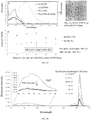
- the narrow-band emissive Pdots can possess all of the following characteristics: (1) Narrow band emission that has a FWHM of less than 70nm, preferably less than 60nm, less than 50nm, less than 40nm, less than 30nm, or less than 20nm; (2) High quantum yield that is greater than 5%, preferably greater than 10%, preferably greater than 20%, greater than 30%, greater than 40%, greater than 50%, greater than 60%, greater than 70%, greater than 80%, or greater than 90%; (3) With a secondary emission peak that is less than 30% of the main peak, preferably less than 20%, less than 10%, less than 5%, or less than 1%; (4) Have high stability over at least 2 weeks, preferably 1 month, 2 month, 3 month, 6 months, 1 year, or longer.
- the present invention can include polymer dots, e.g., narrow-band emissive chromophoric polymer dots.
- the present invention includes a wide variety of polymer dots that exhibit narrow band emission properties (e.g., a FWHM less than 70 nm).
- the variety of polymer dots of the present invention can include polymers that have a narrow band emissive unit (e.g., a narrow band monomer and/or a narrow band unit).
- the present invention can include a homopolymer or heteropolymer including a narrow band monomer, such as BODIPY and/or BODIPY derivative monomer, a squaraine and/or squaraine derivative, a metal complex and/or metal complex derivative monomer, a porphyrin and/or porphyrin derivative monomer, a phthalocyanine and/or phthalocynanine derivative monomer, a lanthanide complex and/or lanthanide complex derivative monomer, a perylene and/or perylene derivative monomer, a cyanine and/or cyanine derivative monomer, a rhodamine and/or rhodamine derivative monomer, a coumarin and/or coumarin derivative monomer, and/or a xanthene and/or xanthene derivative monomer.
- a narrow band monomer such as BODIPY and/or BODIPY derivative monomer, a squaraine and/or s
- a narrow band unit can be, e.g., a narrow band monomer or a fluorescent nanoparticle embedded in or attached to the polymer dot.
- the fluorescent nanoparticle can be, e.g., a quantum dot.
- a narrow band unit can also include a polymer or fluorescent dye molecule that gives a narrow emission in a polymer dot of the present invention.
- the narrow band monomers can be integrated into a heteropolymer with other general monomers that can, e.g., act as energy donors.
- the general monomers can include an emission spectrum that is tuned to substantially overlap the absorption spectrum of a narrow band monomer, thereby acting as an energy donor for the narrow band monomer.
- the energy transfer e.g., can occur along the backbone of a polymer (e.g., intrachain) or between multiple polymer backbones (e.g., interchain).
- the narrow band units e.g., narrow band monomers
- the narrow band unit (e.g., a narrow band monomer) can be attached to a general monomer that can include an emission spectrum that is tuned to substantially overlap the absorption spectrum of a narrow band unit, thereby acting as an energy donor for the narrow band unit.
- the general monomers can include a wide variety of structures that are further described herein (e.g., D1, D2, D2',monomers of P1 -P 10, and/or M1-M10).
- the general monomers can include, e.g., fluorene, a fluorene derivative, a phenyl vinylene, a phenyl vinylene derivative, a phenylene, a phenylene derivative, a benzothiazole, a benzothiazole derivative, a thiophene, a thiophene derivative, a carbazole fluorene, and/or a carbazole fluorene derivative.
- the various polymers used in the polymer dots can be combined in a variety of ways.
- the polymers of the present invention can be chemically crosslinked and/or physically blended in the polymer dots.
- the polymers described herein can further include at least one functional group for, e.g.,conjugation reactions, such as for bioconjugation reactions to antibodies or other biomolecules further described herein.
- the present invention further includes compositions including the polymer dots described herein.
- the compositions of the present invention can include, e.g., polymer dots described herein suspended in a solvent (e.g., an aqueous solution).
- the narrow-band emissive chromophoric polymer dots include at least one narrow-band emissive polymer.
- the narrow-band emissive polymer can be a homopolymer or a heteropolymer (e.g., a copolymer).
- the narrow-band emissive polymers may have broad-band emissions in good solvents. However, the final Pdots made from the narrow-band polymers have narrow-band emissions.
- the chromophoric polymer dots can include luminescent semiconducting polymer with delocalized pi-electrons. The term "semiconducting polymer" is recognized in the art.
- Conventional luminescent semiconducting polymers include, but are not limited to fluorene polymers, phenylene vinylene polymers, phenylene polymers, benzothiadiazole polymers, thiophene polymers, carbazole polymers and related copolymers. While those conventional semiconducting polymers typically have broad-band emissions, narrow-band emissive polymers in this invention include chemical units such as narrow-band monomers so that the final Pdots give narrow-band emissions.
- the emission FWHM of the final Pdots is less than 70 nm. In certain embodiments, the FWHM is less than 60 nm, less than 50 nm, less than 40 nm, less than 30 nm, or less than 20 nm.
- the narrow-band monomers include but are not limited to BODIPY, squaraine, porphyrin, metallophyrin, metal complexes, lanthanide complexes, phthalocyanine, perylene, rhodamine, coumarin, xanthene, cyanine, and their derivatives.
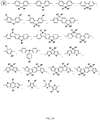
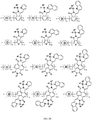
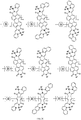
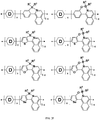
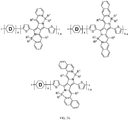
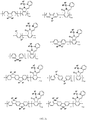
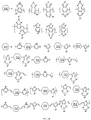
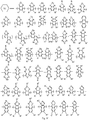
- a non-limiting list of the narrow-band emissive monomers (or chemical units) and a non-limiting list of the narrow-band emissive polymer can be, for example, found in the attached figures.
- the narrow-band emissive polymers for making Pdots include narrow-band monomers.
- the narrow-band emissive polymer dots can also include other monomers that are broad-band emissive.
- the narrow-band monomers can be energy acceptors and other monomers can be energy donors.
- polymer dots of the present invention can include condensed polymer nanoparticles that have intrachain energy transfer between, e.g., a narrow-band monomer and one or more general monomers on the same polymer chain.
- the polymer dots can also have interchain energy transfer in which a condensed polymer nanoparticle can include two or more polymer chains physically blended and/or chemically crosslinked together.
- one of the chains may include a narrow-band monomer and another chain may include one or more general monomers that can act as an energy donor to the narrow band monomer, which is an energy acceptor.
- Some of the polymer dots can include both intrachain and interchain energy transfer. In some instances, the combination of intrachain and interchain energy transfer can increase the quantum yield of the polymer dots.
- the final Pdots can exhibit narrow-band emissions because of energy transfer to the narrow-band monomers.
- the narrow-band emissive chromophoric polymers in good solvents may exhibit broad emissions or narrow emissions. However, their nanoparticle form gives narrow-band emissions.
- the emission FWHM of the above Pdots is less than 70 nm.
- the FWHM is less than 60 nm, less than 50 nm, less than 40 nm, less than 30 nm, or less than 20 nm.
- the FWHM of the polymer dots described herein can range between about 5 nm to about 70 nm, from about 10 nm to about 60 nm, from about 20 nm to about 50 nm, or from about 30 nm to about 45 nm.
- the narrow-band emissive Pdots are narrow band emission without relying on the formation of any defined secondary structures, such as beta phase.
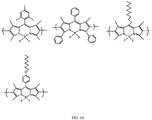
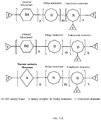
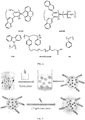
- the narrow-band emissive polymer is a homopolymer that includes only narrow-band emissive monomer ( FIG. 1A ).
- example narrow band monomers can include BODIPY and/or a BODIPY derivative monomer, a squaraine and/or squaraine derivative, a metal complex and/or metal complex derivative monomer, a porphyrin and/or porphyrin derivative monomer, a phthalocyanine and/or phthalocynanine derivative monomer, a lanthanide complex and/or lanthanide complex derivative monomer, a perylene and/or perylene derivative monomer, a cyanine and/or cyanine derivative monomer, a rhodamine and/or rhodamine derivative monomer, a coumarin and/or coumarin derivative monomer, and/or a xanthene and/or xanthene derivative monomer.
- the narrow-band emissive polymer is a two-unit copolymer that includes one narrow-band monomer and one general monomer (e.g., D, D1, D2, and/or D2') ( FIG. 1B ).
- the general monomers can be broad-band emissive.
- the general monomer can be an energy donor and the narrow-band monomer can be an energy-acceptor. Energy-transfer inside Pdots can result in narrow-band emissions.
- the narrow-band emissive polymer is a three-unit copolymer that includes one narrow-band monomer and two general monomers such as general monomer 1 and general monomer 2 (e.g., selected from D, D1, D2, and/or D2') ( FIG. 1C ).
- the narrow-band monomer can be an energy-acceptor
- general monomer 1 can be an energy-donor
- general monomer 2 can also be a donor to the narrow-band monomer.
- general monomer 2 can be an energy-acceptor from general monomer 1 and simultaneously an energy-donor to the narrow-band monomer. Both general monomer 1 and general monomer 2 can be broad-band emissive.
- the narrow-band emissive polymer can be a heteropolymer, such as a multi-unit (>3) copolymer, that includes at least one type of narrow-band emissive monomer so that the final Pdots give narrow-band emissions.
- the narrow-band emissive polymer is copolymer that includes the narrow-band unit cross-linked with the side-chains ( FIG. 1D ).
- the copolymer can include 2 types of general monomers, or 3 types of general monomers, or more than 3 types of general monomers (e.g., selected from D, D1, D2, and/or D2').
- the narrow-band emissive polymer can include at least one type of narrow-band emissive unit in the side-chains.
- the copolymer backbone can be an energy-donor
- the narrow-band emissive unit can be an energy-acceptor. Energy-transfer inside Pdots results in narrow-band emissions.
- the narrow-band emissive polymer is a homopolymer that includes the narrow-band unit cross-linked with the side-chains (FIG. IE).
- the homopolymer backbone can be an energy-donor, and the narrow-band unit can be an energy-acceptor. Energy-transfer inside Pdots can result in narrow-band emissions.
- the narrow-band emissive polymer can be a polymer that includes a narrow-band monomer attached to one terminus or both termini of the linear polymer (FIG. IF) or all termini in case of a branched polymer.
- the polymer can, e.g., include one type of a general monomer (e.g., any one of D, D1, D2, or D2'), or two types of general monomers (e.g,. any one of D, D1, D2 or D2'), or three types of general monomers, or more than three types of general monomers.
- the narrow-band emissive polymer can include at least one type of narrow-band emissive unit in one terminus or both termini of the linear polymer (e.g., FIG. IF) or all termini in case of a branched polymer.
- the polymer backbone can be an energy-donor, and the narrow-band emissive unit can be an energy-acceptor. Energy-transfer inside Pdots results in narrow-band emissions.
- the narrow-band emissive polymer can be a homopolymer or heteropolymer that includes the narrow-band unit attached to the terminus of the polymer.
- the homopolymer or heteropolymer backbone can be an energy-donor, and the narrow-band unit can be an energy-acceptor. Energy-transfer inside Pdots can result in narrow-band emissions.
- FIGS. 1G-L show other examples of schematic structures for the narrow-band emissive polymers that can include, e.g., general monomers as donors (D) and narrow band monomers as acceptors (A).
- the donors can absorb energy and transfer the energy, either directly or indirectly (e.g. by cascade energy transfer), to the narrow-band monomers.
- these polymers can also include functional monomers (F) that provide reactive functional groups for, e.g., chemical reactions and bioconjugation reactions.
- the functional monomers can be copolymerized with the general monomers and narrow band monomers (e.g., FIG. 1G ), or cross-linked with these two kinds of monomers.
- the functional monomers can be used as a terminus (or for both termini) of the polymers (e.g., FIG. 1H and FIG. 1K ).
- Functional groups can be included either in the general monomer or the narrow band monomers (e.g., FIG. 1I ).
- the narrow band monomers can also be copolymerized with any of the general polymers to synthesize a narrow-band emissive copolymer or heteropolymer that contains more than two types of monomers (e.g., FIG. 1J ).
- the narrow band monomer can be covalently attached to the side-chains of the polymer (e.g, FIG. 1I ).
- the narrow band emissive units can be covalently attached to the terminus of the polymer. In some embodiments, the narrow band emissive units can be physically mixed or blended with conventional semiconducting polymers to form narrow-band emissive polymer dots. In one embodiment, the narrow band emissive units can be covalently cross-linked with conventional semiconducting polymers to form narrow-band emissive polymer dots.
- the conventional semiconducting polymers can absorb energy and transfer the energy, either directly or indirectly (e.g. by cascade energy transfer) to the narrow band monomer.
- All the narrow-band emissive polymers described above in FIGS. 1A-L can, e.g., be physically blended or chemically cross-linked with one or more general broad-band polymers.
- the broad-band polymers can be energy donors and the narrow-band emissive polymer can be energy acceptors. Multi-step energy transfer can occur from the broad-band polymer to the narrow-band emissive polymer so that the polymer dots give narrow-band emissions.
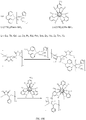
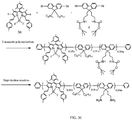
- One example of chemical crosslinking is shown in FIG. 31A .
- the chemical cross-linking between polymers can use the functional reactive groups such as haloformyl, hydroxyl, aldehyde, alkenyl, alkynyl, anhydride, carboxamide, amines, azo compound, carbonate, carboxylate, carboxyl, cyanates, ester, haloalkane, imine, isocyanates, nitrile, nitro, phosphino, phosphate, phosphate, pyridyl, sulfonyl, sulfonic acid, sulfoxide, thiol groups.
- These functional groups can be attached to the side chains and/or the terminus of each polymer chain.
- the present invention can include general monomers that can be polymerized with the narrow band monomers disclosed herein.
- Figure 2A provides a non-limited list of example general monomers (D).
- the general monomer can act as an energy donor for a narrow band monomer in the polymer.
- a variety of derivatized monomeric units can be used.
- each of R 1 R 2 , R 3 and R 4 can be independently selected from, but are not limited to, alkyl, phenyl, alkyl-substituted phenyl, alkyl-substituted fluorenyl and alkyl-substituted carbazolyl.
- Alkyl substituted phenyl can include 2-alkylphenyl, 3-alkylphenyl, 4-alkylphenyl, 2,4-dialkylphenyl, 3,5-dialkylphenyl, and 3,4-dialkylphenyl.
- Alkyl-substituted fluorenyl can include 9,9-dialkyl-substituted fluorenyl, 7-alkyl-9,9-dialkyl-substituted fluorenyl, 7-triphenylaminyl-9,9-dialkyl-substitute fluorenyl and 7-diphenylaminyl-9,9-dialkyl-substitute fluorenyl.
- the alkyl substituents can include C n H 2n+1 , or C n F 2n+1 or - CH 2 CH 2 [OCH 2 CH 2 ] n -OCH 3 wherein n is 1 to 20. In some embodiments, n can be between 1 to 50 or higher.
- the general monomers can also be substituted with other substituents as defined herein.
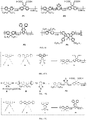
- a polymer can include one or more types of general monomers. As shown in FIGS. 3A-E , three example types of general monomers are shown, D1, D2 and D2'. Each of the general D1 type monomers can be copolymerized with each of the D2 and D2' type monomers and one narrow-band monomer to obtain narrow-band emissive polymer. Any of the D1 type monomers or D2 type monomers can also be separately used to copolymerize with one narrow-band monomer to obtain the narrow-band emissive polymers as, e.g., in FIG. 1B and 1E . For the structures shown in FIG. 3A , a variety of substituents can be attached to the base structures.
- alkyl substituted phenyl can include 2-alkylphenyl, 3-alkylphenyl, 4-alkylphenyl, 2,4-dialkylphenyl, 3,5-dialkylphenyl, 3,4-dialkylphenyl; alkyl-substituted fluorenyl can include 9,9-dialkyl-substituted fluorenyl, 7-alkyl-9,9-dialkyl-substituted fluorenyl, 6-alkyl-9,9-dialkyl-substituted fluorenyl, 7-triphenylaminyl-9,9-dialkyl-substituted fluorenyl and 7-diphenylaminyl-9,9-dialkyl-substituted fluorenyl; alkyl-substituted carbazolyl can include N-alkyl-substituted carbazolyl, 6-alkyl-substituted carbazolyl and 7-
- the alkyl substituents can include C n H 2n+1 , or C n F 2n+1 or - CH 2 CH 2 [OCH 2 CH 2 ] n -OCH 3 wherein n is 1 to 20. In some embodiments, n can be between 1 to 50 or higher.
- the general monomers can also be substituted with other substituents as defined herein. As shown in FIG. 3A , each of X, X 1 and X 2 can be independently selected from the group consisting of carbon (C), silicon (Si), and germanium (Ge). Z, Z 1 , Z 2 can be selected from the group consisting of oxygen (O), sulfur (S), and selenium (Se).
- FIG. 3B shows a non-limiting list of general donors in the narrow-band emissive polymers.
- each of X, X 1 X 2 , X 3 , X 4 , Q, Z, Z 1 , and Z 2 can be heteroatoms, e.g., and can be independently selected from the group consisting of, O, S, Se, Te, N and so on.
- alkyl substituted phenyl can include 2-alkylphenyl, 3-alkylphenyl, 4-alkylphenyl, 2,4-dialkylphenyl, 3,5-dialkylphenyl, 3,4-dialkylphenyl; alkyl-substituted fluorenyl can include 9, 9-dialkyl-substituted fluorenyl, 7-alkyl-9,9-dialkyl-substituted fluorenyl, 6-alkyl-9,9-dialkyl-substituted fluorenyl, 7-triphenylaminyl-9,9-dialkyl-substituted fluorenyl and 7-diphenylaminyl-9,9-dialkyl-substituted fluorenyl; alkyl-substituted carbazolyl can include N-alkyl-substituted carbazolyl, 6-alkyl-substituted carbazolyl and 7-
- the general donors can be selected (but not limited to) from the group shown in FIG. 3C , 3D and 3E .
- alkyl substituted phenyl can include 2-alkylphenyl, 3-alkylphenyl, 4-alkylphenyl, 2,4-dialkylphenyl, 3,5-dialkylphenyl, 3,4-dialkylphenyl; alkyl-substituted fluorenyl can include 9, 9-dialkyl-substituted fluorenyl, 7-alkyl-9,9-dialkyl-substituted fluorenyl, 6-alkyl-9,9-dialkyl-substituted fluorenyl, 7-triphenylaminyl-9,9-dialkyl-substituted fluorenyl and 7-diphenylaminyl-9,9-dialkyl-substituted fluorenyl; alkyl-substituted carbazolyl can include N-alkyl-substituted carbazolyl, 6-alkyl-substituted carbazolyl and 7-
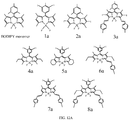
- the narrow-band emissive polymers for making Pdots include boron-dipyrromethene (4,4-difluoro-4-bora-3a,4a-diaza-s-indacene, BODIPY) and their derivatives as narrow-band monomers.
- BODIPY monomers and their derivatives include but are not limited to their alkyl derivatives, aryl derivatives, alkyne derivatives, aromatic derivatives, alkoxide derivatives, aza derivatives, BODIPY extended systems and other BODIPY derivatives.
- the narrow-band emissive polymers can also include any other monomers.
- the BODIPY based-monomers can be energy acceptors and other monomers can be energy donors so that the final Pdots can exhibit narrow-band emissions.
- the narrow-band emissive chromophoric polymers in good solvents may exhibit broad emissions or narrow emissions. However, their nanoparticle form gives narrow-band emissions.
- the emission FWHM of the above Pdots is less than 70 nm. In certain embodiments, the FWHM is less than 60 nm, less than 50 nm, less than 40 nm, less than 30 nm, or less than 20 nm.
- Suitable narrow band monomers of the present invention can include BODIPY derivatives and other boron-containing monomers.
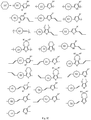
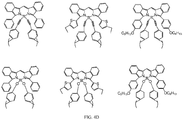
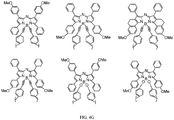
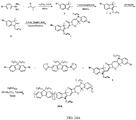
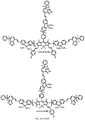
- FIGS. 2B-2N shows a non-limiting list of examples of the narrow-band emissive copolymer including one general monomer chosen from FIG.2A and different BODIPY derivatives or other boron-containing units as narrow-band monomers.
- the narrow band monomers in FIGS. 2B-2L can include a variety of substituents defined herein. For example, for the structures shown in FIGS.
- each of R 1 R 2 , R 4 and R 5 can be independently selected from the group consisting of fluorine (F), phenyl, naphthyl, alkyl-substituted phenyl, alkyl-substituted naphthyl and alkyl-substituted thiophenyl.
- Alkyl substituted phenyl can include 2-alkylphenyl, 3-alkylphenyl, 4-alkylphenyl, 2,4-dialkylphenyl, 3,5-dialkylphenyl, and 3,4-dialkylphenyl.
- Alkyl-substituted naphthyl can include 3-alkyl-substituted naphthyl, 4-alkyl-substituted naphthyl, 6-alkyl-substituted naphthyl and 7-alkyl-substituted naphthyl.
- Alkyl-substituted thiophenyl can include 2-alkylthiophenyl, 3-alkylthiophenyl, 4-alkylthiophenyl.
- the alkyl substituents can include C n H 2n+1 , or C n F 2n+1 or -CH 2 CH 2 [OCH 2 CH 2 ] n -OCH 3 wherein n is 1 to 20.
- n can be between 1 to 50 or higher.
- R 3 can be selected from the group consisting of phenyl, alkyl-substituted phenyl, and alkyl-substituted thiophenyl, and in some cases, from cyano (CN), fluorine (F), and trifluoro (CF 3 ). Additional narrow-band monomers are shown in FIGS. 2D-2G in which each of R 1 and R 2 are independently selected from the group consisting of, but not limited to, fluorine, alkyl, phenyl, alkyl-substituted phenyl, alkyl-substituted fluorenyl and alkyl-substituted carbazolyl.
- Alkyl substituted phenyl can include 2-alkylphenyl, 3-alkylphenyl, 4-alkylphenyl, 2,4-dialkylphenyl, 3,5-dialkylphenyl, and 3,4-dialkylphenyl.
- Alkyl-substituted fluorenyl can include 9,9-dialkyl-substituted fluorenyl, 7-alkyl-9,9-dialkyl-substituted fluorenyl, 7-triphenylaminyl-9,9-dialkyl-substituted fluorenyl and 7-diphenylaminyl-9,9-dialkyl-substituted fluorenyl.
- the alkyl substituents can include C n H 2n+1 , or C n F 2n+1 or -CH 2 CH 2 [OCH 2 CH 2 ] n -OCH 3 wherein n is 1 to 20. In some embodiments, n can be between 1 to 50 or higher.
- FIGS. 2H and 2I show additional example monomers in which each of R 1 R 2 , R 3 and R 4 are independently selected from the group consisting of, but not limited to, fluorine, alkyl, phenyl, alkyl-substituted phenyl, alkyl-substituted fluorenyl, alkyl-substituted carbazolyl and alkyl-substituted thiophenyl.
- Alkyl substituted phenyl can include 2-alkylphenyl, 3-alkylphenyl, 4-alkylphenyl, 2,4-dialkylphenyl, 3,5-dialkylphenyl, and 3,4-dialkylphenyl.
- Alkyl-substituted fluorenyl can include 9,9-dialkyl-substituted fluorenyl, 7-alkyl-9,9-dialkyl-substituted fluorenyl, 7-triphenylaminyl-9,9-dialkyl-substituted fluorenyl and 7-diphenylaminyl-9,9-dialkyl-substituted fluorenyl.
- Alkyl-substituted thiophenyl can include 3-alkyl-substituted thiophenyl, 4-alkyl-substituted thiophenyl, 5-alkyl-substituted thiophenyl, 3,4-dialkyl-substituted thiophenyl, 3,5-dialkyl-substituted thiophenyl and 4,5-dialkyl-substituted thiophenyl.
- the alkyl substituents can include C n H 2n+1 , or C n F 2n+1 or - CH 2 CH 2 [OCH 2 CH 2 ] n -OCH 3 wherein n is 1 to 20. In some embodiments, n can be between 1 to 50 or higher.
- FIGS. 2J and 2K show additional monomers in which R 1 and R 2 are independently selected from the group consisting of, but not limited to, fluorine, alkyl, phenyl, alkyl-substituted phenyl, alkyl-substituted fluorenyl, alkyl-substituted carbazolyl and alkyl-substituted thiophenyl.
- Alkyl substituted phenyl can include 2-alkylphenyl, 3-alkylphenyl, 4-alkylphenyl, 2,4-dialkylphenyl, 3,5-dialkylphenyl, and 3,4-dialkylphenyl.
- Alkyl-substituted fluorenyl can include 9,9-dialkyl-substituted fluorenyl, 7-alkyl-9,9-dialkyl-substituted fluorenyl, 7-triphenylaminyl-9,9-dialkyl-substituted fluorenyl and 7-diphenylaminyl-9,9-dialkyl-substituted fluorenyl.
- Alkyl-substituted thiophenyl can include 3-alkyl-substituted thiophenyl, 4-alkyl-substituted thiophenyl, 5-alkyl-substituted thiophenyl, 3,4-dialkyl - substituted thiophenyl, 3,5-dialkyl-substituted thiophenyl and 4,5-dialkyl-substituted thiophenyl.
- the alkyl substituents can include C n H 2n+1 , or C n F 2n+1 or -CH 2 CH 2 [OCH 2 CH 2 ] n -OCH 3 wherein n is 1 to 20.
- n can be between 1 to 50 or higher.
- R 3 can be hydrogen, fluorine, trifluoro or -CN.
- FIG. 2L further shows generic structures for both general monomers and narrow-band monomers present in a copolymer provided by the present invention.
- each of R 1 R 2 , R 3 and R 4 can be independently selected from the group consisting of, but not limited to, fluorine, alkyl, phenyl, alkyl-substituted phenyl, alkyl-substituted fluorenyl, alkyl-substituted carbazolyl and alkyl-substituted thiophenyl.
- Alkyl substituted phenyl can include 2-alkylphenyl, 3-alkylphenyl, 4-alkylphenyl, 2,4-dialkylphenyl, 3,5-dialkylphenyl, and 3,4-dialkylphenyl.
- Alkyl-substituted fluorenyl can include 9,9-dialkyl-substituted fluorenyl, 7-alkyl-9,9-dialkyl-substituted fluorenyl, 7-triphenylaminyl-9,9-dialkyl-substituted fluorenyl and 7-diphenylaminyl-9,9-dialkyl-substituted fluorenyl.
- Alkyl-substituted thiophenyl can include 3- alkyl-substituted thiophenyl, 4-alkyl-substituted thiophenyl, 5-alkyl-substituted thiophenyl, 3,4-dialkyl-substituted thiophenyl, 3,5-dialkyl-substituted thiophenyl and 4,5- dialkyl-substituted thiophenyl.
- the alkyl substituents include C n H 2n+1 , or C n F 2n+1 or -CH 2 CH 2 [OCH 2 CH 2 ] n -OCH 3 , wherein n is 1 to 20.
- n can be between 1 to 50 or higher.
- R 5 and R 6 are independently selected from the group consisting of, but not limited to, fluorine, alkyl, phenyl, alkyl-substituted phenyl, alkyl-substituted fluorenyl and alkyl-substituted carbazolyl.
- Alkyl substituted phenyl can include 2-alkylphenyl, 3-alkylpheny, 4-alkylphenyl, 2,4-dialkylphenyl, 3,5-dialkylphenyl, and 3,4-dialkylphenyl.
- Alkyl-substituted fluorenyl can include 9,9-dialkyl-substituted fluorenyl, 7-alkyl-9,9-dialkyl-substituted fluorenyl, 7-triphenylaminyl-9,9-dialkyl-substituted fluorenyl and 7-diphenylaminyl-9,9-dialkyl-substituted fluorenyl.
- the alkyl substituents include C n H 2n+1 , or C n F 2n+1 or - CH 2 CH 2 [OCH 2 CH 2 ] n -OCH 3 , wherein n is 1 to 20. In some embodiments, n can be between 1 to 50 or higher.
- BODIPY and BODIPY derivatives can be polymerized to form polymers (e.g., homopolymers or heteropolymers) and/or can be attached (e.g., covalently attached) to a polymer backbone, sidechain and/or terminus.
- alkyl substituted phenyl can include 2-alkylphenyl, 3-alkylphenyl, 4-alkylphenyl, 2,4-dialkylphenyl, 3,5-dialkylphenyl, 3,4-dialkylphenyl; alkyl-substituted fluorenyl can include 9, 9-dialkyl-substituted fluorenyl, 7-alkyl-9,9-dialkyl-substituted fluorenyl, 6-alkyl-9,9-dialkyl-substituted fluorenyl, 7-triphenylaminyl-9,9-dialkyl-substituted fluorenyl and 7-diphenylaminyl-9,9-dialkyl-substituted fluorenyl; alkyl-substituted carbazolyl can include N-alkyl-substituted carbazolyl, 6-alkyl-substituted carbazolyl and 7-
- the narrow-band monomer can be integrated into a backbone of the polymer (e.g., polymerized in the polymer) and/or covalently attached to the backbone, a terminus, or a sidechain of the polymer. through at least one attachment to R 1 , R 2A , R 2B , R 3A , R 3B , R 4A , R 4B , or a combination thereof.
- Figure 4A shows examples of monomers that, e.g., can be integrated with the polymer by attachment to R 3A and R 3B groups.
- alkyl substituted phenyl can include 2-alkylphenyl, 3-alkylphenyl, 4-alkylphenyl, 2,4-dialkylphenyl, 3,5-dialkylphenyl, 3,4-dialkylphenyl; alkyl-substituted fluorenyl can include 9, 9-dialkyl-substituted fluorenyl, 7-alkyl-9,9-dialkyl-substituted fluorenyl, 6-alkyl-9,9-dialkyl-substituted fluorenyl, 7-triphenylaminyl-9,9-dialkyl-substituted fluorenyl and 7-diphenylaminyl-9,9-dialkyl-substituted fluorenyl; alkyl-substituted carbazolyl can include N-alkyl-substituted carbazolyl, 6-alkyl-substituted carbazolyl and 7-
- the narrow-band monomer can be integrated into a backbone of the polymer (e.g., polymerized in the polymer) and/or covalently attached to the backbone, a terminus, or a sidechain of the polymer through at least one attachment to R 1 , R 2A , R 2B , R 3A , R 3B , R 4A , R 4B , or a combination thereof.
- the monomer can, for example, integrate with the backbone of the polymer by attachment to the R 3A and R 3B groups.
- Figure 4B shows examples of monomers that, e.g., can be integrated with the polymer by attachment to R 3A and R 3B groups.
- alkyl substituted phenyl can include 2-alkylphenyl, 3-alkylphenyl, 4-alkylphenyl, 2,4-dialkylphenyl, 3,5-dialkylphenyl, 3,4-dialkylphenyl; alkyl-substituted fluorenyl can include 9, 9-dialkyl-substituted fluorenyl, 7-alkyl-9,9-dialkyl-substituted fluorenyl, 6-alkyl-9,9-dialkyl-substituted fluorenyl, 7-triphenylaminyl-9,9-dialkyl-substituted fluorenyl and 7-diphenylaminyl-9,9-dialkyl-substituted fluorenyl; alkyl-substituted carbazolyl can include N-alkyl-substituted carbazolyl, 6-alkyl-substituted carbazolyl and 7-
- the narrow-band monomer can be integrated into a backbone of the polymer (e.g., polymerized in the polymer) and/or covalently attached to the backbone, a terminus, or a sidechain of the polymer through at least one attachment, e.g., to R 1 , R 2A , R 2B , or a combination thereof.
- the parentheses indicate points of attachment of the monomer to the backbone of the polymer.
- Figure 4C shows examples of monomers that, e.g., can be integrated with the polymer (e.g., copolymerized in the polymer).
- alkyl substituted phenyl can include 2-alkylphenyl, 3-alkylphenyl, 4-alkylphenyl, 2,4-dialkylphenyl, 3,5-dialkylphenyl, 3,4-dialkylphenyl; alkyl-substituted fluorenyl can include 9, 9-dialkyl-substituted fluorenyl, 7-alkyl-9,9-dialkyl-substituted fluorenyl, 6-alkyl-9,9-dialkyl-substituted fluorenyl, 7-triphenylaminyl-9,9-dialkyl-substituted fluorenyl and 7-diphenylaminyl-9,9-dialkyl-substituted fluorenyl; alkyl-substituted carbazolyl can include N-alkyl-substituted carbazolyl, 6-alkyl-substituted carbazolyl and 7-
- the narrow-band monomer can be integrated into a backbone of the polymer (e.g., polymerized in the polymer) and/or covalently attached to the backbone, a terminus, or a sidechain of the polymer.through at least one attachment to R 1 , R 2A , R 2B , R 3A , and R 3B or a combination thereof.
- Figure 4D shows examples of monomers that, e.g., can be integrated with the polymer by attachment to R 3A and R 3B groups.
- the chromophoric polymer dots of the present invention can include a polymer that includes a narrow-band monomer having the formula: wherein each of R 1 , R 2A , R 2B , R 3A , R 3B , R 4A , R 4B , R 5A , and R 5B is independently selected from the group consisting of, but not limited to, hydrogen (H), deuterium (D), halogen, direct or branched alkyl, heteroalkyl, heterocycloalkyl, heterocycloalkylene, alkoxy, aryl, hydroxyl, cyano, nitro, ether and its derivatives, ester and its derivatives, alkyl ketone, alkylester, arylester, alkynyl, alkyl amine, fluoroalkyl, fluoroaryl, and polyalkalene (e.g, mehtoxyethoxyethoxy, ethoxyethoxy, and -(OCH 2 CH
- alkyl substituted phenyl can include 2-alkylphenyl, 3-alkylphenyl, 4-alkylphenyl, 2,4-dialkylphenyl, 3,5-dialkylphenyl, 3,4-dialkylphenyl; alkyl-substituted fluorenyl can include 9, 9-dialkyl-substituted fluorenyl, 7-alkyl-9,9-dialkyl-substituted fluorenyl, 6-alkyl-9,9-dialkyl-substituted fluorenyl, 7-triphenylaminyl-9,9-dialkyl-substituted fluorenyl and 7-diphenylaminyl-9,9-dialkyl-substituted fluorenyl; alkyl-substituted carbazolyl can include N-alkyl-substituted carbazolyl, 6-alkyl-substituted carbazolyl and 7-
- the narrow-band monomer can be integrated into a backbone of the polymer (e.g., copolymerized in the polymer) and/or covalently attached to the backbone, a terminus, or a sidechain of the polymer through at least one attachment to R 1 , R 2A , R 2B R 3A , R 3B , R 4A , R 4B , R 5A , R 5B , or a combination thereof.
- the narrow-band monomers can be integrated into the backbone by attachment to the R 5A and R 5B groups.
- Figure 4E shows examples of monomers that, e.g., can be integrated with the polymer by attachment to R 5A and R 5B groups.
- alkyl substituted phenyl can include 2-alkylphenyl, 3-alkylphenyl, 4-alkylphenyl, 2,4-dialkylphenyl, 3,5-dialkylphenyl, 3,4-dialkylphenyl; alkyl-substituted fluorenyl can include 9, 9-dialkyl-substituted fluorenyl, 7-alkyl-9,9-dialkyl-substituted fluorenyl, 6-alkyl-9,9-dialkyl-substituted fluorenyl, 7-triphenylaminyl-9,9-dialkyl-substituted fluorenyl and 7-diphenylaminyl-9,9-dialkyl-substituted fluorenyl; alkyl-substituted carbazolyl can include N-alkyl-substituted carbazolyl, 6-alkyl-substituted carbazolyl and 7-
- the narrow-band monomer can be integrated into a backbone of the polymer (e.g., polymerized in the polymer) and/or covalently attached to the backbone, a terminus, or a sidechain of the polymer through at least one attachment to R 1A , R 1B , R 2A , R 2B , R 3A , R 3B , or a combination thereof.
- Figure 4F shows examples of monomers that, e.g., can be integrated with the polymer by attachment to R 1A , R 1B , R 2A , R 2B , R 3A or R 3B groups.
- the chromophoric polymer dots of the present invention can include a polymer that includes a narrow-band monomer having the formula: wherein each of R 2A , R 2B , R 3A , R 3B , R 4A , R 4B , R 5A and R 5B is independently selected from the group consisting of, but not limited to, hydrogen (H), deuterium (D), halogen, direct or branched alkyl, heteroalkyl, heterocycloalkyl, heterocycloalkylene, alkoxy, aryl, hydroxyl, cyano, nitro, ether and its derivatives, ester and its derivatives, alkyl ketone, alkylester, arylester, alkynyl, alkyl amine, fluoroalkyl, fluoroaryl, and polyalkalene (e.g, mehtoxyethoxyethoxy, ethoxyethoxy, and -(OCH 2 CH 2 ) n
- alkyl substituted phenyl can include 2-alkylphenyl, 3-alkylphenyl, 4-alkylphenyl, 2,4-dialkylphenyl, 3,5-dialkylphenyl, 3,4-dialkylphenyl; alkyl-substituted fluorenyl can include 9, 9-dialkyl-substituted fluorenyl, 7-alkyl-9,9-dialkyl-substituted fluorenyl, 6-alkyl-9,9-dialkyl-substituted fluorenyl, 7-triphenylaminyl-9,9-dialkyl-substituted fluorenyl and 7-diphenylaminyl-9,9-dialkyl-substituted fluorenyl; alkyl-substituted carbazolyl can include N-alkyl-substituted carbazolyl, 6-alkyl-substituted carbazolyl and 7-
- the chromophoric polymer dots of the present invention can include a polymer that includes a narrow-band monomer having the formula: wherein each of R 1A , R 1B , R 2A , R 2B , R 3A , R 3B , R 4A and R 4B , is independently selected from the group consisting of, but not limited to, hydrogen (H), deuterium (D), halogen, direct or branched alkyl, heteroalkyl, heterocycloalkyl, heterocycloalkylene, alkoxy, aryl, hydroxyl, cyano, nitro, ether and its derivatives, ester and its derivatives, alkyl ketone, alkylester, arylester, alkynyl, alkyl amine, fluoroalkyl, fluoroaryl, and polyalkalene (e.g, mehtoxyethoxyethoxy, ethoxyethoxy, and -(OCH 2 CH 2 )
- alkyl substituted phenyl can include 2-alkylphenyl, 3-alkylphenyl, 4-alkylphenyl, 2,4-dialkylphenyl, 3,5-dialkylphenyl, 3,4-dialkylphenyl; alkyl-substituted fluorenyl can include 9, 9-dialkyl-substituted fluorenyl, 7-alkyl-9,9-dialkyl-substituted fluorenyl, 6-alkyl-9,9-dialkyl-substituted fluorenyl, 7-triphenylaminyl-9,9-dialkyl-substituted fluorenyl and 7-diphenylaminyl-9,9-dialkyl-substituted fluorenyl; alkyl-substituted carbazolyl can include N-alkyl-substituted carbazolyl, 6-alkyl-substituted carbazolyl and 7-
- alkyl substituted phenyl can include 2-alkylphenyl, 3-alkylphenyl, 4-alkylphenyl, 2,4-dialkylphenyl, 3,5-dialkylphenyl, 3,4-dialkylphenyl; alkyl-substituted fluorenyl can include 9, 9-dialkyl-substituted fluorenyl, 7-alkyl-9,9-dialkyl-substituted fluorenyl, 6-alkyl-9,9-dialkyl-substituted fluorenyl, 7-triphenylaminyl-9,9-dialkyl-substituted fluorenyl and 7-diphenylaminyl-9,9-dialkyl-substituted fluorenyl; alkyl-substituted carbazolyl can include N-alkyl-substituted carbazolyl, 6-alkyl-substituted carbazolyl and 7-
- the narrow-band monomer can be integrated into a backbone of the polymer (e.g., copolymerized in the polymer) and/or covalently attached to the backbone, a terminus, or a sidechain of the polymer) through at least one attachment to R 1A , R 1B , R 2A , R 2B , R 3A , R 3B , R 4A , R 4B , R 5A , R 5B , R 6A , R 6B or a combination thereof.
- Figure 4H shows examples of monomers that, e.g., can be integrated with the polymer by attachment to R 2A , R 2B , R 6A or R 6B groups.
- H hydrogen
- alkyl substituted phenyl can include 2-alkylphenyl, 3-alkylphenyl, 4-alkylphenyl, 2,4-dialkylphenyl, 3,5-dialkylphenyl, 3,4-dialkylphenyl; alkyl-substituted fluorenyl can include 9, 9-dialkyl-substituted fluorenyl, 7-alkyl-9,9-dialkyl-substituted fluorenyl, 6-alkyl-9,9-dialkyl-substituted fluorenyl, 7-triphenylaminyl-9,9-dialkyl-substituted fluorenyl and 7-diphenylaminyl-9,9-dialkyl-substituted fluorenyl; alkyl-substituted carbazolyl can include N-alkyl-substituted carbazolyl, 6-alkyl-substituted carbazolyl and 7-
- the narrow-band monomer can be integrated into a backbone (e.g., polymerized in the polymer) and/or covalently attached to the backbone, a terminus, or a sidechain of the polymer) of the polymer through at least one attachment to R 7 , R 8 , R 9 , R 10 , R 11 , R 12 or a combination thereof.
- a backbone e.g., polymerized in the polymer
- the narrow-band monomer can be integrated into a backbone of the polymer and/or covalently attached to the backbone, a terminus, or a sidechain of the polymer through at least one attachment to R 7 , R 8 , R 9 , R 10 , R 11 , R 12 , R 13 , R 14 , R 15 or a combination thereof.
- Narrow band monomers of the present invention can further include dipyrrin derivatives.
- Dipyrrin and dipyrrin derivatives can be polymerized to form polymers (e.g., homopolymers or heteropolymers) and/or can be attached (e.g., covalently attached) to a polymer backbone, sidechain and/or terminus.
- the chromophoric polymer dots of the present invention can include a polymer that includes a narrow-band monomer having the formula: wherein M is a metal. Examples of M can be, but not limited to, Na, Li, Zn, Co, or Si.
- X can include substituents such as, but not limited to, halogen, alkyl, phenyl, alkylphenyl, thiophenyl, alkylthiophenyl, alkoxyl, alkoxylphenyl, alkylthiophenyl, ester, or hydroxyl.
- the number of X groups (n) can be 1 or more than 1, and n can be 0, 1, 2, 3, 4.
- alkyl substituted phenyl can include 2-alkylphenyl, 3-alkylphenyl, 4-alkylphenyl, 2,4-dialkylphenyl, 3,5-dialkylphenyl, 3,4-dialkylphenyl; alkyl-substituted fluorenyl can include 9, 9-dialkyl-substituted fluorenyl, 7-alkyl-9,9-dialkyl-substituted fluorenyl, 6-alkyl-9,9-dialkyl-substituted fluorenyl, 7-triphenylaminyl-9,9-dialkyl-substituted fluorenyl and 7-diphenylaminyl-9,9-dialkyl-substituted fluorenyl; alkyl-substituted carbazolyl can include N-alkyl-substituted carbazolyl, 6-alkyl-substituted carbazolyl and 7-
- the narrow-band monomer can be integrated into a backbone of the polymer (e.g., polymerized in the polymer) and/or covalently attached to the backbone, a terminus, or a sidechain of the polymer) through at least one attachment to R 1 , R 2A , R 2B , R 3A , R 3B , R 4A , R 4B , R 5A , R 5B , or a combination thereof.
- X can include substituents such as, but not limited to, halogen, alkyl, phenyl, alkylphenyl, thiophenyl, alkylthiophenyl, alkoxyl, ester, or hydroxyl.
- the number of X groups (n) can be 1 or more than 1, and n can be 0, 1, 2, 3, 4.
- the narrow-band emissive polymers for making Pdots include squaraine and squaraine derivatives as narrow-band monomers.
- Squaraine derivatives include but are not limited to their alkyl derivatives, aryl derivatives, alkyne derivatives, aromatic derivatives, alkoxide derivatives, aza derivatives, their extended systems and analogues.
- the narrow-band emissive polymers can also include any other monomers.
- the squaraine and their derivatives can be energy acceptors and other monomers can be energy donors so that the final Pdots can exhibit narrow-band emissions.
- the narrow-band emissive chromophoric polymers in good solvents may exhibit broad emissions or narrow emissions.
- the emission FWHM of the above Pdots is less than 70 nm. In certain embodiments, the FWHM is less than 60 nm, less than 50 nm, less than 40 nm, less than 30 nm, or less than 20 nm.
- Suitable squaraine derivatives for use in the present invention can include the following structures described below. Squaraine and squaraine derivatives can be polymerized to form polymers (e.g., homopolymers or heteropolymers) and/or can be attached (e.g., covalently attached) to a polymer backbone, sidechain and/or terminus.
- polymers e.g., homopolymers or heteropolymers
- attached e.g., covalently attached
- Chromophoric polymer dots of the present invention can include a polymer that includes a narrow-band monomer having the formula: wherein each of X 1 and X 2 is independently selected from the group consisting of oxygen, sulfur and nitrogen; each of R 1A and R 1B is independently selected from the group consisting of, but not limited, alkylene, alkenylene, arylene, heteroarylene, phenylene, azulene, cycloalkylene, and heterocycloalkylene; and each of R 2A and R 2B is a reactive group independently selected from the group consisting of, but not limited to, a halide, hydroxyl, and amino. Other reactive groups can be used.
- the halide is a chloro, a bromo, or an iodo group.
- the reactive group can be used to integrate the monomer into a polymer, e.g. along the backbone of the polymer (e.g., by polymerizing in the polymer) and/or to attach the monomer by covalent attachment to the backbone, a terminus, or a sidechain of the polymer.
- Chromophoric polymer dots of the present invention can include a polymer that includes a narrow-band monomer having the formula: wherein each of R 1A and R 1B is independently selected from the group consisting of, but not limited to, alkylene, alkenylene, arylene, heteroarylene, phenylene, azulene, cycloalkylene, and heterocycloalkylene; and each of R 2A and R 2B is a reactive group independently selected from the group consisting of, but not limited to, a halide, hydroxyl, and amino. Other reactive groups can be used.
- the halide is a chloro, a bromo, or an iodo group.
- the reactive group can be used to integrate the monomer into a polymer (e.g. along the backbone of the polymer by polymerizing in the polymer) and/or to attach the monomer by covalent attachment to the backbone, a terminus, or a sidechain of the polymer.
- Chromophoric polymer dots of the present invention can include a polymer that includes a narrow-band monomer having the formula: wherein each of R 1A and R 1B is independently selected from the group consisting of, but not limited to, hydrogen, methyl, alkyl, phenyl, araalkyl, and alkoxy-phenyl; each of R 2A and R 2B is independently selected from the group consisting of, but not limited to, hydrogen, methyl, alkyl, phenyl, araalkyl, and alkoxy-phenyl; each of R 3A and R 3B is a reactive group independently selected from the group consisting of, but not limited to,chloro, bromo, iodo, and hydroxyl; each of R 4A and R 4B is independently is selected from a group consisting of, but not limited to, hydroxyl, hydrogen, alkyl, phenyl, araalkyl, and alkoxy-phenyl; and each of R 5A and R 5B is independently
- the reactive group can be used to integrate the monomer into a polymer (e.g. along the backbone of the polymer by polymerizing in the polymer) and/or to attach the monomer by covalent attachment to the backbone, a terminus, or a sidechain of the polymer.
- Figure 6A shows some examples of narrow band monomers that can be integrated into the polymer by reaction with the reactive groups, e.g., I or Br.
- Chromophoric polymer dots of the present invention can include a polymer that includes a narrow-band monomer having the formula: wherein each of R 1A and R 1B is a reactive group independently selected from the group consisting of, but not limited to, chloro, bromo, iodo, and hydroxyl; and each of R 2A and R 2B is selected from the group consisting of, but not limited to, hydrogen, methyl, alkyl, phenyl, araalkyl, and alkoxy-phenyl. Other reactive groups can be used. The reactive group can be used to integrate the monomer into a polymer (e.g.
- Figure 6B shows an example monomer that can be integrated into the polymer by reaction with the reactive groups, e.g., Br.
- Chromophoric polymer dots of the present invention can include a polymer that includes a narrow-band monomer having the formula: wherein each of X 1 and X 2 is independently selected from the group consisting of carbon, sulphur, and selenium; each of R 1A and R 1B is a reactive group independently selected from the group consisting of, but not limited to, chloro, bromo, iodo, and hydroxyl; and each of R 2A and R 2B is independently selected from the group consisting of, but not limited to, hydrogen, methyl, alkyl, phenyl, araalkyl, alkoxy-phenyl, N-dialkyl-4-phenyl, N-diphenyl-4-phenyl, and N-dialkoxylphenyl-4-phenyl.
- the reactive group can be used to integrate the monomer into a polymer (e.g. along the backbone of the polymer by polymerizing in the polymer) and/or attach the monomer by covalent attachment to the backbone, a terminus, or a sidechain of the polymer.
- Figure 6B shows example monomers that can be integrated into the polymer by reaction with the reactive groups, e.g., Br.
- Chromophoric polymer dots of the present invention can include a polymer that includes a narrow-band monomer having the formula: wherein each of R 2A and R 2B is a reactive group independently selected from the group consisting of, but not limited to, chloro, bromo, iodo, and hydroxyl; and each of R 1A and R 1B is selected from the group consisting of, but not limited to, hydrogen, methyl, alkyl, phenyl, araalkyl, alkoxy-phenyl, N-dialkyl-4-phenyl, N-diphenyl-4-phenyl, and N-dialkoxylphenyl-4-phenyl. Other reactive groups can be used.
- the reactive group can be used to integrate the monomer into a polymer (e.g. along the backbone of the polymer by polymerizing in the polymer) and/or attach the monomer by covalent attachment to the backbone, a terminus, or a sidechain of the polymer.
- Chromophoric polymer dots of the present invention can include a polymer that includes a narrow-band monomer having the formula: wherein each of R 1A and R 1B is independently selected from the group consisting of, but not limited to, alkylene, alkenylene, arylene, heteroarylene, phenylene, azulene, cycloalkylene, and heterocycloalkylene; and each of R 2A and R 2B is a reactive group independently selected from the group consisting of, but not limited to, a halide, hydroxyl, and amino.
- the halide is a chloro, a bromo, or an iodo group.
- the reactive group can be used to integrate the monomer into a polymer (e.g. along the backbone of the polymer by polymerizing in the polymer) and/or attach the monomer by covalent attachment to the backbone, a terminus, or a sidechain of the polymer.
- Chromophoric polymer dots of the present invention can include a polymer that includes a narrow-band monomer having the formula: wherein each of X 1 and X 2 is independently selected from the group consisting of carbon, sulphur, and selenium; each of R 1A and R 1B is a reactive group independently selected from the group consisting of, but not limited to, chloro, bromo, iodo, and hydroxyl; and each of R 2A and R 2B is independently selected from the group consisting of, but not limited to, hydrogen, methyl, alkyl, phenyl, araalkyl, alkoxy-phenyl, N-dialkyl-4-phenyl, N-diphenyl-4-phenyl, and N-dialkoxylphenyl-4-phenyl.
- Figure 6C shows example monomers that can be integrated into the polymer by reaction with the reactive groups, e.g., Br (e.g. along the backbone of the polymer by polymerizing in the polymer) and/or attached by covalent attachment to the backbone, a terminus, or a sidechain of the polymer).
- the reactive groups e.g., Br (e.g. along the backbone of the polymer by polymerizing in the polymer) and/or attached by covalent attachment to the backbone, a terminus, or a sidechain of the polymer).
- Chromophoric polymer dots of the present invention can include a polymer that includes a narrow-band monomer having the formula: wherein each of R 1A and R 1B is independently selected from the group consisting of, but not limited to, alkylene, alkenylene, arylene, heteroarylene, phenylene, azulene, cycloalkylene, and heterocycloalkylene; each of R 2A and R 2B is a reactive group independently selected from the group consisting of, but not limited to, a halide, hydroxyl, and amino; and each of R 3A and R 3B is independently selected from the group consisting of hydrogen, methyl, alkyl, phenyl, aralkyl, and alkoxy-phenyl.
- the halide is a chloro, a bromo, or an iodo group.
- the reactive group can be used to integrate the monomer along into a polymer (e.g. along the backbone of the polymer by polymerizing in the polymer) and/or attach the monomer by covalent attachment to the backbone, a terminus, or a sidechain of the polymer.
- Figure 6D shows example monomers that can be integrated into the polymer by reaction with the reactive groups, e.g., Br.
- Chromophoric polymer dots of the present invention can include a polymer that includes a narrow-band monomer having the formula: wherein each of R 1A , R 1B , R 2A and R 2B are independently selected from the group consisting of, but not limited to, hydrogen, deuterium, alkyl, aryl, acetyl, and hydroxyl; and each of R 3A , R 3B , R 4A and R 4B are independently selected from the group consisting of, but not limited to, hydrogen, deuterium, alkyl, aryl, amino, sulfide, aldehyde, ester, ether, acid, hydroxyl, and halide.
- the narrow-band monomer can be integrated into a backbone of the polymer (e.g. along the backbone of the polymer by polymerizing in the polymer) and/or attached by covalent attachment to the backbone, a terminus, or a sidechain of the polymer through at least one attachment to R 1A , R 1B , R 2A , R 2B , R 3A , R 3B , R 4A , R 4B or a combination thereof.
- Chromophoric polymer dots of the present invention can include a polymer that includes a narrow-band monomer having the formula: wherein each of R 1A , R 1B , R 2A and R 2B are independently selected from the group consisting of, but not limited to, hydrogen, deuterium, alkyl, aryl, acetyl, and hydroxyl; and each of R 3A , R 3B , R 4A , R 4B , R 5A , R 5B , R 6A and R 6B are independently selected from the group consisting of, but not limited to, hydrogen, deuterium, alkyl, aryl, amino, sulfide, aldehyde, ester, ether, acid, hydroxyl, and halide.
- the narrow-band monomer can be integrated into a backbone of the polymer (e.g. along the backbone of the polymer by polymerizing in the polymer) and/or attached by covalent attachment to the backbone, a terminus, or a sidechain of the polymer through at least one attachment to R 1A , R 1B , R 2A , R 2B , R 3A , R 3B , R 4A , R 4B , R 5A , R 5B , R 6A , R 6B or a combination thereof.
- Chromophoric polymer dots of the present invention can include a polymer that includes a narrow-band monomer having the formula: wherein each of R 1A , R 1B , R 1C , R 2A , R 2B , R 2C , R 3A , R 3B , R 3C , R 4A , R 4B , R 4C , R 5A , R 5B , R 5C , R 6A , R 6B , and R 6C are independently selected from the group consisting of, but not limited to, hydrogen, deuterium, alkyl, aryl, amino, sulfide, aldehyde, ester, ether, acid, hydroxyl, and halide, and each of R 7A , R 7B , and R 7C is independently selected from the group consisting of, but not limited to, hydrogen, deuterium, alkyl, aryl and acetyl.
- the narrow-band monomer can be integrated into a backbone of the polymer (e.g. along the backbone of the polymer by polymerizing in the polymer) and/or attached by covalent attachment to the backbone, a terminus, or a sidechain of the polymer through at least one attachment to R 1A , R 1B , R 1C , R 2A , R 2B , R 2C , R 3A , R 3B , R 3C , R 4A , R 4B , R 4C , R 5A , R 5B , R 5C , R 6A , R 6B , R 6C , R 7A , R 7B or a combination thereof.
- the monomer described herein can be integrated with the polymer by attachment as shown by the parentheses.
- Chromophoric polymer dots of the present invention can include a polymer that includes a narrow-band monomer having the formula: wherein each of R 1A and R 1B is independently selected from the group consisting of, but not limited to, hydrogen, deuterium, alkyl and aryl; and each of R 2A , R 2B , R 3A , R 3B , R 4A , R 4B , R 5 , R 6 , R 7 , R 8 , R 9 , R 10 , R 11 and R 12 are independently selected from the group consisting of, but not limited to, hydrogen, deuterium, alkyl, aryl, cyano, amino, sulfide, aldehyde, ester, ether, acid, hydroxyl, and halide.
- the narrow-band monomer can be integrated into a backbone of the polymer (e.g. along the backbone of the polymer by polymerizing in the polymer) and/or attached by covalent attachment to the backbone, a terminus, or a sidechain of the polymer through at least one attachment to R 1A , R 1B , R 2A , R 2B , R 3A , R 3B , R 4A , R 4B , R 5 , R 6 , R 7 , R 8 , R 9 , R 10 , R 11 , R 12 or a combination thereof.
- Chromophoric polymer dots of the present invention can include a polymer that includes a narrow-band monomer having the formula: wherein each of R 13 is independently selected from the group consisting of, but not limited to, hydrogen, deuterium, alkyl and aryl; and R 14 , R 15 , R 16 , R 17 , R 18 , R 19 , R 20 , R 21 , R 22 , R 23 and R 24 are independently selected from the group consisting of, but not limited to, hydrogen, deuterium, alkyl, aryl, cyano, amino, sulfide, aldehyde, ester, ether, acid, hydroxyl, and halide.
- the narrow-band monomer can be integrated into a backbone of the polymer (e.g. along the backbone of the polymer by polymerizing in the polymer) and/or attached by covalent attachment to the backbone, a terminus, or a sidechain of the polymer through at least one attachment to R 13 , R 14 , R 15 , R 16 , R 17 , R 18 , R 19 , R 20 , R 21 , R 22 , R 23 and R 24 or a combination thereof.
- Figure 6E shows example monomers that can be integrated into the polymer by reaction with the reactive groups, e.g., Br.
- the narrow-band emissive polymers for making Pdots include metal complexes and their derivatives as narrow-band monomers.
- Metal complexes and their derivatives include but are not limited to their alkyl derivatives, aryl derivatives, alkyne derivatives, aromatic derivatives, alkoxide derivatives, aza derivatives, their extended systems and analogues.
- the narrow-band emissive polymers can also include any other monomers.
- the metals can be any metal such as Na, Li, Zn, Mg, Fe, Mn, Co, Ni, Cu, In, Si, Ga, Al, Pt, Pd, Ru, Rh, Re, Os, Ir, Ag, Au and so on.
- the metal complexes can be energy acceptors and other monomers can be energy donors so that the final Pdots can exhibit narrow-band emissions.
- the narrow-band emissive chromophoric polymers in good solvents may exhibit broad emissions or narrow emissions. However, their nanoparticle form gives narrow-band emissions.
- the emission FWHM of the above Pdots is less than 70 nm. In certain embodiments, the FWHM is less than 60 nm, less than 50 nm, less than 40 nm, less than 30 nm, or less than 20 nm.
- Metal complexes and metal complex derivatives are shown in Figures 7A-7C .
- Metal complexes and metal complex derivatives can be polymerized to form polymers (e.g., homopolymers or heteropolymers) and/or can be attached (e.g., covalently attached) to a polymer backbone, sidechain and/or terminus.
- the metal complexes of the present invention include derivatives of the metal complexes.
- the metal complex monomers shown in Figure 7A can include the compounds as shown, wherein R 1 and R 2 are independently selected from the group consisting of, but not limited to, phenyl, alkyl-substituted phenyl, alkyl-substituted fluorenyl, diphenyl-substituted fluorenyl, triphenylaminyl-substituted fluorenyl, diphenylaminyl-substituted fluorenyl, alkyl-substituted carbazolyl, alkyl-substituted triphenylaminyl and alkyl-substituted thiophenyl.
- R 1 and R 2 are independently selected from the group consisting of, but not limited to, phenyl, alkyl-substituted phenyl, alkyl-substituted fluorenyl, diphenyl-substituted fluorenyl, triphenylaminyl-
- Alkyl substituted phenyl can include 2-alkylphenyl, 3-alkylphenyl, 4-alkylphenyl, 2,4-dialkylphenyl, 3,5-dialkylphenyl, and 3,4-dialkylphenyl.
- Alkyl-substituted fluorenyl can include 9,9-dialkyl-substituted fluorenyl, 7-alkyl-9,9-dialkyl-substituted fluorenyl, 6-alkyl-9,9-dialkyl-substituted fluorenyl, 7-triphenylaminyl-9,9-dialkyl-substituted fluorenyl and 7-diphenylaminyl-9,9-dialkyl-substituted fluorenyl.
- Alkyl-substituted carbazolyl can include N-alkyl-substituted carbazolyl, 6-alkyl-substituted carbazolyl and 7-alkyl-substituted carbazolyl.
- Alkyl-substituted triphenylaminyl can include 4'-alkyl-substituted triphenylaminyl, 3'-alkyl-substituted triphenylaminyl, 3',4'-dialkyl-substituted triphenylaminyl and 4',4"-dialkyl-substituted triphenylaminyl.
- Alkyl-substituted thiophenyl can include 2-alkylthiophenyl, 3-alkylthiophenyl, and 4-alkylthiophenyl.
- the alkyl substituents can include C n H 2n+1 , or C n F 2n+1 or -CH 2 CH 2 [OCH 2 CH 2 ] n -OCH 3 , wherein n is 1 to 20. In some embodiments, n can be between 1 to 50 or higher.
- Figures 7B and 7C show additional example monomers for use in the present invention.
- the narrow-band emissive polymers for making Pdots include porphyrin, metalloporphyrin, and their derivatives as narrow-band monomers.
- Porphyrin, metalloporphyrin, and their derivatives can be polymerized to form polymers (e.g., homopolymers or heteropolymers) and/or can be attached (e.g., covalently attached) to a polymer backbone, sidechain and/or terminus.
- Porphyrin, metalloporphyrin, and their derivatives include but are not limited to their alkyl derivatives, aryl derivatives, alkyne derivatives, aromatic derivatives, alkoxide derivatives, aza derivatives, their extended systems and analogues.
- the metals in the metalloporphyrins can be any metal such as Na, Li, Zn, Mg, Fe, Mn, Co, Ni, Cu, In, Si, Ga, Al, Pt, Pd, Ru, Rh, Re, Os, Ir, Ag, Au and so on.
- the narrow-band emissive polymers can also include any other monomers.
- the porphyrin, metalloporphyrin and their derivatives can be energy acceptors and other monomers can be energy donors so that the final Pdots can exhibit narrow-band emissions.
- the narrow-band emissive chromophoric polymers in good solvents may exhibit broad emissions or narrow emissions. However, their nanoparticle form gives narrow-band emissions.
- the emission FWHM of the above Pdots is less than 70 nm. In certain embodiments, the FWHM is less than 60 nm, less than 50 nm, less than 40 nm, less than 30 nm, or less than 20 nm.
- FIG 8 shows example porphyrin and porphyrin derivatives for use in the present invention.
- the porphyrin derivatives can complex, e.g., with Pt and Zn.
- R 1 and R 2 can be independently selected from the group consisting of, but not limited to, phenyl, alkyl-substituted phenyl, alkyl-substituted fluorenyl, alkyl-substituted carbazolyl, alkyl-substituted triphenylaminyl, alkyl-substituted thiophenyl, fluorine (F), cyano (CN) and trifluoro (CF 3 ).
- Alkyl substituted phenyl can include 2-alkylphenyl, 3-alkylphenyl, 4-alkylphenyl, 2,4-dialkylphenyl, 3,5-dialkylphenyl, and 3,4-dialkylphenyl.
- Alkyl-substituted fluorenyl can include 9,9-dialkyl-substituted fluorenyl, 7-alkyl-9,9-dialkyl-substituted fluorenyl and 6-alkyl-9,9-dialkyl-substituted fluorenyl.
- Alkyl-substituted carbazolyl can include N-alkyl-substituted carbazolyl, 6-alkyl-substituted carbazolyl and 7-alkyl-substituted carbazolyl.
- Alkyl-substituted thiophenyl can include 2-alkylthiophenyl, 3-alkylthiophenyl, and 4-alkylthiophenyl.
- the alkyl substituents can include C n H 2n+1 , or C n F 2n+1 or -CH 2 CH 2 [OCH 2 CH 2 ] n -OCH 3 , wherein n is 1 to 20. In some embodiments, n can be between 1 to 50 or higher.
- the narrow-band monomer can be integrated into a backbone of the polymer (e.g., by copolymerizing in the polymer) and/or attached by covalent attachment to the backbone,a terminus, or a sidechain of the polymer.through at least one attachment to R 1 , R 2 , or a combination thereof.
- the monomers described herein can be integrated with the polymer by attachment as shown by brackets.
- the general monomer (D) and the narrow band metal complex monomers are present in the polymer at a ratio where D is present as x and the narrow band monomer is present as 1-x.
- the narrow-band emissive polymers for making Pdots include phthalocyanine and its derivatives as monomers.
- Phthalocyanine and its derivatives as monomers can be polymerized to form polymers (e.g., homopolymers or heteropolymers) and/or can be attached (e.g., covalently attached) to a polymer backbone, sidechain and/or terminus.
- Phthalocyanine derivatives include but are not limited to their alkyl derivatives, aryl derivatives, alkyne derivatives, aromatic derivatives, alkoxide derivatives, aza derivatives, their extended systems and analogues.
- the metals in the phthalocyanine derivatives can be any metal such as Na, Li, Zn, Mg, Fe, Mn, Co, Ni, Cu, In, Si, Ga, Al, Pt, Ru, Rh, Re, Os, Ir, Ag, Au or Pd.
- the narrow-band emissive polymers can also include any other monomers.
- the phthalocyanine derivatives can be energy acceptors so that the final Pdots can exhibit narrow-band emissions.
- the narrow-band emissive chromophoric polymers in good solvents may exhibit broad emissions or narrow emissions. However, their nanoparticle form gives narrow-band emissions.
- the emission FWHM of the above Pdots is less than 70 nm. In certain embodiments, the FWHM is less than 60 nm, less than 50 nm, less than 40 nm, less than 30 nm, or less than 20 nm.
- Figure 9 shows an example phthalocyanine structure that can be used as a narrow band monomer in the present invention.
- M can be, but is not limited to, Cu, Zn, Mn, Fe, Si, Pt, Co, Ca, Ni, Na, Mg Ru, Rh, Re, Os, Ir, Ag, Au, Pd or Al.
- R 1 , R 2 , R 3 , and R 4 can be a substituent attached to any suitable position in the isoindole portions of the monomer.
- the narrow-band monomer can be integrated into a backbone of the polymer (e.g., by copolymerizing in the polymer) and/or attached by covalent attachment to the backbone,a terminus, or a sidechain of the polymer through at least one attachment to R 1 , R 2 , R 3 , R 4 , or a combination thereof.
- each of R 1 , R 2 , R 3 , and R 4 can be independently selected from the group consisting of, but not limited to, phenyl, alkyl-substituted phenyl, alkyl-substituted fluorenyl, alkyl-substituted carbazolyl, alkyl-substituted triphenylaminyl, alkyl-substituted thiophenyl, hydrogen, fluorine (F), cyano (CN) and trifluoro (CF 3 ).
- Alkyl substituted phenyl can include 2-alkylphenyl, 3-alkylphenyl, 4-alkylphenyl, 2,4-dialkylphenyl, 3,5-dialkylphenyl, 3,4-dialkylphenyl.
- Alkyl-substituted fluorenyl can include 9,9-dialkyl-substituted fluorenyl, 7-alkyl-9,9-dialkyl-substituted fluorenyl and 6-alkyl-9,9-dialkyl-substituted fluorenyl.
- Alkyl-substituted carbazolyl can include N-alkyl-substituted carbazolyl, 6-alkyl-substituted carbazolyl and 7-alkyl-substituted carbazolyl.
- Alkyl-substituted thiophenyl can include 2-alkylthiophenyl, 3-alkylthiophenyl, and 4-alkylthiophenyl.
- the alkyl substituents can include C n H 2n+1 , or C n F 2n+1 or - CH 2 CH 2 [OCH 2 CH 2 ] n -OCH 3 , wherein n is 1 to 20. In some embodiments, n can be between 1 to 50 or higher.
- the narrow-band emissive polymers for making Pdots include Lanthanide complexes and their derivatives as narrow-band monomers.
- Lanthanide complexes and lanthanide complex derivatives as monomers can be polymerized to form polymers (e.g., homopolymers or heteropolymers) and/or can be attached (e.g., covalently attached) to a polymer backbone, sidechain and/or terminus.
- Lanthanide complexes and their derivatives include but are not limited to their alkyl derivatives, aryl derivatives, alkyne derivatives, aromatic derivatives, alkoxide derivatives, aza derivatives, their extended systems and analogues.
- the narrow-band emissive polymers can also include any other monomers.
- the Lanthanide complexes and their derivatives can be energy acceptors and other monomers can be donors so that the final Pdots can exhibit narrow-band emissions.
- the narrow-band emissive chromophoric polymers in good solvents may exhibit broad emissions or narrow emissions. However, their nanoparticle form gives narrow-band emissions.
- the emission FWHM of the above Pdots is less than 70 nm. In certain embodiments, the FWHM is less than 60 nm, less than 50 nm, less than 40 nm, less than 30 nm, less than 20 nm, or less than 10 nm.
- the lanthanide complexes described herein can have different narrow emission properties and mechanisms as compared to transition metal complexes.
- a fluorescence mechanism of lanthanide (III) complexes such as Ce (III), Pr(III), Nd(III), Sm(III), Eu(III), Tb(III), Dy(III), Ho(III), Er(III), Tm(III), or Yb(III)
- lanthanide (III) complexes such as Ce (III), Pr(III), Nd(III), Sm(III), Eu(III), Tb(III), Dy(III), Ho(III), Er(III), Tm(III), or Yb(III)
- whose 4 ⁇ excited states are not empty and not fully filled by the electron can be that energy absorbed by the organic ligand is first transferred from the singlet state to the triplet state (intersystem crossing) of the ligand, and then transferred (or is directly transferred from the singlet state of the organic ligand) to the 4 ⁇ excited states of the lanthanide
- the emission comes from the 4 ⁇ -4 ⁇ transitions of the Ln(III) ions. Due to the inner shell f orbital electrons being shielded from the environment by the filled 5S 2 5p 6 sub-shells, they don't vary much with the environment. Consequently, the inner-shell 4 ⁇ -4 ⁇ transitions are sharp and result in narrow emission. For some divalent lanthanide ions, such as Sm(II), Eu (II), and YB (II), the emission is from the 5d-4f transitions. These properties of Lanthanide containing Pdots surprisingly can provide additional features as compared to other non-Lanthanide metal based Pdots, such as Pdots containing transition metal complexes.
- lanthanide complexes that can be used with the present invention can be described with the following formula:
- the lanthanide complexes can be used as the narrow-band emissive monomers.
- the lanthanide complexes can, e.g., be repeating units of the polymer backbone.
- the lanthanide complexes can, e.g., be attached to the side-chains of the polymer.
- the lanthanide complexes can, e.g., be attached to the terminus of the polymer.
- Ln is lanthanide metal ion which has an unfilled inner shell and can accept energy from the organic ligands or general polymers to give narrow-band emission.
- L 1 and L 2 can be organic ligands.
- the ligands can be the same or different.
- L 1 that can be anionic ligands coordinated with Ln. The total valences of L 1 and Ln can be equal to finally form a neutral lanthanide complex.
- L 1 can include additional groups to act as neutral ligands to be coordinated with Ln.
- L 1 can be monodentate, bidentate or polydentate and there can be one or more ligands L 1 in the lanthanide complex.
- L 1 can be a bridged ligand and be coordinated with Ln to form binuclear, trinuclear and polynuclear lanthanide complexes. Some of bridged L 1 can form cryptands and can be coordinated to Ln to synthesize lanthanide cryptate.
- L 2 can be a neutral ligand. There can be a plurality of ligands L 2 . L 2 can be the same or different.
- L 2 can be monodentate, bidentate or polydentate and there can be one or more ligands L 2 in the lanthanide complex.
- L 2 can be a bridged ligand and be coordinated with Ln to form binuclear, trinuclear and polynuclear lanthanide complexes.
- Some of bridged L 2 can form cryptands and can be coordinated to Ln to synthesize lanthanide cryptate.
- Figures 10A-10H shows example derivatives of lanthanide complexes that can be used as narrow band emissive units for the present invention.
- the general monomers described herein can be designed to act as energy donors that transfer energy to selected lanthanide complexes.
- the emission profile of a general monomer can overlap with the absorption profile of a lanthanide complex.
- the lanthanide complex can be excited and then emit light with a narrow band emission (e.g., of less than 70 nm FWHM).
- the energy transfer can be accomplished through a variety of ways.
- homopolymers e.g.
- P1-P10) or heteropolymers including general monomers can be chemically bonded with lanthanide complexes and condensed into polymer dots.
- homopolymers (e.g. P1-P10) or heteropolymers including general monomers e.g., D1, D2, and/or monomers of homopolymer in P1-P10, and/or M1-M10) can be chemically crosslinked with homo-or hetero-polymers including lanthanide complexes and condensed into polymer dots.
- the general monomers e.g., D1, D2, and/or monomers of homopolymer in P1-P10, and/or M1-M10
- the general monomers can be copolymerized in any combination with the lanthanide complexes. Due at least in part to packing of the polymers and the lanthanide complexes, energy transfer can be achieved between the general monomers and the lanthanide complexes.
- FIG. 10A shows schematic structures of narrow-band emissive polymers that can include lanthanide complexes.
- Lanthanide complexes can be used to produce a narrow-band emissive homopolymer.
- Lanthanide complexes can also be copolymerized with any of the general polymers to synthesize a narrow-band emissive copolymer or multi-component heteropolymer.
- Lanthanide complexes can be used as a narrow-band emissive unit to crosslink with the side-chains of conventional semiconducting polymers to form narrow-band emissive polymers.
- the present invention can include lanthanide complexes as monomers in a homopolymer or heteropolymer.
- the lanthanide complexes can be linked (e.g., covalently bonded) to a side-chain of a homopolymer or heteropolymer having general monomers that, e.g., can act as energy donors to the lanthanide complexes (e.g., D1 and/or D2 and/or D2' monomers and/or monomers of homopolymer in P1-P10, and/or M1-M10 described herein can be the general monomers).
- the lanthanide complexes can also be copolymerized with a general monomer to form a heteropolymer.
- the general monomer can be luminescent or non-luminescent.
- the general monomer may absorb energy and transfer the energy, either directly or indirectly (e.g. via cascade energy transfer as described elsewhere in this application), to the lanthanide complexes.
- the length of the polymers as denoted, e.g., by n, in FIG. 10A can be designed to have any suitable length to result in any suitable polymer molecular weight (Mw).
- Mw for example, can range between 500 and 1,000,000.
- FIG. 10B shows example derivatives of lanthanide complexes that can be used as narrow band monomers for the present invention.
- a variety of elements in the Lanthanide series can be used, such as Europium (Eu) and Terbium (Tb).
- the lanthanide complex monomers shown in Figure 10B can include the monomers as shown, wherein R 1 and R 2 are independently selected from the group consisting of, but not limited to, phenyl, alkyl-substituted phenyl, alkyl-substituted fluorenyl, diphenyl-substituted fluorenyl, triphenylaminyl-substituted fluorenyl, diphenylaminyl-substituted fluorenyl, alkyl-substituted carbazolyl, alkyl-substituted triphenylaminyl and alkyl-substituted thiophenyl.
- Alkyl substituted phenyl can include 2-alkylphenyl, 3-alkylphenyl, 4-alkylphenyl, 2,4-dialkylphenyl, 3,5-dialkylphenyl, 3,4-dialkylphenyl.
- Alkyl-substituted fluorenyl can include 9,9-dialkyl-substituted fluorenyl, 7-alkyl-9,9-dialkyl-substituted fluorenyl, 6-alkyl-9,9-dialkyl-substituted fluorenyl, 7-triphenylaminyl-9,9-dialkyl-substituted fluorenyl and 7-diphenylaminyl-9,9-dialkyl-substituted fluorenyl.
- Alkyl-substituted carbazolyl can include N-alkyl-substituted carbazolyl, 6-alkyl-substituted carbazolyl and 7-alkyl-substituted carbazolyl.
- Alkyl-substituted triphenylaminyl can include 4'-alkyl-substituted triphenylaminyl, 3'-alkyl-substituted triphenylaminyl, 3',4'-dialkyl-substituted triphenylaminyl and 4',4"-alkyl-substituted triphenylaminyl.
- Alkyl-substituted thiophenyl can include 2-alkylthiophenyl, 3-alkylthiophenyl, and 4-alkylthiophenyl.
- the alkyl substituents can include C n H 2n+1 , or C n F 2n+1 or -CH 2 CH 2 [OCH 2 CH 2 ] n -OCH 3 , wherein n is 1 to 20. In some embodiments, n can be between 1 to 50 or higher.
- the lanthanide complexes can be used as a narrow-band emissive unit to chemically crosslink with conventional semiconducting polymers to form narrow-band emissive polymer dots.
- the general semiconducting polymers can absorb energy and transfer the energy to the lanthanide complexes.
- FIG. 10C shows non-limiting examples of general homopolymers (e.g., P1-P10) and examples of general heterpolymers including one type of monomers of homopolymer P1-P10 and other types of monomers (e.g., M1-M10).
- the general polymers can be designed to act as energy donors to selected lanthanide complexes.
- homo- or heteropolymers including general monomers can be chemically bonded with lanthanide complexes and condensed into polymer dots.
- homo- or heteropolymers including general monomers e.g., monomers of homopolymers P1-P10, and/or monmers of M1-M10
- homo- or heteropolymers including general monomers can be physically blended or chemically crosslinked with homo-or hetero-polymers with attached lanthanide complexes and condensed into polymer dots.
- the general monomers e.g monomers of homopolymers P1-P10, and/or monmers of M1-M10
- the general monomers can be copolymerized in any combination with the lanthanide complexes. Due at least in part to packing of the polymers and the lanthanide complexes, energy transfer can be achieved between the general polymers and the lanthanide complexes.
- P1-P10 are homopolymers of the various monomers having a defined length, n.
- each of R 1 , R 2 , R 3 and R 4 can be independently selected from, but not limited to, the group consisting of H, D, F, Cl, Br, I, alkoxy, aryloxy, alkyl, aryl, alkylketone, arylketone, alkylester, arylester, amide, carboxylic acid, fluoroalkyl, fluoroaryl, and polyalkaleneoxy.
- two of the R groups may be bridging (e.g., covalently linked together to form a cyclic group, such as a cycloalkyl, hetercycloalkyl, aryl, or heteraryl group).
- the polymers include general monomers that can be aromatic and have appropriate conjugation lengths leading to high extinction coefficient in typical wavelength in the region of ultraviolet (UV) to near infrared (NIR), i.e., 200 - 1800 nm, leading to typical fluorescence in the region of 200 -1800 nm.
- UV ultraviolet
- NIR near infrared
- the polymers can be good donors for transferring energy, either directly or indirectly (e.g. by cascade energy transfer), to lanthanide complexes.
- the general monomers can be included in polymers that are homopolymers, or copolymers, or heteropolymers that contain more than two types of monomers.
- polymers may be linear, branched, hyperbranched, dendritic, crosslinked, random, block, graft, or any structural type.
- some example general polymers include other types of monomers (M1-M10).
- the copolymer of P (a general monomer) and M (another general monomer) can be mixed in a suitable ratio, and as characterized by x and 1-x.
- M8 and M9 can be substituted with a range of alkyl groups defined by the formula C n H 2n+1 and 0 ⁇ n ⁇ 20.
- FIG. 10D shows non-limiting examples of anionic ligands L 1 that can include ⁇ -diketone, pyrazolone, isoxazolone, carboxylic acid, phthalocyanine, 8-hydroxyquinoline, pyrazol borate, porphyrin, salicylaldehyde, phenylsalicylaldehyde, adenine, purine, 2-(2-hydroxyphenyl)benzothiadiazole, 2-(2-hydroxyphenyl)quinolone, 1-naphthol-2-carboxaldehyde, hydroxybenzophenone, 1,2-dihydroxybenzene, dihydroxynaphthalene, droxylfluorenone, 7-hydroxyinden-1-one, 7-hydroxy-3-phenylinden-1-one, 2-hydroxy-dimethylbenzene-1,3-diamide
- L 1 has at least one aromatic ring. In some embodiments, L 1 has a direct chemical bond between two of the aryls groups to form a biaryl group, or has two rings in a fused ring system.
- the ligand can also have a multi-aryl group or a fused multi-ring group.
- the functional aryl groups can be bridged by alkyl, aryl, amine and other groups to form (semi-)macrocyclic ligands. In some embodiments, some of the bridged L 1 ligands can form cryptands and can be coordinated to Ln to synthesize lanthanide cryptate.
- the ligand can include aromatic ring member groups (the anionic-neutral ligand II in FIG. 10F ).
- a 1 -A 4 can be ring members and independently selected from substituted or unsubstituted aryl and heteroaryl (e.g., azulene) moieties.
- each R', R" and R'' groups can be independently selected from H, substituted or unsubstituted alkyl, substituted or unsubstituted heteroalkyl, substituted or unsubstituted heteroaryl, halogen, cyano (CN), substituted or unsubstituted aryl, substituted or unsubstituted fluoroalkyl, substituted or unsubstituted fluoroaryl, substituted or unsubstituted alkoxy, substituted or unsubstituted heteroaryl and acyl.
- FIG. 10E shows non-limiting examples of some substituted groups in the anionic ligands L 1 .
- alkyl substituted phenyl can include 2-alkylphenyl, 3-alkylphenyl, 4-alkylphenyl, 2,4-dialkylphenyl, 3,5-dialkylphenyl, 3,4-dialkylphenyl; alkyl-substituted fluorenyl can include 9, 9-dialkyl-substituted fluorenyl, 7-alkyl-9,9-dialkyl-substituted fluorenyl, 6-alkyl-9,9-dialkyl-substituted fluorenyl, 7-triphenylaminyl-9,9-dialkyl-substituted fluorenyl and 7-diphenylaminyl-9,9-dialkyl-substituted fluorenyl; alkyl-substituted carbazolyl can include N-alkyl-substituted carbazolyl, 6-alkyl-substituted carbazolyl and 7-
- the alkyl substituents can include C n H 2n+1 , or C n F 2n+1 or -CH 2 CH 2 [OCH 2 CH 2 ] n -OCH 3 , wherein n is 1 to 20. In some embodiments, n can be between 1 to 50 or higher.
- FIG. 10F shows non-limiting examples of neutral ligands L 2 .
- L 2 can include substituted or unsubstituted pyridine, substituted or unsubstituted bipyridine, substituted or unsubstituted tripyridine, substituted or unsubstituted 1,10-phenanthroline, substituted or unsubstituted phosphine oxide, substituted or unsubstituted bi-(phosphine oxide), substituted or unsubstituted tri-(phosphine oxide), substituted or unsubstituted 4-(4,6-di(1H-pyrazol-1-yl)-1,3,5-triazin-2-yl)- N,N'- dimethylbenzenamine, where substituted groups R 41 -R 67 are independently selected from, but not limited to, hydrogen (H), deuterium (D), halogen, direct or branched alkyl, alkoxy, aryl, alkyl ketone, alkylester,
- alkyl substituted phenyl can include 2-alkylphenyl, 3-alkylphenyl, 4-alkylphenyl, 2,4-dialkylphenyl, 3,5-dialkylphenyl, 3,4-dialkylphenyl; alkyl-substituted fluorenyl can include 9, 9-dialkyl-substituted fluorenyl, 7-alkyl-9,9-dialkyl-substituted fluorenyl, 6-alkyl-9,9-dialkyl-substituted fluorenyl, 7-triphenylaminyl-9,9-dialkyl-substituted fluorenyl and 7-diphenylaminyl-9,9-dialkyl-substituted fluorenyl; alkyl-substituted carbazolyl can include N-alkyl-substituted carbazolyl, 6-alkyl-substituted carbazolyl and 7-
- the alkyl substituents can include C n H 2n+1 , or C n F 2n+1 or -CH 2 CH 2 [OCH 2 CH 2 ] n -OCH 3 , wherein n is 1 to 20. In some embodiments, n can be 1-50 or higher.
- L 2 can be bridged by alkyl, aryl, amine and other groups from R 1 -R 41+n and to form cryptands which can be coordinated to Ln to synthesize lanthanide cryptate.
- FIG. 10G provides an example scheme for making narrow-band emissive polymers that can include, e.g., general monomers as donors and the lanthanide complexes for emission.
- both the general monomers and the lanthanide complexes include amino groups that can be covalently crosslinked with an amine reactive polymer to form lanthanide-complex grafted polymers for preparing narrow-band emissive polymer dots.
- Ln can be Ce (III), Pr(III), Nd(III), Sm(III), Eu(III), Tb(III), Dy(III), Ho(III), Er(III), Tm(III), or Yb(III).
- the lanthanide ion can be Eu(III) or Tb(III).
- FIG. 10H shows another example method of making polymers having lanthanide complexes.
- Ln(TTA) 3 Phen-NH 2 and Ln(DPA) 2 DPA-NH 2 can be attached to a side chain of a polymer by reaction with the NH 2 groups on either complex.
- the narrow-band emissive polymers for making Pdots include perylene and its derivatives as monomers.
- Perylene derivatives include but are not limited to their alkyl derivatives, aryl derivatives, alkyne derivatives, aromatic derivatives, alkoxide derivatives, aza derivatives, their extended systems and analogues.
- the narrow-band emissive polymers can also include any other monomers.
- the perylene derivatives can be energy acceptors so that the final Pdots can exhibit narrow-band emissions.
- the narrow-band emissive chromophoric polymers in good solvents may exhibit broad emissions or narrow emissions. However, their nanoparticle form gives narrow-band emissions.
- the emission FWHM of the above Pdots is less than 70 nm. In certain embodiments, the FWHM is less than 60 nm, less than 50 nm, less than 40 nm, less than 30 nm, or less than 20 nm.
- Figure 11A shows example perylene derivatives that can be used as a narrow band monomer in the present invention.
- the narrow-band monomer can be integrated into a backbone of the polymer (e.g., by copolymerizing in the polymer) and/or attached by covalent attachment to the backbone,a terminus, or a sidechain of the polymer through at least one attachment to R 1A , R 1B , R 2A , R 2B , R 2C , R 2D or a combination thereof.
- the monomer can be integrated into the polymer and/or attached by covalent attachment to the backbone,a terminus, or a sidechain of the polymer by attachment to R 2B and R 2C groups.
- each of R 1A , R 1B , R 2A , R 2B , R 2C and R 2D can be independently selected from the group consisting of, but not limited to, phenyl, alkyl-substituted phenyl, alkyl-substituted fluorenyl, alkyl-substituted carbazolyl, alkyl-substituted triphenylaminyl, alkyl-substituted thiophenyl, fluorine (F), cyano (CN) and trifluoro (CF 3 ).
- Alkyl substituted phenyl can include 2-alkylphenyl, 3-alkylphenyl, 4-alkylphenyl, 2,4-dialkylphenyl, 3,5-dialkylphenyl, and 3,4-dialkylphenyl.
- Alkyl-substituted fluorenyl can include 9,9-dialkyl-substituted fluorenyl, 7-alkyl-9,9-dialkyl-substituted fluorenyl and 6-alkyl-9,9-dialkyl-substituted fluorenyl.
- Alkyl-substituted carbazolyl can include N-alkyl-substituted carbazolyl, 6-alkyl-substituted carbazolyl and 7-alkyl-substituted carbazolyl.
- Alkyl-substituted thiophenyl can include 2-alkylthiophenyl, 3-alkylthiophenyl, and 4-alkylthiophenyl.
- the alkyl substituents can include C n H 2n+1 , or C n F 2n+1 or - CH 2 CH 2 [OCH 2 CH 2 ] n -OCH 3 , wherein n is 1 to 20. In some embodiments, n can be between 1 to 50 or higher.
- the narrow-band emissive polymers for making Pdots include cyanine and its derivatives as monomers.
- Cyanine derivatives include but are not limited to their alkyl derivatives, aryl derivatives, alkyne derivatives, aromatic derivatives, alkoxide derivatives, aza derivatives, their extended systems and analogues.
- the narrow-band emissive polymers can also include any other monomers.
- the cyanine derivatives can be energy acceptors so that the final Pdots can exhibit narrow-band emissions.
- the narrow-band emissive chromophoric polymers in good solvents may exhibit broad emissions or narrow emissions. However, their nanoparticle form gives narrow-band emissions.
- the emission FWHM of the above Pdots is less than 70 nm. In certain embodiments, the FWHM is less than 60 nm, less than 50 nm, less than 40 nm, less than 30 nm, or less than 20 nm.
- Figure 11B shows one set of example cyanine derivatives that can be used as a narrow band monomer in the present invention.
- the narrow-band monomer can be integrated into a backbone of the polymer (e.g., by copolymerizing in the polymer) and/or attached by covalent attachment to the backbone,a terminus, or a sidechain of the polymer through at least one attachment to R 2A , R 2B , R 2C , R 2D , R 2E , R 2F , R 2G , R 3A , R 3B , R 4A , R 4B , R 5A , R 5B , R 6A , R 6B or a combination thereof.
- each of R 2A , R 2B , R 2C , R 2D , R 2E , R 2F , R 2G , R 3A and R 3B can be independently selected from the group consisting of, but not limited to, hydrogen, deuterium, alkyl, aryl, cyano, amino, sulfide, aldehyde, ester, ether, acid, hydroxyl, and halide.
- R 4A and R 4B can be independently selected from the group consisting of, but not limited to, hydrogen, deuterium, alkyl, aryl, acetyl, hydroxyl and phenyl.
- each of R 5A and R 5B can be independently selected from the group consisting of, but not limited to, phenyl, alkyl-substituted phenyl, alkyl-substituted fluorenyl, alkyl-substituted carbazolyl, alkyl-substituted triphenylaminyl, and alkyl-substituted thiophenyl.
- Alkyl substituted phenyl can include 2-alkylphenyl, 3-alkylphenyl, 4-alkylphenyl, 2,4-dialkylphenyl, 3,5-dialkylphenyl, and 3,4-dialkylphenyl.
- Alkyl-substituted fluorenyl can include 9,9-dialkyl-substituted fluorenyl, 7-alkyl-9,9-dialkyl-substituted fluorenyl and 6-alkyl-9,9-dialkyl-substituted fluorenyl.
- Alkyl-substituted carbazolyl can include N-alkyl-substituted carbazolyl, 6-alkyl-substituted carbazolyl and 7-alkyl-substituted carbazolyl.
- Alkyl-substituted thiophenyl can include 2-alkylthiophenyl, 3-alkylthiophenyl, and 4-alkylthiophenyl.
- the alkyl substituents can include C n H 2n+1 , or C n F 2n+1 or - CH 2 CH 2 [OCH 2 CH 2 ] n -OCH 3 , wherein n is 1 to 20. In some embodiments, n can be between 1 to 50 or higher.
- each of R 6A and R 6B can be independently selected from the group consisting of, but not limited to, alkyl, phenyl, and alkyl-substituted phenyl.
- Alkyl substituted phenyl can include 2-alkylphenyl, 3-alkylphenyl, 4-alkylphenyl, 2,4-dialkylphenyl, 3,5-dialkylphenyl, and 3,4-dialkylphenyl.
- the alkyl substituents can include C n H 2n+1 , or C n F 2n+1 or -CH 2 CH 2 [OCH 2 CH 2 ] n -OCH 3 , wherein n is 1 to 20. In some embodiments, n can be between 1 to 50 or higher.
- Figure 11C shows another set of example cyanine derivatives that can be used as a narrow band monomer in the present invention.
- the narrow-band monomer can be integrated into a backbone of the polymer (e.g., by copolymerizing in the polymer) and/or attached by covalent attachment to the backbone,a terminus, or a sidechain of the polymer through at least one attachment to R 1A , R 1B , R 2A , R 2B , R 3A , R 3B or a combination thereof.
- Each of X 1 and X 2 can include, but is not limited to, oxygen, sulfur, selenium, and -C(CH 3 ) 2 .
- each of R 1A , R 1B , R 2A , R 2B , R 3 , R 3A , R 3B , R 4 , R 5 , R 6 , R 7 , R 8 , R 9 and R 10 can be independently selected from the group consisting of, but not limited to, hydrogen, deuterium, alkyl, aryl, cyano, amino, sulfide, aldehyde, ester, ether, acid, hydroxyl, and halide.
- the alkyl substituents can include C n H 2n+1 , or C n F 2n+1 or -CH 2 CH 2 [OCH 2 CH 2 ] n -OCH 3 , wherein n is 1 to 20. In some embodiments, n can be between 1 to 50 or higher.
- Figure 11D shows another set of example cyanine derivatives that can be used as a narrow band monomer in the present invention.
- the narrow-band monomer can be integrated into a backbone of the polymer (e.g., by copolymerizing in the polymer) and/or attached by covalent attachment to the backbone,a terminus, or a sidechain of the polymer through at least one attachment to R 1A , R 1B , R 2A , R 2B , R 3A , R 3B , R 3C , R 3D , R 4 , R 5A , R 5B , R 6 , or a combination thereof.
- Each of X 1 and X 2 can include, but is not limited to, oxygen, sulfur, selenium, and -C(CH 3 ) 2 .
- each of R 1A , R 1B , R 2A , R 2B , R 3A , R 3B , R 3C and R 3D can be independently selected from the group consisting of, but not limited to, hydrogen, deuterium, alkyl, aryl, cyano, amino, sulfide, aldehyde, ester, ether, acid, hydroxyl, and halide.
- R 4 can be independently selected from the group consisting of, but not limited to, hydrogen, deuterium, alkyl, aryl, cyano, amino, sulfide, aldehyde, ester, ether, acid, hydroxyl, and halide.
- each of R 5A and R 5B can be independently selected from the group consisting of, but not limited to, hydrogen, deuterium, alkyl, cyano, amino, sulfide, aldehyde, ester, ether, acid, hydroxyl, halide, phenyl, alkyl-substituted phenyl, alkyl-substituted fluorenyl, alkyl-substituted carbazolyl, alkyl-substituted triphenylaminyl, and alkyl-substituted thiophenyl.
- Alkyl substituted phenyl can include 2-alkylphenyl, 3-alkylphenyl, 4-alkylphenyl, 2,4-dialkylphenyl, 3,5-dialkylphenyl, and 3,4-dialkylphenyl.
- Alkyl-substituted fluorenyl can include 9,9-dialkyl-substituted fluorenyl, 7-alkyl-9,9-dialkyl-substituted fluorenyl and 6-alkyl-9,9-dialkyl-substituted fluorenyl.
- Alkyl-substituted carbazolyl can include N-alkyl-substituted carbazolyl, 6-alkyl-substituted carbazolyl and 7-alkyl-substituted carbazolyl.
- Alkyl-substituted thiophenyl can include 2-alkylthiophenyl, 3-alkylthiophenyl, and 4-alkylthiophenyl.
- the alkyl substituents can include C n H 2n+1 , or C n F 2n+1 or -CH 2 CH 2 [OCH 2 CH 2 ] n -OCH 3 , wherein n is 1 to 20. In some embodiments, n can be between 1 to 50 or higher.
- R 6 can be selected from the group consisting of, but not limited to, hydrogen, deuterium, alkyl, cyano, amino, sulfide, aldehyde, ester, ether, acid, hydroxyl, halide, phenyl, alkyl-substituted phenyl, alkyl-substituted fluorenyl, alkyl-substituted carbazolyl, alkyl-substituted triphenylaminyl, and alkyl-substituted thiophenyl.
- Alkyl substituted phenyl can include 2-alkylphenyl, 3-alkylphenyl, 4-alkylphenyl, 2,4-dialkylphenyl, 3,5-dialkylphenyl, and 3,4-dialkylphenyl.
- Alkyl-substituted fluorenyl can include 9,9-dialkyl-substituted fluorenyl, 7-alkyl-9,9-dialkyl-substituted fluorenyl and 6-alkyl-9,9-dialkyl-substituted fluorenyl.
- Alkyl-substituted carbazolyl can include N-alkyl-substituted carbazolyl, 6-alkyl-substituted carbazolyl and 7-alkyl-substituted carbazolyl.
- Alkyl-substituted thiophenyl can include 2-alkylthiophenyl, 3-alkylthiophenyl, and 4-alkylthiophenyl.
- the alkyl substituents can include C n H 2n+1 , or C n F 2n+1 or -CH 2 CH 2 [OCH 2 CH 2 ] n -OCH 3 , wherein n is 1 to 20. In some embodiments, n can be between 1 to 50 or higher.
- the narrow-band emissive polymers for making Pdots can include rhodamine based monomers and their derivatives as narrow-band monomers.
- Rhodamine based monomers and their derivatives include but are not limited to their alkyl derivatives, aryl derivatives, alkyne derivatives, aromatic derivatives, alkoxide derivatives, aza derivatives, rhodamine extended systems and rhodamine analogues.
- the narrow-band emissive polymers can also include any other monomers.
- the rhodamine based monomers can be energy acceptors so that the final Pdots can exhibit narrow-band emissions.
- the narrow-band emissive chromophoric polymers in good solvents may exhibit broad emissions or narrow emissions. However, their nanoparticle form gives narrow-band emissions.
- the emission FWHM of the Pdots including rhodamine based monomers and their derivatives as narrow-band monomers is less than 70 nm. In certain embodiments, the FWHM can be less than 60nm, less than 50nm, less than 40nm, less than 30nm, or less than 20nm. A variety of other rhodamine derivatives can be used for the present invention.
- the chromophoric polymer dots of the present invention can include a polymer that includes a narrow-band monomer having the formula: wherein each of R 1 , R 2 , R 3 , R 4 , R 5 , R 6 , R 7 , R 8 , R 9 , R 10 , R 11 , R 12 and R 13 can be independently selected from the group consisting of, but not limited to, hydrogen, deuterium, halogen, cyano, nitro, thiocyanate, isothiocyanate, sulfite, carboxyl, amino, sulfide, aldehyde, ester, ether, acid, linear or branched alkyl, hydroxyl alkyl, aralkyl, alkylene, alkenylene, arylene, heteroarylene, phenylene, azulene, cycloalkylene, alkoxy, aryl, alkyl ketone, alkylester, arylester, amide, fluor
- alkyl substituted phenyl can include 2-alkylphenyl, 3-alkylphenyl, 4-alkylphenyl, 2,4-dialkylphenyl, 3,5-dialkylphenyl, 3,4-dialkylphenyl; alkyl-substituted fluorenyl can include 9, 9-dialkyl-substituted fluorenyl, 7-alkyl-9,9-dialkyl-substituted fluorenyl, 6-alkyl-9,9-dialkyl-substituted fluorenyl, 7-triphenylaminyl-9,9-dialkyl-substituted fluorenyl and 7-diphenylaminyl-9,9-dialkyl-substituted fluorenyl; alkyl-substituted carbazolyl can include N-alkyl-substituted carbazolyl, 6-alkyl-substituted carbazolyl and 7-
- the alkyl substituents can include C n H 2n+1 , or C n F 2n+1 or -CH 2 CH 2 [OCH 2 CH 2 ] n -OCH 3 , wherein n is 1 to 20. In some embodiments, n can be between 1 to 50 or higher.
- the narrow-band monomer can be integrated into a backbone of the polymer (e.g., by copolymerizing in the polymer) and/or attached by covalent attachment to the backbone,a terminus, or a sidechain of the polymer through at least one attachment to R 1 , R 2 , R 3 , R 4 , R 5 , R 6 , R 7 , R 8 , R 9 , R 10 , R 11 , R 12 and R 13 or a combination thereof.
- the narrow-band emissive polymers for making Pdots include coumarin based monomers and their derivatives as narrow-band monomers.
- Coumarin based monomers and their derivatives include but are not limited to their alkyl derivatives, aryl derivatives, alkyne derivatives, aromatic derivatives, alkoxide derivatives, aza derivatives, coumarin extended systems and coumarin analogues.
- the narrow-band emissive polymers can also include any other monomers.
- the coumarin based monomers can be energy acceptors so that the final Pdots can exhibit narrow-band emissions.
- the narrow-band emissive chromophoric polymers in good solvents may exhibit broad emissions or narrow emissions.
- the emission FWHM of the Pdots including coumarin based monomers and their derivatives is less than 70 nm. In certain embodiments, the FWHM is less than 60nm, less than 50nm, less than 40nm, less than 30nm, or less than 20nm. A variety of other coumarin derivatives can be used for the present invention.
- the chromophoric polymer dots of the present invention can include a polymer that includes a narrow-band monomer having the formula: wherein each of R 1 , R 2 , R 3 , R 4 , R 5 , R 6 , and R 7 is independently selected from the group consisting of, but not limited to, hydrogen, deuterium, halogen, cyano, nitro, thiocyanate, isothiocyanate, sulfite, carboxyl, amino, sulfide, aldehyde, ester, ether, acid, direct or branched alkyl, hydroxyl alkyl, aralkyl, alkylene, alkenylene, arylene, heteroarylene, phenylene, azulene, cycloalkylene, alkoxy, aryl, alkyl ketone, alkylester, arylester, amide, fluoroalkyl, fluoroaryl, and polyalkalene (e.g, me
- alkyl substituted phenyl can include 2-alkylphenyl, 3-alkylphenyl, 4-alkylphenyl, 2,4-dialkylphenyl, 3,5-dialkylphenyl, 3,4-dialkylphenyl; alkyl-substituted fluorenyl can include 9, 9-dialkyl-substituted fluorenyl, 7-alkyl-9,9-dialkyl-substituted fluorenyl, 6-alkyl-9,9-dialkyl-substituted fluorenyl, 7-triphenylaminyl-9,9-dialkyl-substituted fluorenyl and 7-diphenylaminyl-9,9-dialkyl-substituted fluorenyl; alkyl-substituted carbazolyl can include N-alkyl-substituted carbazolyl, 6-alkyl-substituted carbazolyl and 7-
- the alkyl substituents can include C n H 2n+1 , or C n F 2n+1 or -CH 2 CH 2 [OCH 2 CH 2 ] n -OCH 3 , wherein n is 1 to 20. In some embodiments, n can be between 1 to 50 or higher.
- the narrow-band monomer can be integrated into a backbone of the polymer (e.g., by copolymerizing in the polymer) and/or attached by covalent attachment to the backbone,a terminus, or a sidechain of the polymer through at least one attachment R 1 , R 2 , R 3 , R 4 , R 5 , and R 6 , or a combination thereof.
- the narrow-band emissive polymers for making Pdots include xanthene based monomers and their derivatives as narrow-band monomers.
- Xanthene based monomers and their derivatives include but are not limited to their alkyl derivatives, aryl derivatives, alkyne derivatives, aromatic derivatives, alkoxide derivatives, aza derivatives, xanthene extended systems and xanthene analogues.
- the narrow-band emissive polymers can also include any other monomers.
- the xanthene based monomers can be energy acceptors so that the final Pdots can exhibit narrow-band emissions.
- the narrow-band emissive chromophoric polymers in good solvents may exhibit broad emissions or narrow emissions. However, their nanoparticle form gives narrow-band emissions.
- the emission FWHM of the Pdots including xanthene based monomers and their derivatives is less than 70 nm. In certain embodiments, the FWHM is less than 60nm, less than 50nm, less than 40nm, less than 30nm, or less than 20nm. A variety of other xanthene derivatives can be used for the present invention.
- the chromophoric polymer dots of the present invention can include a polymer that includes a narrow-band monomer having the formula: wherein each of R 1 , R 2 , R 3 , R 4 , R 5 , R 6 , R 7 , R 8 , and R 9 is independently selected from the group consisting of, but not limited to, hydrogen, deuterium, halogen, cyano, nitro, thiocyanate, isothiocyanate, sulfite, carboxyl, amino, sulfide, aldehyde, ester, ether, acid, direct or branched alkyl, hydroxyl alkyl, aralkyl, alkylene, alkenylene, arylene, heteroarylene, phenylene, azulene, cycloalkylene, alkoxy, aryl, alkyl ketone, alkylester, arylester, amide, fluoroalkyl, fluoroaryl, and polyalkal
- alkyl substituted phenyl can include 2-alkylphenyl, 3-alkylphenyl, 4-alkylphenyl, 2,4-dialkylphenyl, 3,5-dialkylphenyl, 3,4-dialkylphenyl; alkyl-substituted fluorenyl can include 9, 9-dialkyl-substituted fluorenyl, 7-alkyl-9,9-dialkyl-substituted fluorenyl, 6-alkyl-9,9-dialkyl-substituted fluorenyl, 7-triphenylaminyl-9,9-dialkyl-substituted fluorenyl and 7-diphenylaminyl-9,9-dialkyl-substituted fluorenyl; alkyl-substituted carbazolyl can include N-alkyl-substituted carbazolyl, 6-alkyl-substituted carbazolyl and 7-
- the alkyl substituents can include C n H 2n+1 , or C n F 2n+1 or -CH 2 CH 2 [OCH 2 CH 2 ] n -OCH 3 , wherein n is 1 to 20. In some embodiments, n can be between 1 to 50 or higher.
- the narrow-band monomer can be integrated into a backbone of the polymer (e.g., by copolymerizing in the polymer) and/or attached by covalent attachment to the backbone,a terminus, or a sidechain of the polymer through at least one attachment to R 1 , R 2 , R 3 , R 4 , R 5 , R 6 , R 7 , R 8 , and R 9 or a combination thereof.
- these narrow-band emissive monomers can be incorporated into the backbone of the conventional semiconducting polymer to obtain narrow-band emissive polymers.
- the narrow-band emissive monomers can be copolymerized with other monomers such as fluorene monomer, phenylene vinylene monomer, phenylene monomer, benzothiadiazole monomer, thiophene monomer, carbazole monomer, and any other monomers to form narrow-band emissive polymers.
- the narrow-band emissive units can be chemically linked to the side chains of the conventional semiconducting polymer to obtain narrow-band emissive polymers.
- conventional luminescent semiconducting polymers include, but are not limited to fluorene polymers, phenylene vinylene polymers, phenylene polymers, benzothiadiazole polymers, thiophene polymers, carbazole fluorene polymers and their copolymers, and any other conventional semiconducting polymers.
- the ratio of the narrow-band monomers in the backbone (or the narrow-band emissive units in the side-chains) relative to other monomers in the polymer can be adjusted to obtain narrow-band emissive Pdots.
- the ratios can be described a variety of ways that will be understood by one of ordinary skill in the art.
- the ratios can be described as X and Y, in which the ratio can be X/(X+Y).
- the ratio can be identified with respect to the number of monomers (n) in a polymer (e.g., one monomer can be 0.02n, a second monomer can be 0.45n, a third monomer can be 0.03n, and a fourth monomer can be 0.5n).
- the ratio of the narrow-band emissive monomer to other monomer is 1:1000. In some embodiments, the ratio of the narrow-band emissive monomer to other monomer is 1:500. In some embodiments, the ratio of the narrow-band emissive monomer to other monomer is 1:100. In some embodiments, the ratio of the narrow-band emissive monomer to other monomer is 1:90.
- the ratio of the narrow-band emissive monomer to other monomer is 1:80. In some embodiments, the ratio of the narrow-band emissive monomer to other monomer is 1:70. In some embodiments, the ratio of the narrow-band emissive monomer to other monomer is 1:60. In some embodiments, the ratio of the narrow-band emissive monomer to other monomer is 1:50. In some embodiments, the ratio of the narrow-band emissive monomer to other monomer is 1:45. In some embodiments, the ratio of the narrow-band emissive monomer to other monomer is 1:40. In some embodiments, the ratio of the narrow-band emissive monomer to other monomer is 1:35.
- the ratio of the narrow-band emissive monomer to other monomer is 1:30. In some embodiments, the ratio of the narrow-band emissive monomer to other monomer is 1:25. In some embodiments, the ratio of the narrow-band emissive monomer to other monomer is 1:20. In some embodiments, the ratio of the narrow-band emissive monomer to other monomer is 1:15. In some embodiments, the ratio of the narrow-band emissive monomer to other monomer is 1:10, 1:9, 1:8, 1:7, 1:6, 1:5, 1:4, 1:3, 1:2, 1:1, 1:0.5, 1:0.1, or higher. A variety of ratios can be optimized to obtain narrow-band emission depending on the monomers used.
- the ratio of the narrow-band monomer to the general monomer is less than about 1:1, less than about 0.8:1, less than about 0.6:1, less than about 0.5:1, less than about 0.4:1, less than about 0.3:1, less than about 0.2:1, less than about 0.1:1, less than about 0.08:1, less than about 0.06:1, less than about 0.04:1, or less than about 0.02:1.
- Example 1 and FIG. 13 describe an example approach to obtain narrow-band emission by adjusting the concentration of narrow-band monomers.
- the narrow-band emissive polymers may have narrow-band emissions in a good solvent, such as some hydrophobic polymer in tetrahydrofuran solution. After forming these polymers into Pdot nanoparticles in water, the Pdot also exhibit narrow-band emission. In this embodiment, the nanoparticle formation does not cause obvious change of the emission bandwidth.
- the FWHM of the Pdot emission in water is less than about 70 nm. In some embodiments, the FWHM of the Pdot emission in water is less than about 60 nm. In some embodiments, the FWHM of the Pdot emission in water is less than about 50 nm.
- the FWHM of the Pdot emission in water is less than about 45 nm. In some embodiments, the FWHM of the Pdot emission in water is less than about 40 nm. In some embodiments, the FWHM is less than about 35 nm, 30 nm, 25 nm, 24 nm, 23 nm, 22 nm, 21 nm, 20 nm, 19 nm, 18 nm, 17 nm, 16 nm, 15 nm, 14 nm, 13 nm, 12 nm, 11 nm, 10 nm, or less.
- the narrow-band emissive polymers may exhibit broad-band emissions in a good solvent, such as some hydrophobic polymer in tetrahydrofuran solution.
- a good solvent such as some hydrophobic polymer in tetrahydrofuran solution.
- hydrophobic semiconducting polymers typically adopt an extended rod-like conformation, and the inter-chain energy transfer is not efficient.
- the polymers are densely packed into a compact nanoparticle, because intra-particle energy transfer and inter-chain energy transfer are much more efficient in the nanoparticle form, therefore the resulting Pdots have narrow-band emissions.
- the FWHM of the Pdot emission in water is less than about 70 nm. In some embodiments, the FWHM of the Pdot emission in water is less than about 60 nm. In some embodiments, the FWHM of the Pdot emission in water is less than about 50 nm. In some embodiments, the FWHM of the Pdot emission in water is less than about 45 nm. In some embodiments, the FWHM of the Pdot emission in water is less than about 40 nm.
- the FWHM of the Pdot emission is less than about 35 nm, 30 nm, 25 nm, 24 nm, 23 nm, 22 nm, 21 nm, 20 nm, 19 nm, 18 nm, 17 nm, 16 nm, 15 nm, 14 nm, 13 nm, 12 nm, 11 nm, 10 nm, or less.
- the narrow-band emissive polymers may have narrow-band emissions in a good solvent, such as some hydrophobic polymer in toluene solution. After forming these polymers into Pdot nanoparticles in water using nanoprecipitation, however, the Pdots exhibit broad-band emissions because of the complex backbone folding behaviors, disordered morphologies and chain aggregation.
- the narrow-band Pdots may be prepared using the miniemulsion method that may maintain the narrow emission from the polymer.
- the emission FWHM of the Pdot formed by miniemulsion is less than about 70 nm.
- the emission FWHM in water is less than about 60 nm. In some embodiments, the emission FWHM in water is less than about 50 nm. In some embodiments, the emission FWHM in water is less than about 45 nm. In some embodiments, the emission FWHM in water is less than about 40 nm.
- the emission FWHM in water is less than about 35 nm, 30 nm, 25 nm, 24 nm, 23 nm, 22 nm, 21 nm, 20 nm, 19 nm, 18 nm, 17 nm, 16 nm, 15 nm, 14 nm, 13 nm, 12 nm, 11 nm, 10 nm, or less.
- the narrow-band emissive chromophoric polymer dots can include narrow-band emissive polymers physically blended or chemically cross-linked with conventional broad-band semiconducting polymers.
- the conventional semiconducting polymer may have energy transfer to the narrow-band emissive polymers so that the final Pdots have narrow-band emissions.
- the narrow-band emissive polymers can be chemically cross-linked with two or more broad-band polymers ( FIG.31A ).
- the broad-band polymers can be energy donors and the narrow-band emissive polymer can be energy acceptors.
- Multi-step energy transfer occurs from the broad-band polymer to the narrow-band emissive polymer so that the polymer dots give narrow-band emissions.
- the chemical cross-linking between polymers can use the functional reactive groups such as haloformyl, hydroxyl, aldehyde, alkenyl, alkynyl, anhydride, carboxamide, amines, azo compound, carbonate, carboxylate, carboxyl, cyanates, ester, haloalkane, imine, isocyanates, nitrile, nitro, phosphino, phosphate, phosphate, pyridyl, sulfonyl, sulfonic acid, sulfoxide, thiol groups. These functional groups can be attached to the side chains and/or the terminus of each polymer chain.
- the concentration of the narrow-band emissive polymers relative to broad-band semiconducting polymers can be adjusted to maximize the fluorescence performance of the narrow-band emissive Pdots, such as narrow emission FWHM, high fluorescence quantum yield, desirable fluorescence lifetime etc.
- the FWHM of the Pdot emission is less than about 70 nm. In some embodiments, the FWHM of the Pdot emission is less than about 60 nm. In some embodiments, the FWHM of the Pdot emission is less than about 50 nm. In some embodiments, the FWHM of the Pdot emission is less than about 45 nm.
- the FWHM of the Pdot emission is less than about 40 nm. In some embodiments, the FWHM of the Pdot emission is less than about 35 nm, 30 nm, 25 nm, 24 nm, 23 nm, 22 nm, 21 nm, 20 nm, 19 nm, 18 nm, 17 nm, 16 nm, 15 nm, 14 nm, 13 nm, 12 nm, 11 nm, 10 nm, or less.
- the narrow-band emissive chromophoric polymer dots can include conventional broad-band semiconducting polymers chemically cross-linked with other narrow-band emissive species.
- the narrow-band emissive species include but are not limited to small organic dye molecules, metal complexes, metal clusters, lanthanide complexes.
- the semiconducting polymer may have energy transfer to the narrow-band emissive species so that the final Pdots have narrow-band emissions.
- the concentration of the narrow-band emissive species relative to semiconducting polymers can be adjusted to maximize the fluorescence performance of the narrow-band emissive Pdots, such as narrow emission FWHM, high fluorescence quantum yield, desirable fluorescence lifetime etc.
- the FWHM of the Pdot emission is less than about 70 nm. In some embodiments, the FWHM of the Pdot emission is less than about 60 nm. In some embodiments, the FWHM of the Pdot emission is less than about 50 nm. In some embodiments, the FWHM of the Pdot emission is less than about 45 nm. In some embodiments, the FWHM of the Pdot emission is less than about 40 nm.
- the FWHM of the Pdot emission is less than about 35 nm, 30 nm, 25 nm, 24 nm, 23 nm, 22 nm, 21 nm, 20 nm, 19 nm, 18 nm, 17 nm, 16 nm, 15 nm, 14 nm, 13 nm, 12 nm, 11 nm, 10 nm, or less.
- the narrow-band emissive chromophoric polymer dots can include polymer dots embedded with inorganic quantum dots.
- the semiconducting polymer may have energy transfer to the quantum dots so that the final composite Pdots have narrow-band emissions.
- Example 9 and FIGs. 26-28 describe the Pdots embedded with inorganic quantum dots to obtain narrow-band emission.
- the concentration of the quantum dots relative to semiconducting polymers can be adjusted to maximize the fluorescence performance of the narrow-band emissive Pdots, such as narrow emission FWHM, high fluorescence quantum yield, etc.
- the FWHM of the composite Pdot emission is less than about 70 nm.
- the FWHM of the composite Pdot emission is less than about 60 nm. In some embodiments, the FWHM of the composite Pdot emission is less than about 50 nm. In some embodiments, the FWHM of the composite Pdot emission is less than about 45 nm. In some embodiments, the FWHM of the composite Pdot emission is less than about 40 nm.
- the FWHM of the composite Pdot emission is less than about 35 nm, 30 nm, 25 nm, 24 nm, 23 nm, 22 nm, 21 nm, 20 nm, 19 nm, 18 nm, 17 nm, 16 nm, 15 nm, 14 nm, 13 nm, 12 nm, 11 nm, 10 nm, or less.
- the narrow-band emissive chromophoric polymer dot includes narrow-band emissive chromophoric polymer chemically cross-linked with small organic dye molecules, metal complexes, and any combinations thereof.
- These dyes or metal complexes may have sensing functions, such as oxygen sensing capability, ion sensing capability, glucose sensing capability, neurotransmitter sensing capability, drug sensing capability, metabolite sensing capability, protein sensing capability, signaling molecule sensing capability, toxin sensing capability, DNA and RNA sensing capability, and the like.
- the narrow-band emissive chromophoric polymer dot may also include narrow-band emissive semiconducting polymer, physically mixed or chemically cross-linked with other components including, e.g. inorganic luminescent materials, to tune emission color, improve quantum yield and photostability, and the like.
- this invention provides narrow-band emissive Pdots functionalized with a functional group.
- the term "functional group” refers to any chemical unit that can be attached, such as by any stable physical or chemical association, to the chromophoric polymer dot, thereby rendering the surface of the chromophoric polymer dot available for conjugation or bioconjugation.
- functional groups can be hydrophobic functional groups. Examples of hydrophobic functional groups include but not limited to alkyne, strained alkyne, azide, diene, alkene, cyclooctyne, and phosphine groups (for click chemistry).
- functional groups can be hydrophilic functional groups.
- hydrophilic functional groups include but not limited to carboxylic acid or salts thereof, amino, mercapto, azido, diazo, aldehyde, ester, hydroxyl, carbonyl, sulfate, sulfonate, phosphate, cyanate, succinimidyl ester, substituted derivatives thereof.
- Such functional groups can be found by one of ordinary skill in the art, for example in Bioconjugate Techniques (Academic Press, New York, 1996 or later versions) the content of which is herein incorporated by reference in its entirety for all purposes.
- a functional group can be created with covalent bonding to the backbone, side chain, or terminating unit of the narrow-band emissive chromophoric polymer. Therefore, the resulting polymer dots exhibit narrow-band emission and simultaneously have functional groups for bioconjugation.
- Such functional groups could be found by one of ordinary skill in the art, for example in Bioconjugate Techniques (Academic Press, New York, 1996 or later versions) the content of which is herein incorporated by reference in its entirety for all purposes.
- each narrow-band emissive polymer dot may have only one functional group.
- each narrow-band emissive polymer dot may have only two functional groups. The two functional groups can be the same or different.
- each narrow-band emissive polymer dot may have only three or more functional groups. The three or more functional groups can be the same or different.
- the present invention provides a bioconjugate comprising a narrow-band emissive chromophoric polymer dot as described above and a biomolecule, wherein the biomolecule is attached to the polymer dot either directly or indirectly by the functional group.
- the bioconjugates also include narrow-band emissive chromophoric polymer dot as described above, associated with biological particle such as virus, bacteria, cells, biological or synthetic vesicles such as liposomes.
- biological particle such as virus, bacteria, cells, biological or synthetic vesicles such as liposomes.
- biomolecule is used to describe a synthetic or naturally occurring protein, glycoprotein, peptide, amino acid, metabolite, drug, toxin, nuclear acid, nucleotide, carbohydrate, sugar, lipid, fatty acid and the like.
- the biomolecule is attached to the functional group of narrow-band emissive chromophoric polymer dot via a covalent bond.
- the functional group of the polymer dot is a carboxyl group
- a protein biomolecule can be directly attached to the polymer dot by cross-linking the carboxyl group with an amine group of the protein molecule.
- each narrow-band emissive polymer dot may have only one biomolecule attached.
- each narrow-band emissive polymer dot may have only two biomolecule attached. The two biomolecules can be the same or different.
- each narrow-band emissive polymer dot may have only three or more biomolecules attached.
- the three or more biomolecules can be the same or different.
- the biomolecular conjugation does not change substantively the emissive properties of the narrow-band emissive Pdots.
- the bioconjugation does not broaden the emission spectra, does not reduce fluorescence quantum yield, does not change the photostability etc.
- a variety of polymerization reactions can be used for synthesis of the polymers described herein.
- semiconducting polymers including homo-polymer and multi-component copolymer or heteropolymer can be synthesized by using a variety of different reactions.
- Non-limiting examples of reactions for synthesizing semiconducting polymers include the Heck, Mcmurray and Knoevenagel, Wittig, Horner, Suzuki-Miyaura, Sonogashira, Yamamoto and Stille coupling reaction and so on.
- Other polymerization strategies such as electropolymerization, oxidative polymerization can also be employed to make semiconducting polymers.
- microwave-assisted polymerization takes less time and often can give higher molecular weight and yield.
- narrow-band emissive chromophoric polymer dot can be prepared by using the solvent mixing method.
- the solvent mixing method involves quick mixing a solution of the chromophoric polymer in a good solvent (such as tetrahydrofuran) with a miscible solvent (such as water) to fold the polymer into a nanoparticle form, and Pdots can be obtained after removal of the good solvent.
- the narrow-band emissive polymer dots can also be prepared by an emulsion or miniemulsion method, based on shearing a mixture comprising two immiscible liquid phases (such as water and another immiscible organic solvent) with the presence of a surfactant.
- the present invention can include methods of making a polymer dot.
- the methods can include providing a solvent solution comprising a chromophoric polymer, the chromophoric polymer being in an elongated coil form and comprising a narrow-band monomer, and wherein the chromophoric polymer includes an emission spectrum with a full width half maximum (FWHM) of less than about 70 nm; and mixing the solvent solution comprising the chromophoric polymer with a miscible solvent to form a condensed chromophoric polymer, wherein the condensed chromophoric polymer includes an emission spectrum with a FWHM less than about 70 nm.
- FWHM full width half maximum
- the present invention can include a method of making a polymer dot that includes providing a solvent solution comprising a chromophoric polymer, the chromophoric polymer being in an elongated coil form and comprising a narrow-band monomer, and wherein the chromophoric polymer includes an emission spectrum with a full width half maximum (FWHM) of greater than about 70 nm; and mixing the solvent solution comprising the chromophoric polymer with a miscible solvent to form a condensed chromophoric polymer, wherein the condensed chromophoric polymer includes an emission spectrum with a FWHM less than about 70 nm.
- FWHM full width half maximum
- polymer dots can be made as condensed polymer nanoparticles that have intrachain energy transfer between, e.g., a narrow-band monomer and one or more general monomers on the same polymer chain.
- the present invention can further include methods of making polymer dots by physically blending and/or chemically crosslinking two or more polymer chains together.
- the polymer dots can have interchain energy transfer in which a condensed polymer nanoparticle can include two or more polymer chains physically blended and/or chemically crosslinked together.
- one of the chains may include a narrow-band monomer and another chain may include one or more general monomers that can act as an energy donor to the narrow band monomer, which is an energy acceptor.
- broad-band polymer chains in good solvent e.g., polymers that have a FWHM of greater than 70 nm
- a narrow band emitting polymer dot e.g., a polymer dot that has a FWHM of less than 70 nm
- Some of the polymer dots can be made to have both intrachain and interchain energy transfer. In some instances, the combination of intrachain and interchain energy transfer can increase the quantum yield of the polymer dots.
- the final Pdots can exhibit narrow-band emissions because of energy transfer to the narrow-band monomers.
- the present invention further provides methods of using the narrow-band emissive polymer dots described herein.
- the present invention provides methods of fluorescence-based detection using the narrow-band emissive polymer dots as a novel class of fluorescent probe and their bioconjugates for a variety of applications, including but not limited to flow cytometry, fluorescence activated sorting, immunofluorescence, immunohistochemistry, fluorescence multiplexing, single molecule imaging, single particle tracking, protein folding, protein rotational dynamics, DNA and gene analysis, protein analysis, metabolite analysis, lipid analysis, FRET based sensors, high throughput screening, cell detection, bacteria detection, virus detection, biomarker detection, cellular imaging, in vivo imaging, bioorthogonal labeling, click reactions, fluorescence-based biological assays such as immunoassays and enzyme-based assays, and a variety of fluorescence techniques in biological assays and measurements.
- the polymer dots disclosed herein can be used for methods of detection that involve multiplexing over a
- the present invention provides methods for imaging polymer dots that include administering a population of polymer dots described herein to a subject and exciting at least one polymer dot in the population of polymer dots, e.g., with an imaging system.
- the method can further include detecting a signal from at least one excited polymer dot in the population of polymer dots.
- the polymer dots can be administered in a composition.
- the present invention includes a method of multiplex detection with a polymer dot.
- the method can include detecting the polymer dot with a detector system comprising a filter configured to pass a spectrum of light having a full width half maximum (FWHM) of less than about 70 nm, wherein the polymer dot includes a condensed chromophoric polymer comprising a narrow-band monomer, the condensed chromophoric polymer having an emission spectrum that is substantially passed through the filter.
- the FWHM is less than about 60 nm, less than about 50 nm, less than about 40 nm, less than about 30 nm, or less than about 20 nm.
- the polymer dots of the present invention can include, e.g., a homopolymer or heteropolymer including a narrow band monomer, such as BODIPY and/or BODIPY derivative monomer, a squaraine and/or squaraine derivative, a metal complex and/or metal complex derivative monomer, a porphyrin and/or porphyrin derivative monomer, a phthalocyanine and/or phthalocynanine derivative monomer, a lanthanide complex and/or lanthanide complex derivative monomer, a perylene and/or perylene derivative monomer, a cyanine and/or cyanine derivative monomer, a rhodamine and/or rhodamine derivative monomer, a coumarin and/or coumarin derivative monomer, and/or a xanthene and/or xanthene derivative monomer.
- a narrow band monomer such as BODIPY and/or BODIPY derivative monomer,
- a narrow band unit can be, e.g., a narrow band monomer or a fluorescent nanoparticle embedded in or attached to the polymer dot.
- the fluorescent nanoparticle can be, e.g., a quantum dot.
- a narrow band unit can also include a polymer or fluorescent dye molecule that gives a narrow emission in a polymer dot of the present invention.
- the present invention also provides methods and compositions for administering the polymer dots described herein to a subject to facilitate diagnostic and/or therapeutic applications.
- the present invention provides a method for administering a polymer dot composition.
- the method can include administering a polymer dot composition described herein to a subject.
- a subject can include, but is not limited to, a mouse, a rat, a rabbit, a human, or other animal.
- the compositions can include a population of polymer dots and a pharmaceutically acceptable excipient.
- Pharmaceutical excipients useful in the present invention include, but are not limited to, binders, fillers, disintegrants, lubricants, coatings, sweeteners, flavors and colors.
- binders fillers, disintegrants, lubricants, coatings, sweeteners, flavors and colors.
- the polymer dots of the present invention can be administered as frequently as necessary, including hourly, daily, weekly or monthly.
- the compounds utilized in the methods of the invention can be, e.g., administered at dosages ranging from, for example, about 1 mg to about 510 mg, or about 0.0125 mg/kg body weight to about 6.375 mg/kg body weight (assuming an average adult weighs 80 kg).
- the dosages may be varied depending upon the requirements of the subject the severity of the condition being treated and/or imaged, and/or the polymer dot being employed. For example, dosages can be empirically determined considering the type and stage of disease diagnosed in a particular patient and/or the type of imaging modality being used in conjunction with the polymer dots.
- the dose administered to a subject should be sufficient to effect a beneficial diagnostic or therapeutic response in the subject.
- the size of the dose also can be determined by the existence, nature, and extent of any adverse side-effects that accompany the administration of a particular polymer dot in a particular subject. Determination of the proper dosage for a particular situation is within the skill of the practitioner.
- compositions described herein can be administered to the patient in a variety of ways, including parenterally, intravenously, intradermally, intramuscularly, colonically, rectally or intraperitoneally.
- the pharmaceutical compositions can be administered parenterally, intravenously, intramuscularly or orally.
- the oral agents comprising a population of the polymer dots of the invention can be in any suitable form for oral administration, such as liquid, tablets, capsules, or the like.
- the oral formulations can be further coated or treated to prevent or reduce dissolution in stomach.
- polymer dot compositions of the present invention can be administered to a subject using any suitable methods known in the art. Suitable formulations for use in the present invention and methods of delivery are generally well known in the art.
- a population of polymer dots described herein can be formulated as pharmaceutical compositions with a pharmaceutically acceptable diluent, carrier or excipient.
- a population of polymer dots of the present invention can be administered in any pharmaceutically acceptable composition.
- a population of polymer dots can be formulated for parenteral, topical, nasal, sublingual, gavage, or local administration.
- the pharmaceutical compositions are administered parenterally, e.g., intravenously, subcutaneously, intradermally, or intramuscularly, or intranasally.
- the invention provides compositions for parenteral administration that include a solution of a single or mixture of a population of polymer dots described herein, dissolved or suspended in an acceptable carrier, e.g., an aqueous carrier.
- compositions may contain pharmaceutically acceptable auxiliary substances as required to approximate physiological conditions including pH adjusting and buffering agents, tonicity adjusting agents, wetting agents and the like, such as, for example, sodium acetate, sodium lactate, sodium chloride, potassium chloride, calcium chloride, sorbitan monolaurate, triethanolamine oleate, etc.
- auxiliary substances such as, for example, sodium acetate, sodium lactate, sodium chloride, potassium chloride, calcium chloride, sorbitan monolaurate, triethanolamine oleate, etc.
- kits for administering the polymer dots to a subject for treating and/or diagnosing a disease state typically include two or more components useful for administration.
- Components can include polymer dots of the present invention, reagents, containers and/or equipment.
- kits of the present invention can include packaging assemblies that can include one or more components.
- a packaging assembly may include a container that houses at least one of the polymer dot compositions as described herein.
- a separate container may include other excipients or agents that can be mixed with the polymer dot compositions prior to administration to a patient.
- a physician may select and match certain components and/or packaging assemblies depending on the particular diagnostic and/or therapeutic application.
- Example 1 Synthesis of BODIPY monomer2a (FIG.12) and a series of fluorene-BODIPY copolymers at different BODIPY concentrations
- the present example provides a method for obtaining narrow-band BODIPY monomer2a and a series of fluorene-BODIPY copolymers at different BODIPY concentrations.
- Mn and molecular weight distribution [weight-average molecular weight/number-average molecular weight (Mw/Mn)] values of all polymers were estimated by size exclusion chromatography (SEC) with a TOSOH G3000HXI system equipped with three consecutive polystyrene gel columns [TOSOH gels: ⁇ -4000, ⁇ -3000, and ⁇ -2500] and refractive-index and ultraviolet detector at 40 °C. The system was operated at a flow rate of 1.0 mL/min with a tetrahydrofuran as an eluent. Polystyrene standards were employed for calibration. All the chemicals were purchased from Sigma-Aldrich and TCI America.
- BODIPY monomer 2a (8-Mesityl-1,3,5,7-tetramethyl-4,4-difluoro-4-bora-3a,4a-diaza-s-indacene).
- 110 ⁇ l of trifluoroacetic acid in dry CH 2 Cl 2 (10 ml) was added slowly to a solution of 2,4,6-trimethylbenzaldehyde (1.482g, 10 mmol) and 2,4-dimethyl-1H-pyrrole (2.38g, 25 mmol) in dry CH 2 Cl 2 (250 ml) at room temperature.
- 2,3-Dichloro-5,6-dicyano-1,4-benzoquinone (2.27 g, 10 mmol) is added after 3 h stirring under ice bath cooling and stirred for 20 min. The solution is stirred for an additional 1 h at room temperature. NEt 3 (20 mL, 144 mmol) is added, followed by slow addition of BF 3 . Et 2 O (23 ml, 170 mmol). The reaction mixture is washed after 12 h of stirring at room temperature with saturated aqueous Na 2 CO 3 solution (2 ⁇ 150 ml), dried over Na 2 SO 4 , and concentrated on a rotary evaporator.
- BODIPY fluorene copolymer series Synthesis of fluorene-BODIPY copolymer series.
- BODIPY fluorene copolymer series with different BODIPY monomer molar ratio (2%, 5%, 10%, 25%, 50%) are synthesized by palladium-catalyzed Suzuki coupling reaction from 9,9-dioctylfluorene and BODIPY monomer.
- the present example provides a method for obtaining narrow-band BODIPY monomer2a and a narrow-band emissive fluorene-BODIPY copolymer polymer510.
- the product was precipitated in 30 mL of a 1:1 mixture of methanol and concentrated hydrochloric acid.
- the polymer was dissolved in dichloromethane and washed with aqueous 15 wt% of sodium thiosulfate solution (3 ⁇ 30 mL) followed by washing with Milli-Q water and drying over MgSO 4 , for the removal of residual iodine from polymer.
- the concentrated polymer solution in dichloromethane was poured into 100 ml of MeOH, filtered. The precipitate was stirred in 50ml of acetone at room temperature for 24h. The polymer was obtained as a yellow powder.
- the present example provides a method for obtaining narrow-band BODIPY monomer2a and a narrow-band emissive fluorene-BODIPY copolymer polymer590.
- Polymer590 Fluorene-BODIPY copolymer Polymer590 are synthesized by palladium-catalyzed Suzuki coupling reaction from 9,9-dioctylfluorene, benzo[c]-1,2,5-thiadiazole and BODIPY monomer.
- the flask was evacuated and refilled with N 2 four times by using the freeze/thaw method and Pd(PPh 3 ) 4 (10 mg, 0.0086 mmol) was added. The flask was further degassed four times, then reaction was heated to 80 °C and stirred under N 2 . After 70 h 0.2ml of bromobenzene and 15mg of phenylboronic acid were added to end-cap the polymer chain and the reaction was stirred for an additional 2 h at 80 °C respectively. The whole mixture was poured into 200 ml of MeOH, filtered, and washed with 0.2M of HCl. The dried polymer was stirred in 50ml of acetone at room temperature for 24h.
- the present example provides a method for obtaining narrow-band BODIPY monomer2a and a narrow-band emissive fluorene-BODIPY copolymer polymer590.
- the flask was evacuated and refilled with N 2 four times by using the freeze/thaw method and Pd(PPh 3 ) 4 (10 mg, 0.0086 mmol) was added. The flask was further degassed four times, then reaction was heated to 80 °C and stirred under N 2 . After 70 h 0.2ml of bromobenzene and 15mg of phenylboronic acid were added to end-cap the polymer chain and the reaction was stirred for an additional 2 h at 80 °C respectively. The whole mixture was poured into 300 ml of MeOH, filtered, and washed with 0.2M of HCl. The dried precipitate was stirred in 50ml of acetone at room temperature for 24h.
- Polymer 1b was obtained as a dark brown powder. Deprotection of the tert-butyl esters was then followed by adding 1 ml of trifluoroacetic acid into a solution of polymer in DCM (40 ml) and stirred overnight. The organic layer was washed with water (150ml ⁇ 5) and concentrated to 10 ml and precipitated in methanol (100 ml). The final powder was collected by filtration, washed with acetone, and dried in vacuum oven to obtain a dark brown solid. Yield: 70 mg, 62.1%.
- the present example provides the preparation and characterizations of narrow-band emissive Pdots by using fluorene-BODIPY copolymers.
- Fluorene-BODIPY Pdots were prepared by nanoprecipitaiton.
- a solution of polymer precursor in THF (2 mL, 100 ppm) was quickly injected into water (10 mL) under ultrasonication.
- THF was evaporated by N 2 flow at 70°C and the solution was concentrated to 4-5 mL, followed by filtration through a 0.2 micron filter.
- the particle size and zeta-potentials of Pdots in bulk solution was characterized by dynamic light scattering (Malvern Zetasizer NanoS).
- TEM measurements were recorded on a transmission electron microscope (FEI Tecnai F20).
- UV-Vis absorption spectra were recorded with a DU 720 scanning spectrophotometer (Beckman Coulter, Inc., CA USA) using 1 cm quartz cuvettes. Fluorescence spectra were obtained using a commercial Fluorolog-3 fluorometer (HORIBA Jobin Yvon, NJ USA). Fluorescence quantum yields were measured using a Hamamatsu photonic multichannel analyzer C10027 equipped with CCD integrating sphere.
- FIGS. 13A shows a series of fluorene-BODIPY copolymers that include a general monomer fluorene and a narrow-band monomer (BODIPY Monomer 2a in FIG. 12 ) at different molar ratios.
- FIG. 13B shows the fluorescence spectra of the polymers in a good solvent tetrahydrofuran (THF).
- FIG. 13C shows the fluorescence spectra of the Pdots in water (THF).
- THF good solvent tetrahydrofuran
- FIG. 13C shows the fluorescence spectra of the Pdots in water (THF).
- the emission spectra of the polymers in THF exhibit similar FWHM for all the polymers.
- the Pdots shows quite different FWHM because of the densely packing of polymer chromophores in the nanoparticles.
- FIGS. 14A shows the chemical structure of a narrow-band emissive polymer (Polymer510) synthesized by using the BODIPY monomer1a as narrow-band monomer and several general monomers.
- FIGS. 14B shows the absorption spectrum and emission spectra of the Polymer510 Pdots in water. When excited at 380 nm, the Pdot emission exhibits a FWHM of 41 nm. When excited at 470 nm, the Pdot emission exhibits a FWHM of 25 nm. The fluorescence quantum yield was measured to be 64%. These properties indicate that narrow-band emission can be obtained in the Pdots.
- FIGS. 15A shows the chemical structure of a narrow-band emissive polymer (Polymer2 590) synthesized by using the BODIPY monomer 2a as narrow-band monomer and several general monomers.
- FIGS. 15B shows the absorption and emission spectra of the Polymer590 in THF.
- FIGS. 15C shows the absorption and emission spectra of the Polymer590 Pdots in water. The Pdot emission exhibits a FWHM of 64 nm and fluorescence quantum yield is 0.13. As indicated by the spectra, the polymer shows broad emission in a good solvent such as THF. However, the Pdots show narrow-band emission.
- FIGS. 15A shows the chemical structure of a narrow-band emissive polymer (Polymer2 590) synthesized by using the BODIPY monomer 2a as narrow-band monomer and several general monomers.
- FIGS. 15B shows the absorption and emission spectra of the Polymer
- FIGS. 16A shows the chemical structure of a narrow-band emissive polymer (Polymer3 680) synthesized by using the BODIPY monomer 3a as narrow-band monomer and several general monomers.
- FIGS. 16B shows the absorption and emission spectra of the Polymer680 in THF.
- FIGS. 16C shows the absorption and emission spectra of the Polymer680 Pdots in water. The Pdot emission exhibits a FWHM of 55 nm and fluorescence quantum yield is 0.19. As indicated by the spectra, the polymer shows broad emission in a good solvent such as THF. However, the Pdots show narrow-band emission.
- the present example provides a method for bioconjugation to the narrow-band emissive fluorene-BODIPY Pdots.
- Bionconjugation was performed by utilizing the EDC-catalyzed reaction between carboxyl groups on fluorene-BODIY Pdots surface and amine groups on biomolecules.
- 80 ⁇ L of polyethylene glycol (5% w/v PEG, MW 3350) and 80 ⁇ L of concentrated HEPES buffer (1 M) were added to 4 mL of functionalized Pdot solution (50 ⁇ g/mL in MilliQ water), resulting in a Pdot solution in 20 mM HEPES buffer with a pH of 7.3.
- the present example provides a method for using the narrow-band emissive fluorene-BODIPY Pdots for cellular labeling.
- the breast cancer cell line MCF-7 was ordered from American Type Culture Collection (ATCC, Manassas, VA, USA). Cells were cultured at 37 °C, 5% CO 2 in Eagles minimum essential medium supplemented with 10% Fetal Bovine Serum (FBS), 50 U/mL penicillin, and 50 ⁇ g/mL streptomycin. The cells were cultured prior to experiments until confluence was reached. The cells were harvested from the culture flask by briefly rinsing with culture media followed by incubation with 5 mL of Trypsin-EDTA solution (0.25 w/v % Trypsin, 0.53 mM EDTA) at 37°C for 5-15 minutes. After complete detachment, the cells were rinsed, centrifuged, and resuspended in 1 ⁇ PBS buffer. The cell concentration was determined by microscopy using a hemocytometer.
- FIGS. 18 shows flow cytometry results of Polymer590 Pdots and Polymer680 Pdots labeled MCF-7 cells, respectively.
- Panel A shows the side scattering (SSC) versus forward scattering (FSC).
- Panel B shows the fluorescence intensity distributions of the MCF-7 cells labeled with Polymer590 Pdots. Blue curve is the negative control, and Orange curve is the positive labeling.
- Panel C shows the fluorescence intensity distributions of the MCF-7 cells labeled with Polymer680 Pdots. Green curve is the negative control, and Red curve is the positive labeling. As can be seen, both the Polymer590 and Polymer680 Pdots are specific for labeling the cellular targets without nonspecific labeling.
- FIGS. 19A and 19B shows fluorescence images of MCF-7 breast-cancer cells labeled with Polymer590 Pdot-streptavidin and Polymer590 Pdot-streptavidin, respectively. Negative labeling performed under the same condition but in the absence of the biotinylated primary antibody does not show fluorescence signal, again indicating the narrow-band emissive Pdot probes are specific for cellular labeling.
- the present example provides example methods for obtaining a narrow-band emissive fluorene-squaraine copolymers, such as PFS (polymer690) (shown in FIG. 24A ) and PFS5.5 (shown in FIG. 24B ).
- PFS polymer690
- PFS5.5 shown in FIG. 24B
- the precipitate were washed by MeOH, H 2 O and Acetone to remove monomers, small oligomer and salts,
- the solid was dissolved in DCM (5 ml), filtered through 0.2 um membrane and re-precipitated in MeOH (30 ml), the solid was stirred in acetone (40 ml) for 4 Hours and filtered off and dried in high vacuum.
- FIG. 24A shows multi-step synthesis of narrow-band emissive polymer PFS (Polymer690) using a squaraine derivative as narrow-band monomer and fluorene as general monomer.
- FIG. 25A shows photophysical data of the narrow-band emissive fluorene-4%squaraine copolymer and fluorene-19%squaraine copolymer.
- FIG. 25B shows absorption spectra data of the fluorene-4%squaraine copolymer and fluorene-19%squaraine copolymer.
- FIG. 25C shows emission spectra of the fluorene-4%squaraine copolymer and fluorene-19%squaraine copolymer excited at 405 nm.
- the fluorene-4%squaraine copolymer Pdots shows emission FWHM of 37 nm at 690 nm and fluorescence quantum yield is 0.23.
- FIG. 25D shows emission spectra of the fluorene-4%squaraine copolymer and fluorene-19%squaraine copolymer excited at 675 nm.
- Pdots Preparation of Pdots.
- a solution of polymer PFS or PFS 5.5 with 20wt% of PS-PEG-COOH or PSMA in THF (4 mL, 50 ppm) was injected into water (10 mL) under ultrasonication, respectively.
- THF was evaporated by N 2 flow at 70°C and the solution was concentrated to 4-5 mL, followed by filtration through a 0.2 micron filter.
- Bionconjugation was performed by utilizing the EDC-catalyzed reaction between carboxyl groups on Pdots' surface and amine groups on biomolecules.
- Triton-X 100 (0.25% (w/v), 80 ⁇ L) and BSA (2% (w/v), 80 ⁇ L) were added. The mixture was then left on rotary shaker for one hour. Finally, the resulting Pdot bioconjugates were separated from free biomolecules by gel filtration using Sephacryl HR-300 gel media.
- Single-particle brightness measurement For the measurement of single-particle fluorescence brightness, samples were diluted in Milli-Q water, dried on cleaned glass coverslips (previously functionalized with (3-aminopropyl)trimethoxysilane (APTMS)), and imaged on a customized home-built wide-field epifluorescence microscope. Fluorescence intensity emitted per frame for a given particle was estimated by integrating the CCD signal over the fluorescent spot.
- ATMS 3-aminopropyl)trimethoxysilane
- the wide-field microscope was constructed by directing the 488-nm laser beam from a Sapphire laser (Coherent, Santa Clara, CA USA) or 405 nm laser beam from a diode laser (World Star Technologies, Toronto, Canada) into an inverted microscope (Nikon TE2000U, Melville, NY, USA) using home-built steering optics. Laser excitation power was measured at the nosepiece before the objective.
- the objective used for illumination and light collection was a Nikon CFI Plan Fluor 100XS Oil (with iris) objective with 100 ⁇ magnification and 0.5-1.3 N.A (Nikon, Melville, NY, USA). Fluorescence signal was filtered by a 500nm long pass filter (HQ500LP; Chroma, Rockingham, VT, USA) and imaged onto an EMCCD camera (Photometrics Cascade: 512B, Arlington, AZ USA).
- FIG. 24D shows a schematic illustration of a squaraine based narrow emissive polymer dots and Pdot-bioconjugates for specific cellular targeting. With their nanometer-scale particle sizes, high quantum yields in water, and small FWHM ( ⁇ 40 nm), these Pdots can, e.g., be used for multiplexing the simultaneous targeting of several molecules on the surfaces of cells.
- FIG. 24D shows a schematic illustration of a squaraine based narrow emissive polymer dots and Pdot-bioconjugates for specific cellular targeting.
- FIG. 25E shows photophysical data and particle size of the narrow-band emissive PFS Pdots and PFS 5.5 Pdots with varying squaraine ratio.
- FIG. 25F shows the fluorescence emission spectra of the narrow-band emissive PFS Pdots and PFS 5.5 Pdots with varying squaraine ratio.
- the PFS-1.5% squaraine copolymer Pdots shows emission FWHM of 37 nm at 690 nm and fluorescence quantum yield is 0.30.
- FIG. 25G shows absorption and fluorescence spectra of PFS and PFS5.5 Pdots with 1.5% squaraine molar ratio.
- Top-left panel a shows the absorption and fluorescence spectra of PFS Pdot with 1.5% squaraine molar ratio.
- Top-right panel b shows the fluorescence spectra of PFS Pdot at 1.5% molar ratio of squaraine dye in THF and the Pdots formed in water.
- Bottom-left panel c shows the absorption spectra of PFS and PFS 5.5 Pdots (with 1.5% squaraine molar ratio) in water.
- Bottom-right panel d shows the fluorescence spectra of PFS and PFS 5.5 Pdots (with 1.5% squaraine molar ratio) in water.
- FIG. 25H shows the particle size distributions of PFS Pdots (average size of 19 nm) and PFS 5.5 Pdots (average size of 19 nm).
- Bottom panels show the TEM images of PFS Pdots (c) and PFS 5.5 Pdots (d).
- FIG. 25I shows single-particle brightness images with 405nm excitation for three samples: (a) Qdots 705; (b) 1.5%PFS Pdots; (c) 1.5%PFS 5.5 Pdots.
- the images in the top panel were obtained under identical excitation and detection conditions. All scale bars represent 5 ⁇ m.
- the bottom panels show the histograms of the brightness distributions.
- 25J shows flow cytometry intensity distributions of MCF-7 breast cancer cells labeled with Qdot 705-streptavidin, PFS Pdot-streptavidin, and PFS5.5 Pdot-streptavidin.
- FIG. 25K shows confocal fluorescence images of MCF-7 cells labeled with PFS Pdot-streptavidin and PFS 5.5 Pdot-streptavidin probes.
- the present example provides a method for obtaining a narrow-band emissive Pdots embedded with inorganic quantum dots (QDs).
- QDs quantum dots
- Figure 27A shows the absorption spectrum of Pdot-Qdot NPs.
- the absorption peak at ⁇ 450 nm (blue arrow) is evidence of PFBT and the small absorption at ⁇ 640 nm (red arrow) is from CdSe QDs, while the high absorption below 400 nm is attributed to both PFBT and QDs.
- QD655 Q55 nm
- QD705 705 nm
- 800 nm QD800
- NIR QDs such as QD705 and QD800 (purple and pink lines in Figure 27B ).
- the quantum yields of Pdot-QD655, Pdot-QD705, and Pdot-QD800 in buffer solutions were determined to be 23%, 38%, and 29%, respectively. This implies that we should be able to take the advantage of the unique optical properties of QDs such as narrow-band and NIR emission, while implanting the merits of Pdots on them, including the large absorption cross-sections and facile surface functionalization. To prove our concept, we first performed the experiments of single particle fluorescence brightness.
- PFBT-DBT Pdots emitting at ⁇ 650nm are 15 times brighter than single QD655.
- the particle brightness of PFBT-QD655 is comparable to that of PFBT-DBT ( Figure 27C, 27D ). Because the particle brightness is given by the product of absorption cross section and quantum yield and in this case the quantum yield was only slightly altered, we can then attribute the brightness enhancement to the vast increase in optical absorption cross section originated from polymer coating or/and QD multiples.
- FIG. 28 shows the two-color confocal microscopy images of microtubules in HeLa cells labeled with Pdot-QD705-streptavidin.
- the blue fluorescence is from nuclear counter-stain Hoechst 34580 (A)
- the red fluorescence (B) is from Pdot-QD705-streptavidin
- (C) is the overlay of panels (A) and (B).
- D-F are images of the control sample where cells were incubated with Pdot-QD705-streptavidin but in the absence of biotinylated primary antibody.
- FIG. 28G-H show the flow cytometry results of Pdot-Qdot labeled MCF-7 cells.
- the purple and pink lines show the fluorescence intensity distributions of Pdot-QD705-streptavidin and Pdot-QD800-streptavidin labeled cells, respectively.
- the black lines represent the results of control samples (no primary Biotin antihuman CD326 EpCAM antibody). Again, these results show specific labeling of the Pdot-QD probes without nonspecific labeling.
- Example 10 Narrow-band emission from blended Pdots comprising a narrow-band emissive fluorene-BODIPY copolymer
- the present example provides a method for obtaining narrow-band emission by using blended Pdots comprising a narrow-band emissive fluorene-BODIPY copolymer.
- a narrow-band emissive copolymer was first synthesized by using the BODIPY monomer 2a in FIG.12 as narrow-band monomer and fluorene as a general monomer.
- This copolymer in a good solvent such as THF exhibit narrow-band emission.
- the Pdots prepared by this polymer exhibit broad-band emission ( FIG. 29B ) because the fluorophores were densely packed and aggregation states were formed.
- the narrow-band emissive Fluorene-BODIPY polymer was mixed with a conventional broad-band emission semiconducting polymer PFBT in THF, and blended Pdots were prepared by injecting a THF solution of the polymer mixture into water. As indicated by the emission spectrum ( FIG, 29C ), the blended Pdots exhibit narrow-band emission as compared to the pure Fluoene-BODIPY Pdots.
- the narrow-band emissive Fluoene-BODIPY polymer was dispersed in the PFBT host, therefore preventing the formation of aggregation. There is also efficient intra-particle energy transfer from PFBT to the BODIPY units. As a result, the PFBT emission was completely quenched, and the blended Pdots gave narrow-band emission.
- FIG. 29F-29H corresponds to the fluorescence spectra of chromophoric polymer dots formed using the different copolymers and polymer blends shown in FIG 29D (I-IV). It is evident from this example that different types of copolymers and blends of polymers and copolymers can be used, and also that blending can significantly improve the quantum yield of the resultant chromophoric polymer dots.
- chromophoric polymer dots were formed from the polymers shown in FIG 29D , where a solution of polymer precursor mixture in THF (for example, 1.2 mL, 100 ppm of PFBT solution, 0.6mL, 100pm of PF-5TBT solution, 0.2mL, 100ppm of 10%mol deep red BODIPY fluorene copolymer solution, 0.5mL, 100ppm of PSMA1800) was quickly injected into water (10 mL) under ultrasonication. THF was evaporated by N 2 flow at 60°C and the solution was concentrated to 8-9 mL.
- THF for example, 1.2 mL, 100 ppm of PFBT solution, 0.6mL, 100pm of PF-5TBT solution, 0.2mL, 100ppm of 10%mol deep red BODIPY fluorene copolymer solution, 0.5mL, 100ppm of PSMA1800
- Example 11 Narrow-Band Emission Chromophoric Polymer Dots Formed From PFPPyBPh
- FIG. 30A shows the synthetic scheme of Poly[(9,9-dioctylfluoren-2,7-yl)- alt- (diphenyl-2-(2-pyridinyl- ⁇ N )phenyl- ⁇ C ]-( T -4)-boron-5,5-yl)] (PFPPyBPh).
- Compound 2 To a solution of phenyl lithium (1.7 mL, 1.8 M in dibutyl ether) was added ZnCl 2 (3.3 mL, 1 M in diethyl ether) at 0 °C. The solution was stirred for 30 min at 0 °C, and for 1 hour at room temperature.
- the compound 1 (0.6 g) and toluene (30 mL) were added in one portion. Then, the resultant solution was stirred at 80 °C overnight. After cooling to room temperature, the solution was poured into water. The organic phase was separated and the aqueous phase was extracted with dichloromethane twice. The combined organic phases were dried over anhydrous Na 2 SO 4 . After removing the solvent, the crude product was purified by silica column to give a white solid (0.3 g, 50%).
- Polymer PFPPyBPh In a 50-mL single-neck flask, the compounds 3 and 2 were charged. Toluene (3.5 mL), aqueous Na 2 CO 3 (2 mL, 2M) and A336 (2 drops) were added consequently. The solution was degassed twice before adding Pd(PPh 3 ) 4 (7.5 mg). Then, the solution was heated to 120 °C for 48 hours. After cooling to room temperature, the solution was poured into methanol. The resultant solid was dissolved into chloroform and passed through a short column. The concentrated solution was then poured into methanol. The solid was collected by filtration and dried under vacuum overnight (120 mg, 68%).
- FIG. 30B shows the absorption and fluorescence spectra of the synthesized PFPPyBPh polymer in THF (tetrahydrofuran).
- FIG. 30C shows the absorption and fluorescence spectra of the chromophoric polymer dots formed using the synthesized PFPPyBPh polymer.
- Example 12 Synthesis of BODIPY monomer 4a (shown in FIG.12) and related narrow-band emissive polymer with side-chain amine groups
- the present example provides a method for obtaining narrow-band BODIPY monomer4a and a narrow-band emissive fluorene-BODIPY copolymer polymer540 with side-chain amine groups.
- the product was diluted with 50ml of toluene and washed with aqueous 15 wt% of sodium thiosulfate solution (3 ⁇ 50 mL) followed by washing with Milli-Q water and drying over MgSO 4 , for the removal of residual iodine from polymer.
- the polymer solution was evaporated and dissolved in dichloromethane. After polymer solution was filtered, the concentrated polymer solution in dichloromethane was poured into 100 ml of MeOH, and filtered. The precipitate was stirred in 50ml of acetone at room temperature for 24h, and filtered. Polymer was obtained as orange solid (120mg).
- Example 13 Synthesis of two general fluorescent polymers with side-chain amine groups for chemically cross-linking with narrow-band emissive polymer.
- the present example provides a method for obtaining general fluorescent polymer with side-chain amine groups that can chemically cross-link with narrow-band emissive polymers.
- the flask was evacuated and refilled with N 2 four times by using the freeze/thaw method and Pd(PPh 3 ) 4 (1-1.5 mol%) was added. The flask was further degassed four times, then reaction was heated to 100 °C and stirred under N 2 . After 70 h 0.2ml of bromobenzene and 15mg of phenylboronic acid in toluene were added to end-cap the polymer chain and the reaction was stirred for an additional 2 h at 100 °C respectively. The whole mixture was poured into 100 ml of MeOH, filtered, and washed with 0.2M of HCl.
- the flask was evacuated and refilled with N 2 four times by using the freeze/thaw method and Pd(PPh 3 ) 4 (1-1.5 mol%) was added. The flask was further degassed four times, then reaction was heated to 100 °C and stirred under N 2 . After 70 h 0.2ml of bromobenzene and 15mg of phenylboronic acid in toluene were added to end-cap the polymer chain and the reaction was stirred for an additional 2 h at 100 °C respectively. The whole mixture was poured into 100 ml of MeOH, filtered, and washed with 0.2M of HCl.
- Example 14 Synthesis of BODIPY monomer 5a (shown in FIG.12) and related narrow-band emissive polymer with side-chain amine groups
- the present example provides a method for obtaining narrow-band BODIPY monomer5a and a narrow-band emissive fluorene-BODIPY copolymer polymer570 with side-chain amine groups.
- Example 15 Synthesis of BODIPY monomer 6a (shown in FIG.12) and related narrow-band emissive polymer with side-chain amine groups
- the present example provides a method for obtaining narrow-band BODIPY monomer5a and a narrow-band emissive fluorene-BODIPY copolymer polymer600 with side-chain amine groups.
- BODOPY monomer 6a Synthesis of BODOPY monomer 6a.
- p-tolualdehyde 120mg, 0.96mmol
- BODIPY monomer 4a 400 mg, 0.62 mmol
- p-toluene sulfonic acid 60mg
- 2 ml of acetic acid 2 ml
- piperidine 3ml
- the mixture was cooled to room temperature, the solvents were removed under vacuum, and the crude product was purified by column chromatography on silica gel eluted with ethyl acetate/hexane 1:7.
- the crude was recrystallized from chloroform/ methanol to give the product as a metallic shiny solid. Yield: 70 mg, 15%.
- Example 16 Synthesis of a fluorescent polymers with side-chain amine groups for chemically cross-linking with narrow-band emissive polymer
- the present example provides a method for obtaining a fluorescent polymer with side-chain amine groups that can chemically cross-link with narrow-band emissive polymers.
- the flask was evacuated and refilled with N 2 four times by using the freeze/thaw method and Pd(PPh 3 ) 4 (1-1.5 mol%) was added. The flask was further degassed four times, then reaction was heated to 100 °C and stirred under N 2 . After 70 h 0.2ml of bromobenzene and 15mg of phenylboronic acid in toluene were added to end-cap the polymer chain and the reaction was stirred for an additional 2 h at 100 °C respectively. The whole mixture was poured into 100 ml of MeOH, filtered, and washed with 0.2M of HCl.
- Example 17 Synthesis of BODIPY monomer 7a (shown in FIG.12) and related narrow-band emissive polymer with side-chain amine groups.
- the present example provides a method for obtaining narrow-band BODIPY monomer7a and a narrow-band emissive fluorene-BODIPY copolymer polymer655 with side-chain amine groups.
- BODOPY monomer 5a Synthesis of BODOPY monomer 5a.
- p-tolualdehyde (168mg, 1.4 mmol)
- BODIPY monomer 1a 200 mg, 0.34 mmol
- p-toluene sulfonic acid 50mg
- 3 ml of acetic acid 3 ml
- piperidine 3ml
- the mixture was cooled to room temperature, the solvents were removed under vacuum, and the crude product was purified by column chromatography on silica gel eluted with ethyl acetate/hexane 1:7.
- the crude was recrystallized from chloroform/ methanol to give the product as a metallic shiny solid. Yield: 99 mg, 37%.
- Example 18 Synthesis of BODIPY monomer 8a (shown in FIG.12) and related narrow-band emissive polymer with side-chain amine groups
- the present example provides a method for obtaining narrow-band BODIPY monomer8a and a narrow-band emissive fluorene-BODIPY copolymer polymers with side-chain amine groups.
- BODIPY monomer 8a Synthesis of BODIPY monomer 8a.
- p-Tolualdehyde 300mg, 2.5 mmol
- BODIPY monomer 4a 400 mg, 0.62 mmol
- p-toluene sulfonic acid 80mg
- 2 ml of acetic acid 2 ml
- piperidine 3ml
- the mixture was cooled to room temperature, the solvents were removed under vacuum, and the crude product was purified by column chromatography on silica gel eluted with ethyl acetate/hexane 1:7.
- the crude was recrystallized from chloroform/ methanol to give the product as a metallic shiny solid. Yield: 180 mg, 33%.
- Example 19 Formation of narrow-band emissive polymer dots by chemically cross-linking general fluorescent polymer with narrow-band emissive polymer
- the present example provides a method for obtaining narrow-band emissive polymer dots by chemically cross-linking general fluorescent polymer with narrow-band fluorene-BODIPY polymers.
- the synthesis scheme is shown in FIG. 31 .
- Example 20 Synthesis of a narrow-band emissive Pdots with absorption peak near 488 nm.
- the present example provides a method for obtaining narrow-band emissive polymer dots with absorption peak near 488 nm ( FIGS. 43 and 44A-C ).
- PFVBT-BODIPY2 Pdots were prepared by nano-coprecipitaiton method.
- a solution of polymer blend PFVBT-BODIPY (200 ppm) and PSPEG or PSMA (100 ppm)) in THF (4 mL) was quickly injected into water (10 mL) under ultrasonication.
- THF was evaporated by N 2 flow at 95°C and the solution was concentrated to ⁇ 8 mL, followed by filtration through a 0.2 micron filter.
- the prepared Pdots aqueous solutions were kept in refrigerator for further use.
- the particle size and zeta-potentials of Pdots in bulk solution was characterized by dynamic light scattering (DLS) (Malvern Zetasizer NanoS).
- UV-Vis absorption spectra were recorded with a DU 720 scanning spectrophotometer (Beckman Coulter, Inc., CA, USA) using 1 cm quartz cuvettes. Fluorescence spectra were obtained using a commercial Perkin-Elmer fluorometer. Fluorescence quantum yields were measured using a Hamamatsu photonic multichannel analyzer C10027 equipped with CCD integrating sphere.
- Example 21 Synthesis of BODIPY based narrow-band emissive polymer (shown in FIG.46) and blended narrow-band emissive polymer dots emitting in the near infrared region
- the present example provides a method for obtaining BODIPY based narrow-band emissive polymer ( FIG.46 ) and narrow-band emissive polymer dots emitting in the near infrared region by blending several types of semiconducting polymers.
- P2 ( FIG.47B ).
- P2 was synthesized by copolymerization of monomers 2,7-dibromo-9,9- bis(3-(tert-butyl propanoate))fluorene (A), 9,9-dioctylfluorene-2,7-diboronic acid bis(1,3-propanediol) ester (B), 4,7-dibromobenzo[c][1,2,5]thiadiazole (D) by Suzuki Coupling with different monomer feed ratios.
- A 2,7-dibromo-9,9- bis(3-(tert-butyl propanoate))fluorene
- B 9,9-dioctylfluorene-2,7-diboronic acid bis(1,3-propanediol) ester
- D 4,7-dibromobenzo[c][1,2,5]thiadiazole
- PFBT-C2 we use PFBT-C2 as an example here: In a 100 mL flask, monomer A (0.18 mmol, 104.8 mg), B (0.82 mmol, 235.9 mg), C (1 mmol, 558.4 mg), was dissolved in toluene (30 mL), Bu 4 NBr (0.04 mmol, 12.5 mg) and Na 2 CO 3 (2M, 12 mL) was added. The mixture was degassed and refilled with N 2 (repeated 4 times) before and after addition of Pd(PPh 3 ) 4 (0.035 mmol, 40 mg). The reactants were stirred at 90°C for 40 hours and phenylboronic acid (100 mg) dissolved in THF (1 mL) was added.
- the semiconducting polymer dots were prepared by co-precipitation method. All polymers were dissolved into anhydrous THF, respectively, to form a 1 mg/mLTHF solution, then as the weight ratio of 50:50:70:8 to mix polymers P1, P2, P3, P4 (for 4-NIR Pdots) THF solution , and the weight ratio of 100:50:6 to mix polymers P2, P3, P4 (for 3-NIR Pdots) THF solution.
- FIG. 48A shows a TEM image of 4-NIR Pdots (P1/P2/P3/P4).
- FIG. 48B shows particle size distributions of narrow-band emissive 4-NIR Pdots (P1/P2/P3/P4).
- FIG. 48C shows TEM image of 3-NIR (P2/P3/P4) Pdots.
- FIG. 48D shows particle size distributions of narrow-band emissive 3-NIR (P2/P3/P4) Pdots. The data were measured by dynamic light scattering.
- FIG. 50A shows the single-particle fluorescence image of Qdot705.
- FIG. 50B shows the single-particle fluorescence image of -NIR Pdots.
- FIG. 50C shows the corresponding intensity distribution histograms of Qdot705.
- FIG. 50D shows the corresponding intensity distribution histograms of 3-NIR Pdots. From the distribute curves of single-particle brightness of several thousand particles of Qdot705 and 3-NIR Pdots, respectively, we can know that 3-NIR Pdots were 3 times brighter than Qdot 705.
- FIG. 50A shows the single-particle fluorescence image of Qdot705.
- FIG. 50B shows the single-particle fluorescence image of -NIR Pdots.
- FIG. 50C shows the corresponding intensity distribution histograms of Qdot705.
- FIG. 50D shows the corresponding intensity distribution histograms of 3-NIR Pdots.
- FIG. 51A shows the flow cytometry measurements of the intensity distributions of MCF-7 cells labeled with 4-NIR Pdot-streptavidin (negative labeling, dot line; positive labeling, solid line).
- FIG. 51B shows the flow cytometry measurements of the intensity distributions of MCF-7 cells labeled with 3-NIR Pdot-streptavidin. (negative labeling, dot line; positive labeling, solid line). All the negative and positive labelings were completed and measured under identical experimental conditions, only in the negative labeling primary biotinylated antibody was absent.
- FIG. 52 shows fluorescence images of MCF-7 breast-cancer cells labeled with 3-NIR Pdot-streptavidin.
- Negative labeling performed under the same condition but in the absence of the biotinylated primary antibody does not show fluorescence signal. From left to right: blue fluorescence from the nuclear stain Hoechst 34580; red fluorescence images from 3-NIR-SA probes; Nomarski (DIC) images; and combined fluorescence images. Scale bars: 20 ⁇ m.
- Example 22 Narrow-band emissive lanthanide polymer dots with a ⁇ 10nm FWHM bandwidth emission
- This example describes polymer dots that include a violet-emissive polymer as a donor and red emissive europium complexes as acceptors along with the application of time-gated fluorescence bioimaging based on the Eu complexes/PVK Pdots.
- the europium complexes were integrated with polymers and condensed to form polymer dots that exhibited a less than about 10 nm FWHM emission.
- FIG. 53 shows example polymers and lanthanide complexes that were used to produce example polymer dots of the present invention.
- Example Europium complexes included Eu15F and EuDNM.
- the polymers included, e.g., polyvinyl-N-carbazole (PVK), polystyrene polymer conjugated with polyethylene glycol having a COOH terminus (PS-PEG-COOH), and polystyrene (PS).
- the length of the various polymers can be denominated by m and n as shown in FIG. 53 .
- the number of repeating units, m and n can be any desired length.
- n can range from 5 to 10,000; in PS-PEG-COOH, m can range from 10-1000, and n can range from 1-100; and in PS, n can range from 5 to 10,000).
- FIG. 54 shows an example preparation method of making polymer dots containing PVK and Eu complex.
- FIG. 55A shows that the emission spectrum of PVK overlapped with the absorption spectrum of Eu15F. This spectral overlap makes it possible for the fluorescence energy transfer from PVK donor to the acceptor Eu15F.
- the average particle diameter of the Eu15F(60wt%)/PVK Pdots was about 16 nm as measured by high resolution TEM ( FIG. 55B ).
- the quantum yields of Eu15F (at different ratios)/PVK Pdots were measured and compared to those of Eu15F in non-fluorescent polymer polystyrene, Eu15F (at different ratios)/PS nanoparticles. As shown in the quantum yield curves ( FIG. 55C ), self-quenching for these particles occurred when the ratio of Eu15F was higher than 60%.
- FIG. 56 shows that fluorescence resonance energy transfer (FRET) existed between conjugated polymer PVK and Eu15F complex.
- FRET fluorescence resonance energy transfer
- FIG. 57 shows emission intensity comparisons between Eu15F/PS nanoparticles and Eu15F/PVK Pdots with varying Eu15F ratios (e.g., from 20% to 80% Eu15F) upon excitation at 342 nm. As shown in FIG.57 , the emission intensities of Eu15F/PVK Pdots were larger than that of Eu15F/PS nanoparticles before the ratio of Eu15F reached 60 wt%.
- FIG. 58A shows absorption spectra of EuDNM/PS nanoparticles, EuDNM/PVK Pdots and pure PVK Pdots, and the emission spectra of PVK Pdots.
- FIG. 58B shows TEM image of EuDNM/PVK Pdots.
- FIG. 58C shows the quantum yields of EuDNM/PS nanoparticles and Eu15F/PVK Pdots versus the ratios of EuDNM complexes.
- the emission spectrum of PVK shows a better overlap with the absorption spectrum of EuDNM than that of Eu15F.
- the average particle size (diameter) of prepared Pdots was around 17 nm as measured by high resolution TEM.
- the quantum yields of EuDNM/PVK were measured and compared to that of EuDNM in non-fluorescent polystyrene nanoparticles. As shown in the quantum yield curve, decrease of quantum yield due to self-quenching happened when the ratio of EuDNM was beyond 50%.
- the molecular weight of PS was chosen to be close to that of conjugated polymer PVK.
- FIG. 59 depicts emission intensity comparisons between EuDNM/PS nanoparticles and EuDNM/PVK Pdots with varying ratios of EuDNM complex.
- the emission intensities of EuDNM/PVK Pdots were larger than that of EuDNM/PS nanoparticles when the ratio of EuDNM was from 20% to 80%.
- the brightness enhancement of EuDNM/PVK over EuDNM/PS nanoparticles was much larger than their quantum yield enhancements.
- This example also includes application of Eu /PVK Pdots for flow cytometry and time-gated fluorescence imaging.
- the scheme in FIG. 60 shows the bioconjugation and cellular surface labeling procedures for Eu /PVK Pdots.
- the bottom curves show the flow cytometry measurements of the intensity distributions of MCF-7 cells labeled with Eu/PVK Pdots (negative labeling, left line; positive labeling, right line). All the negative and positive labeling experiments were completed and measured under identical conditions, except that biotinylated antibody was absent in the negative labeling. It is notable, given the long lifetime of the Lanthanide Pdots, that they produce excellent signal to noise in the flow cytometry application where signal integration time is so short.
- a high speed optical chopper was placed in the intermediate image plane of an inverted Nikon T-2000 microscope.
- One focusing lens was placed in the middle of the optical chopper and the EMCCD camera.
- the distance between optical chopper and EMCCD was 4 times of the focusing length of the focusing lens.
- a UV LED (365 nm) was used as the illumination light source.
- the optical chopper and the UV LED were synchronized through a home-built synchronizer.
- Time-gated-fluorescence image of Eu15F/PVK Pdots and commercial red fluorescence emitting nanoparticles R300 are shown in FIG. 61 .
- the fluorescence lifetime of Eu15F/PVK Pdots was measured to be around 500 ⁇ s; while that of the commercial R300 nanoparticles was around 1 ns. As shown in images, the Eu15F/PVK Pdots still emitted many photons after 200 ⁇ s delay (the time between excitation and signal collection). But the commercial R300 nanoparticles did not emit photons any more after 200 ⁇ s delay.
- the experimental conditions are as below: time delay, around 200 ⁇ s; excitation LED wavelength, 365 nm; emission collection filter, 545-625 nm; objective, 20x; N.A., 0.65; EMCCD: photonmax; exposure time, 200 ms; image size, 16 ⁇ m x 16 ⁇ m.
- the long lifetime of Eu15F/PVK Pdots can be differentiated from commercial R300 nanoparticles by utilizing their fluorescence lifetime difference.
- fluorescence emission spectra FIG.62A
- both particles emit red fluorescence. Due to the spectral overlap, the two types of particles were not differentiated by simply using bandpass filters ( Fig 62B ). However, the two types of particles could be easily differentiated by utilizing their lifetime difference.
- FIG. 62B both particles emitted photons. When there was time delay between excitation and signal collection, only some of the particles emitted photons ( FIG. 62C ). And these particles were Eu15F/PVK Pdots. Therefore the two different types of particles with overlapping emission spectra were easily differentiated by using their difference in lifetime.
- Eu15F/PVK Pdots were applied for live cell imaging, as shown in FIG. 63 .
- Eu15F/PVK Pdots were incubated with MCF-7 cells overnight. Before being placed on a microscope stage for imaging, the cells were fixed with paraformaldehyde for 10 mins, and then washed with 1 ⁇ PBS buffer solution three times.
- the experimental conditions were as below: Time delay: 200 ⁇ s; excitation LED wavelength: 365 nm; emission collection filter: 500 nm longpass filter; Objective: 20 ⁇ ; N.A.: 0.65; Exposure time: 200 ms (EMCCD from photonmax); Image size: 85 ⁇ m ⁇ 64 ⁇ m.
- the background intensity level is usually high due to the auto-fluorescence of cells (top left image), while the background intensity level decreased significantly in a time-gatedfluorescence image (top right image). As a result, the signal/noise ratio could be improved.
Landscapes
- Health & Medical Sciences (AREA)
- Chemical & Material Sciences (AREA)
- Engineering & Computer Science (AREA)
- Life Sciences & Earth Sciences (AREA)
- Biomedical Technology (AREA)
- Materials Engineering (AREA)
- General Health & Medical Sciences (AREA)
- Molecular Biology (AREA)
- Urology & Nephrology (AREA)
- Immunology (AREA)
- Hematology (AREA)
- Medicinal Chemistry (AREA)
- Organic Chemistry (AREA)
- Veterinary Medicine (AREA)
- Public Health (AREA)
- Animal Behavior & Ethology (AREA)
- Epidemiology (AREA)
- Nanotechnology (AREA)
- Cell Biology (AREA)
- Biochemistry (AREA)
- Pathology (AREA)
- Microbiology (AREA)
- General Physics & Mathematics (AREA)
- Biotechnology (AREA)
- Food Science & Technology (AREA)
- Physics & Mathematics (AREA)
- Analytical Chemistry (AREA)
- Chemical Kinetics & Catalysis (AREA)
- Polymers & Plastics (AREA)
- Inorganic Chemistry (AREA)
- Polyoxymethylene Polymers And Polymers With Carbon-To-Carbon Bonds (AREA)
- Investigating, Analyzing Materials By Fluorescence Or Luminescence (AREA)
- Investigating Or Analysing Biological Materials (AREA)
- Medicines Containing Antibodies Or Antigens For Use As Internal Diagnostic Agents (AREA)
- Medicines That Contain Protein Lipid Enzymes And Other Medicines (AREA)
- Addition Polymer Or Copolymer, Post-Treatments, Or Chemical Modifications (AREA)
- Medicinal Preparation (AREA)
Applications Claiming Priority (4)
| Application Number | Priority Date | Filing Date | Title |
|---|---|---|---|
| US201161582181P | 2011-12-30 | 2011-12-30 | |
| US201261607455P | 2012-03-06 | 2012-03-06 | |
| EP12861954.1A EP2797635B1 (fr) | 2011-12-30 | 2012-12-27 | Points polymères chromophores à émission à bande étroite |
| PCT/US2012/071767 WO2013101902A2 (fr) | 2011-12-30 | 2012-12-27 | Points polymères chromophores à émission à bande étroite |
Related Parent Applications (2)
| Application Number | Title | Priority Date | Filing Date |
|---|---|---|---|
| EP12861954.1A Division-Into EP2797635B1 (fr) | 2011-12-30 | 2012-12-27 | Points polymères chromophores à émission à bande étroite |
| EP12861954.1A Division EP2797635B1 (fr) | 2011-12-30 | 2012-12-27 | Points polymères chromophores à émission à bande étroite |
Publications (1)
| Publication Number | Publication Date |
|---|---|
| EP3718573A1 true EP3718573A1 (fr) | 2020-10-07 |
Family
ID=48698803
Family Applications (2)
| Application Number | Title | Priority Date | Filing Date |
|---|---|---|---|
| EP12861954.1A Active EP2797635B1 (fr) | 2011-12-30 | 2012-12-27 | Points polymères chromophores à émission à bande étroite |
| EP20166712.8A Pending EP3718573A1 (fr) | 2011-12-30 | 2012-12-27 | Points polymères chromophores à émission à bande étroite |
Family Applications Before (1)
| Application Number | Title | Priority Date | Filing Date |
|---|---|---|---|
| EP12861954.1A Active EP2797635B1 (fr) | 2011-12-30 | 2012-12-27 | Points polymères chromophores à émission à bande étroite |
Country Status (7)
| Country | Link |
|---|---|
| US (3) | US10150841B2 (fr) |
| EP (2) | EP2797635B1 (fr) |
| JP (6) | JP6141872B2 (fr) |
| CN (2) | CN104487097B (fr) |
| AU (2) | AU2012362466A1 (fr) |
| CA (1) | CA2859048C (fr) |
| WO (1) | WO2013101902A2 (fr) |
Families Citing this family (61)
| Publication number | Priority date | Publication date | Assignee | Title |
|---|---|---|---|---|
| CN102791827B (zh) | 2009-11-09 | 2016-11-16 | 华盛顿大学商业化中心 | 官能化发色聚合物点及其生物共轭体 |
| CA2814790C (fr) | 2010-10-18 | 2019-11-19 | University of Washington Center for Commercialization | Points polymeres chromophores |
| US9797840B2 (en) | 2011-11-28 | 2017-10-24 | University Of Washington Through Its Center For Commercialization | Highly fluorescent polymer nanoparticle |
| CN104487097B (zh) | 2011-12-30 | 2019-01-18 | 华盛顿大学商业中心 | 具有窄带发射的发色聚合物点 |
| EP2809510B1 (fr) | 2012-02-03 | 2021-03-31 | University of Washington through its Center for Commercialization | Points de polymère revêtus de polyélectrolytes et procédés associés |
| US20150175747A1 (en) * | 2012-07-25 | 2015-06-25 | National University Of Singapore | Highly Emissive Far-Red/Near-Infrared Fluorescent Conjugated Polymer-Based Nanoparticles |
| CN105263855B (zh) | 2013-03-05 | 2018-09-18 | 华盛顿大学商业中心 | 使用聚合物点进行分析的系统和方法 |
| WO2014153051A1 (fr) | 2013-03-14 | 2014-09-25 | University Of Washington Through Its Center For Commercialization | Compositions de points polymères et procédés associés |
| CN105517949B (zh) * | 2013-07-08 | 2019-11-12 | 华盛顿大学商业中心 | 用作偏振敏感荧光探针的混合半导体聚合物纳米颗粒 |
| US10983130B2 (en) | 2013-07-11 | 2021-04-20 | University Of Washington Through Its Center For Commercialization | Fluorinated polymer dots |
| US20160216271A1 (en) * | 2013-09-02 | 2016-07-28 | Agency For Science, Technology And Research | Fluorescent Polymer Dots, Methods For Their Preparation, And Uses Thereof |
| WO2015081126A1 (fr) | 2013-11-27 | 2015-06-04 | University Of Washington Through Its Center For Commercialization | Particules polymères chromophores codées |
| GB201405523D0 (en) | 2014-03-27 | 2014-05-14 | Sumitomo Chemical Co | Method of forming a polymer |
| WO2015194663A1 (fr) * | 2014-06-20 | 2015-12-23 | コニカミノルタ株式会社 | Puce de détection pour utilisation en spectroscopie de fluorescence amplifiée par le champ du plasmon de surface (spfs), procédé de mesure par spfs, et trousse de spfs |
| GB201412824D0 (en) * | 2014-07-18 | 2014-09-03 | Univ Manchester | Nanoparticles |
| WO2016050637A2 (fr) | 2014-09-30 | 2016-04-07 | Sicpa Holding Sa | Liquide contenant un marqueur polymère, utilisation d'un marqueur polymère en tant qu'outil d'authentification et procédé et dispositif pour détecter un marqueur polymère dissous dans un liquide |
| KR20170108068A (ko) * | 2015-01-27 | 2017-09-26 | 소니 주식회사 | 유기 포토다이오드에서 유기 광전 변환 층을 위한 물질로서의 스쿠아레인계 분자 |
| US9758625B2 (en) | 2015-03-12 | 2017-09-12 | Becton, Dickinson And Company | Polymeric BODIPY dyes and methods for using the same |
| JP2018509621A (ja) | 2015-03-12 | 2018-04-05 | ベクトン・ディキンソン・アンド・カンパニーBecton, Dickinson And Company | 紫外線吸収性ポリマー色素およびそれを使用する方法 |
| US10429294B2 (en) | 2015-04-02 | 2019-10-01 | University Of Washington | Optical painting and fluorescence-activated sorting of adherent cells |
| JP6817934B2 (ja) * | 2015-05-29 | 2021-01-20 | 富士フイルム株式会社 | 近赤外線吸収性色素多量体、組成物、膜、光学フィルタ、パターン形成方法および装置 |
| JP2018536734A (ja) * | 2015-11-11 | 2018-12-13 | ダウ グローバル テクノロジーズ エルエルシー | 発光ナノ粒子及びその製造プロセス |
| ES2911298T3 (es) * | 2015-12-16 | 2022-05-18 | Becton Dickinson Co | Colorantes poliméricos en tándem fluorescentes fotoestables que incluyen complejos de metales luminiscentes |
| GB201601007D0 (en) | 2016-01-19 | 2016-03-02 | Chromition Ltd | Nanoparticles for use in light emitting applications |
| GB201601004D0 (en) | 2016-01-19 | 2016-03-02 | Chromition Ltd | Nanoparticle conjugates |
| WO2017172608A1 (fr) | 2016-03-28 | 2017-10-05 | Aat Bioquest, Inc. | Conjugués de polyfluoréno[4,5-cde]oxépine et leur utilisation dans des procédés de détection de substances à analyser |
| WO2017210841A1 (fr) | 2016-06-06 | 2017-12-14 | University Of Washington | Capteurs à transducteur à nanoparticules et leurs procédés d'utilisation |
| EP3988631B1 (fr) * | 2016-06-14 | 2023-11-22 | University of Washington | Points pdot hybrides polymère-silice |
| CN106356462A (zh) * | 2016-08-23 | 2017-01-25 | 苏州星烁纳米科技有限公司 | 包括量子点和能量转移分子的发光二极管装置及其制备方法、显示装置 |
| EP3504291B1 (fr) | 2016-08-29 | 2020-10-28 | Life Technologies Corporation | Particules fluorescentes |
| KR20230159629A (ko) * | 2016-12-12 | 2023-11-21 | 벡톤 디킨슨 앤드 컴퍼니 | 수용성 중합체 염료 |
| CN110741029B (zh) * | 2017-06-07 | 2023-07-07 | 住友化学株式会社 | 高分子化合物的制造方法 |
| CN107314992B (zh) * | 2017-06-22 | 2020-02-21 | 陕西师范大学 | 一种fret超分子荧光传感体系及其在检测cd44蛋白中的应用 |
| CN108038352B (zh) * | 2017-12-15 | 2021-09-14 | 西安电子科技大学 | 结合差异化分析和关联规则挖掘全基因组关键基因的方法 |
| CN111712468A (zh) | 2017-12-22 | 2020-09-25 | 北卡罗莱纳州立大学 | 聚合物荧光团、包含其的组合物及制备和使用其的方法 |
| CN108129661B (zh) * | 2018-01-03 | 2021-01-22 | 京东方科技集团股份有限公司 | 一种聚合物、量子点膜层及其制备方法 |
| KR102409156B1 (ko) * | 2018-03-26 | 2022-06-16 | 도레이 카부시키가이샤 | 색변환 조성물, 색변환 시트 그리고 그것을 포함하는 광원 유닛, 디스플레이 및 조명 장치 |
| JP2019172826A (ja) * | 2018-03-28 | 2019-10-10 | 富士フイルム株式会社 | 蛍光性化合物及びこれを用いた蛍光標識生体物質 |
| CN119220109A (zh) | 2018-03-30 | 2024-12-31 | 贝克顿·迪金森公司 | 含侧基发色团的水溶性聚合染料 |
| CN108417658B (zh) * | 2018-04-24 | 2020-04-28 | 北京化工大学 | 一种光谱转换薄膜的制备方法及产品的用途 |
| JP2021533240A (ja) * | 2018-08-07 | 2021-12-02 | ベクトン・ディキンソン・アンド・カンパニーBecton, Dickinson And Company | ペンダント狭発光アクセプタを有するポリマータンデム色素 |
| WO2020060937A1 (fr) * | 2018-09-18 | 2020-03-26 | University Of Washington | Nanoparticules de polymères à absorption étroite et procédés associés |
| US11220628B2 (en) | 2019-02-20 | 2022-01-11 | Aat Bioquest, Inc. | Condensed polycyclic conjugated polymers and their use for biological detection |
| JP7264344B2 (ja) * | 2019-02-27 | 2023-04-25 | 公立大学法人福井県立大学 | 生体高分子を認識するハイブリッド型蛍光プローブ |
| US12344780B2 (en) | 2019-08-09 | 2025-07-01 | Bio-Rad Laboratories, Inc. | Polymer dots |
| US12252582B2 (en) | 2019-08-29 | 2025-03-18 | University Of Delaware | Biofunctional thiophene monomers and polymers thereof for electronic biomedical devices |
| CN115280147A (zh) | 2020-01-30 | 2022-11-01 | 阿特生物探索公司 | 可紫外激发的基于聚芴的缀合物及其在分析物检测方法中的用途 |
| US12436080B2 (en) | 2020-02-24 | 2025-10-07 | Corning Incorporated | Calibration set including nanoparticles of nylon-6 and dyes |
| WO2021172463A1 (fr) * | 2020-02-25 | 2021-09-02 | 株式会社 資生堂 | Produit cosmétique contenant un composé polymère à teneur en liaison siloxane possédant un groupe hôte et/ou un groupe invité |
| US20230159979A1 (en) * | 2020-04-17 | 2023-05-25 | University Of Washington | Transducers, nanoparticle transducer devices and systems, and related methods of use |
| WO2021253024A2 (fr) * | 2020-04-20 | 2021-12-16 | Northwestern University | Nanocomposites organiques poreux supramoléculaires pour photocatalyse hétérogène |
| CN111808602B (zh) * | 2020-06-12 | 2024-01-02 | 苏州星烁纳米科技有限公司 | 碳量子点及其合成方法、薄膜、电子设备 |
| US12232340B2 (en) | 2020-07-31 | 2025-02-18 | The University Of Southern Mississippi | Infrared detection with intrinsically conductive conjugated polymers |
| GB2600979B (en) * | 2020-11-13 | 2023-01-11 | Plessey Semiconductors Ltd | Filter for micro LED display |
| GB2604635B (en) * | 2021-03-11 | 2024-04-03 | Sumitomo Chemical Co | Polymer |
| WO2022216450A1 (fr) | 2021-04-07 | 2022-10-13 | Becton, Dickinson And Company | Colorants polymères fluorescents hydrosolubles |
| CN114460052B (zh) * | 2022-01-11 | 2023-06-20 | 武汉理工大学 | 一种基于荧光碳量子点直接检测丙酮酸钠浓度的方法 |
| CN114716651B (zh) * | 2022-04-18 | 2024-01-30 | 中国科学院长春应用化学研究所 | 一种α-位乙烯基桥联的BODIPY类共轭高分子及其制备方法 |
| CN115181252B (zh) * | 2022-08-17 | 2024-01-19 | 中国科学院长春应用化学研究所 | 一种基于五元芳杂环稠并bodipy的高分子材料及其制备方法 |
| WO2025006156A2 (fr) * | 2023-06-27 | 2025-01-02 | Board Of Regents, The University Of Texas System | Composé bodipy alkylé et procédés d'utilisation du composé bodipy alkylé |
| CN119505863A (zh) * | 2024-10-14 | 2025-02-25 | 南方科技大学 | 半导体聚合物点及其制备方法以及荧光探针 |
Citations (5)
| Publication number | Priority date | Publication date | Assignee | Title |
|---|---|---|---|---|
| US4774339A (en) * | 1987-08-10 | 1988-09-27 | Molecular Probes, Inc. | Chemically reactive dipyrrometheneboron difluoride dyes |
| CN101302353A (zh) * | 2008-07-02 | 2008-11-12 | 大连理工大学 | 一类长波长氟硼二吡咯染料及其制备方法 |
| WO2010075512A1 (fr) * | 2008-12-23 | 2010-07-01 | Michigan Technological University | Polymères avec squelette à base de bodipy pour des cellules solaires |
| WO2010075514A1 (fr) * | 2008-12-23 | 2010-07-01 | Michigan Technological University | Polymères conjugués fluorescents avec squelette à base de bodipy et utilisations correspondantes |
| JP2013168424A (ja) * | 2012-02-14 | 2013-08-29 | Idemitsu Kosan Co Ltd | 有機薄膜太陽電池素子用材料、及びそれを用いた有機薄膜太陽電池 |
Family Cites Families (53)
| Publication number | Priority date | Publication date | Assignee | Title |
|---|---|---|---|---|
| US4946778A (en) | 1987-09-21 | 1990-08-07 | Genex Corporation | Single polypeptide chain binding molecules |
| US5723218A (en) * | 1990-04-16 | 1998-03-03 | Molecular Probes, Inc. | Dipyrrometheneboron difluoride labeled flourescent microparticles |
| CN103087477B (zh) | 2000-06-12 | 2017-04-12 | 住友化学株式会社 | 聚合物基质电致发光材料及装置 |
| US6649138B2 (en) | 2000-10-13 | 2003-11-18 | Quantum Dot Corporation | Surface-modified semiconductive and metallic nanoparticles having enhanced dispersibility in aqueous media |
| GB0114197D0 (en) | 2001-06-11 | 2001-08-01 | Syngenta Ltd | Reactive polymeric surfactants |
| US6417402B1 (en) | 2001-09-26 | 2002-07-09 | Council Of Scientific And Industrial Research | Squaraine based dyes and process for preparation thereof |
| US7462325B2 (en) | 2001-11-30 | 2008-12-09 | Nomadics, Inc. | Luminescent polymer particles |
| JP2004067703A (ja) | 2002-04-24 | 2004-03-04 | Japan Science & Technology Corp | 架橋ポリマー、微粒子および製造方法 |
| US7029763B2 (en) | 2002-07-29 | 2006-04-18 | Lumimove, Inc. | Light-emitting phosphor particles and electroluminescent devices employing same |
| US20040101822A1 (en) | 2002-11-26 | 2004-05-27 | Ulrich Wiesner | Fluorescent silica-based nanoparticles |
| US20040219690A1 (en) | 2003-05-02 | 2004-11-04 | Choi Young Ho | Chromatographic assay system |
| EP1627025B1 (fr) * | 2003-05-09 | 2016-10-12 | Applied Biosystems, LLC | Materiaux polymeriques fluorescents contenant des colorants de rhodamine liposolubles |
| US7682603B2 (en) | 2003-07-25 | 2010-03-23 | The Trustees Of The University Of Pennsylvania | Polymersomes incorporating highly emissive probes |
| US7718737B2 (en) | 2004-03-02 | 2010-05-18 | Bridgestone Corporation | Rubber composition containing functionalized polymer nanoparticles |
| ATE399884T1 (de) | 2004-03-24 | 2008-07-15 | Applera Corp | Codierungs- und decodierungsreaktionen zur bestimmung von target-polynukleotiden |
| US20050255044A1 (en) | 2004-05-14 | 2005-11-17 | Lomnes Stephen J | Contrast agent for combined modality imaging and methods and systems thereof |
| FR2872287B1 (fr) | 2004-06-28 | 2007-03-16 | Cis Bio Internat Sa | Procede d'amelioration de la detection des signaux de fluorescence lors d'un transfert d'energie non radiatif |
| WO2006014680A1 (fr) | 2004-07-19 | 2006-02-09 | Cell Biosciences, Inc. | Procédés et dispositifs de détection d’analytes |
| WO2006034081A2 (fr) | 2004-09-17 | 2006-03-30 | Massachusetts Institute Of Technology | Polymeres destines a la detection d'analytes |
| US7985426B1 (en) | 2004-10-05 | 2011-07-26 | Hsing-Wen Sung | Nanoparticles for targeting hepatoma cells and delivery means |
| WO2006130955A1 (fr) | 2005-05-27 | 2006-12-14 | Mcgill University | Compositions polymeres et utilisations desdites compositions |
| US7947308B2 (en) | 2005-07-20 | 2011-05-24 | Raimar Loebenberg | Effervescent powders for inhalation |
| WO2007027159A1 (fr) | 2005-08-30 | 2007-03-08 | Agency For Science, Technology And Research | Particule fluorescente hydrosoluble comprenant un polymère fluorescent et une molécule amphiphile enchevêtrés |
| US20100098902A1 (en) | 2005-08-31 | 2010-04-22 | Nicholas Kotov | Layer-by-layer assemblies having preferential alignment of deposited axially anisotropic species and methods for preparation and use thereof |
| AU2006301847B2 (en) | 2005-10-14 | 2011-11-17 | Vive Nano Inc. | Composite nanoparticles, nanoparticles and methods for producing same |
| WO2007064841A2 (fr) * | 2005-11-30 | 2007-06-07 | North Carolina State University | Composes porphyriniques destines a une cytometrie de flux |
| EP2623986B1 (fr) | 2006-02-10 | 2017-06-14 | Life Technologies Corporation | Marquage et détection de protéines modifiées post-traductionnellement |
| EP1834994B1 (fr) | 2006-03-15 | 2010-07-14 | Clariant Finance (BVI) Limited | Pigments encapsulés avec des polyélectrolytes |
| US7521232B2 (en) | 2006-05-31 | 2009-04-21 | Icx Nomadics, Inc. | Emissive species for clinical imaging |
| US8802447B2 (en) | 2006-10-05 | 2014-08-12 | Massachusetts Institute Of Technology | Emissive compositions with internal standard and related techniques |
| WO2008063378A2 (fr) | 2006-11-01 | 2008-05-29 | Ventana Medical Systems, Inc. | Haptènes, conjugués de haptène, compositions de haptène, procédé de fabrication et utilisation |
| WO2008067445A2 (fr) * | 2006-11-29 | 2008-06-05 | Sun Chemical Corporation | Colorants poly(oxyalkylène) et leur utilisation comme marqueurs de sécurité fluorescents |
| US20080193766A1 (en) | 2007-02-13 | 2008-08-14 | Northern Nanotechnologies | Control of Transport to and from Nanoparticle Surfaces |
| WO2008143731A2 (fr) | 2007-03-01 | 2008-11-27 | University Of Florida Research Foundation, Inc. | Polymères conjugués greffés en surface |
| WO2009051560A1 (fr) | 2007-10-17 | 2009-04-23 | Agengy For Science, Technology And Research | Matière fluorescente soluble dans l'eau à caractère hydrophile et à caractère hydrophobe équilibrés |
| US20090220434A1 (en) | 2008-02-29 | 2009-09-03 | Florida State University Research Foundation | Nanoparticles that facilitate imaging of biological tissue and methods of forming the same |
| JP2010083860A (ja) | 2008-02-29 | 2010-04-15 | Kyoto Univ | ポリマーナノ微粒子及び光分子イメージング用造影剤 |
| WO2010008422A1 (fr) | 2008-03-14 | 2010-01-21 | Oxazogen, Inc. | Matériaux polymères formant protection laser |
| DE102008033175A1 (de) | 2008-07-15 | 2010-01-21 | Merck Patent Gmbh | Siliciumdioxid-Nanopartikel und deren Verwendung zur Vakzinierung |
| US8716420B2 (en) | 2008-10-13 | 2014-05-06 | Agency For Science, Technology And Research | Amphiphilic polymers and nanocrystals coated therewith |
| EP2400992B1 (fr) | 2009-02-27 | 2015-07-22 | Genentech, Inc. | Procédés et compositions pour le marquage des protéines |
| KR101065241B1 (ko) | 2009-05-13 | 2011-09-19 | 한국과학기술연구원 | 발광 고분자 나노 입자 및 그 제조 방법 |
| WO2011002927A2 (fr) * | 2009-06-30 | 2011-01-06 | Plextronics, Inc. | Compositions, procédés et polymères innovants |
| JP5552268B2 (ja) * | 2009-07-02 | 2014-07-16 | コニカミノルタ株式会社 | 有機エレクトロルミネッセンス素子、その製造方法、照明装置及び表示装置 |
| CN102791827B (zh) | 2009-11-09 | 2016-11-16 | 华盛顿大学商业化中心 | 官能化发色聚合物点及其生物共轭体 |
| US20110278536A1 (en) * | 2010-05-17 | 2011-11-17 | Massachusetts Institute Of Technology | Light emitting material |
| CA2814790C (fr) | 2010-10-18 | 2019-11-19 | University of Washington Center for Commercialization | Points polymeres chromophores |
| EP2682131B1 (fr) | 2011-03-02 | 2020-05-13 | Kyoto University | Sonde de nanoparticules fluorescentes de type à commutation, et procédé d'imagerie moléculaire de fluorescence l'utilisant |
| US9797840B2 (en) | 2011-11-28 | 2017-10-24 | University Of Washington Through Its Center For Commercialization | Highly fluorescent polymer nanoparticle |
| CN104487097B (zh) | 2011-12-30 | 2019-01-18 | 华盛顿大学商业中心 | 具有窄带发射的发色聚合物点 |
| EP2809510B1 (fr) | 2012-02-03 | 2021-03-31 | University of Washington through its Center for Commercialization | Points de polymère revêtus de polyélectrolytes et procédés associés |
| WO2014153051A1 (fr) | 2013-03-14 | 2014-09-25 | University Of Washington Through Its Center For Commercialization | Compositions de points polymères et procédés associés |
| CN105517949B (zh) * | 2013-07-08 | 2019-11-12 | 华盛顿大学商业中心 | 用作偏振敏感荧光探针的混合半导体聚合物纳米颗粒 |
-
2012
- 2012-12-27 CN CN201280070923.3A patent/CN104487097B/zh active Active
- 2012-12-27 CN CN201910130972.5A patent/CN109913203A/zh active Pending
- 2012-12-27 US US14/366,863 patent/US10150841B2/en active Active
- 2012-12-27 AU AU2012362466A patent/AU2012362466A1/en not_active Abandoned
- 2012-12-27 WO PCT/US2012/071767 patent/WO2013101902A2/fr not_active Ceased
- 2012-12-27 EP EP12861954.1A patent/EP2797635B1/fr active Active
- 2012-12-27 EP EP20166712.8A patent/EP3718573A1/fr active Pending
- 2012-12-27 JP JP2014550455A patent/JP6141872B2/ja active Active
- 2012-12-27 CA CA2859048A patent/CA2859048C/fr active Active
-
2017
- 2017-01-30 AU AU2017200592A patent/AU2017200592B2/en active Active
- 2017-05-08 JP JP2017092547A patent/JP6653681B2/ja active Active
-
2018
- 2018-09-21 US US16/138,732 patent/US11697713B2/en active Active
-
2019
- 2019-08-26 JP JP2019153611A patent/JP2020007560A/ja active Pending
-
2022
- 2022-09-30 JP JP2022158004A patent/JP7421239B2/ja active Active
-
2023
- 2023-05-15 US US18/317,288 patent/US20240254288A1/en active Pending
-
2024
- 2024-01-04 JP JP2024000316A patent/JP2024050580A/ja active Pending
-
2025
- 2025-12-26 JP JP2025284186A patent/JP2026062876A/ja active Pending
Patent Citations (5)
| Publication number | Priority date | Publication date | Assignee | Title |
|---|---|---|---|---|
| US4774339A (en) * | 1987-08-10 | 1988-09-27 | Molecular Probes, Inc. | Chemically reactive dipyrrometheneboron difluoride dyes |
| CN101302353A (zh) * | 2008-07-02 | 2008-11-12 | 大连理工大学 | 一类长波长氟硼二吡咯染料及其制备方法 |
| WO2010075512A1 (fr) * | 2008-12-23 | 2010-07-01 | Michigan Technological University | Polymères avec squelette à base de bodipy pour des cellules solaires |
| WO2010075514A1 (fr) * | 2008-12-23 | 2010-07-01 | Michigan Technological University | Polymères conjugués fluorescents avec squelette à base de bodipy et utilisations correspondantes |
| JP2013168424A (ja) * | 2012-02-14 | 2013-08-29 | Idemitsu Kosan Co Ltd | 有機薄膜太陽電池素子用材料、及びそれを用いた有機薄膜太陽電池 |
Non-Patent Citations (11)
| Title |
|---|
| "Bioconjugate Techniques", 1996, ACADEMIC PRESS |
| Atsushi Nagai and Yoshiki Chujo (2010) 'Organoboron Conjugated Polmers' pp. 195-214 in 'Conjugated Polymer Synthesis: Methods and reactions', Ed. Yoshiki Chujo, Wiley-VCH Verlag GmbH & Co KGaA, Weinheim, pp. 328 ISBN: 978-3-527-32267-1 * |
| ATSUSHI NAGAI ET AL: "Highly Luminescent BODIPY-Based Organoboron Polymer Exhibiting Supramolecular Self-Assemble Structure", JOURNAL OF THE AMERICAN CHEMICAL SOCIETY, vol. 130, no. 46, 19 November 2008 (2008-11-19), pages 15276 - 15278, XP055098225, ISSN: 0002-7863, DOI: 10.1021/ja806939w * |
| BRUCHEZ, M.MORONNE, M.GIN, P.WEISS, S.ALIVISATOS, A.P, SCIENCE, vol. 281, 1998, pages 2013 - 2016 |
| CLIFERSON THIVIERGE ET AL: "Brilliant BODIPY-Fluorene Copolymers with Dispersed Absorption and Emission Maxima", MACROMOLECULES, vol. 44, no. 10, 24 May 2011 (2011-05-24), US, pages 4012 - 4015, XP055272054, ISSN: 0024-9297, DOI: 10.1021/ma200174w * |
| JUSTIN A. RIDDLE ET AL: "Signal-Amplifying Resonance Energy Transfer: A Dynamic Multichromophore Array for Allosteric Switching", ANGEWANDTE CHEMIE INTERNATIONAL EDITION, vol. 46, no. 37, 17 September 2007 (2007-09-17), DE, pages 7019 - 7022, XP055272053, ISSN: 1433-7851, DOI: 10.1002/anie.200701410 * |
| MEI ZHU ET AL: "Efficient tuning nonlinear optical properties: Synthesis and characterization of a series of novel poly(aryleneethynylene)s co-containing BODIPY", JOURNAL OF POLYMER SCIENCE PART A: POLYMER CHEMISTRY, vol. 46, no. 22, 9 October 2008 (2008-10-09), US, pages 7401 - 7410, XP055272179, ISSN: 0887-624X, DOI: 10.1002/pola.23045 * |
| MICHAEL BENSTEAD ET AL: "Addressing fluorescence and liquid crystal behaviour in multi-mesogenic BODIPY materials", NEW JOURNAL OF CHEMISTRY, vol. 35, no. 7, 1 January 2011 (2011-01-01), GB, pages 1410, XP055272055, ISSN: 1144-0546, DOI: 10.1039/c0nj00990c * |
| MICHALET, X.PINAUD, F. F.BENTOLILA, L. A.TSAY, J. M.DOOSE, S.LI, J. J.SUNDARESAN, G.WU, A. M.GAMBHIR, S. S.WEISS, S., SCIENCE, vol. 307, 2005, pages 538 - 544 |
| WANG, L.WANG, K. M.SANTRA, S.ZHAO, X. J.HILLIARD, L. R.SMITH, J. E.WU, J. R.TAN, W. H., ANAL. CHEM., vol. 78, 2006, pages 646 - 654 |
| YU RONG ET AL: "Multicolor Fluorescent Semiconducting Polymer Dots with Narrow Emissions and High Brightness", ACS NANO, AMERICAN CHEMICAL SOCIETY, US, vol. 7, no. 1, 1 January 2011 (2011-01-01), pages 376 - 384, XP008180208, ISSN: 1936-0851, DOI: 10.1021/NN304376Z * |
Also Published As
| Publication number | Publication date |
|---|---|
| JP2023002577A (ja) | 2023-01-10 |
| JP6141872B2 (ja) | 2017-06-07 |
| JP2015512955A (ja) | 2015-04-30 |
| US10150841B2 (en) | 2018-12-11 |
| JP2026062876A (ja) | 2026-04-10 |
| AU2012362466A1 (en) | 2014-07-03 |
| EP2797635A4 (fr) | 2016-06-29 |
| JP2024050580A (ja) | 2024-04-10 |
| EP2797635A2 (fr) | 2014-11-05 |
| EP2797635B1 (fr) | 2020-05-20 |
| JP6653681B2 (ja) | 2020-02-26 |
| AU2017200592A1 (en) | 2017-02-23 |
| US20140350183A1 (en) | 2014-11-27 |
| US11697713B2 (en) | 2023-07-11 |
| US20190106542A1 (en) | 2019-04-11 |
| US20240254288A1 (en) | 2024-08-01 |
| CN104487097B (zh) | 2019-01-18 |
| JP2020007560A (ja) | 2020-01-16 |
| CN104487097A (zh) | 2015-04-01 |
| WO2013101902A3 (fr) | 2015-01-15 |
| JP2017186564A (ja) | 2017-10-12 |
| JP7421239B2 (ja) | 2024-01-24 |
| CN109913203A (zh) | 2019-06-21 |
| AU2017200592B2 (en) | 2019-03-21 |
| CA2859048C (fr) | 2020-08-18 |
| WO2013101902A2 (fr) | 2013-07-04 |
| CA2859048A1 (fr) | 2013-07-04 |
Similar Documents
| Publication | Publication Date | Title |
|---|---|---|
| US20240254288A1 (en) | Chromophoric polymer dots with narrow-band emission | |
| US11674964B2 (en) | Encoded chromophoric polymer particles and methods of use thereof | |
| US20260028527A1 (en) | Fluorescent Particles | |
| US20130109029A1 (en) | Methods And Compositions For Cellular Imaging And Cancer Cell Detection Using Light Harvesting Conjugated Polymer-Biomolecular Conjugates | |
| US20220025111A1 (en) | Narrow absorption polymer nanoparticles and related methods | |
| Jeong et al. | Green-, red-, and near-infrared-emitting polymer dot probes for simultaneous multicolor cell imaging with a single excitation wavelength | |
| US20130189727A1 (en) | Methods And Compositions For Cellular Imaging And Cancer Cell Detection Using Light Harvesting Conjugated Polymer-Biomolecular Conjugates |
Legal Events
| Date | Code | Title | Description |
|---|---|---|---|
| PUAI | Public reference made under article 153(3) epc to a published international application that has entered the european phase |
Free format text: ORIGINAL CODE: 0009012 |
|
| STAA | Information on the status of an ep patent application or granted ep patent |
Free format text: STATUS: THE APPLICATION HAS BEEN PUBLISHED |
|
| AC | Divisional application: reference to earlier application |
Ref document number: 2797635 Country of ref document: EP Kind code of ref document: P |
|
| AK | Designated contracting states |
Kind code of ref document: A1 Designated state(s): AL AT BE BG CH CY CZ DE DK EE ES FI FR GB GR HR HU IE IS IT LI LT LU LV MC MK MT NL NO PL PT RO RS SE SI SK SM TR |
|
| STAA | Information on the status of an ep patent application or granted ep patent |
Free format text: STATUS: REQUEST FOR EXAMINATION WAS MADE |
|
| 17P | Request for examination filed |
Effective date: 20210325 |
|
| RBV | Designated contracting states (corrected) |
Designated state(s): AL AT BE BG CH CY CZ DE DK EE ES FI FR GB GR HR HU IE IS IT LI LT LU LV MC MK MT NL NO PL PT RO RS SE SI SK SM TR |
|
| STAA | Information on the status of an ep patent application or granted ep patent |
Free format text: STATUS: EXAMINATION IS IN PROGRESS |
|
| 17Q | First examination report despatched |
Effective date: 20220330 |
|
| GRAP | Despatch of communication of intention to grant a patent |
Free format text: ORIGINAL CODE: EPIDOSNIGR1 |
|
| STAA | Information on the status of an ep patent application or granted ep patent |
Free format text: STATUS: GRANT OF PATENT IS INTENDED |
|
| RIC1 | Information provided on ipc code assigned before grant |
Ipc: A61K 49/00 20060101AFI20251117BHEP Ipc: G01N 21/64 20060101ALI20251117BHEP |
|
| INTG | Intention to grant announced |
Effective date: 20251202 |
|
| GRAS | Grant fee paid |
Free format text: ORIGINAL CODE: EPIDOSNIGR3 |
|
| GRAA | (expected) grant |
Free format text: ORIGINAL CODE: 0009210 |
|
| STAA | Information on the status of an ep patent application or granted ep patent |
Free format text: STATUS: THE PATENT HAS BEEN GRANTED |