EP3719111A1 - Dispositifs de culture de membrane cellularisée et kits - Google Patents
Dispositifs de culture de membrane cellularisée et kits Download PDFInfo
- Publication number
- EP3719111A1 EP3719111A1 EP19382250.9A EP19382250A EP3719111A1 EP 3719111 A1 EP3719111 A1 EP 3719111A1 EP 19382250 A EP19382250 A EP 19382250A EP 3719111 A1 EP3719111 A1 EP 3719111A1
- Authority
- EP
- European Patent Office
- Prior art keywords
- cover
- connectors
- vessel
- culture vessel
- culture
- Prior art date
- Legal status (The legal status is an assumption and is not a legal conclusion. Google has not performed a legal analysis and makes no representation as to the accuracy of the status listed.)
- Granted
Links
Images


Classifications
-
- C—CHEMISTRY; METALLURGY
- C12—BIOCHEMISTRY; BEER; SPIRITS; WINE; VINEGAR; MICROBIOLOGY; ENZYMOLOGY; MUTATION OR GENETIC ENGINEERING
- C12M—APPARATUS FOR ENZYMOLOGY OR MICROBIOLOGY; APPARATUS FOR CULTURING MICROORGANISMS FOR PRODUCING BIOMASS, FOR GROWING CELLS OR FOR OBTAINING FERMENTATION OR METABOLIC PRODUCTS, i.e. BIOREACTORS OR FERMENTERS
- C12M23/00—Constructional details, e.g. recesses, hinges
- C12M23/38—Caps; Covers; Plugs; Pouring means
-
- B—PERFORMING OPERATIONS; TRANSPORTING
- B01—PHYSICAL OR CHEMICAL PROCESSES OR APPARATUS IN GENERAL
- B01L—CHEMICAL OR PHYSICAL LABORATORY APPARATUS FOR GENERAL USE
- B01L3/00—Containers or dishes for laboratory use, e.g. laboratory glassware; Droppers
- B01L3/50—Containers for the purpose of retaining a material to be analysed, e.g. test tubes
- B01L3/508—Rigid containers without fluid transport within
-
- C—CHEMISTRY; METALLURGY
- C12—BIOCHEMISTRY; BEER; SPIRITS; WINE; VINEGAR; MICROBIOLOGY; ENZYMOLOGY; MUTATION OR GENETIC ENGINEERING
- C12M—APPARATUS FOR ENZYMOLOGY OR MICROBIOLOGY; APPARATUS FOR CULTURING MICROORGANISMS FOR PRODUCING BIOMASS, FOR GROWING CELLS OR FOR OBTAINING FERMENTATION OR METABOLIC PRODUCTS, i.e. BIOREACTORS OR FERMENTERS
- C12M23/00—Constructional details, e.g. recesses, hinges
- C12M23/02—Form or structure of the vessel
- C12M23/04—Flat or tray type, drawers
-
- C—CHEMISTRY; METALLURGY
- C12—BIOCHEMISTRY; BEER; SPIRITS; WINE; VINEGAR; MICROBIOLOGY; ENZYMOLOGY; MUTATION OR GENETIC ENGINEERING
- C12M—APPARATUS FOR ENZYMOLOGY OR MICROBIOLOGY; APPARATUS FOR CULTURING MICROORGANISMS FOR PRODUCING BIOMASS, FOR GROWING CELLS OR FOR OBTAINING FERMENTATION OR METABOLIC PRODUCTS, i.e. BIOREACTORS OR FERMENTERS
- C12M23/00—Constructional details, e.g. recesses, hinges
- C12M23/02—Form or structure of the vessel
- C12M23/10—Petri dish
-
- B—PERFORMING OPERATIONS; TRANSPORTING
- B01—PHYSICAL OR CHEMICAL PROCESSES OR APPARATUS IN GENERAL
- B01L—CHEMICAL OR PHYSICAL LABORATORY APPARATUS FOR GENERAL USE
- B01L2300/00—Additional constructional details
- B01L2300/04—Closures and closing means
- B01L2300/041—Connecting closures to device or container
- B01L2300/042—Caps; Plugs
-
- B—PERFORMING OPERATIONS; TRANSPORTING
- B01—PHYSICAL OR CHEMICAL PROCESSES OR APPARATUS IN GENERAL
- B01L—CHEMICAL OR PHYSICAL LABORATORY APPARATUS FOR GENERAL USE
- B01L2300/00—Additional constructional details
- B01L2300/04—Closures and closing means
- B01L2300/041—Connecting closures to device or container
- B01L2300/044—Connecting closures to device or container pierceable, e.g. films, membranes
Definitions
- the present disclosure relates to devices for cultivating cells and tissue growth.
- the present disclosure further relates to kits including such devices.
- Such devices for cell cultivation may also be provided with a biocompatible membrane (either natural or synthetic), placed inside the device, for cell cultivation and tissue growth.
- Cellularized membranes may be used e.g. in tissue engineering.
- Tissue engineering particularly refers to the use of cell cultivation to improve or replace biological tissues e.g. to repair or replace portions of bone, cartilage, blood vessel, skin, muscle or other biological tissue.
- Cell cultivation in this case may be carried out in a controlled and sterile environment in a cleanroom. After tissue has been grown, it needs to be transported to the operating room where it may be implanted in a patient.
- a membrane for cell cultivation and tissue growth which is not properly stretched i.e. a shrunk membrane may not allow the cells to suitably adhere to the membrane and grow.
- the cell cultures inside the vessels may be exposed to pollution by environmental agents during handling and e.g. transport to the operating room, because containers are often open. Or they can be designed to be closed using the above-commented cover, which however does not necessarily provide complete sealing. In this respect, the cover may accidentally be removed. Sterility is thus not guaranteed once the tissue leaves the cleanroom.
- a closed device e.g. a sterile flask comprising a receptacle with a lid or closure piece.
- a problem with this kind of flasks is that accessing the interior can be time-consuming and it may be a cumbersome task to carry out. Particularly, removing the cells from the interior of such devices may be very laborious and time-consuming.
- a further problem may be that such closed devices cannot easily exchange gases, particularly oxygen, with the cells, especially when these are placed in areas of the closed systems that are far from oxygen inlet points.
- Examples of the present disclosure seek to at least partially reduce one or more of the aforementioned problems.
- a device for cellularized membrane cultivation comprises a culture vessel having one or more first sidewalls, a bottom surface, and a culture space being formed in an interior of the culture vessel, the culture space being configured to receive a membrane for cell and tissue growth on the bottom surface of the culture vessel.
- the device further comprises a cover configured to be coupled to the culture vessel, wherein the cover comprises first cover connectors and the first sidewalls of the culture vessel comprise first vessel connectors that are adapted to mate with the first cover connectors such that, in use, the first cover connectors press the membrane against the bottom surface of the culture vessel to prevent the membrane from moving.
- the device comprises first cover connectors and first vessel connectors.
- the first cover connectors may be fastened to the first vessel connectors such that the first cover connectors may easily press the membrane against the bottom surface of the culture vessel.
- the membrane may thus be prevented from shrinking or moving and thus the cells may properly adhere to the membrane and grow.
- the membrane for cell cultivation may be stretched in a simple, cost-effective, and versatile way and that can be used effectively with all types of CO 2 incubators for cell culture and different kinds of membranes is provided.
- the attachment between the first cover connectors and the first vessel connectors define a first sealing such that culture medium and air tightness is provided.
- This first sealing provides a first sealed culture space.
- the culture may thus be carried out of the cleanroom in substantially aseptic conditions, i.e. avoiding external contaminations and particularly during transport from a cleanroom to an operating room.
- the culture vessel further comprises one or more second sidewalls extending between a top and a bottom of the culture vessel, wherein the second sidewalls are arranged radially outwardly with respect to the first sidewalls. Radially outwardly herein is meant that the second sidewalls are further removed from the center of the vessel than the first sidewalls.
- the cover may further comprise second cover connectors and the second sidewalls of the culture vessel comprise second vessel connectors that are adapted to mate with the second cover connectors.
- the attachment between the second cover connectors and the second vessel connectors may define a second sealing such that culture medium and air tightness is provided in the culture space formed within the device.
- first sealing and second sealing are situated radially outwardly with respect to the first sealing. This way, the culture may be carried out in ideal aseptic conditions, i.e. avoiding external contaminations.
- kits for cellularized membrane cultivation comprises a device according to any of the examples herein disclosed and further comprises one or more luer - lock valves. Kits may furthermore comprise a membrane for cell growth and cultivation.
- kits may be packaged as a unit in a sterilized packaging.
- membrane for cell and tissue growth refers to the growth sheet which may be provided on a cell culture vessel, where cells grow and adhere.
- the membrane may be biological or synthetic.
- culturing conditions particularly the selection of culturing media, the design of culturing protocols (the supply and removal of particular media according to a particular time plan) and physical conditions such as, for example, the temperature, pressure, air humidity and lighting are not provided since they are known from conventional culturing methods and can be adapted for specific uses.
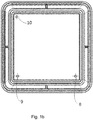
- Figures 1a - 1b schematically illustrate an example of a cover which may be used in a device for cellularized membrane cultivation.
- Figure 1a illustrates a cross-sectional view of the cover.
- a cover 2 is provided.
- the cover 2 in this example is a substantially square cover (see figure 1b ).
- other shapes of the cover are possible e.g. substantially circular-shaped.
- the length of each of the sides forming the square cover may be e.g. between 5 cm and 20 cm. In a particular example, the cover has a length and width of 13 cm.
- the size of the culture vessel (and the corresponding cover) may be adjusted in accordance with its objective, and can thus be varied for different cell growth applications.
- the cover 2 comprises a base 5 and a "dual" twofold rim.
- the rim may comprise a first cover connector 6, a second cover connector 7 and an inclined transition portion 3 between these connectors or "coupling elements".
- the first cover connecter is configured to sealingly couple with a first connector on the culture vessel and the second cover connector is configured to sealingly couple with a second connector on the culture vessel as will be explained later.
- both the first cover connector and the second cover connector form continuous perimeters.
- the first cover connector 6 is arranged radially inwardly (i.e. closer to a geometric center of the cover) with respect to the second cover connector 7.
- the first cover connector 6 and the second cover connector 7 may be of constant height along their perimeters as shown in this example. As also shown in this example, the height of the first cover connector (arrow A) may be different from the height of the second cover connector (arrow B).
- the height of the first cover connector (arrow A) with respect to a top edge of the cover in this example is larger than the height of the second cover connector (arrow B).
- the first cover connector 6 may comprise a pair of parallel, spaced apart flanges 6a, 6b which extend substantially perpendicularly to the plane defined by the base 5. Moreover, the first cover connectors comprise a recess 15 in between the flanges 6a, 6b. Similarly, the second cover connectors 7 comprise a further recess 16.
- the recesses 15, 16 form female coupling members and are adapted to receive and mate with further connectors or male coupling elements located e.g. in a culture vessel, as will be explained later on. In some examples, in order to provide a sealing engagement of the male and female coupling members a snap fit may be used.
- the first cover connector forms a sealing clip configured to snap fit over the male connector on the culture vessel.
- the shape and size of the recesses 15, 16 may vary depending on the shape and size of e.g. the connectors located e.g. in a culture vessel to be attached to the cover 2.
- the cover 2 may be releasably joined to the culture vessel (not shown in this figure) using e.g. a snap fit locking mechanism.
- the dimensions of the cover 2 are chosen such that the cover can be coupled to the vessel 20 in a suitable way.
- the cover 2 may be formed of any suitable material e. g. metal, synthetic resin, glass, a polymeric material or the like, being preferably a non-porous and relatively non-fragile material capable of withstanding sterilization.
- the cover 2 may comprise a grip (not shown) located e.g. at the outer part of the sidewall 3 of the cover 2, thus the attachment, removal and manipulation of the cover 2 may be improved.
- the grip may be shaped so that it may be easily held between the fingers of a user.
- the grip may also be formed by a certain surface roughness, optionally provided by a coating.
- the cover 2 may be efficiently manipulated and used with improved accuracy.
- the cover 2 may easily be axially displaced with respect to the culture vessel such that the cover is properly attached to a culture vessel and a membrane for cell cultivation is readily fixed against a bottom surface of the culture vessel, as again will be explained later on with reference to figure 3 .
- the cover may further be provided with one or more access ports for accessing to the space being formed in an interior of a culture vessel. Particularly, as shown in figure 1b , three access ports may be provided 8, 9 and 10.
- the access ports are configured in this example as truncoconical sockets. It should be clear that other recesses or sockets can be used.
- the access ports 8 - 10 may be provided with a valve, and specifically a one-way valve.
- the valves may be Luer - Lock valves.
- a syringe may be inserted into the container body via the corresponding access port in a safe and clean manner, without contaminating the spaced formed in the interior of the vessel.
- Other elements such as e.g. a filter or a flexible inlet connecting tube may be connected to the corresponding access port via a Luer - lock valve.
- the Luer -Lock valve may be e.g. a swabable barb valve.
- the swabable barb valve is configured to provide a water tight hermetic seal.
- This valve may also be provided with a female luer lock port which provides a needleless access valve for a syringe.
- the access port 8 may be configured to receive and discharge a liquid e.g. growth medium or culture medium, a culture solution mixed with cells, additives, etc...
- a liquid e.g. growth medium or culture medium, a culture solution mixed with cells, additives, etc...
- the exchange of the liquid may be done using e.g. a syringe coupling with the Luer-lock valve
- a flexible inlet connecting tube and / or a flexible outlet connecting tube may be provided.
- the connecting tubes may be connected to e.g. the access port 8 for introducing / extracting a liquid via the corresponding Luer-lock valve.
- the inlet tube(s) may be connected to one end to one or more irrigation bags. Fluid e.g. culture liquid may thus be introduced into the culture vessel via the inlet tube and the corresponding Luer-lock valve and fluid may be conducted out of the culture vessel via the outlet tube.
- the access port 9 may be configured for a gas exchange via the corresponding Luer-lock valve.
- the access port 9 may be provided with a hydrophobic membrane (not shown).
- the hydrophobic membrane may have a pore having a diameter of, e.g. 0.5 ⁇ m or less, preferably 0.2 ⁇ m. Since a gas exchange can be performed between the inside and the outside of the culture vessel 20 using the access port 9, a gas concentration of oxygen, carbon dioxide or the like in the culture medium can be easily kept constant and / or modified.
- the filter may typically be made of polytetra-fluorethylene (PTFE).
- the Luer - lock valve may simply be provided with a standard filter to avoid contamination.
- the access port 10 may be configured to control the pressure inside the device.
- the pressure inside the device may be increased.
- the pressure inside such device may be reduced.
- a tree-way pressure valve may be provided and connected to the access port via the corresponding Luer-lock valve. This tree-way pressure valve is configured to be closed / opened to control the pressure inside the device.
- One or more three-way stopcocks (not shown) with Luer connectors may also be provided.
- the three-way stopcocks may be connected to the luer-lock valve of the corresponding access port.
- Several elements e.g. syringes may thus be connected to the same access port via the corresponding stopcock.
- the means for coupling that are used for connecting the 3-way stopcock to the corresponding syringes may be universal connectors or luer-lock, which are used in medical practice.
- filters may also be provided in the Luer connectors of the three-way stopcocks.
- the access ports 8 - 10 may respectively be provided with a lid or stopper (not shown) so that access ports can be selectively closed / opened.
- FIGS 2a - 2b schematically illustrate an example of a culture vessel which may be used in a device for cell cultivation.
- the culture vessel 20 shown in this example comprises a bottom inner surface 21, a first sidewall 22 and a second sidewall 23.
- the first sidewall 22, and the bottom surface 21 define a culturing space, which is closed off by a cover like the one shown in figure 1 .
- the second sidewall 23 is arranged radially outwardly with respect to the first sidewall 22.
- the sidewalls may be integrally formed with the culture vessel. It is further noted that, as depicted in the figure, the height of the second sidewall may be larger than the height of the first sidewall.
- the material of the culture vessel may be different from the material of the cover (shown in figures 1a - 1b ).
- the material of the culture vessel may be more rigid than the material of the cover.
- the employed materials may be transparent, sterilisable and biocompatible materials.
- the cover (such as the one shown in figure 1 ) may be made of any polymeric biocompatible material suitable for sterilization e.g. liquid silicone rubber (LSR).
- LSR liquid silicone rubber
- the silicones may be used in a hardness range of 30-80 Shore A. In this particular example, the silicone used may be in a hardness range of 50 - 60 Shore A such that the cover is made softer and adaptable to a vessel. Also the water-tightness of the device may be improved.
- the cover may also be made using thermoplastic elastomers in a range of hardness from 50 Shore A to 60 Shore D, polyurethanes, polycarbonate (PC), polyethylene terephthalate (PET), polymethyl methacrylate (PMMA), etc.
- the culture vessel may also be made of any polymeric biocompatible material suitable for sterilization e.g liquid silicone rubber (LSR).
- LSR liquid silicone rubber
- the silicones may be used in a hardness range of 30 - 80 Shore A. In this particular example, the silicone used may be in a hardness range of 70 - 80 Shore A such that the vessel is made relatively hard and rigid.
- the culture vessel 20 may also be made using thermoplastic elastomers in a range of hardness from 30 Shore A to 60 Shore D, polyurethanes, polycarbonate (PC), polyethylene terephthalate (PET), polymethyl methacrylate (PMMA), etc.
- the first sidewall 22 comprises first vessel connectors 22a e.g. a male rib to sealingly couple with the female clip on the cover.
- the first vessel connectors adapted to mate with the connector shown in figure 1 may be a rounded bulb portion.
- the rounded bulb portion 22a may define a substantially vertical plane of symmetry.
- the vertical plane of the rounded bulb portion may be arranged with respect to the bottom inner surface 21 of the culture vessel 20 at an angle of approximately 90 degrees.
- the first vessel connectors 22a may be tilted at different angles with respect to the plane defined by the bottom surface 21 of the culture vessel in order to improve the attachment between a cover and the culture vessel.
- the width of the rounded bulb portion may be e.g. 2.2 mm.
- the cover connectors may have a certain flexibility and, the width of bulb 22a may be slightly larger than recess 15 when undeformed.
- the second sidewall 23 comprises second vessel connectors.
- the second vessel connectors may comprise upstanding flanges 23a. At the end of the flanges 23a, bulges 23b may be provided.
- the flanges 23a may be elastically deformable.
- first vessel connectors 22 and the second vessel connectors 23 of the culture vessel may be adapted to mate respectively with the first cover connectors and the second cover connectors described in figures 1a - 1b .
- the structure and operation of the attachment between the cover and the culture vessel will be explained with more detail with reference to figure 3 .
- the culture vessel may further comprise two or more reinforcing ribs 50, 51 located at a bottom part 52 of the culture vessel.
- a cell culture membrane may also be provided at a location indicated with reference sign 24.
- the cell culture membrane may be disposed detachably over the bottom inner surface 21 of the culture vessel.
- the cell culture membrane may be a sterile biocompatible membrane previously treated with e.g. a tampon phosphate saline (PBS). It noted that, when the membrane is situated over the surface 21 of the culture vessel, air bubbles are to be avoided between the membrane and the surface 21.
- PBS tampon phosphate saline
- the bottom surface of the culture vessel 20 may be non-cell-adhesive, and it may preferably be neither subjected to a surface treatment for an adhesive surface nor a cell-adhesive coating.
- the inner surface of the culture vessel 20 may be provided with a cell-repellent coating. This way, since the interior of the vessel is non-cell-adhesive, the cells to be cultivated will grow preferably in the cell culture membrane.
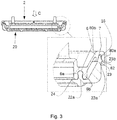
- FIG 3 schematically illustrates an example of a device for cellularized membrane cultivation comprising a cover 2 as described in figures 1a - 1b attached to a culture vessel 20 as described in figures 2a - 2b .
- the cover 2 is configured to be axially displaced in the direction of the direction of the arrow (arrow C) and coupled to the culture vessel 20, thus in use the cover closes off the top of the culture vessel 20.
- the cover 2 comprises first cover connectors 6 and second cover connectors 7 as hereinbefore described with reference to figures 1a - 1b .
- the culture vessel 20 comprises first vessel connectors 22a and second vessel connectors 23a as hereinbefore described, with reference to figures 2a - 2b .
- the rounded bulb 22a of the culture vessel may push the flanges 6a, 6b of the cover first coupling element slightly outwards. Once the rounded bulb 22a is located beyond the proximal part of the flanges, the flanges, due to the elastic deformability of such flanges, move inwards.
- the first cover connectors 6 and the first vessel connectors 22a are thus attached to each other.
- the inner flange 6a may press the cell culture membrane 24 previously located over the bottom inner surface 21 of the vessel 20. Undesired displacements of the membrane are thus avoided. It is noted that the pressing of the cell culture membrane against the bottom surface of the culture vessel is performed using an element which already forms part of the locking mechanism to attach the cover to the culture vessel. Further elements to keep the membrane in position are thus avoided.
- the distal end of flange 6a may be distanced between 0 and 1 mm from the bottom surface 21.
- the distal end of flange 6a may even touch the bottom surface 21.
- a surface defined by the membrane may be a bit larger than the bottom surface of the culture vessel over which the membrane is situated. The press of the membrane against the bottom surface of the culture vessel using the corresponding flange of the first coupling elements may thus be facilitated.
- the recess 16 receives the upstanding flanges 23a and projections 80a, 80b of the second cover connector may be deformed.
- the projections 80a, 80b due to their elastic deformability, move back to their original shape.
- the width of the projection 80b may be e.g. 2.25 mm and its length may be e.g. 8 mm.
- a snapping engagement of the first cover connectors and the second cover connectors with the first and second vessel connector may thus be achieved.
- a hermetic double internal and external seal is provided in the device for cultivating cells such that an aseptic closed environment wherein cells can be properly cultivated is achieved.
- a suitable culture space is formed within the device once the cover and the vessel are attached to each other.
- the culture space may be provided such that, in use, a culture medium may cover the membrane and, at the same time, at least a thin layer of air may be situated between the base of the cover and the culture medium covering the membrane, to avoid the culture medium adhering to the cover.
- the height of the formed culture space may be e.g. between 9 and 11 mm. In this particular example, the height may be 10.7 mm.
- the cover 2 and the culture vessel 20 may be sterilized and packaged in a sterile packaging, e.g. a wrap.
- the cells can be cultivated in the device for cellularized membrane cultivation substantially as follows:
- a culture vessel 20 may be provided.
- the culture vessel may be introduced in a cleanroom or a laminar flow cabinet which is an enclosed bench designed to prevent contamination.
- a membrane impregnated with phosphate buffered saline as hereinbefore described may be provided.
- the membrane may be situated on the bottom surface of the vessel.
- the cover 2 may be brought into proximity of the culture vessel 20.
- the cover 2 may further be aligned with the culture vessel 20 and attached to the culture vessel 20, thus closing off the culture vessel 20.
- the attachment between the first cover connector and the vessel first coupling element may be provided.
- the membrane may be kept in position over the bottom surface of the vessel as hereinbefore described. This attachment may thus provide a first seal against external pollution.
- the attachment between second cover connectors and the second vessel connectors may be provided. This attachment may thus provide a second seal against external pollution.
- the cover and the culture vessel may be attached to each other providing a double seal against external pollution.
- Cells may thus be cultivated in an aseptic environment.
- a culture medium which is a liquid for culturing cells
- the liquid may also comprise cells to be cultivated.
- the culture medium mixed with the cells may be introduced using one of the access ports with a Luer-Lock connector as hereinbefore described. This can be performed using e.g. syringe, or one or more irrigation bags connected to corresponding inlets, as indicated above.
- one or more of the access ports e.g. the access port configured to receive and discharge a liquid are closed off using the corresponding lid such that pollution in the interior of the culture vessel can be avoided.
- the above-commented three-way pressure valve connected to the access port 10 via the corresponding Luer - lock valve may also be closed.
- the culture vessel 20 may be placed in e.g. an incubator (not shown) whose internal temperature e.g. 37 °c and humidity are kept constant.
- the cells may grow during the necessary time until the membrane 24 is at least partially covered with grown cells.
- the previously introduced culturing medium may be extracted from the culture vessel using the corresponding port (e.g. using a syringe or an outlet line and a corresponding bag).
- the new culture medium may be introduced in a substantially similar way as commented above.
- the device When the cells have been grown, the device may be transported to the desired location (e.g. an operating room).
- the culture medium is removed from the culture vessel and the cellularized membrane may be removed, e.g. for implantation.
- PBS may be introduced into the device such that the interior of the device is washed.
Landscapes
- Health & Medical Sciences (AREA)
- Chemical & Material Sciences (AREA)
- Zoology (AREA)
- Life Sciences & Earth Sciences (AREA)
- Engineering & Computer Science (AREA)
- Bioinformatics & Cheminformatics (AREA)
- Organic Chemistry (AREA)
- Wood Science & Technology (AREA)
- Clinical Laboratory Science (AREA)
- General Health & Medical Sciences (AREA)
- Biomedical Technology (AREA)
- Sustainable Development (AREA)
- Biochemistry (AREA)
- General Engineering & Computer Science (AREA)
- Microbiology (AREA)
- Genetics & Genomics (AREA)
- Biotechnology (AREA)
- Analytical Chemistry (AREA)
- Hematology (AREA)
- Chemical Kinetics & Catalysis (AREA)
- Apparatus Associated With Microorganisms And Enzymes (AREA)
Priority Applications (3)
| Application Number | Priority Date | Filing Date | Title |
|---|---|---|---|
| PT193822509T PT3719111T (pt) | 2019-04-04 | 2019-04-04 | Dispositivos para cultura de membranas celularizadas e kits |
| ES19382250T ES2901516T3 (es) | 2019-04-04 | 2019-04-04 | Dispositivos para el cultivo de membranas celularizadas y kits |
| EP19382250.9A EP3719111B1 (fr) | 2019-04-04 | 2019-04-04 | Dispositifs de culture de membrane cellularisée et kits |
Applications Claiming Priority (1)
| Application Number | Priority Date | Filing Date | Title |
|---|---|---|---|
| EP19382250.9A EP3719111B1 (fr) | 2019-04-04 | 2019-04-04 | Dispositifs de culture de membrane cellularisée et kits |
Publications (2)
| Publication Number | Publication Date |
|---|---|
| EP3719111A1 true EP3719111A1 (fr) | 2020-10-07 |
| EP3719111B1 EP3719111B1 (fr) | 2021-10-20 |
Family
ID=66334334
Family Applications (1)
| Application Number | Title | Priority Date | Filing Date |
|---|---|---|---|
| EP19382250.9A Active EP3719111B1 (fr) | 2019-04-04 | 2019-04-04 | Dispositifs de culture de membrane cellularisée et kits |
Country Status (3)
| Country | Link |
|---|---|
| EP (1) | EP3719111B1 (fr) |
| ES (1) | ES2901516T3 (fr) |
| PT (1) | PT3719111T (fr) |
Cited By (1)
| Publication number | Priority date | Publication date | Assignee | Title |
|---|---|---|---|---|
| CN113604332A (zh) * | 2021-07-20 | 2021-11-05 | 西南医科大学附属中医医院 | 一次性缺氧环境细胞培养袋 |
Citations (4)
| Publication number | Priority date | Publication date | Assignee | Title |
|---|---|---|---|---|
| EP0171854A1 (fr) * | 1984-08-07 | 1986-02-19 | Packaging & Container Manufacturers B.V. | Récipient muni d'un couvercle coiffant |
| US5462874A (en) * | 1993-06-23 | 1995-10-31 | Wolf; Martin L. | Dialyzed multiple well tissue culture plate |
| JP2001299326A (ja) * | 2000-04-19 | 2001-10-30 | Minoru Ueda | 培養器 |
| US20140162352A1 (en) * | 2012-12-09 | 2014-06-12 | Phoenix Biomedical Products Inc. | Dual Use Petri Plate With Locking Feature |
-
2019
- 2019-04-04 ES ES19382250T patent/ES2901516T3/es active Active
- 2019-04-04 PT PT193822509T patent/PT3719111T/pt unknown
- 2019-04-04 EP EP19382250.9A patent/EP3719111B1/fr active Active
Patent Citations (4)
| Publication number | Priority date | Publication date | Assignee | Title |
|---|---|---|---|---|
| EP0171854A1 (fr) * | 1984-08-07 | 1986-02-19 | Packaging & Container Manufacturers B.V. | Récipient muni d'un couvercle coiffant |
| US5462874A (en) * | 1993-06-23 | 1995-10-31 | Wolf; Martin L. | Dialyzed multiple well tissue culture plate |
| JP2001299326A (ja) * | 2000-04-19 | 2001-10-30 | Minoru Ueda | 培養器 |
| US20140162352A1 (en) * | 2012-12-09 | 2014-06-12 | Phoenix Biomedical Products Inc. | Dual Use Petri Plate With Locking Feature |
Cited By (2)
| Publication number | Priority date | Publication date | Assignee | Title |
|---|---|---|---|---|
| CN113604332A (zh) * | 2021-07-20 | 2021-11-05 | 西南医科大学附属中医医院 | 一次性缺氧环境细胞培养袋 |
| CN113604332B (zh) * | 2021-07-20 | 2023-09-19 | 西南医科大学附属中医医院 | 一次性缺氧环境细胞培养袋 |
Also Published As
| Publication number | Publication date |
|---|---|
| EP3719111B1 (fr) | 2021-10-20 |
| ES2901516T3 (es) | 2022-03-22 |
| PT3719111T (pt) | 2022-01-13 |
Similar Documents
| Publication | Publication Date | Title |
|---|---|---|
| US11717602B2 (en) | Systems and methods for medical device control | |
| CN1329501C (zh) | 生物反应器系统和方法 | |
| US10247724B1 (en) | Optically clear sealable petri dish bioreactor | |
| EP1601464B1 (fr) | Systeme et procede pour contenant d'incubation et/ou de stockage | |
| ES2749857T3 (es) | Colector para sistema de cultivo celular de múltiples capas de acceso limitado | |
| US3726767A (en) | Microbiological reaction chamber apparatus | |
| CN105579569B (zh) | 细胞培养容器及细胞培养物容纳完成容器 | |
| WO2012027447A1 (fr) | Dispositif de prélèvement et d'injection d'échantillons | |
| US9975753B1 (en) | Detachable fluid transfer device accessory and a fluid transfer assembly | |
| JP2001031127A (ja) | 蓋 | |
| WO2016117281A1 (fr) | Récipient de culture cellulaire, procédé de culture cellulaire et procédé d'utilisation du récipient de culture cellulaire | |
| EP3719111B1 (fr) | Dispositifs de culture de membrane cellularisée et kits | |
| ES2389412T3 (es) | Aparato de cultivo continuo con recipiente móvil para la selección de variantes de células filtrantes | |
| KR20140036994A (ko) | 식중독 모니터링 키트 | |
| CA1323356C (fr) | Instrument d'hemoculture dote d'une valve a commande externe | |
| JPWO2020003504A1 (ja) | 灌流培養システム | |
| JP4459579B2 (ja) | 培養装置 | |
| US20220225969A1 (en) | Biopsy carrier | |
| US20240351042A1 (en) | Outlet valve for a container | |
| WO1996029856A1 (fr) | Reservoir thermoscelle et procede d'utilisation dans des cultures de plantes | |
| CN104152352A (zh) | 细胞培养室及其配套之加热套与支座 | |
| CN209836174U (zh) | 一种基础医学用培养皿 | |
| KR20120068511A (ko) | 무병 우량 씨감자를 포함한 생물체의 대량생산용 배양용기 | |
| WO1997004073A2 (fr) | Couvercles pour recipients de culture cellulaire | |
| WO2024233345A2 (fr) | Plaque de puits jetable de culture cellulaire empilable à puits profond simple ou double de format sbs et élément de fermeture |
Legal Events
| Date | Code | Title | Description |
|---|---|---|---|
| PUAI | Public reference made under article 153(3) epc to a published international application that has entered the european phase |
Free format text: ORIGINAL CODE: 0009012 |
|
| STAA | Information on the status of an ep patent application or granted ep patent |
Free format text: STATUS: THE APPLICATION HAS BEEN PUBLISHED |
|
| AK | Designated contracting states |
Kind code of ref document: A1 Designated state(s): AL AT BE BG CH CY CZ DE DK EE ES FI FR GB GR HR HU IE IS IT LI LT LU LV MC MK MT NL NO PL PT RO RS SE SI SK SM TR |
|
| AX | Request for extension of the european patent |
Extension state: BA ME |
|
| STAA | Information on the status of an ep patent application or granted ep patent |
Free format text: STATUS: REQUEST FOR EXAMINATION WAS MADE |
|
| 17P | Request for examination filed |
Effective date: 20210407 |
|
| RBV | Designated contracting states (corrected) |
Designated state(s): AL AT BE BG CH CY CZ DE DK EE ES FI FR GB GR HR HU IE IS IT LI LT LU LV MC MK MT NL NO PL PT RO RS SE SI SK SM TR |
|
| GRAP | Despatch of communication of intention to grant a patent |
Free format text: ORIGINAL CODE: EPIDOSNIGR1 |
|
| STAA | Information on the status of an ep patent application or granted ep patent |
Free format text: STATUS: GRANT OF PATENT IS INTENDED |
|
| INTG | Intention to grant announced |
Effective date: 20210514 |
|
| GRAS | Grant fee paid |
Free format text: ORIGINAL CODE: EPIDOSNIGR3 |
|
| GRAA | (expected) grant |
Free format text: ORIGINAL CODE: 0009210 |
|
| STAA | Information on the status of an ep patent application or granted ep patent |
Free format text: STATUS: THE PATENT HAS BEEN GRANTED |
|
| AK | Designated contracting states |
Kind code of ref document: B1 Designated state(s): AL AT BE BG CH CY CZ DE DK EE ES FI FR GB GR HR HU IE IS IT LI LT LU LV MC MK MT NL NO PL PT RO RS SE SI SK SM TR |
|
| REG | Reference to a national code |
Ref country code: GB Ref legal event code: FG4D |
|
| REG | Reference to a national code |
Ref country code: CH Ref legal event code: EP |
|
| REG | Reference to a national code |
Ref country code: IE Ref legal event code: FG4D |
|
| REG | Reference to a national code |
Ref country code: DE Ref legal event code: R096 Ref document number: 602019008530 Country of ref document: DE |
|
| REG | Reference to a national code |
Ref country code: AT Ref legal event code: REF Ref document number: 1439976 Country of ref document: AT Kind code of ref document: T Effective date: 20211115 |
|
| REG | Reference to a national code |
Ref country code: PT Ref legal event code: SC4A Ref document number: 3719111 Country of ref document: PT Date of ref document: 20220113 Kind code of ref document: T Free format text: AVAILABILITY OF NATIONAL TRANSLATION Effective date: 20220106 |
|
| REG | Reference to a national code |
Ref country code: LT Ref legal event code: MG9D |
|
| REG | Reference to a national code |
Ref country code: NL Ref legal event code: MP Effective date: 20211020 |
|
| REG | Reference to a national code |
Ref country code: AT Ref legal event code: MK05 Ref document number: 1439976 Country of ref document: AT Kind code of ref document: T Effective date: 20211020 |
|
| REG | Reference to a national code |
Ref country code: ES Ref legal event code: FG2A Ref document number: 2901516 Country of ref document: ES Kind code of ref document: T3 Effective date: 20220322 |
|
| PG25 | Lapsed in a contracting state [announced via postgrant information from national office to epo] |
Ref country code: RS Free format text: LAPSE BECAUSE OF FAILURE TO SUBMIT A TRANSLATION OF THE DESCRIPTION OR TO PAY THE FEE WITHIN THE PRESCRIBED TIME-LIMIT Effective date: 20211020 Ref country code: LT Free format text: LAPSE BECAUSE OF FAILURE TO SUBMIT A TRANSLATION OF THE DESCRIPTION OR TO PAY THE FEE WITHIN THE PRESCRIBED TIME-LIMIT Effective date: 20211020 Ref country code: FI Free format text: LAPSE BECAUSE OF FAILURE TO SUBMIT A TRANSLATION OF THE DESCRIPTION OR TO PAY THE FEE WITHIN THE PRESCRIBED TIME-LIMIT Effective date: 20211020 Ref country code: BG Free format text: LAPSE BECAUSE OF FAILURE TO SUBMIT A TRANSLATION OF THE DESCRIPTION OR TO PAY THE FEE WITHIN THE PRESCRIBED TIME-LIMIT Effective date: 20220120 Ref country code: AT Free format text: LAPSE BECAUSE OF FAILURE TO SUBMIT A TRANSLATION OF THE DESCRIPTION OR TO PAY THE FEE WITHIN THE PRESCRIBED TIME-LIMIT Effective date: 20211020 |
|
| PG25 | Lapsed in a contracting state [announced via postgrant information from national office to epo] |
Ref country code: IS Free format text: LAPSE BECAUSE OF FAILURE TO SUBMIT A TRANSLATION OF THE DESCRIPTION OR TO PAY THE FEE WITHIN THE PRESCRIBED TIME-LIMIT Effective date: 20220220 Ref country code: SE Free format text: LAPSE BECAUSE OF FAILURE TO SUBMIT A TRANSLATION OF THE DESCRIPTION OR TO PAY THE FEE WITHIN THE PRESCRIBED TIME-LIMIT Effective date: 20211020 Ref country code: PL Free format text: LAPSE BECAUSE OF FAILURE TO SUBMIT A TRANSLATION OF THE DESCRIPTION OR TO PAY THE FEE WITHIN THE PRESCRIBED TIME-LIMIT Effective date: 20211020 Ref country code: NO Free format text: LAPSE BECAUSE OF FAILURE TO SUBMIT A TRANSLATION OF THE DESCRIPTION OR TO PAY THE FEE WITHIN THE PRESCRIBED TIME-LIMIT Effective date: 20220120 Ref country code: NL Free format text: LAPSE BECAUSE OF FAILURE TO SUBMIT A TRANSLATION OF THE DESCRIPTION OR TO PAY THE FEE WITHIN THE PRESCRIBED TIME-LIMIT Effective date: 20211020 Ref country code: LV Free format text: LAPSE BECAUSE OF FAILURE TO SUBMIT A TRANSLATION OF THE DESCRIPTION OR TO PAY THE FEE WITHIN THE PRESCRIBED TIME-LIMIT Effective date: 20211020 Ref country code: HR Free format text: LAPSE BECAUSE OF FAILURE TO SUBMIT A TRANSLATION OF THE DESCRIPTION OR TO PAY THE FEE WITHIN THE PRESCRIBED TIME-LIMIT Effective date: 20211020 |
|
| REG | Reference to a national code |
Ref country code: DE Ref legal event code: R097 Ref document number: 602019008530 Country of ref document: DE |
|
| PG25 | Lapsed in a contracting state [announced via postgrant information from national office to epo] |
Ref country code: SM Free format text: LAPSE BECAUSE OF FAILURE TO SUBMIT A TRANSLATION OF THE DESCRIPTION OR TO PAY THE FEE WITHIN THE PRESCRIBED TIME-LIMIT Effective date: 20211020 Ref country code: SK Free format text: LAPSE BECAUSE OF FAILURE TO SUBMIT A TRANSLATION OF THE DESCRIPTION OR TO PAY THE FEE WITHIN THE PRESCRIBED TIME-LIMIT Effective date: 20211020 Ref country code: RO Free format text: LAPSE BECAUSE OF FAILURE TO SUBMIT A TRANSLATION OF THE DESCRIPTION OR TO PAY THE FEE WITHIN THE PRESCRIBED TIME-LIMIT Effective date: 20211020 Ref country code: EE Free format text: LAPSE BECAUSE OF FAILURE TO SUBMIT A TRANSLATION OF THE DESCRIPTION OR TO PAY THE FEE WITHIN THE PRESCRIBED TIME-LIMIT Effective date: 20211020 Ref country code: DK Free format text: LAPSE BECAUSE OF FAILURE TO SUBMIT A TRANSLATION OF THE DESCRIPTION OR TO PAY THE FEE WITHIN THE PRESCRIBED TIME-LIMIT Effective date: 20211020 Ref country code: CZ Free format text: LAPSE BECAUSE OF FAILURE TO SUBMIT A TRANSLATION OF THE DESCRIPTION OR TO PAY THE FEE WITHIN THE PRESCRIBED TIME-LIMIT Effective date: 20211020 |
|
| PLBE | No opposition filed within time limit |
Free format text: ORIGINAL CODE: 0009261 |
|
| STAA | Information on the status of an ep patent application or granted ep patent |
Free format text: STATUS: NO OPPOSITION FILED WITHIN TIME LIMIT |
|
| 26N | No opposition filed |
Effective date: 20220721 |
|
| PG25 | Lapsed in a contracting state [announced via postgrant information from national office to epo] |
Ref country code: AL Free format text: LAPSE BECAUSE OF FAILURE TO SUBMIT A TRANSLATION OF THE DESCRIPTION OR TO PAY THE FEE WITHIN THE PRESCRIBED TIME-LIMIT Effective date: 20211020 |
|
| PG25 | Lapsed in a contracting state [announced via postgrant information from national office to epo] |
Ref country code: SI Free format text: LAPSE BECAUSE OF FAILURE TO SUBMIT A TRANSLATION OF THE DESCRIPTION OR TO PAY THE FEE WITHIN THE PRESCRIBED TIME-LIMIT Effective date: 20211020 |
|
| REG | Reference to a national code |
Ref country code: CH Ref legal event code: PL |
|
| REG | Reference to a national code |
Ref country code: BE Ref legal event code: MM Effective date: 20220430 |
|
| PG25 | Lapsed in a contracting state [announced via postgrant information from national office to epo] |
Ref country code: MC Free format text: LAPSE BECAUSE OF FAILURE TO SUBMIT A TRANSLATION OF THE DESCRIPTION OR TO PAY THE FEE WITHIN THE PRESCRIBED TIME-LIMIT Effective date: 20211020 Ref country code: LU Free format text: LAPSE BECAUSE OF NON-PAYMENT OF DUE FEES Effective date: 20220404 Ref country code: LI Free format text: LAPSE BECAUSE OF NON-PAYMENT OF DUE FEES Effective date: 20220430 Ref country code: CH Free format text: LAPSE BECAUSE OF NON-PAYMENT OF DUE FEES Effective date: 20220430 |
|
| PG25 | Lapsed in a contracting state [announced via postgrant information from national office to epo] |
Ref country code: BE Free format text: LAPSE BECAUSE OF NON-PAYMENT OF DUE FEES Effective date: 20220430 |
|
| PG25 | Lapsed in a contracting state [announced via postgrant information from national office to epo] |
Ref country code: IE Free format text: LAPSE BECAUSE OF NON-PAYMENT OF DUE FEES Effective date: 20220404 |
|
| PG25 | Lapsed in a contracting state [announced via postgrant information from national office to epo] |
Ref country code: MK Free format text: LAPSE BECAUSE OF FAILURE TO SUBMIT A TRANSLATION OF THE DESCRIPTION OR TO PAY THE FEE WITHIN THE PRESCRIBED TIME-LIMIT Effective date: 20211020 Ref country code: CY Free format text: LAPSE BECAUSE OF FAILURE TO SUBMIT A TRANSLATION OF THE DESCRIPTION OR TO PAY THE FEE WITHIN THE PRESCRIBED TIME-LIMIT Effective date: 20211020 |
|
| PG25 | Lapsed in a contracting state [announced via postgrant information from national office to epo] |
Ref country code: HU Free format text: LAPSE BECAUSE OF FAILURE TO SUBMIT A TRANSLATION OF THE DESCRIPTION OR TO PAY THE FEE WITHIN THE PRESCRIBED TIME-LIMIT; INVALID AB INITIO Effective date: 20190404 |
|
| PG25 | Lapsed in a contracting state [announced via postgrant information from national office to epo] |
Ref country code: TR Free format text: LAPSE BECAUSE OF FAILURE TO SUBMIT A TRANSLATION OF THE DESCRIPTION OR TO PAY THE FEE WITHIN THE PRESCRIBED TIME-LIMIT Effective date: 20211020 |
|
| PG25 | Lapsed in a contracting state [announced via postgrant information from national office to epo] |
Ref country code: MT Free format text: LAPSE BECAUSE OF FAILURE TO SUBMIT A TRANSLATION OF THE DESCRIPTION OR TO PAY THE FEE WITHIN THE PRESCRIBED TIME-LIMIT Effective date: 20211020 |
|
| PG25 | Lapsed in a contracting state [announced via postgrant information from national office to epo] |
Ref country code: GR Free format text: LAPSE BECAUSE OF NON-PAYMENT OF DUE FEES Effective date: 20211020 |
|
| PG25 | Lapsed in a contracting state [announced via postgrant information from national office to epo] |
Ref country code: GR Free format text: LAPSE BECAUSE OF NON-PAYMENT OF DUE FEES Effective date: 20211020 |
|
| PGFP | Annual fee paid to national office [announced via postgrant information from national office to epo] |
Ref country code: DE Payment date: 20250429 Year of fee payment: 7 |
|
| PGFP | Annual fee paid to national office [announced via postgrant information from national office to epo] |
Ref country code: GB Payment date: 20250428 Year of fee payment: 7 Ref country code: ES Payment date: 20250501 Year of fee payment: 7 |
|
| PGFP | Annual fee paid to national office [announced via postgrant information from national office to epo] |
Ref country code: IT Payment date: 20250422 Year of fee payment: 7 |
|
| PGFP | Annual fee paid to national office [announced via postgrant information from national office to epo] |
Ref country code: FR Payment date: 20250425 Year of fee payment: 7 |
|
| PGFP | Annual fee paid to national office [announced via postgrant information from national office to epo] |
Ref country code: PT Payment date: 20260319 Year of fee payment: 8 |