EP3719166A1 - Nettoyage au laser avant le revêtement métallique d'un substrat - Google Patents
Nettoyage au laser avant le revêtement métallique d'un substrat Download PDFInfo
- Publication number
- EP3719166A1 EP3719166A1 EP20167321.7A EP20167321A EP3719166A1 EP 3719166 A1 EP3719166 A1 EP 3719166A1 EP 20167321 A EP20167321 A EP 20167321A EP 3719166 A1 EP3719166 A1 EP 3719166A1
- Authority
- EP
- European Patent Office
- Prior art keywords
- substrate
- laser
- treating
- oxides
- organics
- Prior art date
- Legal status (The legal status is an assumption and is not a legal conclusion. Google has not performed a legal analysis and makes no representation as to the accuracy of the status listed.)
- Pending
Links
- 238000000576 coating method Methods 0.000 title claims abstract description 46
- 239000011248 coating agent Substances 0.000 title claims abstract description 41
- 239000000758 substrate Substances 0.000 title claims abstract description 28
- 238000004140 cleaning Methods 0.000 title abstract description 12
- 238000000034 method Methods 0.000 claims abstract description 39
- 239000000356 contaminant Substances 0.000 claims abstract description 27
- 238000013532 laser treatment Methods 0.000 claims description 6
- 239000007921 spray Substances 0.000 claims description 4
- 239000013078 crystal Substances 0.000 claims description 3
- 239000000956 alloy Substances 0.000 claims description 2
- 238000005422 blasting Methods 0.000 abstract description 3
- 239000002245 particle Substances 0.000 description 6
- 239000007789 gas Substances 0.000 description 5
- 238000011282 treatment Methods 0.000 description 5
- 238000004519 manufacturing process Methods 0.000 description 4
- 239000000463 material Substances 0.000 description 4
- 239000003921 oil Substances 0.000 description 3
- XEEYBQQBJWHFJM-UHFFFAOYSA-N Iron Chemical compound [Fe] XEEYBQQBJWHFJM-UHFFFAOYSA-N 0.000 description 2
- PXHVJJICTQNCMI-UHFFFAOYSA-N Nickel Chemical compound [Ni] PXHVJJICTQNCMI-UHFFFAOYSA-N 0.000 description 2
- 238000005266 casting Methods 0.000 description 2
- 238000001816 cooling Methods 0.000 description 2
- TWNQGVIAIRXVLR-UHFFFAOYSA-N oxo(oxoalumanyloxy)alumane Chemical compound O=[Al]O[Al]=O TWNQGVIAIRXVLR-UHFFFAOYSA-N 0.000 description 2
- PNEYBMLMFCGWSK-UHFFFAOYSA-N Alumina Chemical class [O-2].[O-2].[O-2].[Al+3].[Al+3] PNEYBMLMFCGWSK-UHFFFAOYSA-N 0.000 description 1
- 229910001069 Ti alloy Inorganic materials 0.000 description 1
- 239000003082 abrasive agent Substances 0.000 description 1
- 238000005270 abrasive blasting Methods 0.000 description 1
- 230000002411 adverse Effects 0.000 description 1
- QVGXLLKOCUKJST-UHFFFAOYSA-N atomic oxygen Chemical compound [O] QVGXLLKOCUKJST-UHFFFAOYSA-N 0.000 description 1
- UOUJSJZBMCDAEU-UHFFFAOYSA-N chromium(3+);oxygen(2-) Chemical class [O-2].[O-2].[O-2].[Cr+3].[Cr+3] UOUJSJZBMCDAEU-UHFFFAOYSA-N 0.000 description 1
- 239000010941 cobalt Substances 0.000 description 1
- 229910017052 cobalt Inorganic materials 0.000 description 1
- GUTLYIVDDKVIGB-UHFFFAOYSA-N cobalt atom Chemical compound [Co] GUTLYIVDDKVIGB-UHFFFAOYSA-N 0.000 description 1
- 238000005260 corrosion Methods 0.000 description 1
- 230000007797 corrosion Effects 0.000 description 1
- 239000011888 foil Substances 0.000 description 1
- 239000000446 fuel Substances 0.000 description 1
- 239000003517 fume Substances 0.000 description 1
- 238000010438 heat treatment Methods 0.000 description 1
- 229930195733 hydrocarbon Natural products 0.000 description 1
- 150000002430 hydrocarbons Chemical class 0.000 description 1
- 229910052742 iron Inorganic materials 0.000 description 1
- 239000007788 liquid Substances 0.000 description 1
- 229910052751 metal Inorganic materials 0.000 description 1
- 239000002184 metal Substances 0.000 description 1
- 150000002739 metals Chemical class 0.000 description 1
- 239000000203 mixture Substances 0.000 description 1
- 238000012986 modification Methods 0.000 description 1
- 230000004048 modification Effects 0.000 description 1
- 229910052759 nickel Inorganic materials 0.000 description 1
- 229910000480 nickel oxide Inorganic materials 0.000 description 1
- 230000003647 oxidation Effects 0.000 description 1
- 238000007254 oxidation reaction Methods 0.000 description 1
- GNRSAWUEBMWBQH-UHFFFAOYSA-N oxonickel Chemical class [Ni]=O GNRSAWUEBMWBQH-UHFFFAOYSA-N 0.000 description 1
- 239000001301 oxygen Substances 0.000 description 1
- 229910052760 oxygen Inorganic materials 0.000 description 1
- 229910000601 superalloy Inorganic materials 0.000 description 1
- 239000002699 waste material Substances 0.000 description 1
Images
Classifications
-
- C—CHEMISTRY; METALLURGY
- C23—COATING METALLIC MATERIAL; COATING MATERIAL WITH METALLIC MATERIAL; CHEMICAL SURFACE TREATMENT; DIFFUSION TREATMENT OF METALLIC MATERIAL; COATING BY VACUUM EVAPORATION, BY SPUTTERING, BY ION IMPLANTATION OR BY CHEMICAL VAPOUR DEPOSITION, IN GENERAL; INHIBITING CORROSION OF METALLIC MATERIAL OR INCRUSTATION IN GENERAL
- C23C—COATING METALLIC MATERIAL; COATING MATERIAL WITH METALLIC MATERIAL; SURFACE TREATMENT OF METALLIC MATERIAL BY DIFFUSION INTO THE SURFACE, BY CHEMICAL CONVERSION OR SUBSTITUTION; COATING BY VACUUM EVAPORATION, BY SPUTTERING, BY ION IMPLANTATION OR BY CHEMICAL VAPOUR DEPOSITION, IN GENERAL
- C23C4/00—Coating by spraying the coating material in the molten state, e.g. by flame, plasma or electric discharge
- C23C4/02—Pretreatment of the material to be coated, e.g. for coating on selected surface areas
-
- B—PERFORMING OPERATIONS; TRANSPORTING
- B08—CLEANING
- B08B—CLEANING IN GENERAL; PREVENTION OF FOULING IN GENERAL
- B08B7/00—Cleaning by methods not provided for in a single other subclass or a single group in this subclass
- B08B7/0035—Cleaning by methods not provided for in a single other subclass or a single group in this subclass by radiant energy, e.g. UV, laser, light beam or the like
- B08B7/0042—Cleaning by methods not provided for in a single other subclass or a single group in this subclass by radiant energy, e.g. UV, laser, light beam or the like by laser
-
- C—CHEMISTRY; METALLURGY
- C23—COATING METALLIC MATERIAL; COATING MATERIAL WITH METALLIC MATERIAL; CHEMICAL SURFACE TREATMENT; DIFFUSION TREATMENT OF METALLIC MATERIAL; COATING BY VACUUM EVAPORATION, BY SPUTTERING, BY ION IMPLANTATION OR BY CHEMICAL VAPOUR DEPOSITION, IN GENERAL; INHIBITING CORROSION OF METALLIC MATERIAL OR INCRUSTATION IN GENERAL
- C23C—COATING METALLIC MATERIAL; COATING MATERIAL WITH METALLIC MATERIAL; SURFACE TREATMENT OF METALLIC MATERIAL BY DIFFUSION INTO THE SURFACE, BY CHEMICAL CONVERSION OR SUBSTITUTION; COATING BY VACUUM EVAPORATION, BY SPUTTERING, BY ION IMPLANTATION OR BY CHEMICAL VAPOUR DEPOSITION, IN GENERAL
- C23C4/00—Coating by spraying the coating material in the molten state, e.g. by flame, plasma or electric discharge
- C23C4/04—Coating by spraying the coating material in the molten state, e.g. by flame, plasma or electric discharge characterised by the coating material
- C23C4/06—Metallic material
- C23C4/073—Metallic material containing MCrAl or MCrAlY alloys, where M is nickel, cobalt or iron, with or without non-metal elements
-
- C—CHEMISTRY; METALLURGY
- C23—COATING METALLIC MATERIAL; COATING MATERIAL WITH METALLIC MATERIAL; CHEMICAL SURFACE TREATMENT; DIFFUSION TREATMENT OF METALLIC MATERIAL; COATING BY VACUUM EVAPORATION, BY SPUTTERING, BY ION IMPLANTATION OR BY CHEMICAL VAPOUR DEPOSITION, IN GENERAL; INHIBITING CORROSION OF METALLIC MATERIAL OR INCRUSTATION IN GENERAL
- C23C—COATING METALLIC MATERIAL; COATING MATERIAL WITH METALLIC MATERIAL; SURFACE TREATMENT OF METALLIC MATERIAL BY DIFFUSION INTO THE SURFACE, BY CHEMICAL CONVERSION OR SUBSTITUTION; COATING BY VACUUM EVAPORATION, BY SPUTTERING, BY ION IMPLANTATION OR BY CHEMICAL VAPOUR DEPOSITION, IN GENERAL
- C23C4/00—Coating by spraying the coating material in the molten state, e.g. by flame, plasma or electric discharge
- C23C4/12—Coating by spraying the coating material in the molten state, e.g. by flame, plasma or electric discharge characterised by the method of spraying
- C23C4/134—Plasma spraying
-
- C—CHEMISTRY; METALLURGY
- C23—COATING METALLIC MATERIAL; COATING MATERIAL WITH METALLIC MATERIAL; CHEMICAL SURFACE TREATMENT; DIFFUSION TREATMENT OF METALLIC MATERIAL; COATING BY VACUUM EVAPORATION, BY SPUTTERING, BY ION IMPLANTATION OR BY CHEMICAL VAPOUR DEPOSITION, IN GENERAL; INHIBITING CORROSION OF METALLIC MATERIAL OR INCRUSTATION IN GENERAL
- C23C—COATING METALLIC MATERIAL; COATING MATERIAL WITH METALLIC MATERIAL; SURFACE TREATMENT OF METALLIC MATERIAL BY DIFFUSION INTO THE SURFACE, BY CHEMICAL CONVERSION OR SUBSTITUTION; COATING BY VACUUM EVAPORATION, BY SPUTTERING, BY ION IMPLANTATION OR BY CHEMICAL VAPOUR DEPOSITION, IN GENERAL
- C23C4/00—Coating by spraying the coating material in the molten state, e.g. by flame, plasma or electric discharge
- C23C4/18—After-treatment
Definitions
- the present disclosure relates to a metallic coating method and, more particularly, to a coating method utilizing a laser cleaning before the metallic coating.
- Gas turbine engine components such as air foils in high pressure turbines, combustor panels or liners and the like are exposed to extreme temperatures and conditions during use, and are therefore provided with metallic coatings during manufacture.
- contaminants such as oils and other organics, as well as oxides, must be removed from the surface to be coated.
- a substrate is first run through a furnace to burn off the oils and organics, a step referred to as "burn out", and then abrasive blasting (grit blasting) is used to remove the remaining and/or resulting oxides.
- the grit used can be aluminum oxide (Al 2 O 3 ), although other abrasives can also be used.
- RTA reverse transfer arc
- one drawback is that there are always two steps involved, namely burn out and grit blast, both of which are time consuming.
- the grit blast does not always remove all oxides, and the grit blast process itself can embed some of the grit into the substrate. This embedded grit is difficult to remove, and can result in more time and higher power in the RTA process.
- FIG. 3 Such a process is illustrated in FIG. 3 which is discussed below.
- a method for treating a substrate prior to metallic coating comprises the steps of: providing a substrate having a surface to be coated and at least one contaminant selected from as-delivered organics and post-burn out oxides on the surface; treating the surface with a laser to remove the at least one contaminant to produce a cleaned surface on the substrate; and applying a metallic coating to the cleaned surface.
- the metallic coating is applied by low pressure plasma spray.
- the contaminant is the as-delivered organics
- the treating step comprises applying the laser to the as-delivered organics to produce the cleaned surface.
- the contaminant is post-burn out oxides produced by heat treating the as-delivered organics, and the treating step comprises applying the laser to the post-burn out oxides to produce the cleaned surface.
- the contaminant is both as-delivered organics and oxides.
- the method further comprises the step of reverse transfer arc (RTA) treating the surface after the treating step to remove any remaining contaminants and produce the cleaned surface.
- RTA reverse transfer arc
- the RTA treating step is carried out for a period of time of less than 3 minutes and at a current of less than 20 amps.
- the metallic coating is NiCoCrAlY coating.
- the surface comprises a single crystal alloy material.
- the treating step comprises applying a laser at a laser spot size of between 0.700 and 2.4 mm in diameter, power between 500 and 1,000 W, pulse duration of between 50 and 100 ns, pulse overlap of between 40 and 60%, and energy pulse of between 30 and 100 mJ.
- the laser treatment step comprises pulsing a nanosecond laser at up to 1 kW per pulse, at a pulse diameter of about 1.5 mm.
- the substrate is selected from the group consisting of HPT airfoils, combustor panels and combustor liners.
- the invention relates to a method for cleaning an as-delivered surface of a component before coating that surface with a metallic coating such as a NiCoCrAlY coating.
- a metallic coating such as a NiCoCrAlY coating.
- Numerous components of gas turbine engines and the like can be coated in this manner, and the present non-limiting disclosure is made in terms of coating a turbine blade.
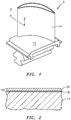
- FIG. 1 is a perspective view of turbine blade 10 of a gas turbine engine, as one example of a component to be treated as disclosed herein.
- Turbine blade 10 includes platform 12 and airfoil 14.
- Airfoil 14 of turbine blade 10 may be formed of a nickel based, cobalt based, iron based superalloy, or mixtures thereof or a titanium alloy.
- Turbine blade 10 is exposed to high temperatures and high pressures during operation of the gas turbine engine.
- one or more metallic coating(s) 16, 18, 20 can be applied over airfoil 14 and platform 12 of turbine blade 10.
- a metallic coating may be applied over a part of the outer surface of airfoil 14 rather than over the entire surface of airfoil 14.
- Airfoil 14 may include cooling holes leading from internal cooling passages to the outer surface of airfoil 14, and the coating 16 may also be applied in other locations as well.
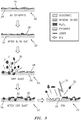
- FIG. 2 is a sectional view of turbine blade 10, where a section is taken from line 2-2 in FIG. 1 .
- the coating system 16 is applied to an exterior surface of airfoil 14 and platform 12.
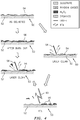
- FIG. 3 shows a schematic illustration of a known process for cleaning a substrate before metallic coating.
- a substrate 22 has a surface 24 with as-delivered contaminants 26 in the form of oils, organics, oxides and other materials which must be removed before a desired metallic coating can be applied to surface 24.
- the part is then subjected to burn out, and this results in substrate 22 having surface 24 with random oxides 28 thereon. These oxides 28 can be remaining from the contaminants 26, or can have resulted from the burn out step.
- surface 24 is then treated with a grit blast process, wherein particles of grit 30 are directed against surface 24 to remove the oxides 28.
- RTA reverse transfer arc
- the process shown in FIG. 3 calls for many time-consuming steps. Further, RTA treatment is a harsh and energy and time consuming process. The harsh conditions and stresses to which the component surface is exposed can have an adverse impact on the overall quality of the substrate.
- FIG. 4 shows two non-limiting configurations of a process wherein laser cleaning is utilized to avoid some of the steps from FIG. 3 , as well as avoiding the undesirable affects of those steps.
- a substrate 50 is delivered having a surface 52 and as-delivered contaminants 54 on surface 52.
- the as-delivered contaminants 54 can include organics which can be a result of the manufacturing process and also from handling and the like, as well a variety of oxides, all of which are to be removed before coating the substrate.
- the burn out step would convert some organics and other materials to oxides, and then the oxides, which would be a combination of remaining oxides from the as-delivered substrate and newly developed oxides from the burn out step, would need to be removed.
- substrate 50 is subjected to a heat treatment to burn off contaminants 54 and leave random oxides 56. Then, surface 52 with random oxides 56 can then be treated with a laser 58 to remove the random oxides 56 and produce a cleaned surface for metallic coating, without the need for grit blasting and, therefore, also without the need for removing embedded grit particles.
- an RTA treatment 60 can still be conducted. It should be appreciated, however, that since there has been no grit blast, there is no embedded grit in the surface. Therefore, the RTA step can be conducted at a lower power and intensity, and for a shorter time, as compared to the RTA conducted in the method of FIG. 3 .
- Typical RTA parameters can reach a current of nearly 50 amps at an extreme end, and can take as long as 8 minutes (480s). With the presently disclosed process, the RTA step if needed will not exceed 3 minutes (180s) in duration, and current will not exceed 20 amps. This results in a significantly reduced stress on the part or component being cleaned for metallic coating.
- laser 58 can be used to directly remove as-delivered organics 54, without any burn out step. This can be done, for example, where there are no areas masked from the laser which might otherwise require burn out to clean. As with the laser cleaning conducted after burn out, RTA cleaning 60 can be performed if necessary, again at a lower intensity and time duration than would otherwise be needed.
- the component to be treated can be a component of a gas turbine engine, such as HPT vanes or blades, combustor panels or liners and the like. Further, these components are treated as-delivered from casting, and have not yet been coated with other coating systems. The surfaces of such components will have what is referred to herein as as-delivered contaminants, which are typically hydrocarbons or other organics that can result from the manufacturing process and handling after such manufacture. Beneath these contaminants, the substrate will be a single crystal casting which, once cleaned, is then ready for metallic coating.
- the metallic coating to be applied can be a NiCoCrAlY coating, as one non-limiting example.
- Other types of metallic coating could follow the laser cleaning as disclosed herein. Examples include any other material which will be applied using LPPS, or a variety of materials which may be applied using different processes such as cathodic arc coating, high velocity oxygen fuel (HVOF) coating, cold spray, flame spray and the like. Any coating process which requires a clean, smooth surface can benefit from the method disclosed herein. Within this broad application, however, one particularly useful application of the method is prior to coating using LPPS to apply a NiCoCrAlY coating.
- Laser treatment as disclosed herein can be conducted using a range of different parameters which can be combined to produce the desired clean smooth surface. These parameters include laser spot size of between 0.700 and 2.4 mm in diameter, power between 500 and 1,000 W, pulse duration of between 50 and 100 ns, pulse overlap of between 40 and 60%, and energy pulse of between 30 and 100 mJ. Within these ranges, it is particularly useful to apply laser by pulsing a nanosecond laser at up to 1 kW per pulse (i.e., up to a peak power of 1 kW in each pulse), at a pulse diameter of about 1.5 mm.
- the contaminants When burn out is needed to burn as-delivered contaminants, for example when the part or component has cavities which trap liquids, the contaminants are typically converted to random oxides, the most prominent of which include aluminum oxides in many different forms or phases, as well as chromium oxides, and nickel oxides. Other metals in the substrate can also oxidize and thus may also be present before cleaning.
- Laser treatment as disclosed herein can quickly remove these oxides without creating a different contaminant (for example, embedded grit), that needs to be removed. Further, the waste stream from laser treatment is minimal, potentially involving only a fume collector.
Landscapes
- Chemical & Material Sciences (AREA)
- Engineering & Computer Science (AREA)
- Physics & Mathematics (AREA)
- Plasma & Fusion (AREA)
- Chemical Kinetics & Catalysis (AREA)
- Materials Engineering (AREA)
- Mechanical Engineering (AREA)
- Metallurgy (AREA)
- Organic Chemistry (AREA)
- Optics & Photonics (AREA)
- Other Surface Treatments For Metallic Materials (AREA)
- Turbine Rotor Nozzle Sealing (AREA)
Applications Claiming Priority (1)
| Application Number | Priority Date | Filing Date | Title |
|---|---|---|---|
| US16/375,147 US20200318227A1 (en) | 2019-04-04 | 2019-04-04 | Laser cleaning prior to metallic coating of a substrate |
Publications (1)
| Publication Number | Publication Date |
|---|---|
| EP3719166A1 true EP3719166A1 (fr) | 2020-10-07 |
Family
ID=70110208
Family Applications (1)
| Application Number | Title | Priority Date | Filing Date |
|---|---|---|---|
| EP20167321.7A Pending EP3719166A1 (fr) | 2019-04-04 | 2020-03-31 | Nettoyage au laser avant le revêtement métallique d'un substrat |
Country Status (2)
| Country | Link |
|---|---|
| US (1) | US20200318227A1 (fr) |
| EP (1) | EP3719166A1 (fr) |
Families Citing this family (1)
| Publication number | Priority date | Publication date | Assignee | Title |
|---|---|---|---|---|
| DE102021202380A1 (de) * | 2021-03-11 | 2022-09-15 | Glatt Gesellschaft Mit Beschränkter Haftung | Verfahren, Reparaturvorrichtung und Reparatursystem zur Reparatur eines Korrosionsschadens einer der Witterung ausgesetzten Oberfläche eines Objekts |
Citations (5)
| Publication number | Priority date | Publication date | Assignee | Title |
|---|---|---|---|---|
| US4898650A (en) * | 1988-05-10 | 1990-02-06 | Amp Incorporated | Laser cleaning of metal stock |
| US5688564A (en) * | 1992-07-23 | 1997-11-18 | Institut Polytechnique De Sevenans | Process for the preparation and coating of a surface |
| US6042898A (en) * | 1998-12-15 | 2000-03-28 | United Technologies Corporation | Method for applying improved durability thermal barrier coatings |
| US20110229665A1 (en) * | 2008-10-01 | 2011-09-22 | Caterpillar Inc. | Thermal spray coating for track roller frame |
| EP3078760A1 (fr) * | 2015-04-10 | 2016-10-12 | United Technologies Corporation | Retrait d'oxyde assistée par laser |
Family Cites Families (3)
| Publication number | Priority date | Publication date | Assignee | Title |
|---|---|---|---|---|
| US7316850B2 (en) * | 2004-03-02 | 2008-01-08 | Honeywell International Inc. | Modified MCrAlY coatings on turbine blade tips with improved durability |
| US7462378B2 (en) * | 2005-11-17 | 2008-12-09 | General Electric Company | Method for coating metals |
| US20070224768A1 (en) * | 2006-02-24 | 2007-09-27 | Uvtech Systems, Inc. | Method and apparatus for delivery of pulsed laser radiation |
-
2019
- 2019-04-04 US US16/375,147 patent/US20200318227A1/en not_active Abandoned
-
2020
- 2020-03-31 EP EP20167321.7A patent/EP3719166A1/fr active Pending
Patent Citations (5)
| Publication number | Priority date | Publication date | Assignee | Title |
|---|---|---|---|---|
| US4898650A (en) * | 1988-05-10 | 1990-02-06 | Amp Incorporated | Laser cleaning of metal stock |
| US5688564A (en) * | 1992-07-23 | 1997-11-18 | Institut Polytechnique De Sevenans | Process for the preparation and coating of a surface |
| US6042898A (en) * | 1998-12-15 | 2000-03-28 | United Technologies Corporation | Method for applying improved durability thermal barrier coatings |
| US20110229665A1 (en) * | 2008-10-01 | 2011-09-22 | Caterpillar Inc. | Thermal spray coating for track roller frame |
| EP3078760A1 (fr) * | 2015-04-10 | 2016-10-12 | United Technologies Corporation | Retrait d'oxyde assistée par laser |
Also Published As
| Publication number | Publication date |
|---|---|
| US20200318227A1 (en) | 2020-10-08 |
Similar Documents
| Publication | Publication Date | Title |
|---|---|---|
| JP4651970B2 (ja) | 遮熱コーティングの施工又は補修法 | |
| US9149881B2 (en) | Damage-repairing method of transition piece and transition piece | |
| US5723078A (en) | Method for repairing a thermal barrier coating | |
| EP1236812B1 (fr) | Procédé de rénovation d'une couche comportant un oxyde formé par croissance thermique | |
| EP1884306B1 (fr) | Réparation par soudure hybride de composants de turbine à gaz en superalliage | |
| US20100126014A1 (en) | Repair method for tbc coated turbine components | |
| EP1944120A2 (fr) | Réparation par soudage de composants métalliques | |
| JP6262941B2 (ja) | コーティングを除去する方法、および被覆超合金構成要素を新品同様にする方法 | |
| US20100257733A1 (en) | High pressure single crystal turbine blade tip repair with laser cladding | |
| US6434823B1 (en) | Method for repairing a coated article | |
| US20070170150A1 (en) | Process for removing a layer | |
| US20240375155A1 (en) | Method of removing contaminants from a diffusion-coated component | |
| CN1932081B (zh) | 修复涡轮机部件的方法 | |
| EP3719166A1 (fr) | Nettoyage au laser avant le revêtement métallique d'un substrat | |
| US20100129544A1 (en) | Polymer-Based Ceramic Coatings for Protecting Surfaces Against Fluoride Ions During a Cleaning Process | |
| JP2008240563A (ja) | ガスタービン高温部品の補修方法およびガスタービン高温部品 | |
| US6652914B1 (en) | Method for selective surface protection of a gas turbine blade which has previously been in service | |
| US20170369981A1 (en) | Treated gas turbine components and processes of treating gas turbine systems and gas turbine components | |
| US20070215174A1 (en) | Process for the Plasma Cleaning of a Component | |
| EP4678782A1 (fr) | Nettoyage laser après traitement thermique par diffusion et avant le grenaillage | |
| JP2018091333A (ja) | 垂直亀裂遮熱コーティングを形成する方法および垂直亀裂遮熱コーティングを含む物品 | |
| US6440238B1 (en) | Process for treating the surface of a component, made from a Ni based superalloy, to be coated | |
| EP2855734A1 (fr) | Agent de masquage pour un nettoyage par ions fluorure | |
| EP3054028A1 (fr) | Réparation à chaud d'une section de revêtements métalliques | |
| JP2007262961A (ja) | ガスタ−ビン動翼及びそのき裂発生抑制方法 |
Legal Events
| Date | Code | Title | Description |
|---|---|---|---|
| PUAI | Public reference made under article 153(3) epc to a published international application that has entered the european phase |
Free format text: ORIGINAL CODE: 0009012 |
|
| STAA | Information on the status of an ep patent application or granted ep patent |
Free format text: STATUS: THE APPLICATION HAS BEEN PUBLISHED |
|
| AK | Designated contracting states |
Kind code of ref document: A1 Designated state(s): AL AT BE BG CH CY CZ DE DK EE ES FI FR GB GR HR HU IE IS IT LI LT LU LV MC MK MT NL NO PL PT RO RS SE SI SK SM TR |
|
| AX | Request for extension of the european patent |
Extension state: BA ME |
|
| RAP1 | Party data changed (applicant data changed or rights of an application transferred) |
Owner name: RAYTHEON TECHNOLOGIES CORPORATION |
|
| STAA | Information on the status of an ep patent application or granted ep patent |
Free format text: STATUS: REQUEST FOR EXAMINATION WAS MADE |
|
| 17P | Request for examination filed |
Effective date: 20210407 |
|
| RBV | Designated contracting states (corrected) |
Designated state(s): AL AT BE BG CH CY CZ DE DK EE ES FI FR GB GR HR HU IE IS IT LI LT LU LV MC MK MT NL NO PL PT RO RS SE SI SK SM TR |
|
| STAA | Information on the status of an ep patent application or granted ep patent |
Free format text: STATUS: EXAMINATION IS IN PROGRESS |
|
| 17Q | First examination report despatched |
Effective date: 20230327 |
|
| RAP3 | Party data changed (applicant data changed or rights of an application transferred) |
Owner name: RTX CORPORATION |