EP3719345B1 - Actionneurs de turbine à air dynamique à amortissement - Google Patents
Actionneurs de turbine à air dynamique à amortissement Download PDFInfo
- Publication number
- EP3719345B1 EP3719345B1 EP19209717.8A EP19209717A EP3719345B1 EP 3719345 B1 EP3719345 B1 EP 3719345B1 EP 19209717 A EP19209717 A EP 19209717A EP 3719345 B1 EP3719345 B1 EP 3719345B1
- Authority
- EP
- European Patent Office
- Prior art keywords
- rat
- lock
- actuator
- lock rod
- piston
- Prior art date
- Legal status (The legal status is an assumption and is not a legal conclusion. Google has not performed a legal analysis and makes no representation as to the accuracy of the status listed.)
- Active
Links
Images
Classifications
-
- B—PERFORMING OPERATIONS; TRANSPORTING
- B64—AIRCRAFT; AVIATION; COSMONAUTICS
- B64D—EQUIPMENT FOR FITTING IN OR TO AIRCRAFT; FLIGHT SUITS; PARACHUTES; ARRANGEMENT OR MOUNTING OF POWER PLANTS OR PROPULSION TRANSMISSIONS IN AIRCRAFT
- B64D41/00—Power installations for auxiliary purposes
- B64D41/007—Ram air turbines
-
- F—MECHANICAL ENGINEERING; LIGHTING; HEATING; WEAPONS; BLASTING
- F03—MACHINES OR ENGINES FOR LIQUIDS; WIND, SPRING, OR WEIGHT MOTORS; PRODUCING MECHANICAL POWER OR A REACTIVE PROPULSIVE THRUST, NOT OTHERWISE PROVIDED FOR
- F03D—WIND MOTORS
- F03D9/00—Adaptations of wind motors for special use; Combinations of wind motors with apparatus driven thereby; Wind motors specially adapted for installation in particular locations
- F03D9/30—Wind motors specially adapted for installation in particular locations
- F03D9/32—Wind motors specially adapted for installation in particular locations on moving objects, e.g. vehicles
-
- F—MECHANICAL ENGINEERING; LIGHTING; HEATING; WEAPONS; BLASTING
- F15—FLUID-PRESSURE ACTUATORS; HYDRAULICS OR PNEUMATICS IN GENERAL
- F15B—SYSTEMS ACTING BY MEANS OF FLUIDS IN GENERAL; FLUID-PRESSURE ACTUATORS, e.g. SERVOMOTORS; DETAILS OF FLUID-PRESSURE SYSTEMS, NOT OTHERWISE PROVIDED FOR
- F15B15/00—Fluid-actuated devices for displacing a member from one position to another; Gearing associated therewith
- F15B15/20—Other details, e.g. assembly with regulating devices
- F15B15/26—Locking mechanisms
-
- F—MECHANICAL ENGINEERING; LIGHTING; HEATING; WEAPONS; BLASTING
- F16—ENGINEERING ELEMENTS AND UNITS; GENERAL MEASURES FOR PRODUCING AND MAINTAINING EFFECTIVE FUNCTIONING OF MACHINES OR INSTALLATIONS; THERMAL INSULATION IN GENERAL
- F16F—SPRINGS; SHOCK-ABSORBERS; MEANS FOR DAMPING VIBRATION
- F16F9/00—Springs, vibration-dampers, shock-absorbers, or similarly-constructed movement-dampers using a fluid or the equivalent as damping medium
- F16F9/10—Springs, vibration-dampers, shock-absorbers, or similarly-constructed movement-dampers using a fluid or the equivalent as damping medium using liquid only; using a fluid of which the nature is immaterial
- F16F9/14—Devices with one or more members, e.g. pistons, vanes, moving to and fro in chambers and using throttling effect
- F16F9/16—Devices with one or more members, e.g. pistons, vanes, moving to and fro in chambers and using throttling effect involving only straight-line movement of the effective parts
- F16F9/18—Devices with one or more members, e.g. pistons, vanes, moving to and fro in chambers and using throttling effect involving only straight-line movement of the effective parts with a closed cylinder and a piston separating two or more working spaces therein
- F16F9/19—Devices with one or more members, e.g. pistons, vanes, moving to and fro in chambers and using throttling effect involving only straight-line movement of the effective parts with a closed cylinder and a piston separating two or more working spaces therein with a single cylinder and of single-tube type
-
- F—MECHANICAL ENGINEERING; LIGHTING; HEATING; WEAPONS; BLASTING
- F16—ENGINEERING ELEMENTS AND UNITS; GENERAL MEASURES FOR PRODUCING AND MAINTAINING EFFECTIVE FUNCTIONING OF MACHINES OR INSTALLATIONS; THERMAL INSULATION IN GENERAL
- F16F—SPRINGS; SHOCK-ABSORBERS; MEANS FOR DAMPING VIBRATION
- F16F9/00—Springs, vibration-dampers, shock-absorbers, or similarly-constructed movement-dampers using a fluid or the equivalent as damping medium
- F16F9/32—Details
- F16F9/3207—Constructional features
- F16F9/3214—Constructional features of pistons
-
- F—MECHANICAL ENGINEERING; LIGHTING; HEATING; WEAPONS; BLASTING
- F05—INDEXING SCHEMES RELATING TO ENGINES OR PUMPS IN VARIOUS SUBCLASSES OF CLASSES F01-F04
- F05B—INDEXING SCHEME RELATING TO WIND, SPRING, WEIGHT, INERTIA OR LIKE MOTORS, TO MACHINES OR ENGINES FOR LIQUIDS COVERED BY SUBCLASSES F03B, F03D AND F03G
- F05B2220/00—Application
- F05B2220/30—Application in turbines
- F05B2220/31—Application in turbines in ram-air turbines ("RATS")
-
- F—MECHANICAL ENGINEERING; LIGHTING; HEATING; WEAPONS; BLASTING
- F05—INDEXING SCHEMES RELATING TO ENGINES OR PUMPS IN VARIOUS SUBCLASSES OF CLASSES F01-F04
- F05B—INDEXING SCHEME RELATING TO WIND, SPRING, WEIGHT, INERTIA OR LIKE MOTORS, TO MACHINES OR ENGINES FOR LIQUIDS COVERED BY SUBCLASSES F03B, F03D AND F03G
- F05B2260/00—Function
- F05B2260/50—Kinematic linkage, i.e. transmission of position
- F05B2260/507—Kinematic linkage, i.e. transmission of position using servos, independent actuators, etc.
-
- F—MECHANICAL ENGINEERING; LIGHTING; HEATING; WEAPONS; BLASTING
- F15—FLUID-PRESSURE ACTUATORS; HYDRAULICS OR PNEUMATICS IN GENERAL
- F15B—SYSTEMS ACTING BY MEANS OF FLUIDS IN GENERAL; FLUID-PRESSURE ACTUATORS, e.g. SERVOMOTORS; DETAILS OF FLUID-PRESSURE SYSTEMS, NOT OTHERWISE PROVIDED FOR
- F15B15/00—Fluid-actuated devices for displacing a member from one position to another; Gearing associated therewith
- F15B15/08—Characterised by the construction of the motor unit
- F15B15/14—Characterised by the construction of the motor unit of the straight-cylinder type
- F15B15/1423—Component parts; Constructional details
- F15B15/1447—Pistons; Piston to piston rod assemblies
-
- F—MECHANICAL ENGINEERING; LIGHTING; HEATING; WEAPONS; BLASTING
- F15—FLUID-PRESSURE ACTUATORS; HYDRAULICS OR PNEUMATICS IN GENERAL
- F15B—SYSTEMS ACTING BY MEANS OF FLUIDS IN GENERAL; FLUID-PRESSURE ACTUATORS, e.g. SERVOMOTORS; DETAILS OF FLUID-PRESSURE SYSTEMS, NOT OTHERWISE PROVIDED FOR
- F15B15/00—Fluid-actuated devices for displacing a member from one position to another; Gearing associated therewith
- F15B15/08—Characterised by the construction of the motor unit
- F15B15/14—Characterised by the construction of the motor unit of the straight-cylinder type
- F15B15/149—Fluid interconnections, e.g. fluid connectors, passages
-
- F—MECHANICAL ENGINEERING; LIGHTING; HEATING; WEAPONS; BLASTING
- F15—FLUID-PRESSURE ACTUATORS; HYDRAULICS OR PNEUMATICS IN GENERAL
- F15B—SYSTEMS ACTING BY MEANS OF FLUIDS IN GENERAL; FLUID-PRESSURE ACTUATORS, e.g. SERVOMOTORS; DETAILS OF FLUID-PRESSURE SYSTEMS, NOT OTHERWISE PROVIDED FOR
- F15B21/00—Common features of fluid actuator systems; Fluid-pressure actuator systems or details thereof, not covered by any other group of this subclass
- F15B21/008—Reduction of noise or vibration
-
- F—MECHANICAL ENGINEERING; LIGHTING; HEATING; WEAPONS; BLASTING
- F15—FLUID-PRESSURE ACTUATORS; HYDRAULICS OR PNEUMATICS IN GENERAL
- F15B—SYSTEMS ACTING BY MEANS OF FLUIDS IN GENERAL; FLUID-PRESSURE ACTUATORS, e.g. SERVOMOTORS; DETAILS OF FLUID-PRESSURE SYSTEMS, NOT OTHERWISE PROVIDED FOR
- F15B2211/00—Circuits for servomotor systems
- F15B2211/80—Other types of control related to particular problems or conditions
- F15B2211/86—Control during or prevention of abnormal conditions
- F15B2211/8616—Control during or prevention of abnormal conditions the abnormal condition being noise or vibration
-
- F—MECHANICAL ENGINEERING; LIGHTING; HEATING; WEAPONS; BLASTING
- F16—ENGINEERING ELEMENTS AND UNITS; GENERAL MEASURES FOR PRODUCING AND MAINTAINING EFFECTIVE FUNCTIONING OF MACHINES OR INSTALLATIONS; THERMAL INSULATION IN GENERAL
- F16F—SPRINGS; SHOCK-ABSORBERS; MEANS FOR DAMPING VIBRATION
- F16F9/00—Springs, vibration-dampers, shock-absorbers, or similarly-constructed movement-dampers using a fluid or the equivalent as damping medium
- F16F9/32—Details
- F16F9/56—Means for adjusting the length of, or for locking, the spring or damper, e.g. at the end of the stroke
-
- Y—GENERAL TAGGING OF NEW TECHNOLOGICAL DEVELOPMENTS; GENERAL TAGGING OF CROSS-SECTIONAL TECHNOLOGIES SPANNING OVER SEVERAL SECTIONS OF THE IPC; TECHNICAL SUBJECTS COVERED BY FORMER USPC CROSS-REFERENCE ART COLLECTIONS [XRACs] AND DIGESTS
- Y02—TECHNOLOGIES OR APPLICATIONS FOR MITIGATION OR ADAPTATION AGAINST CLIMATE CHANGE
- Y02E—REDUCTION OF GREENHOUSE GAS [GHG] EMISSIONS, RELATED TO ENERGY GENERATION, TRANSMISSION OR DISTRIBUTION
- Y02E10/00—Energy generation through renewable energy sources
- Y02E10/70—Wind energy
- Y02E10/72—Wind turbines with rotation axis in wind direction
-
- Y—GENERAL TAGGING OF NEW TECHNOLOGICAL DEVELOPMENTS; GENERAL TAGGING OF CROSS-SECTIONAL TECHNOLOGIES SPANNING OVER SEVERAL SECTIONS OF THE IPC; TECHNICAL SUBJECTS COVERED BY FORMER USPC CROSS-REFERENCE ART COLLECTIONS [XRACs] AND DIGESTS
- Y02—TECHNOLOGIES OR APPLICATIONS FOR MITIGATION OR ADAPTATION AGAINST CLIMATE CHANGE
- Y02E—REDUCTION OF GREENHOUSE GAS [GHG] EMISSIONS, RELATED TO ENERGY GENERATION, TRANSMISSION OR DISTRIBUTION
- Y02E10/00—Energy generation through renewable energy sources
- Y02E10/70—Wind energy
- Y02E10/728—Onshore wind turbines
-
- Y—GENERAL TAGGING OF NEW TECHNOLOGICAL DEVELOPMENTS; GENERAL TAGGING OF CROSS-SECTIONAL TECHNOLOGIES SPANNING OVER SEVERAL SECTIONS OF THE IPC; TECHNICAL SUBJECTS COVERED BY FORMER USPC CROSS-REFERENCE ART COLLECTIONS [XRACs] AND DIGESTS
- Y02—TECHNOLOGIES OR APPLICATIONS FOR MITIGATION OR ADAPTATION AGAINST CLIMATE CHANGE
- Y02T—CLIMATE CHANGE MITIGATION TECHNOLOGIES RELATED TO TRANSPORTATION
- Y02T50/00—Aeronautics or air transport
- Y02T50/40—Weight reduction
Definitions
- This disclosure relates to ram air turbine (RAT) systems, more specifically to RAT actuators.
- RAT ram air turbine
- a ram air turbine (RAT) in the stowed position can have a low resonance which would be excited by in flight vibratory loadings (e.g., windmilling loadings), resulting in very high loads experienced by the RAT and the RAT actuator.
- Low resonances can exist because as the angle of the actuator to the strut decreases, the fundamental mode of the RAT decreases resulting in very high loads. If this is in the windmilling test frequency range, it can result in a significant number of cycles at very high load.
- US 3 022 771 A describes an unlocking mechanism for a two-part strut.
- US 2013/327207 A1 describes an electromechanical actuator damping arrangement for a RAM air turbine.
- a ram air turbine (RAT) actuator piston is defined in claim 1 and includes a body defining a piston structure having an inner cavity.
- the piston includes one or more damping holes axially defined through the body to the inner cavity and a lock rod hole defined axially through the body to the inner cavity.
- the lock rod hole has a larger flow area than one or more of the one or more damping holes.
- the lock rod hole is configured to receive a lock rod of a RAT actuator to at least partially block flow through the lock rod hole when the lock rod is in a locked position.
- the one or more damping holes are configured to allow flow through the damping holes in the locked position to allow the RAT actuator piston to move within the RAT actuator in the locked position to dissipate vibratory loads.
- the piston can include one or more lock pawl windows radially defined through the body from a radially outer surface of the body to the inner cavity, the one or more lock pawl windows configured to receive one or more lock pawls of a RAT actuator.
- the lock rod hole can be configured to receive a lock rod of a RAT actuator to additionally support the lock pawls when the lock rod is in a locked position.
- the one or more damping holes can be defined between an axially outer face of the body and the inner cavity.
- the lock rod hole can be defined between the axially outer face of the body and the inner cavity.
- the one or more damping holes can include a plurality of damping holes.
- the piston can include a piston rod extending from the body forming part of or configured to connect to a rod end.
- a ram air turbine (RAT) actuator is also defined in claim 6 and includes an uplock mechanism defining a chamber and configured to be retained in an uplock axial position (e.g., by one or more lock pawls), and a RAT actuator piston disposed within the uplock mechanism chamber configured to dissipate vibrational energy applied to the piston in a locked position.
- the RAT actuator piston can be any suitable piston as disclosed herein (e.g., as described above). Any other suitable embodiment of a piston configured to dissipate vibrational energy is contemplated herein.
- the RAT actuator include one or more lock pawls disposed in the lock pawl windows.
- the RAT actuator can include the lock rod disposed therein and configured to move axially through the lock rod hole and to support the one or more lock pawls in the locked position to maintain the stowed position of the RAT, and to allow radially inward movement of the one or more lock pawls in an unlocked position such that the lock pawls disengage the uplock mechanism to allow extension of the RAT actuator.
- the RAT actuator can include a valve housing operatively connected to the lock rod to move the lock rod axially.
- the RAT actuator can include at least one actuator spring configured to extend the RAT actuator in the unlocked position.
- the RAT actuator can include any suitable components as appreciated by those having ordinary skill in the art in view of this disclosure.
- a ram air turbine can include any suitable embodiment of a RAT actuator disclosed herein (e.g., as described above). Any other suitable embodiment of a RAT actuator is contemplated herein. Certain embodiments of the RAT include any other suitable components for a RAT as appreciated by those having ordinary skill in the art in view of this disclosure.
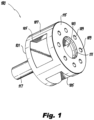
- a ram air turbine (RAT) actuator piston in accordance with the disclosure is shown in Fig. 1 and is designated generally by reference character 100.
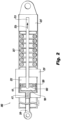
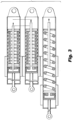
- Other embodiments and/or aspects of this disclosure are shown in Figs. 2-3 .
- Certain embodiments described herein can be used to dissipate vibratory loads in a RAT system in the stowed position, for example.
- a ram air turbine (RAT) actuator piston 100 can include a body 101 defining a piston structure (e.g., a cylindrical shape as shown, or any other suitable shape).
- the body 101 can have an inner cavity 103.
- the piston 100 can include one or more damping holes 109 axially defined through the body 101 to the inner cavity 103 and a lock rod hole 111 defined axially through the body 101 to the inner cavity 103.
- the lock rod hole 111 can have a larger flow area than one or more of the one or more damping holes 109, for example.
- the lock rod hole 111 can be configured to receive a lock rod 213 of a RAT actuator 200 to at least partially block flow through the lock rod hole 111.
- the piston 100 can include one or more lock pawl windows 105 configured to receive one or more lock pawls (e.g., one or more rollers, not shown) of a RAT actuator 200.
- the one or more lock pawl windows 105 can be radially defined through the body 101 from a radially outer surface 107 of the body 101 to the inner cavity 103.
- the lock rod hole 111 can be configured to receive the lock rod 213 to support the lock pawls when the lock rod 213 is in a locked position (e.g., as shown in Fig. 2 ) in addition to at least partially blocking flow through the lock rod hole 111.
- the lock rod 213 can extend into the cavity 103 in the locked position and contact the lock pawls to push the lock pawls radially outward to contact a surrounding uplock mechanism 215 to block the uplock mechanism 215 from moving relative to the piston 100.
- the uplock mechanism 215 and lock pawls are contemplated herein.
- Embodiments may include lock pawls and/or the uplock mechanism dimensioned to allow some motion of the piston 100 back and forth to allow the piston to displace or travel axially a small distance relative to the uplock mechanism such that damping flow can flow through the damping holes 109 back and forth.
- the lock pawls and/or the uplock mechanism 215 may be dimensioned to include from about 40 thousands of an inch to about 150 thousands of an inch in axial play (e.g., which is about 4 times to about 5 times as much play in existing systems).
- the one or more damping holes 109 can be configured to allow flow through (back and forth when vibrating) the damping holes 109 in the locked position to allow the RAT actuator piston 100 to move within the RAT actuator 200 in the locked position to dissipate vibratory loads.
- the one or more damping holes 109 can include any suitable size and shape (e.g., about 1/10th the diameter of the lock rod hole 111 or any other suitable size).
- the one or more damping holes 109 can be defined between an axially outer face 115 of the body 101 and the inner cavity 103.
- the one or more damping holes 109 can be radially positioned between the outer radial surface 107 of body 101 and the lock rod hole 111 or in any other suitable position.
- the lock rod hole 111 can be defined between the axially outer face 115 of the body 101 and the inner cavity 103. Any other suitable location for the damping holes 109 and the lock rod hole 111 is contemplated herein.
- the one or more damping holes 109 can include a plurality of damping holes 109 as shown (e.g., 8 or more).
- the piston 100 can include a piston rod 117 extending from the body 101 forming part of or configured to connect to a rod end 219.
- the rod end 219 can be configured to connect to the RAT.
- a ram air turbine (RAT) actuator 200 can include an uplock mechanism 215 defining a chamber 221 and configured to be retained in an uplock axial position by one or more lock pawls (not shown).
- the RAT actuator 200 can include a RAT actuator piston 100 disposed within the uplock mechanism chamber 221 configured to dissipate vibrational energy applied to the piston 100 in a locked position.
- the RAT actuator piston 100 can be any suitable piston as disclosed herein (e.g., as described above). Any other suitable embodiment of a piston configured to dissipate vibrational energy is contemplated herein.
- the RAT actuator 200 can include one or more lock pawls (not shown) disposed in the lock pawl windows 105.
- the RAT actuator 200 can include the lock rod 213 disposed therein and configured to move axially through the lock rod hole 111 and to support the one or more lock pawls in the locked position to maintain the uplock position of the RAT.
- the lock rod 213 is configured to move axially out of the lock rod hole 111 (e.g., in direction 223) to allow radially inward movement of the one or more lock pawls in an unlocked position such that the lock pawls disengage the uplock mechanism 215 to allow extension of the RAT actuator 200. While certain embodiments can utilize a lock pawl type mechanism for retaining the piston, any other suitable mechanism is contemplated herein. For example, any mechanism that prevents a spring preloaded actuator from deploying is contemplated herein.
- the RAT actuator 200 can include a valve housing 225 operatively connected to the lock rod 213 to move the lock rod 213 axially. Any suitable construction of the valve housing 225 is contemplated herein.
- the RAT actuator 200 can include at least one actuator spring 227 configured to extend the RAT actuator 200 in the unlocked position of the lock rod 213 (e.g., to deploy the RAT as appreciated by those having ordinary skill in the art).
- the RAT actuator 200 can include any suitable components as appreciated by those having ordinary skill in the art in view of this disclosure.
- a ram air turbine can include any suitable embodiment of a RAT actuator disclosed herein (e.g., as described above). Any other suitable embodiment of a RAT actuator is contemplated herein. Certain embodiments of the RAT include any other suitable components (e.g., a turbine, a shaft, a generator, etc.) for a RAT as appreciated by those having ordinary skill in the art in view of this disclosure.
- the RAT can include lock pawls and/or an interface thereof (e.g., in the uplock mechanism) that is dimensioned to allow the piston to vibrate, and the piston can include damper holes that allow damping of vibration of the piston thereby dissipating the vibrational energy in the fluid (e.g., hydraulic fluid) within the uplock mechanism.
- the embodiments allow opening of the larger lock rod hole by remove of the lock rod therefrom to allow fast deployment of the piston such that both dissipation and fast deployment can be achieved.
- Fig. 3 shows a stowed actuator, an actuator once a signal to deploy the actuator to deploy has been given and plunger moved to the right to open orifice and disengage locking mechanism and finally a deployed actuator.
- embodiments can allow the lock rod to move (e.g., to the right as shown) to open the lock rod hole in piston to allow easy flow of fluid (e.g., oil) and to disengage lock pawls from the uplock mechanism housing to allow movement relative to the piston.
- the valve housing/chamber can pull the lock rod and facilitate restowing of the actuator after deployment.
- Embodiments include a damper in the actuator which can damp out the low frequency response in the stowed position for HLSD (high-level-short-duration) and windmilling loading which are typically stowed only requirements.
- HLSD and windmilling are loadings due rotating imbalance due to loss of a fan blade on one of an aircraft's main engines.
- Embodiments provide play in the stowed position of the actuator such that enough damping can be provided for the specific design.
- Embodiments provide damping while preventing increase in deployment time such that damping is provided in the stowed position of the RAT while not negatively impacting deployment time. For example, before the uplock mechanism is released, the flow restriction at the piston will be removed by opening the lock rod hole, thereby preventing any significant portion of the deployment spring's energy from being spent on overcoming friction. Embodiments reduce loads in the RAT and the RAT actuator leading to more robust designs, reduced weight, and reduced cost since addition of an external uplock is not necessary, for example.
Landscapes
- Engineering & Computer Science (AREA)
- General Engineering & Computer Science (AREA)
- Mechanical Engineering (AREA)
- Aviation & Aerospace Engineering (AREA)
- Sustainable Energy (AREA)
- Sustainable Development (AREA)
- Life Sciences & Earth Sciences (AREA)
- Chemical & Material Sciences (AREA)
- Combustion & Propulsion (AREA)
- Power Engineering (AREA)
- Physics & Mathematics (AREA)
- Fluid Mechanics (AREA)
- Fluid-Damping Devices (AREA)
- Vibration Prevention Devices (AREA)
Claims (15)
- Piston d'actionneur de turbine à air dynamique (RAT) (100), comprenant :un corps (101) définissant une structure de piston présentant une cavité interne (103) ;le piston d'actionneur de turbine à air dynamique (RAT) étant caractérisé en ce qu'il comprend égalementun ou plusieurs trous d'amortissement (109) définis axialement à travers le corps (101) jusqu'à la cavité interne (103) ; etun trou de tige de verrouillage (111) défini axialement à travers le corps (101) jusqu'à la cavité interne (103), dans lequel le trou de tige de verrouillage (111) présente une zone d'écoulement plus grande que l'un ou plusieurs de l'un ouplusieurs trous d'amortissement (109), dans lequel le trou de tige de verrouillage (111) est configuré pour recevoir une tige de verrouillage (213) d'un actionneur RAT (200) pour bloquer au moins partiellement l'écoulement à travers le trou de tige de verrouillage (111) lorsque la tige de verrouillage (213) est dans une position verrouillée, dans lequel l'un ou plusieurs trous d'amortissement (109) sont configurés pour permettre l'écoulement à travers l'un ou plusieurs trous d'amortissement (109) dans la position verrouillée pour permettre au piston de l'actionneur RAT (100) de se déplacer à l'intérieur de l'actionneur RAT (200) dans la position verrouillée pour dissiper les charges vibratoires.
- Piston selon la revendication 1, comprenant également une ou plusieurs fenêtres de cliquet de verrouillage (105) définies radialement à travers le corps (101) depuis une surface radialement extérieure du corps (101) jusqu'à la cavité intérieure (103), l'une ou plusieurs fenêtres de cliquet de verrouillage (105) étant configurées pour recevoir l'un ou plusieurs cliquets de verrouillage de l'actionneur RAT, dans lequel le trou de tige de verrouillage (111) est configuré pour recevoir la tige de verrouillage de l'actionneur RAT (200) pour supporter en plus l'un ou plusieurs cliquets de verrouillage lorsque la tige de verrouillage (213) est dans la position verrouillée.
- Piston selon la revendication 1 ou 2, dans lequel l'un ou plusieurs trous d'amortissement (109) sont définis entre une face axialement extérieure du corps (101) et la cavité intérieure (103).
- Piston selon la revendication 3, dans lequel le trou de tige de verrouillage est défini entre la face axialement extérieure du corps (101) et la cavité intérieure (103).
- Piston selon l'une quelconque des revendications précédentes, dans lequel l'un ou plusieurs trous d'amortissement (109) comportent une pluralité de trous d'amortissement (109), et comprenant éventuellement également une tige de piston (117) faisant partie de ou configurée pour se connecter à une extrémité de tige (219) se prolongeant à partir du corps (101).
- Actionneur de turbine à air dynamique (RAT) (200), comprenant :un mécanisme de verrouillage définissant une chambre (221) etconfiguré pour être retenu dans une position axiale de verrouillage ; etun piston d'actionneur RAT (100) disposé à l'intérieur de la chambre du mécanisme de verrouillage (221) configuré pour dissiper l'énergie vibratoire appliquée au piston (100) dans une position verrouillée, etdans lequel le piston de l'actionneur RAT (100) comporte :un corps (101) définissant une structure de piston présentant une cavité interne (103) ;l'actionneur RAT (200) étant caractérisé en ce qu'il comprend égalementune ou plusieurs fenêtres de cliquet de verrouillage (105) définies radialement à travers le corps (101) depuis une surface radialement extérieure du corps (101) jusqu'à la cavité intérieure (103), l'une ou plusieurs fenêtres de cliquet de verrouillage (105) étant configurées pour recevoir un ou plusieurs cliquets de verrouillage d'un actionneur RAT (200) ;un ou plusieurs trous d'amortissement (109) définis axialement à travers le corps (101) jusqu'à la cavité interne (103) ; etun trou de tige de verrouillage (111) défini axialement à travers le corps (101) jusqu'à la cavité interne (103), dans lequel le trou de tige de verrouillage (111) présente une zone d'écoulement plus grande qu'un ou plusieurs de l'un ou plusieurs trous d'amortissement (109), dans lequel le trou de tige de verrouillage (111) est configuré pour recevoir une tige de verrouillage de l'actionneur RAT (200) pour bloquer au moins partiellement l'écoulement à travers le trou de tige de verrouillage (111) et supporterl'un ou plusieurs cliquets de verrouillage lorsque la tige de verrouillage (213) est dans une position verrouillée, dans lequel l'un ou plusieurs trous d'amortissement sont configurés pour permettre l'écoulement à travers l'un ou plusieurs trous d'amortissement (109) dans la position verrouillée pour permettre au piston de l'actionneur RAT (100) de se déplacer à l'intérieur de l'actionneur RAT (200) dans la position verrouillée pour dissiper les charges vibratoires.
- Actionneur RAT selon la revendication 6, comprenant également l'un ou plusieurs cliquets de verrouillage disposés dans une ou plusieurs fenêtres de cliquets de verrouillage (105).
- Actionneur RAT selon la revendication 7, comprenant également la tige de verrouillage (213) disposée à l'intérieur et configurée pour se déplacer axialement à travers le trou de tige de verrouillage (111) et pour supporter l'un ou plusieurs cliquets de verrouillage dans la position verrouillée pour maintenir la position axiale de verrouillage vers le haut de l'actionneur RAT, et pour permettre un mouvement radial vers l'intérieur de l'un ou plusieurs cliquets de verrouillage dans une position déverrouillée de telle sorte que l'un ou plusieurs cliquets de verrouillage désengagent le mécanisme de verrouillage vers le haut pour permettre l'extension de l'actionneur RAT (200).
- Actionneur RAT selon la revendication 8, comprenant également un boîtier de soupape relié de manière fonctionnelle à la tige de verrouillage pour déplacer la tige de verrouillage axialement.
- Actionneur RAT selon la revendication 9, comprenant également au moins un ressort d'actionneur configuré pour étendre l'actionneur RAT dans la position déverrouillée.
- Turbine à air dynamique, comprenant :un actionneur RAT (200) présentant un mécanisme de verrouillage vers le haut définissant une chambre (221) et configuré pour être retenu dans une position axiale de verrouillage vers le haut, et un piston d'actionneur RAT (100) disposé à l'intérieur de la chambre du mécanisme de verrouillage vers le haut (221) configuré pour dissiper l'énergie vibratoire appliquée au piston dans une position verrouillée ; et dans lequel le piston d'actionneur RAT comporte :un corps (101) définissant une structure de piston présentant une cavité interne (103) ;la turbine à air dynamique (RAT) étant caractérisée en ce qu'il comprend égalementune ou plusieurs fenêtres de cliquet de verrouillage (105) définies radialement à travers le corps (101) depuis une surface radialement extérieure du corps (101) jusqu'à la cavité intérieure (103), l'une ou plusieurs fenêtres de cliquet de verrouillage (105) étant configurées pour recevoir un ou plusieurs cliquets de verrouillage de l'actionneur RAT (200) ;un ou plusieurs trous d'amortissement (109) définis axialement à travers le corps (101) jusqu'à la cavité interne (103) ; etun trou de tige de verrouillage (111) défini axialement à travers le corps (101) jusqu'à la cavité interne (103), dans lequel le trou de tige de verrouillage (111) présente une zone d'écoulement plus grande qu'un ou plusieurs de l'un ou plusieurs trous d'amortissement (109), dans lequel le trou de tige de verrouillage (111) est configuré pour recevoir une tige de verrouillage de l'actionneur RAT (200) pour bloquer au moins partiellement l'écoulement à travers le trou de tige de verrouillage (111) et supporter l'un ou plusieurs cliquets de verrouillage lorsque la tige de verrouillage est dans une position verrouillée, dans lequel l'un ou plusieurs trous d'amortissement (109) sont configurés pour permettre l'écoulement à travers l'un ou plusieurs trous d'amortissement (109) dans la position verrouillée pour permettre au piston de l'actionneur RAT (100) de se déplacer à l'intérieur de l'actionneur RAT (200) dans la position verrouillée pour dissiper les charges vibratoires.
- RAT selon la revendication 11, comprenant également l'un ou plusieurs cliquets de verrouillage disposés dans une ou plusieurs fenêtres de cliquets de verrouillage (105).
- RAT selon la revendication 12, comprenant également la tige de verrouillage (111) disposée à l'intérieur et configurée pour se déplacer axialement à travers le trou de tige de verrouillage (111) et pour supporter l'un ou plusieurs cliquets de verrouillage dans la position verrouillée pour maintenir la position axiale de verrouillage vers le haut de l'actionneur RAT, et pour permettre un mouvement radial vers l'intérieur de l'un ou plusieurs cliquets de verrouillage dans une position déverrouillée de telle sorte que l'un ou plusieurs cliquets de verrouillage désengagent le mécanisme de verrouillage vers le haut pour permettre l'extension de l'actionneur RAT.
- RAT selon la revendication 13, comprenant également un boîtier de soupape relié de manière fonctionnelle à la tige de verrouillage pour déplacer la tige de verrouillage (213) axialement.
- RAT selon la revendication 14, comprenant également au moins un ressort d'actionneur (227) configuré : pour prolonger l'actionneur RAT (200) dans la position déverrouillée.
Applications Claiming Priority (1)
| Application Number | Priority Date | Filing Date | Title |
|---|---|---|---|
| US16/361,811 US11014688B2 (en) | 2019-03-22 | 2019-03-22 | Ram air turbine actuators having damping |
Publications (2)
| Publication Number | Publication Date |
|---|---|
| EP3719345A1 EP3719345A1 (fr) | 2020-10-07 |
| EP3719345B1 true EP3719345B1 (fr) | 2025-07-02 |
Family
ID=68609981
Family Applications (1)
| Application Number | Title | Priority Date | Filing Date |
|---|---|---|---|
| EP19209717.8A Active EP3719345B1 (fr) | 2019-03-22 | 2019-11-18 | Actionneurs de turbine à air dynamique à amortissement |
Country Status (2)
| Country | Link |
|---|---|
| US (1) | US11014688B2 (fr) |
| EP (1) | EP3719345B1 (fr) |
Families Citing this family (2)
| Publication number | Priority date | Publication date | Assignee | Title |
|---|---|---|---|---|
| US11603212B1 (en) | 2021-11-04 | 2023-03-14 | Hamilton Sundstrand Corporation | Strut with inner damper rod |
| EP4286282B1 (fr) * | 2022-06-02 | 2024-12-18 | Hamilton Sundstrand Corporation | Mécanisme de libération d'actionneur |
Family Cites Families (6)
| Publication number | Priority date | Publication date | Assignee | Title |
|---|---|---|---|---|
| US3022771A (en) * | 1959-03-03 | 1962-02-27 | Clemco Aero Products Inc | Unlocking mechanism for a two-part extensible strut |
| EP2397760B1 (fr) | 2010-06-16 | 2020-11-18 | Ansaldo Energia IP UK Limited | Agencement d'amortisseur et procédé pour le concevoir |
| US9511875B2 (en) | 2012-06-06 | 2016-12-06 | Hamilton Sundstrand Corporation | Electromechanical actuator damping arrangement for ram air turbine |
| US9415880B2 (en) * | 2013-10-09 | 2016-08-16 | Hamilton Sundstrand Corporation | Actuator for rat deployment |
| US10077118B2 (en) | 2016-06-06 | 2018-09-18 | Hamilton Sundstrand Corporation | Integral rat generator cooling holes |
| US10550867B2 (en) | 2017-07-03 | 2020-02-04 | Hamilton Sundstrand Corporation | Ram air turbine structures for temperature dependent damping |
-
2019
- 2019-03-22 US US16/361,811 patent/US11014688B2/en active Active
- 2019-11-18 EP EP19209717.8A patent/EP3719345B1/fr active Active
Also Published As
| Publication number | Publication date |
|---|---|
| US11014688B2 (en) | 2021-05-25 |
| US20200298992A1 (en) | 2020-09-24 |
| EP3719345A1 (fr) | 2020-10-07 |
Similar Documents
| Publication | Publication Date | Title |
|---|---|---|
| EP3719345B1 (fr) | Actionneurs de turbine à air dynamique à amortissement | |
| US10946986B1 (en) | Mechanism for increasing jettison clearance | |
| EP2634095A2 (fr) | Dispositifs de verrouillage de lancement avec des dispositifs d'amplification des écarts axiales et systèmes d'isolation des engins spatiaux comprenant lesdites dispositifs | |
| EP2711300A2 (fr) | Ensembles de verrouillage de lancement avec réduction de précharge et systèmes d'isolation de vaisseau spatial comprenant celui-ci | |
| US20100170984A1 (en) | Engine assembly for aircraft with sliding nancelle | |
| CN107150789B (zh) | 飞行器起落架组件 | |
| EP2985472B1 (fr) | Cliquet de verrouillage pour actionneur de turbine à air dynamique | |
| CN103375198B (zh) | 用于冲压空气涡轮组件的涡轮锁栓 | |
| EP3196126B1 (fr) | Mécanisme de verrouillage et de déverrouillage | |
| US10317929B2 (en) | Locking and unlocking mechanism | |
| JP2019209965A (ja) | 電気機械的点分離システム | |
| JP6356848B2 (ja) | 航空機におけるランディングギアの格納/伸長 | |
| EP3350075B1 (fr) | Structures, systèmes et procédés de soutien pour avions | |
| CA2914609C (fr) | Assemblage a ressort d'aeronef | |
| JP2025501219A (ja) | 動的環境における振動制御のための格子状構造 | |
| EP3216701B1 (fr) | Mécanisme de loquet | |
| US20120112394A1 (en) | Dampening device | |
| CN113758378B (zh) | 一种面向重复使用火箭的变刚度阻尼支撑机构 | |
| EP3473549B1 (fr) | Assemblage du moteur avec une porte de capot et avec actionneur avec atténuation de vibrations utilisant des matériaux visco-élastiques | |
| US7252266B2 (en) | Landing assist apparatus eccentric bushing | |
| US6203237B1 (en) | Apparatus for releasably connecting first and second structures together | |
| EP3260375A1 (fr) | Mécanisme de libération d'actionneur | |
| US7114681B2 (en) | Landing assist apparatus with offset landing probe | |
| US2994309A (en) | Damper jettisoning canopy remover | |
| EP4257494B1 (fr) | Turbine à air dynamique comprenant un élément d'amortissement pour faire varier la fréquence naturelle |
Legal Events
| Date | Code | Title | Description |
|---|---|---|---|
| PUAI | Public reference made under article 153(3) epc to a published international application that has entered the european phase |
Free format text: ORIGINAL CODE: 0009012 |
|
| STAA | Information on the status of an ep patent application or granted ep patent |
Free format text: STATUS: THE APPLICATION HAS BEEN PUBLISHED |
|
| AK | Designated contracting states |
Kind code of ref document: A1 Designated state(s): AL AT BE BG CH CY CZ DE DK EE ES FI FR GB GR HR HU IE IS IT LI LT LU LV MC MK MT NL NO PL PT RO RS SE SI SK SM TR |
|
| AX | Request for extension of the european patent |
Extension state: BA ME |
|
| STAA | Information on the status of an ep patent application or granted ep patent |
Free format text: STATUS: REQUEST FOR EXAMINATION WAS MADE |
|
| 17P | Request for examination filed |
Effective date: 20210407 |
|
| RBV | Designated contracting states (corrected) |
Designated state(s): AL AT BE BG CH CY CZ DE DK EE ES FI FR GB GR HR HU IE IS IT LI LT LU LV MC MK MT NL NO PL PT RO RS SE SI SK SM TR |
|
| STAA | Information on the status of an ep patent application or granted ep patent |
Free format text: STATUS: EXAMINATION IS IN PROGRESS |
|
| 17Q | First examination report despatched |
Effective date: 20230822 |
|
| REG | Reference to a national code |
Ref country code: DE Free format text: PREVIOUS MAIN CLASS: F16F0009320000 Ref country code: DE Ref legal event code: R079 Ref document number: 602019071878 Country of ref document: DE Free format text: PREVIOUS MAIN CLASS: F16F0009320000 Ipc: B64D0041000000 |
|
| GRAP | Despatch of communication of intention to grant a patent |
Free format text: ORIGINAL CODE: EPIDOSNIGR1 |
|
| STAA | Information on the status of an ep patent application or granted ep patent |
Free format text: STATUS: GRANT OF PATENT IS INTENDED |
|
| RIC1 | Information provided on ipc code assigned before grant |
Ipc: F16F 9/56 20060101ALI20240126BHEP Ipc: F15B 15/26 20060101ALI20240126BHEP Ipc: F16F 9/32 20060101ALI20240126BHEP Ipc: F15B 21/00 20060101ALI20240126BHEP Ipc: F15B 15/14 20060101ALI20240126BHEP Ipc: B64D 41/00 20060101AFI20240126BHEP |
|
| INTG | Intention to grant announced |
Effective date: 20240214 |
|
| GRAJ | Information related to disapproval of communication of intention to grant by the applicant or resumption of examination proceedings by the epo deleted |
Free format text: ORIGINAL CODE: EPIDOSDIGR1 |
|
| STAA | Information on the status of an ep patent application or granted ep patent |
Free format text: STATUS: EXAMINATION IS IN PROGRESS |
|
| INTC | Intention to grant announced (deleted) | ||
| GRAP | Despatch of communication of intention to grant a patent |
Free format text: ORIGINAL CODE: EPIDOSNIGR1 |
|
| STAA | Information on the status of an ep patent application or granted ep patent |
Free format text: STATUS: GRANT OF PATENT IS INTENDED |
|
| INTG | Intention to grant announced |
Effective date: 20250129 |
|
| GRAS | Grant fee paid |
Free format text: ORIGINAL CODE: EPIDOSNIGR3 |
|
| GRAA | (expected) grant |
Free format text: ORIGINAL CODE: 0009210 |
|
| STAA | Information on the status of an ep patent application or granted ep patent |
Free format text: STATUS: THE PATENT HAS BEEN GRANTED |
|
| AK | Designated contracting states |
Kind code of ref document: B1 Designated state(s): AL AT BE BG CH CY CZ DE DK EE ES FI FR GB GR HR HU IE IS IT LI LT LU LV MC MK MT NL NO PL PT RO RS SE SI SK SM TR |
|
| REG | Reference to a national code |
Ref country code: GB Ref legal event code: FG4D |
|
| REG | Reference to a national code |
Ref country code: CH Ref legal event code: EP |
|
| REG | Reference to a national code |
Ref country code: DE Ref legal event code: R096 Ref document number: 602019071878 Country of ref document: DE |
|
| REG | Reference to a national code |
Ref country code: IE Ref legal event code: FG4D |
|
| REG | Reference to a national code |
Ref country code: NL Ref legal event code: MP Effective date: 20250702 |
|
| PG25 | Lapsed in a contracting state [announced via postgrant information from national office to epo] |
Ref country code: PT Free format text: LAPSE BECAUSE OF FAILURE TO SUBMIT A TRANSLATION OF THE DESCRIPTION OR TO PAY THE FEE WITHIN THE PRESCRIBED TIME-LIMIT Effective date: 20251103 |
|
| PG25 | Lapsed in a contracting state [announced via postgrant information from national office to epo] |
Ref country code: NL Free format text: LAPSE BECAUSE OF FAILURE TO SUBMIT A TRANSLATION OF THE DESCRIPTION OR TO PAY THE FEE WITHIN THE PRESCRIBED TIME-LIMIT Effective date: 20250702 |
|
| REG | Reference to a national code |
Ref country code: AT Ref legal event code: MK05 Ref document number: 1809002 Country of ref document: AT Kind code of ref document: T Effective date: 20250702 |
|
| PG25 | Lapsed in a contracting state [announced via postgrant information from national office to epo] |
Ref country code: IS Free format text: LAPSE BECAUSE OF FAILURE TO SUBMIT A TRANSLATION OF THE DESCRIPTION OR TO PAY THE FEE WITHIN THE PRESCRIBED TIME-LIMIT Effective date: 20251102 |
|
| PG25 | Lapsed in a contracting state [announced via postgrant information from national office to epo] |
Ref country code: NO Free format text: LAPSE BECAUSE OF FAILURE TO SUBMIT A TRANSLATION OF THE DESCRIPTION OR TO PAY THE FEE WITHIN THE PRESCRIBED TIME-LIMIT Effective date: 20251002 |
|
| REG | Reference to a national code |
Ref country code: LT Ref legal event code: MG9D |
|
| PG25 | Lapsed in a contracting state [announced via postgrant information from national office to epo] |
Ref country code: AT Free format text: LAPSE BECAUSE OF FAILURE TO SUBMIT A TRANSLATION OF THE DESCRIPTION OR TO PAY THE FEE WITHIN THE PRESCRIBED TIME-LIMIT Effective date: 20250702 |
|
| PG25 | Lapsed in a contracting state [announced via postgrant information from national office to epo] |
Ref country code: FI Free format text: LAPSE BECAUSE OF FAILURE TO SUBMIT A TRANSLATION OF THE DESCRIPTION OR TO PAY THE FEE WITHIN THE PRESCRIBED TIME-LIMIT Effective date: 20250702 |
|
| PG25 | Lapsed in a contracting state [announced via postgrant information from national office to epo] |
Ref country code: HR Free format text: LAPSE BECAUSE OF FAILURE TO SUBMIT A TRANSLATION OF THE DESCRIPTION OR TO PAY THE FEE WITHIN THE PRESCRIBED TIME-LIMIT Effective date: 20250702 |
|
| PGFP | Annual fee paid to national office [announced via postgrant information from national office to epo] |
Ref country code: FR Payment date: 20251022 Year of fee payment: 7 |
|
| PG25 | Lapsed in a contracting state [announced via postgrant information from national office to epo] |
Ref country code: GR Free format text: LAPSE BECAUSE OF FAILURE TO SUBMIT A TRANSLATION OF THE DESCRIPTION OR TO PAY THE FEE WITHIN THE PRESCRIBED TIME-LIMIT Effective date: 20251003 |
|
| PG25 | Lapsed in a contracting state [announced via postgrant information from national office to epo] |
Ref country code: SE Free format text: LAPSE BECAUSE OF FAILURE TO SUBMIT A TRANSLATION OF THE DESCRIPTION OR TO PAY THE FEE WITHIN THE PRESCRIBED TIME-LIMIT Effective date: 20250702 Ref country code: CZ Free format text: LAPSE BECAUSE OF FAILURE TO SUBMIT A TRANSLATION OF THE DESCRIPTION OR TO PAY THE FEE WITHIN THE PRESCRIBED TIME-LIMIT Effective date: 20250702 |
|
| PG25 | Lapsed in a contracting state [announced via postgrant information from national office to epo] |
Ref country code: LV Free format text: LAPSE BECAUSE OF FAILURE TO SUBMIT A TRANSLATION OF THE DESCRIPTION OR TO PAY THE FEE WITHIN THE PRESCRIBED TIME-LIMIT Effective date: 20250702 |
|
| PG25 | Lapsed in a contracting state [announced via postgrant information from national office to epo] |
Ref country code: PL Free format text: LAPSE BECAUSE OF FAILURE TO SUBMIT A TRANSLATION OF THE DESCRIPTION OR TO PAY THE FEE WITHIN THE PRESCRIBED TIME-LIMIT Effective date: 20250702 Ref country code: BG Free format text: LAPSE BECAUSE OF FAILURE TO SUBMIT A TRANSLATION OF THE DESCRIPTION OR TO PAY THE FEE WITHIN THE PRESCRIBED TIME-LIMIT Effective date: 20250702 |
|
| PG25 | Lapsed in a contracting state [announced via postgrant information from national office to epo] |
Ref country code: RS Free format text: LAPSE BECAUSE OF FAILURE TO SUBMIT A TRANSLATION OF THE DESCRIPTION OR TO PAY THE FEE WITHIN THE PRESCRIBED TIME-LIMIT Effective date: 20251002 |
|
| PG25 | Lapsed in a contracting state [announced via postgrant information from national office to epo] |
Ref country code: ES Free format text: LAPSE BECAUSE OF FAILURE TO SUBMIT A TRANSLATION OF THE DESCRIPTION OR TO PAY THE FEE WITHIN THE PRESCRIBED TIME-LIMIT Effective date: 20250702 |
|
| PG25 | Lapsed in a contracting state [announced via postgrant information from national office to epo] |
Ref country code: RO Free format text: LAPSE BECAUSE OF FAILURE TO SUBMIT A TRANSLATION OF THE DESCRIPTION OR TO PAY THE FEE WITHIN THE PRESCRIBED TIME-LIMIT Effective date: 20250702 |
|
| PG25 | Lapsed in a contracting state [announced via postgrant information from national office to epo] |
Ref country code: SM Free format text: LAPSE BECAUSE OF FAILURE TO SUBMIT A TRANSLATION OF THE DESCRIPTION OR TO PAY THE FEE WITHIN THE PRESCRIBED TIME-LIMIT Effective date: 20250702 |
|
| PG25 | Lapsed in a contracting state [announced via postgrant information from national office to epo] |
Ref country code: DK Free format text: LAPSE BECAUSE OF FAILURE TO SUBMIT A TRANSLATION OF THE DESCRIPTION OR TO PAY THE FEE WITHIN THE PRESCRIBED TIME-LIMIT Effective date: 20250702 |
|
| PG25 | Lapsed in a contracting state [announced via postgrant information from national office to epo] |
Ref country code: IT Free format text: LAPSE BECAUSE OF FAILURE TO SUBMIT A TRANSLATION OF THE DESCRIPTION OR TO PAY THE FEE WITHIN THE PRESCRIBED TIME-LIMIT Effective date: 20250702 |