EP3719603A1 - Procédé et appareil de commande d'action - Google Patents
Procédé et appareil de commande d'action Download PDFInfo
- Publication number
- EP3719603A1 EP3719603A1 EP18890321.5A EP18890321A EP3719603A1 EP 3719603 A1 EP3719603 A1 EP 3719603A1 EP 18890321 A EP18890321 A EP 18890321A EP 3719603 A1 EP3719603 A1 EP 3719603A1
- Authority
- EP
- European Patent Office
- Prior art keywords
- state
- dimension
- fuzzy subset
- discrete
- decision
- Prior art date
- Legal status (The legal status is an assumption and is not a legal conclusion. Google has not performed a legal analysis and makes no representation as to the accuracy of the status listed.)
- Granted
Links
Images



Classifications
-
- G—PHYSICS
- G05—CONTROLLING; REGULATING
- G05D—SYSTEMS FOR CONTROLLING OR REGULATING NON-ELECTRIC VARIABLES
- G05D1/00—Control of position, course, altitude or attitude of land, water, air or space vehicles, e.g. using automatic pilots
- G05D1/0088—Control of position, course, altitude or attitude of land, water, air or space vehicles, e.g. using automatic pilots characterized by the autonomous decision making process, e.g. artificial intelligence, predefined behaviours
-
- G—PHYSICS
- G06—COMPUTING OR CALCULATING; COUNTING
- G06N—COMPUTING ARRANGEMENTS BASED ON SPECIFIC COMPUTATIONAL MODELS
- G06N3/00—Computing arrangements based on biological models
- G06N3/02—Neural networks
- G06N3/08—Learning methods
-
- G—PHYSICS
- G05—CONTROLLING; REGULATING
- G05B—CONTROL OR REGULATING SYSTEMS IN GENERAL; FUNCTIONAL ELEMENTS OF SUCH SYSTEMS; MONITORING OR TESTING ARRANGEMENTS FOR SUCH SYSTEMS OR ELEMENTS
- G05B13/00—Adaptive control systems, i.e. systems automatically adjusting themselves to have a performance which is optimum according to some preassigned criterion
- G05B13/02—Adaptive control systems, i.e. systems automatically adjusting themselves to have a performance which is optimum according to some preassigned criterion electric
- G05B13/0265—Adaptive control systems, i.e. systems automatically adjusting themselves to have a performance which is optimum according to some preassigned criterion electric the criterion being a learning criterion
- G05B13/0275—Adaptive control systems, i.e. systems automatically adjusting themselves to have a performance which is optimum according to some preassigned criterion electric the criterion being a learning criterion using fuzzy logic only
-
- G—PHYSICS
- G05—CONTROLLING; REGULATING
- G05B—CONTROL OR REGULATING SYSTEMS IN GENERAL; FUNCTIONAL ELEMENTS OF SUCH SYSTEMS; MONITORING OR TESTING ARRANGEMENTS FOR SUCH SYSTEMS OR ELEMENTS
- G05B13/00—Adaptive control systems, i.e. systems automatically adjusting themselves to have a performance which is optimum according to some preassigned criterion
- G05B13/02—Adaptive control systems, i.e. systems automatically adjusting themselves to have a performance which is optimum according to some preassigned criterion electric
- G05B13/04—Adaptive control systems, i.e. systems automatically adjusting themselves to have a performance which is optimum according to some preassigned criterion electric involving the use of models or simulators
-
- G—PHYSICS
- G06—COMPUTING OR CALCULATING; COUNTING
- G06F—ELECTRIC DIGITAL DATA PROCESSING
- G06F18/00—Pattern recognition
- G06F18/20—Analysing
- G06F18/21—Design or setup of recognition systems or techniques; Extraction of features in feature space; Blind source separation
- G06F18/211—Selection of the most significant subset of features
-
- G—PHYSICS
- G06—COMPUTING OR CALCULATING; COUNTING
- G06F—ELECTRIC DIGITAL DATA PROCESSING
- G06F18/00—Pattern recognition
- G06F18/20—Analysing
- G06F18/21—Design or setup of recognition systems or techniques; Extraction of features in feature space; Blind source separation
- G06F18/2163—Partitioning the feature space
-
- G—PHYSICS
- G06—COMPUTING OR CALCULATING; COUNTING
- G06F—ELECTRIC DIGITAL DATA PROCESSING
- G06F18/00—Pattern recognition
- G06F18/20—Analysing
- G06F18/25—Fusion techniques
- G06F18/251—Fusion techniques of input or preprocessed data
-
- G—PHYSICS
- G06—COMPUTING OR CALCULATING; COUNTING
- G06N—COMPUTING ARRANGEMENTS BASED ON SPECIFIC COMPUTATIONAL MODELS
- G06N3/00—Computing arrangements based on biological models
- G06N3/02—Neural networks
- G06N3/04—Architecture, e.g. interconnection topology
- G06N3/043—Architecture, e.g. interconnection topology based on fuzzy logic, fuzzy membership or fuzzy inference, e.g. adaptive neuro-fuzzy inference systems [ANFIS]
-
- G—PHYSICS
- G06—COMPUTING OR CALCULATING; COUNTING
- G06N—COMPUTING ARRANGEMENTS BASED ON SPECIFIC COMPUTATIONAL MODELS
- G06N3/00—Computing arrangements based on biological models
- G06N3/02—Neural networks
- G06N3/04—Architecture, e.g. interconnection topology
- G06N3/045—Combinations of networks
-
- G—PHYSICS
- G06—COMPUTING OR CALCULATING; COUNTING
- G06N—COMPUTING ARRANGEMENTS BASED ON SPECIFIC COMPUTATIONAL MODELS
- G06N3/00—Computing arrangements based on biological models
- G06N3/02—Neural networks
- G06N3/08—Learning methods
- G06N3/092—Reinforcement learning
-
- G—PHYSICS
- G06—COMPUTING OR CALCULATING; COUNTING
- G06N—COMPUTING ARRANGEMENTS BASED ON SPECIFIC COMPUTATIONAL MODELS
- G06N7/00—Computing arrangements based on specific mathematical models
- G06N7/02—Computing arrangements based on specific mathematical models using fuzzy logic
- G06N7/023—Learning or tuning the parameters of a fuzzy system
Definitions
- the present disclosure relates to the field of artificial intelligence, and in particular, to an action control method and apparatus.
- an artificial intelligence method is usually used to provide an intelligent decision to an artificial intelligence device, and serves as a machine brain of the artificial intelligence device, to control the artificial intelligence device to execute a corresponding action.
- the artificial intelligence method may be used to control the unmanned vehicle to run on a road, or may control the robot to move in a warehouse.
- a reinforcement learning algorithm is usually used to control an action of an artificial intelligence device.
- An unmanned vehicle is used as an example.
- Necessary elements in the reinforcement learning algorithm are first defined based on an actual application scenario: N-dimensional state space S , m-dimensional action space A , and a reward function R ; simulation driving of the unmanned vehicle is performed, based on the N-dimensional state space S , the m-dimensional action space A , and the reward function R , in a simulator environment or driving on a real road, to train a control model; based on an N-dimension state in input N-dimensional state space S , the control model is used to output m-dimensional discrete decisions in the m-dimensional action space A .
- the unmanned vehicle collects a current N-dimensional state and inputs the N-dimensional state into the control model, to obtain an m-dimensional discrete decision output by the control model, and control, based on the m-dimensional discrete decision, to execute a corresponding action.
- a decision output by the artificial intelligence device is a discrete magnitude, and it is difficult to ensure smooth control over the artificial intelligence device, and consequently, smoothness of the action is poor.
- Embodiments of the present disclosure provide an action control method and apparatus, to resolve a technical problem in a related art that it is difficult to ensure smooth control over an artificial intelligence device.
- the technical solutions are as follows:
- an action control method includes:
- weighted summation is performed, based on a membership degree between a state and an active fuzzy subset that are of each dimension, on the plurality of discrete decisions, to obtain a continuous decision. Because an output decision is a continuous quantity, smooth control over the artificial intelligence device can be ensured, thereby ensuring smoothness of the action. In addition, a continuous decision is obtained by using a membership degree, and a manner of properly and continuously discretizing a decision is provided, thereby ensuring that a change trend of the continuous decision matches that of a state, and ensuring that the continuous decision is highly accurate. Further, when the artificial intelligence device is an unmanned vehicle, control smoothness of the unmanned vehicle can be ensured, so that passengers feel more comfortable.
- the performing, based on a membership degree between a state and an active fuzzy subset that are of each dimension, weighted summation on the plurality of discrete decisions, to obtain a continuous decision includes:
- the obtaining a plurality of discrete decisions based on an active fuzzy subset and a control model that are of a state of each of the N dimensions includes:
- the method before the obtaining a plurality of discrete decisions based on an active fuzzy subset and a control model that are of a state of each of the N dimensions, the method further includes:
- the method before the obtaining states of N dimensions of an artificial intelligence device, the method further includes:
- This design provides a manner of automatically obtaining a fuzzy subset through division by using a control model that is obtained through training based on reinforcement learning.
- the manner does not need to depend on artificial making of a decision, and therefore, the manner is highly efficient.
- each state space may be divided into a large quantity of state intervals; and when a fuzzy subset is obtained through combination based on a typical discrete decision of a large quantity of state intervals, because a boundary of the fuzzy subset is very accurate, relatively high accuracy of the fuzzy subset can be ensured.
- the manner is applicable to a scenario in which the high-dimensional state space is divided into fuzzy subsets, and a fuzzy subset may be conveniently and quickly extended to the high-dimensional space. Therefore, the manner is applied to a complex running situation in actual application and is highly practical.
- the obtaining, based on the control model, a typical discrete decision of each of the plurality of state intervals includes:
- the method further includes: calculating, for each fuzzy subset of each of the N dimensions, a state of each dimension by using a membership function corresponding to each fuzzy subset, to obtain a membership degree of each fuzzy subset.
- the method before the obtaining states of N dimensions of an artificial intelligence device, the method further includes: obtaining, based on a preset rule, the membership function of each fuzzy subset, where the membership function is used to calculate a membership degree of a corresponding fuzzy subset, and the preset rule is that a central value of the membership function in each fuzzy subset is set to one, a membership degree of a boundary value in each fuzzy subset is set to 0.5, and a central value of two adjacent fuzzy subsets in all the fuzzy subsets is set to zero.
- the membership function is highly explanatory and more effective.
- steps of the membership function are simple, thereby improving efficiency of constructing the membership function.
- an action control apparatus includes a plurality of function modules, to implement the action control method in any one of the first aspect and possible designs of the first aspect.
- an artificial intelligence device includes a processor and a memory, the memory stores at least one instruction, and the instruction is loaded and executed by the processor to implement the action control method in any one of the first aspect and possible designs of the first aspect.
- a computer readable storage medium stores at least one instruction, and the instruction is loaded and executed by a processor to implement the action control method in any one of the first aspect and possible designs of the first aspect.
- State space is a set of all possible states of an artificial intelligence device.
- the state space may include N dimensions (n is a positive integer).
- a dimension of the state space may be a speed dimension, an angle dimension, a distance dimension, or the like.
- a state of the artificial intelligence device at any moment may be represented by using an N-dimensional vector in the state space.
- Action space is a set of all executable actions of an artificial intelligence device.
- the action space may include m dimensions (m is a positive integer), for example, a throttle dimension, a steering angle dimension, and a brake dimension. Actions of the artificial intelligence device at any moment may be represented by using an m-dimensional vector in the action space.
- a reward function is a function that uses a state as an input and uses a reward value as an output. A larger reward value indicates that a corresponding state is more ideal, and a negative reward value indicates that a corresponding state is not ideal.
- Reinforcement learning is also referred to as evaluation learning, and is learning that maximizes a reward value to be a goal and that is mapped from environment to a behavior.
- the actions are evaluated by using the reward value.
- a control model needs to learn from its own experience, obtain knowledge in an action-evaluation environment, and continuously improve the actions to adapt to the environment.
- a fuzzy subset (fuzzy set) is also referred to as a fuzzy set, and is a set that expresses a fuzzy concept.
- a membership relationship between any state and a fuzzy subset is not absolutely positive or negative, but a degree of a membership relationship is represented by using a membership degree.
- the fuzzy subset is a state interval that corresponds to a same discrete decision in a dimension; to be specific, discrete decisions corresponding to all states in the fuzzy subset are the same.
- Membership degree and membership function If any element x in a field U corresponds to a number A(x) ⁇ [0, 1], A is referred to as a fuzzy set in the field U, and A(x) is referred to as the membership degree of x to A.
- A(x) is a function and referred to as a membership function of A.
- the membership degree A(x) closer to one indicates a higher degree that x belongs to A; the membership degree A(x) closer to zero indicates a lower degree that x belongs to A; and the membership function A(x) with a value interval (0, 1) may be used to represent a degree that x belongs to A.
- a membership degree is used to indicate a degree that a state belongs to a fuzzy subset; a higher membership degree indicates a higher degree that a state belongs to a fuzzy subset; it may be considered that the state strongly belongs to the fuzzy subset; a lower membership degree indicates a lower degree that a state belongs to a fuzzy subset, and it may be considered that the state weakly belongs to the fuzzy subset.
- Active fuzzy subset When a membership degree between a state and a fuzzy subset is not zero, it may be understood that the fuzzy subset is active, and the fuzzy subset is the active fuzzy subset.
- FIG. 1 is a schematic diagram of an implementation environment according to an embodiment of the present disclosure.
- the implementation environment includes an artificial intelligence device 101 and a plurality of servers 102.
- the artificial intelligence device 101 is connected to the plurality of servers 102 by using a wireless network or a wired network.
- the artificial intelligence device 101 may be an unmanned vehicle or a robot.
- Each server 102 may be a server, a server cluster including several servers, or a cloud computing service center.
- a state used by the artificial intelligence device during training may be from the server 102, and the artificial intelligence device may perceive states of all dimensions, to perform learning.
- the unmanned vehicle is used as an example.
- the server may provide, to the unmanned vehicle, current location information of the unmanned vehicle and information about a road on which the unmanned vehicle is running, so that the unmanned vehicle learns the location of the unmanned vehicle and the information about the road on which the unmanned vehicle is running.
- a state obtained by the artificial intelligence device may also be from the server; and the artificial intelligence device may make a corresponding decision based on the obtained state and the control model, to execute a corresponding action.
- the server 102 may further include at least one database, such as a road traffic network database or a geographic information database; and the server 102 is configured to provide a state of each dimension to the artificial intelligence device 101.
- An action control method provided in this embodiment may be applied to a plurality of actual application scenarios.
- the following describes the action control method with reference to two example application scenarios.
- FIG. 3 is a schematic structural diagram of an artificial intelligence device according to an embodiment of the present disclosure.
- the artificial intelligence device includes a receiver 301, a transmitter 302, a memory 303, and a processor 304, where the receiver 301, the transmitter 302, and the memory 303 are separately connected to the processor 304, the memory 303 stores program code, and the processor 304 is configured to invoke the program code to perform an operation performed by the artificial intelligence device in the following embodiments.
- a computer readable storage medium is further provided, for example, a memory including an instruction, and the instruction may be executed by a processor in an electronic device to complete an action control method in the following embodiments.
- the computer readable storage medium may be a read-only memory (Read-Only Memory, ROM), a random access memory (Random Access Memory, RAM), a CD-ROM, a magnetic tape, a floppy disk, or an optical data storage device.
- An embodiment of the present disclosure provides an action control method.
- the method mainly includes three parts.
- a first part is a reinforcement learning process.
- a second part is a spatial fuzzification process.
- Each dimension of the state space may be divided into a plurality of fuzzy subsets in the spatial fuzzification process, and a membership function of each fuzzy subset can be obtained.
- a third part is a defuzzification process.
- a continuous decision is calculated, in an online control process, based on a fuzzy subset of an actual state and a membership function, so as to control an artificial intelligence device to execute a corresponding action.
- the artificial intelligence device is controlled to execute an action based on the continuous decision, to ensure smooth control over the artificial intelligence device, and ensure smoothness of the action.
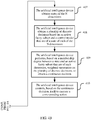
- FIG. 4A and FIG. 4B are a schematic diagram of an action control method according to an embodiment of the present disclosure.
- the method is performed by an artificial intelligence device. As shown in FIG. 4A and FIG. 4B , the method includes the following steps.
- the artificial intelligence device obtains N-dimensional state space S , M-dimensional action space A , and a reward function R , where N is a positive integer that is greater than or equal to one, and M is also a positive integer that is greater than or equal to one.
- the state space, the action space, and the reward function are used as inputs, various discrete decisions are used as outputs, and a training model is constructed based on a reinforcement learning algorithm.
- the artificial intelligence device obtains the state space, the action space, and the reward function in advance, so as to define necessary elements of the reinforcement learning algorithm.
- the state space is represented by S
- the action space is represented by A
- the reward function is represented by R .
- Step 401 may specifically include the following steps 1 to 3.
- Step 1 The artificial intelligent device generates N-dimensional state space S .
- the state space of each dimension is a set of states of a corresponding dimension of the artificial intelligence device; the state space of each dimension may be designed based on a state that can be obtained by the artificial intelligence device in a running process; to be specific, the state space of each dimension may be designed based on a state that can be collected in real time by the artificial intelligence device or a state obtained through processing.
- the state space of each dimension includes two boundaries: A left boundary may represent a minimum value of a state of a corresponding dimension, and a right boundary may represent a maximum value of a state of a corresponding dimension.
- the minimum value of the state may be directly designed as a left boundary of the state space, and the maximum value of the state may be directly designed as a right boundary of the state space.
- a minimum value and a maximum value that are of the state may be normalized, and a normalized minimum value and a normalized maximum value are respectively designed as the left boundary and the right boundary that are of the state space.
- the artificial intelligence device is an unmanned vehicle; state space S may include any combination of ⁇ -dimensional state space, V-dimensional state space, P-dimensional state space, V-front-dimensional state space, V-rear-dimensional state space, P-front-dimensional state space, and P-rear-dimensional state space; ⁇ is an included angle between a central axis of the unmanned vehicle and a central axis of a road, V is a current speed of the unmanned vehicle, P is a distance between the unmanned vehicle and the central axis of the road, V-front is a speed of a vehicle in front of the unmanned vehicle, V-rear is a speed of a vehicle in rear of the unmanned vehicle, P-front is a distance between the unmanned vehicle and the vehicle in front of the unmanned vehicle, and P-rear is a distance between the unmanned vehicle and the vehicle in rear of the unmanned vehicle.
- the artificial intelligence device is a robot; and the state space may include state space of a speed dimension, state space of
- the unmanned vehicle may correspond to N-dimensional state space, where N is equal to three; and the unmanned vehicle includes ⁇ -dimensional state space, V-dimensional state space, and P-dimensional state space; a boundary of the ⁇ -dimensional state space may be -1 and 1, -1 represents -180°, and 1 represents 180°.
- a boundary of the V-dimensional state space is within a range from zero to 300, zero represents a minimum speed, and 300 represents a maximum speed; and a boundary of the P-dimensional state space is -1 and 1, and the boundary is a result normalized by using a road width.
- the artificial intelligence device may obtain a state space generation instruction, and generate N-dimensional state space based on the state space generation instruction.
- the state space generation instruction indicates a quantity of dimensions of state space, and may further indicate a name of the state space of each dimension and a boundary value of the state space of each dimension; and the artificial intelligence device may generate the N-dimensional state space based on the quantity of dimensions, the name of the state space of each dimension, and the boundary value of the state space of each dimension that are included in the state space generation instruction.
- the artificial intelligence device may obtain the state space generation instruction when running code for defining state space.
- the code for defining state space is written by a developer in advance based on an actual requirement, and is stored in the artificial intelligence device in advance by the developer.
- Step 2 The artificial intelligence device generates the M-dimensional action space A .
- the action space of each dimension is a set of actions of a corresponding dimension of the artificial intelligence device, and the action space of each dimension may be determined based on an action that can be executed by the artificial intelligence device in an actual running process.
- the action space of each dimension includes two boundaries: A left boundary may represent a minimum value of an action of a corresponding dimension, and a right boundary may represent a maximum value of an action of a corresponding dimension.
- the minimum value of the action may be directly designed as a left boundary of the action space, and the maximum value of the action may be directly designed as a right boundary of the action space.
- a minimum value and a maximum value that are of the action may be normalized, and a normalized minimum value and a normalized maximum value are respectively designed as the left boundary and the right boundary that are of the action.
- the artificial intelligence device is an unmanned vehicle
- the action space A may include any combination of action space of a steering angle dimension, state space of a throttle dimension, state space of a brake dimension, and the like.
- the artificial intelligence device is a robot; and the action space may include any combination of action space of a cleaning dimension, action space of a weeding dimension, action space of a steering angle dimension, and action space of an article transport dimension.
- Each dimension corresponds to an action of a type
- action space of each dimension is a set of actions of a corresponding type of the artificial intelligence device
- a boundary of action space of each dimension is determined based on a minimum value and a maximum value that are of an action of a corresponding type.
- action space of a speed dimension is a set of running speeds of the artificial intelligence device
- a boundary of the action space of the speed dimension is determined based on a minimum speed and a maximum speed that are of the artificial intelligence device, for example, zero to 400.
- the artificial intelligence device may obtain an action space generation instruction, and generates the M-dimensional action space A based on the action space generation instruction.
- the action space generation instruction indicates a quantity of dimensions of action space, and may further indicate a name of the action space of each dimension and a boundary value of the action space of each dimension; and the artificial intelligence device may generate the M-dimensional action space based on the quantity of dimensions, the name of the action space of each dimension, and the boundary value of the action space of each dimension that are in the action space generation instruction.
- the artificial intelligence device may obtain the action space generation instruction when running code for defining action space.
- the code for defining state space is written by a developer in advance based on an actual requirement, and is stored in the artificial intelligence device in advance by the developer.
- the action space of each dimension may be discretized based on a uniform granularity, or a correspondence between a granularity and a dimension of the action space may be obtained; and the action space of each dimension is discretized based on a granularity corresponding to the dimension.
- a specific value of the granularity may be determined based on an actual requirement. This is not limited in this embodiment.
- the unmanned vehicle may correspond to M-dimensional action space (action space of a steering angle dimension), where M is equal to one; the action space is within a range of [-1, 1], where -1 represents a maximum right turning angle, 1 represents a maximum left turning angle, and zero represents running straight.
- the action space may be discretized based on a granularity of 0.1 to obtain [-1, -0.9, -0.8, ..., 0.8, 0.9, 1], and a total of 21 actions constitute discretized action space of the steering angle dimension.
- the steering angle is within a range of [-1, 1], and is within a range of [-1, -0.9, -0.8, ..., 0.8, 0.9, 1] after being discretized based on a granularity of 0.1, and a total of 21 dimensions are output.
- a convergence speed of a control model is increased to ensure that the control model is quickly trained:
- a design of the action space directly affects the convergence speed of the control model in a subsequent model training process; when more actions are performed in the action space, there are more actions for selection when the control model makes a decision in a state; more selections for the control model indicate a larger calculation amount, and a lower convergence speed of the control model indicates a lower speed of making a decision during online use.
- action space designed in the solutions is continuous, and consequently, an excessive calculation amount is required during model training, and consequently, it is difficult to ensure fast convergence of the control model, and practicality of the control model is low.
- the action space is discretized to reduce exploration space of a reinforcement learning process and a calculation amount required for training a control model, thereby increasing a convergence speed of the control model, and ensuring that the control model is quickly trained. Further, this reduces a calculation amount of making a decision by using the control model online, increases a speed of making the decision, and ensures that the decision is quickly made.
- Step 3 The artificial intelligence device obtains a reward function.
- the reward function may be designed based on an expectation for a state in an actual running process of the artificial intelligence device; the reward function may be designed as an ideal state, and an output reward value is a positive number and positively related to a degree of idealness. To be specific, if a state is more ideal, the reward function outputs a higher reward value when the state is input to the reward function. In addition, the reward function may be designed as a non-ideal state, and the output reward value is a negative number; to be specific, a penalty value is output.
- the control model is enabled to learn a decision corresponding to each state, to improve accuracy of the control model in decision making during use:
- perception of the control model for each state is determined by using a reward value of a state determined by the reward function, and the control model makes a decision by maximizing the reward value.
- a negative reward value is designed in the non-ideal state; when the control model triggers this state, the negative reward value is obtained. This may be understood as being punished, and the control model perceives that the state should be avoided when during subsequent decision making. Therefore, when the control model is actually used to make the decision, an effect of presenting the non-ideal state can be avoided.
- a positive reward value is designed in the ideal state and positively related to the degree of idealness; when the control model triggers this state, the positive reward value is obtained. This may be understood as being encouraged, and the control model perceives that the state should be preferred during subsequent decision making. Therefore, when the control model is actually used to make the decision, an effect of inclining the ideal state can be achieved.
- the unmanned vehicle is used as an example. Because an ideal state of an unmanned vehicle driving process indicates that the unmanned vehicle does not collide, the unmanned vehicle runs quickly, the unmanned vehicle runs along a road, and the like, a reward value output by the reward function may be negatively related to a collision and ⁇ , and may be positively related to a speed.
- the control model is punished when a collision occurs during training, thereby urging the control model to output the decision to avoid the collision. Because a higher speed indicates a greater reward, the control model can be encouraged to output the decision to increase a speed, thereby ensuring that the unmanned vehicle runs as quickly as possible. Because a smaller ⁇ indicates a greater reward, the control model can be encouraged to output the decision to reduce ⁇ , thereby ensuring that the unmanned vehicle runs as far as possible along the road without a behavior that the unmanned vehicle leaves a lane and causes a deviation.
- the artificial intelligence device performs, based on the state space, the action space, and the reward function, model training by using the reinforcement learning algorithm, to obtain a control model.
- the control model is used to output M-dimensional discrete decisions in action space A based on an input N-dimensional state in state space S .
- the artificial intelligence device may obtain a state S t of N dimensions when performing t th learning, S t is an N-dimensional state vector in N-dimensional state space and calculated by using a reward function R , to obtain a reward value R t- 1 ; S t is output to a current control model, to obtain an output A t ; after A t is executed, S t +1 and R t are obtained; S t and R t -1 are added into an empirical pool; model training is performed by using data in the empirical pool, to update the control model, so that subsequent learning can be performed based on an updated control model.
- the artificial intelligence device may be configured with various components such as a camera, various sensors, and a network communications module.
- the artificial intelligence device may perceive, by using the components, a state of an external environment and a state of the artificial intelligence device.
- the artificial intelligence device may collect a front image by using a front-facing camera; and the front image is used to perceive a state of a front environment.
- the artificial intelligence device may collect, by using an ultrasound radar, a distance between the artificial intelligence device and a surrounding object, to perceive a distance between the artificial intelligence device and an obstacle.
- the artificial intelligence device may perceive, by using an acceleration sensor, acceleration and a speed that are of the artificial intelligence device.
- the artificial intelligence device may perceive, by using a gyroscope, an angle of rotation of the artificial intelligence device.
- the artificial intelligence device may obtain, by using a Global Positioning System (Global Positioning SysteM, GPS) sensor, road traffic network data, vehicle location information, and the like, to perceive a distance between the artificial intelligence device and a central axis of a road, an included angle between an orientation of the artificial intelligence device and an orientation of the road, and the like.
- Global Positioning SysteM Global Positioning SysteM, GPS
- An unmanned vehicle is used as an example.
- a GPS sensor may collect location information; and the unmanned vehicle may determine, based on the location information, a current orientation of the unmanned vehicle and an orientation of a central axis of a current driving road, and may calculate, based on the two orientations, an included angle ⁇ between a central axis of the unmanned vehicle and a central axis of a road.
- the unmanned vehicle may calculate, based on the location information, a distance P between the unmanned vehicle and the central axis of the road.
- the acceleration sensor may collect acceleration, and the unmanned vehicle may calculate a speed V of the unmanned vehicle based on the acceleration.
- an exploration policy may be used for exploration in a reinforcement learning process:
- the t th learning is used as an example, an action may be executed at a specific probability and based on A t determined by a reward value R t -1 , and an action is randomly executed at a specific probability, to enhance generalization of the control model, train a capability to explore an unknown environment by the control model, and ensure that the control model can cope with a complex and changeable actual situation in an actual use process.
- the exploration policy may be a ⁇ -greedy policy, an optimistic initial estimation policy, an attenuation ⁇ -greedy policy, an uncertain behavior priority exploration policy, a probability matching policy, an information value policy, or the like. This is not limited in this embodiment.
- a first point that should be noted is as follows: For a design that the action space A is discretized into q actions in the foregoing step 401, in step 402, when the training model is used for training based on discrete action space, only one action needs to be selected from the q actions for each learning and may be used as an output discrete decision. Therefore, the training model can perform fast convergence with relatively small exploration space.
- the model may be trained in a virtual simulator environment, or the model may be trained in a real environment.
- the unmanned vehicle may run, by using an electronic device, simulation software to construct a simulator environment; and the control model may be understood as a process or a thread that runs in the simulator environment.
- the control model is continuously mature until training is completed.
- the unmanned vehicle may run in the real environment, and it is required that the real environment be a multi-lane real road with lane lines, and other mobile vehicles running on a road provide an opportunity for the unmanned vehicle to change a lane, and the other mobile vehicles be arranged at specific randomness, to ensure that a model can be trained based on various datasets, so as to enhance a generalization capability of the model.
- a quantity of episodes of model training, a stop rule of model training, and a specific calculation manner of model training may be determined based on an actual requirement.
- the episode is a process of completing a preset action
- the stop rule is a rule that triggers stop of model training, for example, stop upon completion of one round of model training, or stop upon arrival to a destination.
- a specific algorithm of model training may include a deep reinforcement learning (Deep ReinforceMent Learning, DQN) algorithm, a reinforcement learning (Q-learning) algorithm, and the like.
- DQN algorithm may be used when the quantity of dimensions of state space is relatively large
- the Q-learning algorithm may be used when the quantity of dimensions of state space is relatively small. This is not limited in this embodiment.
- a fourth point that should be noted is as follows: For a solution in a related art in which a high-level decision model is trained by using a convolutional neural network, in this embodiment, a process of training the control model by using the reinforcement learning algorithm has the following technical effects.
- control model has a bottom control capability.
- a mapping function that is of a first angle-of-view image and that is from the first angle-of-view image to the steering angle is learned based on the convolutional neural network, so that the unmanned vehicle determines, during actual driving, the steering angle based on a first angle-of-view image collected in real time and a mapping function.
- a degree of a high-level decision such as a steering angle can be reached, but a degree of bottom control such as determining a left turning speed, a right turning speed, a left turning acceleration, and a right turning acceleration cannot be reached.
- action space of each dimension is designed and may be further refined into a plurality of discrete actions, so that an action of a control model decision may be bottomed, clearly defined, and concretized, and therefore, the control model has a bottom control capability.
- a discrete decision output by the control model can indicate a specific action of each dimension, for example, a value accurate to acceleration and a foot lifting value. In this case, accuracy of the decision is improved and practicability is high.
- control model has strong robustness.
- mapping function has a poor generalization capability:
- the mapping function is only used to control a case in which a vehicle that photographs first angle-of-view images during learning runs, and when another vehicle runs in actual application, reliability of a steering angle determined by the mapping function is very low.
- the mapping function is applicable only to a road in which a vehicle that photographs first angle-of-view images during learning is located; in actual application, when the vehicle runs on another road, reliability of a steering angle determined by the mapping function is also very low. Therefore, it is difficult to cope with a complex and changeable road situation by using this method, and this method is not applicable to another vehicle and has poor robustness.
- the control model is used for training by using a state of a bottom layer as an input, universality of the state of the bottom layer is strong, and the state of the bottom layer is weakly related to an autonomous body with a collection state and an environment of the autonomous body, to ensure that a decision made for a determined state is applicable to various autonomous bodies and environments.
- the unmanned vehicle is used as an example. It is not required that a vehicle applied to an actual use process be the same as a vehicle applied to a learning process, and further, it is not required that a road applied to the actual use process is the same as a road applied to the learning process. A decision made in the actual use process is applicable to various vehicles and roads, to ensure that the unmanned vehicle can cope with a complex and changeable road situation, and consequently, this method has strong robustness.
- a control model that uses a current state as an input and uses a discrete decision as an output may be obtained through the foregoing steps 401 to 402.
- the state space S can be divided into a plurality of disjoint fuzzy subsets ⁇ S i ⁇ , and therefore, all states of each fuzzy subset S i correspond to a same discrete decision a i based on the control model, and a corresponding membership function is generated for each fuzzy subset.
- the artificial intelligence device divides state space of each dimension into a plurality of state intervals.
- the state space of each dimension may be divided in an over-partitioning manner; to be specific, a maximum quantity of state intervals that need to be obtained through division is required, and each state interval is required to be as narrow as possible, to ensure accuracy of a subsequently obtained fuzzy subset.
- a typical discrete decision of each state interval is obtained based on a central value of each state interval.
- ⁇ -dimensional state space can be divided into M state intervals ⁇ t 1 , ⁇ t 2 , ... ⁇ t M , and a central value ⁇ t i of the i th state interval ⁇ t i may be recorded, to obtain a central value set including M central values ⁇ t 1 , ⁇ t 2 , ... ⁇ t M . It is assumed that the ⁇ -dimensional state space is [-1, 1] and M is equal to 200, the set of central values is ⁇ -0.995, -0.985, -0.975, ..., 0.985, 0.995 ⁇ .
- the artificial intelligence device obtains, based on the control model, a typical discrete decision of each of a plurality of state intervals, to obtain a plurality of typical discrete decisions.
- a typical discrete decision of a state interval is a discrete decision that is most likely output by the control model when a central value of the state interval is used as an input of the control model, namely, a discrete decision with a maximum output probability.
- the artificial intelligence device obtains, based on the control model, the typical discrete decision of each state interval, to subsequently obtain a fuzzy subset by combining state intervals with a same typical discrete decision.
- a process of obtaining the typical discrete decision may specifically include the following steps 1 to 3.
- Step 1 For each of the plurality of state intervals, obtain a plurality of representative states of the state interval, where each representative state includes a central value of a state interval of a dimension and a state of another dimension.
- a representative state of a state interval is a state in which a value of a dimension of the state interval is a central value of the state interval and the dimension is equal to a dimension of state space; the representative state is used to make a typical discrete decision corresponding to the state interval; the representative state includes the central value of the state interval and the state of the another dimension; and the state of the another dimension may be a sampling value of state space of another dimension.
- a representative state of the j th state interval of the i th dimension is obtained.
- a process of obtaining the representative state may include steps (1) to (2).
- sampling may be performed once to all state intervals of each dimension, and a representative state of each state interval of the dimension is determined by using a sampling value:
- state space of each of other dimensions other than the i th dimension in the N-dimensional state space is sampled, to obtain a sampling value of state space of all dimensions other than the i th dimension in the N-dimensional state space;
- m central values in the central value set are combined with sampling values of state space of all dimensions other than the i th dimension, to obtain m representative states corresponding to the m central values; in other words, representative states of all state intervals of the i th dimension are obtained. Therefore, it is ensured that sampling is performed once in the i th dimension, and sampling does not need to be performed to m state intervals for m times.
- a representative state of each state interval of ⁇ -dimensional state space is obtained; it is assumed that there are w random sampling points, dimensions other than the ⁇ dimension in state space S are denoted as S O , and w points may be randomly sampled in the state space S O , to obtain these sampling values ⁇ S O 1 , S O 2 ,... S Ow ⁇ .
- Step 2 Respectively input a plurality of representative states into the control model to obtain a plurality of discrete decisions output by the control model.
- Each of the w representative states may be input into the control model.
- a corresponding discrete decision may be output from the control model based on the input representative states, and w discrete decisions may be obtained by using the w representative states.
- Step 3 Select, from the plurality of discrete decisions, a discrete decision with a maximum quantity of repetitions as a typical discrete decision of a state interval.
- a quantity of repetitions of each discrete decision may be counted, to select a discrete decision with a maximum quantity of repetitions as a typical discrete decision of a state interval.
- a typical discrete decision of ⁇ t i in a ⁇ -dimensional state interval ⁇ t 1 , ⁇ t 2 , ... ⁇ t M is obtained; when w discrete decisions are obtained by using w representative states of ⁇ t i , a decision with a maximum quantity of repetitions in the w discrete decisions may be counted, used as a typical discrete decision of ⁇ t i , and denoted as A i .
- the artificial intelligence device combines, based on the plurality of typical discrete decisions, a plurality of adjacent state intervals corresponding to a same typical discrete decision into a fuzzy subset, to obtain at least one fuzzy subset of each dimension.
- a change situation of a typical discrete decision may be analyzed, to obtain an edge location on which the typical discrete decision changes in the state intervals. Division is performed once at the edge location each time the edge location is determined, and therefore, a plurality of state intervals in which a typical discrete decision does not change are combined into a fuzzy subset, and the state space of the dimension is further divided into at least one fuzzy subset, where each of the fuzzy subsets corresponds to a same discrete decision, and adjacent fuzzy subsets correspond to different typical discrete decisions.
- the artificial intelligence device is a robot. It is assumed that state space of a body action dimension includes 100 state intervals, a typical discrete decision corresponding to state intervals 1 to 10 is squatting, a typical discrete decision corresponding to state intervals 10 to 40 is standing, a typical discrete decision corresponding to state intervals 40 to 80 is hand raising, and a typical discrete decision corresponding to state intervals 80 to 100 is jumping.
- the typical discrete decision changes in the state interval 10, the state interval 40, and the state interval 80; to be specific, the edge location is the state interval 10, the state interval 40, and the state interval 80, the state intervals 1 to 10 are combined into a fuzzy subset, the state intervals 10 to 40 are combined into a fuzzy subset, the state intervals 40 to 80 are combined into a fuzzy subset, and the state intervals 80 to 100 are combined into a fuzzy state subset.
- the artificial intelligence device is an unmanned vehicle. It is assumed that a state interval ⁇ t 1 , ⁇ t 2 , ... ⁇ t M and a corresponding discrete decision set ⁇ A 1 , ...A M ⁇ are obtained based on ⁇ -dimensional state space, adjacent state intervals corresponding to a same typical discrete decision are combined to obtain a plurality of new state intervals ⁇ ⁇ t 1 , ⁇ ⁇ t 2 , ... ⁇ ⁇ t k ⁇ that are denoted as a fuzzy subset, where k ⁇ is the number of ⁇ -dimensional fuzzy subsets. Therefore, this completes division of the ⁇ -dimensional fuzzy subsets.
- the state space of each dimension may be divided using this method, to obtain a fuzzy subset of state space of each dimension.
- the artificial intelligence device is an unmanned vehicle
- V-dimensional state space may be divided to obtain a V-dimensional fuzzy subset ⁇ V 1 , V 2 , ... V k v ⁇
- P-dimensional state space may be divided to obtain a P-dimensional fuzzy subset ⁇ P 1 , P 2 ,... P k p ⁇ , where k v is the number of V-dimensional fuzzy subsets, and k p is the number of P-dimensional fuzzy subsets.
- the state space of each dimension is divided into a plurality of fuzzy subsets through the foregoing steps 403 to step 405.
- the following technical effects can be achieved:
- fuzzy subsets are obtained through manual division: When state space of a dimension is divided into a plurality of fuzzy subsets, a plurality of experts need to be invited; each expert manually fills out, based on personal experience, decisions in different states; and states corresponding to a same decision are combined into a fuzzy subset. This manner is very complex, less efficient, and less accurate. Further, it is difficult to apply this method to a scenario in which high-dimensional state space is divided into a fuzzy subset: A state vector of the high-dimensional state space is already an arrangement and combination of states of different dimensions and therefore represents a very complex actual running condition, an expert cannot make a decision based on personal experience. Therefore, for this method, practicability is relatively low and an application scope is narrow.
- this embodiment provides a manner of automatically obtaining a fuzzy subset through division by using a control model obtained through training based on reinforcement learning.
- the manner does not need to depend on artificial making of a decision, and therefore, the manner is highly efficient.
- each state space may be divided into a large quantity of state intervals, and when a fuzzy subset is obtained through combination based on a typical discrete decision of a large quantity of state intervals, because a boundary of the fuzzy subset is very accurate, relatively high accuracy of the fuzzy subset can be ensured.
- the manner is applicable to a scenario in which the high-dimensional state space is divided into fuzzy subsets, and a fuzzy subset may be conveniently and quickly extended to the high-dimensional space. Therefore, the manner is applied to a complex running situation in actual application and is highly practical.
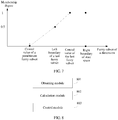
- the artificial intelligence device obtains, based on a preset rule, a membership function of each fuzzy subset, where the membership function is used to calculate a membership degree of a corresponding fuzzy subset, and the preset rule is that a central value of the membership function in each fuzzy subset is set to one, a membership degree of a boundary value in each fuzzy subset is set to 0.5, and a central value of two adjacent fuzzy subsets in all the fuzzy subsets is set to zero.
- a piecewise linear function is obtained by connecting adjacent points of the five points to a straight line, and is used as a membership function of the fuzzy subset.
- a membership function of the fuzzy subset may be shown in FIG. 5 .
- the two fuzzy subsets includes only one adjacent fuzzy subset.
- a left boundary value of the state space of the dimension, a central value of the fuzzy subset, a right boundary value of the fuzzy subset, and a central value of the latter fuzzy subset of the fuzzy subset may be determined, a membership degree of the left boundary value of the state space and a membership degree of the central value of the fuzzy subset are one, a membership degree of the right boundary value of the fuzzy subset is 0.5, and the central value of the latter fuzzy subset is zero.
- a piecewise linear function is obtained by connecting adjacent points of four points to a straight line, and is used as a membership function of the first fuzzy subset.
- a right boundary value of the state space of the dimension, a central value of the fuzzy subset, a left boundary value of the fuzzy subset, and a central value of the previous fuzzy subset of the fuzzy subset may be determined; a membership degree of the right boundary value of the state space and a membership degree of the central value of the fuzzy subset are one, a membership degree of the left boundary value of the fuzzy subset is 0.5, and the central value of the previous fuzzy subset is zero.
- a piecewise linear function is obtained by connecting adjacent points of four points to a straight line, and is used as a membership function of the last fuzzy subset.
- the membership function is highly explanatory and relatively effective:
- a state of a dimension is a central value of a fuzzy subset
- a person generally gives, based on a subjective perception, an evaluation that the state strongly belongs to the fuzzy subset;
- a membership degree between the obtained state and the fuzzy subset is one, to reach a maximum membership degree, thereby accurately representing a degree that the state strongly belongs to the fuzzy subset.
- a state of a dimension is a boundary value of a fuzzy subset
- a person generally gives, based on a subjective perception, a fuzzy evaluation that the state probably belongs to the fuzzy subset, and may also belong to a fuzzy subset adjacent to the fuzzy subset; when the state is calculated by using the membership function of the fuzzy subset, a membership degree between the obtained state and the fuzzy subset is 0.5, and a membership degree between the state and the fuzzy subset adjacent to the fuzzy subset is also 0.5, and the membership degree is equal to each other, thereby accurately representing a degree that the state probably belongs to the fuzzy subset.
- a state of a dimension is a central value of a fuzzy subset adjacent to a fuzzy subset
- a person usually gives, based on the subjective perception, an evaluation that the state weakly belongs to the fuzzy subset; when the state is calculated by using the membership function of the fuzzy subset, a membership degree between the obtained state and the fuzzy subset is zero, thereby accurately representing a degree that the state weakly belongs to the fuzzy subset.
- a membership degree that is obtained through calculation by using the membership function and that is of a state matches a membership degree obtained through man-made evaluation, to properly and accurately represent a degree that the state belongs to the fuzzy subset.
- a membership function is usually constructed in a curve fitting manner: A large quantity of samples are collected in advance, an approximate curve of the membership function is drawn, a membership function that matches the curve is determined from a plurality of typical membership functions such as parabolic distribution and trapezoidal distribution, and a coefficient of the membership function is adjusted to approximate a sample, to obtain the membership function of the fuzzy subset.
- This manner is relatively complex and less efficient. In this embodiment, only five points need to be selected for each fuzzy subset, and the membership function can be obtained through value assignment and connection. Therefore, a speed of constructing the membership function is relatively high, and efficiency is improved.
- the membership function may alternatively be constructed in another manner.
- a common membership function such as a parabolic distribution function, a trapezoidal distribution function, and a triangular distribution function may be obtained in the curve fitting manner; based on the fuzzy subset, curve fitting is performed for the membership function, to obtain a final membership function.
- the membership function may alternatively be constructed in any manner in which the membership function is determined based on the fuzzy subset. This is not limited in this embodiment.
- the state space of each dimension is divided into a plurality of fuzzy subsets, and a membership function of each fuzzy subset is obtained.
- the artificial intelligence device makes a decision in combination with a fuzzy subset, a membership function, a control model, and a current state that are of each dimension, to control an action of the artificial intelligence device.
- the artificial intelligence device obtains states of the N dimensions.
- This step is similar to a process in which the state is obtained when the model is trained in the foregoing step 402, and details are not described herein.
- the artificial intelligence device obtains a plurality of discrete decisions based on an active fuzzy subset and a control model that are of a state of each of the N dimensions, where an active fuzzy subset of a state is a fuzzy subset whose membership degree of the state is not zero, and the control model is used to output a corresponding discrete decision based on an input state.
- the artificial intelligence device obtains, based on a state of each dimension, at least one active fuzzy subset of a plurality of fuzzy subsets of each dimension, to obtain an active fuzzy subset of the N dimensions.
- a plurality of discrete decisions can be obtained based on the active fuzzy subsets and the control model; each of the discrete decisions is a decision that can be considered for the determined state of the N dimensions, and subsequently weighted summation is performed on the discrete decisions, to obtain a continuous decision.
- a specific process of obtaining an active fuzzy subset of each dimension may include the following two possible designs.
- Design 1 For each of the N dimensions, when a membership degree of a fuzzy subset of each dimension is not zero, the fuzzy subset is used as an active fuzzy subset of each dimension.
- a membership function corresponding to each fuzzy subset may be used to calculate a state of the dimension, to obtain a membership degree of each fuzzy subset.
- the fuzzy subset is used as an active fuzzy subset.
- a fuzzy subset may be obtained and used as the active fuzzy subset, where the membership degree of the fuzzy subset in divided fuzzy subsets in all dimensions is not zero.
- a membership degree between each dimension S and each fuzzy subset is calculated by using the membership function of each fuzzy subset of the dimension obtained in the foregoing step 406, where a fuzzy subset whose membership degree is not zero is an active fuzzy subset.
- ⁇ -dimensional state space includes five fuzzy subsets and five membership functions
- ⁇ may be calculated by using the five membership functions after being obtained, to obtain a membership degree between ⁇ and each of the five fuzzy subsets.
- a fuzzy subset whose membership degree is not zero is selected from the five fuzzy subsets and used as a ⁇ -dimensional active fuzzy subset. Based on a design principle of the foregoing membership function, it can be learned that there are no more than two active fuzzy subsets in any dimension.
- Design 2 For each of the N dimensions, two fuzzy subsets are selected from the plurality of fuzzy subsets of each dimension and used as active fuzzy subsets of each dimension, where central values of the two fuzzy subsets are around the state of the dimension.
- a central value of a fuzzy subset on the left side of S can be found in the central value set of the fuzzy subset corresponding to the dimension, namely, a central value that is less than S , in the central values of all fuzzy subsets, and closest to S .
- a fuzzy subset including the central value is used as an active fuzzy subset.
- a central value of a fuzzy subset on the right side of S is found in a central value set of fuzzy subsets corresponding to the dimension, namely, a central value that is greater than S , in the central values of all fuzzy subsets, and closest to S .
- Fuzzy subsets including the central value are used as active fuzzy subsets.
- the active fuzzy subsets include ⁇ i , ⁇ i +1 , V j V j +1 P k , and P k +1 .
- a process of obtaining a discrete decision may specifically include the following steps 1 to 3.
- Step 1 Obtain a central value of an active fuzzy subset corresponding to a state of each dimension, to obtain a plurality of central values.
- Step 2 Combine central values of different dimensions to obtain a plurality of intermediate states, where each intermediate state includes central values of the N dimensions.
- a central value may be selected from a central value of at least one active fuzzy subset of the i th dimension. After the N dimensions are traversed, N central values are selected and then combined to obtain an intermediate state.
- the intermediate state includes N dimensions, and a value of any dimension is a central value of an active fuzzy set of the dimension.
- Step 3 Respectively input a plurality of intermediate states into the control model to obtain a plurality of discrete decisions output by the control model.
- any N-dimensional intermediate state is input to the control model, and the control model may output a discrete decision of the N-dimensional intermediate state.
- the artificial intelligence device performs, based on a membership degree between a state and an active fuzzy subset that are of each dimension, weighted summation on the plurality of discrete decisions, to obtain a continuous decision.
- a membership function is a continuous function
- an obtained decision is a continuous decision.
- the artificial intelligence device is controlled to execute an action based on the continuous decision, to ensure smooth control over the artificial intelligence device, and improve smoothness of the action.
- a process of obtaining a continuous decision by performing weighted summation on the plurality of discrete decisions may specifically include the following steps 1 to 3.
- Step 1 Obtain, for each of the plurality of discrete decisions, membership degrees of N active fuzzy subsets corresponding to each discrete decision, to obtain N membership degrees.
- an intermediate state of the discrete decision may be output in a process of obtaining an output discrete decision obtained by previously inputting an intermediate state to a control model, and then the N active fuzzy subsets of the intermediate state are determined in a process in which central values of a plurality of active fuzzy subsets constitute an intermediate state, and the N active fuzzy subsets are used as the N active fuzzy subsets corresponding to the discrete decision.
- the membership degree of the N active fuzzy subsets may be obtained based on the membership degree that is obtained through calculation in the foregoing process and that is of each fuzzy subset of each dimension, to obtain the N membership degrees.
- a membership function corresponding to the fuzzy subset may be used to calculate a state of the dimension, to obtain a membership degree of the fuzzy subset and the N membership degrees.
- the membership function of the j th active fuzzy subset of the i th dimension is f ij
- the membership function between S and the j th active fuzzy subset is equal to f 1 , k 1 + x 1 j s 1 ⁇ ... ⁇ f n , k n + x n j s n .
- a membership function of ⁇ i may be used to calculate ⁇ to obtain a membership degree w ⁇ 1 between ⁇ and ⁇ i ; a membership function of ⁇ i +1 is used to calculate ⁇ to obtain a membership degree w ⁇ 2 between ⁇ and ⁇ i +1 ; a membership function of V j is used to calculate V to obtain a membership degree w v 1 between V and V j ; a membership function of V j +1 is used to calculate V to obtain w v 2 between V and V j +1 ; a membership function of P k is used to calculate P to obtain a function degree w p 1 between P and P k +1 ; and a membership function of P k +1
- Step 2 Calculate, based on the N membership degrees, weights of the discrete decisions.
- the artificial intelligence device may calculate a product of the N membership degrees as the weights of the discrete decisions. For example, it is assumed that a discrete decision is A xyz , and the weight of the discrete decision is w ⁇ x w v y w p z .
- Step 3 Perform, based on the weights of the discrete decisions, weighted summation on the plurality of discrete decisions, to obtain a continuous decision.
- the artificial intelligence device controls, based on the continuous decision, itself to execute a corresponding action.
- the continuous decision may include M dimensions, namely, dimensions of M-dimensional action space A in the foregoing step 401.
- the artificial intelligence device may obtain a value of the continuous decision in each dimension, and control itself to execute the action of each dimension.
- the artificial intelligence device is an unmanned vehicle.
- the unmanned vehicle rotates at a specific angle based on the continuous decision; for example, the continuous decision of the steering angle dimension is -1, the steering angle dimension is mapped to a maximum angle by which the unmanned vehicle can turn right. In this case, the unmanned vehicle turns right based on the maximum angle; for another example, the continuous decision is zero, the steering angle dimension is mapped to 0°, and the unmanned vehicle runs straight.
- the unmanned vehicle accelerates based on the continuous decision.
- the unmanned vehicle accelerates at a speed of 300 m/s 2 .
- the artificial intelligence device is a robot.
- the robot controls a left-foot action based on the continuous decision. For example, if there are five continuous decisions of the left-foot dimension, the left-foot dimension is mapped to left-foot lifting for 40 cm, and the robot lifts the left foot for 40 cm.
- an execution body is an artificial intelligence device is merely used as an example for description in this embodiment.
- an action control method provided in this embodiment may alternatively be executed by a server.
- the server may be deployed on a cloud, and a network connection may be established between the server and the artificial intelligence device. By using the network connection, the server and the artificial intelligence device perform real-time communication.
- the artificial intelligence device may send obtained states of all dimensions to the server.
- the server may obtain a continuous decision based on a state and a control model that are of each dimension, and send the continuous decision to the artificial intelligence device, so that the artificial intelligence device may control itself to execute a corresponding action after receiving the continuous decision, and therefore, an effect of remotely controlling the artificial intelligence device to execute an action is achieved.
- a minimal communication latency and maximal communication security may be required.
- a second point that should be noted is as follows: A continuous decision is made by using a membership degree between a state and an active fuzzy subset, and this provides a manner of properly and continuously making a decision, to ensure high accuracy of the continuous decision: Because the membership degree can reflect a change trend of the state in a fuzzy interval, with running of the artificial intelligence device, when an obtained value of the state changes with a change trend, a position of the state in the fuzzy subset changes with the change trend, a state position in the fuzzy subset also changes with the change trend, the membership degree of the fuzzy subset also changes with the change trend. A continuous decision made based on the membership degree also changes with the change trend; to be specific, the change trend of the continuous decision matches the change trend of the state, and therefore, accuracy of the manner is high.
- weighted summation is performed on the plurality of discrete decisions, to obtain a continuous decision.
- An output decision is a continuous quantity, to ensure smooth control over the artificial intelligence device, and ensure smoothness of an action.
- a continuous decision is obtained by using a membership degree. This provides a manner of properly and continuously discretizing a decision, to ensure that a change trend of the continuous decision matches that of a state, and ensure that the continuous decision is highly accurate. Further, when the artificial intelligence device is an unmanned vehicle, control smoothness of the unmanned vehicle can be ensured, so that passengers feel more comfortable.
- FIG. 8 is a schematic structural diagram of an action control apparatus according to an embodiment of the present disclosure. As shown in FIG. 8 , the apparatus includes an obtaining module 801, a calculation module 802, and a control module 803.
- the obtaining module 801 is configured to perform the foregoing step 407.
- the obtaining module 801 is further configured to perform the foregoing step 408.
- the calculation module 802 is configured to perform the foregoing step 409.
- the control module 803 is configured to perform the foregoing step 410.
- the obtaining module 801 includes:
- the apparatus further includes: a dividing module, configured to perform the foregoing step 401.
- the obtaining module 801 is further configured to perform the foregoing step 404.
- the obtaining module 801 is further configured to perform the foregoing step 405.
- the obtaining module 801 includes:
- the calculation module 802 is configured to calculate a membership degree of each fuzzy subset.
- the obtaining module 801 is further configured to perform the foregoing step 406.
- All or some of the foregoing embodiments may be implemented by software, hardware, firmware, or any combination thereof.
- the embodiments may be implemented completely or partially in a form of a computer program product.
- the computer program product includes one or more computer program instructions.
- the computer may be a general-purpose computer, a dedicated computer, a computer network, or other programmable apparatuses.
- the computer instructions may be stored in a computer-readable storage medium or may be transmitted from a computer-readable storage medium to another computer-readable storage medium.
- the computer instructions may be transmitted from a website, computer, server, or data center to another website, computer, server, or data center in a wired or wireless manner.
- the computer storage medium may be any usable medium accessible by a computer, or a data storage device, such as a server or a data center, integrating one or more usable media.
- the usable medium may be a magnetic medium (for example, a floppy disk, a hard disk, or a magnetic tape), an optical medium (for example, a digital video disc (digital video disc, DVD), a semiconductor medium (for example, a solid-state drive), or the like.
Landscapes
- Engineering & Computer Science (AREA)
- Physics & Mathematics (AREA)
- Theoretical Computer Science (AREA)
- Artificial Intelligence (AREA)
- General Physics & Mathematics (AREA)
- Software Systems (AREA)
- Evolutionary Computation (AREA)
- Data Mining & Analysis (AREA)
- Health & Medical Sciences (AREA)
- General Engineering & Computer Science (AREA)
- Life Sciences & Earth Sciences (AREA)
- Mathematical Physics (AREA)
- Automation & Control Theory (AREA)
- Molecular Biology (AREA)
- General Health & Medical Sciences (AREA)
- Biomedical Technology (AREA)
- Computing Systems (AREA)
- Computer Vision & Pattern Recognition (AREA)
- Computational Linguistics (AREA)
- Biophysics (AREA)
- Fuzzy Systems (AREA)
- Medical Informatics (AREA)
- Bioinformatics & Computational Biology (AREA)
- Evolutionary Biology (AREA)
- Bioinformatics & Cheminformatics (AREA)
- Computational Mathematics (AREA)
- Pure & Applied Mathematics (AREA)
- Mathematical Optimization (AREA)
- Mathematical Analysis (AREA)
- Algebra (AREA)
- Business, Economics & Management (AREA)
- Game Theory and Decision Science (AREA)
- Aviation & Aerospace Engineering (AREA)
- Radar, Positioning & Navigation (AREA)
- Remote Sensing (AREA)
- Feedback Control In General (AREA)
- Control Of Position, Course, Altitude, Or Attitude Of Moving Bodies (AREA)
Applications Claiming Priority (2)
| Application Number | Priority Date | Filing Date | Title |
|---|---|---|---|
| CN201711408965.4A CN109960246B (zh) | 2017-12-22 | 2017-12-22 | 动作控制方法及装置 |
| PCT/CN2018/121519 WO2019120174A1 (fr) | 2017-12-22 | 2018-12-17 | Procédé et appareil de commande d'action |
Publications (3)
| Publication Number | Publication Date |
|---|---|
| EP3719603A1 true EP3719603A1 (fr) | 2020-10-07 |
| EP3719603A4 EP3719603A4 (fr) | 2021-02-17 |
| EP3719603B1 EP3719603B1 (fr) | 2023-04-26 |
Family
ID=66993132
Family Applications (1)
| Application Number | Title | Priority Date | Filing Date |
|---|---|---|---|
| EP18890321.5A Active EP3719603B1 (fr) | 2017-12-22 | 2018-12-17 | Procédé et appareil de commande d'action |
Country Status (4)
| Country | Link |
|---|---|
| US (1) | US11449016B2 (fr) |
| EP (1) | EP3719603B1 (fr) |
| CN (1) | CN109960246B (fr) |
| WO (1) | WO2019120174A1 (fr) |
Families Citing this family (15)
| Publication number | Priority date | Publication date | Assignee | Title |
|---|---|---|---|---|
| US11410558B2 (en) * | 2019-05-21 | 2022-08-09 | International Business Machines Corporation | Traffic control with reinforcement learning |
| CN110516353B (zh) * | 2019-08-27 | 2024-03-26 | 浙江科技学院 | 一种山区高速公路弯道设计缺陷快速识别方法 |
| CN114467100A (zh) * | 2019-09-25 | 2022-05-10 | 渊慧科技有限公司 | 使用q学习与前瞻搜索相结合训练动作选择神经网络 |
| CN110971677B (zh) * | 2019-11-19 | 2021-11-09 | 国网吉林省电力有限公司电力科学研究院 | 一种基于对抗强化学习的电力物联网终端设备边信道安全监测方法 |
| JP7357537B2 (ja) * | 2019-12-24 | 2023-10-06 | 本田技研工業株式会社 | 制御装置、制御装置の制御方法、プログラム、情報処理サーバ、情報処理方法、並びに制御システム |
| CN110929431B (zh) * | 2020-02-03 | 2020-06-09 | 北京三快在线科技有限公司 | 一种车辆行驶决策模型的训练方法及装置 |
| CN114435395B (zh) * | 2021-12-31 | 2024-12-10 | 赛可智能科技(上海)有限公司 | 自动驾驶的方法、装置、设备、介质及计算机程序产品 |
| CN116834825B (zh) * | 2022-03-24 | 2026-01-16 | 本田技研工业株式会社 | 电动助力转向装置及其辅助方法 |
| CN115866872A (zh) * | 2022-11-21 | 2023-03-28 | 北京核力同创科技有限公司 | 一种基于强化学习的腔体自动老炼系统及方法 |
| CN116189380B (zh) * | 2022-12-26 | 2024-08-02 | 湖北工业大学 | 机械设备人机安全交互方法、系统、装置以及介质 |
| CN116540602B (zh) * | 2023-04-28 | 2024-02-23 | 金陵科技学院 | 一种基于路段安全级别dqn的车辆无人驾驶方法 |
| CN116339130B (zh) * | 2023-05-25 | 2023-09-15 | 中国人民解放军国防科技大学 | 基于模糊规则的飞行任务数据获取方法、装置及设备 |
| CN116494246B (zh) * | 2023-06-13 | 2025-11-07 | 中国南方电网有限责任公司超高压输电公司电力科研院 | 机器人控制方法、装置和变电站作业辅助机器人 |
| CN119357583B (zh) * | 2024-10-08 | 2025-08-05 | 华电国际电力股份有限公司技术服务分公司 | 一种基于即时学习局部模型的设备故障检测方法 |
| CN119189181B (zh) * | 2024-11-26 | 2025-05-13 | 江苏晶雪节能科技股份有限公司 | 双面阻燃保温复合板连续生产输送系统 |
Family Cites Families (20)
| Publication number | Priority date | Publication date | Assignee | Title |
|---|---|---|---|---|
| US6581048B1 (en) * | 1996-06-04 | 2003-06-17 | Paul J. Werbos | 3-brain architecture for an intelligent decision and control system |
| US5796919A (en) * | 1996-10-07 | 1998-08-18 | Kubica; Eric Gregory | Method of constructing and designing fuzzy controllers |
| US6917925B2 (en) * | 2001-03-30 | 2005-07-12 | Intelligent Inference Systems Corporation | Convergent actor critic-based fuzzy reinforcement learning apparatus and method |
| US7627386B2 (en) * | 2004-10-07 | 2009-12-01 | Zonaire Medical Systems, Inc. | Ultrasound imaging system parameter optimization via fuzzy logic |
| CN101414159B (zh) * | 2008-10-08 | 2012-04-18 | 重庆邮电大学 | 基于连续型模糊插值的模糊控制方法和系统 |
| CN102207928B (zh) | 2011-06-02 | 2013-04-24 | 河海大学常州校区 | 基于强化学习的多Agent污水处理决策支持系统 |
| US8311973B1 (en) * | 2011-09-24 | 2012-11-13 | Zadeh Lotfi A | Methods and systems for applications for Z-numbers |
| US9461876B2 (en) * | 2012-08-29 | 2016-10-04 | Loci | System and method for fuzzy concept mapping, voting ontology crowd sourcing, and technology prediction |
| CN103645635A (zh) | 2013-11-25 | 2014-03-19 | 大连海联自动控制有限公司 | 一种基于模拟退火-强化学习算法的船舶运动控制器 |
| EP2933069B1 (fr) * | 2014-04-17 | 2019-07-03 | Softbank Robotics Europe | Robot humanoïde à roues omnidirectionnelles basé sur une commande prédictive linéaire de position et de vitesse |
| CN103955930B (zh) * | 2014-04-28 | 2017-01-18 | 中国人民解放军理工大学 | 基于灰度积分投影互相关函数特征的运动参数估计方法 |
| CN104240522A (zh) | 2014-09-04 | 2014-12-24 | 中山大学 | 基于车载网和模糊神经网络的自适应十字路口控制技术 |
| KR101484249B1 (ko) | 2014-09-22 | 2015-01-16 | 현대자동차 주식회사 | 차량의 주행 모드 제어 장치 및 방법 |
| CN105549384B (zh) | 2015-09-01 | 2018-11-06 | 中国矿业大学 | 一种基于神经网络和强化学习的倒立摆控制方法 |
| CN105501078A (zh) | 2015-11-26 | 2016-04-20 | 湖南大学 | 一种四轮独立驱动电动汽车协同控制方法 |
| CN105956968A (zh) | 2016-05-26 | 2016-09-21 | 程欧亚 | 一种高考志愿人工智能填报系统及方法 |
| CN106874668B (zh) * | 2017-02-14 | 2020-05-12 | 复旦大学 | 一种基于全记忆事件序列挖掘模型的用药分析方法 |
| CN107053179B (zh) | 2017-04-21 | 2019-07-23 | 苏州康多机器人有限公司 | 一种基于模糊强化学习的机械臂柔顺力控制方法 |
| CN107099785B (zh) | 2017-04-24 | 2019-08-23 | 内蒙古大学 | 一种纳米薄膜的制备方法 |
| US11200448B2 (en) * | 2019-05-15 | 2021-12-14 | RELX Inc. | Systems and methods for generating a low-dimensional space representing similarities between patents |
-
2017
- 2017-12-22 CN CN201711408965.4A patent/CN109960246B/zh active Active
-
2018
- 2018-12-17 EP EP18890321.5A patent/EP3719603B1/fr active Active
- 2018-12-17 WO PCT/CN2018/121519 patent/WO2019120174A1/fr not_active Ceased
-
2020
- 2020-06-19 US US16/906,863 patent/US11449016B2/en active Active
Also Published As
| Publication number | Publication date |
|---|---|
| CN109960246A (zh) | 2019-07-02 |
| US20200319609A1 (en) | 2020-10-08 |
| CN109960246B (zh) | 2021-03-30 |
| WO2019120174A1 (fr) | 2019-06-27 |
| US11449016B2 (en) | 2022-09-20 |
| EP3719603A4 (fr) | 2021-02-17 |
| EP3719603B1 (fr) | 2023-04-26 |
Similar Documents
| Publication | Publication Date | Title |
|---|---|---|
| EP3719603B1 (fr) | Procédé et appareil de commande d'action | |
| US12067491B2 (en) | Multi-agent reinforcement learning with matchmaking policies | |
| CN116776964B (zh) | 用于分布式强化学习的方法、程序产品和存储介质 | |
| US11836596B2 (en) | Neural networks with relational memory | |
| CN107544516A (zh) | 基于相对熵深度逆强化学习的自动驾驶系统及方法 | |
| CN113128285A (zh) | 一种处理视频的方法及装置 | |
| CN118092290B (zh) | 基于路径规划的多种植车辆协同控制系统 | |
| CN115909027B (zh) | 一种态势估计方法及装置 | |
| Sun et al. | UAV autonomous obstacle avoidance via causal reinforcement learning | |
| CN120448812A (zh) | 一种无人机寿命预测方法、装置、终端及存储介质 | |
| EP4107669B1 (fr) | Génération d'intégrations spatiales par intégration de mouvement d'agent et optimisation d'un objectif prédictif | |
| WO2022252013A1 (fr) | Procédé et appareil pour l'entraînement d'un réseau neuronal pour imiter le comportement d'un démonstrateur | |
| CN115576327B (zh) | 基于自动驾驶智能小车边缘计算与推理的自主学习方法 | |
| Haggitt et al. | Depth Estimation Images Generated from Monocular UAV Camera Images | |
| Tlapanco et al. | Visual robot navigation incorporating causal models in deep reinforcement learning | |
| Türkmen | A comparative study of nonlinear model predictive control and reinforcement learning for path tracking | |
| Nagami | Algorithms for Data Constrained Robot Learning | |
| CN116257065A (zh) | 基于最大熵分层强化学习的自动驾驶决策方法及系统 | |
| CN118928472A (zh) | 车辆的轨迹规划方法、装置、车辆、介质及程序 | |
| Öfjäll | Online Learning for Robot Vision | |
| Spain | Reinforcement Learning of Helicopter Control |
Legal Events
| Date | Code | Title | Description |
|---|---|---|---|
| STAA | Information on the status of an ep patent application or granted ep patent |
Free format text: STATUS: THE INTERNATIONAL PUBLICATION HAS BEEN MADE |
|
| PUAI | Public reference made under article 153(3) epc to a published international application that has entered the european phase |
Free format text: ORIGINAL CODE: 0009012 |
|
| STAA | Information on the status of an ep patent application or granted ep patent |
Free format text: STATUS: REQUEST FOR EXAMINATION WAS MADE |
|
| 17P | Request for examination filed |
Effective date: 20200703 |
|
| AK | Designated contracting states |
Kind code of ref document: A1 Designated state(s): AL AT BE BG CH CY CZ DE DK EE ES FI FR GB GR HR HU IE IS IT LI LT LU LV MC MK MT NL NO PL PT RO RS SE SI SK SM TR |
|
| AX | Request for extension of the european patent |
Extension state: BA ME |
|
| A4 | Supplementary search report drawn up and despatched |
Effective date: 20210118 |
|
| RIC1 | Information provided on ipc code assigned before grant |
Ipc: G06N 3/04 20060101AFI20210112BHEP |
|
| DAV | Request for validation of the european patent (deleted) | ||
| DAX | Request for extension of the european patent (deleted) | ||
| REG | Reference to a national code |
Ref country code: DE Ref legal event code: R079 Ref document number: 602018049035 Country of ref document: DE Free format text: PREVIOUS MAIN CLASS: G05D0001000000 Ipc: G06N0003080000 |
|
| GRAP | Despatch of communication of intention to grant a patent |
Free format text: ORIGINAL CODE: EPIDOSNIGR1 |
|
| STAA | Information on the status of an ep patent application or granted ep patent |
Free format text: STATUS: GRANT OF PATENT IS INTENDED |
|
| RIC1 | Information provided on ipc code assigned before grant |
Ipc: G06N 3/08 20060101AFI20221107BHEP |
|
| INTG | Intention to grant announced |
Effective date: 20221214 |
|
| RAP3 | Party data changed (applicant data changed or rights of an application transferred) |
Owner name: HUAWEI TECHNOLOGIES CO., LTD. |
|
| GRAS | Grant fee paid |
Free format text: ORIGINAL CODE: EPIDOSNIGR3 |
|
| GRAA | (expected) grant |
Free format text: ORIGINAL CODE: 0009210 |
|
| STAA | Information on the status of an ep patent application or granted ep patent |
Free format text: STATUS: THE PATENT HAS BEEN GRANTED |
|
| AK | Designated contracting states |
Kind code of ref document: B1 Designated state(s): AL AT BE BG CH CY CZ DE DK EE ES FI FR GB GR HR HU IE IS IT LI LT LU LV MC MK MT NL NO PL PT RO RS SE SI SK SM TR |
|
| REG | Reference to a national code |
Ref country code: GB Ref legal event code: FG4D |
|
| REG | Reference to a national code |
Ref country code: CH Ref legal event code: EP |
|
| REG | Reference to a national code |
Ref country code: DE Ref legal event code: R096 Ref document number: 602018049035 Country of ref document: DE |
|
| REG | Reference to a national code |
Ref country code: AT Ref legal event code: REF Ref document number: 1563392 Country of ref document: AT Kind code of ref document: T Effective date: 20230515 |
|
| REG | Reference to a national code |
Ref country code: IE Ref legal event code: FG4D |
|
| REG | Reference to a national code |
Ref country code: LT Ref legal event code: MG9D |
|
| REG | Reference to a national code |
Ref country code: NL Ref legal event code: MP Effective date: 20230426 |
|
| REG | Reference to a national code |
Ref country code: AT Ref legal event code: MK05 Ref document number: 1563392 Country of ref document: AT Kind code of ref document: T Effective date: 20230426 |
|
| PG25 | Lapsed in a contracting state [announced via postgrant information from national office to epo] |
Ref country code: NL Free format text: LAPSE BECAUSE OF FAILURE TO SUBMIT A TRANSLATION OF THE DESCRIPTION OR TO PAY THE FEE WITHIN THE PRESCRIBED TIME-LIMIT Effective date: 20230426 |
|
| PG25 | Lapsed in a contracting state [announced via postgrant information from national office to epo] |
Ref country code: SE Free format text: LAPSE BECAUSE OF FAILURE TO SUBMIT A TRANSLATION OF THE DESCRIPTION OR TO PAY THE FEE WITHIN THE PRESCRIBED TIME-LIMIT Effective date: 20230426 Ref country code: PT Free format text: LAPSE BECAUSE OF FAILURE TO SUBMIT A TRANSLATION OF THE DESCRIPTION OR TO PAY THE FEE WITHIN THE PRESCRIBED TIME-LIMIT Effective date: 20230828 Ref country code: NO Free format text: LAPSE BECAUSE OF FAILURE TO SUBMIT A TRANSLATION OF THE DESCRIPTION OR TO PAY THE FEE WITHIN THE PRESCRIBED TIME-LIMIT Effective date: 20230726 Ref country code: ES Free format text: LAPSE BECAUSE OF FAILURE TO SUBMIT A TRANSLATION OF THE DESCRIPTION OR TO PAY THE FEE WITHIN THE PRESCRIBED TIME-LIMIT Effective date: 20230426 Ref country code: AT Free format text: LAPSE BECAUSE OF FAILURE TO SUBMIT A TRANSLATION OF THE DESCRIPTION OR TO PAY THE FEE WITHIN THE PRESCRIBED TIME-LIMIT Effective date: 20230426 |
|
| PG25 | Lapsed in a contracting state [announced via postgrant information from national office to epo] |
Ref country code: RS Free format text: LAPSE BECAUSE OF FAILURE TO SUBMIT A TRANSLATION OF THE DESCRIPTION OR TO PAY THE FEE WITHIN THE PRESCRIBED TIME-LIMIT Effective date: 20230426 Ref country code: PL Free format text: LAPSE BECAUSE OF FAILURE TO SUBMIT A TRANSLATION OF THE DESCRIPTION OR TO PAY THE FEE WITHIN THE PRESCRIBED TIME-LIMIT Effective date: 20230426 Ref country code: LV Free format text: LAPSE BECAUSE OF FAILURE TO SUBMIT A TRANSLATION OF THE DESCRIPTION OR TO PAY THE FEE WITHIN THE PRESCRIBED TIME-LIMIT Effective date: 20230426 Ref country code: LT Free format text: LAPSE BECAUSE OF FAILURE TO SUBMIT A TRANSLATION OF THE DESCRIPTION OR TO PAY THE FEE WITHIN THE PRESCRIBED TIME-LIMIT Effective date: 20230426 Ref country code: IS Free format text: LAPSE BECAUSE OF FAILURE TO SUBMIT A TRANSLATION OF THE DESCRIPTION OR TO PAY THE FEE WITHIN THE PRESCRIBED TIME-LIMIT Effective date: 20230826 Ref country code: HR Free format text: LAPSE BECAUSE OF FAILURE TO SUBMIT A TRANSLATION OF THE DESCRIPTION OR TO PAY THE FEE WITHIN THE PRESCRIBED TIME-LIMIT Effective date: 20230426 Ref country code: GR Free format text: LAPSE BECAUSE OF FAILURE TO SUBMIT A TRANSLATION OF THE DESCRIPTION OR TO PAY THE FEE WITHIN THE PRESCRIBED TIME-LIMIT Effective date: 20230727 |
|
| PG25 | Lapsed in a contracting state [announced via postgrant information from national office to epo] |
Ref country code: FI Free format text: LAPSE BECAUSE OF FAILURE TO SUBMIT A TRANSLATION OF THE DESCRIPTION OR TO PAY THE FEE WITHIN THE PRESCRIBED TIME-LIMIT Effective date: 20230426 |
|
| PG25 | Lapsed in a contracting state [announced via postgrant information from national office to epo] |
Ref country code: SK Free format text: LAPSE BECAUSE OF FAILURE TO SUBMIT A TRANSLATION OF THE DESCRIPTION OR TO PAY THE FEE WITHIN THE PRESCRIBED TIME-LIMIT Effective date: 20230426 |
|
| REG | Reference to a national code |
Ref country code: DE Ref legal event code: R097 Ref document number: 602018049035 Country of ref document: DE |
|
| PG25 | Lapsed in a contracting state [announced via postgrant information from national office to epo] |
Ref country code: SM Free format text: LAPSE BECAUSE OF FAILURE TO SUBMIT A TRANSLATION OF THE DESCRIPTION OR TO PAY THE FEE WITHIN THE PRESCRIBED TIME-LIMIT Effective date: 20230426 Ref country code: SK Free format text: LAPSE BECAUSE OF FAILURE TO SUBMIT A TRANSLATION OF THE DESCRIPTION OR TO PAY THE FEE WITHIN THE PRESCRIBED TIME-LIMIT Effective date: 20230426 Ref country code: RO Free format text: LAPSE BECAUSE OF FAILURE TO SUBMIT A TRANSLATION OF THE DESCRIPTION OR TO PAY THE FEE WITHIN THE PRESCRIBED TIME-LIMIT Effective date: 20230426 Ref country code: EE Free format text: LAPSE BECAUSE OF FAILURE TO SUBMIT A TRANSLATION OF THE DESCRIPTION OR TO PAY THE FEE WITHIN THE PRESCRIBED TIME-LIMIT Effective date: 20230426 Ref country code: DK Free format text: LAPSE BECAUSE OF FAILURE TO SUBMIT A TRANSLATION OF THE DESCRIPTION OR TO PAY THE FEE WITHIN THE PRESCRIBED TIME-LIMIT Effective date: 20230426 Ref country code: CZ Free format text: LAPSE BECAUSE OF FAILURE TO SUBMIT A TRANSLATION OF THE DESCRIPTION OR TO PAY THE FEE WITHIN THE PRESCRIBED TIME-LIMIT Effective date: 20230426 |
|
| PLBE | No opposition filed within time limit |
Free format text: ORIGINAL CODE: 0009261 |
|
| STAA | Information on the status of an ep patent application or granted ep patent |
Free format text: STATUS: NO OPPOSITION FILED WITHIN TIME LIMIT |
|
| 26N | No opposition filed |
Effective date: 20240129 |
|
| PG25 | Lapsed in a contracting state [announced via postgrant information from national office to epo] |
Ref country code: SI Free format text: LAPSE BECAUSE OF FAILURE TO SUBMIT A TRANSLATION OF THE DESCRIPTION OR TO PAY THE FEE WITHIN THE PRESCRIBED TIME-LIMIT Effective date: 20230426 |
|
| PG25 | Lapsed in a contracting state [announced via postgrant information from national office to epo] |
Ref country code: SI Free format text: LAPSE BECAUSE OF FAILURE TO SUBMIT A TRANSLATION OF THE DESCRIPTION OR TO PAY THE FEE WITHIN THE PRESCRIBED TIME-LIMIT Effective date: 20230426 Ref country code: IT Free format text: LAPSE BECAUSE OF FAILURE TO SUBMIT A TRANSLATION OF THE DESCRIPTION OR TO PAY THE FEE WITHIN THE PRESCRIBED TIME-LIMIT Effective date: 20230426 |
|
| REG | Reference to a national code |
Ref country code: CH Ref legal event code: PL |
|
| PG25 | Lapsed in a contracting state [announced via postgrant information from national office to epo] |
Ref country code: LU Free format text: LAPSE BECAUSE OF NON-PAYMENT OF DUE FEES Effective date: 20231217 |
|
| PG25 | Lapsed in a contracting state [announced via postgrant information from national office to epo] |
Ref country code: MC Free format text: LAPSE BECAUSE OF FAILURE TO SUBMIT A TRANSLATION OF THE DESCRIPTION OR TO PAY THE FEE WITHIN THE PRESCRIBED TIME-LIMIT Effective date: 20230426 |
|
| REG | Reference to a national code |
Ref country code: BE Ref legal event code: MM Effective date: 20231231 |
|
| PG25 | Lapsed in a contracting state [announced via postgrant information from national office to epo] |
Ref country code: MC Free format text: LAPSE BECAUSE OF FAILURE TO SUBMIT A TRANSLATION OF THE DESCRIPTION OR TO PAY THE FEE WITHIN THE PRESCRIBED TIME-LIMIT Effective date: 20230426 Ref country code: LU Free format text: LAPSE BECAUSE OF NON-PAYMENT OF DUE FEES Effective date: 20231217 |
|
| REG | Reference to a national code |
Ref country code: IE Ref legal event code: MM4A |
|
| PG25 | Lapsed in a contracting state [announced via postgrant information from national office to epo] |
Ref country code: IE Free format text: LAPSE BECAUSE OF NON-PAYMENT OF DUE FEES Effective date: 20231217 |
|
| PG25 | Lapsed in a contracting state [announced via postgrant information from national office to epo] |
Ref country code: BE Free format text: LAPSE BECAUSE OF NON-PAYMENT OF DUE FEES Effective date: 20231231 |
|
| PG25 | Lapsed in a contracting state [announced via postgrant information from national office to epo] |
Ref country code: CH Free format text: LAPSE BECAUSE OF NON-PAYMENT OF DUE FEES Effective date: 20231231 |
|
| PG25 | Lapsed in a contracting state [announced via postgrant information from national office to epo] |
Ref country code: IE Free format text: LAPSE BECAUSE OF NON-PAYMENT OF DUE FEES Effective date: 20231217 Ref country code: CH Free format text: LAPSE BECAUSE OF NON-PAYMENT OF DUE FEES Effective date: 20231231 Ref country code: BE Free format text: LAPSE BECAUSE OF NON-PAYMENT OF DUE FEES Effective date: 20231231 |
|
| PG25 | Lapsed in a contracting state [announced via postgrant information from national office to epo] |
Ref country code: BG Free format text: LAPSE BECAUSE OF FAILURE TO SUBMIT A TRANSLATION OF THE DESCRIPTION OR TO PAY THE FEE WITHIN THE PRESCRIBED TIME-LIMIT Effective date: 20230426 |
|
| PG25 | Lapsed in a contracting state [announced via postgrant information from national office to epo] |
Ref country code: BG Free format text: LAPSE BECAUSE OF FAILURE TO SUBMIT A TRANSLATION OF THE DESCRIPTION OR TO PAY THE FEE WITHIN THE PRESCRIBED TIME-LIMIT Effective date: 20230426 |
|
| PG25 | Lapsed in a contracting state [announced via postgrant information from national office to epo] |
Ref country code: CY Free format text: LAPSE BECAUSE OF FAILURE TO SUBMIT A TRANSLATION OF THE DESCRIPTION OR TO PAY THE FEE WITHIN THE PRESCRIBED TIME-LIMIT; INVALID AB INITIO Effective date: 20181217 |
|
| PG25 | Lapsed in a contracting state [announced via postgrant information from national office to epo] |
Ref country code: HU Free format text: LAPSE BECAUSE OF FAILURE TO SUBMIT A TRANSLATION OF THE DESCRIPTION OR TO PAY THE FEE WITHIN THE PRESCRIBED TIME-LIMIT; INVALID AB INITIO Effective date: 20181217 |
|
| PG25 | Lapsed in a contracting state [announced via postgrant information from national office to epo] |
Ref country code: TR Free format text: LAPSE BECAUSE OF FAILURE TO SUBMIT A TRANSLATION OF THE DESCRIPTION OR TO PAY THE FEE WITHIN THE PRESCRIBED TIME-LIMIT Effective date: 20230426 |
|
| PGFP | Annual fee paid to national office [announced via postgrant information from national office to epo] |
Ref country code: DE Payment date: 20251104 Year of fee payment: 8 |
|
| PGFP | Annual fee paid to national office [announced via postgrant information from national office to epo] |
Ref country code: GB Payment date: 20251030 Year of fee payment: 8 |
|
| PGFP | Annual fee paid to national office [announced via postgrant information from national office to epo] |
Ref country code: FR Payment date: 20251110 Year of fee payment: 8 |