EP3719663B1 - Sélection itérative d'indices multi-attributs pour des systèmes de base de données de grande taille - Google Patents
Sélection itérative d'indices multi-attributs pour des systèmes de base de données de grande taille Download PDFInfo
- Publication number
- EP3719663B1 EP3719663B1 EP19167157.7A EP19167157A EP3719663B1 EP 3719663 B1 EP3719663 B1 EP 3719663B1 EP 19167157 A EP19167157 A EP 19167157A EP 3719663 B1 EP3719663 B1 EP 3719663B1
- Authority
- EP
- European Patent Office
- Prior art keywords
- index
- indexes
- costs
- index set
- approach
- Prior art date
- Legal status (The legal status is an assumption and is not a legal conclusion. Google has not performed a legal analysis and makes no representation as to the accuracy of the status listed.)
- Active
Links
Images



Classifications
-
- G—PHYSICS
- G06—COMPUTING OR CALCULATING; COUNTING
- G06F—ELECTRIC DIGITAL DATA PROCESSING
- G06F16/00—Information retrieval; Database structures therefor; File system structures therefor
- G06F16/20—Information retrieval; Database structures therefor; File system structures therefor of structured data, e.g. relational data
- G06F16/22—Indexing; Data structures therefor; Storage structures
- G06F16/2228—Indexing structures
- G06F16/2264—Multidimensional index structures
-
- G—PHYSICS
- G06—COMPUTING OR CALCULATING; COUNTING
- G06F—ELECTRIC DIGITAL DATA PROCESSING
- G06F16/00—Information retrieval; Database structures therefor; File system structures therefor
- G06F16/20—Information retrieval; Database structures therefor; File system structures therefor of structured data, e.g. relational data
- G06F16/24—Querying
- G06F16/245—Query processing
- G06F16/2455—Query execution
-
- G—PHYSICS
- G06—COMPUTING OR CALCULATING; COUNTING
- G06F—ELECTRIC DIGITAL DATA PROCESSING
- G06F16/00—Information retrieval; Database structures therefor; File system structures therefor
- G06F16/20—Information retrieval; Database structures therefor; File system structures therefor of structured data, e.g. relational data
- G06F16/24—Querying
- G06F16/245—Query processing
- G06F16/2453—Query optimisation
-
- G—PHYSICS
- G06—COMPUTING OR CALCULATING; COUNTING
- G06F—ELECTRIC DIGITAL DATA PROCESSING
- G06F11/00—Error detection; Error correction; Monitoring
- G06F11/30—Monitoring
- G06F11/3003—Monitoring arrangements specially adapted to the computing system or computing system component being monitored
- G06F11/3034—Monitoring arrangements specially adapted to the computing system or computing system component being monitored where the computing system component is a storage system, e.g. DASD based or network based
-
- G—PHYSICS
- G06—COMPUTING OR CALCULATING; COUNTING
- G06F—ELECTRIC DIGITAL DATA PROCESSING
- G06F16/00—Information retrieval; Database structures therefor; File system structures therefor
- G06F16/20—Information retrieval; Database structures therefor; File system structures therefor of structured data, e.g. relational data
- G06F16/21—Design, administration or maintenance of databases
- G06F16/211—Schema design and management
-
- G—PHYSICS
- G06—COMPUTING OR CALCULATING; COUNTING
- G06F—ELECTRIC DIGITAL DATA PROCESSING
- G06F16/00—Information retrieval; Database structures therefor; File system structures therefor
- G06F16/20—Information retrieval; Database structures therefor; File system structures therefor of structured data, e.g. relational data
- G06F16/22—Indexing; Data structures therefor; Storage structures
-
- G—PHYSICS
- G06—COMPUTING OR CALCULATING; COUNTING
- G06F—ELECTRIC DIGITAL DATA PROCESSING
- G06F16/00—Information retrieval; Database structures therefor; File system structures therefor
- G06F16/20—Information retrieval; Database structures therefor; File system structures therefor of structured data, e.g. relational data
- G06F16/22—Indexing; Data structures therefor; Storage structures
- G06F16/2282—Tablespace storage structures; Management thereof
-
- G—PHYSICS
- G06—COMPUTING OR CALCULATING; COUNTING
- G06F—ELECTRIC DIGITAL DATA PROCESSING
- G06F16/00—Information retrieval; Database structures therefor; File system structures therefor
- G06F16/20—Information retrieval; Database structures therefor; File system structures therefor of structured data, e.g. relational data
- G06F16/24—Querying
- G06F16/242—Query formulation
- G06F16/2425—Iterative querying; Query formulation based on the results of a preceding query
-
- G—PHYSICS
- G06—COMPUTING OR CALCULATING; COUNTING
- G06F—ELECTRIC DIGITAL DATA PROCESSING
- G06F16/00—Information retrieval; Database structures therefor; File system structures therefor
- G06F16/20—Information retrieval; Database structures therefor; File system structures therefor of structured data, e.g. relational data
- G06F16/24—Querying
- G06F16/242—Query formulation
- G06F16/2433—Query languages
-
- G—PHYSICS
- G06—COMPUTING OR CALCULATING; COUNTING
- G06F—ELECTRIC DIGITAL DATA PROCESSING
- G06F16/00—Information retrieval; Database structures therefor; File system structures therefor
- G06F16/20—Information retrieval; Database structures therefor; File system structures therefor of structured data, e.g. relational data
- G06F16/24—Querying
- G06F16/245—Query processing
- G06F16/2453—Query optimisation
- G06F16/24534—Query rewriting; Transformation
- G06F16/24542—Plan optimisation
-
- G—PHYSICS
- G06—COMPUTING OR CALCULATING; COUNTING
- G06F—ELECTRIC DIGITAL DATA PROCESSING
- G06F16/00—Information retrieval; Database structures therefor; File system structures therefor
- G06F16/20—Information retrieval; Database structures therefor; File system structures therefor of structured data, e.g. relational data
- G06F16/24—Querying
- G06F16/245—Query processing
- G06F16/2453—Query optimisation
- G06F16/24534—Query rewriting; Transformation
- G06F16/24549—Run-time optimisation
-
- G—PHYSICS
- G06—COMPUTING OR CALCULATING; COUNTING
- G06F—ELECTRIC DIGITAL DATA PROCESSING
- G06F16/00—Information retrieval; Database structures therefor; File system structures therefor
- G06F16/20—Information retrieval; Database structures therefor; File system structures therefor of structured data, e.g. relational data
- G06F16/24—Querying
- G06F16/245—Query processing
- G06F16/2455—Query execution
- G06F16/24564—Applying rules; Deductive queries
- G06F16/24565—Triggers; Constraints
-
- G—PHYSICS
- G06—COMPUTING OR CALCULATING; COUNTING
- G06F—ELECTRIC DIGITAL DATA PROCESSING
- G06F16/00—Information retrieval; Database structures therefor; File system structures therefor
- G06F16/20—Information retrieval; Database structures therefor; File system structures therefor of structured data, e.g. relational data
- G06F16/28—Databases characterised by their database models, e.g. relational or object models
- G06F16/284—Relational databases
-
- G—PHYSICS
- G06—COMPUTING OR CALCULATING; COUNTING
- G06F—ELECTRIC DIGITAL DATA PROCESSING
- G06F9/00—Arrangements for program control, e.g. control units
- G06F9/06—Arrangements for program control, e.g. control units using stored programs, i.e. using an internal store of processing equipment to receive or retain programs
- G06F9/46—Multiprogramming arrangements
- G06F9/50—Allocation of resources, e.g. of the central processing unit [CPU]
- G06F9/5005—Allocation of resources, e.g. of the central processing unit [CPU] to service a request
- G06F9/5011—Allocation of resources, e.g. of the central processing unit [CPU] to service a request the resources being hardware resources other than CPUs, Servers and Terminals
- G06F9/5016—Allocation of resources, e.g. of the central processing unit [CPU] to service a request the resources being hardware resources other than CPUs, Servers and Terminals the resource being the memory
-
- G—PHYSICS
- G06—COMPUTING OR CALCULATING; COUNTING
- G06F—ELECTRIC DIGITAL DATA PROCESSING
- G06F9/00—Arrangements for program control, e.g. control units
- G06F9/06—Arrangements for program control, e.g. control units using stored programs, i.e. using an internal store of processing equipment to receive or retain programs
- G06F9/46—Multiprogramming arrangements
- G06F9/50—Allocation of resources, e.g. of the central processing unit [CPU]
- G06F9/5005—Allocation of resources, e.g. of the central processing unit [CPU] to service a request
- G06F9/5027—Allocation of resources, e.g. of the central processing unit [CPU] to service a request the resource being a machine, e.g. CPUs, Servers, Terminals
Definitions
- the invention relates to database systems, in particular, to index selection for a database system.
- indexes are usually selected by Database Administrators (DBAs) who have to rely on their intuition and index advisor tools that often rely on heuristics.
- DBAs Database Administrators
- Index selection (also referred to as index tuning) belongs to the class of NP-hard problems. Finding the best selection of indexes out of a large set of potential indexes is highly challenging as the presence of index elements mutually, which is called Index Interaction (herein referred to as "IIA”), affects their impact and the overall performance.
- IIA Index Interaction
- ISP Index Selection Problem
- KP Knapsack Problem
- a more recent version of Microsoft SQL Server's index advisor also incorporates compressed indexes [Kimura et al. 2011].
- potential index candidates are first filtered for being efficient (i.e., are not dominated by others).
- Kimura et al. propose a heuristic that - in contrast to the DB2 advisor - greedily selects indexes with the largest expected runtime improvement. Only after the budget is exceeded, index costs are considered when the advisor tries to "recover" from the budget violation and iteratively replaces indexes with more space-efficient alternatives.
- Idreos et al. focuses on index selection for column stores. They introduced adaptive indexing, where the tuning of indexes is not a separate task but part of the query processing.
- the two techniques adaptive merging [Graefe and Kuno 2010] and database cracking [Idreos et al. 2007] either need a large number of processed queries to be fully functional or have high initial costs for the first queries compared to non-index scans.
- Caprara et al. 1995 The idea to formulate the ISP as an optimization problem is not new [Caprara et al. 1995; Dash et al. 2011; Papadomanolakis et al. 2007b]. These works consider binary integer problems as well as associated continuous relaxations. As integer optimization problems are NP-complete [Garey and Johnson 1979], heuristics are usually used. Caprara et al. [Caprara et al. 1995] use branch-and-bound algorithms to approximate solutions of their linear integer problem. Their model assumes that for each query at most one index is used which is a strong simplification. The benefit of an index for one query is not affected by other index decisions. Thereby, index interaction is often not considered which leads to suboptimal index configurations.
- US 2013/086038 A1 describes a cost estimator that estimates execution costs for execution of at least one query against a database, using at least one existing index, if any, and based on estimation criteria determined from analyzing the query execution.
- the object of the invention is to provide an improved index selection apparatus, index selection method, and index selection computer program product.
- the claimed invention takes the inner workings of the database computer system into account and provides a further technical effect.
- the inventors have implemented in a columnar in-memory database and studied access patterns of a large production enterprise system. To obtain accurate cost estimates for a configuration, the inventors have used the what-if capabilities of modern query optimizers, similar to the inventive approach [Chaudhuri and Narasayya 1997; Dash et al. 2011; Papadomanolakis et al. 2007b]. What-if calls, however, are the major bottleneck for most index selection approaches (cf. [Papadomanolakis et al. 2007a]). Hence, a major constraint is to limit the number of what-if optimizer calls. And even though the inventive approach does not limit the index candidate set, it decreases the number of what-if calls because in each iteration step the number of possible (index) extensions is comparably small which results in a limited number of what-if calls.
- the workload can be characterized as mostly transactional with a majority of point-access queries but also contains few analytical queries (more information about a comparable system can be found in [Boissier et al. 2016]).
- Figure 1 shows the cost (calculated memory traffic) to process the aforementioned workload for varying memory budgets for the inventors' index selection strategy (denoted by (H6)) and CoPhy's selection approach [Dash et al. 2011].
- the size of Co-Phy's candidate sets is varied.
- the runtime of the inventors' approach amounts to approximately half a second whereas CoPhy needs several minutes in case all possible candidates (in this example 9 912) are used.
- the inventive approach clearly outperforms CoPhy's LP-based approach with limited candidate sets regarding the solution quality. If CoPhy's candidate set is not limited, the performance is on par with the inventive approach.
- the problem is to choose secondary indexes for a workload, consisting of Q queries, such that the overall performance is maximized, e.g., by minimizing the execution time, I/O traffic, or the amount of transferred memory.
- f j ( I ⁇ ) is determined by what-if optimizer calls.
- the functions f j assign costs to sets of indexes (which includes one-dimensional sets).
- a query q j can be of various type, such as a selection, join, insert, update, etc. or a combination of the above.
- the necessary memory for a (multi-attribute) index k, k ⁇ I ⁇ is denoted by p k and can be arbitrarily defined.
- R ( I , I ) we denote the costs (arbitrarily defined) for changing an existing index selection I to a new selection I ⁇ (i.e., create new indexes I ⁇ ⁇ I ⁇ and delete unnecessary ones I ⁇ ⁇ I ⁇ ).
- the multi-attribute index selection problem can be generally defined by minimize x k ⁇ 0,1 , k ⁇ I F I * I x ⁇ + R I * I x ⁇ , I ⁇ * subject to P I * I x ⁇ ⁇ A
- CoPhy uses scan costs ⁇ j k , k ⁇ I ⁇ 0 , where 0 describes the option that no index is applied to q j .
- constraints (6) guarantees that at most one index k is used for query qj.
- constraints (7) serve to identify which indexes k are used at all.
- constraint (8) ensures that the memory budget A is not exceeded. CoPhy takes IIA into account as the LP allows for all index combinations I ⁇ out of I .
- the number of qualifying indexes can also be larger, as I typically contains indexes that start with attributes that overproportional occur in a workload's queries.
- the number of variables and constraints is approximately Q ⁇ I ⁇ q ⁇ Q ⁇ q ⁇ ⁇ I / N
- index selection concepts are characterized by a two-step approach of (i) defining a well-sized index candidate set and (ii) deriving an optimized selection for a fixed memory budget (using heuristics or linear programming techniques).
- the invention proposes a constructive approach to compute index selections which is based on a recursive solution with increasing budgets.
- the invention proposes a workload-driven index selection approach that builds on an iterative mechanism and effectively accounts for IIA.
- the key idea is to prune index candidates as late as possible and to construct index selections in an iterative way.
- the power of recursion allows (i) to deal with the enormous size of index combinations and (ii) to incorporate index interaction in each construction step.
- new indexes are chosen or existing ones extended to consistently maximize the additional performance per additional memory.
- This technique has advantages compared to randomized shuffling or substitution heuristics used by existing approaches.
- the inventive approach also allows to include reconfiguration (index creation and deletion) costs.
- One aspect of the invention therefore relates to a method for determining an index set I for the purpose of allowing running queries more efficiently against a database, e.g. with a shorter response time and/or less computing resources, the method being implemented in a computer system with a physical processing unit and a physical storage device, the computer storing the database with N attributes in the physical storage device.
- the method comprises the following steps:
- This method recursively adds attributes to a set of indexes. Attributes can either extend the current set of indexes I as a new single-attribute index or they can be appended to the "end" of existing indexes out of I (cf. morphing). The decision which attribute is added in which way is determined by comparing the additional performance, e.g. F ( I ) + R ( I ), to the associated additional utilized memory, cf. P ( I ), see (2).
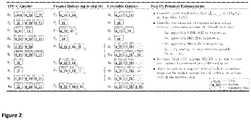
- Figure 2 illustrates the procedure for a TPC-C example 1. In a nutshell, the approach seeks to approximate the efficient frontier (regarding performance and size) associated to the multi-attribute index selection problem.
- the predetermined condition is that either memory consumption exceeds a memory budget or a predefined maximum number of construction steps is reached or no further improvement can be achieved.
- the associated costs include workload costs and preferably also reconfiguration costs of changing a current index set I to a working index set I are defined by function R ( I ,I ) .
- the workload costs are defined by the function F ( I )
- the reconfiguration costs of changing a current index set I to a working index set I are defined by function R ( I ,I )
- the memory consumption is defined by function P(I).
- the database currently uses no index set.
- the database currently uses current index set I .
- the ratio according to step (2) is determined according to F ⁇ + R ⁇ , I ⁇ ⁇ F i ⁇ R i I ⁇ P i and wherein the ratio according to step (5) is determined according to F I + R I I ⁇ ⁇ F I ⁇ + R I ⁇ I ⁇ P I ⁇ ⁇ P I .
- step (5) involves calculating the associated costs, and the step of calculating the associated costs involves caching intermediary results for the purpose of using them in subsequent runs of step (5).
- the method is applicable independent of specific values of F, R, P, and f.
- the method can be generally applied and is independent of particular cost models or optimizers. The only requirements are that query costs need to be quantified and relative performance improvements of index attachments must be comparable, cf. steps (4)-(5).
- the set of index candidates is not restricted in advance. There is also no maximum number of attributes used in a multi-attribute index.
- the method provides a series of construction steps, which recursively and thus efficiently determine growing sets of indexes I and their associated memory consumption P ( I ) .
- the recursive selection allows to take cannibalization effects between different indexes into account as the value of an index candidate is measured by its additional performance improvement in the presence of other earlier selected indexes (cf. IIA).
- Another aspect of the invention relates to a computer system configured for carrying out the method for determining an index set I as described in relation to several embodiments above.
- Another aspect of the invention relates to a computer program product comprising instructions which, when the program is executed by a computer, cause the computer to carry out the steps of the method as described in relation to several embodiments above.
- the index selection problem cannot be solved exhaustively as the number of combinations is enormous and the number of what-if calls that can be processed to estimate each cost improvement due to a specific index is limited.
- the set of index candidates to be considered has to be limited.
- As a limited candidate set can easily shrink the solution quality the index candidate set has to be (i) either very large or (ii) well defined. While (i) makes it difficult to find an optimal selection, it is also not easy to solve (ii), as it resembles the index selection problem itself.
- CoPhy's linear programming approach allows identifying optimal index selections while taking also IIA into account.
- the applicability of the approach is limited to small sets of index candidates.
- DB2 Advisor An optimizer smart enough to recommend its own indexes
- indexes are initially picked greedily based on their individually measured performance/size ratio (starting solution).
- starting solution To account for IIA and to increase performance index elements are randomly substituted. Thereby, the approach is applicable to large candidate sets.
- indexes that can be composed by the inventive method are not restricted in advance (as when starting with certain sets of index candidates). Yet, the number of necessary what-if calls is comparably small as we also prune index candidates: Due to the use of recursive incremental index extensions/alterations, in each step, only small subsets of potential new indexes are considered and few what-if calls are performed.
- the inventive approach effectively includes IIA, (ii) performs a small number of what-if calls, and (iii) quickly identifies index selections for given budgets without using a solver - even for large problems.
- Example 1 We use Example 1 to compare the applicability of the inventive approach to CoPhy's solver-based approach.
- the number of selected indexes is roughly
- ⁇ w ⁇ t N t 100.
- the complexity of the index selection problem is further increased as the costs of a query cannot separately be derived for different indexes, cf.
- Example 1 (i) the costs of a query are context-based, i.e., they may depend on the entire selection I ⁇ .
- Cophy's framework would have to be extended such that cost parameters f j ( I ) are available for all subsets I ⁇ .
- the LP (5) - (8) is very likely to become nonlinear, and hence, might be hardly applicable anymore.
- the inventive method is applicable in settings with multiple indexes per query. In each step, what-if calls are made to evaluate potential extension where the current state, i.e. , the current selection I , is taken into account. The only difference to the "one index only setting" is that some what-if calls performed in earlier steps have to be refreshed as the underlying current state (and in turn, query costs) might have changed.
- Figure 3 illustrates combinations of performance and memory used for the inventors' and CoPhy's selection approach in case different heuristics are used to define index candidate sets.
- the inventors observe that CoPhy's results are affected by the assortment of candidate sets. Depending on the targeted memory budgets, heuristics can perform differently. The inventors' strategy, however, provides excellent results for any budget.
- Figure 4 depicts the corresponding results in case CoPhy's selection approach uses different sizes of candidate sets according to (H1-M), As expected, CoPhy's results are significantly affected by the size of candidate sets. The smaller the set of candidates is, the higher is the chance that important indexes are missing. The larger the set of candidates, the higher the solve time becomes.
- CoPhy's solutions are optimal in case the maximum number of potential indexes (cf. I max ) is used as an exhaustive candidate set.
- the inventors' solution can be used to replace as well as to improve traditional index selection approaches by complementing index candidate sets. If the indexes that the inventors' approach selects are used as additional index candidates, the problem complexity of solver-based approaches hardly increases while the solution quality may only improve.
- Section 3.a the we present benchmark results which are based on data and workloads from a productive enterprise system of a Fortune Global 500 company.
- 3.b we demonstrate that the inventors' solution's quality does not depend on the exemplary cost model used in Section A-D. The inventors evaluate their approach with actual runtime costs measured with a commercial DBMS against all presented concepts including (H4) and (H5), cf. Definition 1.
- Figure 5 shows the cost (calculated memory traffic) to process the aforementioned workload for varying memory budgets for the inventor's index selection strategy (H6) and CoPhy.
- H6 index selection strategy
- CoPhy's candidate sets is varied using (H1- M).
- the measurements reassure the results from Section E.1 and Section E.2
- the inventive approach clearly outperforms CoPhy's LP-based approach with limited candidate sets regarding the solution quality.
- the runtime of the inventive approach amounts to approximately half a second whereas CoPhy with all 9 912 candidates needs several minutes.
- the measurements were conducted with the newest version of the DBMS on a machine with 512 GB of main memory and 64 cores with a clock speed of 2.3 GHz.
- the inventors repeated the measurements at least 100 times per query per index configuration to reduce measurement inaccuracies.
- the workload is created by the above-presented workload generator which mimics real-life workload characteristics.
- the inventors compute index configurations using CoPhy, heuristics, and their recursive strategy.
- Figure 6 shows the performance of various index selection strategies. Up to a budget of roughly 30%, the inventors' solution is on par with the optimal solution CoPhy with all (2937) candidates. The performance of the inventors' solution is always within 3% of the optimal solution.
- the results can be summarized as follows: First, the choice of the candidate set can significantly influence the overall performance. Second, for a fixed candidate set the final selection mechanism crucially affects overall performance. Third, the inventive approach does not depend on a suitable selection of candidates and provides near-optimal results.
- the inventors' results verify that their solution's results also hold in end-to-end scenarios: (i) the inventive approach outperforms simple rule-based selection strategies, (ii) the inventive approach outperforms CoPhy with restricted candidate sets, and (iii) the inventors verify that their results are close to optimal in case of tractable selection problems.
- the inventors demonstrate that their solution finds close to optimal index configurations also when not relying on what-if estimations or specified cost models.
- their solution is scalable as what-if optimizer-based costs are less frequently determined (see Section E.1) and no solver is required.
- Section Section E.1 scaling
- Section E.2 performance
- the inventors used an exemplary illustrating cost model, cf. Example 1.
- the inventors instead of a cost model, the inventors used what-if optimizer-based cost predictions, which include complex effects of modern execution engines.
- the results show that the inventors' approach scales and quickly provides near-optimal index selections.
- the inventors' approach outperforms (H4) and (H5) as well as CoPhy's results if the set of candidates is small compared to the set of all potential candidates.
- the inventors' approach is a promising alternative to existing tools, particularly for large problems.
- the scalability, i.e., the quick runtime, of the inventors' approach can be explained as follows: (i) during the recursive method, the inventors consider only a limited subset of index candidates, and (ii) instead of a randomized mechanism, they use a constructive deterministic one with a comparably small number of steps.
- index A can be applied to more queries than an (extended) index AB and requires less memory (Property 1).
- Similar indexes AB and AC typically cannibalize each other, i.e., when both are selected together they can only marginally increase the overall workload performance compared to a scenario where just (the best) one of them is selected (Property 2).
- index AB index A
- index A typically index A also is, cf. Property 1
- cf. Property 2 index A
- Their method does not construct similar indexes, cf. Property 2.
- the inventors' recursion only realizes index selections/extensions with significant additional performance per size ratio while taking IIA (of the current state) into account, cf. Property 3.
- the realized additional performance per size typically decreases (diminishing returns), cf. Property 1 and Property 4.
Landscapes
- Engineering & Computer Science (AREA)
- Theoretical Computer Science (AREA)
- Physics & Mathematics (AREA)
- General Engineering & Computer Science (AREA)
- General Physics & Mathematics (AREA)
- Databases & Information Systems (AREA)
- Data Mining & Analysis (AREA)
- Software Systems (AREA)
- Computational Linguistics (AREA)
- Mathematical Physics (AREA)
- Computing Systems (AREA)
- Quality & Reliability (AREA)
- Operations Research (AREA)
- Information Retrieval, Db Structures And Fs Structures Therefor (AREA)
Claims (6)
- Procédé pour déterminer un ensemble d'index I pour exécuter des requêtes de manière plus efficace contre une base de données, le procédé étant mis en oeuvre dans un système informatique avec une unité de traitement physique et un dispositif de stockage physique, l'ordinateur stockant la base de données avec N attributs dans le dispositif de stockage physique, le procédé comprenant les étapes consistant à:(1) définir l'ensemble d'indices de travail I = Ø;(2) déterminer un indice à attribut unique {i} (i = 1,..., N) qui maximise le rapport entre la réduction des coûts associés et la consommation de mémoire supplémentaire associée ;(3) ajouter l'indice à attribut unique déterminé à l'ensemble d'indices de travail I;(4) pour chaque indice {i} à attribut unique (i = 1,..., N) et pour chaque indice k ∈ l,(a) créer un nouvel ensemble d'indices Ĩ en ajoutant {i} en tant que nouvel indice à attribut unique à l'ensemble d'indices de travail I si I ∩ {i} = Ø ; et(b) créer un nouvel ensemble d'indices Ĩ en ajoutant {i} à la fin de l'indice k de l'ensemble d'indices de travail I ;(5) à partir des nouveaux ensembles d'indices Ĩ créés à l'étape (4), sélectionner le nouvel ensemble Ĩ ∗ qui présente le rapport maximal entre la réduction des coûts associés et la consommation de mémoire supplémentaire associée ; et(6) définir l'ensemble d'indices de travail I = Ĩ ∗;(7) répéter les étapes (4)-(6) jusqu'à ce qu'une condition prédéterminée soit atteinte.
- Procédé selon la revendication 2, dans lequel la condition prédéterminée est que soit la consommation de mémoire dépasse un budget de mémoire, soit un nombre maximal prédéfini d'étapes de construction est atteint, soit aucune amélioration supplémentaire ne peut être obtenue.
- Procédé selon l'une des revendications précédentes, dans lequel les coûts associés incluent des coûts de charge de travail et des coûts de reconfiguration liés au changement d'un ensemble d'indices courant
I en un ensemble d'indices de travail I sont définis par la fonction R (I , I). - Procédé selon la revendication 4, dans lequel les coûts de charge de travail sont définis par la fonction F(I), les coûts de reconfiguration du changement d'un ensemble d'indices courant
I en un ensemble d'indices de travail I sont définis par la fonction R (I , I), et la consommation de mémoire est définie par la fonction P(F). - Système informatique configuré pour mettre en oeuvre le procédé de détermination d'un ensemble d'indices I selon l'une des revendications précédentes.
- Produit programme informatique, comprenant des instructions qui, lorsque le programme est exécuté par un ordinateur, amènent l'ordinateur à effectuer les étapes du procédé selon une des revendications 1-5.
Priority Applications (3)
| Application Number | Priority Date | Filing Date | Title |
|---|---|---|---|
| EP19167157.7A EP3719663B1 (fr) | 2019-04-03 | 2019-04-03 | Sélection itérative d'indices multi-attributs pour des systèmes de base de données de grande taille |
| US16/838,830 US12282478B2 (en) | 2019-04-03 | 2020-04-02 | Iterative multi-attribute index selection for large database systems |
| CN202010260083.3A CN111797118B (zh) | 2019-04-03 | 2020-04-03 | 大型数据库系统的迭代式多属性索引选择 |
Applications Claiming Priority (1)
| Application Number | Priority Date | Filing Date | Title |
|---|---|---|---|
| EP19167157.7A EP3719663B1 (fr) | 2019-04-03 | 2019-04-03 | Sélection itérative d'indices multi-attributs pour des systèmes de base de données de grande taille |
Publications (2)
| Publication Number | Publication Date |
|---|---|
| EP3719663A1 EP3719663A1 (fr) | 2020-10-07 |
| EP3719663B1 true EP3719663B1 (fr) | 2022-10-26 |
Family
ID=66290173
Family Applications (1)
| Application Number | Title | Priority Date | Filing Date |
|---|---|---|---|
| EP19167157.7A Active EP3719663B1 (fr) | 2019-04-03 | 2019-04-03 | Sélection itérative d'indices multi-attributs pour des systèmes de base de données de grande taille |
Country Status (3)
| Country | Link |
|---|---|
| US (1) | US12282478B2 (fr) |
| EP (1) | EP3719663B1 (fr) |
| CN (1) | CN111797118B (fr) |
Families Citing this family (5)
| Publication number | Priority date | Publication date | Assignee | Title |
|---|---|---|---|---|
| EP4227821A1 (fr) | 2022-02-11 | 2023-08-16 | Hasso-Plattner-Institut für Digital Engineering gGmbH | Formation d'un agent pour la sélection itérative d'indices multi-attributs |
| CN114610912B (zh) * | 2022-03-14 | 2025-10-28 | 北京三快在线科技有限公司 | 多媒体分类模型的剪枝方法、装置、服务器及存储介质 |
| US20240311356A1 (en) * | 2023-03-14 | 2024-09-19 | Google Llc | Workload-Driven Index Selections |
| CN116483831B (zh) * | 2023-04-12 | 2024-01-30 | 上海沄熹科技有限公司 | 一种分布式数据库推荐索引生成方法 |
| CN117689001B (zh) * | 2024-02-02 | 2024-05-07 | 中科方寸知微(南京)科技有限公司 | 基于零数据搜索的神经网络多粒度剪枝压缩方法及系统 |
Family Cites Families (26)
| Publication number | Priority date | Publication date | Assignee | Title |
|---|---|---|---|---|
| US5875445A (en) * | 1997-05-29 | 1999-02-23 | Oracle Corporation | Performance-related estimation using pseudo-ranked trees |
| US5913206A (en) * | 1997-08-15 | 1999-06-15 | Microsoft Corporation | Database system multi-column index selection for a workload |
| US5926813A (en) * | 1997-08-15 | 1999-07-20 | Microsoft Corporation | Database system index selection using cost evaluation of a workload for multiple candidate index configurations |
| US5926913A (en) | 1997-11-05 | 1999-07-27 | Hernandez; J. Manuel | Pneumatic tool extension |
| US6581058B1 (en) * | 1998-05-22 | 2003-06-17 | Microsoft Corporation | Scalable system for clustering of large databases having mixed data attributes |
| US6631366B1 (en) * | 1998-10-20 | 2003-10-07 | Sybase, Inc. | Database system providing methodology for optimizing latching/copying costs in index scans on data-only locked tables |
| US6317738B1 (en) * | 1999-03-26 | 2001-11-13 | Compaq Computer Corporation | System and method for computing running and moving sequence functions in a database system |
| GB9915465D0 (en) * | 1999-07-02 | 1999-09-01 | Lenzie Robert S | Identified preferred indexes for databases |
| CA2279359C (fr) * | 1999-07-30 | 2012-10-23 | Basantkumar John Oommen | Methode de generation de cartes de cardinalite d'attributs |
| US7016910B2 (en) * | 1999-12-30 | 2006-03-21 | Decode Genetics Ehf. | Indexing, rewriting and efficient querying of relations referencing semistructured data |
| JP4483034B2 (ja) * | 2000-06-06 | 2010-06-16 | 株式会社日立製作所 | 異種データソース統合アクセス方法 |
| US6801903B2 (en) * | 2001-10-12 | 2004-10-05 | Ncr Corporation | Collecting statistics in a database system |
| US7139778B2 (en) * | 2002-06-28 | 2006-11-21 | Microsoft Corporation | Linear programming approach to assigning benefit to database physical design structures |
| US7299226B2 (en) * | 2003-06-19 | 2007-11-20 | Microsoft Corporation | Cardinality estimation of joins |
| US7664730B2 (en) * | 2003-09-06 | 2010-02-16 | Oracle International Corporation | Method and system for implementing a SQL profile |
| US7761514B2 (en) * | 2003-11-26 | 2010-07-20 | International Business Machines Corporation | Method and apparatus for providing dynamic group management for distributed interactive applications |
| US7814072B2 (en) * | 2004-12-30 | 2010-10-12 | International Business Machines Corporation | Management of database statistics |
| US7899817B2 (en) * | 2005-10-05 | 2011-03-01 | Microsoft Corporation | Safe mode for inverse query evaluations |
| US7475068B2 (en) * | 2005-10-07 | 2009-01-06 | Oracle International Corp. | Globally optimal and greedy heuristics based approach to access structure selection |
| US8260803B2 (en) * | 2010-09-23 | 2012-09-04 | Hewlett-Packard Development Company, L.P. | System and method for data stream processing |
| US9009124B2 (en) | 2011-06-17 | 2015-04-14 | Microsoft Technology Licensing, Llc | Compression aware physical database design |
| US9773032B2 (en) * | 2011-09-30 | 2017-09-26 | Bmc Software, Inc. | Provision of index recommendations for database access |
| US20130263117A1 (en) * | 2012-03-28 | 2013-10-03 | International Business Machines Corporation | Allocating resources to virtual machines via a weighted cost ratio |
| US20160378822A1 (en) | 2015-06-26 | 2016-12-29 | Microsoft Technology Licensing, Llc | Automated recommendation and creation of database index |
| CN108733781B (zh) * | 2018-05-08 | 2021-10-29 | 安徽工业大学 | 基于内存计算的集群时态数据索引方法 |
| CN109213757A (zh) * | 2018-07-06 | 2019-01-15 | 卓智网络科技有限公司 | 大数据索引优化方法和装置 |
-
2019
- 2019-04-03 EP EP19167157.7A patent/EP3719663B1/fr active Active
-
2020
- 2020-04-02 US US16/838,830 patent/US12282478B2/en active Active
- 2020-04-03 CN CN202010260083.3A patent/CN111797118B/zh active Active
Also Published As
| Publication number | Publication date |
|---|---|
| CN111797118B (zh) | 2025-02-18 |
| CN111797118A (zh) | 2020-10-20 |
| EP3719663A1 (fr) | 2020-10-07 |
| US20200320070A1 (en) | 2020-10-08 |
| US12282478B2 (en) | 2025-04-22 |
Similar Documents
| Publication | Publication Date | Title |
|---|---|---|
| Schlosser et al. | Efficient scalable multi-attribute index selection using recursive strategies | |
| EP3719663B1 (fr) | Sélection itérative d'indices multi-attributs pour des systèmes de base de données de grande taille | |
| US12164512B2 (en) | Automatic partitioning | |
| US10769123B2 (en) | Workload-driven recommendations for Columnstore and Rowstore indexes in relational databases | |
| CN102945240B (zh) | 一种支持分布式计算的关联规则挖掘算法实现方法及装置 | |
| Agrawal et al. | Automatic physical design tuning: workload as a sequence | |
| US9152469B2 (en) | Optimizing execution and resource usage in large scale computing | |
| US7155459B2 (en) | Time-bound database tuning | |
| US9110949B2 (en) | Generating estimates for query optimization | |
| EP4053710B1 (fr) | Conception améliorée et mise en uvre de métriques d'accès aux données pour la conception automatisée de basés de données physiques | |
| US20160292233A1 (en) | Discarding data points in a time series | |
| US10592507B2 (en) | Query processing engine recommendation method and system | |
| Azeroual et al. | Combining data lake and data wrangling for ensuring data quality in CRIS | |
| US20050108204A1 (en) | System and method for managing OLAP summary tables | |
| EP4227821A1 (fr) | Formation d'un agent pour la sélection itérative d'indices multi-attributs | |
| US10176231B2 (en) | Estimating most frequent values for a data set | |
| Liu et al. | Aggregate estimation over dynamic hidden web databases | |
| Patil et al. | OLaaS: OLAP as a Service | |
| Cai et al. | A recommendation-based parameter tuning approach for Hadoop | |
| US20170316003A1 (en) | Bulk Sets for Executing Database Queries | |
| Sidney et al. | Performance prediction for set similarity joins | |
| Ameri et al. | On a new approach to the index selection problem using mining algorithms | |
| US10848384B2 (en) | Method for determining parallel process paths in process data | |
| CN108595502B (zh) | 评估数据库服务性能的方法、装置及计算机可读存储介质 | |
| Munir et al. | Intermediate results materialization selection and format for data-intensive flows |
Legal Events
| Date | Code | Title | Description |
|---|---|---|---|
| PUAI | Public reference made under article 153(3) epc to a published international application that has entered the european phase |
Free format text: ORIGINAL CODE: 0009012 |
|
| STAA | Information on the status of an ep patent application or granted ep patent |
Free format text: STATUS: THE APPLICATION HAS BEEN PUBLISHED |
|
| AK | Designated contracting states |
Kind code of ref document: A1 Designated state(s): AL AT BE BG CH CY CZ DE DK EE ES FI FR GB GR HR HU IE IS IT LI LT LU LV MC MK MT NL NO PL PT RO RS SE SI SK SM TR |
|
| AX | Request for extension of the european patent |
Extension state: BA ME |
|
| STAA | Information on the status of an ep patent application or granted ep patent |
Free format text: STATUS: REQUEST FOR EXAMINATION WAS MADE |
|
| 17P | Request for examination filed |
Effective date: 20210407 |
|
| RBV | Designated contracting states (corrected) |
Designated state(s): AL AT BE BG CH CY CZ DE DK EE ES FI FR GB GR HR HU IE IS IT LI LT LU LV MC MK MT NL NO PL PT RO RS SE SI SK SM TR |
|
| RIC1 | Information provided on ipc code assigned before grant |
Ipc: G06F 16/22 20190101AFI20220329BHEP |
|
| GRAP | Despatch of communication of intention to grant a patent |
Free format text: ORIGINAL CODE: EPIDOSNIGR1 |
|
| STAA | Information on the status of an ep patent application or granted ep patent |
Free format text: STATUS: GRANT OF PATENT IS INTENDED |
|
| INTG | Intention to grant announced |
Effective date: 20220517 |
|
| GRAS | Grant fee paid |
Free format text: ORIGINAL CODE: EPIDOSNIGR3 |
|
| GRAA | (expected) grant |
Free format text: ORIGINAL CODE: 0009210 |
|
| STAA | Information on the status of an ep patent application or granted ep patent |
Free format text: STATUS: THE PATENT HAS BEEN GRANTED |
|
| AK | Designated contracting states |
Kind code of ref document: B1 Designated state(s): AL AT BE BG CH CY CZ DE DK EE ES FI FR GB GR HR HU IE IS IT LI LT LU LV MC MK MT NL NO PL PT RO RS SE SI SK SM TR |
|
| REG | Reference to a national code |
Ref country code: GB Ref legal event code: FG4D |
|
| REG | Reference to a national code |
Ref country code: CH Ref legal event code: EP |
|
| REG | Reference to a national code |
Ref country code: AT Ref legal event code: REF Ref document number: 1527559 Country of ref document: AT Kind code of ref document: T Effective date: 20221115 |
|
| REG | Reference to a national code |
Ref country code: DE Ref legal event code: R096 Ref document number: 602019020966 Country of ref document: DE |
|
| REG | Reference to a national code |
Ref country code: IE Ref legal event code: FG4D |
|
| REG | Reference to a national code |
Ref country code: LT Ref legal event code: MG9D |
|
| REG | Reference to a national code |
Ref country code: NL Ref legal event code: MP Effective date: 20221026 |
|
| REG | Reference to a national code |
Ref country code: AT Ref legal event code: MK05 Ref document number: 1527559 Country of ref document: AT Kind code of ref document: T Effective date: 20221026 |
|
| PG25 | Lapsed in a contracting state [announced via postgrant information from national office to epo] |
Ref country code: NL Free format text: LAPSE BECAUSE OF FAILURE TO SUBMIT A TRANSLATION OF THE DESCRIPTION OR TO PAY THE FEE WITHIN THE PRESCRIBED TIME-LIMIT Effective date: 20221026 |
|
| PG25 | Lapsed in a contracting state [announced via postgrant information from national office to epo] |
Ref country code: SE Free format text: LAPSE BECAUSE OF FAILURE TO SUBMIT A TRANSLATION OF THE DESCRIPTION OR TO PAY THE FEE WITHIN THE PRESCRIBED TIME-LIMIT Effective date: 20221026 Ref country code: PT Free format text: LAPSE BECAUSE OF FAILURE TO SUBMIT A TRANSLATION OF THE DESCRIPTION OR TO PAY THE FEE WITHIN THE PRESCRIBED TIME-LIMIT Effective date: 20230227 Ref country code: NO Free format text: LAPSE BECAUSE OF FAILURE TO SUBMIT A TRANSLATION OF THE DESCRIPTION OR TO PAY THE FEE WITHIN THE PRESCRIBED TIME-LIMIT Effective date: 20230126 Ref country code: LT Free format text: LAPSE BECAUSE OF FAILURE TO SUBMIT A TRANSLATION OF THE DESCRIPTION OR TO PAY THE FEE WITHIN THE PRESCRIBED TIME-LIMIT Effective date: 20221026 Ref country code: FI Free format text: LAPSE BECAUSE OF FAILURE TO SUBMIT A TRANSLATION OF THE DESCRIPTION OR TO PAY THE FEE WITHIN THE PRESCRIBED TIME-LIMIT Effective date: 20221026 Ref country code: ES Free format text: LAPSE BECAUSE OF FAILURE TO SUBMIT A TRANSLATION OF THE DESCRIPTION OR TO PAY THE FEE WITHIN THE PRESCRIBED TIME-LIMIT Effective date: 20221026 Ref country code: AT Free format text: LAPSE BECAUSE OF FAILURE TO SUBMIT A TRANSLATION OF THE DESCRIPTION OR TO PAY THE FEE WITHIN THE PRESCRIBED TIME-LIMIT Effective date: 20221026 |
|
| PG25 | Lapsed in a contracting state [announced via postgrant information from national office to epo] |
Ref country code: RS Free format text: LAPSE BECAUSE OF FAILURE TO SUBMIT A TRANSLATION OF THE DESCRIPTION OR TO PAY THE FEE WITHIN THE PRESCRIBED TIME-LIMIT Effective date: 20221026 Ref country code: PL Free format text: LAPSE BECAUSE OF FAILURE TO SUBMIT A TRANSLATION OF THE DESCRIPTION OR TO PAY THE FEE WITHIN THE PRESCRIBED TIME-LIMIT Effective date: 20221026 Ref country code: LV Free format text: LAPSE BECAUSE OF FAILURE TO SUBMIT A TRANSLATION OF THE DESCRIPTION OR TO PAY THE FEE WITHIN THE PRESCRIBED TIME-LIMIT Effective date: 20221026 Ref country code: IS Free format text: LAPSE BECAUSE OF FAILURE TO SUBMIT A TRANSLATION OF THE DESCRIPTION OR TO PAY THE FEE WITHIN THE PRESCRIBED TIME-LIMIT Effective date: 20230226 Ref country code: HR Free format text: LAPSE BECAUSE OF FAILURE TO SUBMIT A TRANSLATION OF THE DESCRIPTION OR TO PAY THE FEE WITHIN THE PRESCRIBED TIME-LIMIT Effective date: 20221026 Ref country code: GR Free format text: LAPSE BECAUSE OF FAILURE TO SUBMIT A TRANSLATION OF THE DESCRIPTION OR TO PAY THE FEE WITHIN THE PRESCRIBED TIME-LIMIT Effective date: 20230127 |
|
| REG | Reference to a national code |
Ref country code: DE Ref legal event code: R097 Ref document number: 602019020966 Country of ref document: DE |
|
| PG25 | Lapsed in a contracting state [announced via postgrant information from national office to epo] |
Ref country code: SM Free format text: LAPSE BECAUSE OF FAILURE TO SUBMIT A TRANSLATION OF THE DESCRIPTION OR TO PAY THE FEE WITHIN THE PRESCRIBED TIME-LIMIT Effective date: 20221026 Ref country code: RO Free format text: LAPSE BECAUSE OF FAILURE TO SUBMIT A TRANSLATION OF THE DESCRIPTION OR TO PAY THE FEE WITHIN THE PRESCRIBED TIME-LIMIT Effective date: 20221026 Ref country code: EE Free format text: LAPSE BECAUSE OF FAILURE TO SUBMIT A TRANSLATION OF THE DESCRIPTION OR TO PAY THE FEE WITHIN THE PRESCRIBED TIME-LIMIT Effective date: 20221026 Ref country code: DK Free format text: LAPSE BECAUSE OF FAILURE TO SUBMIT A TRANSLATION OF THE DESCRIPTION OR TO PAY THE FEE WITHIN THE PRESCRIBED TIME-LIMIT Effective date: 20221026 Ref country code: CZ Free format text: LAPSE BECAUSE OF FAILURE TO SUBMIT A TRANSLATION OF THE DESCRIPTION OR TO PAY THE FEE WITHIN THE PRESCRIBED TIME-LIMIT Effective date: 20221026 |
|
| PG25 | Lapsed in a contracting state [announced via postgrant information from national office to epo] |
Ref country code: SK Free format text: LAPSE BECAUSE OF FAILURE TO SUBMIT A TRANSLATION OF THE DESCRIPTION OR TO PAY THE FEE WITHIN THE PRESCRIBED TIME-LIMIT Effective date: 20221026 Ref country code: AL Free format text: LAPSE BECAUSE OF FAILURE TO SUBMIT A TRANSLATION OF THE DESCRIPTION OR TO PAY THE FEE WITHIN THE PRESCRIBED TIME-LIMIT Effective date: 20221026 |
|
| PLBE | No opposition filed within time limit |
Free format text: ORIGINAL CODE: 0009261 |
|
| STAA | Information on the status of an ep patent application or granted ep patent |
Free format text: STATUS: NO OPPOSITION FILED WITHIN TIME LIMIT |
|
| 26N | No opposition filed |
Effective date: 20230727 |
|
| PG25 | Lapsed in a contracting state [announced via postgrant information from national office to epo] |
Ref country code: SI Free format text: LAPSE BECAUSE OF FAILURE TO SUBMIT A TRANSLATION OF THE DESCRIPTION OR TO PAY THE FEE WITHIN THE PRESCRIBED TIME-LIMIT Effective date: 20221026 |
|
| REG | Reference to a national code |
Ref country code: CH Ref legal event code: PL |
|
| PG25 | Lapsed in a contracting state [announced via postgrant information from national office to epo] |
Ref country code: LU Free format text: LAPSE BECAUSE OF NON-PAYMENT OF DUE FEES Effective date: 20230403 |
|
| REG | Reference to a national code |
Ref country code: BE Ref legal event code: MM Effective date: 20230430 |
|
| PG25 | Lapsed in a contracting state [announced via postgrant information from national office to epo] |
Ref country code: MC Free format text: LAPSE BECAUSE OF FAILURE TO SUBMIT A TRANSLATION OF THE DESCRIPTION OR TO PAY THE FEE WITHIN THE PRESCRIBED TIME-LIMIT Effective date: 20221026 |
|
| PG25 | Lapsed in a contracting state [announced via postgrant information from national office to epo] |
Ref country code: MC Free format text: LAPSE BECAUSE OF FAILURE TO SUBMIT A TRANSLATION OF THE DESCRIPTION OR TO PAY THE FEE WITHIN THE PRESCRIBED TIME-LIMIT Effective date: 20221026 Ref country code: LI Free format text: LAPSE BECAUSE OF NON-PAYMENT OF DUE FEES Effective date: 20230430 Ref country code: CH Free format text: LAPSE BECAUSE OF NON-PAYMENT OF DUE FEES Effective date: 20230430 |
|
| REG | Reference to a national code |
Ref country code: IE Ref legal event code: MM4A |
|
| PG25 | Lapsed in a contracting state [announced via postgrant information from national office to epo] |
Ref country code: BE Free format text: LAPSE BECAUSE OF NON-PAYMENT OF DUE FEES Effective date: 20230430 |
|
| PG25 | Lapsed in a contracting state [announced via postgrant information from national office to epo] |
Ref country code: IE Free format text: LAPSE BECAUSE OF NON-PAYMENT OF DUE FEES Effective date: 20230403 |
|
| PG25 | Lapsed in a contracting state [announced via postgrant information from national office to epo] |
Ref country code: IE Free format text: LAPSE BECAUSE OF NON-PAYMENT OF DUE FEES Effective date: 20230403 |
|
| PG25 | Lapsed in a contracting state [announced via postgrant information from national office to epo] |
Ref country code: IT Free format text: LAPSE BECAUSE OF FAILURE TO SUBMIT A TRANSLATION OF THE DESCRIPTION OR TO PAY THE FEE WITHIN THE PRESCRIBED TIME-LIMIT Effective date: 20221026 |
|
| PG25 | Lapsed in a contracting state [announced via postgrant information from national office to epo] |
Ref country code: BG Free format text: LAPSE BECAUSE OF FAILURE TO SUBMIT A TRANSLATION OF THE DESCRIPTION OR TO PAY THE FEE WITHIN THE PRESCRIBED TIME-LIMIT Effective date: 20221026 |
|
| PG25 | Lapsed in a contracting state [announced via postgrant information from national office to epo] |
Ref country code: BG Free format text: LAPSE BECAUSE OF FAILURE TO SUBMIT A TRANSLATION OF THE DESCRIPTION OR TO PAY THE FEE WITHIN THE PRESCRIBED TIME-LIMIT Effective date: 20221026 |
|
| PGFP | Annual fee paid to national office [announced via postgrant information from national office to epo] |
Ref country code: DE Payment date: 20250417 Year of fee payment: 7 |
|
| PGFP | Annual fee paid to national office [announced via postgrant information from national office to epo] |
Ref country code: FR Payment date: 20250422 Year of fee payment: 7 |
|
| PG25 | Lapsed in a contracting state [announced via postgrant information from national office to epo] |
Ref country code: CY Free format text: LAPSE BECAUSE OF FAILURE TO SUBMIT A TRANSLATION OF THE DESCRIPTION OR TO PAY THE FEE WITHIN THE PRESCRIBED TIME-LIMIT; INVALID AB INITIO Effective date: 20190403 |
|
| PG25 | Lapsed in a contracting state [announced via postgrant information from national office to epo] |
Ref country code: HU Free format text: LAPSE BECAUSE OF FAILURE TO SUBMIT A TRANSLATION OF THE DESCRIPTION OR TO PAY THE FEE WITHIN THE PRESCRIBED TIME-LIMIT; INVALID AB INITIO Effective date: 20190403 |
|
| PG25 | Lapsed in a contracting state [announced via postgrant information from national office to epo] |
Ref country code: TR Free format text: LAPSE BECAUSE OF FAILURE TO SUBMIT A TRANSLATION OF THE DESCRIPTION OR TO PAY THE FEE WITHIN THE PRESCRIBED TIME-LIMIT Effective date: 20221026 |
|
| PGFP | Annual fee paid to national office [announced via postgrant information from national office to epo] |
Ref country code: GB Payment date: 20260327 Year of fee payment: 8 |