EP3720190B1 - Procédé et appareil de commande d'acces de terminal - Google Patents
Procédé et appareil de commande d'acces de terminal Download PDFInfo
- Publication number
- EP3720190B1 EP3720190B1 EP17934314.0A EP17934314A EP3720190B1 EP 3720190 B1 EP3720190 B1 EP 3720190B1 EP 17934314 A EP17934314 A EP 17934314A EP 3720190 B1 EP3720190 B1 EP 3720190B1
- Authority
- EP
- European Patent Office
- Prior art keywords
- terminal
- access
- moving speed
- access barring
- speed
- Prior art date
- Legal status (The legal status is an assumption and is not a legal conclusion. Google has not performed a legal analysis and makes no representation as to the accuracy of the status listed.)
- Active
Links
Images




Classifications
-
- H—ELECTRICITY
- H04—ELECTRIC COMMUNICATION TECHNIQUE
- H04W—WIRELESS COMMUNICATION NETWORKS
- H04W48/00—Access restriction; Network selection; Access point selection
- H04W48/02—Access restriction performed under specific conditions
- H04W48/04—Access restriction performed under specific conditions based on user or terminal location or mobility data, e.g. moving direction, speed
-
- H—ELECTRICITY
- H04—ELECTRIC COMMUNICATION TECHNIQUE
- H04W—WIRELESS COMMUNICATION NETWORKS
- H04W4/00—Services specially adapted for wireless communication networks; Facilities therefor
- H04W4/30—Services specially adapted for particular environments, situations or purposes
- H04W4/40—Services specially adapted for particular environments, situations or purposes for vehicles, e.g. vehicle-to-pedestrians [V2P]
- H04W4/42—Services specially adapted for particular environments, situations or purposes for vehicles, e.g. vehicle-to-pedestrians [V2P] for mass transport vehicles, e.g. buses, trains or aircraft
-
- H—ELECTRICITY
- H04—ELECTRIC COMMUNICATION TECHNIQUE
- H04W—WIRELESS COMMUNICATION NETWORKS
- H04W48/00—Access restriction; Network selection; Access point selection
- H04W48/02—Access restriction performed under specific conditions
-
- H—ELECTRICITY
- H04—ELECTRIC COMMUNICATION TECHNIQUE
- H04W—WIRELESS COMMUNICATION NETWORKS
- H04W48/00—Access restriction; Network selection; Access point selection
- H04W48/08—Access restriction or access information delivery, e.g. discovery data delivery
-
- H—ELECTRICITY
- H04—ELECTRIC COMMUNICATION TECHNIQUE
- H04W—WIRELESS COMMUNICATION NETWORKS
- H04W48/00—Access restriction; Network selection; Access point selection
- H04W48/08—Access restriction or access information delivery, e.g. discovery data delivery
- H04W48/12—Access restriction or access information delivery, e.g. discovery data delivery using downlink control channel
Definitions
- the disclosure relates to the technical field of communications, and in particular to a method and device for controlling terminal access.
- the high-speed-railway dedicated network may or may not share frequencies with a public long-term evolution (LTE) network.
- LTE long-term evolution
- a method for controlling terminal access applied to a base station capable of providing a high-speed-railway dedicated network service for a terminal according to claim 1.
- the preset correspondences between the terminal moving speeds and the access barring parameters include: at least one terminal moving speed level or speed state, each terminal moving speed level or speed state corresponding to a terminal moving speed range and an access barring parameter, terminal moving speed ranges corresponding to the respective terminal moving speed levels or speed states being different from each other.
- access barring parameters corresponding to the respective terminal moving speed levels or speed states are different from each other.
- sending the access barring rule to the terminal includes: adding the access barring rule to a system message; and sending the system message to the terminal, to enable the terminal to acquire the access barring rule from the system message.
- system message is a system information block type 2 (SIB2).
- SIB2 system information block type 2
- a method for controlling terminal access applied to a terminal for which a base station is capable of providing a high-speed-railway dedicated network service according to claim 5.
- the access barring rule includes preset correspondences between terminal moving speeds and access barring parameters; and initiating access to the base station in response to determining, according to the access barring rule, that the preset terminal access condition is satisfied includes: determining an access barring parameter corresponding to a current moving speed according to the preset correspondences between the terminal moving speeds and the access barring parameters; and initiating access to the base station when the access barring parameter corresponding to the current moving speed satisfies the preset terminal access condition.
- the preset correspondences between the terminal moving speeds and the access barring parameters include: at least one terminal moving speed level or speed state, each terminal moving speed level or speed state corresponding to a terminal moving speed range and an access barring parameter, terminal moving speed ranges corresponding to the respective terminal moving speed levels or speed states being different from each other; and wherein determining the access barring parameter corresponding to the current moving speed according to the preset correspondences between the terminal moving speeds and the access barring parameters includes: determining a terminal moving speed level or speed state corresponding to the current moving speed, according to the terminal moving speed range corresponding to each of the at least one terminal moving speed level or speed state in the correspondences; and determining the access barring parameter corresponding to the current moving speed, according to the access barring parameter corresponding to each of the at least one terminal moving speed level or speed state in the correspondences.
- the preset terminal access condition includes that a random number generated based on uniform distribution is smaller than the access barring parameter corresponding to the current moving speed; and initiating access to the base station when the access barring parameter corresponding to the current moving speed satisfies the preset terminal access condition includes: generating a random number based on uniform distribution; and initiating access to the base station when the random number is smaller than the access barring parameter corresponding to the current moving speed.
- a device for controlling terminal access applied to a base station capable of providing a high-speed-railway dedicated network service for a terminal according to claim 7.
- the preset correspondences between the terminal moving speeds and the access barring parameters include: at least one terminal moving speed level or speed state, each terminal moving speed level or speed state corresponding to a terminal moving speed range and an access barring parameter, terminal moving speed ranges corresponding to the respective terminal moving speed levels or speed states being different from each other.
- access barring parameters corresponding to the respective terminal moving speed levels or speed states are different from each other.
- the sending module includes: an addition sub-module, configured to add the access barring rule to a system message; and a sending sub-module, configured to send the system message to the terminal, to enable the terminal to acquire the access barring rule from the system message.
- system message is a system information block type 2 (SIB2).
- SIB2 system information block type 2
- a device for controlling terminal access applied to a terminal for which a base station is capable of providing a high-speed-railway dedicated network sevice according to claim 10.
- the preset correspondences between the terminal moving speeds and the access barring parameters include: at least one terminal moving speed level or speed state, each terminal moving speed level or speed state corresponding to a terminal moving speed range and an access barring parameter, terminal moving speed ranges corresponding to the respective terminal moving speed levels or speed states being different from each other; and wherein the first determination sub-module includes: a second determination sub-module, configured to determine a terminal moving speed level or speed state corresponding to the current moving speed, according to the terminal moving speed range corresponding to each of the at least one terminal moving speed level or speed state in the correspondences; and a third determination sub-module, configured to determine the access barring parameter corresponding to the current moving speed, according to the access barring parameter corresponding to each of the at least one terminal moving speed level or speed state in the correspondences.
- the preset terminal access condition includes that a random number generated based on uniform distribution is smaller than the access barring parameter corresponding to the current moving speed; and wherein the first access sub-module includes: a random number generation sub-module, configured to generate a random number based on uniform distribution; and a second access sub-module, configured to initiate access to the base station when the random number is smaller than the access barring parameter corresponding to the current moving speed.
- a base station can configure an access barring rule for controlling terminal access and send the access barring rule to a terminal, such that the terminal initiates access to the base station providing a high-speed-railway dedicated network, in response to the terminal determines, according to the access barring rule, that a preset terminal access condition is satisfied.
- the purpose of controlling access of different terminals is achieved through the access barring rule, so as to avoid congestion caused due to that any terminal can access the high-speed-railway dedicated network, and improve the quality of service for the high-speed-railway dedicated network.
- a terminal when a terminal needs to access to a base station providing a high-speed-railway dedicated network, a terminal needs to receive an access barring rule from the base station, and then initiates access to the base station providing the high-speed-railway dedicated network in response to the terminal determines, according to the access barring rule, that a preset terminal access condition is satisfied.
- the purpose of controlling access of different terminals is achieved through the access barring rule, so as to avoid congestion caused due to that any terminal can access the high-speed-railway dedicated network, and improve the quality of service for the high-speed-railway dedicated network.
- first, second, third and the like may be used to describe various information in the embodiments of the disclosure, the information should not be limited to these terms. These terms are only used to distinguish the information of the same type.
- first information may also be called second information and, similarly, second information may also be called first information.
- second information may also be called first information.
- term “if” used here may be explained as “while” or “when” or “responsive to determining”, which depends on the context.
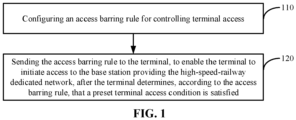
- FIG. 1 illustrates a flowchart of a method for controlling terminal access according to an exemplary embodiment.
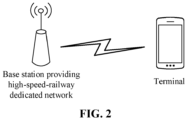
- FIG. 2 illustrates a scenario diagram of a method for controlling terminal access according to an exemplary embodiment.
- the method for controlling terminal access may be applied to a base station capable of providing a high-speed-railway dedicated network service for a terminal. As illustrated in FIG. 1 , the method for controlling terminal access includes steps 110 to 120.
- step 110 an access barring rule for controlling terminal access is configured.
- the access barring rule is configured by a base station providing a high-speed-railway dedicated network, so as to control access of different terminals.
- step 120 the access barring rule is sent to the terminal, to enable the terminal to initiate access to the base station providing the high-speed-railway dedicated network, in response to that the terminal determines, according to the access barring rule, that a preset terminal access condition is satisfied.
- the scenario includes a terminal, and a base station providing a high-speed-railway dedicated network.
- the base station providing the high-speed-railway dedicated network configures an access barring rule for controlling terminal access, in advance, and sends the access barring rule to the terminal within the coverage of the base station.
- the terminal needs to access to the base station providing the high-speed-railway dedicated network, the terminal needs to firstly receive the access barring rule from the base station providing the high-speed-railway dedicated network, and then determines, according to the access barring rule, whether a preset terminal access condition is satisfied. If the preset terminal access condition is satisfied, the terminal can initiate access to the base station providing the high-speed-railway dedicated network. If the preset terminal access condition is not satisfied, the terminal cannot initiate access to the base station providing the high-speed-railway dedicated network.
- an access barring rule for controlling terminal access is configured and sent to a terminal, to enable the terminal to initiate access to the base station providing a high-speed-railway dedicated network, in response to that the terminal determines, according to the access barring rule, that a preset terminal access condition is satisfied.
- the purpose of controlling access of different terminals is achieved through the access barring rule, so as to avoid congestion caused due to that any terminal can access the high-speed-railway dedicated network, and improve the quality of service for the high-speed-railway dedicated network.
- the access barring rule in step 110 includes preset correspondences between terminal moving speeds and access barring parameters.
- the preset correspondences may be configured in advance according to actual conditions by the base station providing the high-speed-railway dedicated network.
- the access barring rule configured by the base station providing the high-speed-railway dedicated network may include preset correspondences between terminal moving speeds and access barring parameters. As such, by configuring a different access barring parameter for each terminal moving speed, the base station providing the high-speed-railway dedicated network achieves the purpose of controlling access of different terminals, and also improves the accuracy of terminal access control.
- the access barring rule in step 110 includes preset correspondences between terminal moving speeds and access barring parameters.
- the preset correspondences between the terminal moving speeds and the access barring parameters include: at least one terminal moving speed level or speed state, each terminal moving speed level or speed state corresponding to a terminal moving speed range and an access barring parameter, terminal moving speed ranges corresponding to the respective terminal moving speed levels or speed states being different from each other.
- the base station providing the high-speed-railway dedicated network may divide terminal moving speeds into several speed levels or speed states, and the terminal moving speeds corresponding to respective terminal moving speed levels or speed states are different from each other.
- the base station providing the high-speed-railway dedicated network divides terminal moving speeds into the following 5 levels.
- the terminal moving speed is within the range of 0 km/h to 10 km/h, or the terminal performs cell reselection once in one minute.
- the terminal moving speed is within the range of 10 km/h to 50 km/h, or the terminal performs cell reselection for 10 times in one minute.
- the terminal moving speed is within the range of 50 km/h to 100 km/h, or the terminal performs cell reselection for 20 times in one minute.
- the terminal moving speed is within the range of 100 km/h to 200 km/h, or the terminal performs cell reselection for 30 times in one minute.
- the terminal moving speed is above 200 km/h, or the terminal performs cell reselection for more than 30 times in one minute.
- the base station providing the high-speed-railway dedicated network may also configure an access barring parameter for each terminal moving speed level or speed state.
- the value of the access barring parameter may be within 0 to 1.
- the magnitude of the access barring parameter may indicate the extent of access barring for the terminal by the base station providing the high-speed-railway dedicated network.
- a greater access barring parameter indicates a lower extent of access barring, and the possibility of the terminal accessing the base station providing the high-speed-railway dedicated network is higher.
- a smaller access barring parameter indicates a greater extent of access barring, and the possibility of the terminal accessing the base station providing the high-speed-railway dedicated network is lower.
- the corresponding access barring parameter is 0.5.
- the corresponding access barring parameter is 1. In this way, it can be ensured that a mobile user on a high-speed railway can initiate access to the base station providing the high-speed-railway dedicated network.
- the access barring rule configured by the base station providing the high-speed-railway dedicated network may include preset correspondences between terminal moving speeds and access barring parameters.
- the preset correspondences between the terminal moving speeds and the access barring parameters include at least one terminal moving speed level or speed state, and each terminal moving speed level or speed state corresponds to a terminal moving speed range and an access barring parameter, terminal moving speed ranges corresponding to the respective terminal moving speed levels or speed states are different from each other.
- the base station providing the high-speed-railway dedicated network can optimize the configuration of the access barring parameter by means of the terminal moving speed levels or speed states, and the efficiency of terminal access control is also improved.
- the access barring rule in step 110 includes preset correspondences between terminal moving speeds and access barring parameters.
- the preset correspondences between the terminal moving speeds and the access barring parameters include: at least one terminal moving speed level or speed state, each terminal moving speed level or speed state corresponding to a terminal moving speed range and an access barring parameter, terminal moving speed ranges corresponding to the respective terminal moving speed levels or speed states being different from each other.
- the access barring parameters corresponding to the respective terminal moving speed levels or speed states are different from each other.
- the base station providing the high-speed-railway dedicated network may configure a different access barring parameter for each terminal moving speed level or speed state, and the value of the access barring parameter is within the range of 0 to 1.
- the terminal moving speed levels or speed states corresponding to the respective access barring parameters are different from each other, thus improving the precision of terminal access control.
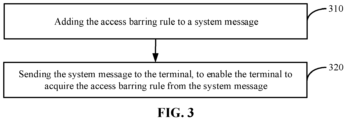
- FIG. 3 illustrates a flowchart of another method for controlling terminal access according to an exemplary embodiment.
- the method for controlling terminal access may be applied to a base station capable of providing a high-speed-railway dedicated network service for a terminal.
- step 120 may include steps 310 to 320, as illustrated in FIG. 3 .
- step 310 the access barring rule is added to a system message.
- the base station providing the high-speed-railway network adds, to the system message, information for performing access barring on terminals at different moving speeds and broadcasts the system message.
- step 320 the system message is sent to the terminal, to enable the terminal to acquire the access barring rule from the system message.
- the access barring rule is added to the system message, and the system message is sent to the terminal, so that the terminal can quickly acquire the access barring rule from the system message, so as to improve the convenience in acquiring the access barring rule.
- system message in step 310 may be a system information block type 2 (SIB2) in particular.
- SIB2 system information block type 2
- the SIB2 is a system message 2 in an LTE network. Besides bearing the access barring rule in the SIB2, the access barring rule may be borne by other information blocks or by designing a new information block.
- the access barring rule is added to the SIB2, and the SIB2 is sent to the terminal, so that the terminal can quickly acquire the access barring rule from the SIB2, so as to improve the reliability in transmitting the access barring rule.
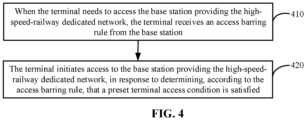
- FIG. 4 illustrates a flowchart of a method for controlling terminal access according to an exemplary embodiment.
- the method for controlling terminal access may be applied to a terminal for which a base station is capable of providing a high-speed-railway dedicated network service.
- the method for controlling terminal access includes steps 410 to 420.
- step 410 when the terminal needs to access to the base station providing the high-speed-railway dedicated network, the terminal receives an access barring rule from the base station.
- the access barring rule is configured by a base station providing a high-speed-railway dedicated network, so as to control access of different terminals.
- step 420 the terminal initiates access to the base station providing the high-speed-railway dedicated network, in response to determining, according to the access barring rule, that a preset terminal access condition is satisfied.
- the terminal when the terminal needs to access to the base station providing the high-speed-railway dedicated network, the terminal firstly needs to receive the access barring rule from the base station providing the high-speed-railway dedicated network, and then determines, according to the access barring rule, whether a preset terminal access condition is satisfied. If the preset terminal access condition is satisfied, the terminal can initiate access to the base station providing the high-speed-railway dedicated network. If the preset terminal access condition is not satisfied, the terminal cannot initiate access to the base station providing the high-speed-railway dedicated network.
- the terminal when a terminal needs to access to a base station providing a high-speed-railway dedicated network, the terminal needs to receive an access barring rule from the base station, and then initiate access to the base station providing the high-speed-railway dedicated network in response to that the terminal determines, according to the access barring rule, that a preset terminal access condition is satisfied.
- the purpose of controlling access of different terminals is achieved through the access barring rule, so as to avoid congestion caused due to the fact that any terminal can access the high-speed-railway dedicated network, and improve the quality of service for the high-speed-railway dedicated network.
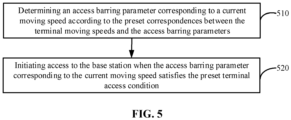
- FIG. 5 illustrates a flowchart of another method for controlling terminal access according to an exemplary embodiment.
- the method for controlling terminal access may be applied to a terminal for which a base station is capable of providing a high-speed-railway dedicated network service.
- the access barring rule includes preset correspondences between terminal moving speeds and access barring parameters.
- Step 420 may include steps 510 to 520, as illustrated in FIG. 5 .
- step 510 an access barring parameter corresponding to a current moving speed is determined according to the preset correspondences between the terminal moving speeds and the access barring parameters.
- the access barring rule is configured by a base station providing a high-speed-railway dedicated network, so as to control access of different terminals.
- step 520 access is initiated to the base station when the access barring parameter corresponding to the current moving speed satisfies the preset terminal access condition.
- the terminal determines, according to the access barring parameter corresponding to the current moving speed, whether the preset terminal access condition is satisfied. If the preset terminal access condition is satisfied, the terminal can initiate access to the base station providing the high-speed-railway dedicated network. If the preset terminal access condition is not satisfied, the terminal cannot initiate access to the base station providing the high-speed-railway dedicated network.
- an access barring parameter corresponding to a current moving speed is determined according to the preset correspondences between the terminal moving speeds and the access barring parameters. Access is initiated to the base station when the access barring parameter corresponding to the current moving speed satisfies the preset terminal access condition. Access cannot be initiated to the base station when the access barring parameter corresponding to the current moving speed does not satisfy the preset terminal access condition.
- the base station providing the high-speed-railway dedicated network can achieve the purpose of controlling access of different terminals, and also improve the accuracy of terminal access control.
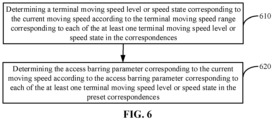
- FIG. 6 illustrates a flowchart of another method for controlling terminal access according to an exemplary embodiment.
- the method for controlling terminal access may be applied to a terminal for which a base station is capable of providing a high-speed-railway dedicated network service.
- the access barring rule includes preset correspondences between terminal moving speeds and access barring parameters.
- the preset correspondences between the terminal moving speeds and the access barring parameters include: at least one terminal moving speed level or speed state, each terminal moving speed level or speed state corresponding to a terminal moving speed range and an access barring parameter, terminal moving speed ranges corresponding to the respective terminal moving speed levels or speed states being different from each other.
- Step 510 may include steps 610 to 620, as illustrated in FIG. 6 .
- a terminal moving speed level or speed state corresponding to the current moving speed is determined according to the terminal moving speed range corresponding to each of the at least one terminal moving speed level or speed state in the correspondences.
- the terminal needs to determine the terminal moving speed level or speed state to which the current moving speed belongs.
- step 620 the access barring parameter corresponding to the current moving speed is determined according to the access barring parameter corresponding to each of the at least one terminal moving speed level or speed state in the preset correspondences.
- the base station providing the high-speed-railway dedicated network also configures an access barring parameter for each terminal moving speed level or speed state.
- the value of the access barring parameter is within the range of 0 to 1.
- the terminal needs to determine the access barring parameter corresponding to the terminal moving speed level or speed state to which the current moving speed belongs, to be the access barring parameter corresponding to the current moving speed.
- a terminal moving speed level or speed state corresponding to the current moving speed is determined according to the terminal moving speed range corresponding to each of the at least one terminal moving speed level or speed state in the correspondences.
- the access barring parameter corresponding to the current moving speed is determined according to the access barring parameter corresponding to each of the at least one terminal moving speed level or speed state in the preset correspondences. As such, the access barring parameter corresponding to the current moving speed is determined according to the terminal moving speed level or speed state, and the speed of acquiring the access barring parameter is improved.
- FIG. 7 illustrates a flowchart of another method for controlling terminal access according to an exemplary embodiment.
- the method for controlling terminal access may be applied to a terminal for which a base station is capable of providing a high-speed-railway dedicated network service.
- the access barring rule includes preset correspondences between terminal moving speeds and access barring parameters.
- the preset terminal access condition includes that a random number generated based on uniform distribution is smaller than the access barring parameter corresponding to the current moving speed.
- Step 520 may include steps 710 to 720, as illustrated in FIG. 7 .
- step 710 a random number is generated based on uniform distribution.
- the value of the random number is within the range of 0 to 1, so that the cell prevents access of some users according to load conditions, so as to avoid overload of the cell.
- step 720 access is initiated to the base station providing the high-speed-railway dedicated network, when the random number is smaller than the access barring parameter corresponding to the current moving speed.
- the access barring parameter corresponding to the current moving speed is configured by the base station providing the high-speed-railway dedicated network.
- the random number is smaller than the access barring parameter corresponding to the current moving speed, it indicates that the preset terminal access condition is satisfied, and access can be initiated to the base station providing the high-speed-railway dedicated network.
- the random number is not smaller than the access barring parameter corresponding to the current moving speed, it indicates that the preset terminal access condition is not satisfied, and access cannot be initiated to the base station providing the high-speed-railway dedicated network.
- a random number is generated based on uniform distribution, and access is initiated to the base station providing the high-speed-railway dedicated network, when the random number is smaller than the access barring parameter corresponding to the current moving speed.
- the random number is not smaller than the access barring parameter corresponding to the current moving speed, it indicates that the preset terminal access condition is not satisfied, and access cannot be initiated to the base station providing the high-speed-railway dedicated network.
- the purpose of controlling access of different terminals is achieved through the access barring parameter corresponding to the current terminal moving speed, congestion caused due to that any terminal can access the high-speed-railway dedicated network is avoided, and the quality of service of the high-speed-railway dedicated network is improved.
- embodiments of a device for controlling terminal access is also provided in the disclosure.
- FIG. 8 illustrates a block diagram of a device for controlling terminal access according to an exemplary embodiment.
- the device may be applied to a base station capable of providing a high-speed-railway dedicated network service for a terminal, and is used for performing the method for controlling terminal access as illustrated in FIG. 1 .
- the device for controlling terminal access may include a configuration module 81 and a sending module 82.
- the configuration module is configured to configure an access barring rule for controlling terminal access.
- the sending module is configured to send the access barring rule to the terminal, to enable the terminal to initiate access to the base station in response to determining, according to the access barring rule, that a preset terminal access condition is satisfied.
- an access barring rule for controlling terminal access is configured and sent to a terminal, to enable the terminal to initiate access to the base station providing a high-speed-railway dedicated network, in response to that the terminal determines, according to the access barring rule, that a preset terminal access condition is satisfied.
- the purpose of controlling access of different terminals is achieved through the access barring rule, so as to avoid congestion caused due to that any terminal can access the high-speed-railway dedicated network, and improve the quality of service for the high-speed-railway dedicated network.
- the access barring rule includes preset correspondences between terminal moving speeds and access barring parameters.
- the access barring rule configured by the base station providing the high-speed-railway dedicated network may include preset correspondences between terminal moving speeds and access barring parameters. As such, by configuring a different access barring parameter for each terminal moving speed, the base station providing the high-speed-railway dedicated network achieves the purpose of controlling access of different terminals, and also improves the accuracy of terminal access control.
- the preset correspondences between the terminal moving speeds and the access barring parameters include: at least one terminal moving speed level or speed state, each terminal moving speed level or speed state corresponding to a terminal moving speed range and an access barring parameter, terminal moving speed ranges corresponding to the respective terminal moving speed levels or speed states being different from each other.
- the access barring rule configured by the base station providing the high-speed-railway dedicated network may include preset correspondences between terminal moving speeds and access barring parameters.
- the preset correspondences between the terminal moving speeds and the access barring parameters include: at least one terminal moving speed level or speed state, each terminal moving speed level or speed state corresponding to a terminal moving speed range and an access barring parameter, terminal moving speed ranges corresponding to the respective terminal moving speed levels or speed states being different from each other.
- the base station providing the high-speed-railway dedicated network can optimize the configuration of the access barring parameter according to the terminal moving speed levels or speed states, and the efficiency of controlling terminal access is also improved.
- access barring parameters corresponding to the respective terminal moving speed levels or speed states are different from each other.
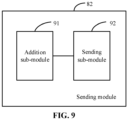
- the sending module 82 may include an addition sub-module 91 and a sending sub-module 92 as illustrated in FIG. 9 .
- the addition sub-module is configured to add the access barring rule to a system message.
- the sending sub-module is configured to send the system message to the terminal, to enable the terminal to acquire the access barring rule from the system message.
- the access barring rule is added to the system message, and the system message is sent to the terminal, so that the terminal can quickly acquire the access barring rule from the system message, so as to improve the convenience in acquiring the access barring rule.
- the system message is an SIB2 in particular.
- the access barring rule is added to the SIB2, and the SIB2 is sent to the terminal, so that the terminal can quickly acquire the access barring rule from the SIB2, so as to improve the reliability of transmission of the access barring rule.
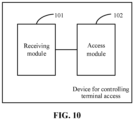
- FIG. 10 illustrates a block diagram of a device for controlling terminal access according to an exemplary embodiment.
- the device may be applied to a terminal for which a base station is capable of providing a high-speed-railway dedicated network service, and is used for performing the method for controlling terminal access as illustrated in FIG. 4 .
- the device for controlling terminal access may include a receiving module 101 and an access module 102.
- the receiving module is configured to receive an access barring rule from the base station when the terminal needs to access to the base station.
- the access module is configured to initiate access to the base station in response to determining, according to the access barring rule, that a preset terminal access condition is satisfied.
- the terminal when a terminal needs to access to a base station providing a high-speed-railway dedicated network, the terminal needs to receive an access barring rule from the base station, and then initiate access to the base station providing the high-speed-railway dedicated network in response to that the terminal determines, according to the access barring rule, that a preset terminal access condition is satisfied.
- the purpose of controlling access of different terminals is achieved through the access barring rule, so as to avoid congestion caused due to that any terminal can access the high-speed-railway dedicated network, and improve the quality of service for the high-speed-railway dedicated network.
- the access barring rule includes preset correspondences between terminal moving speeds and access barring parameters.
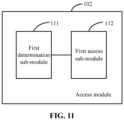
- the access module 102 may include a first determination sub-module 111 and a first access sub-module 112.
- the first determination sub-module is configured to determine an access barring parameter corresponding to a current moving speed according to the preset correspondences between the terminal moving speeds and the access barring parameters.
- the first access sub-module is configured to initiate access to the base station when the access barring parameter corresponding to the current moving speed satisfies the preset terminal access condition.
- an access barring parameter corresponding to a current moving speed is determined according to the preset correspondences between the terminal moving speeds and the access barring parameters. Access is initiated to the base station when the access barring parameter corresponding to the current moving speed satisfies the preset terminal access condition. Access cannot be initiated to the base station when the access barring parameter corresponding to the current moving speed does not satisfy the preset terminal access condition.
- the base station providing the high-speed-railway dedicated network achieves the purpose of controlling access of different terminals, and also improves the accuracy of controlling terminal access.
- the access barring rule includes preset correspondences between terminal moving speeds and access barring parameters.
- the preset correspondences between the terminal moving speeds and the access barring parameters include: at least one terminal moving speed level or speed state, each terminal moving speed level or speed state corresponding to a terminal moving speed range and an access barring parameter, terminal moving speed ranges corresponding to the respective terminal moving speed levels or speed states being different from each other.
- the first determination sub-module 111 may include a second determination sub-module 121 and a third determination sub-module 122.
- the second determination sub-module is configured to determine a terminal moving speed level or speed state corresponding to the current moving speed, according to the terminal moving speed range corresponding to each of the at least one terminal moving speed level or speed state in the correspondences.
- the third determination sub-module is configured to determine the access barring parameter corresponding to the current moving speed, according to the access barring parameter corresponding to each of the at least one terminal moving speed level or speed state in the correspondences.
- a terminal moving speed level or speed state corresponding to the current moving speed is determined according to the terminal moving speed range corresponding to each of the at least one terminal moving speed level or speed state in the correspondences.
- the access barring parameter corresponding to the current moving speed is determined according to the access barring parameter corresponding to each of the at least one terminal moving speed level or speed state in the preset correspondences. As such the access barring parameter corresponding to the current moving speed is determined according to the terminal moving speed level or speed state, and the speed of acquiring the access barring parameter is improved.
- the access barring rule includes preset correspondences between terminal moving speeds and access barring parameters.
- the preset terminal access condition includes that a random number generated based on uniform distribution is smaller than the access barring parameter corresponding to the current moving speed.
- the first access sub-module 112 may include a random number generation sub-module 131 and a second access sub-module 132.
- the random number generation sub-module is configured to generate a random number based on uniform distribution.
- the second access sub-module is configured to initiate access to the base station when the random number is smaller than the access barring parameter corresponding to the current moving speed.
- a random number is generated based on uniform distribution, and access is initiated to the base station providing the high-speed-railway dedicated network, when the random number is smaller than the access barring parameter corresponding to the current moving speed.
- the random number is not smaller than the access barring parameter corresponding to the current moving speed, it indicates that the preset terminal access condition is not satisfied, and access cannot be initiated to the base station providing the high-speed-railway dedicated network.
- the purpose of controlling access of different terminals is achieved through the access barring parameter corresponding to the current terminal moving speed, congestion caused due to that any terminal can access the high-speed-railway dedicated network is avoided, and the quality of service for the high-speed-railway dedicated network is improved.
- the device embodiments substantially correspond to the method embodiments, and thus for related parts, reference can be made to part of descriptions of the method embodiments.
- the device embodiments described above are only schematic, units described as separate parts therein may or may not be physically separated, and parts displayed as units may or may not be physical units, and namely may be located in the same place or may also be distributed to multiple network units. Some or all of the modules may be selected according to a practical requirement to achieve the purpose of the solution of the present disclosure. Those of ordinary skill in the art may understand and implement the embodiments without paying any creative effort.
- Also provided in the disclosure is a non-transitory computer-readable storage medium having stored thereon a computer program for executing the method for controlling terminal access according to any one of FIG. 1 to FIG. 3 .
- Also provided in the disclosure is a non-transitory computer-readable storage medium having stored thereon a computer program for executing the method for controlling terminal access according to any one of FIG. 4 to FIG. 7
- the device for controlling terminal access, applied to a base station capable of providing a high-speed-railway dedicated network service for a terminal.
- the device includes a processor, and a memory stored with processor-executable instructions.
- the processor is configured to: configure an access barring rule for controlling terminal access; and send the access barring rule to the terminal, to enable the terminal to initiate access to the base station in response to determining, according to the access barring rule, that a preset terminal access condition is satisfied.
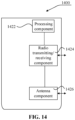
- FIG. 14 illustrates a schematic structural diagram of a device for controlling terminal access according to an exemplary embodiment.
- the device 1400 may be provided as a base station providing a high-speed-railway dedicated network.
- the device 1400 includes a processing component 1422, a radio transmission/receiving component 1424, an antenna component 1426, and a signal processing part specific to a wireless interface.
- the processing component 1422 may further include one or more processors.
- One processor of the processing component 1422 may be configured to perform any of the methods for controlling terminal access.
- the device includes: a processor, and a memory stored with processor-executable instructions.
- the processor is configured to receive an access barring rule from the base station when the terminal needs to access to the base station; and initiate access to the base station in response to determining, according to the access barring rule, that a preset terminal access condition is satisfied.
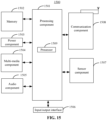
- FIG. 15 illustrates a schematic structural diagram of a device for controlling terminal access according to an exemplary embodiment.
- FIG. 15 illustrates a device 1500 for controlling terminal access according to an exemplary embodiment.
- the device 1500 may be a terminal such as a computer, a mobile phone, a digital broadcast terminal, a message transceiving device, a game console, a tablet device, medical equipment, fitness equipment, a personal digital assistant, etc.
- the device 1500 may include one or more of: a processing component 1501, a memory 1502, a power component 1503, a multi-media component 1504, an audio component 1505, an input/output (I/O) interface 1506, a sensor component 1507, and a communication component 1508.
- a processing component 1501 a memory 1502
- a power component 1503 a multi-media component 1504
- an audio component 1505 an input/output (I/O) interface 1506, a sensor component 1507, and a communication component 1508.
- I/O input/output
- the processing component 1501 generally controls the overall operation of the device 1500, such as operations associated with display, a phone call, data communication, a camera operation and a recording operation.
- the processing component 1501 may include one or more processors 1509 to execute instructions, so as to complete all or some steps in the methods above.
- the processing component 1501 may include one or more modules for the interaction between the processing component 1501 and the other components.
- the processing component 1501 may include a multi-media module for interaction between the multi-media component 1504 and the processing component 1501.
- the memory 1502 is configured to store various types of data so as to support operations at the device 1500.
- the examples of these types of data include instructions of any application or method for operating on the device 1500, contact person data, phone book data, messages, pictures, video, etc.
- the memory 1502 may be implemented by any type of volatile or non-volatile storage device or a combination of both, for example, a static random access memory (SRAM), an electrically erasable programmable read-only memory (EEPROM), an erasable programmable read-only memory (EPROM), a programmable read-only memory (PROM), a read-only memory (ROM), a magnetic memory, a flash memory, a magnetic disk or an optical disk.
- SRAM static random access memory
- EEPROM electrically erasable programmable read-only memory
- EPROM erasable programmable read-only memory
- PROM programmable read-only memory
- ROM read-only memory
- magnetic memory a magnetic memory
- flash memory a magnetic disk
- the power component 1503 supplies power for the various components of the device 1500.
- the power component 1503 may include a power management system, one or more power sources, and other components associated with the generation, management and distribution of power for the device 1500.
- the multi-media component 1504 includes a screen serving as an output interface between the device 1500 and a user.
- the screen may include a liquid crystal display (LCD) and a touch pad (TP). If the screen includes a touch pad, then the screen may be implemented as a touch screen so as to receive an input signal from the user.
- the touch pad includes one or more touch sensors to sense touch, slide and gestures on the touch pad. The touch sensors may not only sense the boundary of a touch or slide action, but also can detect the duration and pressure related to the touch or slide operation.
- the multi-media component 1504 includes a front camera and/or a rear camera.
- the front camera and/or the rear camera may receive external multi-media data.
- Each front camera and rear camera may be a fixed optical lens system or have a focal length or optical zoom capability.
- the audio component 1505 is configured to output and/or input an audio signal.
- the audio component 1505 includes a microphone (MIC), and when the device 1500 is in an operating mode, such as a calling mode, a recording mode and a voice recognition mode, the microphone is configured to receive an external audio signal.
- the received audio signal can be further stored in the memory 1502 or sent via the communication component 1508.
- the audio component 1505 further includes a loudspeaker for outputting an audio signal.
- the I/O interface 1506 provides an interface between the processing component 1501 and a peripheral interface module, and the above peripheral interface module may be a keyboard, a click wheel, a button, etc.
- the button may include but is not limited to a home page button, a volume button, a start button and a locking button.
- the sensor component 1507 includes one or more sensors for providing state evaluation for the device 1500 from various aspects.
- the sensor component 1507 may detect an on/off state of the device 1500, and the relative positioning between components; for example the components are a display and keyboard of the device 1500.
- the sensor component 1507 may also detect a positional change of the device 1500 or a component of the device 1500, whether there is contact between a user and the battery charging apparatus 1500, the orientation or acceleration/deceleration of the device 1500, and a temperature change of the device 1500.
- the sensor component 1507 may include a proximity sensor configured to detect the existence of an object nearby without any physical contact.
- the sensor component 1507 may also include an optical sensor, such as a CMOS or CCD image sensor, for use in an imaging application.
- the sensor component 1507 may also include an acceleration sensor, a gyroscope sensor, a magnetic sensor, a pressure sensor or a temperature sensor.
- the communication component 1508 is configured for wired or wireless communication between the device 1500 and another device.
- the device 1500 may access a communication standard based wireless network, such as WiFi, 2G, 5G or a combination thereof.
- the communication component 1508 receives a broadcast signal from an external broadcast management system or broadcasts relevant information through a broadcast channel.
- the communication component 1508 further includes a near-field communication (NFC) module for short-range communication.
- NFC near-field communication
- the NFC module may be implemented based on the radiofrequency identification (RFID) technique, the infrared data association (IrDA) technique, the ultra-wide band (UWB) technique, the Bluetooth (BT) technique or others.
- RFID radiofrequency identification
- IrDA infrared data association
- UWB ultra-wide band
- BT Bluetooth
- the device 1500 may be implemented by one or more application-specific integrated circuit (ASIC), a digital signal processor (DSP), a digital signal processing device (DSPD), a programmable logic device (PLD), a field programmable gate array (FPGA), a controller, a micro-controller, a micro-processor or other electronic elements, for executing the above methods.
- ASIC application-specific integrated circuit
- DSP digital signal processor
- DSPD digital signal processing device
- PLD programmable logic device
- FPGA field programmable gate array
- controller a micro-controller, a micro-processor or other electronic elements, for executing the above methods.
- a non-transitory computer-readable storage medium including instructions is also provided, for example a memory 1502 including instructions.
- the above instructions may be executed by the processor 1509 of the device 1500 to complete the above methods.
- the non-transitory computer-readable storage medium may be a ROM, a random access memory (RAM), a CD-ROM, a magnetic tape, a floppy disk, an optical data storage device and so on.
- the instructions in the storage medium is executed by the processor to enable the device 1500 to execute a method for controlling terminal access.
Landscapes
- Engineering & Computer Science (AREA)
- Computer Networks & Wireless Communication (AREA)
- Signal Processing (AREA)
- Computer Security & Cryptography (AREA)
- Aviation & Aerospace Engineering (AREA)
- Mobile Radio Communication Systems (AREA)
Claims (12)
- Procédé de commande d'un accès de terminal, comprenant :la configuration (110), parune station de base capable de fournir un service de réseau dédié de ligne ferroviaire à grande vitesse pour un terminal, une règle d'interdiction d'accès pour commander l'accès de terminal ;caractérisé en ce que le procédé comprend en outre :l'envoi (120), par la station de base, de la règle d'interdiction d'accès au terminal, pour permettre au terminal de déterminer un paramètre d'interdiction d'accès correspondant à une vitesse de déplacement actuelle, en fonction de correspondances prédéfinies entre des vitesses de déplacement de terminal et des paramètres d'interdiction d'accès, et pour permettre au terminal d'initier l'accès à la station de base lorsque le paramètre d'interdiction d'accès correspondant à la vitesse de déplacement actuelle satisfait une condition d'accès de terminal prédéfinie ;dans lequel la règle d'interdiction d'accès comprend les correspondances prédéfinies entre les vitesses de déplacement de terminal et les paramètres d'interdiction d'accès.
- Procédé selon la revendication 1, dans lequel les correspondances prédéfinies entre les vitesses de déplacement de terminal et les paramètres d'interdiction d'accès comprennent :
au moins un état de vitesse ou niveau de vitesse de déplacement de terminal, au moins un état de vitesse ou niveau de vitesse de déplacement de terminal correspondant à une plage de vitesse de déplacement de terminal et un paramètre d'interdiction d'accès, des plages de vitesse de déplacement de terminal correspondant aux états de vitesse ou niveaux de vitesse de déplacement de terminal respectifs étant différentes les unes des autres. - Procédé selon la revendication 2, dans lequel des paramètres d'interdiction d'accès correspondant aux états de vitesse ou aux niveaux de vitesse de déplacement de terminal respectifs sont différents les uns des autres.
- Procédé selon la revendication 1, dans lequel l'envoi de la règle d'interdiction d'accès au terminal comprend :l'ajout, par la station de base, de la règle d'interdiction d'accès à un message système ; etl'envoi, par la station de base du message système au terminal, pour permettre au terminal d'acquérir la règle d'interdiction d'accès à partir du message système,dans lequel le message système est un bloc d'informations système de type 2, S I B2.
- Procédé de commande d'accès de terminal, appliqué à un terminal comprenant :la réception (410) d'une règle d'interdiction d'accès à partir d'une station de base lorsque le terminal demande l'accès à la station de base, dans lequel la station de base est capable de fournir un service de réseau dédié de ligne ferroviaire à grande vitesse ; etl'initiation (420) de l'accès à la station de base en réponse à la détermination, selon la règle d'interdiction d'accès, qu'une condition d'accès de terminal prédéfinie est satisfaite ;caractérisé en ce que,l'initiation (420) de l'accès à la station de base en réponse à la détermination, selon la règle d'interdiction d'accès, que la condition d'accès de terminal prédéfinie est satisfaite comprend :la détermination (510) d'un paramètre d'interdiction d'accès correspondant à une vitesse de déplacement actuelle en fonction de correspondances prédéfinies entre des vitesses de déplacement de terminal et des paramètres d'interdiction d'accès ; etl'initiation (520) de l'accès à la station de base lorsque le paramètre d'interdiction d'accès correspondant à la vitesse de déplacement actuelle satisfait la condition d'accès de terminal prédéfinie, dans lequel la règle d'interdiction d'accès comprend les correspondances prédéfinies entre les vitesses de déplacement de terminal et les paramètres d'interdiction d'accès.
- Procédé selon la revendication 5, dans lequel la détermination (510) du paramètre d'interdiction d'accès correspondant à la vitesse de déplacement actuelle en fonction des correspondances prédéfinies entre les vitesses de déplacement de terminal et les paramètres d'interdiction d'accès comprend : la détermination (610) d'un état de vitesse ou niveau de vitesse de déplacement de terminal correspondant à la vitesse de déplacement actuelle, en fonction de la plage de vitesse de déplacement de terminal correspondant à chacun d'au moins un état de vitesse ou niveau de vitesse de déplacement de terminal dans les correspondances prédéfinies, dans lequel les correspondances prédéfinies entre les vitesses de déplacement de terminal et les paramètres d'interdiction d'accès comprennent : au moins un état de vitesse ou niveau de vitesse de déplacement de terminal, au moins un état de vitesse ou niveau de vitesse de déplacement de terminal correspondant à une plage de vitesse de déplacement de terminal et un paramètre d'interdiction d'accès, des plages de vitesse de déplacement de terminal correspondant à des états de vitesse ou niveaux de vitesse de déplacement de terminal respectifs étant différents les unes des autres ; et la détermination (620) du paramètre d'interdiction d'accès correspondant à la vitesse de déplacement actuelle, en fonction du paramètre d'interdiction d'accès correspondant à chacun de l'au moins un état de vitesse ou niveau de vitesse de déplacement de terminal dans les correspondances prédéfinies,
ou l'initiation (520) de l'accès à la station de base lorsque le paramètre d'interdiction d'accès correspondant à la vitesse de déplacement actuelle satisfait la condition d'accès de terminal prédéfinie comprend : la génération (710) d'un nombre aléatoire en fonction d'une distribution uniforme, dans lequel la condition d'accès de terminal prédéfinie comprenant qu'un nombre aléatoire généré en fonction d'une distribution uniforme est inférieur au paramètre d'interdiction d'accès correspondant à la vitesse de déplacement actuelle ; et l'initiation (720) de l'accès à la station de base lorsque le nombre aléatoire est inférieur au paramètre d'interdiction d'accès correspondant à la vitesse de déplacement actuelle. - Dispositif de commande d'accès de terminal, appliqué à une station de base, le dispositif comprenant :un module de configuration (81), configuré pour configurer une règle d'interdiction d'accès pour commander l'accès de terminal, dans lequel la station de base est capable de fournir un service de réseau dédié de ligne ferroviaire à grande vitesse pour un terminal ; et caractérisé en ce qu'il comprendun module d'envoi (82), configuré pour envoyer la règle d'interdiction d'accès au terminal, pour permettre au terminal de déterminer un paramètre d'interdiction d'accès correspondant à une vitesse de déplacement actuelle, en fonction de correspondances prédéfinies entre des vitesses de déplacement de terminal et des paramètres d'interdiction d'accès, et permettre au terminal d'initier l'accès à la station de base lorsque le paramètre d'interdiction d'accès correspondant à la vitesse de déplacement actuelle satisfait une condition d'accès de terminal prédéfinie ;dans lequel la règle d'interdiction d'accès comprend les correspondances prédéfinies entre les vitesses de déplacement de terminal et les paramètres d'interdiction d'accès.
- Dispositif selon la revendication 7, dans lequel les correspondances prédéfinies entre les vitesses de déplacement de terminal et les paramètres d'interdiction d'accès comprennent :au moins un état de vitesse ou niveau de vitesse de déplacement de terminal, au moins un état de vitesse ou niveau de vitesse de déplacement de terminal correspondant à une plage de vitesse de déplacement de terminal et un paramètre d'interdiction d'accès, des plages de vitesse de déplacement de terminal correspondant à des états de vitesse ou niveaux de vitesse de déplacement de terminal respectifs étant différentes les unes des autres,dans lequel des paramètres d'interdiction d'accès correspondant aux états de vitesse ou niveaux de vitesse de déplacement de terminal respectifs sont de préférence différents les uns des autres.
- Dispositif selon la revendication 7, dans lequel le module d'envoi (82) comprend :un sous-module d'ajout (91), configuré pour ajouter la règle d'interdiction d'accès à un message système ; etun sous-module d'envoi (92), configuré pour envoyer le message système au terminal, pour permettre au terminal d'acquérir la règle d'interdiction d'accès à partir du message système,dans lequel le message système est de préférence un bloc d'informations système de type 2, SIB2.
- Dispositif de commande d'accès de terminal, appliqué à un terminal>le dispositif comprenant :un module de réception (101), configuré pour recevoir une règle d'interdiction d'accès en provenance d'une station de base lorsque le terminal doit accéder à la station de base, dans lequel la station de base est capable de fournir un service de réseau dédié de ligne ferroviaire à grande vitesse pour le terminal ; etun module d'accès (102), configuré pour initier l'accès à la station de base en réponse à la détermination, selon la règle d'interdiction d'accès, qu'une condition d'accès de terminal prédéfinie est satisfaite ;caractérisé en ce que,le module d'accès comprend :un premier sous-module de détermination (111), configuré pour déterminer un paramètre d'interdiction d'accès correspondant à une vitesse de déplacement actuelle en fonction de correspondances prédéfinies entre des vitesses de déplacement de terminal et des paramètres d'interdiction d'accès, dans lequel la règle d'interdiction d'accès comprend les correspondances prédéfinies entre des vitesses de déplacement de terminal et les paramètres d'interdiction d'accès ; etun premier sous-module d'accès (112), configuré pour initier l'accès à la station de base lorsque le paramètre d'interdiction d'accès correspondant à la vitesse de déplacement actuelle satisfait la condition d'accès de terminal prédéfinie.
- Dispositif selon la revendication 10,dans lequel les correspondances prédéfinies entre les vitesses de déplacement de terminal et les paramètres d'interdiction d'accès comprennent de préférence : au moins un état de vitesse ou niveau de vitesse de déplacement de terminal, chaque état de vitesse ou niveau de vitesse de déplacement de terminal correspondant à une plage de vitesse de déplacement de terminal et un paramètre d'interdiction d'accès, des plages de vitesse de déplacement de terminal correspondant aux états de vitesse ou niveaux de vitesse de déplacement de terminal respectifs étant différentes les unes des autres ; etdans lequel le premier sous-module de détermination (111) comprend :un deuxième sous-module de détermination (121), configuré pour déterminer un état de vitesse ou niveau de vitesse de déplacement de terminal correspondant à la vitesse de déplacement actuelle, en fonction de la plage de vitesse de déplacement de terminal correspondant à chacun de l'au moins un état de vitesse ou niveau de vitesse de déplacement de terminal dans les correspondances ; etun troisième sous-module de détermination (122), configuré pour déterminer le paramètre d'interdiction d'accès correspondant à la vitesse de déplacement actuelle, en fonction du paramètre d'interdiction d'accès correspondant à chacun de l'au moins un état de vitesse ou niveau de vitesse de déplacement de terminal dans les correspondances.
- Dispositif selon la revendication 11,
dans lequel le premier sous-module d'accès (112) comprend :un sous-module de génération de nombre aléatoire (131), configuré pour générer un nombre aléatoire en fonction d'une distribution uniforme, dans lequel la condition d'accès de terminal prédéfinie comprend qu'un nombre aléatoire généré en fonction d'une distribution uniforme est inférieur au paramètre d'interdiction d'accès correspondant à la vitesse de déplacement actuelle ; etun second sous-module d'accès (132), configuré pour initier l'accès à la station de base lorsque le nombre aléatoire est inférieur au paramètre d'interdiction d'accès correspondant à la vitesse de déplacement actuelle.
Applications Claiming Priority (1)
| Application Number | Priority Date | Filing Date | Title |
|---|---|---|---|
| PCT/CN2017/115279 WO2019109349A1 (fr) | 2017-12-08 | 2017-12-08 | Procédé et appareil de commande d'acces de terminal |
Publications (3)
| Publication Number | Publication Date |
|---|---|
| EP3720190A1 EP3720190A1 (fr) | 2020-10-07 |
| EP3720190A4 EP3720190A4 (fr) | 2021-07-14 |
| EP3720190B1 true EP3720190B1 (fr) | 2024-02-07 |
Family
ID=66750761
Family Applications (1)
| Application Number | Title | Priority Date | Filing Date |
|---|---|---|---|
| EP17934314.0A Active EP3720190B1 (fr) | 2017-12-08 | 2017-12-08 | Procédé et appareil de commande d'acces de terminal |
Country Status (4)
| Country | Link |
|---|---|
| US (1) | US11134429B2 (fr) |
| EP (1) | EP3720190B1 (fr) |
| CN (1) | CN110140367B (fr) |
| WO (1) | WO2019109349A1 (fr) |
Families Citing this family (2)
| Publication number | Priority date | Publication date | Assignee | Title |
|---|---|---|---|---|
| WO2019119357A1 (fr) * | 2017-12-21 | 2019-06-27 | 北京小米移动软件有限公司 | Procédé et appareil d'accès cellulaire |
| CN112680793B (zh) | 2019-10-17 | 2022-02-01 | 上海新昇半导体科技有限公司 | 一种半导体晶体生长装置 |
Family Cites Families (17)
| Publication number | Priority date | Publication date | Assignee | Title |
|---|---|---|---|---|
| CN102045810B (zh) * | 2009-10-09 | 2014-01-08 | 华为技术有限公司 | 机器类型通讯终端设备接入网络的方法、装置和系统 |
| JP5361672B2 (ja) * | 2009-11-10 | 2013-12-04 | 株式会社エヌ・ティ・ティ・ドコモ | 移動機、ネットワーク、およびハンドオーバー制御方法 |
| JP5527814B2 (ja) * | 2010-04-28 | 2014-06-25 | Necカシオモバイルコミュニケーションズ株式会社 | 通信端末装置、通信システム、通信制御方法、ならびに、プログラム |
| CN102118833A (zh) * | 2011-03-04 | 2011-07-06 | 电信科学技术研究院 | 一种小区接入指示方法、小区选择方法和设备 |
| CN105163363B (zh) | 2011-09-20 | 2019-05-24 | 华为技术有限公司 | 一种控制终端接入共享网络的方法及接入网网元 |
| JP2014011539A (ja) * | 2012-06-28 | 2014-01-20 | Sharp Corp | 移動局装置、基地局装置、通信システム、セル選択方法および集積回路 |
| CN103582018A (zh) * | 2012-08-03 | 2014-02-12 | 华为技术有限公司 | 一种系统间负荷控制方法、接入设备及用户设备 |
| WO2014092477A1 (fr) * | 2012-12-13 | 2014-06-19 | Lg Electronics Inc. | Procédé de cellule de sélection d'équipement utilisateur dans un système de communication sans fil et équipement utilisateur utilisant le procédé |
| KR102078167B1 (ko) * | 2013-01-25 | 2020-02-17 | 삼성전자 주식회사 | 이동 통신 시스템에서 셀 서비스 영역이 작은 셀에 대한 이동성을 제어하는 방법 및 장치 |
| CN104796931B (zh) * | 2014-01-08 | 2018-06-12 | 财团法人资讯工业策进会 | 无线网络系统及其基站连线方法 |
| RU2661848C1 (ru) * | 2014-09-29 | 2018-07-19 | Хуавэй Текнолоджиз Ко., Лтд. | Способ для управления оборудованием пользователя, чтобы осуществлять доступ к сети связи высокоскоростного движущегося транспортного средства |
| US9918271B2 (en) * | 2015-02-25 | 2018-03-13 | Qualcomm Incorporated | Optimized barred timer handling in high-speed scenario |
| CN107211336A (zh) * | 2015-03-09 | 2017-09-26 | 华为技术有限公司 | 控制用户设备接入高速移动工具通信网络的方法 |
| US10419974B2 (en) * | 2015-11-09 | 2019-09-17 | Telefonaktiebolaget Lm Ericsson (Publ) | Random access handling in single frequency network with unidirectional antenna node arrangement |
| EP3590282B1 (fr) * | 2017-03-03 | 2024-09-11 | Apple Inc. | Train à grande vitesse en nr (new radio) |
| CN108632946B (zh) * | 2017-03-24 | 2021-06-22 | 华为技术有限公司 | 一种接入控制方法、终端及接入网设备 |
| CN110574430B (zh) * | 2017-05-04 | 2021-10-08 | 苹果公司 | 用于高移动速度的无线电链路监测和小区搜索技术 |
-
2017
- 2017-12-08 WO PCT/CN2017/115279 patent/WO2019109349A1/fr not_active Ceased
- 2017-12-08 CN CN201780002121.1A patent/CN110140367B/zh active Active
- 2017-12-08 EP EP17934314.0A patent/EP3720190B1/fr active Active
-
2020
- 2020-06-01 US US16/889,422 patent/US11134429B2/en active Active
Also Published As
| Publication number | Publication date |
|---|---|
| WO2019109349A1 (fr) | 2019-06-13 |
| US11134429B2 (en) | 2021-09-28 |
| CN110140367A (zh) | 2019-08-16 |
| US20200296655A1 (en) | 2020-09-17 |
| EP3720190A4 (fr) | 2021-07-14 |
| EP3720190A1 (fr) | 2020-10-07 |
| CN110140367B (zh) | 2022-06-17 |
Similar Documents
| Publication | Publication Date | Title |
|---|---|---|
| US12323864B2 (en) | Cell reselection method and apparatus, and communication device | |
| EP3836602B1 (fr) | Procédé et appareil de mesure de cellule, dispositif et support de stockage | |
| US12082054B2 (en) | Information processing method and apparatus, and computer storage medium | |
| US20220201650A1 (en) | Paging response method and device, paging method and device | |
| US12593299B2 (en) | Information transmission method and apparatus, and communication device and storage medium | |
| US12309629B2 (en) | Information processing methods, user equipment, and base station | |
| US12096474B2 (en) | Method and device for configuring bandwidth part | |
| EP3771236B1 (fr) | Procédé et dispositif d'accès à des cellules | |
| US20250150876A1 (en) | Measurement method, terminal, and network device and non-transitory computer-readable storage medium | |
| US20240357525A1 (en) | Information configuration method, information configuration apparatus, and storage medium | |
| KR102436552B1 (ko) | 셀 타입 지시 방법, 장치 및 컴퓨터 판독 가능 저장 매체 | |
| US11134429B2 (en) | Method and apparatus for controlling terminal access | |
| US12096516B2 (en) | Method and apparatus for obtaining system message, communication device, and storage medium | |
| CN114631353B (zh) | 通信方法及装置、用户设备及存储介质 | |
| CN108521882B (zh) | 网络接入方法及装置 | |
| EP4447495A1 (fr) | Procédé et appareil de traitement d'informations, dispositif de communication et support de stockage | |
| US20240407000A1 (en) | Method for using unlicensed channel, apparatus, device, and storage medium | |
| US11382032B2 (en) | Cell access method and apparatus | |
| US10609591B2 (en) | Rate configuration method and device | |
| US20250193866A1 (en) | Information transmission method and apparatus, and communication device and storage medium | |
| EP4535861A1 (fr) | Procédé et appareil de redirection cellulaire et support de stockage | |
| US20230396399A1 (en) | Information transmission method, communication device and storage medium | |
| EP4333517A1 (fr) | Procédé d'émission-réception d'indication, procédé d'indication et procédé de détermination de réponse | |
| US20240357550A1 (en) | Method and device of processing information | |
| WO2024138437A1 (fr) | Procédé et appareil de transmission d'informations, et support de stockage |
Legal Events
| Date | Code | Title | Description |
|---|---|---|---|
| STAA | Information on the status of an ep patent application or granted ep patent |
Free format text: STATUS: THE INTERNATIONAL PUBLICATION HAS BEEN MADE |
|
| PUAI | Public reference made under article 153(3) epc to a published international application that has entered the european phase |
Free format text: ORIGINAL CODE: 0009012 |
|
| STAA | Information on the status of an ep patent application or granted ep patent |
Free format text: STATUS: REQUEST FOR EXAMINATION WAS MADE |
|
| 17P | Request for examination filed |
Effective date: 20200629 |
|
| AK | Designated contracting states |
Kind code of ref document: A1 Designated state(s): AL AT BE BG CH CY CZ DE DK EE ES FI FR GB GR HR HU IE IS IT LI LT LU LV MC MK MT NL NO PL PT RO RS SE SI SK SM TR |
|
| AX | Request for extension of the european patent |
Extension state: BA ME |
|
| DAV | Request for validation of the european patent (deleted) | ||
| DAX | Request for extension of the european patent (deleted) | ||
| A4 | Supplementary search report drawn up and despatched |
Effective date: 20210614 |
|
| RIC1 | Information provided on ipc code assigned before grant |
Ipc: H04W 48/04 20090101AFI20210608BHEP |
|
| RIC1 | Information provided on ipc code assigned before grant |
Ipc: H04W 48/04 20090101AFI20230802BHEP |
|
| GRAP | Despatch of communication of intention to grant a patent |
Free format text: ORIGINAL CODE: EPIDOSNIGR1 |
|
| STAA | Information on the status of an ep patent application or granted ep patent |
Free format text: STATUS: GRANT OF PATENT IS INTENDED |
|
| INTG | Intention to grant announced |
Effective date: 20230912 |
|
| P01 | Opt-out of the competence of the unified patent court (upc) registered |
Effective date: 20231017 |
|
| GRAS | Grant fee paid |
Free format text: ORIGINAL CODE: EPIDOSNIGR3 |
|
| GRAA | (expected) grant |
Free format text: ORIGINAL CODE: 0009210 |
|
| STAA | Information on the status of an ep patent application or granted ep patent |
Free format text: STATUS: THE PATENT HAS BEEN GRANTED |
|
| AK | Designated contracting states |
Kind code of ref document: B1 Designated state(s): AL AT BE BG CH CY CZ DE DK EE ES FI FR GB GR HR HU IE IS IT LI LT LU LV MC MK MT NL NO PL PT RO RS SE SI SK SM TR |
|
| REG | Reference to a national code |
Ref country code: GB Ref legal event code: FG4D |
|
| REG | Reference to a national code |
Ref country code: CH Ref legal event code: EP |
|
| REG | Reference to a national code |
Ref country code: DE Ref legal event code: R096 Ref document number: 602017079071 Country of ref document: DE |
|
| REG | Reference to a national code |
Ref country code: IE Ref legal event code: FG4D |
|
| REG | Reference to a national code |
Ref country code: LT Ref legal event code: MG9D |
|
| REG | Reference to a national code |
Ref country code: NL Ref legal event code: MP Effective date: 20240207 |
|
| PG25 | Lapsed in a contracting state [announced via postgrant information from national office to epo] |
Ref country code: IS Free format text: LAPSE BECAUSE OF FAILURE TO SUBMIT A TRANSLATION OF THE DESCRIPTION OR TO PAY THE FEE WITHIN THE PRESCRIBED TIME-LIMIT Effective date: 20240607 |
|
| PG25 | Lapsed in a contracting state [announced via postgrant information from national office to epo] |
Ref country code: LT Free format text: LAPSE BECAUSE OF FAILURE TO SUBMIT A TRANSLATION OF THE DESCRIPTION OR TO PAY THE FEE WITHIN THE PRESCRIBED TIME-LIMIT Effective date: 20240207 |
|
| PG25 | Lapsed in a contracting state [announced via postgrant information from national office to epo] |
Ref country code: GR Free format text: LAPSE BECAUSE OF FAILURE TO SUBMIT A TRANSLATION OF THE DESCRIPTION OR TO PAY THE FEE WITHIN THE PRESCRIBED TIME-LIMIT Effective date: 20240508 |
|
| REG | Reference to a national code |
Ref country code: AT Ref legal event code: MK05 Ref document number: 1656144 Country of ref document: AT Kind code of ref document: T Effective date: 20240207 |
|
| PG25 | Lapsed in a contracting state [announced via postgrant information from national office to epo] |
Ref country code: RS Free format text: LAPSE BECAUSE OF FAILURE TO SUBMIT A TRANSLATION OF THE DESCRIPTION OR TO PAY THE FEE WITHIN THE PRESCRIBED TIME-LIMIT Effective date: 20240507 Ref country code: NL Free format text: LAPSE BECAUSE OF FAILURE TO SUBMIT A TRANSLATION OF THE DESCRIPTION OR TO PAY THE FEE WITHIN THE PRESCRIBED TIME-LIMIT Effective date: 20240207 Ref country code: HR Free format text: LAPSE BECAUSE OF FAILURE TO SUBMIT A TRANSLATION OF THE DESCRIPTION OR TO PAY THE FEE WITHIN THE PRESCRIBED TIME-LIMIT Effective date: 20240207 |
|
| PG25 | Lapsed in a contracting state [announced via postgrant information from national office to epo] |
Ref country code: ES Free format text: LAPSE BECAUSE OF FAILURE TO SUBMIT A TRANSLATION OF THE DESCRIPTION OR TO PAY THE FEE WITHIN THE PRESCRIBED TIME-LIMIT Effective date: 20240207 |
|
| PG25 | Lapsed in a contracting state [announced via postgrant information from national office to epo] |
Ref country code: AT Free format text: LAPSE BECAUSE OF FAILURE TO SUBMIT A TRANSLATION OF THE DESCRIPTION OR TO PAY THE FEE WITHIN THE PRESCRIBED TIME-LIMIT Effective date: 20240207 |
|
| PG25 | Lapsed in a contracting state [announced via postgrant information from national office to epo] |
Ref country code: RS Free format text: LAPSE BECAUSE OF FAILURE TO SUBMIT A TRANSLATION OF THE DESCRIPTION OR TO PAY THE FEE WITHIN THE PRESCRIBED TIME-LIMIT Effective date: 20240507 Ref country code: NO Free format text: LAPSE BECAUSE OF FAILURE TO SUBMIT A TRANSLATION OF THE DESCRIPTION OR TO PAY THE FEE WITHIN THE PRESCRIBED TIME-LIMIT Effective date: 20240507 Ref country code: NL Free format text: LAPSE BECAUSE OF FAILURE TO SUBMIT A TRANSLATION OF THE DESCRIPTION OR TO PAY THE FEE WITHIN THE PRESCRIBED TIME-LIMIT Effective date: 20240207 Ref country code: LT Free format text: LAPSE BECAUSE OF FAILURE TO SUBMIT A TRANSLATION OF THE DESCRIPTION OR TO PAY THE FEE WITHIN THE PRESCRIBED TIME-LIMIT Effective date: 20240207 Ref country code: IS Free format text: LAPSE BECAUSE OF FAILURE TO SUBMIT A TRANSLATION OF THE DESCRIPTION OR TO PAY THE FEE WITHIN THE PRESCRIBED TIME-LIMIT Effective date: 20240607 Ref country code: HR Free format text: LAPSE BECAUSE OF FAILURE TO SUBMIT A TRANSLATION OF THE DESCRIPTION OR TO PAY THE FEE WITHIN THE PRESCRIBED TIME-LIMIT Effective date: 20240207 Ref country code: GR Free format text: LAPSE BECAUSE OF FAILURE TO SUBMIT A TRANSLATION OF THE DESCRIPTION OR TO PAY THE FEE WITHIN THE PRESCRIBED TIME-LIMIT Effective date: 20240508 Ref country code: FI Free format text: LAPSE BECAUSE OF FAILURE TO SUBMIT A TRANSLATION OF THE DESCRIPTION OR TO PAY THE FEE WITHIN THE PRESCRIBED TIME-LIMIT Effective date: 20240207 Ref country code: ES Free format text: LAPSE BECAUSE OF FAILURE TO SUBMIT A TRANSLATION OF THE DESCRIPTION OR TO PAY THE FEE WITHIN THE PRESCRIBED TIME-LIMIT Effective date: 20240207 Ref country code: BG Free format text: LAPSE BECAUSE OF FAILURE TO SUBMIT A TRANSLATION OF THE DESCRIPTION OR TO PAY THE FEE WITHIN THE PRESCRIBED TIME-LIMIT Effective date: 20240207 Ref country code: AT Free format text: LAPSE BECAUSE OF FAILURE TO SUBMIT A TRANSLATION OF THE DESCRIPTION OR TO PAY THE FEE WITHIN THE PRESCRIBED TIME-LIMIT Effective date: 20240207 |
|
| PG25 | Lapsed in a contracting state [announced via postgrant information from national office to epo] |
Ref country code: PL Free format text: LAPSE BECAUSE OF FAILURE TO SUBMIT A TRANSLATION OF THE DESCRIPTION OR TO PAY THE FEE WITHIN THE PRESCRIBED TIME-LIMIT Effective date: 20240207 Ref country code: PT Free format text: LAPSE BECAUSE OF FAILURE TO SUBMIT A TRANSLATION OF THE DESCRIPTION OR TO PAY THE FEE WITHIN THE PRESCRIBED TIME-LIMIT Effective date: 20240607 |
|
| PG25 | Lapsed in a contracting state [announced via postgrant information from national office to epo] |
Ref country code: SE Free format text: LAPSE BECAUSE OF FAILURE TO SUBMIT A TRANSLATION OF THE DESCRIPTION OR TO PAY THE FEE WITHIN THE PRESCRIBED TIME-LIMIT Effective date: 20240207 Ref country code: PT Free format text: LAPSE BECAUSE OF FAILURE TO SUBMIT A TRANSLATION OF THE DESCRIPTION OR TO PAY THE FEE WITHIN THE PRESCRIBED TIME-LIMIT Effective date: 20240607 Ref country code: PL Free format text: LAPSE BECAUSE OF FAILURE TO SUBMIT A TRANSLATION OF THE DESCRIPTION OR TO PAY THE FEE WITHIN THE PRESCRIBED TIME-LIMIT Effective date: 20240207 Ref country code: LV Free format text: LAPSE BECAUSE OF FAILURE TO SUBMIT A TRANSLATION OF THE DESCRIPTION OR TO PAY THE FEE WITHIN THE PRESCRIBED TIME-LIMIT Effective date: 20240207 |
|
| PG25 | Lapsed in a contracting state [announced via postgrant information from national office to epo] |
Ref country code: DK Free format text: LAPSE BECAUSE OF FAILURE TO SUBMIT A TRANSLATION OF THE DESCRIPTION OR TO PAY THE FEE WITHIN THE PRESCRIBED TIME-LIMIT Effective date: 20240207 |
|
| PG25 | Lapsed in a contracting state [announced via postgrant information from national office to epo] |
Ref country code: SM Free format text: LAPSE BECAUSE OF FAILURE TO SUBMIT A TRANSLATION OF THE DESCRIPTION OR TO PAY THE FEE WITHIN THE PRESCRIBED TIME-LIMIT Effective date: 20240207 |
|
| PG25 | Lapsed in a contracting state [announced via postgrant information from national office to epo] |
Ref country code: CZ Free format text: LAPSE BECAUSE OF FAILURE TO SUBMIT A TRANSLATION OF THE DESCRIPTION OR TO PAY THE FEE WITHIN THE PRESCRIBED TIME-LIMIT Effective date: 20240207 Ref country code: EE Free format text: LAPSE BECAUSE OF FAILURE TO SUBMIT A TRANSLATION OF THE DESCRIPTION OR TO PAY THE FEE WITHIN THE PRESCRIBED TIME-LIMIT Effective date: 20240207 |
|
| PG25 | Lapsed in a contracting state [announced via postgrant information from national office to epo] |
Ref country code: SK Free format text: LAPSE BECAUSE OF FAILURE TO SUBMIT A TRANSLATION OF THE DESCRIPTION OR TO PAY THE FEE WITHIN THE PRESCRIBED TIME-LIMIT Effective date: 20240207 |
|
| PG25 | Lapsed in a contracting state [announced via postgrant information from national office to epo] |
Ref country code: SM Free format text: LAPSE BECAUSE OF FAILURE TO SUBMIT A TRANSLATION OF THE DESCRIPTION OR TO PAY THE FEE WITHIN THE PRESCRIBED TIME-LIMIT Effective date: 20240207 Ref country code: SK Free format text: LAPSE BECAUSE OF FAILURE TO SUBMIT A TRANSLATION OF THE DESCRIPTION OR TO PAY THE FEE WITHIN THE PRESCRIBED TIME-LIMIT Effective date: 20240207 Ref country code: RO Free format text: LAPSE BECAUSE OF FAILURE TO SUBMIT A TRANSLATION OF THE DESCRIPTION OR TO PAY THE FEE WITHIN THE PRESCRIBED TIME-LIMIT Effective date: 20240207 Ref country code: EE Free format text: LAPSE BECAUSE OF FAILURE TO SUBMIT A TRANSLATION OF THE DESCRIPTION OR TO PAY THE FEE WITHIN THE PRESCRIBED TIME-LIMIT Effective date: 20240207 Ref country code: DK Free format text: LAPSE BECAUSE OF FAILURE TO SUBMIT A TRANSLATION OF THE DESCRIPTION OR TO PAY THE FEE WITHIN THE PRESCRIBED TIME-LIMIT Effective date: 20240207 Ref country code: CZ Free format text: LAPSE BECAUSE OF FAILURE TO SUBMIT A TRANSLATION OF THE DESCRIPTION OR TO PAY THE FEE WITHIN THE PRESCRIBED TIME-LIMIT Effective date: 20240207 |
|
| REG | Reference to a national code |
Ref country code: DE Ref legal event code: R097 Ref document number: 602017079071 Country of ref document: DE |
|
| PG25 | Lapsed in a contracting state [announced via postgrant information from national office to epo] |
Ref country code: IT Free format text: LAPSE BECAUSE OF FAILURE TO SUBMIT A TRANSLATION OF THE DESCRIPTION OR TO PAY THE FEE WITHIN THE PRESCRIBED TIME-LIMIT Effective date: 20240207 |
|
| PLBE | No opposition filed within time limit |
Free format text: ORIGINAL CODE: 0009261 |
|
| STAA | Information on the status of an ep patent application or granted ep patent |
Free format text: STATUS: NO OPPOSITION FILED WITHIN TIME LIMIT |
|
| PG25 | Lapsed in a contracting state [announced via postgrant information from national office to epo] |
Ref country code: IT Free format text: LAPSE BECAUSE OF FAILURE TO SUBMIT A TRANSLATION OF THE DESCRIPTION OR TO PAY THE FEE WITHIN THE PRESCRIBED TIME-LIMIT Effective date: 20240207 |
|
| 26N | No opposition filed |
Effective date: 20241108 |
|
| PG25 | Lapsed in a contracting state [announced via postgrant information from national office to epo] |
Ref country code: SI Free format text: LAPSE BECAUSE OF FAILURE TO SUBMIT A TRANSLATION OF THE DESCRIPTION OR TO PAY THE FEE WITHIN THE PRESCRIBED TIME-LIMIT Effective date: 20240207 |
|
| PG25 | Lapsed in a contracting state [announced via postgrant information from national office to epo] |
Ref country code: MC Free format text: LAPSE BECAUSE OF FAILURE TO SUBMIT A TRANSLATION OF THE DESCRIPTION OR TO PAY THE FEE WITHIN THE PRESCRIBED TIME-LIMIT Effective date: 20240207 |
|
| REG | Reference to a national code |
Ref country code: CH Ref legal event code: PL |
|
| PG25 | Lapsed in a contracting state [announced via postgrant information from national office to epo] |
Ref country code: LU Free format text: LAPSE BECAUSE OF NON-PAYMENT OF DUE FEES Effective date: 20241208 |
|
| REG | Reference to a national code |
Ref country code: BE Ref legal event code: MM Effective date: 20241231 |
|
| PG25 | Lapsed in a contracting state [announced via postgrant information from national office to epo] |
Ref country code: BE Free format text: LAPSE BECAUSE OF NON-PAYMENT OF DUE FEES Effective date: 20241231 |
|
| PG25 | Lapsed in a contracting state [announced via postgrant information from national office to epo] |
Ref country code: CH Free format text: LAPSE BECAUSE OF NON-PAYMENT OF DUE FEES Effective date: 20241231 |
|
| PG25 | Lapsed in a contracting state [announced via postgrant information from national office to epo] |
Ref country code: IE Free format text: LAPSE BECAUSE OF NON-PAYMENT OF DUE FEES Effective date: 20241208 |
|
| PGFP | Annual fee paid to national office [announced via postgrant information from national office to epo] |
Ref country code: DE Payment date: 20251212 Year of fee payment: 9 |
|
| PGFP | Annual fee paid to national office [announced via postgrant information from national office to epo] |
Ref country code: GB Payment date: 20251211 Year of fee payment: 9 |
|
| PGFP | Annual fee paid to national office [announced via postgrant information from national office to epo] |
Ref country code: FR Payment date: 20251212 Year of fee payment: 9 |