EP3720204B1 - Verfahren und vorrichtungen zur bestimmung des funkrufortes oder des aufenthaltsortes - Google Patents
Verfahren und vorrichtungen zur bestimmung des funkrufortes oder des aufenthaltsortes Download PDFInfo
- Publication number
- EP3720204B1 EP3720204B1 EP18899002.2A EP18899002A EP3720204B1 EP 3720204 B1 EP3720204 B1 EP 3720204B1 EP 18899002 A EP18899002 A EP 18899002A EP 3720204 B1 EP3720204 B1 EP 3720204B1
- Authority
- EP
- European Patent Office
- Prior art keywords
- information
- location
- paging message
- identifier
- bwp
- Prior art date
- Legal status (The legal status is an assumption and is not a legal conclusion. Google has not performed a legal analysis and makes no representation as to the accuracy of the status listed.)
- Active
Links
Images




Classifications
-
- H—ELECTRICITY
- H04—ELECTRIC COMMUNICATION TECHNIQUE
- H04W—WIRELESS COMMUNICATION NETWORKS
- H04W68/00—User notification, e.g. alerting and paging, for incoming communication, change of service or the like
- H04W68/02—Arrangements for increasing efficiency of notification or paging channel
-
- H—ELECTRICITY
- H04—ELECTRIC COMMUNICATION TECHNIQUE
- H04W—WIRELESS COMMUNICATION NETWORKS
- H04W48/00—Access restriction; Network selection; Access point selection
- H04W48/08—Access restriction or access information delivery, e.g. discovery data delivery
-
- H—ELECTRICITY
- H04—ELECTRIC COMMUNICATION TECHNIQUE
- H04W—WIRELESS COMMUNICATION NETWORKS
- H04W48/00—Access restriction; Network selection; Access point selection
- H04W48/16—Discovering, processing access restriction or access information
-
- H—ELECTRICITY
- H04—ELECTRIC COMMUNICATION TECHNIQUE
- H04W—WIRELESS COMMUNICATION NETWORKS
- H04W68/00—User notification, e.g. alerting and paging, for incoming communication, change of service or the like
- H04W68/005—Transmission of information for alerting of incoming communication
-
- H—ELECTRICITY
- H04—ELECTRIC COMMUNICATION TECHNIQUE
- H04W—WIRELESS COMMUNICATION NETWORKS
- H04W88/00—Devices specially adapted for wireless communication networks, e.g. terminals, base stations or access point devices
- H04W88/02—Terminal devices
-
- H—ELECTRICITY
- H04—ELECTRIC COMMUNICATION TECHNIQUE
- H04W—WIRELESS COMMUNICATION NETWORKS
- H04W88/00—Devices specially adapted for wireless communication networks, e.g. terminals, base stations or access point devices
- H04W88/08—Access point devices
Definitions
- the present disclosure relates to the field of communication technology, and in particular to methods and devices, in particular a user equipment and a network-side device, for determining paging location or camping location.
- BWP Bandwidth Part
- a User Equipment may only support a relative small working bandwidth (such as 5 MHz), while a cell on the network side may support a relatively large bandwidth (such as 100 MHz), and the small bandwidth in this large bandwidth in which the UE works are considered as a BWP.
- a relative small working bandwidth such as 5 MHz
- a cell on the network side may support a relatively large bandwidth (such as 100 MHz)
- the small bandwidth in this large bandwidth in which the UE works are considered as a BWP.
- the network side configures one or more BWPs for the UE, and changes the BWP in which the UE may works by activating or deactivating the BWP.
- the network side will configure a default BWP.
- the network side may configure a timer for the UE. When the timer expires, the UE will switch back to the default BWP.
- the content of the paging message is mainly used to indicate the updating of the system information and the arrival of the service for the UE.
- the UE receives the paging message through discontinuous reception (DRX) in an idle state or an inactive state.
- the location information of the UE receiving the paging message includes:
- Paging Frame it is a radio frame number, and may contain one or more Paging Occasions (POs).
- PO it is a subframe number, in which the paging message is scheduled by the Paging Radio Network Temporary Identity (P-RNTI) in the Physical Downlink Control Channel (PDCCH).
- P-RNTI Paging Radio Network Temporary Identity
- PDCH Physical Downlink Control Channel
- the locations of PF and PO are calculated by the UE according to its UE_ID (for example, an International Mobile Subscriber Identity (IMSI)).
- UE_ID for example, an International Mobile Subscriber Identity (IMSI)
- IMSI International Mobile Subscriber Identity
- the DRX cycle for the UE to receive the paging message is determined by the shorter of the broadcast paging cycle in the system information and the UE-specific paging cycle.
- a SSB includes: a Primary Synchronous Signal (PSS), a Secondary Synchronous Signal (SSS), and a Physical Broadcast Channel (PBCH).
- PSS Primary Synchronous Signal
- SSS Secondary Synchronous Signal
- PBCH Physical Broadcast Channel
- PUSCH Physical Uplink Sharing Channel
- NR New Radio
- the UE when it is in the idle or inactive state, it may camp or receive paging messages on a specific BWP or beam. In a case that there are multiple BWPs or beams in a cell on which the UE can camp or receive paging messages, on which BWP or beam the UE camps or receives paging messages is a problem that needs to be solved.
- US20170367069A1 provided a communication method and system for paging in a next generation (5G) wireless communication system for supporting higher data rates beyond a 4G system with a technology for Internet of Things (IoT).
- An apparatus and method are provided for transmitting/receiving a paging message in a next generation communication system.
- ERICSSON "Correction to paging carrier selection formula in Rel-14 NB-IoT", 3GPP DRAFT; 36304_CR0363_(REL-14)_R2-1704181-CORRECTION TO PAGING CARRIER SELECTION FORMULA IN REL-14 NB-IOT, 3RD GENERATION PARTNERSHIP PROJECT (3GPP), MOBILE COMPETENCE CENTRE; 650, ROUTE DES LUC, vol. RAN WG2, no.
- a method applied to a user equipment a method applied to a network-side device, a user equipment and a network-side device with the features of the independent claims are provided.
- the invention is set out in appended set of claims.
- a method for determining paging location or camping location applied to a user equipment (UE) is provided according to the appended independent claim 1.
- a method for determining paging location or camping location applied to a network-side device is further provided according to the appended independent claim 8.
- a user equipment is further provided according to the appended independent claim 12.
- a network-side device is further provided according to the appended independent claim 13.
- the words “exemplary” or “for example” are used to indicate examples, illustrations or explanations. Any embodiment or design described in the embodiments of the present disclosure as “exemplary” or “for example” should not be construed as more preferred or advantageous than other embodiments or designs. Rather, the use of the words “exemplary” or “for example” is intended to present related concepts in a specific manner.
- the wireless communication system may be a system using the fifth generation mobile communication technology (hereinafter referred to as 5G systems for short).
- 5G systems fifth generation mobile communication technology
- Fig. 2 it is a diagram of an architecture of a wireless communication system according to an embodiment of the present disclosure.
- the wireless communication system may include: a network-side device 20 and a user equipment.
- the user equipment is referred to as UE 21.
- the UE 21 can communicate with the network-side device 20.
- the connection between the above devices may be a wireless connection.
- solid lines are used in Fig. 2 .
- the above communication system may include multiple UEs, and the network-side device may communicate with multiple UEs (transmitting signaling or data).
- the network-side device provided in the embodiments of the present disclosure may be a base station.
- the network-side device may be a commonly used base station, or an evolved node base station (eNB), or may be a network-side device in a 5G system (e.g., the next generation node base station (gNB) or the transmission and reception point (TRP)), or the like.
- eNB evolved node base station
- 5G system e.g., the next generation node base station (gNB) or the transmission and reception point (TRP)
- the user equipment provided in the embodiments of the present disclosure may be a mobile phone, a tablet, a notebook, an Ultra-Mobile Personal Computer (UMPC), a netbook, or a Personal Digital Assistant (PDA).
- UMPC Ultra-Mobile Personal Computer
- PDA Personal Digital Assistant
- Fig. 3 it shows a flow of a method for determining paging location or camping location according to an embodiment of the present disclosure.
- the method may be executed by a UE, and may include the following steps:
- Step 301 determining information of a first location on which the UE camps or receives a paging message, wherein the information of the first location indicates a location of a BWP or a beam;
- the information of the first location includes arbitrary combination of one or more of: frequency location information and spatial location information.
- the frequency location information includes arbitrary combination of one or more of: a BWP identifier, a Sub-Carrier Space (SCS) identifier, a frequency identifier, a frequency offset identifier, a bandwidth identifier, a Physical Resource Block (PRB) identifier and a PRB offset identifier (e.g., corresponding to the offset of a certain reference PRB (such as PRB of number 0) in the cell).
- SCS Sub-Carrier Space
- PRB Physical Resource Block
- the spatial location information includes arbitrary combination of one or more of: a reference signal identifier, a Synchronization Signal Block (SSB) Identifier, a Channel State Information-Reference Signal (CSI-RS) identifier, a beam identifier, a beam pair identifier, and a transmission node identifier.
- a reference signal identifier a Synchronization Signal Block (SSB) Identifier
- CSI-RS Channel State Information-Reference Signal
- Step 302 camping on or receiving the paging message on a corresponding BWP or beam according to the information of the first location.
- the network side sends a paging message on multiple different BWPs or beams in a cell, and allocates different UEs to different BWPs or beams to camp thereon or to receive the paging message thereon, thereby balancing the paging message sending load.
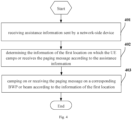
- Fig. 4 it shows a flow of another method for determining paging location or camping location in an embodiment of the present disclosure.
- the method may be executed by a UE, and has the following specific steps:
- Step 401 receiving assistance information sent by a network-side device
- a broadcast message e.g., a Master Information Block (MIB), a System Information Block (SIB), etc.
- the broadcast message including the assistance information
- an dedicated message e.g., a Radio Resource Control Reconfiguration (RRC Reconfiguration) message, a Radio Resource Control Release (RRC Release) message, etc.
- RRC Reconfiguration Radio Resource Control Reconfiguration
- RRC Release Radio Resource Control Release
- the assistance information may include information of a second location which allows camping or sending the paging message thereon.
- the information of the first location and the information of the second location are not intended to describe a specific order of the location information.
- the information of the second location to be able to camp thereon or send the paging message thereon can be determined.
- the assistance information includes arbitrary combination of one or more of: a camping weight of a BWP or a beam which allows camping thereon; a paging weight of a BWP or a beam which allows sending the paging message thereon; and a UE identity for calculating the information of the first location to camp thereon or to receive the paging message thereon.
- the BWP which allows camping or sending the paging message thereon is arbitrary combination of one or more of: a BWP containing a synchronization signal block (SSB) defined by a cell, a BWP for initial cell access, and a BWP containing system information.
- SSB synchronization signal block
- the UE identity includes any one of: an International Mobile Subscriber Identity (IMSI), a System Architecture Evolution (SAE) Temporary Mobile Station Identifier (S-TMSI), a UE resume identifier (resumeID) for identifying an INACTIVE state of the UE, a Cell Radio Network Temporary Identifier (C-RNTI), a random number, and a fixed value (such as "0").
- IMSI International Mobile Subscriber Identity
- SAE System Architecture Evolution
- S-TMSI System Architecture Evolution
- resume UE UE resume identifier
- C-RNTI Cell Radio Network Temporary Identifier
- a random number such as "0"
- the information of the second location includes arbitrary combination of one or more of: frequency location information and spatial location information.
- Step 402 determining the information of the first location on which the UE camps or receives the paging message according to the assistance information
- the information of the first location includes arbitrary combination of one or more of: frequency location information and spatial location information.
- the frequency location information includes arbitrary combination of one or more of: a BWP identifier, a Sub-Carrier Space (SCS) identifier, a frequency identifier, a frequency offset identifier, a bandwidth identifier, a Physical Resource Block (PRB) identifier and a PRB offset identifier (e.g., corresponding to the offset of a certain reference PRB (such as PRB of number 0) in the cell).
- SCS Sub-Carrier Space
- PRB Physical Resource Block
- the spatial location information includes arbitrary combination of one or more of: a reference signal identifier, a Synchronization Signal Block (SSB) Identifier, a Channel State Information-Reference Signal (CSI-RS) identifier, a beam identifier, a beam pair identifier, and a transmission node identifier.
- a reference signal identifier a Synchronization Signal Block (SSB) Identifier
- CSI-RS Channel State Information-Reference Signal
- Step 403 camping on or receiving the paging message on a corresponding BWP or beam according to the information of the first location.
- Step 402 may determine the information of the first location in the manners as follows (including manner I, manner II, manner III and manner IV).
- the information of the first location is the frequency location information of a BWP to camp or to receive the paging message thereon; in manners III and IV, the information of the first location is the spatial location information of a beam to camp or to receive the paging message thereon.
- Manner I calculating frequency location information of one or more BWPs on which the UE camps or receives the paging message, according to one or more of: a UE identity, a paging cycle of UE, the number of BWPs which allow camping or sending the paging message thereon, and a camping weight or a paging weight of each BWP; for example, the frequency location information of the BWP may be the BWP identifier.
- Example 1 the identifier n (0 ⁇ n ⁇ (Nn-1)) of the BWP for camping or receiving the paging message is the minimum from the values of n that satisfy the following formula: floor UE_ID / N ⁇ Ns mod W ⁇ W 0 + W 1 + ... + W n
- Example 2 the identifier n (0 ⁇ n ⁇ (Nn-1)) of the BWP for camping or receiving the paging message is the minimum from the values of n that satisfy the following formula: floor UE_ID / N ⁇ Ns mod Nn ⁇ n + 1 ;
- Example 3 the identifier n (0 ⁇ n ⁇ (Nn-1)) of the BWP for camping or receiving the paging message is the minimum from the values of n that satisfy the following formula: UE_ID mod Nn ⁇ n + 1 ;
- the identifier n (0 ⁇ n ⁇ (Nn-1)) of the BWP for camping or receiving the paging message is selected by the UE from Nn BWPs randomly, where Nn is the total number of the BWPs in the cell which allow camping or sending the paging message thereon.
- Manner III calculating spatial location information of one or more beams on which the UE camps or receives the paging message, according to the UE identity, the paging cycle of UE, and the number of beams which allow camping or sending the paging message thereon.
- Example 1 the identifier m (0 ⁇ m ⁇ (Nm-1)) of the beam for camping or receiving the paging message is the minimum from the values of m that satisfy the following formula: floor UE_ID / N ⁇ Ns mod W ⁇ W 0 + W 1 + ... + W m
- Example 2 the identifier m (0 ⁇ m ⁇ (Nm-1)) of the beam for camping or receiving the paging message is the minimum from the values of m that satisfy the following formula: floor UE_ID / N ⁇ Ns mod Nm ⁇ m + 1 ;
- Example 3 the identifier m (0 ⁇ m ⁇ (Nm-1)) of the beam for camping or receiving the paging message is the minimum from the values of m that satisfy the following formula: UE_ID mod Nm ⁇ m + 1 ;
- Manner IV selecting randomly spatial location information of a beam from spatial location information of multiple beams which allow camping or sending the paging message thereon, as the spatial location information of the beam to camp or to receive the paging message.
- the identifier m (0 ⁇ m ⁇ (Nm-1)) of the beam for camping or receiving the paging message is selected by the UE from Nm beams randomly, where Nm is the total number of the beams in the cell which allow camping or sending the paging message thereon.
- the network side sends a paging message on multiple different BWPs or beams in a cell, and allocates different UEs to different BWPs or beams to camp or receive the paging message thereon, thereby balancing the paging message sending load.
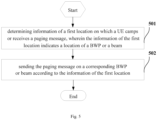
- Fig. 5 it shows a flow of a method for determining paging location or camping location in an embodiment of the present disclosure.
- the method is executed by a network-side device, and has the following specific steps:
- the frequency location information includes arbitrary combination of one or more of: a BWP identifier, a SCS identifier, a frequency identifier, a frequency offset identifier, a bandwidth identifier, a PRB identifier and a PRB offset identifier (e.g., corresponding to the offset of a certain reference PRB (such as PRB of number 0) in the cell).
- the spatial location information includes arbitrary combination of one or more of: a reference signal identifier, a SSB Identifier, a CSI-RS identifier, a beam identifier, a beam pair identifier, and a transmission node identifier.
- Step 502 sending the paging message on a corresponding BWP or beam according to the information of the first location.
- the network-side device may send the paging message for the UE on all corresponding multiple frequency locations (e.g., BWPs).
- the network-side device may send the paging message for the UE on all corresponding multiple spatial locations (e.g., beams).
- the network side sends a paging message on multiple different BWPs or beams in a cell, and allocates different UEs to different BWPs or beams to camp or receive the paging message thereon, thereby balancing the paging message sending load.
- FIG. 6 it shows a flow of a method for determining paging location or camping location in an embodiment of the present disclosure.
- the method is executed by a network-side device, and has the following specific steps:
- the assistance information may include information of a second location of a BWP or a beam which allows camping or sending the paging message thereon. Further, the assistance information further includes arbitrary combination of one or more of: a camping weight of a BWP or a beam which allows camping thereon; a paging weight of a BWP or a beam which allows sending the paging message thereon; and a UE identity for calculating the information of the first location to camp thereon or to receive the paging message thereon.
- the BWP which allows camping or sending the paging message thereon is arbitrary combination of one or more of: a BWP containing a synchronization signal block (SSB) defined by a cell, a BWP for initial cell access, and a BWP containing system information.
- SSB synchronization signal block
- the UE identity includes any one of: an IMSI, an S-TMSI, a UE resume ID (resumeID) for identifying an INACTIVE state, a C-RNTI, a random number, and a fixed value (such as "0").
- IMSI an IMSI
- S-TMSI an S-TMSI
- UE resume ID resume ID
- C-RNTI a C-RNTI
- random number such as "0"
- the information of the second location includes arbitrary combination of one or more of: the frequency location information and the spatial location information.
- the frequency location information includes arbitrary combination of one or more of: a BWP identifier, a SCS identifier, a frequency identifier, a frequency offset identifier, a bandwidth identifier, a PRB identifier and a PRB offset identifier (e.g., corresponding to the offset of a certain reference PRB (such as PRB of number 0) in the cell).
- the spatial location information includes arbitrary combination of one or more of: a reference signal identifier, a SSB Identifier, a CSI-RS identifier, a beam identifier, a beam pair identifier, and a transmission node identifier.
- Step 602 determining the information of the first location on which the UE camps or receives the paging message; It should be noted that, the order of Step 601 and Step 602 is not specifically limited in the embodiment of the present disclosure.
- Step 603 sending the paging message on a corresponding BWP or beam according to the information of the first location.
- Step 602 may determine the information of the first location in the manners as follows (including manner I, manner II, manner III and manner IV).
- the information of the first location is the frequency location information of a BWP to camp or to receive the paging message thereon; in manners III and IV, the information of the first location is the spatial location information of a beam to camp or to receive the paging message thereon.
- Manner I calculating frequency location information of one or more BWPs on which the UE camps or receives the paging message, according to one or more of: a UE identity, a paging cycle of UE, the number of BWPs which allow camping or sending the paging message thereon, and a camping weight or a paging weight of each BWP; for example, the frequency location information of the BWP may be the BWP identifier.
- Example 1 the identifier n (0 ⁇ n ⁇ (Nn-1)) of the BWP for camping or receiving the paging message is the minimum from the values of n that satisfy the following formula: floor UE_ID / N ⁇ Ns mod W ⁇ W 0 + W 1 + ... + W n
- Example 2 the identifier n (0 ⁇ n ⁇ (Nn-1)) of the BWP for camping or receiving the paging message is the minimum from the values of n that satisfy the following formula: floor UE_ID / N ⁇ Ns mod Nn ⁇ n + 1 ;
- Example 3 the identifier n (0 ⁇ n ⁇ (Nn-1)) of the BWP for camping or receiving the paging message is the minimum from the values of n that satisfy the following formula: UE_ID mod Nn ⁇ n + 1 ;
- the identifier n (0 ⁇ n ⁇ (Nn-1)) of the BWP for camping or receiving the paging message is selected by the UE from Nn BWPs randomly, where Nn is the total number of the BWPs in the cell which allow camping or sending the paging message thereon.
- Manner III calculating spatial location information of one or more beams on which the UE camps or receives the paging message, according to the UE identity, the paging cycle of UE, and the number of beams which allow camping or sending the paging message thereon.
- Example 1 the identifier m (0 ⁇ m ⁇ (Nm-1)) of the beam for camping or receiving the paging message is the minimum from the values of m that satisfy the following formula: floor UE_ID / N ⁇ Ns mod W ⁇ W 0 + W 1 + ... + W m
- Example 2 the identifier m (0 ⁇ m ⁇ (Nm-1)) of the beam for camping or receiving the paging message is the minimum from the values of m that satisfy the following formula: floor UE_ID / N ⁇ Ns mod Nm ⁇ m + 1 ;
- Example 3 the identifier m (0 ⁇ m ⁇ (Nm-1)) of the beam for camping or receiving the paging message is the minimum from the values of m that satisfy the following formula: UE_ID mod Nm ⁇ m + 1 ;
- Manner IV selecting randomly spatial location information of a beam from spatial location information of multiple beams which allow camping or sending the paging message thereon, as the spatial location information of the beam on which the UE camps or receives the paging message.
- the identifier m (0 ⁇ m ⁇ (Nm-1)) of the beam for camping or receiving the paging message is selected by the UE from Nm beams randomly, where Nm is the total number of the beams in the cell which allow camping or sending the paging message thereon.
- the network side sends a paging message on multiple different BWPs or beams in a cell, and allocates different UEs to different BWPs or beams to camp or receive the paging message thereon, thereby balancing the paging message sending load.
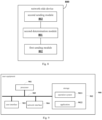
- An embodiment of the present disclosure further provides a user equipment. Since the principle of solving the problem by the user equipment is similar to that of the methods for determining paging location or camping location in the embodiments of the present disclosure, the implementation of the user equipment may refer to the implementation of the methods. The repetition will not be described.
- the UE 700 includes:
- the UE 700 further includes: a second reception module 703, which is configured to receive assistance information sent by a network-side device; the first determination module 701 is further configured to determine the information of the first location on which the UE camps or receives the paging message according to the assistance information.
- the second reception module 703 is further configured to receive a broadcast message sent by the network-side device.
- the broadcast message includes the assistance information; or, the second reception module 703 is further configured to receive an dedicated message sent by the network-side device.
- the dedicated message includes the assistance information.
- the first determination module 701 is further configured to calculate frequency location information of one or more BWPs on which the UE camps or receives the paging message, according to one or more of: a UE identity, a paging cycle of UE, the number of BWPs which allow camping or sending the paging message thereon, and a camping weight or a paging weight of each BWP; or the first determination module 701 is further configured to select randomly frequency location information of a BWP from frequency location information of multiple BWPs which allow camping or sending the paging message thereon, as the frequency location information of the BWP on which the UE camps or receives the paging message.
- the first determination module 701 is further configured to calculate spatial location information of one or more beams on which the UE camps or receives the paging message, according to one or more of: the UE identity, the paging cycle of UE, the number of beams which allow camping or sending the paging message thereon, and a camping weight or a paging weight of each beam; or the first determination module 701 is further configured to select randomly one piece of spatial location information from spatial location information of multiple beams which allow camping or sending the paging message thereon, as the spatial location information of the beam on which the UE camps or receives the paging message.
- the assistance information includes information of a second location which allows camping or sending the paging message thereon.
- the assistance information further includes arbitrary combination of one or more of: a camping weight of a BWP or a beam which allows camping thereon; a paging weight of a BWP or a beam which allows sending the paging message thereon; and a UE identity for calculating the information of the first location to camp thereon or to receive the paging message thereon.
- the BWP which allows camping or sending the paging message thereon is arbitrary combination of one or more of: a BWP containing a SSB defined by a cell, a BWP for initial cell access, and a BWP containing system information.
- the UE identity includes any one of: an IMSI, an S-TMSI, a UE resume ID (resumeID), a C-RNTI, a random number, and a fixed value.
- the information of the first location includes arbitrary combination of one or more of: the frequency location information and the spatial location information.
- the information of the second location includes arbitrary combination of one or more of: the frequency location information and the spatial location information.
- the frequency location information includes arbitrary combination of one or more of: a BWP identifier, a SCS identifier, a frequency identifier, a frequency offset identifier, a bandwidth identifier, a PRB identifier and a PRB offset identifier.
- the spatial location information includes arbitrary combination of one or more of: a reference signal identifier, a synchronization signal identifier, a CSI-RS identifier, a beam identifier, a beam pair identifier, and a transmission node identifier.
- the user equipment provided in the embodiment of the present disclosure can perform the above method embodiment, and has similar principle and technical effects, which will not be repeated in the embodiment here.
- An embodiment of the present disclosure further provides a network-side device. Since the principle of solving the problem by the network-side device is similar to that of the methods for determining paging location or camping location in the embodiments of the present disclosure, the implementation of the network-side device may refer to the implementation of the methods. The repetition will not be described.
- the network-side device 800 includes:
- the network-side device 800 further includes: a second sending module 803 configured to send assistance information to the UE, the assistance information being used by the UE to determine the information of the first location of a BWP or beam to camp or to receive the paging message thereon.
- a second sending module 803 configured to send assistance information to the UE, the assistance information being used by the UE to determine the information of the first location of a BWP or beam to camp or to receive the paging message thereon.
- the second sending module 803 is further configured to send a broadcast message to the UE.
- the broadcast message includes the assistance information; or, the second sending module 803 is further configured to send an dedicated message to the UE.
- the dedicated message includes the assistance information
- the second determination module 801 is further configured to calculate frequency location information of one or more BWPs on which the UE camps or receives the paging message, according to one or more of: a UE identity, a paging cycle of UE, the number of BWPs which allow camping or sending the paging message thereon, and a camping weight or a paging weight of each BWP; or the second determination module 801 is further configured to select randomly frequency location information of a BWP from frequency location information of multiple BWPs which allow camping or sending the paging message thereon, as the frequency location information of the BWP on which the UE camps or receives the paging message.
- the second determination module 801 is further configured to calculate spatial location information of one or more beams on which the UE camps or receives the paging message, according to one or more of: the UE identity, the paging cycle of UE, the number of beams which allow camping or sending the paging message thereon, and a camping weight or a paging weight of each beam; or the second determination module 801 is further configured to select randomly one piece of spatial location information from spatial location information of multiple beams which allow camping or sending the paging message thereon, as the spatial location information of the beam on which the UE camps or receives the paging message.
- the assistance information includes information of a second location which allows camping or sending the paging message thereon.
- the assistance information further includes arbitrary combination of one or more of: a camping weight of a BWP or a beam which allows camping thereon; a paging weight of a BWP or a beam which allows sending the paging message thereon; and a UE identity for calculating the information of the first location to camp thereon or to receive the paging message thereon.
- the BWP which allows camping or sending the paging message thereon is arbitrary combination of one or more of: a BWP containing a SSB defined by a cell, a BWP for initial cell access, and a BWP containing system information.
- the UE identity includes any one of: an IMSI, an S-TMSI, a UE resume ID (resumeID), a C-RNTI, a random number, and a fixed value.
- the information of the first location includes arbitrary combination of one or more of: the frequency location information and the spatial location information.
- the information of the second location includes arbitrary combination of one or more of: the frequency location information and the spatial location information.
- the frequency location information includes arbitrary combination of one or more of: a BWP identifier, a SCS identifier, a frequency identifier, a frequency offset identifier, a bandwidth identifier, a PRB identifier and a PRB offset identifier.
- the spatial location information includes arbitrary combination of one or more of: a reference signal identifier, a synchronization signal identifier, a CSI-RS identifier, a beam identifier, a beam pair identifier, and a transmission node identifier.
- the network-side device provided in the embodiment of the present disclosure can perform the above method embodiment, and has similar principle and technical effects, which will not be repeated in the embodiment here.
- the user equipment 900 includes at least one processor 901, a storage 902, at least one network interface 904 and a user interface 903.
- Various components in the user equipment 900 are coupled together via a bus system 905.
- the bus system 905 is used to realize connection and communication between these components.
- the bus system 905 also includes a power bus, a control bus, and a status signal bus.
- various buses are marked as the bus system 905 in Fig. 9 .
- the user interface 903 may include a display, a keyboard, or a pointing device (for example, a mouse, a trackball, a touch pad, or a touch screen, etc.).
- a pointing device for example, a mouse, a trackball, a touch pad, or a touch screen, etc.
- the storage 902 in the embodiment of the present disclosure may be a volatile memory or a non-volatile memory, or may include both the volatile memory and the non-volatile memory.
- the non-volatile memory may be a Read-Only Memory (ROM), a Programmable ROM (PROM), an Erasable PROM (EPROM), an Electrically EPROM (EEPROM), or a flash memory.
- the volatile memory may be a Random Access Memory (RAM), which is used as an external cache.
- RAM Random Rambus RAM
- SRAM Static RAM
- DRAM Dynamic RAM
- SDRAM Synchronous DRAM
- DDRSDRAM Double Data Rate SDRAM
- ESDRAM Enhanced SDRAM
- SLDRAM Synchlink DRAM
- DRRAM Direct Rambus RAM
- the storage 902 of the system and method described in the embodiments of the present disclosure is intended to include, but is not limited to, these and any other suitable types of storages.
- the storage 902 stores the following elements, executable modules or data structures, or their subsets, or their extended sets: an operating system 9021 and an application 9022.
- the operating system 9021 includes various system programs, such as a framework layer, a core library layer, and a driver layer, etc., for implementing various basic services and processing hardware-based tasks.
- the application 9022 includes various applications, such as a media player, a browser, etc., for implementing various application services.
- the program for implementing the methods of the embodiments of the present disclosure may be included in the application 9022.
- the programs or instructions stored in the storage 902 are called and executed to implement the following steps: determining information of a first location on which the UE camps or receives a paging message, wherein the information of the first location indicates a location of a bandwidth part (BWP) or a beam; and camping on or receiving the paging message on a corresponding BWP or beam according to the information of the first location.
- BWP bandwidth part
- the user equipment provided by the embodiment of the present disclosure can implement the above method embodiments, and the principle and technical effects thereof are similar to those of the methods. Thus, the repetition will not be described in the embodiment.
- the network-side device 1000 includes a processor 1001, a transceiver 1002, a storage 1003 and a bus interface, wherein:
- the network-side device 1000 further includes a computer program stored on the storage 1003 and capable of running on the processor 1001.
- the computer program implements the following steps: determining information of a first location on which a UE camps or receives a paging message, wherein the information of the first location indicates a location of a bandwidth part (BWP) or a beam; and sending the paging message on a corresponding BWP or beam according to the information of the first location.
- BWP bandwidth part
- the bus architecture may include any number of interconnected buses and bridges, which are linked together specifically by various circuits such as one or more processors represented by the processor 1001 and the storage represented by the storage 1003.
- the bus architecture can also link various other circuits such as peripheral devices, voltage regulators, and power management circuits, etc., which are well known in the art, and therefore, they will not be further described herein.
- the bus interface provides interfaces.
- the transceiver 1002 may be a plurality of elements, including a transmitter and a receiver, and provides units for communicating with various other devices on a transmission medium.
- the processor 1001 is responsible for managing the bus architecture and general processing, and the storage 1003 may store data used by the processor 1001 when performing operations.
- the network-side device provided by the embodiment of the present disclosure can implement the above method embodiments, and the principle and technical effects thereof are similar to those of the methods. Thus, the repetition will not be described in the embodiment.
- the steps of the methods or algorithms described in conjunction with the disclosed contents of the present disclosure may be implemented by hardware, or by a processor executing software instructions.
- the software instructions may be composed of corresponding software modules, which may be stored in RAM, flash memory, ROM, EPROM, EEPROM, registers, hard disk, mobile hard disk, read-only optical disk, or any other form of storage medium well known in the art.
- An exemplary storage medium is coupled to the processor so that the processor can read information from the storage medium and can write information to the storage medium.
- the storage medium may also be a component of the processor.
- the processor and the storage medium may be located in an ASIC.
- the ASIC may be located in a core network interface device.
- the processor and the storage medium may also exist as discrete components in the core network interface device.
- the functions described in the present disclosure may be implemented by hardware, software, firmware, or arbitrary combination thereof. When implemented in software, these functions can be stored in a computer-readable medium or transmitted as one or more instructions or codes on a computer-readable medium.
- the computer-readable medium includes the computer storage medium and the communication medium, and the communication medium includes any medium that facilitates transferring a computer program from one place to another.
- the storage medium may be any available medium that can be accessed by a general-purpose or special-purpose computer.
- the embodiments of the present disclosure may be provided as a method, a system, or a computer program product. Therefore, the embodiments of the present disclosure may take the form of an entirely hardware embodiment, an entirely software embodiment, or an embodiment combining software and hardware aspects. Moreover, the embodiments of the present disclosure may take the form of a computer program product implemented on one or more computer-usable storage media (including but not limited to disk storage, CD-ROM, optical storage, etc.) containing computer-usable program codes therein.
- computer-usable storage media including but not limited to disk storage, CD-ROM, optical storage, etc.
- These computer program instructions may also be stored in a computer-readable storage capable of directing a computer or other programmable data processing device to work in a specific manner, such that the instructions stored in the computer-readable storage produce a manufactured article including the instruction means which implements the functions specified in one or more of the processes in the flowcharts and/or one or more of the blocks in the block diagrams.
- These computer program instructions may also be loaded on a computer or other programmable data processing devices, so that a series of operation steps can be performed on the computer or other programmable devices to produce a computer-implemented process, so that the instructions executed on the computer or other programmable device provide the steps for implementing the functions specified in one or more of the processes in the flowcharts and/or one or more of the blocks in the block diagrams.
Landscapes
- Engineering & Computer Science (AREA)
- Computer Networks & Wireless Communication (AREA)
- Signal Processing (AREA)
- Computer Security & Cryptography (AREA)
- Mobile Radio Communication Systems (AREA)
Claims (13)
- Verfahren zum Bestimmen eines Paging-Standortes oder eines Aufhalten-Standortes, das auf ein Benutzergerät, UE, angewendet wird, das die folgenden Schritte umfasst:Bestimmen (301) von Informationen eines ersten Standortes, auf dem sich das UE aufhält oder eine Paging-Nachricht empfängt, wobei die Informationen des ersten Standortes einen Standort eines Bandbreitenteils, BWP, oder eines Strahls anzeigen; undAufhalten oder Empfangen (302) der Paging-Nachricht auf einem entsprechenden BWP oder Strahl gemäß den Informationen des ersten Standortes;wobei das Bestimmen von Informationen eines ersten Standortes, auf dem sich das UE aufhält oder eine Paging-Nachricht empfängt, die folgenden Schritte umfasst:Empfangen (401) von Unterstützungsinformationen, die von einer netzwerkseitigen Vorrichtung gesendet werden, wobei die Unterstützungsinformationen in einer Broadcast-Nachricht oder einer dedizierten Nachricht enthalten sind; undBestimmen (402) der Informationen des ersten Standortes, auf dem sich das UE aufhält oder die Paging-Nachricht gemäß den Unterstützungsinformationen empfängt;wobei das Bestimmen der Informationen des ersten Standortes, auf dem das UE sich aufhält oder die Paging-Nachricht gemäß den Unterstützungsinformationen empfängt, die folgende Schritte umfasst:Berechnen von räumlichen Standortsinformationen eines oder mehrerer Strahlen, auf denen das UE sich aufhält oder die Pagin-Nachricht empfängt, gemäß der UE-Identität, dem Paging-Zyklus des UE und einer Anzahl von Strahlen, die das Aufhalten oder Senden der Paging-Nachricht darauf ermöglichen;wobei die räumlichen Standortsinformationen Folgendes aufweisen: eine Referenzsignal-Kennung, und/oder eine Synchronisationssignalblock-Kennung, und/oder eine Channel-State-Information-Reference-Signal-Kennung, CSI-RS-Kennung, und/oder eine Strahl-Kennung, und/oder eine Strahlpaar-Kennung, und/oder eine Übertragungsknoten-Kennung.
- Verfahren nach Anspruch 1, wobei das Bestimmen (402) der Informationen des ersten Standortes, auf dem sich das UE aufhält oder die Paging-Nachricht gemäß den Unterstützungsinformationen empfängt, die folgenden Schritte umfasst:Berechnen von Frequenz-Standortinformationen eines oder mehrerer BWPs, auf denen das UE sich aufhält oder die Paging-Nachricht empfängt, gemäß einer UE-Identität und/ oder einem Paging-Zyklus des UE und/oder einer Anzahl von BWPs, die das Aufhalten oder Senden der Paging-Nachricht darauf ermöglichen, und/oder einer Aufhalten-Gewichtung oder einer Paging-Gewichtung jedes BWP; oderzufälliges Auswahlen von Frequenz-Standortinformationen eines BWP aus Frequenz-Standortinformationen mehrerer BWPs, die das Aufhalten oder Senden der Paging-Nachricht darauf ermöglichen, als die Frequenz-Standortinformationen des BWP, auf dem sich das UE aufhält oder die Paging-Nachricht empfängt.
- Verfahren nach Anspruch 1, wobei die Unterstützungsinformationen Folgendes aufweisen: Informationen eines zweiten Standortes, der das Aufhalten oder Senden der Paging-Nachricht darauf ermöglicht.
- Verfahren gemäß Anspruch 3, wobei die Unterstützungsinformationen ferner Folgendes aufweisen: eine Aufhalten-Gewichtung eines BWP oder eines Strahls, der das Aufhalten darauf ermöglicht; und/oder eine Paging-Gewichtung eines BWP oder eines Strahls, der das Senden der Paging-Nachricht darauf ermöglicht; und/oder eine UE-Identität zum Berechnen der Informationen des ersten Standortes, um sich darauf aufzuhalten oder die Paging-Nachricht darauf zu empfangen.
- Verfahren nach Anspruch 3 oder 4, wobei der BWP, der das Aufhalten oder Senden der Paging-Nachricht darauf ermöglicht, Folgendes ist: ein BWP, der einen Synchronisationssignalblock enthält, der durch eine Zelle definiert ist, und/oder ein BWP für den anfänglichen Zellenzugriff und/oder ein BWP, der Systeminformationen enthält.
- Verfahren gemäß Anspruch 4, wobei die UE-Identität eines der folgenden Elemente aufweist: eine internationale Mobilfunk-Teilnehmerkennung, eine temporäre Systemarchitektur-Evolutions-Mobilstation-Kennung, eine UE-Wiederaufnahmekennung, eine temporäre Kennung eines Zellenfunknetzes, eine Zufallszahl und einen festen Wert; oderdie Informationen des ersten Standortes Folgendes aufweisen: Frequenz-Standortinformationen und/oder räumliche Standortinformationen;die Informationen des zweiten Standortes Folgendes aufweisen: Frequenz-Standortinformationen und/oder räumliche Standortinformationen.
- Verfahren nach Anspruch 6, wobei die Frequenz-Standortinformationen Folgendes aufweisen: eine BWP-Kennung, und/oder einen Unterträger-Raumkennung, und/oder eine Frequenzkennung, und/oder eine Frequenzversatzkennung, und/oder eine Bandbreitenkennung, und/oder eine PRB-Kennung, und/oder eine PRB-Versatzkennung.
- Verfahren zum Bestimmen eines Paging-Standortes oder Aufhalten-Standortes, das auf eine netzwerkseitige Vorrichtung angewendet wird, das die folgenden Schritte umfasst:Bestimmen (501) von Informationen eines ersten Standortes, auf dem sich ein UE aufhält oder eine Paging-Nachricht empfängt, wobei die Informationen des ersten Standortes einen Standort eines Bandbreitenteils, BWP, oder eines Strahls anzeigen;Senden (502) der Paging-Nachricht auf einem entsprechenden BWP oder Strahl gemäß den Informationen des ersten Standortes; undSenden von Unterstützungsinformationen an das UE, wobei die Unterstützungsinformationen von dem UE verwendet werden, um die Informationen des ersten Standortes eines BWP oder Strahls zu bestimmen, auf dem sich das UE aufhält oder die Paging-Nachricht empfängt, wobei die Unterstützungsinformationen in einer Broadcast-Nachricht oder einer dedizierten Nachricht enthalten sind;wobei das Bestimmen der Informationen des ersten Standortes, auf dem sich das UE aufhält oder die Paging-Nachricht empfängt, die folgenden Schritte umfasst:Berechnen von räumlichen Standortsinformationen eines oder mehrerer Strahlen, auf denen sich das UE aufhält oder die Paging-Nachricht empfängt, gemäß der UE-Identität, dem Paging-Zyklus des UE und einer Anzahl von Strahlen, die das Empfangen oder Senden der Paging-Nachricht darauf ermöglichen;wobei die räumlichen Standortsinformationen Folgendes aufweisen: eine Referenzsignal-Kennung, und/oder eine Synchronisationssignalblock-Kennung, und/oder eine Channel-State-Information-Reference-Signal-Kennung, CSI-RS-Kennung, und/oder eine Strahl-Kennung, und/oder eine Strahlpaar-Kennung, und/oder eine Übertragungsknoten-Kennung.
- Verfahren nach Anspruch 8, wobei das Bestimmen der Informationen des ersten Standortes, auf dem sich das UE aufhält oder die Paging-Nachricht empfängt, die folgende Schritte umfasst:Berechnen von Frequenz-Standortinformationen eines oder mehrerer BWPs, auf denen das UE sich aufhält oder die Paging-Nachricht empfängt, gemäß einer UE-Identität und/ oder einem Paging-Zyklus des UE und/oder einer Anzahl von BWPs, die das Aufhalten oder Senden der Paging-Nachricht darauf ermöglichen, und/oder einer Aufhalten-Gewichtung oder einer Paging-Gewichtung jedes BWP; oderzufälliges Auswählen von Frequenz-Standortinformationen eines BWP aus Frequenz-Standortinformationen mehrerer BWPs, die das Aufhalten oder Senden der Paging-Nachricht darauf ermöglichen, als die Frequenz-Standortinformationen des BWP, auf dem sich das UE aufhält oder die Paging-Nachricht empfängt.
- Verfahren nach Anspruch 8, wobei die Unterstützungsinformationen Informationen eines zweiten Standortes, der das Aufhalten oder Senden der Paging-Nachricht darauf ermöglicht, aufweisen.
- Verfahren nach Anspruch 10, wobei die Unterstützungsinformationen Folgendes aufweisen: eine Aufhalten-Gewichtung eines BWP oder eines Strahls, der das Aufhalten darauf ermöglicht; und/oder eine Paging-Gewichtung eines BWP oder eines Strahls, der das Senden der Paging-Nachricht darauf ermöglicht; und/oder eine UE-Identität zum Berechnen der Informationen des ersten Standortes, um sich darauf aufzuhalten oder die Paging-Nachricht darauf zu empfangen.
- Benutzergerät, UE, mit:einem ersten Bestimmungsmodul (701), das so konfiguriert ist, dass es Informationen eines ersten Standortes bestimmt, auf dem sich das UE aufhält oder eine Paging-Nachricht empfängt, wobei die Informationen des ersten Standortes einen Standort eines Bandbreitenteils, BWP, oder eines Strahls anzeigen; undeinem ersten Empfangsmodul (702), das so konfiguriert ist, dass es sich an einem entsprechenden BWP oder Strahl gemäß den Informationen des ersten Standortes aufhält oder die Pagingnachricht darauf empfängt;wobei das erste Bestimmungsmodul (701) so konfiguriert ist, dass esUnterstützungsinformationen empfängt, die von einer netzwerkseitigen Vorrichtung gesendet werden, wobei die Unterstützungsinformationen in einer Broadcast-Nachricht oder einer dedizierten Nachricht enthalten sind; unddie Informationen des ersten Standortes, auf dem das UE sich aufhält oder die Paging-Nachricht empfängt, gemäß den Unterstützungsinformationen bestimmt;wobei das Bestimmen der Informationen des ersten Standorts, auf dem sich das UE aufhält oder die Paging-Nachricht empfängt, gemäß den Unterstützungsinformationen die folgenden Schritte umfasst:Berechnen von räumlichen Standortsinformationen eines oder mehrerer Strahlen, auf denen sich das UE aufhält oder die Paging-Nachricht empfängt, gemäß der UE-Identität, dem Paging-Zyklus des UE und einer Anzahl von Strahlen, die das Empfangen oder Senden der Paging-Nachricht darauf ermöglichen;wobei die räumlichen Standortsinformationen Folgendes aufweisen: eine Referenzsignal-Kennung, und/oder eine Synchronisationssignalblock-Kennung, und/oder eine Channel-State-Information-Reference-Signal-Kennung, CSI-RS-Kennung, und/oder eine Strahl-Kennung, und/oder eine Strahlpaar-Kennung, und/oder eine Übertragungsknoten-Kennung.
- Netzwerkseitige Vorrichtung (800), mit:einem zweiten Bestimmungsmodul (801), das so konfiguriert ist, dass es Informationen über einen ersten Standort bestimmt, auf dem ein UE sich aufhält oder eine Paging-Nachricht empfängt, wobei die Informationen des ersten Standortes einen Standort eines Bandbreitenteils, BWP, oder eines Strahls anzeigen; undeinem ersten Sendemodul (802), das so konfiguriert ist, dass es die Paging-Nachricht auf einem entsprechenden BWP oder Strahl gemäß den Informationen des ersten Standortes sendet;das erste Sendemodul (802) so konfiguriert ist, dass es Unterstützungsinformationen an das UE sendet, wobei die Unterstützungsinformationen von dem UE verwendet werden, um die Informationen des ersten Standortes eines BWP oder Strahls zu bestimmen, auf dem sich das UE aufhält oder die Paging-Nachricht empfängt, wobei die Unterstützungsinformationen in einer Broadcast-Nachricht oder einer dedizierten Nachricht enthalten sind;wobei das Bestimmen der Informationen des ersten Standorts, auf dem sich das UE aufhält oder die Paging-Nachricht empfängt, die folgenden Schritte umfasst:Berechnen von räumlichen Standortsinformationen eines oder mehrerer Strahlen, auf denen sich das UE aufhält oder die Paging-Nachricht empfängt, gemäß der UE-Identität, dem Paging-Zyklus des UE und einer Anzahl von Strahlen, die das Empfangen oder Senden der Paging-Nachricht darauf ermöglichen;wobei die räumlichen Standortsinformationen Folgendes aufweisen: eine Referenzsignal-Kennung, und/oder eine Synchronisationssignalblock-Kennung, und/oder eine Channel-State-Information-Reference-Signal-Kennung, CSI-RS-Kennung, und/oder eine Strahl-Kennung, und/oder eine Strahlpaar-Kennung, und/oder eine Übertragungsknoten-Kennung.
Applications Claiming Priority (2)
| Application Number | Priority Date | Filing Date | Title |
|---|---|---|---|
| CN201810005096.9A CN109996333B (zh) | 2018-01-03 | 2018-01-03 | 寻呼位置或驻留位置的确定方法和设备 |
| PCT/CN2018/125463 WO2019134615A1 (zh) | 2018-01-03 | 2018-12-29 | 寻呼位置或驻留位置的确定方法和设备 |
Publications (3)
| Publication Number | Publication Date |
|---|---|
| EP3720204A1 EP3720204A1 (de) | 2020-10-07 |
| EP3720204A4 EP3720204A4 (de) | 2021-02-17 |
| EP3720204B1 true EP3720204B1 (de) | 2025-04-30 |
Family
ID=67128735
Family Applications (1)
| Application Number | Title | Priority Date | Filing Date |
|---|---|---|---|
| EP18899002.2A Active EP3720204B1 (de) | 2018-01-03 | 2018-12-29 | Verfahren und vorrichtungen zur bestimmung des funkrufortes oder des aufenthaltsortes |
Country Status (5)
| Country | Link |
|---|---|
| US (2) | US11229005B2 (de) |
| EP (1) | EP3720204B1 (de) |
| CN (1) | CN109996333B (de) |
| ES (1) | ES3031436T3 (de) |
| WO (1) | WO2019134615A1 (de) |
Families Citing this family (12)
| Publication number | Priority date | Publication date | Assignee | Title |
|---|---|---|---|---|
| CN110798879A (zh) * | 2018-08-01 | 2020-02-14 | 维沃移动通信有限公司 | 一种信息接收方法、信息发送方法、终端及网络侧设备 |
| CN110958662B (zh) * | 2018-09-27 | 2022-11-22 | 维沃移动通信有限公司 | 一种接入控制方法、终端及网络侧设备 |
| US12107661B2 (en) | 2019-08-01 | 2024-10-01 | Qualcomm Incorporated | Control method for smart repeaters |
| US12101165B2 (en) | 2019-08-01 | 2024-09-24 | Qualcomm Incorporated | Access procedure of smart directional repeaters |
| US12047999B2 (en) | 2019-08-01 | 2024-07-23 | Qualcomm Incorporated | Access procedure configuration of a millimeter wave repeater |
| KR102943254B1 (ko) | 2019-10-03 | 2026-03-25 | 샤프 가부시키가이샤 | 전력 절감 동작들을 위한 방법들 및 장치들 |
| US12309830B2 (en) | 2020-03-23 | 2025-05-20 | Qualcomm Incorporated | Access procedure configuration of a millimeter wave repeater |
| CN113747571B (zh) * | 2020-05-29 | 2023-02-03 | 华为技术有限公司 | 一种通信方法及装置 |
| CN114599057B (zh) * | 2020-12-04 | 2024-06-18 | 北京紫光展锐通信技术有限公司 | 驻留在dl bwp的方法、设备、装置及存储介质 |
| WO2024170589A1 (en) | 2023-02-15 | 2024-08-22 | Continental Automotive Technologies GmbH | Method for paging for network energy saving |
| WO2024170590A1 (en) | 2023-02-15 | 2024-08-22 | Continental Automotive Technologies GmbH | Methods for paging for network energy saving |
| WO2024170553A2 (en) | 2023-02-15 | 2024-08-22 | Continental Automotive Technologies GmbH | Methods for paging enhancement for network energy saving |
Family Cites Families (13)
| Publication number | Priority date | Publication date | Assignee | Title |
|---|---|---|---|---|
| KR102236066B1 (ko) | 2013-05-21 | 2021-04-05 | 삼성전자주식회사 | 무선 통신 네트워크에서 페이징 채널 신호를 송/수신하는 장치 및 방법 |
| WO2015051547A1 (zh) * | 2013-10-12 | 2015-04-16 | 华为技术有限公司 | 寻呼方法和装置 |
| CN104811279B (zh) * | 2014-01-23 | 2018-05-22 | 电信科学技术研究院 | 一种寻呼消息传输方法及装置 |
| CN108886738B (zh) * | 2016-04-04 | 2021-12-03 | 苹果公司 | 用于独立波束成形系统的寻呼设计 |
| EP3473043B1 (de) | 2016-06-21 | 2021-01-27 | Samsung Electronics Co., Ltd. | System und verfahren zum paging in einem drahtloskommunikationssystem der nächsten generation |
| CN107079404B (zh) * | 2017-01-06 | 2020-10-30 | 北京小米移动软件有限公司 | 寻呼信号发送方法、寻呼信号接收方法、装置及系统 |
| EP4167619A1 (de) * | 2017-02-02 | 2023-04-19 | IPLA Holdings Inc. | Neuer funkruf |
| KR101811250B1 (ko) | 2017-02-15 | 2018-01-15 | 김성환 | 와이파이와 비콘을 이용한 주민 공공정보 전송 서비스 시스템 |
| KR101962148B1 (ko) * | 2017-06-16 | 2019-03-26 | 엘지전자 주식회사 | 하향링크 채널을 송수신하는 방법 및 이를 위한 장치 |
| WO2019047143A1 (zh) | 2017-09-08 | 2019-03-14 | 北京小米移动软件有限公司 | 寻呼消息接收方法及装置和寻呼配置方法及装置 |
| CN117811705A (zh) * | 2017-09-08 | 2024-04-02 | 三星电子株式会社 | 使用带宽部分配置处理无线电链路监测的方法和系统 |
| CN111885713B (zh) * | 2017-10-05 | 2022-08-26 | 上海朗帛通信技术有限公司 | 一种被用于无线通信的用户设备、基站中的方法和装置 |
| CN111543069B (zh) * | 2017-11-14 | 2024-06-07 | 诺基亚技术有限公司 | 空闲模式和非活动模式下的bwp处理 |
-
2018
- 2018-01-03 CN CN201810005096.9A patent/CN109996333B/zh active Active
- 2018-12-29 WO PCT/CN2018/125463 patent/WO2019134615A1/zh not_active Ceased
- 2018-12-29 US US16/954,497 patent/US11229005B2/en active Active
- 2018-12-29 EP EP18899002.2A patent/EP3720204B1/de active Active
- 2018-12-29 ES ES18899002T patent/ES3031436T3/es active Active
-
2021
- 2021-12-08 US US17/545,784 patent/US11751164B2/en active Active
Also Published As
| Publication number | Publication date |
|---|---|
| CN109996333B (zh) | 2020-09-29 |
| EP3720204A1 (de) | 2020-10-07 |
| WO2019134615A1 (zh) | 2019-07-11 |
| US11751164B2 (en) | 2023-09-05 |
| US20220104171A1 (en) | 2022-03-31 |
| ES3031436T3 (en) | 2025-07-08 |
| US11229005B2 (en) | 2022-01-18 |
| CN109996333A (zh) | 2019-07-09 |
| EP3720204A4 (de) | 2021-02-17 |
| US20200322919A1 (en) | 2020-10-08 |
Similar Documents
| Publication | Publication Date | Title |
|---|---|---|
| EP3720204B1 (de) | Verfahren und vorrichtungen zur bestimmung des funkrufortes oder des aufenthaltsortes | |
| AU2021202649B2 (en) | Methods and devices for broadcasting system information on demand | |
| US11653326B2 (en) | Method, device and readable storage medium for paging | |
| EP2932780B1 (de) | Basisstation, benutzervorrichtung und verfahren für zufallszugriff | |
| EP4207882B1 (de) | Ressourcenanzeigeverfahren, elektronische vorrichtung und speichermedium | |
| EP3648389A1 (de) | Kommunikationsverfahren, netzwerkvorrichtung und relaisvorrichtung | |
| CN111464474B (zh) | 一种信号传输方法及其相关设备 | |
| JP7753343B2 (ja) | ページング受信の改善のためにアイドル/非アクティブモードのueによってcsi-rs/trs指示を受信するシステム及び方法 | |
| KR20200108290A (ko) | 사운딩 참조 신호 전송 방법, 네트워크 디바이스 및 단말기 디바이스 | |
| EP3573410A1 (de) | Verfahren und vorrichtung zur reaktion auf einen direktzugriff sowie direktzugriffsverfahren und -vorrichtung | |
| EP3509365B1 (de) | Verfahren und vorrichtung zur datenübertragung | |
| US20170048906A1 (en) | Operation method of communication node supporting device to device communication in communication network | |
| KR102384359B1 (ko) | 정보 수신 방법 및 기기 | |
| WO2022021296A1 (en) | Systems and methods to provide csi-rs/trs indication to ues in idle/inactive mode | |
| EP4156807B1 (de) | Ressourcenbestimmungsverfahren, endgerätevorrichtung und netzwerkvorrichtung | |
| US8447316B2 (en) | Method and apparatus for communicating hidden common enhanced dedicated channel resources | |
| US10863549B2 (en) | Random access method, terminal device, and network device | |
| US10660142B2 (en) | Device and method of handling a radio resource control connection | |
| EP4213558A1 (de) | Datenübertragungsverfahren und zugehörige vorrichtung | |
| WO2021114099A1 (en) | Method and apparatus for data transmission | |
| US20260046878A1 (en) | Communication method, communication apparatus, computer-readable storage medium, and program product | |
| EP4694403A1 (de) | Verfahren zur meldung von anfrageinformationen, informationskonfigurationsverfahren und zugehörige vorrichtung | |
| WO2013075294A1 (en) | Method and apparatus for access point communications | |
| WO2025167863A1 (zh) | Prach资源确定、指示方法、装置、终端及网络侧设备 | |
| CN120380811A (zh) | 多小区驻留中的寻呼方案 |
Legal Events
| Date | Code | Title | Description |
|---|---|---|---|
| STAA | Information on the status of an ep patent application or granted ep patent |
Free format text: STATUS: THE INTERNATIONAL PUBLICATION HAS BEEN MADE |
|
| PUAI | Public reference made under article 153(3) epc to a published international application that has entered the european phase |
Free format text: ORIGINAL CODE: 0009012 |
|
| STAA | Information on the status of an ep patent application or granted ep patent |
Free format text: STATUS: REQUEST FOR EXAMINATION WAS MADE |
|
| 17P | Request for examination filed |
Effective date: 20200701 |
|
| AK | Designated contracting states |
Kind code of ref document: A1 Designated state(s): AL AT BE BG CH CY CZ DE DK EE ES FI FR GB GR HR HU IE IS IT LI LT LU LV MC MK MT NL NO PL PT RO RS SE SI SK SM TR |
|
| AX | Request for extension of the european patent |
Extension state: BA ME |
|
| REG | Reference to a national code |
Ref country code: DE Ref legal event code: R079 Free format text: PREVIOUS MAIN CLASS: H04W0068000000 Ipc: H04W0068020000 Ref country code: DE Ref legal event code: R079 Ref document number: 602018081624 Country of ref document: DE Free format text: PREVIOUS MAIN CLASS: H04W0068000000 Ipc: H04W0068020000 |
|
| A4 | Supplementary search report drawn up and despatched |
Effective date: 20210119 |
|
| RIC1 | Information provided on ipc code assigned before grant |
Ipc: H04W 88/02 20090101ALI20210113BHEP Ipc: H04W 68/00 20090101ALI20210113BHEP Ipc: H04W 88/08 20090101ALI20210113BHEP Ipc: H04W 68/02 20090101AFI20210113BHEP |
|
| DAV | Request for validation of the european patent (deleted) | ||
| DAX | Request for extension of the european patent (deleted) | ||
| STAA | Information on the status of an ep patent application or granted ep patent |
Free format text: STATUS: EXAMINATION IS IN PROGRESS |
|
| 17Q | First examination report despatched |
Effective date: 20221220 |
|
| GRAP | Despatch of communication of intention to grant a patent |
Free format text: ORIGINAL CODE: EPIDOSNIGR1 |
|
| STAA | Information on the status of an ep patent application or granted ep patent |
Free format text: STATUS: GRANT OF PATENT IS INTENDED |
|
| INTG | Intention to grant announced |
Effective date: 20241125 |
|
| GRAS | Grant fee paid |
Free format text: ORIGINAL CODE: EPIDOSNIGR3 |
|
| GRAA | (expected) grant |
Free format text: ORIGINAL CODE: 0009210 |
|
| STAA | Information on the status of an ep patent application or granted ep patent |
Free format text: STATUS: THE PATENT HAS BEEN GRANTED |
|
| AK | Designated contracting states |
Kind code of ref document: B1 Designated state(s): AL AT BE BG CH CY CZ DE DK EE ES FI FR GB GR HR HU IE IS IT LI LT LU LV MC MK MT NL NO PL PT RO RS SE SI SK SM TR |
|
| REG | Reference to a national code |
Ref country code: CH Ref legal event code: EP Ref country code: GB Ref legal event code: FG4D |
|
| REG | Reference to a national code |
Ref country code: IE Ref legal event code: FG4D |
|
| REG | Reference to a national code |
Ref country code: DE Ref legal event code: R096 Ref document number: 602018081624 Country of ref document: DE |
|
| REG | Reference to a national code |
Ref country code: NL Ref legal event code: FP |
|
| REG | Reference to a national code |
Ref country code: ES Ref legal event code: FG2A Ref document number: 3031436 Country of ref document: ES Kind code of ref document: T3 Effective date: 20250708 |
|
| REG | Reference to a national code |
Ref country code: AT Ref legal event code: MK05 Ref document number: 1791275 Country of ref document: AT Kind code of ref document: T Effective date: 20250430 |
|
| PG25 | Lapsed in a contracting state [announced via postgrant information from national office to epo] |
Ref country code: FI Free format text: LAPSE BECAUSE OF FAILURE TO SUBMIT A TRANSLATION OF THE DESCRIPTION OR TO PAY THE FEE WITHIN THE PRESCRIBED TIME-LIMIT Effective date: 20250430 Ref country code: PT Free format text: LAPSE BECAUSE OF FAILURE TO SUBMIT A TRANSLATION OF THE DESCRIPTION OR TO PAY THE FEE WITHIN THE PRESCRIBED TIME-LIMIT Effective date: 20250901 |
|
| REG | Reference to a national code |
Ref country code: LT Ref legal event code: MG9D |
|
| PG25 | Lapsed in a contracting state [announced via postgrant information from national office to epo] |
Ref country code: GR Free format text: LAPSE BECAUSE OF FAILURE TO SUBMIT A TRANSLATION OF THE DESCRIPTION OR TO PAY THE FEE WITHIN THE PRESCRIBED TIME-LIMIT Effective date: 20250731 Ref country code: NO Free format text: LAPSE BECAUSE OF FAILURE TO SUBMIT A TRANSLATION OF THE DESCRIPTION OR TO PAY THE FEE WITHIN THE PRESCRIBED TIME-LIMIT Effective date: 20250730 |
|
| PG25 | Lapsed in a contracting state [announced via postgrant information from national office to epo] |
Ref country code: PL Free format text: LAPSE BECAUSE OF FAILURE TO SUBMIT A TRANSLATION OF THE DESCRIPTION OR TO PAY THE FEE WITHIN THE PRESCRIBED TIME-LIMIT Effective date: 20250430 |
|
| PG25 | Lapsed in a contracting state [announced via postgrant information from national office to epo] |
Ref country code: BG Free format text: LAPSE BECAUSE OF FAILURE TO SUBMIT A TRANSLATION OF THE DESCRIPTION OR TO PAY THE FEE WITHIN THE PRESCRIBED TIME-LIMIT Effective date: 20250430 |
|
| PG25 | Lapsed in a contracting state [announced via postgrant information from national office to epo] |
Ref country code: HR Free format text: LAPSE BECAUSE OF FAILURE TO SUBMIT A TRANSLATION OF THE DESCRIPTION OR TO PAY THE FEE WITHIN THE PRESCRIBED TIME-LIMIT Effective date: 20250430 |
|
| PG25 | Lapsed in a contracting state [announced via postgrant information from national office to epo] |
Ref country code: AT Free format text: LAPSE BECAUSE OF FAILURE TO SUBMIT A TRANSLATION OF THE DESCRIPTION OR TO PAY THE FEE WITHIN THE PRESCRIBED TIME-LIMIT Effective date: 20250430 |
|
| PG25 | Lapsed in a contracting state [announced via postgrant information from national office to epo] |
Ref country code: RS Free format text: LAPSE BECAUSE OF FAILURE TO SUBMIT A TRANSLATION OF THE DESCRIPTION OR TO PAY THE FEE WITHIN THE PRESCRIBED TIME-LIMIT Effective date: 20250731 |
|
| PG25 | Lapsed in a contracting state [announced via postgrant information from national office to epo] |
Ref country code: IS Free format text: LAPSE BECAUSE OF FAILURE TO SUBMIT A TRANSLATION OF THE DESCRIPTION OR TO PAY THE FEE WITHIN THE PRESCRIBED TIME-LIMIT Effective date: 20250830 |
|
| PG25 | Lapsed in a contracting state [announced via postgrant information from national office to epo] |
Ref country code: LV Free format text: LAPSE BECAUSE OF FAILURE TO SUBMIT A TRANSLATION OF THE DESCRIPTION OR TO PAY THE FEE WITHIN THE PRESCRIBED TIME-LIMIT Effective date: 20250430 |
|
| PGFP | Annual fee paid to national office [announced via postgrant information from national office to epo] |
Ref country code: NL Payment date: 20251112 Year of fee payment: 8 |
|
| PGFP | Annual fee paid to national office [announced via postgrant information from national office to epo] |
Ref country code: DE Payment date: 20251104 Year of fee payment: 8 |
|
| PGFP | Annual fee paid to national office [announced via postgrant information from national office to epo] |
Ref country code: GB Payment date: 20251114 Year of fee payment: 8 |
|
| PG25 | Lapsed in a contracting state [announced via postgrant information from national office to epo] |
Ref country code: DK Free format text: LAPSE BECAUSE OF FAILURE TO SUBMIT A TRANSLATION OF THE DESCRIPTION OR TO PAY THE FEE WITHIN THE PRESCRIBED TIME-LIMIT Effective date: 20250430 Ref country code: SM Free format text: LAPSE BECAUSE OF FAILURE TO SUBMIT A TRANSLATION OF THE DESCRIPTION OR TO PAY THE FEE WITHIN THE PRESCRIBED TIME-LIMIT Effective date: 20250430 |
|
| PGFP | Annual fee paid to national office [announced via postgrant information from national office to epo] |
Ref country code: FR Payment date: 20251110 Year of fee payment: 8 |
|
| PG25 | Lapsed in a contracting state [announced via postgrant information from national office to epo] |
Ref country code: CZ Free format text: LAPSE BECAUSE OF FAILURE TO SUBMIT A TRANSLATION OF THE DESCRIPTION OR TO PAY THE FEE WITHIN THE PRESCRIBED TIME-LIMIT Effective date: 20250430 |
|
| PG25 | Lapsed in a contracting state [announced via postgrant information from national office to epo] |
Ref country code: EE Free format text: LAPSE BECAUSE OF FAILURE TO SUBMIT A TRANSLATION OF THE DESCRIPTION OR TO PAY THE FEE WITHIN THE PRESCRIBED TIME-LIMIT Effective date: 20250430 |
|
| PG25 | Lapsed in a contracting state [announced via postgrant information from national office to epo] |
Ref country code: SK Free format text: LAPSE BECAUSE OF FAILURE TO SUBMIT A TRANSLATION OF THE DESCRIPTION OR TO PAY THE FEE WITHIN THE PRESCRIBED TIME-LIMIT Effective date: 20250430 Ref country code: RO Free format text: LAPSE BECAUSE OF FAILURE TO SUBMIT A TRANSLATION OF THE DESCRIPTION OR TO PAY THE FEE WITHIN THE PRESCRIBED TIME-LIMIT Effective date: 20250430 |
|
| PG25 | Lapsed in a contracting state [announced via postgrant information from national office to epo] |
Ref country code: IT Free format text: LAPSE BECAUSE OF FAILURE TO SUBMIT A TRANSLATION OF THE DESCRIPTION OR TO PAY THE FEE WITHIN THE PRESCRIBED TIME-LIMIT Effective date: 20250430 |
|
| REG | Reference to a national code |
Ref country code: DE Ref legal event code: R097 Ref document number: 602018081624 Country of ref document: DE |
|
| PLBE | No opposition filed within time limit |
Free format text: ORIGINAL CODE: 0009261 |
|
| STAA | Information on the status of an ep patent application or granted ep patent |
Free format text: STATUS: NO OPPOSITION FILED WITHIN TIME LIMIT |
|
| REG | Reference to a national code |
Ref country code: CH Ref legal event code: L10 Free format text: ST27 STATUS EVENT CODE: U-0-0-L10-L00 (AS PROVIDED BY THE NATIONAL OFFICE) Effective date: 20260311 |
|
| 26N | No opposition filed |
Effective date: 20260202 |
|
| PGFP | Annual fee paid to national office [announced via postgrant information from national office to epo] |
Ref country code: ES Payment date: 20260112 Year of fee payment: 8 |