EP3722363A1 - Schlagzähes copolymer-polypropylen für dünnwandige injektionsverpackungen - Google Patents
Schlagzähes copolymer-polypropylen für dünnwandige injektionsverpackungen Download PDFInfo
- Publication number
- EP3722363A1 EP3722363A1 EP19169026.2A EP19169026A EP3722363A1 EP 3722363 A1 EP3722363 A1 EP 3722363A1 EP 19169026 A EP19169026 A EP 19169026A EP 3722363 A1 EP3722363 A1 EP 3722363A1
- Authority
- EP
- European Patent Office
- Prior art keywords
- ethylene
- impact copolymer
- copolymer polypropylene
- propylene
- polypropylene composition
- Prior art date
- Legal status (The legal status is an assumption and is not a legal conclusion. Google has not performed a legal analysis and makes no representation as to the accuracy of the status listed.)
- Withdrawn
Links
- 229920001577 copolymer Polymers 0.000 title claims abstract description 111
- -1 polypropylene Polymers 0.000 title claims abstract description 92
- 239000004743 Polypropylene Substances 0.000 title claims abstract description 75
- 229920001155 polypropylene Polymers 0.000 title claims abstract description 75
- 238000004806 packaging method and process Methods 0.000 title claims description 17
- 239000007924 injection Substances 0.000 title description 6
- 238000002347 injection Methods 0.000 title description 6
- 239000000203 mixture Substances 0.000 claims abstract description 93
- 239000011159 matrix material Substances 0.000 claims abstract description 49
- 229920000181 Ethylene propylene rubber Polymers 0.000 claims abstract description 43
- 229920001384 propylene homopolymer Polymers 0.000 claims abstract description 39
- VGGSQFUCUMXWEO-UHFFFAOYSA-N Ethene Chemical compound C=C VGGSQFUCUMXWEO-UHFFFAOYSA-N 0.000 claims abstract description 31
- 239000005977 Ethylene Substances 0.000 claims abstract description 31
- 238000001746 injection moulding Methods 0.000 claims abstract description 23
- 238000004519 manufacturing process Methods 0.000 claims abstract description 8
- QQONPFPTGQHPMA-UHFFFAOYSA-N propylene Natural products CC=C QQONPFPTGQHPMA-UHFFFAOYSA-N 0.000 claims description 40
- 125000004805 propylene group Chemical group [H]C([H])([H])C([H])([*:1])C([H])([H])[*:2] 0.000 claims description 33
- 238000000034 method Methods 0.000 claims description 28
- 239000011954 Ziegler–Natta catalyst Substances 0.000 claims description 12
- 125000005234 alkyl aluminium group Chemical group 0.000 claims description 11
- JWCYDYZLEAQGJJ-UHFFFAOYSA-N dicyclopentyl(dimethoxy)silane Chemical group C1CCCC1[Si](OC)(OC)C1CCCC1 JWCYDYZLEAQGJJ-UHFFFAOYSA-N 0.000 claims description 7
- 239000003426 co-catalyst Substances 0.000 claims description 6
- 235000013305 food Nutrition 0.000 claims description 5
- 230000009477 glass transition Effects 0.000 claims description 5
- 125000002924 primary amino group Chemical group [H]N([H])* 0.000 claims description 5
- 150000001336 alkenes Chemical class 0.000 claims description 4
- 150000001875 compounds Chemical class 0.000 claims description 4
- KOFGHHIZTRGVAF-UHFFFAOYSA-N n-ethyl-n-triethoxysilylethanamine Chemical group CCO[Si](OCC)(OCC)N(CC)CC KOFGHHIZTRGVAF-UHFFFAOYSA-N 0.000 claims description 4
- JRZJOMJEPLMPRA-UHFFFAOYSA-N olefin Natural products CCCCCCCC=C JRZJOMJEPLMPRA-UHFFFAOYSA-N 0.000 claims description 4
- 229910000077 silane Inorganic materials 0.000 claims description 4
- 125000002947 alkylene group Chemical group 0.000 claims description 3
- 125000005842 heteroatom Chemical group 0.000 claims description 3
- 229920002959 polymer blend Polymers 0.000 claims description 3
- 238000003860 storage Methods 0.000 claims description 3
- 239000003054 catalyst Substances 0.000 description 14
- 239000001257 hydrogen Substances 0.000 description 10
- 229910052739 hydrogen Inorganic materials 0.000 description 10
- 229920000642 polymer Polymers 0.000 description 10
- UFHFLCQGNIYNRP-UHFFFAOYSA-N Hydrogen Chemical compound [H][H] UFHFLCQGNIYNRP-UHFFFAOYSA-N 0.000 description 8
- URLKBWYHVLBVBO-UHFFFAOYSA-N Para-Xylene Chemical group CC1=CC=C(C)C=C1 URLKBWYHVLBVBO-UHFFFAOYSA-N 0.000 description 8
- 239000012190 activator Substances 0.000 description 8
- 239000007789 gas Substances 0.000 description 8
- 230000000052 comparative effect Effects 0.000 description 7
- 125000000217 alkyl group Chemical group 0.000 description 6
- 229920001519 homopolymer Polymers 0.000 description 6
- 239000003607 modifier Substances 0.000 description 6
- 239000000178 monomer Substances 0.000 description 6
- 229920005989 resin Polymers 0.000 description 6
- 239000011347 resin Substances 0.000 description 6
- 239000004698 Polyethylene Substances 0.000 description 5
- 239000000654 additive Substances 0.000 description 5
- HQQADJVZYDDRJT-UHFFFAOYSA-N ethene;prop-1-ene Chemical group C=C.CC=C HQQADJVZYDDRJT-UHFFFAOYSA-N 0.000 description 5
- VOITXYVAKOUIBA-UHFFFAOYSA-N triethylaluminium Chemical compound CC[Al](CC)CC VOITXYVAKOUIBA-UHFFFAOYSA-N 0.000 description 5
- VXNZUUAINFGPBY-UHFFFAOYSA-N 1-Butene Chemical compound CCC=C VXNZUUAINFGPBY-UHFFFAOYSA-N 0.000 description 4
- LIKMAJRDDDTEIG-UHFFFAOYSA-N 1-hexene Chemical compound CCCCC=C LIKMAJRDDDTEIG-UHFFFAOYSA-N 0.000 description 4
- KWKAKUADMBZCLK-UHFFFAOYSA-N 1-octene Chemical compound CCCCCCC=C KWKAKUADMBZCLK-UHFFFAOYSA-N 0.000 description 4
- TWRXJAOTZQYOKJ-UHFFFAOYSA-L Magnesium chloride Chemical compound [Mg+2].[Cl-].[Cl-] TWRXJAOTZQYOKJ-UHFFFAOYSA-L 0.000 description 4
- 235000013611 frozen food Nutrition 0.000 description 4
- 239000011949 solid catalyst Substances 0.000 description 4
- 239000010936 titanium Substances 0.000 description 4
- 229910052723 transition metal Inorganic materials 0.000 description 4
- 150000003624 transition metals Chemical class 0.000 description 4
- 125000005913 (C3-C6) cycloalkyl group Chemical group 0.000 description 3
- PBKONEOXTCPAFI-UHFFFAOYSA-N 1,2,4-trichlorobenzene Chemical compound ClC1=CC=C(Cl)C(Cl)=C1 PBKONEOXTCPAFI-UHFFFAOYSA-N 0.000 description 3
- 238000005481 NMR spectroscopy Methods 0.000 description 3
- 125000001495 ethyl group Chemical group [H]C([H])([H])C([H])([H])* 0.000 description 3
- 125000002496 methyl group Chemical group [H]C([H])([H])* 0.000 description 3
- VLKZOEOYAKHREP-UHFFFAOYSA-N n-Hexane Chemical compound CCCCCC VLKZOEOYAKHREP-UHFFFAOYSA-N 0.000 description 3
- 229920005629 polypropylene homopolymer Polymers 0.000 description 3
- 239000003381 stabilizer Substances 0.000 description 3
- 238000003756 stirring Methods 0.000 description 3
- 229910052719 titanium Inorganic materials 0.000 description 3
- QPFMBZIOSGYJDE-UHFFFAOYSA-N 1,1,2,2-tetrachloroethane Chemical compound ClC(Cl)C(Cl)Cl QPFMBZIOSGYJDE-UHFFFAOYSA-N 0.000 description 2
- ZGEGCLOFRBLKSE-UHFFFAOYSA-N 1-Heptene Chemical compound CCCCCC=C ZGEGCLOFRBLKSE-UHFFFAOYSA-N 0.000 description 2
- VTYYLEPIZMXCLO-UHFFFAOYSA-L Calcium carbonate Chemical compound [Ca+2].[O-]C([O-])=O VTYYLEPIZMXCLO-UHFFFAOYSA-L 0.000 description 2
- 125000001931 aliphatic group Chemical group 0.000 description 2
- 239000003963 antioxidant agent Substances 0.000 description 2
- 238000006243 chemical reaction Methods 0.000 description 2
- 125000000113 cyclohexyl group Chemical group [H]C1([H])C([H])([H])C([H])([H])C([H])(*)C([H])([H])C1([H])[H] 0.000 description 2
- 125000001511 cyclopentyl group Chemical group [H]C1([H])C([H])([H])C([H])([H])C([H])(*)C1([H])[H] 0.000 description 2
- 230000000694 effects Effects 0.000 description 2
- 229920001971 elastomer Polymers 0.000 description 2
- 150000002148 esters Chemical class 0.000 description 2
- 150000002170 ethers Chemical class 0.000 description 2
- 229920005676 ethylene-propylene block copolymer Polymers 0.000 description 2
- 229910001629 magnesium chloride Inorganic materials 0.000 description 2
- 229910052751 metal Inorganic materials 0.000 description 2
- 239000002184 metal Substances 0.000 description 2
- 150000002736 metal compounds Chemical class 0.000 description 2
- 150000002737 metalloid compounds Chemical class 0.000 description 2
- 239000008188 pellet Substances 0.000 description 2
- YWAKXRMUMFPDSH-UHFFFAOYSA-N pentene Chemical compound CCCC=C YWAKXRMUMFPDSH-UHFFFAOYSA-N 0.000 description 2
- 229920000573 polyethylene Polymers 0.000 description 2
- 229920005638 polyethylene monopolymer Polymers 0.000 description 2
- 238000002360 preparation method Methods 0.000 description 2
- 239000011342 resin composition Substances 0.000 description 2
- 239000000454 talc Substances 0.000 description 2
- 229910052623 talc Inorganic materials 0.000 description 2
- 239000004711 α-olefin Substances 0.000 description 2
- 125000006273 (C1-C3) alkyl group Chemical group 0.000 description 1
- 125000004178 (C1-C4) alkyl group Chemical group 0.000 description 1
- 238000001644 13C nuclear magnetic resonance spectroscopy Methods 0.000 description 1
- LLQHSBBZNDXTIV-UHFFFAOYSA-N 6-[5-[[4-[2-(2,3-dihydro-1H-inden-2-ylamino)pyrimidin-5-yl]piperazin-1-yl]methyl]-4,5-dihydro-1,2-oxazol-3-yl]-3H-1,3-benzoxazol-2-one Chemical compound C1C(CC2=CC=CC=C12)NC1=NC=C(C=N1)N1CCN(CC1)CC1CC(=NO1)C1=CC2=C(NC(O2)=O)C=C1 LLQHSBBZNDXTIV-UHFFFAOYSA-N 0.000 description 1
- 239000004215 Carbon black (E152) Substances 0.000 description 1
- MKYBYDHXWVHEJW-UHFFFAOYSA-N N-[1-oxo-1-(2,4,6,7-tetrahydrotriazolo[4,5-c]pyridin-5-yl)propan-2-yl]-2-[[3-(trifluoromethoxy)phenyl]methylamino]pyrimidine-5-carboxamide Chemical compound O=C(C(C)NC(=O)C=1C=NC(=NC=1)NCC1=CC(=CC=C1)OC(F)(F)F)N1CC2=C(CC1)NN=N2 MKYBYDHXWVHEJW-UHFFFAOYSA-N 0.000 description 1
- RTAQQCXQSZGOHL-UHFFFAOYSA-N Titanium Chemical compound [Ti] RTAQQCXQSZGOHL-UHFFFAOYSA-N 0.000 description 1
- 150000001299 aldehydes Chemical class 0.000 description 1
- 239000004411 aluminium Substances 0.000 description 1
- 229910052782 aluminium Inorganic materials 0.000 description 1
- XAGFODPZIPBFFR-UHFFFAOYSA-N aluminium Chemical compound [Al] XAGFODPZIPBFFR-UHFFFAOYSA-N 0.000 description 1
- 150000001408 amides Chemical class 0.000 description 1
- 150000001412 amines Chemical class 0.000 description 1
- 229940077746 antacid containing aluminium compound Drugs 0.000 description 1
- 230000003078 antioxidant effect Effects 0.000 description 1
- 125000003118 aryl group Chemical group 0.000 description 1
- 229910000019 calcium carbonate Inorganic materials 0.000 description 1
- 229910052804 chromium Inorganic materials 0.000 description 1
- 239000011651 chromium Substances 0.000 description 1
- 238000010924 continuous production Methods 0.000 description 1
- 238000007796 conventional method Methods 0.000 description 1
- 125000004122 cyclic group Chemical group 0.000 description 1
- 125000001995 cyclobutyl group Chemical group [H]C1([H])C([H])([H])C([H])(*)C1([H])[H] 0.000 description 1
- 238000009826 distribution Methods 0.000 description 1
- 238000005516 engineering process Methods 0.000 description 1
- 230000007613 environmental effect Effects 0.000 description 1
- 239000000945 filler Substances 0.000 description 1
- 239000004088 foaming agent Substances 0.000 description 1
- 230000008014 freezing Effects 0.000 description 1
- 238000007710 freezing Methods 0.000 description 1
- 239000011521 glass Substances 0.000 description 1
- 229910052735 hafnium Inorganic materials 0.000 description 1
- 229930195733 hydrocarbon Natural products 0.000 description 1
- 150000002430 hydrocarbons Chemical class 0.000 description 1
- 125000001183 hydrocarbyl group Chemical group 0.000 description 1
- 150000002431 hydrogen Chemical class 0.000 description 1
- 125000004435 hydrogen atom Chemical group [H]* 0.000 description 1
- 239000011261 inert gas Substances 0.000 description 1
- 150000002576 ketones Chemical class 0.000 description 1
- 239000007788 liquid Substances 0.000 description 1
- 239000000314 lubricant Substances 0.000 description 1
- 239000011777 magnesium Substances 0.000 description 1
- 150000002681 magnesium compounds Chemical class 0.000 description 1
- 239000000463 material Substances 0.000 description 1
- 238000000691 measurement method Methods 0.000 description 1
- 238000012986 modification Methods 0.000 description 1
- 230000004048 modification Effects 0.000 description 1
- 150000002825 nitriles Chemical class 0.000 description 1
- 239000012299 nitrogen atmosphere Substances 0.000 description 1
- 239000002667 nucleating agent Substances 0.000 description 1
- 150000007524 organic acids Chemical class 0.000 description 1
- 235000005985 organic acids Nutrition 0.000 description 1
- 230000000704 physical effect Effects 0.000 description 1
- 239000000049 pigment Substances 0.000 description 1
- 238000006116 polymerization reaction Methods 0.000 description 1
- 150000003254 radicals Chemical class 0.000 description 1
- 230000035484 reaction time Effects 0.000 description 1
- 150000003839 salts Chemical class 0.000 description 1
- 230000035939 shock Effects 0.000 description 1
- 239000000377 silicon dioxide Substances 0.000 description 1
- VYPSYNLAJGMNEJ-UHFFFAOYSA-N silicon dioxide Inorganic materials O=[Si]=O VYPSYNLAJGMNEJ-UHFFFAOYSA-N 0.000 description 1
- 239000007787 solid Substances 0.000 description 1
- 239000007858 starting material Substances 0.000 description 1
- 229920006132 styrene block copolymer Polymers 0.000 description 1
- 238000010998 test method Methods 0.000 description 1
- 238000012360 testing method Methods 0.000 description 1
- 229920001169 thermoplastic Polymers 0.000 description 1
- 229920002725 thermoplastic elastomer Polymers 0.000 description 1
- 239000004416 thermosoftening plastic Substances 0.000 description 1
- 150000007970 thio esters Chemical class 0.000 description 1
- 150000003568 thioethers Chemical class 0.000 description 1
- JLTRXTDYQLMHGR-UHFFFAOYSA-N trimethylaluminium Chemical compound C[Al](C)C JLTRXTDYQLMHGR-UHFFFAOYSA-N 0.000 description 1
- 229910052720 vanadium Inorganic materials 0.000 description 1
- 229910052726 zirconium Inorganic materials 0.000 description 1
Images

Classifications
-
- C—CHEMISTRY; METALLURGY
- C08—ORGANIC MACROMOLECULAR COMPOUNDS; THEIR PREPARATION OR CHEMICAL WORKING-UP; COMPOSITIONS BASED THEREON
- C08L—COMPOSITIONS OF MACROMOLECULAR COMPOUNDS
- C08L23/00—Compositions of homopolymers or copolymers of unsaturated aliphatic hydrocarbons having only one carbon-to-carbon double bond; Compositions of derivatives of such polymers
- C08L23/02—Compositions of homopolymers or copolymers of unsaturated aliphatic hydrocarbons having only one carbon-to-carbon double bond; Compositions of derivatives of such polymers not modified by chemical after-treatment
- C08L23/10—Homopolymers or copolymers of propene
- C08L23/12—Polypropene
-
- C—CHEMISTRY; METALLURGY
- C08—ORGANIC MACROMOLECULAR COMPOUNDS; THEIR PREPARATION OR CHEMICAL WORKING-UP; COMPOSITIONS BASED THEREON
- C08L—COMPOSITIONS OF MACROMOLECULAR COMPOUNDS
- C08L2207/00—Properties characterising the ingredient of the composition
- C08L2207/20—Recycled plastic
Definitions
- the present invention relates to an impact copolymer polypropylene composition for preparation of packaging by injection molding, a process for preparing the composition and to use of the composition in injection molding, e.g. thin-wall injection molding.
- the invention also relates to a method of injection molding, e.g. thin-wall injection molding, wherein the composition is injected, and to articles comprising the impact copolymer polypropylene composition.
- Thin-wall injection molding is a key technology for making food packaging due to economic and environmental concerns. Thin-wall injection molding requires high melt flow polymer to achieve the necessary processability and high flexibility required for innovative packaging designs.
- Polypropylene is one polymer widely used in injection molding of thin-wall articles, and especially food packaging.
- Polypropylene due to its brittleness, it is a challenge to maximize the impact and stiffness strength of the thin-wall injection molded articles. This problem is exacerbated at low temperatures and it is especially difficult to obtain thin wall injection molded articles with desirable mechanical properties at low temperatures e.g. -40°C, the temperature used for shock freezing of frozen food.
- US6156836A discloses polypropylene resin compositions which have an improved balance of physical properties in comparison to similar polypropylene materials as well as thin-wall moldability.
- the polypropylene resin composition comprises: (A) 54 to 65% by weight of a crystalline ethylene-propylene block copolymer having a MFR from 60 to 120 g/10 minutes, wherein the crystalline ethylene-propylene block copolymer comprises a homopolypropylene moiety and an ethylene-propylene copolymer moiety, wherein the homopolypropylene moiety has an isotactic pentad fraction value of 96% or more and an MFR value from 150 to 250 g/10 minutes and the ratio of the ethylene-propylene copolymer moiety is from 5 to 10% by weight based on the total of the homopolypropylene moiety and the ethylene-propylene copolymer moiety; (B) 17 to 24% by weight of a thermoplastic elastomer comprising at least one
- EP2174980A1 discloses heterophasic polypropylene resin having a MFR of more than 40 g/10 minutes comprising a propylene homo- or copolymer matrix and an ethylene-propylene rubber phase dispersed within the matrix, wherein the heterophasic polypropylene resin has a fraction insoluble in p-xylene at 25°C (XCU) with an intrinsic viscosity of 1.2 dl/g or less, the XCU being composed of propylene monomer units in an amount of at least 95 wt%, and a fraction soluble in p-xylene at 25°C (XCS), having an intrinsic viscosity of 2.0 to 3.5 dl/g and being composed of propylene monomer units in an amount of 50 wt% or more, and having a glass transition temperature T g in the range of -42 to -30°C.
- XCU fraction insoluble in p-xylene at 25°C
- XCS fraction soluble in p-x
- US8445598B2 discloses heterophasic polypropylene resin comprising a propylene homo- or copolymer matrix and an ethylene-propylene rubber phase dispersed within the matrix wherein the heterophasic polypropylene resin has a fraction insoluble in p-xylene at 25°C (XCU) with an intrinsic viscosity of 1.5 dl/g or less, and an amount of propylene monomer units of at least 95 mol%, and a fraction soluble in p-xylene at 25°C (XCS) with an intrinsic viscosity of 1.5 to 3.0 dl/g, and an amount of propylene monomer units of 50 to 75 mol%, and a molecular weight distribution of 2.5 to 3.5, and MFR more than 100 g/10 min, the XCU fraction is present in an amount of 70 to 90 wt% of the heterophasic polypropylene resin and the XCS fraction is present in an amount of 10 to 30 wt% of the heterophasic poly
- the present invention provides an impact copolymer polypropylene composition
- a propylene homopolymer or copolymer matrix and an ethylene propylene rubber phase dispersed in the matrix
- the ethylene propylene rubber phase (PER) is present in an amount of 10-18 wt%, based on the total weight of the propylene homopolymer or copolymer matrix and the ethylene propylene rubber phase, and the amount of ethylene in the ethylene propylene rubber (PER-C2) phase is 50-56 mol%.
- PER ethylene propylene rubber phase
- the present invention provides a process for preparing an impact copolymer polypropylene composition as hereinbefore described, comprising:
- the present invention provides a preferred process for preparing an impact copolymer polypropylene composition as hereinbefore described, wherein the process comprises:
- the present invention provides an impact copolymer polypropylene composition obtainable by the processes herein described.
- the present invention provides the use of the impact copolymer polypropylene composition herein described in injection molding, preferably thin-wall injection molding.
- the present invention provides a method of injection molding, e.g. thin-wall injection molding, comprising injecting a molten impact copolymer polypropylene composition as herein described into a mold; solidifying the impact copolymer polypropylene in the mold and ejecting from the mold a molded impact copolymer polypropylene article.
- the present invention provides a molded article (e.g. packaging) comprising the impact copolymer polypropylene composition herein described.
- hydrocarbyl refers to a univalent radical derived from a hydrocarbon. Examples include alkyl groups. As used herein the term “aliphatic” is used to refer to non-cyclic groups. Aliphatic groups may be straight-chained (sometimes referred to as linear) or branched.
- impact copolymer polypropylene (ICP) composition refers to a polymer comprising a propylene homopolymer or copolymer matrix and an ethylene propylene rubber phase (PER) dispersed in the matrix.
- the composition further comprises additives, e.g. antioxidants and/or stabilizers.
- propylene homopolymer refers to a polymer which consists essentially of repeat units deriving from propylene.
- Propylene homopolymer may, for example, comprise at least 99 %, more preferably at least 99.5 %, still more preferably at least 99.95 %, and yet more preferably at least 99.95%, e.g. 100%, by weight of repeat units deriving from propylene.
- propylene copolymer refers to a polymer comprising repeat units deriving from propylene and at least one other comonomer.
- propylene copolymer comprises at least 0.05%, more preferably at least 0.1 % and still more preferably at least 0.4 wt% of a repeat unit deriving from at least one other comonomer.
- Propylene copolymer will normally not comprise more than 15 wt% of repeat units deriving from at least one other comonomer.
- PER-C2 refers to the mol% of repeat units deriving from ethylene (C2) in the ethylene propylene rubber phase, based on the total amount of repeat units present therein.
- PE homopolymer refers to the mol% of block polyethylene present in the ethylene propylene rubber phase, based on the total weight of the rubber phase.
- ZN Ziegler Natta
- a transition metal halide e.g. titanium halide, chromium halide, hafnium halide, zirconium halide or vanadium halide
- a metal or metalloid compound e.g. a magnesium compound or a silica compound
- catalyst system refers to the catalyst and optional activators, electron donors and modifiers.
- multistage process refers to a process which is carried out in two or more stages.
- the present invention provides an impact copolymer polypropylene composition
- a propylene homopolymer or copolymer matrix and an ethylene propylene rubber (PER) phase dispersed in the matrix wherein the ethylene propylene rubber phase is present in an amount of 10-18 wt%, based on the total weight of propylene homopolymer or copolymer matrix and ethylene propylene rubber phase, and the amount of ethylene in the ethylene propylene rubber (PER-C2) phase is 50-56 mol%.
- the impact copolymer polypropylene composition of the present invention possesses an ideal balance of properties for use in injection molding and particularly thin-wall injection molding, e.g. of packaging. Specifically the composition has a relatively high MFR 2 which facilitates injection into, and flow in, the mold, a relatively high flexural modulus as well as high notched Izod impact strength, even at low temperature, and a low Tg.
- the impact copolymer polypropylene composition may comprise a propylene homopolymer matrix.
- the impact copolymer polypropylene composition may comprise a propylene copolymer matrix.
- the impact polypropylene composition may comprise a matrix which is a mixture of a propylene homopolymer and a propylene copolymer matrix.
- the comonomer present is preferably one or more olefin (other than propylene) and more preferably one or more alpha-olefin.
- the comonomer is selected from ethylene or C 4 -C 8 alpha-olefin and mixtures thereof.
- Representative examples of preferred comonomers include ethylene, but-1-ene, pent-1-ene, hex-1-ene, hept-1-ene, oct-1-ene and mixtures thereof.
- Preferred comonomers include ethylene, but-1-ene, hex-1-ene and oct-1-ene. Ethylene is particularly preferred.
- Preferred propylene copolymers comprise 0.1-10 wt%, more preferably 0.3-5.0 wt% and still more preferably 0.3-3.0 wt% comonomer.
- the impact copolymer polypropylene composition comprises a propylene homopolymer matrix.
- the propylene homopolymer or copolymer present in the matrix preferably has a tacticity of at least 94%.
- the tacticity affects the flexural modulus of the impact copolymer polypropylene composition and the final thin-wall injection molded article, e.g. packaging.
- the propylene homopolymer or copolymer present in the matrix has a tacticity of at least 95% and more preferably at least 96%.
- the tacticity of the propylene homopolymer or copolymer present in the matrix preferably has an upper limit of 98%.
- the propylene homopolymer or copolymer present in the matrix preferably has a MFR 2 of 100-700 g/10 min, more preferably 120-500 g/10 min and still more preferably 140-500 g/10 min. This contributes to the overall processability of the composition.
- Preferred impact copolymer polypropylene compositions of the present invention comprise 82-90 wt%, more preferably 83-90 wt%, still more preferably 83.5-90 wt%, yet more preferably 84-90 wt% and still more preferably 84.5-90 wt% of propylene homopolymer or copolymer matrix, based on the total weight of propylene homopolymer or copolymer matrix and ethylene propylene rubber phase.
- the ethylene propylene rubber phase is present in the composition of the present invention in an amount of 10-17 wt%, more preferably 10-16.5 wt%, yet more preferably 10-16 wt% and still more preferably 10-15.5 wt%, based on the total weight of propylene homopolymer or copolymer matrix and ethylene propylene rubber phase.
- the ethylene propylene rubber phase present in the composition of the present invention preferably consists essentially, e.g. consists of, repeat units derived from ethylene and propylene. If other repeat units (i.e. units from monomers other than ethylene or propylene) are present, they are preferably present in an amount of less than 1 mol% and still more preferably less than 0.5 mol%.
- the ratio of ethylene to propylene in the ethylene propylene rubber phase is 1:1 to 1.27:1 and more preferably 1.04:1 to 1.27:1.
- the amount of ethylene in the ethylene propylene rubber (PER) phase is 51-56 mol%, more preferably 51-55 mol%, and still more preferably 52-55 mol%.
- the amount of propylene in the ethylene propylene rubber (PER) phase is 44 to 50 mol%, more preferably 44-49 mol%, still more preferably 45 to 49 mol% and still more preferably 45 to 48 mol%.
- the PER content of the impact copolymer propylene composition is believed to significantly affect its mechanical properties, especially the impact strength at both room temperature and at low temperatures (e.g. -20 °C). Without wishing to be bound by theory, it is thought that a high PER content gives high impact strength (at both room temperature and low temperatures) and low flexural modulus, while conversely a low PER content gives a low impact strength and high flexural modulus.
- the optimal PER content is thus one key factor that must be taken into account when seeking to optimize the impact strength and flexural modulus, including the impact strength at low temperature, when seeking to achieve an overall desirable balance of mechanical properties.
- PER-C2 ethylene monomer unit in the PER phase
- T g glass temperature
- Preferred impact copolymer polypropylene compositions of the present invention have a total C2 content of 4-20 mol%, more preferably 4-15 mol% and still more preferably 5-10 mol%. This reflects the fact that the matrix is preferably a propylene homopolymer.
- the amount of polyethylene homopolymer (as determined by NMR as described in the examples) present in the impact copolymer polypropylene composition of the present invention is ⁇ 3 mol%. More preferably the amount of polyethylene homopolymer is 0-2.5 mol% and more preferably 0-2.0 mol%. Still more preferably the impact copolymer polypropylene composition has 50-56 mol% ethylene in the ethylene propylene rubber (PER) phase (i.e. PER-C2) and 0-2.5 mol% ethylene homopolymer, more preferably 50-55 mol% ethylene in the ethylene propylene rubber (PER) phase (i.e.
- PER-C2 ethylene propylene rubber
- PER-C2 ethylene propylene rubber
- PER-C2 ethylene propylene rubber
- the impact copolymer polypropylene composition has a high melt flow rate (MFR 2 ). This ensures it is suitable for thin wall injection molding applications, e.g. to prepare packaging.
- MFR 2 mainly depends on the molecular weight of the polymer. Longer chains of polymers tend to have lower MFR 2 compared to shorter chains.
- the MFR 2 of the impact copolymer polypropylene composition is 60-300 g/10 min, as determined according to ASTM D1238-13 at 230 °C 2.16 kg. More preferably the MFR 2 of the impact copolymer polypropylene composition is 60-200 g/10 min and still more preferably 70-200 g/10 min.
- the impact copolymer polypropylene composition of the present invention preferably has a flexural modulus of at least 12,500 kg/cm 2 , as determined according to ASTM D790. At this range, it is suitable for various applications and especially in packaging e.g. frozen food packaging, which requires a certain mechanical strength to prevent damage during storage and transportation.
- the upper limit of the flexural modulus is preferably 16,000 kg/cm 2 .
- the impact copolymer polypropylene composition of the present invention preferably has an Izod impact strength at -20°C of at least 3.0 kg.cm/cm, as determined according to ASTM D256.
- the Izod impact strength at -20°C is 3-10 kg.cm/cm, more preferably 3.2-8.0 kg.cm/cm and still more preferably 3.3-6.0 kg.cm/cm, as determined according to ASTM D256.
- the impact copolymer polypropylene composition of the present invention preferably has an Izod impact strength at 23 °C of at least 5.0 kg.cm/cm, as determined according to ASTM D256.
- the Izod impact strength at 23 °C is 5-15 kg.cm/cm, more preferably 5.5-12.0 kg.cm/cm and still more preferably 6.0-11.0 kg.cm/cm, as determined according to ASTM D256.
- the impact copolymer polypropylene composition preferably has a glass transition temperature (T g ) of lower than -39 °C. This enables the composition to be used at low temperatures, especially for the frozen food industry. More preferably the impact copolymer polypropylene composition has a T g of at least -40 °C. Preferably the impact copolymer polypropylene composition has a Tg of -40 to -55 °C and more preferably -40 to -50 °C.
- Preferred impact copolymer polypropylene compositions of the present invention comprise at least two, more preferably three, still more preferably four and yet more preferably all of the following properties:
- the impact copolymer polypropylene composition may be prepared by any conventional methods known in the art. Preferably, however, the impact copolymer polypropylene composition is produced in a multistage process. Each stage may be carried out in the same reactor or in one or more separate reactors. The process may be continuous, semi-continuous or batch but is preferably a continuous process.
- a preferred process for preparing the impact copolymer polypropylene composition of the present invention comprises (e.g. consists essentially of): (i) polymerising propylene and optionally an olefin comonomer to obtain the propylene homopolymer or copolymer matrix; and (ii) polymerising propylene and ethylene in the presence of the propylene homopolymer or copolymer matrix to obtain the ethylene propylene rubber phase dispersed in the propylene homopolymer or copolymer matrix.
- the propylene homopolymer or copolymer matrix and the ethylene propylene rubber phase is produced in the same reactor.
- the polymerisation conditions are changed after the polymerisation of the propylene homopolymer or copolymer matrix is complete.
- the propylene homopolymer or copolymer matrix may be produced in one or more reactors and then transferred to another reactor in which the ethylene propylene rubber phase is produced. Conventional reactors and polymerisation equipment may be used.
- the process may also comprise a pre-polymerisation step which precedes the first polymerisation step.
- Any pre-polymerisation step is carried out in a conventional manner.
- the propylene homopolymer or copolymer matrix is preferably produced in a bulk polymerisation.
- the bulk polymerisation is carried out in several reactors, e.g. 1, 2 or 3 reactors.
- the conditions may be the same or different in each reactor.
- the ethylene propylene rubber phase is preferably produced in a gas phase polymerisation in the presence of the propylene homopolymer or copolymer.
- the gas phase polymerisation may be carried out in one or more reactors, e.g. 1 or 2 reactors.
- the polymerisation of the propylene homopolymer or copolymer matrix is preferably carried out at a temperature of 65-80 °C and more preferably about 70 °C.
- the polymerisation is carried out at a pressure of 0.1-4.5 MPa, more preferably 2.9-4.2 MPa and still more preferably 3.3-4.2 MPa.
- the polymerisation time is 5-240 minutes, more preferably 30-130 minutes and still more preferably 40-80 minutes.
- the polymerisation of the ethylene propylene rubber phase is preferably carried out at a temperature of 65-80 and more preferably about 70 °C.
- the polymerisation is carried out at a pressure of 0.1-2.2 MPa, more preferably 1-1.6 MPa and still more preferably 1-1.3 MPa.
- a pre-mixed gas comprising hydrogen, ethylene and propylene is continuously fed into the reactor.
- the ratio of ethylene to propylene is 300 g:1 litre to 450 g:1 litre and more preferably 350 g:1 litre to 400 g:1 litre.
- the ratio of hydrogen to ethylene is 1:60 to 1:20 and more preferably 1:30 to 1:50.
- the ratio of hydrogen to propylene is 5 g:1 litre to 20 g:1 litre and more preferably 6 g:1 litre to 15 g:1 litre.
- the polymerisation time is 10-240 minutes, more preferably 20 to 120 minutes and still more preferably 30-50 minutes.
- the progress of the reaction is monitored using conventional means.
- the reaction time for each stage of the polymerisation process is important as it partly determines the amount of matrix and ethylene propylene rubber phase present.
- the polymerisation time for the first stage is longer than the polymerisation time for the second stage.
- the progress of each of the polymerisation reactions is monitored using conventional means.
- the impact copolymer polypropylene composition of the present invention is polymerised by a catalyst system comprising a Ziegler Natta catalyst.
- a Ziegler-Natta catalyst is used in both stages of the polymerisation. More preferably the same Ziegler-Natta catalyst is used in both stages.
- the Ziegler-Natta catalyst comprises a titanium halide supported on a metal or metalloid compound, preferably MgCl 2 .
- the solid catalyst comprises an amount of transition metal in the range of 0.1-5 mmol/g.
- the solid catalyst comprises an amount of Mg in the range of 1-25 wt% based on the weight of dry, solid catalyst.
- the solid catalyst system further comprises one or more internal electron donors.
- suitable internal electron donors include amines, amides, ethers, esters, aromatic esters, ketones, nitriles, thioethers, thioesters, aldehydes, alcoholates, and salts of organic acids.
- a preferred internal electron donor comprises at least one organo-ester functional group and more preferably is a diester compound.
- the catalyst system further comprises an activator as a cocatalyst. Activators may be selected from alkyl aluminium and alkoxy aluminium compounds. Preferred activators are alkyl aluminium compounds e.g. trimethyl aluminium. The activator is preferably used in excess relative to the transition metal.
- the molar ratio of the aluminium in the activator to the transition metal in the catalyst system is preferably from 1 to 500 mol/mol, and more preferably 2 to 100 mol/mol.
- the molar ratio of alkyl aluminum to titanium on the solid support (Al/Ti) is preferably in the range 10-400, and more preferably in the range 30-120.
- the catalyst system comprising a Ziegler-Natta catalyst may additionally comprise co-activator and/or modifiers.
- co-activator and/or modifiers for example, two or more alkyl aluminium compounds may be used and/or the catalyst system may be combined with the different types of internal donor e.g. ethers, ester etc. to modify the activity and/or selectivity of the catalyst system.
- external donors are added to the polymerisation to modify the activity and/or selectivity of the polymerisation(s).
- an external donor is added to each stage of the polymerisation.
- the external donors in the polymerisation of each of the propylene homopolymer or copolymer matrix and the ethylene propylene rubber phase may be the same or different.
- a preferred external donor in the polymerisation of the propylene homopolymer or copolymer matrix is an amino alkoxysilane compound.
- a preferred external donor in the polymerisation of the ethylene propylene rubber phase is a dialkoxy silane compound.
- a preferred process for preparing an impact copolymer polypropylene composition of the present invention comprises:
- a in formula (I) is 0.
- x is 1.
- R 4 is methyl or ethyl.
- R 1 and R 2 are independently C 1-6 aliphatic hydrocarbyl. More preferably R 1 and R 2 are independently C 4-3 alkyl, more preferably C 1-2 alkyl, e.g. methyl or ethyl. Preferably R 1 and R 2 are the same.
- R 5 and R 6 are a C 3-6 cycloalkyl group selected from cyclobutyl, cyclopentyl and cyclohexyl. More preferably R 5 and R 6 are cyclopentyl or cyclohexyl. Preferably R 5 and R 6 are the same.
- R 7 is C 1-3 alkyl, more preferably C 1-2 alkyl, e.g. methyl or ethyl.
- Representative examples of external electron donors of formula (I) include amino trialkoxysilane.
- Representative examples of external electron donors of formula (II) include dicycloalkyl dialkoxysilane.
- the first electron donor is diethylamino-triethoxysilane.
- the second electron donor is dicyclopentyldimethoxysilane.
- the first electron donor is diethylamino-triethoxysilane and the second electron donor is dicyclopentyldimethoxysilane.
- the impact copolymer polypropylene composition of the present invention optionally comprises modifiers and/or additives. These modifiers and/or additives may be included during the polymerisation process and/or after the polymerisation by melt mixing.
- suitable additives include, but are not limited to, stabilizers, lubricants, nucleating agents, pigments and foaming agents.
- Preferred compositions of the present invention comprise 0-1 wt% additives.
- suitable modifiers include fillers (e.g. talc, calcium carbonate) and thermoplastics.
- Preferred compositions of the invention comprise 0-10 wt% modifiers.
- the impact copolymer polypropylene composition of the present invention is particularly well suited for use in injection molding, in particular thin-wall injection molding.
- Injection molding comprises injecting the molten impact copolymer polypropylene composition into a mold; solidifying the impact copolymer polypropylene in the mold and ejecting from the mold a molded impact copolymer polypropylene article.
- the article per se comprising the impact copolymer polypropylene composition forms a further aspect of the present invention.
- Preferred articles include containers and container tops/lids, and in particular containers and lids for food, especially frozen food.
- Particularly preferred articles include industrial containers, cold storage containers and packaging (e.g. food packaging and packaging in cold chain logistics).
- Melt flow rate (MFR 2 ) was determined according to ASTM D1238-13 at 230°C 2.16 kg.
- PER content (wt%), PER-C2 content (mol%), total C2 in ICP (mol%) and PE homopolymer in ICP (mol%) were measured by 13 C-NMR spectroscopy using a Bruker Ascend 500 NMR spectrometer, with a 13 C resonance frequency of 100.4 MHz.
- the sample was prepared in 1, 2, 4-trichlorobenzene with 1, 1, 2, 2-tetrachloroethane ( d 2 ) and measured at 120°C.
- the integral of each peak position was used together with first order of Markovian Statistics and Simplex Algorithm as described by H. N. Cheng. (J. Anal. Chem. 54, 1828 -1833, 1982 ).
- Glass transition temperature (T g ) was measured using DMA Q800 with frequency 1 Hz, amplitude of 20 ⁇ m and a ramp rate of 3°C/min running from -80°C to 70°C.
- Notched Izod Impact strength was evaluated by ASTM D256 at both 23°C and -20°C.
- a commercially available Ziegler-Natta catalyst (Ziegler-Natta Polypropylene MgCl 2 based supported catalyst, 7 mg) was pre-contacted with 1 ml of 15%w/w triethyl aluminum, 0.4 ml of 250 mM diethyl-amino triethoxy silane, and 2 ml of hexane at room temperature for 3 minutes. The mixture was then injected into a polymerisation reactor, which was filled with 450 gram of liquid propylene, and 50 normal litter of hydrogen without other inert gas at 25°C, and held at this temperature for 10 minute with a stirring speed of 200 rpm.
- the polymerisation temperature was then increased to 70°C within 3 minutes, maintaining a stirring speed of 200 rpm, and the temperature was held for 40 minutes.
- a mixture of 1.5 ml of 15 %w/w triethyl aluminum and 0.3 ml of 250 mM dicyclopentyl dimethoxy silane was injected into the reactor.
- the agitator was stopped and the reactor was depressurized down to atmospheric pressure, keeping the reactor temperature at 50°C.
- the reactor vessel was then pressurized with a premixed gas of hydrogen/ethylene/propylene up to a polymerisation pressure of 1.2 MPa at 70°C within 1 minute with stirring at 200 rpm.
- the polymerisation vessel was fed a gas composition of hydrogen/ethylene/propylene at 69/2210/5.4 ml/minute for 25 minutes.
- the reaction was stopped by depressurizing the reactor vessel to atmospheric pressure.
- Example 1 The same catalyst composition and homopolymerisation conditions as in Example 1 were used, except that 60 normal liter hydrogen was employed. On the 39 th minute of homopolymerisation, a mixture of 1.5 ml 15%w/w triethyl aluminum, and 0.4 ml of 250 mM dicyclopentyl dimethoxy silane was added as in Example 1.
- the co-polymerisation conditions were the same as in Example 1, except that the gas composition was hydrogen/ethylene/propylene at 53/1600/4.5 ml/ minute and the polymerisation time was 20 minutes.
- Example 1 The same catalyst composition and homopolymerisation conditions as in Example 1 were used. On the 39 th minute of homopolymerisation, a mixture of 1.5 ml 15%w/w triethyl aluminum, and 0.5 ml of 250 mM dicyclopentyl dimethoxy silane was added as in Example 1.
- the co-polymerisation conditions were the same as in Example 1, except that the gas composition was hydrogen/ethylene/propylene at 59/1600/4.5 ml/minute and the polymerisation time was 25 minutes.
- Example 2 The same catalyst composition and homopolymerisation conditions as in Example 1 were used. On the 39 th minute of homopolymerisation, a mixture of 1.5 ml 15%w/w triethyl aluminum, and 0.5 ml of 250 mM dicyclopentyl dimethoxy silane was added as in Example 1.
- the co-polymerisation conditions were the same as in Example 1, except that the gas composition was hydrogen/ethylene/propylene at 69/2210/5.4 ml/minute and the polymerisation time was 30 minutes.
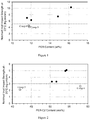
- Comparative impact copolymer polypropylene compositions were prepared. Comparative example 5 has a PER-C2 content which is lower than the examples (1-4) of the present invention and comparative example 6 has a PER-C2 content which is higher than the examples (1-4) of the present invention.
- the examples 1-4 of the present invention show a better balance of mechanical properties, specifically flexural modulus and Izod impact strength at 23°C and -20 °C compared to the comparative examples.
- the flexural modulus of all of the examples is approximately 12,000-14,000 kg/cm 2 but the Izod impact strength, particularly at -20°C of examples 1-4 is significantly better than that of both comparative examples.
- each of the examples of the present invention has a Tg of below -39 °C.
Landscapes
- Chemical & Material Sciences (AREA)
- Health & Medical Sciences (AREA)
- Chemical Kinetics & Catalysis (AREA)
- Medicinal Chemistry (AREA)
- Polymers & Plastics (AREA)
- Organic Chemistry (AREA)
- Manufacture Of Macromolecular Shaped Articles (AREA)
- Compositions Of Macromolecular Compounds (AREA)
Priority Applications (2)
| Application Number | Priority Date | Filing Date | Title |
|---|---|---|---|
| EP19169026.2A EP3722363A1 (de) | 2019-04-12 | 2019-04-12 | Schlagzähes copolymer-polypropylen für dünnwandige injektionsverpackungen |
| PCT/EP2020/060273 WO2020208198A1 (en) | 2019-04-12 | 2020-04-09 | Impact copolymer polypropylene for thin-wall injection packaging |
Applications Claiming Priority (1)
| Application Number | Priority Date | Filing Date | Title |
|---|---|---|---|
| EP19169026.2A EP3722363A1 (de) | 2019-04-12 | 2019-04-12 | Schlagzähes copolymer-polypropylen für dünnwandige injektionsverpackungen |
Publications (1)
| Publication Number | Publication Date |
|---|---|
| EP3722363A1 true EP3722363A1 (de) | 2020-10-14 |
Family
ID=66175286
Family Applications (1)
| Application Number | Title | Priority Date | Filing Date |
|---|---|---|---|
| EP19169026.2A Withdrawn EP3722363A1 (de) | 2019-04-12 | 2019-04-12 | Schlagzähes copolymer-polypropylen für dünnwandige injektionsverpackungen |
Country Status (2)
| Country | Link |
|---|---|
| EP (1) | EP3722363A1 (de) |
| WO (1) | WO2020208198A1 (de) |
Citations (6)
| Publication number | Priority date | Publication date | Assignee | Title |
|---|---|---|---|---|
| US6156836A (en) | 1997-12-26 | 2000-12-05 | Japan Polychem Corporation | Polypropylene resin composition |
| WO2001058970A1 (en) * | 2000-02-08 | 2001-08-16 | Exxonmobil Chemical Patents Inc. | Propylene impact copolymers |
| EP2174980A1 (de) | 2008-10-07 | 2010-04-14 | Borealis AG | Heterophasisches Polypropylen von hoher Flüssigkeit |
| US20100280181A1 (en) * | 2007-12-17 | 2010-11-04 | Borealis Technology Oy | Heterophasic polypropylene with high flowability and excellent low temperature impact properties |
| US20130005902A1 (en) * | 2009-12-23 | 2013-01-03 | Petar Doshev | Heterophasic polypropylene with improved balance between stiffness and transparency |
| WO2018138235A1 (en) * | 2017-01-30 | 2018-08-02 | Borealis Ag | Heterophasic polyolefin composition having improved optical properties |
Family Cites Families (1)
| Publication number | Priority date | Publication date | Assignee | Title |
|---|---|---|---|---|
| CN110062775B (zh) * | 2016-12-12 | 2021-12-07 | Sabic环球技术有限责任公司 | 多相丙烯共聚物 |
-
2019
- 2019-04-12 EP EP19169026.2A patent/EP3722363A1/de not_active Withdrawn
-
2020
- 2020-04-09 WO PCT/EP2020/060273 patent/WO2020208198A1/en not_active Ceased
Patent Citations (7)
| Publication number | Priority date | Publication date | Assignee | Title |
|---|---|---|---|---|
| US6156836A (en) | 1997-12-26 | 2000-12-05 | Japan Polychem Corporation | Polypropylene resin composition |
| WO2001058970A1 (en) * | 2000-02-08 | 2001-08-16 | Exxonmobil Chemical Patents Inc. | Propylene impact copolymers |
| US20100280181A1 (en) * | 2007-12-17 | 2010-11-04 | Borealis Technology Oy | Heterophasic polypropylene with high flowability and excellent low temperature impact properties |
| US8445598B2 (en) | 2007-12-17 | 2013-05-21 | Borealis Technology Oy | Heterophasic polypropylene with high flowability and excellent low temperature impact properties |
| EP2174980A1 (de) | 2008-10-07 | 2010-04-14 | Borealis AG | Heterophasisches Polypropylen von hoher Flüssigkeit |
| US20130005902A1 (en) * | 2009-12-23 | 2013-01-03 | Petar Doshev | Heterophasic polypropylene with improved balance between stiffness and transparency |
| WO2018138235A1 (en) * | 2017-01-30 | 2018-08-02 | Borealis Ag | Heterophasic polyolefin composition having improved optical properties |
Non-Patent Citations (1)
| Title |
|---|
| H. N. CHENG, J. ANAL. CHEM., vol. 54, 1982, pages 1828 - 1833 |
Also Published As
| Publication number | Publication date |
|---|---|
| WO2020208198A1 (en) | 2020-10-15 |
Similar Documents
| Publication | Publication Date | Title |
|---|---|---|
| EP2294129B1 (de) | Thermoplastische polyolefine mit hohem strömungsgrad und ausgezeichneter oberflächenqualität hergestellt durch mehrstufigen verfahren | |
| US20160200839A1 (en) | Polypropylene composition comprising a propylene copolymer component | |
| US20090018267A1 (en) | Polypropylene Composition Comprising a Propylene Homopolymer Component | |
| EP2834300B1 (de) | Thermoplastisches polyolefin mit hohem durchfluss mit ausgeglichener mechanischer leistung sowie geringer schrumpfung und geringem ausdehnungskoeffizienten | |
| EP2686382B1 (de) | Statistisches propylen-ethylen-copolymer | |
| EP2719725B1 (de) | Nukleierte Polypropylenzusammensetzung für Behälter | |
| KR20130029408A (ko) | 사출 성형 물품을 위한 바이모달 폴리에틸렌 조성물 | |
| EP1818365A1 (de) | Polypropylenzusammensetzungen | |
| EP2898017B1 (de) | Propylenethylen-zufallscopolymer | |
| US7691939B2 (en) | Polyolefin composition having a high balance of stiffness and impact strength | |
| EP2665772B1 (de) | Polyolefinzusammensetzung | |
| WO2007060114A1 (en) | Impact resistant polyolefin compositions | |
| CN107805340B (zh) | 一种聚烯烃组合物和聚烯烃材料 | |
| EP2951239B1 (de) | Spritzgegossene polypropylenartikel | |
| EP2445962B1 (de) | Polyolefinzusammensetzungen | |
| EP3722363A1 (de) | Schlagzähes copolymer-polypropylen für dünnwandige injektionsverpackungen | |
| EP3722364B1 (de) | Copolymer-polypropylen mit hohem durchfluss und hoher steifigkeit und schlagfestigkeit | |
| EP2247424B1 (de) | Polyolefinzusammensetzungen | |
| EP0509169B1 (de) | Verfahren zur Herstellung von Olefin Polymer | |
| US20250223391A1 (en) | Impact copolymer polypropylene composition and molded article obtained from such composition |
Legal Events
| Date | Code | Title | Description |
|---|---|---|---|
| PUAI | Public reference made under article 153(3) epc to a published international application that has entered the european phase |
Free format text: ORIGINAL CODE: 0009012 |
|
| STAA | Information on the status of an ep patent application or granted ep patent |
Free format text: STATUS: THE APPLICATION HAS BEEN PUBLISHED |
|
| AK | Designated contracting states |
Kind code of ref document: A1 Designated state(s): AL AT BE BG CH CY CZ DE DK EE ES FI FR GB GR HR HU IE IS IT LI LT LU LV MC MK MT NL NO PL PT RO RS SE SI SK SM TR |
|
| AX | Request for extension of the european patent |
Extension state: BA ME |
|
| STAA | Information on the status of an ep patent application or granted ep patent |
Free format text: STATUS: THE APPLICATION IS DEEMED TO BE WITHDRAWN |
|
| 18D | Application deemed to be withdrawn |
Effective date: 20210415 |