EP3722411B1 - Dispositif de retenue d'objet fragile pourvu d'un mécanisme de protection - Google Patents
Dispositif de retenue d'objet fragile pourvu d'un mécanisme de protection Download PDFInfo
- Publication number
- EP3722411B1 EP3722411B1 EP18891287.7A EP18891287A EP3722411B1 EP 3722411 B1 EP3722411 B1 EP 3722411B1 EP 18891287 A EP18891287 A EP 18891287A EP 3722411 B1 EP3722411 B1 EP 3722411B1
- Authority
- EP
- European Patent Office
- Prior art keywords
- container
- liquid
- lid member
- cells
- sheet
- Prior art date
- Legal status (The legal status is an assumption and is not a legal conclusion. Google has not performed a legal analysis and makes no representation as to the accuracy of the status listed.)
- Active
Links
Images


Classifications
-
- B—PERFORMING OPERATIONS; TRANSPORTING
- B65—CONVEYING; PACKING; STORING; HANDLING THIN OR FILAMENTARY MATERIAL
- B65D—CONTAINERS FOR STORAGE OR TRANSPORT OF ARTICLES OR MATERIALS, e.g. BAGS, BARRELS, BOTTLES, BOXES, CANS, CARTONS, CRATES, DRUMS, JARS, TANKS, HOPPERS, FORWARDING CONTAINERS; ACCESSORIES, CLOSURES, OR FITTINGS THEREFOR; PACKAGING ELEMENTS; PACKAGES
- B65D81/00—Containers, packaging elements, or packages, for contents presenting particular transport or storage problems, or adapted to be used for non-packaging purposes after removal of contents
- B65D81/02—Containers, packaging elements, or packages, for contents presenting particular transport or storage problems, or adapted to be used for non-packaging purposes after removal of contents specially adapted to protect contents from mechanical damage
- B65D81/05—Containers, packaging elements, or packages, for contents presenting particular transport or storage problems, or adapted to be used for non-packaging purposes after removal of contents specially adapted to protect contents from mechanical damage maintaining contents at spaced relation from package walls, or from other contents
- B65D81/051—Containers, packaging elements, or packages, for contents presenting particular transport or storage problems, or adapted to be used for non-packaging purposes after removal of contents specially adapted to protect contents from mechanical damage maintaining contents at spaced relation from package walls, or from other contents using pillow-like elements filled with cushioning material, e.g. elastic foam, fabric
- B65D81/052—Containers, packaging elements, or packages, for contents presenting particular transport or storage problems, or adapted to be used for non-packaging purposes after removal of contents specially adapted to protect contents from mechanical damage maintaining contents at spaced relation from package walls, or from other contents using pillow-like elements filled with cushioning material, e.g. elastic foam, fabric filled with fluid, e.g. inflatable elements
-
- A—HUMAN NECESSITIES
- A01—AGRICULTURE; FORESTRY; ANIMAL HUSBANDRY; HUNTING; TRAPPING; FISHING
- A01N—PRESERVATION OF BODIES OF HUMANS OR ANIMALS OR PLANTS OR PARTS THEREOF; BIOCIDES, e.g. AS DISINFECTANTS, AS PESTICIDES OR AS HERBICIDES; PEST REPELLANTS OR ATTRACTANTS; PLANT GROWTH REGULATORS
- A01N1/00—Preservation of bodies of humans or animals, or parts thereof
- A01N1/10—Preservation of living parts
- A01N1/14—Mechanical aspects of preservation; Apparatus or containers therefor
- A01N1/146—Non-refrigerated containers specially adapted for transporting or storing living parts whilst preserving
-
- A—HUMAN NECESSITIES
- A01—AGRICULTURE; FORESTRY; ANIMAL HUSBANDRY; HUNTING; TRAPPING; FISHING
- A01N—PRESERVATION OF BODIES OF HUMANS OR ANIMALS OR PLANTS OR PARTS THEREOF; BIOCIDES, e.g. AS DISINFECTANTS, AS PESTICIDES OR AS HERBICIDES; PEST REPELLANTS OR ATTRACTANTS; PLANT GROWTH REGULATORS
- A01N1/00—Preservation of bodies of humans or animals, or parts thereof
- A01N1/10—Preservation of living parts
- A01N1/14—Mechanical aspects of preservation; Apparatus or containers therefor
- A01N1/146—Non-refrigerated containers specially adapted for transporting or storing living parts whilst preserving
- A01N1/148—Non-refrigerated containers specially adapted for transporting or storing living parts whilst preserving with provisions specially adapted for transporting
-
- B—PERFORMING OPERATIONS; TRANSPORTING
- B65—CONVEYING; PACKING; STORING; HANDLING THIN OR FILAMENTARY MATERIAL
- B65D—CONTAINERS FOR STORAGE OR TRANSPORT OF ARTICLES OR MATERIALS, e.g. BAGS, BARRELS, BOTTLES, BOXES, CANS, CARTONS, CRATES, DRUMS, JARS, TANKS, HOPPERS, FORWARDING CONTAINERS; ACCESSORIES, CLOSURES, OR FITTINGS THEREFOR; PACKAGING ELEMENTS; PACKAGES
- B65D81/00—Containers, packaging elements, or packages, for contents presenting particular transport or storage problems, or adapted to be used for non-packaging purposes after removal of contents
- B65D81/18—Containers, packaging elements, or packages, for contents presenting particular transport or storage problems, or adapted to be used for non-packaging purposes after removal of contents providing specific environment for contents, e.g. temperature above or below ambient
- B65D81/22—Containers, packaging elements, or packages, for contents presenting particular transport or storage problems, or adapted to be used for non-packaging purposes after removal of contents providing specific environment for contents, e.g. temperature above or below ambient in moist conditions or immersed in liquids
-
- B—PERFORMING OPERATIONS; TRANSPORTING
- B65—CONVEYING; PACKING; STORING; HANDLING THIN OR FILAMENTARY MATERIAL
- B65D—CONTAINERS FOR STORAGE OR TRANSPORT OF ARTICLES OR MATERIALS, e.g. BAGS, BARRELS, BOTTLES, BOXES, CANS, CARTONS, CRATES, DRUMS, JARS, TANKS, HOPPERS, FORWARDING CONTAINERS; ACCESSORIES, CLOSURES, OR FITTINGS THEREFOR; PACKAGING ELEMENTS; PACKAGES
- B65D85/00—Containers, packaging elements or packages, specially adapted for particular articles or materials
- B65D85/50—Containers, packaging elements or packages, specially adapted for particular articles or materials for living organisms, articles or materials sensitive to changes of environment or atmospheric conditions, e.g. land animals, birds, fish, water plants, non-aquatic plants, flower bulbs, cut flowers or foliage
-
- C—CHEMISTRY; METALLURGY
- C12—BIOCHEMISTRY; BEER; SPIRITS; WINE; VINEGAR; MICROBIOLOGY; ENZYMOLOGY; MUTATION OR GENETIC ENGINEERING
- C12M—APPARATUS FOR ENZYMOLOGY OR MICROBIOLOGY; APPARATUS FOR CULTURING MICROORGANISMS FOR PRODUCING BIOMASS, FOR GROWING CELLS OR FOR OBTAINING FERMENTATION OR METABOLIC PRODUCTS, i.e. BIOREACTORS OR FERMENTERS
- C12M3/00—Tissue, human, animal or plant cell, or virus culture apparatus
-
- C—CHEMISTRY; METALLURGY
- C12—BIOCHEMISTRY; BEER; SPIRITS; WINE; VINEGAR; MICROBIOLOGY; ENZYMOLOGY; MUTATION OR GENETIC ENGINEERING
- C12M—APPARATUS FOR ENZYMOLOGY OR MICROBIOLOGY; APPARATUS FOR CULTURING MICROORGANISMS FOR PRODUCING BIOMASS, FOR GROWING CELLS OR FOR OBTAINING FERMENTATION OR METABOLIC PRODUCTS, i.e. BIOREACTORS OR FERMENTERS
- C12M3/00—Tissue, human, animal or plant cell, or virus culture apparatus
- C12M3/04—Tissue, human, animal or plant cell, or virus culture apparatus with means providing thin layers
-
- B—PERFORMING OPERATIONS; TRANSPORTING
- B65—CONVEYING; PACKING; STORING; HANDLING THIN OR FILAMENTARY MATERIAL
- B65D—CONTAINERS FOR STORAGE OR TRANSPORT OF ARTICLES OR MATERIALS, e.g. BAGS, BARRELS, BOTTLES, BOXES, CANS, CARTONS, CRATES, DRUMS, JARS, TANKS, HOPPERS, FORWARDING CONTAINERS; ACCESSORIES, CLOSURES, OR FITTINGS THEREFOR; PACKAGING ELEMENTS; PACKAGES
- B65D2581/00—Containers, packaging elements, or packages, for contents presenting particular transport or storage problems, or adapted to be used for non-packaging purposes after removal of contents
- B65D2581/02—Containers, packaging elements, or packages, for contents presenting particular transport or storage problems, or adapted to be used for non-packaging purposes after removal of contents specially adapted to protect contents from mechanical damage
- B65D2581/05—Containers, packaging elements, or packages, for contents presenting particular transport or storage problems, or adapted to be used for non-packaging purposes after removal of contents specially adapted to protect contents from mechanical damage maintaining contents at spaced relation from package walls, or from other contents
Definitions
- the present invention relates to a fragile object holding device provided with a protecting mechanism.
- a technique of applying a sheet-like(sheet-shaped) cell culture that is produced using a temperature-responsive culture dish, to which tissue engineering is applied, to a heart surface has been attempted in severe myocardial infarction.
- the technique using the sheet-like cell culture enables safe transplant of a large number of cells in a wide range, and is particularly useful in treatment such as myocardial infarction (chronic heart failure associated with myocardial infarction), dilated cardiomyopathy, ischemic cardiomyopathy, and heart disease (for example, heart failure, particularly chronic heart failure) associated with contractile dysfunction (for example, left ventricular systolic dysfunction).
- a package for transporting a cultured cell sheet is disclosed in JP-A-2009-89715 .
- liquid-tightness is caused by exhausting air together with a small amount of a liquid culture medium when sealing with a lid, bubbles do not move in the liquid culture medium during transportation.
- such a package can prevent the shift and breakage of the cultured cell sheet.
- a preservation transport container for a membrane-like tissue disclosed in JP-A-2012-130311 causes a preservation solution not to ripple or flow by filling a containing unit with the preservation solution to a degree that a gas layer is not formed and causing liquid-tightness, and consequently can prevent damage to the membrane-like tissue without transmitting vibration to the membrane-like tissue.
- WO 2013/094370 A1 discloses a device comprising: an outer container having a body and a lid member; an inner container for accommodating a cultured cell sheet; a mesh fixed to the upper rim of the inner container; and a clip to couple the body of the outer container and the lid member.
- the present invention is devised in view of such points, and an object thereof is to provide a device that can efficiently achieve a liquid-tight state with simple operation and can prevent ripples of a liquid during placing and removing operation of a lid.
- the present invention relates to a device as defined in claim 1, and use of such a device for accommodating a sheet-like cell culture as defined in claim 7.
- the protecting member and/or the lid member may be subjected to a water-repellent treatment.
- the protecting member may have flexibility.
- the protecting member may be fluid-impermeable.
- the protecting member may be configured to be sandwiched between the lid member and the container.
- the device may further include a space that houses a pressed-out liquid.
- the sheet-like cell culture may be a laminate.
- a clip may be provided that includes a cover member and a base member which are configured to press and sandwich the device from above and below.
- the device since a liquid-tight state can be efficiently achieved with a simple mechanism and simple operation, the device is greatly advantageous in terms of operability and production costs. Since the inside of the container can be completely brought into the liquid-tight state, bubbles (gas) do not enter the container. Thus, the bubbles do not move in the container and the fragile object is not damaged due to shaking of the container during transportation. In particular, in a case where the fragile object is a laminate of sheet-like cell cultures, the bubbles do not move and thus the laminate does not shift or break. Therefore, the fragile object can be preserved in the long term while maintaining a shape of the fragile object in the liquid and preventing deformation.
- the device since a liquid-tight state can be easily released, vibration of the container and generation of flow of the liquid, which are caused, for example, by an operator forcibly removing the lid member, can be suppressed, and thus the fragile object is not damaged.
- the device since operation can be performed without contaminating the surroundings, the device is appropriate to use at a place where cleanliness is strictly controlled, such as a bio-clean room used in producing a sheet-like cell culture and an intensive care unit where a sheet-like cell culture is used.
- a fragile object in the present invention refers to an object that has low physical strength and can crack, be damaged, and be deformed due to shaking of a liquid.
- Examples of a shape of such an object include an object having a thin portion, an object having a band shape, and an object having a sheet shape.
- Examples of such an object having a sheet shape include, but are not particularly limited to, sheet-like structures, for example, a flat membrane tissue made of a material derived from a living body, such as a sheet-like cell culture, and films made of various materials, such as plastic, paper, a woven fabric, a nonwoven fabric, a metal, a polymer, and a lipid.
- the sheet-like structure may be polygonal or circular, and may or may not be uniform in terms of a width, a thickness, and a diameter.
- One sheet-like structure of the present invention may be used in a single-layer state, or the sheet-like structure may be used in a state of a laminate, in which two or more sheets overlap each other. In a case of the latter, layers of the laminate may be interlocked with each other, or may not be interlocked with each other. In an interlocked case, all overlapping portions may be interlocked with each other or may be partially interlocked with each other.
- fragment in the present invention means that, for example, it is difficult or practically impossible to perform evaluation of tensile properties with a tensile tester of the related art (for example, a tensile tester described in JIS K 7161), in which an object is fixed to a gripper outside a liquid, due to fragility thereof.
- a fragile object includes an object which has a small value of each of the tensile properties and is difficult to be accurately measured with the tensile tester of the related art.
- Examples of such a fragile object include objects that exhibit a fracturing load of less than 10 newtons (N), less than 5 N, less than 2 N, less than 1 N, less than 0.5 N, less than 0.1 N, and less than 0.05 N in a tensile test.
- N newtons
- a measurement limit of a tensile test of the related art is generally approximately 1 N as a fracturing load
- an object exhibiting a fracturing load that falls short of the measurement limit (for example, less than 0.5 N) is preferable as a fragile object in one form of the present invention.
- the term "graft" refers to a fragile object derived from a living body that has relatively low physical strength.
- the graft includes a cultured cell (for example, a cell culture) and a harvested cell.
- the graft further includes a product produced by cells.
- the graft can also include a material (a supplementary material or a support material) for supplementing and/or supporting a predetermined part of a living body (for example, a target lesion).
- the graft can take various shapes such as a sheet-like shape, a film-like shape, a block-like shape, and a columnar shape. The graft is used in transplant into a living body.
- the graft examples include a three-dimensional cell tissue (an organoid and a spheroid) and a two-dimensional cell tissue (a sheet-shaped cell culture).
- the sheet-like cell culture refers to a cell culture in which cells are interlocked with each other to form a sheet-like shape.
- the cells may be interlocked with each other directly (including going through a cell element such as an adhesion molecule) and/or via a mediator.
- the mediator is not particularly limited insofar as the mediator is a substance capable of at least physically (mechanically) interlocking cells with each other, and an example thereof includes an extracellular matrix.
- the mediator is preferably derived from cells, and is particularly derived from cells configuring the sheet-like cell culture.
- the sheet-like cell culture may be configured by one cell layer (a single layer) or configured by two or more cell layers (a multi-layer body).
- the sheet-like cell culture may have a three-dimensional structure having a thickness exceeding a thickness of one cell without cells showing a clear layer structure.
- cells may exist in a non-uniformly (for example, in a mosaic) disposed state instead of being uniformly arranged in a horizontal direction.
- the sheet-like cell culture may exist as an independently formed single (one-sheet) sheet-like cell culture, or may exist as a laminate that is formed by laminating two or more layers of the independent single (one-sheet) sheet-like cell culture.
- the laminate may be, for example, a laminate in which two layers (two sheets), three layers (three sheets), four layers (four sheets), five layers (five sheets), or six layers (six sheets) of the sheet-like cell cultures are laminated.
- the sheet-like cell culture in the present invention is configured by any cells capable of forming the structure.
- adherent cells include adherent somatic cells (for example, cardiomyocytes, fibroblasts, epithelial cells, endothelial cells, hepatocytes, pancreatic cells, kidney cells, adrenal cells, periodontal ligament cells, gingival cells, periosteal cells, skin cells, synovial cells, and chondrocytes) and stem cells (for example, myoblasts, tissue stem cells such as cardiac stem cells, pluripotent stem cells such as embryonic stem cells, induced pluripotent stem (iPS) cells, and mesenchymal stem cells).
- adherent somatic cells for example, cardiomyocytes, fibroblasts, epithelial cells, endothelial cells, hepatocytes, pancreatic cells, kidney cells, adrenal cells, periodontal ligament cells, gingival cells, periosteal cells, skin cells, synovial cells, and chondrocytes
- the somatic cells may be cells differentiated from stem cells, particularly iPS cells.
- Non-limiting examples of cells capable of forming the sheet-like cell culture include myoblasts (for example, skeletal myoblasts), mesenchymal stem cells (for example, cells derived from bone marrow, adipose tissues, peripheral blood, skin, hair roots, muscle tissues, endometrium, placenta, and cord blood), cardiomyocytes, fibroblasts, cardiac stem cells, embryonic stem cells, iPS cells, synovial cells, chondrocytes, epithelial cells (for example, oral mucosal epithelial cells, retinal pigment epithelial cells, and nasal mucosal epithelial cells), endothelial cells (for example, vascular endothelial cells), hepatocytes (for example, hepatic parenchymal cells), pancreatic cells (for example, pancreatic islet cells), kidney cells, adrenal cells, periodontal ligament cells, gingival cells,
- the cells can be derived from any organisms that can be treated with a cell culture. Examples of such organisms include, but are not limited to, humans, non-human primates, dogs, cats, pigs, horses, goats, and sheep. In addition, although one type of cells may be used in forming the sheet-like cell culture, two or more types of cells can be used as well. In a preferable form of the present invention, in a case where there are two or more types of cells forming a cell culture, for example, in a case of skeletal myoblasts, the proportion (purity) of the largest number of cells is 65% or more, preferably 70% or more, and more preferably 75% or more at the time of a cell culture production end.
- the sheet-like cell culture in the present invention may be a sheet-like cultured tissue obtained by disseminating and culturing cells in a scaffold (a scaffold at the time of cell culturing), but is preferably formed only of substances derived from cells forming the cell culture and does not include substances other than the substances derived from cells.
- the sheet-like cell culture may be produced through any known techniques.
- the sheet-like cell culture is a sheet-like skeletal myoblast culture. Since the sheet-like skeletal myoblast culture is fragile to a point that the sheet-like skeletal myoblast culture fractures due to its own weight when a part thereof is grasped, the sheet-like skeletal myoblast culture cannot be transported alone in the related art and it is extremely difficult to return to an original shape thereof once folded. Therefore, it is significant to maintain a sheet shape in a liquid.
- Examples of a material for the container include, but are not limited to, polyethylene, polypropylene, Teflon (registered trademark), polyethylene terephthalate, polymethyl methacrylate, nylon 6,6, polyvinyl alcohol, cellulose, silicon, polystyrene, glass, polyacrylamide, polydimethylacrylamide, and metals (for example, iron, stainless steel, aluminum, copper, and brass).
- the container has at least one flat bottom surface for maintaining the shape of the fragile object, and examples thereof include, but are not limited to, a petri dish, a cell culture dish, and a cell culture bottle.
- the area of the flat bottom surface is typically 1.13 to 78.5 cm 2 , preferably 12.6 to 78.5 cm 2 , and more preferably 9.1 to 60.8 cm 2 .
- a liquid in the container is configured to include at least one type of component, and the component is not particularly limited.
- the liquid is configured by a liquid such as water, an aqueous solution, a non-aqueous solution, a suspension, and an emulsion.
- a solution or a liquid may be a liquid having fluidity as a whole, or may include solid substances such as cell scaffolds and other non-liquid components such as bubbles.
- the component configuring the liquid in the container is not particularly limited insofar as an effect on the fragile object is small.
- the fragile object is a membrane made of a material derived from a living body
- the component configuring the liquid in the container is, from a perspective of biological stability and long-term preservability, a biocompatible component, that is, a component which does not cause undesired effects such as inflammatory reaction, immune reaction, and poisoning reaction or at least has a small effect on a biological tissue or a cell.
- the component examples include water, a physiological salt solution, physiological buffers (for example, HBSS, PBS, EBSS, Hepes, and bicarbonate sodium), culture media (for example, DMEM, MEM, F12, DMEM/F12, DME, RPMI1640, MCDB, L15, SkBM, RITC80-7, and IMDM), sugar solutions (a sucrose solution and Ficoll-paque (registered trademark) PLUS), seawater, a serum-containing solution, a Renografin (registered trademark) solution, a metrizamide solution, a meglumine solution, glycerin, ethylene glycol, ammonia, benzene, toluene, acetone, ethyl alcohol, benzol, an oil, a mineral oil, animal fat, a vegetable oil, an olive oil, a colloid solution, liquid paraffin, a turpentine oil, a linseed oil, and a castor oil.
- the component configuring the liquid in the container is a component which can stabilize and preserve cells, contains minimum oxygen and nutrients necessary for cell survival, and does not destroy cells due to osmotic pressure.
- the component include, but are not limited to, a physiological salt solution, physiological buffers (for example, HBSS, PBS, EBSS, Hepes, and bicarbonate sodium), culture media (for example, DMEM, MEM, F12, DMEM/F12, DME, RPMI1640, MCDB, L15, SkBM, RITC80-7, and IMDM), and sugar solutions (a sucrose solution and Ficoll-paque PLUS (registered trademark)).
- physiological buffers for example, HBSS, PBS, EBSS, Hepes, and bicarbonate sodium
- culture media for example, DMEM, MEM, F12, DMEM/F12, DME, RPMI1640, MCDB, L15, SkBM, RITC80-7, and IMDM
- sugar solutions a
- the amount of the liquid in the container has a degree that the fragile object can be maintained in a state where a lid member is attached to the container, and the amount is not particularly limited insofar as a liquid volume formed between a bottom portion of the container and a top of the lid member is approximately at a height that the fragile object does not fluctuate (shake) in the liquid. That is, when a space is generated between a liquid surface and the lid member, the liquid (liquid surface) can shake, and so the fragile object is also likely to shake. Thus, it is preferable that the liquid volume is adjusted such that the space is not generated between the liquid surface and the lid member.
- the sheet-like cell culture has a diameter of approximately 35 to 55 mm and an area of 6 cm 2 or more.
- the liquid volume is, for example, 1.0 mm to 20.0 mm regardless of the diameter of the sheet-like cell culture.
- the lid member is not particularly limited insofar as the container can be sealed.
- a material from which the lid member include, but are not limited to, polyethylene, polypropylene, Teflon (registered trademark), polyethylene terephthalate, polymethyl methacrylate, nylon 6,6, polyvinyl alcohol, cellulose, silicon, polystyrene, glass, polyacrylamide, polydimethylacrylamide, and metals (for example, iron, stainless steel, aluminum, copper, and brass).
- shapes of the lid member and the container are not particularly limited insofar as the lid member and the container can be engaged with each other and a sealed space can be formed due to such engagement.
- the shape of the lid member is circular.
- a state of the fragile object accommodated in the container and the presence or absence of bubbles in the liquid may be checked by making the lid member and/or the container of a light-transmitting material.
- the fragile object is held in the liquid in the container where the liquid is accommodated.
- a position of the fragile object in the liquid is not particularly limited, the fragile object is disposed at a position in which the lid member and the fragile object do not come into contact with each other (or may come into contact with each other) in a state where the lid member is attached to the container to form the sealed space.
- the fragile object is disposed above a bottom of the container or near the bottom.
- a "water-repellent treatment” refers to treating a solid surface such that a contact angle, which is an angle formed between a liquid surface and a solid surface, is 90° or more at a boundary line where the solid surface and the liquid are in contact with each other.
- a contact angle which is an angle formed between a liquid surface and a solid surface
- the contact angle is close to 180° and liquid droplets become almost spherical. Therefore, even when the liquid is interposed between individual surfaces which are subjected to the water-repellent treatment, the individual surfaces do not stick to each other.
- An example of a water-repellent treatment method includes a coating method of adhering a resin, such as Teflon (registered trademark), silicon, a fluorine-based water repellent, a waxy resin, an alumina soap, pyridinium salt, and ceratin, to the solid surface.
- a method of executing an unevenness treatment on the solid surface without using a coating agent such as forming unevenness on the solid surface through a laser treatment just as a super-water-repellent treatment, may be adopted.
- One aspect of the present invention relates to a device including a container for accommodating a fragile object, a lid member for sealing the container, and a protecting member, the device being capable of forming a liquid-tight space by covering a liquid surface in the container which accommodates the fragile object and a liquid with the protecting member and further covering the protecting member and an opening portion of the container with the lid member.
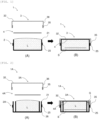
- Fig. 1 is a cross-sectional view of a device 1 according to the first embodiment of the present invention.
- Fig. 2 is a cross-sectional view of a device 1A according to a second embodiment.
- Fig. 3 is a cross-sectional view of a device 1B according to a third embodiment, not forming part of the present invention. Note that in each of the drawings in the present application, for ease of description, the size of each of members is enlarged as appropriate, and each of the illustrated members is not shown in the actual size.
- the container 2 accommodates a liquid L and the fragile object S.
- the liquid L by further adding the liquid L in a state where the container 2 is full with the liquid L, a convex surface is formed on a liquid surface due to surface tension of the liquid L ( Fig. 1 (A) ).
- the protecting member 4 in an inclined state is placed on the liquid surface, and comes into close contact with the rim portion 21 while pressing and leveling the convex surface. Since the container 2 is sealed with the protecting member 4 as described above, in a case where there are bubbles in the liquid surface, the inclined protecting member 4 applies a buoyant force to bubbles, and thereby the bubbles can be reliably pressed out.
- the protecting member 4 is sandwiched between the container and the lid member, and thereby a liquid-tight state in the container 2 is formed.
- the fluid-impermeable protecting member 4 blocks the gas. Thus, bubbles do not enter the container 2 and the fragile object S is not damaged.
- the lid member 3 When using the fragile object S, the lid member 3 is removed from the container 2. At this time, since the protecting member 4 and the lid member 3 are subjected to the water-repellent treatment, the protecting member 4 does not stick to the lid member 3. Therefore, even when the lid member 3 is removed from the container 2, the protecting member 4 can keep a liquid-tight state in the container 2. Next, as the protecting member 4 is removed by sliding in a horizontal direction and releasing the liquid-tight state, the protecting member 4 can be easily removed from the container 2. That is, in a case where there is no protecting member 4 between the lid member 3 and the container 2, the lid member 3 and the liquid surface come into direct and close contact with each other, and the lid member 3 pulls the liquid due to surface tension when removing the lid member 3.
- the protecting member 4 functions as a protecting mechanism that protects the liquid surface.
- Dimensional errors of the device 1 in a vertical direction and the horizontal direction may be absorbed by having an elastic seal member (for example, a packing) interposed between the container 2, the lid member 3, and the protecting member 4.
- the device since a liquid-tight state can be efficiently achieved with a simple mechanism and simple operation, the device is greatly advantageous in terms of operability and production costs. Since the inside of the container can be completely brought into the liquid-tight state, bubbles (gas) do not enter the container. Thus, the bubbles do not move in the container and the fragile object is not damaged due to shaking of the container during transportation. In particular, in a case where the fragile object is a laminate of sheet-like cell cultures, the bubbles do not move and thus the laminate does not shift or break. Therefore, the fragile object can be preserved over the long term while maintaining a shape of the fragile object in the liquid and preventing deformation.
- the device 1A includes a container 2A, a lid member 3A for sealing the container 2A, and a protecting member 4A.
- the container 2A has a shape of a general-purpose petri dish having the rim portion 21 that surrounds the opening portion, and has a tubular wall 26 that protrudes upward from a bottom portion.
- An accommodation space that can accommodate the fragile object S is formed inside the tubular wall 26 of the container 2A.
- a height of the tubular wall 26 is the same as a height of the rim portion 21 of the container 2A.
- the lid member 3A When the lid member 3A is attached to the container 2A, the lid member can come into close contact with both of the rim portion 21 of the container 2A and a rim portion of the tubular wall 26.
- the outer diameter of the protecting member 4A is smaller than the inner diameter of the rim portion 21 of the container 2A, and is larger than the outer diameter of a rim portion of the tubular wall 26.
- the protecting member 4A has a film shape or is film-shaped, having flexibility, and an inner surface of the lid member 3A is subjected to the water-repellent treatment.
- the liquid L and the fragile object S are accommodated inside the tubular wall 26 of the container 2A.
- a convex surface is formed on a liquid surface due to surface tension of the liquid L ( Fig. 2 (A) ).
- the protecting member 4A is placed on the liquid surface, and comes into close contact with the rim portion 21 while pressing and leveling the convex surface. Since the protecting member 4A has a film shape and can be slowly placed on the liquid surface, the liquid does not ripple.
- the protecting member 4A since a convex portion of the liquid L pressed out by the protecting member 4A is received by a space G outside the tubular wall 26 of the container 2A, the surroundings are not contaminated and the liquid L does not enter between the protecting member 4A and the lid member 3A. Therefore, when removing the lid member 3A, the protecting member 4A does not stick to the inside of the lid member 3A. Since the protecting member 4A can be sandwiched between the lid member 3A and the container 2A with a strong force by screwing the lid member 3A with the container 2A, liquid-tightness in the accommodation space can be maintained, and simultaneously the liquid L in the space G does not leak to the outside.
- the lid member 3A When using the fragile object S, the lid member 3A is removed from the container 2A. Since unevenness is formed in a plurality of places on the inner surface of the lid member 3A at this time, the protecting member 4A does not stick to the inside of the lid member 3A. Therefore, even when the lid member 3A is removed from the container 2A, the protecting member 4A can keep a liquid-tight state in the container 2A. Next, as the protecting member 4A is peeled off from the liquid surface so as to be wound up, a contact area with the liquid surface gradually decreases. Thus, ripples in the liquid surface can be suppressed to a minimum.
- the lid member 3A is pulled to the liquid surface when removing, and a repulsive force is generated at a moment when the lid member 3A comes off, thereby generating vibration in the liquid surface.
- the protecting member 4A is interposed between the container and the lid member, the vibration is not transmitted to the fragile object S since the protecting member 4A protects the liquid surface.
- Dimensional errors of the device 1A in the vertical direction and the horizontal direction may be absorbed by having an elastic seal member (for example, a packing) interposed between the container 2A, the lid member 3A, and the protecting member 4A.
- the device since a liquid-tight state can be efficiently achieved with a simple mechanism and simple operation, the device is greatly advantageous in terms of operability and production costs. Since the inside of the container can be completely brought into the liquid-tight state, bubbles (gas) do not enter the container. Thus, the bubbles do not move in the container and the fragile object is not damaged due to shaking of the container during transportation. In particular, in a case where the fragile object is a laminate of sheet-like cell cultures, the bubbles do not move and thus the laminate does not shift or break. Therefore, the fragile object can be preserved over the long term while maintaining a shape of the fragile object in the liquid and preventing deformation.
- the device 1B includes a container 2B, a lid member 3B for sealing the container 2B, and a protecting member 4B.
- the container 2B is a bottomed tubular container including an upper portion 22 and a lower portion 23, and the lower portion 23 configures a space that can accommodate the fragile object S.
- An inner diameter of the upper portion 22 is larger than an inner diameter of the lower portion 23, and a stepped portion 24 is provided at a boundary between the upper portion 22 and the lower portion 23.
- the lid member 3B has a projection portion 31 that protrudes downward from the top plate portion 32.
- the protecting member 4B is sandwiched between the projection portion 31 and the stepped portion 24, and a packing R for improving adhesion is provided between the protecting member 4B and the stepped portion 24.
- the protecting member 4B has a plurality of small holes provided therein, and can cause the liquid L to permeate therethrough.
- a packing R' having a U-shaped cross-sectional shape is provided between the rim portion 21 of the container 2B and the lid member 3B, and thus dimensional errors of the device 1B in the vertical direction and the horizontal direction can be absorbed.
- the container 2B accommodates the liquid L and the fragile object S.
- the liquid L fills up to a height exceeding the stepped portion 24, and the protecting member 4B is placed on the stepped portion 24 while inclining the protecting member.
- the protecting member 4B is sandwiched between the projection portion 31 and the stepped portion 24 of the container 2B by screwing the lid member 3B to the container 2B.
- the packing R interposed between the protecting unit 4B and the stepped portion 24 is pressed flat, thereby improving a liquid-tight state formed in the lower portion 23 of the container 2B.
- the liquid L pressed out by the projection portion 31 is housed in the space G between the upper portion 22 of the container 2B and the projection portion 31.
- the lid member 3B is removed from the container 2B. Since surface tension is not generated between the protecting member 4B and the lid member 3B by virtue of the plurality of small holes provided in the protecting member 4B, the protecting member 4B does not stick to the inside of the lid member 3B.
- spaces of the lower portion 23 and the upper portion 22 of the container 2B communicate with each other via the plurality of small holes in the protecting member 4B, that is, a liquid-tight state is released.
- the protecting member 4B is easily removed, and thus the fragile object can be taken out.
- the device since a liquid-tight state can be efficiently achieved with a simple mechanism and simple operation, the device is greatly advantageous in terms of operability and production costs. Since the inside of the container can be completely brought into the liquid-tight state, bubbles (gas) do not enter the container. Thus, the bubbles do not move in the container and the fragile object is not damaged due to shaking of the container during transportation. In particular, in a case where the fragile object is a laminate of sheet-like cell cultures, the bubbles do not move and thus the laminate does not shift or break. Therefore, the fragile object can be preserved over the long term while maintaining a shape of the fragile object in the liquid and preventing deformation.
- the device 1B according to the third embodiment since a liquid-tight state can be easily released, vibration of the container and generation of flow of the liquid, which are caused, for example, by an operator forcibly removing the lid member, can be suppressed, and thus the fragile object is not damaged.
- the use of the fragile object, in which the device of the present invention is used can be performed, for example, through the following steps in turn.
- Fig. 4 is a perspective view of a clip 7 according to a fourth embodiment of the present invention.
- Fig. 5 is a perspective view of a clip 7A according to a fifth embodiment of the present invention.
- Fig. 6 is a perspective view of a clip 7B according to a sixth embodiment of the present invention. Note that in each of the drawings in the present application, for ease of description, the size of each of members is enlarged as appropriate, and each of the illustrated members is not shown in the actual size.
- the clip 7 can press and sandwich the device including the container (not illustrated) and the lid member (not illustrated) for sealing the container such that the device is put therein from above and below.
- Both of the base member 8 and the cover member 9 have a circular shape, and can appropriately press the device from above and below.
- the base member 8 includes an opening portion 81, a bottom portion 82, a screwing portion (engagement portion) 83, a placement portion 84, and a ridge portion 85. Engagement means screwing in the embodiment.
- the placement portion 84 has a placement surface, on which the container can be placed, as an upper surface, and the opening portion 81 is provided in a center portion thereof.
- the placement portion 84 has the annular ridge portion 85 (elongated ridge) that surrounds a lower end of the container and can define a position where the container is positioned with respect to the base member 8, when the container is placed on the placement surface.
- the placement portion 84 has a disk shape that protrudes upward from the bottom portion 82, and the screwing portion 83 is provided on the outer peripheral side surface of the placement portion 84.
- the bottom portion 82 has an outer diameter larger than an outer diameter of the placement portion 84, and serves a role of a bottom portion when providing the base member 8 on a table.
- the cover member 9 includes an opening portion 91, a top portion 92, a screwing portion (engagement portion) 93, a tubular skirt wall 94, and a grip portion 95.
- the top portion 92 has a cover surface that can cover an upper surface of the lid member, and the opening portion 91 is provided in a center portion thereof.
- the top portion 92 includes the tubular skirt wall 94 hanging down from a rim of the top portion 92, and the device can be sandwiched by being surrounded with the top portion 92, the tubular skirt wall 94, and the placement portion 84.
- the screwing portion 93 (not illustrated) is provided on an inner peripheral surface of a lower end portion of the tubular skirt wall 94, and the cover member 9 can be screwed to the base member 8 by screwing such a screwing portion 93 with the screwing portion 83 of the base member 8.
- a position where the lid member is provided with respect to the clip 7 can also be defined by matching an inner diameter of at least a part of the tubular skirt wall 94 (for example, an inner peripheral surface of an upper end portion of the tubular skirt wall 94) with an outer diameter of the lid member.
- the container where the accommodation object S is accommodated is covered with the lid member.
- a liquid-tight space can also be formed.
- sealability can also be improved.
- the container is provided on the base member 8. At this time, the container can be positioned at the center of the placement portion 84 using the ridge portion 85.
- the screwing portion 83 of the base member 8 is provided below the placement portion 84, that is, the screwing portion 83 is not a structure that surrounds a side surface of the container, vibration can be suppressed by sliding the container in a lateral direction, when placing/removing the container to/from the placement portion 84.
- the cover member 9 is attached to the base member 8.
- the lid member can also be positioned at the center of the cover member 9 (and the base member 8) using the tubular skirt wall 94.
- the clip 7 can define relative positions of the container and the lid member using the ridge portion 85 of the base member 8 and the tubular skirt wall 94 of the cover member 9.
- the screwing portion 83 of the base member 8 and the screwing portion 93 of the cover member 9 are screwed with each other.
- the grip portion 95 provided on the outer peripheral surface of the tubular skirt wall 94 as a protruding portion may be a groove portion
- the container and the lid member can be fastened to each other from above and below with a strong force.
- the container is a container that does not have a screwing portion such as a general-purpose petri dish, and has high versatility.
- a configuration where the female screw portion 35 and the male screw portion 25 are omitted and the lid member does not rotate (is not screwed) with respect to the container may be adopted.
- torque of the lid member does not reach the protecting member interposed between the container and the lid member, the configuration is particularly advantageous.
- the configuration is advantageous since the seal member is accurately compressed between the container and the lid member of which relative positions are accurately determined, and thus sealablilty improves.
- a problem that the device is destroyed can be prevented since it is sufficient that the cover member 9 is screwed by a height of the screwing portion 83 of the base member 8, sandwiching operation is easy, and a sandwiching pressure can be easily adjusted.
- both of the base member 8 and the cover member 9 have the opening portion 81 and the opening portion 91, respectively, at the center portions, a position where the device is fixed and a state of the liquid L and the accommodation object S accommodated in the device can be observed at all times.
- This is particularly advantageous in a case where the container and the lid member are made of a light-transmitting material.
- the fragile object is an object having low visibility such as a sheet-like cell culture since light can be emitted from one opening portion and the sheet-like cell culture can be viewed from the other opening portion.
- the lid member in a case of forming a liquid-tight space as described above, the lid member can be pressed against the container while checking if bubbles or foreign substances are mixed in the container via the opening portion 91.
- the device is transported. Since the device is firmly sandwiched in the clip 7, a problem that the lid member comes off the container due to shaking during transportation can be prevented. Since the surroundings are surrounded by the clip 7, the device is protected from outside shock. Finally, the clip 7 is removed from the device at a destination and is used.
- the screwing portion 83 and the screwing portion 93 can be replaced with other engagement means that has a function of pressing the device from above and below, such as slide engagement (for example, refer to JP-A-2006-315757 ), flange fitting (for example, refer to JP-A-2006-001582 ), and ridge engagement (for example, refer to JP-A-2016-203985 ).
- the annular ridge portion 85 can be replaced with other means that can position the container on the placement surface, such as a plurality of annularly disposed protrusions.
- the accommodation object S for example, the fragile object (for example, a laminate of sheet-like cell cultures) can also be accommodated. In this case, by making the inside of the container liquid-tight, the fragile object can be transported while maintaining the shape of the fragile object.
- the clip 7A includes a base member 8A and a cover member 9A.
- the base member 8A further includes protruding walls 86, a groove portion 87, and a notch portion 88.
- the plurality of protruding walls 86 are walls that are provided outside the ridge portion 85 and protrude to exceed a height of the container from the placement portion 84.
- the groove portion 87 is provided in a lower surface of the bottom portion 82 of the base member 8A.
- the base member 8A can be prevented from sticking to an operation surface when providing the base member 8A on a table.
- the container (not illustrated) is positioned at the center of the base member 8A using the ridge portion 85.
- the lid member can be positioned at the center of the base member 8A by causing the lid member to follow the protruding walls 86 when covering the container with the lid member (not illustrated). That is, an operator can define relative positions of the container and the lid member using the ridge portion 85 and the protruding walls 86 of the base member 8A. This is particularly advantageous in that the seal member can be accurately pressed in a case where the annular seal member is interposed between the container and the lid member.
- the device (not illustrated) is sandwiched.
- screwing operation can be easily performed by gripping the grip portion 95 configured as the protruding portion that radially protrudes from the cover member 9A and the notch portion 88 provided in a side surface of the bottom portion 82 of the base member 8A.
- screwing of the cover member 9A is released to remove the device from the base member 8A.
- the lid member can be accurately positioned with respect to the container.
- the clip 7B includes a cover member (not illustrated) and a base member 8B.
- the base member 8B includes a placement portion 84B, a ridge portion 85B, and protruding walls 86B (description of other configurations will be omitted).
- the ridge portion 85B is semiannularly disposed on the placement portion 84B.
- the protruding walls 86B are semiannularly disposed outside the ridge portion 85B, and a notch (gap) C is provided in a part thereof (the two or more protruding walls 86B may be semiannularly disposed with a gap provided). That is, in the embodiment, one side half of a placement surface of the placement portion 84B (an opposite side half to the ridge portion 85B and the protruding walls 86B) is configured as a flat surface.
- the container (not illustrated) is provided to slide from an opposite side to the ridge portion 85B and the protruding walls 86B in the lateral direction (a direction of the ridge portion 85B and the protruding walls 86B). At this time, by causing the container to slide on a flat surface of the placement portion 84B, unintended vibration of the container can be suppressed.
- the lid member (not illustrated) is attached to the container. At this time, by pressing the lid member against the protruding walls 86B of the base member 8B, the lid member can be accurately positioned with respect to the container.
- the device (not illustrated) the device is removed from the base member 8B.
- a projection portion 89 which is a mark, may be provided on a side facing the notch C on the placement portion 84B such that a sliding direction is easily noticed when sliding the device 1 on the base member 8B. Accordingly, the device 1 can be accurately positioned on the placement portion 84B simply by sliding the device 1 between the projection portion 89 and the notch C.
- the device 1 can also be made to not be shifted by adopting a configuration where the projection portion 89 is disposed on an extension line of the ridge portion 85B to face the notch C and the side surface of the device 1 is locked by the projection portion 89.
- the device since the container and a lid member can be efficiently brought into close contact with each other with a simple mechanism and simple operation, the device is greatly advantageous in terms of operability and production costs.
- the accommodation object in the container can be viewed from the outside, a state of the accommodation object and mixing of foreign substances can be easily checked.
- sealablilty improves.
- the seal member can be accurately pressed in a case where the elastic seal member is interposed between the container and the lid member, sealablilty improves further.
- the container and the lid member can be fixed by reliably bringing into close contact with each other, a problem that the lid member comes off the container during transportation can be prevented.
- the accommodation object is a laminate of sheet-like cell cultures
- the laminate can be prevented from shifting or breaking as bubbles enter and move in the container, and the laminate can be preserved over the long term while maintaining a shape thereof and preventing deformation.
- the cover member 9 or the cover member 9A may be combined with the base member 8, the base member 8A, or the base member 8B.
- the ridge portion 85, the ridge portion 85B, the protruding wall 86, or the protruding wall 86B may be combined with the base member 8, the base member 8A, or the base member 8B.
Landscapes
- Life Sciences & Earth Sciences (AREA)
- Engineering & Computer Science (AREA)
- Health & Medical Sciences (AREA)
- Zoology (AREA)
- Wood Science & Technology (AREA)
- General Health & Medical Sciences (AREA)
- Organic Chemistry (AREA)
- Bioinformatics & Cheminformatics (AREA)
- Biomedical Technology (AREA)
- Chemical & Material Sciences (AREA)
- Mechanical Engineering (AREA)
- Environmental Sciences (AREA)
- Dentistry (AREA)
- Biotechnology (AREA)
- Sustainable Development (AREA)
- Microbiology (AREA)
- Biochemistry (AREA)
- General Engineering & Computer Science (AREA)
- Genetics & Genomics (AREA)
- Virology (AREA)
- Cell Biology (AREA)
- Evolutionary Biology (AREA)
- Marine Sciences & Fisheries (AREA)
- Toxicology (AREA)
- Apparatus Associated With Microorganisms And Enzymes (AREA)
Claims (9)
- Un dispositif (1, 1A) comprenant :un récipient (2, 2A) pour loger un objet fragile ;un élément de couvercle (3, 3A) pour sceller le récipient ; etun élément de protection en forme de plaque ou de film (4, 4A),le dispositif étant capable de former un espace étanche aux liquides en recouvrant une surface de liquide dans le récipient, qui est configuré pour recevoir l'objet fragile et un liquide, avec l'élément de protection et en recouvrant en outre l'élément de protection et une portion d'ouverture du récipient avec l'élément de couvercle,et dans lequel ledit élément de protection est amovible en coulissant dans une direction horizontale dans le cas où il est en forme de plaque ou en étant décollé de la surface de liquide dans le cas où il est en forme de film.
- Le dispositif (1, 1A) selon la revendication 1,
dans lequel l'élément de protection (4, 4A) et/ou l'élément de couvercle (3, 3A) sont soumis à un traitement hydrofuge. - Le dispositif (1, 1A) selon la revendication 1 ou 2,
dans lequel l'élément de protection (4, 4A) présente une flexibilité. - Le dispositif (1, 1A) selon l'une quelconque des revendications 1 à 3,
dans lequel l'élément de protection (4, 4A) est imperméable aux fluides. - Le dispositif (1, 1A) selon l'une quelconque des revendications 1 à 4,
dans lequel l'élément de protection (4, 4A) est configuré pour être pris en sandwich entre l'élément de couvercle (3, 3A) et le récipient (2, 2A). - Le dispositif (1, 1A) selon l'une quelconque des revendications 1 à 5, comprenant en outre :
un espace qui est configuré pour loger un liquide expulsé. - Utilisation du dispositif (1, 1A) selon l'une quelconque des revendications 1 à 6 pour loger un objet fragile,
dans laquelle l'objet fragile est une culture cellulaire de type feuille. - Utilisation selon la revendication 7,
dans laquelle la culture cellulaire de type feuille est un stratifié. - Un kit de parties comprenant :un dispositif (1, 1A) selon l'une quelconque des revendications 1 à 6 ; etune attache (7, 7A, 7B) comprenant :
un élément de couvercle (9, 9A) et un élément de base (8, 8A, 8B) qui sont configurés pour presser et prendre en sandwich ledit dispositif (1, 1A) depuis le haut et le bas.
Applications Claiming Priority (2)
| Application Number | Priority Date | Filing Date | Title |
|---|---|---|---|
| JP2017241716 | 2017-12-18 | ||
| PCT/JP2018/046483 WO2019124339A1 (fr) | 2017-12-18 | 2018-12-18 | Dispositif de retenue d'objet fragile pourvu d'un mécanisme de protection |
Publications (3)
| Publication Number | Publication Date |
|---|---|
| EP3722411A1 EP3722411A1 (fr) | 2020-10-14 |
| EP3722411A4 EP3722411A4 (fr) | 2021-02-17 |
| EP3722411B1 true EP3722411B1 (fr) | 2024-10-16 |
Family
ID=66993443
Family Applications (1)
| Application Number | Title | Priority Date | Filing Date |
|---|---|---|---|
| EP18891287.7A Active EP3722411B1 (fr) | 2017-12-18 | 2018-12-18 | Dispositif de retenue d'objet fragile pourvu d'un mécanisme de protection |
Country Status (5)
| Country | Link |
|---|---|
| US (1) | US11420805B2 (fr) |
| EP (1) | EP3722411B1 (fr) |
| JP (1) | JP7210472B2 (fr) |
| SG (1) | SG11202005176UA (fr) |
| WO (1) | WO2019124339A1 (fr) |
Families Citing this family (3)
| Publication number | Priority date | Publication date | Assignee | Title |
|---|---|---|---|---|
| SG11201913105UA (en) * | 2017-07-20 | 2020-02-27 | Terumo Corp | Fragile object preserving device having seal mechanism |
| CN112334570B (zh) * | 2018-07-10 | 2024-02-09 | 泰尔茂株式会社 | 用于移送移植片的装置 |
| EP3896144A4 (fr) | 2018-12-18 | 2022-02-16 | TERUMO Kabushiki Kaisha | Outil de préhension |
Family Cites Families (17)
| Publication number | Priority date | Publication date | Assignee | Title |
|---|---|---|---|---|
| US2943387A (en) * | 1957-10-24 | 1960-07-05 | Lukens Steel Co | Process of circumferentially welding steel pipe |
| US4415076A (en) * | 1981-11-23 | 1983-11-15 | Campbell Charles E | Soft contact lens container |
| JPH0695927B2 (ja) * | 1992-03-18 | 1994-11-30 | 島久薬品株式会社 | 培地形成具 |
| US5891617A (en) * | 1993-09-15 | 1999-04-06 | Organogenesis Inc. | Cryopreservation of harvested skin and cultured skin or cornea equivalents by slow freezing |
| JP2006001582A (ja) | 2004-06-17 | 2006-01-05 | Makoto Watanabe | 樹脂製嵌合容器 |
| JP4134105B2 (ja) | 2005-05-13 | 2008-08-13 | 有己 古野 | 中蓋の脱着構造 |
| US7784608B2 (en) * | 2005-10-20 | 2010-08-31 | Johnson & Johnson Vision Care, Inc. | Contact lens packages |
| JP4896494B2 (ja) * | 2005-10-31 | 2012-03-14 | 株式会社 ジャパン・ティッシュ・エンジニアリング | 培養組織のための包装体及び培養組織包装体 |
| US8999703B2 (en) * | 2008-05-05 | 2015-04-07 | Daniel P. Welch | Cell container |
| JP4572258B2 (ja) * | 2009-01-09 | 2010-11-04 | 株式会社 ジャパン・ティッシュ・エンジニアリング | 培養細胞シート包装体 |
| JP5775295B2 (ja) | 2010-12-22 | 2015-09-09 | テルモ株式会社 | 膜状組織の保存輸送容器及び保存輸送方法 |
| JP6104176B2 (ja) * | 2011-12-21 | 2017-03-29 | テルモ株式会社 | 膜状組織の保存輸送容器及び保存輸送方法 |
| JP5982492B2 (ja) * | 2012-09-11 | 2016-08-31 | 株式会社日立製作所 | 生体試料用包装容器及びそれを用いた生体試料の輸送方法 |
| JP6248476B2 (ja) * | 2013-08-29 | 2017-12-20 | 大日本印刷株式会社 | 加振装置 |
| JP6548440B2 (ja) | 2015-04-15 | 2019-07-24 | 東京ライト工業株式会社 | 容器及びキャップ |
| JP6711825B2 (ja) * | 2015-06-24 | 2020-06-17 | 株式会社サンプラテック | 培養容器輸送用セットおよび細胞・生体組織輸送ユニット |
| SG11201913105UA (en) * | 2017-07-20 | 2020-02-27 | Terumo Corp | Fragile object preserving device having seal mechanism |
-
2018
- 2018-12-18 EP EP18891287.7A patent/EP3722411B1/fr active Active
- 2018-12-18 WO PCT/JP2018/046483 patent/WO2019124339A1/fr not_active Ceased
- 2018-12-18 JP JP2019561092A patent/JP7210472B2/ja active Active
- 2018-12-18 SG SG11202005176UA patent/SG11202005176UA/en unknown
-
2020
- 2020-06-17 US US16/903,860 patent/US11420805B2/en active Active
Also Published As
| Publication number | Publication date |
|---|---|
| EP3722411A1 (fr) | 2020-10-14 |
| WO2019124339A1 (fr) | 2019-06-27 |
| JP7210472B2 (ja) | 2023-01-23 |
| JPWO2019124339A1 (ja) | 2020-12-10 |
| US20200307889A1 (en) | 2020-10-01 |
| SG11202005176UA (en) | 2020-07-29 |
| US11420805B2 (en) | 2022-08-23 |
| EP3722411A4 (fr) | 2021-02-17 |
Similar Documents
| Publication | Publication Date | Title |
|---|---|---|
| US12016329B2 (en) | Fragile object preserving device provided with sealing mechanism | |
| US12004507B2 (en) | Device for transporting graft | |
| US11420805B2 (en) | Fragile object holding device provided with protecting mechanism | |
| JP2023101552A (ja) | 挟持具 | |
| JP7108614B2 (ja) | 連通機構を具備する脆弱物保持デバイス | |
| WO2020013174A1 (fr) | Dispositif pour le transfert d'un greffon | |
| JP2019017346A (ja) | 係止機構を具備する脆弱物保持デバイス | |
| JP7039202B2 (ja) | 液体受容空間を具備する脆弱物保持デバイス | |
| JP7241029B2 (ja) | 注入機構を具備する脆弱物保持デバイス | |
| JP7550537B2 (ja) | 移植片を移送するための容器 | |
| JP7181200B2 (ja) | 脆弱物保持デバイス | |
| JP2019019107A (ja) | 液体保持空間を具備する脆弱物保持デバイス | |
| JP2019017343A (ja) | ガイド機構を具備する脆弱物保持デバイス | |
| JP7175892B2 (ja) | 摺動機構を具備する脆弱物保持デバイス | |
| JP2020005578A (ja) | 検体回収機構を具備する移植片収容デバイス | |
| JP2020005579A (ja) | 検体回収機構を具備する移植片収容デバイス | |
| JP2019017347A (ja) | メッシュ機構を具備する脆弱物保持デバイス | |
| JP2020007271A (ja) | 移植片を収容するためのデバイス |
Legal Events
| Date | Code | Title | Description |
|---|---|---|---|
| STAA | Information on the status of an ep patent application or granted ep patent |
Free format text: STATUS: THE INTERNATIONAL PUBLICATION HAS BEEN MADE |
|
| PUAI | Public reference made under article 153(3) epc to a published international application that has entered the european phase |
Free format text: ORIGINAL CODE: 0009012 |
|
| STAA | Information on the status of an ep patent application or granted ep patent |
Free format text: STATUS: REQUEST FOR EXAMINATION WAS MADE |
|
| 17P | Request for examination filed |
Effective date: 20200709 |
|
| AK | Designated contracting states |
Kind code of ref document: A1 Designated state(s): AL AT BE BG CH CY CZ DE DK EE ES FI FR GB GR HR HU IE IS IT LI LT LU LV MC MK MT NL NO PL PT RO RS SE SI SK SM TR |
|
| AX | Request for extension of the european patent |
Extension state: BA ME |
|
| A4 | Supplementary search report drawn up and despatched |
Effective date: 20210115 |
|
| RIC1 | Information provided on ipc code assigned before grant |
Ipc: C12M 3/04 20060101ALI20210111BHEP Ipc: C12M 3/00 20060101ALI20210111BHEP Ipc: A01N 1/02 20060101AFI20210111BHEP |
|
| DAV | Request for validation of the european patent (deleted) | ||
| DAX | Request for extension of the european patent (deleted) | ||
| REG | Reference to a national code |
Ref legal event code: R079 Free format text: PREVIOUS MAIN CLASS: C12M0003000000 Ref country code: DE Ref legal event code: R079 Ref document number: 602018075629 Country of ref document: DE Free format text: PREVIOUS MAIN CLASS: C12M0003000000 Ipc: A01N0001020000 |
|
| GRAP | Despatch of communication of intention to grant a patent |
Free format text: ORIGINAL CODE: EPIDOSNIGR1 |
|
| STAA | Information on the status of an ep patent application or granted ep patent |
Free format text: STATUS: GRANT OF PATENT IS INTENDED |
|
| RIC1 | Information provided on ipc code assigned before grant |
Ipc: A01N 1/02 20060101AFI20240618BHEP |
|
| INTG | Intention to grant announced |
Effective date: 20240704 |
|
| GRAS | Grant fee paid |
Free format text: ORIGINAL CODE: EPIDOSNIGR3 |
|
| GRAA | (expected) grant |
Free format text: ORIGINAL CODE: 0009210 |
|
| STAA | Information on the status of an ep patent application or granted ep patent |
Free format text: STATUS: THE PATENT HAS BEEN GRANTED |
|
| AK | Designated contracting states |
Kind code of ref document: B1 Designated state(s): AL AT BE BG CH CY CZ DE DK EE ES FI FR GB GR HR HU IE IS IT LI LT LU LV MC MK MT NL NO PL PT RO RS SE SI SK SM TR |
|
| REG | Reference to a national code |
Ref country code: GB Ref legal event code: FG4D |
|
| REG | Reference to a national code |
Ref country code: CH Ref legal event code: EP |
|
| REG | Reference to a national code |
Ref country code: IE Ref legal event code: FG4D |
|
| REG | Reference to a national code |
Ref country code: DE Ref legal event code: R096 Ref document number: 602018075629 Country of ref document: DE |
|
| REG | Reference to a national code |
Ref country code: DE Ref legal event code: R079 Ref document number: 602018075629 Country of ref document: DE Free format text: PREVIOUS MAIN CLASS: A01N0001020000 Ipc: A01N0001100000 |
|
| REG | Reference to a national code |
Ref country code: LT Ref legal event code: MG9D |
|
| REG | Reference to a national code |
Ref country code: NL Ref legal event code: MP Effective date: 20241016 |
|
| REG | Reference to a national code |
Ref country code: AT Ref legal event code: MK05 Ref document number: 1732135 Country of ref document: AT Kind code of ref document: T Effective date: 20241016 |
|
| PG25 | Lapsed in a contracting state [announced via postgrant information from national office to epo] |
Ref country code: NL Free format text: LAPSE BECAUSE OF FAILURE TO SUBMIT A TRANSLATION OF THE DESCRIPTION OR TO PAY THE FEE WITHIN THE PRESCRIBED TIME-LIMIT Effective date: 20241016 |
|
| PG25 | Lapsed in a contracting state [announced via postgrant information from national office to epo] |
Ref country code: NL Free format text: LAPSE BECAUSE OF FAILURE TO SUBMIT A TRANSLATION OF THE DESCRIPTION OR TO PAY THE FEE WITHIN THE PRESCRIBED TIME-LIMIT Effective date: 20241016 |
|
| PG25 | Lapsed in a contracting state [announced via postgrant information from national office to epo] |
Ref country code: IS Free format text: LAPSE BECAUSE OF FAILURE TO SUBMIT A TRANSLATION OF THE DESCRIPTION OR TO PAY THE FEE WITHIN THE PRESCRIBED TIME-LIMIT Effective date: 20250216 Ref country code: HR Free format text: LAPSE BECAUSE OF FAILURE TO SUBMIT A TRANSLATION OF THE DESCRIPTION OR TO PAY THE FEE WITHIN THE PRESCRIBED TIME-LIMIT Effective date: 20241016 Ref country code: PT Free format text: LAPSE BECAUSE OF FAILURE TO SUBMIT A TRANSLATION OF THE DESCRIPTION OR TO PAY THE FEE WITHIN THE PRESCRIBED TIME-LIMIT Effective date: 20250217 |
|
| PG25 | Lapsed in a contracting state [announced via postgrant information from national office to epo] |
Ref country code: FI Free format text: LAPSE BECAUSE OF FAILURE TO SUBMIT A TRANSLATION OF THE DESCRIPTION OR TO PAY THE FEE WITHIN THE PRESCRIBED TIME-LIMIT Effective date: 20241016 |
|
| PG25 | Lapsed in a contracting state [announced via postgrant information from national office to epo] |
Ref country code: BG Free format text: LAPSE BECAUSE OF FAILURE TO SUBMIT A TRANSLATION OF THE DESCRIPTION OR TO PAY THE FEE WITHIN THE PRESCRIBED TIME-LIMIT Effective date: 20241016 |
|
| PG25 | Lapsed in a contracting state [announced via postgrant information from national office to epo] |
Ref country code: ES Free format text: LAPSE BECAUSE OF FAILURE TO SUBMIT A TRANSLATION OF THE DESCRIPTION OR TO PAY THE FEE WITHIN THE PRESCRIBED TIME-LIMIT Effective date: 20241016 |
|
| PG25 | Lapsed in a contracting state [announced via postgrant information from national office to epo] |
Ref country code: NO Free format text: LAPSE BECAUSE OF FAILURE TO SUBMIT A TRANSLATION OF THE DESCRIPTION OR TO PAY THE FEE WITHIN THE PRESCRIBED TIME-LIMIT Effective date: 20250116 |
|
| PG25 | Lapsed in a contracting state [announced via postgrant information from national office to epo] |
Ref country code: GR Free format text: LAPSE BECAUSE OF FAILURE TO SUBMIT A TRANSLATION OF THE DESCRIPTION OR TO PAY THE FEE WITHIN THE PRESCRIBED TIME-LIMIT Effective date: 20250117 Ref country code: LV Free format text: LAPSE BECAUSE OF FAILURE TO SUBMIT A TRANSLATION OF THE DESCRIPTION OR TO PAY THE FEE WITHIN THE PRESCRIBED TIME-LIMIT Effective date: 20241016 Ref country code: AT Free format text: LAPSE BECAUSE OF FAILURE TO SUBMIT A TRANSLATION OF THE DESCRIPTION OR TO PAY THE FEE WITHIN THE PRESCRIBED TIME-LIMIT Effective date: 20241016 |
|
| PG25 | Lapsed in a contracting state [announced via postgrant information from national office to epo] |
Ref country code: PL Free format text: LAPSE BECAUSE OF FAILURE TO SUBMIT A TRANSLATION OF THE DESCRIPTION OR TO PAY THE FEE WITHIN THE PRESCRIBED TIME-LIMIT Effective date: 20241016 |
|
| PG25 | Lapsed in a contracting state [announced via postgrant information from national office to epo] |
Ref country code: RS Free format text: LAPSE BECAUSE OF FAILURE TO SUBMIT A TRANSLATION OF THE DESCRIPTION OR TO PAY THE FEE WITHIN THE PRESCRIBED TIME-LIMIT Effective date: 20250116 |
|
| PG25 | Lapsed in a contracting state [announced via postgrant information from national office to epo] |
Ref country code: SM Free format text: LAPSE BECAUSE OF FAILURE TO SUBMIT A TRANSLATION OF THE DESCRIPTION OR TO PAY THE FEE WITHIN THE PRESCRIBED TIME-LIMIT Effective date: 20241016 |
|
| PG25 | Lapsed in a contracting state [announced via postgrant information from national office to epo] |
Ref country code: MC Free format text: LAPSE BECAUSE OF FAILURE TO SUBMIT A TRANSLATION OF THE DESCRIPTION OR TO PAY THE FEE WITHIN THE PRESCRIBED TIME-LIMIT Effective date: 20241016 |
|
| PG25 | Lapsed in a contracting state [announced via postgrant information from national office to epo] |
Ref country code: DK Free format text: LAPSE BECAUSE OF FAILURE TO SUBMIT A TRANSLATION OF THE DESCRIPTION OR TO PAY THE FEE WITHIN THE PRESCRIBED TIME-LIMIT Effective date: 20241016 |
|
| REG | Reference to a national code |
Ref country code: DE Ref legal event code: R097 Ref document number: 602018075629 Country of ref document: DE |
|
| PG25 | Lapsed in a contracting state [announced via postgrant information from national office to epo] |
Ref country code: EE Free format text: LAPSE BECAUSE OF FAILURE TO SUBMIT A TRANSLATION OF THE DESCRIPTION OR TO PAY THE FEE WITHIN THE PRESCRIBED TIME-LIMIT Effective date: 20241016 |
|
| PG25 | Lapsed in a contracting state [announced via postgrant information from national office to epo] |
Ref country code: RO Free format text: LAPSE BECAUSE OF FAILURE TO SUBMIT A TRANSLATION OF THE DESCRIPTION OR TO PAY THE FEE WITHIN THE PRESCRIBED TIME-LIMIT Effective date: 20241016 |
|
| PG25 | Lapsed in a contracting state [announced via postgrant information from national office to epo] |
Ref country code: SK Free format text: LAPSE BECAUSE OF FAILURE TO SUBMIT A TRANSLATION OF THE DESCRIPTION OR TO PAY THE FEE WITHIN THE PRESCRIBED TIME-LIMIT Effective date: 20241016 |
|
| PG25 | Lapsed in a contracting state [announced via postgrant information from national office to epo] |
Ref country code: CZ Free format text: LAPSE BECAUSE OF FAILURE TO SUBMIT A TRANSLATION OF THE DESCRIPTION OR TO PAY THE FEE WITHIN THE PRESCRIBED TIME-LIMIT Effective date: 20241016 |
|
| PG25 | Lapsed in a contracting state [announced via postgrant information from national office to epo] |
Ref country code: IT Free format text: LAPSE BECAUSE OF FAILURE TO SUBMIT A TRANSLATION OF THE DESCRIPTION OR TO PAY THE FEE WITHIN THE PRESCRIBED TIME-LIMIT Effective date: 20241016 |
|
| REG | Reference to a national code |
Ref country code: CH Ref legal event code: PL |
|
| PG25 | Lapsed in a contracting state [announced via postgrant information from national office to epo] |
Ref country code: LU Free format text: LAPSE BECAUSE OF NON-PAYMENT OF DUE FEES Effective date: 20241218 |
|
| PLBE | No opposition filed within time limit |
Free format text: ORIGINAL CODE: 0009261 |
|
| STAA | Information on the status of an ep patent application or granted ep patent |
Free format text: STATUS: NO OPPOSITION FILED WITHIN TIME LIMIT |
|
| PG25 | Lapsed in a contracting state [announced via postgrant information from national office to epo] |
Ref country code: SE Free format text: LAPSE BECAUSE OF FAILURE TO SUBMIT A TRANSLATION OF THE DESCRIPTION OR TO PAY THE FEE WITHIN THE PRESCRIBED TIME-LIMIT Effective date: 20241016 |
|
| 26N | No opposition filed |
Effective date: 20250717 |
|
| GBPC | Gb: european patent ceased through non-payment of renewal fee |
Effective date: 20250116 |
|
| REG | Reference to a national code |
Ref country code: BE Ref legal event code: MM Effective date: 20241231 |
|
| PG25 | Lapsed in a contracting state [announced via postgrant information from national office to epo] |
Ref country code: GB Free format text: LAPSE BECAUSE OF NON-PAYMENT OF DUE FEES Effective date: 20250116 Ref country code: BE Free format text: LAPSE BECAUSE OF NON-PAYMENT OF DUE FEES Effective date: 20241231 |
|
| PG25 | Lapsed in a contracting state [announced via postgrant information from national office to epo] |
Ref country code: FR Free format text: LAPSE BECAUSE OF NON-PAYMENT OF DUE FEES Effective date: 20241231 |
|
| PG25 | Lapsed in a contracting state [announced via postgrant information from national office to epo] |
Ref country code: CH Free format text: LAPSE BECAUSE OF NON-PAYMENT OF DUE FEES Effective date: 20241231 |
|
| PG25 | Lapsed in a contracting state [announced via postgrant information from national office to epo] |
Ref country code: IE Free format text: LAPSE BECAUSE OF NON-PAYMENT OF DUE FEES Effective date: 20241218 |
|
| PGFP | Annual fee paid to national office [announced via postgrant information from national office to epo] |
Ref country code: DE Payment date: 20251028 Year of fee payment: 8 |