EP3723006A1 - Signalverarbeitungsverfahren und -vorrichtung - Google Patents
Signalverarbeitungsverfahren und -vorrichtung Download PDFInfo
- Publication number
- EP3723006A1 EP3723006A1 EP18896329.2A EP18896329A EP3723006A1 EP 3723006 A1 EP3723006 A1 EP 3723006A1 EP 18896329 A EP18896329 A EP 18896329A EP 3723006 A1 EP3723006 A1 EP 3723006A1
- Authority
- EP
- European Patent Office
- Prior art keywords
- matrix
- matrix multiplication
- fractal
- multiplication
- cache
- Prior art date
- Legal status (The legal status is an assumption and is not a legal conclusion. Google has not performed a legal analysis and makes no representation as to the accuracy of the status listed.)
- Granted
Links
Images


Classifications
-
- G—PHYSICS
- G06—COMPUTING OR CALCULATING; COUNTING
- G06F—ELECTRIC DIGITAL DATA PROCESSING
- G06F17/00—Digital computing or data processing equipment or methods, specially adapted for specific functions
- G06F17/10—Complex mathematical operations
- G06F17/16—Matrix or vector computation, e.g. matrix-matrix or matrix-vector multiplication, matrix factorization
-
- G—PHYSICS
- G06—COMPUTING OR CALCULATING; COUNTING
- G06N—COMPUTING ARRANGEMENTS BASED ON SPECIFIC COMPUTATIONAL MODELS
- G06N3/00—Computing arrangements based on biological models
- G06N3/02—Neural networks
- G06N3/04—Architecture, e.g. interconnection topology
-
- G—PHYSICS
- G06—COMPUTING OR CALCULATING; COUNTING
- G06N—COMPUTING ARRANGEMENTS BASED ON SPECIFIC COMPUTATIONAL MODELS
- G06N3/00—Computing arrangements based on biological models
- G06N3/02—Neural networks
- G06N3/04—Architecture, e.g. interconnection topology
- G06N3/045—Combinations of networks
-
- G—PHYSICS
- G06—COMPUTING OR CALCULATING; COUNTING
- G06N—COMPUTING ARRANGEMENTS BASED ON SPECIFIC COMPUTATIONAL MODELS
- G06N3/00—Computing arrangements based on biological models
- G06N3/02—Neural networks
- G06N3/04—Architecture, e.g. interconnection topology
- G06N3/0464—Convolutional networks [CNN, ConvNet]
-
- G—PHYSICS
- G06—COMPUTING OR CALCULATING; COUNTING
- G06N—COMPUTING ARRANGEMENTS BASED ON SPECIFIC COMPUTATIONAL MODELS
- G06N3/00—Computing arrangements based on biological models
- G06N3/02—Neural networks
- G06N3/06—Physical realisation, i.e. hardware implementation of neural networks, neurons or parts of neurons
- G06N3/063—Physical realisation, i.e. hardware implementation of neural networks, neurons or parts of neurons using electronic means
-
- G—PHYSICS
- G06—COMPUTING OR CALCULATING; COUNTING
- G06N—COMPUTING ARRANGEMENTS BASED ON SPECIFIC COMPUTATIONAL MODELS
- G06N3/00—Computing arrangements based on biological models
- G06N3/02—Neural networks
- G06N3/08—Learning methods
-
- G—PHYSICS
- G06—COMPUTING OR CALCULATING; COUNTING
- G06V—IMAGE OR VIDEO RECOGNITION OR UNDERSTANDING
- G06V10/00—Arrangements for image or video recognition or understanding
- G06V10/40—Extraction of image or video features
- G06V10/44—Local feature extraction by analysis of parts of the pattern, e.g. by detecting edges, contours, loops, corners, strokes or intersections; Connectivity analysis, e.g. of connected components
- G06V10/443—Local feature extraction by analysis of parts of the pattern, e.g. by detecting edges, contours, loops, corners, strokes or intersections; Connectivity analysis, e.g. of connected components by matching or filtering
- G06V10/449—Biologically inspired filters, e.g. difference of Gaussians [DoG] or Gabor filters
- G06V10/451—Biologically inspired filters, e.g. difference of Gaussians [DoG] or Gabor filters with interaction between the filter responses, e.g. cortical complex cells
- G06V10/454—Integrating the filters into a hierarchical structure, e.g. convolutional neural networks [CNN]
-
- G—PHYSICS
- G06—COMPUTING OR CALCULATING; COUNTING
- G06V—IMAGE OR VIDEO RECOGNITION OR UNDERSTANDING
- G06V10/00—Arrangements for image or video recognition or understanding
- G06V10/70—Arrangements for image or video recognition or understanding using pattern recognition or machine learning
- G06V10/764—Arrangements for image or video recognition or understanding using pattern recognition or machine learning using classification, e.g. of video objects
-
- G—PHYSICS
- G06—COMPUTING OR CALCULATING; COUNTING
- G06V—IMAGE OR VIDEO RECOGNITION OR UNDERSTANDING
- G06V10/00—Arrangements for image or video recognition or understanding
- G06V10/70—Arrangements for image or video recognition or understanding using pattern recognition or machine learning
- G06V10/82—Arrangements for image or video recognition or understanding using pattern recognition or machine learning using neural networks
-
- G—PHYSICS
- G06—COMPUTING OR CALCULATING; COUNTING
- G06V—IMAGE OR VIDEO RECOGNITION OR UNDERSTANDING
- G06V40/00—Recognition of biometric, human-related or animal-related patterns in image or video data
- G06V40/10—Human or animal bodies, e.g. vehicle occupants or pedestrians; Body parts, e.g. hands
- G06V40/16—Human faces, e.g. facial parts, sketches or expressions
- G06V40/172—Classification, e.g. identification
Definitions
- Embodiments of this application relate to the field of computer technologies, and in particular, to a signal processing method and apparatus.
- a neural network is a network structure that imitates an animal neural network behavior characteristic to perform information processing.
- the structure includes a large quantity of nodes (or neurons) connected to each other, and is used to process information by learning and training input information based on a specific operation model.
- a neural network includes an input layer, a hidden layer, and an output layer.
- the input layer is responsible for receiving an input signal.
- the output layer is responsible for outputting a calculation result of the neural network.
- the hidden layer is responsible for calculation processes such as learning and training, and is a memory unit of the network.
- a memory function of the hidden layer is represented by a weight matrix. Generally, each neuron corresponds to a weight coefficient.
- a convolutional neural network (Convolutional Neural Network, CNN) is a multi-layer neural network, in which each layer includes a plurality of two-dimensional planes, each plane includes a plurality of independent neurons, a plurality of neurons in each plane share a weight, and a quantity of parameters in the neural network can be reduced by weight sharing.
- a convolution operation performed by a processor is usually as follows: converting convolution of an input signal feature and a weight into a matrix multiplication operation between a signal matrix and a weight matrix.
- the signal matrix and the weight matrix are partitioned to obtain a plurality of fractal (Fractal) signal matrices and fractal weight matrices, and then matrix multiplication and accumulation operations are performed on the plurality of fractal signal matrices and fractal weight matrices.
- fractal Frractal
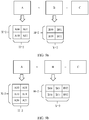
- the matrix A may be divided into four fractal signal matrices, namely, A00, A01, A10, and A11, based on a condition; and the matrix B may be divided into four fractal weight matrices, namely, B00, B01, B10, and B 11, based on a condition.
- a corresponding matrix C may include four matrix blocks: C00, C01, C10, and C11.
- a relationship between each matrix block in the matrix C and a fractal signal matrix and a fractal weight matrix may be shown by the following formulas.
- data reusing may be implemented by adjusting an operation sequence of the eight matrix multiplications, thereby reducing power consumption. For example, if A00B00 is first calculated, and then A00B01 is calculated, A00 can be reused. For another example, if A00B00 is first calculated, and then A10c00 is calculated, B00 can be reused. It can be learned from this that an operation sequence of a plurality of matrix multiplications determines how data is reused in an operation process, and therefore affects performance such as a computing capability and power consumption of a processor.
- an operation sequence of a plurality of matrix multiplications is usually determined based on a hit ratio of a cache (cache), so that data reusing is performed as much as possible.
- a cache cache
- an operation sequence obtained only based on a cache hit ratio may not bring processor performance into full play.
- Embodiments of this application provide a signal processing method, so as to resolve a technical problem in the prior art that an operation sequence obtained only based on a cache hit ratio may not bring processor performance into full play.
- an embodiment of this application provides a signal processing method, where the method includes:
- the operation sequence is determined based on the foregoing three types of power consumption. Compared with a prior-art solution in which the foregoing three types of power consumption are considered as the same and only a cache hit ratio is considered, this solution can reduce power consumption of a processor more effectively.
- the operation sequence of the X ⁇ H ⁇ Y matrix multiplications is determined in the following manner:
- the operation sequence can be quickly obtained through searching, and because the searching is performed based on a cost value of transiting from one matrix multiplication to another matrix multiplication, power consumption of a processor can be reduced more effectively by using the obtained operation sequence.
- the performance parameters further include bandwidth parameters
- the bandwidth parameters include a bandwidth penalty value of reading the any fractal signal matrix from the first cache, a bandwidth penalty value of reading the any fractal weight matrix from the second cache, and a bandwidth penalty value of reading the operation result of the any matrix multiplication from the third cache; and the bandwidth parameters are obtained based on read/write bandwidth of the first cache, read/write bandwidth of the second cache, and read/write bandwidth of the third cache.
- the operation sequence of the plurality of matrix multiplications is determined based on power consumption and bandwidth, so that a computing capability of a processor can be better used and power consumption of the processor can be reduced by using the operation sequence.
- an embodiment of this application provides a signal processing apparatus, where the signal processing apparatus includes:
- the processing module determines the operation sequence of the X ⁇ H ⁇ Y matrix multiplications in the following manner:
- the performance parameters further include bandwidth parameters
- the bandwidth parameters include a bandwidth penalty value of reading the any fractal signal matrix from the first cache, a bandwidth penalty value of reading the any fractal weight matrix from the second cache, and a bandwidth penalty value of reading the operation result of the any matrix multiplication from the third cache; and the bandwidth parameters are obtained based on read/write bandwidth of the first cache, read/write bandwidth of the second cache, and read/write bandwidth of the third cache.
- An embodiment of this application further provides a signal processing apparatus, and the signal processing apparatus includes: a memory, configured to store a software program; and a processor, configured to read the software program in the memory and perform the signal processing method according to the foregoing aspects or possible designs.
- An embodiment of this application further provides a computer storage medium.
- the storage medium stores a software program.
- the software program is read and executed by one or more processors, the signal processing method according to the foregoing aspects or possible designs can be implemented.
- An embodiment of this application further provides a computer program product including an instruction.
- the computer program product When the computer program product is run on a computer, the computer is enabled to perform the signal processing method according to the foregoing aspects or possible designs.
- An embodiment of this application further provides a computer program.
- the computer program When the computer program is run on a computer, the computer is enabled to perform the signal processing method according to the foregoing aspects or possible designs.
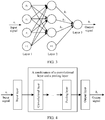
- FIG. 2 is a schematic structural diagram of a neural network.
- the neural network 200 has N processing layers, N ⁇ 3, and N is a natural number.
- the first layer of the neural network is an input layer 201, and is responsible for receiving an input signal.
- the last layer of the neural network is an output layer 203, and is responsible for outputting a processing result of the neural network.
- Other layers than the first layer and the last layer are intermediate layers 204. These intermediate layers jointly constitute a hidden layer 202.
- Each intermediate layer in the hidden layer can receive an input signal and output a signal, and the hidden layer is responsible for an input-signal processing process.
- Each layer represents a logical level of signal processing. Through a plurality of layers, a data signal can be processed at a plurality of logical levels.
- the processing function may be a rectified linear unit (Rectified Linear Unit, ReLU), a hyperbolic tangent function (tanh), a sigmoid function (sigmoid), or the like.
- ( x 1 , x 2 , x 3 ) is a one-dimensional signal matrix
- ( h 1 ,h 2 ,h 3 ) is an output signal matrix
- W ij denotes a weight coefficient between input x j and output h i
- a matrix that includes a weight coefficient is a weight matrix.
- b i is an offset value of a neural network processing function, and the offset value is used to adjust input of the neural network to obtain an ideal output result.
- h 1 f W 11 x 1 + W 12 x 2 + W 13 x 3 + b 1
- h 2 f W 21 x 1 + W 22 x 2 + W 23 x 3 + b 2
- h 3 f W 31 x 1 + W 32 x 2 + W 33 x 3 + b 3
- input signals of the neural network may be signals in various forms such as a voice signal, a text signal, an image signal, and a temperature signal.
- the voice signal may be a voice signal recorded by a recording device, a voice signal received by a mobile phone or a fixed-line phone in a call process, a voice signal that is sent by a radio station and that is received by a radio, or the like.
- the text signal may be a TXT text signal, a Word text signal, a PDF text signal, or the like.
- the image signal may be a scene signal photographed by a camera, an image signal of a community environment captured by a display monitoring device, a face signal of a human face obtained by an access control system, or the like.
- the input signals of the neural network include various other engineering signals that can be processed by a computer, which are not listed herein.
- Processing performed by the hidden layer 202 of the neural network may be processing such as removing a noise signal from a voice signal to enhance the voice signal, understanding specific content in a text signal, and performing recognition on a face image signal of a human face.
- Each layer of the neural network may include a plurality of nodes, and the node may be referred to as a neuron.
- a fully connected neural network is a neural network in which neurons are fully connected between adjacent layers, to be specific, all neurons in a layer are connected to each neuron in a next layer.
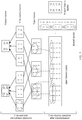
- FIG. 3 is a schematic structural diagram of a fully connected neural network that includes three layers. "+1" in FIG. 3 represents an offset neuron that is configured to adjust input at each layer of the neural network.
- a signal matrix and a weight matrix have larger dimensions at a processing layer that is more rearward, and consequently, a network size of the neural network is excessively large.
- a convolutional neural network In a convolutional neural network, a relatively small parameter template can be used to slide filtering in an input signal spatial domain, thereby resolving a problem that a network size of a fully connected neural network is excessively large.
- the convolutional neural network includes a feature extractor including a convolutional layer and a sub sampling layer. At the convolutional layer of the convolutional neural network, one neuron is connected only to some of neurons at a neighboring layer.
- One convolutional layer of the convolutional neural network usually includes feature planes. Each feature plane includes some neurons in a rectangular arrangement. Neurons in a same feature plane share a weight, and the shared weight herein is a convolution kernel.
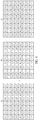
- the convolution kernel is usually initialized in a form of a random decimal matrix. In a network training process, the convolution kernel obtains a proper weight through learning. A direct benefit brought by the convolution kernel is that connections between layers of the network are reduced. Sub sampling is also referred to as pooling. Sub sampling may be considered as a special convolution process. Convolution and sub sampling greatly reduce model complexity and reduce a quantity of model parameters. As shown in FIG. 4 , a convolutional neural network includes three parts. A first part is an input layer, a second part includes a combination of n convolutional layers and a pooling layer, and a third part is an output layer. The output layer may include a fully connected multi-layer perceptron classifier.
- the convolutional layer in the convolutional neural network may be used to perform a convolution operation on an input signal array and a weight array.
- a one-dimensional input signal is used herein as an example.
- a convolutional neural network may be widely applied to speech recognition, face recognition, general object recognition, motion analysis, image processing, and the like.
- an input signal is a two-dimensional matrix.
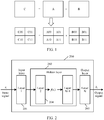
- FIG. 5 it is assumed that an input feature corresponding to an image at a convolutional layer includes three three-row three-column signal matrices, and a convolution kernel includes six two-row two-column weight matrices.
- FIG. 5 shows two specific operation manners for performing a convolution operation in a convolutional neural network. One is a conventional convolution operation, and the other is a convolution operation after matrix transformation.
- the conventional convolution operation is to perform a matrix multiplication operation on each signal matrix and a weight matrix corresponding to the signal matrix, and accumulate results of corresponding matrix multiplication operations to obtain two output signal matrices, that is, an output feature.
- different signal matrices are converted to obtain an input feature matrix that includes three signal matrices and has a relatively large matrix dimension.
- a corresponding conversion operation is also performed on the six weight matrices to obtain a kernel matrix that includes six weight matrices and has a relatively large matrix dimension.
- a matrix multiplication operation is performed on the input feature matrix and the kernel matrix that are obtained through transformation, to obtain an output feature matrix.
- Partitioning a matrix means dividing the matrix into a plurality of sub-blocks, and each sub-block may be referred to as a fractal matrix.
- fractal matrix There is a correspondence between a plurality of fractal signal matrices and a plurality of fractal weight matrices obtained through partitioning.
- a fractal signal matrix and a fractal weight matrix corresponding to the fractal signal matrix meet a matrix multiplication rule.
- the matrix multiplication rule is that a quantity of columns of the first matrix that participates in a matrix multiplication is equal to a quantity of rows of the second matrix that participates in the matrix multiplication.
- each small block in the signal matrix represents one fractal signal matrix, and there are 64 (8 ⁇ 8) fractal signal matrices in total; each small block in the weight matrix represents one fractal weight matrix, and there are 64 (8 ⁇ 8) fractal weight matrices in total.
- the matrix multiplication of the fractal signal matrix and the fractal weight matrix may be represented as Ax,h ⁇ Ah,y. Therefore, each matrix multiplication formed by a fractal signal matrix and a fractal weight matrix may be described as a point (x, h, y) in three-dimensional space. In this way, determining an operation sequence of a plurality of matrix multiplications is equivalent to searching for an operation sequence in a graph with 8 ⁇ 8 ⁇ 8 vertices in three-dimensional space, so that processor performance is optimal in a measurement dimension.
- an operation sequence of a plurality of matrix multiplications is usually determined based on a hit ratio of a cache (cache), to be specific, it is considered that an input matrix and a result matrix of a matrix multiplication have a same effect on processor performance, so that an operation sequence that makes the cache hit ratio highest is selected for performing an operation on the plurality of matrix multiplications.
- a cache cache
- an input matrix and a result matrix may be separately stored in different caches, and bandwidth capabilities and power consumption thereof may be different. Therefore, an operation sequence obtained only based on a cache hit ratio may not bring processor performance into full play.
- embodiments of this application provide a signal processing method, so as to resolve a technical problem in the prior art that an operation sequence obtained only based on a cache hit ratio may not bring processor performance into full play.
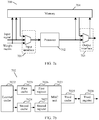
- FIG. 7a is a schematic structural diagram of an apparatus to which an embodiment of this application is applied.
- the signal processing apparatus may include an input interface 701.
- the input interface is configured to receive a signal matrix and/or a weight matrix, and the input interface may use a selector to implement switching between signal matrix reception and weight matrix reception.
- the input interface may receive the foregoing signal matrix or weight matrix in a time division multiplexing manner.
- there may be two input interfaces for respectively receiving the signal matrix and the weight matrix, for example, the signal matrix and the weight matrix may be simultaneously received.
- the signal processing apparatus may further include a processor 702, configured to have a function of performing processing of the signal processing method in the embodiments of this application.
- the processor may be of a single-processor structure, of a multi-processor structure, a single-thread processor, a multi-thread processor, or the like.
- the processor may be integrated into an application-specific integrated circuit, or may be a processor chip independent of an integrated circuit.
- the signal processing apparatus may further include an output interface 703, configured to output a signal processing result in the foregoing signal processing method.
- the signal processing result may be directly output by the processor, or may be first stored in a memory and then output by using the memory.
- the signal processing result output through the output interface may be sent to a memory for storage, or may be sent to a next signal processing apparatus for further processing, or may be sent to a display device for display or a player terminal for play, or the like.
- the signal processing apparatus 700 may further include: a memory 704 that may store the foregoing signal matrix, the signal processing result, the weight matrix, a related instruction for processor configuration, and the like. In some feasible embodiments, there may be one memory, or there may be a plurality of memories.
- the memory may be a floppy disk, a hard disk such as a built-in hard disk or a removable hard disk, a magnetic disk, an optical disc, a magneto-optical disc, a flash memory, or a storage medium in any other form known in the art.
- the processor 702 may include a multiplication-accumulation (multiplication-accumulation, MAC) unit 7021, an external cache 7022, a first cache 7023, a second cache 7024, a third cache 7025, a first register 7026, a second register 7027, and a third register 7028.
- the MAC unit 7021 is configured to perform a specific multiply-add operation.
- the external cache 7022 may be configured to store the signal matrix and the weight matrix.
- the first cache 7023 and the first register 7026 may be configured to store a fractal signal matrix of the signal matrix.
- the second cache 7024 and the second register 7027 may be configured to store a fractal weight matrix of the weight matrix.
- the third cache 7025 and the third register 7028 may be configured to store an operation result of a matrix multiplication.
- the MAC unit 7021 may directly interact with the first cache 7023, the second cache 7024, the third cache 7025, the first register 7026, the second register 7027, and the third register 7028.
- each matrix block (result matrix) of a matrix C may be performed in two steps.
- C00 may be performed according to the following steps (I) and (II):
- C 00 _ temp A 00 B 00
- C 00 C 00 _ temp + A 01 B 10
- step (I) when performing a matrix multiplication operation on a fractal weight matrix A00 and a fractal weight matrix B00, the MAC unit 7021 may first attempt to read A00 from the first register 7026, and read A00 from the first cache 7023 if A00 is not in the first register 7026. Similarly, the MAC unit 7021 may first attempt to read B00 from the second register 7027, and read B00 from the second cache 7024 if B00 is not in the second register 7027. Then, the MAC unit 7021 performs a matrix multiplication operation on A00 and B00 to obtain a matrix multiplication operation result C 00_ temp (a first operation result), and writes the matrix multiplication operation result C 00_ temp into the third register 7028.
- the matrix multiplication operation result in this embodiment of this application is obtained by multiplying the fractal signal matrix and the fractal weight matrix, and therefore may also be referred to as a fractal result matrix.
- step (II) when performing a matrix multiplication operation on a fractal weight matrix A01 and a fractal weight matrix B10, the MAC unit 7021 reads A01 and B10 in the same manner, performs the matrix multiplication operation to obtain a matrix multiplication operation result (a second operation result), and may directly read the first operation result C 00_ temp from the third register 7028.
- the MAC unit 7021 adds the first operation result and the second operation result to obtain a result matrix C00, and writes C00 into the third register 7028.
- C 00_ temp is reused during calculation of C00, thereby effectively reducing a read/write amount of C 00_ temp. This reduces a bandwidth requirement of a processor and reduces read/write power consumption of a memory.
- FIG. 8 is a schematic flowchart corresponding to a signal processing method according to an embodiment of this application. As shown in FIG. 8 , the method includes the following steps.
- Step 801 Receive a signal matrix and a weight matrix.
- the signal matrix may be from an input layer of a neural network or a previous intermediate layer of an intermediate layer at which signal processing is performed, and an input signal may be any signal that can be collected and processed, such as a voice signal, a text signal, an image signal, or a temperature signal.
- the signal matrix may be a matrix not converted, or may be a converted matrix.
- the signal matrix may be a two-dimensional matrix of M rows and K columns, and the matrix includes a plurality of to-be-processed signals that can be processed by a computer, that is, each element corresponds to one signal.
- a matrix from which the signal matrix is converted may be a one-dimensional column vector, a one-dimensional row vector, a two-dimensional matrix (such as a grayscale image), a three-dimensional matrix (such as an RGB color image), or the like. This is not specifically limited in this embodiment of this application.
- the weight matrix may include a plurality of weight coefficients.
- the weight matrix may be defined by the neural network.
- the weight coefficient acts on the input signal. An input signal corresponding to a large weight coefficient is enhanced in a process of learning and training of the neural network, and an input signal corresponding to a small weight coefficient is weakened in a process of learning and training of the neural network.
- the weight matrix may be a weight matrix not converted, or may be a converted weight matrix, and is a two-dimensional weight matrix of K rows and N columns.
- Step 802 Partition the signal matrix to obtain X ⁇ H fractal signal matrices, and partition the weight matrix to obtain H ⁇ Y fractal weight matrices, where the X ⁇ H fractal weight matrices and the H ⁇ Y fractal signal matrices form X ⁇ H ⁇ Y matrix multiplications.
- the partitioning the signal matrix to obtain X ⁇ H fractal signal matrices specifically means partitioning the signal matrix into X rows and H columns, where any row includes H fractal signal matrices, and any column includes X fractal signal matrices.
- the partitioning the weight matrix to obtain H ⁇ Y fractal weight matrices specifically means partitioning the weight matrix into H rows and Y columns, where any row includes Y fractal signal matrices, and any column includes H fractal signal matrices.
- 8 (2 ⁇ 2 ⁇ 2) matrix multiplication operations need to be performed to calculate a matrix C, that is, four fractal signal matrices and four fractal weight matrices form eight matrix multiplications.
- 18 (3 ⁇ 2 ⁇ 3) matrix multiplication operations need to be performed to calculate a matrix C, that is, six fractal signal matrices and six fractal weight matrices form 18 matrix multiplications.
- Step 803 Obtain an operation sequence of the X ⁇ H ⁇ Y matrix multiplications, and process the X ⁇ H ⁇ Y matrix multiplications based on the operation sequence of the X ⁇ H ⁇ Y matrix multiplications to obtain X ⁇ Y result matrices, where any one of the X ⁇ Y result matrices is obtained by accumulating operation results of at least two of the X ⁇ H ⁇ Y matrix multiplications.
- the operation sequence of the X ⁇ H ⁇ Y matrix multiplications is used to indicate a sequence in which a MAC unit calculates the X ⁇ H ⁇ Y matrix multiplications.
- the operation sequence may be represented in a plurality of forms, such as a data table. Refer to Table 1.
- Table 1 Example of the operation sequence of the X ⁇ H ⁇ Y matrix multiplications Sequence number Address information of a fractal signal matrix Address information of a fractal weight matrix 1 Address information of A00 Address information of B00 2 Address information of A10 Address information of B00 3 Address information of A01 Address information of B 10 ... ... ... X ⁇ H ⁇ Y************
- the sequence number is used to indicate a sequence.
- the MAC unit may perform an operation on each matrix multiplication based on a sequence of sequence numbers.
- the address information of the fractal signal matrix may be location information of the fractal signal matrix in the signal matrix.
- the address information of the fractal signal matrix may be represented by using coordinates of the fractal signal matrix in the signal matrix. Referring to FIG. 6 , coordinates corresponding to each small grid in the matrix A are address information of a fractal signal matrix, for example, (0, 0) is address information of a fractal signal matrix 1, and (0, 1) is address information of a fractal signal matrix 2.
- the address information of the fractal weight matrix may be location information of the fractal weight matrix in the weight matrix. For details, refer to the address information of the fractal signal matrix. Details are not described again.
- Table 1 is only an example.
- the address information of the fractal signal matrix and the address information of the fractal weight matrix may be listed merely in sequence with no sequence numbers, or another possible form may be used, provided that the operation sequence of the matrix multiplications can be effectively indicated. This is not specifically limited in this application.
- the operation sequence of the X ⁇ H ⁇ Y matrix multiplications is obtained based on performance parameters.
- the performance parameters include power consumption of reading any one of the X ⁇ H fractal signal matrices from a first cache, power consumption of reading any one of the H ⁇ Y fractal weight matrices from a second cache, and power consumption of reading an operation result of any one of the X ⁇ H ⁇ Y matrix multiplications from a third cache.
- the performance parameters may further include bandwidth parameters.
- the bandwidth parameters include a bandwidth penalty value of reading the any fractal signal matrix from the first cache, a bandwidth penalty value of reading the any fractal weight matrix from the second cache, and a bandwidth penalty value of reading the operation result of the any matrix multiplication from the third cache.
- the operation sequence of the plurality of matrix multiplications is determined based on power consumption and bandwidth, so that a computing capability of a processor can be better used and power consumption of the processor can be reduced by using the operation sequence.
- the following specifically describes a manner of determining the operation sequence based on the performance parameters.
- the operation sequence of the X ⁇ H ⁇ Y matrix multiplications may be determined in the following manner: selecting a first matrix multiplication from the X ⁇ H ⁇ Y matrix multiplications, and sequentially searching for a second matrix multiplication to an (X ⁇ H ⁇ Y) th matrix multiplication by using the first matrix multiplication as a start point, to obtain the operation sequence, where the k th matrix multiplication is obtained through searching in the following manner: selecting a matrix multiplication whose cost value is less than a first threshold, based on a cost value of transiting from a (k-1) th matrix multiplication to any one of the X ⁇ H ⁇ Y matrix multiplications, to obtain the k th matrix multiplication, where k is an integer greater than or equal to 2 and less than or equal to X ⁇ H ⁇ Y; and the k th matrix multiplication is a matrix multiplication in the X ⁇ H ⁇ Y matrix multiplications other than the first matrix multiplication to the
- the following describes a calculation manner of a cost value of transiting from the (k-1) th matrix multiplication to an i th matrix multiplication (the i th matrix multiplication is any one of the X ⁇ H ⁇ Y matrix multiplications).
- Transition from the (k-1) th matrix multiplication to the i th matrix multiplication may be represented as transition from (x k-1 , h k-1 , y k-1 ) to (x i , h i , y i ), that is, the MAC unit first calculates (x k-1 , h k-1 , y k-1 ) and then calculates (x i , h i , y i ).
- the cost value is determined based on power consumption of different caches.
- x1, x2, and x3 are all greater than 0.
- x1, x2, and x3 may be respectively the power consumption of reading the any fractal signal matrix from the first cache, the power consumption of reading the any fractal weight matrix from the second cache, and the power consumption of reading the operation result of the any matrix multiplication from the third cache; or may be a group of proportional values obtained based on the power consumption of reading the any fractal signal matrix from the first cache, the power consumption of reading the any fractal weight matrix from the second cache, and the power consumption of reading the operation result of the any matrix multiplication from the third cache.
- the cost value of transiting from (x i-1 , h i-1 , y i-1 ) to (x i , h i , y i ) is determined based on the foregoing three types of power consumption, and then the operation sequence is determined.
- this solution can reduce power consumption of a processor more effectively.
- read/write bandwidth of the first cache, read/write bandwidth of the second cache, and read/write bandwidth of the third cache may also be different.
- the read/write bandwidth of the first cache is 50 mb/s
- the read/write bandwidth of the second cache is 100 mb/s
- the read/write bandwidth of the third cache is 100 mb/s. Because the read/write bandwidth of the first cache is less than the read/write bandwidth of the second cache and the read/write bandwidth of the third cache, reusing the fractal signal matrix as much as possible can bring a computing capability of a processor into full play.
- bandwidth parameters are introduced in this embodiment of this application, and the bandwidth parameters include a bandwidth penalty value of reading the any fractal signal matrix from the first cache, a bandwidth penalty value of reading the any fractal weight matrix from the second cache, and a bandwidth penalty value of reading the operation result of the any matrix multiplication from the third cache.
- the bandwidth parameters are obtained based on the read/write bandwidth of the first cache, the read/write bandwidth of the second cache, and the read/write bandwidth of the third cache. Larger bandwidth indicates a smaller corresponding bandwidth penalty value.
- x1, x2, x3, y1, y2, and y3 are all greater than 0.
- x1:x2:x3 v1:v2:v3, where v1 is the power consumption of reading the any fractal signal matrix from the first cache, v2 is the power consumption of reading the any fractal weight matrix from the second cache, and v3 is the power consumption of reading the operation result of the any matrix multiplication from the third cache;
- y1:y2:y3 1/w1:1/w2:1/w3, where w1 is the read/write bandwidth of the first cache, w2 is the read/write bandwidth of the second cache, and w2 is the read/write bandwidth of the third cache.
- the read/write bandwidth of the first cache is 50 mb/s
- the read/write bandwidth of the second cache is 100 mb/s
- the read/write bandwidth of the third cache is 100 mb/s
- the operation sequence of the plurality of matrix multiplications is determined based on power consumption and bandwidth, so that a computing capability of a processor can be better used and power consumption of the processor can be reduced by using the operation sequence.
- the first matrix multiplication may be represented as (x 1 , h 1 , y 1 ).
- a cost value of transiting from (x 1 , h 1 , y 1 ) to any one of the 511 nodes may be calculated, and a node with a smallest cost value (in this embodiment of this application, to avoid node repetition in the sequence, a selected node is a node other than a node that is already in the sequence, and subsequent selection is performed in the same manner) is selected as the second node.
- a third node is searched for.
- the third node may be any one of 511 nodes.
- a cost value of transiting from (x 1 , h 1 , y 1 ) to any one of the 511 nodes may be calculated, and a node with a smallest cost value is selected as the third node. Then, a fourth node is searched for, and so on. When a 512 th node is searched for, a node with a smallest cost value is selected as the last node, so as to obtain the operation sequence.
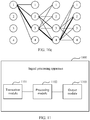
- FIG. 10a is a schematic diagram of a search sequence.
- cost values of the node 1 and the four nodes are separately calculated, and a node with a smallest cost value is reserved, for example, the node 3.
- cost values of the node 3 and the four nodes are separately calculated, and a node with a smallest cost value is reserved, for example, the node 2.
- cost values of the node 3 and the four nodes are separately calculated, and a node with a smallest cost value is reserved, for example, the node 4.
- the operation sequence obtained in this way is node 1 - node 3 - node 2 - node 4.
- i-1 nodes that are already in the sequence may be excluded, thereby reducing a calculation amount.
- cost values may be calculated only for the node 3, the node 2, and the node 4, and cost values of the node 3 and the node 1 do not need to be calculated. No further details are provided.
- a plurality of nodes may be reserved (for example, if there are 512 nodes in total, eight nodes may be reserved) in each search step. Specifically, when a second node is searched for by using (x 1 , h 1 , y 1 ) as a start point, a cost value of transiting from (x 1 , h 1 , y 1 ) to any one of the 511 nodes may be calculated, and eight sequences with smallest sums of cost values in existing sequences are reserved, to obtain candidate second nodes.
- a third node is searched for, and in this case, a cost value of transiting from each candidate second node to any one of the 511 nodes may be calculated, and eight sequences with smallest sums of cost values in existing sequences are reserved, to obtain candidate third nodes. Then, a fourth node is searched for, and so on. When a 512 th node is searched for, a sequence with a smallest sum of cost values is selected as the operation sequence.
- FIG. 10c is a schematic diagram of another search sequence.
- the node 1 when the node 1 is used as a start point to search for a second node, cost values of the node 1 and the four nodes are separately calculated, and two sequences with smallest sums of cost values in existing sequences are reserved.
- the existing sequences are node 1 - node 2, node 1 - node 3, and node 1 - node 4.
- node 1 - node 2 is used as an example.
- a sum of cost values of the existing sequence is a cost value of transiting from the node 1 to the node 2.
- the two sequences with smallest sums of cost values are node 1 - node 2 and node 1 - node 3, and therefore, the node 2 and the node 3 are candidate second nodes.
- cost values of the node 2 and the four nodes, and cost values of the node 3 and the four nodes are separately calculated, and two sequences with smallest sums of cost values in existing sequences are reserved.
- the existing sequences are node 1 - node 2 - node 3, node 1 - node 2 - node 4, node 1 - node 3 - node 2, and node 1 - node 3 - node 4.
- node 1 - node 2 - node 3 is used as an example. Because transition is performed twice, a sum of cost values of the existing sequence is a sum of a cost value of transiting from the node 1 to the node 2 and a cost value of transiting from the node 2 to the node 3.
- the two sequences with smallest sums of cost values are node 1 - node 2 - node 3 and node 1 - node 3 - node 4, and therefore, the node 3 and the node 4 are candidate third nodes.
- cost values of the node 3 and the four nodes, and cost values of the node 4 and the four nodes are separately calculated, and one sequence with a smallest sum of cost values in existing sequences is reserved.
- the final operation sequence obtained in this way is node 1 - node 3 - node 4 - node 2.
- An embodiment of this application further provides two other manners of determining the operation sequence.
- the start point (a first node) may be ignored, and calculation directly starts from a cost value of transiting from the first node to a second node.
- (x 1 , h 1 , y 1 ) is used as a search start point.
- the operation sequence of the X ⁇ H ⁇ Y matrix multiplications in this embodiment of this application may be pre-determined and stored. In this way, when step 803 is being performed, the stored operation sequence of the X ⁇ H ⁇ Y matrix multiplications may be directly obtained, so that signal processing efficiency can be improved. Alternatively, when step 803 is being performed, the operation sequence of the X ⁇ H ⁇ Y matrix multiplications may be determined based on the performance parameters. This is not specifically limited.
- Step 804 Output a signal processing result, where the signal processing result includes operation results of the plurality of matrix multiplications.
- the signal processing result is to be sent to a next intermediate layer of the intermediate layer at which the signal processing is performed or to an output layer of the neural network.
- an embodiment of this application further provides a signal processing apparatus.
- the signal processing apparatus is configured to implement the method procedure shown in FIG. 8 .
- the signal processing apparatus 1100 includes:
- the processing module 1102 determines the operation sequence of the X ⁇ H ⁇ Y matrix multiplications in the following manner:
- the performance parameters further include bandwidth parameters
- the bandwidth parameters include a bandwidth penalty value of reading the any fractal signal matrix from the first cache, a bandwidth penalty value of reading the any fractal weight matrix from the second cache, and a bandwidth penalty value of reading the operation result of the any matrix multiplication from the third cache.
- the bandwidth parameters are obtained based on read/write bandwidth of the first cache, read/write bandwidth of the second cache, and read/write bandwidth of the third cache.
- module division is an example, and is merely logical function division. In actual implementation, another division manner may be used.
- the functional modules in this embodiment of this application may be integrated into one processing module, or each module may exist alone physically, or two or more modules may be integrated into one module.
- the integrated module may be implemented in a form of hardware, or may be implemented in a form of a software function module.
- the integrated module When the integrated module is implemented in the form of a software function module and sold or used as an independent product, the integrated module may be stored in a computer-readable storage medium. Based on such an understanding, the technical solutions in this application essentially, or the part contributing to the prior art, or all or some of the technical solutions may be implemented in a form of a software product.
- the computer software product is stored in a storage medium and includes instructions for instructing a computer device (which may be a personal computer, a server, a network device, or the like) or a processor (processor) to perform all or some of the steps of the method described in the embodiments of this application.
- the foregoing storage medium includes any medium that can store program code, such as a USB flash drive, a removable hard disk, a read-only memory (Read-Only Memory, ROM), a random access memory (Random Access Memory, RAM), a magnetic disk, or an optical disc.
- program code such as a USB flash drive, a removable hard disk, a read-only memory (Read-Only Memory, ROM), a random access memory (Random Access Memory, RAM), a magnetic disk, or an optical disc.
- All or some of the foregoing embodiments may be implemented by software, hardware, firmware, or any combination thereof.
- the embodiments may be implemented completely or partially in a form of a computer program product.
- the computer program product includes one or more computer instructions.
- the one or more computer program instructions are loaded and executed on a computer, the procedure or functions according to the embodiments of the present invention are all or partially generated.
- the computer may be a general-purpose computer, a special-purpose computer, a computer network, or another programmable apparatus.
- the one or more computer instructions may be stored in a computer-readable storage medium or may be transmitted from a computer-readable storage medium to another computer-readable storage medium.
- the one or more computer instructions may be transmitted from a website, computer, server, or data center to another website, computer, server, or data center in a wired (for example, a coaxial cable, an optical fiber, or a digital subscriber line (DSL)) or wireless (for example, infrared, radio, or microwave) manner.
- the computer-readable storage medium may be any usable medium that can be accessed by the computer, or a data storage device, such as a server or a data center, integrating one or more usable media.
- the usable medium may be a magnetic medium (for example, a floppy disk, a hard disk, or a magnetic tape), an optical medium (for example, a DVD), a semiconductor medium (for example, a solid state disk (solid state disk, SSD)), or the like.
- a magnetic medium for example, a floppy disk, a hard disk, or a magnetic tape
- an optical medium for example, a DVD
- a semiconductor medium for example, a solid state disk (solid state disk, SSD)
- the embodiments of the present invention may be provided as a method, a system, or a computer program product. Therefore, the embodiments of the present invention may use a form of hardware only embodiments, software only embodiments, or embodiments with a combination of software and hardware. Moreover, the embodiments of the present invention may use a form of a computer program product that is implemented on one or more computer-usable storage media (including but not limited to a magnetic disk storage, a CD-ROM, an optical memory, and the like) that include computer-usable program code.
- computer-usable storage media including but not limited to a magnetic disk storage, a CD-ROM, an optical memory, and the like
- These computer program instructions may be provided for a general-purpose computer, a special-purpose computer, an embedded processor, or a processor of another programmable data processing device to generate a machine, so that the instructions executed by the computer or the processor of another programmable data processing device generate an apparatus configured to implement a specified function in one or more processes in the flowcharts and/or in one or more blocks in the block diagrams.
- these computer program instructions may be stored in a computer readable memory that can instruct a computer or another programmable data processing device to work in a specific manner, so that the instructions stored in the computer readable memory generate an artifact that includes an instruction apparatus.
- the instruction apparatus implements a specified function in one or more processes in the flowcharts and/or in one or more blocks in the block diagrams.
- these computer program instructions may be loaded onto a computer or another programmable data processing device, so that a series of operations and steps are performed on the computer or the another programmable device, thereby generating computer-implemented processing. Therefore, the instructions executed on the computer or the another programmable device provide steps for implementing a specified function in one or more processes in the flowcharts and/or in one or more blocks in the block diagrams.
Landscapes
- Engineering & Computer Science (AREA)
- Physics & Mathematics (AREA)
- Theoretical Computer Science (AREA)
- General Physics & Mathematics (AREA)
- Health & Medical Sciences (AREA)
- General Health & Medical Sciences (AREA)
- Evolutionary Computation (AREA)
- Mathematical Physics (AREA)
- Software Systems (AREA)
- Computing Systems (AREA)
- Artificial Intelligence (AREA)
- Data Mining & Analysis (AREA)
- Biomedical Technology (AREA)
- Life Sciences & Earth Sciences (AREA)
- General Engineering & Computer Science (AREA)
- Molecular Biology (AREA)
- Multimedia (AREA)
- Biophysics (AREA)
- Computational Linguistics (AREA)
- Databases & Information Systems (AREA)
- Computer Vision & Pattern Recognition (AREA)
- Computational Mathematics (AREA)
- Mathematical Analysis (AREA)
- Mathematical Optimization (AREA)
- Pure & Applied Mathematics (AREA)
- Medical Informatics (AREA)
- Algebra (AREA)
- Biodiversity & Conservation Biology (AREA)
- Oral & Maxillofacial Surgery (AREA)
- Human Computer Interaction (AREA)
- Neurology (AREA)
- Complex Calculations (AREA)
Applications Claiming Priority (2)
| Application Number | Priority Date | Filing Date | Title |
|---|---|---|---|
| CN201711489008.9A CN109993275B (zh) | 2017-12-29 | 2017-12-29 | 一种信号处理方法及装置 |
| PCT/CN2018/116534 WO2019128548A1 (zh) | 2017-12-29 | 2018-11-20 | 一种信号处理方法及装置 |
Publications (3)
| Publication Number | Publication Date |
|---|---|
| EP3723006A1 true EP3723006A1 (de) | 2020-10-14 |
| EP3723006A4 EP3723006A4 (de) | 2021-01-27 |
| EP3723006B1 EP3723006B1 (de) | 2025-05-21 |
Family
ID=67063021
Family Applications (1)
| Application Number | Title | Priority Date | Filing Date |
|---|---|---|---|
| EP18896329.2A Active EP3723006B1 (de) | 2017-12-29 | 2018-11-20 | Signalverarbeitungsverfahren und -vorrichtung |
Country Status (4)
| Country | Link |
|---|---|
| US (1) | US11238130B2 (de) |
| EP (1) | EP3723006B1 (de) |
| CN (1) | CN109993275B (de) |
| WO (1) | WO2019128548A1 (de) |
Families Citing this family (7)
| Publication number | Priority date | Publication date | Assignee | Title |
|---|---|---|---|---|
| US9942074B1 (en) | 2016-11-30 | 2018-04-10 | Micron Technology, Inc. | Wireless devices and systems including examples of mixing coefficient data specific to a processing mode selection |
| US10027523B2 (en) | 2016-11-30 | 2018-07-17 | Micron Technology, Inc. | Wireless devices and systems including examples of mixing input data with coefficient data |
| WO2020031281A1 (ja) * | 2018-08-07 | 2020-02-13 | 日本電気株式会社 | 情報処理装置、情報処理方法、及びコンピュータ読み取り可能な記録媒体 |
| US10886998B2 (en) * | 2019-02-22 | 2021-01-05 | Micron Technology, Inc. | Mixing coefficient data specific to a processing mode selection using layers of multiplication/accumulation units for wireless communication |
| US10924152B1 (en) | 2019-11-13 | 2021-02-16 | Micron Technology, Inc. | Mixing coefficient data for processing mode selection |
| US11709248B2 (en) * | 2020-11-10 | 2023-07-25 | Texas Instruments Incorporated | Beamforming hardware accelerator for radar systems |
| US20240147264A1 (en) * | 2021-04-22 | 2024-05-02 | Qualcomm Incorporated | Techniques for indicating signal processing procedures for network deployed neural network models |
Family Cites Families (11)
| Publication number | Priority date | Publication date | Assignee | Title |
|---|---|---|---|---|
| US4843587A (en) * | 1987-12-10 | 1989-06-27 | General Dynamics Pomona Division | Processing system for performing matrix multiplication |
| US6073204A (en) * | 1997-04-23 | 2000-06-06 | Micron Technology, Inc. | Memory system having flexible architecture and method |
| NO308149B1 (no) * | 1998-06-02 | 2000-07-31 | Thin Film Electronics Asa | Skalerbar, integrert databehandlingsinnretning |
| CN1168328C (zh) * | 2002-02-07 | 2004-09-22 | 大唐移动通信设备有限公司 | 一种适用于软件无线电技术实现的迭代运算结构及方法 |
| CN100518079C (zh) * | 2004-09-30 | 2009-07-22 | 北京航空航天大学 | 分布式性能数据采集方法 |
| US10223333B2 (en) * | 2014-08-29 | 2019-03-05 | Nvidia Corporation | Performing multi-convolution operations in a parallel processing system |
| CN104915322B (zh) * | 2015-06-09 | 2018-05-01 | 中国人民解放军国防科学技术大学 | 一种卷积神经网络硬件加速方法 |
| CN104899182B (zh) * | 2015-06-09 | 2017-10-31 | 中国人民解放军国防科学技术大学 | 一种支持可变分块的矩阵乘加速方法 |
| US10552370B2 (en) * | 2015-10-08 | 2020-02-04 | Via Alliance Semiconductor Co., Ltd. | Neural network unit with output buffer feedback for performing recurrent neural network computations |
| US9870341B2 (en) * | 2016-03-18 | 2018-01-16 | Qualcomm Incorporated | Memory reduction method for fixed point matrix multiply |
| CN109214508B (zh) * | 2017-06-30 | 2022-04-05 | 华为技术有限公司 | 信号处理的系统和方法 |
-
2017
- 2017-12-29 CN CN201711489008.9A patent/CN109993275B/zh active Active
-
2018
- 2018-11-20 EP EP18896329.2A patent/EP3723006B1/de active Active
- 2018-11-20 WO PCT/CN2018/116534 patent/WO2019128548A1/zh not_active Ceased
-
2020
- 2020-06-29 US US16/915,156 patent/US11238130B2/en active Active
Also Published As
| Publication number | Publication date |
|---|---|
| EP3723006B1 (de) | 2025-05-21 |
| CN109993275B (zh) | 2021-01-29 |
| CN109993275A (zh) | 2019-07-09 |
| EP3723006A4 (de) | 2021-01-27 |
| US20200327185A1 (en) | 2020-10-15 |
| WO2019128548A1 (zh) | 2019-07-04 |
| US11238130B2 (en) | 2022-02-01 |
Similar Documents
| Publication | Publication Date | Title |
|---|---|---|
| US11238130B2 (en) | Signal processing method and apparatus | |
| US10860922B2 (en) | Sparse convolutional neural network accelerator | |
| CN112236779B (zh) | 基于卷积神经网络的图像处理方法和图像处理装置 | |
| US10096134B2 (en) | Data compaction and memory bandwidth reduction for sparse neural networks | |
| CN111445418A (zh) | 图像去雾处理方法、装置及计算机设备 | |
| US20210073569A1 (en) | Pooling device and pooling method | |
| CN111382867A (zh) | 神经网络压缩的方法、数据处理的方法及相关装置 | |
| CN106650928A (zh) | 一种神经网络的优化方法及装置 | |
| US20200218777A1 (en) | Signal Processing Method and Apparatus | |
| CN111369450A (zh) | 去除摩尔纹的方法与装置 | |
| WO2019001323A1 (zh) | 信号处理的系统和方法 | |
| CN111107274B (zh) | 一种图像亮度统计方法及成像设备 | |
| KR20200022386A (ko) | 정보 처리 장치 및 정보 처리 방법 | |
| WO2021088569A1 (en) | Convolution method and device, electronic device | |
| CN116152171A (zh) | 智能建造目标计数方法、电子设备及存储介质 | |
| US20200372275A1 (en) | Hardware Accelerator for Integral Image Computation | |
| KR102833795B1 (ko) | 컨볼루션 뉴럴 네트워크를 처리하는 방법 및 장치 | |
| CN114677286B (zh) | 一种图像处理方法、装置、存储介质及终端设备 | |
| CN113468935B (zh) | 人脸识别方法 | |
| WO2023006170A1 (en) | Devices and methods for providing computationally efficient neural networks | |
| CN111783876B (zh) | 自适应智能检测电路及图像智能检测方法 | |
| CN114902240B (zh) | 神经网络通道数搜索方法和装置 | |
| CN112967200A (zh) | 图像处理方法、装置、电子设备、介质和计算机程序产品 | |
| CN118333127B (zh) | 一种数据处理方法、装置和数据处理芯片 | |
| CN116757976B (zh) | 一种高效的多曝光图像分块融合方法 |
Legal Events
| Date | Code | Title | Description |
|---|---|---|---|
| STAA | Information on the status of an ep patent application or granted ep patent |
Free format text: STATUS: THE INTERNATIONAL PUBLICATION HAS BEEN MADE |
|
| PUAI | Public reference made under article 153(3) epc to a published international application that has entered the european phase |
Free format text: ORIGINAL CODE: 0009012 |
|
| STAA | Information on the status of an ep patent application or granted ep patent |
Free format text: STATUS: REQUEST FOR EXAMINATION WAS MADE |
|
| 17P | Request for examination filed |
Effective date: 20200705 |
|
| AK | Designated contracting states |
Kind code of ref document: A1 Designated state(s): AL AT BE BG CH CY CZ DE DK EE ES FI FR GB GR HR HU IE IS IT LI LT LU LV MC MK MT NL NO PL PT RO RS SE SI SK SM TR |
|
| AX | Request for extension of the european patent |
Extension state: BA ME |
|
| A4 | Supplementary search report drawn up and despatched |
Effective date: 20210112 |
|
| RIC1 | Information provided on ipc code assigned before grant |
Ipc: G06N 3/063 20060101ALI20201221BHEP Ipc: G06N 3/04 20060101AFI20201221BHEP Ipc: G06K 9/46 20060101ALI20201221BHEP Ipc: G06F 17/16 20060101ALI20201221BHEP |
|
| DAV | Request for validation of the european patent (deleted) | ||
| DAX | Request for extension of the european patent (deleted) | ||
| STAA | Information on the status of an ep patent application or granted ep patent |
Free format text: STATUS: EXAMINATION IS IN PROGRESS |
|
| 17Q | First examination report despatched |
Effective date: 20220405 |
|
| REG | Reference to a national code |
Ref country code: DE Ref legal event code: R079 Free format text: PREVIOUS MAIN CLASS: G06N0003040000 Ref country code: DE Ref legal event code: R079 Ref document number: 602018082204 Country of ref document: DE Free format text: PREVIOUS MAIN CLASS: G06N0003040000 Ipc: G06F0017160000 |
|
| GRAP | Despatch of communication of intention to grant a patent |
Free format text: ORIGINAL CODE: EPIDOSNIGR1 |
|
| STAA | Information on the status of an ep patent application or granted ep patent |
Free format text: STATUS: GRANT OF PATENT IS INTENDED |
|
| RIC1 | Information provided on ipc code assigned before grant |
Ipc: G06V 10/764 20220101ALI20250117BHEP Ipc: G06V 40/16 20220101ALI20250117BHEP Ipc: G06V 10/82 20220101ALI20250117BHEP Ipc: G06V 10/44 20220101ALI20250117BHEP Ipc: G06N 3/08 20060101ALI20250117BHEP Ipc: G06N 3/045 20230101ALI20250117BHEP Ipc: G06F 17/16 20060101AFI20250117BHEP |
|
| INTG | Intention to grant announced |
Effective date: 20250129 |
|
| GRAS | Grant fee paid |
Free format text: ORIGINAL CODE: EPIDOSNIGR3 |
|
| GRAA | (expected) grant |
Free format text: ORIGINAL CODE: 0009210 |
|
| STAA | Information on the status of an ep patent application or granted ep patent |
Free format text: STATUS: THE PATENT HAS BEEN GRANTED |
|
| AK | Designated contracting states |
Kind code of ref document: B1 Designated state(s): AL AT BE BG CH CY CZ DE DK EE ES FI FR GB GR HR HU IE IS IT LI LT LU LV MC MK MT NL NO PL PT RO RS SE SI SK SM TR |
|
| REG | Reference to a national code |
Ref country code: GB Ref legal event code: FG4D |
|
| REG | Reference to a national code |
Ref country code: CH Ref legal event code: EP |
|
| REG | Reference to a national code |
Ref country code: DE Ref legal event code: R096 Ref document number: 602018082204 Country of ref document: DE |
|
| REG | Reference to a national code |
Ref country code: IE Ref legal event code: FG4D |
|
| REG | Reference to a national code |
Ref country code: NL Ref legal event code: MP Effective date: 20250521 |
|
| PG25 | Lapsed in a contracting state [announced via postgrant information from national office to epo] |
Ref country code: FI Free format text: LAPSE BECAUSE OF FAILURE TO SUBMIT A TRANSLATION OF THE DESCRIPTION OR TO PAY THE FEE WITHIN THE PRESCRIBED TIME-LIMIT Effective date: 20250521 Ref country code: PT Free format text: LAPSE BECAUSE OF FAILURE TO SUBMIT A TRANSLATION OF THE DESCRIPTION OR TO PAY THE FEE WITHIN THE PRESCRIBED TIME-LIMIT Effective date: 20250922 Ref country code: ES Free format text: LAPSE BECAUSE OF FAILURE TO SUBMIT A TRANSLATION OF THE DESCRIPTION OR TO PAY THE FEE WITHIN THE PRESCRIBED TIME-LIMIT Effective date: 20250521 |
|
| REG | Reference to a national code |
Ref country code: LT Ref legal event code: MG9D |
|
| PG25 | Lapsed in a contracting state [announced via postgrant information from national office to epo] |
Ref country code: NO Free format text: LAPSE BECAUSE OF FAILURE TO SUBMIT A TRANSLATION OF THE DESCRIPTION OR TO PAY THE FEE WITHIN THE PRESCRIBED TIME-LIMIT Effective date: 20250821 Ref country code: GR Free format text: LAPSE BECAUSE OF FAILURE TO SUBMIT A TRANSLATION OF THE DESCRIPTION OR TO PAY THE FEE WITHIN THE PRESCRIBED TIME-LIMIT Effective date: 20250822 |
|
| PG25 | Lapsed in a contracting state [announced via postgrant information from national office to epo] |
Ref country code: PL Free format text: LAPSE BECAUSE OF FAILURE TO SUBMIT A TRANSLATION OF THE DESCRIPTION OR TO PAY THE FEE WITHIN THE PRESCRIBED TIME-LIMIT Effective date: 20250521 Ref country code: NL Free format text: LAPSE BECAUSE OF FAILURE TO SUBMIT A TRANSLATION OF THE DESCRIPTION OR TO PAY THE FEE WITHIN THE PRESCRIBED TIME-LIMIT Effective date: 20250521 |
|
| PG25 | Lapsed in a contracting state [announced via postgrant information from national office to epo] |
Ref country code: BG Free format text: LAPSE BECAUSE OF FAILURE TO SUBMIT A TRANSLATION OF THE DESCRIPTION OR TO PAY THE FEE WITHIN THE PRESCRIBED TIME-LIMIT Effective date: 20250521 |
|
| PG25 | Lapsed in a contracting state [announced via postgrant information from national office to epo] |
Ref country code: HR Free format text: LAPSE BECAUSE OF FAILURE TO SUBMIT A TRANSLATION OF THE DESCRIPTION OR TO PAY THE FEE WITHIN THE PRESCRIBED TIME-LIMIT Effective date: 20250521 |
|
| PG25 | Lapsed in a contracting state [announced via postgrant information from national office to epo] |
Ref country code: RS Free format text: LAPSE BECAUSE OF FAILURE TO SUBMIT A TRANSLATION OF THE DESCRIPTION OR TO PAY THE FEE WITHIN THE PRESCRIBED TIME-LIMIT Effective date: 20250821 |
|
| PG25 | Lapsed in a contracting state [announced via postgrant information from national office to epo] |
Ref country code: IS Free format text: LAPSE BECAUSE OF FAILURE TO SUBMIT A TRANSLATION OF THE DESCRIPTION OR TO PAY THE FEE WITHIN THE PRESCRIBED TIME-LIMIT Effective date: 20250921 |
|
| PG25 | Lapsed in a contracting state [announced via postgrant information from national office to epo] |
Ref country code: LV Free format text: LAPSE BECAUSE OF FAILURE TO SUBMIT A TRANSLATION OF THE DESCRIPTION OR TO PAY THE FEE WITHIN THE PRESCRIBED TIME-LIMIT Effective date: 20250521 |
|
| REG | Reference to a national code |
Ref country code: AT Ref legal event code: MK05 Ref document number: 1797372 Country of ref document: AT Kind code of ref document: T Effective date: 20250521 |
|
| PGFP | Annual fee paid to national office [announced via postgrant information from national office to epo] |
Ref country code: DE Payment date: 20250930 Year of fee payment: 8 |
|
| PG25 | Lapsed in a contracting state [announced via postgrant information from national office to epo] |
Ref country code: SM Free format text: LAPSE BECAUSE OF FAILURE TO SUBMIT A TRANSLATION OF THE DESCRIPTION OR TO PAY THE FEE WITHIN THE PRESCRIBED TIME-LIMIT Effective date: 20250521 Ref country code: AT Free format text: LAPSE BECAUSE OF FAILURE TO SUBMIT A TRANSLATION OF THE DESCRIPTION OR TO PAY THE FEE WITHIN THE PRESCRIBED TIME-LIMIT Effective date: 20250521 Ref country code: DK Free format text: LAPSE BECAUSE OF FAILURE TO SUBMIT A TRANSLATION OF THE DESCRIPTION OR TO PAY THE FEE WITHIN THE PRESCRIBED TIME-LIMIT Effective date: 20250521 |
|
| PG25 | Lapsed in a contracting state [announced via postgrant information from national office to epo] |
Ref country code: CZ Free format text: LAPSE BECAUSE OF FAILURE TO SUBMIT A TRANSLATION OF THE DESCRIPTION OR TO PAY THE FEE WITHIN THE PRESCRIBED TIME-LIMIT Effective date: 20250521 |
|
| PG25 | Lapsed in a contracting state [announced via postgrant information from national office to epo] |
Ref country code: EE Free format text: LAPSE BECAUSE OF FAILURE TO SUBMIT A TRANSLATION OF THE DESCRIPTION OR TO PAY THE FEE WITHIN THE PRESCRIBED TIME-LIMIT Effective date: 20250521 |
|
| PG25 | Lapsed in a contracting state [announced via postgrant information from national office to epo] |
Ref country code: SK Free format text: LAPSE BECAUSE OF FAILURE TO SUBMIT A TRANSLATION OF THE DESCRIPTION OR TO PAY THE FEE WITHIN THE PRESCRIBED TIME-LIMIT Effective date: 20250521 Ref country code: RO Free format text: LAPSE BECAUSE OF FAILURE TO SUBMIT A TRANSLATION OF THE DESCRIPTION OR TO PAY THE FEE WITHIN THE PRESCRIBED TIME-LIMIT Effective date: 20250521 |
|
| PG25 | Lapsed in a contracting state [announced via postgrant information from national office to epo] |
Ref country code: IT Free format text: LAPSE BECAUSE OF FAILURE TO SUBMIT A TRANSLATION OF THE DESCRIPTION OR TO PAY THE FEE WITHIN THE PRESCRIBED TIME-LIMIT Effective date: 20250521 |
|
| REG | Reference to a national code |
Ref country code: DE Ref legal event code: R097 Ref document number: 602018082204 Country of ref document: DE |
|
| PLBE | No opposition filed within time limit |
Free format text: ORIGINAL CODE: 0009261 |
|
| STAA | Information on the status of an ep patent application or granted ep patent |
Free format text: STATUS: NO OPPOSITION FILED WITHIN TIME LIMIT |
|
| REG | Reference to a national code |
Ref country code: CH Ref legal event code: L10 Free format text: ST27 STATUS EVENT CODE: U-0-0-L10-L00 (AS PROVIDED BY THE NATIONAL OFFICE) Effective date: 20260402 |
|
| 26N | No opposition filed |
Effective date: 20260224 |