EP3723100A1 - Verfahren und system zur unterstützung einer dienstarchitektur für ein medizinisches/pflegeunterstützungssystem - Google Patents
Verfahren und system zur unterstützung einer dienstarchitektur für ein medizinisches/pflegeunterstützungssystem Download PDFInfo
- Publication number
- EP3723100A1 EP3723100A1 EP18884882.4A EP18884882A EP3723100A1 EP 3723100 A1 EP3723100 A1 EP 3723100A1 EP 18884882 A EP18884882 A EP 18884882A EP 3723100 A1 EP3723100 A1 EP 3723100A1
- Authority
- EP
- European Patent Office
- Prior art keywords
- medical
- application
- patient
- care
- group
- Prior art date
- Legal status (The legal status is an assumption and is not a legal conclusion. Google has not performed a legal analysis and makes no representation as to the accuracy of the status listed.)
- Withdrawn
Links
Images



















Classifications
-
- G—PHYSICS
- G16—INFORMATION AND COMMUNICATION TECHNOLOGY [ICT] SPECIALLY ADAPTED FOR SPECIFIC APPLICATION FIELDS
- G16H—HEALTHCARE INFORMATICS, i.e. INFORMATION AND COMMUNICATION TECHNOLOGY [ICT] SPECIALLY ADAPTED FOR THE HANDLING OR PROCESSING OF MEDICAL OR HEALTHCARE DATA
- G16H40/00—ICT specially adapted for the management or administration of healthcare resources or facilities; ICT specially adapted for the management or operation of medical equipment or devices
- G16H40/20—ICT specially adapted for the management or administration of healthcare resources or facilities; ICT specially adapted for the management or operation of medical equipment or devices for the management or administration of healthcare resources or facilities, e.g. managing hospital staff or surgery rooms
-
- G—PHYSICS
- G16—INFORMATION AND COMMUNICATION TECHNOLOGY [ICT] SPECIALLY ADAPTED FOR SPECIFIC APPLICATION FIELDS
- G16H—HEALTHCARE INFORMATICS, i.e. INFORMATION AND COMMUNICATION TECHNOLOGY [ICT] SPECIALLY ADAPTED FOR THE HANDLING OR PROCESSING OF MEDICAL OR HEALTHCARE DATA
- G16H50/00—ICT specially adapted for medical diagnosis, medical simulation or medical data mining; ICT specially adapted for detecting, monitoring or modelling epidemics or pandemics
- G16H50/70—ICT specially adapted for medical diagnosis, medical simulation or medical data mining; ICT specially adapted for detecting, monitoring or modelling epidemics or pandemics for mining of medical data, e.g. analysing previous cases of other patients
-
- G—PHYSICS
- G06—COMPUTING OR CALCULATING; COUNTING
- G06F—ELECTRIC DIGITAL DATA PROCESSING
- G06F21/00—Security arrangements for protecting computers, components thereof, programs or data against unauthorised activity
- G06F21/60—Protecting data
- G06F21/62—Protecting access to data via a platform, e.g. using keys or access control rules
- G06F21/629—Protecting access to data via a platform, e.g. using keys or access control rules to features or functions of an application
-
- G—PHYSICS
- G06—COMPUTING OR CALCULATING; COUNTING
- G06Q—INFORMATION AND COMMUNICATION TECHNOLOGY [ICT] SPECIALLY ADAPTED FOR ADMINISTRATIVE, COMMERCIAL, FINANCIAL, MANAGERIAL OR SUPERVISORY PURPOSES; SYSTEMS OR METHODS SPECIALLY ADAPTED FOR ADMINISTRATIVE, COMMERCIAL, FINANCIAL, MANAGERIAL OR SUPERVISORY PURPOSES, NOT OTHERWISE PROVIDED FOR
- G06Q10/00—Administration; Management
- G06Q10/10—Office automation; Time management
- G06Q10/101—Collaborative creation, e.g. joint development of products or services
-
- G—PHYSICS
- G06—COMPUTING OR CALCULATING; COUNTING
- G06Q—INFORMATION AND COMMUNICATION TECHNOLOGY [ICT] SPECIALLY ADAPTED FOR ADMINISTRATIVE, COMMERCIAL, FINANCIAL, MANAGERIAL OR SUPERVISORY PURPOSES; SYSTEMS OR METHODS SPECIALLY ADAPTED FOR ADMINISTRATIVE, COMMERCIAL, FINANCIAL, MANAGERIAL OR SUPERVISORY PURPOSES, NOT OTHERWISE PROVIDED FOR
- G06Q10/00—Administration; Management
- G06Q10/10—Office automation; Time management
- G06Q10/105—Human resources
-
- G—PHYSICS
- G06—COMPUTING OR CALCULATING; COUNTING
- G06Q—INFORMATION AND COMMUNICATION TECHNOLOGY [ICT] SPECIALLY ADAPTED FOR ADMINISTRATIVE, COMMERCIAL, FINANCIAL, MANAGERIAL OR SUPERVISORY PURPOSES; SYSTEMS OR METHODS SPECIALLY ADAPTED FOR ADMINISTRATIVE, COMMERCIAL, FINANCIAL, MANAGERIAL OR SUPERVISORY PURPOSES, NOT OTHERWISE PROVIDED FOR
- G06Q50/00—Information and communication technology [ICT] specially adapted for implementation of business processes of specific business sectors, e.g. utilities or tourism
- G06Q50/10—Services
- G06Q50/22—Social work or social welfare, e.g. community support activities or counselling services
-
- G—PHYSICS
- G16—INFORMATION AND COMMUNICATION TECHNOLOGY [ICT] SPECIALLY ADAPTED FOR SPECIFIC APPLICATION FIELDS
- G16H—HEALTHCARE INFORMATICS, i.e. INFORMATION AND COMMUNICATION TECHNOLOGY [ICT] SPECIALLY ADAPTED FOR THE HANDLING OR PROCESSING OF MEDICAL OR HEALTHCARE DATA
- G16H10/00—ICT specially adapted for the handling or processing of patient-related medical or healthcare data
- G16H10/20—ICT specially adapted for the handling or processing of patient-related medical or healthcare data for electronic clinical trials or questionnaires
-
- G—PHYSICS
- G16—INFORMATION AND COMMUNICATION TECHNOLOGY [ICT] SPECIALLY ADAPTED FOR SPECIFIC APPLICATION FIELDS
- G16H—HEALTHCARE INFORMATICS, i.e. INFORMATION AND COMMUNICATION TECHNOLOGY [ICT] SPECIALLY ADAPTED FOR THE HANDLING OR PROCESSING OF MEDICAL OR HEALTHCARE DATA
- G16H10/00—ICT specially adapted for the handling or processing of patient-related medical or healthcare data
- G16H10/60—ICT specially adapted for the handling or processing of patient-related medical or healthcare data for patient-specific data, e.g. for electronic patient records
-
- G—PHYSICS
- G16—INFORMATION AND COMMUNICATION TECHNOLOGY [ICT] SPECIALLY ADAPTED FOR SPECIFIC APPLICATION FIELDS
- G16H—HEALTHCARE INFORMATICS, i.e. INFORMATION AND COMMUNICATION TECHNOLOGY [ICT] SPECIALLY ADAPTED FOR THE HANDLING OR PROCESSING OF MEDICAL OR HEALTHCARE DATA
- G16H80/00—ICT specially adapted for facilitating communication between medical practitioners or patients, e.g. for collaborative diagnosis, therapy or health monitoring
-
- H—ELECTRICITY
- H04—ELECTRIC COMMUNICATION TECHNIQUE
- H04L—TRANSMISSION OF DIGITAL INFORMATION, e.g. TELEGRAPHIC COMMUNICATION
- H04L67/00—Network arrangements or protocols for supporting network services or applications
- H04L67/01—Protocols
- H04L67/12—Protocols specially adapted for proprietary or special-purpose networking environments, e.g. medical networks, sensor networks, networks in vehicles or remote metering networks
Definitions
- the present invention relates to a service architecture support method and a service architecture support system in a medical/care support system, and more specifically relates to a support method in which, in a medical/care support system that allows medical/care information related to a specific patient or a specific care recipient to be browsed according to a request from a user terminal through a communication network by use of the user terminal so as to support the provision of a medical/care service to the patient or the care recipient, an application program (hereinafter also referred to as an "application” or "app”) that is operated on the system is incorporated so as to construct and provide a new service to the medical/care service provided by the system, and to a system which carries out such a method.
- an application program hereinafter also referred to as an "application” or "app”
- the present applicant files a patent application on a medical/care support system in which a group is generated for each target person of a medical/care service (that is, a patient or a care recipient) and in which medical/care information related to the target person can be shared among group members in the group (see Patent Document 1).
- This medical/care support system has features and advantages in which one or a plurality of users of a medical/care service (including not only the patient or the care recipient, but also a medical worker or a care worker) are selectively made to belong, as group members, to a group generated for each target person of the medical/care service (that is, the patient or the care recipient), in which only the group members are allowed to browse medical/care information on the target person related to the group and in which thus the medical/care information related to the target person can be shared among the group members while ensuring the privacy of the target person.
- a medical/care service including not only the patient or the care recipient, but also a medical worker or a care worker
- the browsing and the input and output of medical information and care information on each patient or each care recipient, the transmission and reception of messages, and the like can be executed through a communication network with a user terminal, and thus it is possible to provide support so that medical workers and care workers of a large number of professions, such as doctors and nurses with different specialties, nutritionists, care managers and helpers cooperate with each other to provide higher quality medical and care services.
- the "medical/care information" described above means all medical or care information on each target person serving as a target person of a medical/care service, that is, a patient or a care recipient.
- Patent Document 2 discloses a system which produces a mobile application framework for brand expansion.
- This system includes: an interface for a network; a resource which organizes branding contents provided from a developer so as to produce the mobile application framework; and an application for accessing the mobile application framework by at least one user from at least one mobile device, the mobile application framework including: a navigation menu for accessing a plurality of previously defined categories of branding functions; and a sub-menu which provides access to individual functions within the previously defined categories, and the previously defined categories are assigned for brand expansion corresponding to target industrial sections (see Claim 1, Paragraphs [0014] to [0025] and Figs. 1 to 6 ).
- Patent Document 3 discloses a network-based platform system devised such that a program code for executing a specific function in an application (game) for smartphones is previously produced and is provided to a developer and that thus it is possible to easily develop the application for smartphones and to reduce a development period.
- This platform system includes: an application framework for smartphones; a framework providing server which provides the recognition code of a specific-function UI (user interface) screen that needs to be installed in the application for smartphones developed based on the application framework; a store server which distributes the application; and a client terminal which receives the application framework for smartphones from the framework providing server, which generates the application for smartphones according to a key input of the developer, which installs, in the application, the specific function embodied in the application framework and which registers the application in the store server by a key input of the developer (see Claims 1, 4, 5 and 10, Paragraphs [0028] to [0061] and Figs. 1 to 3 ).
- Patent Documents 2 and 3 In order to satisfy the needs related to the application development environment, the idea to provide the application frameworks disclosed in Patent Documents 2 and 3 is beneficial. However, the purpose and the target platform of the application frameworks disclosed in Patent Documents 2 and 3 are significantly different from those of the medical/care support system of Patent Document 1, and thus it is difficult to directly utilize the idea of the application frameworks disclosed in Patent Documents 2 and 3 for the medical/care support system of Patent Document 1.
- the present invention is made in view of the conditions described above, and an object thereof is to provide a service architecture support method and a service architecture support system in a medical/care support system where in a medical/care support system having features "in which one or a plurality of users of a medical/care service (including not only a patient or a care recipient, but also a medical worker or a care worker) are selectively made to belong to a group generated for each target person of the medical/care service (that is, the patient or the care recipient), in which only the group members are allowed to browse medical/care information on the target person related to the group and in which thus the medical/care information related to the target person can be shared among the group members while ensuring the privacy of the target person", an application program is incorporated as necessary so as to be able to easily add various new services to the medical/care service provided by the system.
- Another object of the present invention is to provide a service architecture support method and a service architecture support system in a medical/care support system in which an application program that is operated on the medical/care support system and that can effectively utilize the features of the system, can be efficiently developed, and in which moreover, the details of a new service provided by the application program after being incorporated into the medical/care support system can be finely adjusted according to the needs of a patient or a care recipient serving as a target person of a medical/care service or a medical worker or a care worker for providing a medical/care service.
- Yet another object of the present invention is to provide a service architecture support method and a service architecture support system in a medical/care support system in which group members in a group generated for each target person of a medical/care service (a patient or a care recipient) can dynamically adjust, according to their needs, the start or stop of utilization of one or a plurality of new services provided by one or a plurality of application programs.
- Still another object of the present invention is to provide a service architecture support method and a service architecture support system in a medical/care support system in which when group members in a group generated for each target person of a medical/care service (a patient or a care recipient) selectively utilize, according to their needs, a plurality of new services provided by one or a plurality of application programs, it is not necessary to repeat an operation of logging in to and logging out of the medical/care support system.
- Still yet another object of the present invention is to provide a service architecture support method and a service architecture support system in a medical/care support system in which one or a plurality of new services provided by one or a plurality of application programs are added to existing medical/care services so as to provide a synergistic effect, and in which consequently, it is possible to expect an enhanced effect as compared with a case where one or a plurality of new services and existing medical/care services are separately provided.
- the application framework for providing one or a plurality of the specific functions is provided, and thus one or a plurality of the application programs for providing one or a plurality of the new services can be developed by utilization of the application framework.
- the application identification information is assigned to the application program, and the application identification information is stored so as to be associated with one or a plurality of pieces of the group identification information such that only the group members who belong to one or a plurality of the groups having one or a plurality of pieces of the group identification information associated with the application identification information are allowed to utilize, through the user terminal, one or a plurality of the new services provided by the application program.
- the applications are incorporated into the medical/care support system, and thus various new services can easily be added to the medical/care services provided by the system.
- the application identification information is assigned to the application program, and the application identification information is stored so as to be associated with one or a plurality of pieces of the group identification information such that only the group members who belong to one or a plurality of the groups having one or a plurality of pieces of the group identification information associated with the application identification information are allowed to utilize, through the user terminal, one or a plurality of the new services provided by the application program.
- the medical/care support system in which one or a plurality of users of a medical/care service (including not only a patient or a care recipient but also a medical worker or a care worker) are selectively made to belong to a group generated for each target person of the medical/care service (that is, the patient or the care recipient), in which only the group members are allowed to browse medical/care information on the target person related to the group and in which thus the medical/care information related to the target person can be shared among the group members while ensuring the privacy of the target person".
- a medical/care service including not only a patient or a care recipient but also a medical worker or a care worker
- the application framework is provided on the medical support system, and thus one or a plurality of the applications can be developed by utilization of the application framework, it is possible to efficiently develop the application program which is operated on the medical/care support system and which can effectively utilize the feature of the system.
- the manager executes the manager settings such that one or a plurality of the specific functions installed in the application program can be utilized on the medical/care support system and in the manager settings, the details (practice conditions) of one or a plurality of the specific functions are set according to the need of the patient or care recipient related to one or a plurality of the groups associated with the application identification information of the application program or the medical worker or the care worker related to the group, with the result that it is possible to finely adjust the details of the new service provided by the application program after being incorporated into the medical/care support system according to the need of the patient or the care recipient serving as the target person of the medical/care service or the medical worker or the care worker who provides the medical/care service.
- the application identification information is assigned to the application program, and the application identification information is stored so as to be associated with one or a plurality of pieces of the group identification information such that only the group members who belong to one or a plurality of the groups having one or a plurality of pieces of the group identification information associated with the application identification information are allowed to utilize, through the user terminal, one or a plurality of the new services provided by the application program.
- the group members in the group generated for each target person of the medical/care service that is, the patient or the care recipient
- the group members belonging to each of the groups provide, as necessary, an instruction on the user terminal so as to be able to selectively utilize a plurality of the new services provided by a plurality of the application programs having a plurality of pieces of the application identification information associated with the group identification information of the group, when the group members in the group generated for each target person of the medical/care service (the patient or the care recipient) selectively utilize, according to their needs, a plurality of the new services provided by one or a plurality of the application programs, it is not necessary to repeat an operation of logging in to and logging out of the medical/care support system.
- one or a plurality of the new services provided by the application program is utilized, and thus it is possible to browse information (application-related information) provided by the group members related to one or a plurality of the groups associated with the application identification information of the application program together with the medical/care information on the patient or the care recipient related to one or a plurality of the groups, with the result that information which is not noticed when the application-related information and the medical/care information are separately present is often noticed.
- one or a plurality of the new services provided by one or a plurality of the application programs are added to existing medical/care services, and thus a synergistic effect is often provided. Consequently, it is possible to expect an enhanced effect as compared with a case where one or a plurality of the new services and the existing medical/care services are separately provided.
- the framework management section on the medical/care support system, the application framework for providing one or a plurality of the specific functions is provided, and thus one or a plurality of the application programs for providing one or a plurality of the new services can be developed by utilization of the application framework.
- the application identification information is assigned to the application program, and the application identification information is stored so as to be associated with one or a plurality of pieces of the group identification information such that only the group members who belong to one or a plurality of the groups having one or a plurality of pieces of the group identification information associated with the application identification information are allowed to utilize, through the user terminal, one or a plurality of the new services provided by the application program.
- the applications are incorporated into the medical/care support system, and thus various new services can easily be added to the medical/care services provided by the system.
- the application management section When the application program which is developed by the utilization of the application framework and in which one or a plurality of the specific functions are installed is incorporated into the medical/care support system, by the application management section, the application identification information is assigned to the application program, and the application identification information is stored so as to be associated with one or a plurality of pieces of the group identification information such that only the group members who belong to one or a plurality of the groups having one or a plurality of pieces of the group identification information associated with the application identification information are allowed to utilize, through the user terminal, one or a plurality of the new services provided by the application program.
- the medical/care support system in which one or a plurality of users of a medical/care service (including not only a patient or a care recipient, but also a medical worker or a care worker) are selectively made to belong to a group generated for each target person of the medical/care service (that is, the patient or the care recipient), in which only the group members are allowed to browse medical/care information on the target person related to the group and in which thus the medical/care information related to the target person can be shared among the group members while ensuring the privacy of the target person".
- a medical/care service including not only a patient or a care recipient, but also a medical worker or a care worker
- the application framework is provided on the medical support system, and thus one or a plurality of the applications can be developed by utilization of the application framework, it is possible to efficiently develop the application program which is operated on the medical/care support system and which can effectively utilize the feature of the system.
- the manager executes the manager settings such that one or a plurality of the specific functions installed in the application program can be utilized on the medical/care support system and in the manager settings, the details (practice conditions) of one or a plurality of the specific functions are set according to the need of the patient or care recipient related to one or a plurality of the groups associated with the application identification information of the application program or the medical worker or the care worker related to the group, with the result that it is possible to finely adjust the details of the new service provided by the application program after being incorporated into the medical/care support system according to the need of the patient or the care recipient serving as the target person of the medical/care service or the medical worker or the care worker who provides the medical/care service.
- the application management section when the application program is incorporated into the medical/care support system, by the application management section, the application identification information is assigned to the application program, and the application identification information is stored so as to be associated with one or a plurality of pieces of the group identification information such that only the group members who belong to one or a plurality of the groups having one or a plurality of pieces of the group identification information associated with the application identification information are allowed to utilize, through the user terminal, one or a plurality of the new services provided by the application program.
- the group members in the group generated for each target person of the medical/care service can dynamically adjust, according to their needs, the start or stop of utilization of one or a plurality of the new services provided by one or a plurality of the application programs.
- the group members belonging to each of the groups provide, as necessary, an instruction on the user terminal so as to be able to selectively utilize a plurality of the new services provided by a plurality of the application programs having a plurality of pieces of the application identification information associated with the group identification information of the group, when the group members in the group generated for each target person of the medical/care service (the patient or the care recipient) selectively utilize, according to their needs, a plurality of the new services provided by one or a plurality of the application programs, it is not necessary to repeat an operation of logging in to and logging out of the medical/care support system.
- one or a plurality of the new services provided by the application program is utilized, and thus it is possible to browse information (application-related information) provided by the group members related to one or a plurality of the groups associated with the application identification information of the application program together with the medical/care information on the patient or the care recipient related to one or a plurality of the groups, with the result that information which is not noticed when the application-related information and the medical/care information are separately present is often noticed.
- one or a plurality of the new services provided by one or a plurality of the application programs are added to existing medical/care services, and thus a synergistic effect is often provided. Consequently, it is possible to expect an enhanced effect as compared with a case where one or a plurality of the new services and the existing medical/care services are separately provided.
- the "reply information” described above means information which is displayed or transmitted as a reply to the "service element information" in order to form the new service provided by the "service element information”, and is, for example, information which is displayed as a reply on the timeline in order to provide (realize) the new service or information which is transmitted as a reply to the medical/care support system.
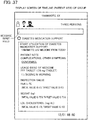
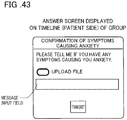
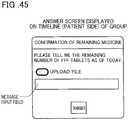
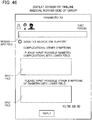
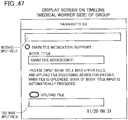
- reply messages described in Figs. 42 to 45 and various types of reply messages described in Figs. 46 and 47 which will be described later, apply thereto.
- the "application framework” described above means software that is configured so as to include at least functional block groups each of which provides one or a plurality of specific functions and so as to be able to develop the desired application program which is operated on the medical/care support system by utilization of at least one of the functional block groups.
- the "application program (application)” described above means a program in which at least one of the functional block groups provided by the application framework is installed and which is operated on the medical/care support system so as to additionally provide some kind of new service to the medical/care service provided by the system.
- the "new service” described above means a service which is provided by the application program and which is added to the medical/care service provided by the medical/care support system.
- Examples of the new service related to the medical field include: (a) medical services associated with various types of care (treatment), such as medication management, lifestyle improvement, diabetes medication support, team medical support, pressure ulcer care and rehabilitation support; and (b) medical services associated with community production/operation such as various types of coordination, consultation reception, advice and information provision which function as cooperation windows between multi-professional workers.
- Examples of the new service related to the care field include: (c) care services associated with various types of care, such as home-visit care, home-visit nursing, home rehabilitation support, home bathing support, dementia support, and the like.
- the "application-related information" described above means information which is provided, by utilization of the new service provided by the application program, to the group members related to one or a plurality of groups associated with the application identification information of the application program.
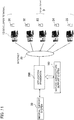
- Fig. 1 shows an overall configuration when a medical support service, provided by a medical support system 30 in which a service architecture support system 100 according to an embodiment of the present invention is incorporated, is utilized.
- the medical support service is utilized through the Internet 20 serving as a communication network from a patient terminal 10 possessed by the patient P, a medical worker terminal 11 operated by the medical worker M or a patient-related person terminal 12 possessed by the patient-related person R (hereinafter, these terminals may also be collectively referred to as a "user terminal").
- the patient P, the patient-related person R or the medical worker M who has performed the user registration serves as a "user" of the medical support service. Since the medical support service is realized by the medical support system 30, the "user" of the medical support service can be said to be the "user” of the medical support system 30. A patient P, the patient-related person R or the medical worker M who has not performed the user registration cannot utilize the medical support service.
- any one of the user terminals 10, 11 or 12 provides an instruction to the medical support system 30 through the Internet 20, by the operation of hardware and software installed within the medical support system 30, various operations and functions are executed, such as "user registration”, “generation of a group”, “invitation to group”, “transmission and reception (communication) of a message”, “regular registration”, and “browsing of medical information”, which will be described later.
- various operations and functions are executed, such as "user registration”, “generation of a group”, “invitation to group”, “transmission and reception (communication) of a message”, “regular registration”, and “browsing of medical information”, which will be described later.
- medical information of each patient and exchanged messages can be shared among a plurality of medical workers M, between the patient P and the medical worker M or among the patient P, the medical worker M and the patient-related person R, while protecting the privacy of the patient P, with the result that it is possible to provide a higher quality medical service to each patient P based on the shared medical information and messages.
- the patient terminal 10 and the patient-related person terminal 12 are generally assumed to be portable terminals such as a portable phone and a smart phone, and each patient P or patient-related person R possesses his or her special terminal, a desktop or notebook personal computer, or a touch panel terminal can be used. Since the medical worker terminal 11 is often installed in the medical-related facility, though the medical worker terminal 11 is generally assumed to be a desktop or notebook personal computer, it is needless to say that a touch panel terminal or a portable terminal can be used. In short, as long as these terminals 10, 11 and 12 are terminal devices which can transmit and receive information to and from the medical support system 30 through the Internet 20 and produce a display, the form and configuration thereof are not limited.
- Each patient P has one or more diseases, and receives, in a specific medical-related facility F, a medical service such as diagnosis and treatment from the medical worker M who belongs thereto.
- a medical service such as diagnosis and treatment from the medical worker M who belongs thereto.
- the patient-related person R indicates a person who has a relationship with a patient P in any form such as a family member, a relative, a friend or an acquaintance of the patient P. Even when the medical worker M is a family member, a relative, a friend, an acquaintance or the like, of a certain patient P, the medical worker M can serve as the patient-related person R of the patient P.
- the medical worker M can serve as the patient-related person R of the patient P.
- eight patient-related persons R1, R2, R3, R4, R5, R6, R7 and R8 may utilize the service architecture support system 100 according to the conditions of the patient P.
- Medical worker M indicates a person such as a doctor or a nurse who is engaged in a medical service in the medical-related facility F.
- the medical workers M belong to various types of medical-related facilities F such as specialized clinics (small-scale clinics), hospitals (medium and largescale medical facilities) and home-visit nursing stations, and provide, in the medical-related facilities F, medical services such as diagnosis and treatment to the patients P.
- medical-related facilities F such as specialized clinics (small-scale clinics), hospitals (medium and largescale medical facilities) and home-visit nursing stations, and provide, in the medical-related facilities F, medical services such as diagnosis and treatment to the patients P.
- Medical-related facility F indicates a facility in which the medical workers M provide medical services to the patients P, such as a small-scale clinic (clinic), a hospital which is larger than the clinic or a home-visit nursing station.
- a small-scale clinic such as clinical
- hospital which is larger than the clinic or a home-visit nursing station.
- the facility provides a medical service such as diagnosis, treatment, nursing, care, inspection, surgery or consultation, the form and size thereof are not limited.
- the present invention is not limited to this configuration.
- Each of the patients P, the patient-related persons R and the medical workers M have identification information (user ID) which can be uniquely identified, and thus even when they log in to the medical support system 30 from the same terminal, they can be distinguished, with the result that even when a plurality of persons share the same terminal, no problem occurs.
- a system manager A a manager terminal 14 which is operated by the system manager A, and a service architecture support system 100 are shown.
- the service architecture support system 100 is provided in order to generate an application framework 200 on the medical support system 30, and is operated so as to cooperate with the medical support system 30.
- the system manager A is selected in order to manage the overall operation of the medical support system 30, uses the manager terminal 14 of the system manager A so as to access the medical support system 30 through the Internet 20, and thereby can perform the necessary processing.
- the system manager A manages not only the medical support system 30, but also the service architecture support system 100.
- the system manager A is set to perform the processing of "manager settings" (which will be described later) on an application program 220 which is developed by utilization of the application framework 200.
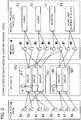
- Fig. 2 is an illustrative view showing a correlation between the patients P1 and P2, the patient-related persons R1 to R8 and the medical workers M1 to M8 who utilize the medical support system 30, that is, those who are the users of the medical support system 30.
- a group G is registered for each disease of each patient P.
- a separate group G is formed for each of the diseases which each patient P has.
- Persons (participants) who participate in each group G generally include, in addition to the patient P, at least one medical worker M who belongs to the medical-related facility F at which the patient P receives treatment and the like, and who is in charge of the patient P, and further include the patient-related person R who is added as necessary.
- the group members of each group G are generally formed with the patient P, the medical worker M in charge and the patient-related person R.
- any one of the medical-related facilities F to which the medical worker M participating in each group G belongs is generally subjected to "regular registration" for the group G (hence, the patient P).
- the medical-related facility F subjected to the "regular registration” is mainly responsible for the overall treatment policy of the disease of the patient P related to the group G.
- the configuration of group members is not limited to such a case.
- the former occurs, for example, when the patient P does not want to inform the patient-related person R of the medical information of the patient P.
- the latter occurs when it is not desired to inform the patient P of the medical information of the patient P though it is desired to share the medical information of the patient P among a plurality of medical workers M who are involved in the treatment of the patient P.
- each group G except the patient P The participants (group members) of each group G except the patient P are called "supporters", regardless of whether they are the medical workers M or the patient-related persons R. This is because they support the patient P in some form.
- the group members of each group G are formed with the patient P and at least one supporter when the patient P is included. It can be said that when the patient P is not included, the group members are formed with only a plurality of supporters.
- the patient P1 has three diseases (here, diabetes, hyperlipidemia and gout are assumed), groups G11, G12 and G13 are respectively generated for the three diseases of the patient PI, and each of the groups G is associated with the medical-related facility F.
- a clinic F1 is subjected to regular registration
- a clinic F2 is subjected to regular registration
- a hospital F3 is subjected to regular registration.
- the patient P1 belongs to the three groups G11, G12 and G13.
- the medical workers M who belong to the clinic F1, the clinic F2 and the hospital F3, which are subjected to regular registration also belong to the groups G11, G12 and G13.
- the patient P2 has two diseases (here, Alzheimer's disease and high blood pressure are assumed), groups G21 and G22 are respectively generated for the two diseases of the patient P2 and each of the groups G is associated with the medical-related facility F.
- groups G21 and G22 are respectively generated for the two diseases of the patient P2 and each of the groups G is associated with the medical-related facility F.
- the hospital F3 is subjected to regular registration
- a home-visit nursing station F4 is subjected to regular registration.
- the patient P2 belongs to the two groups G21 and G22.
- the medical workers M who belong to the hospital F3 and the home-visit nursing station F4, which are subjected to regular registration also belong to the groups G21 and G22.
- the group G11 is the group of the patient P1 for diabetes treatment
- the group G12 is the group of the patient P1 for hyperlipidemia treatment
- the group G13 is the group of the patient P1 for gout treatment.
- the group G21 is the group of the patient P2 for Alzheimer's disease treatment
- the group G22 is the group of the patient P2 for high blood pressure treatment.
- the medical worker M1 is a doctor, belongs to the clinic F1, and belongs as a supporter of the patient P1 to the group G11 for diabetes treatment and the group G13 for gout treatment.
- the medical worker M2 is a nurse, belongs to the same clinic F1 as the medical worker M1, and belongs as a supporter of the patient P1 to the group G11 for diabetes treatment.
- the medical worker M3 is a doctor, belongs to the clinic F2, and belongs as a supporter of the patient P1 to the group G12 for hyperlipidemia treatment.
- the medical worker M4 is a nurse, belongs to the same clinic F2 as the medical worker M3, and belongs as a supporter of the patient P1 to the group G12 for hyperlipidemia treatment.
- the medical worker M5 is a doctor, belongs to the hospital F3, and belongs as a supporter of the patient P1 to the group G13 for diabetes treatment.
- the medical worker M6 is a doctor, belongs to the same hospital F3 as the medical worker M5, and belongs as a supporter of the patient P1 to the group G11 for diabetes treatment and as a supporter of the patient P2 to the group G21 for Alzheimer's disease treatment and the group G22 for high blood pressure treatment.
- the medical worker M7 is a nurse, belongs to the home-visit nursing station F4, and belongs as a supporter of the patient P2 to the group G21 for Alzheimer's disease treatment.
- the medical worker M8 is a nurse, belongs to the same home-visit nursing station F4 as the medical worker M7, and belongs as a supporter of the patient P2 to the group G22 for high blood pressure treatment.
- the groups G11, G12 and G13 are respectively generated for the three diseases (here, diabetes, hyperlipidemia and gout) of the patient PI, and for the groups G11, G12 and G13, the clinic F1, the clinic F2 and the hospital F3 are respectively subjected to regular registration.
- the medical workers M1 and M2 belonging to the clinic F1 are in charge of the treatment and the like of the disease (here, diabetes) in the group G11 of the patient P1 as primary doctors.
- the medical workers M3 and M4 belonging to the clinic F2 are in charge of the treatment and the like of the disease (here, hyperlipidemia) in the group G12 of the patient P1 as primary doctors.
- the medical workers M5 and M6 belonging to the hospital F3 are in charge of the treatment and the like of the disease (here, gout) in the group G13 of the patient P1 as primary doctors.
- the groups G21 and G22 are respectively generated for the two diseases (here, Alzheimer's disease and high blood pressure) of the patient P2, and for the groups G21 and G22, the hospital F3 and the home-visit nursing station F4 are respectively subjected to regular registration.
- the medical workers M5 and M6 belonging to the hospital F3 are in charge of the treatment and the like of the disease (here, Alzheimer's disease) in the group G21 of the patient P2 as primary doctors.
- the medical workers M7 and M8 belonging to the home-visit nursing station F4 are in charge of the treatment and the like of the disease (here, high blood pressure) in the group G22 of the patient P2 as primary doctors.
- Fig. 3 is a functional block diagram showing an internal configuration of the medical support system 30.
- the medical support system 30 of the present embodiment includes a user management unit 310, a group management unit 320, an authentication unit 340 and a communication control unit 350.
- the communication control unit 350 is a section which allows the transmission and reception of information between the medical support system 30 and a plurality of user terminals (that is, the patient terminal 10, the medical worker terminal 11 and the patient-related person terminal 12) through the Internet 20 serving as a communication network provided outside the medical support system 30.
- the communication control process of the communication control unit 350 is executed by a known method, and thus the description thereof will be omitted.
- the authentication unit 340 is a section which authenticates whether or not a person who accesses the medical support system 30 from the user terminal 10, 11 or 12 through the Internet 20 is a regular user who receives user registration in the medical support system 30.
- the authentication unit 340 is connected through the communication control unit 350 to the Internet 20 provided outside the medical support system 30.
- the user management unit 310 and the group management unit 320 transmit and receive information to and from the patient terminal 10, the medical worker terminal 11 and the patient-related person terminal 12 provided outside the medical support system 30. Then, only when the person is authenticated as the regular user in the authentication unit 340, the person is allowed to access the user management unit 310 and the group management unit 320. Then, the user can first utilize the medical support service provided by the medical support system 30.
- the user management unit 310 will be described next.
- the user management unit 310 is a section which registers (user registration) individual users who utilize the medical service provided from the medical-related facility F or users who support the users, that is, the patient P, the medical worker M and the patient-related person R and which manages the registered users.
- the user management unit 310 includes a registration unit 311, a user information storage unit 312, a patient information storage unit 313, a medical worker information storage unit 314, a medical-related facility information storage unit 315 and a disease information storage unit 316.
- the registration unit 311 is formed with software for controlling the operation thereof, and controls an operation on the user registration as a whole in the user management unit 310. For example, for the user terminal 10, 11 or 12 which accesses the medical support system 30, a predetermined user registration screen (see Fig. 16A ) is displayed, and a person who wants to utilize the medical support service (applicant for utilization) is prompted to input and transmit predetermined personal information. When the predetermined personal information is transmitted from the user terminal 10, 11 or 12 to the medical support system 30 accordingly, the personal information is stored as the "user information" of the applicant for utilization in the user information storage unit 312. As necessary, the registration unit 311 reads and utilizes the user information stored in the user information storage unit 312, and, for example, corrects and deletes the user information.
- the user information storage unit 312 is formed with: an information storage medium such as a hard disk; and software which controls operations of recording, reproduction, deletion, and the like of information on the information storage medium, and stores, according to an instruction from the registration unit 311, the user information, that is, the necessary information of the patient P, the medical worker M and the patient-related person R serving as the users.
- “user identification information” (user ID) which can be uniquely identified is assigned to each user.
- the user information is stored, for example, in the form of a user table as shown in Fig. 4(a) .
- the patient information storage unit 313 is formed with: an information storage medium such as a hard disk; and software which controls operations of recording, reproduction, deletion, and the like of information on the information storage medium, and stores, according to an instruction from the registration unit 311, the personal information of the patient P.
- a "patient ID” which can be uniquely identified is assigned to each patient P.
- the "patient ID” is “patient identification information” and is also "service recipient identification information”.
- the personal information of the patient P is stored, for example, in the form of a patient table as shown in Fig. 4(b) .
- the medical worker information storage unit 314 is formed with: an information storage medium such as a hard disk; and software which controls operations of recording, reproduction, deletion, and the like of information on the information storage medium, and stores, according to an instruction from the registration unit 311, the personal information of the medical worker M.
- a "medical worker ID” which can be uniquely identified is assigned to each medical worker M.
- the “medical worker ID” is “medical worker identification information” and is also "business worker identification information”.
- the personal information of the medical worker M is stored, for example, in the form of a medical worker table as shown in Fig. 4(c) .
- the medical-related facility information storage unit 315 is formed with: an information storage medium such as a hard disk; and software which controls operations of recording, reproduction, deletion, and the like of information on the information storage medium, and stores, according to an instruction from the registration unit 311, the necessary information of the medical-related facility F.
- a "medical-related facility ID" which can be uniquely identified is assigned to each medical-related facility F.
- the "medical-related facility ID” is “medical-related facility identification information”.
- the necessary information of the medical-related facility F is stored, for example, in the form of a medical-related facility table as shown in Fig. 4(d) .
- the disease information storage unit 316 is formed with: an information storage medium such as a hard disk; and software which controls operations of recording, reproduction, deletion, and the like of information on the information storage medium, and stores, according to an instruction from the registration unit 311, disease information.
- a "disease ID” which can be uniquely identified is assigned to each disease.
- the “disease ID” is “disease identification information”.
- the disease information is stored, for example, in the form of a disease table as shown in Fig. 5(b) .
- the group management unit 320 will be described next.
- the group management unit 320 is a section which manages the group G that is registered and formed for each disease of each patient P in the medical support system 30.
- the group management unit 320 executes a large number of functions such as the new registration of a group, the storage of information of a group member, the control of an invitation request, a timeline and a message, and regular registration.
- the group management unit 320 includes a registration unit 321, a group information storage unit 322, a group member information storage unit 323, an invitation request control unit 324, an invitation request information storage unit 325, a timeline control unit 326, a message control unit 327, a regular facility information storage unit 328, a sharing agreement information storage unit 329, a patient existence verification unit 330, an authentication unit 331 and an application storage unit 332.
- the application storage unit 332 is added to the medical support system 30 for the service architecture support system 100 (application framework 200) which will be described later.
- the registration unit 321 is formed with software for controlling the operation thereof, and generates and registers the group G according to a request from the medical worker M or the patient P for each disease of each patient P.
- the registration unit 321 executes, according to a request from the medical worker M or the patient P, a process related to the "regular registration" which will be described later (specifically, the association of the patient P, the disease and the medical-related facility F).
- the group G is generated according to a request from the medical worker M when the medical worker M performs "patient group registration".
- the "patient group registration” indicates that the medical worker M registers, in the medical support system 30, the patient P and the disease of the patient P on which the medical-related facility F of the medical worker M performs treatment and the like.
- the medical worker M specifies the patient P and the disease of the patient P on which the medical-related facility F of the medical worker M performs treatment and the like, and registers them in the medical support system 30, and this is so that the medical information of the patient P can be shared within the medical-related facility F to which the medical worker M belongs.
- the registration unit 321 automatically generates the group G in synchronization with the "patient group registration", and stores information related to the generated group G in the group information storage unit 322.
- the number of first group members in the group G generated in this way is zero except in a case where previously determined members (default members) are automatically invited.
- the medical worker M who has performed the "patient group registration" and the patient P who is the target of the "patient group registration” are not group members.
- the medical worker M who has performed the "patient group registration” to become a group member the medical worker M transmits an invitation request to himself or herself and needs to provide approval.
- the patient P transmits an invitation request to the patient P and needs to receive approval.
- the group G is generated according to a request from the patient P when the patient P requests "regular registration".
- the patient P selects one of the medical-related facility F at which the patient P receives treatment and the like and the medical-related facility F from which the patient P will receive treatment and the like, requests "regular registration” and receives approval from the medical-related facility F.
- the registration unit 321 automatically generates the group G in synchronization with "regular registration", and stores information (group information) related to the generated group G in the group information storage unit 322. Specifically, in the "regular registration", the patient P, the disease and the medical-related facility F are associated with each other.
- the number of first group members in the group G generated in this way is zero except in a case where default members are automatically invited.
- the patient P who requests "regular registration" and the medical worker M of the medical-related facility F which is the target of the "regular registration” are not group members.
- the patient P transmits an invitation request to himself or herself and needs to provide approval.
- the patient P who requests "regular registration” transmits an invitation request to the medical worker M and needs to receive approval.
- the group information storage unit 322 is formed with: an information storage medium such as a hard disk; and software which controls operations of recording, reproduction, deletion, and the like of information on the information storage medium, and stores the group information, that is, information indicating which one of diseases of a specific patient P each group G is related to and which one of the medical-related facilities F is registered as a "regular facility".
- the "group information” is stored, for example, in the form of a group table as shown in Fig. 5(c) .
- the group member information storage unit 323 is formed with: an information storage medium such as a hard disk; and software which controls operations of recording, reproduction, deletion, and the like of information on the information storage medium.
- the group member information storage unit 323 stores group member information, that is, information related to the patient P who can be said to be the owner of each group G and the medical worker M and the patient-related person R who participate in each group G as supporters of the patient P.
- the "group member information" is stored, for example, in the form of a group participation table as shown in Fig. 5(d) .
- the invitation request control unit 324 is formed with software for controlling the operation thereof, identifies a non-group member (that is, the patient P, the medical worker M or the patient-related person R) who is desired to participate in each group G and controls an "invitation request" which is sent to the non-group member.
- the invitation request control unit 324 transmits, according to an instruction from the user, that is, the medical worker M, the patient P or the patient-related person R, the invitation request to the identified non-group member by electronic mail.
- the invitation request control unit 324 receives a reply (which indicates whether or not the invitation request is approved) from the user who receives the invitation request.
- the invitation request is an invitation which is sent to the user who is desired to participate in the desired group G so as to become a group member and which is in the form of electronic mail.
- the sender needs to receive "permission" of a predetermined manager before transmitting the invitation request to the user who is desired to participate in the group G.
- This permission is determined by the manager with consideration given to, for example, whether or not the user who is invited is appropriate as a group member and whether or not any problem occurs by the participation of the user.
- the manager there is a "medical worker-side manager” and a "patient-side manager".
- the “medical worker-side manager” is a medical worker M (who is also the user) who has the authority to "allow” or “reject” the transmission of the invitation request, and is set for each medical-related facility F or for each group.
- the “medical worker-side manager” for example, the director, the office manager, or the like of a clinic is specified.
- the “patient-side manager” is the patient P (who is also the user) or a user, such as a family member or a friend of the patient P, who receives, from the patient P, the authority to "allow” or “reject” the transmission of the invitation request, and is set for each patient P or for each group.
- a parent, the spouse, a child, a close friend, or the like of the patient P is specified.
- a configuration may be adopted in which when the permission of either the "medical worker-side manager” or the "patient-side manager” is received, the invitation request can be transmitted, or a configuration may be adopted in which when only the permission of the "medical worker-side manager” is received, the invitation request can be transmitted. This point can be determined according to needs or requests.
- the user who receives the invitation request which is transmitted as a result of the reception of both or at least one of the "permission” of the "medical worker-side manager” and the “permission” of the "patient-side manager” participates in the group G specified by the invitation request
- the user preferably "approves” the invitation.
- the user is automatically added as a group member.
- the user preferably "rejects” the invitation.
- the user who receives the invitation request determines whether or not to "approve” the invitation so as to be able to select participation or non-participation in the group G.
- the user who approves the invitation becomes a group member in the group G
- all the group members (specifically, the medical worker M and the patient-related person R) other than the patient P are the supporters of the patient P.
- the medical information of the patient P and messages are shared according to a sharing rule selected by the patient P.
- the patient P wants to receive a second opinion on his or her disease from a medical worker M in another medical-related facility F or when the patient P has a patient-related person R such as a family member, a relative or a friend who wants to know the treatment progress and the like on the disease of the patient P
- the invitation request is transmitted to such a person.
- the medical information on the specific disease of the patient P in the medical-related facility F can be shared among a plurality of medical workers M and patient-related persons R and the patient P including medical workers in other medical-related facilities while ensuring the uniqueness of the medical information.
- the settings of the "medical worker-side manager” and the “patient-side manager” are stored in the invitation request information storage unit 325.
- the process of the "permission” by the “medical worker-side manager” and the “patient-side manager” is executed with the invitation request control unit 324.
- the generation and transmission of the invitation request and the reception of a reply from an invitation request receiver are executed with the invitation request control unit 324.
- the invitation request information storage unit 325 is formed with: an information storage medium such as a hard disk; and software which controls operations of recording, reproduction, deletion, and the like of information on the information storage medium.
- the invitation request information storage unit 325 stores "invitation request information" which is generated according to a request with the invitation request control unit 331, that is, various types of information indicating who sends the invitation request and who receives the invitation request, and information on the rejection of the invitation request by the manager.
- the invitation request information storage unit 325 also stores the details of the reply from the invitation request receiver (the approval of the invitation request or the rejection of the invitation request) and the settings of the "medical worker-side manager" and the "patient-side manager".
- the "invitation request information” is stored, for example, in the form of an invitation request table as shown in Fig. 6(a) .
- an "invitee passphrase" is included in the invitation request table of Fig. 6(a) because whether or not the person who receives the invitation request is an authorized invitee, that is, whether or not the person is the authorized person, is checked with this passphrase.
- the person who receives the invitation request In order for the person who receives the invitation request to participate in the group of the inviter related to the invitation request, the person needs to access a URL described in the electronic mail of the invitation request and to input the passphrase in an invitation request approval screen displayed there.
- the passphrase which is input does not agree with the "invitee passphrase" stored in the invitation request table, the person cannot participate in the group, with the result that it is possible to easily identify the authorized person of the invitee.
- the timeline control unit 326 is formed with software for controlling the operation thereof, and controls a "timeline" (that is, an information display region) which is assigned to each group G. Specifically, the information display region called the "timeline" is assigned to a newly generated group G, and the shared medical information is displayed in the timeline in a predetermined order (for example, in an order in which information is posted). Since information to be displayed and parameters such as a time at which the information is displayed are sent from the medical worker terminal 11 through the Internet 20 to the group management unit 330, the timeline control unit 335 displays, according to the parameter, the information which is sent in the timeline.
- a timeline that is, an information display region
- This timeline 51 is generated for the group G11 for diabetes treatment of the patient PI, and includes a shared area for all members 51a and a medical worker shared area 51b.
- the shared area for all members 51a information which is shared by all the members in the group G11 is displayed.
- the medical worker shared area 51b information which is shared only by the medical workers M in the group G11 is displayed.
- the medical information displayed in the shared area for all members 51a can be shared among all the members in the group G11, and the patient PI, the medical workers M1 and M2 who belong to the clinic F1, the medical worker M6 who belongs to the hospital F3 and the patient-related persons R1, R2 and R4 can freely perform posting and browsing.
- the medical information displayed in the medical worker shared area 51b can be shared only among the medical workers in the group G11, and the medical workers M1 and M2 who belong to the clinic F1 and the medical worker M6 who belongs to the hospital F3 can freely perform posting and browsing.
- the message control unit 327 is formed with software for controlling the operation thereof, and controls the transmission and reception of messages from one group member to other group members.
- a message transmission reservation table shown in Fig. 7(a) is used.
- a patient attribute table shown in Fig. 7(b) is used to store the attributes of individual patients P, and is used when the message control unit 336 selectively transmits a predetermined message to some patients P.
- the regular facility information storage unit 328 is formed with: an information storage medium such as a hard disk; and software which controls operations of recording, reproduction, deletion, and the like of information on the information storage medium.
- the regular facility information storage unit 328 stores "regular facility information" which is utilized and generated in the "regular registration” (the association of the patient P, the disease and the medical-related facility F) process that is executed with the registration unit 321.
- the details of the regular registration are disclosed in Patent Document 1 described previously, and thus the description thereof will be omitted.
- the "regular facility information” is stored, for example, in the form of a medical-related facility patient table as shown in Fig. 5(a) .
- the registration unit 321 displays a predetermined sharing rule selection screen in an inquiry screen for sharing of the medical information described above, and prompts the user to select a sharing rule, that is, the sharing range of the medical information. For example, two choices for the sharing rule are set, and one is that "the medical information is shared only within the medical-related facility F related to the regular registration" and the other is that "the medical information is shared within the medical-related facility F related to the regular registration and among all the group members including the patient P related to the regular registration".
- the registration unit 321 stores an answer indicating "agreeing with the sharing" and the selected sharing rule in the sharing agreement information storage unit 329. It is needless to say that three or more sharing rules may be set.
- the sharing agreement information storage unit 329 is formed with: an information storage medium such as a hard disk; and software which controls operations of recording, reproduction, deletion, and the like of information on the information storage medium, and stores a statement of intention (sharing agreement information) which is generated with the registration unit 321 and which indicates "agreeing with sharing of the medical information of the user" and the selected sharing rule.
- the sharing agreement information and the selected sharing rule are stored, for example, in the form of a medical information sharing table shown in Fig. 6(c) .
- the patient existence verification unit 330 is formed with software for controlling the operation thereof, and verifies "whether or not the patient P who requests regular registration exits", that is, "whether or not the patient P is the authorized person or whether or not another person is posing as the authorized person". This patient existence verification process is preferably performed before the start of the regular registration process described above.
- Fig. 6(d) shows an example of an NFC terminal table which is produced in order to manage an NFC terminal.
- the authentication unit 331 is formed with software for controlling the operation thereof, and checks whether or not the patient P, the medical worker M or the patient-related person R who accesses the specific group G of the medical support system 30 through the user terminal is the authorized member, that is, whether or not the patient P, the medical worker M or the patient-related person R has the authority to access the timeline of the group G. Then, when it is confirmed that the patient P, the medical worker M or the patient-related person R is the authorized member, the patient P, the medical worker M or the patient-related person R is allowed to access the timeline of the group G. When it is confirmed that the patient P, the medical worker M or the patient-related person R is not the authorized member, the medical worker M or the patient-related person R is prevented from accessing the timeline of the group G.
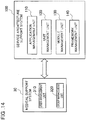
- the application storage unit 332 is added for the service architecture support system 100 which will be described later, and is formed with: an information storage medium such as a hard disk; and software which controls operations of recording, reproduction, deletion, and the like of information on the information storage medium.
- the application storage unit 332 is a section which stores a file (application configuration file) itself that configures all applications 220 developed by utilization of the application framework 200 (which is generated with the service architecture support system 100) and information that is utilized in the applications 220.
- the application storage unit 332 stores all the applications 220 (that is, the application configuration file of the applications 220) which are uploaded from a developer terminal 13 that develops the applications 220 into the medical support system 30 and which are installed, and additionally stores settings information (for example, information related to the manager settings and information provided by the user settings) used when each of the applications 220 is executed and the like.
- the group G is registered and generated for each disease of each patient P.
- the production of the group G is performed, as described above, with the patient group registration performed by the medical worker M or with the regular registration performed by the patient P.
- the group members in the group G are increased in number, (excepting the default members), as necessary, by the invitation of the patient P, the medical worker M or the patient-related person R, and are decreased in number as necessary. Since the details of these operations of the medical support system 30 are disclosed in Patent Document 1, and are not related to the service architecture support system 100 according to the present embodiment, the description thereof will be omitted.
- developer D1 when individual developers who develop desired applications 220 with the application framework 200 are distinguished, they are represented as: “developer D1", “developer D2”, and such, whereas when the individual developers are not distinguished, they are represented as: “developers D”.
- the developer terminal 13 (see Figs. 11 and 12 ) operated by the developer D and the manager terminal 14 (see Fig. 1 ) operated by the system manager A of the medical support system 30 may be, as with the user terminal described above (that is, the patient terminal 10, the medical worker terminal 11 or the patient-related person terminal 12), portable terminals such as a portable phone and a smart phone, desktop or notebook personal computers, or touch panel terminals.
- the form and configuration thereof are not limited.
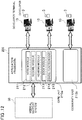
- the application framework 200 is constructed on the medical support system 30 serving as a platform, and a plurality of developer terminals 13 can be connected to the application framework 200 through the Internet 20.
- Each of the developers D1 to D5 operates his or her developer terminal 13 so as to access the application framework 200 through the Internet 20, and uses, as necessary, specific functions prepared in the application framework 200 so as to be able to efficiently develop the desired application (application program) 220 which is operated on the medical support system 30.
- the application 220 (that is, a file which configures the application 220) which is developed by utilization of the application framework 200 is uploaded from the developer terminal 13 through the Internet 20 into the medical support system 30, is passed though predetermined installation processing and is stored within the system 30, specifically, in the application storage unit 332 (see Fig. 3 ) provided within the group management unit 320. Thereafter, a service (new medical service) provided by the application program 220 can be utilized from the medical support system 30.
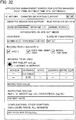
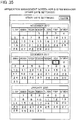
- the details of the new medical service (for example, in the case of a medication support app, what questions the patient is asked, what inspection data is collected, and the like) are determined according to the settings of the system manager of the medical support system 30.
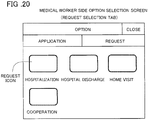
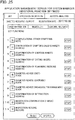
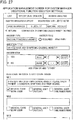
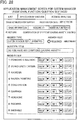
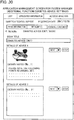
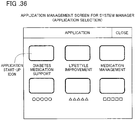
- the user (that is, the patient P, the medical worker M or the patient-related person R) of the medical support system 30 who wants to utilize the new medical service preferably only selects (clicks), on an application selection screen (see, for example, Figs. 19 , 20 and 22 ) displayed on the user terminal (that is, the patient terminal 10, the medical worker terminal 11 or the patient-related person terminal 12) of the user, the icon of the application 220 desired by the user.
- the uploaded application 220 that is, the application configuration file
- Fig. 12 shows a state where the application 220 is developed by utilization of the application framework 200
- Fig. 13 shows a state where the application 220 thus developed is utilized.
- two units 210a and 210b which have different functions according to their purposes are provided.
- the present invention is not limited to this configuration. It is needless to say that the total number of these units may be one or three or more and that arbitrary settings can be made as necessary.
- the unit 210a is formed as a "care unit", and is prepared so that, for example, additional medical services associated with various types of care (treatment) such as medication management, lifestyle improvement, diabetes medication support, team medical support, pressure ulcer care and rehabilitation support can be efficiently constructed on the medical support system 30 with the applications 220 and that the services described above can be provided to the user of the medical support system 30 at reasonable prices.
- additional medical services such as medication management, lifestyle improvement, diabetes medication support, team medical support, pressure ulcer care and rehabilitation support
- multi-professional cooperation of medical experts that is, cooperation between multi-professional workers such as a doctor, a nurse, a nutritionist, a care manager and a helper
- four sharing function modules which have specific functions are provided so as to be able to be effectively utilized for the development of various applications 220 which provide these types of services. These modules will be described later.
- the unit 210b is formed as a "community unit", and is prepared so that, for example, additional medical services associated with community production/operation such as various types of coordination, consultation reception, advice and information provision which function as cooperation windows between multi-professional workers can be efficiently constructed on the medical support system 30 with the applications 220 and so that the services described above can be provided to the user of the medical support system 30 at reasonable prices.
- additional medical services associated with community production/operation
- such as various types of coordination, consultation reception, advice and information provision which function as cooperation windows between multi-professional workers
- cooperation window functions in the medical/care field such as a home medical consultation window, a care consultation window, regional comprehensive support and medical coordination.
- a plurality of sharing function modules (specific function modules) (not shown) which are different from the "care unit” are provided so as to be able to be effectively utilized for the development of various applications 220 which provide these types of services.
- the community unit 210b includes, according to the purposes (services) thereof, sharing function modules different from the sharing function modules of the care unit 210a, this is only the difference between both the units 210a and 210b, and since the roles of both the units 210a and 210b in the application framework 200 are the same as each other, the description of the sharing function modules of the community unit 210b will be omitted here.
- the care unit 210a includes, as shown in Figs. 12 and 13 , the four sharing function modules which are a note module 211, a record module 212, a hearing module 213 and a book module 214.
- These modules 211, 212, 213 and 214 are provided for various applications 220 which provide additional medical services associated with various types of care (treatment) such as medication management, lifestyle improvement, diabetes medication support, team medical support, pressure ulcer care and rehabilitation support, and are prepared as means for facilitating the development of the applications 220.
- These modules 211, 212, 213 and 214 are shared in all the applications 220 which are developed for the care unit 210a.
- the note module 211 is a module for providing, to the developer D, the function of recording desired information in a predetermined storage means (specifically, the application storage unit 332 of the medical support system 30) each time the user of the medical support system 30 needs the function.
- This function enables the same operation as an operation in which the user (for example, the medical worker M) of the medical support system 30 (medical support service) records desired information in a notebook as necessary.
- this function is described within the application 220, it is possible to easily realize an operation in which at the time of the execution thereof, for example, a specific medical worker M is prompted to input details corresponding to the settings of the function: "complications, other symptoms" shown in Fig.
- the predetermined initial settings is executed in a "manager settings process" performed by the system manager A in the medical support system 30.
- a settings change (this settings change is generally performed by a request or an instruction from the user, for example, the medical worker M) which is performed as necessary after the start of use of the function is also executed in the "manager settings process" performed by the manager A.
- the user for example, the medical worker M
- the manager A who receives the request executes the "manager settings process" again so as to perform the settings change desired by the requester.
- timeline (medical worker side)
- medical worker side can be browsed only by the medical worker M among the group members, and corresponds to the medical worker shared area 51b of Fig. 9 .
- timeline (patient side) can be browsed by all the group members, and corresponds to the shared area for all members 51a of Fig. 9 . This is true in the following description.
- the record module 212 is a module for providing, to the developer D, the function of automatically capturing predetermined information (external information) provided from the outside and recording it in a predetermined storage means (specifically, the application storage unit 332 of the medical support system 30).
- This function enables an operation in which predetermined external information (for example, various types of inspection information sent from an inspection agency) necessary for the user (for example, the medical worker M) of the medical support system 30, is automatically collected at the desired timing and is recorded within the medical support system 30.
- this function when this function is described within the application 220, it is possible to easily realize an operation in which at the time of the execution thereof, for example, information (inspection information) related to an inspection item specified in the function settings: "inspection record" shown in Fig. 25 , is read from a predetermined information source (for example, a database) which is externally present and is automatically stored in the application storage unit 332 (the specifications of the inspection item are executed in the "user settings process" which will be described later).
- a predetermined information source for example, a database
- the message posting function of the medical support system 30 is used, and thus it is possible to very easily realize an operation of posting and displaying, at a desired time, the headline: "inspection record" and the corresponding inspection information on the timeline (medical worker side) of the group G.
- the inspection information for example, vital signs are present which are the most basic information regarding the life of the specified patient P.
- the vital signs often indicate, for example, the four items of pulse or heart rate, respiration (number), blood pressure and body temperature, and the current condition of the patient P can be grasped and expressed from the numerical information thereof. Items such as weight, blood pressure, blood sugar level and HbA1c, which are included in diagnoses performed before and after treatment or in the middle thereof, apply thereto. It is needless to say that external information other than the inspection information described above can be likewise captured and recorded.
- initial settings are needed as in the case of the note module 211 in order to use the function of the record module 212 incorporated into the application 220, at the time of the start of use, the predetermined initial settings are executed in the "manager settings process" performed by the system manager A.
- the settings change which is performed as necessary after the start of use of the function is also executed in the "manager settings process” performed by the manager A.
- the hearing module 213 is a module for providing, to the developer D, a function for conducting a series of questions and answers (for example, a medical interview with a patient) on a predetermined target person.
- This function enables an operation in which the user (for example, the medical worker M) of the medical support system 30 asks the predetermined target person (for example, the patient P) a series of questions at the desired timing, and in which thus desired information (for example, information on the recent condition and symptoms of the patient P) corresponding to the questions is acquired as answers and is recorded.
- a series of question samples (question template group) and a series of answer samples (answer template group) are prepared, the template groups are utilized and thus it is possible to simply make desired question sentences and answer forms suitable therefor.
- the function of the hearing module 213 is described within the application 220, it is possible to easily realize an operation in which at the time of the execution thereof, for example, in the function settings: "confirmation of symptoms causing anxiety", “confirmation of eating habits", and the like shown in Fig.
- desired question sentences are automatically produced, in which the question sentences (question information) are posted on the timeline (patient side) of the group G to which the patient P serving as the target person belongs with the message posting function of the medical support system 30 at the desired timing, and in which the patient P is prompted to give answers. Then, it is possible to easily realize an operation in which when answers are input from the patient P, a function of the medical support system 30 is used so as to automatically store the details of the answers (answer information) in the application storage unit 332.
- the specifications of the question information and the specifications of the answer form for the answer information are executed in the "user settings process" which will be described later.
- initial settings are needed as in the cases of the note module 211 and the record module 212 in order to use the function of the hearing module 213 incorporated into the application 220, at the time of the start of use, the predetermined initial settings are executed in the "manager settings process" performed by the system manager A.
- the settings change which is performed after the start of use of the function is also executed as necessary in the "manager settings process” performed by the manager A.
- the book module 214 is a module for providing, to the developer D, the function of storing, in a file format, various types of information as "contents" in a predetermined storage means (specifically, the application storage unit 332).
- This function can easily realize an operation in which files of various formats (for example, pdf, xls, doc, jpg and mp4) where useful information (beneficial information) for a specific user (for example, the patient P, the medical worker M or the patient-related person R) of the medical support system 30 is organized as the "contents" and previously stored, in which the message posting function of the medical support system 30 is used, and in which thus the specified contents are posted and displayed at the desired timing on the timeline (patient side) of the specific group G.
- files of various formats for example, pdf, xls, doc, jpg and mp4
- useful information for a specific user (for example, the patient P, the medical worker M or the patient-related person R) of the medical support system 30 is organized as the "contents" and previously
- the message posting function of the medical support system 30 is used so as to post and display, at the desired timing, contents (files) previously prepared according to the titles thereof on the timeline (patient side) of the group G to which the patient P serving as the target person belongs.
- the patient P or the patient-related person R can easily acquire beneficial information with optimal timing.
- the preparation, the storage, and the specifications of the contents (files) are executed in the "user settings process" which will be described later.
- the predetermined initial settings are executed in the "manager settings process” performed by the system manager A.
- the settings change which is performed after the start of use of the function is also executed as necessary in the "manager settings process” performed by the manager A.
- each of the note module 211, the record module 212, the hearing module 213 and the book module 214 described above is realized with a bot (BOT) which automatically executes, when receiving a predetermined instruction or request from any one of the applications 220, a predetermined program
- the present invention is not limited to this configuration.
- Any automatic execution program can be utilized which automatically executes a predetermined function, in a state where the program is independent from the medical support system 30 serving as the platform, according to an instruction or request sent from the application 220 or the medical support system 30.
- the automatic execution program may be software or may be written in hardware. As long as the program can provide the specific function of each of the modules 211, 212, 213 and 214, the program can be sufficiently used.
- the care unit 210a described above includes a basic function unit 215 in addition to the sharing function modules 211, 212, 213 and 214 described above.
- the basic function unit 215 is a section which executes a basic function of the care unit 210a other than the specific functions of the four function modules 211, 212, 213 and 214 described above.
- the basic function unit 215 executes: processing necessary for utilizing the specific function of the module 211, 212, 213 or 214 from the developer terminal 13 with the application 220; and processing necessary for calling and using the specific function of the module 211, 212, 213 or 214 within the application 220.
- the basic function unit 215 executes processing necessary for cooperation between the modules 211, 212, 213 and 214 (the application framework 200), the medical support system 30 and the developer terminal 13, whereas when the application 220 is utilized, the basic function unit 215 executes predetermined processing necessary for cooperation between the modules 211, 212, 213 and 214 (the application framework 200), the medical support system 30 and the user terminal 10, 11 or 12 (that is, the application 220).
- the configuration of the service architecture support system 100 will be described next with reference to Figs. 14 and 15 .
- the service architecture support system 100 generates application framework 200 having the configuration described above on the medical support system 30, and realizes cooperation between the application framework 200 and the medical support system 30 so as to realize the enhanced efficiency of the development of the application 220 and the facilitation of the construction of a new medical service (additional service) in the medical support system 30.
- the service architecture support system 100 can perform an operation in cooperation with the medical support system 30, there is no limitation to the configuration thereof.
- the system 100 may be configured (arranged) within the medical support system 30 integrally therewith or may be configured (arranged) outside the medical support system 30 separately therefrom.
- the service architecture support system 100 may be configured (arranged) within a server device (not shown) in which the medical support system 30 is incorporated together therewith or may be configured (arranged) in a server device separate from the server device in which the medical support system 30 is incorporated so as to communicate therewith through the Internet 20 or another network.
- the service architecture support system 100 includes four sections which are an application management unit 110, a unit management unit 120, a module management unit 130 and a framework management unit 140, and is operated in cooperation with the medical support system 30.
- the application management unit 110 is a section which manages the application 220 that utilizes the application framework 200 generated with the service architecture support system 100 and the developer D thereof.
- the service architecture support system 100 registers (application registration) the application 220 developed by utilization of the application framework 200, registers (developer registration) the developer D of the application 220 and manages information related to the application 220 and the developer D which are registered as described above. Since here, the developer D cannot perform the developer registration without being a user of the medical support system 30, the developer D first performs user registration in the medical support system 30 and thereafter performs the developer registration.
- the application management unit 110 having the functions as described above includes a registration unit 111 and an application information storage unit 112.
- the registration unit 111 is formed with software for controlling the operation thereof, and controls the overall operation of the user registration in the application management unit 110, the developer registration, and the application registration; as well as an operation related to the execution of the application 220 installed into the medical support system 30 after the application registration.
- the registration unit 111 is on standby for an application development request from the developer D (application development applicant) who wants to develop the application 220 by utilization of the application framework 200, displays a predetermined user registration screen (not shown) on the developer terminal 13 of the developer D when receiving the request and prompts the developer D to input predetermined personal information so as to perform the user registration in the medical support system 30.
- the registration unit 111 displays a predetermined application registration screen (not shown) on the developer terminal 13, and prompts the developer D to input predetermined application information (for example, the name, the application, and the purpose of the application) so as to perform the application registration.
- predetermined application information for example, the name, the application, and the purpose of the application
- the developer D who completes the user registration, the developer registration and the application registration utilizes the application framework 200 so as to develop the desired application 220.
- Which one of the care unit 210a and the community unit 210b provided in the application framework 200 is used is automatically determined according to the application and the purpose of the application 220. For example, when the application 220 is intended for (applied to) diabetes medication support, the utilization of the care unit 210a is automatically determined, and thus the developer D utilizes the four specific functions provided by the note module 211, the record module 212, the hearing module 213 and the book module 214 provided in the care unit 210a so as to develop the application 220 of the developer D.
- the utilization of the community unit 210b is automatically determined, and thus the developer D utilizes a plurality of specific functions provided by a module group (not shown) provided in the care unit 210b so as to develop the application 220 of the developer D.
- the developer registration and the application registration wants to utilize the application framework 200 so as to upload the application 220 (in which the application registration has been performed) developed by the developer D into the service architecture support system 100 (medical support system 30), a request (upload request) indicating the information thereof is transmitted to the system 100.
- the registration unit 111 receives the upload request, the registration unit 111 displays a predetermined upload screen (not shown) on the developer terminal 13 of the developer D, and prompts the developer D to upload the newly developed application 220.
- the registration unit 111 stores the new application 220 (application configuration file) in the application storage unit 332 of the medical support system 30, performs predetermined processing so as to incorporate (install) the new application into the medical support system 30 and allows the new application to be utilized. In this way, the upload/incorporation processing of the new application 220 is completed.
- the registration unit 111 also executes, as necessary, for example, operations in which the "user information", the "developer information” and the "application information" stored in the application information storage unit 112 are read and utilized, corrected and deleted.
- the application information storage unit 112 is formed with: an information storage medium such as a hard disk; and software which controls operations of recording, reproduction, deletion, and the like of information on the information storage medium, and stores the "user information", the "developer information” and the "application information” described above and other necessary information (such as the purpose and application of the application).
- the registration of the "user information", the "developer information” and the "application information” described above is performed with, for example, the user table of Fig. 16(a) , the developer table of Fig. 16(b) , the developer affiliate organization table of Fig. 16(c) and the application table of Fig. 16(d) .
- a user ID assigned to the application development applicant and associated information such as a password are stored in the user table as shown in Fig 16(a) .
- This user table is the same as that shown in Fig. 4(a) except that the information of the developer D is newly added.
- developer identification information (developer ID) assigned to the application development applicant and the associated information thereof, as well as the affiliate organization identification information (affiliate organization ID) assigned to the organization to which the application development applicant belongs and the associated information thereof, are respectively stored in the developer table of Fig. 16(b) and in the developer affiliate organization table of Fig. 16(c) .
- application identification information (application ID) assigned to the application 220, the developer ID of the developer who develops it, the group ID of the group G which can utilize the application, a date (registration date) on which the application is registered, and information indicating whether or not the application can be utilized and in which group G the application can be utilized (status information), are stored in the application table of Fig. 16(d) . Since at the time of the application registration, the development of the application is not completed, the status information is stored so as to be “disabled”. Then, when the application is uploaded and installed so as to be able to be utilized in the medical support system 30, the status information is rewritten from "disabled” to "enabled”.
- the application 220 (application 1) having an application ID of "1" is associated with two group IDs "10003" and "10004", and the application 220 (application 2) having an application ID of "2" is associated with two group IDs "10003" and "10005".
- the application 1 is enabled (can be executed) in the two groups G having the group IDs "10003" and "10004", and that the application 2 is enabled (can be executed) in the two groups G having the group IDs "10003" and "10005".
- the two applications 1 and 2 are simultaneously enabled (can be executed), and in other words, group members (the medical worker M, the patient P or the patient-related person R) belonging to the group G having the group ID "10003” can selectively utilize the applications 1 and 2, and can also utilize both the applications 1 and 2 in parallel.
- the group members belonging to the group G having the group ID "10003” use the one user ID such that they can utilize the application 1 and thereafter utilize the application 2, and can utilize the application 2 and thereafter utilize the application 1.
- the user table shown in Fig. 16(a) is stored in the application storage unit 332 of the medical support system 30, this is a copy of the user table shown in Fig. 4(a) (this is stored in the user information storage unit 312 of the medical support system 30). Both the tables are synchronous with each other such that pieces of information within both the tables constantly agree with each other.
- the developer table shown in Fig. 16(b) , the developer affiliate organization table shown in Fig. 16(c) and the application table shown in Fig. 16(d) are also stored in the application storage unit 332.
- the application registration is performed at the same time as the user registration and the developer registration
- the present invention is not limited to this configuration.
- a configuration may be adopted in which the application registration is not performed when the user registration and the developer registration are performed, and in which in a stage where after the completion of the application 220, the application 220 is uploaded and incorporated (installed) into the medical support system 30, the application registration is performed. It is needless to say that it is possible to add or delete a group G which can utilize the application 220 after the application registration is performed (that is, which has a group ID associated with the registered application ID).
- the unit management unit 120 will be described next.
- the unit management unit 120 is a section which controls the care unit 210a and the community unit 210b provided in the service architecture support system 100.
- the unit management unit 120 executes various types of functions such as the control of the functions (unit functions) of both the units 210a and 210b, the control of the interface, the control of mutual access between both the units 210a and 210b and the developer terminal 13 or the user terminal 10, 11 or 12, the new registration of a new unit, the deletion of the unit 210a or 210b, and the change of the details thereof.
- the unit management unit 120 having the functions as described above includes a registration unit 121 and a function control unit 122.
- the registration unit 121 is formed with software for controlling the operation thereof and an information storage means such a hard disk, and performs processing for producing a new unit and additionally registering it, processing for deleting the existing unit 210a or 210b, processing for correcting registration information related to the existing unit 210a or 210b and the like.
- the information related to the registered units 210a and 210b is stored in a storage region within the registration unit 121.
- the registration unit 121 stores, in the storage region, unit information, that is, information indicating to which genre (such as care, community or side effect management) the unit belongs and what function module the unit has. Since the total number of units is not limited, it is possible to produce the necessary number of units.
- the function control unit 122 is formed with software for controlling the operation thereof, and controls functions (unit functions) which are provided to the care unit 210a and the community unit 210b. Specifically, the function control unit 122 performs, for example, mutual access control between the units 210a and 210b provided within the application framework 200 and the developer terminal 13 or the user terminal 10, 11 or 12, and allows a specific function provided by the unit 210a or 210b to be utilized from the developer terminal 13 or the user terminal 10, 11 or 12 (the application 220) .
- the module management unit 130 will be described next. Here, only the four function modules 211, 212, 213 and 214 provided within the care unit 210a will be described, and the description of function modules within the community unit 210b will be omitted.
- the module management unit 130 is a section which manages a function module group provided within each the care unit 210a and the community unit 210b.
- the module management unit 130 manages the operations of the note module 211, the record module 212, the hearing module 213 and the book module 214 in the care unit 210a and the module group (not shown) in the community unit 210b and the usage situations thereof.
- the module management unit 130 having the functions as described above includes a note module control unit 131, a record module control unit 132, a hearing module control unit 133, a book module control unit 134 and a registration unit 135.
- the note module control unit 131 is formed with software which controls the operation of the note module 211 within the application framework 200.
- the note module control unit 131 displays, on the developer terminal 13, for example, a predetermined note module usage screen (not shown) or displays, on the developer terminal 13, a screen (not shown) which specifies, for example, information to be recorded, timing with which to be recorded, a person to be recorded, the title of the information and the like such that the function of: "recording desired information, as necessary, as recorded in a notebook" prepared in the note module 211 can be easily utilized.
- the note module control unit 131 prompts the person to be recorded to input specified information on the screen of the user terminal 10, 11 or 12 of the person to be recorded, displays the information input and recorded in this way as necessary on the screen of the user terminal 10, 11 or 12 of a specified person and records (stores) the input information in a specified place (for example, the application storage unit 332).
- the record module control unit 132 is formed with software which controls the operation of the record module 212 within the application framework 200.
- the record module control unit 132 displays, on the developer terminal 13, for example, a predetermined record module usage screen (not shown) or displays, on the developer terminal 13, a screen (not shown) which specifies, for example, information to be automatically collected and recorded, timing, an information source, a storage destination, the title thereof and the like, such that the function of: "automatically collecting and recording necessary external information (for example, inspection information) at the desired timing" prepared in the record module 212 can be easily utilized.
- the record module control unit 132 automatically collects information specified from the specified information source with specified timing and records (stores) the information in a specified place (for example, the application storage unit 332).
- the hearing module control unit 133 is formed with software which controls the operation of the hearing module 213 within the application framework 200.
- the hearing module control unit 133 displays, on the developer terminal 13, for example, a predetermined hearing module usage screen (not shown) or displays, on the developer terminal 13, a question production screen (not shown), for example, for specifying a question template to be used, specifying a correction to be made in the question template, specifying a person for whom the produced questions and the title thereof need to be displayed and specifying a person who needs to answer the produced questions, an answer form, and the like, such that the function of: "asking a predetermined target person a series of questions (for example, a medical interview)" prepared in the hearing module 213 can be easily utilized.
- the hearing module control unit 133 displays the produced questions on the screen of the user terminal 10, 11 or 12 of the specified person, and records (stores) answers input for the displayed questions in a specified place (for example, the application storage unit 332).
- the book module control unit 134 is formed with software which controls the operation of the book module 214 within the application framework 200.
- the book module control unit 134 displays, on the developer terminal 13, for example, a predetermined book module usage screen (not shown) or displays, on the developer terminal 13, for example, a screen for specifying on whose user terminal 10, 11 or 12 a file specifications screen specifying a file to be stored as "contents" and the title thereof is displayed such that the function of: "storing various types of information in a file format as contents" prepared in the book module 214 can be easily utilized.
- the book module control unit 134 displays a predetermined file specifications screen on the specified user terminal 10, 11 or 12, displays contents included in the file specified on the file specifications screen as necessary on the specified user terminal 10, 11 or 12 and records (stores) an uploaded content file in a specified place (for example, the application storage unit 332).
- the registration unit 135 is formed with software for controlling the operation thereof and an information storage means such a hard disk, and performs processing for producing a new module and additionally registering it for each of the units 210a and 210b, processing for deleting the four existing modules 131, 132, 133 and 134 prepared in the unit 210a and existing modules (not shown) prepared in the unit 210b, processing for correcting registration information related to the existing modules and the like.
- the information related to the existing modules 211, 212, 213 and 214 within the registered unit 210a and the existing modules within the unit 210b is stored in a storage region within the registration unit 135.
- the registration unit 135 stores, in the storage region, module information, that is, information indicating what function the module has and for what purpose the module is used. Since the total number of modules within the unit is not limited, it is possible to produce the necessary number thereof.
- the framework management unit 140 is formed with: software for controlling the operations of the application management unit 110, the unit management unit 120 and the module management unit 130; and an information storage means such as a hard disk.
- the framework management unit 140 manages the overall operation of the application framework 200, stores information related to cooperation between the application management unit 110, the unit management unit 120 and the module management unit 130 installed within the application framework 200 and uses the information thereof so as to achieve the predetermined function of the application framework 200.
- the developer D (application development applicant) who wants to develop, by utilization of the application framework 200, the application 220 operated on the medical support system 30, accesses the service architecture support system 100 from the developer terminal 13 of the developer D through the Internet 20, and transmits a request indicating the information thereof, that is, the "application development request" to the system 100.
- the service architecture support system 100 is constantly on standby for the reception of the application development request sent from the developer terminal 13 (step S1).
- the registration unit 111 of the application management unit 110 displays a predetermined user registration screen (not shown) on the developer terminal 13 of the developer D to which the request is transmitted, and prompts the developer D to input predetermined personal information so as to first perform the user registration in the medical support system 30 (step S2).
- the predetermined personal information is transmitted from the developer terminal 13 to the service architecture support system 100 accordingly, the personal information is stored in the application information storage unit 112 as "user information" and "developer information” related to the developer D. In this way, the user registration and the developer registration are completed (step S3).
- the information stored in the user registration and the developer registration is, for example, as described in the user table, the developer table and the developer affiliate organization table of Figs. 16(a), 16(b) and 16(c) .
- the registration unit 111 displays a predetermined application registration screen (not shown) on the developer terminal 13, and prompts the developer D to input predetermined application information so as to perform the application registration (step S4).
- the application information is stored in the application information storage unit 112 as "application information" related to the developer D.
- the service architecture support system 100 is on standby for the transmission of the upload request for the new application 220 from the developer terminal 13 after the completion of the development (step S6).
- the information stored in the application registration is, for example, as described in the application table of Fig. 16(d) .
- the function of the application framework 200 can be utilized, and thus the developer D described above accesses the application framework 200 from the developer terminal 13 of the developer D, utilizes the function of the unit of the genre to which the application 220 to be developed belongs, for example, the care unit 210a, and thereby can efficiently develop the new application 220.
- the developer D incorporates, into the new application 220, as necessary, the functions of the note module 211, the record module 212, the hearing module 213 and the book module 214 prepared in the care unit 210a, and thus it is possible to significantly simplify the description related to the functions provided by the modules 211, 212, 213 and 214, with the result that it is possible to highly efficiently develop the new application 220.
- the new application 220 describes: a point (a)i.e., in which order the specific functions of the four modules 211, 212, 213 and 214 are combined and how they are combined together to produce desired question information and presentation information in order to achieve the purpose thereof (for example, diabetes medication support); and a point (b) i.e., what information is specified and added (for example, the name of a medicine used in the questions and the intake thereof, inspection items collected and recorded and titles provided for the individual items) when the specific functions of the modules 211, 212, 213 and 214 are practiced, of whom the specifications and addition of the information are requested (for example, which one of the system manager A and a specific user), on which timeline the question information and the presentation information produced in this way are posted (displayed), in what order they are posted (displayed) and with what timing they are posted (displayed), and thereby can significantly reduce parts described in the application 220 with a program language.
- “question information” refers to information which includes any question to a
- the registration unit 111 displays a predetermined upload screen (not shown) on the developer terminal 13 of the developer D, and prompts the developer D to upload the new application 220 (step S7).
- the registration unit 111 stores the data of the new application 220 in the application storage unit 332 of the medical support system 30, performs predetermined installation processing so as to incorporate the new application into the medical support system 30 and allows the new application to be utilized on the system 30 (step S8). In this way, the upload/incorporation processing of the new application 220 is completed.
- a group member who belongs to one or a plurality of groups G with which the new application 220 is associated can utilize the new application 220 which was incorporated into the medical support system 30 in this way from the user terminal 10, 11 or 12 of the group member any time after the necessary "manager settings process” and "user settings process” are executed so as to complete the necessary initial settings.
- the new service provided by the new application 220 incorporated into the medical support system 30 in this way is registered in the medical support system 30 as an additional medical service (additional service) to the existing medical services provided within the medical support system 30 by the system 30 or as an optional service.
- additional service additional service
- the user the patient P, the patient-related person R or the medical worker M
- the additional service new service any time from the user terminal 10, 11 or 12 of the user according to the desire of the user or stop the utilization.
- step S8 of Fig. 48 the processing which incorporates the new application 220 into the medical support system 30 is completed, the registration unit 111 of the application management unit 110 in the service architecture support system 100 displays, as shown in Fig. 49 , a predetermined initial settings screen (see, for example, Figs. 23 to 35 ) on the manager terminal 14 (see Fig. 1 ) of the system manager A in the medical support system 30 so as to prompt the system manager A to perform the initial settings on the new application 220 which was incorporated (step S11).
- This is a first-stage initial settings on the new application 220 which is performed in the "manager settings process" by the system manager A.
- the registration unit 111 performs, based on the details of the settings, the "manager settings (manager initial settings)" on the four modules 211, 212, 213 and 214 incorporated into the new application 220 (step S12). Furthermore, the registration unit 111 adds an icon (new application icon) indicating the new application 220 to a predetermined application selection screen (see, for example, Figs. 19 , 20 and 22 ) (step S13). Thereafter, the registration unit 111 is on standby for the selection of the new application icon with the user terminal 10, 11 or 12, that is, the arrival of a request of utilization of the new service provided by the new application 220 (step S14).
- the registration unit 111 displays an initial settings screen (see, for example, Figs. 46 and 47 ) on the user terminal 10, 11 or 12 specified in the new application 220 so as to prompt the specified user to make the initial settings on the new application 220 which was incorporated (step S15).
- an initial settings screen see, for example, Figs. 46 and 47
- the registration unit 111 displays an initial settings screen (see, for example, Figs. 46 and 47 ) on the user terminal 10, 11 or 12 specified in the new application 220 so as to prompt the specified user to make the initial settings on the new application 220 which was incorporated (step S15).
- the registration unit 111 performs, based on the details of the settings, the "user settings (user initial settings)" on the four modules 211, 212, 213 and 214 incorporated into the new application 220 (step S16).
- the registration unit 111 starts the execution of the new application 220. In other words, the provision of the new service by the new application 220 to the specified user is started (step S17).
- the predetermined question information and presentation information are sequentially posted and displayed on the timeline of the group G according to a predetermined schedule, and thus it is possible to report predetermined information (for example, a possible complications and other symptoms and an inspection result) to the patient P and the patient-related person R serving as specified users at the desired timing.
- predetermined information for example, a possible complications and other symptoms and an inspection result
- the patient P or the patient-related person R related to the group provides answer information in relation to the question information (for example, confirmation of symptoms causing anxiety, eating habits and remaining medicine) posted on the timeline
- the answer information is posted and displayed on the timeline and is stored simultaneously and automatically, with the result that the medical worker M of the group G can confirm the answer information.
- various new services for example, a medication support service
- various new services can be easily constructed and additionally provided to the existing medical services provided with the medical support system 30, and it is also possible to effectively utilize the feature of the system 30 in the new services, that is, the feature "in which one or a plurality of users of a medical service (including not only a patient, but also a medical worker) are selectively made to belong, as group members, to a group generated for each target person (patient) of the medical service, in which only the group members are allowed to browse medical information on the target person related to the group and in which thus the medical information related to the target person can be shared among the group members while ensuring the privacy of the target person".
- a medical service including not only a patient, but also a medical worker
- Fig. 17 shows an example of a timeline on a "home screen" presented by the medical support system 30 in a state where the new application 220 is uploaded and installed into the service architecture support system 100 from the developer terminal 13 so as to be able to be used.
- a message for a specific patient P3 here, Yamamoto XX who receives treatment of diabetes
- a medical worker M who is the primary doctor of the patient P3 (Yamamoto XX)
- the diabetes treatment group G31 of the patient P3 is selected, and the timeline (medical worker side) of the group G31G as shown in Fig. 18 is displayed on the medical worker terminal 11 of the medical worker M.
- the timeline corresponds to the medical worker shared area 51b in the timeline of the group G11 in Fig. 9 , only the medical worker M who is a group member of the diabetes treatment group G31 of the patient P3 can browse the timeline, and the patient P3 and the patient-related person R cannot browse the timeline.
- an "option" button (option start-up button) is displayed.
- an option selection screen (medical worker side) for application selection shown in Fig. 19 or an option selection screen (medical worker side) for request selection shown in Fig. 20 is displayed on the medical worker terminal 11.
- the option selection screen of Fig. 19 is displayed when an "app" tab is selected on the screen
- the option selection screen of Fig. 20 is displayed when a "request" tab is selected on the screen.
- the medical worker M who is the group member of the diabetes treatment group G31 of the patient P3 can select and utilize, from the option selection screen (medical worker side) of Fig. 19 , one or more of three additional services (provided by the corresponding application 220) displayed on the screen, which are: "lifestyle improvement", “medication management” and "diabetes medication support” .
- the medical worker M can also select and utilize, from the option selection screen (medical worker side) of Fig. 20 , one or more of four additional services (also provided by the corresponding application 220) displayed on the screen, which are: "hospitalization", “hospital discharge”, "home visit” and "cooperation".
- the message for the patient P3 is clicked by the patient P3, the diabetes treatment group G31 of the patient P3 is selected, and thus the timeline (patient side) of the group G31 as shown in Fig. 21 is displayed on the patient terminal 10 of Mr. Yamamoto.
- the timeline (patient side) corresponds to the shared area for all members 51a in the timeline of the group G11 in Fig. 9 , and can be browsed by all the group members (the patient P3, the patient-related person R and the medical worker M) of the group G31 of the patient P3.
- an "app” button (app start-up button) is displayed.
- an option selection screen (patient side) for application selection shown in Fig. 22 is displayed on the patient terminal 10 of the patient P3.
- the patient P3 can select and utilize, from the application selection screen (patient side) of Fig. 22 , one or more of the three additional services (provided by the corresponding application 220) displayed on the screen, which are: “lifestyle improvement”, “medication management” and “diabetes medication support”. Since this screen is displayed on the patient side, the four additional services displayed on the medical worker side screen, which are: "hospitalization”, “hospital discharge”, “home visit” and “cooperation”, are not displayed, with the result that the patient P3 naturally cannot utilize these additional services.
- the patient-related person R who is a group member of the group G31 of the patient P3 can also select and utilize, from the application selection screen (patient side) of Fig. 22 , one or more of the three additional services displayed on the screen, which are: "lifestyle improvement", “medication management” and "diabetes medication support”.
- the applications 220 for providing various additional services can be efficiently developed and incorporated into the medical support system 30, and moreover, the incorporated additional services are divided into additional services applicable to the medical worker M and additional services applicable to the patient P and the patient-related person R so as to be additionally provided easily and individually.
- the side which utilizes the additional services only clicks, as necessary, on the user terminal 10, 11 or 12 of the side, the corresponding button displayed on the option selection screen or the application selection screen, and thereby can selectively utilize the desired additional service or stop the utilization, with the result that the service architecture support system 100 is very convenient and effective.
- Fig. 23 shows, in a case where the application 220 for providing the additional service of "diabetes medication support” is installed into the medical support system 30 in which the service architecture support system 100 is incorporated, a display example of when the system manager A of the medical support system 30 executes the "manager settings process” for settings the basic information thereof on an "application management screen for system manager".
- the "manager settings process” is executed, the "manager initial settings (first-stage initial settings)" is executed with the registration unit 111 of the service architecture support system 100 accordingly, with the result that the first-stage initial settings on the application 220 is completed as set in the "manager settings process”.
- the name of the application 220 is set to "diabetes medication support" by the system manager A, the category thereof is specified to "medication” and the authority to set items such as the details of questions in the application 220 is given to the system manager A, Dr. Koyama who is the primary doctor (the medical worker M) of the patient P3 (Yamamoto XX), and an external medical worker (external staff) who does not belong to the medical-related facility F to which Dr. Koyama belongs.
- the subsequent consultation date is set, the use of a progress summary describing an outline of the treatment progress is set, the function of: "medication confirmation (1 week)" is added as the description of the application 22, and "inspection record” in which the measurement value of a predetermined inspection item is recorded is enabled. Furthermore, since the patient side timeline of the group G31 of the patient P3 is specified as the available timeline of the application 22, information necessary for providing the diabetes medication support service, that is, "application element information" is posted on the patient side timeline of the group G31, and thus all the group members in the group G31 can browse the patient side timeline.
- Fig. 24 shows a display example when in the "application management screen for system manager", medicines which can be used in the diabetes medication support service are set. Although in the figure, seven types of medicines which are taken for diabetes treatment by the patient P3 and the intakes thereof are set, this is specified in the diabetes medication support application 220. The medicines which are actually taken are selected and changed from among these medicines according to the time. (The change of the selected medicines is performed in the "manager settings process” which is executed by the system manager A.) Furthermore, the "medicine alarm” for medication time notification provided by the application 220 is set so as to be automatically posted on the timeline (patient side) of the group G31 of the patient P3, and the "medicine calendar” provided by the application 220 is also set so as to be used.
- Fig. 25 shows a display example when in the "application management screen for system manager", additional functions are set.
- a total of eleven functions are provided by the diabetes medication support application 220, and the eleven functions are: a note function whose title is “complications, other symptoms”, a hearing function whose title is “confirmation of symptoms causing anxiety", a hearing function whose title is “confirmation of exercise habits”, a hearing function whose title is “confirmation of eating habits”, a hearing function whose title is “confirmation of remaining medicine”, a book function whose title is “diabetes advice (diet)", a book function whose title is “diabetes advice (exercise)", a book function whose title is “diabetes advice (knowledge/risk management)", a hearing function whose title is “confirmation of interaction", a hearing function whose title is “medication confirmation (1 week)” and a record function whose title is “inspection record”.
- the application 220 is produced with the four specific functions which are: the note function, the record function, the hearing function and the book function presented by the note module 211, the record module 212, the hearing module 213 and the book module 214. It is clear from this example how these four specific functions are actually utilized in the application 220.
- Fig. 25 In order for the eleven functions shown in Fig. 25 to be effectively utilized in the diabetes medication support service provided by the diabetes medication support application 220, it is necessary for the system manager A to make the first-stage initial settings. In some of these functions, in addition to the first-stage initial settings made by the system manager A, it is necessary for a specified user to make the second-stage initial settings.
- the first-stage initial settings (manager initial settings) made by the system manager A are such that: (a) in the application management screen of Fig. 25 the function is set so as to be utilized a (b) in the application management screen of Fig. 29 , the note title is set to, for example, "patient note”, and items (recording items) which are recorded in the "patient note” are individually specified. By setting these two points, the manager initial settings are completed. When it is desired to change the details of the settings after the manager initial settings is completed in this way, the system manager A executes the "manager settings process" again, and thus such a settings change can be made.
- the manager initial settings are such that: (a) in the application management screen of Fig. 25 , the function is set so as to be utilized, (b) in the application management screen of Fig. 26 , the respective items of function title, notification schedule and supplementary explanation are set, and a question to be presented is registered, (c) in the application management screen of Fig. 27 , an answer type and an answer rule, a question title, an answer item, an additional message and a range of disclosure thereof are set and (d) in the application management screen of Fig. 28 , an answer type and an answer rule, a question title and an answer item are set.
- the manager initial settings are completed. The user initial settings are not needed, and thus in this way, the hearing function "confirmation of symptoms causing anxiety" can be utilized in the application 220.
- the manager initial settings are such that: (a) in the application management screen of Fig. 25 , the function is set so as to be utilized and (b) in the application management screen (not shown) similar to Figs. 27 to 29 , according to the details of hearing (exercise habits, eating habits and remaining medicine), the settings of function title, notification schedule and supplementary explanation, the registration of a question, the settings of an answer type and an answer rule, the settings of a question title, the settings of an answer item and the like are performed as necessary. By making all these settings and the like, the manager initial settings are completed. The user initial settings are not needed, and thus in this way, these three hearing functions can be utilized in the application 220.
- the manager initial settings are such that: (a) in the application management screen of Fig. 25 , the function is set so as to be utilized and (b) in the application management screen of Fig. 30 , advice (contents) for settings and transmission of a book title is selected (specified) and the necessary corrections are made. By settings these two points, the manager initial settings are completed.
- the manager initial settings are such that: (a) in the application management screen of Fig. 25 , the function is set so as to be utilized and (b) in the application management screen similar to Fig. 30 , according to the details of the book (exercise and knowledge/risk management), advice (contents) for settings and transmission of a book title is selected (specified), and the necessary corrections are made. By setting these two points, the manager initial settings are completed.
- the manager initial settings are such that: (a) in the application management screen of Fig. 25 , function is set so as to be utilized and (b) in the application management screen of Fig. 31 , the settings of a record title and the selection (specifications) of the inspection item to be recorded are performed. By settings these two points, the manager initial settings are completed. The user initial settings are not needed, and thus in this way, the record function can be utilized in the application 220.
- the specifications of the information source of the inspection information are performed on another application management screen (not shown).
- Figs. 32 and 33 show an example of "notification of new settings" which are produced by the system manager A on the settings change of the application 220.
- the "notification of new settings” is posted on the timeline (patient side) of the group G31 which can be browsed by all the group members so that the initial settings of the function group described above in the application 220 that are made by the manager initial settings or the manager initial settings and the user initial settings, a settings change from the initial settings or a further settings change from the settings in the settings change is reported to all the group members of the group G31 of the patient P3.
- Figs. 32 and 33 show an example of "notification of new settings" which are produced by the system manager A on the settings change of the application 220.
- the "notification of new settings” is posted on the timeline (patient side) of the group G31 which can be browsed by all the group members so that the initial settings of the function group described above in the application 220 that are made by the manager initial settings or the manager initial settings and the user initial settings, a settings change
- the "notification of new settings” provides the following notifications on the new service of "diabetes medication support” provided by the application 220: (a) the usage period is from December 1st, 2017 to any completion date; (b) the authority (record/answer authority) to record (input) information in the new service and to answer a question is given to the patient (patient P), the family member and the friend of the patient (patient-related persons R) and the medical/care workers (medical worker M and care worker); (c) specifications of a medicine to be used and the medication time thereof and the display of inspection values; (d) measurement values of predetermined inspections are recorded on the patient note; (e) the range of disclosure of complications and other symptoms described in the notification schedule is all the group members of the group G of Mr. Yamamoto; (f) dates and times on which confirmation of symptoms causing anxiety, inspection record and confirmation of remaining medicine are performed are specified (changed).
- Fig. 34 is the "application management screen for system manager” for setting the values of individual inspection items which are input into “inspection value” fields in the "notification of new settings” shown in Fig. 32 .
- the system manager A can input and set, on this screen, initial values, target values, reference value upper limits and reference value lower limits on three inspection items, which are HbA1c, weight and LDL cholesterol, and can further set whether or not the patient is alerted to (warned of) these inspection values. This applies to the manager initial settings.
- Fig. 35 is the "application management screen for system manager” for setting the usage start date of the service which is input into a "usage period” field in the "notification of new settings” shown in Fig. 32 .
- the system manager A can set, on this screen, the usage start date of the service. This also applies to the manager initial settings.
- Fig. 36 is the "application management screen for system manager" which indicates the icon list of a group of applications 220 installed into the medical support system 30. It is found that the system manager A can arbitrarily select and individually manage not only the diabetes medication support application 220 described above, but also another application 220 which is desired. The system manager A can manage, from this screen, which application 220 can be utilized in the medical support system 30.
- Figs. 37 to 45 show examples of the screen displayed on the timeline (patient side) of the diabetes treatment group G31 of the patient P3 when the diabetes medication support service provided by the diabetes medication support application 220 described above is received.
- Fig. 37 is a screen showing a state where a message (presentation information) indicating the usage start of the diabetes medication support service described above is posted (displayed) on the timeline (patient side) of the diabetes treatment group G31 of the patient P3.
- This message is realized by utilization of the message posting function of the medical support system 30.
- group members belonging to the group G31 are a total of three persons, which are the patient P3, the primary doctor of the patient P3 (medical worker M) and a family member of the patient P3 (patient-related person R), and all of them can browse the messages. This is because, as indicated in the application table shown in Fig.
- Fig. 37 In the diabetes medication support service usage start message of Fig. 37 , in the item of "patient note”, characters of "complications, other symptoms” and characters for “confirmed.” are displayed, and when the characters for "confirmed.” are clicked, the details of "complications, other symptoms” are displayed in another window, with the result that the patient P3 and the family member of the patient P3 (patient-related person R) read the characters so as to be able to easily check the complications and other symptoms.
- Fig. 38 shows a state where the details of "complications, other symptoms” are posted on the timeline of the group G31 of the patient P3. It is possible to read the details on the timeline as described above. This is realized by use of the note function (see Fig.
- the patient P3 can reply (answer) from the screen of Fig. 38 to the medical worker M in charge.
- An example of the answer screen used in the reply is shown in Fig. 42 .
- any one of two radio buttons is selected, and an appropriate message is input into a message input field.
- Fig. 39 shows a state where in the diabetes medication support service described above, two question messages of "confirmation of symptoms causing anxiety” and “confirmation of eating habits” are posted on the timeline (patient side) of the group G31 of the patient P3. These question messages are realized by the two hearing functions of "confirmation of symptoms causing anxiety” and “confirmation of eating habits” described above and the message posting function of the medical support system 30. As is understood from the figure, an “answer” button displayed on each of the question messages is clicked, and thus the patient P3 or the family member (patient-related person R) can answer the question. An example of the answer screen used in the answer to the question of "confirmation of symptoms causing anxiety" is shown in Fig. 43 .
- the answer screen is in written form, and an appropriate message can be input into a message input field, and a file can be uploaded.
- An example of the answer screen used in the answer to the question of "confirmation of eating habits" is shown in Fig. 44 .
- the answer screen is a multiple-choice form in which one is selected from four choices.
- Fig. 40 is a screen showing a state where in the diabetes medication support service described above, two question messages of "confirmation of remaining medicine” and “confirmation of exercise habits” are posted on the timeline (patient side) of the group G31 of the patient P3. These question messages are realized by the two hearing functions of "confirmation of remaining medicine” and “confirmation of exercise habits” described above and the message posting function of the medical support system 30. As is understood from the figure, an “answer” button displayed on each of the question messages is clicked, and thus the patient P3 or the family member (patient-related person R) can answer the question. An example of the answer screen used in the answer to the question of "confirmation of remaining medicine” is shown in Fig. 45 . The answer screen is a written form, and an appropriate message can be input into a message input field, and a file can be uploaded.
- Fig. 41 is a screen showing a state where in the diabetes medication support service described above, a presentation message of "dietary notes” and a question message of "medication confirmation” are posted on the timeline (patient side) of the group G31 of the patient P3.
- the message of "dietary notes” is realized by the book function of "diabetes advice (diet)" described above and the message posting function of the medical support system 30.
- the question message of "medication confirmation” is realized by the hearing function of "medication confirmation” described above and the message posting function of the medical support system 30.
- an “answer” button displayed on the question message of "medication confirmation” is clicked, and thus the patient P3 or the family member (patient-related person R) can answer the question.
- an application framework 200 which provides the four specific functions (functions provided by the four modules 211, 212, 213 and 214) described above on the medical support system 30, and thus the applications 220 which provide various new services (for example, the diabetes medication support) can be developed by utilization of the application framework 200.
- the application 220 for example, the diabetes medication support application
- the application framework 200 which is developed by utilization of the application framework 200 and in which the specific function provided by the framework 200 is installed
- a unique application ID is assigned to the application 220
- the application ID is stored so as to be associated with one or a plurality of group IDs and thus the new service of "diabetes medication support" provided by the application 220 is allowed to be utilized only by group members who belong to one or a plurality of groups G having one or a plurality of groups IDs associated with the application ID through the user terminal 10, 11 or 12 of the group members.
- the applications 220 are incorporated into the medical support system 30, and thus various new services can easily be added to the medical services provided by the system 30.
- the application ID is assigned to the application 220, the application ID is stored so as to be associated with one or a plurality of group IDs and thus the new service provided by the application 220 is allowed to be utilized only by the group members who belong to one or a plurality of groups G having one or a plurality of groups IDs associated with the application ID through the user terminal 10, 11 or 12 of the group members.
- the medical support system 30 in which one or a plurality of users of a medical service (including not only the patient P, but also the medical worker M) are selectively made to belong, as group members, to a group G generated for each target person (the patient or the care recipient) of a medical/care service, in which only the group members are allowed to browse medical information on the target person related to the group G and in which thus the medical information related to the target person can be shared among the group members while ensuring the privacy of the target person".
- a medical service including not only the patient P, but also the medical worker M
- the application framework 200 is provided on the medical support system 30, and thus various applications 220 can be developed by utilization of the application framework 200, it is possible to efficiently develop the application 220 which is operated on the medical support system 30 and which can effectively utilize the feature of the system 30.
- the system manager A executes the "manager settings” or further executes the "user settings” as necessary, such that the four specific functions installed in the application 220 can be utilized on the medical support system 30 and that in the "manager settings” and the "user settings", the details (practice conditions) of the specific functions are set according to the needs of the patient P related to one or a plurality of groups G associated with the application ID of the application 220 or the medical worker M related to the group G, with the result that it is possible to finely adjust the details of the new service provided by the application 220 after being incorporated into the medical support system 30 according to the needs of the patient P serving as the target person of the medical service or the medical worker M who provides the medical service.
- the unique application ID is assigned to the application 220, the application ID is stored so as to be associated with one or a plurality of group IDs and thus the new service provided by the application 220 is allowed to be utilized only by the group members who belong to one or a plurality of groups G having one or a plurality of groups IDs associated with the application ID through the user terminal 10, 11 or 12 of the group members.
- the group members in the group G generated for each target person (patient P) of the medical service can dynamically adjust, according to their needs, the start or stop of utilization of the new service provided by the application 220.
- group members belonging to each of the groups G provide an instruction, on the user terminal 10, 11 or 12 of the group members, as necessary, to a plurality of new services provided by a plurality of applications 220 having a plurality of application IDs associated with the group ID of the group G so as to be able to selectively utilize the new services
- group members in the group G generated for each target person (patient P) of the medical service selectively utilize, according to their needs, a plurality of new services provided by the application programs, it is not necessary to repeat a complicated operation of logging in to and logging out of the medical support system 30.
- the new service provided by the application 220 is utilized, and thus it is possible to browse information (application related information) provided by group members related to one or a plurality of groups G associated with the application ID of the application 220 together with the medical information on the patient P related to one or a plurality of the groups G, with the result that information which is not noticed when the application related information and the medical information are separately present is often noticed.
- the new service provided by the application 220 is added to existing medical services, and thus a synergistic effect is often provided. Consequently, it is possible to expect an enhanced effect as compared with a case where the new service and the existing medical services are separately provided.
- the present invention is not limited to this example. It is needless to say that a function module other than these function modules may be additionally provided or some of the modules may be deleted.
- the total number of function modules provided within one unit is not limited. The specific functions provided by the function modules can be changed as necessary.
- the present invention is not limited to this case. Additional care services may be newly provided by use of applications 220.
- the present invention can also be applied to a case where additional care services and medical services are newly provided by use of applications to care services provided by a care support system.
- the present invention can also be applied to a case where additional medical services and/or care services are newly provided by use of applications 220 to medical services and care services provided by a medical/care support system.
- the patient P, the patient-related person R, the medical worker M and the medical-related facility F can be respectively replaced with a care recipient, a care recipient-related person, a care worker and a care-related facility.
- Care recipient refers to a person who receives a care service, such as home-visit or in-house care, bathing care or rehabilitation from a care worker M belonging to any care-related facility.
- Care worker refers to a person who is engaged in any care business, such as a care worker, a care manager, or a helper.
- the care-related facility facilities of various types and sizes are present, such as a special elderly nursing home and a paid nursing home. It is clear that even in these cases, the effects of the present invention described above can be obtained.
- the present invention can be applied to a medical support system which provides medical services to patients, a care support system which provides care services to care recipients and a medical/care support system which provides both medical services and care services to patients or care recipients.
- the present invention can be widely applied to fields in which various new services are preferably added, as necessary, to medical services and/or care services provided by these systems.
Landscapes
- Engineering & Computer Science (AREA)
- Health & Medical Sciences (AREA)
- Business, Economics & Management (AREA)
- Medical Informatics (AREA)
- General Health & Medical Sciences (AREA)
- Public Health (AREA)
- Primary Health Care (AREA)
- Epidemiology (AREA)
- Human Resources & Organizations (AREA)
- General Business, Economics & Management (AREA)
- Data Mining & Analysis (AREA)
- Entrepreneurship & Innovation (AREA)
- Theoretical Computer Science (AREA)
- Strategic Management (AREA)
- Biomedical Technology (AREA)
- General Physics & Mathematics (AREA)
- Physics & Mathematics (AREA)
- Tourism & Hospitality (AREA)
- Economics (AREA)
- Marketing (AREA)
- Pathology (AREA)
- Operations Research (AREA)
- Quality & Reliability (AREA)
- Databases & Information Systems (AREA)
- Signal Processing (AREA)
- Computer Networks & Wireless Communication (AREA)
- Computing Systems (AREA)
- Bioethics (AREA)
- Computer Hardware Design (AREA)
- Computer Security & Cryptography (AREA)
- Software Systems (AREA)
- General Engineering & Computer Science (AREA)
- Child & Adolescent Psychology (AREA)
- Medical Treatment And Welfare Office Work (AREA)
Applications Claiming Priority (2)
| Application Number | Priority Date | Filing Date | Title |
|---|---|---|---|
| JP2017233093A JP6674435B2 (ja) | 2017-12-05 | 2017-12-05 | 医療・介護支援システムにおけるサービス構築支援方法及びシステム |
| PCT/JP2018/044536 WO2019111885A1 (ja) | 2017-12-05 | 2018-12-04 | 医療・介護支援システムにおけるサービス構築支援方法及びシステム |
Publications (2)
| Publication Number | Publication Date |
|---|---|
| EP3723100A1 true EP3723100A1 (de) | 2020-10-14 |
| EP3723100A4 EP3723100A4 (de) | 2021-08-25 |
Family
ID=66751120
Family Applications (1)
| Application Number | Title | Priority Date | Filing Date |
|---|---|---|---|
| EP18884882.4A Withdrawn EP3723100A4 (de) | 2017-12-05 | 2018-12-04 | Verfahren und system zur unterstützung einer dienstarchitektur für ein medizinisches/pflegeunterstützungssystem |
Country Status (6)
| Country | Link |
|---|---|
| US (1) | US11133102B2 (de) |
| EP (1) | EP3723100A4 (de) |
| JP (1) | JP6674435B2 (de) |
| CN (1) | CN111480203B (de) |
| SG (1) | SG11202005232PA (de) |
| WO (1) | WO2019111885A1 (de) |
Families Citing this family (13)
| Publication number | Priority date | Publication date | Assignee | Title |
|---|---|---|---|---|
| US11291369B2 (en) * | 2017-05-11 | 2022-04-05 | University Of Maryland, Baltimore | Method and apparatus for monitoring collection of physiological patient data |
| JP7175695B2 (ja) * | 2018-09-28 | 2022-11-21 | キヤノンメディカルシステムズ株式会社 | 支援装置、表示システム、及び支援方法 |
| JP7227613B2 (ja) * | 2019-07-08 | 2023-02-22 | 国立大学法人東海国立大学機構 | 生活習慣改善のための介入システム |
| JP7019648B2 (ja) * | 2019-10-01 | 2022-02-15 | 株式会社エムティーアイ | 情報処理システムおよびプログラム |
| KR102578042B1 (ko) * | 2021-03-24 | 2023-09-14 | 주식회사 에이치디정션 | 원내 안내 시스템 및 원내 안내 서비스 제공 방법 |
| JP7295589B2 (ja) * | 2021-04-30 | 2023-06-21 | 株式会社Brace | 患者情報管理システム及び患者情報管理プログラム |
| JP2023075733A (ja) * | 2021-11-19 | 2023-05-31 | 株式会社シンフォニア | 診療説明支援システム及び診療説明支援プログラム |
| CN114913945A (zh) * | 2022-04-24 | 2022-08-16 | 湖南问宜生健康咨询服务有限公司 | 一种能实现血糖数据校对的方法、装置及平台 |
| DE102022113960A1 (de) * | 2022-06-02 | 2023-12-07 | Weinmann Emergency Medical Technology Gmbh + Co. Kg | Medizintechnisches Gerät, medizintechnisches System sowie Verfahren zur Steuerung eines medizintechnischen Geräts und Verfahren zur Ermittlung des Trainingsbedarfs eines Anwenders medizintechnischer Geräte |
| JP7262069B1 (ja) | 2022-11-28 | 2023-04-21 | 株式会社レイヤード | 患者管理システム及びプログラム |
| JP2024124393A (ja) * | 2023-03-01 | 2024-09-12 | Sompoケア株式会社 | 方法、情報処理装置、及びプログラム |
| TWI852738B (zh) * | 2023-08-22 | 2024-08-11 | 科智企業股份有限公司 | 模組產生系統與方法 |
| CN117577283B (zh) * | 2024-01-16 | 2024-03-19 | 四川互慧软件有限公司 | 一种基于互联网的上门护理管理方法 |
Family Cites Families (17)
| Publication number | Priority date | Publication date | Assignee | Title |
|---|---|---|---|---|
| US20020099568A1 (en) * | 2001-01-23 | 2002-07-25 | Turner Kathryn C. | System and method for facilitating the coordination of care of an individual and dissemination of information |
| US8313433B2 (en) * | 2004-08-06 | 2012-11-20 | Medtronic Minimed, Inc. | Medical data management system and process |
| CN101465774A (zh) * | 2007-12-19 | 2009-06-24 | 覃征 | 一种支持移动环境下的协同群组构建的系统及方法 |
| US9659423B2 (en) | 2008-12-15 | 2017-05-23 | Proteus Digital Health, Inc. | Personal authentication apparatus system and method |
| WO2010135184A1 (en) * | 2009-05-18 | 2010-11-25 | Telcordia Technologies, Inc. | A mobile enabled social networking application to support closed, moderated group interactions for purpose of facilitating therapeutic care |
| CN102934077A (zh) | 2010-02-25 | 2013-02-13 | 凡瓦尔公司 | 用于针对移动环境和其他环境的企业品牌应用框架的系统和方法 |
| US20130035946A1 (en) * | 2011-08-03 | 2013-02-07 | Suneel James Ratan | Social networks for care coordination, management, and support and health information exchange |
| KR101373550B1 (ko) | 2012-01-11 | 2014-03-13 | (주)마상소프트 | 네트워크 기반의 플랫폼 시스템 |
| CN103580993A (zh) * | 2012-07-19 | 2014-02-12 | 奥沃集合公司 | 网络平台内提供软件工具用以建立群组并在群组成员客户端之间通信的系统和方法 |
| GB2509743A (en) | 2013-01-11 | 2014-07-16 | Memedsandme Ltd | Collecting data relating to an adverse event relating to use of a substance |
| JP6498177B2 (ja) * | 2013-03-15 | 2019-04-10 | プロテウス デジタル ヘルス, インコーポレイテッド | 本人認証装置システムおよび方法 |
| JP6193659B2 (ja) * | 2013-06-03 | 2017-09-06 | 株式会社日本エンブレース | 医療・介護支援方法、医療・介護支援システム及び医療・介護支援プログラム |
| US20140358570A1 (en) * | 2013-06-04 | 2014-12-04 | Koninklijke Philips N.V. | Healthcare support system and method |
| US20150317435A1 (en) * | 2014-05-02 | 2015-11-05 | Practice Fusion, Inc. | Presenting a patient's disparate medical data on a unified timeline |
| JP2016021117A (ja) * | 2014-07-14 | 2016-02-04 | 株式会社レイ・クリエーション | 患者容態情報共有システム |
| CA2972918A1 (en) * | 2015-01-30 | 2016-08-04 | The Diary Corporation | System and method for controlling permissions for selected recipients by owners of data |
| WO2017042396A1 (en) * | 2015-09-10 | 2017-03-16 | F. Hoffmann-La Roche Ag | Informatics platform for integrated clinical care |
-
2017
- 2017-12-05 JP JP2017233093A patent/JP6674435B2/ja active Active
-
2018
- 2018-12-04 CN CN201880079112.7A patent/CN111480203B/zh active Active
- 2018-12-04 EP EP18884882.4A patent/EP3723100A4/de not_active Withdrawn
- 2018-12-04 US US16/770,077 patent/US11133102B2/en not_active Expired - Fee Related
- 2018-12-04 WO PCT/JP2018/044536 patent/WO2019111885A1/ja not_active Ceased
- 2018-12-04 SG SG11202005232PA patent/SG11202005232PA/en unknown
Also Published As
| Publication number | Publication date |
|---|---|
| JP2019101834A (ja) | 2019-06-24 |
| US11133102B2 (en) | 2021-09-28 |
| SG11202005232PA (en) | 2020-07-29 |
| CN111480203B (zh) | 2021-08-24 |
| WO2019111885A1 (ja) | 2019-06-13 |
| CN111480203A (zh) | 2020-07-31 |
| JP6674435B2 (ja) | 2020-04-01 |
| US20210193304A1 (en) | 2021-06-24 |
| EP3723100A4 (de) | 2021-08-25 |
Similar Documents
| Publication | Publication Date | Title |
|---|---|---|
| US11133102B2 (en) | Service architecture support method and system for medical/nursing support system | |
| US12367977B2 (en) | Software application for patient care and related device, system, and method | |
| US9058635B1 (en) | Medical patient data collaboration system | |
| US11101026B2 (en) | Schedule-based electronic medical record modules, applications, and uses thereof | |
| US20160350722A1 (en) | Managing scheduled events in network-hosted time management system | |
| US20110125528A1 (en) | Systems, apparatus, and methods for developing patient medical history using hierarchical relationships | |
| US20140058753A1 (en) | Professional networking platform with ranked patient information delivery | |
| US20110125527A1 (en) | Systems, apparatus, and methods for identifying patient-to patient relationships | |
| Yusuf et al. | Development of monitoring and health service information system to support smart health on android platform | |
| Cheng et al. | Codesign and usability testing of a mobile application to support family-delivered enteral tube care | |
| Lewiecki et al. | Project ECHO: telehealth to expand capacity to deliver best practice medical care | |
| CN104820903A (zh) | 一种医疗随访日程移动化管理方法及其管理系统 | |
| JP6806345B2 (ja) | 医療・介護分野における多職種連携支援方法及びシステム | |
| US20160335400A1 (en) | Systems and methods for managing patient-centric data | |
| Flocke et al. | Designing for sustainability: an approach to integrating staff role changes and electronic health record functionality within safety-net clinics to address provision of tobacco cessation care | |
| Chua et al. | Video and in-person palliative care delivery challenges before and during the COVID-19 pandemic | |
| Pomernacki et al. | Lessons from initiating the first veterans health administration (VA) Women's health practice-based research network (WH-PBRN) study | |
| Benham-Hutchins et al. | Design and implementation of a data collection system for social network analysis | |
| Zullig et al. | Research‐practice partnerships: Adapting a care coordination intervention for rural Veterans over 3 years at multiple sites | |
| Schilling et al. | An Information Directory App InHouse Call for Streamlining Communication to Optimize Efficiency and Patient Care in a Hospital: Pilot Mixed Methods Design and Utility Study | |
| Misola et al. | Assessing patient feedback on the feasibility of the YourRx telepharmacy mobile application | |
| Lin et al. | Smart Telehealth Appointment System–WI Care | |
| JP2024087971A (ja) | 医用情報管理装置、医用情報管理システム、プログラム及び医用情報管理方法 | |
| Kadam et al. | Social networking platform for Healthcare professionals featured with e-Health Services | |
| WO2024154632A1 (ja) | 情報交換方法、プログラム、および情報システム |
Legal Events
| Date | Code | Title | Description |
|---|---|---|---|
| STAA | Information on the status of an ep patent application or granted ep patent |
Free format text: STATUS: THE INTERNATIONAL PUBLICATION HAS BEEN MADE |
|
| PUAI | Public reference made under article 153(3) epc to a published international application that has entered the european phase |
Free format text: ORIGINAL CODE: 0009012 |
|
| STAA | Information on the status of an ep patent application or granted ep patent |
Free format text: STATUS: REQUEST FOR EXAMINATION WAS MADE |
|
| 17P | Request for examination filed |
Effective date: 20200701 |
|
| AK | Designated contracting states |
Kind code of ref document: A1 Designated state(s): AL AT BE BG CH CY CZ DE DK EE ES FI FR GB GR HR HU IE IS IT LI LT LU LV MC MK MT NL NO PL PT RO RS SE SI SK SM TR |
|
| AX | Request for extension of the european patent |
Extension state: BA ME |
|
| RIN1 | Information on inventor provided before grant (corrected) |
Inventor name: OGURA, YOSHIHIRO Inventor name: ITO, MANABU Inventor name: ICHIBA, HIRONOBU |
|
| RIN1 | Information on inventor provided before grant (corrected) |
Inventor name: ITO, MANABU Inventor name: ICHIBA, HIRONOBU Inventor name: OGURA, YOSHIHIRO |
|
| DAV | Request for validation of the european patent (deleted) | ||
| DAX | Request for extension of the european patent (deleted) | ||
| A4 | Supplementary search report drawn up and despatched |
Effective date: 20210728 |
|
| RIC1 | Information provided on ipc code assigned before grant |
Ipc: G16H 40/20 20180101AFI20210722BHEP Ipc: G06Q 50/22 20180101ALI20210722BHEP Ipc: G16H 80/00 20180101ALI20210722BHEP |
|
| STAA | Information on the status of an ep patent application or granted ep patent |
Free format text: STATUS: THE APPLICATION HAS BEEN WITHDRAWN |
|
| 18W | Application withdrawn |
Effective date: 20211203 |