EP3723322B1 - Procédé d'authentification d'un véhicule, unité d'authentification, unité de service et unité de calcul centrale à l'extérieur du véhicule - Google Patents
Procédé d'authentification d'un véhicule, unité d'authentification, unité de service et unité de calcul centrale à l'extérieur du véhicule Download PDFInfo
- Publication number
- EP3723322B1 EP3723322B1 EP20167797.8A EP20167797A EP3723322B1 EP 3723322 B1 EP3723322 B1 EP 3723322B1 EP 20167797 A EP20167797 A EP 20167797A EP 3723322 B1 EP3723322 B1 EP 3723322B1
- Authority
- EP
- European Patent Office
- Prior art keywords
- value
- unit
- vehicle
- check value
- central computer
- Prior art date
- Legal status (The legal status is an assumption and is not a legal conclusion. Google has not performed a legal analysis and makes no representation as to the accuracy of the status listed.)
- Active
Links
Images

Classifications
-
- H—ELECTRICITY
- H04—ELECTRIC COMMUNICATION TECHNIQUE
- H04L—TRANSMISSION OF DIGITAL INFORMATION, e.g. TELEGRAPHIC COMMUNICATION
- H04L9/00—Cryptographic mechanisms or cryptographic arrangements for secret or secure communications; Network security protocols
- H04L9/32—Cryptographic mechanisms or cryptographic arrangements for secret or secure communications; Network security protocols including means for verifying the identity or authority of a user of the system or for message authentication, e.g. authorization, entity authentication, data integrity or data verification, non-repudiation, key authentication or verification of credentials
- H04L9/3236—Cryptographic mechanisms or cryptographic arrangements for secret or secure communications; Network security protocols including means for verifying the identity or authority of a user of the system or for message authentication, e.g. authorization, entity authentication, data integrity or data verification, non-repudiation, key authentication or verification of credentials using cryptographic hash functions
-
- G—PHYSICS
- G06—COMPUTING OR CALCULATING; COUNTING
- G06F—ELECTRIC DIGITAL DATA PROCESSING
- G06F21/00—Security arrangements for protecting computers, components thereof, programs or data against unauthorised activity
- G06F21/30—Authentication, i.e. establishing the identity or authorisation of security principals
- G06F21/44—Program or device authentication
-
- G—PHYSICS
- G06—COMPUTING OR CALCULATING; COUNTING
- G06Q—INFORMATION AND COMMUNICATION TECHNOLOGY [ICT] SPECIALLY ADAPTED FOR ADMINISTRATIVE, COMMERCIAL, FINANCIAL, MANAGERIAL OR SUPERVISORY PURPOSES; SYSTEMS OR METHODS SPECIALLY ADAPTED FOR ADMINISTRATIVE, COMMERCIAL, FINANCIAL, MANAGERIAL OR SUPERVISORY PURPOSES, NOT OTHERWISE PROVIDED FOR
- G06Q50/00—Information and communication technology [ICT] specially adapted for implementation of business processes of specific business sectors, e.g. utilities or tourism
- G06Q50/06—Energy or water supply
-
- H—ELECTRICITY
- H04—ELECTRIC COMMUNICATION TECHNIQUE
- H04L—TRANSMISSION OF DIGITAL INFORMATION, e.g. TELEGRAPHIC COMMUNICATION
- H04L63/00—Network architectures or network communication protocols for network security
- H04L63/08—Network architectures or network communication protocols for network security for authentication of entities
-
- B—PERFORMING OPERATIONS; TRANSPORTING
- B60—VEHICLES IN GENERAL
- B60R—VEHICLES, VEHICLE FITTINGS, OR VEHICLE PARTS, NOT OTHERWISE PROVIDED FOR
- B60R25/00—Fittings or systems for preventing or indicating unauthorised use or theft of vehicles
- B60R25/20—Means to switch the anti-theft system on or off
- B60R25/24—Means to switch the anti-theft system on or off using electronic identifiers containing a code not memorised by the user
-
- G—PHYSICS
- G06—COMPUTING OR CALCULATING; COUNTING
- G06Q—INFORMATION AND COMMUNICATION TECHNOLOGY [ICT] SPECIALLY ADAPTED FOR ADMINISTRATIVE, COMMERCIAL, FINANCIAL, MANAGERIAL OR SUPERVISORY PURPOSES; SYSTEMS OR METHODS SPECIALLY ADAPTED FOR ADMINISTRATIVE, COMMERCIAL, FINANCIAL, MANAGERIAL OR SUPERVISORY PURPOSES, NOT OTHERWISE PROVIDED FOR
- G06Q2240/00—Transportation facility access, e.g. fares, tolls or parking
Definitions
- the invention relates to a method for authenticating a vehicle and a vehicle-external central processing unit
- vehicle use a variety of functions and vehicle-related services are utilized that require authentication of the vehicle or its driver to infrastructure facilities. This may be necessary, for example, at barriers to restricted-access or metered parking spaces that are only accessible to certain vehicles and/or drivers.
- Another example is company refueling stations or charging stations, whose use is restricted to company vehicles.
- authentication is carried out using local systems that are generally limited to the specific application.
- Authorized drivers are provided with magnetic cards or radio devices, for example, with which they can authenticate themselves or activate a function.
- a method for access management of a vehicle is disclosed DE 10 2016 218 986 A1 , and a communication system is known from this, which has a vehicle and an authentication device consisting of a mobile terminal and a central computer.
- DE 10 2012 010 723 A1 relates to a diagnostic system comprising a diagnostic device in a vehicle and a diagnostic script provision device.
- a system and method for access control, a portable terminal and an interface unit for the system are FR 2 881 304 A1 known.
- US 2008/211624 A1 discloses a system and method for controlling physical access using a digital certificate validation process.
- the invention provides a method for authenticating a vehicle to a service unit by means of a vehicle-external central processing unit according to claim 1.
- an authentication unit is provided in the vehicle.
- the authentication unit is arranged as a standalone device on the vehicle or is a component of the vehicle.
- the authentication unit can, for example, comprise a microprocessor and/or microcontroller.
- an initial value is generated by the service unit and transmitted from the service unit to the authentication unit.
- the service unit to which authentication of the vehicle and/or the driver is to take place, creates a random or pseudo-random value as an initial value to initiate the method and transmits it to the authentication unit.
- the service unit can, for example,
- the service unit can comprise a microprocessor and/or microcontroller and a radio unit and can be arranged, for example, in a barrier at which a vehicle driver requests entry.
- the transmission can, for example, take place via a radio connection between the service unit and the authentication unit.
- the authentication unit reads a request command from a request table stored in the authentication unit.
- the request table is stored in the authentication unit.
- the request table can have the at least one request command as a table element.
- a selection is made according to a predetermined method, wherein the initial value is used alone or in combination with other values as the input variable, or a value calculated from the initial value.
- the method can, for example, determine an index value assigned to the request commands for the initial value.
- the request command can, for example, be program code and/or a signal for querying a predetermined parameter of the vehicle from a network of the vehicle.
- the request command read from the request table is output by the authentication unit to an interface of the vehicle. In other words, the request command is transmitted from the authentication unit to the interface.
- the interface of the vehicle can, for example, be an OBD port (on-board diagnostic port) of the vehicle.
- the request command can be a command for outputting a predetermined value from a vehicle component of the vehicle, which enables identification of the vehicle and, for example, complies with the CAN standard.
- the request command is executed by the vehicle component, which outputs an output value in response to the request command.
- the output value associated with the request command is generated.
- the vehicle component can, for example, be an engine control unit of the vehicle.
- the request command can provide for the output of an identification value from the engine control unit as an output value.
- the generated output value is received from the interface by the authentication unit. In other words, the output value is transmitted from the vehicle component to the authentication unit via the interface.
- the authentication unit calculates a vehicle verification value from the output value using a predetermined verification value function.
- the verification value function can be, for example, a hash value function or a pseudorandom value function (pseudo random number generator, PRNG).
- PRNG pseudorandom value function
- the authentication unit calculates the assigned vehicle verification value, with the calculation being performed using the predetermined verification value function.
- the vehicle verification value can be, for example, a verification signature, a hash value, or a pseudorandom value that can be used to verify the output value, but from which the output value itself cannot be calculated.
- the vehicle verification value generated from the output value and the initial value are transmitted from the authentication unit to a central processing unit. This can be done, for example, via a mobile radio network and/or the Internet.
- the central processing unit can be, for example, a central computer or a computer network and can be located outside the vehicle. The transmission can take place directly from the authentication unit to the central processing unit or can be routed via the service unit.
- the central processing unit reads a characteristic value from a characteristic value table stored in the central processing unit.
- the characteristic value is an expected value which, if the process runs correctly, matches the output value received from the vehicle component. This can, for example, be the aforementioned unique identification value of the engine control unit.
- the characteristic value to be read out can be determined using the same method as in the authentication unit.
- the central processing unit uses the predetermined test value function to calculate a further vehicle test value from the characteristic value.
- the vehicle test value calculated by the authentication unit from the output value and the further vehicle test value generated by the central processing unit from the characteristic value are checked by the central processing unit for a match. If the vehicle test value matches the further vehicle test value, the central processing unit sends a predetermined release signal to the service unit. In other words, the central processing unit sends a release signal to the service unit.
- the transmission can, for example, be wired or wireless.
- the invention provides the advantage that a vehicle can be authenticated at a service unit without transmitting sensitive output values to the service unit itself.
- the service unit and/or an unauthorized recipient intercepting transmitted values cannot thus access the output value or reconstruct it from the intercepted values.
- This enables the vehicle to be linked to the central processing unit via the query table with the associated characteristic value table.
- the invention includes optional developments which result in further advantages.
- a further development of the invention provides that an identification value uniquely assigned to the authentication unit is stored in the authentication unit.
- the identification value is a value that uniquely identifies the authentication unit.
- the authentication unit generates an identification check value from the identification value using the check value function.
- the authentication unit calculates the identification check value using the check value function.
- the method provides for the identification check value to be transmitted to the central processing unit together with the vehicle check value.
- this further development provides that, in addition to the vehicle check value, the identification check value is sent from the authentication unit to the central processing unit.
- the central processing unit checks the identification check value for a match against entries in an identification table stored in the processing unit. In other words, the central processing unit checks whether the received identification check value is stored in the identification table of the central processing unit.
- the central processing unit only sends the predetermined release signal to the service unit if one of the entries in the identification table matches the identification check value. Sending the release signal therefore requires that, in addition to the vehicle check value matching the other vehicle check value, the identification check value must also be stored in the identification table.
- the further development has the advantage that the procedure requires a verification of the authentication unit and thus security can be increased.
- a further development of the invention provides that a second initial value is generated by the authentication unit, and a secret value is stored in the authentication unit.
- a further secret value is stored in the central processing unit.
- a respective secret value is stored in both units as a so-called shared secret.
- the secret value and the further secret value must be identical.
- the authentication unit calculates a session check value using the predetermined check value function, which is generated from the secret value stored in the authentication unit, the initial value generated by the service unit, and the further initial value generated by the authentication unit.
- the session check value is generated using the check value function from the secret value stored in the authentication unit, the initial value generated by the service unit, and the further initial value generated by the authentication unit.
- the session check value is transmitted from the authentication unit to the central processing unit together with the vehicle check value.
- the central processing unit uses the check value function to generate a further session check value, which is created from the further secret value, the initial value, and the further initial value.
- the central processing unit uses the check value function to generate the further session check value from the further secret value, the initial value, and the further initial value stored in the central processing unit.
- the central processing unit checks the further session check value and the session check value for a match.
- the central processing unit thus checks whether the session check value generated by the authentication unit and the further session check value generated by the central processing unit are identical.
- the central processing unit is only intended to send the predetermined release signal to the service unit if the session check value matches the further session check value. In other words, in order to continue the process, the two session check values must be identical. This ensures that the central processing unit and the Authentication unit is provided with the same initial value, the same additional initial value and the same secret value.
- each authentication process between the authentication unit and the central processing unit can be secured using session verification values.
- session verification values For example, it is possible that the respective initial values and/or the respective additional initial values and/or the respective secret values differ between different authentication procedures. This can result in each authentication procedure having a unique session verification value. If the previously used session verification value is used again, a discrepancy occurs because, for example, the secret value can be updated during a respective authentication process.
- a further development of the invention provides that the central processing unit sends the additional secret value to the service unit as the predetermined release signal.
- the predetermined release signal is the additional secret value stored in the central processing unit, which corresponds to the secret value stored in the authentication unit.
- the service unit calculates a first release check value from the secret value and the initial value using the check value function.
- the service unit calculates a second release check value N from the first release check value M using the check value function.
- the first release check value M is transmitted from the service unit to the central processing unit.
- the second release check value N is transmitted from the service unit to the authentication unit.
- the central processing unit uses the check value function to calculate an update value U from the additional secret value and the first release check value M.
- the additional secret value stored in the central processing unit is updated by the update value U using a predetermined update function.
- the central control unit updates the additional secret value, calculating an updated secret value from the existing additional secret value and the update value U using the predetermined update function. This updated secret value replaces the additional secret value originally stored in the external processing unit.
- the authentication unit uses the check value function to calculate a further first release check value M' from the secret value and the initial value.
- the check value function then calculates a further second release check value N' from the further first release check value M'. In other words, the authentication unit performs the same steps as those performed in the service unit.
- the authentication unit After calculating the further second release check value N', the authentication unit checks it for a match with the second release check value N. In other words, the authentication unit checks whether the further second release check value N' calculated by the authentication unit is identical to the second release check value N calculated by the service unit and transmitted to the authentication unit. In this way, it is checked whether the further secret value transmitted from the central processing unit to the service unit and the initial value stored in the service unit match the corresponding values in the authentication unit.
- the authentication unit uses the check value function to calculate the update value from the secret value and the further second release check value N'.
- the secret value stored in the authentication unit is updated by the update value using the predetermined update function, just as in the central processing unit.
- the authentication unit updates the secret value, calculating the updated secret value from the existing secret value and the update value using the predetermined update function.
- This secret value replaces the secret value originally stored in the authentication unit.
- the same updated secret value is calculated in the authentication unit as in the central processing unit.
- the authentication unit and the central processing unit have the same updated secret values for a future authentication process.
- the update function can, for example, be an SOR function (exclusive-OR operation).
- This enhancement provides the advantage that the secret value shared by the central processing unit and the authentication unit is checked for consistency and updated during the process. This ensures that the secret values remain synchronized.
- a further development of the invention provides that the query command to be read from the query table and the characteristic value to be read from the characteristic value table are selected by means of a selection function depending on the session verification value.
- a predetermined selection function is stored in the central processing unit and in the authentication unit.
- the selection function is used by the central processing unit and the authentication unit to determine the query command to be read from the query table and the characteristic value to be read from the characteristic value table based on the initial value, the further initial value, and the secret value.
- the selection function is the Luhn algorithm.
- the selection function is a modulo-10 function. The selection is thus performed by determining an index value that is assigned to the characteristic value to be read and the query command to be read. The index value is determined by dividing the session check value by 10 with a remainder, where the index value is the remainder remaining when the session check value is divided by 10.
- a further development of the invention provides that, after the service unit receives the release signal, a communication process is initiated between the service unit and the authentication unit and/or a control unit of the vehicle. In other words, communication between the service unit and the authentication unit and/or the control unit of the vehicle takes place as soon as the authentication unit has been authenticated by the central processing unit.
- a further development of the invention provides that the service unit transmits a service identifier to the central processing unit.
- the central processing unit checks whether the service identifier is enabled for the identification value in the central processing unit.
- the central processing unit only sends the predetermined enable signal to the service unit if the service identifier is enabled for the identification value.
- the method comprises transmitting the service identifier from the service unit to the central processing unit.
- the service identifier can, for example, be the Uniquely identify a service unit or a function provided by the service unit.
- a status of the service identifier for the identification value can be defined in the central processing unit.
- the "activated" status means that the activation of the service unit or the function provided by the service unit for the authentication unit with the identification value is permitted.
- the "deactivated" status means that the activation of the service unit or the function provided by the service unit for the authentication unit with the identification value is not permitted. For example, it can be provided that the release signal is only sent by the central processing unit if the service identifier for the identification value is activated in the central processing unit.
- a further development of the invention provides that a predetermined query signal is transmitted by the central processing unit to an input unit if the service identifier for the identification value is deactivated.
- the query signal is transmitted to the input unit if the authentication unit with the associated identification value is not activated for the service unit or the function of the service unit with the associated service identifier.
- the input unit can be, for example, a mobile phone, a tablet, an input system of a vehicle, or a mobile user device.
- the input unit Upon receipt of the query signal, the input unit outputs a predetermined warning signal.
- the warning signal can be, for example, a haptic, acoustic, or visual signal.
- the input unit Upon a predetermined user input, the input unit sends an activation signal to the central processing unit.
- the activation signal is transmitted from the input unit to the central processing unit when the predetermined user input has been made at the input unit.
- the warning signal can include a text message prompting the user to activate the function. If the user then taps a predetermined area on a touch-sensitive screen as user input, the input unit can generate the activation signal and send it to the central processing unit. Upon receipt of the activation signal, the central processing unit activates the service identifier for the identification value. Alternatively or additionally, the release signal is sent to the service unit.
- a further development of the invention provides that the transmissions between the authentication unit and the central processing unit are routed via the service unit.
- transmissions from the authentication unit to the central processing unit and from the central processing unit to the authentication unit are routed via the service unit.
- messages are sent from the authentication unit to the service unit, received by the service unit, and forwarded to the central processing unit.
- the transmissions can, for example, be carried out by the authentication unit using Wi-Fi direct, Bluetooth, Car-2-X, or comparable wireless transmission paths with ranges in the meter range. Contacting the central processing unit via mobile internet is therefore not necessary.
- a method for generating a characteristic value table does not fall within the scope of protection of the claim.
- a coupling signal is transmitted to a central processing unit by an input unit, which then transmits at least one request command for requesting a characteristic value from a vehicle component of the vehicle to the authentication unit.
- the request command is stored by the authentication unit in a request table in the authentication unit.
- the request command is output by the authentication unit to an interface of the vehicle.
- the request command is executed by the vehicle component and the characteristic value is generated as a response.
- the characteristic value is received from the interface by the authentication unit.
- the characteristic value is transmitted from the authentication unit to the central processing unit.
- the central processing unit stores the characteristic value in the characteristic value table of the central processing unit.
- the scope of protection of the claim does not include an input unit which is designed to send a coupling signal to a central processing unit in order to initiate a method for generating a characteristic value table.
- An authentication unit which is configured to receive an initial value and, depending on the initial value, to send a request command from a memory stored in the authentication unit does not fall within the scope of protection of the claim. stored query table and output the query command to an interface of the vehicle.
- the authentication unit is configured to receive an output value generated by a vehicle component in the vehicle in response to the query command from the interface and, using a predetermined check value function, to calculate a vehicle check value associated with the output value and to transmit the vehicle check value associated with the output value to a central processing unit.
- the invention also includes a central processing unit according to claim 11, which is configured to receive a vehicle test value and an initial value and, depending on the initial value, to read a characteristic value from a characteristic value table stored in the central processing unit.
- the central processing unit is configured to calculate a vehicle test value associated with the characteristic value using a predetermined test value function, to check this value for a match with the received vehicle test value, and, if the test values match, to send a predetermined release signal to a service unit.
- a service unit which is configured to generate an initial value and send it to an authentication unit and to enable a predetermined function upon receipt of a predetermined enable signal does not fall within the scope of protection of the claim.
- the invention also includes further developments of the central processing unit according to the invention that have features already described in connection with the further developments of the method according to the invention. For this reason, the corresponding further developments of the central processing unit according to the invention are not described again here.
- the invention also includes combinations of the features of the described embodiments.
- the described components of the embodiment each represent individual, independently considered features of the invention, which also further develop the invention independently of one another and are thus also to be considered as components of the invention, either individually or in a combination other than that shown. Furthermore, the described embodiment can also be supplemented by further features of the invention already described.
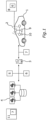
- Fig. 1 shows a method for generating a characteristic value table.
- the goal of a coupling is to integrate a vehicle 1 into a system so that it can be authenticated to third parties.
- the authentication unit 2 can, for example, comprise a microprocessor and/or a microcontroller.
- the authentication unit 2 can be installed in the vehicle 1 or connected to the vehicle 1 as an accessory. In this case, it can be provided, for example, that the authentication unit 2 is connected, for example, as a plug (stick or dongle) to an OBD interface of the vehicle 1.
- a driver or owner of the vehicle 1 makes a predetermined user input in an input unit 3.
- the input unit 3 can, for example, be a mobile device, in particular a smartphone, a tablet, or a laptop. It can also be a console of the vehicle 1.
- a coupling signal 5 can be generated by the input unit 3 and transmitted to a central processing unit 4.
- the coupling signal 5 can, for example, comprise the user's login data and/or information about the vehicle 1 and/or the authentication unit 2.
- the transmission of the coupling signal 5 can, for example, take place via mobile Internet.
- the central processing unit 4 can, in response to the receipt of the coupling signal 5, send at least one request command 6 to request a assigned characteristic value 7 to the authentication unit 2.
- the transmission can be made, for example, directly to the authentication unit 2 via mobile internet or via the input unit 3.
- the request command 6 can be received by the authentication unit 2 and stored in a request table 8.
- the request command 6 can also be output by the authentication unit 2 to an interface 9 of the vehicle 1.
- the interface 9 can be, for example, an OBD port of the vehicle 1 or a connection to an Ethernet network of the vehicle 1.
- a vehicle component 10 can receive the request command 6, execute it, and output the characteristic value 7 as an output value in response.
- the vehicle component 10 can be, for example, an engine control unit of the vehicle 1.
- the characteristic value 7 can be, for example, an identification number of the engine control unit.
- the characteristic value 7 can be output from the interface 9 of the vehicle 1 and received by the authentication unit 2.
- the characteristic value 7 can be transmitted to the central processing unit 4 by the authentication unit 2.
- the central processing unit 4 can receive the characteristic value 7 and store it in a characteristic value table 11.
- the characteristic value table 11 and the request table 8 can have an index, wherein a request command 6 in the request table 8 is assigned the respective characteristic value 7 in the characteristic value table 11 via an index value 13.
- a shared secret is provided to the central processing unit 4 and the authentication unit 2.
- the query commands 6 are designed to result in the output of the same characteristic value 7 from the vehicle 1.
- the advantage is that the authentication unit 2 is functionally connected to the vehicle 1. If, for example, the authentication unit 2 is integrated into a different vehicle, this results in a different characteristic value 7 being output when the query command 6 is input to the vehicle 1.
- a secret value S can be generated by the central processing unit.
- the secret value S can be transmitted to the authentication unit 2 and stored as another secret value S' in the central processing unit 4.
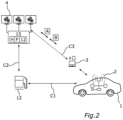
- Fig. 2 shows an authentication of the vehicle 1 at a service unit 12 via the central processing unit 4. It can be provided that a function that is is connected to the vehicle 1 and is carried out by a service unit 12, requires authentication of the vehicle 1 to the service unit.
- the service unit 12 can be, for example, a fuel pump at a petrol station, a charger or a barrier. It can be provided that only certain vehicles are intended for the service unit 12 or a function of the service unit 12.
- a communication connection C1 between the vehicle 1 or the authentication unit 2 and the service unit 12 can, for example, exist via an insecure connection. This can mean, for example, that the communication is unencrypted. For this reason, it can be ruled out that sensitive information for authenticating the vehicle 1 to the service unit 12 is sent via the communication connection C1. In order to nevertheless enable secure, reliable authentication of the vehicle 1 to the service unit 12, the authenticity of the vehicle 2 to the service unit 12 is confirmed by the central processing unit 4.
- a driver of the vehicle 1 makes an input in the service unit 12 at the beginning of an authentication process.
- the authentication process is initiated automatically by the service unit 12 when, for example, the vehicle 1 is at a predetermined distance from the service unit 12. This can occur, for example, when the vehicle 1 is in front of a service unit 12 designed as a barrier.
- the method can provide for communication to be initiated between the service unit 12 and the authentication unit 2. During the method, communication can be established simultaneously between the service unit 12 and the central processing unit 4. To enable secure authentication, it can be provided that the communication between the central processing unit 4 and the service unit 12 is encrypted via a secure communication connection C2. It can be provided that an additional communication connection C3 is established between the authentication unit 2 and the central processing unit 4, which can be established via the input unit 3.
- Fig. 3 shows a possible characteristic value table 11 with the respective characteristic values 7, which is stored in the central processing unit 4.
- Each of the characteristic values 7 can be assigned an index value 13.
- Characteristic values 7 can be values, that identify the vehicle 1 or components of the vehicle 10. This can be, in particular, a make of the vehicle 1, a model, a year of manufacture, a VIN number, a chassis number, or an identification number of an engine control unit.
- a request table 8 is stored in the authentication unit 2, in which the request commands 6 with the assigned index values 13 can be stored.
- a respective request command 6 with a respective index value 13 is assigned a corresponding characteristic value 7 in the characteristic value table 11 with the same index value 13.
- the request command 6 can, for example, be a code for the CAN bus of the vehicle 1, which causes the assigned characteristic value 7 to be output from the interface 9.
- the characteristic values 7 in the characteristic value table 11 are the expected values that are to be output by the vehicle 1 when a request is sent to the vehicle 1 using the assigned request command 6.
- the request commands 6 can, for example, be request commands 6 that have been transmitted by the central processing unit 4 to the authentication unit 2 during the coupling process in order to query the associated characteristic values 7 of the vehicle 1.
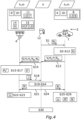
- Fig. 4 shows a sequence of a method for authenticating a vehicle 1. It can be provided that the central processing unit 4, the service unit 12 and the authentication unit 2 are set up to carry out check values using a check value function h. It can be provided that the central processing unit 4 and the authentication unit 2 are coupled to one another, which means that the coupling method has been carried out with the central processing unit 4 and the authentication unit 2. Coupled can mean, for example, that the further secret value S', the identification value ID of the authentication unit 2 and the characteristic value table 11 are stored in the central processing unit 4. The secret value S, the identification value ID and the request table 8 can be stored in the authentication unit 2.
- the service unit 12 At the beginning of the procedure, it can be provided that the service unit 12 generates an initial value Nr by means of a random function or a pseudorandom function is generated.
- the initial value Nr can be transmitted from the service unit 12 to the authentication unit 2 (S1).
- the authentication unit 2 can generate another initial value Np using a random function (S2).
- the authentication unit 2 can calculate a session check value V from the secret value S, the first initial value Nr and the second initial value Np by means of the check value function h, which session check value V can be assigned to the secret value S, the first initial value Nr and the second initial value Np (S3).
- the next sub-step S4 comprises a determination of the index value 13 by the authentication unit 2 in order to be able to read one of the request commands 6 from the request table 8. It can be provided that the selection of the index value 13 is dependent on the secret value S, the initial value Nr, and the second initial value Np. For this purpose, it can be provided that the index value 13 is calculated from the session check value V using a selection function m. For example, it can be provided that the index value 13 is a remainder of a division of the session check value V by the number 10.
- the authentication unit 2 reads the request command 6, which is assigned to the calculated index value 13 (S5).
- the read request command 6 is output by the authentication unit 2 to the interface 9 of the vehicle 1 and received by the vehicle component 10 (S6).
- the vehicle component 10 outputs a response signal R, which is identical to the characteristic value 7 (S7).
- the authentication unit 2 can receive the response signal R from the interface 9 (S10).
- the authentication unit 2 can calculate a vehicle check value Hr assigned to the response signal R (S11).
- the authentication unit 2 calculates an identification check value H from the identification value ID using the check value function h (S12).
- the session check value V, the vehicle check value Hr, the identification check value H and the further initial value Np can be transmitted from the authentication unit 2 to the service unit 12 (S13).
- the service unit 12 can receive the values and forward them together with the initial value Nr to the central processing unit 4 (S14).
- the central processing unit 4 can check in a step S15 whether the identification check value H of the authentication unit 2 is registered in an identification table 14 in the external processing unit 4. For this purpose, the central processing unit 4 can compare the identification check value H with identification check values stored in an identification table 14. If the transmitted identification check value H matches one of the stored identification check values H in the identification table 14, this means that the authentication unit 2 is registered in the central processing unit 4.
- the central processing unit 4 uses the check value function h to calculate a further session check value V' from the further secret value S', the initial value Nr, and the further initial value Np. If the further session check value V' calculated by the central processing unit 4 matches the session check value V sent by the authentication unit 2, the index value 13 can be calculated from the further session check value V' in a next step S17 using the selection algorithm m.
- the central processing unit 4 reads the characteristic value 7 from the characteristic value table 11, which is assigned to the calculated index value 13. For the read characteristic value 7, a further vehicle check value Hr' can be calculated using the check value function h. The central processing unit 4 then checks whether the further vehicle check value Hr' calculated by the central processing unit 4 matches the vehicle check value Hr sent by the authentication unit 2.
- the central processing unit 4 sends an enable signal 16 to the service unit 12 to signal that the authentication unit 2 has been successfully authenticated by the central processing unit 4 (S18).
- the enable signal can, for example, be the additional secret value S'.
- the service unit 12 can calculate a first release check value M from the further secret value S' and the initial value Nr using the check value function h (S19). From the first release check value M, the service unit 12 can calculate a second release check value N (S20).
- the service unit 12 can send the first release check value M to the central processing unit 4 (S21).
- the central processing unit 4 can calculate an update value U from the secret value S and the first release check value M using the check value function h (S22).
- the central processing unit 4 can update the further secret value S' (S23) so that it has a different value after the update than before the update.
- the second release check value N can be transmitted to the authentication unit 2 by the service unit 12 (S24).
- the authentication unit 2 can calculate the first release check value M' from the initial value Nr and the secret value S using the check value function (S25) and the second release check value N' from the first release check value M' using the check value function (S26). In a further step S27, the authentication unit 2 checks whether the second release check value N' calculated by it matches the received second release check value N. If this condition is met, the update value U is calculated from the secret value S and the second release check value M' using the check value function (S28). The secret value S is replaced by an updated secret value S using the update value U (S29).
- a predetermined communication input is initiated between the service unit 12 and the authentication unit 2 or a control unit of the vehicle 1. It may also be provided that a predetermined function is activated in the service unit 12.
- the predetermined function may, for example, be a This may include opening a barrier, dispensing fuel, or initiating a charging process.
- Vehicles have become an integral part of our lives. They transport the majority of people and goods. During a vehicle's life cycle, which extends from its manufacture to its scrapping, the driver uses a variety of vehicle-related services.
- Vehicle-related services require actions on the part of the vehicle driver. For example, the driver had to enter into a written or verbal contract or operate a vending machine.
- Vehicle-related services include, for example, providing a parking space, refueling the vehicle, or requesting maintenance or breakdown assistance.
- a motor vehicle-related service is defined as a set of transactions between a service provider and a customer.
- the customer could be, for example, the driver or the owner of the vehicle.
- Motor vehicle-related services require, at a minimum, a contract outlining the contract components, authentication of the driver or vehicle to ensure identity, and authorization of the service by the vehicle driver, for example in the form of a handwritten or digital confirmation.
- Typical examples of motor vehicle-related services include refueling the vehicle, charging the vehicle or using a paid parking space for the vehicle.
- gas station services In other countries, such as Italy, Canada, and the United States, it is common for gas station services to be available 24 hours a day, every day of the week. To accommodate these business hours, gas stations have equipped their pumps with payment systems. These payment systems require the customer to authorize payment before refueling. Typically, a customer specifies a specific amount (for example, 100 dollars or euros) for which the vehicle can be refueled. If less fuel is used, the actual amount is charged. If the vehicle is operated as part of a company fleet or a rental car fleet, it is common for the driver to be provided with fuel cards. These fuel cards can be used as a means of payment at certain gas stations. In this case, the customer is required to enter relevant information during the payment process. This is usually the current mileage of the vehicle being refueled.
- a specific amount for example, 100 dollars or euros
- fuel cards can be used as a means of payment at certain gas stations. In this case, the customer is required to enter relevant information during the payment process. This is usually the current mileage of the vehicle being re
- the invention comprises four main components:
- the first component is the input unit 3.
- the input unit 3 e.g., a smartphone/tablet/PC/vehicle console
- the other main components are the authentication unit 2, the service unit 12, which is located at the service provider, and the central processing unit 4, which is configured to authenticate and authorize the authentication unit 2 at the service unit 12.
- the method provides that all authentication units 2 provided for the method must undergo a predetermined pairing process, whereby the driver loads their login data into the central processing unit 4 and links the authentication unit 2 to their vehicle 1. The driver performs this pairing process using the input unit 3. Once the pairing process is completed, the authentication unit 2, which is arranged in the vehicle 1, can wirelessly authenticate itself to the service units 12 using the central processing unit 4 and use the offered services.
- the solution offers the following advantages: The authentication of vehicle 1 by authentication unit 2 is performed using the characteristic values 7 provided from interface 9 (e.g., the OBD port) of vehicle 1. If authentication unit 2 is used with a different vehicle 1, authentication unit 2 will receive different characteristic values 7 from interface 9. Consequently, authentication will fail.
- interface 9 e.g., the OBD port
- Vehicle-based authentication and authorization of services is driver-independent. This is an advantage for vehicles 1 used by multiple drivers, for example, multiple family members or different renters.
- the procedure provides the driver with a central system through which he can register for various vehicle-related services.
- the solution is applicable to all motor vehicle-related services.
- the process can be used in connection with automated and cashless payments at gas stations, automatic vehicle identification, and the associated granting of entry to parking lots. It can also be used to enable the automatic handover of a rental car.
- Fig. 1 shows the coupling of an authentication unit 2.
- the driver uploads their login data to the central processing unit 4 and selects the services they require.
- the input unit 3 guides the driver through the coupling process, in which the authentication unit 2 is linked to the vehicle 1 with the involvement of the central processing unit 4.
- the central processing unit 4 with the help of the authentication unit 2, searches the vehicle 1 for data and identifies a subset of data, the so-called key values 7, which remain constant during the usage time of the authentication unit 2 in the vehicle 1.
- These key values 7 are used as a so-called fingerprint of the vehicle 1 and are also referred to as a key set.
- the key set can also be time-dependent, as there are key values 7 that, although transient, remain constant for a specific driver during the usage time of the authentication unit 2.
- the central processing unit 4 records data including driver details and the identification code of the
- Authentication unit 2 that are relevant for the authentication of vehicle 1.
- Fig. 2 shows the application of the authentication unit 2. This can only occur if the authentication unit 2 has been coupled to the vehicle 1. In this method, the authentication unit 2 authenticates itself to the service unit 12. The service unit 12 verifies the authenticity of the authentication unit 2 using the central processing unit 4 and provides the requested service to the vehicle 1.
- the driver of vehicle 1 has the option of subsequently activating additional services that they wish to use while using the authentication unit 2. For example, it may happen that the driver is on vacation in a city for which they have not activated the use of parking spaces or refueling. They may stop in front of a gas station or parking lot with a service unit 12 and the central processing unit 4 authenticates their identity. During the process, the central processing unit 4 can check whether the service identifier F and/or the service unit 12 are permitted in the register table 15 for the identification check value H. In other words, at least one value can be assigned to a respective identification check value H in the register table 15, which value indicates which services or service units 12 are activated by the central processing unit 4 for the identification check value H and thus for the authentication unit 2 with the associated identification value ID.
- a query signal B can be sent to the user's input unit 3.
- the input unit 3 can output a warning signal, whereby the user can be asked whether they wish to use the services at the service unit 12 despite the lack of activation.
- the relevant contract components for the services can be displayed on the input unit 3.
- the input unit 3 can transmit an activation signal A to the central processing unit 4.
- the central processing unit 4 can then transmit the release signal 16 to the service unit 12. and thus authorize the service unit 12 to provide the services of the service identifier F.
Landscapes
- Engineering & Computer Science (AREA)
- Computer Security & Cryptography (AREA)
- Theoretical Computer Science (AREA)
- Business, Economics & Management (AREA)
- Health & Medical Sciences (AREA)
- General Physics & Mathematics (AREA)
- Physics & Mathematics (AREA)
- Economics (AREA)
- Computer Hardware Design (AREA)
- General Engineering & Computer Science (AREA)
- Computer Networks & Wireless Communication (AREA)
- Signal Processing (AREA)
- Water Supply & Treatment (AREA)
- Software Systems (AREA)
- Public Health (AREA)
- General Health & Medical Sciences (AREA)
- Human Resources & Organizations (AREA)
- Marketing (AREA)
- Primary Health Care (AREA)
- Strategic Management (AREA)
- Tourism & Hospitality (AREA)
- General Business, Economics & Management (AREA)
- Computing Systems (AREA)
- Management, Administration, Business Operations System, And Electronic Commerce (AREA)
- Small-Scale Networks (AREA)
Claims (11)
- Procédé d'authentification d'un véhicule (1) vis-à-vis d'une unité de service (12) au moyen d'une unité de calcul centrale (4) extérieure au véhicule, dans lequel- une unité d'authentification (2) est fournie dans le véhicule (1),- une valeur initiale (Nr) est transmise de l'unité de service (12) à l'unité d'authentification (2),- une instruction de demande (6) est lue en fonction de la valeur initiale (Nr) par l'unité d'authentification (2) à partir d'une table de demandes (8) stockée dans l'unité d'authentification (2),- l'instruction de demande (6) est délivrée par l'unité d'authentification (8) à une interface (9) du véhicule (1),- un composant de véhicule (10) du véhicule (1) exécute l'instruction de demande (6) et, en réponse, génère une valeur de sortie (R),- la valeur de sortie (R) est reçue par l'unité d'authentification (2) en provenance de l'interface (9),- l'unité d'authentification (2) génère, au moyen d'une fonction de vérification (h) prédéterminée, une valeur de vérification de véhicule (Hr) à partir de la valeur de sortie (R),- la valeur de vérification de véhicule (Hr) générée à partir de la valeur de sortie (R) et la valeur initiale (Nr) sont transmises à l'unité de calcul centrale (4),- l'unité de calcul centrale (4) lit, en fonction de la valeur initiale (Nr), une valeur caractéristique (7) à partir d'une table de valeurs caractéristiques (11) stockée dans l'unité de calcul centrale (4),- l'unité de calcul centrale (4) génère, au moyen de la fonction de vérification (h) prédéterminée, une autre valeur de vérification de véhicule (Hr') à partir de la valeur caractéristique (7),- la valeur de vérification de véhicule (Hr) générée à partir de la valeur de sortie (R) et l'autre valeur de vérification de véhicule (Hr') générée à partir de la valeur caractéristique (7) sont vérifiées par l'unité de calcul centrale (4) pour vérifier si elles concordent l'une avec l'autre, etl'unité de calcul centrale (4) envoie un signal de validation prédéterminé (16) à l'unité de service (12) en cas de concordance entre les valeurs de vérification de véhicule (Hr).
- Procédé selon la revendication 1, caractérisé en ce que- une valeur d'identification (ID) associée de façon univoque à l'unité d'authentification (2) respective est stockée dans l'unité d'authentification (2),- l'unité d'authentification (2) génère, au moyen de la fonction de vérification (h), une valeur de vérification d'identification (H) à partir de la valeur d'identification (ID),- la valeur de vérification d'identification (H) est transmise à l'unité de calcul centrale (4) avec la valeur de vérification de véhicule (Hr),- l'unité de calcul centrale (4) vérifie la concordance entre la valeur de vérification d'identification (H) et les entrées d'une table d'identification (14) stockée dans l'unité de calcul (4), et- l'unité de calcul centrale (4) n'envoie le signal de validation (16) prédéterminé à l'unité de service (12) que si l'une des entrées de la table d'identification (14) concorde avec la valeur de vérification d'identification (H).
- Procédé selon l'une des revendications précédentes, caractérisé en ce que- l'unité d'authentification (2) génère une deuxième valeur initiale (Np),- une valeur secrète (S) est stockée dans l'unité d'authentification (2),- une autre valeur secrète (S0) est stockée dans l'unité de calcul centrale (4),- l'unité d'authentification (2) génère, au moyen d'une autre fonction de vérification (h) prédéterminée, une valeur de vérification de session (V) à partir de la valeur secrète (S), de la valeur initiale (Nr) et de l'autre valeur initiale (Np),- la valeur de vérification de session (V) est transmise à l'unité de calcul centrale (4) avec la valeur de vérification de véhicule (Hr) associée à la valeur caractéristique (7),- l'unité de calcul centrale (4) génère, au moyen de la fonction de vérification (h), une autre valeur de vérification de session (V') à partir de l'autre valeur secrète (S1), de la valeur initiale (Nr) et de l'autre valeur initiale (Np),- l'unité de calcul centrale (4) vérifie la concordance entre l'autre valeur de vérification de session (V') et la valeur de vérification de session (V), et- l'unité de calcul centrale (4) n'envoie le signal de validation (16) prédéterminé à l'unité de service (12) que si la valeur de vérification de session (V) concorde avec la deuxième valeur de vérification de session (V').
- Procédé selon la revendication 3, caractérisé en ce que- l'unité de calcul centrale (4) envoie l'autre valeur secrète (S0) en tant que signal de validation prédéterminé (16) à l'unité de service (12),
l'unité de service (12)- calcule, au moyen de la fonction de vérification (h), une première valeur de vérification de validation (M) à partir de l'autre valeur secrète (S0) et de la valeur initiale (Nr),- calcule, au moyen de la fonction de vérification (h), une deuxième valeur de vérification de validation (N) à partir de la première valeur de vérification de validation (M),- transmet la première valeur de vérification de validation (M) à l'unité de calcul centrale (4),- transmet la deuxième valeur de vérification de validation (N) à l'unité d'authentification (2),
l'unité de calcul centrale (4)- calcule, au moyen de la fonction de vérification (h), une valeur de mise à jour (U) à partir de l'autre valeur secrète (S0) et de la première valeur de vérification de validation (M),- met à jour, au moyen d'une fonction de mise à jour prédéterminée, l'autre valeur secrète (S0) en la valeur de mise à jour (U),
l'unité d'authentification (2)- calcule, au moyen de la fonction de vérification (h), une autre première valeur de vérification de validation (M') à partir de la valeur secrète (S) et de la première valeur initiale (Nr),- calcule, au moyen de la fonction de vérification (h), une autre deuxième valeur de vérification de validation (N') à partir de l'autre première valeur de vérification de validation (M'),- en cas de concordance entre l'autre deuxième valeur de vérification de validation (N') et la deuxième valeur de vérification de validation (N),- calcule, au moyen de la fonction de vérification (h), la valeur de mise à jour (U) à partir de la valeur secrète (S) et de l'autre première valeur de vérification de validation (M'), et- met à jour, au moyen de la fonction de mise à jour prédéterminée, la valeur secrète (S) en l'autre valeur de mise à jour (U1). - Procédé selon l'une des revendications précédentes, caractérisé en ce que l'instruction de demande (6) à lire à partir de la table de demandes (8) et la valeur caractéristique (7) à lire à partir de la table de valeurs caractéristiques (11) sont sélectionnées au moyen d'une fonction de sélection prédéterminée en fonction de la valeur de vérification de session (V).
- Procédé selon la revendication 5, caractérisé en ce que la fonction de sélection est l'algorithme de Luhn.
- Procédé selon l'une des revendications précédentes, caractérisé en ce qu'après une réception du signal de validation (16) par l'unité de service (12), un processus de communication est lancé entre l'unité de service (12) et l'unité d'authentification (2) et/ou un appareil de commande du véhicule (1).
- Procédé selon l'une des revendications précédentes, caractérisé en ce que- l'unité de service (12) transmet un identifiant de service (F) à l'unité de calcul centrale (4),- l'unité de calcul centrale (4) vérifie si l'identifiant de service (F) est débloqué pour la valeur d'identification (ID) dans l'unité de calcul centrale (4),- l'unité de calcul centrale (4) n'envoie le signal de validation (16) prédéterminé à l'unité de service (12) que si l'identifiant de service (F) est activé pour la valeur d'identification (ID).
- Procédé selon l'une des revendications précédentes, caractérisé en ce que les transmissions entre l'unité d'authentification (2) et l'unité de calcul centrale (4) sont effectuées par l'intermédiaire de l'unité de service (3).
- Procédé selon la revendication 8 ou 9, caractérisé en ce que- l'unité de calcul centrale (4) transmet un signal de demande de retour (B) prédéterminé à une unité d'entrée (3) lorsque l'identifiant de service (F) est désactivé pour la valeur d'identification (ID),- l'unité d'entrée (3) délivre un signal d'avertissement prédéterminé lors de la réception du signal de demande de retour (B),- l'unité d'entrée (3) envoie un signal d'activation (A) à l'unité de calcul centrale (4) lors d'une entrée d'utilisateur prédéterminée, et/ou
l'unité de calcul centrale (4) active l'identifiant de service (F) pour la valeur d'identification (ID). - Système comprenant une unité d'authentification (2), une unité de service (12) et une unité de calcul (4), conçu pour mettre en œuvre un procédé selon l'une des revendications précédentes.
Applications Claiming Priority (1)
| Application Number | Priority Date | Filing Date | Title |
|---|---|---|---|
| DE102019205362.9A DE102019205362A1 (de) | 2019-04-12 | 2019-04-12 | Verfahren zur Authentifizierung eines Fahrzeugs, Authentifizierungseinheit, Diensteinheit und fahrzeugexterne zentrale Recheneinheit |
Publications (3)
| Publication Number | Publication Date |
|---|---|
| EP3723322A2 EP3723322A2 (fr) | 2020-10-14 |
| EP3723322A3 EP3723322A3 (fr) | 2020-12-30 |
| EP3723322B1 true EP3723322B1 (fr) | 2025-06-11 |
Family
ID=70165874
Family Applications (1)
| Application Number | Title | Priority Date | Filing Date |
|---|---|---|---|
| EP20167797.8A Active EP3723322B1 (fr) | 2019-04-12 | 2020-04-02 | Procédé d'authentification d'un véhicule, unité d'authentification, unité de service et unité de calcul centrale à l'extérieur du véhicule |
Country Status (3)
| Country | Link |
|---|---|
| US (1) | US11347836B2 (fr) |
| EP (1) | EP3723322B1 (fr) |
| DE (1) | DE102019205362A1 (fr) |
Families Citing this family (4)
| Publication number | Priority date | Publication date | Assignee | Title |
|---|---|---|---|---|
| DE102022002462B4 (de) | 2022-07-05 | 2024-06-06 | Mercedes-Benz Group AG | Verfahren zum Betreiben eines fahrzeugintegrierten Rechensystems und Fahrzeug |
| DE102022002454B4 (de) | 2022-07-05 | 2024-02-01 | Mercedes-Benz Group AG | Verfahren zur Registrierung eines Steuergerätes eines Fahrzeugs bei einer Diensteinfrastruktur |
| DE102022002638A1 (de) | 2022-07-19 | 2024-01-25 | Mercedes-Benz Group AG | Verfahren zum Hinterlegen eines Identifikators auf einer zentralen Recheneinrichtung |
| WO2024176237A1 (fr) * | 2023-02-23 | 2024-08-29 | More Yuval | Système et procédé d'identification univalente pour le ravitaillement en carburant ou la charge de véhicules |
Family Cites Families (9)
| Publication number | Priority date | Publication date | Assignee | Title |
|---|---|---|---|---|
| US8171524B2 (en) * | 1995-10-02 | 2012-05-01 | Corestreet, Ltd. | Physical access control |
| US7127611B2 (en) * | 2002-06-28 | 2006-10-24 | Motorola, Inc. | Method and system for vehicle authentication of a component class |
| FR2881304B1 (fr) * | 2005-01-25 | 2007-06-29 | Dv Partners Sarl | Systeme et procede de controle d'acces, terminal portable et unite d'interfacage pour ce systeme |
| DE102011101535A1 (de) * | 2011-05-14 | 2012-02-02 | Daimler Ag | System und Verfahren zum Aufladen von Batterien von Fahrzeugen |
| CN104247361B (zh) * | 2011-12-01 | 2018-07-24 | 英特尔公司 | 用于安全消息过滤的方法、设备和相关车辆控制系统,以及含对应指令的计算机可读存储器 |
| DE102012010723A1 (de) * | 2012-05-30 | 2012-11-29 | Daimler Ag | Diagnoseverfahren und Diagnoseeinrichtung für ein Kraftfahrzeug |
| US8912924B2 (en) * | 2012-09-25 | 2014-12-16 | Inrix, Inc. | Authorization of service using vehicle information and/or user information |
| DE102016218986B4 (de) * | 2016-09-30 | 2024-02-08 | Volkswagen Aktiengesellschaft | Verfahren zur Zugriffsverwaltung eines Fahrzeugs |
| US10504373B2 (en) * | 2016-12-29 | 2019-12-10 | Bosch Automotive Service Solutions Inc. | Vehicular zone locating system |
-
2019
- 2019-04-12 DE DE102019205362.9A patent/DE102019205362A1/de active Pending
-
2020
- 2020-04-02 EP EP20167797.8A patent/EP3723322B1/fr active Active
- 2020-04-09 US US16/844,175 patent/US11347836B2/en active Active
Also Published As
| Publication number | Publication date |
|---|---|
| US11347836B2 (en) | 2022-05-31 |
| DE102019205362A1 (de) | 2020-10-15 |
| US20200327218A1 (en) | 2020-10-15 |
| EP3723322A2 (fr) | 2020-10-14 |
| EP3723322A3 (fr) | 2020-12-30 |
Similar Documents
| Publication | Publication Date | Title |
|---|---|---|
| EP3723322B1 (fr) | Procédé d'authentification d'un véhicule, unité d'authentification, unité de service et unité de calcul centrale à l'extérieur du véhicule | |
| DE102013222428B4 (de) | Berechtigungsnachweisprüfung und Autorisierungslösung zur Personenfahrzeugvermietung | |
| DE102008021030B4 (de) | Verfahren zum Betreiben eines Fahrzeugs sowie entsprechende Vorrichtung und entsprechendes Fahrzeug | |
| EP3665891B1 (fr) | Procédé de détermination d'un inventaire de fonctions activées dans une unité fonctionnelle et une unité fonctionnelle opérable conformément à ce procédé | |
| CN106778109A (zh) | 一种基于智能合约的认证权限评价方法及装置 | |
| EP2715684A1 (fr) | Système électronique destiné à réaliser, rapidement et dans de bonnes conditions de sécurité, des transactions au moyen d'appareils mobiles | |
| DE102012013450A1 (de) | Verfahren zum Steuern einer Zugangsberechtigung oder Fahrberechtigung für ein Fahrzeug | |
| DE102015005232A1 (de) | Steuern einer Freischaltberechtigung eines Kraftfahrzeugs | |
| EP1185026A2 (fr) | Procédé de transmission de données | |
| DE102014219502A1 (de) | System und Verfahren für einen beschränkten Zugang zu einem Fahrzeug | |
| EP2913989A2 (fr) | Liaison d'un terminal à une poste mobile pour l'attribution de frais | |
| EP2561484A1 (fr) | Procédé de manipulation de billets électroniques | |
| DE102016103128A1 (de) | Ein Verfahren zur Zugriffssteuerung an Kraftfahrzeugen | |
| EP3254432B1 (fr) | Procédé de gestion d'autorisation dans un ensemble comportant plusieurs systèmes informatiques | |
| EP3239918A1 (fr) | Procédé de validation du prélèvement d'une quantité d'énergie définie et dispositif de prélèvement | |
| WO2020104184A1 (fr) | Procédé de paiement dans un véhicule automobile au moyen d'une transaction d'un réseau informatique de cryptomonnaie | |
| DE102019202504A1 (de) | Automatisierte Überprüfung eines elektrischen Ladevorgangs | |
| EP4353523A1 (fr) | Procédé et dispositif de protection d'une station de charge contre une utilisation frauduleuse | |
| EP3040947B1 (fr) | Procédé destiné a éviter les mauvais usages d'autorisations d'accès d'un système de contrôle d'accès basé sur un identifiant | |
| DE102014001038A1 (de) | Elektronische Identität für ein Fahrzeug | |
| DE102013006549A1 (de) | Verfahren und System zum bargeldlosen Bezahlen oder Geldabheben mit einem mobilen Kundenterminal | |
| EP3252697A1 (fr) | Dispositif de validation pour un systeme de ticket | |
| DE102014001993A1 (de) | Verfahren zum Anmieten eines Mietfahrzeugs | |
| EP3977371B1 (fr) | Procédé et appareil de contrôle permettant la vérification sûre d'un billet électronique | |
| EP3361436A1 (fr) | Procédé d'autorisation d'une transaction |
Legal Events
| Date | Code | Title | Description |
|---|---|---|---|
| PUAI | Public reference made under article 153(3) epc to a published international application that has entered the european phase |
Free format text: ORIGINAL CODE: 0009012 |
|
| STAA | Information on the status of an ep patent application or granted ep patent |
Free format text: STATUS: THE APPLICATION HAS BEEN PUBLISHED |
|
| AK | Designated contracting states |
Kind code of ref document: A2 Designated state(s): AL AT BE BG CH CY CZ DE DK EE ES FI FR GB GR HR HU IE IS IT LI LT LU LV MC MK MT NL NO PL PT RO RS SE SI SK SM TR |
|
| AX | Request for extension of the european patent |
Extension state: BA ME |
|
| PUAL | Search report despatched |
Free format text: ORIGINAL CODE: 0009013 |
|
| AK | Designated contracting states |
Kind code of ref document: A3 Designated state(s): AL AT BE BG CH CY CZ DE DK EE ES FI FR GB GR HR HU IE IS IT LI LT LU LV MC MK MT NL NO PL PT RO RS SE SI SK SM TR |
|
| AX | Request for extension of the european patent |
Extension state: BA ME |
|
| RIC1 | Information provided on ipc code assigned before grant |
Ipc: H04L 9/32 20060101AFI20201120BHEP Ipc: H04L 29/06 20060101ALI20201120BHEP Ipc: B60R 25/24 20130101ALI20201120BHEP |
|
| STAA | Information on the status of an ep patent application or granted ep patent |
Free format text: STATUS: REQUEST FOR EXAMINATION WAS MADE |
|
| 17P | Request for examination filed |
Effective date: 20210630 |
|
| RBV | Designated contracting states (corrected) |
Designated state(s): AL AT BE BG CH CY CZ DE DK EE ES FI FR GB GR HR HU IE IS IT LI LT LU LV MC MK MT NL NO PL PT RO RS SE SI SK SM TR |
|
| RAP1 | Party data changed (applicant data changed or rights of an application transferred) |
Owner name: CONTINENTAL AUTOMOTIVE TECHNOLOGIES GMBH |
|
| STAA | Information on the status of an ep patent application or granted ep patent |
Free format text: STATUS: EXAMINATION IS IN PROGRESS |
|
| 17Q | First examination report despatched |
Effective date: 20231123 |
|
| RAP3 | Party data changed (applicant data changed or rights of an application transferred) |
Owner name: CONTINENTAL AUTOMOTIVE TECHNOLOGIES GMBH |
|
| REG | Reference to a national code |
Ref legal event code: R079 Free format text: PREVIOUS MAIN CLASS: H04L0009320000 Ref country code: DE Ref legal event code: R079 Ref document number: 502020011189 Country of ref document: DE Free format text: PREVIOUS MAIN CLASS: H04L0009320000 Ipc: H04L0009400000 |
|
| GRAP | Despatch of communication of intention to grant a patent |
Free format text: ORIGINAL CODE: EPIDOSNIGR1 |
|
| STAA | Information on the status of an ep patent application or granted ep patent |
Free format text: STATUS: GRANT OF PATENT IS INTENDED |
|
| RIC1 | Information provided on ipc code assigned before grant |
Ipc: H04L 9/40 20220101AFI20250207BHEP |
|
| INTG | Intention to grant announced |
Effective date: 20250303 |
|
| RIN1 | Information on inventor provided before grant (corrected) |
Inventor name: BHARAMGOUDAR, SUNIL Inventor name: MACK, ROLF |
|
| GRAS | Grant fee paid |
Free format text: ORIGINAL CODE: EPIDOSNIGR3 |
|
| P01 | Opt-out of the competence of the unified patent court (upc) registered |
Free format text: CASE NUMBER: APP_15909/2025 Effective date: 20250401 |
|
| GRAA | (expected) grant |
Free format text: ORIGINAL CODE: 0009210 |
|
| STAA | Information on the status of an ep patent application or granted ep patent |
Free format text: STATUS: THE PATENT HAS BEEN GRANTED |
|
| AK | Designated contracting states |
Kind code of ref document: B1 Designated state(s): AL AT BE BG CH CY CZ DE DK EE ES FI FR GB GR HR HU IE IS IT LI LT LU LV MC MK MT NL NO PL PT RO RS SE SI SK SM TR |
|
| REG | Reference to a national code |
Ref country code: GB Ref legal event code: FG4D Free format text: NOT ENGLISH |
|
| REG | Reference to a national code |
Ref country code: CH Ref legal event code: EP |
|
| REG | Reference to a national code |
Ref country code: IE Ref legal event code: FG4D Free format text: LANGUAGE OF EP DOCUMENT: GERMAN |
|
| REG | Reference to a national code |
Ref country code: DE Ref legal event code: R096 Ref document number: 502020011189 Country of ref document: DE |
|
| PG25 | Lapsed in a contracting state [announced via postgrant information from national office to epo] |
Ref country code: ES Free format text: LAPSE BECAUSE OF FAILURE TO SUBMIT A TRANSLATION OF THE DESCRIPTION OR TO PAY THE FEE WITHIN THE PRESCRIBED TIME-LIMIT Effective date: 20250611 Ref country code: FI Free format text: LAPSE BECAUSE OF FAILURE TO SUBMIT A TRANSLATION OF THE DESCRIPTION OR TO PAY THE FEE WITHIN THE PRESCRIBED TIME-LIMIT Effective date: 20250611 |
|
| REG | Reference to a national code |
Ref country code: LT Ref legal event code: MG9D |
|
| PG25 | Lapsed in a contracting state [announced via postgrant information from national office to epo] |
Ref country code: NO Free format text: LAPSE BECAUSE OF FAILURE TO SUBMIT A TRANSLATION OF THE DESCRIPTION OR TO PAY THE FEE WITHIN THE PRESCRIBED TIME-LIMIT Effective date: 20250911 Ref country code: GR Free format text: LAPSE BECAUSE OF FAILURE TO SUBMIT A TRANSLATION OF THE DESCRIPTION OR TO PAY THE FEE WITHIN THE PRESCRIBED TIME-LIMIT Effective date: 20250912 |
|
| REG | Reference to a national code |
Ref country code: NL Ref legal event code: MP Effective date: 20250611 |
|
| PG25 | Lapsed in a contracting state [announced via postgrant information from national office to epo] |
Ref country code: BG Free format text: LAPSE BECAUSE OF FAILURE TO SUBMIT A TRANSLATION OF THE DESCRIPTION OR TO PAY THE FEE WITHIN THE PRESCRIBED TIME-LIMIT Effective date: 20250611 |
|
| PG25 | Lapsed in a contracting state [announced via postgrant information from national office to epo] |
Ref country code: HR Free format text: LAPSE BECAUSE OF FAILURE TO SUBMIT A TRANSLATION OF THE DESCRIPTION OR TO PAY THE FEE WITHIN THE PRESCRIBED TIME-LIMIT Effective date: 20250611 |
|
| PG25 | Lapsed in a contracting state [announced via postgrant information from national office to epo] |
Ref country code: RS Free format text: LAPSE BECAUSE OF FAILURE TO SUBMIT A TRANSLATION OF THE DESCRIPTION OR TO PAY THE FEE WITHIN THE PRESCRIBED TIME-LIMIT Effective date: 20250911 |
|
| REG | Reference to a national code |
Ref country code: CH Ref legal event code: W10 Free format text: ST27 STATUS EVENT CODE: U-0-0-W10-W00 (AS PROVIDED BY THE NATIONAL OFFICE) Effective date: 20251022 |
|
| PG25 | Lapsed in a contracting state [announced via postgrant information from national office to epo] |
Ref country code: LV Free format text: LAPSE BECAUSE OF FAILURE TO SUBMIT A TRANSLATION OF THE DESCRIPTION OR TO PAY THE FEE WITHIN THE PRESCRIBED TIME-LIMIT Effective date: 20250611 |
|
| PG25 | Lapsed in a contracting state [announced via postgrant information from national office to epo] |
Ref country code: NL Free format text: LAPSE BECAUSE OF FAILURE TO SUBMIT A TRANSLATION OF THE DESCRIPTION OR TO PAY THE FEE WITHIN THE PRESCRIBED TIME-LIMIT Effective date: 20250611 |
|
| RAP4 | Party data changed (patent owner data changed or rights of a patent transferred) |
Owner name: AUMOVIO GERMANY GMBH |
|
| PG25 | Lapsed in a contracting state [announced via postgrant information from national office to epo] |
Ref country code: PT Free format text: LAPSE BECAUSE OF FAILURE TO SUBMIT A TRANSLATION OF THE DESCRIPTION OR TO PAY THE FEE WITHIN THE PRESCRIBED TIME-LIMIT Effective date: 20251013 |
|
| PG25 | Lapsed in a contracting state [announced via postgrant information from national office to epo] |
Ref country code: IS Free format text: LAPSE BECAUSE OF FAILURE TO SUBMIT A TRANSLATION OF THE DESCRIPTION OR TO PAY THE FEE WITHIN THE PRESCRIBED TIME-LIMIT Effective date: 20251011 |
|
| PG25 | Lapsed in a contracting state [announced via postgrant information from national office to epo] |
Ref country code: SM Free format text: LAPSE BECAUSE OF FAILURE TO SUBMIT A TRANSLATION OF THE DESCRIPTION OR TO PAY THE FEE WITHIN THE PRESCRIBED TIME-LIMIT Effective date: 20250611 |
|
| PG25 | Lapsed in a contracting state [announced via postgrant information from national office to epo] |
Ref country code: CZ Free format text: LAPSE BECAUSE OF FAILURE TO SUBMIT A TRANSLATION OF THE DESCRIPTION OR TO PAY THE FEE WITHIN THE PRESCRIBED TIME-LIMIT Effective date: 20250611 |
|
| PG25 | Lapsed in a contracting state [announced via postgrant information from national office to epo] |
Ref country code: PL Free format text: LAPSE BECAUSE OF FAILURE TO SUBMIT A TRANSLATION OF THE DESCRIPTION OR TO PAY THE FEE WITHIN THE PRESCRIBED TIME-LIMIT Effective date: 20250611 |
|
| PG25 | Lapsed in a contracting state [announced via postgrant information from national office to epo] |
Ref country code: EE Free format text: LAPSE BECAUSE OF FAILURE TO SUBMIT A TRANSLATION OF THE DESCRIPTION OR TO PAY THE FEE WITHIN THE PRESCRIBED TIME-LIMIT Effective date: 20250611 |
|
| REG | Reference to a national code |
Ref country code: DE Ref legal event code: R081 Ref document number: 502020011189 Country of ref document: DE Owner name: AUMOVIO GERMANY GMBH, DE Free format text: FORMER OWNER: CONTINENTAL AUTOMOTIVE TECHNOLOGIES GMBH, 30175 HANNOVER, DE |
|
| PG25 | Lapsed in a contracting state [announced via postgrant information from national office to epo] |
Ref country code: SK Free format text: LAPSE BECAUSE OF FAILURE TO SUBMIT A TRANSLATION OF THE DESCRIPTION OR TO PAY THE FEE WITHIN THE PRESCRIBED TIME-LIMIT Effective date: 20250611 Ref country code: RO Free format text: LAPSE BECAUSE OF FAILURE TO SUBMIT A TRANSLATION OF THE DESCRIPTION OR TO PAY THE FEE WITHIN THE PRESCRIBED TIME-LIMIT Effective date: 20250611 |
|
| PG25 | Lapsed in a contracting state [announced via postgrant information from national office to epo] |
Ref country code: DK Free format text: LAPSE BECAUSE OF FAILURE TO SUBMIT A TRANSLATION OF THE DESCRIPTION OR TO PAY THE FEE WITHIN THE PRESCRIBED TIME-LIMIT Effective date: 20250611 |
|
| PG25 | Lapsed in a contracting state [announced via postgrant information from national office to epo] |
Ref country code: IT Free format text: LAPSE BECAUSE OF FAILURE TO SUBMIT A TRANSLATION OF THE DESCRIPTION OR TO PAY THE FEE WITHIN THE PRESCRIBED TIME-LIMIT Effective date: 20250611 |
|
| PLBE | No opposition filed within time limit |
Free format text: ORIGINAL CODE: 0009261 |
|
| STAA | Information on the status of an ep patent application or granted ep patent |
Free format text: STATUS: NO OPPOSITION FILED WITHIN TIME LIMIT |
|
| REG | Reference to a national code |
Ref country code: CH Ref legal event code: L10 Free format text: ST27 STATUS EVENT CODE: U-0-0-L10-L00 (AS PROVIDED BY THE NATIONAL OFFICE) Effective date: 20260423 |