EP3724390B1 - Vliesmaterial mit codierter information, verfahren zur codierung von informationen auf einem vliesmaterial und system zur verwendung davon - Google Patents
Vliesmaterial mit codierter information, verfahren zur codierung von informationen auf einem vliesmaterial und system zur verwendung davon Download PDFInfo
- Publication number
- EP3724390B1 EP3724390B1 EP18830901.7A EP18830901A EP3724390B1 EP 3724390 B1 EP3724390 B1 EP 3724390B1 EP 18830901 A EP18830901 A EP 18830901A EP 3724390 B1 EP3724390 B1 EP 3724390B1
- Authority
- EP
- European Patent Office
- Prior art keywords
- nonwoven
- pattern
- information
- web material
- web
- Prior art date
- Legal status (The legal status is an assumption and is not a legal conclusion. Google has not performed a legal analysis and makes no representation as to the accuracy of the status listed.)
- Active
Links
Images




Classifications
-
- G—PHYSICS
- G06—COMPUTING OR CALCULATING; COUNTING
- G06K—GRAPHICAL DATA READING; PRESENTATION OF DATA; RECORD CARRIERS; HANDLING RECORD CARRIERS
- G06K7/00—Methods or arrangements for sensing record carriers, e.g. for reading patterns
- G06K7/10—Methods or arrangements for sensing record carriers, e.g. for reading patterns by electromagnetic radiation, e.g. optical sensing; by corpuscular radiation
- G06K7/14—Methods or arrangements for sensing record carriers, e.g. for reading patterns by electromagnetic radiation, e.g. optical sensing; by corpuscular radiation using light without selection of wavelength, e.g. sensing reflected white light
- G06K7/1404—Methods for optical code recognition
- G06K7/1439—Methods for optical code recognition including a method step for retrieval of the optical code
- G06K7/1447—Methods for optical code recognition including a method step for retrieval of the optical code extracting optical codes from image or text carrying said optical code
-
- G—PHYSICS
- G06—COMPUTING OR CALCULATING; COUNTING
- G06K—GRAPHICAL DATA READING; PRESENTATION OF DATA; RECORD CARRIERS; HANDLING RECORD CARRIERS
- G06K7/00—Methods or arrangements for sensing record carriers, e.g. for reading patterns
- G06K7/10—Methods or arrangements for sensing record carriers, e.g. for reading patterns by electromagnetic radiation, e.g. optical sensing; by corpuscular radiation
- G06K7/14—Methods or arrangements for sensing record carriers, e.g. for reading patterns by electromagnetic radiation, e.g. optical sensing; by corpuscular radiation using light without selection of wavelength, e.g. sensing reflected white light
- G06K7/1404—Methods for optical code recognition
- G06K7/1408—Methods for optical code recognition the method being specifically adapted for the type of code
- G06K7/143—Glyph-codes
-
- D—TEXTILES; PAPER
- D04—BRAIDING; LACE-MAKING; KNITTING; TRIMMINGS; NON-WOVEN FABRICS
- D04H—MAKING TEXTILE FABRICS, e.g. FROM FIBRES OR FILAMENTARY MATERIAL; FABRICS MADE BY SUCH PROCESSES OR APPARATUS, e.g. FELTS, NON-WOVEN FABRICS; COTTON-WOOL; WADDING ; NON-WOVEN FABRICS FROM STAPLE FIBRES, FILAMENTS OR YARNS, BONDED WITH AT LEAST ONE WEB-LIKE MATERIAL DURING THEIR CONSOLIDATION
- D04H1/00—Non-woven fabrics formed wholly or mainly of staple fibres or like relatively short fibres
- D04H1/40—Non-woven fabrics formed wholly or mainly of staple fibres or like relatively short fibres from fleeces or layers composed of fibres without existing or potential cohesive properties
- D04H1/44—Non-woven fabrics formed wholly or mainly of staple fibres or like relatively short fibres from fleeces or layers composed of fibres without existing or potential cohesive properties the fleeces or layers being consolidated by mechanical means, e.g. by rolling
- D04H1/46—Non-woven fabrics formed wholly or mainly of staple fibres or like relatively short fibres from fleeces or layers composed of fibres without existing or potential cohesive properties the fleeces or layers being consolidated by mechanical means, e.g. by rolling by needling or like operations to cause entanglement of fibres
- D04H1/492—Non-woven fabrics formed wholly or mainly of staple fibres or like relatively short fibres from fleeces or layers composed of fibres without existing or potential cohesive properties the fleeces or layers being consolidated by mechanical means, e.g. by rolling by needling or like operations to cause entanglement of fibres by fluid jet
- D04H1/495—Non-woven fabrics formed wholly or mainly of staple fibres or like relatively short fibres from fleeces or layers composed of fibres without existing or potential cohesive properties the fleeces or layers being consolidated by mechanical means, e.g. by rolling by needling or like operations to cause entanglement of fibres by fluid jet for formation of patterns, e.g. drilling or rearrangement
-
- D—TEXTILES; PAPER
- D04—BRAIDING; LACE-MAKING; KNITTING; TRIMMINGS; NON-WOVEN FABRICS
- D04H—MAKING TEXTILE FABRICS, e.g. FROM FIBRES OR FILAMENTARY MATERIAL; FABRICS MADE BY SUCH PROCESSES OR APPARATUS, e.g. FELTS, NON-WOVEN FABRICS; COTTON-WOOL; WADDING ; NON-WOVEN FABRICS FROM STAPLE FIBRES, FILAMENTS OR YARNS, BONDED WITH AT LEAST ONE WEB-LIKE MATERIAL DURING THEIR CONSOLIDATION
- D04H13/00—Other non-woven fabrics
-
- G—PHYSICS
- G06—COMPUTING OR CALCULATING; COUNTING
- G06K—GRAPHICAL DATA READING; PRESENTATION OF DATA; RECORD CARRIERS; HANDLING RECORD CARRIERS
- G06K19/00—Record carriers for use with machines and with at least a part designed to carry digital markings
- G06K19/06—Record carriers for use with machines and with at least a part designed to carry digital markings characterised by the kind of the digital marking, e.g. shape, nature, code
- G06K19/06009—Record carriers for use with machines and with at least a part designed to carry digital markings characterised by the kind of the digital marking, e.g. shape, nature, code with optically detectable marking
- G06K19/06046—Constructional details
- G06K19/06103—Constructional details the marking being embedded in a human recognizable image, e.g. a company logo with an embedded two-dimensional code
-
- G—PHYSICS
- G06—COMPUTING OR CALCULATING; COUNTING
- G06K—GRAPHICAL DATA READING; PRESENTATION OF DATA; RECORD CARRIERS; HANDLING RECORD CARRIERS
- G06K19/00—Record carriers for use with machines and with at least a part designed to carry digital markings
- G06K19/06—Record carriers for use with machines and with at least a part designed to carry digital markings characterised by the kind of the digital marking, e.g. shape, nature, code
- G06K19/06009—Record carriers for use with machines and with at least a part designed to carry digital markings characterised by the kind of the digital marking, e.g. shape, nature, code with optically detectable marking
- G06K19/06046—Constructional details
- G06K19/06131—Constructional details the marking comprising a target pattern, e.g. for indicating the center of the bar code or for helping a bar code reader to properly orient the scanner or to retrieve the bar code inside of an image
-
- G—PHYSICS
- G06—COMPUTING OR CALCULATING; COUNTING
- G06K—GRAPHICAL DATA READING; PRESENTATION OF DATA; RECORD CARRIERS; HANDLING RECORD CARRIERS
- G06K7/00—Methods or arrangements for sensing record carriers, e.g. for reading patterns
- G06K7/10—Methods or arrangements for sensing record carriers, e.g. for reading patterns by electromagnetic radiation, e.g. optical sensing; by corpuscular radiation
- G06K7/14—Methods or arrangements for sensing record carriers, e.g. for reading patterns by electromagnetic radiation, e.g. optical sensing; by corpuscular radiation using light without selection of wavelength, e.g. sensing reflected white light
- G06K7/1404—Methods for optical code recognition
- G06K7/1408—Methods for optical code recognition the method being specifically adapted for the type of code
Definitions
- the invention is in the field of encoding information in a pattern. More specifically, the invention is directed to a nonwoven material having a pattern comprising details which are optically readable and decodable for providing meaningful information, to a method of producing a nonwoven material having a pattern for embedding information; and a system for utilizing information disposed in a nonwoven material.
- Barcode-type encoding is commonly used in labels, envelopes and packages of various kinds.
- Today, optically readable information is increasingly being embedded in the surface of objects or on packaging materials. If required, this can be carried out in a manner making the markings more or less invisible to the naked eye.
- the technology is often referred to as digital watermarking. It can be used for securing the authenticity of a document or an object. Examples of such use are ID documents, bank notes, passports, etc.
- viewing an object with a device capable of decoding the embedded information can also display various kinds of technical or other information related to the object.
- code thus included in a viewed object can trigger software to display e.g. augmented reality effects related to the object.
- a nonwoven may be defined as a manufactured sheet, web or batt of directionally or randomly oriented fibres, bonded by friction and/or cohesion and/or adhesion, excluding paper.
- Wetlaid nonwoven may be distinguished from paper based on the length to diameter ratio of the fiber used: nonwoven is made up from fiber having a greater such ratio than paper.
- the fibers used in nonwoven may be natural, man-made or synthetic; often, mixtures of these are employed.
- WO 95/09261 discloses encoding information relating to a nonwoven product by providing a bond pattern on said product by thermal embossing.
- a nonwoven having a pattern displaying at least two groups of areas hydroembossed onto the nonwoven web having different optical properties distinguishable to reading and decoding equipment, so as to provide a steganographic marking, as described in claim 1.
- barcode type information is included in a pattern on a nonwoven web.
- the pattern is formed of differences in the microstructure of the web, caused by variations in e.g. fibre grade, fibre type, carding velocity, line velocity and the difference between these velocities; in addition to the differences caused by variations in the hydroentangling parameters such as water pressure, dewatering as determined through hole size and vacuum grade; drying temperature and line velocity in drying.
- Disclosed herein is a method for obtaining information from a nonwoven web, comprising observing the web surface using an optical reading device, collecting data based on differences in optical properties in the web surface, storing in a digital memory a pattern based on the collected data and comparing the stored pattern to a collection of previously stored patterns.
- a device for implementing the above method comprising an optical reading device and a digital memory and configured to observe the web surface using the optical reading device, collect data based on differences in optical properties in the web surface, store in the digital memory a pattern based on the collected data and compare the stored pattern to a collection of previously stored patterns.
- the nonwoven material according to the invention is produced using an embossing sleeve with a high-precision pattern, and hydroentanglement.
- an embossing sleeve with a high-precision pattern, and hydroentanglement is produced using an embossing sleeve with a high-precision pattern, and hydroentanglement.
- the nonwoven material has an embossed pattern having a basic, static component and a dynamic component which varies within a given length of the nonwoven web.
- the variation in the dynamic component is not directly discernible to the naked eye.
- the nonwoven material according to the invention has been subjected to thermoembossing and hydroembossing.
- the material according to the invention has, in addition to an embossed pattern, at least one further marking capable of conveying steganographic information.
- the further marking or markings may be e.g. printed.
- a system comprising a web according to the invention and means for reading and decoding the information embedded in the nonwoven material, as described in claim 9.
- the system comprises the ability to trigger an event dependent on the information encoded in the nonwoven material.
- the event is launched using the means for reading and decoding the information, and may involve visual and audible effects.
- a system for identifying a nonwoven web material based on an individual optically identifiable pattern.
- the pattern may relate to the equipment with which the nonwoven material is produced, or to the type or grade of the nonwoven material.
- data is collected using an optical reading device such as a digital camera, to identify a pattern typical of the specific production equipment for the relevant nonwoven web.
- an optical reading device such as a digital camera
- a pattern due to differences in the overall structure of the material is observed and compared to a number of patterns in a repository, collected from different equipment and production lines.
- Such patterns need not include variable components, but represent general characteristics typical of a specific fabric grade produced on a specific production line.
- the definition of threshold values and ranges within which a measured parameter may vary is required for discerning production lines.
- Various production parameters may be varied to achieve required differences in measured parameters.
- data is collected using an optical reading device such as a digital camera, to identify a pattern typical of a particular grade or type of nonwoven material.
- an optical reading device such as a digital camera
- a system for identifying a nonwoven web material according to the invention, based on an individual optically identifiable pattern, as described in claim 13.
- the nonwoven material according to the present invention includes at least two groups of areas having different optical characteristics which may be discernible to the eye or readable using technical aids. Preferably, there are at least three groups of areas having different optical characteristics.
- Macroscopic there are two levels of information-encoding patterning: Macroscopic and microscopic. Macroscopic texture is visible to the naked eye whereas microscopic requires a tool. Several categories of information may be encoded on both levels. The macroscopic level may act as a position reference for information at the microscopic level in a manner known per se.
- Encoding on both levels may be static or dynamic. Static information remains unchanged during production of the nonwoven product. Dynamic information changes as production proceeds. Thus, both information relating to the unchanging properties of the material, e.g. composition and basic structure, and information relating to the properties of individual sections of material, e.g. batch or time of production, may be encoded.
- Groups of areas are hydroembossed onto the nonwoven web so as to provide at least two groups of areas having different optical properties.
- the difference in optical properties is achieved by different depths of embossing.
- a greater height in the web contains more fibers.
- the differences in mass of fibers between valleys and peaks in the web surface profile provide a difference in opacity, which is detectable for encoding purposes.
- a first group is represented by the uncompressed basic surface level of the nonwoven.
- a second group is has an intermediate level of compression, and a third group has a maximum level of compression.
- the nonwoven is embossed to display a pattern visible to the unaided eye.
- a pattern advantageously comprises repeating geometric shapes.
- the geometric shapes are advantageously formed by ridges having a width in the range of 1.5 to 2 mm in the mentioned plane or a parallel plane.
- the fiber used to form a nonwoven material according to the invention has a dimension of 1.3 to 2 dtex, corresponding to about 10 to 12 ⁇ m when a circular cross section is assumed.
- the fiber may be natural, natural manmade or synthetic. Preferably, at least part of the fiber is manmade fiber.
- At least part of the fiber used in the nonwoven material of the present invention is crimped.
- the number of crimps per cm is about 4. Crimping enhances fiber consolidation and cohesion to the embossing template, thereby giving rise to a nonwoven having a stable embossing.
- a method for manufacturing a nonwoven material having at least two groups of areas with different optical properties, capable of encoding optically readable information.
- a nonwoven material is produced forming a web which may be for example carded, wet laid, airlaid, spunlaid, or meltblown.
- the nonwoven material is hydroentangled. This method provides a stable macroscopic and microscopic pattern which lends itself to encode steganographic markings when used with an embossing roller and fiber compositions as described herein.
- the nonwoven material is preferably embossed using an embossing sleeve.
- the embossing pattern and its properties are advantageously determined by a detachable embossing sleeve imposed on the surface of a suction drum, which in hydroentangling is preferably a suction drum designed to remove the water directed against the nonwoven material using dedicated nozzles.
- At least the first station may be dedicated to bonding only while one or more subsequent stations may perform hydroembossing.
- stations performing hydroembossing if e.g. two are employed, one may provide a static pattern and another a dynamic pattern; both may provide different static patterns; or both may provide dynamic patterns, all to provide a final resultant pattern.
- hydroentanglement is carried out at one station and thermoembossing at another station.
- a static pattern may be generated using hydroembossing and thermoembossing while a changing pattern is generated using laser, ultrasound or corresponding technologies.
- the embossing pattern is proportional to the diameter of the fiber. Thicker fiber needs a wider embossing pattern to set properly.
- the depth of the embossing pattern is proportional to the basis weight of the nonwoven material to be produced. With higher gsm (grams per square meter), the embossing depth needs to be larger.
- the dimensions of the surface pattern of the sleeve are designed according to the properties of the web involved.
- the length of fiber used influences the dimensions and ratios of the sleeve surface structure.
- the nonwoven material according to the invention may have a basic weight in the range of 20gsm to 120gsm.
- the width of depressions in the sleeve is preferable in the range of 800 to 2500 ⁇ m, more preferably in the range 850-2200 ⁇ m; even more preferably in the range 900 - 2000 ⁇ m.
- the width of depressions in the sleeve is preferable in the range of 350 - 1000 ⁇ m; more preferably in the range 400 -900 ⁇ m; most preferably in the range of 500 - 800 ⁇ m.
- splittable fibers are advantageously used. These may be carded easily, and in a hydroentanglement operation they split so as to provide the benefits of thinner fibers in hydroembossing and patterning.
- splittable fibers could be from 2.2 to 3 dtex and split into for example 16 wedges of down to 0.2 denier per filament.
- Fiber variability may be used for coding. Special fibers or standard fibers of various grades may be used. A change in fiber dimension, defined e.g. by the dtex value, comes with a change in fabric appearance.
- the cross sectional shape of the fiber influences i. a. the opacity and reflective properties of the fabric. For example, trilobal fiber may replace round fiber.
- the macroscopic pattern on the nonwoven may provide information on the fiber composition and thus the preferred use of the nonwoven.
- a visible, repeating pattern comprising a number of variable elements is applied to a nonwoven fabric, whereby the elements can be set in two discrete states, for example enabled-disabled, existent - nonexistent.
- the pattern further comprises an orientation element.
- a binary encoding system can be utilized.
- the number of variable elements determines the possible amount of information.
- a further possibility to produce a variable pattern arises with exchangeable plugs integrated into the embossing sleeve.
- Complete graphic elements or their parts may be substituted. For example, a flower symbol may be changed into another, or the number or shape of petals may be varied.
- Rotatable elements provide the option of placing an element in a desired number of positions, encoding information correspondingly. For example, if a symbol has a clear direction indicator and it is rotated through eight different positions, using four symbols provides a character space of 8 4 or 4096; i.e. a 12-bit code domain.
- Fig. 1a shows an example of a variable element 1, here in the form of a five-leaf clover.
- Fig. 1b shows an example of an orientation element 2 associated with the variable elements.
- the orientation element has features for distinctly expressing direction, and indicates the manner in which a group of variable elements shall be read.
- Fig. 1c shows a set of variable elements 1 and orientation elements 2, expressing a binary number. The set includes 14 variable elements, and all of these are present. Thus, the encoded number is 2 14 -1 or 16 383.
- Figure 1d shows a representation of the number 8670, encoded using the presence or non-presence of elements 1 in the 14-element pattern. Present are the elements representing 2 1 , 2 2 , 2 4 , 2 6 , 2 7 , 2 8 and 2 13 .
- Figure 1e shows the possible appearance of a sheet encoded with this repeating pattern.
- variable elements 1 Further information can be encoded by modifying the variable elements 1.
- the degree of modification is mainly limited by the capability of machine vision hardware and software to identify the differences.
- Figure 1f shows how the presence or nonpresence of sections of the variable elements may be used to produce additional variation.
- the amount of leaves on the five-leaf clover has been varied to express binary numbers.
- the orientation element makes it possible to identify which leaf represents which bit; in this example, the increasing order is clockwise beginning with the uppermost leaf.
- the lower right corner pattern encodes 2 0 , 2 2 and 2 4 , or 21.
- the orientation element 2 can be employed to identify specifics of the individual web, e.g. the production line from which it originates. Different production lines may have different orientation elements.
- a striped barcode pattern is applied to a nonwoven fabric in the machine direction.
- the stripes can continue along an arbitrary length of the web.
- thicker lines along the outer borders of the line pattern indicate the limits of the coded area.
- the line pattern is advantageously produced by an additional accessory mounted on an embossing roll which produces a repeating pattern.
- barcodes can store an ID that can be used for tracking a product.
- Figure 2a shows a barcode template
- Figure 2b shows the number 19886 encoded using the template.
- one or more continuous patterns 3, 4 is/are applied to specific area(s) along the machine direction of a nonwoven web, and information is associated with the location of the relevant pattern in the cross machine direction of the web.
- Figure 3 shows an example of a cross-direction movable pattern 3 which may be used for encoding e.g. date of production.
- the relevant variable parameter is the distance 5 of the pattern from the longitudinal edge of the web. The distance 5 can be varied by controlling the slitting operation.
- Continuous patterns may also be combined with repeating patterns, whereby a repeating symbol may provide a reference for the continuous pattern instead of an edge of the web.
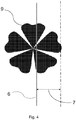
- Fig. 4 shows a continuous pattern 6, here a line, the position of which is defined by its offset 7 relative to the edge 8 of repeating figure 9. Offset 7 may be given discrete values for encoding selected information.
- Continuous pattern 6 may be imposed by various methods, e.g. printing, embossing or modifying a hydroentanglement process.
- modular embossing rolls with different patterns are employed. This allows for sophisticated data encoding by altering the modules used per production run.
- Figure 5a shows how two rolls with differing modular pattern can imprint unique identifiers.
- Roll 1 first imprints various unique patterns, here expressed by letters A through F.
- roll 2 which imprints another unique pattern, expressed as numbers 1 through 6.
- the fabric exhibits a combination of the two patterns, here indicated as a combination of the two identifiers from the respective rolls.
- the modules can be shifted to generate a multitude of unique patterns.
- the amount of possible identifiers depends on how many interchangeable modules are available for the rolls.
- Figure 5b shows an example of how new identifiers are created by removing module 1 from the end of roll 2 in the previous example, while adding module 7 to the other end, whereby all modules are shifted to the left. This creates a new unique pattern.
- the modular roll system allows for a potentially infinite number of variations, as more modules are added over time. Assuming 10 patterns for both rolls, it is possible to create 100 unique identifiers and by varying the module order, the number increases considerably.
- Fig. 6 a-b shows an example of a pattern which can be generated using rotatable elements integrated into an embossing sleeve.
- the symbol has eight defined rotational orientations as shown in Fig. 6a .
- Four symbols as shown in Fig. 6b thus provides a 12-bit code.
- a computer vision powered application can be developed for those who do not have the possibility to decode the visible identifiers. Such an application may be implemented in a mobile or a stationary device.
- a database can be queried to retrieve the information that has been stored and associated with the ID. Examples of date that could be stored:
- Microscopic or macroscopic pattern details can be read using an optical input device e.g. a smartphone camera.
- embedded code may be read by a smartphone app and trigger various visual effects or display product information. Marketing campaigns, consumer competitions and lotteries and the like can also be based on such app-readable code.
- a system comprising a nonwoven web according having an embossed pattern comprising at least two groups of areas having different machine readable optical properties, said areas arranged to encode optically readable information which may not be discernible to the naked eye; the system further comprising means for reading and transmitting the information.
- Such means may be for example a camera, possibly a smartphone camera, a spectrometer or another device suitable for optical input.
- the system further comprises a computing device to which the read information is transmitted, and where a decoding and pattern recognition operation is carried out. If a pattern included in a database of the computing device is recognized, a response is sent to the means for reading and transmitting the information.
- an event in dependence of the optical information read by the reading and transmitting means and processed by the computing device.
- Such an event may be a display of graphic information in the form of pictures or video, possibly as an overlay to produce an augmented reality effect.
- a system according to the invention may further comprise means for displaying characters, pictures or video feed as well as sound based on the information encoded into the pattern embossed on the nonwoven material.
- Such means for displaying may be an LCD display and a loudspeaker or earphone, or combinations thereof.
- Such means may be included in the means for reading and transmitting the information; i.e. if the reading and transmitting means is a smartphone, the smartphone may display information in response to instructions from the computing device.
- a system may comprise a reading device, e.g. a smartphone for capturing and transmitting, over a mobile network, an image of a nonwoven material having a pattern displaying at least two groups of areas having different optical properties to a remote computer.
- a trained image recognition model residing in the computer determines whether the image is relevant for displaying information to the party handling the reading device.
- Such information may be, for example:
- various visual and audible effects may be triggered to be displayed on the reading device in response to an image of a pattern.
- Production lines may be adapted so, that each production line creates a unique pattern, a "fingerprint” that sets it apart from other lines while preserving quality and standard properties in the product.
- a product fulfilling a specific standard could have a fingerprint, setting it apart from the same product manufactured using another line.
- the fingerprints could be identified at least using optical measurement equipment. Machine learning could be utilized for this purpose.
- an aspect of the present invention is the provision of a system for optically identifying unique patterns in like products manufactured on different production lines by defining a required difference, representing a threshold, in at least one optical property; identifying at least one production parameter affecting said optical property/properties; repeatedly observing and storing values for said optical property/properties in production situations ; and creating a repository linking a value range for said at least one optical property to a specific production line.
- one or several production parameters is adjusted to bring the relevant optical property/properties within a value range satisfying the defined threshold condition.
- Examples of production parameters which can be varied for creating identifiable thresholds in optical properties are card, carding speed, randomizer in carding (random roll), line speed, speed differences between sections, hydroentanglement parameters (profile of the strip, water pressure, dewatering which is affected by both the hole size in the support and the vacuum power); drying temperature, line speed in drying.
- the same technology may be used for identifying various types, grades, and versions of nonwoven.
- a further aspect of the present invention is the provision of a system for identifying various types, grades and versions of nonwoven by optically identifying unique patterns in different products. Differences in optical properties are caused by differences in fiber properties such as length, dtex, crimp, diameter, shape (round, oval, flat, number of lobes in multilobed fiber), material, melting temperature, opacity, reflection and colour.
- the repository of properties is a digital memory which can be used in a computerized system.
Landscapes
- Engineering & Computer Science (AREA)
- Physics & Mathematics (AREA)
- General Physics & Mathematics (AREA)
- Theoretical Computer Science (AREA)
- Textile Engineering (AREA)
- General Health & Medical Sciences (AREA)
- Electromagnetism (AREA)
- Toxicology (AREA)
- Artificial Intelligence (AREA)
- Computer Vision & Pattern Recognition (AREA)
- Health & Medical Sciences (AREA)
- Mechanical Engineering (AREA)
- Treatment Of Fiber Materials (AREA)
Claims (15)
- Vliesstoff-Faserbahnmaterial, das ein Muster aufweist, welches mindestens zwei Gruppen von auf der Vliesstoffbahn wasserstrahlverfestigten Bereichen umfasst, die unterschiedliche maschinenlesbare optische Eigenschaften aufweisen, wobei die Bereiche so angeordnet sind, dass sie optisch lesbare Informationen codieren.
- Vliesstoff-Faserbahnmaterial nach Anspruch 1, das drei Gruppen von Bereichen aufweist, die unterschiedliche maschinenlesbare optischen Eigenschaften aufweisen, wobei die Bereiche so angeordnet sind, dass sie optisch lesbare Informationen codieren.
- Vliesstoff-Faserbahnmaterial nach Anspruch 1 oder 2, wobei sich die Gruppen von Bereichen weiter in Bezug auf Unterschiede unterscheiden, die durch Kardier-, Thermopräge-, Entwässerungs- oder Trocknungsparameter verursacht werden.
- Vliesstoff-Faserbahnmaterial nach einem der vorstehenden Ansprüche, wobei das Vliesstoff-Faserbahnmaterial synthetische Fasern und/oder natürliche Chemiefasern umfasst.
- Vliesstoff-Faserbahnmaterial nach einem der vorstehenden Ansprüche, umfassend codierte maschinenlesbare optische Informationen, die eine erste, statische Komponente aufweisen, die keine Abweichung zeigt, und eine zweiten, dynamische Komponente, die eine Abweichung über die Länge des Vliesstoffmaterials zeigt.
- Vliesstoff-Faserbahnmaterial nach einem der vorstehenden Ansprüche, umfassend codierte, maschinenlesbare optische Informationen auf der Grundlage von grafischen Symbolen, die eine Vielzahl von Rotationsausrichtungen umfassen.
- Verfahren zur Herstellung eines Vliesstoff-Faserbahnmaterials, das ein Muster aufweist, welches Informationen für eine optische Maschineneingabe codiert, umfassend die Erzeugung von Unterschieden in der Bahnstruktur durch Wasserstrahlverfestigen der Vliesstoffbahn.
- Verfahren nach Anspruch 7, umfassend die Schritte von- Bereitstellen einer Vliesstoffbahn- Bereitstellen eines Musters auf der Vliesstoffbahn, das aus mindestens zwei Gruppen von Bereichen gebildet ist, die unterschiedliche maschinenlesbaren optischen Eigenschaften aufweisen.
- System, umfassend eine Bahn nach Anspruch 1, umfassend Mittel zum Ablesen des Vliesstoffs nach Informationen, die mit bloßem Auge nicht erkennbar sind, und zum Übertragen dieser Informationen an eine Rechenvorrichtung.
- System nach Anspruch 9, umfassend Mittel in der Rechenvorrichtung zum Auslösen eines Ereignisses, das in Abhängigkeit von den Informationen ausgewählt wird, die von dem Vliesstoff abgelesen werden.
- System nach Anspruch 10, wobei es sich bei dem Ereignis um einen visuellen Effekt handelt, der optional die Anzeige eines dynamischen Videoeffekts beinhaltet.
- System nach Anspruch 10, wobei es sich bei dem Ereignis um einen hörbaren Effekt handelt.
- System zum Identifizieren eines Vliesstoff-Bahnmaterials nach Anspruch 1 auf der Grundlage eines individuellen optisch identifizierbaren Musters, umfassend die Schritte von- Definieren einer erforderlichen Differenz, die einen Schwellenwert darstellt, in mindestens einer optischen Eigenschaft;- Identifizieren mindestens eines Produktionsparameters, der die optische(n) Eigenschaft(en) beeinflusst;- wiederholtes Beobachten und Speichern von Werten für die optische(n) Eigenschaft(en) in Produktionssituationen;- Erstellen eines Speichers, der einen Wertebereich für die mindestens eine optische Eigenschaft mit einer bestimmten Produktionslinie verknüpft, und- optionales Einstellen des mindestens einen Produktionsparameters, um die mindestens eine optische Eigenschaft in einen erforderlichen Wertebereich zu bringen.
- System nach Anspruch 13, wobei sich das optisch identifizierbare Muster auf die Anlage bezieht, mit der das Vliesstoffmaterial produziert wird.
- System nach Anspruch 13, wobei sich das optisch identifizierbare Muster auf den Typ oder die Qualität des Vliesstoffs bezieht.
Applications Claiming Priority (3)
| Application Number | Priority Date | Filing Date | Title |
|---|---|---|---|
| US201762596927P | 2017-12-11 | 2017-12-11 | |
| US201862627225P | 2018-02-07 | 2018-02-07 | |
| PCT/FI2018/050902 WO2019115875A1 (en) | 2017-12-11 | 2018-12-11 | A nonwoven material having encoded information, a method for encoding information on a nonwoven material and a system for using same |
Publications (2)
| Publication Number | Publication Date |
|---|---|
| EP3724390A1 EP3724390A1 (de) | 2020-10-21 |
| EP3724390B1 true EP3724390B1 (de) | 2022-01-12 |
Family
ID=65009783
Family Applications (1)
| Application Number | Title | Priority Date | Filing Date |
|---|---|---|---|
| EP18830901.7A Active EP3724390B1 (de) | 2017-12-11 | 2018-12-11 | Vliesmaterial mit codierter information, verfahren zur codierung von informationen auf einem vliesmaterial und system zur verwendung davon |
Country Status (4)
| Country | Link |
|---|---|
| US (1) | US11544488B2 (de) |
| EP (1) | EP3724390B1 (de) |
| ES (1) | ES2907091T3 (de) |
| WO (1) | WO2019115875A1 (de) |
Families Citing this family (5)
| Publication number | Priority date | Publication date | Assignee | Title |
|---|---|---|---|---|
| DE102019203267A1 (de) | 2019-03-11 | 2020-09-17 | Adidas Ag | Form, Verfahren und System zum Verarbeiten eines thermoplastischen Textils |
| EP3715514B1 (de) | 2019-03-25 | 2024-09-25 | Suominen Corporation | Vliesstoff und herstellung davon |
| EP3715515B1 (de) | 2019-03-25 | 2024-08-28 | Suominen Corporation | Verfahren zur herstellung einer vliesbahn |
| FI12853Y1 (fi) | 2019-09-30 | 2020-12-30 | Suominen Corp | Kuitukankaan valmistuslinja |
| EP3798342B1 (de) * | 2019-09-30 | 2022-04-13 | Suominen Corporation | Fertigungslinie für einen vliesstoff |
Family Cites Families (34)
| Publication number | Priority date | Publication date | Assignee | Title |
|---|---|---|---|---|
| US4493868A (en) | 1982-12-14 | 1985-01-15 | Kimberly-Clark Corporation | High bulk bonding pattern and method |
| US5045094A (en) * | 1988-12-15 | 1991-09-03 | Monsanto Company | Nonwoven fiber bed mist eliminator |
| NL9001368A (nl) * | 1990-06-15 | 1992-01-02 | Tel Developments B V | Beveiliging van voorwerpen of dokumenten. |
| US5399174A (en) * | 1993-04-06 | 1995-03-21 | Kimberly-Clark Corporation | Patterned embossed nonwoven fabric, cloth-like liquid barrier material |
| US6093665A (en) * | 1993-09-30 | 2000-07-25 | Kimberly-Clark Worldwide, Inc. | Pattern bonded nonwoven fabrics |
| US6383958B1 (en) * | 1999-06-18 | 2002-05-07 | David P. Swanson | Nonwoven sheets, adhesive articles, and methods for making the same |
| US6621915B1 (en) * | 2000-02-29 | 2003-09-16 | China Textile Institute | Method and system inspecting on-line cotton web homogeneity by digital image processing |
| FI116086B (fi) * | 2000-06-08 | 2005-09-15 | Avantone Oy | Varmistusmerkitty paperi- tai kartonkituote ja varmistusmerkitty pakkaus |
| GB2407190B (en) * | 2000-06-21 | 2005-06-15 | Fryco Ltd | Optical encoding |
| US7006669B1 (en) * | 2000-12-31 | 2006-02-28 | Cognex Corporation | Machine vision method and apparatus for thresholding images of non-uniform materials |
| FR2833976B1 (fr) * | 2001-12-20 | 2004-07-23 | Chenel Guy G | Procede de marquage d'un produit en forme de nappe de matiere textile ou de matiere non tissee |
| US8171567B1 (en) * | 2002-09-04 | 2012-05-01 | Tracer Detection Technology Corp. | Authentication method and system |
| US20040118530A1 (en) * | 2002-12-19 | 2004-06-24 | Kimberly-Clark Worldwide, Inc. | Nonwoven products having a patterned indicia |
| US20040241399A1 (en) * | 2003-03-21 | 2004-12-02 | Marmon Samuel E. | Pattern bonded nonwoven fabrics |
| US20050170726A1 (en) * | 2003-12-30 | 2005-08-04 | K.B. Aviation, Inc, D/B/A Brunson Associates | Multiple layer nonwoven products and methods for creating color schemes and for producing such products |
| US7803244B2 (en) | 2006-08-31 | 2010-09-28 | Kimberly-Clark Worldwide, Inc. | Nonwoven composite containing an apertured elastic film |
| TWI487821B (zh) * | 2008-05-26 | 2015-06-11 | Teijin Aramid Gmbh | 反彈道物品 |
| US20100199406A1 (en) * | 2009-02-06 | 2010-08-12 | Nike, Inc. | Thermoplastic Non-Woven Textile Elements |
| WO2011008486A2 (en) * | 2009-06-29 | 2011-01-20 | Drifire, Llc | Protective fabrics and garments |
| US8403223B2 (en) * | 2011-02-11 | 2013-03-26 | Ut-Battelle, Llc | Invisible-fluorescent identification tags for materials |
| US8884769B2 (en) * | 2011-04-05 | 2014-11-11 | Guy R. Novak | Dimensionally-sensitive moisture sensor and an alarm system for an absorbent article |
| US9022280B2 (en) * | 2011-06-24 | 2015-05-05 | Verisign, Inc. | Multi-mode barcode resolution system |
| DE102013223566A1 (de) * | 2013-10-24 | 2015-04-30 | Benecke-Kaliko Ag | Produktoberfläche aufweisend einen optoelektronisch lesbaren Code |
| US9442074B2 (en) * | 2014-06-27 | 2016-09-13 | Eastman Chemical Company | Fibers with surface markings used for coding |
| CH708200A8 (de) * | 2014-09-12 | 2015-03-13 | Boegli Gravures Sa | Verfahren und Vorrichtung zur Authentifizierung von Identifikations-Merkmalen auf einer Verpackungsfolie. |
| CN113887265B (zh) * | 2015-03-30 | 2025-11-04 | 斑马技术公司 | 带有动态环境数据系统、方法和装置的二维条形码 |
| US10858768B2 (en) * | 2015-07-31 | 2020-12-08 | The Procter & Gamble Company | Shaped nonwoven |
| JP2018535332A (ja) * | 2015-11-12 | 2018-11-29 | ファースト クオリティ ノンウーヴンズ、インコーポレイテッド | 改善された耐摩耗性を有する不織布及びその製造方法 |
| CN108289772A (zh) * | 2015-11-30 | 2018-07-17 | 宝洁公司 | 带有低绒毛的非织造布热粘结图案 |
| WO2017095578A1 (en) * | 2015-11-30 | 2017-06-08 | The Procter & Gamble Company | Absorbent article with colored topsheet |
| WO2017106080A1 (en) * | 2015-12-16 | 2017-06-22 | Avintiv Specialty Materials Inc. | Soft nonwoven fabric and method of manufacturing thereof |
| EP3187635A1 (de) * | 2015-12-30 | 2017-07-05 | Hayat Kimya Sanayi Anonim Sirketi | Weicher vliesstoff |
| CZ2016250A3 (cs) * | 2016-05-02 | 2017-11-29 | Pegas Nonwovens S.R.O. | Netkaná textilie obsahující tepelně pojitelná vlákna a pojicí vtisky |
| US10888471B2 (en) * | 2016-12-15 | 2021-01-12 | The Procter & Gamble Company | Shaped nonwoven |
-
2018
- 2018-12-11 US US16/771,703 patent/US11544488B2/en active Active
- 2018-12-11 EP EP18830901.7A patent/EP3724390B1/de active Active
- 2018-12-11 WO PCT/FI2018/050902 patent/WO2019115875A1/en not_active Ceased
- 2018-12-11 ES ES18830901T patent/ES2907091T3/es active Active
Also Published As
| Publication number | Publication date |
|---|---|
| US11544488B2 (en) | 2023-01-03 |
| US20210073493A1 (en) | 2021-03-11 |
| ES2907091T3 (es) | 2022-04-21 |
| EP3724390A1 (de) | 2020-10-21 |
| WO2019115875A1 (en) | 2019-06-20 |
Similar Documents
| Publication | Publication Date | Title |
|---|---|---|
| EP3724390B1 (de) | Vliesmaterial mit codierter information, verfahren zur codierung von informationen auf einem vliesmaterial und system zur verwendung davon | |
| US20200334514A1 (en) | Hand-Tearing Texture Anti-fake Method and Product and Material Thereof | |
| CN102099844B (zh) | 通过光学设备要被存储的意义单一的标签、生产该标签的方法及其在产品防伪和产品识别中的应用 | |
| CN212515868U (zh) | 纹理防伪织物 | |
| EP1318486A1 (de) | Verfahren und Vorrichtung zur Markierung von Artikeln | |
| CN208796271U (zh) | 线串防伪印刷物及其承印材料 | |
| KR20010072349A (ko) | 구조적인 결의 위조 방지 방법 | |
| JP2011520644A (ja) | 平らな支持体にセキュリティ特徴を製作する方法 | |
| JP2017528608A (ja) | コード化のために用いる表面マーキングを有する繊維 | |
| WO2013063872A1 (zh) | 一种基于二维码防伪的方法、标签及标签制作方法 | |
| CN108694370A (zh) | 非专用app自动识别纹理真假的防伪方法 | |
| CN103279872A (zh) | 拍拍看智能包装防伪防窜积分抽奖视频互动系统 | |
| CN105070188A (zh) | 三抗锡金水溶防伪标 | |
| CN103093173A (zh) | 一种防伪方法、标签及标签制作方法 | |
| CN101581062B (zh) | 有触觉感的压纹香烟包裹材料和加工方法 | |
| CN102982606A (zh) | 一种利用物理特征识别的防伪方法和系统 | |
| EP1141902B1 (de) | Verfahren zur markierung und zur authentifizierung eines gegenstandes | |
| CN205375973U (zh) | 复合防伪标签 | |
| CN217767687U (zh) | 一种微型随机纹理防伪标识 | |
| CN201250365Y (zh) | 有触觉感的压纹香烟包裹材料 | |
| CN111292605A (zh) | 全息烫印特征识别防伪标识及其制备方法 | |
| CN1271584C (zh) | 原币数码多重防伪标签 | |
| CN104182783A (zh) | 一种防伪标签、防伪标签的生产方法以及防伪验证方法 | |
| CN219246081U (zh) | 一种产品包装双重视觉防伪结构 | |
| CN201629097U (zh) | 一种防伪标识 |
Legal Events
| Date | Code | Title | Description |
|---|---|---|---|
| STAA | Information on the status of an ep patent application or granted ep patent |
Free format text: STATUS: UNKNOWN |
|
| STAA | Information on the status of an ep patent application or granted ep patent |
Free format text: STATUS: THE INTERNATIONAL PUBLICATION HAS BEEN MADE |
|
| PUAI | Public reference made under article 153(3) epc to a published international application that has entered the european phase |
Free format text: ORIGINAL CODE: 0009012 |
|
| STAA | Information on the status of an ep patent application or granted ep patent |
Free format text: STATUS: REQUEST FOR EXAMINATION WAS MADE |
|
| 17P | Request for examination filed |
Effective date: 20200702 |
|
| AK | Designated contracting states |
Kind code of ref document: A1 Designated state(s): AL AT BE BG CH CY CZ DE DK EE ES FI FR GB GR HR HU IE IS IT LI LT LU LV MC MK MT NL NO PL PT RO RS SE SI SK SM TR |
|
| AX | Request for extension of the european patent |
Extension state: BA ME |
|
| DAV | Request for validation of the european patent (deleted) | ||
| DAX | Request for extension of the european patent (deleted) | ||
| STAA | Information on the status of an ep patent application or granted ep patent |
Free format text: STATUS: EXAMINATION IS IN PROGRESS |
|
| 17Q | First examination report despatched |
Effective date: 20210331 |
|
| GRAP | Despatch of communication of intention to grant a patent |
Free format text: ORIGINAL CODE: EPIDOSNIGR1 |
|
| STAA | Information on the status of an ep patent application or granted ep patent |
Free format text: STATUS: GRANT OF PATENT IS INTENDED |
|
| RIC1 | Information provided on ipc code assigned before grant |
Ipc: D04H 1/495 20120101AFI20210712BHEP Ipc: G06K 7/14 20060101ALI20210712BHEP Ipc: G06K 19/06 20060101ALI20210712BHEP |
|
| INTG | Intention to grant announced |
Effective date: 20210806 |
|
| GRAS | Grant fee paid |
Free format text: ORIGINAL CODE: EPIDOSNIGR3 |
|
| GRAA | (expected) grant |
Free format text: ORIGINAL CODE: 0009210 |
|
| STAA | Information on the status of an ep patent application or granted ep patent |
Free format text: STATUS: THE PATENT HAS BEEN GRANTED |
|
| AK | Designated contracting states |
Kind code of ref document: B1 Designated state(s): AL AT BE BG CH CY CZ DE DK EE ES FI FR GB GR HR HU IE IS IT LI LT LU LV MC MK MT NL NO PL PT RO RS SE SI SK SM TR |
|
| REG | Reference to a national code |
Ref country code: GB Ref legal event code: FG4D |
|
| REG | Reference to a national code |
Ref country code: CH Ref legal event code: EP |
|
| REG | Reference to a national code |
Ref country code: IE Ref legal event code: FG4D |
|
| REG | Reference to a national code |
Ref country code: DE Ref legal event code: R096 Ref document number: 602018029638 Country of ref document: DE |
|
| REG | Reference to a national code |
Ref country code: AT Ref legal event code: REF Ref document number: 1462453 Country of ref document: AT Kind code of ref document: T Effective date: 20220215 |
|
| REG | Reference to a national code |
Ref country code: ES Ref legal event code: FG2A Ref document number: 2907091 Country of ref document: ES Kind code of ref document: T3 Effective date: 20220421 |
|
| REG | Reference to a national code |
Ref country code: LT Ref legal event code: MG9D |
|
| REG | Reference to a national code |
Ref country code: NL Ref legal event code: MP Effective date: 20220112 |
|
| REG | Reference to a national code |
Ref country code: AT Ref legal event code: MK05 Ref document number: 1462453 Country of ref document: AT Kind code of ref document: T Effective date: 20220112 |
|
| PG25 | Lapsed in a contracting state [announced via postgrant information from national office to epo] |
Ref country code: NL Free format text: LAPSE BECAUSE OF FAILURE TO SUBMIT A TRANSLATION OF THE DESCRIPTION OR TO PAY THE FEE WITHIN THE PRESCRIBED TIME-LIMIT Effective date: 20220112 |
|
| PG25 | Lapsed in a contracting state [announced via postgrant information from national office to epo] |
Ref country code: SE Free format text: LAPSE BECAUSE OF FAILURE TO SUBMIT A TRANSLATION OF THE DESCRIPTION OR TO PAY THE FEE WITHIN THE PRESCRIBED TIME-LIMIT Effective date: 20220112 Ref country code: RS Free format text: LAPSE BECAUSE OF FAILURE TO SUBMIT A TRANSLATION OF THE DESCRIPTION OR TO PAY THE FEE WITHIN THE PRESCRIBED TIME-LIMIT Effective date: 20220112 Ref country code: PT Free format text: LAPSE BECAUSE OF FAILURE TO SUBMIT A TRANSLATION OF THE DESCRIPTION OR TO PAY THE FEE WITHIN THE PRESCRIBED TIME-LIMIT Effective date: 20220512 Ref country code: NO Free format text: LAPSE BECAUSE OF FAILURE TO SUBMIT A TRANSLATION OF THE DESCRIPTION OR TO PAY THE FEE WITHIN THE PRESCRIBED TIME-LIMIT Effective date: 20220412 Ref country code: LT Free format text: LAPSE BECAUSE OF FAILURE TO SUBMIT A TRANSLATION OF THE DESCRIPTION OR TO PAY THE FEE WITHIN THE PRESCRIBED TIME-LIMIT Effective date: 20220112 Ref country code: HR Free format text: LAPSE BECAUSE OF FAILURE TO SUBMIT A TRANSLATION OF THE DESCRIPTION OR TO PAY THE FEE WITHIN THE PRESCRIBED TIME-LIMIT Effective date: 20220112 Ref country code: BG Free format text: LAPSE BECAUSE OF FAILURE TO SUBMIT A TRANSLATION OF THE DESCRIPTION OR TO PAY THE FEE WITHIN THE PRESCRIBED TIME-LIMIT Effective date: 20220412 |
|
| PG25 | Lapsed in a contracting state [announced via postgrant information from national office to epo] |
Ref country code: PL Free format text: LAPSE BECAUSE OF FAILURE TO SUBMIT A TRANSLATION OF THE DESCRIPTION OR TO PAY THE FEE WITHIN THE PRESCRIBED TIME-LIMIT Effective date: 20220112 Ref country code: LV Free format text: LAPSE BECAUSE OF FAILURE TO SUBMIT A TRANSLATION OF THE DESCRIPTION OR TO PAY THE FEE WITHIN THE PRESCRIBED TIME-LIMIT Effective date: 20220112 Ref country code: GR Free format text: LAPSE BECAUSE OF FAILURE TO SUBMIT A TRANSLATION OF THE DESCRIPTION OR TO PAY THE FEE WITHIN THE PRESCRIBED TIME-LIMIT Effective date: 20220413 Ref country code: FI Free format text: LAPSE BECAUSE OF FAILURE TO SUBMIT A TRANSLATION OF THE DESCRIPTION OR TO PAY THE FEE WITHIN THE PRESCRIBED TIME-LIMIT Effective date: 20220112 Ref country code: AT Free format text: LAPSE BECAUSE OF FAILURE TO SUBMIT A TRANSLATION OF THE DESCRIPTION OR TO PAY THE FEE WITHIN THE PRESCRIBED TIME-LIMIT Effective date: 20220112 |
|
| PG25 | Lapsed in a contracting state [announced via postgrant information from national office to epo] |
Ref country code: IS Free format text: LAPSE BECAUSE OF FAILURE TO SUBMIT A TRANSLATION OF THE DESCRIPTION OR TO PAY THE FEE WITHIN THE PRESCRIBED TIME-LIMIT Effective date: 20220512 |
|
| REG | Reference to a national code |
Ref country code: DE Ref legal event code: R097 Ref document number: 602018029638 Country of ref document: DE |
|
| PG25 | Lapsed in a contracting state [announced via postgrant information from national office to epo] |
Ref country code: SM Free format text: LAPSE BECAUSE OF FAILURE TO SUBMIT A TRANSLATION OF THE DESCRIPTION OR TO PAY THE FEE WITHIN THE PRESCRIBED TIME-LIMIT Effective date: 20220112 Ref country code: SK Free format text: LAPSE BECAUSE OF FAILURE TO SUBMIT A TRANSLATION OF THE DESCRIPTION OR TO PAY THE FEE WITHIN THE PRESCRIBED TIME-LIMIT Effective date: 20220112 Ref country code: RO Free format text: LAPSE BECAUSE OF FAILURE TO SUBMIT A TRANSLATION OF THE DESCRIPTION OR TO PAY THE FEE WITHIN THE PRESCRIBED TIME-LIMIT Effective date: 20220112 Ref country code: EE Free format text: LAPSE BECAUSE OF FAILURE TO SUBMIT A TRANSLATION OF THE DESCRIPTION OR TO PAY THE FEE WITHIN THE PRESCRIBED TIME-LIMIT Effective date: 20220112 Ref country code: DK Free format text: LAPSE BECAUSE OF FAILURE TO SUBMIT A TRANSLATION OF THE DESCRIPTION OR TO PAY THE FEE WITHIN THE PRESCRIBED TIME-LIMIT Effective date: 20220112 Ref country code: CZ Free format text: LAPSE BECAUSE OF FAILURE TO SUBMIT A TRANSLATION OF THE DESCRIPTION OR TO PAY THE FEE WITHIN THE PRESCRIBED TIME-LIMIT Effective date: 20220112 |
|
| PLBE | No opposition filed within time limit |
Free format text: ORIGINAL CODE: 0009261 |
|
| STAA | Information on the status of an ep patent application or granted ep patent |
Free format text: STATUS: NO OPPOSITION FILED WITHIN TIME LIMIT |
|
| PG25 | Lapsed in a contracting state [announced via postgrant information from national office to epo] |
Ref country code: AL Free format text: LAPSE BECAUSE OF FAILURE TO SUBMIT A TRANSLATION OF THE DESCRIPTION OR TO PAY THE FEE WITHIN THE PRESCRIBED TIME-LIMIT Effective date: 20220112 |
|
| 26N | No opposition filed |
Effective date: 20221013 |
|
| PG25 | Lapsed in a contracting state [announced via postgrant information from national office to epo] |
Ref country code: SI Free format text: LAPSE BECAUSE OF FAILURE TO SUBMIT A TRANSLATION OF THE DESCRIPTION OR TO PAY THE FEE WITHIN THE PRESCRIBED TIME-LIMIT Effective date: 20220112 |
|
| REG | Reference to a national code |
Ref country code: CH Ref legal event code: PL |
|
| REG | Reference to a national code |
Ref country code: BE Ref legal event code: MM Effective date: 20221231 |
|
| PG25 | Lapsed in a contracting state [announced via postgrant information from national office to epo] |
Ref country code: LU Free format text: LAPSE BECAUSE OF NON-PAYMENT OF DUE FEES Effective date: 20221211 |
|
| PG25 | Lapsed in a contracting state [announced via postgrant information from national office to epo] |
Ref country code: LI Free format text: LAPSE BECAUSE OF NON-PAYMENT OF DUE FEES Effective date: 20221231 Ref country code: IE Free format text: LAPSE BECAUSE OF NON-PAYMENT OF DUE FEES Effective date: 20221211 Ref country code: CH Free format text: LAPSE BECAUSE OF NON-PAYMENT OF DUE FEES Effective date: 20221231 |
|
| PG25 | Lapsed in a contracting state [announced via postgrant information from national office to epo] |
Ref country code: BE Free format text: LAPSE BECAUSE OF NON-PAYMENT OF DUE FEES Effective date: 20221231 |
|
| PG25 | Lapsed in a contracting state [announced via postgrant information from national office to epo] |
Ref country code: CY Free format text: LAPSE BECAUSE OF FAILURE TO SUBMIT A TRANSLATION OF THE DESCRIPTION OR TO PAY THE FEE WITHIN THE PRESCRIBED TIME-LIMIT Effective date: 20220112 |
|
| PG25 | Lapsed in a contracting state [announced via postgrant information from national office to epo] |
Ref country code: MK Free format text: LAPSE BECAUSE OF FAILURE TO SUBMIT A TRANSLATION OF THE DESCRIPTION OR TO PAY THE FEE WITHIN THE PRESCRIBED TIME-LIMIT Effective date: 20220112 Ref country code: HU Free format text: LAPSE BECAUSE OF FAILURE TO SUBMIT A TRANSLATION OF THE DESCRIPTION OR TO PAY THE FEE WITHIN THE PRESCRIBED TIME-LIMIT; INVALID AB INITIO Effective date: 20181211 |
|
| PG25 | Lapsed in a contracting state [announced via postgrant information from national office to epo] |
Ref country code: MC Free format text: LAPSE BECAUSE OF FAILURE TO SUBMIT A TRANSLATION OF THE DESCRIPTION OR TO PAY THE FEE WITHIN THE PRESCRIBED TIME-LIMIT Effective date: 20220112 |
|
| PG25 | Lapsed in a contracting state [announced via postgrant information from national office to epo] |
Ref country code: MC Free format text: LAPSE BECAUSE OF FAILURE TO SUBMIT A TRANSLATION OF THE DESCRIPTION OR TO PAY THE FEE WITHIN THE PRESCRIBED TIME-LIMIT Effective date: 20220112 |
|
| PG25 | Lapsed in a contracting state [announced via postgrant information from national office to epo] |
Ref country code: MT Free format text: LAPSE BECAUSE OF FAILURE TO SUBMIT A TRANSLATION OF THE DESCRIPTION OR TO PAY THE FEE WITHIN THE PRESCRIBED TIME-LIMIT Effective date: 20220112 |
|
| PG25 | Lapsed in a contracting state [announced via postgrant information from national office to epo] |
Ref country code: TR Free format text: LAPSE BECAUSE OF FAILURE TO SUBMIT A TRANSLATION OF THE DESCRIPTION OR TO PAY THE FEE WITHIN THE PRESCRIBED TIME-LIMIT Effective date: 20220112 |
|
| PGFP | Annual fee paid to national office [announced via postgrant information from national office to epo] |
Ref country code: DE Payment date: 20251211 Year of fee payment: 8 |
|
| PGFP | Annual fee paid to national office [announced via postgrant information from national office to epo] |
Ref country code: GB Payment date: 20251219 Year of fee payment: 8 |
|
| PGFP | Annual fee paid to national office [announced via postgrant information from national office to epo] |
Ref country code: IT Payment date: 20251223 Year of fee payment: 8 |
|
| PGFP | Annual fee paid to national office [announced via postgrant information from national office to epo] |
Ref country code: FR Payment date: 20251229 Year of fee payment: 8 |
|
| PGFP | Annual fee paid to national office [announced via postgrant information from national office to epo] |
Ref country code: ES Payment date: 20260130 Year of fee payment: 8 |