EP3725211A2 - Dispositif de mesure de ligne de visée - Google Patents
Dispositif de mesure de ligne de visée Download PDFInfo
- Publication number
- EP3725211A2 EP3725211A2 EP20157854.9A EP20157854A EP3725211A2 EP 3725211 A2 EP3725211 A2 EP 3725211A2 EP 20157854 A EP20157854 A EP 20157854A EP 3725211 A2 EP3725211 A2 EP 3725211A2
- Authority
- EP
- European Patent Office
- Prior art keywords
- coordinate system
- camera coordinate
- center
- dimensional coordinates
- eyeball
- Prior art date
- Legal status (The legal status is an assumption and is not a legal conclusion. Google has not performed a legal analysis and makes no representation as to the accuracy of the status listed.)
- Granted
Links
Images



Classifications
-
- A—HUMAN NECESSITIES
- A61—MEDICAL OR VETERINARY SCIENCE; HYGIENE
- A61B—DIAGNOSIS; SURGERY; IDENTIFICATION
- A61B3/00—Apparatus for testing the eyes; Instruments for examining the eyes
- A61B3/10—Objective types, i.e. instruments for examining the eyes independent of the patients' perceptions or reactions
- A61B3/113—Objective types, i.e. instruments for examining the eyes independent of the patients' perceptions or reactions for determining or recording eye movement
-
- A—HUMAN NECESSITIES
- A61—MEDICAL OR VETERINARY SCIENCE; HYGIENE
- A61B—DIAGNOSIS; SURGERY; IDENTIFICATION
- A61B3/00—Apparatus for testing the eyes; Instruments for examining the eyes
- A61B3/0008—Apparatus for testing the eyes; Instruments for examining the eyes provided with illuminating means
-
- A—HUMAN NECESSITIES
- A61—MEDICAL OR VETERINARY SCIENCE; HYGIENE
- A61B—DIAGNOSIS; SURGERY; IDENTIFICATION
- A61B3/00—Apparatus for testing the eyes; Instruments for examining the eyes
- A61B3/10—Objective types, i.e. instruments for examining the eyes independent of the patients' perceptions or reactions
- A61B3/14—Arrangements specially adapted for eye photography
- A61B3/15—Arrangements specially adapted for eye photography with means for aligning, spacing or blocking spurious reflection ; with means for relaxing
- A61B3/156—Arrangements specially adapted for eye photography with means for aligning, spacing or blocking spurious reflection ; with means for relaxing for blocking
- A61B3/158—Arrangements specially adapted for eye photography with means for aligning, spacing or blocking spurious reflection ; with means for relaxing for blocking of corneal reflection
-
- G—PHYSICS
- G06—COMPUTING OR CALCULATING; COUNTING
- G06V—IMAGE OR VIDEO RECOGNITION OR UNDERSTANDING
- G06V40/00—Recognition of biometric, human-related or animal-related patterns in image or video data
- G06V40/10—Human or animal bodies, e.g. vehicle occupants or pedestrians; Body parts, e.g. hands
- G06V40/18—Eye characteristics, e.g. of the iris
- G06V40/19—Sensors therefor
Definitions
- This disclosure relates to a line-of-sight measurement device, and more particularly, to a line-of-sight measurement device that measures a line of sight from an image obtained by capturing an image of a face.
- JP 2014-188322A an infrared light pattern is used, and in JP 2017-1111746A , a plurality of light sources are used.
- JP 2014-188322A and JP 2017-1111746A require a device for using a plurality of light sources and light projection patterns in order to obtain a corneal reflection image. As a result, there is an increase in costs for the device.
- a line-of-sight measurement device includes: an imaging unit that images a face of a subject to be observed; a light illumination unit that illuminates light to an eye of the subject to be observed; a camera coordinate system eyeball center coordinate calculation unit that estimates three-dimensional coordinates of an eyeball center in a camera coordinate system, from a face image representing the face imaged by the imaging unit; a pupil center calculation unit that estimates three-dimensional coordinates of an apparent pupil center in the camera coordinate system, from a pupil center position of the eye on the face image; an eyeball position orientation estimation unit that calculates a three-dimensional optical axis vector toward a three-dimensional position of the pupil center from a three-dimensional position of the eyeball center, in the camera coordinate system, on the basis of the three-dimensional coordinates of the eyeball center in the camera coordinate system and the three-dimensional coordinates of the apparent pupil center in the camera coordinate system; a corneal reflection image calculation unit that obtains three-dimensional coordinates of a corneal reflection image in the camera coordinate system,
- the image coordinates of the corneal reflection image on the face image can be obtained with high accuracy from the pupil center position of the eye on the face image in order to perform line-of-sight measurement with a simple configuration.
- a positional relationship between the imaging unit and the light illumination unit, a positional relationship between the imaging unit and the eye, and parameters relating to the imaging unit may satisfy a predetermined constraint for determining that an imaging direction of the imaging unit and a light illumination direction of the light illumination unit are coaxial.
- the eyeball position orientation estimation unit may calculate an angle formed by a line segment connecting the three-dimensional coordinates of the apparent pupil center in the camera coordinate system and the three-dimensional coordinates of the eyeball center in the camera coordinate system and a line segment connecting the three-dimensional coordinates of the eyeball center in the camera coordinate system and three-dimensional coordinates of the imaging unit, acquire a predetermined angle correction amount corresponding to the angle, and calculate the three-dimensional optical axis vector toward the three-dimensional position of the pupil center from the three-dimensional position of the eyeball center in the camera coordinate system, on the basis of a vector connecting the three-dimensional coordinates of the eyeball center in the camera coordinate system and the three-dimensional coordinates of the apparent pupil center in the camera coordinate system, the acquired angle correction amount, the calculated angle, and the three-dimensional coordinates of the eyeball center in the camera coordinate system.
- a line-of-sight measurement device includes: an imaging unit that images a face of a subject to be observed; a light illumination unit that illuminates light to an eye of the subject to be observed; a camera coordinate system eyeball center coordinate calculation unit that estimates three-dimensional coordinates of an eyeball center in a camera coordinate system, from a face image representing the face imaged by the imaging unit; a corneal reflection image calculation unit that estimates three-dimensional coordinates of a corneal reflection image in the camera coordinate system, from a position of the corneal reflection image of the eye on the face image; an eyeball position orientation estimation unit that calculates a three-dimensional optical axis vector toward a three-dimensional position of a corneal curvature center from a three-dimensional position of the eyeball center, in the camera coordinate system, on the basis of the three-dimensional coordinates of the eyeball center in the camera coordinate system and the three-dimensional coordinates of the corneal reflection image in the camera coordinate system; a pupil center calculation unit that obtains three-dimensional coordinates of
- the image coordinates of the pupil center on the face image can be obtained with high accuracy from the position of the corneal reflection image of the eye on the face image in order to perform line-of-sight measurement with a simple configuration.
- a positional relationship between the imaging unit and the light illumination unit, a positional relationship between the imaging unit and the eye, and parameters relating to the imaging unit may satisfy a predetermined constraint for determining that an imaging direction of the imaging unit and a light illumination direction of the light illumination unit are coaxial.
- the pupil center calculation unit may calculate an angle formed by a line segment connecting the three-dimensional coordinates of the eyeball center in the camera coordinate system and the three-dimensional coordinates of the corneal curvature center of the camera coordinate system and a line segment connecting the three-dimensional coordinates of the eyeball center in the camera coordinate system and three-dimensional coordinates of the imaging unit, on the basis of the optical axis vector and the three-dimensional coordinates of the eyeball center in the camera coordinate system, acquire a predetermined angle correction amount corresponding to the calculated angle, calculate a vector connecting the three-dimensional coordinates of the eyeball center in the camera coordinate system and the three-dimensional coordinates of the apparent pupil center in the camera coordinate system, on the basis of the three-dimensional coordinates of the eyeball center in the camera coordinate system, the optical axis vector, and the angle correction amount, and obtain the three-dimensional coordinates of the apparent pupil center in the camera coordinate system, on the basis of the calculated vector, the three-dimensional coordinates of the eyeball center
- the line-of-sight measurement device is capable of accurately obtaining the image coordinates of the corneal reflection image on the face image or the image coordinates of the pupil center in order to perform line-of-sight measurement with a simple configuration.
- the line-of-sight detection technique based on the corneal reflection method is mainly handled in the embodiment disclosed here, but an overview of the eyeball model fitting method will be described for the following description.
- the corneal reflection method is a method of obtaining a line-of-sight vector from a positional relationship between a pupil and a near-infrared LED (corneal reflection image) reflected in the cornea by using a camera and the near-infrared LED, as shown in Fig. 11 .
- the eyeball model fitting method is a method of estimating the eyeball center position by applying a three-dimensional eyeball model to the feature points of the outer corner and the inner corner of the eye as shown in Fig. 12 and setting a vector connecting the eyeball center and the pupil center as a line-of-sight vector. It is not indispensable to use the feature points of the outer corner and the inner corner of the eye, and a method of estimating the eyeball center by some means may be used.
- Fig. 13 is a detailed explanatory diagram of the line of sight obtained by two types of line-of-sight detection methods.
- the line-of-sight vector obtained by the corneal reflection method is gcr
- the line-of-sight vector obtained by the eyeball model fitting method is geb.
- the coordinates of the corneal curvature center can be obtained by calculation. Therefore, as information relating to the cornea, the following three information pieces are obtained: the corneal reflection image, the corneal curvature center, and the pupil center observed on the corneal surface (hereinafter referred to as the apparent pupil center).
- the line-of-sight vector can be calculated as a vector connecting the correct pupil center and corneal curvature center.
- the eyeball model fitting method is unable to deal with corneal refraction since only the apparent pupil center is obtained as the information relating to the cornea, where the line-of-sight vector is calculated as a vector connecting the apparent pupil center and the eyeball center.
- the line-of-sight vectors gcr and geb do not exactly coincide.
- the angle difference (hereinafter referred to as a line-of-sight error) p between two line-of-sight vectors is not constant and varies depending on the position and the orientation of the eyeball. If the line-of-sight vector gcr obtained by the corneal reflection method is correct, the large line-of-sight error p means deterioration of the line-of-sight estimation accuracy of the eyeball model fitting method.
- coordinates of the corneal reflection image are estimated from a result of observation of the pupil center.
- the result is obtained by using an image capturing unit in which it is determined that the camera and the illumination are coaxial, an eyeball center estimation technique, a three-dimensional eyeball model, and a technique of correcting the optical axis vector.
- the pupil center coordinates are estimated from the result of observation of the corneal reflection image. Since the configuration is implemented by software, no additional hardware is required.
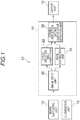
- the line-of-sight measurement device 10 includes: an image capturing unit 12 including a CCD camera or the like that captures an image including a subject's face as a target; an illumination unit 13 that illuminates light on the subject's eyes; a computer 14 that performs image processing; and an output unit 16 that includes a CRT or the like.
- the image capturing unit 12 is one camera, and the illumination unit 13 is, for example, one near infrared LED.
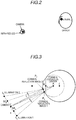
- the imaging direction of the image capturing unit 12 and the illumination direction of the illumination unit 13 are not coaxial, but are arranged such that it is determined that the directions are coaxial ( Fig. 2 ).
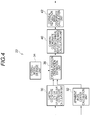
- the arrangement satisfies the constraint condition shown in Expression (1) ( Fig. 3 ).
- two near-infrared LEDs may be arranged on both the left side and the right side of the camera after satisfying Expression (1).
- L is the distance between the image capturing unit 12 and the intersection between the cornea and the straight line from the image capturing unit 12 toward the corneal curvature center
- r is the radius of corneal curvature
- f is the focal length in units of pixels of the image capturing unit 12.
- the computer 14 includes a CPU, a ROM that stores a program for a line-of-sight measurement processing routine to be described later, a RAM that stores data and the like, and a bus that connects these.
- the computer 14 will be described with function blocks divided for respective units for implementing functions determined on the basis of hardware and software.
- the computer 14 includes an image input unit 20, a corneal reflection image estimation unit 22, a pupil estimation unit 24, and a corneal reflection method line-of-sight detection unit 28.
- the image input unit 20 inputs a face image as a grayscale image which is output from the image capturing unit 12.
- the corneal reflection image estimation unit 22 estimates a time series of image coordinates of a corneal reflection image from a time series of a face image which is an output of the image input unit 20.
- the pupil estimation unit 24 estimates the time series of the image coordinates of the pupil center, from the time series of the face image which is an output of the image input unit 20.
- the corneal reflection method line-of-sight detection unit 28 calculates a line-of-sight vector in the camera coordinate system using a corneal reflection method (refer to Fig. 11 ) from the time series of the image coordinates of the corneal reflection image and the time series of the image coordinates of the pupil center.
- the image input unit 20 includes, for example, an A/D converter, an image memory that stores image data for one screen, and the like.
- the corneal reflection image estimation unit 22 includes a camera coordinate system eyeball center coordinate calculation unit 30, an apparent pupil center calculation unit 32, an eyeball model storage unit 34, an eyeball position orientation estimation unit 36, a camera coordinate system corneal reflection image calculation unit 40, and a corneal reflection image coordinate calculation unit 42.
- the camera coordinate system eyeball center coordinate calculation unit 30 estimates the three-dimensional coordinates of the eyeball center in the camera coordinate system shown in Fig. 5 from the face image as follows.
- the line of sight is calculated using the corneal curvature center and the pupil center calculated from the corneal reflection image of the face image, and the three-dimensional coordinates of the eyeball center in the eyeball model coordinate system are estimated using the calculated line of sight.
- the current rotation matrix R and translation vector t of the face model coordinate system with respect to the camera coordinate system are obtained by fitting the face model to the current face image.
- the three-dimensional coordinates of the eyeball center in the face model coordinate system are converted into the three-dimensional coordinates of the eyeball center in the camera coordinate system, on the basis of the obtained rotation translation vector.
- the apparent pupil center calculation unit 32 estimates the three-dimensional coordinates of the apparent pupil center in the camera coordinate system from the pupil center position of the eye on the face image.
- the pupil center is detected from the face image, and the pupil center coordinates in the image coordinate system shown in Fig. 5 are obtained.
- the pupil center is detected using a known technique in the past, and the following pupil center coordinates in the image coordinate system are obtained.
- D D x D y
- the three-dimensional coordinates in a camera coordinate system are estimated from the image coordinates of the pupil center.
- the Z coordinate of the pupil center in the camera coordinate system is obtained by some distance measurement unit and is set as dz.
- the coordinates of the image center are set as (xc, yc).
- the eyeball model storage unit 34 stores an eyeball model, which is formed of two spheres, and parameters thereof. Specifically, the eyeball model storage unit 34 stores a radius of corneal curvature r, a distance u between the eyeball center E and the corneal curvature center A, a distance s between the corneal curvature center A and the true pupil center B, and a ratio (n1/n2) of a refractive index n1 of the atmosphere to a refractive index n2 of the aqueous humor.
- the distance s between the corneal curvature center A and the true pupil center B and the ratio (n1/n2) of the refractive index n1 of the atmosphere to the refractive index n2 of the aqueous humor are parameters used in a case of calculating the line-of-sight vector in the camera coordinate system through the corneal reflection method using the corneal reflection method line-of-sight detection unit 28.
- the eyeball position orientation estimation unit 36 calculates a three-dimensional optical axis vector toward the three-dimensional position of the pupil center from the three-dimensional position of the eyeball center in the camera coordinate system, on the basis of the three-dimensional coordinates of the eyeball center in the camera coordinate system and the three-dimensional coordinates of the apparent pupil center in the camera coordinate system.
- an angle correction amount is estimated from the fact that the imaging direction of the image capturing unit 12 and the illumination direction of the illumination unit 13 are arranged such that it is determined that the directions are coaxial, and from a corner CED shown in Fig. 6 .
- the corner CED is formed by a line segment connecting the three-dimensional coordinates of the apparent pupil center in the camera coordinate system and the three-dimensional coordinates of the eyeball center in the camera coordinate system, and a line segment connecting the three-dimensional coordinates of the eyeball center in the camera coordinate system and the three-dimensional coordinates of the imaging unit.
- the angle w is calculated in accordance with the following expression.
- a three-dimensional optical axis vector g toward the three-dimensional coordinates of the pupil center from the three-dimensional coordinates of the eyeball center in the camera coordinate system is calculated by the following expression, on the basis of the three-dimensional coordinates e of the eyeball center in the camera coordinate system, the vector geb from the eyeball center E to the apparent pupil center, and the angle correction amount p.
- g g eb cos ⁇ + ⁇ g eb ⁇ e ⁇ g eb ⁇ e ⁇ ⁇ g eb sin ⁇ + ⁇ g eb ⁇ e ⁇ g eb ⁇ e ⁇ ⁇ g eb ⁇ e ⁇ g eb ⁇ e ⁇ ⁇ g eb 1 ⁇ cos ⁇
- the optical axis vector is determined from the correction amount and the three-dimensional coordinates of the eyeball center, and is combined with the three-dimensional coordinates of the eyeball center. Then, the position and the orientation of the eyeball model can be estimated.
- the camera coordinate system corneal reflection image calculation unit 40 obtains the three-dimensional coordinates of the corneal reflection image in the camera coordinate system, on the basis of the three-dimensional coordinates of the eyeball center in the camera coordinate system, the optical axis vector, and a predetermined three-dimensional eyeball model.
- the three-dimensional coordinate a of the corneal curvature center A in the camera coordinate system is estimated in accordance with the following expression, by using the three-dimensional coordinates e of the eyeball center in the camera coordinate system, the optical axis vector g, and the distance u between the eyeball center E and the corneal curvature center A stored in the eyeball model storage unit 34.
- a e + u g ⁇ g ⁇
- the corneal reflection image coordinate calculation unit 42 estimates the image coordinates of the corneal reflection image on the face image from the three-dimensional coordinates of the corneal reflection image in the camera coordinate system, as described below.
- the three-dimensional coordinates of the corneal reflection image in the camera coordinate system are two-dimensionally projected using the camera parameters.
- the focal length expressed in pixel units is f and the coordinates of the image center are (xc, yc)
- the image coordinates (Px, Py) of the corneal reflection image are as follows.
- P x f p x p z + x c
- P y f p y p z + y c
- the image coordinates of the corneal reflection image can be estimated from the observed value of the pupil center.
- the pupil estimation unit 24 includes a camera coordinate system eyeball center coordinate calculation unit 50, a camera coordinate system corneal reflection image calculation unit 52, an eyeball model storage unit 54, an eyeball position orientation estimation unit 56, an apparent pupil center calculation unit 60, and a pupil center image coordinate calculation unit 62.
- the camera coordinate system eyeball center coordinate calculation unit 50 estimates the three-dimensional coordinates of the eyeball center in the camera coordinate system from the face image.
- the camera coordinate system corneal reflection image calculation unit 52 estimates the three-dimensional coordinates of the corneal reflection image in the camera coordinate system from the position of the eye corneal reflection image on the face image.
- the three-dimensional coordinates of the corneal reflection image in the camera coordinate system are estimated from the image coordinates of the corneal reflection image.
- the Z coordinate of the corneal reflection image coordinates in the camera coordinate system is obtained by some distance measurement unit and is set as pz.
- the coordinates of the image center are set as (xc, yc).
- the eyeball model storage unit 54 stores a radius of corneal curvature r, a distance u between the eyeball center E and the corneal curvature center A, a distance s between the corneal curvature center A and the true pupil center B, and a ratio (n1/n2) of a refractive index n1 of the atmosphere to a refractive index n2 of the aqueous humor.
- the distance s between the corneal curvature center A and the true pupil center B and the ratio (n1/n2) of the refractive index n1 of the atmosphere to the refractive index n2 of the aqueous humor are parameters used in a case of calculating the line-of-sight vector in the camera coordinate system through the corneal reflection method using the corneal reflection line-of-sight detection unit 28.
- the eyeball position orientation estimation unit 56 calculates a three-dimensional optical axis vector toward the three-dimensional position of the corneal curvature center from the three-dimensional position of the eyeball center in the camera coordinate system, on the basis of the three-dimensional coordinates of the eyeball center in the camera coordinate system and the three-dimensional coordinates of the corneal reflection image in the camera coordinate system.
- the three-dimensional coordinates of the corneal curvature center A in the camera coordinate system are estimated using the fact that it is determined that the imaging direction of the image capturing unit 12 and the illumination direction of the illumination unit 13 are arranged to be coaxial, the three-dimensional coordinates p of the corneal reflection image in the camera coordinate system, and the radius of corneal curvature r.
- a p ⁇ p ⁇ ⁇ p ⁇ + r
- an optical axis vector is obtained from the three-dimensional coordinates of the corneal curvature center A in the camera coordinate system and the three-dimensional coordinates of the eyeball center in the camera coordinate system.
- the optical axis vector g is a vector toward the corneal curvature center A in the camera coordinate system from the eyeball center E in the camera coordinate system, and is thus calculated in accordance with the following expression.
- g a ⁇ e
- the position and the orientation of the eyeball model can be estimated by determining the optical axis vector and combining the optical axis vector with the estimated values of the eyeball center coordinates.
- the apparent pupil center calculation unit 60 obtains the three-dimensional coordinates of the apparent pupil center in the camera coordinate system, on the basis of the three-dimensional coordinates of the eyeball center in the camera coordinate system, the optical axis vector, and a predetermined three-dimensional eyeball model.
- an angle of a corner CEA is calculated.
- the corner CEA is formed by a line segment EA and a line segment EC.
- the line segment EA connects the three-dimensional coordinates E of the eyeball center in the camera coordinate system and the three-dimensional coordinates A of the corneal curvature center of the camera coordinate system.
- the line segment EC connects the three-dimensional coordinates E of the eyeball center in the camera coordinate system and the three-dimensional coordinates C of the image capturing unit 12.
- ⁇ arccos ⁇ e ⁇ g ⁇ ⁇ e ⁇ ⁇ g ⁇
- a relationship between the angle of the corner CEA and the angle difference p between the line-of-sight vector gcr obtained by the corneal reflection method and the line-of-sight vector geb obtained by the eyeball model fitting method is obtained in advance.
- the angle difference p corresponding to the angle of the corner CEA is calculated as a correction amount p.
- a vector geb connecting the three-dimensional coordinates E of the eyeball center in the camera coordinate system and the three-dimensional coordinates A of the corneal curvature center in the camera coordinate system is calculated by the following expression, on the basis of the three-dimensional coordinates e of the eyeball center in the camera coordinate system, the optical axis vector g, and the angle correction amount p.
- a point where the distance from the corneal curvature center A becomes equal to r is obtained on a vector geb connecting the three-dimensional coordinates E of the eyeball center in the camera coordinate system and the three-dimensional coordinates A of the corneal curvature center in the camera coordinate system.
- the pupil center image coordinate calculation unit 62 estimates the image coordinates of the pupil center on the face image from the three-dimensional coordinates of the apparent pupil center in the camera coordinate system.
- the three-dimensional coordinates of the apparent pupil center in the camera coordinate system are two-dimensionally projected using the camera parameters.
- the image coordinates (Dx, Dy) of the pupil center are as follows.
- D x f d x d z + x c
- D y f d y d z + y c
- the image coordinates of the pupil center can be estimated from the observed value of the corneal reflection image.
- the corneal reflection method line-of-sight detection unit 28 obtains a line-of-sight vector by the corneal reflection method on the basis of the image coordinates of the corneal reflection image and the image coordinates of the pupil center, and outputs the line-of-sight vector by the output unit 16.
- the line-of-sight vector is obtained by the corneal reflection method using the observed value of the corneal reflection image determined to be correct and the observed value of the pupil center.
- the operation of the line-of-sight measurement device 10 will be described. First, if the illumination unit 13 illuminates the near-infrared light on the subject's eyes, the image capturing unit 12 continuously captures the face image of the subject.
- the computer 14 executes a line-of-sight measurement processing routine shown in Fig. 8 for each captured face image.
- step S100 the face image captured by the image capturing unit 12 is acquired.
- step S102 the image coordinates of the corneal reflection image are estimated from the face image.
- step S104 the image coordinates of the pupil center are estimated from the face image.
- step S106 a line-of-sight vector is obtained by the corneal reflection method on the basis of the image coordinates of the corneal reflection image and the image coordinates of the pupil center, and is output by the output unit 16, and the line-of-sight measurement processing routine ends.
- Step S102 is realized through the corneal reflection image estimation processing routine shown in Fig. 9 .
- step S110 the current rotation matrix R and translation vector t of the face model coordinate system with respect to the camera coordinate system are obtained by fitting the face model to the current face image.
- step S112 the three-dimensional coordinates of the eyeball center in the face model coordinate system are converted into the three-dimensional coordinates of the eyeball center in the camera coordinate system, on the basis of the obtained rotation translation vector.
- step S114 the pupil center is detected from the face image, and the pupil center coordinates in the image coordinate system are obtained.
- step S116 the three-dimensional coordinates in the camera coordinate system are estimated from the image coordinates of the pupil center.
- step S118 an angle correction amount is estimated from the angle of the corner CED and the fact that the imaging direction of the image capturing unit 12 and the illumination direction of the illumination unit 13 are arranged such that it is determined that the directions are coaxial.
- the angle of the corner CED is formed by the line segment connecting the three-dimensional coordinates of the apparent pupil center in the camera coordinate system and the three-dimensional coordinates of the eyeball center in the camera coordinate system and the line segment connecting the three-dimensional coordinates of the eyeball center in the camera coordinate system and the three-dimensional coordinates of the imaging unit.
- step S120 the three-dimensional optical axis vector g toward the three-dimensional position of the pupil center from the three-dimensional position of the eyeball center in the camera coordinate system is calculated on the basis of the angle w of the corner CED, the three-dimensional coordinates e of the eyeball center in the camera coordinate system, and the angle correction amount.
- step S122 the three-dimensional coordinates a of the corneal curvature center A in the camera coordinate system is estimated using the three-dimensional coordinates e of the eyeball center in the camera coordinate system, the optical axis vector g, and the distance u between the eyeball center E and the corneal curvature center A stored in the eyeball model storage unit 34.
- step S124 a point where the distance from the corneal curvature center A becomes equal to r is obtained on the vector CA, and a three-dimensional vector of the corneal reflection image P is estimated.
- step S126 the image coordinates of the corneal reflection image on the face image are estimated from the three-dimensional coordinates of the corneal reflection image in the camera coordinate system.
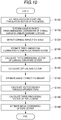
- Step S104 is realized by the pupil center estimation processing routine shown in Fig. 10 .
- step S130 the current rotation matrix R and translation vector t of the face model coordinate system with respect to the camera coordinate system are obtained by fitting the face model to the current face image.
- step S132 the three-dimensional coordinates of the eyeball center in the face model coordinate system are converted into the three-dimensional coordinates of the eyeball center in the camera coordinate system, on the basis of the obtained rotation translation vector.
- step S134 a corneal reflection image is detected from the face image, and the coordinates of the corneal reflection image in the image coordinates are obtained.
- step S136 the three-dimensional coordinates of the corneal reflection image in the camera coordinate system are estimated from the image coordinates of the corneal reflection image.
- step S138 the three-dimensional coordinates of the corneal curvature center A in the camera coordinate system are estimated using the fact that it is determined that the imaging direction of the image capturing unit 12 and the illumination direction of the illumination unit 13 are arranged to be coaxial, the three-dimensional coordinates p of the corneal reflection image in the camera coordinate system, and the radius of corneal curvature r.
- step S140 an optical axis vector is obtained from the three-dimensional coordinates of the corneal curvature center A in the camera coordinate system and the three-dimensional coordinates of the eyeball center in the camera coordinate system.
- step S142 on the basis of the optical axis vector g and the three-dimensional coordinates e of the eyeball center in the camera coordinate system, an angle of a corner CEA is calculated.
- the corner CEA is formed by a line segment EA and a line segment EC.
- the line segment EA connects the three-dimensional coordinates E of the eyeball center in the camera coordinate system and the three-dimensional coordinates A of the corneal curvature center of the camera coordinate system.
- the line segment EC connects the three-dimensional coordinates E of the eyeball center in the camera coordinate system and the three-dimensional coordinates C of the image capturing unit 12. Thereby, a predetermined angle correction amount corresponding to the calculated angle of the corner CEA is acquired.
- step S144 a vector geb connecting the three-dimensional coordinates E of the eyeball center in the camera coordinate system and the three-dimensional coordinates A of the corneal curvature center in the camera coordinate system is calculated, on the basis of the three-dimensional coordinates e of the eyeball center in the camera coordinate system, the optical axis vector g, and the angle correction amount p.
- step S146 a point where the distance from the corneal curvature center A becomes equal to r is obtained on a vector geb connecting the three-dimensional coordinates E of the eyeball center in the camera coordinate system and the three-dimensional coordinates A of the corneal curvature center in the camera coordinate system.
- the point is set as the three-dimensional coordinates of the apparent pupil center in the camera coordinate system.
- step S148 the image coordinates of the pupil center on the face image are estimated from the three-dimensional coordinates of the apparent pupil center in the camera coordinate system.
- image coordinates of the corneal reflection image on the face image can be obtained with high accuracy from the eye pupil center position on the face image in order to perform line-of-sight measurement with a simple configuration.
- the image coordinates of the pupil center on the face image can be obtained with high accuracy from the position of the corneal reflection image of the eye on the face image in order to perform line-of-sight measurement with a simple configuration.
- Model-based estimation of the other image coordinates can be performed from one result of observation of two observed values (pupil center and the corneal reflection image) used in the corneal reflection method, by using the image capturing unit in which it is determined that the camera and the illumination are coaxial, an eyeball center estimation technique, a three-dimensional eyeball model, and a technique of correcting the optical axis vector. Thereby, it is possible to determine whether the result of observation is correct by comparing the observed value with the estimated value, and it is possible to increase the reliability of the observation at a low cost.
Landscapes
- Health & Medical Sciences (AREA)
- Life Sciences & Earth Sciences (AREA)
- Engineering & Computer Science (AREA)
- General Health & Medical Sciences (AREA)
- Ophthalmology & Optometry (AREA)
- Physics & Mathematics (AREA)
- Biophysics (AREA)
- Animal Behavior & Ethology (AREA)
- Veterinary Medicine (AREA)
- Public Health (AREA)
- Surgery (AREA)
- Biomedical Technology (AREA)
- Heart & Thoracic Surgery (AREA)
- Medical Informatics (AREA)
- Molecular Biology (AREA)
- Human Computer Interaction (AREA)
- Multimedia (AREA)
- General Physics & Mathematics (AREA)
- Theoretical Computer Science (AREA)
- Eye Examination Apparatus (AREA)
Applications Claiming Priority (1)
| Application Number | Priority Date | Filing Date | Title |
|---|---|---|---|
| JP2019064828A JP7283841B2 (ja) | 2019-03-28 | 2019-03-28 | 視線計測装置 |
Publications (3)
| Publication Number | Publication Date |
|---|---|
| EP3725211A2 true EP3725211A2 (fr) | 2020-10-21 |
| EP3725211A3 EP3725211A3 (fr) | 2020-12-30 |
| EP3725211B1 EP3725211B1 (fr) | 2026-02-11 |
Family
ID=69699760
Family Applications (1)
| Application Number | Title | Priority Date | Filing Date |
|---|---|---|---|
| EP20157854.9A Active EP3725211B1 (fr) | 2019-03-28 | 2020-02-18 | Dispositif de mesure de ligne de visée |
Country Status (3)
| Country | Link |
|---|---|
| US (1) | US11571125B2 (fr) |
| EP (1) | EP3725211B1 (fr) |
| JP (1) | JP7283841B2 (fr) |
Families Citing this family (5)
| Publication number | Priority date | Publication date | Assignee | Title |
|---|---|---|---|---|
| KR102710604B1 (ko) * | 2020-05-08 | 2024-09-26 | 한국전자통신연구원 | 시선 추적 장치 및 방법 |
| JP2023048007A (ja) * | 2021-09-27 | 2023-04-06 | キヤノン株式会社 | 視線検出装置及び撮像装置 |
| US12141350B2 (en) * | 2022-07-08 | 2024-11-12 | Tencent America LLC | Vergence based gaze matching for mixed-mode immersive telepresence application |
| CN115588052B (zh) * | 2022-10-24 | 2026-04-21 | 浙江极氪智能科技有限公司 | 视线方向数据采集方法、装置、设备及存储介质 |
| CN117275078A (zh) * | 2023-09-15 | 2023-12-22 | 上海交通大学 | 基于面部特征标定的实时注视估计方法及系统 |
Citations (2)
| Publication number | Priority date | Publication date | Assignee | Title |
|---|---|---|---|---|
| JP2014188322A (ja) | 2013-03-28 | 2014-10-06 | Panasonic Corp | 視線検出装置、視線検出方法及びプログラム |
| JP2017111746A (ja) | 2015-12-18 | 2017-06-22 | 国立大学法人静岡大学 | 視線検出装置及び視線検出方法 |
Family Cites Families (10)
| Publication number | Priority date | Publication date | Assignee | Title |
|---|---|---|---|---|
| US5471542A (en) * | 1993-09-27 | 1995-11-28 | Ragland; Richard R. | Point-of-gaze tracker |
| US6659611B2 (en) * | 2001-12-28 | 2003-12-09 | International Business Machines Corporation | System and method for eye gaze tracking using corneal image mapping |
| US7963652B2 (en) * | 2003-11-14 | 2011-06-21 | Queen's University At Kingston | Method and apparatus for calibration-free eye tracking |
| JP2008136789A (ja) * | 2006-12-05 | 2008-06-19 | Nec Corp | 眼球パラメータ推定装置及び方法 |
| NL2003372C2 (en) * | 2009-08-20 | 2011-02-22 | Univ Delft Tech | Apparatus and method for automatically determining a strabismus angle. |
| US8885882B1 (en) * | 2011-07-14 | 2014-11-11 | The Research Foundation For The State University Of New York | Real time eye tracking for human computer interaction |
| JP5949319B2 (ja) * | 2012-08-21 | 2016-07-06 | 富士通株式会社 | 視線検出装置及び視線検出方法 |
| JP6785723B2 (ja) * | 2017-06-09 | 2020-11-18 | 株式会社豊田中央研究所 | 視線計測装置 |
| JP6800091B2 (ja) | 2017-06-09 | 2020-12-16 | 株式会社豊田中央研究所 | 視線計測装置及びプログラム |
| JP6971686B2 (ja) * | 2017-08-02 | 2021-11-24 | 株式会社Jvcケンウッド | 視線検出装置及び視線検出方法 |
-
2019
- 2019-03-28 JP JP2019064828A patent/JP7283841B2/ja active Active
-
2020
- 2020-02-11 US US16/787,332 patent/US11571125B2/en active Active
- 2020-02-18 EP EP20157854.9A patent/EP3725211B1/fr active Active
Patent Citations (2)
| Publication number | Priority date | Publication date | Assignee | Title |
|---|---|---|---|---|
| JP2014188322A (ja) | 2013-03-28 | 2014-10-06 | Panasonic Corp | 視線検出装置、視線検出方法及びプログラム |
| JP2017111746A (ja) | 2015-12-18 | 2017-06-22 | 国立大学法人静岡大学 | 視線検出装置及び視線検出方法 |
Also Published As
| Publication number | Publication date |
|---|---|
| JP2020162759A (ja) | 2020-10-08 |
| JP7283841B2 (ja) | 2023-05-30 |
| EP3725211A3 (fr) | 2020-12-30 |
| US20200305712A1 (en) | 2020-10-01 |
| US11571125B2 (en) | 2023-02-07 |
| EP3725211B1 (fr) | 2026-02-11 |
Similar Documents
| Publication | Publication Date | Title |
|---|---|---|
| EP3725211B1 (fr) | Dispositif de mesure de ligne de visée | |
| US10755124B2 (en) | Passenger counting device, system, method and program, and vehicle movement amount calculation device, method and program | |
| EP3413234A1 (fr) | Dispositif, programme, et procédé de suivi du regard | |
| JP6596678B2 (ja) | 視線測定装置および視線測定方法 | |
| US10902635B2 (en) | Line-of-sight detection device | |
| JP7255436B2 (ja) | 眼球構造推定装置 | |
| US10140726B2 (en) | Apparatus and method for estimating gazed position of person | |
| US10499808B2 (en) | Pupil detection system, gaze detection system, pupil detection method, and pupil detection program | |
| EP3545818B1 (fr) | Dispositif, procédé et programme d'estimation de direction de ligne de visée | |
| US8971576B2 (en) | Information processing apparatus and processing method thereof | |
| JP6677522B2 (ja) | 情報処理装置、情報処理装置の制御方法およびプログラム | |
| EP3690814B1 (fr) | Dispositif de reconnaissance de voie | |
| CN111527374A (zh) | 视线方向校正装置、视线方向校正方法及视线方向校正程序 | |
| JP6288770B2 (ja) | 顔検出方法、顔検出システム、および顔検出プログラム | |
| JP6785723B2 (ja) | 視線計測装置 | |
| US8941732B2 (en) | Three-dimensional measuring method | |
| WO2023067867A1 (fr) | Dispositif de commande monté sur véhicule et procédé d'acquisition d'informations tridimensionnelles | |
| CN112419399B (zh) | 一种图像测距方法、装置、设备和存储介质 | |
| JP6789888B2 (ja) | ステレオカメラ装置 | |
| EP3605015A1 (fr) | Dispositif de traitement d'image stéréo | |
| JP7173836B2 (ja) | コントローラ、位置判定装置、位置判定システム、表示システム、プログラム、および記録媒体 | |
| WO2021095354A1 (fr) | Dispositif de reconnaissance de monde extérieur, procédé de reconnaissance de monde extérieur, et programme de reconnaissance de monde extérieur |
Legal Events
| Date | Code | Title | Description |
|---|---|---|---|
| PUAI | Public reference made under article 153(3) epc to a published international application that has entered the european phase |
Free format text: ORIGINAL CODE: 0009012 |
|
| STAA | Information on the status of an ep patent application or granted ep patent |
Free format text: STATUS: THE APPLICATION HAS BEEN PUBLISHED |
|
| AK | Designated contracting states |
Kind code of ref document: A2 Designated state(s): AL AT BE BG CH CY CZ DE DK EE ES FI FR GB GR HR HU IE IS IT LI LT LU LV MC MK MT NL NO PL PT RO RS SE SI SK SM TR |
|
| AX | Request for extension of the european patent |
Extension state: BA ME |
|
| PUAL | Search report despatched |
Free format text: ORIGINAL CODE: 0009013 |
|
| AK | Designated contracting states |
Kind code of ref document: A3 Designated state(s): AL AT BE BG CH CY CZ DE DK EE ES FI FR GB GR HR HU IE IS IT LI LT LU LV MC MK MT NL NO PL PT RO RS SE SI SK SM TR |
|
| AX | Request for extension of the european patent |
Extension state: BA ME |
|
| RIC1 | Information provided on ipc code assigned before grant |
Ipc: A61B 3/113 20060101AFI20201123BHEP |
|
| STAA | Information on the status of an ep patent application or granted ep patent |
Free format text: STATUS: REQUEST FOR EXAMINATION WAS MADE |
|
| 17P | Request for examination filed |
Effective date: 20210630 |
|
| RBV | Designated contracting states (corrected) |
Designated state(s): AL AT BE BG CH CY CZ DE DK EE ES FI FR GB GR HR HU IE IS IT LI LT LU LV MC MK MT NL NO PL PT RO RS SE SI SK SM TR |
|
| RAP1 | Party data changed (applicant data changed or rights of an application transferred) |
Owner name: TOYOTA JIDOSHA KABUSHIKI KAISHA Owner name: AISIN CORPORATION |
|
| RIN1 | Information on inventor provided before grant (corrected) |
Inventor name: MATSUMURA, TAKESHI Inventor name: YAMADA, YUYA Inventor name: KATO, TAKASHI Inventor name: OSUGA, SHIN Inventor name: KOJIMA, SHIN-ICHI |
|
| STAA | Information on the status of an ep patent application or granted ep patent |
Free format text: STATUS: EXAMINATION IS IN PROGRESS |
|
| 17Q | First examination report despatched |
Effective date: 20230503 |
|
| GRAP | Despatch of communication of intention to grant a patent |
Free format text: ORIGINAL CODE: EPIDOSNIGR1 |
|
| STAA | Information on the status of an ep patent application or granted ep patent |
Free format text: STATUS: GRANT OF PATENT IS INTENDED |
|
| INTG | Intention to grant announced |
Effective date: 20250917 |
|
| GRAS | Grant fee paid |
Free format text: ORIGINAL CODE: EPIDOSNIGR3 |
|
| GRAA | (expected) grant |
Free format text: ORIGINAL CODE: 0009210 |
|
| STAA | Information on the status of an ep patent application or granted ep patent |
Free format text: STATUS: THE PATENT HAS BEEN GRANTED |
|
| AK | Designated contracting states |
Kind code of ref document: B1 Designated state(s): AL AT BE BG CH CY CZ DE DK EE ES FI FR GB GR HR HU IE IS IT LI LT LU LV MC MK MT NL NO PL PT RO RS SE SI SK SM TR |
|
| REG | Reference to a national code |
Ref country code: CH Ref legal event code: F10 Free format text: ST27 STATUS EVENT CODE: U-0-0-F10-F00 (AS PROVIDED BY THE NATIONAL OFFICE) Effective date: 20260211 Ref country code: GB Ref legal event code: FG4D |
|
| REG | Reference to a national code |
Ref country code: DE Ref legal event code: R096 Ref document number: 602020066614 Country of ref document: DE |
|
| REG | Reference to a national code |
Ref country code: IE Ref legal event code: FG4D |
|
| PGFP | Annual fee paid to national office [announced via postgrant information from national office to epo] |
Ref country code: DE Payment date: 20260312 Year of fee payment: 7 |
|
| PGFP | Annual fee paid to national office [announced via postgrant information from national office to epo] |
Ref country code: FR Payment date: 20260324 Year of fee payment: 7 |