EP3725432A1 - Verfahren und vorrichtung zur herstellung von vorformlingen, die zum löten von elektronischen, photonischen, thermischen oder mechanischen komponenten bestimmt ist - Google Patents
Verfahren und vorrichtung zur herstellung von vorformlingen, die zum löten von elektronischen, photonischen, thermischen oder mechanischen komponenten bestimmt ist Download PDFInfo
- Publication number
- EP3725432A1 EP3725432A1 EP20169300.9A EP20169300A EP3725432A1 EP 3725432 A1 EP3725432 A1 EP 3725432A1 EP 20169300 A EP20169300 A EP 20169300A EP 3725432 A1 EP3725432 A1 EP 3725432A1
- Authority
- EP
- European Patent Office
- Prior art keywords
- suspension
- metal particles
- preform
- solder paste
- desolvated
- Prior art date
- Legal status (The legal status is an assumption and is not a legal conclusion. Google has not performed a legal analysis and makes no representation as to the accuracy of the status listed.)
- Pending
Links
Images


Classifications
-
- B—PERFORMING OPERATIONS; TRANSPORTING
- B23—MACHINE TOOLS; METAL-WORKING NOT OTHERWISE PROVIDED FOR
- B23K—SOLDERING OR UNSOLDERING; WELDING; CLADDING OR PLATING BY SOLDERING OR WELDING; CUTTING BY APPLYING HEAT LOCALLY, e.g. FLAME CUTTING; WORKING BY LASER BEAM
- B23K35/00—Rods, electrodes, materials, or media, for use in soldering, welding, or cutting
- B23K35/02—Rods, electrodes, materials, or media, for use in soldering, welding, or cutting characterised by mechanical features, e.g. shape
- B23K35/0222—Rods, electrodes, materials, or media, for use in soldering, welding, or cutting characterised by mechanical features, e.g. shape for use in soldering or brazing
- B23K35/0244—Powders, particles or spheres; Preforms made therefrom
-
- B—PERFORMING OPERATIONS; TRANSPORTING
- B22—CASTING; POWDER METALLURGY
- B22F—WORKING METALLIC POWDER; MANUFACTURE OF ARTICLES FROM METALLIC POWDER; MAKING METALLIC POWDER; APPARATUS OR DEVICES SPECIALLY ADAPTED FOR METALLIC POWDER
- B22F1/00—Metallic powder; Treatment of metallic powder, e.g. to facilitate working or to improve properties
- B22F1/10—Metallic powder containing lubricating or binding agents; Metallic powder containing organic material
-
- B—PERFORMING OPERATIONS; TRANSPORTING
- B22—CASTING; POWDER METALLURGY
- B22F—WORKING METALLIC POWDER; MANUFACTURE OF ARTICLES FROM METALLIC POWDER; MAKING METALLIC POWDER; APPARATUS OR DEVICES SPECIALLY ADAPTED FOR METALLIC POWDER
- B22F3/00—Manufacture of workpieces or articles from metallic powder characterised by the manner of compacting or sintering; Apparatus specially adapted therefor ; Presses and furnaces
- B22F3/02—Compacting only
-
- B—PERFORMING OPERATIONS; TRANSPORTING
- B22—CASTING; POWDER METALLURGY
- B22F—WORKING METALLIC POWDER; MANUFACTURE OF ARTICLES FROM METALLIC POWDER; MAKING METALLIC POWDER; APPARATUS OR DEVICES SPECIALLY ADAPTED FOR METALLIC POWDER
- B22F3/00—Manufacture of workpieces or articles from metallic powder characterised by the manner of compacting or sintering; Apparatus specially adapted therefor ; Presses and furnaces
- B22F3/02—Compacting only
- B22F3/03—Press-moulding apparatus therefor
-
- B—PERFORMING OPERATIONS; TRANSPORTING
- B22—CASTING; POWDER METALLURGY
- B22F—WORKING METALLIC POWDER; MANUFACTURE OF ARTICLES FROM METALLIC POWDER; MAKING METALLIC POWDER; APPARATUS OR DEVICES SPECIALLY ADAPTED FOR METALLIC POWDER
- B22F3/00—Manufacture of workpieces or articles from metallic powder characterised by the manner of compacting or sintering; Apparatus specially adapted therefor ; Presses and furnaces
- B22F3/10—Sintering only
- B22F3/1017—Multiple heating or additional steps
- B22F3/1021—Removal of binder or filler
- B22F3/1025—Removal of binder or filler not by heating only
-
- B—PERFORMING OPERATIONS; TRANSPORTING
- B22—CASTING; POWDER METALLURGY
- B22F—WORKING METALLIC POWDER; MANUFACTURE OF ARTICLES FROM METALLIC POWDER; MAKING METALLIC POWDER; APPARATUS OR DEVICES SPECIALLY ADAPTED FOR METALLIC POWDER
- B22F7/00—Manufacture of composite layers, workpieces, or articles, comprising metallic powder, by sintering the powder, with or without compacting wherein at least one part is obtained by sintering or compression
- B22F7/06—Manufacture of composite layers, workpieces, or articles, comprising metallic powder, by sintering the powder, with or without compacting wherein at least one part is obtained by sintering or compression of composite workpieces or articles from parts, e.g. to form tipped tools
- B22F7/062—Manufacture of composite layers, workpieces, or articles, comprising metallic powder, by sintering the powder, with or without compacting wherein at least one part is obtained by sintering or compression of composite workpieces or articles from parts, e.g. to form tipped tools involving the connection or repairing of preformed parts
- B22F7/064—Manufacture of composite layers, workpieces, or articles, comprising metallic powder, by sintering the powder, with or without compacting wherein at least one part is obtained by sintering or compression of composite workpieces or articles from parts, e.g. to form tipped tools involving the connection or repairing of preformed parts using an intermediate powder layer
-
- B—PERFORMING OPERATIONS; TRANSPORTING
- B23—MACHINE TOOLS; METAL-WORKING NOT OTHERWISE PROVIDED FOR
- B23K—SOLDERING OR UNSOLDERING; WELDING; CLADDING OR PLATING BY SOLDERING OR WELDING; CUTTING BY APPLYING HEAT LOCALLY, e.g. FLAME CUTTING; WORKING BY LASER BEAM
- B23K35/00—Rods, electrodes, materials, or media, for use in soldering, welding, or cutting
- B23K35/22—Rods, electrodes, materials, or media, for use in soldering, welding, or cutting characterised by the composition or nature of the material
- B23K35/24—Selection of soldering or welding materials proper
- B23K35/30—Selection of soldering or welding materials proper with the principal constituent melting at less than 1550°C
- B23K35/3006—Ag as the principal constituent
-
- B—PERFORMING OPERATIONS; TRANSPORTING
- B22—CASTING; POWDER METALLURGY
- B22F—WORKING METALLIC POWDER; MANUFACTURE OF ARTICLES FROM METALLIC POWDER; MAKING METALLIC POWDER; APPARATUS OR DEVICES SPECIALLY ADAPTED FOR METALLIC POWDER
- B22F2998/00—Supplementary information concerning processes or compositions relating to powder metallurgy
- B22F2998/10—Processes characterised by the sequence of their steps
Definitions
- the technical sector of the present invention relates to methods for sintering electronic components and more specifically to methods and devices for pretreating compositions for sintering.
- solder can be obtained by sintering a composition of the sinter paste type between the electronic component and its substrate.
- These sinter pastes are often also called solder pastes although they are not formally solder pastes.
- solder In the field of microelectronics, electronic power components, for example, are attached to substrates by metal solders.
- the solder in addition to its mechanical fastening function, must ensure good thermal and electrical conductivity of the component.
- Micrometric or nanometric metallic particles for example silver, or of metal oxalate, for example silver oxalate, are used in particular for the production of solders by the sintering process.
- the metal particles or the metal oxalate grains can simply be dispersed in an alcohol. This composition is then called suspension of metal particles or suspension of metal oxalate.
- the metal particles or the metal oxalate grains can also be packaged in a more sophisticated preparation then called “brazing paste” which provides better hold in the form of a gel and allows easier use and storage.
- suspensions and pastes have certain drawbacks.
- the high viscosity of pastes can make their application by screen printing or microdrop dispensing particularly difficult. It is also common for suspensions to clog product dispensing nozzles.
- the pastes and especially the suspensions comprise several phases and there may be problems of settling in their container.
- the application can also be irregular both in density and in thickness.
- the desolvation of the primary paste can also take place upstream of the sintering process.
- the metal particles are then agglomerated in the form of a dome and do not make it possible to ensure that the electronic component bears uniformly on the particles during sintering. It appears that the adhesion of the electronic component to the substrate is not optimal.
- transporting the metal powder to the sintering station increases the risks of oxidation and loss of coherence of the metal particles.
- the object of the invention is to remedy the aforementioned drawbacks by proposing a new methodology.
- the brazing composition is represented either by a solder paste, or by a suspension of metal grains or of metal oxalate in suspension in a solvent.
- the suspension of metal grains or of metal oxalate is subjected to a preliminary filtration step through a filtration membrane placed on a suction device.
- the desolvation step can be carried out under vacuum and at a temperature between 60 ° C and 100 ° C, preferably at 80 ° C.
- a subject of the invention is also the preform of metal particles obtained according to the process.
- the metal particles of the preform have a particle size of the order of a micrometer or a nanometer.
- the metal particles are silver grains or silver oxalate grains.
- the filtration means comprises a filtration membrane capable of receiving the suspension and a means suction of one or more binders and one or more solvents through said filtration membrane.
- the desolvation means comprises a heating plate capable of receiving the solder paste or the filtered suspension and a retractable vacuum bell.
- the compacting means comprises a cavity suitable for receiving the desolvated solder paste or the suspension, a punch and a counter punch arranged so as to compact the desolvated solder paste or the suspension in the cavity so as to obtain a preform of metal particles having a predetermined shape, thickness and density.
- An advantage of the present invention lies in the reduction of the cycle times necessary for the sintering of an electronic component.
- Another advantage of the present invention lies in obtaining preforms of metal particles comprising little or no other compounds.
- Yet another advantage of the present invention lies in the production of preforms of metal particles exhibiting good mechanical strength.
- Yet another advantage of the present invention lies in the provision of preforms of metal particles making it possible to perfectly control the height of the solder during sintering of electronic components.
- Yet another advantage of the present invention lies in the provision of preforms of metal particles making it possible to perfectly control the extent of the sintering zone of the electronic component.
- Yet another advantage of the present invention lies in the provision of preforms of metal particles making it possible to reduce the problems of lack of parallelism between the component and its substrate.
- the brazing composition used in the invention consists either of a brazing paste or of a suspension of metal particles or grains or of metal oxalate in a solvent.
- This solvent can be, for example, ethylene glycol.
- Primary solder pastes essentially contain metallic particles as well as organic elements which must be removed as much as possible from the paste before it is used for sintering electronic components, for example.
- Metal particles are the essential elements of the dough. They will allow the sintering of the electronic component on its substrate.
- the metal particles of the solder pastes generally have a particle size of the order of a micrometer or a nanometer. To achieve good sintering, the metal particles must have good thermal and electrical conductivity. So all metallic particles are likely to be used, in particular silver.
- Organic compounds perform different functions: the binder function to give cohesion to the paste and allow its application by screen printing, for example, the dispersant function to prevent the metal particles from sintering in the paste and the diluent function to fix the viscosity paste and anti-oxidant function to prevent oxidation of metal particles.
- the binder function to give cohesion to the paste and allow its application by screen printing
- the dispersant function to prevent the metal particles from sintering in the paste
- the diluent function to fix the viscosity paste and anti-oxidant function to prevent oxidation of metal particles.
- the solder paste comprises metal particles having a particle size of the order of a micrometer or a nanometer, one or more binders and one or more solvents.
- particles or grains of silver or silver oxalate in the suspension are particularly recommended because they have good thermal and electrical conductivity and they are not very sensitive to oxidation.
- particles or grains of silver or silver oxalate have a particle size of the order of a micrometer or a nanometer.
- the figure 1 illustrates the different steps of the process according to the invention.
- the initial stage concerns only the suspension and the next two stages the suspension itself and a solder paste.
- the initial step consists of a step of filtering the suspension of silver grains or silver oxalate.
- This step aims to rapidly filter a large part of the solvent in which the grains are dispersed. Ideally, it is filtration by suction through a filtration membrane placed on a suction device. It goes without saying that any other suction system can be used. work in the invention.
- the grains of silver or silver oxalate are dispersed on the filtration membrane manually or using an automatic dispersion means and then the suction means is activated.
- the filtration membrane is provided with pores having a diameter adapted to the particle size of the metal particles of the suspension. This collects the metal grains of the suspension.
- the solder paste and the suspension are subjected to a desolvation step then a compacting step.
- the desolvation step makes it possible to extract from the solder paste the solvents and binders present in the paste and the traces of solvents still present in the suspension.
- the solder paste and the suspension are dispensed on a temperature-regulated heating plate.
- this step is carried out at a temperature between 60 ° C and 100 ° C, preferably 80 ° C.
- the desolvation step can be carried out under vacuum, which makes it possible to improve and accelerate the desolvation.
- the vacuum is created around the solder paste or the suspension using a vacuum bell.
- This step makes it possible to obtain a desolvated solder paste comprising a reduced or even a tiny amount of binders and a suspension which is virtually solvent-free. It is estimated that the paste and the suspension comprise almost only silver particles.
- the desolvated solder paste is in the form of a malleable mass, and the suspension is in the form of powder. It is necessary to give them a suitable shape so that they can be used for sintering an electronic component.
- a step of compacting the desolvated sinter paste or the suspension is carried out so as to obtain a preform of metal particles capable of being used for the sintering of an electronic component on a substrate.
- This step makes it possible to obtain a preform of metal particles or grains having a desired shape, thickness and density which can be adapted as a function of subsequent use.
- the preform thus produced has a certain cohesion allowing its subsequent use on the substrate receiving the electronic component without degrading it.
- the compacting step comprises the following phases.
- the cavity defines the overall shape of the preform that is to be used.
- the position of the punch is variable and / or the compaction pressure can be adjusted as required. It is thus possible to perfectly control the density, shape and thickness of the preform obtained and to adapt the shape of the preform to the dimensions of the component to be assembled by sintering.
- the preform obtained comprises upper and lower faces which are strictly parallel.
- the preform is suitable for being used for sintering an electronic component and has sufficient mechanical strength to be handled manually or automatically without degradation.
- the preform obtained according to the method according to the invention comprises metal particles having a particle size of the order of a micrometer or of a nanometer.
- the metal particles are grains of silver or grains of silver oxalate.
- the invention also relates to a device for implementing the method according to the invention.
- the figure 2 thus represents a device 1 of pretreatment of a solder paste or of a suspension comprising metal particles having a particle size of the order of a micrometer or a nanometer, one or more binders and one or more solvents.
- the device 1 makes it possible to obtain a preform 3 of metal particles capable of being used for the sintering of an electronic component on a substrate.
- the device 1 consists of a filtration means 4, a desolvation means 5, a compacting means 6 and a transfer means 7.
- the device 1 can also comprise a means for dispensing the paste. to solder the primary or the suspension 2 as well as a means of providing the preform 3 of metal particles. It goes without saying that the quantity of paste or suspension to be deposited on the filtration means 4 is defined beforehand according to the needs and the final dimensions which are sought.
- the transfer means 7 allowing the transfer of the filtered solder paste or the suspension 8 from the filtration means 4 to the desolvation means 5.
- the transfer means 7 also allows the transfer of the desolvated solder paste or the suspension 11 from the desolvation means 5 to the compacting means 6 described below.
- the transfer means 7 is a scraper consisting of a thin blade mounted on a spring and moving between the different means 4, 5 and 6 of the pretreatment device 1.
- the transfer means 7 is positioned in front of the filtration means 4 to lead the paste or the suspension and the preform from place to place.
- the figure 3 represents the filtration means 4 according to one embodiment of the device 1 according to the invention.
- the filtration means 4 is able to receive and filter the suspension 2 so as to obtain a filtered suspension 8.
- the filtration means 4 comprises a filtration membrane 9 capable of receiving the suspension 2 and a means 10 for sucking one or more solvents through the filtration membrane 9.
- the filtration membrane 9 has pores of diameter adapted to the particle size of the metal particles of the suspension 2.
- the filtration membrane 9 makes it possible to receive and filter the suspension 2. Its design is such that it prevents the metal particles of the suspension 2 from passing through it. Conversely, the filtration membrane 9 allows the solvent to pass by suction along the arrow F through it by means of the suction means 10.
- the figure 4 represents the means of desolvation 5 according to one embodiment of the device according to the invention.
- the desolvation means 5 is suitable for receiving and desolvating the filtered solder paste or the suspension 8 so as to obtain a desolvated solder paste or a suspension 11.
- the desolvation means 5 makes it possible to remove the solvent or solvents present in the solvent. filtered solder paste or in suspension 8.
- the desolvation means comprises a heating plate 12 adapted to receive the filtered solder paste or the suspension 8 and a retractable vacuum bell 13.
- the heating plate 12 receives and heats the filtered solder paste or the suspension 8 by heat transfer.
- the solvent or solvents present in the filtered solder paste or in the suspension 8 evaporate as a function of the temperature.
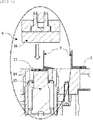
- the figure 5 shows the compacting means 6 according to one embodiment of the device according to the invention.
- the compacting means 6 is suitable for receiving and compacting the desolvated solder paste or the suspension 11 so as to obtain a preform 3 of metal particles.
- the means of compaction 6 allows, by the application of compressive forces on the desolvated solder paste or the suspension 11, to form the preform 3 while controlling its shape, its density and its thickness.
- the solder paste comprises metal particles having a particle size of the order of a micrometer or a nanometer, one or more binders and one or more solvents.
- the compacting means 6 which comprises a cavity 14, a punch 15 and a counter-punch 16.
- the cavity 14 is able to receive the desolvated solder paste or the suspension 11 and its shape determines the final shape of the preform 3.
- the scraper 7 it can be seen that the cavity 14 has been filled and the excess composition is discharged by the scraper 7.
- the punch 15 and the counter-punch 16 are arranged so as to compact the desolvated solder paste or the suspension 11 in the cavity so as to obtain a preform of metal particles having a predetermined shape, thickness and density.
- the forces exerted by the punch 15 and the counter punch 16 determine the density and thickness of the preform 3.
- the transfer means 7 allows the preform 3 to be ejected from the compacting means 6 as well as its transfer to a gripping zone.
- the preform 3 of metal particles is then able to be used for the sintering of an electronic component.
- the advantage of the invention can be seen in allowing brazing to be carried out using a preform containing almost 100% of metal grains. This way of proceeding avoids all the known treatments of the brazing composition carried out in the presence of the electronic component.
- the preform makes it possible to carry out continuous soldering while limiting the intervention time in the presence of the electronic component.
- the method according to the invention allows great flexibility of use in the sintering process, since it is possible to rapidly manufacture preforms whose dimensions are adapted to those of the components to be sintered, then to carry out the brazing directly. It can be seen that this sintering can be carried out continuously by associating the device according to the invention with a sintering station.
Landscapes
- Engineering & Computer Science (AREA)
- Mechanical Engineering (AREA)
- Manufacturing & Machinery (AREA)
- Chemical & Material Sciences (AREA)
- Composite Materials (AREA)
- Materials Engineering (AREA)
- Electric Connection Of Electric Components To Printed Circuits (AREA)
- Powder Metallurgy (AREA)
Applications Claiming Priority (1)
| Application Number | Priority Date | Filing Date | Title |
|---|---|---|---|
| FR1904144A FR3095142B1 (fr) | 2019-04-18 | 2019-04-18 | Procédé et dispositif de fabrication de préformes destinées à la brasure de composants électroniques, photoniques, thermiques ou mécaniques. |
Publications (1)
| Publication Number | Publication Date |
|---|---|
| EP3725432A1 true EP3725432A1 (de) | 2020-10-21 |
Family
ID=67514897
Family Applications (1)
| Application Number | Title | Priority Date | Filing Date |
|---|---|---|---|
| EP20169300.9A Pending EP3725432A1 (de) | 2019-04-18 | 2020-04-14 | Verfahren und vorrichtung zur herstellung von vorformlingen, die zum löten von elektronischen, photonischen, thermischen oder mechanischen komponenten bestimmt ist |
Country Status (2)
| Country | Link |
|---|---|
| EP (1) | EP3725432A1 (de) |
| FR (1) | FR3095142B1 (de) |
Citations (8)
| Publication number | Priority date | Publication date | Assignee | Title |
|---|---|---|---|---|
| US4810672A (en) | 1986-04-22 | 1989-03-07 | Siemens Aktiengesellschaft | Method of securing electronic components to a substrate |
| US20070183920A1 (en) | 2005-02-14 | 2007-08-09 | Guo-Quan Lu | Nanoscale metal paste for interconnect and method of use |
| US20120055978A1 (en) * | 2010-09-03 | 2012-03-08 | Heraeus Materials Technology Gmbh & Co. Kg | Contacting Means and Method for Contacting Electrical Components |
| WO2015075122A1 (en) * | 2013-11-22 | 2015-05-28 | Höganäs Ab (Publ) | Preforms for brazing |
| JP2017217694A (ja) * | 2016-06-10 | 2017-12-14 | 京セラ株式会社 | 銀ロウペースト組成物 |
| US10183893B2 (en) * | 2013-03-26 | 2019-01-22 | Ngk Insulators, Ltd. | Compact drying method |
| EP3715039A1 (de) * | 2019-03-27 | 2020-09-30 | Senju Metal Industry Co., Ltd | Lotlegierung, lotkugel, lotvorform, lotpaste und lötverbindung |
| EP4005727A1 (de) * | 2019-07-26 | 2022-06-01 | Nihon Superior Co., Ltd. | Vorformlot und mit diesem vorformlot geformter lotgebundener gegenstand |
-
2019
- 2019-04-18 FR FR1904144A patent/FR3095142B1/fr active Active
-
2020
- 2020-04-14 EP EP20169300.9A patent/EP3725432A1/de active Pending
Patent Citations (8)
| Publication number | Priority date | Publication date | Assignee | Title |
|---|---|---|---|---|
| US4810672A (en) | 1986-04-22 | 1989-03-07 | Siemens Aktiengesellschaft | Method of securing electronic components to a substrate |
| US20070183920A1 (en) | 2005-02-14 | 2007-08-09 | Guo-Quan Lu | Nanoscale metal paste for interconnect and method of use |
| US20120055978A1 (en) * | 2010-09-03 | 2012-03-08 | Heraeus Materials Technology Gmbh & Co. Kg | Contacting Means and Method for Contacting Electrical Components |
| US10183893B2 (en) * | 2013-03-26 | 2019-01-22 | Ngk Insulators, Ltd. | Compact drying method |
| WO2015075122A1 (en) * | 2013-11-22 | 2015-05-28 | Höganäs Ab (Publ) | Preforms for brazing |
| JP2017217694A (ja) * | 2016-06-10 | 2017-12-14 | 京セラ株式会社 | 銀ロウペースト組成物 |
| EP3715039A1 (de) * | 2019-03-27 | 2020-09-30 | Senju Metal Industry Co., Ltd | Lotlegierung, lotkugel, lotvorform, lotpaste und lötverbindung |
| EP4005727A1 (de) * | 2019-07-26 | 2022-06-01 | Nihon Superior Co., Ltd. | Vorformlot und mit diesem vorformlot geformter lotgebundener gegenstand |
Non-Patent Citations (1)
| Title |
|---|
| ZHANG DONGXIAO ET AL: "Preparation and Application of Cu-Ag Composite Preforms for Power Electronic Packaging", 2019 IEEE 69TH ELECTRONIC COMPONENTS AND TECHNOLOGY CONFERENCE (ECTC), IEEE, 28 May 2019 (2019-05-28), pages 63 - 68, XP033603571, DOI: 10.1109/ECTC.2019.00017 * |
Also Published As
| Publication number | Publication date |
|---|---|
| FR3095142B1 (fr) | 2023-08-25 |
| FR3095142A1 (fr) | 2020-10-23 |
Similar Documents
| Publication | Publication Date | Title |
|---|---|---|
| CN103681525B (zh) | 预烧结半导体芯片结构 | |
| EP2540437B1 (de) | Herstellungsverfahren einer vorrichtung, die mit metalloxalat ausgeführte lötungen umfasst | |
| FR2802128A1 (fr) | Dispositif de depose de couches minces de matiere en poudre ou pulverulente et procede adapte | |
| FR3066936B1 (fr) | Procede de soudage par cofrittage ameliore | |
| CA3010483A1 (en) | Alloy powder and method for preparing the same | |
| KR20120096429A (ko) | 접합용 페이스트, 및 반도체 소자와 기판의 접합 방법 | |
| EP1343600B1 (de) | Herstellungsverfahren für dünne bänder aus metall/keramik-kompositmaterial | |
| FR3035611B1 (fr) | Procede et dispositif de fabrication d'un materiau stratifie comprenant une couche de cellulose fibrillee | |
| EP3860783A1 (de) | Verfahren zur herstellung einer gegenform und verfahren zur herstellung eines teils mit einer komplexen form unter verwendung einer solchen gegenform | |
| FR2788386A1 (fr) | Procede de fabrication d'un micro-actionneur en utilisant une photolithographie | |
| EP2126969B1 (de) | Verfahren zur verbindung elektronischer wafer | |
| JP5706931B2 (ja) | 金属粒子分散液 | |
| EP3986643A1 (de) | Verfahren zur generativen laserstrahlfrtigung eines maschinenteils mit technischer und/oder dekorativer funktion und maschinenteil mit technischer und/oder dekorativer funktion | |
| FR2648288A1 (fr) | Procede de fabrication d'actionneurs electrostrictifs, et articles ainsi obtenus | |
| FR3095142A1 (fr) | Procédé et dispositif de fabrication de préformes destinées à la brasure de composants électroniques, photoniques, thermiques ou mécaniques. | |
| EP2666878B1 (de) | Selbstschmierendes Rasierapparatmesser, und sein Herstellungsprozess | |
| EP4315403A2 (de) | Verfahren zur montage eines elektronischen bauelements auf einem substrat mittels sintern | |
| US12048971B2 (en) | Manufacturing process and device for preforms intended for brazing electronic, photonic, thermal or mechanical components | |
| EP3351064A1 (de) | Montageverfahren durch silbersintern ohne druck | |
| EP3362208B1 (de) | System zum sprühen von partikeln auf ein substrat mit einem reaktor zur herstellung der aufzusprühenden teilchen | |
| JP2021002557A (ja) | 接合方法および接合装置 | |
| FR3021670A1 (fr) | Procede d'assemblage permanent de deux elements par interdiffusion en phase liquide transitoire | |
| CN105986228A (zh) | 一种用于制作氧化铝薄膜的溅射靶材及其制作方法 | |
| CN116963856A (zh) | 接合结构体 | |
| EP2082435B1 (de) | Metallisierungseinrichtung und verfahren |
Legal Events
| Date | Code | Title | Description |
|---|---|---|---|
| PUAI | Public reference made under article 153(3) epc to a published international application that has entered the european phase |
Free format text: ORIGINAL CODE: 0009012 |
|
| STAA | Information on the status of an ep patent application or granted ep patent |
Free format text: STATUS: THE APPLICATION HAS BEEN PUBLISHED |
|
| AK | Designated contracting states |
Kind code of ref document: A1 Designated state(s): AL AT BE BG CH CY CZ DE DK EE ES FI FR GB GR HR HU IE IS IT LI LT LU LV MC MK MT NL NO PL PT RO RS SE SI SK SM TR |
|
| AX | Request for extension of the european patent |
Extension state: BA ME |
|
| STAA | Information on the status of an ep patent application or granted ep patent |
Free format text: STATUS: REQUEST FOR EXAMINATION WAS MADE |
|
| 17P | Request for examination filed |
Effective date: 20210310 |
|
| RBV | Designated contracting states (corrected) |
Designated state(s): AL AT BE BG CH CY CZ DE DK EE ES FI FR GB GR HR HU IE IS IT LI LT LU LV MC MK MT NL NO PL PT RO RS SE SI SK SM TR |
|
| STAA | Information on the status of an ep patent application or granted ep patent |
Free format text: STATUS: EXAMINATION IS IN PROGRESS |
|
| 17Q | First examination report despatched |
Effective date: 20231107 |