EP3725736A1 - Selle pour animaux de selle et de somme et son procédé de fabrication - Google Patents
Selle pour animaux de selle et de somme et son procédé de fabrication Download PDFInfo
- Publication number
- EP3725736A1 EP3725736A1 EP19020293.7A EP19020293A EP3725736A1 EP 3725736 A1 EP3725736 A1 EP 3725736A1 EP 19020293 A EP19020293 A EP 19020293A EP 3725736 A1 EP3725736 A1 EP 3725736A1
- Authority
- EP
- European Patent Office
- Prior art keywords
- heels
- saddle
- saddle tree
- bridge element
- animal
- Prior art date
- Legal status (The legal status is an assumption and is not a legal conclusion. Google has not performed a legal analysis and makes no representation as to the accuracy of the status listed.)
- Withdrawn
Links
- 238000004519 manufacturing process Methods 0.000 title claims abstract description 22
- 241001465754 Metazoa Species 0.000 title claims description 65
- 238000010276 construction Methods 0.000 claims abstract description 33
- 238000000034 method Methods 0.000 claims abstract description 30
- 238000005452 bending Methods 0.000 claims abstract description 9
- 239000000463 material Substances 0.000 claims description 102
- 239000012815 thermoplastic material Substances 0.000 claims description 19
- 239000000758 substrate Substances 0.000 claims description 5
- 238000003825 pressing Methods 0.000 claims description 2
- 230000000284 resting effect Effects 0.000 claims description 2
- 241000283073 Equus caballus Species 0.000 description 40
- 230000002787 reinforcement Effects 0.000 description 12
- 239000002184 metal Substances 0.000 description 11
- 239000004033 plastic Substances 0.000 description 5
- 238000004132 cross linking Methods 0.000 description 4
- 238000005520 cutting process Methods 0.000 description 4
- 239000011888 foil Substances 0.000 description 4
- 229920003023 plastic Polymers 0.000 description 4
- 238000012545 processing Methods 0.000 description 4
- 241000283086 Equidae Species 0.000 description 3
- 238000004026 adhesive bonding Methods 0.000 description 3
- 210000001217 buttock Anatomy 0.000 description 3
- 238000010438 heat treatment Methods 0.000 description 3
- 238000007493 shaping process Methods 0.000 description 3
- 241001136792 Alle Species 0.000 description 2
- 241000446313 Lamella Species 0.000 description 2
- 210000001015 abdomen Anatomy 0.000 description 2
- 210000003484 anatomy Anatomy 0.000 description 2
- 239000002131 composite material Substances 0.000 description 2
- 238000001723 curing Methods 0.000 description 2
- 230000006735 deficit Effects 0.000 description 2
- 238000013461 design Methods 0.000 description 2
- 238000009826 distribution Methods 0.000 description 2
- 230000000694 effects Effects 0.000 description 2
- 210000003128 head Anatomy 0.000 description 2
- 238000001746 injection moulding Methods 0.000 description 2
- 238000005304 joining Methods 0.000 description 2
- 239000000203 mixture Substances 0.000 description 2
- 229920002635 polyurethane Polymers 0.000 description 2
- 239000004814 polyurethane Substances 0.000 description 2
- 238000009958 sewing Methods 0.000 description 2
- 239000000725 suspension Substances 0.000 description 2
- 210000002268 wool Anatomy 0.000 description 2
- 238000010146 3D printing Methods 0.000 description 1
- NIXOWILDQLNWCW-UHFFFAOYSA-M Acrylate Chemical compound [O-]C(=O)C=C NIXOWILDQLNWCW-UHFFFAOYSA-M 0.000 description 1
- OKTJSMMVPCPJKN-UHFFFAOYSA-N Carbon Chemical compound [C] OKTJSMMVPCPJKN-UHFFFAOYSA-N 0.000 description 1
- 239000004593 Epoxy Substances 0.000 description 1
- 239000004952 Polyamide Substances 0.000 description 1
- 229920005830 Polyurethane Foam Polymers 0.000 description 1
- 238000003848 UV Light-Curing Methods 0.000 description 1
- 230000015572 biosynthetic process Effects 0.000 description 1
- 230000036760 body temperature Effects 0.000 description 1
- 229910052799 carbon Inorganic materials 0.000 description 1
- 239000004918 carbon fiber reinforced polymer Substances 0.000 description 1
- 238000005253 cladding Methods 0.000 description 1
- 238000001816 cooling Methods 0.000 description 1
- 238000005553 drilling Methods 0.000 description 1
- 229920001971 elastomer Polymers 0.000 description 1
- 238000005516 engineering process Methods 0.000 description 1
- 239000011152 fibreglass Substances 0.000 description 1
- 239000006260 foam Substances 0.000 description 1
- 229920001821 foam rubber Polymers 0.000 description 1
- 239000008187 granular material Substances 0.000 description 1
- 239000010985 leather Substances 0.000 description 1
- 239000007788 liquid Substances 0.000 description 1
- 238000005259 measurement Methods 0.000 description 1
- 238000000465 moulding Methods 0.000 description 1
- 238000012856 packing Methods 0.000 description 1
- 229920001084 poly(chloroprene) Polymers 0.000 description 1
- 229920002647 polyamide Polymers 0.000 description 1
- 229920000642 polymer Polymers 0.000 description 1
- 229920001296 polysiloxane Polymers 0.000 description 1
- 239000011496 polyurethane foam Substances 0.000 description 1
- 230000005855 radiation Effects 0.000 description 1
- 230000003014 reinforcing effect Effects 0.000 description 1
- 229920005989 resin Polymers 0.000 description 1
- 239000011347 resin Substances 0.000 description 1
- 230000002441 reversible effect Effects 0.000 description 1
- 239000005060 rubber Substances 0.000 description 1
- 238000005476 soldering Methods 0.000 description 1
- 238000007711 solidification Methods 0.000 description 1
- 230000008023 solidification Effects 0.000 description 1
- 210000002023 somite Anatomy 0.000 description 1
- 239000007858 starting material Substances 0.000 description 1
- 239000000126 substance Substances 0.000 description 1
- 239000004753 textile Substances 0.000 description 1
- 229920001187 thermosetting polymer Polymers 0.000 description 1
- 238000003466 welding Methods 0.000 description 1
Images




Classifications
-
- B—PERFORMING OPERATIONS; TRANSPORTING
- B68—SADDLERY; UPHOLSTERY
- B68C—SADDLES; STIRRUPS
- B68C1/00—Saddling equipment for riding- or pack-animals
- B68C1/02—Saddles
- B68C1/025—Saddle-trees
Definitions
- the invention relates to the field of saddles for riding animals and pack animals, in particular for horses, components thereof and methods for their production.
- Saddles and carrying devices for riding and pack animals come in many different designs. Due to the individual anatomy of the animals to which the saddle or the corresponding carrying device is to be attached, these can either be manufactured in a way in which a shape and size fits the majority of the animals or can be easily adapted to them, or they will individually made to measure for each of the animals.
- the customization of saddles and carrying devices has many advantages over standardized products, in particular they are more comfortable for the animal to carry.
- the disadvantage of custom-made products is that they have to be individually adapted to each animal, which ultimately means that the manufacturer of the saddle or the carrying device must see the animal, take measurements and adapt the saddle or the carrying device to it.
- Older processes for the production of custom-made saddles require special skills from the processor, while newer processes use modern 3D scanners and 3D printing technology. Both of these processes and thus also the products made from them are therefore expensive and not widely available.
- the object of the present invention is therefore to provide a saddle or a carrying device which can be produced in a simple manner and which are custom-made directly on the riding animal or pack animal. This ensures that the fit of the saddle or the carrying device, which typically rests on the back of the riding or pack animal via the saddle tree, is optimally adapted to the back of the animal. This in turn prevents that under stress, e.g. When riding the mount, its back is incorrectly strained and pressure points arise on it, which are uncomfortable for the animal and can lead to impairments.
- a saddle tree and finally a saddle or a carrying device, in particular a riding saddle, which, compared to mass-produced saddles or carrying devices, lies better on the animal's back and for the rider or for the load on the animal's back leads to more stability and therefore less impairment of the animal.
- a saddle or a carrying device which comprises a saddle tree according to claim 1 or a component of a saddle tree obtainable from a method according to claim 11.
- a saddle or carrying device is very simple and inexpensive to manufacture in comparison with known custom-made saddles or carrying devices from the prior art.
- the heels of the saddle tree can be optimally adapted to the back of the riding or pack animal so that they rest better on the area of the animal's back that is suitable for carrying loads.
- the heels can be dimensioned in relation to their base area so that the bearing surface of the saddle or the carrying device on the back of the animal is as large as possible over the heels, whereby the load distribution is improved.
- the heels and thus the saddle or the carrying device are for the most part permanently on it even during the movement of the riding or pack animal Back on what again improves the load distribution and furthermore means that the saddle or the carrying device does not slip on the animal during use, for example when riding.
- the present invention therefore relates to a saddle tree for a saddle, in particular a riding saddle, which has a rear, a middle and a front section.
- the rear section is located in the rear area of the back of the animal and the front section is located in the front area which is closer to the head of the animal.
- the sections of the saddle tree as used here are not sharply delimited and do not necessarily have a length ratio to one another. Rather, the division of the saddle tree into sections serves to make the invention easier to understand.
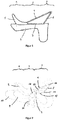
- the saddle tree comprises at least two flat heels, each with an inside for resting on the back of an animal and an outside, the heels protruding from the rear section of the saddle tree through the middle section into the front section, as well as a frame element construction which has at least one rear bridge element , which connects the two traditional costumes in the rear section of the saddle tree, and a front bridge element which connects the two traditional costumes in the front section of the saddle tree.
- the connection of the traditional costumes via the rear bridge element is largely rigid.
- the traditional costumes are thus arranged essentially immovable with respect to one another in the rear section.
- connection of the costumes via the front bridge element is designed to be movable compared to the connection via the rear bridge element, so that the heels in the area of the front section and possibly also the middle section of the saddle tree from a rest position defined with respect to the area of the costumes in the rear section of the saddle tree , are deflectable by bending and / or torsion.
- the rest position corresponds to the position of the heels in the area of the front and / or the middle section of the saddle tree in relation to the position of the heels in the area of the largely rigid rear section when no external forces, for example caused by the movement of the animal, are acting on the heels act.
- the heels are largely flat bodies or have at least one largely flat inside to rest against the animal's back.
- these inner sides can be largely flat or also slightly curved.
- a bending movement of the heels in the front and / or middle section of the saddle tree is understood here to be a movement in which these sections are moved out of the rest position in such a way that a surface normal of the inner sides is essentially tilted backwards or forwards when viewed in the longitudinal direction. The bending movement takes place relative to the immobile areas of the heels in the rear section of the saddle tree, which are rigidly connected to one another by the bridge element.
- a torsional movement is understood to mean a twisting of the heels in the area of the front and possibly at least partially the middle section of the saddle tree from the rest position, in which a surface normal of the inside is tilted to the side in these areas, i.e. is essentially tilted about an imaginary axis defined parallel to the longitudinal direction.
- the twisting of the heels in the front and / or middle section takes place relative to the stationary areas of the heels in the rear section of the saddle tree.
- the saddle tree is essentially symmetrical, whereby this is to be understood in connection with the present invention to the effect that the saddle tree in the ready-to-use state on the riding animal or pack animal is essentially mirror-symmetrical on both sides of a mirror plane imagined in the longitudinal direction and perpendicular through the animal having mutually formed components.
- pack animals are also included, which can carry any load instead of a rider.
- saddle also includes unless otherwise noted general carrying devices for loads.
- the saddle tree, the method for its production and the saddle according to the present invention are particularly suitable for riding animals such as horses and for carrying a rider.
- the heels are particularly in the front section of the saddle tree, i. in the shoulder area of the mount, flexible, so that they go along with movements that are generated by the mount in the area of the bearing surface of the costumes on the mount's back and essentially remain in contact with the mount.
- the largest possible support surface of the traditional costumes on the back of the mount has the advantage that the saddle tree and thus ultimately also the saddle have a more stable seat on the back of the mount and thus slip less easily. Since the movement of the riding animal is particularly pronounced in the shoulder area, it is particularly advantageous that the heels are designed to be flexible in the area of the front section of the saddle tree.
- a heel which is held in the area of the rear section of the saddle tree and to which a force is applied at the opposite free end, i.e. in the area of the front section of the saddle tree, can be deflected by an angle, in particular so that the heel returns to its original shape when the force is removed, preferably without plastic deformation occurring.
- an angle is in the range from 0.5 to 3 °, in particular 0.7 to 2 °, preferably in the range of approximately 1 °.
- a heel which has this type of flexibility can perform the bending and / or torsional movement that is essential for the mode of operation of the saddle tree according to the invention and is perpendicular to the surface of the heel.
- This flexibility is particularly relevant in the area of the front section of the saddle tree.
- the costumes are preferably made in one piece and in particular from a single material, this can Movement or this mobility also run in the middle section of the saddle tree.
- the heel can perform both the movement perpendicular to its surface and the torsional movement.
- the traditional costumes can optionally be made more rigid or largely rigid, since the relative movement of the traditional costumes to one another is less in this area of the back of the mount than in the shoulder area.
- the heels are rigidly connected to one another in this area by the rear bridge element, which leads to increased rigidity in this area.
- the stiffening of the heels in the rear section of the saddle tree can also be done, for example, by inserting a rail made of a stiffer material in the rear area of the heel, for example a rod or a lamella made of a material with a lower flexibility compared to the material of the heels.
- the stiffening in the rear section can also take place in that the layer thickness of the heel is increased in this area.
- the increased rigidity of the heels in the area of the rear section of the saddle tree is generated exclusively by connecting the two heels to the rear bridge element.
- the costumes can in principle be formed from any material that enables the desired type of flexibility.
- the costumes consist of a material which can be formed on the back of the mount and then hardened.
- a material is a chemically crosslinking or a thermoplastic material. If the material is a chemically cross-linking material, this is applied to the back of the mount, in particular during the open time of the material, and then hardens in this position.
- Suitable chemically crosslinking materials are typically two-component compositions based on polyurethane, polyurethane hybrids, silicone, acrylate, epoxy or other resins. Warm-curing or UV-curing compositions on the chemical basis mentioned would also be conceivable.
- the material for the traditional costumes is preferably a thermoplastic material, since this is particularly easy to process and in connection with the one below described method, which is also the subject of the present invention, has significant advantages. Since the traditional costumes are preferably molded on the back of the mount, a thermoplastic material is suitable which can be molded at a temperature at which there is no burns on the back of the mount. Nevertheless, the costumes should remain stable when the riding saddle is used and not deform due to the effects of heat, for example due to the body temperature of the mount, solar radiation or friction.
- a pad is typically or process-related between the mount and the malleable material of the traditional costumes, so that the mount does not come into direct contact with the warm or hot material when molded.
- a thermoplastic material can also be used which has a higher softening point.
- thermoplastic material which can be deformed at temperatures between 40 and 100 ° C., in particular between 50 and 80 ° C., is particularly suitable.
- thermoplastic materials such as are commercially available from Thermoworx at www.thermoworx.com are suitable.
- the traditional costumes are designed in such a way that they essentially rest on the area of the mount's back that is suitable for carrying loads.
- This area looks slightly different for each mount, but usually runs on both sides of the mount's spine from the middle or rear back to the mount's shoulder. In the case of a horse, this area is recognized by a person skilled in the art and referred to as the saddle position.
- the two heels of the saddle tree are connected to one another in the rear section of the saddle tree.
- the connection of the heels should be in the rear section, since this is where the relative movement of the two heels to one another is smallest. So the connection of the traditional costumes can be made largely stiff or rigid there.
- the traditional costumes are connected in the rear section via a rear bridge element.
- This rear bridge element can be connected to the heels in any desired manner, for example glued, screwed, riveted, welded, clamped or materially connected.
- the rear bridge element comprises an area which is formed from, or consists of, an identical material to the heels and is connected to the heels in a materially bonded manner.
- the heels and the rear bridge element are formed from an identical thermoplastic material and are already connected to one another during the first shaping or during or after the hardening of the thermoplastic material, this by heating the surface over which the heels with the rear bridge element to be connected, is softened or liquefied and the items are joined together.
- a joining of the rear bridge element with the heels during the first shaping is also possible if a chemically cross-linking material is used. If the rear bridge element is only to be mounted on the traditional costumes after the first shaping, or if the traditional costume and bridge element are made of different materials, they are typically mechanically connected or glued to one another.
- the rear bridge element can in principle be designed as desired, as long as it fulfills the purpose of connecting the two heels to one another in a largely rigid manner.
- the rear bridge element is preferably designed in such a way that it comprises a seat shell or a device for attaching a seat shell for the rider.
- the rear bridge element is designed as a seat shell.
- the rear bridge element for the additional stiffening and stability of the saddle tree can have additional reinforcement or reinforcement on the inside or on its surface.
- This can typically be a rod or a lamella made of metal or a composite material.
- the saddle tree according to the invention has a frame element construction with a rear and a front bridge element, which each connect the two heels to one another.
- the frame element construction typically comprises one or more frame elements via which the rear bridge element and the front bridge element are connected to one another. Since it is essential for the saddle tree according to the invention, as described above, that the Connection of the costumes via the rear bridge element is largely rigid and the connection of the costumes via the front bridge element is designed to be movable in comparison to the connection via the rear bridge element, the frame elements are designed so that this different mobility of the costumes in the area of the rear and the front bridge element is possible.
- the entire frame element construction is thus constructed in such a way that it connects the two heels to one another in such a way that the described bending and / or torsional movement of the heels is possible in the area of the front and possibly also in the middle section of the saddle tree.
- This movement of the heels is reversible, which means that the heels return to their original position when the force that caused the bending and / or torsional movement ceases.
- the restoring force which pushes the heels back into their original position, can on the one hand be achieved in that the heels are made of an elastically flexible material.
- the restoring force can be supported or exerted passively or actively by the frame element construction. This can also be achieved, for example, through the choice of the material of the frame element construction, the material thickness and the geometry, but is achieved in particular through the use of joints and / or spring elements in the frame construction.
- the frame element construction has at least six frame elements, these being essentially identical in pairs due to the symmetry of the saddle tree.
- the frame elements can be rigid rods or rods made of metal, plastic, wood or a composite material, for example a carbon or glass fiber reinforced plastic.
- the frame elements are preferably metal rods which at least in sections have threads for assembling the saddle tree, or are directly threaded rods made of metal.
- Two first frame elements each run on both sides of the mirror plane from the rear bridge element along the heels to the front section of the saddle tree.
- the first frame elements are connected to each side of the rear bridge element in the rear section of the saddle tree, ie from above onto the Seen in the saddle tree, they are connected to the left and right of or in the left and right area of the rear bridge element. In particular, they run from the rear section of the saddle tree along the heel to the front section of the saddle tree or beyond and are supported on the heels in the front section of the saddle tree.
- the connection of the first frame elements to the rear bridge element takes place in particular mechanically, i.e. the frame elements are e.g. screwed or attached to the bridge element.
- the first frame elements have a thread in the area of the rear section of the saddle tree and are thereby screwed directly into previously made bores in the rear bridge element. It is also possible to embed the first frame elements directly in the material of the rear bridge element when it is formed.
- the first frame elements are preferably connected by attaching short rods to the rear bridge element, which barely protrude from this and each have a ball or a ball socket of a ball joint at the protruding ends, with which the first frame elements then each have a correspondingly fitting one Articulated head are attached.
- threaded sleeves in the rear bridge element during its formation, on which the first frame elements are each connected to the latter via a joint.
- the threaded sleeves for the frame elements can be welded to this reinforcement or mechanically attached to it. This can give the entire saddle tree additional stability and / or be advantageous due to the design.
- the joint via which the first frame element is connected to the rear bridge element is particularly preferably an axial ball joint. This gives the frame elements some play and can be optimally attached to the back of the e.g. Customize mount.
- the first frame elements run in particular along the heels to the front section of the saddle tree or beyond.
- the first frame elements are supported on the traditional costumes. This support should not be rigid, as the heels should absorb the movement on the back of the mount.
- the support takes place via one or more guide elements, for example guide eyes or guide sleeves, which are rigidly attached to the heels and through which the first frame elements run.
- the first frame elements each allow a relative forward and backward movement or the said bending and / or torsional movement of the heels.
- the guide elements can be designed as desired.
- a sleeve made of metal or plastic can preferably be worked into the malleable material directly when the heels are formed, or it can later be fixed to the heel with the same material. This is easily possible if the material is a thermoplastic material, since it softens by renewed and only very local heating and can also be materially connected to a holder for the sleeve.
- the first frame elements can furthermore comprise wings in at least one area, which prevent rotation of the frame elements with respect to the heels.
- the first frame elements are each connected to a second frame element.
- These second frame elements protrude from the surface of the heel and are connected to one another in the area facing away from the heel via a front bridge element.
- the protrusion of the second frame elements is to be understood in such a way that the second frame elements preferably generally point away from the surface of the traditional costumes.
- the two second frame elements are closer to one another in the area of the heels than in the area of the front bridge element.
- the direct line (beeline) between the connection points of the second frame elements with the first frame elements is shorter than the direct line between the connection points of the second frame elements with the front bridge element.
- a third frame element leads back from the front bridge element into the rear bridge element and is connected to it there.
- the connection of the third Frame elements with the rear bridge element can basically be made in the same way as described above for the connection of the first frame elements with the rear bridge element, for example also embedded in the material of the rear bridge element or attached to an optional reinforcement or reinforcement.
- all frame elements are selected and designed in such a way that they can absorb the movements that are generated by the mount in the area of the bearing surface of the traditional costumes on the mount's back.
- the radius of movement of the connection point of the first frame element with the second frame element should typically be greater than the radius of movement of the connection point of the second frame element with the front bridge element.
- the saddle tree picks up the movement of the mount and prevents it from being fully transmitted to the rider.
- the frame elements must interact in such a way that the movement of the heels on the frame elements is suspended.
- the second and third frame elements can be designed in the same way as the first.
- the second frame elements preferably each comprise a spring element or consist of it.
- the two second frame elements represent spring elements.
- gas pressure springs such as those commercially available, are suitable for this.
- connection of the rear bridge element to the first frame element and / or the connection of the first frame element to the second frame element and / or the connection of the second Frame element runs with the front bridge element via joints, in particular via hinge or ball joints or functionally equivalent alternatives.
- connection points of the first frame elements with the rear bridge element, the connection points of the first frame elements with the second frame elements and the connection points of the second frame elements with the front bridge element preferably have joints, in particular ball joints. This increases on the one hand the flexibility of the entire saddle tree when using it, on the other hand the joints facilitate the fixation of the frame element construction to the heels in the manufacturing process described later.
- the rear bridge element, the third frame elements and the front bridge element can be designed in one piece. This can take place, for example, in that these components are made of an identical material, or in that they are designed as described above and are enclosed with a material, for example with a thermoplastic material, as described above.
- a material for example with a thermoplastic material, as described above.
- the two bridge elements and the third frame elements are typically rigidly connected to one another.
- the third frame element preferably in a thermoplastic material, as it is used for the traditional costumes and in particular also as a component of the rear bridge element and if the rear bridge element comprises or consists of a raw shape for a seat, the rear bridge element and the third frame element an optimal raw shape for the seat of the saddle.
- the rear bridge element, the third frame elements and the front bridge element are designed in one piece, this has the advantage that this component of the saddle tree can typically be prefabricated by machine, thereby facilitating the manufacturing process for the saddle tree.
- the rear bridge element, the third frame elements and the front bridge element could be produced in one piece by injection molding. If a material with high strength and good mechanical properties, for example polyamide, is used, the use of the third frame element and the front bridge element made of metal could be dispensed with.
- the prefabricated component should therefore simply have attachment points for the first and second frame elements and for further optional elements and it must be possible to attach the prefabricated component to the traditional costumes in the method described below.
- the saddle tree according to the invention can have further optional features and components.
- the saddle tree comprises mechanical fastening elements for Harness and stirrups, in particular mountings for these.
- the fastening elements are preferably connected directly to the saddle tree and / or to the frame element construction.
- Such fastening elements can be mechanically fastened at various points on the saddle tree, for example screwed, riveted or glued or welded on.
- the mounting of the stirrups is preferably connected to the rear bridge element, since this transfers the force that the rider exerts on the stirrups into the rear section of the riding saddle. As a result, the optimal mobility of the heels is maintained in the area of the front or the middle area of the saddle tree.
- the saddle tree preferably comprises metal rods, which are in particular rigidly connected to the rear bridge element. These can be attached to the rear bridge element in the same way as the first and third frame elements, that is to say typically via threaded sleeves.
- the belt is preferably attached to the third frame element. Most preferably it runs from the third frame element between the traditional costumes and a padding which, when the saddle tree is used, lies between the traditional costumes and the back. This ensures full mobility of the heels in the area of the front and possibly the middle section of the saddle tree.
- the present invention further relates to a saddle, in particular a riding saddle comprising the saddle tree described above.
- such a riding saddle can comprise further elements, as are also used in riding saddles from the prior art and as are known to the person skilled in the art.
- additional elements are a seat for the rider or a device for attaching other loads, padding in the areas that are in contact with the mount and the rider, the described mechanical fastening elements for harness and stirrups and the like as well as a cladding of the Saddle with a cover and finally also decorative elements.
- the seat for the rider is preferably formed as described above in cooperation with the rear bridge element.
- the rear bridge element comprises a seat shell or is designed as a seat shell.
- all of these elements can together form a seat shell.
- This seat shell in particular represents a type of blank or a raw shape in a unitary shape of a seat, which can then be adapted in a special processing step to the shape of the buttocks and the preferred sitting position of the rider. This can be done, for example, by lining and upholstering the seat shell or again by using a malleable material.
- the seat shell is made of a thermoplastic material, it can be heated to adapt to the shape of the rider's buttocks and shaped freely or by molding. It is also possible to apply a second moldable material that can be solidified.
- the blank or the raw shape of the seat shell has several openings or channels which lead from the rear and / or underside of the seat shell, along its surface or in particular through it, to the actual seat surface. These can typically be attached in the raw form by drilling.
- the ideally finished and possibly already partially clothed saddle tree can be fixed to the mount or to a frame and the raw shape of the seat shell can be attached and closed with a film that is loose on the edge of the raw shape and covered towards the seat surface.
- the rider, for whom the riding saddle is made can sit on it and the raw form is filled with a formable and hardenable material from its rear or underside, through the channels or bores.
- This material then adapts to the shape of the buttocks and the preferred seating position of the rider and hardens in this state.
- the materials mentioned above are suitable as formable and hardenable material for this process step.
- a one- or two-component polyurethane foam is particularly suitable.
- the seat shell adapted to the rider can then be upholstered, covered and / or covered.
- the riding saddle is typically upholstered in the areas where the riding saddle rests on the riding animal, i.e. especially in the area of the traditional costumes, and is carried out in particular by means of textile, fleece or felt-like materials, foams, wool or animal skins.
- the method according to the invention is very simple compared to other methods which are known from the prior art for the production of tailor-made saddle trees and riding saddles, and yet a very high accuracy of fit of the saddle is guaranteed.
- the pads that are used in the process are preferably made of felt, typically wool felt, or another material with comparable properties such as a fleece or foam-like material, in particular a synthetic fleece, foam rubber such as neoprene or sponge rubber.
- the layers, in particular the first layer are dimensioned in terms of their layer thickness so that the heels, which are formed by the introduction and curing of the malleable material, have a thickness that is necessary for the intended use in the saddle tree of a riding saddle. The strength of the documents therefore also depends on which mechanical properties of the malleable material in the cured state.
- the layer thickness of the substrates, in particular the first substrate is typically in the range from 2 to 20 mm, in particular 4 to 15 mm, preferably 6 to 10 mm.
- the two pads are formed from the same material as this is easier to handle.
- the areas from the first documents are cut out along the outlines of the traditional costumes, for example with a cutter, scissors or the like.
- the areas along the outlines of the traditional costumes can also be cut out when the two bases have already been connected to one another. You just have to make sure that only the first document is cut and not both. This can be done, for example, by adjusting the blade length of a cutter.
- connection of the first to the second base takes place, for example, by gluing, sewing, by means of a Velcro fastener or the like.
- the pads can also serve as padding for the traditional costumes and thus preferably remain as part of the saddle after the production of the traditional costumes. For this they can be cut into any shape, typically that they completely enclose the heels.
- an additional layer of padding can be inserted between the second pad and the back of the mount, which in particular corresponds to the strength and flexibility of the padding used later and compressed by the weight of the rider or another load . This ensures that the traditional costumes fit the mount's back as precisely as possible.
- the moldable material is pressed into the supports, for example, with a blanket, which is placed directly on the mount, where the saddle will later be located, over the supports with the moldable material and is typically stretched around the belly of the mount.
- the blanket can be provided with suitable cords or ribbons.
- a device specially manufactured for this purpose which comprises slats, typically wooden slats, which are attached to one another along the back of the mount with some clearance.
- the slats are attached to each other with straps, for example, and form a kind of slatted frame. Straps or straps are attached to the outside slats, with which the construction can be attached around the belly of the mount, similar to a saddle.
- a type of cushion is inserted between this construction and the underlay with the malleable material for making the traditional costumes, which can be filled with air, a liquid or the like on site.
- An air cushion that can be inflated is preferably used.
- the fixing of the two heels formed from the solidified material in a stable position to one another on the back of the mount is typically done by attaching the rear and / or the front bridge element.
- a temporary fixation is also conceivable, which is removed again when the saddle tree is further processed.
- the entire frame element construction is prefabricated and as such is connected directly to the two traditional costumes on the back of the mount.
- the connection can be made mechanically, for example by gluing or welding.
- Suitable connection points are on the rear bridge element and also on the guide elements.
- the guide elements are already attached around the first frame elements and are thus available as connection points Available. If the malleable material from which the heels are formed is the material of the rear bridge element and the material which contains the guide elements is a thermoplastic material, the prefabricated rear bridge element with the frame element construction can be attached simply by heating the surfaces of the thermoplastic material at the joining points and immediately attached to the costumes.
- the individual components of the saddle tree, starting materials or prefabricated components are provided as a type of kit (kit of parts) and then on the animal in a method as described above, in particular by a person trained for this , adjusted and put together.
- Such a kit includes in particular a copying element, i.e. preferably a transparent and flexible film, the material for the documents, for example two layers of a felt material, malleable material, for example in the form of granules of a thermoplastic material, the individual parts for or an already prefabricated frame element construction, preferably comprising a seat shell or a corresponding raw form thereof, as well as further optional components that are required for the completion of the saddle tree or the saddle, for example upholstery, belts, stirrups, lining material, etc.
- a copying element i.e. preferably a transparent and flexible film
- the material for the documents for example two layers of a felt material, malleable material, for example in the form of granules of a thermoplastic material
- the individual parts for or an already prefabricated frame element construction, preferably comprising a seat shell or a corresponding raw form thereof, as well as further optional components that are required for the completion of the saddle tree or the saddle, for example upholstery, belts, stirr
- an already prefabricated frame element construction is provided, which is then connected to the traditional costumes in a subsequent step in the method described.
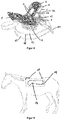
- this frame element construction comprises a rear and a front bridge element as well as frame elements that connect the two bridge elements to one another, i.e. typically two third frame elements that rigidly connect the rear bridge element to the front bridge element, and the two first frame elements that each connect to the rear bridge element and are each connected to a second frame element and the second frame elements are then each also connected to the front bridge element.
- the first and second frame elements are designed in such a way that that they allow the mobility of the heels described above when using the saddle.
- the second frame elements each comprise a spring element, preferably a gas pressure spring, and at least the connection of the first frame elements to the second frame elements and the connection of the second frame elements to the front bridge element are made via joints.
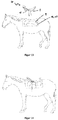
- a prefabricated frame element construction is shown for example in FIG Figure 12 and in Figure 15 .
Landscapes
- Engineering & Computer Science (AREA)
- Mechanical Engineering (AREA)
- Eyeglasses (AREA)
- Catching Or Destruction (AREA)
- Orthopedics, Nursing, And Contraception (AREA)
Priority Applications (4)
| Application Number | Priority Date | Filing Date | Title |
|---|---|---|---|
| EP19020293.7A EP3725736A1 (fr) | 2019-04-16 | 2019-04-16 | Selle pour animaux de selle et de somme et son procédé de fabrication |
| PCT/EP2020/025171 WO2020211980A2 (fr) | 2019-04-16 | 2020-04-16 | Selle destinée à des animaux de monture et de somme et son procédé de fabrication |
| EP20729942.1A EP3956257A2 (fr) | 2019-04-16 | 2020-04-16 | Selle destinée à des animaux de monture et de somme et son procédé de fabrication |
| US17/604,566 US20220194779A1 (en) | 2019-04-16 | 2020-04-16 | Saddle for riding and pack animals and method for producing same |
Applications Claiming Priority (1)
| Application Number | Priority Date | Filing Date | Title |
|---|---|---|---|
| EP19020293.7A EP3725736A1 (fr) | 2019-04-16 | 2019-04-16 | Selle pour animaux de selle et de somme et son procédé de fabrication |
Publications (1)
| Publication Number | Publication Date |
|---|---|
| EP3725736A1 true EP3725736A1 (fr) | 2020-10-21 |
Family
ID=66334140
Family Applications (2)
| Application Number | Title | Priority Date | Filing Date |
|---|---|---|---|
| EP19020293.7A Withdrawn EP3725736A1 (fr) | 2019-04-16 | 2019-04-16 | Selle pour animaux de selle et de somme et son procédé de fabrication |
| EP20729942.1A Pending EP3956257A2 (fr) | 2019-04-16 | 2020-04-16 | Selle destinée à des animaux de monture et de somme et son procédé de fabrication |
Family Applications After (1)
| Application Number | Title | Priority Date | Filing Date |
|---|---|---|---|
| EP20729942.1A Pending EP3956257A2 (fr) | 2019-04-16 | 2020-04-16 | Selle destinée à des animaux de monture et de somme et son procédé de fabrication |
Country Status (3)
| Country | Link |
|---|---|
| US (1) | US20220194779A1 (fr) |
| EP (2) | EP3725736A1 (fr) |
| WO (1) | WO2020211980A2 (fr) |
Families Citing this family (3)
| Publication number | Priority date | Publication date | Assignee | Title |
|---|---|---|---|---|
| DE102021106054A1 (de) | 2021-03-12 | 2022-09-15 | Theo Sommer GmbH | Sattelbaum für einen Reitsattel und Sattel mit dem Sattelbaum |
| GB202206249D0 (en) * | 2022-04-28 | 2022-06-15 | Kempsell David | Saddles |
| US20240116748A1 (en) * | 2022-10-07 | 2024-04-11 | Mark Thompson | Combination Modular Riding and Pack Saddle and Methods for Manufacturing the Same |
Citations (3)
| Publication number | Priority date | Publication date | Assignee | Title |
|---|---|---|---|---|
| US544602A (en) * | 1895-08-13 | Alphonso de thierry | ||
| US1155465A (en) * | 1915-03-16 | 1915-10-05 | Frederick C Beal | Saddle. |
| WO2014145911A1 (fr) * | 2013-03-15 | 2014-09-18 | Edmund Coffin | Arçon de selle à flexion contrôlée |
Family Cites Families (14)
| Publication number | Priority date | Publication date | Assignee | Title |
|---|---|---|---|---|
| US148379A (en) * | 1874-03-10 | Improvement in saddles | ||
| US155897A (en) * | 1874-10-13 | Improvement in spring saddle-seats | ||
| US568939A (en) * | 1896-10-06 | Riding-saddle | ||
| US2229A (en) * | 1841-08-28 | Thomas mysfcrdogkj | ||
| US77849A (en) * | 1868-05-12 | Robert j | ||
| US288026A (en) * | 1883-11-06 | Saddle | ||
| US53854A (en) * | 1866-04-10 | Improved spring-saddle | ||
| US8454A (en) * | 1851-10-21 | Improvement in saddles | ||
| US827506A (en) * | 1905-09-26 | 1906-07-31 | George C Cox | Saddle. |
| US854086A (en) * | 1906-06-08 | 1907-05-21 | John H Gillespie | Saddle. |
| US1301838A (en) * | 1918-12-10 | 1919-04-29 | Jesus Sanchez Guerrero | Riding-saddle. |
| DE19964290C2 (de) * | 1999-11-24 | 2003-03-20 | Jochen Hennig | Sattelbaum mit elastischen Längsfedern |
| DE202010010215U1 (de) * | 2010-07-13 | 2011-11-09 | Hkm Sports Equipment Gmbh | Reitsattel mit veränderlicher Kopfweite |
| US10829363B2 (en) * | 2016-04-07 | 2020-11-10 | Edmund Coffin | Controlled flex through the use of stopples |
-
2019
- 2019-04-16 EP EP19020293.7A patent/EP3725736A1/fr not_active Withdrawn
-
2020
- 2020-04-16 WO PCT/EP2020/025171 patent/WO2020211980A2/fr not_active Ceased
- 2020-04-16 EP EP20729942.1A patent/EP3956257A2/fr active Pending
- 2020-04-16 US US17/604,566 patent/US20220194779A1/en active Pending
Patent Citations (3)
| Publication number | Priority date | Publication date | Assignee | Title |
|---|---|---|---|---|
| US544602A (en) * | 1895-08-13 | Alphonso de thierry | ||
| US1155465A (en) * | 1915-03-16 | 1915-10-05 | Frederick C Beal | Saddle. |
| WO2014145911A1 (fr) * | 2013-03-15 | 2014-09-18 | Edmund Coffin | Arçon de selle à flexion contrôlée |
Also Published As
| Publication number | Publication date |
|---|---|
| WO2020211980A2 (fr) | 2020-10-22 |
| US20220194779A1 (en) | 2022-06-23 |
| WO2020211980A3 (fr) | 2020-12-10 |
| EP3956257A2 (fr) | 2022-02-23 |
Similar Documents
| Publication | Publication Date | Title |
|---|---|---|
| DE60103159T2 (de) | Kunststoffsattel für ein fahrrad und dessen herstellung | |
| DE60209403T2 (de) | Fahrradkurbel und ihre Fertigungsmethode | |
| DE60220026T2 (de) | Verstellbarer sattel | |
| DE60209962T2 (de) | Fahrrad-Kurbel und ihre Fertigungsmethode | |
| DE102012103250B4 (de) | Vorrichtung für eine Sitzauflage eines Reit- oder Transporttieres | |
| EP3956257A2 (fr) | Selle destinée à des animaux de monture et de somme et son procédé de fabrication | |
| DE3836312A1 (de) | Sitzkissen mit aufhaengung, insbesondere fuer fahrzeugsitze, und verfahren zu seiner herstellung | |
| DE102010009867B4 (de) | Vorrichtung zum Verteilen von Lastkräften, insbesondere Tracht für einen Sattel, sowie Sattel für ein Reittier mit einer solchen Vorrichtung | |
| WO2011000017A1 (fr) | Élément de protection | |
| EP3450287A1 (fr) | Selle de bicyclette | |
| DE2035489A1 (de) | Sitzaufbau und Verfahren zu seiner Her stellung | |
| EP1321429B1 (fr) | Selle pour équitation | |
| DE102012106008A1 (de) | Vorrichtung für eine Sitzauflage eines Reit- oder Transporttieres | |
| EP1752414B1 (fr) | Tapis de selle avec un dispositif à ressort à lame pour la stabilisation et la répartition de pression | |
| DE102012025754A1 (de) | Vorrichtung für eine Sitzauflage eines Reit- oder Transporttieres | |
| DE102018211090A1 (de) | Fahrradsattel sowie Verfahren zur Herstellung eines Polsterelements für einen Fahrradsattel | |
| DE102018116872A1 (de) | Orthese mit zumindest einem schalenartigen Stützteil | |
| EP2566419B1 (fr) | Orthèse | |
| WO2001027024A1 (fr) | Selle d'equitation | |
| DE10102345C1 (de) | Deckelement und Modulsystem zur Herstellung von Schuheinlagen | |
| DE10133751A1 (de) | Formstabile, druckausgleichende Zwischenlage und Verfahren zu ihrer Herstellung | |
| DE102018120767A1 (de) | Reitsattel mit verstellbarem Sattelbaum | |
| DE1760648C3 (de) | Sattelbaum | |
| DE102022113762A1 (de) | Hufschuh, verfahren zur herstellung eines hufschuhs und verwendung eines hufschuhs | |
| EP4193971A2 (fr) | Procédé de fabrication d'une orthèse et orthèse |
Legal Events
| Date | Code | Title | Description |
|---|---|---|---|
| PUAI | Public reference made under article 153(3) epc to a published international application that has entered the european phase |
Free format text: ORIGINAL CODE: 0009012 |
|
| AK | Designated contracting states |
Kind code of ref document: A1 Designated state(s): AL AT BE BG CH CY CZ DE DK EE ES FI FR GB GR HR HU IE IS IT LI LT LU LV MC MK MT NL NO PL PT RO RS SE SI SK SM TR |
|
| AX | Request for extension of the european patent |
Extension state: BA ME |
|
| STAA | Information on the status of an ep patent application or granted ep patent |
Free format text: STATUS: THE APPLICATION HAS BEEN WITHDRAWN |
|
| 18W | Application withdrawn |
Effective date: 20201015 |