EP3726253A1 - Estimations d'emplacement améliorées par vidéo - Google Patents
Estimations d'emplacement améliorées par vidéo Download PDFInfo
- Publication number
- EP3726253A1 EP3726253A1 EP19169939.6A EP19169939A EP3726253A1 EP 3726253 A1 EP3726253 A1 EP 3726253A1 EP 19169939 A EP19169939 A EP 19169939A EP 3726253 A1 EP3726253 A1 EP 3726253A1
- Authority
- EP
- European Patent Office
- Prior art keywords
- location estimates
- location
- instance
- pieces
- optical information
- Prior art date
- Legal status (The legal status is an assumption and is not a legal conclusion. Google has not performed a legal analysis and makes no representation as to the accuracy of the status listed.)
- Pending
Links
Images




Classifications
-
- G—PHYSICS
- G01—MEASURING; TESTING
- G01S—RADIO DIRECTION-FINDING; RADIO NAVIGATION; DETERMINING DISTANCE OR VELOCITY BY USE OF RADIO WAVES; LOCATING OR PRESENCE-DETECTING BY USE OF THE REFLECTION OR RERADIATION OF RADIO WAVES; ANALOGOUS ARRANGEMENTS USING OTHER WAVES
- G01S5/00—Position-fixing by co-ordinating two or more direction or position line determinations; Position-fixing by co-ordinating two or more distance determinations
- G01S5/16—Position-fixing by co-ordinating two or more direction or position line determinations; Position-fixing by co-ordinating two or more distance determinations using electromagnetic waves other than radio waves
-
- G—PHYSICS
- G01—MEASURING; TESTING
- G01S—RADIO DIRECTION-FINDING; RADIO NAVIGATION; DETERMINING DISTANCE OR VELOCITY BY USE OF RADIO WAVES; LOCATING OR PRESENCE-DETECTING BY USE OF THE REFLECTION OR RERADIATION OF RADIO WAVES; ANALOGOUS ARRANGEMENTS USING OTHER WAVES
- G01S19/00—Satellite radio beacon positioning systems; Determining position, velocity or attitude using signals transmitted by such systems
- G01S19/38—Determining a navigation solution using signals transmitted by a satellite radio beacon positioning system
- G01S19/39—Determining a navigation solution using signals transmitted by a satellite radio beacon positioning system the satellite radio beacon positioning system transmitting time-stamped messages, e.g. GPS [Global Positioning System], GLONASS [Global Orbiting Navigation Satellite System] or GALILEO
- G01S19/42—Determining position
- G01S19/48—Determining position by combining or switching between position solutions derived from the satellite radio beacon positioning system and position solutions derived from a further system
-
- G—PHYSICS
- G01—MEASURING; TESTING
- G01S—RADIO DIRECTION-FINDING; RADIO NAVIGATION; DETERMINING DISTANCE OR VELOCITY BY USE OF RADIO WAVES; LOCATING OR PRESENCE-DETECTING BY USE OF THE REFLECTION OR RERADIATION OF RADIO WAVES; ANALOGOUS ARRANGEMENTS USING OTHER WAVES
- G01S5/00—Position-fixing by co-ordinating two or more direction or position line determinations; Position-fixing by co-ordinating two or more distance determinations
- G01S5/02—Position-fixing by co-ordinating two or more direction or position line determinations; Position-fixing by co-ordinating two or more distance determinations using radio waves
-
- G—PHYSICS
- G01—MEASURING; TESTING
- G01S—RADIO DIRECTION-FINDING; RADIO NAVIGATION; DETERMINING DISTANCE OR VELOCITY BY USE OF RADIO WAVES; LOCATING OR PRESENCE-DETECTING BY USE OF THE REFLECTION OR RERADIATION OF RADIO WAVES; ANALOGOUS ARRANGEMENTS USING OTHER WAVES
- G01S2205/00—Position-fixing by co-ordinating two or more direction or position line determinations; Position-fixing by co-ordinating two or more distance determinations
- G01S2205/01—Position-fixing by co-ordinating two or more direction or position line determinations; Position-fixing by co-ordinating two or more distance determinations specially adapted for specific applications
Definitions
- the following disclosure relates to the field of indoor positioning, or more particularly relates to systems, apparatuses, and methods for determining a location estimate at least partially based on optical information.
- the solution needs to be based on an existing infrastructure in the buildings and on existing capabilities in the consumer devices.
- WiFi- and/or Bluetooth (BT)-technologies that are already supported in almost every smartphone, tablet, laptop and even in the majority of the feature phones. It is, thus, required to find a solution that uses the WiFi- and BT-radio signals in such a way that makes it possible to achieve 2-3 m horizontal positioning accuracy, close to 100 % floor detection with the ability to quickly build the global coverage for this approach.
- a novel approach for radio-based indoor positioning that models e.g. the WiFi-radio environment (or any similar radio e.g. Bluetooth) from observed received signal strength (RSS-) measurements as two-dimensional radio maps is hereby able to capture the dynamics of the indoor radio propagation environment in a compressable and highly accurate way. This makes it possible to achieve unprecedented horizontal positioning accuracy with the WiFi-signals only within the coverage of the created radio maps and also gives highly reliable floor detection.
- RSS- received signal strength
- WiFi-measurements data could be harvested via crowd-sourcing if the consumer devices were equipped with the necessary functionality to enable the WiFi-data collection, e.g. as a background process, naturally with the end-user consent. It could also be possible to use volunteers to survey the sites (e.g. buildings) in exchange of reward or recognition and get the coverage climbing up globally in the places and venues important for the key customers.
- the technical challenges related to the harvesting, processing, redundancy, ambiguity and storing of the crowd-sourced data need to be understood and solved first, before the WiFi radio map creation can be based on the fully crowd-sourced data.
- geo-references for probe data can easily be obtained outdoors, e.g. from GNSS (Global Navigation Satellite System)
- GNSS Global Navigation Satellite System
- geo-references are needed for crowd-sourcing of radio data to support global indoor/outdoor radio-based positioning.
- GNSS Global Navigation Satellite System
- sensor-based solutions quickly diverge in the absence of GNSS fixes. Therefore, any additional source(s) of location information from indoors is of great use.
- an object of the invention to provide a solution for enabling more accurate location estimates, in particular in indoor scenarios.
- a method comprising:
- This method may for instance be performed and/or controlled by an apparatus, for instance a server.
- this method may be performed and/or controlled by more than one apparatus, for instance a server cloud comprising at least two servers.
- the method may be performed and/or controlled by using at least one processor of the server, or server cloud.
- a method comprising:
- This method may for instance be performed and/or controlled by a mobile device.
- a method comprising:
- This method may for instance be performed and/or controlled by a video-enabled apparatus, e.g. a server coupled to (e.g. connected to) at least one, or a plurality of optical sensor(s) (e.g. video camera(s)), which are configured to gather one or more pieces of optical information.
- a video-enabled apparatus e.g. a server coupled to (e.g. connected to) at least one, or a plurality of optical sensor(s) (e.g. video camera(s)), which are configured to gather one or more pieces of optical information.
- this method may for instance be performed and/or controlled by a video surveillance system.
- a computer program when executed by a processor causing an apparatus, for instance a server, a mobile device, or a video-enabled apparatus, to perform and/or control the steps or actions of the respective method according to the first, second, or third exemplary aspect of the present invention.
- an apparatus for instance a server, a mobile device, or a video-enabled apparatus
- the respective computer program may be stored on computer-readable storage medium, in particular a tangible and/or non-transitory medium.
- the computer readable storage medium could for example be a disk or a memory or the like.
- the computer program could be stored in the computer readable storage medium in the form of instructions encoding the computer-readable storage medium.
- the computer readable storage medium may be intended for taking part in the operation of a device, like an internal or external memory, for instance a Read-Only Memory (ROM) or hard disk of a computer, or be intended for distribution of the program, like an optical disc.
- ROM Read-Only Memory
- an apparatus configured to perform and/or control or comprising respective means for performing and/or controlling the respective method according to the first, second, or third exemplary aspect of the present invention.
- the means of the respective apparatus can be implemented in hardware and/or software. They may comprise for instance at least one processor for executing computer program code for performing the required functions, at least one memory storing the program code, or both. Alternatively, they could comprise for instance circuitry that is designed to implement the required functions, for instance implemented in a chipset or a chip, like an integrated circuit. In general, the means may comprise for instance one or more processing means or processors.
- an apparatus comprising at least one processor and at least one memory including computer program code, the at least one memory and the computer program code configured to, with the at least one processor, cause an apparatus, for instance the apparatus, at least to perform and/or to control the respective method according to the first, second, or third exemplary aspect of the present invention.
- the above-disclosed apparatus may be a module or a component for a device, for example a chip.
- the disclosed apparatus according to any aspect of the invention may be a device, for instance a server or server cloud, a mobile device, or a video-enabled apparatus.
- the disclosed apparatus according to any aspect of the invention may comprise only the disclosed components, for instance means, processor, memory, or may further comprise one or more additional components.
- a system comprising: at least one apparatus as disclosed above and configured to perform and/or control the method according to the first exemplary aspect of the present invention; one or more mobile devices as disclosed above configured to perform and/or control the method according to the second exemplary aspect of the present invention and configured to provide one or more first location estimates to the at least one apparatus; and at least one video-enabled apparatus as disclosed above configured to perform and/or control the method according to the third exemplary aspect of the present invention and configured to provide one or more pieces of optical information, and/or one or more second location estimates to the at least one apparatus.
- the one or more first location estimates may for instance be obtained, e.g. by receiving the one or more first location estimates, e.g. from one or more mobile devices.
- the one or more mobile devices may for instance have determined the respective one or more first location estimates, and then provide (e.g. output, or send) them.
- the respective one or more mobile devices may for instance store the one or more first location estimates in a database.
- the one or more first location estimates may for instance be obtained, e.g. by retrieving the one or more first location estimates from the database.
- Each respective first location estimate of the one or more first location estimates is indicative of at least one first position (e.g. of a respective mobile device), which is determined (e.g. estimated) by the respective mobile device.
- a respective first location estimate may for instance be determined by the respective mobile device at least partially based on various types of location data: e.g. GNSS information, accelerometer information, gyroscope information, magnetometer information, barometer information, WiFi/BLE information, radio map(s), or a combination thereof.
- location data may for instance be utilized to determine a respective first location estimate.
- Such a first location estimate may for instance be associated with an uncertainty value.
- the method according to the first exemplary aspect in particular enables to refine the first position represented by a respective first location estimate.
- the mobile device may for instance be portable (e.g. weigh less than 5, 4, 3, 2, or 1 kg).
- the mobile device may for instance comprise or be connectable to a display for displaying information, e.g. a route that is guided/navigated to a user, to name but one non-limiting example.
- the mobile device may for instance comprise or be connectable to means for outputting sound, e.g. in the form of spoken commands or information.
- the mobile device may for instance comprise or be connectable to one or more sensors for determining the devices position, such as for instance a GNSS receiver, in the form of a GPS receiver.
- the mobile device may for instance comprise or be connectable to one or more sensors, e.g.
- the mobile device may for instance comprise or be connectable to a receiver and/or a transmitter (e.g. a transceiver) for receiving and/or sending information.
- the mobile device may for instance be comprised by or be a part of a vehicle (e.g. car, bicycle, scooter, motorbike, e-bike, truck, or the like, to name but a few non-limiting examples).
- a mobile device may for instance be represented by circuitry that is designed to implement the required functions, for instance implemented in a chipset or a chip, like an integrated circuit.
- Such circuitry may for instance be comprised by or be a part of the vehicle.
- the area may for instance be a public area equipped with one or more optical sensors, such as a shopping mall, airport, parking area, and/or office.
- the method according to all exemplary aspects of the present invention may for instance enable a probe collection in such challenging environments, e.g. as parking halls.
- the one or more pieces of optical information may for instance be obtained, e.g. by receiving the one or more pieces of optical information, e.g. from the video-enabled apparatus.
- a video-enabled apparatus may for instance be, comprise, or be a part of a video surveillance system, to name but one non-limiting example.
- the video-enabled apparatus may for instance be connectable to one or more optical sensors (e.g. (video) cameras), which may for instance be configured to gather the one or more pieces of optical information.
- the one or more pieces of optical information may for instance represent a video, e.g. of the area. In such a video of the area, it is possible e.g. to track one or more objects located within the area.
- the area represented by the one or more pieces of optical information may for instance be determinable at which (e.g. exact) location an object represented by the one or more pieces of optical information is located.
- the one or more second location estimates may for instance be determined.
- a respective second location estimate may for instance represent a (second) position of an object that is represented by the one or more pieces of optical information.
- the object may for instance be located within the area.
- the object may for instance carry or be associated with a mobile device.
- a(n) e.g. exact
- the one or more second location estimates may for instance be determined by the apparatus (e.g. a server) performing and/or controlling the method according to the first exemplary aspect of the present invention. Additionally or alternatively, the one or more second location estimates may for instance be determined by the video-enabled apparatus (or the video surveillance system) that gathered the one or more pieces of optical information. In this case, the video-enabled apparatus (or the video surveillance system) may for instance provide the one or more second location estimates so that the one or more second location estimates are obtained, e.g. by receiving the one or more second location estimates, e.g. from the video-enabled apparatus (or the video surveillance system).
- the object may for instance be a human or a non-human-object
- the object may for instance be represented by one or more attributes. More details on such one or more attributes of a respective object are disclosed in the following part of this specification.
- At least one first position of the one or more first location estimates relatively matches at least one second position of the one or more second location estimates.
- a respective result of the determining may for instance be comprised by or represented by the matching information.
- the term "relatively” as used herein may be understood that a first position is as close to a second position as is defined to consider that the first position and the second position can represent the same mobile device of the first location estimate and be assumed to be e.g. carried by a respective object. Further, the term “relatively” as used herein may be understood that a first position is as close to a second position as is pre-defined or defined according to pre-defined rules by a threshold value or function.
- first positions of the one or more first location estimates can be considered to represent one or more second positions of the one or more second location estimates.
- the one or more first positions of the one or more first location estimates may for instance be determined by respective one or more mobile devices, while the one or more second positions of the one or more second location estimates may for instance be determined at least partially based on the one or more pieces of optical information.
- a plurality (e.g. at least two) of first positions comprised by or represented by the one or more first location estimates may for instance represent positions of the same mobile device.
- the respective first location estimates were for instance determined at different times (prior to their obtaining).
- the respective first location estimates may for instance represent a path or track, along which the respective mobile device has moved.
- the same may for instance apply to a plurality (e.g. at least two) of second positions comprised by or represented by the one or more second location estimates, which may for instance represent positions of the same object.
- a respective second position that may for instance be derived from the one or more pieces of optical information may for instance be more accurate than a respective first position of the respective first location estimate of the one or more location estimates, such a respective second position may for instance be used to refine the first location estimate. In this way, a more accurate position represented by the third location estimate of a respective mobile device can be determined.
- a respective location estimate (e.g. a first, a second and/or a third location estimate) may for instance be indicative of latitude-, longitude coordinates, or x-, and y-coordinates.
- a respective location estimate may for instance be indicative of an altitude value (e.g. absolute or relative altitude value), a floor level (e.g. of a venue, e.g. comprising the area), an uncertainty value, or a combination thereof.
- a respective location estimate may for instance represent a position within the (e.g. surveyed) area.
- the video-enabled apparatus may for instance track one or more objects (e.g. human (e.g. person) and/or non-human object (e.g. a vehicle, to name but one non-limiting example)) within the area (e.g. a given area within a venue, e.g. a building and/or adjacent areas, to name but a few non-limiting examples). Further, such a tracking may for instance be performed and/or controlled by the server of the first exemplary aspect of the present invention (e.g. at least partially based on the one or more pieces of optical information). Thus, target tracking in a recorded or captured video, e.g. represented by the one or more pieces of optical information, may for instance be performed and/or controlled.
- objects e.g. human (e.g. person) and/or non-human object (e.g. a vehicle, to name but one non-limiting example)
- the area e.g. a given area within a venue, e.g. a building and/or adjacent areas
- Such a tracking may for instance be performed and/or controlled in real-time, or near real-time, e.g. at least partially based on a video stream input represented by the one or more pieces of optical information.
- the solution according to all exemplary aspects of the present invention may for instance enable to track multiple (e.g. at least two) objects, e.g. at the same time.
- One or more mobile devices may for instance have determined the one or more first location estimates, e.g. according to the method of the second exemplary aspect of the present invention.
- the one or more mobile devices may for instance be in the vicinity of the area, e.g. a given buildings, and possibly carried by the objects being tracked by the video-enabled apparatus, and gather (e.g. collect) various types of location data: GNSS, accelerometer, gyroscope, magnetometer, barometer, WiFi/BLE, UWB (Ultra Wide Band), map, etc.
- Mobile devices may for instance further estimate their location based on so-called sensor fusion: GNSS + sensor + WiFi/BLE + (radio) map (e.g. depending on whichever is available at the respective mobile device).
- a respective mobile device may have several tracks or paths e.g. comprising or containing a set of locations (latitude/longitude/altitude/floor level/uncertainty value, or a combination thereof), and optionally corresponding timestamp information.
- Such estimated tracks or path of a respective mobile device may for instance be utilized by a server performing and/or controlling the method according to the first exemplary aspect of the present invention.
- the one or more third location estimates are determined at least partially based on the matching information.
- the matching information may for instance comprise or represent a result of the determining whether or not at least one first position relatively matches at least one second position.
- the one or more third location estimates may for instance be determined at least partially based on the at least one second location estimate that relatively matches at least one first location estimate, wherein a respective first position of the at least one first location estimate that was determined to relatively match a respective second position of at least one second location estimate may for instance be refined at least partially based on the at least one second location estimate.
- the one or more third location estimates may for instance be determined based on all of the one or more first and second location estimates.
- all the one or more first and second location estimates are used to determine the one or more third location estimates.
- the one or more third location estimates may for instance be determined based on all of the one or more first and second location estimates.
- the method further comprises:
- a respective third location estimate of the one or more third location estimates may for instance be utilized by various further purposes, e.g. by one or more third parties.
- a respective third location estimate may be used by a location-based service, for geo-referencing of crowd-sourced radio data, or the like, to name but one few non-limiting example.
- the respective third location estimate may for instance be output (e.g. send) to a server or server cloud, e.g. of the respective third party.
- a respective third location estimate of the one or more third location estimates may for instance be output, e.g. by sending or transmitting the respective third location estimate.
- the respective third location estimate may for instance be output to one or more other entities, e.g. one or more servers of third parties, e.g. providing location-based services, to name but one non-limiting example.
- the respective third location estimate that is output may for instance be utilized for various purposes, e.g. to geo-reference the probe data, or geo-reference radio data in particular.
- a respective third location estimate of the one or more third location estimates comprises or represents an improved or enhanced position of the respective mobile device.
- At least two first positions and/or at least two second positions of at least two first and/or second location estimates represent a path respectively track of a respective mobile device and/or object
- the path and/or track may for instance represent a way or route along which the respective mobile device and/or object has moved.
- the solution according to all exemplary aspects of the present invention may for instance enable to determine (e.g. record or capture, and/or analyze) one or more attributes or features of one or more objects represented by the one or more pieces of optical information (e.g. such as size, shape, color, motion (e.g. path or track) of the respective object. This may for instance enable to combine multiple location estimates and/or tracks of the same object together.
- one or more attributes or features of one or more objects represented by the one or more pieces of optical information e.g. such as size, shape, color, motion (e.g. path or track) of the respective object.
- Such a track or path of an object (additionally of alternatively tracks or paths of multiple objects) represented by the one or more second location estimates (e.g. derived from a video-enabled apparatus according to the third exemplary aspect of the present invention) and a track or path of a mobile device (additionally of alternatively tracks or paths of multiple mobile devices) may for instance be compared. If a track or path from the video-enabled apparatus at least partially matches a track or path derived from a mobile device, e.g. spatially and temporally, it may for instance be concluded that the two tracks or paths represent a trajectory of the same object.
- one or more paths or tracks may for instance be combined into one or more groups, wherein such a group may for instance correspond to the respective (e.g. same) object, e.g. determined at least partially based on an image/object recognition.
- the respective group may for instance be considered when determining whether or not at least one first position relatively matches at least one second position.
- a comparison may for instance be performed and/or controlled at least partially based on one or more distances between (e.g. time-matched) positions from two paths or tracks.
- One path or track may for instance be represented by one or more first positions, and another path or track may for instance be represented by one or more second positions.
- Positions from such two paths or tracks at a time t may for instance be considered to match if one or more respective distances between them are smaller than a pre-defined threshold value, to name but one non-limiting example.
- a pre-defined threshold value to name but one non-limiting example.
- only positions with an uncertainty value e.g. associated with the respective first and/or second location estimate
- the paths or tracks may for instance be considered to correspond to the same object respectively mobile device.
- the path respectively track of a respective object is determined based on one or more attributes of the respective object represented by the one or more pieces of optical information.
- a respective piece of the one or more pieces of optical information may for instance represent one or more attributes indicative of a size, a shape, a color, and/or a motion mode of a respective object in case one or more non-human objects are comprised or represented by the one or more pieces of optical information.
- a respective piece of the one or more pieces of optical information may for instance represent one or more attributes indicative of a height, a color of clothes, and/or a motion mode of a respective object in case of one or more human objects being comprised or represented by the one or more pieces of optical information.
- a tracking of one or more positions of a respective object is enabled. The tracking may for instance be performed and/or controlled at least partially based on at least one respective piece of the one or more pieces of optical information.
- a respective first location estimate of the one or more first location estimates and/or a respective second location estimate of the one or more second location estimates is associated with or comprises a first and/or second timestamp information indicative of a time and/or date at which the respective first location estimate of the one or more first location estimates and/or a respective second location estimate of the one or more second location estimates was gathered.
- the gathering of a respective first location estimate of the one or more first location estimates and/or a respective second location estimate of the one or more second location estimates may for instance have taken place prior to the obtaining of the respective first and/or second location estimates.
- a respective first location estimate of the one or more first location estimates and/or a respective second location estimate of the one or more second location estimates may for instance comprise or be associated with a first and/or a second timestamp information.
- the one or more third location estimates are determined in case (e.g. only if) the at least one first position of the one or more first location estimates relatively matches at least one second position of the one or more second location estimates.
- the respective (first and/or second) location estimates may for instance be considered to determine a respective third location estimate only in case a respective first timestamp information comprised by or associated with a respective first location estimate relatively matches - within the meaning of the present invention as disclosed above - a respective second timestamp information comprised by or associated with a respective second location estimate.
- the method further comprises:
- a respective first position comprised or represented by a respective first location estimate that relatively matches a respective second position comprised or represented by a respective second location estimate were determined at the same (or within the pre-defined timestamp threshold value) time and/or date.
- respective clocks of the respective mobile device and the video-enabled apparatus may for instance be synchronized with sufficient accuracy.
- a respective first location estimate may for instance be determined by a respective mobile device
- a respective second location estimate may for instance be determined by or be determined at least partially based on one or more pieces of optical information gathered by the video-enabled apparatus
- a timestamp information may for instance be associated with a respective location estimate, wherein the respective timestamp information is generated based on a clock e.g. comprised by or connectable to the respective mobile device, and/or the respective video-enabled apparatus.
- the accuracy may for instance depend on the application: a maximum allowed time difference between the both apparatuses - a respective mobile device and the video-enabled apparatus - may for instance be equal to or less than, e.g. 1 second.
- a time offset may for instance be determined (e.g. estimated), e.g. as a part of the determining whether or not at least one first position relatively matches at least one second position (e.g. as a part of a path or track matching operation). This may for instance be realized e.g.
- a respective first position and its associated first timestamp information relatively matches with multiple different values for an assumed time offset.
- an estimate for a respective time offset may for instance be determined.
- Such a time offset may for instance be used to compensate a time difference, e.g. when performing and/or controlling a probe geo-referencing (e.g. as a various purpose for which a respective third location estimate can be utilized).
- At least one respective first position of the one or more first location estimate(s) does not match with at least one respective second position of the one or more second location estimate(s) time-wise (e.g. by comparing respective pieces of timestamp information, as disclosed above), it may for instance still be possible to compare respective (first) positions comprised or represented by the one or more first location estimate(s) with some (e.g. other set of) one or more second location estimate(s), and vice versa. For instance, even if no match of respective positions of the one or more first location estimates and the one or more second location estimates is/are found, one or more third location estimates may for instance still be determined. In case a match (e.g. matching locations) is (are) found (e.g.
- a matching location(s) is (are) indicating that two tracks or paths (e.g. one comprising or consisting of first positions, e.g. represented by the one or more first location estimates, and another comprising or consisting of second positions, e.g. represented by the one or more second location estimates) belong to the same object and hence mobile device.
- the method further comprises:
- a respective identification information e.g. indication of a device ID, MAC (Medium Access Control) address, or the like, to name but one non-limiting example
- a respective identification information e.g. object ID, or set of one or more attribute information, as disclosed above
- the at least one second position of the respective object may for instance be associated with a respective mobile device, and/or vice versa.
- Positions of the respective object determined at least partially based on one or more pieces of optical information gathered by the video-enabled apparatus can be considered - in many cases - to be more accurate than one or more first location estimates determined by a respective mobile device itself.
- one or more second location estimates e.g. "video-based estimates” may for instance improve the accuracy of one or more first location estimates of respective mobile devices.
- a respective first and/or second location estimate of the one or more first and/or second location estimates is further indicative of an altitude, floor, uncertainty value, or a combination thereof.
- the determining whether at least one first position relatively matches at least one second position further comprises:
- At least one first position relatively matches at least one second position may for instance be determined in a spatially and temporally dimension. Only if both relatively match (thus, are equal to or below a pre-defined threshold value), it is assumed that the respective mobile device of the respective first location estimate representing the respective first position is associated with the respective object of the respective second location estimate representing the respective second positon.
- probe geotagging in indoor areas may for instance be improved as well, in particular in public buildings, parking spaces, etc. to name but a few non-limiting examples.
- Fig. 1 is a schematic high-level block diagram of a system 100 according to an exemplary aspect of the present invention.
- a system 100 may for instance represent a generic system architecture which may for instance be utilized by example embodiments of the present invention.
- System 100 comprises a server 110, an optional database 120, a video-enabled apparatus (respectively another server) 140, another optional database 141, and at least one camera, wherein in Fig. 1 two of such cameras 142-1, 142-2 are exemplary shown.
- the video-enabled apparatus 140, the optional database 141, and the at least one camera may for instance embody a video surveillance system, e.g. for surveying the area 150.
- system 100 comprises an object located within the area 150, wherein two exemplary embodiments of such an object are shown: i) a non-human object, e.g. in the form of a vehicle, and ii) a human object.
- one or more mobile devices from which one mobile device 130 is carried by the human or located within the vehicle, can be located. Such one or more mobile devices may for instance be comprised by system 100 as well.
- the mobile device 130 may for instance be embodied as a smartphone, tablet, wearable, portable navigation device, IoT (Internet-of-Things) device, or may be comprised, be a part of, or be embedded into a vehicle, to name but a few non-limiting examples.
- IoT Internet-of-Things
- the server 110, and/or the video-enabled apparatus 140 may for instance be embodied as a server cloud (e.g. a plurality of servers connected, e.g. via the Internet and providing one or more services at least partially jointly).
- the server 110 and/or the video-enabled apparatus 140 may for instance be connected, e.g. via a communication network (e.g. cellular communication network) e.g. to each other, and/or to the one or more mobile devices 130, to the optional database 120 and/or database 141, and/or to the cameras 142-1, 142-2.
- a communication network e.g. cellular communication network
- the database 120 may for instance be comprised by or connectable to the server 110.
- the database 120 may for instance comprise a memory, e.g. for storing one or more first location estimates, one or more second location estimates, one or more pieces of optical information, one or more third location estimates, or a combination thereof, to name but a few non-limiting examples.
- the database 141 may for instance be comprised by or connectable to the video-enabled apparatus 140.
- the database 141 may for instance comprise a memory, e.g. for storing one or more first location estimates, one or more second location estimates, one or more pieces of optical information, one or more third location estimates, or a combination thereof, to name but a few non-limiting examples.
- the server 110 may for instance be configured to perform and/or control the method according to the first exemplary aspect of the present invention.
- a (or each) respective mobile device of the one or more mobile devices 130 may for instance be configured to perform and/or control the method according to the second exemplary aspect of the present invention.
- the video-enabled apparatus 140 may for instance be configured to perform and/or control the method according to the third exemplary aspect of the present invention.
- Example embodiments according to all exemplary aspects of the present invention enable to determine whether a first position of a mobile device (e.g. one of the mobile devices 130) (relatively) matches a second position of an object (within the area 150), and utilizing the second position of the object (e.g. carrying the respective mobile device) determined at least partially based on one or more pieces of optical information gathered by at least one of the cameras 142-1, 142-2 to refine a first location estimate representing the first position of the mobile device (within the area 150), or to determine one or more (e.g. new) more accurate location estimates of the mobile device 130.
- a mobile device e.g. one of the mobile devices 130
- the second position of the object e.g. carrying the respective mobile device
- Fig. 2 is a flowchart 200 showing an example embodiment of a method according to the first exemplary aspect of the present invention.
- This flowchart 200 may for instance be performed by a server, e.g. server 110 of Fig. 1 .
- a first step 201 one or more first location estimates are obtained, e.g. by receiving the one or more first location estimates from one or more mobile devices (e.g. mobile device(s) 130 of Fig. 1 ; see step 302 of Fig. 3 as well).
- mobile devices e.g. mobile device(s) 130 of Fig. 1 ; see step 302 of Fig. 3 as well).
- a second step 202 one or more pieces of optical information are obtained, e.g. by receiving the one or more pieces of optical information from a video-enabled apparatus (e.g. video-enabled apparatus 140 of Fig. 1 ; see step 403 of Fig. 4 as well).
- a video-enabled apparatus e.g. video-enabled apparatus 140 of Fig. 1 ; see step 403 of Fig. 4 as well.
- one or more second location estimates are obtained, e.g. by receiving the one or more first location estimates from a video-enabled apparatus (e.g. video-enabled apparatus 140 of Fig. 1 ; see step 403 of Fig. 4 as well).
- a video-enabled apparatus e.g. video-enabled apparatus 140 of Fig. 1 ; see step 403 of Fig. 4 as well.
- steps 202 and 203 may for instance both be performed and/or controlled. Alternatively, only step 202 or step 203 may for instance be performed and/or controlled.
- a fourth step 204 it is checked whether or not one or more pieces of optical information were obtained in step 202.
- one or more second location estimates are determined at least partially based on the one or more pieces of optical information. This step 205 may for instance not be performed and/or controlled in case in step 203 one or more second location estimates are obtained, and in step 202 no pieces of optical information were obtained, or step 202 was not performed and/or controlled at all.
- a sixth step 206 it is determined whether at least one first position of the one or more first location estimates relatively matches at least one second position of the one or more second location estimates.
- a respective result of the determining may for instance be comprised by or represented by the matching information.
- step 206 in a seventh step 207, one or more third location estimates are determined, wherein a respective third location estimate of the one or more third location estimates is indicative of a refined position of a respective mobile device (e.g. one of the mobile devices 130 of Fig. 1 ). Further, even if in step 206 no match is found, one or more third location estimates may for instance be determined in the same way.
- a match e.g. matching locations
- such a matching location is respectively matching locations are indicating that two tracks or paths (e.g. one consisting of first positions, e.g. represented by the one or more first location estimates, and another consisting of second positions, e.g. represented by the one or more second location estimates) belong to the same object (e.g. an object location in the area 150 of Fig. 1 ) and hence mobile device (e.g. mobile device 130 of Fig. 1 ).
- the third location estimate (of step 207) is output, e.g. by sending respectively transmitting the third location estimate to another entity (not shown in the system 100 of Fig. 1 ), which may for instance utilize the third location estimate.
- another entity may for instance be a server or server cloud of a third party, e.g. a location-based service, to name but one non-limiting example.
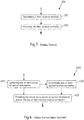
- Fig. 3 is a flowchart 300 showing an example embodiment of a method according to the second exemplary aspect of the present invention.
- This flowchart 300 may for instance be performed by a mobile device, e.g. one of the mobile devices 130 of Fig. 1 .
- a first location estimate is determined.
- the first location estimate may for instance be determined, e.g. based on one or more pieces of information gathered (e.g. measured) by one or more sensors comprised by the mobile device, such as e.g. an accelerometer sensor, a GNSS (e.g. a GPS) sensor, a barometric sensor, a magnetometer sensor, a gyroscope sensor, or a combination thereof e.g. to gather respective one or more pieces of information.
- GNSS e.g. a GPS
- a barometric sensor e.g. a magnetometer sensor
- a gyroscope sensor e.g. to gather respective one or more pieces of information.
- the determined first location estimate is provided, e.g. by outputting (e.g. sending) the determined first location estimate, e.g. to server 110 of Fig. 1 .
- the first location estimate may for instance be output to another entity that is different from the server 110 of Fig. 1 , which relays the first location estimate to the server 110 (upon reception of it).
- Fig. 4 is a flowchart 400 showing an example embodiment of a method according to the third exemplary aspect of the present invention.
- This flowchart 400 may for instance be performed by a video-enabled apparatus, e.g. video-enabled apparatus (respectively server) 140 of Fig. 1 .
- one or more pieces of optical information are gathered (e.g. recorded or captured), e.g. by one or more (video) cameras (e.g. cameras 142-1, 142-2 of Fig. 1 ).
- Such cameras may for instance monitor respectively survey an area (e.g. area 150 of Fig. 1 , e.g. an area within a building, parking lot, public accessible building, shopping mall, airport, station or the like, to name but a few non-limiting examples).
- one or more second location estimates are determined, e.g. at least partially based on the one or more pieces of optical information (gathered in step 401).
- the determining of the one or more second location estimates may for instance be performed and/or controlled by server 110 of Fig. 1 at least partially based on provided one or more pieces of optical information (see step 205 of Fig. 2 ).
- the one or more second location estimates may for instance be indicative of one or more (second) positions of one or more objects located within the area, which may for instance be derived from the one or more pieces of optical information that are e.g. gathered by one or more cameras surveying respectively monitoring the area.
- a third step 403 the one or more pieces of optical information (gathered in step 401), and/or the optionally determined one or more second location estimates (of step 402) are provided, e.g. by outputting (e.g. sending) the one or more pieces of optical information and/or the optionally determined one or more second location estimates, e.g. to server 110 of Fig. 1 .
- the one or more pieces of optical information and/or the optionally determined one or more second location estimates may for instance be output to another entity that is different from the server 110 of Fig. 1 , which relays the one or more pieces of optical information and/or the optionally determined one or more second location estimates to the server 110 (upon reception of it).
- Fig. 5 is a schematic block diagram of an apparatus 500 according to an exemplary aspect of the present invention, which may for instance represent the server 110 of Fig. 1 .
- Apparatus 500 comprises a processor 510, working memory 520, program memory 530, data memory 540, communication interface(s) 550, and an optional user interface 560.
- Apparatus 500 may for instance be configured to perform and/or control or comprise respective means (at least one of 510 to 560 for performing and/or controlling the method according to the first exemplary aspect of the present invention.
- Apparatus 500 may as well constitute an apparatus comprising at least one processor (510) and at least one memory (520) including computer program code, the at least one memory and the computer program code configured to, with the at least one processor, cause an apparatus, e.g. apparatus 500 at least to perform and/or control the method according to the first exemplary aspect of the invention of the present invention.
- Processor 510 may for instance comprise a first and/or second location estimate obtainer 511 as a functional and/or structural unit.
- First and/or second location estimate obtainer 511 may for instance be configured to obtain (e.g. receive) a first and/or second location estimate (see step 201 and/or step 203 of Fig. 2 ).
- Processor 510 may for instance comprise a second location estimate determiner 512 as a functional and/or structural unit.
- Second location estimate determiner 512 may for instance be configured to determine a second location estimate determiner (see step 205 of Fig. 2 ).
- Processor 510 may for instance comprise a matcher 513 as a functional and/or structural unit
- Matcher 513 may for instance be configured to determine whether at least one first position of one or more first location estimates relatively matches at least one second position of one or more second location estimates (see step 206 of Fig. 2 ).
- Processor 510 may for instance comprise a third location estimate determiner 514 as a functional and/or structural unit.
- Third location estimate determiner 514 may for instance be configured to determine a third location estimate (see step 207 of Fig. 2 ).
- Processor 510 may for instance further control the memories 520 to 540, the communication interface(s) 550, and the optional user interface 560.
- Processor 510 may for instance execute computer program code stored in program memory 530, which may for instance represent a computer readable storage medium comprising program code that, when executed by processor 510, causes the processor 510 to perform the method according to the first exemplary aspect of the present invention.
- Processor 510 may be a processor of any suitable type.
- Processor 510 may comprise but is not limited to one or more microprocessor(s), one or more processor(s) with accompanying one or more digital signal processor(s), one or more processor(s) without accompanying digital signal processor(s), one or more special-purpose computer chips, one or more field-programmable gate array(s) (FPGA(s)), one or more controller(s), one or more application-specific integrated circuit(s) (ASIC(s)), or one or more computer(s).
- FPGA field-programmable gate array
- ASIC application-specific integrated circuit
- Processor 510 may for instance be an application processor that runs an operating system.
- Program memory 530 may also be included into processor 510. This memory may for instance be fixedly connected to processor 510, or be at least partially removable from processor 510, for instance in the form of a memory card or stick. Program memory 530 may for instance be non-volatile memory. It may for instance be a FLASH memory (or a part thereof), any of a ROM, PROM, EPROM and EEPROM memory (or a part thereof) or a hard disc (or a part thereof), to name but a few examples. Program memory 530 may also comprise an operating system for processor 510. Program memory 530 may also comprise a firmware for apparatus 500.
- Apparatus 500 comprises a working memory 520, for instance in the form of a volatile memory. It may for instance be a Random Access Memory (RAM) or Dynamic RAM (DRAM), to give but a few non-limiting examples. It may for instance be used by processor 510 when executing an operating system and/or computer program.
- RAM Random Access Memory
- DRAM Dynamic RAM
- Data memory 540 may for instance be a non-volatile memory. It may for instance be a FLASH memory (or a part thereof), any of a ROM, PROM, EPROM and EEPROM memory (or a part thereof) or a hard disc (or a part thereof), to name but a few examples. Data memory 540 may for instance store one or more first location estimates, one or more second location estimates, one or more pieces of optical information, one or more third location estimates, or a combination thereof, to name but a few non-limiting examples.
- Communication interface(s) 550 enable apparatus 500 to communicate with other entities, e.g. with server video-enabled apparatus 140 of Fig. 1 , and/or with one or more mobile device 130, e.g. carried by a human and/or an object of Fig. 1 .
- the communication interface(s) 550 may for instance comprise a wireless interface, e.g. a cellular radio communication interface and/or a WLAN interface) and/or wire-bound interface, e.g. an IP-based interface, for instance to communicate with entities via the Internet.
- Communication interface(s) may enable apparatus 500 to communicate with other entities.
- User interface 560 is optional and may comprise a display for displaying information to a user and/or an input device (e.g. a keyboard, keypad, touchpad, mouse, etc.) for receiving information from a user.
- an input device e.g. a keyboard, keypad, touchpad, mouse, etc.
- Some or all of the components of the apparatus 500 may for instance be connected via a bus. Some or all of the components of the apparatus 500 may for instance be combined into one or more modules.
- Fig. 6 is a schematic block diagram of an apparatus 600 according to an exemplary aspect of the present invention, which may for instance represent the mobile device 130 carried by a human and/or an object of Fig. 1 .
- Apparatus 600 comprises a processor 610, working memory 620, program memory 630, data memory 640, communication interface(s) 650, an optional user interface 660 and an optional sensor(s) 670.
- Apparatus 600 may for instance be configured to perform and/or control or comprise respective means (at least one of 610 to 670) for performing and/or controlling the method according to the second exemplary aspect of the present invention.
- Apparatus 600 may as well constitute an apparatus comprising at least one processor (610) and at least one memory (620) including computer program code, the at least one memory and the computer program code configured to, with the at least one processor, cause an apparatus, e.g. apparatus 600 at least to perform and/or control the method according to the second exemplary aspect of the invention of the present invention.
- Processor 610 may for instance comprise first location estimate determiner 611 as a functional and/or structural unit.
- First location estimate determiner 611 may for instance be configured to determine a first location estimate (see step 301 of Fig. 3 ).
- Processor 610 may for instance further control the memories 620 to 640, the communication interface(s) 650, the optional user interface 660 and the optional sensor(s) 670.
- Processor 610 may for instance execute computer program code stored in program memory 630, which may for instance represent a computer readable storage medium comprising program code that, when executed by processor 610, causes the processor 610 to perform the method according to the second exemplary aspect of the present invention.
- Processor 610 may be a processor of any suitable type.
- Processor 610 may comprise but is not limited to one or more microprocessor(s), one or more processor(s) with accompanying one or more digital signal processor(s), one or more processor(s) without accompanying digital signal processor(s), one or more special-purpose computer chips, one or more field-programmable gate array(s) (FPGA(s)), one or more controller(s), one or more application-specific integrated circuit(s) (ASIC(s)), or one or more computer(s).
- FPGA field-programmable gate array
- ASIC application-specific integrated circuit
- Processor 610 may for instance be an application processor that runs an operating system.
- Program memory 630 may also be included into processor 610. This memory may for instance be fixedly connected to processor 610, or be at least partially removable from processor 610, for instance in the form of a memory card or stick. Program memory 630 may for instance be non-volatile memory. It may for instance be a FLASH memory (or a part thereof), any of a ROM, PROM, EPROM and EEPROM memory (or a part thereof) or a hard disc (or a part thereof), to name but a few examples. Program memory 630 may also comprise an operating system for processor 610. Program memory 630 may also comprise a firmware for apparatus 600.
- Apparatus 600 comprises a working memory 620, for instance in the form of a volatile memory. It may for instance be a Random Access Memory (RAM) or Dynamic RAM (DRAM), to give but a few non-limiting examples. It may for instance be used by processor 610 when executing an operating system and/or computer program.
- RAM Random Access Memory
- DRAM Dynamic RAM
- Data memory 640 may for instance be a non-volatile memory. It may for instance be a FLASH memory (or a part thereof), any of a ROM, PROM, EPROM and EEPROM memory (or a part thereof) or a hard disc (or a part thereof), to name but a few examples. Data memory 640 may for instance store one or more first location estimates, one or more second location estimates, one or more pieces of optical information, one or more third location estimates, or a combination thereof, to name but a few non-limiting examples.
- Communication interface(s) 650 enable apparatus 600 to communicate with other entities, e.g. with server 110 of Fig. 1 .
- the communication interface(s) 650 may for instance comprise a wireless interface, e.g. a cellular radio communication interface and/or a WLAN interface) and/or wire-bound interface, e.g. an IP-based interface, for instance to communicate with entities via the Internet.
- Communication interface(s) may enable apparatus 600 to communicate with other entities.
- User interface 660 is optional and may comprise a display for displaying information to a user and/or an input device (e.g. a keyboard, keypad, touchpad, mouse, etc.) for receiving information from a user.
- an input device e.g. a keyboard, keypad, touchpad, mouse, etc.
- Sensor(s) 670 are optional and may for instance comprise an accelerometer sensor, a GNSS (e.g. a GPS) sensor, a barometric sensor, a magnetometer sensor, a gyroscope sensor, or a combination thereof e.g. to gather respective information which may for instance be a basis for determining a first location estimate.
- a GNSS e.g. a GPS
- a barometric sensor e.g. a magnetometer sensor
- a gyroscope sensor e.g. to gather respective information which may for instance be a basis for determining a first location estimate.
- Some or all of the components of the apparatus 600 may for instance be connected via a bus. Some or all of the components of the apparatus 600 may for instance be combined into one or more modules.
- Fig. 7 is a schematic block diagram of an apparatus 700 according to an exemplary aspect of the present invention, which may for instance represent the video-enabled apparatus 140 of Fig. 1 .
- Apparatus 700 comprises a processor 710, working memory 720, program memory 730, data memory 740, communication interface(s) 750, an optional user interface 760 and (an) optional camera(s) 770.
- Apparatus 700 may for instance be configured to perform and/or control or comprise respective means (at least one of 710 to 770) for performing and/or controlling the method according to the third exemplary aspect of the present invention.
- Apparatus 700 may as well constitute an apparatus comprising at least one processor (710) and at least one memory (720) including computer program code, the at least one memory and the computer program code configured to, with the at least one processor, cause an apparatus, e.g. apparatus 700 at least to perform and/or control the method according to the third exemplary aspect of the invention of the present invention.
- Processor 710 may for instance comprise an optical information gatherer 711 as a functional and/or structural unit.
- Optical information gatherer 711 may for instance be configured to gather (e.g. record) one or more pieces of optical information (see step 401 of Fig. 4 ).
- Processor 710 may for instance comprise an optional second location estimate determiner 712 as a functional and/or structural unit.
- Optional second location estimate determiner 712 may for instance be configured to determine one or more second location estimates (see step 402 of Fig. 4 ).
- Processor 710 may for instance further control the memories 720 to 740, the communication interface(s) 750, the optional user interface 760 and the optional sensor(s) 770.
- Processor 710 may for instance execute computer program code stored in program memory 730, which may for instance represent a computer readable storage medium comprising program code that, when executed by processor 710, causes the processor 710 to perform the method according to the third exemplary aspect of the present invention.
- Processor 710 may be a processor of any suitable type.
- Processor 710 may comprise but is not limited to one or more microprocessor(s), one or more processor(s) with accompanying one or more digital signal processor(s), one or more processor(s) without accompanying digital signal processor(s), one or more special-purpose computer chips, one or more field-programmable gate array(s) (FPGA(s)), one or more controller(s), one or more application-specific integrated circuit(s) (ASIC(s)), or one or more computer(s).
- FPGA field-programmable gate array
- ASIC application-specific integrated circuit
- Processor 710 may for instance be an application processor that runs an operating system.
- Program memory 730 may also be included into processor 710. This memory may for instance be fixedly connected to processor 710, or be at least partially removable from processor 710, for instance in the form of a memory card or stick. Program memory 730 may for instance be non-volatile memory. It may for instance be a FLASH memory (or a part thereof), any of a ROM, PROM, EPROM and EEPROM memory (or a part thereof) or a hard disc (or a part thereof), to name but a few examples. Program memory 730 may also comprise an operating system for processor 710. Program memory 730 may also comprise a firmware for apparatus 700.
- Apparatus 700 comprises a working memory 720, for instance in the form of a volatile memory. It may for instance be a Random Access Memory (RAM) or Dynamic RAM (DRAM), to give but a few non-limiting examples. It may for instance be used by processor 710 when executing an operating system and/or computer program.
- RAM Random Access Memory
- DRAM Dynamic RAM
- Data memory 740 may for instance be a non-volatile memory. It may for instance be a FLASH memory (or a part thereof), any of a ROM, PROM, EPROM and EEPROM memory (or a part thereof) or a hard disc (or a part thereof), to name but a few examples. Data memory 740 may for instance store one or more first location estimates, one or more second location estimates, one or more pieces of optical information, one or more third location estimates, or a combination thereof, to name but a few non-limiting examples.
- Communication interface(s) 750 enable apparatus 700 to communicate with other entities, e.g. with server 110 of Fig. 1 , with one or more cameras (e.g. cameras 142-1, 142-2 of Fig. 1 ).
- the communication interface(s) 750 may for instance comprise a wireless interface, e.g. a cellular radio communication interface and/or a WLAN interface) and/or wire-bound interface, e.g. an IP-based interface, for instance to communicate with entities via the Internet.
- Communication interface(s) may enable apparatus 700 to communicate with other entities.
- User interface 760 is optional and may comprise a display for displaying information to a user and/or an input device (e.g. a keyboard, keypad, touchpad, mouse, etc.) for receiving information from a user.
- an input device e.g. a keyboard, keypad, touchpad, mouse, etc.
- Camera(s) 770 are optional and may for instance be configured to gather one or more pieces of optical information, which may for instance be a basis to determine one or more second location estimates.
- Some or all of the components of the apparatus 700 may for instance be connected via a bus. Some or all of the components of the apparatus 700 may for instance be combined into one or more modules.
- Video surveillance system sends tracks of the objects to the server.
- the time offset can be estimated as a part of the track matching operation. This could be realized e.g. by trying to match the measured positions with multiple different values for the assumed time system offset This way we also get an estimate for the time offset, which can be used to compensate the time difference when doing the probe geo-referencing.
- probe geotagging in indoor areas may for instance be improved as well, in particular in public buildings, parking spaces, etc. to name but a few non-limiting examples.
- An apparatus comprising at least one processor and at least one memory including computer program code, the at least one memory and the computer program code configured to, with the at least one processor, cause the apparatus to at least perform:
- the apparatus according to embodiment 1, the at least one memory and the computer program code configured to, with the at least one processor, cause the apparatus further to perform:
- a respective first location estimate of the one or more first location estimates and/or a respective second location estimate of the one or more second location estimates is associated with or comprises a first and/or second timestamp information indicative of a time and/or date at which the respective first location estimate of the one or more first location estimates and/or a respective second location estimate of the one or more second location estimates was gathered.
- the one or more third location estimates are determined in case the at least one first position of the one or more first location estimates relatively matches at least one second position of the one or more second location estimates.
- the at least one memory and the computer program code configured to, with the at least one processor, cause the apparatus further to perform:
- the at least one memory and the computer program code configured to, with the at least one processor, cause the apparatus further to perform:
- a respective first and/or second location estimate of the one or more first and/or second location estimates is further indicative of an altitude, floor, uncertainty value, or a combination thereof.
- determining whether at least one first position relatively matches at least one second position further comprises:
- a method comprising:
- This method may for instance be performed and/or controlled by a mobile device.
- a mobile device configured to perform and/or control or comprising respective means for performing and/or controlling the method according to embodiment 11.
- a mobile device comprising at least one processor and at least one memory including computer program code, the at least one memory and the computer program code configured to, with the at least one processor, cause the apparatus to at least perform:
- a method comprising:
- This method may for instance be performed and/or controlled by a video-enabled apparatus, e.g. a server coupled to (e.g. connected to) a plurality of optical sensors (e.g. video cameras), which are configured to gather one or more pieces of optical information.
- a video-enabled apparatus e.g. a server coupled to (e.g. connected to) a plurality of optical sensors (e.g. video cameras), which are configured to gather one or more pieces of optical information.
- this method may for instance be performed and/or controlled by a video surveillance system.
- each respective second location estimate of the one or more second location estimates is indicative of at least one second position of an object (e.g. human or non-human object) estimated at least partially based on one or more pieces of optical information indicative of at least one optically surveyed area.
- object e.g. human or non-human object
- a video-enabled apparatus configured to perform and/or control or comprising respective means for performing and/or controlling the method according to any of the embodiments 14 to 15.
- a video-enabled apparatus comprising at least one processor and at least one memory including computer program code, the at least one memory and the computer program code configured to, with the at least one processor, cause the apparatus to at least perform:
- each respective second location estimate of the one or more second location estimates is indicative of at least one second position of an object (e.g. human or non-human object) estimated at least partially based on one or more pieces of optical information indicative of at least one optically surveyed area.
- object e.g. human or non-human object
- a tangible computer-readable medium storing computer program code, the computer program code when executed by a processor causing an apparatus to perform and/or control:
- a tangible computer-readable medium storing computer program code, the computer program code when executed by a processor causing an apparatus to perform and/or control:
- a system comprising:
- any presented connection in the described embodiments is to be understood in a way that the involved components are operationally coupled.
- the connections can be direct or indirect with any number or combination of intervening elements, and there may be merely a functional relationship between the components.
- any of the methods, processes and actions described or illustrated herein may be implemented using executable instructions in a general-purpose or special-purpose processor and stored on a computer-readable storage medium (e.g., disk, memory, or the like) to be executed by such a processor.
- a computer-readable storage medium e.g., disk, memory, or the like
- References to a 'computer-readable storage medium' should be understood to encompass specialized circuits such as FPGAs, ASICs, signal processing devices, and other devices.
- a and/or B is considered to comprise any one of the following three scenarios: (i) A, (ii) B, (iii) A and B.
- article “a” is not to be understood as “one”, i.e. use of the expression “an element” does not preclude that also further elements are present.
- the term “comprising” is to be understood in an open sense, i.e. in a way that an object that "comprises an element A” may also comprise further elements in addition to element A.
- the statement of a feature comprises at least one of the subsequently enumerated features is not mandatory in the way that the feature comprises all subsequently enumerated features, or at least one feature of the plurality of the subsequently enumerated features. Also, a selection of the enumerated features in any combination or a selection of only one of the enumerated features is possible. The specific combination of all subsequently enumerated features may as well be considered. Also, a plurality of only one of the enumerated features may be possible.
Landscapes
- Engineering & Computer Science (AREA)
- Radar, Positioning & Navigation (AREA)
- Remote Sensing (AREA)
- Physics & Mathematics (AREA)
- General Physics & Mathematics (AREA)
- Computer Networks & Wireless Communication (AREA)
- Electromagnetism (AREA)
- Position Fixing By Use Of Radio Waves (AREA)
Priority Applications (1)
| Application Number | Priority Date | Filing Date | Title |
|---|---|---|---|
| EP19169939.6A EP3726253A1 (fr) | 2019-04-17 | 2019-04-17 | Estimations d'emplacement améliorées par vidéo |
Applications Claiming Priority (1)
| Application Number | Priority Date | Filing Date | Title |
|---|---|---|---|
| EP19169939.6A EP3726253A1 (fr) | 2019-04-17 | 2019-04-17 | Estimations d'emplacement améliorées par vidéo |
Publications (1)
| Publication Number | Publication Date |
|---|---|
| EP3726253A1 true EP3726253A1 (fr) | 2020-10-21 |
Family
ID=66217998
Family Applications (1)
| Application Number | Title | Priority Date | Filing Date |
|---|---|---|---|
| EP19169939.6A Pending EP3726253A1 (fr) | 2019-04-17 | 2019-04-17 | Estimations d'emplacement améliorées par vidéo |
Country Status (1)
| Country | Link |
|---|---|
| EP (1) | EP3726253A1 (fr) |
Cited By (7)
| Publication number | Priority date | Publication date | Assignee | Title |
|---|---|---|---|---|
| WO2023094124A1 (fr) * | 2021-11-26 | 2023-06-01 | Dormakaba Schweiz Ag | Procédé, système et produit-programme informatique pour superviser une zone de commande |
| US12236780B2 (en) | 2021-09-09 | 2025-02-25 | Leonardo Us Cyber And Security Solutions, Llc | Systems and methods for electronic signature tracking and analysis |
| US12347315B2 (en) | 2022-01-24 | 2025-07-01 | Leonardo Us Cyber And Security Solutions Llc | Systems and methods for parking management |
| US12456377B2 (en) | 2022-02-25 | 2025-10-28 | Leonardo Us Cyber And Security Solutions, Llc | Systems and methods for electronic surveillance |
| US12469097B2 (en) | 2020-12-15 | 2025-11-11 | Selex Es Inc. | Systems and methods for electronic signature tracking |
| US12513385B2 (en) | 2021-03-10 | 2025-12-30 | Leonardo Us Cyber And Security Solutions, Llc | Systems and methods for vehicle information capture using white light |
| US12562070B2 (en) | 2021-11-18 | 2026-02-24 | Leonardo Us Cyber And Security Solutions, Llc | Systems and methods for tracking aircraft |
Citations (3)
| Publication number | Priority date | Publication date | Assignee | Title |
|---|---|---|---|---|
| US20090268030A1 (en) * | 2008-04-29 | 2009-10-29 | Honeywell International Inc. | Integrated video surveillance and cell phone tracking system |
| US20110134240A1 (en) * | 2009-12-08 | 2011-06-09 | Trueposition, Inc. | Multi-Sensor Location and Identification |
| US20150350561A1 (en) * | 2014-05-28 | 2015-12-03 | Cambridge Silicon Radio Limited | Method for embedding product information in video using radio frequencey information |
-
2019
- 2019-04-17 EP EP19169939.6A patent/EP3726253A1/fr active Pending
Patent Citations (3)
| Publication number | Priority date | Publication date | Assignee | Title |
|---|---|---|---|---|
| US20090268030A1 (en) * | 2008-04-29 | 2009-10-29 | Honeywell International Inc. | Integrated video surveillance and cell phone tracking system |
| US20110134240A1 (en) * | 2009-12-08 | 2011-06-09 | Trueposition, Inc. | Multi-Sensor Location and Identification |
| US20150350561A1 (en) * | 2014-05-28 | 2015-12-03 | Cambridge Silicon Radio Limited | Method for embedding product information in video using radio frequencey information |
Cited By (9)
| Publication number | Priority date | Publication date | Assignee | Title |
|---|---|---|---|---|
| US12469097B2 (en) | 2020-12-15 | 2025-11-11 | Selex Es Inc. | Systems and methods for electronic signature tracking |
| US12614241B2 (en) | 2020-12-15 | 2026-04-28 | Leonardo Us Cyber And Security Solutions, Llc | Systems and methods for electronic signature tracking |
| US12513385B2 (en) | 2021-03-10 | 2025-12-30 | Leonardo Us Cyber And Security Solutions, Llc | Systems and methods for vehicle information capture using white light |
| US12236780B2 (en) | 2021-09-09 | 2025-02-25 | Leonardo Us Cyber And Security Solutions, Llc | Systems and methods for electronic signature tracking and analysis |
| US12562070B2 (en) | 2021-11-18 | 2026-02-24 | Leonardo Us Cyber And Security Solutions, Llc | Systems and methods for tracking aircraft |
| WO2023094124A1 (fr) * | 2021-11-26 | 2023-06-01 | Dormakaba Schweiz Ag | Procédé, système et produit-programme informatique pour superviser une zone de commande |
| US12353947B2 (en) | 2021-11-26 | 2025-07-08 | Dormakaba Schweiz Ag | Method, system and computer program product for supervising a control area |
| US12347315B2 (en) | 2022-01-24 | 2025-07-01 | Leonardo Us Cyber And Security Solutions Llc | Systems and methods for parking management |
| US12456377B2 (en) | 2022-02-25 | 2025-10-28 | Leonardo Us Cyber And Security Solutions, Llc | Systems and methods for electronic surveillance |
Similar Documents
| Publication | Publication Date | Title |
|---|---|---|
| KR102252566B1 (ko) | 로케이션 서비스를 개선하기 위해 3차원 로케이션 정보를 사용하기 위한 시스템 및 방법 | |
| US9432964B2 (en) | Method and apparatus for determining locations of access points | |
| US9131347B2 (en) | Utilizing a pressure profile to determine a location context identifier | |
| US9906921B2 (en) | Updating points of interest for positioning | |
| US20170078851A1 (en) | Associating a signal observation with a location tag | |
| JP7157754B2 (ja) | 屋内測位のための正確な高度推定 | |
| CN105556329B (zh) | 混合照片导航及地图绘制 | |
| JP2017535792A (ja) | 地球磁場を用いた自己位置推定とマップ作成の同時実行 | |
| US20140064112A1 (en) | Context-based position determination | |
| US9116006B2 (en) | Apparatus and method for determining indoor collection points and collecting heterogeneous infrastructure measurement information | |
| US11226391B2 (en) | Floor levels of a venue | |
| US10972873B2 (en) | Enhancing the accuracy for device localization | |
| JP7307139B2 (ja) | 追跡装置により捕捉される少なくとも1つの無線信号観測結果セットに基づく、追跡装置が対象エリア内にいるかどうかの判定 | |
| EP3660533A1 (fr) | Fiabilité d'estimations d'emplacements | |
| EP3669204A1 (fr) | Auto-correction d'une carte radio | |
| US11375336B2 (en) | Radio-based occupancies in venues | |
| US11592516B2 (en) | Positioning based on calendar information | |
| US11415659B2 (en) | Privacy sensitive positioning | |
| EP3699644A1 (fr) | Utilisation d'environnements radio modifiés dynamiquement et cartes radio |
Legal Events
| Date | Code | Title | Description |
|---|---|---|---|
| PUAI | Public reference made under article 153(3) epc to a published international application that has entered the european phase |
Free format text: ORIGINAL CODE: 0009012 |
|
| STAA | Information on the status of an ep patent application or granted ep patent |
Free format text: STATUS: THE APPLICATION HAS BEEN PUBLISHED |
|
| AK | Designated contracting states |
Kind code of ref document: A1 Designated state(s): AL AT BE BG CH CY CZ DE DK EE ES FI FR GB GR HR HU IE IS IT LI LT LU LV MC MK MT NL NO PL PT RO RS SE SI SK SM TR |
|
| AX | Request for extension of the european patent |
Extension state: BA ME |
|
| STAA | Information on the status of an ep patent application or granted ep patent |
Free format text: STATUS: REQUEST FOR EXAMINATION WAS MADE |
|
| 17P | Request for examination filed |
Effective date: 20210421 |
|
| RBV | Designated contracting states (corrected) |
Designated state(s): AL AT BE BG CH CY CZ DE DK EE ES FI FR GB GR HR HU IE IS IT LI LT LU LV MC MK MT NL NO PL PT RO RS SE SI SK SM TR |
|
| STAA | Information on the status of an ep patent application or granted ep patent |
Free format text: STATUS: EXAMINATION IS IN PROGRESS |
|
| 17Q | First examination report despatched |
Effective date: 20230320 |