EP3726437A1 - Fehleranalysevorrichtung, fehleranalyseverfahren und fehleranalyseprogramm - Google Patents
Fehleranalysevorrichtung, fehleranalyseverfahren und fehleranalyseprogramm Download PDFInfo
- Publication number
- EP3726437A1 EP3726437A1 EP17934463.5A EP17934463A EP3726437A1 EP 3726437 A1 EP3726437 A1 EP 3726437A1 EP 17934463 A EP17934463 A EP 17934463A EP 3726437 A1 EP3726437 A1 EP 3726437A1
- Authority
- EP
- European Patent Office
- Prior art keywords
- cause
- failure
- attribute
- predetermined failure
- occurrence
- Prior art date
- Legal status (The legal status is an assumption and is not a legal conclusion. Google has not performed a legal analysis and makes no representation as to the accuracy of the status listed.)
- Withdrawn
Links
Images





Classifications
-
- G—PHYSICS
- G06—COMPUTING OR CALCULATING; COUNTING
- G06N—COMPUTING ARRANGEMENTS BASED ON SPECIFIC COMPUTATIONAL MODELS
- G06N20/00—Machine learning
-
- G—PHYSICS
- G06—COMPUTING OR CALCULATING; COUNTING
- G06F—ELECTRIC DIGITAL DATA PROCESSING
- G06F11/00—Error detection; Error correction; Monitoring
- G06F11/07—Responding to the occurrence of a fault, e.g. fault tolerance
- G06F11/0703—Error or fault processing not based on redundancy, i.e. by taking additional measures to deal with the error or fault not making use of redundancy in operation, in hardware, or in data representation
- G06F11/079—Root cause analysis, i.e. error or fault diagnosis
-
- G—PHYSICS
- G06—COMPUTING OR CALCULATING; COUNTING
- G06F—ELECTRIC DIGITAL DATA PROCESSING
- G06F18/00—Pattern recognition
- G06F18/20—Analysing
- G06F18/21—Design or setup of recognition systems or techniques; Extraction of features in feature space; Blind source separation
- G06F18/213—Feature extraction, e.g. by transforming the feature space; Summarisation; Mappings, e.g. subspace methods
- G06F18/2132—Feature extraction, e.g. by transforming the feature space; Summarisation; Mappings, e.g. subspace methods based on discrimination criteria, e.g. discriminant analysis
-
- G—PHYSICS
- G06—COMPUTING OR CALCULATING; COUNTING
- G06F—ELECTRIC DIGITAL DATA PROCESSING
- G06F18/00—Pattern recognition
- G06F18/20—Analysing
- G06F18/21—Design or setup of recognition systems or techniques; Extraction of features in feature space; Blind source separation
- G06F18/214—Generating training patterns; Bootstrap methods, e.g. bagging or boosting
-
- G—PHYSICS
- G06—COMPUTING OR CALCULATING; COUNTING
- G06N—COMPUTING ARRANGEMENTS BASED ON SPECIFIC COMPUTATIONAL MODELS
- G06N5/00—Computing arrangements using knowledge-based models
- G06N5/01—Dynamic search techniques; Heuristics; Dynamic trees; Branch-and-bound
-
- H—ELECTRICITY
- H04—ELECTRIC COMMUNICATION TECHNIQUE
- H04L—TRANSMISSION OF DIGITAL INFORMATION, e.g. TELEGRAPHIC COMMUNICATION
- H04L69/00—Network arrangements, protocols or services independent of the application payload and not provided for in the other groups of this subclass
- H04L69/40—Network arrangements, protocols or services independent of the application payload and not provided for in the other groups of this subclass for recovering from a failure of a protocol instance or entity, e.g. service redundancy protocols, protocol state redundancy or protocol service redirection
Definitions
- the present invention relates to a failure analysis device, a failure analysis method, and a failure analysis program.
- FIG 9 is a block diagram showing a configuration example of a communication system used to provide a communication service.
- the communication system includes paired communication devices.
- the communication system is communicably connected to a base station and a router.
- failures In the above-described communication systems which are in operation in various parts of the world, various failures sometimes occur during operation of the systems. Examples of failures that occur include a low throughput failure in which packet data transmitted through a communication system is transferred only at a throughput that is a designed throughput or less.
- Examples of failures also include a packet loss in which a part of packet data carried through the communication system is lost. Examples further include a zero traffic failure in which substantially no packet data is transferred between a transmitter and a receiver.
- the cause of a failure is classified into either an "internal cause” or an “external cause”.
- the "internal cause” corresponds to a cause that has emerged between paired communication devices, for example.
- an example of a possible internal cause is a situation including an inappropriate orientation relationship between the antenna provided in one communication device and the antenna provided in the other communication device.
- Possible internal causes also include a situation in which an obstacle such as a tree exists in Line-of-Sight (LOS) and an occurrence of radio interference in which interference occurs on radio waves between the paired communication devices.
- LOS Line-of-Sight
- the "external cause” corresponds to a cause occurring outside the paired communication devices (in other words, occurring at a location other than between the paired communication devices).
- a specific example of an external cause can be a malfunction of a router or a base station communicably connected to the communication system.
- an external cause is a case of receiving data not intended to be received, such as data including a computer virus.
- data not intended to be received such as data including a computer virus.
- events peculiar to the region in which the communication system is installed such as an event that can hinder radio communication, are also considered as external causes.
- Patent Literatures Patent Literatures 1 to 3, for example.
- PTL 1 discloses an abnormality occurrence cause identifying device that assumes a plurality of causes as causes of an abnormality occurring in a connected terminal, preliminarily learns a state of the terminal emerging due to the assumed cause, and collects, from each of connected terminals, information indicating the state of each of the connected terminals.
- the abnormality occurrence cause identifying device described in PTL 1 estimates which of the learned states is closest to the state of the terminal related to the occurrence of the abnormality by a discrimination analysis based on statistics, and identifies the cause to which the state belongs as a cause of the occurrence of the abnormality.
- PTL 2 describes a network failure estimation method of searching a case database using an input failure site and failure phenomenon as search keys, estimating the cause of the failure on the basis of a cause site and frequency of the case record obtained by the search, and presenting the result.
- PTL 3 discloses a malfunction prediction system that generates a learning model that predicts a malfunction of a monitored device using time-series sensor data received by a learning server, as training data.
- the failure prediction device described in PTL 3 transmits, to a learning server, time-series sensor data regarding states before the malfunction occurred in the monitored device.
- the malfunction prediction device uses the learning model and predicts the probability of malfunction of the monitored device using the time-series sensor data received from the monitored device as an input.
- PTL 4 describes an example of a learner to generate a learning model using a heterogeneous mixture learning technique.
- the cause can be identified promptly. Furthermore, it is preferable that a countermeasure for the identified cause can be identified together.
- the present invention aims to provide a failure analysis device, a failure analysis method, and a failure analysis program capable of promptly identifying a cause of the failure that has occurred and countermeasures therefor, capable of solving the above-described problems.
- a failure analysis device includes an identification unit which discriminates whether a predetermined failure has occurred on the basis of a learning model for discriminating the presence or absence of an occurrence of the predetermined failure learned by using a cause attribute which is associated with a cause of the predetermined failure and on the basis of a value of the attribute, and that identifies the cause of the predetermined failure discriminated to have occurred and countermeasures therefor.
- a failure analysis method includes: discriminating whether a predetermined failure has occurred on the basis of a learning model for discriminating the presence or absence of an occurrence of the predetermined failure learned by using a cause attribute which is associated with a cause of the predetermined failure and on the basis of a value of the attribute; and identifying the cause of the predetermined failure discriminated to have occurred and countermeasures therefor.
- a failure analysis program causes a computer to execute: a discrimination process of discriminating whether a predetermined failure has occurred on the basis of a learning model for discriminating the presence or absence of an occurrence of the predetermined failure learned by using a cause attribute which is associated with a cause of the predetermined failure and on the basis of a value of the attribute; and an identifying process of identifying the cause of the predetermined failure discriminated to have occurred and countermeasures therefor.
- FIG. 1 is a block diagram showing a configuration example of a failure analysis device according to a first exemplary embodiment of the present invention.
- a failure analysis device 100 includes a data receiving unit 101, a data storage unit 102, a model generation unit 103, a model storage unit 104, and an identification unit 105.
- the data receiving unit 101 has a function of receiving acquisition target data transmitted from a failure analysis target device. For example, the data receiving unit 101 receives log information output from a network device used in mobile communication at predetermined time intervals.
- the data receiving unit 101 inputs the received data to the data storage unit 102.
- the data receiving unit 101 further inputs the data received when there is a possibility that a failure such as a packet loss has occurred, to the identification unit 105.
- the data storage unit 102 has a function of storing data input from the data receiving unit 101, as training data.
- the data storage unit 102 stores past log information regarding a failure analysis target device and information regarding the presence or absence of occurrence of a failure.
- FIG. 2 is an explanatory diagram showing an example of training data stored in a data storage unit 102.
- a part of the training data stored in the data storage unit 102 includes information indicating details of a past failure, a failure that occurred in the past.
- the training data shown in FIG. 2 includes date, time, an attribute, and failure occurrence information.
- the date and time correspond to the date and time on which the failure analysis target device recorded the acquisition target data.
- the attributes include a cause attribute and a non-cause attribute.
- the cause attribute includes a "first cause attribute" to a "fifth cause attribute”.
- FIG. 3 is an explanatory diagram showing an example of a cause of a failure, a cause attribute, and a countermeasure for the failure.
- the causes of the failure shown in FIG. 3 are all causes of a low throughput failure.
- an administrator preliminarily defines an attribute corresponding to a cause as a cause attribute, for each of causes of a low throughput failure. Furthermore, the administrator also preliminarily defines a countermeasure corresponding to the cause.
- the administrator causes the model storage unit 104 to store information indicating a predefined relationship, for example.
- the administrator associates a cause "antenna misorientation" with cause attributes such as "channel disconnection or error continued for six hours or more” or “reception level dropped below normal threshold” and with a countermeasure "dispatching engineer to site”.
- the administrator associates a cause "frequent occurrence of an automatic optimization function for modulation schemes in radio channels (quality degradation)" with cause attributes such as "significant fluctuations in radio wave reception intensity” or “sporadic occurrence of performance monitor errors” and with countermeasures such as "speed enhancement” and "antenna replacement/orientation adjustment of antenna”.
- the "weather dependence is high” is described for the cause of "frequent occurrence of an automatic optimization function for modulation schemes in radio channels (quality degradation)", leading to a relatively large cause attribute value indicating the weather dependence in a trained model.
- the administrator associates the cause "burst traffic occurrence” with a cause attribute "occurrence of packet loss in status where no channel disconnection has occurred” and with countermeasures such as "speed enhancement” and "QoS configuration in counterpart device”.
- the administrator associates the cause "QoS misconfiguration" with the cause attribute "occurrence of packet loss at a bandwidth usage rate of a predetermined threshold or more" and with the countermeasure "configuration change".
- the administrator also associates the cause "occurrence of event or occurrence of malfunction/failure in situation other than in the device concerned" with the cause attribute "sudden traffic change from previous week", and with countermeasures such as "confirmation of implementation of campaigns, or the like” and "confirmation from management department for other devices”.
- the administrator stores information indicating the above-described each of correspondences in the model storage unit 104, for example.
- the "first cause attribute” is "channel disconnection or error continued for six hours or more".
- the "first cause attribute” has either "1" or "0” recorded on the basis of a performance monitor and traffic information.
- performance monitor and traffic information is information indicating performance of the radio communication being implemented.
- an attribute for which a real number can be recorded may be defined as the cause attribute.
- non-cause attributes include “model”, “weekdays”, “humidity”, and “traffic amount”.
- the "model” includes a record such as "1" for the model of the failure analysis target device. Records of models use inventory information, which is information indicating the location, model, and configuration of a failure analysis target device.
- the inventory information for example, information indicating the location of a failure analysis target device, such as a cold region, in the training data.
- information indicating the configuration of the failure analysis target device such as the fact that the configuration includes special content, may be recorded in the training data.
- the "weekday” includes distinction as to whether the data is recorded on a weekday. “Yes” is recorded at “weekday” for the data recorded on a weekday. “No” is recorded at “weekday” for the data recorded on a non-weekday.
- the record of whether the data is recorded on a weekday uses calendar information which is information including the day of the week of each of dates, the day of the week corresponding to a holiday, the date corresponding to a national holiday, and the date of an event (for example, a day of an annual event such as Christmas or Halloween).
- the calendar information is used to judge whether the date is a holiday or a weekday. Furthermore, the calendar information enables judgment as to whether the date falls on a holiday or on an annual event day.
- the "humidity” includes a record of the humidity (40 (%), for example) of the day on which the acquisition target data was recorded in a region where the device is installed.
- the record of the humidity uses weather information indicating information regarding the weather of the region where the failure analysis target device is installed.
- the weather information includes, for example, information indicating a type such as “sunny”, “cloudy” or “rainy”, as well as precipitation, temperature, and humidity. These pieces of information are examples, and the weather information used in each of devices need not include all of the exemplified weather information. Furthermore, other information as weather information may be included in the weather information used in each of the devices.
- the "traffic amount” includes a record of the traffic in radio communication executed on the failure analysis target device.
- the record of the traffic amount uses a performance monitor and traffic information.
- event information indicating the presence or absence of occurrence of an event
- campaign information indicating the presence or absence of a campaign
- training data may be generated using network topology information indicating a relationship between devices or channel quality information indicating the quality of a network channel between the devices.
- the network topology information is specifically expressed as an effective graph indicating a connection relationship between the devices and a direction of a flow of traffic between the connected devices.
- the network topology information for example, information indicating an attribute of an adjacent device (a device that is further adjacent to an adjacent device) is recorded in the training data.
- the network topology information may include, for example, the connection mode (star type, bidirectional type, ring type, or the like) between a model generation target device and another device, the communication method (radio, optical, or the like), the number of connected devices, or the like.
- training data may be generated using information indicating demographics of the region in which the device is installed.
- information indicating demographics In a case where urban planning is defined, it is allowable to use the urban planning as information indicating demographics.
- Urban planning can be defined as one mode of information indicating demographics.
- the failure occurrence information is information indicating the presence or absence of occurrence of a failure.
- FIG. 2 shows "low throughput occurrence" indicating the presence or absence of a low throughput failure as an example of the failure occurrence information.
- the failure occurrence information may indicate, for example, one of the presence or absence of occurrence of packet loss, the presence or absence of occurrence of QoS loss (Discard) failure, the presence or absence of occurrence of a radio loss failure or the presence or absence of occurrence of a radio link down failure.
- the failure occurrence information uses information indicating the presence or absence of occurrence of a failure that needs specification of a countermeasure.
- the present exemplary embodiment describes an exemplary case of identifying a countermeasure for a low throughput failure.
- processing of converting the data acquired by the data receiving unit 101 into values to be recorded in the training data shown in FIG. 2 may be executed by either the data receiving unit 101 or the data storage unit 102.
- the model generation unit 103 has a function of performing learning to obtain a model that identifies occurrence of a predetermined failure, by using the training data stored in the data storage unit 102.
- a model obtained by execution of learning by the model generation unit 103 using the training data is referred to as a learning model.
- the model generation unit 103 uses training data corresponding to the time of occurrence of the low throughput failure and training data corresponding to the time of non-occurrence of a low throughput failure at a predetermined ratio (for example, 1: 1).
- the model generation unit 103 generates a learning model in which a value of each of attributes is assigned to an explanatory variable corresponding to the attribute.
- a learning model By the generation of a learning model, an explanatory variable having a coefficient larger than a coefficient (weight) of other explanatory variables will be identified as an explanatory variable having a large influence on the occurrence of a failure.
- a cause of the failure that has occurred is identified on the basis of the cause attribute corresponding to the identified explanatory variable.
- the model generation unit 103 can generate a learning model by performing heterogeneous mixture learning described in PTL 4.
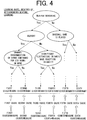
- FIG. 4 is an explanatory diagram showing an example of a learning model generated by the model generation unit 103 through heterogeneous mixture learning.
- the ellipses shown in FIG. 4 indicates branching under conditions corresponding to attributes (explanatory variables).
- the condition used in branching is called a gate function.
- the learning model obtained by the heterogeneous mixture learning is a learning model expressed in a binary tree format.
- the binary tree includes nodes indicating branching under conditions corresponding to attributes and leaf nodes indicating discriminants.
- the model generation unit 103 generates a learning model in which an appropriate discriminant is presented after branching is performed a plurality of times under conditions corresponding to each of attributes.
- the learning model presents a first discriminant.
- a discriminant is an equation represented as below, for example.
- Equation (1) corresponds to explanatory variables, and y corresponds to an objective variable. Furthermore, a 1 to a n in Equation (1) are coefficients of explanatory variables, and b is a constant term.
- Each of the presented discriminants is a discriminant indicating the presence or absence of occurrence of a low throughput failure. For example, in a case where a value close to "1" is obtained from the first discriminant to which the attribute value has been given, it is identified that a low throughput failure has occurred.
- the attribute used in the gate function may be limited to the cause attribute alone, or there is no need to particularly limit the attribute used in the gate function.
- the model generation unit 103 may generate a decision tree instead of a learning model obtained by heterogeneous mixture learning.
- FIG. 5 is an explanatory diagram showing an example of a decision tree generated by the model generation unit 103.
- the ellipses shown in FIG. 5 indicates branching under conditions corresponding to attributes.
- the decision tree includes nodes indicating branching under conditions corresponding to attributes and leaf nodes indicating the presence or absence of occurrence of a failure.
- the model generation unit 103 generates a learning model that determines the presence or absence of occurrence of a failure after branching is performed a plurality of times under conditions corresponding to each of attributes.
- the learning model determines that a low throughput failure has occurred.
- each of the leaf nodes indicating "1" in the decision tree shown in FIG. 5 corresponds to occurrence of a low throughput failure.
- the decision tree is a model used in a case where subdivision of cause of a failure is not required as much as in the learning model obtained by the heterogeneous mixture learning shown in FIG. 4 .
- the model generation unit 103 may simply generate a discriminant such as Equation (1).
- a value being a predetermined value (for example, 0.5) or more is obtained from the discriminant to which the attribute value is given, it is allowable to identify that a low throughput failure has occurred.
- the number of terms in the generated discriminant is larger than that in the discriminant in the learning model obtained by heterogeneous mixture learning.
- the discriminant is a model used in cases where the number of types of attributes is relatively small.
- model generation unit 103 may generate other types of learning models.
- the learning model generated by the model generation unit 103 may present the type of the cause of a failure such as the above-described "internal cause” or “external cause” instead of the cause of the failure.
- the model generation unit 103 stores the generated learning model in the model storage unit 104.
- the identification unit 105 identifies a cause of a failure corresponding to each of discriminants generated in a learning model obtained by heterogeneous mixture learning stored in the model storage unit 104, as well as identifying a countermeasure for the cause of the failure. For example, the identification unit 105 identifies a cause associated with a cause attribute corresponding to an explanatory variable having a coefficient of a threshold or more in a discriminant as well as identifying a countermeasure.
- the identification unit 105 identifies a cause and a countermeasure corresponding to the cause attribute, as a cause and a countermeasure corresponding to the discriminant.
- the identification unit 105 identifies each of "antenna misorientation" and "dispatching engineer to site” respectively as a cause and a countermeasure corresponding to the first discriminant on the basis of the correspondence shown in FIG. 3 and then adds the identified result to the learning model.
- the identification unit 105 identifies the cause of the failure corresponding to each of the leaf node indicating "1" in the decision tree stored in the model storage unit 104, and a countermeasure for the cause of the failure.
- the identification unit 105 identifies each of a cause and a countermeasure corresponding to the cause attribute, and then adds the identified result to the learning model.
- the identification unit 105 does not need to add the cause and the countermeasure for the leaf node indicating "0" to the learning model.
- the identification unit 105 identifies a cause of the failure corresponding to the discriminant stored in the model storage unit 104 as well as identifying a countermeasure for the cause of the failure. For example, in a case where the coefficient of the explanatory variable corresponding to the cause attribute is a threshold or more in the discriminant, the identification unit 105 identifies a cause and a countermeasure corresponding to the cause attribute, as a cause and a countermeasure corresponding to the discriminant. The identification unit 105 adds the identified cause and the countermeasure to the learning model.
- the identification unit 105 has a function of identifying whether a failure (in this example, a low throughput failure) has occurred, a cause of the failure, and a countermeasure corresponding to the cause by using the learning model stored in the model storage unit 104.
- the data obtained at the time when there is a possibility of occurrence of a failure is input to the identification unit 105 from the data receiving unit 101.
- the format of the input data is similar to the format of the data shown in FIG. 2 , for example.
- the identification unit 105 identifies whether a failure (low throughput failure) has occurred on the basis of the value of the attribute contained in the input data and the learning model. In a case where a failure has occurred, the identification unit 105 identifies a cause of the failure and a countermeasure therefor which have been added.
- the identification unit 105 selects a discriminant to be used according to the branching in a tree structure. Next, the identification unit 105 assigns the value of the attribute to the explanatory variable of the selected discriminant. For example, here it is assumed that the first discriminant is selected.
- the identification unit 105 identifies that a low throughput failure has occurred. In another case where a value close to "0" is obtained from the first discriminant to which the attribute value is assigned, the identification unit 105 does not identify that a low throughput failure has occurred.
- the identification unit 105 identifies that a low throughput failure has occurred. In a case where a value less than 0.5 is obtained from the first discriminant, the identification unit 105 does not identify that a low throughput failure has occurred.
- the identification unit 105 After identifying that a low throughput failure has occurred, when the coefficient of the explanatory variable corresponding to the cause attribute is a threshold or more, the identification unit 105 identifies the added cause (cause of low throughput failure) that has been associated with the cause attribute. The identification unit 105 also identifies the added countermeasure (countermeasure for a low throughput failure).
- the identification unit 105 selects a leaf node following the branching in the tree structure. For example, in a case where the leaf node indicating "1" is selected, the identification unit 105 identifies that a low throughput failure has occurred. In a case where the leaf node indicating "0" is selected, the identification unit 105 identifies that a low throughput failure has not occurred.
- the identification unit 105 After identifying that a low throughput failure has occurred, the identification unit 105 identifies the added cause of the low throughput failure on the basis of the cause attribute corresponding to the branching condition indicated by the nodes through which the selection of the leaf node is selected. In addition, the identification unit 105 also identifies a countermeasure that has already been added to the identified cause of the failure.
- the identification unit 105 assigns the value of the attribute to the explanatory variable of the discriminant. For example, in a case where a value being a predetermined value or more is obtained from the discriminant, the identification unit 105 identifies that a low throughput failure has occurred. In a case where a value close to 0 is obtained from the discriminant, the identification unit 105 identifies that a low throughput failure has not occurred.
- the identification unit 105 identifies that a low throughput failure has occurred. In a case where a value less than 0.5 is obtained from the discriminant, the identification unit 105 does not identify that a low throughput failure has occurred.
- the identification unit 105 After identifying that a low throughput failure has occurred, when the coefficient of the explanatory variable corresponding to the cause attribute is a threshold or more, the identification unit 105 identifies the added cause (cause of low throughput failure) that has been associated with the cause attribute. The identification unit 105 also identifies the added countermeasure (countermeasure for a low throughput failure).
- the model generation unit 103 of the failure analysis device 100 may set the explanatory variable to the number of connected users and the traffic amount in the past log information regarding the target device and may set the objective variable to the presence or absence of packet loss, and may perform learning to obtain the model using the heterogeneous mixture learning technique.
- the identification unit 105 When a packet loss occurs in the target device, the identification unit 105 gives the value of the attribute contained in the log information obtained at the time when there is a possibility of occurrence of a packet loss, to the learning model. Since the discriminant is selected on the basis of the value of the given attribute, the identification unit 105 identifies an explanatory variable having a large influence on the occurrence of packet loss in the selected discriminant.
- the failure analysis device 100 of the present exemplary embodiment may include a failure handling unit that executes the identified countermeasure.
- the failure handling unit may automatically execute the identified countermeasure on a network device or the like.
- the failure handling unit issues a change command, a script, or the like to execute a design change.
- the failure analysis device 100 including the failure handling unit is capable of automatically resolve the failure by analyzing the received data to determine the cause of the failure and executing a countermeasure corresponding to the cause.
- FIG. 6 is a flowchart showing operation of a failure analysis process performed by the failure analysis device 100 according to the first exemplary embodiment.
- An administrator preliminarily defines the correspondence between a cause attribute and a countermeasure for each of causes of a low throughput failure.
- the administrator stores information indicating the defined correspondence in the model storage unit 104 (step S101).
- the data receiving unit 101 receives acquisition target data transmitted from the failure analysis target device (step S102). Next, the data receiving unit 101 inputs the received data to the data storage unit 102.
- the data storage unit 102 stores training data using the data input from the data receiving unit 101, the correspondence stored in the model storage unit 104, or the like.
- the data storage unit 102 accumulates the training data (step S103).
- the model generation unit 103 executes learning using the training data stored in the data storage unit 102 and thereby generates a learning model (step S104).
- the model generation unit 103 generates one of a learning model obtained by heterogeneous mixture learning, a decision tree, or a discriminant, as a learning model. Next, the model generation unit 103 stores the generated learning model in the model storage unit 104 (step S105).
- the data receiving unit 101 receives the data, transmitted from the failure analysis target device, concerning the time when there is a possibility of occurrence of a failure (step S106). Next, the data receiving unit 101 inputs the received data or the like to the identification unit 105.
- the identification unit 105 identifies a cause of the failure that has occurred and a countermeasure therefor, on the basis of the input data (step S107).
- the identification unit 105 outputs information identified in step S107 (Step S108). After outputting the identified information, the failure analysis device 100 completes the failure analysis process.
- the model generation unit 103 of the failure analysis device 100 can generate a learning model obtained by heterogeneous mixture learning in which the degree of influence of each of explanatory variables is computed for each of discriminants. Therefore, the identification unit 105 can promptly identify the cause of the failure that has occurred using the computed degree of influence of the explanatory variable.
- the identification unit 105 can narrow down the cause attribute. Therefore, the identification unit 105 can promptly identify the cause of the failure that has occurred.
- the identification unit 105 can narrow down explanatory variables having a large influence on a failure. Therefore, the identification unit 105 can promptly identify the cause of the failure that has occurred on the basis of the explanatory variables of the learning model.
- FIG. 7 is an explanatory diagram showing a hardware configuration example of the failure analysis device according to the present invention.
- the failure analysis device 100 shown in FIG. 7 includes a central processing unit (CPU) 111, a main storage unit 112, and a communication unit 113, and an auxiliary storage unit 114. Furthermore, the device may include an input unit 115 for the user to operate and an output unit 116 for presenting the processing result or the progress of the processing content to the user.
- CPU central processing unit
- main storage unit 112 main storage unit 112
- communication unit 113 main storage unit 114
- auxiliary storage unit 114 auxiliary storage unit 114.
- the device may include an input unit 115 for the user to operate and an output unit 116 for presenting the processing result or the progress of the processing content to the user.
- the main storage unit 112 is used as a data working area and a temporary data save area.
- the main storage unit 112 is implemented by random access memory (RAM).
- the communication unit 113 has a function of performing data input/output with peripheral devices via a wired network or a wireless network (information communication network).
- the auxiliary storage unit 114 is a non-transitory tangible storage medium.
- the non-transitory tangible storage medium include a magnetic disk, a magneto-optical disk, a compact disc read only memory (CD-ROM), a digital versatile disc read only memory (DVD-ROM), and semiconductor memory.
- the input unit 115 has a function of inputting data and processing instructions.
- the input unit 115 is an input device such as a keyboard or a mouse.
- the output unit 116 has a function of outputting data.
- the output unit 116 is a display device such as a liquid crystal display device or a printing device such as a printer.
- individual components of the failure analysis device 100 are connected to a system bus 117.
- the auxiliary storage unit 114 stores programs for implementing the data receiving unit 101, the model generation unit 103, and the identification unit 105 shown in FIG. 1 , for example.
- the main storage unit 112 is used as a storage area of the data storage unit 102 and a storage area of the model storage unit 104. Furthermore, the data receiving unit 101 receives the acquisition target data via the communication unit 113.
- the failure analysis device 100 may be implemented by hardware.
- the failure analysis device 100 may be equipped with a circuit including hardware components such as Large Scale Integration (LSI) containing a program for implementing the functions shown in FIG. 1 .
- LSI Large Scale Integration
- the failure analysis device 100 may be implemented by software by causing the CPU 111 shown in FIG. 7 to execute a program that provides functions of individual components shown in FIG. 1 .
- the CPU 111 loads the program stored in the auxiliary storage unit 114 to the main storage unit 112 and executes the program to control the operation of the failure analysis device 100, thereby implementing individual functions by software.
- a part or all of individual components may be implemented by a general-purpose circuit (circuitry), a dedicated circuit, a processor, or a combination thereof. These may be formed by a single chip or may be formed by a plurality of chips connected via a bus. Some or all of the components may be implemented by a combination of the above-described circuits or the like and a program.
- the plurality of information processing devices and circuits may be centrally arranged or distributed.
- an information processing device, a circuit, or the like may be implemented as a form in which each component are connected via a communication network, such as a client and server system, a cloud computing system.
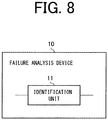
- FIG. 8 is a block diagram showing an outline of the failure analysis device according to the present invention.
- a failure analysis device 10 according to the present invention includes an identification unit 11 (for example, the identification unit 105) that discriminates whether a predetermined failure has occurred on the basis of a learning model for discriminating the presence or absence of an occurrence of the predetermined failure learned by using a cause attribute which is associated with a cause of the predetermined failure and on the basis of a value of the attribute, and that identifies the cause of the predetermined failure discriminated to have occurred and countermeasures therefor.
- an identification unit 11 for example, the identification unit 105
- the identification unit 105 that discriminates whether a predetermined failure has occurred on the basis of a learning model for discriminating the presence or absence of an occurrence of the predetermined failure learned by using a cause attribute which is associated with a cause of the predetermined failure and on the basis of a value of the attribute, and that identifies the cause of the predetermined failure discriminated to have occurred and countermeasures therefor.
- the failure analysis device can promptly identify a cause of the failure that has occurred and countermeasures therefor.
- the failure analysis device 10 may include a learning unit (for example, the model generation unit 103) that performs learning to obtain a learning model by using training data including a plurality of sets of values of a plurality of attributes including a cause attribute and failure occurrence information indicating whether a predetermined failure has occurred.
- a learning unit for example, the model generation unit 103 that performs learning to obtain a learning model by using training data including a plurality of sets of values of a plurality of attributes including a cause attribute and failure occurrence information indicating whether a predetermined failure has occurred.
- the failure analysis device can perform learning to obtain a learning model used to identify the cause of a failure.
- the learning unit generates a binary tree, as a learning model, by defining a condition regarding an attribute as a node other than a leaf node and defining a discriminant for discriminating the presence or absence of an occurrence of the predetermined failure as a leaf node, and the identification unit 11 identifies a discriminant corresponding to the leaf node of the binary tree using a value of the attribute, discriminates whether the predetermined failure has occurred on the basis of the value of the attribute and the discriminant, identifies a cause of the predetermined failure that has been discriminated to have occurred on the basis of a coefficient value of an explanatory variable corresponding to a cause attribute included in the discriminant, and identifies a countermeasure preliminarily associated with the cause.
- the failure analysis device can promptly identify the cause of the failure and countermeasures therefor using a learning model obtained by heterogeneous mixture learning.
- the learning unit generates a decision tree, as a learning model, by defining a condition regarding an attribute as a node other than a leaf node and defining information indicating the presence or absence of an occurrence of the predetermined failure as a leaf node, and the identification unit 11 identifies whether the leaf node corresponding to the value of the attribute indicates the occurrence of the predetermined failure on the basis of the value of the attribute and the decision tree, and identifies a cause of the predetermined failure preliminarily associated with the cause attribute used as the condition in nodes from the leaf node to the root node indicating the occurrence of the predetermined failure and countermeasures therefor.
- the failure analysis device can promptly identify a cause of the failure and countermeasures therefor using the binary tree.
- the learning unit generates, as a learning model, a discriminant for discriminating the presence or absence of an occurrence of the predetermined failure
- the identification unit 11 discriminates whether the predetermined failure has occurred on the basis of the value of the attribute and the discriminant, identifies a cause of the predetermined failure that has been discriminated to have occurred on the basis of a coefficient value of an explanatory variable corresponding to a cause attribute included in the discriminant, and identifies a countermeasure preliminarily associated with the cause.
- the failure analysis device can promptly identify a cause of the failure and countermeasures therefor using the discriminant.
- the failure analysis device 10 may include a storage unit (for example, the model storage unit 104) that stores a set of a cause, a cause attribute, and a countermeasure for a predetermined failure preliminarily associated with each other.
- a storage unit for example, the model storage unit 104 that stores a set of a cause, a cause attribute, and a countermeasure for a predetermined failure preliminarily associated with each other.
- the failure analysis device can preliminarily store the relationship between the cause of a predetermined failure, a cause attribute, and a countermeasure for the failure.
- the present invention is suitably applicable to the use of the maintenance work of a communication system.
Landscapes
- Engineering & Computer Science (AREA)
- Theoretical Computer Science (AREA)
- Data Mining & Analysis (AREA)
- Physics & Mathematics (AREA)
- General Engineering & Computer Science (AREA)
- General Physics & Mathematics (AREA)
- Software Systems (AREA)
- Artificial Intelligence (AREA)
- Evolutionary Computation (AREA)
- Computer Vision & Pattern Recognition (AREA)
- Computing Systems (AREA)
- Mathematical Physics (AREA)
- Medical Informatics (AREA)
- Bioinformatics & Computational Biology (AREA)
- Bioinformatics & Cheminformatics (AREA)
- Life Sciences & Earth Sciences (AREA)
- Evolutionary Biology (AREA)
- Computational Linguistics (AREA)
- Health & Medical Sciences (AREA)
- Biomedical Technology (AREA)
- Quality & Reliability (AREA)
- Signal Processing (AREA)
- Computer Networks & Wireless Communication (AREA)
- Computer Security & Cryptography (AREA)
- Data Exchanges In Wide-Area Networks (AREA)
- Maintenance And Management Of Digital Transmission (AREA)
- Debugging And Monitoring (AREA)
Applications Claiming Priority (1)
| Application Number | Priority Date | Filing Date | Title |
|---|---|---|---|
| PCT/JP2017/044309 WO2019116418A1 (ja) | 2017-12-11 | 2017-12-11 | 障害分析装置、障害分析方法および障害分析プログラム |
Publications (2)
| Publication Number | Publication Date |
|---|---|
| EP3726437A1 true EP3726437A1 (de) | 2020-10-21 |
| EP3726437A4 EP3726437A4 (de) | 2020-12-16 |
Family
ID=66820799
Family Applications (1)
| Application Number | Title | Priority Date | Filing Date |
|---|---|---|---|
| EP17934463.5A Withdrawn EP3726437A4 (de) | 2017-12-11 | 2017-12-11 | Fehleranalysevorrichtung, fehleranalyseverfahren und fehleranalyseprogramm |
Country Status (4)
| Country | Link |
|---|---|
| US (1) | US11586981B2 (de) |
| EP (1) | EP3726437A4 (de) |
| JP (1) | JPWO2019116418A1 (de) |
| WO (1) | WO2019116418A1 (de) |
Families Citing this family (10)
| Publication number | Priority date | Publication date | Assignee | Title |
|---|---|---|---|---|
| JP7415714B2 (ja) * | 2020-03-23 | 2024-01-17 | 富士通株式会社 | 障害原因特定システム、障害原因特定方法および障害原因特定プログラム |
| CN115698880B (zh) * | 2020-05-29 | 2026-02-24 | 株式会社大赛璐 | 异常调制原因显示装置、异常调制原因显示方法以及异常调制原因显示程序 |
| US11188411B1 (en) * | 2020-11-19 | 2021-11-30 | Capital One Services, Llc | Computer-based systems and/or computing devices configured for root cause analysis of computing incidents using machine learning |
| WO2022107296A1 (ja) * | 2020-11-19 | 2022-05-27 | 日本電信電話株式会社 | 推定装置、推定方法、および、推定プログラム |
| WO2023012898A1 (ja) * | 2021-08-03 | 2023-02-09 | 日本電気株式会社 | 情報処理システム、情報処理装置、及び情報処理方法 |
| CN114490303B (zh) * | 2022-04-07 | 2022-07-12 | 阿里巴巴达摩院(杭州)科技有限公司 | 故障根因确定方法、装置和云设备 |
| CN115865625B (zh) * | 2022-11-28 | 2024-12-17 | 武汉烽火技术服务有限公司 | 一种通信设备故障根因的分析方法和装置 |
| JP7812607B2 (ja) * | 2023-02-21 | 2026-02-10 | Kddi株式会社 | ネットワークのデータ変化検知装置、方法及びプログラム |
| JP7840906B2 (ja) * | 2023-06-20 | 2026-04-06 | 株式会社東芝 | 情報処理装置、情報処理システム、プログラムおよび情報処理方法 |
| CN118869462B (zh) * | 2024-07-12 | 2026-01-23 | 中国移动通信集团北京有限公司 | 资源池故障定位方法和装置 |
Family Cites Families (17)
| Publication number | Priority date | Publication date | Assignee | Title |
|---|---|---|---|---|
| US7583587B2 (en) | 2004-01-30 | 2009-09-01 | Microsoft Corporation | Fault detection and diagnosis |
| JP4445300B2 (ja) | 2004-03-18 | 2010-04-07 | 富士通株式会社 | ネットワーク障害推定方法及びネットワーク障害推定装置 |
| JP2007165721A (ja) | 2005-12-15 | 2007-06-28 | Omron Corp | プロセス異常分析装置及びプログラム |
| JP4559974B2 (ja) | 2006-01-16 | 2010-10-13 | 三菱電機株式会社 | 管理装置及び管理方法及びプログラム |
| EP2813913A1 (de) | 2007-03-22 | 2014-12-17 | Nec Corporation | Diagnostische Vorrichtung |
| JP2010218301A (ja) * | 2009-03-17 | 2010-09-30 | Taiyo Nippon Sanso Corp | 異常診断装置、異常診断方法及び異常診断プログラム |
| JP5514643B2 (ja) * | 2010-06-21 | 2014-06-04 | 株式会社日立ソリューションズ | 障害原因判定ルール変化検知装置及びプログラム |
| JP5803469B2 (ja) | 2011-09-15 | 2015-11-04 | 富士通株式会社 | 予測方法及び予測プログラム |
| US8909582B2 (en) | 2013-02-04 | 2014-12-09 | Nec Corporation | Hierarchical latent variable model estimation device, hierarchical latent variable model estimation method, and recording medium |
| JP6380169B2 (ja) | 2015-03-04 | 2018-08-29 | 株式会社デンソー | 故障診断装置および端末装置 |
| JP2016173782A (ja) | 2015-03-18 | 2016-09-29 | エヌ・ティ・ティ・コミュニケーションズ株式会社 | 故障予測システム、故障予測方法、故障予測装置、学習装置、故障予測プログラム及び学習プログラム |
| AU2016203497B2 (en) | 2015-06-22 | 2017-05-11 | Accenture Global Services Limited | Wi-fi access point performance management |
| JP6148316B2 (ja) * | 2015-07-31 | 2017-06-14 | ファナック株式会社 | 故障条件を学習する機械学習方法及び機械学習装置、並びに該機械学習装置を備えた故障予知装置及び故障予知システム |
| DE102016008987B4 (de) | 2015-07-31 | 2021-09-16 | Fanuc Corporation | Maschinenlernverfahren und Maschinenlernvorrichtung zum Lernen von Fehlerbedingungen, und Fehlervorhersagevorrichtung und Fehlervorhersagesystem, das die Maschinenlernvorrichtung einschließt |
| CN106909478A (zh) | 2015-12-22 | 2017-06-30 | 曹圣航 | 一种基于wmi技术与决策树分类算法的智能维修系统 |
| JP6811018B2 (ja) | 2016-03-07 | 2021-01-13 | 三菱重工業株式会社 | 品質評価システム、品質評価方法及びプログラム |
| CN106301522B (zh) | 2016-08-20 | 2020-05-26 | 航天恒星科技有限公司 | 遥感卫星地面站数据接收任务的可视化故障诊断方法及系统 |
-
2017
- 2017-12-11 JP JP2019559425A patent/JPWO2019116418A1/ja active Pending
- 2017-12-11 US US16/771,472 patent/US11586981B2/en active Active
- 2017-12-11 EP EP17934463.5A patent/EP3726437A4/de not_active Withdrawn
- 2017-12-11 WO PCT/JP2017/044309 patent/WO2019116418A1/ja not_active Ceased
Also Published As
| Publication number | Publication date |
|---|---|
| WO2019116418A1 (ja) | 2019-06-20 |
| US11586981B2 (en) | 2023-02-21 |
| JPWO2019116418A1 (ja) | 2020-12-17 |
| US20210019653A1 (en) | 2021-01-21 |
| EP3726437A4 (de) | 2020-12-16 |
Similar Documents
| Publication | Publication Date | Title |
|---|---|---|
| US11586981B2 (en) | Failure analysis device, failure analysis method, and failure analysis program | |
| US12096232B2 (en) | System, method, and apparatus for providing dynamic, prioritized spectrum management and utilization | |
| US12452681B2 (en) | System, method, and apparatus for providing dynamic, prioritized spectrum management and utilization | |
| US12262215B2 (en) | System, method, and apparatus for providing dynamic, prioritized spectrum management and utilization | |
| US10069684B2 (en) | Core network analytics system | |
| US9100864B2 (en) | Operation monitoring apparatus, cause event estimating method for the same, and information communication network system | |
| CN119228129B (zh) | 面向流程监控的供应链智能追踪系统 | |
| AU2019275633B2 (en) | System and method of automated fault correction in a network environment | |
| CN117792864A (zh) | 一种告警处理方法、装置、存储介质及电子装置 | |
| CN113098715B (zh) | 一种信息处理方法、装置、系统、介质和计算设备 | |
| US12166536B2 (en) | Weather impact modeling of satellite based services | |
| CN120075859A (zh) | 基于动态路由调整的短信通道故障处理方法 | |
| CN120528815A (zh) | 一种基于机器学习的智能网络预测与动态优化方法 | |
| JP7173273B2 (ja) | 障害分析装置、障害分析方法および障害分析プログラム | |
| CN118396592A (zh) | 基站设备运维环节的稽核方法及装置、介质、设备 | |
| CN100463412C (zh) | 用于优化通信网络的诊断工具的诊断树的设备 | |
| Perino et al. | Experience: advanced network operations in (Un)-connected remote communities | |
| US12634707B2 (en) | System, method, and apparatus for providing dynamic, prioritized spectrum management and utilization | |
| Jackson et al. | Improved reliability-prediction and field-reliability-data analysis for field-replaceable units | |
| CN121743951B (zh) | 结合因果推断的智能业务异常根因分析方法及系统 | |
| Burgos¹ et al. | and the Need for its Study in STEM Careers | |
| CN121435005A (zh) | 一种多维数据处理方法、装置、电子设备及存储介质 | |
| WO2024114567A1 (zh) | 一种网络问题分析方法以及相关装置 | |
| EP4736092A1 (de) | System und verfahren zur goldenen automatischen korrektur für mehrere verkäufer | |
| CN117950891A (zh) | 业务异常的处理方法、装置、电子设备及存储介质 |
Legal Events
| Date | Code | Title | Description |
|---|---|---|---|
| STAA | Information on the status of an ep patent application or granted ep patent |
Free format text: STATUS: THE INTERNATIONAL PUBLICATION HAS BEEN MADE |
|
| PUAI | Public reference made under article 153(3) epc to a published international application that has entered the european phase |
Free format text: ORIGINAL CODE: 0009012 |
|
| STAA | Information on the status of an ep patent application or granted ep patent |
Free format text: STATUS: REQUEST FOR EXAMINATION WAS MADE |
|
| 17P | Request for examination filed |
Effective date: 20200713 |
|
| AK | Designated contracting states |
Kind code of ref document: A1 Designated state(s): AL AT BE BG CH CY CZ DE DK EE ES FI FR GB GR HR HU IE IS IT LI LT LU LV MC MK MT NL NO PL PT RO RS SE SI SK SM TR |
|
| AX | Request for extension of the european patent |
Extension state: BA ME |
|
| REG | Reference to a national code |
Ref country code: DE Ref legal event code: R079 Free format text: PREVIOUS MAIN CLASS: G06N0005040000 Ipc: G06N0020000000 |
|
| A4 | Supplementary search report drawn up and despatched |
Effective date: 20201118 |
|
| RIC1 | Information provided on ipc code assigned before grant |
Ipc: H04L 29/14 20060101ALI20201112BHEP Ipc: G06N 20/00 20190101AFI20201112BHEP Ipc: G06N 5/00 20060101ALI20201112BHEP |
|
| DAV | Request for validation of the european patent (deleted) | ||
| DAX | Request for extension of the european patent (deleted) | ||
| STAA | Information on the status of an ep patent application or granted ep patent |
Free format text: STATUS: EXAMINATION IS IN PROGRESS |
|
| 17Q | First examination report despatched |
Effective date: 20230323 |
|
| STAA | Information on the status of an ep patent application or granted ep patent |
Free format text: STATUS: THE APPLICATION HAS BEEN WITHDRAWN |
|
| 18W | Application withdrawn |
Effective date: 20230616 |