EP3726478A1 - Procédé et appareil permettant de produire un diagramme de guidage de navigation - Google Patents
Procédé et appareil permettant de produire un diagramme de guidage de navigation Download PDFInfo
- Publication number
- EP3726478A1 EP3726478A1 EP18888051.2A EP18888051A EP3726478A1 EP 3726478 A1 EP3726478 A1 EP 3726478A1 EP 18888051 A EP18888051 A EP 18888051A EP 3726478 A1 EP3726478 A1 EP 3726478A1
- Authority
- EP
- European Patent Office
- Prior art keywords
- data
- point cloud
- screenshot
- product model
- module
- Prior art date
- Legal status (The legal status is an assumption and is not a legal conclusion. Google has not performed a legal analysis and makes no representation as to the accuracy of the status listed.)
- Pending
Links
Images




Classifications
-
- G—PHYSICS
- G06—COMPUTING OR CALCULATING; COUNTING
- G06V—IMAGE OR VIDEO RECOGNITION OR UNDERSTANDING
- G06V20/00—Scenes; Scene-specific elements
- G06V20/60—Type of objects
- G06V20/64—Three-dimensional [3D] objects
- G06V20/647—Three-dimensional [3D] objects by matching two-dimensional images to three-dimensional objects
-
- G—PHYSICS
- G06—COMPUTING OR CALCULATING; COUNTING
- G06T—IMAGE DATA PROCESSING OR GENERATION, IN GENERAL
- G06T19/00—Manipulating three-dimensional [3D] models or images for computer graphics
- G06T19/003—Navigation within 3D models or images
-
- G—PHYSICS
- G06—COMPUTING OR CALCULATING; COUNTING
- G06T—IMAGE DATA PROCESSING OR GENERATION, IN GENERAL
- G06T19/00—Manipulating three-dimensional [3D] models or images for computer graphics
- G06T19/006—Mixed reality
-
- G—PHYSICS
- G06—COMPUTING OR CALCULATING; COUNTING
- G06T—IMAGE DATA PROCESSING OR GENERATION, IN GENERAL
- G06T19/00—Manipulating three-dimensional [3D] models or images for computer graphics
- G06T19/20—Editing of three-dimensional [3D] images, e.g. changing shapes or colours, aligning objects or positioning parts
-
- G—PHYSICS
- G06—COMPUTING OR CALCULATING; COUNTING
- G06V—IMAGE OR VIDEO RECOGNITION OR UNDERSTANDING
- G06V10/00—Arrangements for image or video recognition or understanding
- G06V10/70—Arrangements for image or video recognition or understanding using pattern recognition or machine learning
- G06V10/74—Image or video pattern matching; Proximity measures in feature spaces
- G06V10/75—Organisation of the matching processes, e.g. simultaneous or sequential comparisons of image or video features; Coarse-fine approaches, e.g. multi-scale approaches; using context analysis; Selection of dictionaries
- G06V10/751—Comparing pixel values or logical combinations thereof, or feature values having positional relevance, e.g. template matching
-
- G—PHYSICS
- G06—COMPUTING OR CALCULATING; COUNTING
- G06V—IMAGE OR VIDEO RECOGNITION OR UNDERSTANDING
- G06V20/00—Scenes; Scene-specific elements
- G06V20/20—Scenes; Scene-specific elements in augmented reality scenes
Definitions
- the disclosure relates to the technical field of Augmented Reality (AR), and in particular, to methods and apparatuses for generating a navigation guide.
- AR Augmented Reality
- AR is a technology for computing the positions and angles of images captured by an imaging device (e.g., a camera) in real-time and augmenting with corresponding images, videos, three-dimensional (3D) models, and the like.
- an imaging device e.g., a camera
- 3D three-dimensional
- a guide is required for the off-line scan of real-world objects such that to guide a user to capture images of the real-world object with a camera aligned thereto.
- a guide is generated based on an initialization angle. If the angle at which the camera used by the user for imaging the real-world object differs from the initialization angle, manual intervention is required to modify the guide, which entails a large amount of manual labor and leads to slow modifications.
- Embodiments of the disclosure provide improved methods and apparatuses for generating a navigation guide to address the above-described problems.
- the disclosure provides a method for generating a navigation guide, the method comprising: obtaining a point cloud database corresponding to an object to be identified, the object having a respective product model; determining a target navigation position based on the point cloud database; obtaining data associated with a screenshot of the product model, the screenshot captured based on the target navigation position; and generating the navigation guide for the object based on the data associated with the screenshot.
- the determining the target navigation position of the object to be identified based on the point cloud database comprises: obtaining an initialization angle from the point cloud database; and designating the initialization angle as the target navigation position for a camera of a mobile device.
- the obtaining the data associated with the screenshot of the product model which is captured based on the target navigation position comprises: adjusting the product model of the object to be identified based on the target navigation position; and obtaining the data associated with the screenshot of the adjusted product model.
- the generating the navigation guide for the object to be identified based on the data associated with the screenshot comprises: extracting edge data from the data associated with the screenshot; adjusting one or more of edge color and background color of the data associated with the screenshot based on the edge data; extracting a profile diagram of the object to be identified based on the adjusted data associated with the screenshot; and designating the profile diagram as the navigation guide for the object to be identified.
- the method further comprises performing one or more of frequency filtering and color correction on the edge data.
- the method further comprises: loading a pre-configured service page when activating an AR application, the service page comprising the navigation guide for the object to be identified; and controlling the movement of a camera to scan the object to be identified to obtain video data.
- the method further comprises: obtaining content material data from a content material library upon a user aligns the camera onto the object to be identified based on the navigation guide; matching imagery data in the video data with the point cloud database to obtain a three-dimensional matrix; and interacting the content material data and the imagery data in relation to the product model based on the three-dimensional matrix to present the object to be identified to the user, wherein the content material data comprises one or more of: animation data, textural data, and other annotation data.
- the disclosure provides a method for generating a point cloud database, the method comprising: obtaining a product model of an object to be identified; recording the product model in with an initialization angle to obtain the point cloud data associated with the initialization angle; recording the product model with a plurality of recording angles to obtain the point cloud data associated with the plurality of recording angles; and storing, the initialization angle, the point cloud data associated with the initialization angle, as well as the plurality of recording angles and the point cloud data associated with the plurality of recording angles in the point cloud database.
- the disclosure provides an apparatus for generating a navigation guide, the apparatus comprising: a point cloud database obtaining module configured for obtaining a point cloud database corresponding to an object to be identified, the object having a respective product model; a target navigation position determination module configured for determining a target navigation position based on the point cloud database; a screenshot data obtaining module configured for obtaining data associated with a screenshot of the product model, the screenshot captured based on the target navigation position; and a navigation guide generation module configured for generating the navigation guide for the object to be identified based on the data associated with the screenshot.
- the target navigation position determination module comprises: an initialization angle acquisition sub-module configured for obtaining an initialization angle from the point cloud database; and a target navigation position designating sub-module configured for designating the initialization angle as the target navigation position for a camera of a mobile device.
- the screenshot data obtaining module comprises: a product model adjustment sub-module configured for adjusting the product model of the object to be identified based on the target navigation position; and a screenshot data obtaining sub-module configured for obtaining the data associated with the screenshot of the adjusted product model.
- the navigation guide generation module comprises: an edge data extraction sub-module configured for extracting edge data from the data associated with the screenshot; a screenshot data adjustment sub-module configured for adjusting one or more of edge color and background color of the data associated with the screenshot based on the edge data; a profile extraction sub-module configured for extracting a profile diagram of the object to be identified based on the adjusted data associated with the screenshot; and a navigation guide designating sub-module configured for designating the profile diagram as the navigation guide for the object to be identified.
- the apparatus further comprises: a data processing sub-module configured for performing one or more of frequency filtering and color correction on the edge data.
- the apparatus further comprises: a service page loading module configured for loading a pre-configured service page when activating an AR application, the service page comprising the navigation guide for the object to be identified; and a video data acquisition module configured for controlling the movement of the camera to scan the object to be identified to obtain video data.
- a service page loading module configured for loading a pre-configured service page when activating an AR application, the service page comprising the navigation guide for the object to be identified
- a video data acquisition module configured for controlling the movement of the camera to scan the object to be identified to obtain video data.
- the video data comprises imagery data
- the apparatus further comprises: a content material data obtaining module configured for obtaining content material data from a content material library when a user aligns the camera onto the object to be identified based on the navigation guide; a three-dimensional matrix acquisition module for matching the imagery data in the video data with the point cloud database to obtain a three-dimensional matrix; and an object presentation module for interacting the content material data and the imagery data to the product model based on the three-dimensional matrix to present the object to be identified to the user, wherein the content material data comprises one or more of: animation data, textural data, and other annotation data.
- the disclosure provides an apparatus for generating a point cloud database, the method comprising: a product model obtaining module for obtaining a product model for an object to be identified; a first point cloud data acquisition module for recording the product model at an initialization angle to obtain point cloud data associated with the initialization angle; a second point cloud data acquisition module for recording the product model at a plurality of recording angles to obtain point cloud data associated with the plurality of recording angles; and a point cloud data storing module for storing, into the point cloud database, the initialization angle and the point cloud data associated with the initialization angle, as well as the plurality of recording angles and the point cloud data associated with the plurality of recording angles.
- the disclosure provides an apparatus, the apparatus comprising: one or more processors; and one or more computer-readable media having instructions stored thereon, when executed by the one or more processors, instructing the apparatus to perform the methods as described above.
- the disclosure provides one or more computer-readable media having instructions stored thereon, when executed by one or more processors, instructing an apparatus to perform the methods as described above.
- Embodiments of the disclosure have the following advantages.
- Embodiments of the disclosure provide a method for generating a navigation guide provides. Specifically, when an AR application is activated, a point cloud database pre-configured for the object to be identified is obtained. An initial target navigation position is determined based on the point cloud database. The data associated with a screenshot of the product model is obtained based on the target navigation position. Subsequently, a navigation guide for guiding a user to align the camera onto the object to be identified is generated based on the data associated with the screenshot. As a result, the navigation guide is generated quickly based on the point cloud database, and thereby the user can rely on the navigation guide to more accurately scan the object to be identified to then has such an object presented in an AR system. As such, the improved process does not involve manual modification of the guide, entailing no manual labor required and yet high the processing speed.
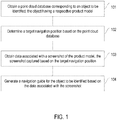
- FIG. 1 is a flow diagram illustrating a method for generating a navigation guide according to an embodiment of the disclosure. As shown in FIG. 1 , the method for generating a navigation guide includes the following steps.
- Step 101 obtain a point cloud database corresponding to an object to be identified, the object having a respective product model.
- the point cloud database is recorded in advance for the object to be identified; and the respective product model is also designed in advance for presenting the object to be identified.
- the product model is made by a designer. In other embodiments, the product model is obtained by scanning using a 3D scanning device.
- Step 102 determine a target navigation position based on the point cloud database.
- the navigation guide is generated at a faster speed using the point cloud database such that a user can align to a target navigation position faster to display the object to be identified.
- a mobile device equipped with a camera is configured to perform the method.
- the point cloud database is recorded based on an initialization angle.
- the determining the target navigation position of the object to be identified based on the point cloud database includes: obtaining the initialization angle from the point cloud database; and designating the initialization angle as the target navigation position for the camera of the mobile device.
- Embodiments of the disclosure are applicable to various mobile devices, including but not limited to mobile phones, tablet computers, notebook computers, palmtop computers, in-vehicle terminals, wearable devices, and any other devices equipped with cameras or otherwise capable of capturing images.
- the object to be identified refers to a real-world object, at which a camera of a mobile device aligns.
- a real-world object may include, for example, a water purifier, a dishwasher, and other smart appliances.
- the user when activating an AR application, the user turns on the camera, and the camera starts to scan the object to be identified to obtain video data.
- the AR application is activated by the user after the camera is turned on.
- the point cloud database is recorded by aligning with the object to be identified based on a configured initialization angle to obtain the corresponding point cloud data. Additionally, the object to be identified is further recorded in a rotational manner at the initialization angle to obtain the point cloud data captured at different angles. In some embodiments, the initialization angle is obtained from the point cloud database and used as the target navigation position for the camera.
- Step 103 obtain the data associated with a screenshot of the product model, the screenshot captured based on the target navigation position.
- the product model is a 3D model.
- data associated with a 2D screenshot of the 3D model is obtained.
- the data associated with the screenshot has no other interfering parts/objects except for those associated with the model.
- step 103 includes the following sub-steps.
- Sub-step S11 adjust the product model of the object to be identified based on the target navigation position.
- Sub-step S12 obtain the data associated with the screenshot of the adjusted product model.
- the initialization angle is obtained from the point cloud database, based on which the product model is adjusted such that the position/orientation of the model is in a direction consistent with the one recorded in the point cloud database. Subsequently, a screenshot for the product model is obtained in this direction, and the data associated with the screenshot is also obtained. This way, the product model is well-matched with the object according to a navigation instruction, after the object is identified in an AR environment.
- object identification in an AR environment refers to the techniques that compute the position and orientation of an object in real-time, and align the virtual objects in interactions with real-world objects in a later stage.
- the use of these techniques achieves the later-stage interactions between the object to be identified and the product model such that the product model is adjustably c aligned in relation to the object to be identified (e.g., the overlay is adjustably kept) even through movements of the camera.
- Step 104 generate the navigation guide for the object based on the data associated with the screenshot.
- the navigation guide is used to guide the user to adjust the camera to a position that is expected of the user to place the camera, which may be an angle recorded in the point cloud database.
- step 104 includes the following sub-steps.
- Sub-step S21 extract edge data from the data associated with the screenshot.
- Sub-step S22 adjust the edge color and the background color of the data associated with the screenshot based on the edge data.
- Sub-step S23 extract a profile diagram for the object to be identified based on the adjusted data associated with the screenshot.
- Sub-step S24 designate the profile diagram as the navigation guide for the object to be identified.
- an edge detection algorithm e.g., Sobel algorithm
- the edge data e.g., edges in the image
- the data associated with the screenshot is directly input to a Sobel operator to extract the edge data.
- the edge color and the background of the data associated with the screenshot are specified to generate a profile diagram having corresponding dimensions.
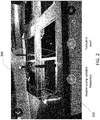
- the relatively sized profile diagram is designated as a navigation guide. As shown in FIG. 2 , an example of a navigation guide 200, is illustrated in the context of a real-world object 250.
- the edge data obtained using the Sobel algorithm captures the most basic feature of an image, and therefore plays an important role in applications such as computer vision, image processing, and the like. Further, the edge information in the image has useful information for content recognition, providing the main mechanism for feature extraction in image processing and pattern recognition.
- a size of an image is specified using functionalities (e.g., the Canvas API defined by HTML standards) provided by, for example, a front-end application (e.g., a web browser).
- functionalities e.g., the Canvas API defined by HTML standards
- a front-end application e.g., a web browser.
- the function of Canvas.toDataUrl() is invoked to obtain an image of the specified width and height.
- the following illustrates a process (e.g., pseudo-code) for generating an image of specified dimensions using the Canvas APIs.
- step 104 further includes the following steps.
- Sub-step S25 perform one or both of frequency filtering and color correction on the edge data.
- a white-colored wireframe or a wireframe in other colors is generated.
- the application of frequency filtering and color correction to the edge data only requires a conditional decision, the pseudo-code of which is illustrated below.
- pixelX and pixelY represent images subjected to lateral and longitudinal edge detection, respectively.
- Magnitude represents a G gradient
- 200 is a threshold value. The larger the threshold value is, the coarser the filtering is, and the more noise points are. On the contrary, with a smaller threshold value, there are fewer noise points.
- 255, 255, 255, 255, alpha represent a color space of red, green, blue and alpha value (e.g., transparency), respectively.
- the set of values [255, 255, 255, 255] represents a color of white opaque, e.g., the desired white-colored wireframe.
- the array pushed by sobelData.push (255, 255, 255, 255) is a color mixer, the elements of which respectively represents red, green, blue and transparency. As such, a wireframe of the desired color is obtained via specifying the corresponding values.
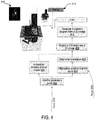
- FIGS. 3A-3B are flow diagrams illustrating a process for activating an AR navigation according to an embodiment of the disclosure.
- an AR application on a front-end of a mobile device e.g., client device
- the front-end of the mobile device is configured to implement camera rendering and service routing.
- An Hailuo Platform 320 is configured to include an AR content material library.
- the camera of the client device is configured to acquire a video stream 302 (e.g., a video stream via a UC Browser) that includes frames of imagery data.
- a navigation bar 301 is displayed on the left-hand side of the front end as well.
- the front-end is configured to send, to the Hailuo Platform 320, an Mtop service request 303, which includes the imagery data captured by the camera of the mobile device.
- the Hailuo Platform 320 is configured to return to the mobile device a page 305 including a jump link (e.g., anchor link), the clicking upon which navigates the user to a page that includes access to the activated camera, and a product model.
- the front-end device is configured to render the video stream acquired by the camera, and then send the rendered results to a display (e.g., screen) of the mobile device for displaying.
- the AR application continues into a tracking mode, as illustrated in FIG. 3B , in which the navigation bar 301 is no longer displayed.
- the AR application on a front-end of a mobile device e.g., client device
- the front-end of the mobile device is configured to, in addition to the afore-described camera rendering and service routing,
- the front end can perform processing based on the video stream 352 and a tracking result (e.g., a three-dimensional matrix 353) in addition to camera rendering and service routing.
- a tracking result e.g., a three-dimensional matrix 353
- the point cloud data 390 and the video stream 352 are sent to an algorithm operator 340 to obtain a processed video stream.
- the processed video stream is sent to the front end to achieve the superposition alignment (e.g., superimpose) between the real-world object and the virtual object, with based on the tracking result, and finally.
- the processed video stream is sent to the screen of the terminal mobile device for displaying to be played.
- FIG. 3B also illustrates two examples of the generation of model information for input to, for example, e algorithm operator 340.
- point cloud technique is used to generate point cloud data as the model information.
- the limitation is that live recording is required, and the cost of manual intervention is high.
- models are used to generate object model data as the model information.
- the limitation is that scanning is required, and a real-world object needs to be completed displayed.
- the process further includes: loading a pre-configured service page when activating an AR application, where the service page includes the navigation guide for the object to be identified; and controlling the camera movement to scan the object to be identified to obtain video data.
- a pre-configured service page is loaded upon the AR application being activated.
- the service page is configured to include the navigation guide for the object to be identified so as to guide the user to reposition the camera's pose (e.g., position, orientation) to a target navigation position/pose.
- the camera is also controlled to scan the object to be identified, and video data of the object to be identified captured by the camera is received at the AR application.
- the video data includes imagery data.
- the process further includes: obtaining AR content material data from a content material library when a user aligns the camera onto the object to be identified based on the navigation guide; matching the imagery data in the video data with the point cloud database to obtain a three-dimensional matrix; and interacting the content material data and the imagery data in relation to the product model, based on the three-dimensional matrix, to present the object to be identified to the user.
- the content material data includes one or more of: animation data, textural data, and/or other annotation data.
- the user can be prompted to align the camera onto the object to be identified based on the navigation guide.
- the angle used by the user for aligning the camera onto the object is the same as the initialization angle recorded in the point cloud database in association with the product model.
- the user obtains content materials from a content material library, such as an animation, texture, and other annotation data. These content materials are in turn used for presenting the object to be identified to the user.
- a content material library such as an animation, texture, and other annotation data.
- a point cloud database is retrieved.
- the data in the point cloud database is matched against the imagery data obtained by a lens (e.g., of the camera) for the object, frame by frame, so that two variables (a projection matrix and a view matrix), e.g., a three-dimensional matrix, is generated upon a successful match.
- FIG. 5 is a flow diagram illustrating a process for computing 3D matrixes according to an embodiment of the present disclosure.
- the user's camera is configured to obtain camera input at 502, after which camera data (e.g., input source) 504 is transmitted to an algorithm operator 506 for processing.
- camera data e.g., input source
- data 512 including feature point data, position data, ration data, camera calibration data and the like is used to generated points cloud data 510 (the details of which is described in connection with FIG. 6 below).
- the point cloud data 510 is also transmitted to the algorithm operator 506, which is configured to generate the two above-described matrixes 508.
- the information corresponding to the projection matrix and the view matrix that are identified and extracted by the algorithm operator is applied to the virtual object. Any other suitable technique can also be used herein for implementation, without limitation.
- a point cloud database pre-configured for the object to be identified in advance is obtained.
- An initial target navigation position is determined based on the point cloud database.
- data associated with a screenshot of the product model is obtained.
- a navigation guide for guiding a user to align a camera onto the object to be identified is generated based on the data associated with the screenshot.
- the navigation guide is generated quickly using the point cloud database, thereby the user can reply to the navigation guide to more accurately scan the object to be identified speed and then to present such an object.
- the improved process does not involve manual modification of the navigation guide, entailing no manual labor required and yet high processing speed.
- FIG. 6 is a flow diagram illustrating a method for generating a point cloud database according to an embodiment of the disclosure. As shown herein, the method includes the following steps.
- Step 201 obtain a product model associated with an object to be identified.
- Step 202 record the product model at an initialization angle to obtain point cloud data corresponding to the initialization angle.
- Step 203 record the product model at a plurality of recording angles to obtain point cloud data corresponding to the plurality of recording angles.
- Step 204 store the initialization angle and the point cloud data corresponding to the initialization angle, as well as the plurality of recording angles and the point cloud data corresponding to the plurality of recording angles into a point cloud database.
- an algorithm engineer aligns a camera at the object to be identified at a certain angle (e.g., the initialization angle) during initialization.
- the point cloud data associated with the feature points of the object to be identified and the initialization angle are both recorded.
- the algorithm engineer rotates the camera around the object to be identified to record the point cloud data associated with the feature points of the object at different angles.
- the point cloud data includes data such as three-dimensional edge information and shape information.
- a compressed package (e.g., the point cloud database) is generated.
- the cloud point database includes the above-described initialization angle and recording angles, as well as their respective point cloud data, A projection matrix and a view matrix are extracted from the point cloud data using a recognition algorithm. The two matrices are the two important variables for properly aligning the virtual object in relation to the real-world object.
- the compressed package is retrieved and matched against the object (to be identified) that is captured by the camera.
- the matching results include: whether the scanned object is identified; and/or identifying a three-dimensional matrix (e.g., including the projection matrix and the view matrix) for the object.
- the matrix is used to restore the position of the object in the screen of an AR system so that the virtual object is accurately aligned in relation to the real-world object.
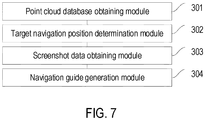
- FIG. 7 is block diagram illustrating an apparatus for generating a navigation guide according to an embodiment of the disclosure.
- the apparatus includes a point cloud database obtaining module (301), a target navigation position determination module (302), a screenshot data obtaining module (303), and a navigation guide generation module (304).
- the point cloud database obtaining module (301) is configured for obtaining a point cloud database corresponding to an object to be identified, the object having a respective product model.
- the target navigation position determination module (302) is configured for determining a target navigation position based on the point cloud database.
- the screenshot data obtaining module (303) is configured for obtaining data associated with a screenshot of the product model, the screenshot captured based on the target navigation position.
- the navigation guide generation module (304) is configured for generating the navigation guide for the object to be identified based on the data associated with the screenshot.
- the apparatus is included at a mobile device with a camera.
- the point cloud database is recorded based on an initialization angle.
- the target navigation position determination module (302) includes an initialization angle acquisition sub-module for obtaining the initialization angle from the point cloud database; and a target navigation position designating sub-module for designating the initialization angle as the target navigation position for the camera.
- the screenshot data acquisition module (303) includes: a product model adjustment sub-module for adjusting the product model of the object to be identified based on the target navigation position; and a screenshot data acquisition sub-module for obtaining the data associated with the screenshot of the adjusted product model.
- the navigation guide generation module (304) includes: an edge data extraction sub-module for extracting edge data from the data associated with the screenshot; a screenshot data adjustment sub-module for adjusting edge color and background color of the data associated with the screenshot based on the edge data; a profile diagram extraction sub-module for extracting a profile diagram of the object to be identified based on the adjusted data associated with the screenshot; and a navigation guide designating sub-module for designating the profile diagram as the navigation guide for the object to be identified.
- the navigation guide generation module (304) further includes a data processing sub-module for performing frequency filtering and color correction on the edge data.
- the apparatus further includes a service page loading module for loading a pre-configured service page upon activating an AR application, where the service page includes the navigation guide for the object to be identified; and a video data acquisition module for controlling the movement of the camera to scan the object to be identified to obtain video data.
- the video data includes imagery data.
- the apparatus further includes a content material data obtaining module for obtaining content material data from a content material library when a user aligns the camera onto the object to be identified based on the navigation guide; a three-dimensional matrix acquisition module for matching the imagery data in the video data with the point cloud database to obtain a three-dimensional matrix; and an object presentation module for interacting the content material data and the imagery data in relation to the product model based on the three-dimensional matrix to present the object to be identified to the user, where the content material data includes one or more of: animation data, textural data, and other annotation data.
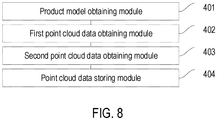
- FIG. 8 is block diagram illustrating an apparatus for generating a point cloud database according to an embodiment of the disclosure.
- the apparatus includes a product model obtaining module (401), a first point cloud data obtaining module (402), a second point cloud data obtaining module (403), point cloud data storing module (404).
- the product model obtaining module (401) is configured for obtaining a product model of an object for identifying.
- the first point cloud data obtaining module (402) is configured for recording the product model at an initialization angle to obtain the point cloud data associated with the initialization angle.
- the second point cloud data obtaining module (403) is configured for recording the product model at a plurality of recording angles to obtain the point cloud data associated with the plurality of recording angles.
- the point cloud data storing module (404) is configured for storing, into the point cloud database, the initialization angle and the point cloud data associated with the initialization angle, as well as the plurality of recording angles and the point cloud data associated with the plurality of recording angles.
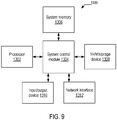
- FIG. 9 is a block diagram illustrating an exemplary system (or apparatus) (1300) for implementing various embodiments of the disclosure.
- the system (1300) includes one or more processors (1302); at least one system control module (chip set) (1304) coupled to the processor(s) (1302); a system memory (1306) coupled to the system control module (1304); a non-volatile memory (NVM)/storage device (1308) coupled to the system control module (1304); one or more input/output devices (1310) coupled to the system control module (1304); and a network interface (1312) coupled to the system control module (1306).
- the processors (1302) includes one or more single-core or multi-core processors.
- the processors (1302) may include any combination of general purpose processors or special purpose processors (for example, graphics processors, application processors, or baseband processors).
- the system (1300) is used as a data platform as described herein.
- the system (1300) includes one or more computer-readable media (for example, the system memory (1306) or NVM/storage device (1308)) having instructions stored thereon.
- the one or more processors (1302) are coupled to the one or more computer-readable media and configured to execute the instructions to perform methods as above-described.
- system control module (1304) includes any suitable interface controller to provide any suitable interface to at least one of the processor(s) (1302) and/or to any suitable device or component in communication with the system control module (1304).
- the system control module (1304) includes a memory controller module to provide an interface to the system memory (1306).
- the memory controller module may be a hardware module, a software module, and/or a firmware module.
- the system memory (1306) is used to load and store data and/or instructions, for example, for the system (1300).
- the system memory (1306) includes any suitable volatile memory, such as a suitable DRAM.
- the system memory (1306) includes a double data rate type four synchronous dynamic random-access memory (DDR SDRAM).
- system control module (1304) includes one or more input/output controllers to provide an interface to the NVM/storage device (1308) and the input/output device(s) (1310).
- the NVM/storage device (1308) may be used to store data and/or instructions.
- the NVM/storage device (1308) may include any suitable non-volatile memory (for example, a flash memory) and/or may include any suitable non-volatile storage device(s) (for example, one or more hard disk drives (HDDs), one or more compact disc (CD) drives, and/or one or more digital versatile disc (DVD) drives).
- suitable non-volatile memory for example, a flash memory
- suitable non-volatile storage device(s) for example, one or more hard disk drives (HDDs), one or more compact disc (CD) drives, and/or one or more digital versatile disc (DVD) drives.
- HDDs hard disk drives
- CD compact disc
- DVD digital versatile disc
- the NVM/storage device (130)8 includes a storage resource that physically forms a part of a device on which the system (1300) is installed; or it may be accessible by the device and not necessarily being a part of the device.
- the NVM/storage device (1308) may be accessed over a network via the input/output device(s) (1310).
- the input/output device(s) (1310) provides an interface for the system (1300) to communicate with any other suitable device.
- the input/output devices (1310) includes a communication component, an audio component, a sensor component, and the like.
- the network interface (1312) provides an interface for the system (1300) to communicate through one or a plurality of networks.
- the system (1300) may wirelessly communicate with one or a plurality of components of a wireless network in accordance with any of one or a plurality of wireless network standards and/or protocols. such as accessing a wireless network based on a communication standard like WiFi, 2G, or 3G or a combination thereof to perform wireless communication.
- At least one of the processor(s) (1302) is packaged together with logic of one or a plurality of controllers (for example, the memory controller module) of the system control module (1304). In one embodiment, at least one of the processor(s) (1302) is packaged together with logic of one or a plurality of controllers of the system control module (1304) to form a System in Package (SiP). In one embodiment, at least one of the processor(s) (1302) is integrated on the same die with logic of one or a plurality of controllers of the system control module (1304). In one embodiment, at least one of the processor(s) (1302) is integrated on the same die with logic of one or a plurality of controllers of the system control module (1304) to form a System on Chip (SoC).
- SoC System on Chip
- the system (1300) may be, but is not limited to, a browser, a workstation, a desktop computing device, or a mobile computing device (for example, a laptop computing device, a hand-held computing device, a tablet computer, or a netbook).
- the system (1300) may have more or fewer components and/or different architectures.
- the system (1300) includes one or more of a camera, a keyboard, a liquid crystal display (LCD) screen (including a touch screen display), a non-volatile memory port, a plurality of antennas, a graphics chip, an application specific integrated circuit (ASIC), and a speaker.
- LCD liquid crystal display
- ASIC application specific integrated circuit
- a display screen may be implemented as a touch screen display to receive input signals from a user.
- the touch panel includes one or more touch sensors to sense touches, swipes, and gestures on the touch panel.
- the touch sensors may not only sense a boundary of a touch or swipe action, but also detect a period of time and a pressure related to the touch or swipe operation.
- the disclosure further provides a non-volatile readable storage medium in which one or more modules (programs) is/are stored.
- the device is configured to execute instructions in various steps of the methods described above herein.
- the disclosure provides an apparatus including: one or more processors; and one or more computer-readable media having instructions stored thereon, when executed by the one or more processors, the instructions causes the apparatus to execute instructions in various steps of the methods described above herein.
- embodiments of the disclosure may be provided as a method, an apparatus, or a computer program product. Therefore, an embodiment of the disclosure may use forms of a full hardware embodiment, a full software embodiment, or an embodiment combining software and hardware aspects. Moreover, an embodiment of the disclosure may employ the format of a computer program product implemented on one or more computer usable storage media (including, but not limited to, a magnetic disk memory, a CD-ROM, an optical memory, and so on) containing computer usable program code therein.
- computer usable storage media including, but not limited to, a magnetic disk memory, a CD-ROM, an optical memory, and so on
- the computer device includes one or more processors (CPUs), input/output interfaces, network interfaces, and memories.
- the memory may include computer-readable medium in the form of non-permanent memory, random access memory (RAM) and/or non-volatile memory or the like, such as read-only memory (ROM) or flash memory (flash RAM).
- RAM random access memory
- ROM read-only memory
- flash RAM flash memory
- the memory is an example of a computer-readable medium.
- the computer-readable medium includes permanent and non-permanent, movable and non-movable media that can achieve information storage by means of any methods or techniques.
- the information may be computer-readable instructions, data structures, modules of programs or other data.
- Examples of the computer storage medium include, but are not limited to, phase-change memory (PRAM), static random access memory (SRAM), dynamic random access memory (DRAM), other types of random access memory (RAM), read-only memory (ROM), electrically erasable programmable read-only memory (EEPROM), flash memory or other memory technologies, read-only compact disc read-only memory (CD-ROM), digital versatile disk (DVD) or other optical storages, magnetic cassette, magnetic tape, magnetic disk storage or other magnetic storage devices, or any other non-transmission medium that can be used for storing information accessible by a computing device.
- the computer readable medium does not include transitory computer readable media (transitory media), such as modulated data signals and carrier waves.
- These computer program instructions may be provided to a general-purpose computer, a special-purpose computer, an embedded processor, or a processor of any other programmable data processing terminal device to generate a machine, so that the instructions executed by a computer or a processor of any other programmable data processing terminal device generate an apparatus for implementing a specified function in one or more processes in the flowcharts and/or in one or more blocks in the block diagrams.
- These computer program instructions may also be stored in a computer-readable memory that can direct a computer or another programmable data processing terminal device to operate in a particular manner, such that the instructions stored in the computer-readable memory produce an article of manufacture including instruction means, the instruction means implementing the functions specified in one or more flows of the flowcharts and/or one or more blocks of the block diagrams.
- These computer program instructions may also be loaded onto a computer or another programmable data processing terminal device such that a series of operational steps are performed on the computer or another programmable terminal device to produce a computer-implemented processing, and thus the instructions executed on the computer or another programmable terminal device provide the steps for implementing the functions specified in one or more flows of the flowcharts and/or one or more blocks of the block diagrams.
Landscapes
- Engineering & Computer Science (AREA)
- Theoretical Computer Science (AREA)
- Physics & Mathematics (AREA)
- General Physics & Mathematics (AREA)
- Software Systems (AREA)
- Multimedia (AREA)
- Computer Vision & Pattern Recognition (AREA)
- General Engineering & Computer Science (AREA)
- Computer Hardware Design (AREA)
- Computer Graphics (AREA)
- Evolutionary Computation (AREA)
- General Health & Medical Sciences (AREA)
- Medical Informatics (AREA)
- Databases & Information Systems (AREA)
- Computing Systems (AREA)
- Artificial Intelligence (AREA)
- Health & Medical Sciences (AREA)
- Radar, Positioning & Navigation (AREA)
- Remote Sensing (AREA)
- Architecture (AREA)
- Processing Or Creating Images (AREA)
- Image Analysis (AREA)
- Navigation (AREA)
Applications Claiming Priority (2)
| Application Number | Priority Date | Filing Date | Title |
|---|---|---|---|
| CN201711353151.5A CN109931923B (zh) | 2017-12-15 | 2017-12-15 | 一种导航引导图的生成方法和装置 |
| PCT/CN2018/120076 WO2019114653A1 (fr) | 2017-12-15 | 2018-12-10 | Procédé et appareil permettant de produire un diagramme de guidage de navigation |
Publications (2)
| Publication Number | Publication Date |
|---|---|
| EP3726478A1 true EP3726478A1 (fr) | 2020-10-21 |
| EP3726478A4 EP3726478A4 (fr) | 2021-09-08 |
Family
ID=66819983
Family Applications (1)
| Application Number | Title | Priority Date | Filing Date |
|---|---|---|---|
| EP18888051.2A Pending EP3726478A4 (fr) | 2017-12-15 | 2018-12-10 | Procédé et appareil permettant de produire un diagramme de guidage de navigation |
Country Status (6)
| Country | Link |
|---|---|
| US (1) | US11170574B2 (fr) |
| EP (1) | EP3726478A4 (fr) |
| JP (1) | JP7244185B2 (fr) |
| CN (1) | CN109931923B (fr) |
| TW (1) | TW201928725A (fr) |
| WO (1) | WO2019114653A1 (fr) |
Families Citing this family (3)
| Publication number | Priority date | Publication date | Assignee | Title |
|---|---|---|---|---|
| WO2021121306A1 (fr) * | 2019-12-18 | 2021-06-24 | 北京嘀嘀无限科技发展有限公司 | Procédé et système de localisation visuelle |
| CN113886682B (zh) * | 2021-09-10 | 2024-09-27 | 平安科技(深圳)有限公司 | 肩颈运动场景下的信息推送方法、系统和存储介质 |
| US12423926B2 (en) | 2022-07-28 | 2025-09-23 | Ntt Docomo, Inc. | XR multi-window control |
Family Cites Families (49)
| Publication number | Priority date | Publication date | Assignee | Title |
|---|---|---|---|---|
| US7324081B2 (en) | 1999-03-02 | 2008-01-29 | Siemens Aktiengesellschaft | Augmented-reality system for situation-related support of the interaction between a user and an engineering apparatus |
| JP4433525B2 (ja) | 1999-10-05 | 2010-03-17 | 株式会社セガ | 画像処理装置 |
| KR101309176B1 (ko) | 2006-01-18 | 2013-09-23 | 삼성전자주식회사 | 증강 현실 장치 및 방법 |
| US8060186B2 (en) * | 2007-02-15 | 2011-11-15 | Siemens Aktiengesellschaft | System and method for intraoperative guidance of stent placement during endovascular interventions |
| US8180396B2 (en) | 2007-10-18 | 2012-05-15 | Yahoo! Inc. | User augmented reality for camera-enabled mobile devices |
| US10133438B2 (en) | 2008-09-17 | 2018-11-20 | Nokia Technologies Oy | User interface for augmented reality |
| US8442502B2 (en) | 2010-03-02 | 2013-05-14 | Empire Technology Development, Llc | Tracking an object in augmented reality |
| US9901828B2 (en) | 2010-03-30 | 2018-02-27 | Sony Interactive Entertainment America Llc | Method for an augmented reality character to maintain and exhibit awareness of an observer |
| US8803992B2 (en) * | 2010-05-12 | 2014-08-12 | Fuji Xerox Co., Ltd. | Augmented reality navigation for repeat photography and difference extraction |
| WO2012003844A1 (fr) | 2010-07-05 | 2012-01-12 | Sony Ericsson Mobile Communications Ab | Procédé d'affichage d'informations d'augmentation dans un système de réalité augmentée |
| US20120019557A1 (en) | 2010-07-22 | 2012-01-26 | Sony Ericsson Mobile Communications Ab | Displaying augmented reality information |
| WO2012020867A1 (fr) | 2010-08-13 | 2012-02-16 | 엘지전자 주식회사 | Appareil et procédé permettant d'afficher des informations de service rendues à l'intérieur d'une zone de service |
| GB201208088D0 (en) * | 2012-05-09 | 2012-06-20 | Ncam Sollutions Ltd | Ncam |
| US9854328B2 (en) | 2012-07-06 | 2017-12-26 | Arris Enterprises, Inc. | Augmentation of multimedia consumption |
| US20150206349A1 (en) | 2012-08-22 | 2015-07-23 | Goldrun Corporation | Augmented reality virtual content platform apparatuses, methods and systems |
| CN103279987B (zh) * | 2013-06-18 | 2016-05-18 | 厦门理工学院 | 基于Kinect的物体快速三维建模方法 |
| US10217284B2 (en) | 2013-09-30 | 2019-02-26 | Qualcomm Incorporated | Augmented virtuality |
| US9773313B1 (en) * | 2014-01-03 | 2017-09-26 | Google Inc. | Image registration with device data |
| JP6138077B2 (ja) | 2014-03-19 | 2017-05-31 | 三菱電機株式会社 | 写真計測システムおよび写真撮影位置指示方法 |
| WO2015155628A1 (fr) * | 2014-04-07 | 2015-10-15 | Eyeways Systems Ltd. | Appareil et procédé pour le positionnement, l'orientation et la conscience de la situation à base d'images |
| CN105023266B (zh) * | 2014-04-29 | 2018-03-30 | 高德软件有限公司 | 增强现实实现方法、装置和终端设备 |
| US9886162B2 (en) | 2014-06-02 | 2018-02-06 | Qualcomm Incorporated | Device-provided tracking data for augmented reality |
| CN105303384A (zh) * | 2014-07-21 | 2016-02-03 | 上海羽舟网络科技有限公司 | 一种产品的3d展示方法及系统 |
| CN104183014B (zh) * | 2014-08-13 | 2017-01-18 | 浙江大学 | 一种面向城市增强现实的高融合度信息标注方法 |
| US9875579B2 (en) * | 2014-08-22 | 2018-01-23 | Applied Research Associates, Inc. | Techniques for enhanced accurate pose estimation |
| DE102014013678B3 (de) * | 2014-09-10 | 2015-12-03 | Faro Technologies, Inc. | Verfahren zum optischen Abtasten und Vermessen einer Umgebung mit einem Handscanner und Steuerung durch Gesten |
| CN104376552B (zh) * | 2014-09-19 | 2017-12-29 | 四川大学 | 一种3d模型与二维图像的虚实配准方法 |
| US9990028B2 (en) | 2014-10-03 | 2018-06-05 | Verizon Patent And Licensing Inc. | System and method for providing live augmented reality content |
| US20160358383A1 (en) * | 2015-06-05 | 2016-12-08 | Steffen Gauglitz | Systems and methods for augmented reality-based remote collaboration |
| US20170017301A1 (en) * | 2015-07-16 | 2017-01-19 | Hand Held Products, Inc. | Adjusting dimensioning results using augmented reality |
| CN105261060A (zh) * | 2015-07-23 | 2016-01-20 | 东华大学 | 基于点云压缩和惯性导航的移动场景实时三维重构方法 |
| US10092361B2 (en) * | 2015-09-11 | 2018-10-09 | AOD Holdings, LLC | Intraoperative systems and methods for determining and providing for display a virtual image overlaid onto a visual image of a bone |
| US9599825B1 (en) * | 2015-09-30 | 2017-03-21 | Daqri, Llc | Visual indicator for transparent display alignment |
| US20170103574A1 (en) | 2015-10-13 | 2017-04-13 | Google Inc. | System and method for providing continuity between real world movement and movement in a virtual/augmented reality experience |
| US10268740B2 (en) | 2015-10-14 | 2019-04-23 | Tharmalingam Satkunarajah | 3D analytics actionable solution support system and apparatus |
| US10402676B2 (en) * | 2016-02-15 | 2019-09-03 | Pictometry International Corp. | Automated system and methodology for feature extraction |
| CN105989604A (zh) * | 2016-02-18 | 2016-10-05 | 合肥工业大学 | 一种基于kinect的目标物体三维彩色点云生成方法 |
| US20170312032A1 (en) * | 2016-04-27 | 2017-11-02 | Arthrology Consulting, Llc | Method for augmenting a surgical field with virtual guidance content |
| CN106097425A (zh) * | 2016-06-07 | 2016-11-09 | 天津天大求实电力新技术股份有限公司 | 基于增强现实技术的电力设备信息提取与展示方法及系统 |
| CN106254848B (zh) | 2016-07-29 | 2019-06-11 | 宇龙计算机通信科技(深圳)有限公司 | 一种基于增强现实的学习方法及终端 |
| JP6917820B2 (ja) * | 2016-08-05 | 2021-08-11 | 株式会社半導体エネルギー研究所 | データ処理システム |
| CN106355647A (zh) | 2016-08-25 | 2017-01-25 | 北京暴风魔镜科技有限公司 | 增强现实系统和方法 |
| US10115236B2 (en) * | 2016-09-21 | 2018-10-30 | Verizon Patent And Licensing Inc. | Placing and presenting virtual objects in an augmented reality environment |
| US20180101989A1 (en) * | 2016-10-06 | 2018-04-12 | Google Inc. | Headset removal in virtual, augmented, and mixed reality using an eye gaze database |
| US10341568B2 (en) * | 2016-10-10 | 2019-07-02 | Qualcomm Incorporated | User interface to assist three dimensional scanning of objects |
| CN106502419A (zh) * | 2016-11-11 | 2017-03-15 | 广州市万表科技股份有限公司 | 虚拟手表试戴方法及装置 |
| US10489975B2 (en) * | 2017-01-04 | 2019-11-26 | Daqri, Llc | Environmental mapping system |
| CN107292921B (zh) * | 2017-06-19 | 2020-02-04 | 电子科技大学 | 一种基于kinect相机的快速三维重建方法 |
| US11587315B2 (en) * | 2019-06-19 | 2023-02-21 | Deere & Company | Apparatus and methods for augmented reality measuring of equipment |
-
2017
- 2017-12-15 CN CN201711353151.5A patent/CN109931923B/zh active Active
-
2018
- 2018-10-12 TW TW107135972A patent/TW201928725A/zh unknown
- 2018-12-10 JP JP2020529350A patent/JP7244185B2/ja active Active
- 2018-12-10 WO PCT/CN2018/120076 patent/WO2019114653A1/fr not_active Ceased
- 2018-12-10 EP EP18888051.2A patent/EP3726478A4/fr active Pending
- 2018-12-10 US US16/766,835 patent/US11170574B2/en active Active
Also Published As
| Publication number | Publication date |
|---|---|
| WO2019114653A1 (fr) | 2019-06-20 |
| CN109931923A (zh) | 2019-06-25 |
| US20200372711A1 (en) | 2020-11-26 |
| EP3726478A4 (fr) | 2021-09-08 |
| JP7244185B2 (ja) | 2023-03-22 |
| JP2021507332A (ja) | 2021-02-22 |
| CN109931923B (zh) | 2023-07-07 |
| US11170574B2 (en) | 2021-11-09 |
| TW201928725A (zh) | 2019-07-16 |
Similar Documents
| Publication | Publication Date | Title |
|---|---|---|
| US9756261B2 (en) | Method for synthesizing images and electronic device thereof | |
| US10410089B2 (en) | Training assistance using synthetic images | |
| CN108769517B (zh) | 一种基于增强现实进行远程辅助的方法与设备 | |
| US9619861B2 (en) | Apparatus and method for improving quality of enlarged image | |
| US20190213712A1 (en) | Motion blur simulation | |
| US11620730B2 (en) | Method for merging multiple images and post-processing of panorama | |
| CN109614983A (zh) | 训练数据的生成方法、装置及系统 | |
| CN105187814A (zh) | 影像处理方法以及影像处理装置 | |
| CA2898668A1 (fr) | Procede et dispositif de mise en uvre destines a une realite augmentee pour code bidimensionnel | |
| CN109743566B (zh) | 一种用于识别vr视频格式的方法与设备 | |
| US20140204083A1 (en) | Systems and methods for real-time distortion processing | |
| CN110751735B (zh) | 一种基于增强现实的远程指导的方法与设备 | |
| US10762713B2 (en) | Method for developing augmented reality experiences in low computer power systems and devices | |
| US11170574B2 (en) | Method and apparatus for generating a navigation guide | |
| CN114387346A (zh) | 一种图像识别、预测模型处理方法、三维建模方法和装置 | |
| CN103399629B (zh) | 获取手势屏幕显示坐标的方法和装置 | |
| KR102450236B1 (ko) | 전자 장치, 그 제어 방법 및 컴퓨터 판독가능 기록 매체 | |
| WO2015072091A1 (fr) | Dispositif de traitement d'images, procédé de traitement d'images, et support de stockage de programmes | |
| CN110290299A (zh) | 成像方法、装置、存储介质及电子设备 | |
| CN114972048A (zh) | 一种图像处理、图像变形方法和装置 | |
| KR20140132568A (ko) | 움직이는 물체를 하나의 이미지에 합성하기 위한 장치 및 방법 | |
| JP2020177617A (ja) | 深度エンジンを用いた対話型画像処理の方法、装置、媒体 | |
| JP2020177618A (ja) | 深度エンジンとデジタル信号プロセッサを用いた対話型画像処理の方法、装置、媒体 | |
| US11431923B2 (en) | Method of imaging by multiple cameras, storage medium, and electronic device | |
| KR20150039049A (ko) | 템플릿 편집 프레임 크기에 따른 사용자 인터페이스 제공 방법 및 그 장치 |
Legal Events
| Date | Code | Title | Description |
|---|---|---|---|
| STAA | Information on the status of an ep patent application or granted ep patent |
Free format text: STATUS: THE INTERNATIONAL PUBLICATION HAS BEEN MADE |
|
| PUAI | Public reference made under article 153(3) epc to a published international application that has entered the european phase |
Free format text: ORIGINAL CODE: 0009012 |
|
| STAA | Information on the status of an ep patent application or granted ep patent |
Free format text: STATUS: REQUEST FOR EXAMINATION WAS MADE |
|
| 17P | Request for examination filed |
Effective date: 20200611 |
|
| AK | Designated contracting states |
Kind code of ref document: A1 Designated state(s): AL AT BE BG CH CY CZ DE DK EE ES FI FR GB GR HR HU IE IS IT LI LT LU LV MC MK MT NL NO PL PT RO RS SE SI SK SM TR |
|
| AX | Request for extension of the european patent |
Extension state: BA ME |
|
| DAV | Request for validation of the european patent (deleted) | ||
| DAX | Request for extension of the european patent (deleted) | ||
| A4 | Supplementary search report drawn up and despatched |
Effective date: 20210806 |
|
| RIC1 | Information provided on ipc code assigned before grant |
Ipc: G06K 9/00 20060101ALI20210803BHEP Ipc: G06T 7/38 20170101ALI20210803BHEP Ipc: G06T 17/00 20060101ALI20210803BHEP Ipc: G06T 19/00 20110101AFI20210803BHEP |
|
| STAA | Information on the status of an ep patent application or granted ep patent |
Free format text: STATUS: EXAMINATION IS IN PROGRESS |
|
| 17Q | First examination report despatched |
Effective date: 20230221 |
|
| P01 | Opt-out of the competence of the unified patent court (upc) registered |
Effective date: 20230418 |