EP3726873A1 - Verfahren zur authentifizierung eines benutzers bei einem dienstanbieter - Google Patents
Verfahren zur authentifizierung eines benutzers bei einem dienstanbieter Download PDFInfo
- Publication number
- EP3726873A1 EP3726873A1 EP19305509.2A EP19305509A EP3726873A1 EP 3726873 A1 EP3726873 A1 EP 3726873A1 EP 19305509 A EP19305509 A EP 19305509A EP 3726873 A1 EP3726873 A1 EP 3726873A1
- Authority
- EP
- European Patent Office
- Prior art keywords
- akma
- gba
- service provider
- key
- user equipment
- Prior art date
- Legal status (The legal status is an assumption and is not a legal conclusion. Google has not performed a legal analysis and makes no representation as to the accuracy of the status listed.)
- Withdrawn
Links
- 238000000034 method Methods 0.000 title claims abstract description 23
- 238000004891 communication Methods 0.000 claims abstract description 23
- 238000009795 derivation Methods 0.000 claims abstract description 18
- 238000004364 calculation method Methods 0.000 claims abstract description 4
- 230000006870 function Effects 0.000 description 14
- 238000010586 diagram Methods 0.000 description 5
- 230000007246 mechanism Effects 0.000 description 1
- 238000012986 modification Methods 0.000 description 1
- 230000004048 modification Effects 0.000 description 1
- 230000007704 transition Effects 0.000 description 1
Images

Classifications
-
- H—ELECTRICITY
- H04—ELECTRIC COMMUNICATION TECHNIQUE
- H04L—TRANSMISSION OF DIGITAL INFORMATION, e.g. TELEGRAPHIC COMMUNICATION
- H04L9/00—Cryptographic mechanisms or cryptographic arrangements for secret or secure communications; Network security protocols
- H04L9/08—Key distribution or management, e.g. generation, sharing or updating, of cryptographic keys or passwords
- H04L9/0816—Key establishment, i.e. cryptographic processes or cryptographic protocols whereby a shared secret becomes available to two or more parties, for subsequent use
- H04L9/0838—Key agreement, i.e. key establishment technique in which a shared key is derived by parties as a function of information contributed by, or associated with, each of these
- H04L9/0841—Key agreement, i.e. key establishment technique in which a shared key is derived by parties as a function of information contributed by, or associated with, each of these involving Diffie-Hellman or related key agreement protocols
-
- H—ELECTRICITY
- H04—ELECTRIC COMMUNICATION TECHNIQUE
- H04L—TRANSMISSION OF DIGITAL INFORMATION, e.g. TELEGRAPHIC COMMUNICATION
- H04L9/00—Cryptographic mechanisms or cryptographic arrangements for secret or secure communications; Network security protocols
- H04L9/08—Key distribution or management, e.g. generation, sharing or updating, of cryptographic keys or passwords
- H04L9/0816—Key establishment, i.e. cryptographic processes or cryptographic protocols whereby a shared secret becomes available to two or more parties, for subsequent use
- H04L9/0838—Key agreement, i.e. key establishment technique in which a shared key is derived by parties as a function of information contributed by, or associated with, each of these
- H04L9/0841—Key agreement, i.e. key establishment technique in which a shared key is derived by parties as a function of information contributed by, or associated with, each of these involving Diffie-Hellman or related key agreement protocols
- H04L9/0844—Key agreement, i.e. key establishment technique in which a shared key is derived by parties as a function of information contributed by, or associated with, each of these involving Diffie-Hellman or related key agreement protocols with user authentication or key authentication, e.g. ElGamal, MTI, MQV-Menezes-Qu-Vanstone protocol or Diffie-Hellman protocols using implicitly-certified keys
-
- H—ELECTRICITY
- H04—ELECTRIC COMMUNICATION TECHNIQUE
- H04L—TRANSMISSION OF DIGITAL INFORMATION, e.g. TELEGRAPHIC COMMUNICATION
- H04L9/00—Cryptographic mechanisms or cryptographic arrangements for secret or secure communications; Network security protocols
- H04L9/08—Key distribution or management, e.g. generation, sharing or updating, of cryptographic keys or passwords
- H04L9/0861—Generation of secret information including derivation or calculation of cryptographic keys or passwords
-
- H—ELECTRICITY
- H04—ELECTRIC COMMUNICATION TECHNIQUE
- H04L—TRANSMISSION OF DIGITAL INFORMATION, e.g. TELEGRAPHIC COMMUNICATION
- H04L9/00—Cryptographic mechanisms or cryptographic arrangements for secret or secure communications; Network security protocols
- H04L9/30—Public key, i.e. encryption algorithm being computationally infeasible to invert or user's encryption keys not requiring secrecy
- H04L9/3066—Public key, i.e. encryption algorithm being computationally infeasible to invert or user's encryption keys not requiring secrecy involving algebraic varieties, e.g. elliptic or hyper-elliptic curves
-
- H—ELECTRICITY
- H04—ELECTRIC COMMUNICATION TECHNIQUE
- H04W—WIRELESS COMMUNICATION NETWORKS
- H04W12/00—Security arrangements; Authentication; Protecting privacy or anonymity
- H04W12/06—Authentication
- H04W12/069—Authentication using certificates or pre-shared keys
-
- H—ELECTRICITY
- H04—ELECTRIC COMMUNICATION TECHNIQUE
- H04L—TRANSMISSION OF DIGITAL INFORMATION, e.g. TELEGRAPHIC COMMUNICATION
- H04L2209/00—Additional information or applications relating to cryptographic mechanisms or cryptographic arrangements for secret or secure communication H04L9/00
- H04L2209/80—Wireless
-
- H—ELECTRICITY
- H04—ELECTRIC COMMUNICATION TECHNIQUE
- H04W—WIRELESS COMMUNICATION NETWORKS
- H04W12/00—Security arrangements; Authentication; Protecting privacy or anonymity
- H04W12/04—Key management, e.g. using generic bootstrapping architecture [GBA]
- H04W12/041—Key generation or derivation
Definitions
- the present invention relates to a method to authenticate a user at a service provider using a GBA or AKMA protocol to communicate with a user equipment.
- the invention also pertains to a user equipment and to a service provider device using said method.
- GBA Generic Bootstrap Architecture
- the 3G/4G GBA authentication protocol is such that GBA keys established between the service provider and the User Equipment are known by the Mobile Network Operator (MNO). This is an issue raised by several service providers.
- MNO Mobile Network Operator
- the problem is that the MNO is able to decipher the communications between the user equipment (UE) and the service provider device, which is known as Network Application Function or NAF in the GBA protocol, and the confidentiality of the communication cannot be guaranteed.
- 3GPP created a dedicated study item for 5G Rel-16 named AKMA for Authentication and Key Agreement for Applications based on 3GPP credentials in 5G loT (3GPP TR 33.835).
- the AKMA solution should be modified in order to prevent an MNO from knowing the service provider keys shared between the service provider and the user equipment. It is here highlighted that, at the moment, the AKMA is under study and there is not yet final choice of terminology. Therefore, in the final version of AKMA, some entities or keys may have slightly different names than the ones used in the following.
- the presence of the MNO in the framework is mandatory since the service provider can rely on the MNO authentication architecture.
- the MNO ensures that the user is a subscriber of the MNO recently authenticated.
- service providers keys i.e. NAF or AKMA Application Function keys, which are independent from the MNO.
- the present invention aims at avoiding the MNO to be able to decipher the communications between the UE and the NAF or AKMA Application Function to guarantee the confidentiality of the communication.
- the present invention is defined, in its broadest sense, as a method relying on an operator's GBA or AKMA authentication framework while maintaining confidentiality of the communication between the user and the service provider regarding the operator, said method using a Diffie-Hellman exchange between the user equipment and the service provider, leading to a Diffie-Hellman session key, while establishing the GBA or AKMA protocol, said method comprising a step of calculation of a final Network or AKMA Application Function key to be used in further communication between the user equipment and the service provider by derivation from the Diffie-Hellman session key and from the GBA or AKMA protocol's service provider key, the user authentication being performed through the use of the GBA or AKMA protocol.
- the solution consists in adding in GBA or AKMA protocol new parameters enabling the establishment of an initial session key between the user equipment (UE) and the service provider device, i.e. its Network Application Function (NAF) server, independently from the home network owned by an MNO.
- This initial session key specific to the UE and to the NAF is used as input parameter to derive final NAF or AKMA Application Function keys shared between the UE and the NAF, where the "classical" GBA or AKMA keys, i.e. Ks_int/ext_NAF as defined in 3G/4G, are also used as input parameters of the key derivation to ensure that the subscriber was recently authenticated by the MNO according to the GBA or AKMA protocol.
- Diffie-Hellman exchange is selected as method to establish the initial session key between the UE and the NAF.
- the use of Diffie-Hellmann guaranties Perfect Forward Secrecy.
- 3GPP decided that there is no immediate need for Rel-16 to transition to quantum safe algorithms.
- the proposed solution provides keys independence and also perfect forward secrecy, which is an important security feature in the design of a protocol.
- the invention can advantageously be based on elliptic curves.
- the invention also concerns a GBA or AKMA protocol's compliant user equipment adapted to authenticate a user at a service provider using a GBA or AKMA protocol, the authentication relying on an operator's GBA or AKMA authentication framework while maintaining confidentiality of the communication between the user equipment and the service provider regarding the operator, said user equipment having further cryptographic material to establish a Diffie-Hellman exchange with the service provider, leading to a Diffie-Hellman session key, while establishing the GBA or AKMA protocol, said user equipment having a derivation module adapted to derive a final Network or AKMA Application Function key to be used in further communication with the service provider by derivation from the Diffie-Hellman session key and from the GBA or AKMA protocol's service provider key, the user authentication being performed through the use of the GBA or AKMA protocol.
- This user equipment establishes a communication with the service provider's device that is protected using the Diffie-Hellman session key and authenticated using the GBA or AKMA protocol.
- the invention relates at last to a GBA or AKMA protocol's compliant service provider's device adapted to authenticate a user having a GBA or AKMA compliant user equipment using a GBA or AKMA protocol, the authentication relying on an operator's GBA or AKMA authentication framework while maintaining confidentiality of the communication between the user equipment and the service provider regarding the operator, said service provider's device having further cryptographic material to establish a Diffie-Hellman exchange with the user equipment, leading to a Diffie-Hellman session key, while establishing the GBA or AKMA protocol, said service provider's device having a derivation module adapted to derive a final Network or AKMA Application Function key to be used in further communication with the user equipment by derivation from the Diffie-Hellman session key and from the GBA or AKMA protocol's service provider key, the user authentication being performed through the use of the GBA or AKMA protocol.
- Such a service provider's device is adapted to communicate with a user equipment of the invention to allow a confidential and efficient authentication of the user.
- one or more embodiments comprise the features hereinafter fully described and particularly pointed out in the claims.
- Figure 1 represents a time diagram of a GBA based protocol according to the prior art.
- This protocol is based on the ability for a Network Application Function NAF of a service provider SP to rely on a Mobile Network Operator MNO to authenticate a user. This is done using a bootstrap B-TID that is received at the NAF from a user equipment UE of a user which is registered at a Bootstrapping Server Function BSF of the MNO thanks to prior authentication of the subscriber by the MNO.
- the user equipment UE stores at least a bootstrap B-TID and a master key Ks resulting from a dedicated authentication of the user by the MNO.
- a step S1 the user equipment UE derives a NAF key Ks_ext/int_NAF from the master key Ks.
- a step S2 it sends an application request AppR including the bootstrap B-TID and an application specific dataset in a form of a message msg to the NAF of the service provider SP.
- the BSF stores as many bootstrap as registered users. It also stores the master key Ks which remains unknown by the NAF of the service provider SP but which enables the derivation of the user's final NAF keys. It stores at last application specific part of user profile Prof.
- the BSF While receiving a bootstrap B-TID and a NAF identifier NAF_Id, the BSF retrieves the NAF key Ks_ext/int_NAF, generally by derivation of the master key using the NAF identifier, retrieves a bootstrap time BS_T as allocated at the bootstrap phase when the bootstrap key Ks was computed and a key lifetime K_LT. It also retrieves the application specific part of user profile Prof. The BSF then sends an authentication answer AutA including all these parameters P to the NAF in a step S4.
- All parameters P are then stored ST(P) at the NAF in a step S5 and an application answer AppA is sent back to the user equipment UE.
- Both entities the NAF and the user equipment UE are now sharing a same key, the NAF key Ks_ext/int_NAF.
- Next communications for the application provided by the service provider SP to the user equipment UE are done using this derived NAF key.
- Figure 2 discloses the method of the invention.
- the user equipment UE needs to access to a random number generator.
- An exemplary user equipment UE is shown on figure 3 . It comprises a derivation module DM to derive keys at the different steps of the invention. It comprises a cryptographic module CM able to make calculation using the different manipulated keys.
- a memory MEM enables to store at least the master key Ks, the bootstrap B-TID. It also comprises a random number generator RNG.
- the user equipment UE at the time of derivation of a NAF key to open an application at a service provider, also chooses parameters for a Diffie Hellman exchange to be establish with the NAF.
- the method of the invention thus comprises a step S'1 including the derivation of the NAF key Ks_ext/int_NAF and a selection SEL(g,p,x) of a generator or base g, of a primary number p and of a random x according to the Diffie Hellman protocol.
- the user equipment UE also calculates the exponentiation of g: g x .
- the user equipment UE sends an application request AppR comprising not only the bootstrap B-TID and the application specific dataset msg, but also the base, the primary number which serves as a modulo and the value of the exponentiation g x .
- Next steps S3 and S4 are identical to the ones of the GBA or AKMA classical protocol.
- the BSF is solicited to authenticate the user.
- the derived NAF key Ks_ext/int_NAF is thus returned with the other authentication parameters to the NAF.
- a step S5' the parameters as returned by the BSF are stored ST(P) and then the NAF chooses a random y and calculates g y and g xy .
- the NAF thus comprises at least the same modules as the user equipment UE to implement the Diffie Hellman exchange, a derivation module DM, a cryptographic module CM, a random number generator RNG and a memory MEM as schematically shown on figure 3 .
- K_LT is also added to metadata for this inventive NAF key iNAF_key.
- step S6' an application answer AppA is sent back to the user equipment comprising the g y value.
- a step S7 the user equipment UE is enabled to calculate g xy and the inventive NAF key iNAF_key using the calculated g xy and the NAF key Ks_ext/int_NAF derived at step S1'.
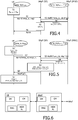
- FIGs 4, 5 and 6 shows the application of the method of the invention with the AKMA protocol.
- This protocol is based on an architecture similar to the GBA one.
- the NAF is replaced by an AKMA Application Function AApF
- the BSF by an AKMA Authentication Function AAuF.
- the bootstrap key Ks is an AKMA key K AKMA .
- the bootstrapping identifier B_TID is now a temporary identifier Temp_Id.
- the equivalent of the Ks_ext/int for the user equipment is now here generically called Application Function key K AF .
- the final NAF key as obtained with the invention is named final or inventive AKMA Application Function key iAApF instead of final or inventive NAF key iNAF_key.
- the mechanism is otherwise the same than explained in the description of figures 1 to 3 .
Landscapes
- Engineering & Computer Science (AREA)
- Computer Security & Cryptography (AREA)
- Computer Networks & Wireless Communication (AREA)
- Signal Processing (AREA)
- Theoretical Computer Science (AREA)
- General Physics & Mathematics (AREA)
- Algebra (AREA)
- Mathematical Analysis (AREA)
- Mathematical Optimization (AREA)
- Mathematical Physics (AREA)
- Pure & Applied Mathematics (AREA)
- Physics & Mathematics (AREA)
- Computing Systems (AREA)
- Mobile Radio Communication Systems (AREA)
Priority Applications (4)
| Application Number | Priority Date | Filing Date | Title |
|---|---|---|---|
| EP19305509.2A EP3726873A1 (de) | 2019-04-18 | 2019-04-18 | Verfahren zur authentifizierung eines benutzers bei einem dienstanbieter |
| US17/603,590 US12081654B2 (en) | 2019-04-18 | 2020-04-07 | Method to authenticate a user at a service provider |
| PCT/EP2020/059920 WO2020212207A1 (en) | 2019-04-18 | 2020-04-07 | Method to authenticate a user at a service provider |
| EP20715418.8A EP3957095A1 (de) | 2019-04-18 | 2020-04-07 | Verfahren zur authentifizierung eines benutzers bei einem dienstanbieter |
Applications Claiming Priority (1)
| Application Number | Priority Date | Filing Date | Title |
|---|---|---|---|
| EP19305509.2A EP3726873A1 (de) | 2019-04-18 | 2019-04-18 | Verfahren zur authentifizierung eines benutzers bei einem dienstanbieter |
Publications (1)
| Publication Number | Publication Date |
|---|---|
| EP3726873A1 true EP3726873A1 (de) | 2020-10-21 |
Family
ID=67105958
Family Applications (2)
| Application Number | Title | Priority Date | Filing Date |
|---|---|---|---|
| EP19305509.2A Withdrawn EP3726873A1 (de) | 2019-04-18 | 2019-04-18 | Verfahren zur authentifizierung eines benutzers bei einem dienstanbieter |
| EP20715418.8A Pending EP3957095A1 (de) | 2019-04-18 | 2020-04-07 | Verfahren zur authentifizierung eines benutzers bei einem dienstanbieter |
Family Applications After (1)
| Application Number | Title | Priority Date | Filing Date |
|---|---|---|---|
| EP20715418.8A Pending EP3957095A1 (de) | 2019-04-18 | 2020-04-07 | Verfahren zur authentifizierung eines benutzers bei einem dienstanbieter |
Country Status (3)
| Country | Link |
|---|---|
| US (1) | US12081654B2 (de) |
| EP (2) | EP3726873A1 (de) |
| WO (1) | WO2020212207A1 (de) |
Cited By (2)
| Publication number | Priority date | Publication date | Assignee | Title |
|---|---|---|---|---|
| CN113316138A (zh) * | 2021-04-27 | 2021-08-27 | 中盈优创资讯科技有限公司 | 一种应用层加密实现方法及其实现装置 |
| CN119032582A (zh) * | 2023-03-24 | 2024-11-26 | 北京小米移动软件有限公司 | 一种密钥协商方法、装置、设备及存储介质 |
Families Citing this family (3)
| Publication number | Priority date | Publication date | Assignee | Title |
|---|---|---|---|---|
| IT202100012206A1 (it) | 2021-05-12 | 2022-11-12 | Pastificio Rana Spa | Macchina e metodo per la cottura di cibo |
| IT202100012233A1 (it) | 2021-05-12 | 2022-11-12 | Pastificio Rana Spa | Sistema e metodo per la preparazione di una dose di cibo |
| US12500744B2 (en) * | 2021-09-17 | 2025-12-16 | Qualcomm Incorporated | Securing application communication |
Family Cites Families (9)
| Publication number | Priority date | Publication date | Assignee | Title |
|---|---|---|---|---|
| US4200770A (en) * | 1977-09-06 | 1980-04-29 | Stanford University | Cryptographic apparatus and method |
| US7062044B1 (en) * | 2002-06-28 | 2006-06-13 | The United States Of America As Represented By The National Security Agency | Method of elliptic curve cryptographic key agreement using coefficient splitting |
| US8122240B2 (en) * | 2005-10-13 | 2012-02-21 | Telefonaktiebolaget Lm Ericsson (Publ) | Method and apparatus for establishing a security association |
| US8522025B2 (en) * | 2006-03-28 | 2013-08-27 | Nokia Corporation | Authenticating an application |
| DE102006030768A1 (de) * | 2006-06-23 | 2007-12-27 | Atmel Germany Gmbh | Verfahren, Transponder und System zur schnellen Datenübertragung |
| JP5325974B2 (ja) * | 2008-10-10 | 2013-10-23 | テレフオンアクチーボラゲット エル エム エリクソン(パブル) | ゲートウェイ装置、認証サーバ、その制御方法及びコンピュータプログラム |
| CN102299797A (zh) * | 2010-06-23 | 2011-12-28 | 财团法人工业技术研究院 | 认证方法、密钥分配方法及认证与密钥分配方法 |
| US8346287B2 (en) * | 2011-03-31 | 2013-01-01 | Verizon Patent And Licensing Inc. | Provisioning mobile terminals with a trusted key for generic bootstrap architecture |
| EP3932004A4 (de) * | 2019-03-01 | 2022-04-13 | NEC Corporation | Verfahren zur synchronisierung eines heimnetzwerkschlüssels |
-
2019
- 2019-04-18 EP EP19305509.2A patent/EP3726873A1/de not_active Withdrawn
-
2020
- 2020-04-07 WO PCT/EP2020/059920 patent/WO2020212207A1/en not_active Ceased
- 2020-04-07 US US17/603,590 patent/US12081654B2/en active Active
- 2020-04-07 EP EP20715418.8A patent/EP3957095A1/de active Pending
Non-Patent Citations (3)
| Title |
|---|
| "3rd Generation Partnership Project; Technical Specification Group Services and System Aspects; Generic Authentication Architecture (GAA); Generic Bootstrapping Architecture (GBA) (Release 15)", 3GPP STANDARD; TECHNICAL SPECIFICATION; 3GPP TS 33.220, 3RD GENERATION PARTNERSHIP PROJECT (3GPP), MOBILE COMPETENCE CENTRE ; 650, ROUTE DES LUCIOLES ; F-06921 SOPHIA-ANTIPOLIS CEDEX ; FRANCE, vol. SA WG3, no. V15.4.0, 18 December 2018 (2018-12-18), pages 1 - 93, XP051591201 * |
| ALIBABA (CHINA) GROUP ET AL: "Key Issue on secure communication between UE and application server", vol. SA WG3, no. Harbin (China); 20180924 - 20180928, 3 October 2018 (2018-10-03), XP051503325, Retrieved from the Internet <URL:http://www.3gpp.org/ftp/tsg%5Fsa/WG3%5FSecurity/TSGS3%5F92Bis%5FHarbin/Docs/S3%2D183158%2Ezip> [retrieved on 20181003] * |
| ANONYMOUS: "Elliptic curve Diffie-Hellman - Wikipedia, the free encyclopedia", 20 April 2013 (2013-04-20), XP055146824, Retrieved from the Internet <URL:http://en.wikipedia.org/w/index.php?title=Elliptic_curve_Diffie%E2%80%93Hellman&oldid=551292197> [retrieved on 20141015] * |
Cited By (2)
| Publication number | Priority date | Publication date | Assignee | Title |
|---|---|---|---|---|
| CN113316138A (zh) * | 2021-04-27 | 2021-08-27 | 中盈优创资讯科技有限公司 | 一种应用层加密实现方法及其实现装置 |
| CN119032582A (zh) * | 2023-03-24 | 2024-11-26 | 北京小米移动软件有限公司 | 一种密钥协商方法、装置、设备及存储介质 |
Also Published As
| Publication number | Publication date |
|---|---|
| US12081654B2 (en) | 2024-09-03 |
| EP3957095A1 (de) | 2022-02-23 |
| US20220200795A1 (en) | 2022-06-23 |
| WO2020212207A1 (en) | 2020-10-22 |
Similar Documents
| Publication | Publication Date | Title |
|---|---|---|
| US12081654B2 (en) | Method to authenticate a user at a service provider | |
| US8559633B2 (en) | Method and device for generating local interface key | |
| EP2810418B1 (de) | Gruppenbasiertes bootstrapping in einer maschinenkommunikation | |
| EP3432532B1 (de) | Verfahren zur verteilung und authentifizierung von schlüsseln, vorrichtung und system | |
| EP3422629B1 (de) | Verfahren, vorrichtung und system zur verschlüsselungsschlüsselverteilung und -authentifizierung | |
| EP2039199B1 (de) | Benutzergeräte-berechtigungsnachweissystem | |
| EP3319295B1 (de) | Vorrichtungen und verfahren zur authentifizierung von client-vorrichtungen | |
| KR100520116B1 (ko) | 모바일 애드 혹 상의 암호화를 위한 노드간 키 분배 방법및 이를 이용한 네트워크 장치 | |
| EP2259539B1 (de) | Sicheres bootstrapping für die drahtlose kommunikation | |
| US8917870B2 (en) | Methods and devices for computing a shared encryption key | |
| CN101194529B (zh) | 用于协商至少一个第一通信用户和第二通信用户之间的安全密钥以保护通信连接的安全的方法 | |
| CN103391541B (zh) | 无线设备的配置方法及装置、系统 | |
| CN114363890B (zh) | 扩展的通用引导架构认证方法、装置及存储介质 | |
| EP2613581A1 (de) | Verfahren zur übertragung von benutzeridentitätsinformationen und benutzergerät, internetseitiges gerät und system | |
| KR20130140873A (ko) | 공개키에 의존하는 키 관리를 위한 보안 연계의 발견 | |
| WO2020221252A1 (zh) | 发送终端序列号的方法和装置以及认证方法和装置 | |
| WO2020177591A1 (zh) | 密钥的确定方法、装置、存储介质及电子装置 | |
| CN102754386A (zh) | 用于多媒体通信系统中的安全通信的分级密钥管理 | |
| Wang et al. | Weaknesses of a password-authenticated key exchange protocol between clients with different passwords | |
| EP3413508A1 (de) | Vorrichtungen und verfahren zur authentifizierung von client-vorrichtungen | |
| EP1933498A1 (de) | Verfahren, system und einrichtung zum behandeln über einen von ue und externen geräten gemeinsam benutzten chiffrierschlüssel | |
| EP4236407B1 (de) | Sicherheitsauthentifizierungsverfahren und -vorrichtung für wi-fi | |
| Moon et al. | Authentication protocol using an identifier in an ad hoc network environment | |
| CN116471588A (zh) | 一种高效密钥交换方法 | |
| Smith et al. | Securing mobile phone calls with identity-based cryptography |
Legal Events
| Date | Code | Title | Description |
|---|---|---|---|
| PUAI | Public reference made under article 153(3) epc to a published international application that has entered the european phase |
Free format text: ORIGINAL CODE: 0009012 |
|
| STAA | Information on the status of an ep patent application or granted ep patent |
Free format text: STATUS: THE APPLICATION HAS BEEN PUBLISHED |
|
| AK | Designated contracting states |
Kind code of ref document: A1 Designated state(s): AL AT BE BG CH CY CZ DE DK EE ES FI FR GB GR HR HU IE IS IT LI LT LU LV MC MK MT NL NO PL PT RO RS SE SI SK SM TR |
|
| AX | Request for extension of the european patent |
Extension state: BA ME |
|
| STAA | Information on the status of an ep patent application or granted ep patent |
Free format text: STATUS: THE APPLICATION IS DEEMED TO BE WITHDRAWN |
|
| 18D | Application deemed to be withdrawn |
Effective date: 20210422 |