EP3726896B1 - Méthodes et appareil pour positionner un dispositif terminal - Google Patents
Méthodes et appareil pour positionner un dispositif terminal Download PDFInfo
- Publication number
- EP3726896B1 EP3726896B1 EP18897983.5A EP18897983A EP3726896B1 EP 3726896 B1 EP3726896 B1 EP 3726896B1 EP 18897983 A EP18897983 A EP 18897983A EP 3726896 B1 EP3726896 B1 EP 3726896B1
- Authority
- EP
- European Patent Office
- Prior art keywords
- positioning
- access node
- measurement
- terminal device
- function entity
- Prior art date
- Legal status (The legal status is an assumption and is not a legal conclusion. Google has not performed a legal analysis and makes no representation as to the accuracy of the status listed.)
- Active
Links
Images



Classifications
-
- G—PHYSICS
- G01—MEASURING; TESTING
- G01S—RADIO DIRECTION-FINDING; RADIO NAVIGATION; DETERMINING DISTANCE OR VELOCITY BY USE OF RADIO WAVES; LOCATING OR PRESENCE-DETECTING BY USE OF THE REFLECTION OR RERADIATION OF RADIO WAVES; ANALOGOUS ARRANGEMENTS USING OTHER WAVES
- G01S5/00—Position-fixing by co-ordinating two or more direction or position line determinations; Position-fixing by co-ordinating two or more distance determinations
- G01S5/02—Position-fixing by co-ordinating two or more direction or position line determinations; Position-fixing by co-ordinating two or more distance determinations using radio waves
- G01S5/06—Position of source determined by co-ordinating a plurality of position lines defined by path-difference measurements
-
- H—ELECTRICITY
- H04—ELECTRIC COMMUNICATION TECHNIQUE
- H04W—WIRELESS COMMUNICATION NETWORKS
- H04W64/00—Locating users or terminals or network equipment for network management purposes, e.g. mobility management
-
- H—ELECTRICITY
- H04—ELECTRIC COMMUNICATION TECHNIQUE
- H04W—WIRELESS COMMUNICATION NETWORKS
- H04W24/00—Supervisory, monitoring or testing arrangements
- H04W24/10—Scheduling measurement reports ; Arrangements for measurement reports
-
- H—ELECTRICITY
- H04—ELECTRIC COMMUNICATION TECHNIQUE
- H04W—WIRELESS COMMUNICATION NETWORKS
- H04W64/00—Locating users or terminals or network equipment for network management purposes, e.g. mobility management
- H04W64/006—Locating users or terminals or network equipment for network management purposes, e.g. mobility management with additional information processing, e.g. for direction or speed determination
-
- H—ELECTRICITY
- H04—ELECTRIC COMMUNICATION TECHNIQUE
- H04W—WIRELESS COMMUNICATION NETWORKS
- H04W8/00—Network data management
- H04W8/22—Processing or transfer of terminal data, e.g. status or physical capabilities
- H04W8/24—Transfer of terminal data
Definitions
- This application relates to the field of positioning technologies, and in particular, to a terminal device positioning technology in a communications system.
- a positioning technology that is based on a mobile communications network is developing rapidly, and has a significant position in daily travel, vehicle positioning and navigation, radio resource allocation and integration, national information security, and the like.
- positioning calculation is performed by using a measurement value of a radio signal detected by a base station and/or a terminal.
- Main positioning technologies include: (1) distance positioning, in which positioning calculation is performed by using a distance (TOA) between a terminal and two or more base stations; and (2) angle positioning, in which positioning calculation is performed by using an angle (AOA) between a terminal and two or more base stations.
- Both a TOA and an AOAused in the prior art are measurement values in a line-of-sight (Line of Sight, LOS for short) transmission environment, and a non-line-of-sight (Not Line of Sight, NLOS for short) transmission environment is not considered.
- HUAWEI ET AL "Discussion on core requirements for further indoor positioning enhancements for UTRA and LTE", 3GPP DRAFT RP-162176 , describes requirements for indoor positioning for UTRA and LTE.
- US9482742 describes a method of generating a Positioning Reference Signal (PRS) sequence for a system comprising a plurality of physical transmitting antenna elements serving a single cell.
- PRS Positioning Reference Signal
- This application provides a terminal device apparatus, a method executed by the terminal device, an access node apparatus and a method executed by the access node, for positioning the terminal device, through positioning measurement that is based on a single access node.
- a method and an apparatus for positioning a terminal device are provided.
- the method is applied to a terminal device side, to position a terminal device through positioning measurement that is based on a single access node.
- the method includes: obtaining, by the terminal device, positioning measurement information for the terminal device, where the positioning measurement information is measurement result information of multipath positioning measurement that is based on the single access node and that is performed based on a positioning reference signal sent by the single access node; and after obtaining the positioning measurement information, sending, by the terminal device, the positioning measurement information to a positioning service function entity.
- the positioning service function entity may perform location estimation on the terminal device based on the positioning measurement information, to position the terminal device.
- the terminal device further receives the positioning reference signal sent by the single access node, and obtains the positioning measurement information based on the positioning reference signal.
- the terminal device can report the measurement result information of the multipath positioning measurement that is based on the single access node to the positioning service function entity, to implement positioning through multipath measurement, and avoid a problem that a plurality of base stations have a strict requirement on time and data synchronization.
- This technical solution may be applied to terminal device positioning in a non-line-of-sight NLOS transmission environment.
- the terminal device before obtaining the positioning measurement information for the terminal device, the terminal device further needs to enable the positioning service function entity to learn of a measurement capability supported by the terminal device, and send device capability indication information of the terminal device to the positioning service function entity, to indicate whether the terminal device supports the multipath positioning measurement that is based on the single access node.
- this design can enable the positioning service function entity to determine a positioning measurement manner that can be supported by the terminal device, thereby effectively implementing positioning.
- the terminal device before obtaining the positioning measurement information for the terminal device, the terminal device further receives a location information request sent by the positioning service function entity, obtains the positioning measurement information based on the location information request, and reports the positioning measurement information to the positioning service function entity.
- the terminal device can report the positioning measurement information based on the request of the positioning service function entity, thereby reducing unnecessary reporting overheads.
- an apparatus for positioning a terminal device can implement the corresponding positioning method according to the first aspect.
- the apparatus is limited in a functional form.
- a specific implementation of the apparatus may be a positioning device.
- the apparatus may be a terminal device, or a chip or a functional module in a terminal device.
- the foregoing method may be implemented by software or hardware, or by hardware executing corresponding software.
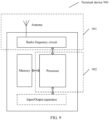
- the apparatus may include a processor and a memory.
- the processor is configured to support the apparatus in executing a corresponding function in the method according to the first aspect.
- the memory is configured to couple to the processor, and stores a program (instruction) and data that are necessary to the apparatus.
- the apparatus may further include a communications interface, configured to support communication between the apparatus and another network element.
- the communications interface may be a transceiver.
- the apparatus may include a sending unit.
- the sending unit is configured to send the positioning measurement information to the positioning service function entity.
- the apparatus may further include a processing unit.
- the processing unit is configured to obtain the positioning measurement information for the terminal device.
- a method and an apparatus for positioning a terminal device are provided.
- the method is applied to a terminal device side, to position a terminal device through positioning measurement of a single access node.
- the method includes: sending, by the terminal device to a positioning service function entity, positioning measurement information for the terminal device, where the positioning measurement information is measurement result information of multipath positioning measurement that is based on the single access node and that is performed based on a positioning reference signal sent by the single access node.
- the positioning service function entity may perform location estimation on the terminal device based on the positioning measurement information, to position the terminal device.
- the terminal device further receives the positioning reference signal sent by the single access node, and obtains the positioning measurement information based on the positioning reference signal.
- the terminal device can report the measurement result information of the multipath positioning measurement that is based on the single access node to the positioning service function entity, to implement positioning through multipath measurement, and avoid a problem that a plurality of base stations have a strict requirement on time and data synchronization.
- This technical solution may be applied to terminal device positioning in a non-line-of-sight NLOS transmission environment.
- the terminal device before reporting the positioning measurement information, the terminal device further needs to enable the positioning service function entity to learn of a measurement capability supported by the terminal device, and send device capability indication information of the terminal device to the positioning service function entity, to indicate whether the terminal device supports the multipath positioning measurement that is based on the single access node.
- this design can enable the positioning service function entity to determine a positioning measurement manner that can be supported by the terminal device, thereby effectively implementing positioning.
- the terminal device before reporting the positioning measurement information, the terminal device further receives a location information request sent by the positioning service function entity, obtains the positioning measurement information based on the location information request, and reports the positioning measurement information to the positioning service function entity.
- the terminal device can report the positioning measurement information based on the request of the positioning service function entity, thereby reducing unnecessary reporting overheads.
- an apparatus for positioning a terminal device can implement the corresponding positioning method according to the second aspect.
- the apparatus is limited in a functional form.
- a specific implementation of the apparatus may be a positioning device.
- the apparatus is specifically a terminal device, or may be a chip or a functional module in a terminal device.
- the foregoing method may be implemented by software or hardware, or by hardware executing corresponding software.
- the apparatus may include a processor and a memory.
- the processor is configured to support the apparatus in executing a corresponding function in the method according to the second aspect.
- the memory is configured to couple to the processor, and stores a program (instruction) and data that are necessary to the apparatus.
- the apparatus may further include a communications interface, configured to support communication between the apparatus and another network element.
- the communications interface may be a transceiver.
- the apparatus may include a sending unit.
- the sending unit is configured to send the positioning measurement information to the positioning service function entity.
- the apparatus may further include a processing unit.
- the processing unit is configured to obtain the positioning measurement information for the terminal device.
- a method and an apparatus for positioning a terminal device are provided.
- the method may be applied to an access node side such as a base station, an evolved universal terrestrial radio access network NodeB (E-UTRAN NodeB, eNB for short) or a new radio access network NodeB (New Radio Access NodeB, NR NodeB for short), to position a terminal device through positioning measurement of a single access node.
- the method includes: obtaining, by an access node, positioning measurement information for the terminal device, where the positioning measurement information is measurement result information of multipath positioning measurement that is based on the single access node and that is performed based on a positioning reference signal sent by the terminal device; and after obtaining the positioning measurement information, sending, by the access node, the positioning measurement information to a positioning service function entity.
- the positioning service function entity may perform location estimation on the terminal device based on the positioning measurement information, to position the terminal device.
- the access node further receives the positioning reference signal sent by the terminal device, and obtains the positioning measurement information based on the positioning reference signal.
- the access node can report the measurement result information of the multipath positioning measurement that is based on the single access node to the positioning service function entity, to implement positioning through multipath measurement, and avoid a problem that a plurality of base stations have a strict requirement on time and data synchronization.
- This technical solution may be applied to terminal device positioning in a non-line-of-sight NLOS transmission environment.
- the access node before obtaining the positioning measurement information for the terminal device, the access node further needs to enable the positioning service function entity to learn of a measurement capability supported by the access node, and send device capability indication information of the access node to the positioning service function entity, to indicate whether the access node supports the multipath positioning measurement that is based on the single access node.
- this design can enable the positioning service function entity to determine a positioning measurement manner that can be supported by the access node, thereby effectively implementing positioning.
- the access node before obtaining the positioning measurement information for the terminal device, the access node further receives a location information request sent by the positioning service function entity, obtains the positioning measurement information based on the location information request, and reports the positioning measurement information to the positioning service function entity.
- the access node can report the positioning measurement information based on the request of the positioning service function entity, thereby reducing unnecessary reporting overheads.
- an apparatus for positioning a terminal device can implement the corresponding positioning method according to the third aspect.
- the apparatus is limited in a functional form.
- a specific implementation of the apparatus may be a positioning device.
- the apparatus is specifically an access node, or may be a chip or a functional module in an access node.
- the foregoing method may be implemented by software or hardware, or by hardware executing corresponding software.
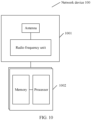
- the apparatus may include a processor and a memory.
- the processor is configured to support the apparatus in executing a corresponding function in the method according to the third aspect.
- the memory is configured to couple to the processor, and stores a program (instruction) and data that are necessary to the apparatus.
- the apparatus may further include a communications interface, configured to support communication between the apparatus and another network element.
- the communications interface may be a transceiver.
- the apparatus may include a sending unit.
- the sending unit is configured to send the positioning measurement information to the positioning service function entity.
- the apparatus may further include a processing unit.
- the processing unit is configured to obtain the positioning measurement information for the terminal device.
- a method and an apparatus for positioning a terminal device are provided.
- the method may be applied to an access node side such as a base station, an evolved universal terrestrial radio access network NodeB (E-UTRAN NodeB, eNB for short) or a new radio access network NodeB (New Radio Access NodeB, NR NodeB for short), to position a terminal device through positioning measurement of a single access node.
- the method includes: sending, by an access node to a positioning service function entity, positioning measurement information for the terminal device, where the positioning measurement information is measurement result information of multipath positioning measurement that is based on the single access node and that is performed based on a positioning reference signal sent by the terminal device.
- the positioning service function entity may perform location estimation on the terminal device based on the positioning measurement information, to position the terminal device.
- the access node further receives the positioning reference signal sent by the terminal device, and obtains the positioning measurement information based on the positioning reference signal.
- the access node can report the measurement result information of the multipath positioning measurement that is based on the single access node to the positioning service function entity, to implement positioning through multipath measurement, and avoid a problem that a plurality of base stations have a strict requirement on time and data synchronization.
- This technical solution may be applied to terminal device positioning in a non-line-of-sight NLOS transmission environment.
- the access node before reporting the positioning measurement information, the access node further needs to enable the positioning service function entity to learn of a measurement capability supported by the access node, and send device capability indication information of the access node to the positioning service function entity, to indicate whether the access node supports the multipath positioning measurement that is based on the single access node.
- this design can enable the positioning service function entity to determine a positioning measurement manner that can be supported by the access node, thereby effectively implementing positioning.
- the access node before reporting the positioning measurement information, the access node further receives a location information request sent by the positioning service function entity, obtains the positioning measurement information based on the location information request, and reports the positioning measurement information to the positioning service function entity.
- the access node can report the positioning measurement information based on the request of the positioning service function entity, thereby reducing unnecessary reporting overheads.
- an apparatus for positioning a terminal device can implement the corresponding positioning method according to the fourth aspect.
- the apparatus is limited in a functional form.
- a specific implementation of the apparatus may be a positioning device.
- the apparatus is specifically an access node, or may be a chip or a functional module in an access node.
- the foregoing method may be implemented by software or hardware, or by hardware executing corresponding software.
- the apparatus may include a processor and a memory.
- the processor is configured to support the apparatus in executing a corresponding function in the method according to the fourth aspect.
- the memory is configured to couple to the processor, and stores a program (instruction) and data that are necessary to the apparatus.
- the apparatus may further include a communications interface, configured to support communication between the apparatus and another network element.
- the communications interface may be a transceiver.
- the apparatus may include a sending unit.
- the sending unit is configured to send the positioning measurement information to the positioning service function entity.
- the apparatus may further include a processing unit.
- the processing unit is configured to obtain the positioning measurement information for the terminal device.
- a method and an apparatus for positioning a terminal device are provided.
- the method may be applied to a positioning service function entity such as a positioning service center or an enhanced serving mobile location center (Enhanced Serving Mobile Location Centre, E-SMLC for short), to position a terminal device based on a single access node.
- the method includes: determining that a device capability of a measurement device supports the multipath positioning measurement that is based on the single access node, where the measurement device includes an access node and/or a terminal device that is to be positioned, and the access node is a single access node configured to position the terminal device; and receiving positioning measurement information sent by the measurement device for the terminal device, where the positioning measurement information is multipath positioning measurement information that is based on the single access node.
- the positioning service function entity can perform location estimation on the terminal device based on the positioning measurement information. It may be understood that, in an environment in which a system supports a plurality of types of positioning measurement, before providing a positioning service, the positioning service function entity needs to determine a positioning measurement manner that can be supported by the measurement device, to effectively implement positioning.
- the positioning service function entity may perform terminal location estimation based on positioning measurement information reported by the terminal device that is to be positioned, or may perform terminal location estimation based on positioning measurement information reported by the corresponding access node, or may perform terminal location estimation based on positioning measurement information reported by both the terminal device and the access node.
- the positioning service function entity can receive measurement result information of the multipath positioning measurement that is based on the single access node and that is reported by the measurement device, to implement positioning through multipath measurement, and avoid a problem that a plurality of base stations have a strict requirement on time and data synchronization.
- This technical solution may be applied to terminal device positioning in a non-line-of-sight NLOS transmission environment.
- the positioning service function entity may send a positioning capability request to the measurement device and/or a device capability register function entity, receive device capability indication information of the measurement device returned by the measurement device and/or the device capability register function entity, and perform determining based on the device capability indication information, where the device capability indication information is used to indicate whether the measurement device supports the multipath positioning measurement that is based on the single access node.
- the positioning service function entity sends a first message to the access node, where the first message is used to instruct the access node to send a positioning reference signal to the terminal device; and the terminal device performs, based on the positioning reference signal, the multi-path positioning measurement that is based on the single access node, so that the positioning service function entity can further obtain the positioning measurement information reported by the terminal device.
- the positioning service function entity sends a second message to the terminal device, where the second message is used to instruct the terminal device to send a positioning reference signal to the access node; and the access node performs, based on the positioning reference signal, the multi-path positioning measurement that is based on the single access node, so that the positioning service function entity can further obtain the positioning measurement information reported by the access node.
- the measurement device can send, according to an instruction of the positioning service function entity, a signal related to positioning measurement, thereby reducing unnecessary overheads.
- the positioning service function entity after determining that the device capability of the measurement device supports the multipath positioning measurement that is based on the single access node, the positioning service function entity sends a location information request to the measurement device; and the measurement device obtains the positioning measurement information based on the location information request, and reports the positioning measurement information to the positioning service function entity.
- the measurement device can report the positioning measurement information based on the request of the positioning service function entity, thereby reducing unnecessary reporting overheads.
- an apparatus for positioning a terminal device can implement the corresponding positioning method according to the fifth aspect.
- the apparatus is limited in a functional form.
- a specific implementation of the apparatus may be a positioning device or a positioning service function entity, or may be a chip or a functional module in a positioning device or a positioning service function entity.
- the foregoing method may be implemented by software or hardware, or by hardware executing corresponding software.
- the apparatus may include a processor and a memory.
- the processor is configured to support the apparatus in executing a corresponding function in the method according to the fifth aspect.
- the memory is configured to couple to the processor, and stores a program (instruction) and data that are necessary to the apparatus.
- the apparatus may further include a communications interface, configured to support communication between the apparatus and another network element.
- the communications interface may be a transceiver.
- the apparatus may include a receiving unit.
- the receiving unit is configured to receive the positioning measurement information sent by the measurement device for the terminal device.
- the apparatus may further include a processing unit.
- the processing unit is configured to determine that the device capability of the measurement device supports the multipath positioning measurement that is based on the single access node.
- a method and an apparatus for positioning a terminal device are provided.
- the method may be applied to a positioning service function entity such as a positioning service center or an enhanced serving mobile location center (Enhanced Serving Mobile Location Centre, E-SMLC for short), to position a terminal device based on a single access node.
- the method includes: receiving positioning measurement information sent by a measurement device for the terminal device, where the positioning measurement information is multipath positioning measurement information that is based on the single access node, the measurement device includes an access node and/or the terminal device that is to be positioned, and the access node is a single access node configured to position the terminal device.
- the positioning service function entity can perform location estimation on the terminal device based on the positioning measurement information.
- the positioning service function entity may perform terminal location estimation based on positioning measurement information reported by the terminal device that is to be positioned, or may perform terminal location estimation based on positioning measurement information reported by the corresponding access node, or may perform terminal location estimation based on positioning measurement information reported by both the terminal device and the access node.
- the positioning service function entity can receive measurement result information of the multipath positioning measurement that is based on the single access node and that is reported by the measurement device, to implement positioning through multipath measurement, and avoid a problem that a plurality of base stations have a strict requirement on time and data synchronization.
- This technical solution may be applied to terminal device positioning in a non-line-of-sight NLOS transmission environment.
- the positioning service function entity before receiving the positioning measurement information sent by the measurement device for the terminal device, the positioning service function entity further needs to first determine that a device capability of the measurement device supports the multipath positioning measurement that is based on the single access node.
- the positioning service function entity may send a positioning capability request to the measurement device and/or a device capability register function entity, receive device capability indication information of the measurement device returned by the measurement device and/or the device capability register function entity, and perform determining based on the device capability indication information, where the device capability indication information is used to indicate whether the measurement device supports the multipath positioning measurement that is based on the single access node.
- this design can enable the positioning service function entity to determine, when providing a positioning service, a positioning measurement manner that can be supported by the measurement device, thereby effectively implementing positioning.
- the positioning service function entity sends a first message to the access node, where the first message is used to instruct the access node to send a positioning reference signal to the terminal device; and the terminal device performs, based on the positioning reference signal, the multi-path positioning measurement that is based on the single access node, so that the positioning service function entity can further obtain the positioning measurement information reported by the terminal device.
- the positioning service function entity sends a second message to the terminal device, where the second message is used to instruct the terminal device to send a positioning reference signal to the access node; and the access node performs, based on the positioning reference signal, the multi-path positioning measurement that is based on the single access node, so that the positioning service function entity can further obtain the positioning measurement information reported by the access node.
- the measurement device can send, according to an instruction of the positioning service function entity, a signal related to positioning measurement, thereby reducing unnecessary overheads.
- the positioning service function entity after determining that the device capability of the measurement device supports the multipath positioning measurement that is based on the single access node, the positioning service function entity sends a location information request to the measurement device; and the measurement device obtains the positioning measurement information based on the location information request, and reports the positioning measurement information to the positioning service function entity.
- the measurement device can report the positioning measurement information based on the request of the positioning service function entity, thereby reducing unnecessary reporting overheads.
- an apparatus for positioning a terminal device can implement the corresponding positioning method according to the sixth aspect.
- the apparatus is limited in a functional form.
- a specific implementation of the apparatus may be a positioning device or a positioning service function entity, or may be a chip or a functional module in a positioning device or a positioning service function entity.
- the foregoing method may be implemented by software or hardware, or by hardware executing corresponding software.
- the apparatus may include a processor and a memory.
- the processor is configured to support the apparatus in executing a corresponding function in the method according to the sixth aspect.
- the memory is configured to couple to the processor, and stores a program (instruction) and data that are necessary to the apparatus.
- the apparatus may further include a communications interface, configured to support communication between the apparatus and another network element.
- the communications interface may be a transceiver.
- the apparatus may include a receiving unit.
- the receiving unit is configured to receive the positioning measurement information sent by the measurement device for the terminal device.
- the apparatus may further include a processing unit.
- the processing unit is configured to determine that the device capability of the measurement device supports the multipath positioning measurement that is based on the single access node.
- the multipath positioning measurement includes positioning measurement for a main path and at least one reflection path, or positioning measurement for at least two reflection paths, where the positioning measurement includes at least one of the following: measurement on a time of arrival TOA used for distance positioning and measurement on an angle of arrival AOA used for angle positioning. It may be understood that there are two cases of multipath.
- One is a multipath formed by a main path used as a direct path between an access node and a terminal device and a multipath formed by at least one reflection path used as a path that runs through a reflector and that is between the access node and the terminal device, and the other is a multipath formed by at least two reflection paths.
- the access node is a single access node, and there may be one or more reflectors.
- the computer storage medium stores a computer program (instruction).
- the program (instruction) runs on a computer, the computer is enabled to perform the method according to any one of the foregoing aspects.
- This application further provides a computer program product, not longer covered by the appended claims.
- the computer program product runs on a computer, the computer is enabled to perform the method according to any one of the foregoing aspects.
- the chip stores an instruction.
- a communications device is enabled to perform the corresponding methods in the foregoing aspects.
- the apparatus includes a memory, a processor, and a computer program that is stored in the memory and that can run on the processor.
- the processor executes the computer program, implements the corresponding methods in the foregoing aspects.
- the apparatus includes a processor.
- the processor is configured to: couple to a memory, read an instruction in the memory, and implement, based on the instruction, the corresponding methods in the foregoing aspects. It may be understood that the memory may be integrated into the processor, or may exist independent of the processor.
- This application further provides an apparatus for positioning a terminal device.
- the apparatus includes a processor.
- the processor is configured to implement the corresponding methods in the foregoing aspects when executing a computer program.
- This application further provides a system for positioning a terminal device, no longer covered by the amended claims.
- the system includes the foregoing positioning service function entity and the terminal device and/or the access node. These components of the system separately implement the corresponding methods in the foregoing aspects.
- any apparatus, computer storage medium, computer program product, chip, or system for positioning a terminal provided above is configured to implement a corresponding method provided above. Therefore, for a beneficial effect that can be achieved by the apparatus, computer storage medium, computer program product, chip, or system, refer to a beneficial effect of the corresponding method, and details are not described herein again.
- a plurality of in this application refers to two or more than two.
- the term “and/or” in this application describes merely an association relationship for describing associated objects and represents that three relationships may exist.
- a and/or B may represent the following three cases: Only A exists, both A and B exist, and only B exists.
- the character “/” in this specification generally indicates an “or” relationship between the associated objects.
- the terms “first”, “second”, “third”, “fourth”, and the like are intended to distinguish between different objects but do not indicate a particular order of the objects.
- nouns "network” and “system” are usually interchangeably used, but a person skilled in the art can understand meanings of the nouns.
- all "terminals"/"terminal devices” mentioned in this application may be mobile devices, for example, a mobile phone, a personal digital assistant, a handheld or laptop computer, and a similar device having a telecommunications capability.
- the "terminals"/"terminal devices” may alternatively be wearable devices, vehicle-mounted devices, or the like, and include a terminal in a 5G network, a terminal in a future evolved public land mobile network (Public Land Mobile Network, PLMN for short), and the like.
- PLMN Public Land Mobile Network
- Such a terminal may include a device and a removable storage module associated with the device (for example, but not limited to, a subscriber identification module (Subscriber Identification Module, SIM for short) application, a universal subscriber identification module (Universal Subscriber Identification Module, USIM for short) application, or a universal integrated circuit card (Universal Integrated Circuit Card, UICC for short) of a removable user identity module (Removable User Identity Module, R-USIM for short)).
- a terminal may include a device that does not have the module.
- the term "terminal"/"terminal device” may refer to a non-portable device having a similar capability, for example, a desktop computer, a set-top box, or a network device.
- terminal may further be any hardware or software component that can terminate a communication session of a user.
- “user terminal”, “user equipment”, “UE”, “site”, “station”, “STA”, “user equipment”, “user agent”, “user agent”, “UA”, “user apparatus”, “mobile device”, and “device”, and the like are substitutive terms that are synonymous with “terminal”/"terminal device” in this specification.
- the foregoing devices are collectively referred to as user equipment or UE.
- the "access node” mentioned in this application is a network device, and is an apparatus deployed in a radio access network to provide a wireless communication function for a terminal device.
- the access node may include various forms of macro base stations, micro base stations, relay stations, access points, and the like, including systems and devices for improving peer devices in a conventional wireless telecommunications system.
- Such an advanced or next-generation device may be included in a long term evolution LTE communications system, a 5G communications system, a future evolved system, or a plurality of communications convergence systems, for example, an evolved universal terrestrial radio access network NodeB (E-UTRAN NodeB, eNB for short) included in an LTE system, a new radio access network NodeB (New Radio Access NodeB, NR NodeB for short) included in 5G, another radio access point, or a similar component.
- E-UTRAN NodeB, eNB evolved universal terrestrial radio access network NodeB
- New Radio Access NodeB New Radio Access NodeB
- NR NodeB New Radio Access NodeB
- names of devices having an access node function may be different.
- access nodes For ease of description, in this application, the foregoing apparatuses providing a wireless communication function for UE are collectively referred to as access nodes.
- positioning service function entity is a function entity that provides a positioning service for UE, and may be a service function entity or a higher layer service function entity disposed independent of an access node, or may be a service function entity disposed on an access node. Any entity that can implement a related function is a "positioning service function entity".
- entity names of entities that have a function of a positioning service function entity may be different, for example, "positioning service center” and "enhanced serving mobile location center (Enhanced Serving Mobile Location Center, E-SMLC for short)”.
- E-SMLC Enhanced Serving Mobile Location Center
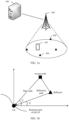
- FIG. 1a shows an architecture of a network system according to this application.
- the system is configured to position UE, and includes UE 100, an access node 200, a positioning service function entity 300, and a reflector 400.
- a schematic diagram of separate dispositions of the positioning service function entity 300 and the access node 200 is provided in the system shown in FIG. 1a .
- a positioning service function may be configured on the access node 200, and the positioning service function entity 300 may be disposed on the access node 200.
- obstacles such as a building and a natural landscape that affect the propagation of the electromagnetic wave.
- a propagation path of an electromagnetic wave received by the UE 100 may be classified into two types of paths.
- One type is a main path (a path from the access node 200 directly to the UE 100) corresponding to the access node 200 near the UE 100
- the other type is at least one reflection path (a path from the access node 200 to the reflector 400, and then from the reflector 400 to the UE 100) corresponding to the reflector 400.
- the access node 200 is a single access node for positioning the UE 100.
- positioning measurement is multipath positioning measurement for a single access node, the multipath positioning measurement includes positioning measurement for a main path and at least one reflection path, or positioning measurement for at least two reflection paths, where the positioning measurement may relate to measurement on a time of arrival TOA used for distance positioning and measurement on an angle of arrival AOA used for angle positioning.
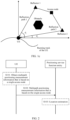
- For an angle of arrival AOA refer to schematic diagrams of AOAs in different positioning measurement scenarios shown in FIG. 1b and FIG. 1c .
- FIG. 1b is a schematic diagram of angles of arrival AOA of a main path and a reflection path.
- 1c is a schematic diagram of angles of arrival AOA of at least two reflection paths.
- the circle represents a location of UE
- the square represents a location of an access node
- the triangle represents a location of a reflector.
- the access node transmits a signal
- the UE receives the signal.
- Some signals sent by the access node are directly transmitted to the UE in the air, and the propagation path is a direct path, that is, a main path.
- Some signals are reflected by the reflector and then received by the UE, and this path is a reflection path.
- an angle of the direct path for receiving is ⁇ 0 , namely, an AOA of the main path; and an angle of the reflection path for receiving is ⁇ 1 , namely, an AOA of the reflection path.
- the circle represents a location of UE, the square represents a location of an access node, and the triangles represent locations of reflectors.
- the access node transmits a signal, and the UE receives the signal. Signals sent by the access node are not directly transmitted to the UE due to an obstacle. Some signals are received by the UE after being reflected by a reflector 1, and this path is a reflection path 1.
- FIG. 1b and FIG. 1c are schematic diagrams of an AOA corresponding to a signal path from an access node to UE. An angle of arrival from the UE to the access node is similar to this, and details are not described again.
- FIG. 1a is a schematic diagram of a signal in a downlink direction in which the UE 100 performs positioning measurement. This is not limited in this application, and is merely an example of a scenario.
- the positioning measurement may be performed by only the UE 100, or may be performed by only the access node 200, or may be performed by the UE 100 and the access node 200 together.
- the UE 100 detects, by using a multi-antenna technology, different angles of arrival (Angle of Arrival, AOA for short) and/or times of arrival (Time of Arrival, TOA for short) of a same signal by receiving a positioning reference signal that is based on a single access node 200 in a downlink direction, to obtain measurement values of multipath AOAs and/or TOAs.
- AOA Angle of Arrival
- TOA Time of Arrival
- the single access node 200 detects, by using a multi-antenna technology, different angles of arrival and/or times of arrival of a same signal by receiving a positioning reference signal sent by the UE 100 that is to be positioned in an uplink direction, to obtain measurement values of multipath AOAs and/or TOAs.
- the UE 100 and the access node 200 perform positioning measurement together, the UE 100 and the access node 200 respectively obtain measurement values of multipath AOAs and/or TOAs that are measured in a downlink direction and an uplink direction.
- the UE 100 and/or the access node 200 report/reports the measurement values of the multipath AOAs and/or TOAs to the positioning service function entity 300 (where the UE 100 is in communication connection with the positioning service function entity 300 by using the access node 200).
- the positioning service function entity 300 can perform location estimation on the UE 100, to position the UE 100. It should be noted that if a location of the reflector 400 is known, a calculation result of the location estimation is more accurate.
- FIG. 1a shows merely an example of the architecture of the network system in this application, and this application is not limited thereto.
- this application may be further applied to an IEEE802.11 system, and positioning accuracy of indoor wireless fidelity (Wireless Fidelity, Wi-Fi for short) is improved by using multipath measurement information that is based on a single access point (Access Point, AP for short).
- Wi-Fi Wireless Fidelity
- AP Access Point
- FIG. 2 is a flowchart of a first embodiment of a method for positioning a terminal device according to this application.
- this embodiment and subsequent embodiments are described as a whole from a perspective of a plurality of interaction parties. However, it is not limited that steps on all interaction sides in a system need to be performed together. The technical solution provided in this application is improved on each side of the system.
- the method includes the following steps.
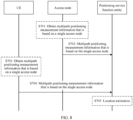
- S101 UE obtains multipath positioning measurement information that is based on a single access node.
- the UE may obtain the positioning measurement information from an entity capable of performing positioning measurement, or the UE may obtain the positioning measurement information by directly performing positioning measurement.
- the positioning measurement is multipath positioning measurement that is based on the single access node and that is performed based on a positioning reference signal sent by the single access node.
- the positioning measurement information is measurement result information of the multipath positioning measurement that is based on the single access node.
- a multipath includes a main path corresponding to the single access node and at least one reflection path corresponding to a reflector, or at least two reflection paths corresponding to reflectors, where there are at least two reflectors in the system.
- the plurality of reflection paths include reflection paths respectively corresponding to a plurality of reflectors, and also include a plurality of reflection paths corresponding to one reflector in a plurality of times of measurement.
- the single access node is not necessarily an access node that has been accessed by the UE.
- the single access node may be an access node near the UE, and is configured to position the UE.
- the UE may detect an AOA and/or a TOA of a same signal (a downlink positioning reference signal) by using a multi-antenna technology, to obtain measurement values of a multipath AOA and/or TOA.
- the TOA and the AOA may be determined in the following manners:
- the UE may periodically obtain the positioning measurement information, or may obtain the positioning measurement information based on triggering of a request sent by the positioning service function entity or triggering of a positioning reference signal sent by the access node.
- the UE sends the multipath positioning measurement information that is based on the single access node to the positioning service function entity, and the positioning service function entity receives the positioning measurement information.
- the UE sends a message carrying the positioning measurement information to the positioning service function entity, so that the positioning service function entity obtains the measurement result information of the multipath positioning measurement that is based on the single access node.
- the UE may add, to different messages, the multipath positioning measurement information that is based on the single access node.
- LTE Positioning Protocol LPP for short.
- the LPP protocol includes transfer of location information (Location Information). Therefore, the positioning measurement information may be carried in an LPP message.
- the "location information (Location Information)" herein may not only represent actual location estimation on the UE, but also may represent measurement data (for example, TOA and AOA measurement) used for positioning calculation.
- measurement data for example, TOA and AOA measurement
- the positioning measurement information may be carried in another message in the LTE system, or the positioning measurement information may be carried in another message in a terminal in a 5G network or a future evolved public land mobile network (Public Land Mobile Network, PLMN for short).
- PLMN Public Land Mobile Network
- the UE may periodically send the positioning measurement information to the positioning service function entity, or may send the positioning measurement information based on triggering of a request sent by the positioning service function entity or triggering of a positioning reference signal sent by the access node.
- the positioning service function entity performs location estimation on the UE based on the received positioning measurement information, to implement positioning.
- the positioning service function entity may optionally perform location estimation in the following manners:
- the foregoing solution is intended for a case in which the location of the reflector is unknown, and the location of the reflector needs to be estimated. If the location of the reflector in the system is known, positioning accuracy of the UE is further improved. If the location of the reflector is known, related processing of location estimation on the reflector in a processing procedure may be omitted, and the location of the UE may be estimated directly by using the known location of the reflector and the TOA and the AOA of the main path, to determine the location of the UE.
- the foregoing solution is intended for a case in which the locations of the reflectors are unknown, and the locations of the reflectors need to be estimated. If the locations of the reflectors in the system are known, positioning accuracy of the UE is further improved. If the locations of the at least two reflectors are known, related processing of location estimation on the reflectors in a processing procedure may be omitted, and the location of the UE may be estimated directly by using the locations of the at least two reflectors and the measurement values of the TOAs and the AOAs of the reflection paths corresponding to the at least two reflection paths.
- one reflector corresponds to one reflection path.
- the positioning reference signal is sent for a plurality of times, so that a plurality of times of measurement may be performed, the plurality of times of reflector location estimation is performed for each reflector.
- an average value of a plurality of measurement values for the reflector is calculated, to improve estimation precision of the reflector.
- the UE is accurately positioned, and a problem that a plurality of base stations have a strict requirement on time and data synchronization is avoided.
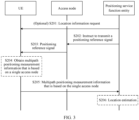
- FIG. 3 is a flowchart of a second embodiment of a method for positioning a terminal device according to this application.
- a difference between this embodiment and Embodiment 1 lies in that, in this embodiment, an interaction procedure between an access node and another object is added, and content that is the same as or similar to that in Embodiment 1 is not described in this embodiment again.
- the method includes the following steps.
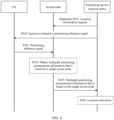
- a positioning service function entity sends a location information request to UE.
- the interaction procedure is optional, because in a procedure of positioning the UE, optionally, the UE may periodically report the positioning measurement information, or the positioning service function entity may send the location information request to the UE, to trigger the UE to report the positioning measurement information.
- the positioning service function entity sends the location information request to the UE, to instruct the UE to send positioning measurement information. Triggering may be performed as required, thereby reducing overheads caused by frequent reporting of positioning measurement information by the UE.
- the location information request may be carried in different messages in different systems. For example, in an LTE system, the location information request may be carried in an LPP message for sending, or may be carried in another message for sending.
- the positioning service function entity sends, to the access node, instruction information for instructing the access node to transmit a positioning reference signal.
- the positioning service function entity may select an access node near the UE, and send an instruction to the access node, to instruct the access node to send the positioning reference signal to position the UE.
- the instruction may be carried in an LTE positioning protocol annex (LTE Positioning Protocol Annex, LPPa for short) message for sending. This is merely an example.
- the instruction may be carried in another message in the LTE system, or may be carried in another message in a terminal in a 5G network or a future evolved public land mobile network (Public Land Mobile Network, PLMN for short).
- S203 The access node sends the positioning reference signal to the UE.
- the positioning reference signal may be a reference signal specially used for positioning, or may be an existing signal such as a PRS or a CRS.
- that the access node sends the positioning reference signal to the UE may be sending the positioning reference signal to an entity that completes positioning measurement on a UE side. The entity and the UE may be disposed separately.
- S204 UE obtains multipath positioning measurement information that is based on a single access node.
- step S101 in Embodiment 1 Details are not described herein again. Certainly, this application is not limited thereto.
- S205 The UE sends the multipath positioning measurement information that is based on the single access node to the positioning service function entity, and the positioning service function entity receives the positioning measurement information.
- step S102 in Embodiment 1. Details are not described herein again. Certainly, this application is not limited thereto.
- the positioning service function entity performs location estimation on the UE based on the received positioning measurement information, to implement positioning.
- step S103 in Embodiment 1. Details are not described herein again. Certainly, this application is not limited thereto.
- the UE by using the interaction procedure in which the positioning service function entity instructs the access node to transmit the positioning reference signal, and the UE reports the multipath measurement information that is based on the single access node to the positioning service function entity, the UE is accurately positioned, and a problem that a plurality of base stations have a strict requirement on time and data synchronization is avoided.
- the positioning service function entity may choose to consider by default that all the UEs have a capability of supporting the multipath positioning measurement that is based on the single access node. If it is not considered by default that all UEs in a system have a capability of supporting the multipath positioning measurement that is based on the single access node, the positioning service function entity needs to determine a positioning measurement capability supported by UE, to determine whether to position the UE in a multipath positioning measurement manner that is based on the single access node.
- the positioning service function entity determines the positioning measurement capability supported by the UE, and may learn, by using a UE report, of the capability supported by the UE, and determine whether the UE supports the multipath positioning measurement that is based on the single access node.
- the capability supported by the UE may be obtained by using a third party (for example, a device capability register function entity). This is described below by using a specific interaction procedure.
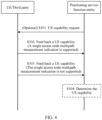
- FIG. 4 is a schematic interaction flowchart of determining a positioning measurement capability supported by a terminal device according to this application. As shown in FIG. 4 , determining a positioning measurement capability supported by UE includes the following steps.
- a positioning service function entity sends a capability request of the UE to the UE/a third party.
- This step is an optional step. It may be understood that the positioning service function entity may determine the positioning measurement capability supported by the UE, by sending a capability request when necessary, to instruct the UE/the third party to perform a feedback, or the positioning service function entity may determine the positioning measurement capability through periodical reporting performed by the UE/the third party. The positioning service function entity sends the capability request, so that a feedback by the UE/the third party can be triggered as required, thereby reducing overheads caused by frequent reporting performed by the UE/the third party.
- the capability request may be carried in an LPP message for sending, and the LPP protocol includes positioning capability (Positioning Capabilities) interaction.
- the request may be carried in another message in an LTE system, or the request may be carried in another message in a terminal in a 5G network or in a future evolved public land mobile network (Public Land Mobile Network, PLMN for short).
- PLMN Public Land Mobile Network
- steps S302 and S303 are not sequential steps in the procedure, and the two steps are two processing manners in different cases in which the UE has the positioning measurement capability.
- S302 The UE/the third party feeds back a capability supported by the UE to the positioning service function entity, where the capability indicates that the UE supports multipath measurement that is based on a single access node.
- the UE/the third party may indicate, in a manner such as by using a specific field or some bits in a message fed back to the positioning service function entity, whether the UE supports some capabilities.
- whether the UE supports these capabilities is indicated by using value information such as 0 and 1 in indication bits corresponding to these positioning manners.
- a multicomponent identification Multiple Components Identification, MPC Identification for short
- S303 The UE/the third party feeds back a capability supported by the UE to the positioning service function entity, where the capability indicates that the UE does not support the multipath measurement that is based on the single access node.
- the UE/the third party may indicate, in a manner such as by using a specific field or some bits in a message fed back to the positioning service function entity, whether the UE supports some capabilities.
- whether the UE supports these capabilities is indicated by using value information such as 0 and 1 in indication bits corresponding to these positioning manners.
- the UE after receiving the request, for example, the request carried in an LPP message, the UE adds 1-bit information to capability information related to an LPP.
- the positioning service function entity determines a capability of the UE based on received UE capability feedback information.
- the positioning service function entity can determine, based on the UE capability feedback information, whether the UE supports the multipath positioning measurement that is based on the single access node, and further determine whether to implement location estimation on the UE in this manner.
- the location estimation on the UE may be implemented with reference to the manners in Embodiment 1 and Embodiment 2.
- This design can enable the positioning service function entity to determine a positioning measurement manner that can be supported by the UE, thereby effectively implementing positioning.
- FIG. 5 is a flowchart of a first embodiment of another method for positioning a terminal device according to this application.
- this embodiment and subsequent embodiments are described as a whole from a perspective of a plurality of interaction parties. However, it is not limited that steps on all interaction sides in a system need to be performed together. The technical solution provided in this application is improved on each side of the system.
- the method includes the following steps.
- An access node obtains multipath positioning measurement information that is based on a single access node.
- the access node is a single access node.
- the access node may obtain the positioning measurement information from an entity capable of performing positioning measurement, or the access node may obtain the positioning measurement information by directly performing positioning measurement.
- the positioning measurement is multipath positioning measurement that is based on the single access node and that is performed based on a positioning reference signal sent by UE that is to be positioned.
- the positioning measurement information is measurement result information of the multipath positioning measurement that is based on the single access node.
- a multipath includes a main path between the UE and the single access node and at least one reflection path between the access node and a reflector, or at least two reflection paths corresponding to a reflector, where there is at least one reflector in the system.
- the plurality of reflection paths include reflection paths respectively corresponding to a plurality of reflectors, and also include a plurality of reflection paths corresponding to one reflector in a plurality of times of measurement.
- the access node is not necessarily an access node that has been accessed by the UE that is to be positioned.
- the access node may be an access node near the UE, and is configured to position the UE.
- the access node may detect an AOA and/or a TOA of a same signal (an uplink positioning reference signal) by using a multi-antenna technology, to obtain measurement values of a multipath AOA and/or TOA. Manners similar to those in Embodiment 1 may be selected and used as measurement and estimation manners of the TOA and the AOA, and details are not described herein again.
- the access node may periodically obtain the positioning measurement information, or may obtain the positioning measurement information based on triggering of a request sent by the positioning service function entity or triggering of a positioning reference signal sent by the UE.
- the access node sends the multipath positioning measurement information that is based on the single access node to the positioning service function entity, and the positioning service function entity receives the positioning measurement information.
- the access node Through signaling interaction between the access node and the positioning service function entity, the access node sends a message carrying the positioning measurement information of the UE to the positioning service function entity, so that the positioning service function entity obtains the measurement result information of the multipath positioning measurement that is based on the single access node and that is performed on the UE.
- the access node may add, to different messages, the multipath positioning measurement information that is based on the single access node.
- LTE positioning protocol annex LTE Positioning Protocol Annex, LPPa for short.
- LPPa protocol includes transfer of location information (Location Information).
- the positioning measurement information may be carried in an LPPa message.
- location information Location Information
- the "location information (Location Information)" herein may not only represent actual location estimation on the UE, but also may represent measurement data (for example, TOA and AOA measurement) used for positioning calculation.
- measurement data for example, TOA and AOA measurement
- the positioning measurement information may be carried in another message in the LTE system, or the positioning measurement information may be carried in another message in a terminal in a 5G network or a future evolved public land mobile network (Public Land Mobile Network, PLMN for short).
- PLMN Public Land Mobile Network
- the access node may periodically send the positioning measurement information to the positioning service function entity, or may send the positioning measurement information based on triggering of a request sent by the positioning service function entity or triggering of a positioning reference signal sent by the UE.
- the positioning service function entity performs location estimation on the UE based on the received positioning measurement information, to implement positioning.
- Embodiment 1 A manner similar to that in Embodiment 1 may be selected and used as a manner for performing location estimation on the UE, and details are not described herein again.
- the UE is accurately positioned, and a problem that a plurality of base stations have a strict requirement on time and data synchronization is avoided.
- FIG. 6 is a flowchart of a second embodiment of another method for positioning a terminal device according to this application.
- a difference between this embodiment and Embodiment 3 lies in that, in this embodiment, an interaction procedure between UE and another object is added, and content that is the same as or similar to that in Embodiment 3 is not described in this embodiment again.
- the method includes the following steps.
- S501 A positioning service function entity sends a location information request to an access node.
- the interaction procedure is optional, because in a procedure of positioning the UE, optionally, the access node may periodically report the positioning measurement information, or the positioning service function entity may send the location information request to the access node, to trigger the interaction procedure.
- the positioning service function entity sends the location information request to the access node, to instruct the access node to send positioning measurement information. Triggering may be performed as required, thereby reducing overheads caused by frequent reporting of positioning measurement information by the access node.
- the location information request may be carried in an LPPa message for sending. This is merely an example. Alternatively, the request may be carried in another message in an LTE system, or the request may be carried in another message in a terminal in a 5G network or in a future evolved public land mobile network (Public Land Mobile Network, PLMN for short).
- PLMN Public Land Mobile Network
- the positioning service function entity sends, to the UE, instruction information for instructing the UE to transmit a positioning reference signal.
- the positioning service function entity sends the instruction to the UE that is to be positioned, to instruct the UE to send the positioning reference signal for positioning.
- the instruction may be carried in an LTE positioning protocol (LTE Positioning Protocol, LPP for short) message for sending. This is merely an example.
- LTE Positioning Protocol LPP for short
- the instruction may be carried in another message in the LTE system, or may be carried in another message in a terminal in a 5G network or a future evolved public land mobile network (Public Land Mobile Network, PLMN for short).
- PLMN Public Land Mobile Network
- S503 The UE sends the positioning reference signal to the access node.
- the UE sends the positioning reference signal to the access node near the UE.
- the positioning reference signal may be a reference signal specially used for positioning, or may be an existing signal such as a PRS or a CRS.
- that the UE sends the positioning reference signal to the access node may be sending the positioning reference signal to an entity (for example, a measurement unit that is disposed separately from the access node) that completes positioning measurement on an access node side.
- the access node obtains multipath positioning measurement information that is based on a single access node and that is for the UE.
- step S401 in Embodiment 3 Details are not described herein again. Certainly, this application is not limited thereto.
- the access node sends the multipath positioning measurement information that is based on the single access node to the positioning service function entity, and the positioning service function entity receives the positioning measurement information.
- step S402 in Embodiment 3 Details are not described herein again. Certainly, this application is not limited thereto.
- the positioning service function entity performs location estimation on the UE based on the received positioning measurement information, to implement positioning.
- step S403 in Embodiment 3 Details are not described herein again. Certainly, this application is not limited thereto.
- the UE is accurately positioned, and a problem that a plurality of base stations have a strict requirement on time and data synchronization is avoided.
- the positioning service function entity may choose to consider by default that all the access nodes have a capability of supporting the multipath positioning measurement that is based on the single access node.
- the positioning service function entity needs to determine a positioning measurement capability supported by the access node, to determine whether to position, by using the access node, the UE in a multipath positioning measurement manner that is based on the single access node.
- the positioning service function entity determines the positioning measurement capability supported by the access node, and may learn, by using an access node report, of the capability supported by the access node, and determine whether the access node supports the multipath positioning measurement that is based on the single access node.
- the capability supported by the access node may be obtained by using a third party (for example, a device capability register function entity). This is described below by using a specific interaction procedure.
- FIG. 7 is a schematic interaction flowchart of determining a positioning measurement capability supported by an access node according to this application. As shown in FIG. 7 , determining the positioning measurement capability supported by the access node includes the following steps.
- a positioning service function entity sends a capability request of the access node to the access node/a third party.
- This step is an optional step. It may be understood that the positioning service function entity may determine the positioning measurement capability supported by the access node, by sending the capability request when necessary, to instruct the access node/the third party to perform a feedback, or the positioning service function entity may determine the positioning measurement capability through periodical reporting performed by the access node/the third party. The positioning service function entity sends the capability request, so that a feedback by the access node/the third party can be triggered as required, thereby reducing overheads caused by frequent reporting performed by the access node/the third party.
- the capability request may be carried in an LPPa message for sending, and the LPPa protocol includes positioning capability (Positioning Capabilities) interaction.
- the request may be carried in another message in an LTE system, or the request may be carried in another message in a terminal in a 5G network or in a future evolved public land mobile network (Public Land Mobile Network, PLMN for short).
- PLMN Public Land Mobile Network
- steps S602 and S603 are not sequential steps in the procedure, and the two steps are two processing manners in different cases in which the access node has the positioning measurement capability.
- S602 The access node/the third party feeds back a capability supported by the access node to the positioning service function entity, where the capability indicates that the access node supports multipath measurement that is based on a single access node.
- the access node/the third party may indicate, in a manner such as by using a specific field or some bits in a message fed back to the positioning service function entity, whether the access node supports some capabilities.
- whether the access node supports these capabilities is indicated by using value information such as 0 and 1 in indication bits corresponding to these positioning manners.
- a multicomponent identification Multiple Components Identification, MPC Identification for short
- S603 The access node/the third party feeds back a capability supported by the access node to the positioning service function entity, where the capability indicates that the access node does not support the multipath measurement that is based on the single access node.
- the access node/the third party may indicate, in a manner such as by using a specific field or some bits in a message fed back to the positioning service function entity, whether the access node supports some capabilities.
- whether the access node supports these capabilities is indicated by using value information such as 0 and 1 in indication bits corresponding to these positioning manners.
- the access node after receiving the request, adds 1-bit information to capability information related to an LPPa.
- the positioning service function entity determines a capability of the access node based on received access node capability feedback information.
- the positioning service function entity can determine, based on the access node capability feedback information, whether the access node supports the multipath positioning measurement that is based on the single access node, and further determine whether to implement location estimation on the UE in this manner by using the access node.
- the location estimation on the UE may be implemented in the manners in Embodiment 3 and Embodiment 4
- This design can enable the positioning service function entity to determine a positioning measurement manner that can be supported by the access node configured to position the UE, thereby effectively positioning the UE.
- the location estimation on the UE is described separately from perspectives of sending, on a UE side, the multipath positioning measurement information that is based on the single access node and sending, on an access node side, the multipath positioning measurement information that is based on the single access node.
- the positioning service function entity may perform location estimation on the UE based on the measurement information reported by the UE, or the measurement information reported by the access node, or the measurement information reported by both the UE and the access node.
- the following describes a calculation method that may be selected and used for performing location estimation by the positioning service function entity.
- FIG. 8 is a flowchart of an embodiment of another method for positioning a terminal device according to this application.
- a calculation method for performing location estimation by a positioning service function entity is mainly described, and only main steps related to sending of positioning measurement information are described.
- the method is not limited to these steps, and may further include other related steps in Embodiment 2 and/or Embodiment 3.
- details are not described herein again.
- S701 An access node obtains multipath positioning measurement information that is based on a single access node.
- the access node sends the multipath positioning measurement information that is based on the single access node to the positioning service function entity, and the positioning service function entity receives the positioning measurement information.
- S701 and S702 are respectively similar to S401 and S402 in the foregoing embodiment. For details, refer to the descriptions of S401 and S402. Details are not described herein again.
- S703 UE obtains the multipath positioning measurement information that is based on the single access node.
- S704 The UE sends the multipath positioning measurement information that is based on the single access node to the positioning service function entity, and the positioning service function entity receives the positioning measurement information.
- S703 and S704 are respectively similar to S101 and S102 in the foregoing embodiment. For details, refer to the descriptions of S101 and S102. Details are not described herein again.
- S701 and S702, and S703 and S704 are not necessarily performed in a particular sequence, and are merely intended for objects that perform different actions. S701 and S702, and S703 and S704 do not necessarily all exist. In different scenarios, S701 and S702 may not exist, or S703 and S704 may not exist.
- the positioning service function entity performs location estimation on the UE based on the received positioning measurement information, to implement positioning.
- the positioning service function entity may perform location estimation on the UE based on measurement information reported by the UE and/or the access node.
- location estimation performed on the UE based on the measurement information reported by the UE or the access node refer to the location estimation performed on the UE in the manners described in S103 and S206 or S403 and S506 in the foregoing embodiments.
- location estimation performed on the UE based on the measurement information reported by the LTE and the access node refer to the location estimation performed on the UE in the manners described in S103, S206, S403, and S506 in the foregoing embodiments.
- an average value of a result of the location estimation performed based on the measurement information reported by the UE and a result of the location estimation result performed based on the measurement information reported by the access node is calculated, to determine a final location of the UE.
- the following detailed calculation method may be specifically selected and used to perform location estimation on the UE. This is merely an example description of the calculation method, and this application is not limited thereto.
- x ⁇ R l k is an estimated location of the reflector l at the moment k.
- r ( l ) [ k ] is a difference between a distance measurement value of a reflection path (introduced by the reflector l ) and a distance measurement value of a main path at the moment k.
- ⁇ Diff , 1 l k is a standard deviation of distance differences between reflection paths and main paths that correspond to the location estimation x ⁇ R l k on the reflector and the location estimation x ⁇ UE [ k ] on the terminal at the moment k.
- d ⁇ R l k is the distance measurement value (which is calculated based on the TOA of the reflection path) of the reflection path at the moment k.
- d R x ⁇ R l k , x ⁇ UE k is an estimated value of the reflection path distance obtained at the moment k based on the location estimation on the UE and the location estimation on the reflector (which is determined based on an estimated location from the location of the access node to the reflector l and an estimated location from the reflector l to the estimated location of the UE).
- d R x ⁇ R l k , x ⁇ UE k ⁇ x ⁇ R l k ⁇ x BS ⁇ + ⁇ x ⁇ R l k ⁇ x ⁇ UE k ⁇ .
- ⁇ AOA is a measurement standard deviation of a TOA.
- ⁇ ⁇ R l k is the measurement value (which is calculated based on an angle of arrival AOA of the reflection path) of the AOA of the reflection path at the moment k.
- ⁇ R x ⁇ R l k , x ⁇ UE k is an angle of an estimated location of the reflector l relative to the access node at the moment k.
- ⁇ AOA is a measurement standard deviation of the AOA.
- ⁇ TOA and ⁇ AOA are constants, and values of ⁇ TOA and ⁇ AOA may be different for different antennas, and may be empirical values.
- x ⁇ UE [ k ] is the second location estimation on the UE at the moment k.
- ⁇ Diff , 2 l k is a standard deviation of distance differences between reflection paths and main paths that correspond to location estimation x ⁇ R l k on a reflector at the moment k and the second location estimation x ⁇ UE [ k ] on the UE.
- d 1 (x ⁇ UE [ k ]) is a distance of a main path that is based on the second location estimation on the UE at the moment k.
- d 1 (x ⁇ UE [ k ]) ⁇ x ⁇ UE [ k ]-x BS ⁇ , and d ⁇ 1 [ k ] and ⁇ 1 [ k ] are respectively a propagation distance and the measurement value of the AOA of the main path at the moment k.
- ⁇ 1 (x ⁇ UE [ k ]) is an angle of a second estimated location of the UE at the moment k relative to the access node.
- x ⁇ UE [ k ] is location estimation on the UE at the moment k.
- r ( m,n ) [ k ] is a difference between distance measurement values of a reflection path (introduced by the reflector m) and a reflection path (introduced by the reflector n) at the moment k .
- R x ⁇ R m k , x ⁇ UE [ k ⁇ x ⁇ R m k ⁇ x BS ⁇ + ⁇ x ⁇ R m k ⁇ x ⁇ UE k ⁇ is a distance of a reflection path determined at the moment k based on the location of the access node, location estimation on the reflector m, and location estimation on the UE.
- ⁇ Diff,1 [ k ] is a standard deviation of distance differences between location estimation x ⁇ UE [ k ] on the UE and location estimation x ⁇ R m k and x ⁇ R n k on reflectors at the moment k.
- ⁇ TOA is a measured standard deviation of a TOA.
- ⁇ AOA is a measured standard deviation of the AOA.
- ⁇ TOA and ⁇ AOA are constants, and values of ⁇ TOA and ⁇ AOA may be different for different antennas, and may be empirical values.
- x ⁇ UE [ k ] is the second location estimation on the UE at the moment k.
- each of the entities includes corresponding hardware structures and/or software modules for performing the functions.
- a person skilled in the art should easily be aware that, in combination with units and algorithm steps of the examples described in the embodiments disclosed in this specification, this application may be implemented by hardware or a combination of hardware and computer software. Whether a function is performed by hardware or hardware driven by computer software depends on particular applications and design constraints of the technical solutions. A person skilled in the art may use different methods to implement the described functions for each particular application, but it should not be considered that the implementation goes beyond the scope of this application.
- functional modules in the UE, the access node, and the positioning service function entity may be obtained through division based on the foregoing method examples.
- functional modules may be obtained through division in correspondence with functions, or two or more functions may be integrated into one processing module.
- the integrated module may be implemented in a form of hardware, or may be implemented in a form of a software functional module.
- module division is exemplary, and is merely logical function division. During actual implementation, another division manner may be used.
- An example in which functional modules are divided based on functions is used hereinafter for description.
- FIG. 9 is a schematic structural diagram of a simplified terminal device.
- the terminal device 900 includes a processor, a memory, a radio frequency circuit, an antenna, and an input/output apparatus.
- the processor is mainly configured to: process a communication protocol and communication data, control the terminal device 900, execute a software program, process data of the software program, and so on.
- the memory is mainly configured to store a software program and data.
- the radio frequency circuit is mainly configured to: perform conversion between a baseband signal and a radio frequency signal, and process a radio frequency signal.
- the antenna is mainly configured to receive and send a radio frequency signal in a form of an electromagnetic wave.
- the input/output apparatus such as a touchscreen, a display screen, or a keyboard is mainly configured to: receive data entered by a user, and output data to the user. It should be noted that some types of terminal devices 900 may have no input/output apparatus.
- the memory and the processor may be integrated together, or may be disposed independently.
- the processor When data needs to be sent, after performing baseband processing on the to-be-sent data, the processor outputs a baseband signal to a radio frequency circuit. After the radio frequency circuit performs radio frequency processing on the baseband signal, a radio frequency signal is sent by using the antenna in an electromagnetic wave form.
- the radio frequency circuit receives a radio frequency signal by using the antenna, converts the radio frequency signal into a baseband signal, and outputs the baseband signal to the processor.
- the processor converts the baseband signal into data, and processes the data.
- FIG. 9 shows only one memory and processor.
- An actual terminal device product may include one or more processors and one or more memories.
- the memory may also be referred to as a storage medium, a storage device, or the like.
- the memory may be disposed independent of the processor, or may be integrated with the processor. This is not limited in this embodiment of this application.
- an antenna and a radio frequency circuit that have a receiving and sending function may be considered as a transceiver unit of the terminal device 900, and a processor having a processing function may be considered as a processing unit of the terminal device 900.
- the terminal device 900 includes the transceiver unit 901 and the processing unit 902.
- the transceiver unit may also be referred to as a transceiver (including a transmitter and/or a receiver), a transceiver machine, a transceiver apparatus, or the like.
- the processing unit may also be referred to as a processor, a processing board, a processing module, a processing apparatus, or the like.
- a component configured to implement a receiving function in the transceiver unit 901 may be considered as a receiving unit, and a component configured to implement a sending function in the transceiver unit 901 may be considered as a sending unit.
- the transceiver unit 901 includes the receiving unit and the sending unit.
- the transceiver unit sometimes may also be referred to as a transceiver machine, a transceiver, a transceiver circuit, or the like.
- the receiving unit sometimes may also be referred to as a receiver machine, a receiver, a receiving circuit, or the like.
- the sending unit sometimes may also be referred to as a transmitter machine, a transmitter, a transmitter circuit, or the like.
- the transceiver unit 901 and the processing unit 902 may be integrated together or may be disposed independently.
- all functions of the processing unit 902 may be integrated into one chip for implementation.
- some functions may be integrated into one chip for implementation and some other functions are integrated into one or more other chips for implementation. This is not limited in this application.
- the transceiver unit 901 is configured to perform the steps performed by the UE in S102 in FIG. 2 , and/or other steps in this application.
- the processing unit 902 is configured to perform S101 in FIG. 2 , and/or other steps in this application.
- the transceiver unit 901 is configured to perform the steps performed by the UE in S201, S203, and/or S205 in FIG. 3 , and/or other steps in this application.
- the processing unit 902 is configured to perform S204 in FIG. 3 , and/or other steps in this application.
- the transceiver unit 901 is configured to perform the steps performed by the UE in S301, S302, and/or S303 in FIG. 4 , and/or other steps in this application.
- the processing unit 902 is configured to perform other steps in this application.
- the transceiver unit 901 is configured to perform the steps performed by the UE in S502 and/or S503 in FIG. 6 , and/or other steps in this application.
- the processing unit 902 is configured to perform other steps in this application.
- the transceiver unit 901 is configured to perform the steps performed by the UE in S704 in FIG. 8 , and/or other steps in this application.
- the processing unit 902 is configured to perform S703 in FIG. 8 , and/or other steps in this application.
- FIG. 10 is a schematic structural diagram of a simplified network device.
- the network device 100 includes a part 1001 and a part 1002.
- the part 1001 is mainly configured to receive and send a radio frequency signal and perform conversion between the radio frequency signal and a baseband signal.
- the part 1002 is mainly configured to: perform baseband processing, control the network device 100, and so on.
- the part 1001 may be usually referred to as a transceiver unit, a transceiver machine, a transceiver circuit, a transceiver, or the like.
- the part 1002 is usually a control center of the network device 100, may be usually referred to as a processing unit, and is configured to control the network device 100 to perform the steps performed by the access node in the foregoing related embodiments.
- a control center of the network device 100 may be usually referred to as a processing unit, and is configured to control the network device 100 to perform the steps performed by the access node in the foregoing related embodiments.
- a transceiver unit of the part 1001 may also be referred to as a transceiver machine, a transceiver, or the like.
- the transceiver unit includes an antenna and a radio frequency unit.
- the radio frequency unit is mainly configured to perform radio frequency processing.
- a component configured to implement a receiving function in the part 1001 may be considered as a receiving unit, and a component configured to implement a sending function may be considered as a sending unit.
- the part 1001 includes the receiving unit and the sending unit.
- the receiving unit may also be referred to as a receiver machine, a receiver, a receiver circuit, or the like, and the sending unit may be referred to as a transmitter machine, a transmitter, a transmitter circuit, or the like.
- the part 1002 may include one or more boards. Each board may include one or more processors and one or more memories.
- the processor is configured to read and execute a program in the memory to implement a baseband processing function and control the network device 100. If there are a plurality of boards, the boards may be interconnected to enhance a processing capability. In an optional implementation, a plurality of boards may share one or more processors, or a plurality of boards share one or more memories, or a plurality of boards simultaneously share one or more processors.
- the memory and the processor may be integrated together, or may be disposed independently. In some embodiments, the part 1001 and the part 1002 may be integrated together, or may be disposed independently. In addition, all functions of the part 1002 may be integrated into one chip for implementation. Alternatively, some functions may be integrated into one chip for implementation and some other functions are integrated into one or more other chips for implementation. This is not limited in this application.
- the transceiver unit is configured to perform the steps performed by the access node in S202 and/or S203 in FIG. 3 , and/or other steps in this application.
- the processing unit is configured to perform other steps in this application.
- the transceiver unit is configured to perform the steps performed by the access node in S402 in FIG. 5 , and/or other steps in this application.
- the processing unit is configured to perform S401 in FIG. 5 , and/or other steps in this application.
- the transceiver unit is configured to perform the steps performed by the access node in S501, S503 and/or SS505 in FIG. 6 , and/or other steps in this application.
- the processing unit is configured to perform S504 in FIG. 6 , and/or other steps in this application.
- the transceiver unit is configured to perform the steps performed by the access node in S601, S602 and/or S603 in FIG. 7 , and/or other steps in this application.
- the processing unit is configured to perform other steps in this application.
- the transceiver unit is configured to perform the steps performed by the access node in S702 in FIG. 8 , and/or other steps in this application.
- the processing unit is configured to perform S701 in FIG. 8 , and/or other steps in this application.
- FIG. 11 is another schematic structural diagram of a simplified network device.
- the network device 110 includes a processor, a memory, a communications unit including a communications interface, and an optional input/output apparatus.
- the processor is mainly configured to: process a communication protocol and communication data, control the network device 110, execute a software program, process data of the software program, and so on.
- the memory is mainly configured to store a software program and data.
- the communications unit is mainly configured to perform transmission processing for network communication.
- the communications interface performs interface processing related to network communication, and is mainly configured to receive and send a message and data.
- the input/output apparatus such as an indicator, a touchscreen, a display screen, or a keyboard is mainly configured to: receive data entered by an operator, and output data to the operator. It should be noted that some types of network devices may have no input/output apparatus.
- the memory and the processor may be integrated together, or may be disposed independently.
- the processor When data needs to be sent, the processor processes the to-be-sent data, and outputs the to-be-sent data to the communications unit.
- the communications unit performs interface processing by using the communications interface, and then sends the data to the outside.
- the communications unit receives the data by using the communications interface, processes the data, and outputs the data to the processor, and the processor further processes the data.
- FIG. 11 shows only one memory and processor.
- An actual device may include one or more processors and one or more memories.
- the memory may also be referred to as a storage medium, a storage device, or the like.
- the memory may be disposed independent of the processor, or may be integrated with the processor. This is not limited in this embodiment of this application.
- a communications interface and a communications unit that have a receiving and sending function may be considered as a transceiver unit of the network device 110, and a processor having a processing function may be considered as a processing unit of the network device 110.
- the network device 110 includes the transceiver unit 1101 and the processing unit 1102.
- the transceiver unit may also be referred to as a transceiver (including a transmitter and/or a receiver), a transceiver machine, a transceiver apparatus, or the like.
- the processing unit may also be referred to as a processor, a processing board, a processing module, a processing apparatus, or the like.
- a component configured to implement a receiving function in the transceiver unit 1101 may be considered as a receiving unit, and a component configured to implement a sending function in the transceiver unit 1101 may be considered as a sending unit.
- the transceiver unit 1101 includes the receiving unit and the sending unit.
- the transceiver unit sometimes may also be referred to as a transceiver machine, a transceiver, a transceiver circuit, or the like.
- the receiving unit sometimes may also be referred to as a receiver machine, a receiver, a receiving circuit, or the like.
- the sending unit sometimes may also be referred to as a transmitter machine, a transmitter, a transmitter circuit, or the like.
- the transceiver unit 1101 and the processing unit 1102 may be integrated together or may be disposed independently.
- all functions of the processing unit 1102 may be integrated into one chip for implementation.
- some functions may be integrated into one chip for implementation and some other functions are integrated into one or more other chips for implementation. This is not limited in this application.
- the transceiver unit 1101 is configured to perform the steps performed by the positioning service function entity in S102 in FIG. 2 , and/or other steps in this application.
- the processing unit 1102 is configured to perform S103 in FIG. 2 , and/or other steps in this application.
- the transceiver unit 1101 is configured to perform the steps performed by the positioning function entity in S201, S202, and/or S205 in FIG. 3 , and/or other steps in this application.
- the processing unit 1102 is configured to perform S206 in FIG. 3 , and/or other steps in this application.
- the transceiver unit 1101 is configured to perform the steps performed by the positioning service function entity in S301, S302, and/or S303 in FIG. 4 , and/or other steps in this application.
- the processing unit 1102 is configured to perform S304 in FIG. 4 , and/or other steps in this application.
- the transceiver unit 1101 is configured to perform the steps performed by the positioning service function entity in S402 in FIG. 5 , and/or other steps in this application.
- the processing unit 1102 is configured to perform S403 in FIG. 5 , and/or other steps in this application.
- the transceiver unit 1101 is configured to perform the steps performed by the positioning service function entity in S501, S502, and/or S505 in FIG. 6 , and/or other steps in this application.
- the processing unit 1102 is configured to perform S506 in FIG. 6 , and/or other steps in this application.
- the transceiver unit 1101 is configured to perform the steps performed by the positioning service function entity in S601, S602, and/or S603 in FIG. 7 , and/or other steps in this application.
- the processing unit 1102 is configured to perform S604 in FIG. 7 , and/or other steps in this application.
- the transceiver unit 1101 is configured to perform the steps performed by the positioning service function entity in S702 and/or S704 in FIG. 8 , and/or other steps in this application.
- the processing unit 1102 is configured to perform S705 in FIG. 8 , and/or other steps in this application.
- This application further provides a system for positioning a terminal.
- the system includes the positioning service function entity, the UE, and/or the access node in the foregoing implementations.
- This application further provides a computer program product.
- the computer program product runs on a computer, the computer is enabled to perform any method provided above.
- This application further provides a communications chip. The chip stores an instruction. When the instruction is run on each entity, each entity is enabled to perform the method provided above.
- All or some of the foregoing embodiments may be implemented by using software, hardware, firmware, or any combination thereof.
- a software program is used to implement the embodiments, the embodiments may be implemented completely or partially in a form of a computer program product.
- the computer program product includes one or more computer instructions.
- the computer may be a general-purpose computer, a dedicated computer, a computer network, or other programmable apparatuses.
- the computer instructions may be stored in a computer-readable storage medium or may be transmitted from a computer-readable storage medium to another computer-readable storage medium.
- the computer instructions may be transmitted from a website, computer, server, or data center to another website, computer, server, or data center in a wired (for example, a coaxial cable, an optical fiber, or a digital subscriber line (digital subscriber line, DSL)) or wireless (for example, infrared, radio, or microwave) manner.
- the computer-readable storage medium may be any usable medium accessible by a computer, or a data storage device, such as a server or a data center, integrating one or more usable media.
- the usable medium may be a magnetic medium (for example, a floppy disk, a hard disk, or a magnetic tape), an optical medium (for example, a DVD), a semiconductor medium (for example, a solid-state drive (solid state disk, SSD)), or the like.
- a magnetic medium for example, a floppy disk, a hard disk, or a magnetic tape
- an optical medium for example, a DVD
- a semiconductor medium for example, a solid-state drive (solid state disk, SSD)
Landscapes
- Engineering & Computer Science (AREA)
- Computer Networks & Wireless Communication (AREA)
- Signal Processing (AREA)
- Databases & Information Systems (AREA)
- Physics & Mathematics (AREA)
- General Physics & Mathematics (AREA)
- Radar, Positioning & Navigation (AREA)
- Remote Sensing (AREA)
- Mobile Radio Communication Systems (AREA)
- Position Fixing By Use Of Radio Waves (AREA)
Claims (4)
- Appareil de mesure pour positionner un dispositif terminal, dans lequel l'appareil de mesure est appliqué sur un côté de dispositif terminal, et comprend :une unité de traitement (902), configurée pour obtenir une information de mesure de positionnement pour un dispositif terminal, dans lequel l'information de mesure de positionnement est une information de résultat de mesure de mesure de positionnement par trajets multiples qui est basée sur un noeud d'accès unique (200) et qui est réalisée sur la base d'un signal de référence de positionnement envoyé par le noeud d'accès unique ; etune unité d'émetteur-récepteur (901), configurée pour envoyer l'information de mesure de positionnement sur une entité de fonction de services de positionnement (300), dans lequell'information de mesure de positionnement est utilisée par l'entité de fonction de services de positionnement pour réaliser une estimation de localisation sur le dispositif terminal ;dans lequell'unité d'émetteur-récepteur est en outre configurée pour : avant que l'unité de traitement n'obtienne l'information de mesure de positionnement pour le dispositif terminal, envoyer une information d'indication de capacité de dispositif du dispositif terminal sur l'entité de fonction de services de positionnement, dans lequel l'information d'indication de capacité de dispositif indique si oui ou non le dispositif terminal supporte la mesure de positionnement par trajets multiples qui est basée sur le noeud d'accès unique ;dans lequel la mesure de positionnement par trajets multiples comprend :une mesure de positionnement pour un trajet principal et au moins un trajet de réflexion, ou une mesure de positionnement pour au moins deux trajets de réflexion, dans lequella mesure de positionnement comprend une mesure sur un temps d'arrivée, TOA, utilisé pour le positionnement et la mesure en termes de distance sur un angle d'arrivée, AOA, utilisé pour un positionnement d'angle.
- Appareil de mesure pour positionner un dispositif terminal, dans lequel l'appareil de mesure est appliqué sur un côté de noeud d'accès, et comprend :une unité de traitement, configurée pour obtenir une information de mesure de positionnement pour un dispositif terminal, dans lequel l'information de mesure de positionnement est une information de résultat de mesure de mesure de positionnement par trajets multiples qui est basée sur un noeud d'accès unique et qui est réalisée sur la base d'un signal de référence de positionnement envoyé par le dispositif terminal ; etune unité d'émetteur-récepteur, configurée pour envoyer l'information de mesure de positionnement sur une entité de fonction de services de positionnement, dans lequel l'information de mesure de positionnement est utilisée par l'entité de fonction de services de positionnement pour réaliser une estimation de localisation sur le dispositif terminal ;dans lequell'unité d'émetteur-récepteur est en outre configurée pour : avant que l'unité de traitement n'obtienne l'information de mesure de positionnement pour le dispositif terminal, envoyer une information d'indication de capacité de dispositif du dispositif terminal sur l'entité de fonction de services de positionnement, dans lequel l'information d'indication de capacité de dispositif indique si oui ou non un noeud d'accès supporte la mesure de positionnement par trajets multiples qui est basée sur le noeud d'accès unique ;dans lequel la mesure de positionnement par trajets multiples comprend :une mesure de positionnement pour un trajet principal et au moins un trajet de réflexion, ou une mesure de positionnement pour au moins deux trajets de réflexion, dans lequella mesure de positionnement comprend une mesure sur un temps d'arrivée, TOA, utilisé pour le positionnement et la mesure en termes de distance sur un angle d'arrivée, AOA, utilisé pour un positionnement d'angle.
- Procédé pour positionner un dispositif terminal, dans lequel le procédé comprend :l'obtention (5101, S204), par un dispositif terminal, d'une information de mesure de positionnement pour le dispositif terminal, dans lequel l'information de mesure de positionnement est une information de résultat de mesure de mesure de positionnement par trajets multiples qui est basée sur un noeud d'accès unique et qui est réalisée sur la base d'un signal de référence de positionnement envoyé par le noeud d'accès unique (S203) ; etl'envoi (S102, S205), par le dispositif terminal, de l'information de mesure de positionnement sur une entité de fonction de services de positionnement, dans lequel l'information de mesure de positionnement est utilisée par l'entité de fonction de services de positionnement pour réaliser une estimation de localisation sur le dispositif terminal (S103, S206) ;dans lequel, avant l'obtention, par un dispositif terminal, de l'information de mesure de positionnement pour le dispositif terminal, le procédé comprend en outre :l'envoi (S302), par le dispositif terminal, d'une information d'indication de capacité de dispositif du dispositif terminal sur l'entité de fonction de services de positionnement, dans lequel l'information d'indication de capacité de dispositif indique si oui ou non le dispositif terminal supporte la mesure de positionnement par trajets multiples qui est basée sur le noeud d'accès unique ;dans lequel la mesure de positionnement par trajets multiples comprend :une mesure de positionnement pour un trajet principal et au moins un trajet de réflexion, ou une mesure de positionnement pour au moins deux trajets de réflexion, dans lequella mesure de positionnement comprend une mesure sur un temps d'arrivée, TOA, utilisé pour le positionnement et la mesure en termes de distance sur un angle d'arrivée, AOA, utilisé pour un positionnement d'angle.
- Procédé pour positionner un dispositif terminal, dans lequel le procédé comprend :l'obtention (S401, S504, S701), par un noeud d'accès, d'une information de mesure de positionnement pour un dispositif terminal, dans lequel l'information de mesure de positionnement est une information de résultat de mesure de mesure de positionnement par trajets multiples qui est basée sur un noeud d'accès unique et qui est réalisée sur la base d'un signal de référence de positionnement envoyé par le dispositif terminal (S503) ; etl'envoi (S402, S505, S702), par le noeud d'accès, de l'information de mesure de positionnement sur une entité de fonction de services de positionnement, dans lequel l'information de mesure de positionnement est utilisée par l'entité de fonction de services de positionnement pour réaliser une estimation de localisation sur le dispositif terminal (S403, S506, S705) ;dans lequel, avant l'obtention, par un noeud d'accès, de l'information de mesure de positionnement pour le dispositif terminal, le procédé comprend en outre :l'envoi (S602), par le noeud d'accès, d'une information d'indication de capacité de dispositif du noeud d'accès sur l'entité de fonction de services de positionnement, dans lequel l'information d'indication de capacité de dispositif indique si oui ou non le noeud d'accès supporte la mesure de positionnement par trajets multiples qui est basée sur le noeud d'accès unique ;dans lequel la mesure de positionnement par trajets multiples comprend :une mesure de positionnement pour un trajet principal et au moins un trajet de réflexion, ou une mesure de positionnement pour au moins deux trajets de réflexion,dans lequella mesure de positionnement comprend une mesure sur un temps d'arrivée, TOA, utilisé pour le positionnement et la mesure en termes de distance sur un angle d'arrivée, AOA, utilisé pour un positionnement d'angle.
Applications Claiming Priority (2)
| Application Number | Priority Date | Filing Date | Title |
|---|---|---|---|
| CN201810011364.8A CN110012536B (zh) | 2018-01-05 | 2018-01-05 | 用于终端设备的定位方法、装置及系统 |
| PCT/CN2018/123374 WO2019134555A1 (fr) | 2018-01-05 | 2018-12-25 | Procédé, dispositif et système de positionnement pour dispositif terminal |
Publications (3)
| Publication Number | Publication Date |
|---|---|
| EP3726896A1 EP3726896A1 (fr) | 2020-10-21 |
| EP3726896A4 EP3726896A4 (fr) | 2021-02-24 |
| EP3726896B1 true EP3726896B1 (fr) | 2023-10-04 |
Family
ID=67143823
Family Applications (1)
| Application Number | Title | Priority Date | Filing Date |
|---|---|---|---|
| EP18897983.5A Active EP3726896B1 (fr) | 2018-01-05 | 2018-12-25 | Méthodes et appareil pour positionner un dispositif terminal |
Country Status (4)
| Country | Link |
|---|---|
| US (1) | US11009582B2 (fr) |
| EP (1) | EP3726896B1 (fr) |
| CN (1) | CN110012536B (fr) |
| WO (1) | WO2019134555A1 (fr) |
Families Citing this family (40)
| Publication number | Priority date | Publication date | Assignee | Title |
|---|---|---|---|---|
| WO2020112004A1 (fr) * | 2018-11-26 | 2020-06-04 | Telefonaktiebolaget Lm Ericsson (Publ) | Dispositif sans fil, nœud de réseau radio et procédés associés de gestion d'emplacement dans un réseau de communication sans fil |
| US11523364B2 (en) | 2019-08-13 | 2022-12-06 | Qualcomm Incorporated | Computation complexity framework for positioning reference signal processing |
| EP4030643B1 (fr) * | 2019-09-29 | 2025-11-05 | Huawei Technologies Co., Ltd. | Procédé et appareil d'envoi de résultat de mesure d'angle |
| CN112866897B (zh) * | 2019-11-08 | 2022-11-11 | 大唐移动通信设备有限公司 | 一种定位测量方法、终端和网络节点 |
| WO2021103037A1 (fr) | 2019-11-30 | 2021-06-03 | 华为技术有限公司 | Procédé de détermination d'informations de positionnement, et appareil de communication |
| US12196845B2 (en) * | 2020-03-31 | 2025-01-14 | Huawei Technologies Co., Ltd. | Systems and methods for locating user equipment in a wireless network |
| US11690042B2 (en) * | 2020-05-15 | 2023-06-27 | Qualcomm Incorporated | Reducing the overhead of timestamps in positioning state information (PSI) reports |
| CN113747344B (zh) * | 2020-05-29 | 2023-06-16 | 大唐移动通信设备有限公司 | 一种终端定位方法及设备 |
| CN112055976A (zh) * | 2020-07-23 | 2020-12-08 | 北京小米移动软件有限公司 | 定位测量方法、定位测量装置及存储介质 |
| CN116567526A (zh) * | 2020-07-24 | 2023-08-08 | 华为技术有限公司 | 多径下单锚点定位的方法及通信装置 |
| CN112514419B (zh) * | 2020-10-22 | 2024-01-12 | 北京小米移动软件有限公司 | 终端获取测量信息的方法、装置、通信设备及存储介质 |
| WO2022124968A1 (fr) * | 2020-12-09 | 2022-06-16 | Telefonaktiebolaget Lm Ericsson (Publ) | Procédé et appareil de localisation de diffuseur et d'identification de matériau |
| CN116601513A (zh) | 2020-12-23 | 2023-08-15 | 高通股份有限公司 | 侧链路辅助式混合网络定位 |
| WO2022139958A1 (fr) * | 2020-12-23 | 2022-06-30 | Qualcomm Incorporated | Localisation améliorée dans réseau hybride assistée par liaison latérale |
| US12701532B2 (en) | 2021-01-05 | 2026-08-04 | Qualcomm Incorporated | Multi-measurement reporting per reference signal |
| CN112346009B (zh) * | 2021-01-06 | 2021-04-16 | 广东省新一代通信与网络创新研究院 | 一种基于智能反射面的定位方法及系统 |
| US12487315B2 (en) * | 2021-03-04 | 2025-12-02 | Qualcomm Incorporated | Sidelink reference signal for reconfigurable intelligent surface aided positioning |
| BR112023017611A2 (pt) * | 2021-03-10 | 2024-01-23 | Qualcomm Inc | Ângulo diferencial de chegada (aoa) para posicionamento de dispositivos móveis de baixa potência |
| EP4314890A1 (fr) * | 2021-04-01 | 2024-02-07 | Telefonaktiebolaget LM Ericsson (publ) | Mappage d'emplacements de diffuseur dans un environnement radio |
| EP4301029A4 (fr) * | 2021-04-02 | 2024-12-04 | Huawei Technologies Co., Ltd. | Procédé et appareil de rapport d'informations de positionnement |
| CN115175230A (zh) * | 2021-04-02 | 2022-10-11 | 华为技术有限公司 | 定位信息的上报方法及装置 |
| US11630181B2 (en) | 2021-04-05 | 2023-04-18 | Qualcomm Incorporated | Systems and methods for storage of UE positioning capabilities in a network |
| WO2022219539A1 (fr) * | 2021-04-12 | 2022-10-20 | Telefonaktiebolaget Lm Ericsson (Publ) | Procédés, nœud d'accès et nœud de réseau pour adresser des ambiguïtés dans l'estimation d'angle d'arrivée |
| US20240373272A1 (en) * | 2021-06-01 | 2024-11-07 | Zte Corporation | Transmission delay measurement method, positioning method, terminal, base station and storage medium |
| WO2022264113A1 (fr) * | 2021-06-17 | 2022-12-22 | Guangdong Oppo Mobile Telecommunications Corp., Ltd. | Procédés et appareils de mesure de signal de référence de positionnement de liaison descendante |
| CN115567866A (zh) * | 2021-07-02 | 2023-01-03 | 华为技术有限公司 | 一种定位方法及装置 |
| US12041512B2 (en) * | 2021-09-27 | 2024-07-16 | Electronics And Telecommunications Research Institute | Method and apparatus for positioning using image and radio signals |
| CN116017680A (zh) * | 2021-10-22 | 2023-04-25 | 华为技术有限公司 | 通信方法及装置 |
| EP4454365A1 (fr) * | 2021-12-20 | 2024-10-30 | Telefonaktiebolaget LM Ericsson (publ) | Demande de mesure de positionnement comprenant un certain nombre de trajets |
| CN116321408B (zh) * | 2021-12-21 | 2026-05-26 | 大唐移动通信设备有限公司 | 一种定位方法及装置 |
| CN116456270A (zh) * | 2022-01-07 | 2023-07-18 | 华为技术有限公司 | 一种定位方法和装置 |
| WO2023130876A1 (fr) * | 2022-01-07 | 2023-07-13 | 华为技术有限公司 | Procédé et appareil de positionnement |
| CN116614876B (zh) * | 2022-02-08 | 2026-03-03 | 维沃移动通信有限公司 | 定位方法、装置、用户设备及存储介质 |
| CN116939480A (zh) * | 2022-04-08 | 2023-10-24 | 中国移动通信有限公司研究院 | 定位方法、装置、相关设备及存储介质 |
| CN117676790A (zh) * | 2022-08-19 | 2024-03-08 | 中兴通讯股份有限公司 | 感知同步的方法和设备、计算机可读介质 |
| US12585006B2 (en) * | 2023-01-10 | 2026-03-24 | Qualcomm Incorporated | Enhanced multipath component reporting in new radio |
| JP7812822B2 (ja) * | 2023-03-20 | 2026-02-10 | 株式会社Kddi総合研究所 | 反射板の反射パターンを制御する基地局装置、制御装置、制御方法、およびプログラム |
| WO2024216501A1 (fr) * | 2023-04-18 | 2024-10-24 | 华为技术有限公司 | Procédé de communication, dispositif de communication, support de stockage et produit programme |
| CN119967575A (zh) * | 2023-11-07 | 2025-05-09 | 华为技术有限公司 | 通信方法和通信装置 |
| WO2026089640A1 (fr) * | 2024-10-21 | 2026-04-30 | Telefonaktiebolaget Lm Ericsson (Publ) | Procédé et appareil de positionnement d'un nœud cible |
Family Cites Families (21)
| Publication number | Priority date | Publication date | Assignee | Title |
|---|---|---|---|---|
| CN1744763A (zh) * | 2005-09-30 | 2006-03-08 | 上海贝豪通讯电子有限公司 | 在td-scdma和wifi系统下的联合定位方法 |
| CN101489180B (zh) * | 2008-01-15 | 2010-11-17 | 大唐移动通信设备有限公司 | 定位移动终端的方法和装置 |
| WO2010106747A1 (fr) * | 2009-03-17 | 2010-09-23 | パナソニック株式会社 | Système et procédé de localisation |
| CN102045838B (zh) * | 2009-10-14 | 2013-06-12 | 电信科学技术研究院 | 一种观察到达时间差测量定位方法及设备 |
| CN102045840B (zh) * | 2009-10-26 | 2014-06-04 | 中国移动通信集团广东有限公司 | 一种移动定位方法及无线网络控制器 |
| CN102098778B (zh) * | 2009-12-09 | 2013-09-11 | 电信科学技术研究院 | 基站能力确定方法、系统和设备 |
| US8478291B2 (en) * | 2010-08-27 | 2013-07-02 | Trueposition, Inc. | Location accuracy improvement using a priori probabilities |
| CN202110642U (zh) * | 2011-07-06 | 2012-01-11 | 江苏省莱科信息技术有限公司 | 紧急救助系统 |
| WO2013062462A1 (fr) * | 2011-10-28 | 2013-05-02 | Telefonaktiebolaget L M Ericsson (Publ) | Positionnement mobile faisant appel à des empreintes radio comprenant une vitesse ou un défilement du temps de propagation |
| US9084217B2 (en) * | 2012-01-03 | 2015-07-14 | Wavion Ltd. | Single-site localization via multipath fingerprinting |
| US9453905B2 (en) * | 2012-01-13 | 2016-09-27 | Ziva Corporation | Geolocation |
| KR101853138B1 (ko) * | 2012-04-04 | 2018-04-30 | 한국전자통신연구원 | 무선 측위 방법 및 장치 |
| JP2016508217A (ja) * | 2012-12-12 | 2016-03-17 | インヴィジトラック,インク. | 低減衰rf技術を使用する対象の追跡および測距におけるマルチパス緩和 |
| CN103096464B (zh) * | 2013-01-09 | 2015-11-18 | 上海大唐移动通信设备有限公司 | 单基站用户终端定位方法及系统 |
| KR101785953B1 (ko) * | 2013-03-28 | 2017-11-15 | 노키아 솔루션스 앤드 네트웍스 오와이 | 무선 통신들에서 채널 추정 |
| CN106162865A (zh) * | 2015-01-15 | 2016-11-23 | 中兴通讯股份有限公司 | 终端的定位方法及装置 |
| CN107431892B (zh) * | 2015-03-18 | 2020-05-22 | 索尼公司 | 确定装置的位置的方法、设备和计算机存储介质 |
| US9482742B1 (en) * | 2015-05-12 | 2016-11-01 | Qualcomm Incorporated | Positioning reference signal (PRS) generation for multiple transmit antenna systems |
| EP3535600A1 (fr) * | 2016-11-04 | 2019-09-11 | Telefonaktiebolaget LM Ericsson (PUBL) | Positionnement d'informations de support en vue d'une estimation de temps d'arrivée (toa) dans des conditions de propagation à trajets multiples possibles |
| CN106658713B (zh) * | 2017-01-18 | 2020-03-24 | 南京理工大学 | 基于多参数估计的单基站移动用户定位方法 |
| CN107148081B (zh) * | 2017-06-02 | 2020-02-21 | 重庆邮电大学 | 基于非线性约束最小二乘的单站定位方法 |
-
2018
- 2018-01-05 CN CN201810011364.8A patent/CN110012536B/zh active Active
- 2018-12-25 EP EP18897983.5A patent/EP3726896B1/fr active Active
- 2018-12-25 WO PCT/CN2018/123374 patent/WO2019134555A1/fr not_active Ceased
-
2020
- 2020-07-02 US US16/919,318 patent/US11009582B2/en active Active
Also Published As
| Publication number | Publication date |
|---|---|
| EP3726896A1 (fr) | 2020-10-21 |
| US20200333427A1 (en) | 2020-10-22 |
| EP3726896A4 (fr) | 2021-02-24 |
| CN110012536B (zh) | 2021-10-01 |
| WO2019134555A1 (fr) | 2019-07-11 |
| US11009582B2 (en) | 2021-05-18 |
| CN110012536A (zh) | 2019-07-12 |
Similar Documents
| Publication | Publication Date | Title |
|---|---|---|
| US11009582B2 (en) | Method, apparatus, and system for positioning terminal device | |
| US12057918B2 (en) | Non-line-of-sight path detection for user equipment positioning in wireless networks | |
| US11914060B2 (en) | Positioning method, apparatus, and device | |
| US12058640B2 (en) | Methods and devices for dual-direction positioning of a device | |
| US11412400B2 (en) | Method for positioning reference design | |
| US11480669B2 (en) | Method for SRS for positioning resource overhead reduction in multi-RTT | |
| EP3905802B1 (fr) | Positionnement de réseau de dispositifs dans un système de communications à formation de faisceau | |
| KR102617035B1 (ko) | 빔 정보를 이용하여 위치결정하기 위한 방법 및 디바이스 | |
| US9829563B2 (en) | Positioning method and apparatus | |
| EP3543731A1 (fr) | Procédé et système de positionnement, et dispositif associé | |
| CN114223170B (zh) | 按需定位的方法和设备 | |
| US20230258760A1 (en) | Method of transmitting and receiving information for measurement of prs in wireless communication system and apparatus therefor | |
| KR102610912B1 (ko) | 영상과 무선 전파를 이용하는 측위 방법 및 장치 | |
| CN118542035A (zh) | 联合通信和感知机制 | |
| CN116782121A (zh) | 一种通信方法及装置 | |
| WO2017071136A1 (fr) | Procédé et appareil de positionnement assisté | |
| CN116939499A (zh) | 一种通信方法及装置 | |
| KR20130068445A (ko) | 단말이 위치정보를 획득하는 방법 및 네트워크 노드가 위치정보를 단말에 제공해주는 방법 | |
| CN121220066A (zh) | 用于选择用于感测对象的设备的机制 | |
| US20230362879A1 (en) | Positioning method and apparatus, device, and storage medium | |
| EP3993521A1 (fr) | Appareil et procédé de synchronisation temporelle | |
| US20240114481A1 (en) | Method for determining positioning integrity based on speed of location estimation | |
| CN115190415B (zh) | 一种通信方法、装置及系统 |
Legal Events
| Date | Code | Title | Description |
|---|---|---|---|
| STAA | Information on the status of an ep patent application or granted ep patent |
Free format text: STATUS: THE INTERNATIONAL PUBLICATION HAS BEEN MADE |
|
| PUAI | Public reference made under article 153(3) epc to a published international application that has entered the european phase |
Free format text: ORIGINAL CODE: 0009012 |
|
| STAA | Information on the status of an ep patent application or granted ep patent |
Free format text: STATUS: REQUEST FOR EXAMINATION WAS MADE |
|
| 17P | Request for examination filed |
Effective date: 20200716 |
|
| AK | Designated contracting states |
Kind code of ref document: A1 Designated state(s): AL AT BE BG CH CY CZ DE DK EE ES FI FR GB GR HR HU IE IS IT LI LT LU LV MC MK MT NL NO PL PT RO RS SE SI SK SM TR |
|
| AX | Request for extension of the european patent |
Extension state: BA ME |
|
| A4 | Supplementary search report drawn up and despatched |
Effective date: 20210122 |
|
| RIC1 | Information provided on ipc code assigned before grant |
Ipc: G01S 1/04 20060101ALN20210118BHEP Ipc: H04W 64/00 20090101AFI20210118BHEP |
|
| DAV | Request for validation of the european patent (deleted) | ||
| DAX | Request for extension of the european patent (deleted) | ||
| STAA | Information on the status of an ep patent application or granted ep patent |
Free format text: STATUS: EXAMINATION IS IN PROGRESS |
|
| 17Q | First examination report despatched |
Effective date: 20220511 |
|
| GRAP | Despatch of communication of intention to grant a patent |
Free format text: ORIGINAL CODE: EPIDOSNIGR1 |
|
| STAA | Information on the status of an ep patent application or granted ep patent |
Free format text: STATUS: GRANT OF PATENT IS INTENDED |
|
| INTG | Intention to grant announced |
Effective date: 20230522 |
|
| GRAS | Grant fee paid |
Free format text: ORIGINAL CODE: EPIDOSNIGR3 |
|
| GRAA | (expected) grant |
Free format text: ORIGINAL CODE: 0009210 |
|
| STAA | Information on the status of an ep patent application or granted ep patent |
Free format text: STATUS: THE PATENT HAS BEEN GRANTED |
|
| AK | Designated contracting states |
Kind code of ref document: B1 Designated state(s): AL AT BE BG CH CY CZ DE DK EE ES FI FR GB GR HR HU IE IS IT LI LT LU LV MC MK MT NL NO PL PT RO RS SE SI SK SM TR |
|
| REG | Reference to a national code |
Ref country code: GB Ref legal event code: FG4D |
|
| REG | Reference to a national code |
Ref country code: CH Ref legal event code: EP |
|
| REG | Reference to a national code |
Ref country code: DE Ref legal event code: R096 Ref document number: 602018058942 Country of ref document: DE |
|
| REG | Reference to a national code |
Ref country code: IE Ref legal event code: FG4D |
|
| REG | Reference to a national code |
Ref country code: LT Ref legal event code: MG9D |
|
| REG | Reference to a national code |
Ref country code: NL Ref legal event code: MP Effective date: 20231004 |
|
| REG | Reference to a national code |
Ref country code: AT Ref legal event code: MK05 Ref document number: 1619143 Country of ref document: AT Kind code of ref document: T Effective date: 20231004 |
|
| PG25 | Lapsed in a contracting state [announced via postgrant information from national office to epo] |
Ref country code: NL Free format text: LAPSE BECAUSE OF FAILURE TO SUBMIT A TRANSLATION OF THE DESCRIPTION OR TO PAY THE FEE WITHIN THE PRESCRIBED TIME-LIMIT Effective date: 20231004 |
|
| PG25 | Lapsed in a contracting state [announced via postgrant information from national office to epo] |
Ref country code: GR Free format text: LAPSE BECAUSE OF FAILURE TO SUBMIT A TRANSLATION OF THE DESCRIPTION OR TO PAY THE FEE WITHIN THE PRESCRIBED TIME-LIMIT Effective date: 20240105 |
|
| PG25 | Lapsed in a contracting state [announced via postgrant information from national office to epo] |
Ref country code: IS Free format text: LAPSE BECAUSE OF FAILURE TO SUBMIT A TRANSLATION OF THE DESCRIPTION OR TO PAY THE FEE WITHIN THE PRESCRIBED TIME-LIMIT Effective date: 20240204 |
|
| PG25 | Lapsed in a contracting state [announced via postgrant information from national office to epo] |
Ref country code: LT Free format text: LAPSE BECAUSE OF FAILURE TO SUBMIT A TRANSLATION OF THE DESCRIPTION OR TO PAY THE FEE WITHIN THE PRESCRIBED TIME-LIMIT Effective date: 20231004 |
|
| PG25 | Lapsed in a contracting state [announced via postgrant information from national office to epo] |
Ref country code: AT Free format text: LAPSE BECAUSE OF FAILURE TO SUBMIT A TRANSLATION OF THE DESCRIPTION OR TO PAY THE FEE WITHIN THE PRESCRIBED TIME-LIMIT Effective date: 20231004 |
|
| PG25 | Lapsed in a contracting state [announced via postgrant information from national office to epo] |
Ref country code: ES Free format text: LAPSE BECAUSE OF FAILURE TO SUBMIT A TRANSLATION OF THE DESCRIPTION OR TO PAY THE FEE WITHIN THE PRESCRIBED TIME-LIMIT Effective date: 20231004 |
|
| PG25 | Lapsed in a contracting state [announced via postgrant information from national office to epo] |
Ref country code: LT Free format text: LAPSE BECAUSE OF FAILURE TO SUBMIT A TRANSLATION OF THE DESCRIPTION OR TO PAY THE FEE WITHIN THE PRESCRIBED TIME-LIMIT Effective date: 20231004 Ref country code: IS Free format text: LAPSE BECAUSE OF FAILURE TO SUBMIT A TRANSLATION OF THE DESCRIPTION OR TO PAY THE FEE WITHIN THE PRESCRIBED TIME-LIMIT Effective date: 20240204 Ref country code: GR Free format text: LAPSE BECAUSE OF FAILURE TO SUBMIT A TRANSLATION OF THE DESCRIPTION OR TO PAY THE FEE WITHIN THE PRESCRIBED TIME-LIMIT Effective date: 20240105 Ref country code: ES Free format text: LAPSE BECAUSE OF FAILURE TO SUBMIT A TRANSLATION OF THE DESCRIPTION OR TO PAY THE FEE WITHIN THE PRESCRIBED TIME-LIMIT Effective date: 20231004 Ref country code: BG Free format text: LAPSE BECAUSE OF FAILURE TO SUBMIT A TRANSLATION OF THE DESCRIPTION OR TO PAY THE FEE WITHIN THE PRESCRIBED TIME-LIMIT Effective date: 20240104 Ref country code: AT Free format text: LAPSE BECAUSE OF FAILURE TO SUBMIT A TRANSLATION OF THE DESCRIPTION OR TO PAY THE FEE WITHIN THE PRESCRIBED TIME-LIMIT Effective date: 20231004 Ref country code: PT Free format text: LAPSE BECAUSE OF FAILURE TO SUBMIT A TRANSLATION OF THE DESCRIPTION OR TO PAY THE FEE WITHIN THE PRESCRIBED TIME-LIMIT Effective date: 20240205 |
|
| PG25 | Lapsed in a contracting state [announced via postgrant information from national office to epo] |
Ref country code: SE Free format text: LAPSE BECAUSE OF FAILURE TO SUBMIT A TRANSLATION OF THE DESCRIPTION OR TO PAY THE FEE WITHIN THE PRESCRIBED TIME-LIMIT Effective date: 20231004 Ref country code: RS Free format text: LAPSE BECAUSE OF FAILURE TO SUBMIT A TRANSLATION OF THE DESCRIPTION OR TO PAY THE FEE WITHIN THE PRESCRIBED TIME-LIMIT Effective date: 20231004 Ref country code: PL Free format text: LAPSE BECAUSE OF FAILURE TO SUBMIT A TRANSLATION OF THE DESCRIPTION OR TO PAY THE FEE WITHIN THE PRESCRIBED TIME-LIMIT Effective date: 20231004 Ref country code: NO Free format text: LAPSE BECAUSE OF FAILURE TO SUBMIT A TRANSLATION OF THE DESCRIPTION OR TO PAY THE FEE WITHIN THE PRESCRIBED TIME-LIMIT Effective date: 20240104 Ref country code: LV Free format text: LAPSE BECAUSE OF FAILURE TO SUBMIT A TRANSLATION OF THE DESCRIPTION OR TO PAY THE FEE WITHIN THE PRESCRIBED TIME-LIMIT Effective date: 20231004 Ref country code: HR Free format text: LAPSE BECAUSE OF FAILURE TO SUBMIT A TRANSLATION OF THE DESCRIPTION OR TO PAY THE FEE WITHIN THE PRESCRIBED TIME-LIMIT Effective date: 20231004 |
|
| REG | Reference to a national code |
Ref country code: DE Ref legal event code: R097 Ref document number: 602018058942 Country of ref document: DE |
|
| PG25 | Lapsed in a contracting state [announced via postgrant information from national office to epo] |
Ref country code: DK Free format text: LAPSE BECAUSE OF FAILURE TO SUBMIT A TRANSLATION OF THE DESCRIPTION OR TO PAY THE FEE WITHIN THE PRESCRIBED TIME-LIMIT Effective date: 20231004 |
|
| PG25 | Lapsed in a contracting state [announced via postgrant information from national office to epo] |
Ref country code: CZ Free format text: LAPSE BECAUSE OF FAILURE TO SUBMIT A TRANSLATION OF THE DESCRIPTION OR TO PAY THE FEE WITHIN THE PRESCRIBED TIME-LIMIT Effective date: 20231004 |
|
| PG25 | Lapsed in a contracting state [announced via postgrant information from national office to epo] |
Ref country code: SK Free format text: LAPSE BECAUSE OF FAILURE TO SUBMIT A TRANSLATION OF THE DESCRIPTION OR TO PAY THE FEE WITHIN THE PRESCRIBED TIME-LIMIT Effective date: 20231004 |
|
| PG25 | Lapsed in a contracting state [announced via postgrant information from national office to epo] |
Ref country code: SM Free format text: LAPSE BECAUSE OF FAILURE TO SUBMIT A TRANSLATION OF THE DESCRIPTION OR TO PAY THE FEE WITHIN THE PRESCRIBED TIME-LIMIT Effective date: 20231004 Ref country code: SK Free format text: LAPSE BECAUSE OF FAILURE TO SUBMIT A TRANSLATION OF THE DESCRIPTION OR TO PAY THE FEE WITHIN THE PRESCRIBED TIME-LIMIT Effective date: 20231004 Ref country code: RO Free format text: LAPSE BECAUSE OF FAILURE TO SUBMIT A TRANSLATION OF THE DESCRIPTION OR TO PAY THE FEE WITHIN THE PRESCRIBED TIME-LIMIT Effective date: 20231004 Ref country code: IT Free format text: LAPSE BECAUSE OF FAILURE TO SUBMIT A TRANSLATION OF THE DESCRIPTION OR TO PAY THE FEE WITHIN THE PRESCRIBED TIME-LIMIT Effective date: 20231004 Ref country code: EE Free format text: LAPSE BECAUSE OF FAILURE TO SUBMIT A TRANSLATION OF THE DESCRIPTION OR TO PAY THE FEE WITHIN THE PRESCRIBED TIME-LIMIT Effective date: 20231004 Ref country code: DK Free format text: LAPSE BECAUSE OF FAILURE TO SUBMIT A TRANSLATION OF THE DESCRIPTION OR TO PAY THE FEE WITHIN THE PRESCRIBED TIME-LIMIT Effective date: 20231004 Ref country code: CZ Free format text: LAPSE BECAUSE OF FAILURE TO SUBMIT A TRANSLATION OF THE DESCRIPTION OR TO PAY THE FEE WITHIN THE PRESCRIBED TIME-LIMIT Effective date: 20231004 |
|
| REG | Reference to a national code |
Ref country code: CH Ref legal event code: PL |
|
| PLBE | No opposition filed within time limit |
Free format text: ORIGINAL CODE: 0009261 |
|
| STAA | Information on the status of an ep patent application or granted ep patent |
Free format text: STATUS: NO OPPOSITION FILED WITHIN TIME LIMIT |
|
| PG25 | Lapsed in a contracting state [announced via postgrant information from national office to epo] |
Ref country code: LU Free format text: LAPSE BECAUSE OF NON-PAYMENT OF DUE FEES Effective date: 20231225 |
|
| PG25 | Lapsed in a contracting state [announced via postgrant information from national office to epo] |
Ref country code: MC Free format text: LAPSE BECAUSE OF FAILURE TO SUBMIT A TRANSLATION OF THE DESCRIPTION OR TO PAY THE FEE WITHIN THE PRESCRIBED TIME-LIMIT Effective date: 20231004 |
|
| REG | Reference to a national code |
Ref country code: BE Ref legal event code: MM Effective date: 20231231 |
|
| PG25 | Lapsed in a contracting state [announced via postgrant information from national office to epo] |
Ref country code: MC Free format text: LAPSE BECAUSE OF FAILURE TO SUBMIT A TRANSLATION OF THE DESCRIPTION OR TO PAY THE FEE WITHIN THE PRESCRIBED TIME-LIMIT Effective date: 20231004 Ref country code: LU Free format text: LAPSE BECAUSE OF NON-PAYMENT OF DUE FEES Effective date: 20231225 |
|
| 26N | No opposition filed |
Effective date: 20240705 |
|
| GBPC | Gb: european patent ceased through non-payment of renewal fee |
Effective date: 20240104 |
|
| REG | Reference to a national code |
Ref country code: IE Ref legal event code: MM4A |
|
| PG25 | Lapsed in a contracting state [announced via postgrant information from national office to epo] |
Ref country code: IE Free format text: LAPSE BECAUSE OF NON-PAYMENT OF DUE FEES Effective date: 20231225 |
|
| PG25 | Lapsed in a contracting state [announced via postgrant information from national office to epo] |
Ref country code: GB Free format text: LAPSE BECAUSE OF NON-PAYMENT OF DUE FEES Effective date: 20240104 |
|
| PG25 | Lapsed in a contracting state [announced via postgrant information from national office to epo] |
Ref country code: BE Free format text: LAPSE BECAUSE OF NON-PAYMENT OF DUE FEES Effective date: 20231231 |
|
| PG25 | Lapsed in a contracting state [announced via postgrant information from national office to epo] |
Ref country code: FR Free format text: LAPSE BECAUSE OF NON-PAYMENT OF DUE FEES Effective date: 20231231 |
|
| PG25 | Lapsed in a contracting state [announced via postgrant information from national office to epo] |
Ref country code: CH Free format text: LAPSE BECAUSE OF NON-PAYMENT OF DUE FEES Effective date: 20231231 |
|
| PG25 | Lapsed in a contracting state [announced via postgrant information from national office to epo] |
Ref country code: SI Free format text: LAPSE BECAUSE OF FAILURE TO SUBMIT A TRANSLATION OF THE DESCRIPTION OR TO PAY THE FEE WITHIN THE PRESCRIBED TIME-LIMIT Effective date: 20231004 |
|
| PG25 | Lapsed in a contracting state [announced via postgrant information from national office to epo] |
Ref country code: SI Free format text: LAPSE BECAUSE OF FAILURE TO SUBMIT A TRANSLATION OF THE DESCRIPTION OR TO PAY THE FEE WITHIN THE PRESCRIBED TIME-LIMIT Effective date: 20231004 Ref country code: IE Free format text: LAPSE BECAUSE OF NON-PAYMENT OF DUE FEES Effective date: 20231225 Ref country code: GB Free format text: LAPSE BECAUSE OF NON-PAYMENT OF DUE FEES Effective date: 20240104 Ref country code: FR Free format text: LAPSE BECAUSE OF NON-PAYMENT OF DUE FEES Effective date: 20231231 Ref country code: CH Free format text: LAPSE BECAUSE OF NON-PAYMENT OF DUE FEES Effective date: 20231231 Ref country code: BE Free format text: LAPSE BECAUSE OF NON-PAYMENT OF DUE FEES Effective date: 20231231 |
|
| PG25 | Lapsed in a contracting state [announced via postgrant information from national office to epo] |
Ref country code: FI Free format text: LAPSE BECAUSE OF FAILURE TO SUBMIT A TRANSLATION OF THE DESCRIPTION OR TO PAY THE FEE WITHIN THE PRESCRIBED TIME-LIMIT Effective date: 20231004 |
|
| PG25 | Lapsed in a contracting state [announced via postgrant information from national office to epo] |
Ref country code: CY Free format text: LAPSE BECAUSE OF FAILURE TO SUBMIT A TRANSLATION OF THE DESCRIPTION OR TO PAY THE FEE WITHIN THE PRESCRIBED TIME-LIMIT; INVALID AB INITIO Effective date: 20181225 |
|
| PG25 | Lapsed in a contracting state [announced via postgrant information from national office to epo] |
Ref country code: HU Free format text: LAPSE BECAUSE OF FAILURE TO SUBMIT A TRANSLATION OF THE DESCRIPTION OR TO PAY THE FEE WITHIN THE PRESCRIBED TIME-LIMIT; INVALID AB INITIO Effective date: 20181225 |
|
| PG25 | Lapsed in a contracting state [announced via postgrant information from national office to epo] |
Ref country code: TR Free format text: LAPSE BECAUSE OF FAILURE TO SUBMIT A TRANSLATION OF THE DESCRIPTION OR TO PAY THE FEE WITHIN THE PRESCRIBED TIME-LIMIT Effective date: 20231004 |
|
| PGFP | Annual fee paid to national office [announced via postgrant information from national office to epo] |
Ref country code: DE Payment date: 20251104 Year of fee payment: 8 |