EP3728304B1 - Synthèse en phase solide de peptides acylés - Google Patents
Synthèse en phase solide de peptides acylés Download PDFInfo
- Publication number
- EP3728304B1 EP3728304B1 EP18735611.8A EP18735611A EP3728304B1 EP 3728304 B1 EP3728304 B1 EP 3728304B1 EP 18735611 A EP18735611 A EP 18735611A EP 3728304 B1 EP3728304 B1 EP 3728304B1
- Authority
- EP
- European Patent Office
- Prior art keywords
- fmoc
- peptide
- group
- amino
- solid
- Prior art date
- Legal status (The legal status is an assumption and is not a legal conclusion. Google has not performed a legal analysis and makes no representation as to the accuracy of the status listed.)
- Active
Links
Classifications
-
- C—CHEMISTRY; METALLURGY
- C07—ORGANIC CHEMISTRY
- C07K—PEPTIDES
- C07K1/00—General methods for the preparation of peptides, i.e. processes for the organic chemical preparation of peptides or proteins of any length
- C07K1/006—General methods for the preparation of peptides, i.e. processes for the organic chemical preparation of peptides or proteins of any length of peptides containing derivatised side chain amino acids
-
- C—CHEMISTRY; METALLURGY
- C07—ORGANIC CHEMISTRY
- C07K—PEPTIDES
- C07K1/00—General methods for the preparation of peptides, i.e. processes for the organic chemical preparation of peptides or proteins of any length
- C07K1/06—General methods for the preparation of peptides, i.e. processes for the organic chemical preparation of peptides or proteins of any length using protecting groups or activating agents
- C07K1/061—General methods for the preparation of peptides, i.e. processes for the organic chemical preparation of peptides or proteins of any length using protecting groups or activating agents using protecting groups
- C07K1/063—General methods for the preparation of peptides, i.e. processes for the organic chemical preparation of peptides or proteins of any length using protecting groups or activating agents using protecting groups for alpha-amino functions
-
- C—CHEMISTRY; METALLURGY
- C07—ORGANIC CHEMISTRY
- C07K—PEPTIDES
- C07K14/00—Peptides having more than 20 amino acids; Gastrins; Somatostatins; Melanotropins; Derivatives thereof
- C07K14/435—Peptides having more than 20 amino acids; Gastrins; Somatostatins; Melanotropins; Derivatives thereof from animals; from humans
- C07K14/575—Hormones
- C07K14/605—Glucagons
-
- A—HUMAN NECESSITIES
- A61—MEDICAL OR VETERINARY SCIENCE; HYGIENE
- A61K—PREPARATIONS FOR MEDICAL, DENTAL OR TOILETRY PURPOSES
- A61K38/00—Medicinal preparations containing peptides
Definitions
- the present invention relates to the field of peptide synthesis at an industrial or laboratory scale. Improved methods for peptide modification (e.g. acylation) are disclosed.
- the present invention is directed to methods of effectively synthesizing peptides having complex substituents at an amino group of an amino acid side chain.
- Preferred embodiments relate to the synthesis of peptides, where the amino group of an amino acid side chain is acylated.
- Modifications of side-chain amino groups and in particular the acylation of side-chain amino groups are found in naturally occurring as well as in man-made peptides. They may modify a peptide's properties, e.g. its stability against enzymatic degradation and circulation lifetime in the bloodstream. Therefore, methods for the efficient synthesis of acylated peptides are of great interest, e.g for the manufacture of therapeutic peptides.
- the present invention refers to the complete solid phase synthesis of semaglutide.
- Semaglutide belongs to the group of glucagon-like peptides. It is an analog of human glucagon-like peptide 1 GLP1(7-37), where alanine in position 2 (8) has been exchanged against alpha-Amino-isobutyric acid (Aib), and lysine in position 28 (34) has been exchanged against arginine. Further, the lysine in position 20 (26) is acylated by a complex side chain.
- GLP1 glucagon-like peptide 1
- GLP1 glucagon-like peptide 1
- SEQ ID NO: 2 HAEGTFTSDVSSYLEGQAAKEFIAWLVKGRG
- LPPS Liquid Phase Peptide Synthesis
- SPPS Solid Phase Peptide Synthesis
- hybrid approaches can be utilized, where fragments are first synthesized by one of the above techniques and then joined together using the other approach. This strategy is typically employed for large peptides with challenging sequences.
- LPPS also referred to as Solution Peptide Synthesis
- LPPS takes place in a homogenous reaction medium. Successive couplings yield the desired peptide. Virtually no standard protocol exists and careful planning is required to select from a variety of possible protecting group combinations, coupling methods, and solvents.
- LPPS usually involves the isolation, characterization, and - where desired - purification of intermediates after each coupling. Longer peptides are commonly synthesized by convergent approaches, where several fragments are assembled in parallel and finally combined to yield the end product.
- Successive cycles of amino acid addition are carried out, each consisting of: a) cleavage of the N ⁇ -protecting group from the resin-bound peptide, b) washing steps, c) coupling of a protected amino acid, and d) washing steps. Because the growing chain is bound to the insoluble support, the excess of reagents and soluble by-products can be removed by simple filtration. Washing steps with appropriate solvents ensure the complete removal of cleavage agents after the deprotection step a) as well as the elimination of excesses of reagents and soluble by-products resulting from the coupling step c).
- Fmoc SPPS relies on the use of 9-fluorenylmethyloxycarbonyl (Fmoc) as the temporary amino protecting group and is the most popular form of SPPS.
- Fmoc 9-fluorenylmethyloxycarbonyl
- peptide purification can only be performed at the end of the synthesis, after cleavage from the resin. This is often disadvantageous in particular for the synthesis of large peptides, where various, resin-bound side products can accumulate and render the purification of the final product very challenging.
- SPPS process for industrial manufacture it is therefore imperative to optimize the purity of the raw peptide product.
- Semaglutide is described by documents WO 2006/097537 , CN-A 104356224 , CN-A 106478806 , WO 2017/114191 , CN-A 105753964 , CN-A 103848910 and WO 2016/046753 .
- Fully SPPS based approaches, recombinant approaches with subsequent introduction of the substituent at Lys 20 (26), and hybrid approaches have been proposed.
- WO 2017/114191 A1 discloses a method for preparing semaglutide using amino acids protected by Fmoc-Lys(Alloc)-OH as raw material.
- the present application addresses these problems and provides a method for synthesizing peptides having complex substituents at an amino group of an amino acid side in general.
- a method for the complete synthesis of semaglutide by SPPS with good yield and purity is disclosed.
- the substituent S may in principle be bound by any covalent bound to the free amino group obtained in step b). Most commonly, the binding of the substituent S will represent an acylation, i.e. it will result in the formation of an amide of a carboxylic acid. Inter alia , the methods of the present invention therefore allow the synthesis of branched peptides, PEGylated peptides, and of peptides carrying any type of simple or complex substituent at the side chain amino group obtained in step b).
- the substituent S may be of any chemical structure, and may inter alia include or consist of mono- or polysaccharides, fatty acid moieties such as palmitoyl moieties or myristoyl moieties, dicarboxylic acid moieties, prenyl moieties, polyethylene glycol (PEG) moieties, amino acid moieties such as glutamyl moieties (e.g. gamma-glutamyl moieties), Poly(styrene-co-maleic acid anhydride) moieties, polysialic acid moieties, hydroxyethyl starch moieties.
- the substituent S is an AEEAc-AEEAc- ⁇ -Glu-17-carboxy-heptadecanoyl moiety.
- a step of cleaving a peptide from the solid support as used in the methods of the present invention also includes the step of cleaving the protecting groups from the semaglutide peptide (deprotection).
- the present invention relates to a method for the full chemical synthesis of a semaglutide peptide, the method involving:
- step e) of the above method involves coupling, by stepwise solid-phase peptide synthesis, the amino acid sequence R 7 -His(PG18)-Aib-Glu(PG17)-Gly-Thr(PG16)-Phe-Thr(PG15)-Ser(PG14)-Asp(PG13)-Val-Ser(PG12)-Ser(PG11)-Tyr(PG10)-Leu-Glu(PG9)-Gly-Gln(PG8)-Ala-Ala- to said free N-terminal alpha amino group so as to obtain a solid-phase bound semaglutide peptide, wherein: PG8 to PG18 independently are H or side chain protecting groups and are the same as or different from any of each other and/or any of PG1 to PG5, and R7 is H or an amino protecting group, which may be the same as or different from R1.
- salts thereof may also include salts thereof, in particular salts containing counterions resulting from agents used during conducting the methods of the present invention (e.g., resulting from protection groups, scavengers, cleaving agents or the like) or pharmaceutically acceptable salts.
- the present invention further relates to solid-phase bound peptides, to peptides obtainable according to the methods of the present invention, and to pharmaceutical compositions comprising said peptides.
- the peptides produced according to the methods of the present invention are characterized by a specific and favorable impurity profile.
- liquid mixtures are defined by volume percentages and volume ratios.
- amino acid refers to an organic acid -i.e. a compound containing at least one carboxyl group (-COOH)-, which further contains at least one amino group (-NH 2 ).
- Alpha amino acids (RCH(NH 2 )COOH) are the building blocks, from which peptides and proteins are predominantly constructed. However, in particular artificial peptides may contain building blocks other than alpha amino acids.
- Alpha amino acids will be referred to interchangeably by either their full name (exemplified: alanine), 3-letter code according to WIPO Standard ST. 25 (e.g. Ala), or 1-letter code (e.g. A).
- L- alpha amino acids are in general referred to. It should be noted, however, that the present invention can likewise be put to practice using D- alpha amino acids and other stereoisomers.
- peptide and “polypeptide” may be understood interchangeably and relates to compounds, where at least two amino acids are covalently linked by an amide bond between a carboxyl group of one amino acid moiety and the amino group of the amino acid moiety. Typically, this bond is between the carboxyl group of a first alpha amino acid and the (alpha) amino group of a second alpha amino acid and is referred to as "peptide bond”.
- Fmoc-Lys(Boc-Glu-OtBu)-OH refers to a Lys derivative with a Fmoc protected alpha amino group and a free alpha carboxyl group, whose side chain is substituted with a glutamyl moiety having a Boc protected alpha amino group and an OtBu protected carboxyl group.
- the glutamyl moiety forms an amide bond to the Lys side chain via its gamma carboxyl group.
- Aaa1-Aaa2-Lys(AEEAc-Alloc)-Aaa4-Aaa5 refers to a branched pentapeptide, where the Lys side chain at position 3 is substituted with a amide bonded 8-amino-3,6-dioxa-octanoic acid moiety having an Alloc protected alpha amino group.
- said amide bond is between the Lys' epsilon amino group and the carboxyl group of AEEAc.
- the expression -Lys(AEEAc-AEEAc-g-Glu-17-carboxyheptadecanoyl)- refers to a structure of the formula 1 below.
- Semaglutide is a peptide of SEQ ID NO: 1, wherein the lysine in position 20 (26) carries a substituent as depicted in formula 1 above.
- semaglutide may be referred to as H-His-Aib-Glu-Gly-Thr-Phe-Thr-Ser-Asp-Val-Ser-Ser-Tyr-Leu-Glu-Gly-Gln-Ala-Ala-Lys(AEEAc-AEEAc- ⁇ -Glu-17-carboxyheptadecanoyl)-Glu-Phe-Ile-Ala-Trp-Leu-Val-Arg-Gly-Arg-Gly-OH.
- the peptide strand of the peptide of SEQ ID NO: 1 or of any other glucagon-like peptide may form a salt such as, e.g., by means of binding protons or other cations and/or anions, releasing protons or other cations and/or anions at the termini and/or a some of the amino acid side chains.
- a salt such as, e.g., by means of binding protons or other cations and/or anions, releasing protons or other cations and/or anions at the termini and/or a some of the amino acid side chains.
- a semaglutide peptide as used herein may optionally bear any counter ions known in the art, such as anions or cations, such as e.g., chloride ions, acetate ions, carbonate ions, hydrocarbonate ions, sodium ions, potassium ions, magnesium ions, any ions of a cleavage solution (e.g., TFA ions, bromide ions, perchlorate ions, ammonium ions) and/or cations or anions of residuals of protecting groups.
- anions or cations such as e.g., chloride ions, acetate ions, carbonate ions, hydrocarbonate ions, sodium ions, potassium ions, magnesium ions, any ions of a cleavage solution (e.g., TFA ions, bromide ions, perchlorate ions, ammonium ions) and/or cations or anions of residuals of protecting groups.
- a peptide may optionally be covalently or non-covalently associated to traces of one or more scavengers, such as, e.g., triisopropylsilane (TIS), dithiothreitol (DTT), anisole, thioanisole or 1,2-ethanedithiol.
- scavengers such as, e.g., triisopropylsilane (TIS), dithiothreitol (DTT), anisole, thioanisole or 1,2-ethanedithiol.
- a semaglutide peptide as used herein is free of any protecting groups and has no other modifications at amino acid side chains except the moiety of Lys 20 . Accordingly, the semaglutide peptide is preferably the fully unprotected peptide, which is preferably not further modified.
- N-terminus of the peptide of formula I may be modified (e.g, acylated (e.g., acetylated)).
- the C-terminus may be modified (e.g., amidated).
- one or more amino acid moiety side chains may be conjugated with a fluorophore.
- the peptide of formula I may also be labeled radioactively (e.g., by 3 H, 32 P, 35 S, 14 C, 99m Tc or lanthanides (e.g., 64 Gd)) or may be labelled with a spin label, such as one or more heavy isotopes, e.g., 13 C, detectable by Nuclear Magnetic Resonance (NMR).
- NMR Nuclear Magnetic Resonance
- the peptide synthesized by means of the present invention will typically consist of natural L-alpha amino acids.
- the peptide may also comprise one or more non-natural amino acid(s) such as, e.g., D-alpha amino acid(s), beta amino acid(s), methylated amino acid(s) (e.g., N-methylated amino acid(s)) or may even consist of such.
- glucagon-like peptide or GLP as used herein refers to the homologous peptides derived from the GCG gene (HGNC:4191), the extendins and analogs thereof as well as derivatives of any of the foregoing.
- glucagon-like peptide 1 analogs and "GLP-1 analogs” are used herein interchangeably. As used herein, they relate to peptides capable of binding to the GLP-1 receptor. Derivatives and analogs of GLP-1 (7-37) and of extendins 4 (1-39) such as Exenatide, Lixisenatide, and Liraglutide are preferred GLP-1 analogs. Exemplarily, a GLP-1 analog may comprise a polypeptide strand having at least 80%, 90% or 95% homology to the sequence of human GLP-1 (7-37), and, optionally, also a modification at the lysine moiety homolog to Lys 20 (Lys 28) of human GLP-1 (7-37).
- sequence homology may refer to any definition of sequence homology known in the art.
- sequence homology may be understood as sequence homology determined by BLAST (Basic Local Alignment Search Tool) of the National Center for Biotechnology Information (NCBI) in the version of the filing date of the present application.
- analogs or “analogs” as used herein is used for peptides whose sequence is derived from a first peptide sequence by replacement of up to 50% of the amino acid moieties, and/or by deletion of up to 10% of the amino acid moieties of said first peptide sequence, and/or by addition of up to 10 amino acid moieties.
- Preferred analogs are derived from a first peptide sequence by replacement of up to 20% of the amino acid moieties, and/or by deletion of up to 10% of the amino acid moieties of said first peptide sequence, and/or by addition of up to 10 amino acid moieties.
- derivative refers to a compound which can be obtained from a first compound by a chemical reaction.
- a derivative may differ from the first compound by the presence or absence of substituents.
- amino acid derivatives for use in SPPS usually differ from the amino acid they are derived from at least by the presence of an amino protecting group.
- standard amino acid derivatives usually further comprise side chain protecting groups.
- protecting group as used herein may be understood in the broadest sense as a group which is introduced into a molecule by chemical modification of a functional group to block said group from reaction in subsequent process steps, e.g. to prevent side reactions of the amino acid side chains.
- amino protecting groups are the Boc and Fmoc groups
- carboxylic acid protecting groups are unreactive esters such as Methyl esters, Benzyl esters, or tert. Butyl esters.
- peptide synthesis involves the use of various protecting groups and activated esters. Therefore, according to one embodiment of the present invention, various protecting groups and activated esters may be used during the synthesis of a peptide, in particular of a semaglutide peptide.
- activated ester may be understood in the broadest sense as an ester, which is suitable to spontaneously react with an amino group.
- activated esters are p-nitrophenyl, pentafluorophenyl and succinimido esters.
- At least one, preferably all of the steps a), c), and e) of the method according to the present invention are preferably carried out by Solid Phase Peptide Synthesis (SPPS).
- SPPS Solid Phase Peptide Synthesis
- a precursor peptide is synthesized on a resin, i.e., on a "solid phase", most typically a bead-like structure which can be easily separated from liquid phase by filtration.
- the resin-bound peptide the peptide is released from the resin and protective groups are removed.
- the terms "resin” and “[resin]” may be understood in the broadest sense as a bead-like structure usable for SPPS.
- the terms “resin”, “solid phase”, “solid support”, and “support” are used exchangeably herein.
- SPPS is commonly carried out on gel phase rather than solid phase supports.
- Suitable resins may be based on polystyrene, polystyrene-PEG composites, PEG, PEGA, cross-linked ethoxylate acrylate (CLEAR), polyamides, polydimethylacrylamide, or any other support with the desired physical and chemical properties.
- Resins based on beaded polystyrene with 1% divinylbenzene are among the routinely used supports, typically having a size distribution of 200-400 mesh or 100-200 mesh.
- linker is used to refer to bifunctional molecules anchoring the growing peptide to the insoluble carrier. Linkers may be coupled to any carrier suitable for SPPS.
- the C-terminal Fmoc amino acid may be coupled to the linker yielding the so-called handle which can be purified before loading the polymer. High loads regardless of the bulkiness of the amino acid are obtained by coupling these handles.
- Linkers suitable for use with the present invention include, but are not limited to:
- Polystyrene based 4-Alkoxybenzyl alcohol (Wang) resin, polymeric diphenyldiazomethane (PDDM) resin, 4-(2',4'-Dimethoxyphenyl-Fmoc-aminomethyl)-phenoxymethyl-polystyrene (Rink) resin, 2-Methoxy-4-alkoxybenzyl alcohol (Sasrin) resin, and especially 2-Chlorotrityl chloride (CTC) resin are particularly suitable for use with the methods of the present invention and are commercially available from suppliers such as Sigma-Aldrich, Bachem and EMD Millipore. However, any other resin suitable for SPPS may be used.
- a suitable linker structure is preferably orthogonal to the amino protecting groups Alloc and R 1 . This allows for removal of said protecting groups, while keeping the peptide immobilized on the solid phase.
- two moieties comprised in a precursor peptide are considered "orthogonal", if the first moiety can be removed from said precursor peptide essentially without affecting the second moiety.
- the protecting groups Alloc and Fmoc are orthogonal to each other.
- each of the Alloc and Fmoc protecting groups is orthogonal to the side chain protecting groups Pbf, OtBu, tBu, OMpe, Trt, Mtt, Mmt, Boc, and to the linker structures of Wang resin, CTC resin, and Sasrin resin.
- the peptide may also be conjugated to the resin via a side chain of a (preferably terminal) amino acid.
- any type of SPPS may be used in the context of the present invention.
- Various types of equipment can be used for SPPS. Manual, semi-automated and automated synthesizers for either batchwise or continuous flow SPPS are available. For any given equipment, the resin may be chosen properly so as to meet the mechanical requirements imposed by the equipment.
- Resin load may influence effectivity in SPPS, in particular in industrial SPPS. This may have particular impact when dealing with long, aggregation-prone peptide sequences such as the glucagon-like peptides: On one side, process efficiency increases with increasing resin load. On the other side, it is essential to reduce on-resin precipitation by reducing resin load. Hence, a delicate balance may be met and the optimal resin load can be established by routine experimentation for any given SPPS protocol. Resin load can be varied, e.g., either by using resins for which different substitution degrees are commercially available, or by coupling the second amino acid in molar deficit relative to the first amino acid, and subsequently acetylating, i.e. blocking, unreacted first amino acids. Likewise, the first amino acid may be coupled in molar deficit to the resin, followed by a blocking step.
- a resin load in the range of around 0.2 mmol/g to around 0.9 mmol/g is used, for example around 0.2 mmol/g, 0.3 mmol/g, 0.4 mmol/g, 0.5 mol/g, 0.6 mmol/g, 0.7 mmol/g, 0.8 mmol/g, or 0.9 mmol/g.
- the swelling and shrinking of the resin in the various solvents used can lead to considerable fluctuations of resin volume and hence peptide concentration on the resin.
- R 1 is used throughout the present application to refer to an amino protecting group.
- R 1 is an amino protecting group, which is orthogonal to Alloc.
- R 1 is selected from the group consisting of 9-fluorenyl-methoxycarbonyl (Fmoc), t-butyloxycarbonyl (Boc), 4-methyltrityl (Mtt), 4-methoxytrityl (Mmt), or trityl (Trt).
- R1 is a 9-fluorenyl-methoxycarbonyl (Fmoc) group.
- the steps a), c), and e) of the method according to the present invention are therefore preferably carried out by Fmoc-SPPS.
- the cycles of chain elongation preferentially involve the coupling of a building block, which comprises a free carboxyl group and/or an activated ester of a carboxyl group, a Fmoc-protected amino group, and optionally further protecting groups.
- the building block used in the last chain elongation reaction of steps c) and/ or e) may lack an Fmoc-protected amino group.
- the term "building block” refers to a moiety, which is used as one educt of the chain elongation reaction, and which is incorporated at least in part into the growing solid phase bound molecule during said chain elongation reaction.
- the building blocks used with the present invention typically comprise a free carboxyl group and/or an activated ester of a carboxyl group, a R 1 -protected amino group, and optionally further protecting groups.
- the building blocks may lack a R 1 -protected amino group.
- the methods of the present invention comprise performing solid phase peptide synthesis using building blocks, which comprise a free carboxyl group, an R1 protected amino group, and optionally further protecting groups, and wherein the steps of:
- Typical building blocks for use with embodiments of the present invention include R 1 protected AEEAc-OH, carboxylic acids, dicarboxylic acids, mono-esters of dicarboxylic acids, R 1 protected amino acid derivatives, and R 1 protected dipeptide derivatives such as R 1 protected pseudoproline dipeptide derivatives.
- Fmoc-AEEAc-OH Alloc-Lys(Fmoc)-OH
- carboxylic acids dicarboxylic acids, mono-esters of dicarboxylic acids, Fmoc amino acid derivatives, and Fmoc dipeptide derivatives.
- step c) is performed by stepwise solid-phase synthesis using Fmoc-AEEAc-OH, Fmoc-Glu-OtBu, and octadecanedioic acid or octadecanedioic acid mono-t-butyl ester as building blocks.
- each building building block used in steps a) and/or e) is selected independently from the group consisting of:
- At least one building block is selected from the group consisting of:
- Pseudoproline dipeptide derivatives are preferred dipeptide derivatives in the context of the present application.
- a building block which does not contain an amino group, is used in the last chain elongation step of step c) and/or of step e).
- the building block used in the last chain elongation step of step c) and/or step e) is a carboxylic or dicarboxylic acid.
- Suitable Fmoc amino acid derivatives for use with embodiments of the present invention comprise the standard compound Fmoc-Ala-OH, Fmoc-Arg(Pbf)-OH, Fmoc-Arg(Pmc)-OH, Fmoc-Asn(Trt)-OH, Fmoc-Asn(Mtt)-OH, Fmoc-Asp(OtBu)-OH, Fmoc-Asp(OMpe)-OH, Fmoc-Cys(Trt)-OH, Fmoc-Cys(Mmt)-OH, Fmoc-Gly-OH, Fmoc-Gln(Mtt)-OH, Fmoc-Gln(Trt)-OH, Fmoc-Glu(OtBu)-OH, Fmoc-His(1-Trt)-OH, Fmoc-Ile-OH, Fmoc-Leu-OH, Fmoc-
- non-natural amino acid derivatives such as Aib ( ⁇ -aminoisobutyric acid), Nle (norleucine), or Orn (ornithine) in the synthesis peptides is likewise encompassed by the methods of the present invention.
- amino acid derivatives Fmoc-Aib-OH, Fmoc-Ala-OH, Fmoc-Arg(Pbf)-OH, Fmoc-Asp(OtBu)-OH, Fmoc-Asp(OMpe)-OH, Fmoc-Gly-OH, Fmoc-GIn(Trt)-OH, Fmoc-Glu(OtBu)-OH, Boc-His(Boc)-OH, Fmoc-His(1-Trt)-OH Fmoc-Ile-OH, Fmoc-Leu-OH, Fmoc-Phe-OH, Fmoc-Ser(tBu)-OH, Fmoc-Thr(tBu)-OH, Fmoc-Trp(Boc)-OH, Fmoc-Tyr(tBu)-OH, and Fmoc-Val-OH are used.
- Fmoc-Trp(Boc)-OH with Fmoc-Arg(Pbf)-OH allows to suppress sulfonyl modification of tryptophan moieties by cationic species during peptide cleavage from the resin.
- TFA cleavage from the resin may result in formation of side products such as carbamates, it can be advantageous to subject the crude peptide to a decarboxylation reaction. This may, exemplarily, be achieved by subjecting the crude peptide to a high pH treatment such as, e.g., a pH of at least 7.2, at least 8.0, at least 8.5, at least 9, at least 9.5, at least 10, at least 10.5, at least 11, or at least 11.5.
- a high pH treatment such as, e.g., a pH of at least 7.2, at least 8.0, at least 8.5, at least 9, at least 9.5, at least 10, at least 10.5, at least 11, or at least 11.5.
- decarboxylation reactions may be performed in mildly acid conditions such as, e.g. a pH of 6.0 to 7.0, pH of 5.5. to 6.5, or a pH of 5.0 to 6.0.
- said treatments may be accompanied by a heat treatment, e.g., at a temperature of 30-70°C, for example at 30°C, 35°C, 40°C, 45°C, 50°C, 55°C, 60°C, 65°C, or 70°C.
- Each cycle of building block addition to the resin typically starts with Fmoc cleavage, i.e., removal of the Fmoc protecting group from the resin-bound peptide chain. This is achieved by incubating the peptide resin with a base in a solvent capable of swelling the resin and dissolving the reagents.
- Popular bases for this purpose comprise, e.g., secondary amines such as piperidine and 4-methyl piperidine.
- Suitable solvents comprise, e.g., DMF, NMP, dimethyl sulfoxide, dichlormethane, tetrahydrofuran, acetonitrile, toluol, and mixtures thereof.
- the reaction is commonly carried out at ambient temperature, e.g. within a temperature range of 15-30°C.
- the base-labile and acid-stable Fmoc is split off by a short treatment (2 to 15 minutes, e.g. 2, 3, 4, 5, 6, 7, 8, 9, 10, 11, 12, 13, 14, or 15 minutes) with 5-50%, preferably 20%, piperidine in DMF (v/v).
- this treatment is repeated and/or slightly prolonged (7 to 30 minutes, e.g. 7, 8, 9, 10, 11, 12, 13, 14, 15, 16, 17, 18, 19, 20, 21, 22, 23, 24, 25, 26, 27, 28, 29, or 30 minutes).
- the duration of Fmoc cleavage as well as the number of repetitions may be gradually increased.
- the cleavage time may be 15-75 minutes, e.g. 15, 30, 45, 60, or 75 minutes, and the cleavage may be repeated up to 8 times, e.g. 2, 3, 4, 5, 6, 7, or 8 times.
- the temperature may be increased, e.g. to a temperature between 30°C and 45°C. Under those conditions, complete deblocking is achieved in most cases.
- the reagent used for Fmoc cleavage may be varied.
- reagent may considerably accelerate the cleavage, e.g. the use of: 1 to 5% DBU in DMF, 20% piperidine and 1-5% DBU in DMF, 20% piperidine in NMP, or 20% piperidine in DMF at 45°C.
- acceleration of the cleavage reaction may be achieved by microwave treatment.
- the nature of the peptide may render the use of milder treatments advantageous.
- Particular mild cleavage conditions are, e.g., 0.1 M HOBt plus 20% piperidine in DMF, 50 % morpholine in DMF, 2% HOBt plus 2% hexamethyleneimine plus 25% N-methylpyrrolidine in 50% DMSO in NMP.
- the skilled person will routinely optimize and control Fmoc cleavage conditions at each step of the synthesis.
- the Fmoc protecting group is cleaved off the growing peptide chain conjugated to the solid phase using a mixture selected from the group consisting of 5-50% (v/v) piperidine or 4-methyl piperidine in N,N-dimethylformamide (DMF), 5-50% (v/v) piperidine or 4-methyl piperidine in N-methylpyrrolidone (NMP), 1-5% (v/v) diazabicyclo[5.4.0]undec-7-ene (DBU) in DMF, and 50% (v/v) morpholine in DMF.
- a mixture selected from the group consisting of 5-50% (v/v) piperidine or 4-methyl piperidine in N,N-dimethylformamide (DMF), 5-50% (v/v) piperidine or 4-methyl piperidine in N-methylpyrrolidone (NMP), 1-5% (v/v) diazabicyclo[5.4.0]undec-7-ene (DBU) in DMF, and 50% (v/v
- the cleavage reagent is typically washed out carefully after Fmoc-removal. DMF and optionally IPA are used for washing until neutral pH. To ensure complete base removal, it may be advantageous to add small amounts of HOBt in in later washing cycles.
- step b) of the methods according to the present invention i.e. to the step of removing the Fmoc/R 1 group from the compound of formula (i) or formula (vii).
- the coupling of a building block, usually an amino acid derivative, to the (peptide) resin, i.e. the elongation step, is one of the central steps of the SPPS cycle.
- Rate and yield of the reaction may be influenced by various parameters such as the choice of solvent, the steric hindrance, and the reactivity of the activated carboxylic acid.
- the solvent may not only determine the swelling of the precursor peptide-resin and may thus influence the accessibility of the reactive sites; it may also directly affect the kinetics of the coupling reaction.
- Suitable solvents are capable of swelling the resin and dissolving the reagents and comprise, e.g., DMF, NMP, dimethyl sulfoxide, dichlormethane, tetrahydrofuran, acetonitrile, toluol, and mixtures thereof.
- the steric hindrance is determined by the nature of the amino acid side chains and their protecting groups.
- the reactivity of the activated carboxylic acid determines the acylation rate, as well as the extent of side reactions, such as racemization.
- peptide derivatives such as pseudoproline dipeptide derivatives, di-or tripeptide derivatives, or branched dipeptide derivatives may be used in lieu of single amino acid derivatives.
- building block activation is carried out in DMF as a solvent, i.e. the building block, a coupling reagent and optionally an additive are dissolved in DMF and mixed.
- DIC may be used as coupling reagent in combination with either OxymaPure ® or HOBt as an additive.
- TBTU or DEPBT may be used to convert the Fmoc amino acid into an active OBt or ODhbt ester in the presence of a base, preferably DIPEA.
- Further alternatives comprise TATU plus DIPEA, HBTU plus DIPEA, and HATU plus DIPEA.
- the building block of choice is pre-activated by incubation with the above reagents for 1-30 min, e.g. for 2, 3, 4, 5, 6, 7, 8, 9, 10, ... , 28, 29, or 30 min before addition to the resin.
- the coupling reaction is allowed to proceed for 1 to 74 h, e.g. for 1, 2, 3, 4, 5, 6, 7, 8, 9, 10, 11, 12, 13, 14, 15, 16, 17, 18, 19, 20, 21, 22, 23, 24, 25, 26, 27, 28, 29, 30, ..., 71, 72, 73, or 74 h.
- the building block may be used in a 0.4-3 molar ratio relative to the amount of resin-bound amine groups, e.g. at a molar ratio of 0.4, 0.5, 0.6, 0.7, 0.8, 0.9, 1.0, 1.1, 1.2, 1.3, 1.4, 1.5, 1.6, 1.7, 1.8, 1.9, 2.0, 2.1, 2.2, 2.3, 2.4, 2.5, 2.6, 2.7, 2.8, 2.9, or 3.0.
- a second portion of activating agent or base to the reaction mixture after some time, e.g. after 10, 20, 30, 40, or 60 min.
- the pre-activation and coupling steps are commonly carried out at room temperature, but may also be performed at other temperatures. It may be advantageous to perform one or more re-coupling steps in order to achieve near to complete conversion of amino groups.
- amino acid activation is carried out in a solvent consisting of NMP, dimethyl sulfoxide, dichlormethane, tetrahydrofuran, acetonitrile, toluol, and mixtures thereof, optionally with DMF.
- steps a), c), and e) of a method according to the present invention comprises Fmoc-based Solid Phase Peptide Synthesis (SPPS) using suitably protected amino acid derivatives or dipeptide derivatives, wherein said protected amino acid derivatives or dipeptide derivatives are activated by means of one or more coupling reagent/additive mixtures selected for each step independently from the group consisting of
- At least one, preferably all, of steps a), c), and e) of a method according to the present invention comprises/comprise activating the building blocks used by means of one or more coupling reagent mixtures comprising reagents selected for each coupling reaction independently from the group consisting of:
- the coupling of His derivatives is preferably carried out so as to avoid racemization.
- This side reaction can be reduced by three different approaches: 1) blocking of the N3 of the imidazole ring, 2) blocking of the N1 of the imidazole ring by electron withdrawing groups such as Boc or Tos, and 3) optimization of coupling conditions when using Fmoc-His(1-Trit)-OH. It is therefore recommended to use Fmoc-His(1-Trit)-OH, Boc-His(1-Trt)-OH, or Boc-His(Boc)-OH, most preferably Boc-His(Boc)-OH, in combination with DEPBT/DIPEA to introduce an N-terminal His.
- dipeptide derivatives such as Fmoc-His(1-Trit)-Aib-OH, Boc-His(1-Trit)-Aib-OH, Boc-His(Boc)-Aib-OH, or Fmoc-His(Boc)-Aib-OH.
- dipeptide derivatives such as Fmoc-His(1-Trit)-Ala-OH, Boc-His(1-Trit)-Ala-OH, Boc-His(Boc)-Ala-OH, or Fmoc-His(Boc)-Ala-OH.
- the N-terminal histidine moiety is introduced into the precursor peptide conjugated to the solid phase using an amino acid derivative selected from the group consisting of Boc-His(Boc)-OH, Boc-His(1-Trt)-OH, and Fmoc-His(1-Trt)-OH and the coupling reagent/additive mixture DEPBT/DIPEA.
- an amino acid derivative selected from the group consisting of Boc-His(Boc)-OH, Boc-His(1-Trt)-OH, and Fmoc-His(1-Trt)-OH and the coupling reagent/additive mixture DEPBT/DIPEA.
- suitably protected His-Aib-Dipeptides may be used as building blocks.
- Capping may be performed to block unreacted amines from peptide bond formation in the following steps of synthesis, i.e., to avoid the formation of deletion variants of the sequence to be synthesized.
- a short treatment of the peptide resin with a large excess of a highly reactive unhindered acid derivative, e.g. N-hydroxysuccinimide, acetic anhydride or benzoyl chloride, and a base, e.g. pyridine, collidine, or DIPEA, optionally in the presence of an additive such as OxymaPure ® or HOBt.
- Capping will typically yield a truncated sequence, which generally differs considerably from the final peptide and can be readily separated.
- systematic double coupling is followed by capping.
- the reagents are typically filtered off and the resin is carefully washed, e.g. with DMF and optionally IPA, before proceeding to the next deprotection step.
- on-resin aggregation of the peptide e.g. of semaglutide, is prevented during SPPS.
- glucagon-like peptides such as semaglutide intrinsically tend to aggregate, which represents an additional challenge for their efficient synthesis.
- Stepwise Fmoc-SPPS may become comparably difficult or even fail as soon as the resin-bound peptide aggregates.
- Further possible measures include introduction of at least one O-isoacyl peptide bond to serine or threonine, introduction of at least one pseudo proline dipeptide, or N-alkylation of at least one peptide bond by 2-hydroxy-4-methoxybenzyl (Hmb) or 2,4-dimethoxybenzyl (Dmb) moieties.
- at least one dipeptide derivative comprising a O-isoacyl peptide bond such as Boc-Ser(Val-Fmoc)-OH or Boc-Thr(Gly-Fmoc)-OH may be used for this purpose.
- At least one dipeptide with an N-alkylated peptide bond such as Fmoc-Glu(OtBu)-(Dmb)Gly-OH and Fmoc-Ala-(Dmb)Ala-OH may be used.
- the use of at least one Fmoc pseudoproline dipeptide advantageously suppresses peptide aggregation and hence the formation of by-products due to inefficient synthesis.
- the pseudoproline dipeptide is introduced at a position corresponding to or identical with a position selected from Gly 4 -Thr 5 , Phe 6 -Thr 7 , Thr 7 -Ser 8 , Val 10 -Ser 11 or Ser 11 -Ser 12 of the peptide of SEQ ID NO: 1.
- pseudoproline dipeptides refers to temporary proline mimics, which can be readily obtained from Ser and Thr by oxazolidine formation and from Cys by thiazolidine formation. The person skilled in the art is well-aware of such pseudoproline dipeptides. These dipeptides are one possible option to mititgate on-resin aggregation during SPPS.
- the 2,2-dimethyloxazolidines (Psi(Me,Me)pro) are smoothly cleaved by TFA and thus particularly suitable for Fmoc-SPPS.
- Fmoc-Gly-Thr(Psi(Me,Me)pro)-OH Fmoc-Phe-Thr(Psi(Me,Me)pro)-OH, Fmoc-Thr(tBu)-Ser(Psi(Me,Me)pro)-OH, Fmoc-Val-Ser(Psi(Me,Me)pro)-OH, and/or Fmoc-Ser(tBu)-Ser(Psi(Me,Me)pro)-OH may be used.
- pseudoproline moiety results in the provision of a solid-phase conjugated glucagon like peptide, preferably a solid-phase conjugated semaglutide, which is characterized by a reduced percentage of related impurities.
- pseudoproline dipeptide derivatives are known by the person skilled in the art (cf., brochure " Pseudoproline Dipeptides Bachem - Pioneering Partner for Peptides", published by Global Marketing, Bachem Group, November 2015 ).
- one or more pseudoproline dipeptides are introduced at a position selected from the group consisting of Gly 4 -Thr 5 , Phe 6 -Thr 7 , Thr 7 -Ser 8 , Val 10 -Ser 11 or Ser 11 -Ser 12 of the peptide of formula I.
- one or more pseudoproline dipeptide derivatives selected from the group consisting of Fmoc-Gly-Thr(Psi(Me,Me)pro)-OH, Fmoc-Phe-Thr(Psi(Me,Me)pro)-OH, Fmoc-Thr(tBu)-Ser(Psi(Me,Me)pro)-OH, Fmoc-Val-Ser(Psi(Me,Me)pro)-OH, and Fmoc-Ser(tBu)-Ser(Psi(Me,Me)pro)-OH is/are used.
- one or more pseudoproline dipeptide/s is/are introduced at a position identical with or corresponding to a position selected from the group consisting of Gly 4 -Thr 5 , Phe 6 -Thr 7 , or Thr 7 -Ser 8 of the peptide of formula I.
- a single pseudoproline dipeptide is introduced at a position corresponding to or identical with Thr 7 -Ser 8 of the peptide of SEQ ID NO: 1.
- a single pseudoproline dipeptide is introduced at a position corresponding to or identical with Phe 6 -Thr 7 of the peptide of SEQ ID NO: 1.
- one or more pseudoproline dipeptide/s selected from the group consisting of Fmoc-Gly-Thr(Psi(Me,Me)pro)-OH, Fmoc- Phe-Thr(Psi(Me,Me)pro)-OH, or Fmoc-Thr(tBu)-Ser(Psi(Me,Me)pro)-OH are used.
- the only pseudoproline dipeptide/s introduced is/are located at positions identical with or corresponding to a position selected from the group consisting of Gly 4 -Thr 5 , Phe 6 -Thr 7 , or Thr 7 -Ser 8 of the peptide of SEQ ID NO: 1.
- the only pseudoproline dipeptide/s introduced is/are selected from the group consisting of Fmoc-Gly-Thr(Psi(Me,Me)pro)-OH, Fmoc- Phe-Thr(Psi(Me,Me)pro)-OH, or Fmoc-Thr(tBu)-Ser(Psi(Me,Me)pro)-OH.
- a single pseudoproline dipeptide is introduced at a position identical with or corresponding to a position selected from the group consisting of Gly 4 -Thr 5 , Phe 6 -Thr 7 , Thr 7 -Ser 8 , Val 10 -Ser 11 or Ser 11 -Ser 12 of the peptide of SEQ ID NO: 1, preferably selected from the group consisting of Gly 4 -Thr 5 , Phe 6 -Thr 7 , and Thr 7 -Ser 8 of the peptide of SEQ ID NO: 1.
- a single pseudoproline dipeptide selected from the group consisting of Fmoc-Gly-Thr(Psi(Me,Me)pro)-OH, Fmoc-Phe-Thr(Psi(Me,Me)pro)-OH, or Fmoc-Thr(tBu)-Ser(Psi(Me,Me)pro)-OH is used.
- a position corresponding to a position selected from Gly 4 -Thr 5 , Phe 6 -Thr 7 , Thr 7 -Ser 8 , Val 10 -Ser 11 or Ser 11 -Ser 12 of the peptide of SEQ ID NO: 1 refers to a position within the primary sequence of a glucagon-like peptide, which position is considered homologous to a position selected from Gly 4 -Thr 5 , Phe 6 -Thr 7 , Thr 7 -Ser 8 , Val 10 -Ser 11 or Ser 11 -Ser 12 of the peptide of SEQ ID NO: 1, based on a sequence alignment of said glucagon-like peptide with the peptide of SEQ ID NO: 1.
- positions which are displayed on top of each other in such an alignment are considered to be homologous, i.e. to correspond to each other.
- Typical sequence alignment tools such as BLAST or ClustalW are well known to the person skilled in the art.
- the progress of the SPPS reaction may be monitored using in process controls to ensure efficient Fmoc removal, coupling, and/or capping steps.
- Fmoc determination on one hand and determination of free amines on the other hand may result in complementary information. Taken together, these methods may enable efficient monitoring of each step of the SPPS process.
- the amount of Fmoc cleaved from the resin-bound peptide may easily be quantified, e.g., by spectrometric determination.
- the Fmoc cleavage reagent drained from the resin may be collected and the Fmoc concentration therein determined, e.g. by measuring the absorbance at 301 nm. Based on the amount of Fmoc cleaved off, the resin load, i.e. the original amount of Fmoc peptide on the resin, may be calculated.
- a small sample of presumably Fmoc-deprotected resin may be subjected to an additional harsh Fmoc cleavage protocol in order to determine the amount of residual Fmoc removed by this treatment.
- a small scale test cleavage of the peptide from a resin sample may be carried out in order to assess the completeness of Fmoc removal.
- the resulting peptides may be analyzed by analytical RP-HPLC using a standard gradient, where Fmoc protected and free peptide sequences are usually well separated.
- the peptide sample may be analyzed by mass spectrometry, e.g. by LC-MS or MALDI-MS. Thin layer chromatography likewise may enable the detection of minute amounts of Fmoc peptides.
- the amount of free amines on the resin may be assessed by various assays, including the colorimetric Kaiser (i.e. Ninhydrin), TNBS, Chloranil, and Bromophenol Blue tests. This is well-known to a person skilled in the art.
- the Kaiser test is based on the reaction of ninhydrin with amines. It is a very sensitive test for primary amines, visualized by an intense blue color, and somewhat less suitable for secondary amines, which yield a brownish red color. The color usually develops mainly in the beads and partly in the supernatant.
- the color may be transferred completely to the solution.
- the intensity of the color depends on the nature of the amino terminus to be detected. Rather unspecific shades are obtained with N-terminal, sidechain protected Asp, Asn, Cys, Ser, and Thr and brownish red beads result with N-terminal Pro. As the resin sample is typically heated, "hidden" NH 2 -groups may become more accessible and thus detectable.
- the TNBS (2,4,6-trinitrobenzenesulfonicacid) test is nearly as sensitive as the Kaiser test, but can only be used for detecting primary amino groups. Only the beads will turn orange-red and the intensity of the color does not depend on the nature of the N-terminal amino acid. As a slightly orange staining in the core of the beads cannot be detected by simple visual inspection, it is recommended to use more sensitive read-outs, e.g. to inspect the beads under a microscope.
- Step d) of a method according to the present invention i.e. the step of removing the Alloc protecting group from the resin-bound precursor peptide, so as to expose a free N-terminal alpha amino group
- the soluble [Pd(PPh 3 ) 4 ] may be advantageous.
- the amount of catalyst will be routinely optimized for any given reaction and may be, e.g., 0.002, 0.0025, 0.0030, 0.0035, 0.0040, ..., 0.0100, ..., 0.0200, ...., 0.0300, ..., 0.0400, ..., 0.0500, ..., 0.0600, ..., 0.0700, ..., 0.0800, ..., 0.0900, ..., 0.1000, ..., 0.1100, ..., 0.1200, ..., 0.1300, ..., 0.1400, ..., 0.1500, ..., 01600, ..., 0.1700, ..., 0.1800, ..., 0.1900, ..., 0.2000, ..., 0.2100, ..., 0.2200, ..., 0.2300, ..., 0.2400, ..., 0.2500, ..., 0.2600, ..., 0.2700, ..., 0.2800, ..., 0.2900, 0.3000, ..., 0.3100, ...
- allyl scavengers selected, e.g., from the group consisting of N,N-dimethylbarbituric acid (NDMBA), Thiosalicylic acid, phenylsilane (PhSiH 3 ), NaBH 4 , Bu 4 NBH 4 , NH 3 ⁇ BH 3 , dimethylamine borane-complex (Me 2 NH ⁇ BH 3 ), t-BuNH 2 ⁇ BH 3 , Me 3 N ⁇ BH 3 , morpholine, or Py ⁇ BH 3 .
- NDMBA N,N-dimethylbarbituric acid
- RhSiH 3 phenylsilane
- NaBH 4 phenylsilane
- Bu 4 NBH 4 NH 3 ⁇ BH 3
- dimethylamine borane-complex Me 2 NH ⁇ BH 3
- t-BuNH 2 ⁇ BH 3 Me 3 N ⁇ BH 3
- morpholine or Py ⁇ BH 3 .
- each scavenger will be routinely optimized for any given reaction and may be, e.g., 2.0, 2.5, 3.0, 3.5, 4.0, 4.5, 5.0, 5.5, 6.0, 6.5, 7.0, 7.5, 8.0, 8.5, 9.0, 9.5, 10.0, 10.5, 11.0, 11.5, 12.0, 12.5, 13.0, 13.5, 14.0, 14.5, 15.0, 15.5, 16.0, 16.5, 17.0, 17.5, 18.0, 18.5, 19.0, 19.5, 20.0, 20.5, 21.0, 21.5, 22.0, 22.5, 23.0, 23.5, 24.0, 24.5, 25.0, 25.5, 26.0, 26.5, 27.0, 27.5, 28.0, 28.5, 29,0, 29.5, 30.0, 30.5, 31.0, 31.5, 32.0, 32.5, 33.0, 33.5, 34.0, 34.5, 35.0, 35.5, 36.0, 36.5, 37.0, 37.5, 38.0, 38.5, 39.0, 39.5, or 40.0 equivalents of the amount of
- swell the peptide resin in a solvent before adding the catalyst and scavengers.
- Said reagents may be added to the swollen resin in any order.
- Any suitable solvent e.g. THF, DCM or DMF, may be used for swelling the resin and carrying out step d).
- the swollen resin may be mixed with a solution comprising the scavenger(s) before adding the catalyst.
- a solution comprising the catalyst and scavengers may be added to the swollen resin.
- Step d) may be carried out under inert gas, e.g. under N 2 atmosphere.
- 8.0-12.0 eq. dimethylamine borane-complex and/or 2.0-6.0 eq. morpholine are used as scavenger(s) with 0.002 eq.-1.1500 eq. [Pd(PPh 3 ) 4 ] as catalyst and DCM as solvent.
- 12.0-40.0 eq. dimethylamine borane-complex and/or 4.0-6.0 eq. morpholine are used as scavenger(s) with 0.02 eq.-1.15 eq. [Pd(PPh 3 ) 4 ] as catalyst and DMF as solvent.
- 15-20 eq. phenylsilane may be used as a scavenger with [Pd(PPh 3 ) 4 ] as catalyst and DCM as solvent.
- 15-20 eq. phenylsilane may be used as a scavenger with [Pd(PPh 3 ) 4 ] as catalyst and DMF as solvent.
- 12.0-18.0 eq. dimethylamine borane-complex and/or 4.0-6.0 eq. morpholine are used as scavenger(s) with 0.02 eq.-1.15 eq.
- [Pd(PPh 3 ) 4 ] as catalyst and DCM as solvent.
- 15-20 eq. phenylsilane may be used as a scavenger with [Pd(PPh 3 ) 4 ] as catalyst and DCM as solvent.
- 12.0-18.0 eq. dimethylamine borane-complex and/or 4.0-6.0 eq. morpholine are used as scavenger(s) with 0.02 eq.-1.15 eq. [Pd(PPh 3 ) 4 ] as catalyst and DCM as solvent under N 2 atmosphere.
- 15-20 eq. phenylsilane may be used as a scavenger with [Pd(PPh 3 ) 4 ] as catalyst and DCM as solvent under N 2 atmosphere.
- step d) involves incubation of the solid-phase bound peptide obtained in step c) with a solution comprising [Pd(PPh 3 ) 4 ] and one or more scavengers.
- said scavengers are selected from the group consisting of morpholine, dimethylamine borane-complex, and phenylsilane.
- step d) further involves extensive washing steps, wherein MeOH, DMF and IPA may be used.
- the washing steps may involve exposure of the resin-bound precursor peptide to small amounts of water or silica.
- the peptide is cleaved off the resin. This is herein represented by step (f) of cleaving the peptide from the solid phase, typically, cleaving the semaglutide peptide from the solid phase and (concomitantly) cleaving the protecting groups from the semaglutide peptide (deprotection).
- the side chain protecting groups are concomitantly cleaved off the peptide, i.e., the peptide is deprotected, thereby providing the essentially unprotected peptide, preferably semaglutide.
- deprotection and cleavage from the resin (f) are carried out concomitantly by incubation with a cleavage composition comprising TFA and one or more scavengers.
- any composition suitable for this purpose may be used.
- cleavage and deprotection is conducted by means of a composition comprising more than 50% (v/v) TFA, more preferably more than 75% (v/v) TFA, in particular at least 80% (v/v) or even at least 90% (v/v) TFA.
- the composition may also comprise water and/or one or more scavengers.
- the composition comprises TFA, water and one or more scavengers.
- thiol scavengers such as EDT and/or silane scavengers such as, e.g., TIPS.
- the cleavage composition may comprise at least 80% TFA, preferably at least 90% TFA, and EDT.
- the cleavage composition may comprise at least 80% TFA, preferably at least 90% TFA, water, and EDT.
- the cleavage composition may comprise at least 80% TFA, preferably at least 90% TFA, water, and TIPS.
- the cleavage composition may comprise at least 80% TFA, preferably at least 90% TFA, water, TIPS and EDT.
- compositions for use in the context of the present invention may be selected from the group consisting of TFA/water/TIPS (90:5:5) v/v/v, TFA/water/phenol (90:5:5) v/v/v, TFA/water/EDT/TIPS (90:5:2.5:2.5) v/v/v/v, TFA/water/EDT/TIPS (90:4:3:3) v/v/v/v, TFA/water/EDT (90:5:5) v/v/v, TFA/thioanisole/anisole/EDT (90:5:3:2) v/v/v/v/v and TFA/thioanisole/water/phenol/ EDT (82.5:5:5:5:2.5) v/v/v/v/v/v/v.
- the step of cleaving the precursor peptide off the resin may be carried out at any conditions suitable for this purpose.
- Cleavage is preferably carried out (preferably under inert gas) by incubating the washed resin with the cleavage composition for about 1 to 4 h and/or at a temperature of 0 to 32°C.
- cleavage may be carried out (preferably under inert gas) by incubating the washed resin with the cleavage composition for up to 1, up to 1.5, up to 2, up to 2.5, up to 3, up to 3.5 or up to 4 h or longer than 4 h at a temperature of about 0 to 4°C, 4 to 10°C, 10-15°C, 15 to 25°C, or 25 to 35°C.
- cleavage may be carried out (preferably under inert gas) by incubating the washed resin with the cleavage composition for up to 1, up to 1.5, up to 2, up to 2.5, up to 3, up to 3.5 or up to 4 h or longer than 4 h at a temperature of about 0, 1, 2, 3, 4, 5, 6, 7, 8, 9, 10, 11, 12, 13, 14, 15, 16, 17, 18, 19, 20, 21, 22, 23, 24, 25, 26, 27, 28, 29, 30, 31, or 32°C.
- cleavage composition may be used.
- the cleavage of protected peptide fragments from 2-Chlorotrityl resin may be achieved using TFE/AcOH/DCM (1:1:3), 0.5% TFA/DCM, or HFIP/DCM.
- compositions for use in the context of the present invention depending on the amino acid composition of the peptide in question and will envisage the optional use of one or more scavengers such as, inter alia , DTE, EDT, TES, TIPS, 2-mercaptoethanol, ethyl methyl sulfide, m- or p-cresol, 2-Me-indole, Ac-Trp-OMe, or tryptamine.
- scavengers such as, inter alia , DTE, EDT, TES, TIPS, 2-mercaptoethanol, ethyl methyl sulfide, m- or p-cresol, 2-Me-indole, Ac-Trp-OMe, or tryptamine.
- scavengers are used to refer to compounds which are added to the reaction mixture in order to suppress side reactions during cleavage of a peptide from the resin after SPPS and/or during removal of protecting groups.
- Typical scavengers used in a cleavage composition are "thiol scavengers” (e.g. EDT, DTE, DTT, and beta-mercaptoethanol) and “silane scavengers” (e.g. TES and TIPS).
- scavengers comprise ethyl methyl sulfide, thioanisole, anisole, m- or p-cresol, 2-Me-indole, Ac-Trp-OMe, or tryptamine.
- scavengers comprise ethyl methyl sulfide, thioanisole, anisole, m- or p-cresol, 2-Me-indole, Ac-Trp-OMe, or tryptamine.
- a solution SO which comprises the ingredients of the cleavage composition, the residuals of protecting groups cleaved off the peptide and the peptide.
- the solution SO comprises TFA (typically at least 80% (v/v) or at least 90% (v/v)), water, one or more scavengers, the residuals of protecting groups cleaved off the peptide, and the peptide.
- the resin is then separated, usually by filtration, from the solution SO obtained from step f), i.e., by cleaving the peptide from the solid phase, typically, cleaving the semaglutide peptide from the solid phase and (concomitantly) cleaving the protecting groups from the semaglutide peptide (deprotection).
- said solution SO obtained from step f) comprises the semaglutide peptide and the regents used for cleavage (e.g., TFA, water, scavengers), and residuals of the protecting groups cleaved off the peptide.
- the resin is rinsed after filtration, e.g.
- the additional rinsing solutions may also form part of the solution SO obtained from step f), i.e., they may be pooled with the solution obtained directly after cleavage of the peptide from the resin.
- the person skilled in the art will note that it is desirable to isolate the peptide of formula I from the solution SO, thereby obtaining a crude peptide (typically present as the TFA salt). In one embodiment of the present invention, this is performed by precipitation of the peptide from the solution SO by means of an anti-solvent and subsequently isolating the obtained precipitate.
- anti-solvent may be understood in the broadest sense as any reagent which induces peptide precipitation when mixed with a peptide solution.
- exemplary, anti-solvents may comprise diethyl ether, IPE, MTBE, and mixtures of IPE with ACN.
- the anti-solvent may be mixed with solution SO by any means and in any order, i.e. the anti-solvent may be added to the solution SO or vice versa.
- the precipitate comprising the semaglutide peptide is then formed as a suspension in the anti-solvent, wherein said suspension further comprises the reagents of the cleavage composition (e.g., TFA, water, and scavengers) as well as the residuals of the protecting groups cleaved off the peptide.
- the precipitate comprising (or essentially consisting of) the semaglutide peptide may then be isolated from the crude suspension by any means known for such purpose in the art.
- this step (iii) is accomplished by means of filtration and/or centrifugation.
- a crude peptide precipitate may comprise at least 30% (w/w), preferably at least 40% (w/w), more preferably at least 50% (w/w), more preferably at least 60% (w/w), more preferably at least 70% (w/w), even more preferably at least 80% (w/w), even more preferably at least 90% (w/w), in particular at least 95% (w/w) or even 100% (w/w) of the peptide of interest in the dry state.
- a crude peptide precipitate comprises 40-70 % (w/w) of the peptide of interest, e.g. semaglutide, in the dry state.
- Filtration may be any filtration method known in the art, such as, e.g., dead-end filtration or cross-flow filtration.
- cross-flow filtration crossflow filtration
- tangential flow filtration tangential filtration
- the filter may be of any material known in the context of filtration in the art, such as, e.g., plastic (e.g., nylon, polystyrene), metal, alloy, glass, ceramics, cellophane, cellulose, or composite material.
- the filter may be hydrophobic or hydrophilic.
- the surface of the filter may be neutral or positively charged or negatively charged.
- Centrifugation may be understood in the broadest sense as any means wherein the sedimentation of the suspended precipitate is accelerated.
- a centrifugal force of up to 100 x g, at least 100 x g, at least 1,000 x g, at least 2,500 x g, at least 5,000 x g, at least 7,500 x g, at least 10,000 x g, at least 15,000 x g, at least 25,000 x g, or at least at least 50,000 x g may be used.
- a cake comprising (or (essentially) consisting of) the crude semaglutide peptide is formed.
- the cake may be resuspended in an anti-solvent which may be identical or different to the above-referenced anti-solvents.
- centrifugation and resupending the pellet in an anti-solvent may be reiterated several times which may increase the purity of the crude semaglutide peptide further.
- the crude peptide obtained by the method of the present invention can be subjected to further purification by one or more preparative process steps.
- Means for purification and separation comprise, e.g., one or more electrophoretic methods (e.g., gel electrophoresis or capillary (CE) electrophoresis), one or more additional precipitation-based methods (e.g., salting in or salting out), one or more dialytical methods (dialysis), and/or one or more chromatographic methods (e.g., gel permeation chromatography (GPC), size exclusion chromatography, Ion exchange chromatography (IEC), high performance liquid chromatography (HPLC), reversed phase HPLC (RP-HPLC), fast protein liquid chromatography (FPLC), Flash Chromatography (flash), Rapid Refluid Liquid Chromatography (RRLC), Rapid Separation Liquid Chromatography (RSLC), Ultra Fast Liquid Chromatography (UFLC), reverse
- electrophoretic methods e.g.,
- the peptide, e.g. the semaglutide peptide, synthesized according to an embodiment of the present invention may be purified by two dimensional RP-HPLC using a C8 or C18 hydrocarbon silica.
- a mobile phase comprising acetonitrile and diluted H 3 PO 4 may be used in the first dimension and a mobile phase comprising acetonitrile and diluted TFA may be used in the second dimension.
- Another aspect of the present invention relates to a method for the full chemical synthesis of a semaglutide peptide, the method involving:
- step b') involves incubation of the solid-phase bound peptide obtained in step a') with a solution comprising [Pd(PPh 3 ) 4 ] and one or more scavengers, optionally selected from the group consisting of morpholine, dimethylamine borane-complex, and phenylsilane.
- step a') is preferably carried out by SPPS using Fmoc-protected alpha amino acid derivatives, Fmoc-protected a dipeptide derivatives, and/or Fmoc protected pseudoproline dipeptide derivatives as building blocks.
- step c') preferably involves performing SPPS using Fmoc-AEEAc-OH, Fmoc-Glu-OtBu, and octadecanedioic acid or octadecanedioic acid mono-t-butyl ester as building blocks.
- a still further aspect of the present invention relates to a precursor peptide conjugated to a resin.
- the present invention provides a solid-phase bound peptide of the structure wherein:
- R 1 and R7 are independently selected from the group consisting of H, 9-fluorenyl-methoxycarbonyl (Fmoc), t-butyloxycarbonyl (Boc), 4-methyltrityl (Mtt), 4-methoxytrityl (Mmt), or trityl (Trt).
- -OR 5 and -OR 6 are independently selected from the group consisting of -OH, -OtBu (t-butyl ester), and -OMPe (3-methylpent-3-yl ester).
- the solid phase bound precursor peptide is Alloc-Lys(Fmoc)-Glu(PG5)-Phe(PG4)-Ile-Ala-Trp(PG3)-Leu-Val-Arg(PG2)-Gly-Arg(PG1)-Gly-L-B, wherein B is a solid phase functionalized with any suitable linker structure L and PG1 through PG5 independently are absent or are side-chain protecting groups, which may be the same as or different from any of each other.
- precursor peptide may be understood in the broadest sense as a compound that can be converted into a peptide in the sense of the present invention, e.g., a glucagon-like peptide, in particular semaglutide.
- a precursor is a product of SPPS, which is partly or fully protected at its side chains and conjugated to its resin, i.e., solid-phase conjugated.
- the present invention also relates to a peptide, in particular a semaglutide peptide, as obtainable from the methods of the present invention.
- removal of the alloc group from the alpha amino function may lead to the formation of specific side products of the general formula (viii): wherein:
- the side product may be of the formula His-Aib-Glu-Gly-Thr-Phe-Thr-Ser-Asp-Val-Ser-Ser-Tyr-Leu-Glu-Gly-Gln-Ala-Ala-(N ⁇ -allyl)-Lys(AEEAc-AEEAc- ⁇ -Glu-17-carboxyheptadecanoyl)-Glu-Phe-Ile-Ala-Trp-Leu-Val-Arg-Gly-Arg-Gly-OH and/or of the formula (N ⁇ -allyl) 2 -Lys(AEEAc-AEEAc- ⁇ -Glu-17-carboxyheptadecanoyl)-Glu-Phe-Ile-Ala-Trp-Leu-Val-Arg-Gly-Arg-Gly-OH.
- a peptide obtainable by a method disclosed herein is therefore characterized in that it contains detectable levels of an impurity of the formula (viii): wherein:
- the present invention relates to a semaglutide peptide characterized in that it contains detectable levels of an impurity of the formula His-Aib-Glu-Gly-Thr-Phe-Thr-Ser-Asp-Val-Ser-Ser-Tyr-Leu-Glu-Gly-Gln-Ala-Ala-(N ⁇ -allyl)-Lys(AEEAc-AEEAc- ⁇ -Glu-17-carboxyheptadecanoyl)-Glu-Phe-Ile-Ala-Trp-Leu-Val-Arg-Gly-Arg-Gly-OH and/or of the formula (N ⁇ -allyl) 2 -Lys(AEEAc-AEEAc- ⁇ -Glu-17-carboxyheptadecanoyl)-Glu-Phe-Ile-Ala-Trp-Leu-Val-Arg-Gly-Arg-Gly-OH.
- a peptide according to the present invention preferably comprises traces (e.g., 0.001 ppm (w/w) or more, 0.01 ppm (w/w) or more, or 0.1 ppm (w/w) or more, or 1 ppm (w/w) or more) of such impurities.
- traces e.g., 0.001 ppm (w/w) or more, 0.01 ppm (w/w) or more, or 0.1 ppm (w/w) or more, or 1 ppm (w/w) or more
- the person skilled in the art will use routine experimentation to detect and optionally quantify the impurity in question. This will commonly involve, but is not limited to, the use of mass spectrometry and/or analytical chromatography, e.g. reversed phase chromatography, ion exchange chromatography, size exclusion chromatography, normal phase chromatography, or ion pair chromatography, according to the established guidelines set out, e.g., in the US pharmacopeia and/or as corresponds to the state of the art in the field of analytical chemistry.
- RP-HPLC in combination with UV detection or mass spectrometry may be used. Independent on the detection means (e.g. UV detector or mass spectrometer), the quantity of the impurity may be expressed in relative terms (e.g. 0.01 area %) or in absolute terms (e.g. 0.01% w/w).
- the methods of the present invention are suitable to reduce these impurities to a minimum.
- the present invention relates to a semaglutide peptide characterized in that it contains detectable levels, but below 0.50% of an impurity of the formula His-Aib-Glu-Gly-Thr-Phe-Thr-Ser-Asp-Val-Ser-Ser-Tyr-Leu-Glu-Gly-Gln-Ala-Ala-(N ⁇ -allyl)-Lys(AEEAc-AEEAc- ⁇ -Glu-17-carboxyheptadecanoyl)-Glu-Phe-Ile-Ala-Trp-Leu-Val-Arg-Gly-Arg-Gly-OH and/or of the formula (N ⁇ -allyl) 2 -Lys(AEEAc-AEEAc- ⁇ -Glu-17-carboxyheptadecanoyl)-Glu-Phe-Ile-Ala-Trp-Leu-Val-Arg-Gly-Arg-Gly-OH.
- the present invention relates to a semaglutide peptide characterized in that it contains between 0.01% and 0.50% of an impurity of the formula His-Aib-Glu-Gly-Thr-Phe-Thr-Ser-Asp-Val-Ser-Ser-Tyr-Leu-Glu-Gly-Gln-Ala-Ala-(N ⁇ -allyl)-Lys(AEEAc-AEEAc- ⁇ -Glu-17-carboxyheptadecanoyl)-Glu-Phe-Ile-Ala-Trp-Leu-Val-Arg-Gly-Arg-Gly-OH and/or of the formula (N ⁇ -allyl) 2 -Lys(AEEAc-AEEAc- ⁇ -Glu-17-carboxyheptadecanoyl)-Glu-Phe-Ile-Ala-Trp-Leu-Val-Arg-Gly-Arg-Gly-OH.
- the peptide obtainable according to the methods of the present invention contains between 0.01% and 5%, 0.01% and 0.50%, 0.01% and 0.40%, 0.01% and 0.30%, 0.01% and 0.02%, or 0.01 and 0.01% of at least one impurity as defined above. In certain embodiments, the peptide obtainable according to the methods of the present invention contains between 0.005% and 5%, 0.005% and 0.5%, 0.005% and 0.4%, 0.005% and 0.3%, 0.005% and 0.2%, or 0.005 and 0.1% of at least one impurity as defined above.
- the percentage of any impurity is determined as the relative content observed by mass spectrometry or by analytical reversed phase HPLC (RP-HPLC), e.g. with UV detection at e.g. 220 nm and/or with detection by mass spectrometry.
- RP-HPLC analytical reversed phase HPLC
- the relative content is usually determined as relative peak area or relative signal intensity, i.e. area or intensity % of a given peak area or signal intensity divided by the sum of the areas or intensities of all observed peaks or signals in a chromatogram or mass spectrum.
- the percentage of any impurity is determined as the absolute content observed by mass spectrometry or by analytical reversed phase HPLC (RP-HPLC), e.g. with UV detection at e.g. 220 nm and/or with detection by mass spectroscopy.
- the absolute content is usually indicated as % (w/w) relative to the total mass of a sample, and may be preferably determined by comparison with an external standard.
- the percentage of the impurity is determined as the relative peak area observed in analytical RP-HPLC with UV detection at 220 nm. Any product-specific RP-HPLC protocol suitable for the detection of peptidic contaminants may be used. The suitability of the analytic method is routinely assessed in terms of principal peak purity determined by LC-MS. The person skilled in the art will immediately understand that, due to their similar structure, all peptidic components have the same or at least comparable response factors, such that the relative peak area measured by RP HPLC at e.g. 220 nm correlates well to the relative abundance of a given peptide expressed in weight percent relative to the summed mass of all peptide components, indicated in % (m/m). Alternatively, the percentage of any impurity may be determined by mass spectrometry.
- the peptide obtainable according to the methods of the present invention contains between 0.01% and 5%, 0.01% and 0.50%, 0.01% and 0.40%, 0.01% and 0.30%, 0.01% and 0.02%, or 0.01 and 0.01% of at least one of the above-defined impurities, determined as the relative peak area observed in analytical RP-HPLC with UV detection at 220 nm and/or mass spectroscopy.
- the peptide obtainable according to the methods of the present invention contains between 0.01% (w/w) and 5% (w/w), 0.01% (w/w) and 0.50% (w/w), 0.01% (w/w) and 0.40% (w/w), 0.01% (w/w) and 0.30% (w/w), 0.01% (w/w) and 0.2% (w/w), or 0.01 % (w/w) and 0.1% (w/w) of at least one of the above-defined impurities.
- composition comprising a peptide, e.g. a glucagon-like peptide, produced according to the methods of the present invention.
- a pharmaceutical composition may comprise:
- a pharmaceutically acceptable carrier may be any additive or composition of additives known for this purpose.
- Such additive may exemplarily be a non-toxic solvent such as, e.g., water, dimethyl sulfoxide (DMSO), ethanol, vegetable oil, paraffin oil or combinations thereof.
- DMSO dimethyl sulfoxide
- ethanol ethanol
- vegetable oil paraffin oil or combinations thereof.
- a carrier may contain one or more detergents, one or more foaming agents (e.g., sodium lauryl sulfate (SLS)/ sodium doceyl sulfate (SDS)), one or more coloring agents (e.g., TiO 2 , food coloring), one or more vitamins, one or more salts (e.g., sodium, potassium, calcium, zinc salts), one or more humectants (e.g., sorbitol, glycerol, mannitol, propylenglycol, polydextrose), one or more enzymes, one or more preserving agents (e.g., benzoic acid, methylparabene), one or more texturing agents (e.g., carboxymethyl cellulose (CMC), polyethylene glycol (PEG), sorbitol), one or more emulsifiers, one or more bulking agents, one or more glacing agents, one or more separating agents, one or more antioxidants, one or more herbal and plant extracts, one or more
- Yet another aspect of the present disclosure relates to a method for the full chemical synthesis of a semaglutide peptide, the method involving:
- Step a') may be carried out by SPPS using Fmoc-protected alpha amino acid derivatives, Fmoc-protected a dipeptide derivatives, and/or Fmoc protected pseudoproline dipeptide derivatives as building blocks.
- Step b') may involve incubation of the solid-phase bound peptide obtained in step a') with a solution comprising [Pd(PPh3)4] and one or more scavengers.
- Step c') may be performed by stepwise solid-phase synthesis using Fmoc-AEEAc-OH, Fmoc-Glu-OtBu, and octadecanedioic acid or octadecanedioic acid mono-t-butyl ester as building blocks.
- Samples were analyzed on a C18 stationary phase using a mobile phase comprising 0.05% TFA (v/v) and acetonitrile.
- the acetonitrile gradient was from about 30% to about 60% (v/v) within 30 min. This gradient was designed to resolve impurities with elution characteristics similar to the product, which may become challenging during work-up of the crude peptide.
- SPPS Solid Phase Peptide Synthesis
- the synthesis was performed on preloaded H-Gly-2-chlorotrityl resin using a fully automated peptide synthesizer. Coupling reactions were carried out applying standard Fmoc-amino acid derivatives and Fmoc-dipeptide derivatives with DIC/Oxyma or TBTU/DIPEA as coupling reagents/additives in DMF as solvent. Fmoc-deprotection was carried out using a solution of 20% piperidine in DMF. DMF and IPA were used as solvents for washing steps. After each coupling, an acetylation step was performed routinely.
- the peptide was cleaved from the resin by incubation with TFA/H2O/TIPS (90:5:5, v/v/v) or TFA/EDT/water (90:5:5, v/v/v) separated from the resin by filtration, and precipitated on cold IPE.
- the Alloc-deprotection was performed for 30 to 360 min at room temperature in a manual SPPS reactor using 12.0-18.0 eq. dimethylamine borane-complex and/or 4.0-6.0 eq. morpholine as scavenger(s) with 0.02 eq.-1.15 eq. [Pd(PPh 3 ) 4 ] as catalyst and DCM as solvent under N 2 atmosphere. Washing steps included MeOH, DMF and IPA. Alternatively, 15-20 eq. phenylsilane may be used as a scavenger with [Pd(PPh 3 ) 4 ] as catalyst and DCM as solvent under N 2 atmosphere.
- Amino acid or peptide side chain amino groups were acylated using one of the two protocols below.
- stepwise manual or automated SPPS was carried out using Fmoc-AEEAc-OH, Fmoc-Glu-OtBu, and either octadecanedioic acid or octadecanedioic acid mono-t-butyl ester.
- DIC/Oxyma or TBTU/DIPEA coupling chemistry was employed and the coupling time was 18-22 h or 2-16 h.
- the protected side chain sequence fragment was synthesized by manual SPPS on a pre-loaded H-AEEAc-2-chlorotrityl resin, using essentially the same conditions as set out for protocol a).
- the fragment e.g. mono-tBu-carboxyheptadecanoyl- ⁇ -Glu(OtBu)-AEEAc-AEEAc-OH, was then cleaved using HFIP in DCM and concentrated before coupling using EDC, HOSu, and DIPEA in DMF.
- DIC/Oxyma or TBTU/DIPEA may be used as coupling reagents.
- the crude peptide was purified by two dimensional RP-HPLC using a C8 hydrocarbon bonded silica (10 micrometer particle diameter, pore size 100 ⁇ ). 0.1% H 3 PO 4 aq. as eluent system containing ACN as organic modifier was used as a mobile phase in the first dimension, 0.1% TFA aq. containing ACN as organic modifier was used in the second dimension.
- SPPS of the semaglutide backbone sequence was performed on preloaded H-Gly-2-chlorotrityl resin using a fully automated peptide synthesizer. Coupling reactions were carried out applying Fmoc-AA derivatives (including Fmoc-Lys(Alloc)-OH) or Fmoc-dipeptide derivatives and DIC/Oxyma or TBTU/DIPEA as coupling reagents/additives in DMF as solvent. Fmoc-deprotection was carried out using a solution of 20% piperidine in DMF. DMF and IPA were used as solvents for washing steps. After each coupling, an acetylation step was performed. The SPPS was carried out on 30 mmol scale. Crude material obtained from a test cleavage showed 45.4% U-HPLC purity.
- Alloc-deprotection was performed as outlined in the general methods above for 30 min at room temperature in a manual SPPS reactor using morpholine and dimethylamine borane-complex as scavengers with [Pd(PPh 3 ) 4 ] as catalyst and DCM as solvent under N 2 atmosphere.
- the side chain amino group was acylated according to protocol a) above.
- Semaglutide was cleaved from the peptidyl resin by incubation with TFA/EDT/water (90:5:5), separated from the resin by filtration, and precipitated on cold IPE.
- the resulting crude material showed 36.1 % HPLC purity determined with the above analytical protocol (or 45.5 % U-HPLC purity).
- Liquid chromatography mass spectrometry revealed two species (relative peak area: 3.1% and 1.0%) with M+40, which are considered to correspond to (N ⁇ -allyl)-Lys derivatives of semaglutide.
- the synthesis was performed on a preloaded H-Gly-2-chlorotrityl resin using a fully automated or manual peptide synthesizer and Fmoc-Lys(AEEAc-AEEAc-( ⁇ -Glu-OtBu)-17-t-butoxycarboxyheptadecanoyl)-OH as a building block.
- This latter moiety may be synthesized according to protocol b) above.
- Coupling reactions were carried out applying Fmoc-amino acid derivatives or Fmoc-dipeptide derivatives and DIC/Oxyma or TBTU/DIPEA as coupling reagents/additives in DMF as solvent.
- Fmoc-deprotection was carried out using a solution of 20% piperidine in DMF (v/v). DMF and IPA were used as solvents for washing steps. After each coupling, an acetylation step was performed. The SPPS was carried out on 1.66 mmol scale. Semaglutide was cleaved from the peptidyl resin by incubation with TFA/EDT/water (90:5:5, v/v/v), separated from the resin by filtration, and precipitated on cold IPE. The resulting crude material showed -39.1 % HPLC purity determined the above analytical protocol.
- the peptidyl moiety corresponding to amino acids 31-20 of the semaglutide backbone was synthesized on a preloaded H-Gly-2-chlorotrityl resin using standard Fmoc-amino acid derivatives and Alloc-Lys(Fmoc)-OH as starting materials. Coupling reactions were carried out applying Fmoc-amino acid derivatives and DIC/Oxyma or TBTU/DIPEA as coupling reagents/additives in DMF as solvent. Fmoc-deprotection was carried out using a solution of 20% piperidine in DMF (v/v).
- Liquid chromatography mass spectrometry revealed one species (relative peak area 1.6%) with M+40, which is considered to correspond to a (N-allyl)-Lys derivative of semaglutide. More precisely, it is expected to be a (N ⁇ -allyl)-Lys derivative of semaglutide.
- the synthesis of the complete semaglutide backbone will be performed on preloaded H-Gly-2-chlorotrityl resin using a fully automated peptide synthesizer and Fmoc-Lys(AEEAc-Alloc)-OH as a building block.
- This latter moiety may be synthesized according to protocol b) above.
- Coupling reactions will be carried out applying Fmoc-amino acid derivatives or Fmoc-dipeptide derivatives and DIC/Oxyma or TBTU/DIPEA as coupling reagents/additives in DMF as solvent.
- Fmoc-deprotection will be carried out using a solution of 20% piperidine in DMF (v/v). DMF and IPA will be used as solvents for washing steps. After each coupling, an acetylation step will be performed.
- the resulting free amino group will be reacted with Fmoc-AEEAc-OH, Fmoc-Glu-OtBu, and subsequently (second) with either octadecanedioic acid or octadecanedioic acid mono-t-butyl ester as set out in general protocol a) above. Semaglutide will be cleaved from the peptidyl resin, separated from the resin by filtration, and precipitated on cold IPE.
- the peptidyl moiety corresponding to amino acids 31-20 of the semaglutide backbone will be synthesized on a preloaded H-Gly-2-chlorotrityl resin using standard Fmoc-amino acid derivatives and Alloc-Lys(AEEAc-Fmoc)-OH as starting materials.
- Coupling reactions will be carried out applying Fmoc-amino acid derivatives and DIC/Oxyma or TBTU/DIPEA as coupling reagents/additives in DMF as solvent.
- Fmoc-deprotection will be carried out using a solution of 20% piperidine in DMF (v/v). DMF and IPA will be used as solvents for washing steps. After each coupling, an acetylation step will be performed.
- acylation of the epsilon amino group will be performed by stepwise Fmoc-SPPS, according to protocol a) above.
- the Alloc group will be removed from the alpha amino group of the Lys moiety as set out in the general methods above. Subsequently, the sequence corresponding to amino acids 1-19 of the semaglutide sequence will be added by SPPS and the peptide will be cleaved from the resin as set out in the general methods above.
Landscapes
- Chemical & Material Sciences (AREA)
- Organic Chemistry (AREA)
- Health & Medical Sciences (AREA)
- Life Sciences & Earth Sciences (AREA)
- Medicinal Chemistry (AREA)
- Biophysics (AREA)
- General Health & Medical Sciences (AREA)
- Genetics & Genomics (AREA)
- Biochemistry (AREA)
- Molecular Biology (AREA)
- Proteomics, Peptides & Aminoacids (AREA)
- Analytical Chemistry (AREA)
- Endocrinology (AREA)
- Toxicology (AREA)
- Zoology (AREA)
- Gastroenterology & Hepatology (AREA)
- Peptides Or Proteins (AREA)
Claims (14)
- Procédé pour la synthèse chimique totale d'un peptide de sémaglutide, le procédé impliquant :a) la fourniture d'une première séquence peptidique de la formule (i) liée à une phase solide
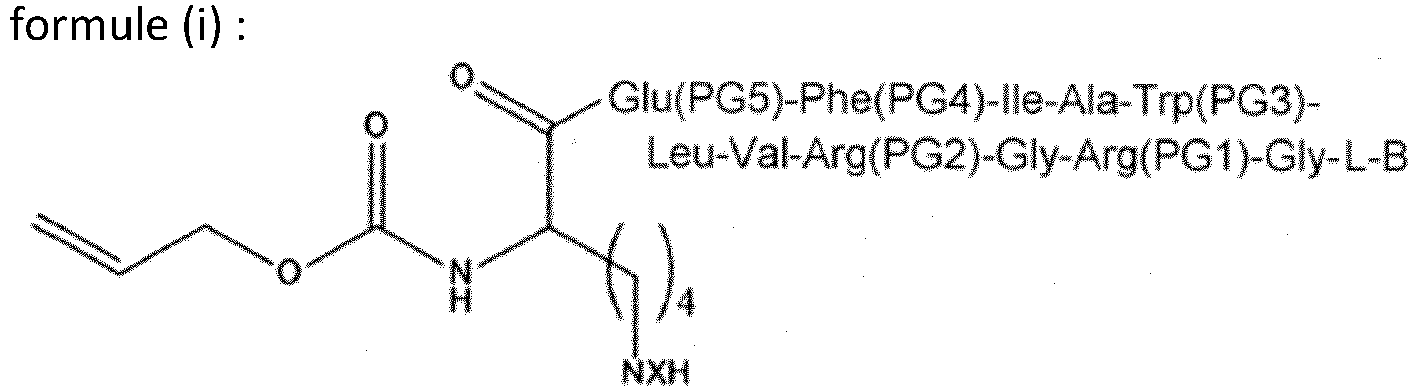 X étant un groupe protecteur d'amino R1 ou étant un groupement acide 8-amino-3,6-dioxa-octanoïque lié par un amide ayant un groupe amino protégé par R1 (AEEAc-R1) ;B étant une phase solide fonctionnalisée par une quelconque structure de lieur appropriée L ; etPG1 à PG5 indépendamment étant absents ou étant des groupes protecteurs de chaîne latérale, qui peuvent être les mêmes ou différents les uns des autres ;b) l'élimination du groupe protecteur R1 de sorte à exposer un groupe amino libre ;c) l'acylation dudit groupe amino libre de sorte à obtenir une deuxième séquence peptidique de la formule (ii) liée à une phase solide, R5 et R6 étant les mêmes ou différents et étant H ou un groupement de groupe protecteur de carboxyle ;
formule (ii) : d) l'élimination du groupe protecteur Alloc de la terminaison N du peptide de formule (ii) lié à une phase solide, de sorte à exposer un groupe alpha amino N-terminal libre ;e) le couplage, par synthèse peptidique sur phase solide par étapes, de la séquence d'acides aminés R7-His(PG19)-Aib-Glu(PG18)-Gly-Thr(PG17)-Phe(PG16)-Thr(PG15)-Ser(PG14)-Asp(PG13)-Val-Ser(PG12)-Ser(PG11)-Tyr(PG10)-Leu-Glu(PG9)-Gly-Gln(PG8)-Ala-Ala- audit groupe alpha amino N-terminal libre de sorte à obtenir un peptide de sémaglutide lié à une phase solide,PG8 à PG19 indépendamment étant absents ou étant des groupes protecteurs de chaîne latérale, qui peuvent être les mêmes ou différents les uns des autres et/ou d'un quelconque parmi PG1 à PG5 ; etR7 étant H ou un groupe protecteur d'amino, qui peut être le même ou différent de R1; etf) le clivage du peptide de sémaglutide de la phase solide.
 - Procédé selon la revendication 1, l'étape d) impliquant l'incubation du peptide lié à un support solide obtenu dans l'étape c) avec une solution comprenant [Pd(PPh3)4] et un ou plusieurs agents de piégeage,
préférablement, les agents de piégeage étant choisis dans le groupe constitué par la morpholine, un complexe diméthylamine borane et le phénylsilane. - Procédé selon l'une quelconque des revendications 1 ou 2, en outre :au moins l'une parmi l'étape a) et/ou l'étape c) impliquant une synthèse peptidique sur phase solide par étapes ; ouchacune des étapes a), c) et e) impliquant une synthèse peptidique sur phase solide.
- Procédé selon l'une quelconque des revendications 1 à 3, une synthèse peptidique sur phase solide étant réalisée en utilisant des blocs de construction, qui comprennent un groupe carboxyle libre ou un ester activé d'un groupe carboxyle, un groupe amino protégé par R1, et éventuellement d'autres groupes protecteurs, et les étapes de :i) couplage d'un bloc de construction, qui comprend un groupe amino protégé par R1, à un groupe amino libre généré dans une étape précédente ; etii) élimination de R1 pour exposer un groupe amino libre étant mises en œuvre en des cycles répétés.
- Procédé selon l'une quelconque des revendications 1 à 4, R1 étant un groupe 9-fluorényl-méthoxycarbonyle (Fmoc),
préférablement, l'étape b) étant réalisée en incubant le composé de formule (i) avec un mélange choisi dans le groupe constitué par 5 à 50 % (v/v) de pipéridine ou de 4-méthyl pipéridine dans du N,N-diméthylformamide (DMF), 5 à 50 % (v/v) de pipéridine ou de 4-méthyl pipéridine dans de la N-méthylpyrrolidone (NMP), 1 à 5 % (v/v) de 3,5 diazabicyclo[5.4.0]undéc-7-ène (DBU) dans du DMF, et 50 % (v/v) de morpholine dans du DMF. - Procédé selon la revendication 5,l'étape c) étant réalisée par synthèse sur phase solide par étapes en utilisant Fmoc-AEEAc-OH, Fmoc-Glu-OtBu et l'acide octadécanedioïque ou l'ester monot-butylique d'acide octadécanedioïque comme blocs de construction ; et/ouchaque bloc de construction utilisé dans les étapes a) et/ou e) étant choisi indépendamment dans le groupe constitué par :1) des dérivés d'acides alpha-aminés, le groupe alpha amino étant protégé par Fmoc, éventuellement en outre la chaîne latérale d'acide aminé portant un groupe protecteur; et/ou2) Alloc-Lys(Fmoc)-OH ; et/ou3) des dérivés de dipeptide, qui comprennent un groupe amino protégé par Fmoc ou Boc, préférablement un groupe alpha amino N-terminal protégé par Fmoc ou Boc, éventuellement en outre au moins une chaîne latérale d'acide aminé portant un groupe protecteur.
- Procédé selon l'une quelconque des revendications 1 à 6, un ou plusieurs dérivés de dipeptide de pseudoproline protégée par R1 étant utilisé(s) dans l'étape e), préférablement le ou les dérivés de dipeptide de pseudoproline protégée par R1 étant choisi(s) parmi Fmoc-Gly-Thr(Psi(Me,Me)pro)-OH, Fmoc-Thr(tBu)-Ser(Psi(Me,Me)pro)-OH, Fmoc-Val-Ser(Psi(Me,Me)pro)-OH, Fmoc-Ser(tBu)-Ser(Psi(Me,Me)pro)-OH et Fmoc-Phe-Thr(Psi(Me,Me)pro)-OH.
- Procédé selon l'une quelconque des revendications 1 à 7, toutes les étapes a), c) et e) étant mises en œuvre au moyen d'une synthèse sur phase solide Fmoc, et/ou au moins l'une, préférablement toutes, les étapes a), c) et e) comprenant l'activation des blocs de construction utilisés au moyen d'un ou plusieurs mélanges de réactifs de couplage comprenant des réactifs choisis pour chaque réaction de couplage indépendamment dans le groupe constitué par :(A) tétrafluoroborate de (benzotriazolyl)tétraméthyluronium (TBTU) plus diisopropyléthylamine (DIPEA) ;(B) diisopropylcarbodiimide (DIC) plus ester éthylique d'acide cyano-hydroxyimino-acétique (Oxyma) ;(C) 3-(diéthoxy-phosphoryloxy)-3H-benzo[d][1,2,3]triazin-4-one (DEPBT) plus DIPEA;(D) DIC plus hydroxybenzotriazole (HOBt) ;(E) tétrafluoroborate de N-[(7-aza-1H-benzotriazol-1-yl)(diméthylamino)-méthylène]-N-méthylméthanaminium N-oxyde (TATU) plus DIPEA;(F) hexafluorophosphate de 2-(1H-benzotriazol-1-yl)-1,1,3,3-tétraméthyluronium (HBTU) plus DIPEA; et(G) hexafluorophosphate de N-[(7-aza-1H-benzotriazol-1-yl)(diméthylamino)-méthylène]-N-méthylméthanaminium N-oxyde (HATU) plus DIPEA.
- Procédé selon l'une quelconque des revendications 1 à 8, en outre des groupes protecteurs étant clivés du peptide de sémaglutide, préférablement simultanément à l'étape f) ; et/outous les groupes protecteurs de chaîne latérale et/ou groupes protecteurs liés au groupe alpha carboxyle des blocs de construction utilisés étant orthogonaux à R1 et Alloc ; et/oules groupes protecteurs de chaîne latérale et/ou groupes protecteurs liés au groupe alpha carboxyle des blocs de construction utilisés étant indépendamment choisis dans le groupe constitué par 2,2,5,7,8-pentaméthylchroman-6-sulfonyle (Pmc), 2,2,4,6,7-pentaméthyldihydrobenzofuran-5-sulfonyle (Pbf), 2,3,6-triméthyl-4-méthoxybenzènesulfonyle (Mtr), t-butyle (tBu), trityle (Trt), 4-méthoxytrityle (Mmt), 4-méthyltrityle (Mtt), ester de t-butyle (OtBu), ester de 3-méthylpent-3-yle (OMpe), 2-phénylisopropyle (OPp), t-butoxycarbonyle (Boc), 2-(4,4-diméthyl-2,6-dioxocyclohexylidène)éthyle (Dde) et 1-(4,4-diméthyl-2,6-dioxocyclohex-1-ylidène)isovaléryle (ivDe).
- Peptide lié à une phase solide de la structure
 B étant une phase solide fonctionnalisée par une quelconque structure de lieur appropriée L;A étant Glu(PG5)-Phe(PG4)-Ile-Ala-Trp(PG3)-Leu-Val-Arg(PG2)-Gly-Arg(PG1)-Gly, en outre, PG1 à PG5 indépendamment étant absents ou étant des groupes protecteurs de chaîne latérale, qui peuvent être les mêmes ou différents les uns des autres ;z étant choisi parmi 1 à 10, préférablement 4 ;X étant choisi parmi un groupe protecteur d'amino R1, H, ou un groupe choisi parmi les structures (iii) à (vi) ci-dessous,** désignant le point de fixation à l'atome N de la chaîne latérale amino ;n étant choisi parmi 1 à 10, préférablement 8 ;R5 et R6 étant les mêmes ou différents et étant H ou un groupement de groupe protecteur de carboxyle ; et R7 étant H ou un groupe protecteur d'amino, qui peut être le même ou différent de R1.


- Peptide lié à une phase solide selon la revendication 10, R1 étant choisi dans le groupe constitué par 9-fluorényl-méthoxycarbonyle (Fmoc), 4-méthyltrityle (Mtt), 4-méthoxytrityle (Mmt) ou trityle (Trt).
- Peptide lié à une phase solide selon l'une quelconque des revendications 10 ou 11, -OR5 et -OR6 étant indépendamment choisis dans le groupe constitué par - OH, -OtBu (ester t-butylique) et -OMpe (ester de 3-méthylpent-3-yle).
- Peptide lié à une phase solide selon l'une quelconque des revendications 10 à 12, R7 étant choisi dans le groupe constitué par H, 9-fluorényl-méthoxycarbonyle (Fmoc), t-butyloxycarbonyle (Boc), 4-méthyltrityle (Mtt), 4-méthoxytrityle (Mmt) ou trityle (Trt).
- Peptide lié à une phase solide selon l'une quelconque des revendications 10 à 13, le peptide lié à une phase solide étant Alloc-Lys(Fmoc)- Glu(PG5)-Phe(PG4)-Ile-Ala-Trp(PG3)-Leu-Val-Arg(PG2)-Gly-Arg(PG1)-Gly-L-B, L, B, et PG1 à PG5 étant tels que définis dans la revendication 10.
Applications Claiming Priority (2)
| Application Number | Priority Date | Filing Date | Title |
|---|---|---|---|
| EP17209828 | 2017-12-21 | ||
| PCT/EP2018/068696 WO2019120639A1 (fr) | 2017-12-21 | 2018-07-10 | Synthèse en phase solide de peptides acylés |
Publications (2)
| Publication Number | Publication Date |
|---|---|
| EP3728304A1 EP3728304A1 (fr) | 2020-10-28 |
| EP3728304B1 true EP3728304B1 (fr) | 2025-02-12 |
Family
ID=60942856
Family Applications (1)
| Application Number | Title | Priority Date | Filing Date |
|---|---|---|---|
| EP18735611.8A Active EP3728304B1 (fr) | 2017-12-21 | 2018-07-10 | Synthèse en phase solide de peptides acylés |
Country Status (3)
| Country | Link |
|---|---|
| US (1) | US11186608B2 (fr) |
| EP (1) | EP3728304B1 (fr) |
| WO (1) | WO2019120639A1 (fr) |
Families Citing this family (24)
| Publication number | Priority date | Publication date | Assignee | Title |
|---|---|---|---|---|
| CN109627317B (zh) * | 2019-02-01 | 2020-11-27 | 兰州大学 | 片段缩合制备索马鲁肽的方法 |
| CN110372785B (zh) * | 2019-07-25 | 2020-10-23 | 成都诺和晟泰生物科技有限公司 | 一种索马鲁肽的合成方法 |
| EP3819308A1 (fr) | 2019-11-07 | 2021-05-12 | Fresenius Kabi iPSUM S.r.l. | Procédé de fabrication d'acides aminés dérivés |
| CN113402598A (zh) * | 2020-03-16 | 2021-09-17 | 江苏金斯瑞生物科技有限公司 | 一种索马鲁肽的固相合成方法 |
| WO2021205388A2 (fr) | 2020-04-10 | 2021-10-14 | Fresenius Kabi Oncology Limited | Procédé amélioré pour la préparation d'une chaîne latérale de sémaglutide |
| CN113801233B (zh) * | 2020-06-11 | 2024-03-01 | 宁波鲲鹏生物科技有限公司 | 一种索玛鲁肽的制备方法 |
| CN111732651B (zh) * | 2020-08-04 | 2020-12-08 | 苏州金顶生物有限公司 | 一种连续流固相反应制备索马鲁肽的方法 |
| CN111732650B (zh) * | 2020-08-04 | 2020-12-08 | 苏州金顶生物有限公司 | 索马鲁肽的连续流固相反应制备 |
| CN112028986A (zh) * | 2020-09-11 | 2020-12-04 | 哈尔滨吉象隆生物技术有限公司 | 一种司美格鲁肽的合成方法 |
| CN112125970B (zh) * | 2020-09-23 | 2021-07-16 | 深圳深创生物药业有限公司 | 一种司美格鲁肽的合成方法 |
| CN112175068B (zh) * | 2020-09-28 | 2021-06-25 | 深圳深创生物药业有限公司 | 一种司美格鲁肽的纯化方法 |
| CN112111002B (zh) * | 2020-09-28 | 2021-07-13 | 深圳深创生物药业有限公司 | 一种司美格鲁肽制备方法 |
| CA3204051A1 (fr) | 2021-01-20 | 2022-07-28 | Brian Lian | Compositions et procedes pour le traitement de troubles metaboliques et hepatiques |
| CN113045641B (zh) * | 2021-03-19 | 2024-10-22 | 合肥科生景肽生物科技有限公司 | 一种索马鲁肽的制备方法 |
| JP7642830B2 (ja) | 2021-09-15 | 2025-03-10 | バイキング・セラピューティクス・インコーポレイテッド | 代謝及び肝臓障害の処置のための組成物及び方法 |
| CN113880935B (zh) * | 2021-10-25 | 2022-08-26 | 浙江肽昇生物医药有限公司 | 一种索马鲁肽全保护肽树脂的制备方法、一种索马鲁肽制备方法 |
| CN114249808B (zh) * | 2021-12-27 | 2024-11-12 | 江苏诺泰澳赛诺生物制药股份有限公司 | 一种Cagrilintide的合成方法 |
| US20230406900A1 (en) * | 2022-06-01 | 2023-12-21 | Scinopharm Taiwan, Ltd. | Process for preparing glucagon-like peptide-1 |
| TWI871636B (zh) * | 2022-06-01 | 2025-02-01 | 台灣神隆股份有限公司 | 胰高血糖素樣肽-1的製備方法 |
| EP4655311A1 (fr) | 2023-01-24 | 2025-12-03 | Boehringer Ingelheim International GmbH | Procédé de synthèse de polypeptides |
| WO2025184364A1 (fr) * | 2024-03-01 | 2025-09-04 | University Of Notre Dame Du Lac | Dépôts à auto-assemblage de thérapies peptidiques adjuvantes |
| WO2026013135A1 (fr) | 2024-07-10 | 2026-01-15 | Ascendis Pharma A/S | Réactifs de liaison à l'albumine |
| WO2026013136A1 (fr) | 2024-07-10 | 2026-01-15 | Ascendis Pharma A/S | Composés de liaison à l'albumine |
| WO2026013138A1 (fr) | 2024-07-10 | 2026-01-15 | Ascendis Pharma A/S | Composés à liaison à l'albumine améliorée |
Citations (4)
| Publication number | Priority date | Publication date | Assignee | Title |
|---|---|---|---|---|
| US5753206A (en) * | 1995-06-07 | 1998-05-19 | Immunomedics, Inc. | Radiometal-binding analogues of luteinizing hormone releasing hormone |
| WO2006097537A2 (fr) * | 2005-03-18 | 2006-09-21 | Novo Nordisk A/S | Composes de glp-1 acyles |
| WO2016005960A1 (fr) * | 2014-07-11 | 2016-01-14 | Dr. Reddy's Laboratories Limited | Procédé pour la préparation de liraglutide |
| WO2017114191A1 (fr) * | 2015-12-30 | 2017-07-06 | 深圳翰宇药业股份有限公司 | Procédé de préparation du sermaglutide |
Family Cites Families (7)
| Publication number | Priority date | Publication date | Assignee | Title |
|---|---|---|---|---|
| ES2561208T3 (es) | 2008-09-12 | 2016-02-25 | Novo Nordisk A/S | Método de acilación de un péptido o una proteína |
| US20150038435A1 (en) | 2012-03-01 | 2015-02-05 | Novo Nordisk A/S | N-terminally modified oligopeptides and uses thereof |
| CN103848910B (zh) | 2012-11-30 | 2016-04-13 | 深圳翰宇药业股份有限公司 | 一种萨摩鲁泰的固相合成方法 |
| GR20140100479A (el) | 2014-09-23 | 2016-05-05 | Novetide, Ltd., | Συνθεση λιραγλουτιδης |
| CN104356224A (zh) | 2014-10-24 | 2015-02-18 | 杭州阿德莱诺泰制药技术有限公司 | 一种制备萨摩鲁泰的方法 |
| CN105753964A (zh) | 2014-12-16 | 2016-07-13 | 深圳翰宇药业股份有限公司 | 一种萨摩鲁肽的制备方法及其中间体 |
| CN106478806B (zh) | 2016-10-24 | 2019-08-30 | 合肥国肽生物科技有限公司 | 一种索玛鲁肽的固相合成方法 |
-
2018
- 2018-07-10 EP EP18735611.8A patent/EP3728304B1/fr active Active
- 2018-07-10 WO PCT/EP2018/068696 patent/WO2019120639A1/fr not_active Ceased
- 2018-07-10 US US16/955,532 patent/US11186608B2/en active Active
Patent Citations (5)
| Publication number | Priority date | Publication date | Assignee | Title |
|---|---|---|---|---|
| US5753206A (en) * | 1995-06-07 | 1998-05-19 | Immunomedics, Inc. | Radiometal-binding analogues of luteinizing hormone releasing hormone |
| WO2006097537A2 (fr) * | 2005-03-18 | 2006-09-21 | Novo Nordisk A/S | Composes de glp-1 acyles |
| WO2016005960A1 (fr) * | 2014-07-11 | 2016-01-14 | Dr. Reddy's Laboratories Limited | Procédé pour la préparation de liraglutide |
| WO2017114191A1 (fr) * | 2015-12-30 | 2017-07-06 | 深圳翰宇药业股份有限公司 | Procédé de préparation du sermaglutide |
| US20190010204A1 (en) * | 2015-12-30 | 2019-01-10 | Hybio Pharmaceutical Co., Ltd. | Method for preparing sermaglutide |
Non-Patent Citations (3)
| Title |
|---|
| ALBERT ISIDRO-LLOBET ET AL: "Amino Acid-Protecting Groups", CHEMICAL REVIEWS, vol. 109, no. 6, 10 June 2009 (2009-06-10), pages 2455 - 2504, XP055081001, ISSN: 0009-2665, DOI: 10.1021/cr800323s * |
| GÓNGORA-BENÍTEZ MIRIAM ET AL: "A universal strategy for preparing protected C-terminal peptides on the solid phase through an intramolecular click chemistry-based handle", CHEMICAL COMMUNICATIONS, vol. 48, no. 17, 1 January 2012 (2012-01-01), UK, pages 2313 - 2315, XP055884255, ISSN: 1359-7345, Retrieved from the Internet <URL:https://pubs.rsc.org/en/content/articlepdf/2012/cc/c2cc17222d> DOI: 10.1039/c2cc17222d * |
| THIERRIET N ET AL: "Use of Alloc-amino Acids in Solid-Phase Peptide Synthesis. Tandem Deprotection-Coupling Reactions Using Neutral Conditions", TETRAHEDRON LETTERS, vol. 38, no. 41, 1997, pages 7275 - 7278 * |
Also Published As
| Publication number | Publication date |
|---|---|
| US11186608B2 (en) | 2021-11-30 |
| EP3728304A1 (fr) | 2020-10-28 |
| WO2019120639A1 (fr) | 2019-06-27 |
| US20210009631A1 (en) | 2021-01-14 |
Similar Documents
| Publication | Publication Date | Title |
|---|---|---|
| EP3728304B1 (fr) | Synthèse en phase solide de peptides acylés | |
| EP3433267B1 (fr) | Procédé de préparation de peptides de type glucagon | |
| US12577274B2 (en) | Manufacture of glucagon peptides | |
| AU723268B2 (en) | Improved solid-phase peptide synthesis and agent for use in such synthesis | |
| DK2757107T3 (en) | A process for the solid phase synthesis of liraglutide | |
| KR100633214B1 (ko) | 펩티드 합성 방법 및 그 조성물 | |
| AU2017372048A1 (en) | Synthesis of liraglutide | |
| CN104650219A (zh) | 片段缩合制备利拉鲁肽的方法 | |
| EP3523324B1 (fr) | Procédé de préparation de peptides comprenant une chaîne latérale de lysine modifiée par lyophilisation | |
| WO2020254479A1 (fr) | Procédé de fabrication de glucagon | |
| WO2023279323A1 (fr) | Procédé de synthèse d'analogue de glp-1 | |
| WO2013046233A2 (fr) | Procédé de préparation d'acétate d'octréotide | |
| WO2023279324A1 (fr) | Procédé de synthèse d'un analogue de glp-1 | |
| Scolaro et al. | Solid‐phase synthesis of bombesin by continuous flow procedure using Fmoc‐amino acids | |
| JP2008534639A (ja) | Peg樹脂上におけるアルファ−ヘリックスのペプチド合成 | |
| CN119684391A (zh) | 一种含有柔性接头的多肽合成方法 | |
| CN101155824A (zh) | 在PEG树脂上合成α-螺旋的肽合成法 | |
| HK1116805A (en) | Peptide synthesis of alpha-helixes on peg resin | |
| WO2000055182A1 (fr) | Methode de synthese d'un peptide |
Legal Events
| Date | Code | Title | Description |
|---|---|---|---|
| STAA | Information on the status of an ep patent application or granted ep patent |
Free format text: STATUS: UNKNOWN |
|
| STAA | Information on the status of an ep patent application or granted ep patent |
Free format text: STATUS: THE INTERNATIONAL PUBLICATION HAS BEEN MADE |
|
| TPAC | Observations filed by third parties |
Free format text: ORIGINAL CODE: EPIDOSNTIPA |
|
| PUAI | Public reference made under article 153(3) epc to a published international application that has entered the european phase |
Free format text: ORIGINAL CODE: 0009012 |
|
| STAA | Information on the status of an ep patent application or granted ep patent |
Free format text: STATUS: REQUEST FOR EXAMINATION WAS MADE |
|
| 17P | Request for examination filed |
Effective date: 20200714 |
|
| AK | Designated contracting states |
Kind code of ref document: A1 Designated state(s): AL AT BE BG CH CY CZ DE DK EE ES FI FR GB GR HR HU IE IS IT LI LT LU LV MC MK MT NL NO PL PT RO RS SE SI SK SM TR |
|
| AX | Request for extension of the european patent |
Extension state: BA ME |
|
| DAV | Request for validation of the european patent (deleted) | ||
| DAX | Request for extension of the european patent (deleted) | ||
| STAA | Information on the status of an ep patent application or granted ep patent |
Free format text: STATUS: EXAMINATION IS IN PROGRESS |
|
| 17Q | First examination report despatched |
Effective date: 20220202 |
|
| P01 | Opt-out of the competence of the unified patent court (upc) registered |
Effective date: 20230421 |
|
| GRAP | Despatch of communication of intention to grant a patent |
Free format text: ORIGINAL CODE: EPIDOSNIGR1 |
|
| STAA | Information on the status of an ep patent application or granted ep patent |
Free format text: STATUS: GRANT OF PATENT IS INTENDED |
|
| RIC1 | Information provided on ipc code assigned before grant |
Ipc: C07K 14/605 20060101AFI20240513BHEP |
|
| INTG | Intention to grant announced |
Effective date: 20240607 |
|
| GRAJ | Information related to disapproval of communication of intention to grant by the applicant or resumption of examination proceedings by the epo deleted |
Free format text: ORIGINAL CODE: EPIDOSDIGR1 |
|
| STAA | Information on the status of an ep patent application or granted ep patent |
Free format text: STATUS: EXAMINATION IS IN PROGRESS |
|
| GRAP | Despatch of communication of intention to grant a patent |
Free format text: ORIGINAL CODE: EPIDOSNIGR1 |
|
| STAA | Information on the status of an ep patent application or granted ep patent |
Free format text: STATUS: GRANT OF PATENT IS INTENDED |
|
| INTC | Intention to grant announced (deleted) | ||
| INTG | Intention to grant announced |
Effective date: 20241004 |
|
| GRAS | Grant fee paid |
Free format text: ORIGINAL CODE: EPIDOSNIGR3 |
|
| GRAA | (expected) grant |
Free format text: ORIGINAL CODE: 0009210 |
|
| STAA | Information on the status of an ep patent application or granted ep patent |
Free format text: STATUS: THE PATENT HAS BEEN GRANTED |
|
| AK | Designated contracting states |
Kind code of ref document: B1 Designated state(s): AL AT BE BG CH CY CZ DE DK EE ES FI FR GB GR HR HU IE IS IT LI LT LU LV MC MK MT NL NO PL PT RO RS SE SI SK SM TR |
|
| REG | Reference to a national code |
Ref country code: GB Ref legal event code: FG4D |
|
| REG | Reference to a national code |
Ref country code: CH Ref legal event code: EP |
|
| REG | Reference to a national code |
Ref country code: DE Ref legal event code: R096 Ref document number: 602018079069 Country of ref document: DE |
|
| REG | Reference to a national code |
Ref country code: IE Ref legal event code: FG4D |
|
| REG | Reference to a national code |
Ref country code: NL Ref legal event code: MP Effective date: 20250212 |
|
| PG25 | Lapsed in a contracting state [announced via postgrant information from national office to epo] |
Ref country code: RS Free format text: LAPSE BECAUSE OF FAILURE TO SUBMIT A TRANSLATION OF THE DESCRIPTION OR TO PAY THE FEE WITHIN THE PRESCRIBED TIME-LIMIT Effective date: 20250512 |
|
| PG25 | Lapsed in a contracting state [announced via postgrant information from national office to epo] |
Ref country code: FI Free format text: LAPSE BECAUSE OF FAILURE TO SUBMIT A TRANSLATION OF THE DESCRIPTION OR TO PAY THE FEE WITHIN THE PRESCRIBED TIME-LIMIT Effective date: 20250212 |
|
| PG25 | Lapsed in a contracting state [announced via postgrant information from national office to epo] |
Ref country code: PL Free format text: LAPSE BECAUSE OF FAILURE TO SUBMIT A TRANSLATION OF THE DESCRIPTION OR TO PAY THE FEE WITHIN THE PRESCRIBED TIME-LIMIT Effective date: 20250212 |
|
| PG25 | Lapsed in a contracting state [announced via postgrant information from national office to epo] |
Ref country code: ES Free format text: LAPSE BECAUSE OF FAILURE TO SUBMIT A TRANSLATION OF THE DESCRIPTION OR TO PAY THE FEE WITHIN THE PRESCRIBED TIME-LIMIT Effective date: 20250212 |
|
| REG | Reference to a national code |
Ref country code: LT Ref legal event code: MG9D |
|
| PG25 | Lapsed in a contracting state [announced via postgrant information from national office to epo] |
Ref country code: IS Free format text: LAPSE BECAUSE OF FAILURE TO SUBMIT A TRANSLATION OF THE DESCRIPTION OR TO PAY THE FEE WITHIN THE PRESCRIBED TIME-LIMIT Effective date: 20250612 Ref country code: NO Free format text: LAPSE BECAUSE OF FAILURE TO SUBMIT A TRANSLATION OF THE DESCRIPTION OR TO PAY THE FEE WITHIN THE PRESCRIBED TIME-LIMIT Effective date: 20250512 |
|
| PG25 | Lapsed in a contracting state [announced via postgrant information from national office to epo] |
Ref country code: NL Free format text: LAPSE BECAUSE OF FAILURE TO SUBMIT A TRANSLATION OF THE DESCRIPTION OR TO PAY THE FEE WITHIN THE PRESCRIBED TIME-LIMIT Effective date: 20250212 |
|
| PG25 | Lapsed in a contracting state [announced via postgrant information from national office to epo] |
Ref country code: HR Free format text: LAPSE BECAUSE OF FAILURE TO SUBMIT A TRANSLATION OF THE DESCRIPTION OR TO PAY THE FEE WITHIN THE PRESCRIBED TIME-LIMIT Effective date: 20250212 |
|
| PG25 | Lapsed in a contracting state [announced via postgrant information from national office to epo] |
Ref country code: PT Free format text: LAPSE BECAUSE OF FAILURE TO SUBMIT A TRANSLATION OF THE DESCRIPTION OR TO PAY THE FEE WITHIN THE PRESCRIBED TIME-LIMIT Effective date: 20250612 Ref country code: LV Free format text: LAPSE BECAUSE OF FAILURE TO SUBMIT A TRANSLATION OF THE DESCRIPTION OR TO PAY THE FEE WITHIN THE PRESCRIBED TIME-LIMIT Effective date: 20250212 |
|
| PG25 | Lapsed in a contracting state [announced via postgrant information from national office to epo] |
Ref country code: BG Free format text: LAPSE BECAUSE OF FAILURE TO SUBMIT A TRANSLATION OF THE DESCRIPTION OR TO PAY THE FEE WITHIN THE PRESCRIBED TIME-LIMIT Effective date: 20250212 Ref country code: GR Free format text: LAPSE BECAUSE OF FAILURE TO SUBMIT A TRANSLATION OF THE DESCRIPTION OR TO PAY THE FEE WITHIN THE PRESCRIBED TIME-LIMIT Effective date: 20250513 |
|
| REG | Reference to a national code |
Ref country code: AT Ref legal event code: MK05 Ref document number: 1766005 Country of ref document: AT Kind code of ref document: T Effective date: 20250212 |
|
| PG25 | Lapsed in a contracting state [announced via postgrant information from national office to epo] |
Ref country code: SE Free format text: LAPSE BECAUSE OF FAILURE TO SUBMIT A TRANSLATION OF THE DESCRIPTION OR TO PAY THE FEE WITHIN THE PRESCRIBED TIME-LIMIT Effective date: 20250212 |
|
| PG25 | Lapsed in a contracting state [announced via postgrant information from national office to epo] |
Ref country code: SM Free format text: LAPSE BECAUSE OF FAILURE TO SUBMIT A TRANSLATION OF THE DESCRIPTION OR TO PAY THE FEE WITHIN THE PRESCRIBED TIME-LIMIT Effective date: 20250212 |
|
| PG25 | Lapsed in a contracting state [announced via postgrant information from national office to epo] |
Ref country code: DK Free format text: LAPSE BECAUSE OF FAILURE TO SUBMIT A TRANSLATION OF THE DESCRIPTION OR TO PAY THE FEE WITHIN THE PRESCRIBED TIME-LIMIT Effective date: 20250212 |
|
| PGFP | Annual fee paid to national office [announced via postgrant information from national office to epo] |
Ref country code: DE Payment date: 20250729 Year of fee payment: 8 |
|
| PG25 | Lapsed in a contracting state [announced via postgrant information from national office to epo] |
Ref country code: IT Free format text: LAPSE BECAUSE OF FAILURE TO SUBMIT A TRANSLATION OF THE DESCRIPTION OR TO PAY THE FEE WITHIN THE PRESCRIBED TIME-LIMIT Effective date: 20250212 |
|
| PGFP | Annual fee paid to national office [announced via postgrant information from national office to epo] |
Ref country code: BE Payment date: 20250722 Year of fee payment: 8 Ref country code: GB Payment date: 20250724 Year of fee payment: 8 |
|
| PG25 | Lapsed in a contracting state [announced via postgrant information from national office to epo] |
Ref country code: AT Free format text: LAPSE BECAUSE OF FAILURE TO SUBMIT A TRANSLATION OF THE DESCRIPTION OR TO PAY THE FEE WITHIN THE PRESCRIBED TIME-LIMIT Effective date: 20250212 |
|
| PGFP | Annual fee paid to national office [announced via postgrant information from national office to epo] |
Ref country code: FR Payment date: 20250723 Year of fee payment: 8 |
|
| PGFP | Annual fee paid to national office [announced via postgrant information from national office to epo] |
Ref country code: CH Payment date: 20250801 Year of fee payment: 8 |
|
| PG25 | Lapsed in a contracting state [announced via postgrant information from national office to epo] |
Ref country code: EE Free format text: LAPSE BECAUSE OF FAILURE TO SUBMIT A TRANSLATION OF THE DESCRIPTION OR TO PAY THE FEE WITHIN THE PRESCRIBED TIME-LIMIT Effective date: 20250212 Ref country code: CZ Free format text: LAPSE BECAUSE OF FAILURE TO SUBMIT A TRANSLATION OF THE DESCRIPTION OR TO PAY THE FEE WITHIN THE PRESCRIBED TIME-LIMIT Effective date: 20250212 |
|
| PG25 | Lapsed in a contracting state [announced via postgrant information from national office to epo] |
Ref country code: RO Free format text: LAPSE BECAUSE OF FAILURE TO SUBMIT A TRANSLATION OF THE DESCRIPTION OR TO PAY THE FEE WITHIN THE PRESCRIBED TIME-LIMIT Effective date: 20250212 |
|
| PG25 | Lapsed in a contracting state [announced via postgrant information from national office to epo] |
Ref country code: SK Free format text: LAPSE BECAUSE OF FAILURE TO SUBMIT A TRANSLATION OF THE DESCRIPTION OR TO PAY THE FEE WITHIN THE PRESCRIBED TIME-LIMIT Effective date: 20250212 |
|
| REG | Reference to a national code |
Ref country code: DE Ref legal event code: R097 Ref document number: 602018079069 Country of ref document: DE |
|
| PLBE | No opposition filed within time limit |
Free format text: ORIGINAL CODE: 0009261 |
|
| STAA | Information on the status of an ep patent application or granted ep patent |
Free format text: STATUS: NO OPPOSITION FILED WITHIN TIME LIMIT |
|
| 26N | No opposition filed |
Effective date: 20251113 |
|
| PG25 | Lapsed in a contracting state [announced via postgrant information from national office to epo] |
Ref country code: LU Free format text: LAPSE BECAUSE OF NON-PAYMENT OF DUE FEES Effective date: 20250710 |