EP3729063B1 - System und verfahren zur spektroskopieanalyse von diamanten - Google Patents
System und verfahren zur spektroskopieanalyse von diamanten Download PDFInfo
- Publication number
- EP3729063B1 EP3729063B1 EP18836529.0A EP18836529A EP3729063B1 EP 3729063 B1 EP3729063 B1 EP 3729063B1 EP 18836529 A EP18836529 A EP 18836529A EP 3729063 B1 EP3729063 B1 EP 3729063B1
- Authority
- EP
- European Patent Office
- Prior art keywords
- gem
- diamond
- analysis
- intensity
- light
- Prior art date
- Legal status (The legal status is an assumption and is not a legal conclusion. Google has not performed a legal analysis and makes no representation as to the accuracy of the status listed.)
- Active
Links
Images


Classifications
-
- G—PHYSICS
- G01—MEASURING; TESTING
- G01N—INVESTIGATING OR ANALYSING MATERIALS BY DETERMINING THEIR CHEMICAL OR PHYSICAL PROPERTIES
- G01N21/00—Investigating or analysing materials by the use of optical means, i.e. using sub-millimetre waves, infrared, visible or ultraviolet light
- G01N21/84—Systems specially adapted for particular applications
- G01N21/87—Investigating jewels
-
- G—PHYSICS
- G01—MEASURING; TESTING
- G01N—INVESTIGATING OR ANALYSING MATERIALS BY DETERMINING THEIR CHEMICAL OR PHYSICAL PROPERTIES
- G01N21/00—Investigating or analysing materials by the use of optical means, i.e. using sub-millimetre waves, infrared, visible or ultraviolet light
- G01N21/62—Systems in which the material investigated is excited whereby it emits light or causes a change in wavelength of the incident light
- G01N21/63—Systems in which the material investigated is excited whereby it emits light or causes a change in wavelength of the incident light optically excited
- G01N21/64—Fluorescence; Phosphorescence
-
- G—PHYSICS
- G01—MEASURING; TESTING
- G01N—INVESTIGATING OR ANALYSING MATERIALS BY DETERMINING THEIR CHEMICAL OR PHYSICAL PROPERTIES
- G01N21/00—Investigating or analysing materials by the use of optical means, i.e. using sub-millimetre waves, infrared, visible or ultraviolet light
- G01N21/62—Systems in which the material investigated is excited whereby it emits light or causes a change in wavelength of the incident light
- G01N21/63—Systems in which the material investigated is excited whereby it emits light or causes a change in wavelength of the incident light optically excited
- G01N21/65—Raman scattering
Definitions
- the present invention relates to a system and a method for combining spectroscopic analyses to determine whether a gem is a diamond of natural origin or synthetic origin.
- Gemmology applications of spectroscopic findings such as the possibility of providing a positive identification of diamond from the spectrum of Raman scattered light (as uniquely determined by the crystal structure of carbon in its solid diamond form) or those useful to determine the natural or synthetic nature of diamond and its color from the emission or optical absorption of particular defects in the crystal structure, require the use of multiple complex optical instruments and advanced scientific knowledge for handling measurements and interpreting results. Such instruments and knowledge are mainly available at specialized research centers and laboratories and require considerable investments. For these reasons, currently available portable gemological analysis devices are mainly characterised by a trade-off of price, reliability of diagnostic results, and operational complexity, which is not always beneficial.
- US 7362109 concerns an apparatus for distinguishing gems based on electrical and/or thermal conductivity as automatically detected upon contact with the gem to be analysed.
- US 7277161 discloses a method of qualifying a diamond based on the light transmitted through the diamond, wherein the diamond is irradiated with light at a wavelength between 225 nm and 300 nm and the light transmission is measured and compared with a reference value that corresponds to a transmission through a reference diamond.
- a diamond is irradiated with UV light at a wavelength of 225 nm or less, such that only a surface region of the diamond is irradiated, and produces a luminescence pattern. The luminescence and fluorescence emitted by the diamond is thus observed. Once UV irradiation terminates, phosphorescence is also observed. Photoluminescence patterns have been visually studied by an operator using magnification means, i.e. a microscope.
- EP 0226608 discloses a method that comprises the steps of (a) placing a sample in a beam of monochromatic light with a wavelength between 450 and 650 nm; (b) passing Raman radiation scattered from the sample through a filter that only allows the passage of the characteristic frequency of the scattered Raman radiation of a diamond, and (c) detecting the radiation so filtered.
- Instruments based on spectroscopic analysis of diamond can provide information for discriminating diamonds from other gems, for distinguishing type I from type II diamonds, for discriminating synthetic and natural diamonds.
- the cubic crystallographic structure of tetracoordinated carbon determines its spectrum of Raman light scattered from a natural diamond, the spectrum being characterised by a single intense narrow line at1332 cm -1 , at ambient temperature.
- M. S. Liu et al. in "Temperature dependence of the first-order Raman phonon line of diamond", published in Phys. Rev. B 61, pages 3391-3395 (1999 ), study micro-Raman scattering from monocrystalline diamonds at temperatures ranging from 77 to 873 K. The measures show that the frequency of the phonon and the width of the line are temperature-dependent.
- WO 2015/27990 discloses a method and an apparatus for spectroscopic analysis to distinguish a yellow diamond whose color has a natural or artificial origin.
- US 5811824 relates to a method and an apparatus for checking whether a diamond has a layer of synthetic diamond deposited thereupon by CVD based on the absorption spectrum.
- the method comprises irradiating at least two areas of a diamond surface with UV radiation and observe the intensity of radiation at a wavelength between 230 nm 320 nm that is transmitted from each area of the diamond, to detect a reduced absorption of the radiation transmitted in at least one of the two zones, indicative of the presence of synthetic diamond.
- type I transparent colourless natural diamonds colour degrees D-J
- type I transparent colourless natural diamonds colour degree D to J
- type I transparent colourless natural diamonds have very high absorbance values in the near UV region, corresponding to an optical transmittance of less than 1/100, versus a transmittance close to 1 for type II diamonds.
- SiV silicon vacancy
- Fluorescence emissions of diamond also include an emission at about 884 nm, a few nm wide, caused by Ni impurities and almost exclusively found in HPHT synthetic diamonds (see the above mentioned Hainschwang et al. paper).
- the present invention relates to an apparatus for the analysis of transparent, substantially colourless gems of unknown composition and origin, that can perform a plurality of spectroscopic analyses and collect and process information from the measures to produce one or more diagnostic results.
- the plurality of spectroscopic analyses include measures of Raman scattering, ultraviolet (UV) transmittance, fluorescence in the red spectral region, e.g. 738 nm and 884 nm, and phosphorescence in the visible spectrum, mainly in the range between 400-600 nm, excited at a wavelength lower than or equal to 230 nm.
- the data is analyzed by the system and combined thereby to produce a set of diagnostic results concerning the distinction between diamonds and precious stones other than diamond and, in case of diamonds, the distinction between type I colourless natural diamonds, type II colourless synthetic CVD diamonds, type II colourless synthetic HPHT diamonds, potential type II colourless synthetic diamonds, and potential type II colourless natural diamonds.
- the Raman scattering peak at1332 cm -1 uniquely defines the gem being analyzed as monocrystalline diamond, irrespective of its natural or synthetic origin.
- the Raman line of diamond is included in the spectral region between about 650 nm and 748 nm.
- the Raman line is located at 712 nm for an excitation wavelength of 650 nm.
- the apparatus is able provide the result of the diagnosis of the sample under examination in a manner that is intelligible by a user, even when he/she has no special scientific knowledge for result analysis.
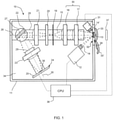
- FIG. 1 is a schematic top view of an apparatus for spectroscopic analysis of a gem according to one embodiment of the present invention
- An apparatus 10 for spectroscopic analysis comprises a first light source 12 configured to emit a first primary light beam 14.
- the first source 12 is arranged in such a position as to direct the beam onto a sample 13, which is a gem and in particular a colourless gem.
- the gem under examination is at ambient temperature. Therefore, the detected spectra are spectra measured at room temperature.
- the first light source 12 is configured to emit a light beam at a wavelength 1 between 550 nm and 680 nm. More preferably it is configured to emit monochromatic light in the visible red spectral region, at a wavelength 1 between 600 and 680 nm.
- the spectroscopy apparatus 10 comprises a second light source 31 configured to emit UV light, preferably radiation at a wavelength equal to or less than 230 nm.
- the second light source 31 is configured to emit a non-monochromatic light beam comprising radiation at a wavelength equal to or less than 230 nm which may cause phosphorescence emission.
- the second light source is a deuterium lamp which emits a continuous spectrum from 180 nm to 370 nm, optionally optically coupled to an optical filter (not shown) which is configured to transmit light at a wavelength of less than 230 nm.
- the first and second sources 12 and 31 can be activated separately, according to the spectroscopic analysis to be conducted.
- the light emitted and/or scattered by the sample 13, induced by irradiation from the first light source 12 and indicated with a secondary optical beam 15, is collected by a first optical focusing system 30 which includes, for example, two focusing lenses 17 and 18, with the second lens 18 located downstream from the first lens with respect to the sample 13, like in the exemplary embodiment of Figure 1 .
- the first optical focusing system 30 consists of a single focusing lens, for example a biconvex lens.
- the secondary optical beam 15 is focused by focusing system 30 on a slit 19 to form an image of the light that comes from the sample.
- the width of the slit is preferably selected to obtain an image of the slit on a detector device, as described in greater detail below, with a width of the order of one pixel.
- an optical filter 20 is arranged to receive the secondary optical filter from the slit 19, to filter out any light of the primary beam diffused elastically elastically scattered at the same wavelength as the incident beam from the sample or from its surface.
- the wavelength-selective optical filter 20 selective is a passband or step optical filter.
- the excitation wavelength is 633 nm and a highpass filter with a cut-off wavelength of 640 nm is selected.
- the secondary beam is collimated by a collimating lens 21 on an optical spectral-dispersion element 22, which is configured to spatially distribute the secondary optical beam according to the wavelength.
- the dispersive element 22 is a diffraction grating.
- the optical dispersion element is mounted to a structure 27 positioned to stably support the dispersive element and receive the secondary optical beam at the right angle.
- the dispersed optical beam is collected by a convergent lens 23 and focused on a photodetector device 24.
- the photodetector device 24 comprises a sensor 38 electrically connected to the processing circuit 25, e.g. a microprocessor, configured to receive and process the output signals from the sensor 38 as is known per se and to produce spectral intensity distribution x-y data that are adapted to be displayed as a picture in a display or be transmitted to an external unit for processing.
- the sensor 38 is a CCD or CMOS sensor.
- the passive optical elements 19-22 for focusing, collimating and dispersing the secondary optical beam 15 from the sample are arranged along a first optical axis 26.
- the diffraction grating 22 directs the secondary beam towards the photodetector device 24 along a second optical axis 31.
- the optical elements are placed along the first optical axis 26 by being fastened to a support structure by means of usual fastening arrangements.
- the optical system of the apparatus 10 is housed in a container 11 with a top opening that may be closed by a lid (not shown).
- the sample 13 is fixed in a sample holder 32 that holds it in place.
- the sample holder comprises a through opening and a mounting and/or clamping mechanism to hold the gem in position on the opening, so as to expose the first side of the gem and a second side, opposite thereto.
- the radiation emitted by the first or second source is incident upon a first side of the gem 13, when the latter is positioned on the sample holder 32.
- the sample holder 32 is preferably mounted to a wall of the container 11 to thereby allow placement of the sample without opening the container that contains the optical and optoelectronic components.
- the sample holder 32 comprises a first lid 33 which encloses the sample once it has been fixed to the mounting mechanism, at a second side of the sample, opposite to the first side.
- the first lid 33 arranged 57 above the second side of the sample, is adapted to be removed or moved between a position in which it encloses the sample and a position in which it releases the sample thereby allowing positioning or removal thereof.
- a plurality of interchangeable lids are provided for replacement or rotation.
- the plurality of lids are made of materials with different optical properties.
- three interchangeable lids are provided (only two lids being shown): a first lid 33 that is transparent to visible light only and opaque to ultraviolet (UV) light and a second lid 33' made of a material that is transparent to visible light has its inner side, facing the second side of the gem, coated with a film 39 of a material that is fluorescent to UV radiation.
- the plurality of covers comprises a third lid (not shown) opaque to visible light, to prevent ambient light from entering the device during the acquisition of spectra by the first photodetector device 24.
- the apparatus further comprises a second photodetector device 37, i.e. a visible light sensor, for example a photodiode sensor.
- the second photodetector device is arranged to collect the fluorescence generated by the film 39, at the second side of the sample opposite to the first light incidence side of the sample.
- the second photodetector 37 is preferably arranged downstream from the lid, to thereby receive the visible light transmitted or emitted by the lid, when the latter is arranged 57 above the sample.
- the second lid 33' is used to observe the UV radiation transmitted through the gem, and the photodiode sensor 37 is located at the fluorescent film 39, the photodiode sensor being preferably masked from ambient light.
- the photodiode sensor 37 detects the visible light generated by the fluorescent material.
- a film of fluorescent material may be interposed between the second side of the gem and the photodiode sensor 37.
- the film of fluorescent material (39) may be positioned either in a first position between the second side of the gem and the second photodetector device (37) or in a second position external to the field of view of the second photodetector device.
- the film 39 may be a coating film glued or formed on the inner wall of the cover.
- Detection of a fluorescence signal will likely indicate that the sample is a type II synthetic or natural diamond.
- the absence of fluorescence indicates that the diamond is a type I natural diamond.
- the first lid 33 made of a material that is transparent to visible light and opaque to UV light is preferably used to detect a possible phosphorescence radiation, occurring especially in synthetic diamonds, when irradiated with UV radiation.
- the UV source 31 is turned on, irradiates the sample 13 for a given time interval and is then turned off. The emission of visible phosphorescence light continues for a relatively short time interval,.g. a few seconds, once the UV excitation source has been turned off.
- the transparent material of the cover 33 allows the visible light emitted by the diamond to pass through the lid and be detected by the second photodetector 37.
- the lid 33 is opaque to visible radiation.
- the (electric and/or electronic) logical connection lines are shown in Figure 1 by dashed lines.
- the CPU is external to the container 11, e.g. is installed in a PC or in a mobile user terminal, such as a tablet or a smartphone.
- the CPU 36 is housed in the container 11 and may be connected to a PC or another user terminal.
- the CPU 36 receives the electrical signals representative of spectral intensity distribution at its input.
- the first photodetector device 24 is configured to acquire a spectral region from 600 nm to 950 nm.
- the CPU 36 receives spectral intensity distribution from the photodetector device 24 at its input and is configured to analyze spectral intensity as described hereinbelow.
- the analysis of spectral intensity distribution and the determination of the natural or synthetic origin of the gem are performed automatically by the CPU 36, and the analysis of fluorescence and phosphorescence signals output by second photodetector 37 is also carried automatically.
- the CPU 36 is connected to the first and second light sources 12, 31 for selective activation of the first and second source.
- the CPU 36 may be attached to a display (not shown) for displaying the diagnostic results obtained from the measurements performed by first photodetector device 24 and/or the second photodetector 37.
- the diagnostic result as automatically processed by the CPU, may be a text message on display which informs the user about the nature of the gem to be tested.
- the user is not required to examine the emission spectra or quantitative or spectral parameters of the output signals.
- the transmission intensity of UV light through the gem is detected by a UV light sensor.
- no fluorescent film is provided between the second side of the gem and the UV sensor.
- FIG 2 is a flowchart of an automatic method of determining the nature of the gem being examined and if the gem is a diamond, the natural or synthetic origin and possibly the type thereof. The process is executed by a CPU, e.g. the CPU 36 described with reference to Figure 1 .
- a colourless diamond-type gem is placed in the sample holder 32 and a spectroscopic measurement is performed by activating the first light sources 12 at an excitation wavelength ⁇ 1 and by detecting an emission/scattering spectrum produced by the gem, using the photodetector device 24.
- a spectroscopic analysis algorithm 100 is initialized (step 101).
- spectral intensity distribution is analyzed to determine the presence or the absence of a Raman intensity peak at a wavelength corresponding to a Raman displacement, i.e. a difference in wave numbers between diffused light and the excitation wavelength, equal to 1332 cm -1 ;
- the value ⁇ is a predetermined positive nm value (e.g 3 nm) which is defined as comprising the Raman peak centered at the wavelength ⁇ R , considering the width of the Raman peak (about 1 nm) and the experimental uncertainty in instrument calibration (of nm order).
- step 102 If, as a result of the analysis performed in step 102, a Raman peak is determined to be absent, the algorithm establishes that the gem is not a diamond (103) the program terminates (120) by outputting an indication that the gem is not a diamond.
- outputting an indication in output comprises displaying a text message on a display connected to the CPU 36.
- the algorithm establishes that the gem is a diamond (104) and proceeds to check 116 whether the diamond is a type I natural diamond or a type II synthetic or natural diamond.
- type I natural diamonds are illuminated with UV radiation, they exhibit a strong optical absorption in the UV spectral region, for instance at about 250 nm. This optical absorption in the UV is usually not detected in type II diamonds, irrespective of their origin.
- the first source 12 is turned off and the second source 31 is turned on, so that the first side (e.g. The one inside container 11) of the sample is irradiated with UV light.
- the UV source 31 is on, the UV radiation transmitted through the gem is detected by the second side, opposite to the first side of the sample (e.g. outside the container 11), so that the presence or absence of an significant optical absorption in the UV region can be checked.
- the second lid 33' is placed above the gem 13 such that the UV light transmitted by the gem will interact with the fluorescent film.
- the visible light emitted from the second side of the gem hits the fluorescent film 39 thereby causing a fluorescence emission in the visible spectrum, which is detected by the photodiode sensor 37.
- the CPU 36 receives the fluorescence signal that comes from the photodiode sensor 37 and transmits it as an input to the algorithm 100, which analyzes the signal by checking whether the fluorescence intensity I T emitted by the film 39 is greater than or equal to or less than a threshold value ( T ) v (step 112).
- a threshold value ( T ) v (step 112).
- the algorithm establishes that the diamond is a type I natural diamond (114). If the colourless diamond does not absorb radiation in the UV, e.g. the intensity I T > (I T ) v , the algorithm establishes that the diamond is of type II (113). The result 114 terminates the program (120) and outputs an indication that the gem is a type I natural diamond,
- the result 113 causes the process to continue with the analysis of the spectral intensity induced by the first primary beam 14 emitted from the first source 12 (data received in step 101) to check whether the colourless type II diamond type is natural or, if it is synthetic, whether it is a CVD or HPHT diamond (check 117).
- the check 117 comprises, after activation of the first light source 12, carrying out a step 105 of checking the spectral distribution for the presence or absence of an intensity peak at a wavelength of approximately 738 nm, associated with SiV centers, typically observed in a synthetic CVD diamond.
- the step 105 comprises checking whether the intensity in the range ⁇ C - ⁇ and ⁇ C + ⁇ , with ⁇ being a predetermined positive value, e.g. of nm order, is greater than a threshold value (I C ) t .
- the algorithm establishes that the gem is a synthetic CVD diamond (106) and the program terminates (120) by outputting an indication that the gem is a synthetic CVD diamond.
- the step 107 comprises checking whether the intensity in the range ⁇ C - ⁇ and ⁇ C + ⁇ , with ⁇ being a predetermined positive value, preferably of nm order, is greater than a predetermined threshold value (I C ) t .
- intensity threshold values (I H ) t , (I C ) t and (I R ) t as well as the values of ⁇ , for defining the spectral range of interest may be the same for the steps 102, 105 and 107 or may be defined as a predetermined different values.
- the algorithm establishes that the gem is a synthetic HPHT diamond (108) and the program terminates (120) by outputting an indication that the gem is a synthetic HPHT diamond.
- step 107 If, as a result of the analysis of step 107, the intensity peak I H is determined to be absent, i.e. there was no way of establishing whether the type II diamond is a synthetic HPHT diamond, the algorithm proceeds with a further investigation, generally referenced 118, to check whether the diamond under examination emits a phosphorescence signal in the visible spectral region (step 109).
- the first light source 12 is off, the second light source 31 is turned on and irradiates the diamond with UV light for a predetermined irradiation time.
- the UV excitation source 31 is turned off, and, after a predetermined period of time t F from the time it is turned off, of the order of fractions of a second, the photodiode sensor 37, preferably placed in front of the first lid 33, detects the signals emitted by the gem at its second side.
- a phosphorescence emission from the diamond will likely indicate that the diamond is a type II synthetic diamond.
- phosphorescence is determined to be present if, after the time t F , there is a signal at a wavelength F , during the interval between 400 nm and 600 nm for example 550 nm, with an intensity I F is greater than a predetermined threshold value for the intensity, (I F ) v .
- the threshold value (I F ) v is equal to 3S, where S is the average amplitude of noise fluctuations as calculated from the standard deviation of the intensity values measured before illuminating the gem.
- step 109 If the result of step 109 indicates the presence of a phosphorescence signal, the algorithm 100 establishes that the diamond under examination is potentially a type II synthetic diamond (110). If the result of step 109 indicates the absence of a phosphorescence signal, the algorithm establishes that the diamond under examination is potentially a type II natural diamond (111). In both cases, the program terminates (120) and outputs an indication on the result of the check. For the result 110, for example, a text message "Probably synthetic diamond. Further investigation recommended" is displayed. For the result 111, for example, a text message "Probably natural diamond. Further investigation recommended” is displayed. After the check 118, additional analysis may be suggested to exclude any rare cases of type II phosphorescent natural diamonds and type II non-phosphorescent synthetic diamonds with or without Si and Ni impurities.
- outputting the indication includes displaying a text message that appears on the display of the PC or mobile terminal, to which the CPU 36 is connected.
- a text message includes "type I natural diamond”, “synthetic CVD diamond”, “synthetic HPHT diamond”, “not a diamond”, etc.
- the apparatus of the present invention will be able to discriminate in a relatively quick and automatic manner a natural diamond from a synthetic diamond and, if the diamond has been determined to be synthetic, whether it is a CVD or HPHT diamond.
- step 107 if the result of the analysis of step 107 is that the intensity peak I H is determined to be absent, the algorithm terminates (120) by outputting an indication that there was no way of establishing whether the diamond is of synthetic or natural origin.
- Figure 3 show some images of diamonds of different types, as taken a few fractions of a second after illumination of the samples with UV light at a wavelength of less than 230 nm, to show phosphorescence emission (if any) according to the synthetic or natural origin of diamond.
- the images 41 and 42 relate to a Type Ia colourless natural diamond and a type IIa colourless natural diamond, both characterised by the absence of phosphorescence.
- the image 43 shows the weak phosphorescence of a colourless synthetic CVD diamond, whereas the image 44 shows the strong phosphorescence of a colourless synthetic HPHT diamond.
- Figure 4 shows exemplary fluorescence spectra of a synthetic diamond with Si impurities, obtained with a CVD method (continuous line) and a synthetic diamond with Ni impurities produced with a HPHT method (dashed line).
- the samples were irradiated with a beam of monochromatic light with a wavelength ⁇ 1 between 550 nm and 680 nm, and their fluorescence was processed by a collection system to provide spectral resolution and consequent detection by an image sensor.
Landscapes
- Health & Medical Sciences (AREA)
- Physics & Mathematics (AREA)
- Life Sciences & Earth Sciences (AREA)
- Chemical & Material Sciences (AREA)
- Analytical Chemistry (AREA)
- Biochemistry (AREA)
- General Health & Medical Sciences (AREA)
- General Physics & Mathematics (AREA)
- Immunology (AREA)
- Pathology (AREA)
- Nuclear Medicine, Radiotherapy & Molecular Imaging (AREA)
- Investigating, Analyzing Materials By Fluorescence Or Luminescence (AREA)
Claims (9)
- Spektroskopisches Analysegerät (10) zur Unterscheidung zwischen farblosen Edelsteinen, umfassend:- einen Probenbehälter (32), um einen Edelstein (13) in einer Analyseposition zu halten, die eine erste Seite des Edelsteins und eine zweite Seite desselben, die der ersten Seite gegenüberliegt, freilegt- eine erste Lichtquelle (12), die so konfiguriert ist, dass sie einen ersten Primärstrahl (14) mit einer Anregungswellenlänge zwischen 600 nm und 680 nm emittiert, der auf die Analyseposition gerichtet ist, um auf die erste Seite des Edelsteins aufzutreffen, wenn dieser in dem Probenbehälter positioniert ist, und um eine Emission oder Diffusion von Licht zu erzeugen;- eine zweite Lichtquelle (31), die so konfiguriert ist, dass sie einen zweiten Primärstrahl (14') aussendet, der ultraviolettes Licht (UV) umfasst, wobei der zweite Primärstrahl auf die Analyseposition gerichtet ist, um auf die erste Seite des Edelsteins zu treffen;- ein optisches Fokussiersystem (30) zum Fokussieren des von der ersten Seite des Edelsteins emittierten oder diffusem Lichts in einem sekundären optischen Strahl (15);- eine spektrale Dispersionsvorrichtung (22), die so angeordnet ist, dass sie den sekundären optischen Strahl (15) stromabwärts des optischen Fokussiersystems (30) sammelt, und so konfiguriert ist, dass sie den sekundären optischen Strahl (15) räumlich dispergiert;- eine erste Photodetektorvorrichtung (24), die so angeordnet ist, dass sie das von der spektralen Dispersionsvorrichtung (22) dispergierte Licht sammelt, und die so konfiguriert ist, dass sie ein Ausgangssignal der spektralen Intensitätsverteilung als Funktion der Emissionswellenlänge in einem Bereich von Emissionswellenlängen ausgibt, der in dem Bereich zwischen 660 nm und 900 nm liegt;- eine zweite Photodetektorvorrichtung (37) zum Erfassen von sichtbarem Licht, die vor einer zweiten Seite des Edelsteins angeordnet ist, um das durch den Edelstein hindurchgehende Licht einzufangen;- einen Film aus fluoreszierendem Material (39) für UV-Licht, der in einer ersten Position zwischen der zweiten Seite des Edelsteins und der zweiten Photodetektorvorrichtung (37) zur Erfassung von Fluoreszenz und in einer zweiten Position außerhalb des Sichtfeldes der zweiten Photodetektorvorrichtung (37) angeordnet werden kann;
eine zentrale Verarbeitungseinheit (36), die mit der ersten und der zweiten Photodetektorvorrichtung (24, 37), mit der ersten (12) und der zweiten Lichtquelle (31) verbunden ist, wobei die zentrale Verarbeitungseinheit (36) so konfiguriert ist, dass sie:• die erste Lichtquelle (12) aktivieren kann, um den ersten Primärstrahl (14) in Richtung der Analyseposition zu emittieren;• von der ersten Photodetektorvorrichtung (24) die Verteilung der spektralen Intensität in Abhängigkeit von der Emissionswellenlänge erfasst;• die spektrale Intensitätsverteilung analysieren (102) kann, um das Vorhandensein oder Nichtvorhandensein eines Raman-Intensitätspeaks bei einer Wellenlänge zu bestimmen, die einer Wellenzahldifferenz zwischen dem Diffusionslicht und der Anregungswellenlänge entspricht, die gleich 1332 cm-1 ist.• wenn als Ergebnis der Analyse festgestellt wird, dass kein Raman-Intensitätspeak vorhanden ist (103), festzustellen, dass der Edelstein kein Diamant ist, und Ausgeben eines Signals, dass der Edelstein kein Diamant ist;• - wenn als Ergebnis der Analyse festgestellt wird, dass ein Raman-Intensitätspeak vorhanden ist (104), festzustellen, dass der Edelstein ein Diamant ist, und mit der Überprüfung (116) fortfahren, ob der getestete Diamant UV-Licht absorbiert, wobei die Überprüfung der UV-Licht-Absorption Folgendes umfasst- Deaktivieren der ersten Lichtquelle (12) und Aktivieren der zweiten Lichtquelle (31), um den zweiten Primärstrahl (14') in Richtung der Analyseposition zu emittieren;- Positionieren des Films aus fluoreszierendem Material (39) in der ersten Position, so dass der zweite Primärstrahl, der durch den Edelstein hindurchgeht, mit dem Film aus fluoreszierendem Material interagiert, um sichtbares Licht zu erzeugen, das von der zweiten Photodetektorvorrichtung (37) erfasst wird;- Erfassen eines Fluoreszenzsignals von der zweiten Photodetektorvorrichtung (37), das für das durch den Edelstein übertragene UV-Licht repräsentativ ist;- Analysieren des Fluoreszenzsignals, um zu bestimmen, ob die Fluoreszenzintensität größer oder kleiner als oder gleich einem vorbestimmten Transmissionsschwellenwert (IT)v (112) ist;- wenn als Ergebnis der Analyse (112) festgestellt wird, dass die Fluoreszenzintensität kleiner oder gleich dem Schwellenwert (IT)v ist, festzustellen, dass es sich bei dem Edelstein um einen natürlichen Diamanten vom Typ II handelt, und Ausgeben eines Signals, dass der Edelstein ein natürlicher Diamant ist;- wenn als Ergebnis der Analyse (112) festgestellt wird, dass die Fluoreszenzintensität größer als der Schwellenwert (IT)v ist, festzustellen, dass es sich bei dem Edelstein um einen Diamanten vom Typ II handelt, und Ausgeben eines Signals, dass der Edelstein ein Diamant vom Typ II ist. - Vorrichtung nach Anspruch 1, wobei die zentrale Verarbeitungseinheit (36) so konfiguriert ist, dass sie, nachdem sie festgestellt hat, dass es sich bei dem Edelstein um einen Diamanten vom Typ II handelt- die zweite Lichtquelle (31) deaktiviert und die erste Lichtquelle (12) aktiviert, um den ersten Primärstrahl in Richtung der Analyseposition zu emittieren;- von der ersten Photodetektorvorrichtung (24) die Verteilung der spektralen Intensität erfasst und die Verteilung der spektralen Intensität analysiert (105), um das Vorhandensein oder die Abwesenheit eines Intensitätspeaks bei einer Wellenlänge von ungefähr 738 nm zu bestimmen, und- wenn als Ergebnis der Analyse (105) das Vorhandensein des Intensitätspeaks bei 738 nm ermittelt wird, festzustellen, dass der Diamant ein synthetischer CVD-Diamant ist (106), und Ausgeben eines Signals, dass der Edelstein ein synthetischer CVD-Diamant ist;- wenn als Ergebnis der Analyse (105) festgestellt wird, dass der Intensitätspeak bei 738 nm nicht vorhanden ist, wird fortgefahren mit- dem Analysieren (107) der Verteilung der spektralen Intensität, um das Vorhandensein oder das Fehlen eines Intensitätspeaks bei einer Wellenlänge von etwa 884 nm zu bestimmen;- wenn als Ergebnis der Analyse (107) das Vorhandensein des Intensitätspeaks bei 884 nm ermittelt wird, festzustellen, dass der Diamant ein synthetischer HPHT-Diamant ist (108), und Ausgeben eines Signals, dass der Edelstein ein synthetischer HPHT-Diamant ist.
- Vorrichtung nach Anspruch 2, wobei die zentrale Verarbeitungseinheit (36) konfiguriert ist, um:- wenn als Ergebnis der Analyse (107) festgestellt wird, dass der Intensitätspeak bei 884 nm nicht vorhanden ist, mit der Überprüfung fortzufahren, ob der zu prüfende Edelstein ein Phosphoreszenzsignal im sichtbaren Spektralbereich (109) emittiert, wobei die Überprüfung der Emission eines Phosphoreszenzsignals umfasst:- Deaktivieren der ersten Lichtquelle (12) und Aktivieren der zweiten Lichtquelle (31) für eine vorbestimmte Bestrahlungszeit, die den zweiten Primärstrahl in Richtung der Analyseposition aussendet;- am Ende der Bestrahlungszeit die zweite Lichtquelle (31) zu deaktivieren und nach einer Zeit tF ab der Deaktivierung ein Phosphoreszenzsignal von der zweiten Photodetektorvorrichtung (37) zu erfassen;- wenn als Ergebnis der Analyse (109) festgestellt wird, dass die Phosphoreszenzintensität kleiner als der Schwellenwert (IF)v ist, festzustellen, dass der Edelstein ein synthetischer Diamant vom Typ II ist (110), und Ausgeben eines Signals, dass der Edelstein ein synthetischer Diamant vom Typ II ist;- wenn als Ergebnis der Analyse (109) festgestellt wird, dass die Phosphoreszenzintensität größer oder gleich dem Schwellenwert (IF)v ist, festzustellen, dass der Edelstein ein natürlicher Diamant vom Typ II ist (111), und Ausgeben eines Signals, dass der Edelstein ein natürlicher Diamant vom Typ II ist.
- Vorrichtung nach einem der vorhergehenden Ansprüche, wobei der Probenbehälter (32) einen Deckel (33') aufweist, der in einer ersten Erfassungsposition positioniert werden kann, in der er oberhalb des Edelsteins an seiner zweiten Seite und in einer zweiten, von dem Edelstein entfernten Position positioniert ist, wobei der Film aus fluoreszierendem Material (39) auf einer Innenseite des Deckels (33') positioniert ist, so dass die zweite Photodetektorvorrichtung in der Erfassungsposition Fluoreszenzlicht sammeln kann.
- Vorrichtung nach einem der vorhergehenden Ansprüche, wobei der Probenbehälter (32) eine durchgehende Öffnung und einen Befestigungs- und/oder Klemmmechanismus umfasst, um den Edelstein an der Öffnung in Position zu halten, so dass die erste Seite und die zweite Seite des Edelsteins freigelegt werden.
- Ein spektroskopisches Analyseverfahren (10) zur Unterscheidung zwischen farblosen Edelsteinen, umfassend:- Positionierung eines Edelsteins (13) in einer Analyseposition, die eine erste Seite des Edelsteins und eine zweite, der ersten Seite gegenüberliegende Seite des Edelsteins freilegt;- Ausrichten eines ersten Primärstrahls (14) mit einer Anregungswellenlänge zwischen 600 nm und 680 nm auf die Analyseposition, um auf eine erste Seite des Edelsteins aufzutreffen und Emission oder Diffusion von Licht zu erzeugen, wobei der erste Primärstrahl von einer ersten Lichtquelle (12) emittiert wird;- Fokussieren und räumliches Dispergieren des von der ersten Seite des Edelsteins emittierten oder diffusen Lichts;- Erfassen des räumlich dispergierten Lichts und Erzeugen einer Verteilung der spektralen Intensität in Abhängigkeit von der Emissionswellenlänge mittels einer ersten Photodetektorvorrichtung (24) in einem Bereich von Emissionswellenlängen, der in dem Bereich zwischen 660 nm und 900 nm liegt;- Erfassen der Verteilung der spektralen Intensität in Abhängigkeit von der Emissionswellenlänge von der ersten Photodetektorvorrichtung (24);- Analysieren (102) der Verteilung der spektralen Intensität, um das Vorhandensein oder die Abwesenheit eines Peaks der Raman-Intensität bei einer Wellenlänge zu bestimmen, die einer Differenz der Wellenzahlen zwischen dem Diffusionslicht und der Anregungswellenlänge entspricht, die gleich 1332 cm-1 ist;- wenn als Ergebnis der Analyse festgestellt wird, dass ein Raman-Intensitätspeak nicht vorhanden ist (103), festzustellen, dass der Edelstein kein Diamant ist, und ein Signal auszugeben, dass der Edelstein kein Diamant ist;- wenn als Ergebnis der Analyse festgestellt wird, dass ein Raman-Intensitätspeak vorhanden ist (104), festzustellen, dass der Edelstein ein Diamant ist, und Fortfahren mit dem Verifizieren (116), ob der getestete Diamant UV-Licht absorbiert, wobei das Verifizieren der UV-Absorption umfasst- Deaktivieren der ersten Lichtquelle (12) und Aktivieren einer zweiten Lichtquelle (31), die so konfiguriert ist, dass sie einen zweiten Primärstrahl, der Licht mit der Wellenlänge von ultraviolettem Licht (UV) umfasst, in Richtung der Analyseposition emittiert, um auf die erste Seite des Edelsteins zu treffen;- Positionieren eines Films aus fluoreszierendem Material (39) auf der zweiten Seite des Edelsteins, so dass der zweite Primärstrahl, der durch den Edelstein hindurchgeht, mit dem Film aus fluoreszierendem Material wechselwirkt, um sichtbares Licht zu erzeugen;
Erfassen von sichtbarem Licht, das von dem Film aus fluoreszierendem Material (39) emittiert wird, mittels einer zweiten Photodetektorvorrichtung (37), um ein Fluoreszenzsignal auszugeben, das für das durch den Edelstein transmittierte UV-Licht repräsentativ ist, und Analysieren des Fluoreszenzsignals, um zu bestimmen, ob die Fluoreszenzintensität größer oder kleiner als oder gleich einem vorbestimmten Transmissionsschwellenwert (IT)v ist (112)- wenn als Ergebnis der Analyse (112) festgestellt wird, dass die Fluoreszenzintensität kleiner oder gleich dem Schwellenwert (IT)v ist, festzustellen, dass es sich bei dem Edelstein um einen natürlichen Diamanten vom Typ II handelt, und Ausgeben eines Signals, dass der Edelstein ein natürlicher Diamant ist;- wenn als Ergebnis der Analyse (112) festgestellt wird, dass die Intensität der durchgelassenen UV-Strahlung größer als der Schwellenwert (IT)v ist, festzustellen, dass es sich bei dem Edelstein um einen Diamanten vom Typ II handelt, und Ausgeben eines Signals, dass der Edelstein ein Diamanten vom Typ II ist. - Verfahren nach Anspruch 6, das ferner umfasst, dass nach der Feststellung, dass es sich bei dem Edelstein um einen Diamanten des Typs II handelt- Deaktivieren der zweiten Lichtquelle (31) und Aktivieren der ersten Lichtquelle (12) zum Aussenden des ersten Primärstrahls (14) in Richtung der Analyseposition;- Erfassen einer spektralen Intensitätsverteilung von der ersten Photodetektorvorrichtung (24) und Analysieren (105) der spektralen Intensitätsverteilung, um das Vorhandensein oder Nichtvorhandensein eines Intensitätspeaks bei einer Wellenlänge von etwa 738 nm zu bestimmen, und- wenn als Ergebnis der Analyse (105) das Vorhandensein des Intensitätspeaks bei 738 nm ermittelt wird, festzustellen, dass der Diamant ein synthetischer CVD-Diamant ist (106), und Ausgeben eines Signals, dass der Edelstein ein synthetischer CVD-Diamant ist;- wenn als Ergebnis der Analyse (105) festgestellt wird, dass der Intensitätspeak bei 738 nm nicht vorhanden ist, wird fortgefahren mit- dem Analysieren (107) der Verteilung der spektralen Intensität, um das Vorhandensein oder das Fehlen eines Intensitätspeaks bei einer Wellenlänge von etwa 884 nm zu bestimmen;- wenn als Ergebnis der Analyse (107) das Vorhandensein des Intensitätspeaks bei 884 nm ermittelt wird, festzustellen, dass es sich bei dem Diamanten um einen synthetischen HPHT-Diamanten handelt (108), und Ausgeben eines Signals, dass es sich bei dem Edelstein um einen synthetischen HPHT-Diamanten handelt.
- Verfahren nach Anspruch 7, ferner umfassend:- wenn als Ergebnis der Analyse (107) festgestellt wird, dass der Intensitätspeak bei 884 run nicht vorhanden ist, Fortfahren mit der Verifizierung, ob der zu prüfende Edelstein ein Phosphoreszenzsignal im sichtbaren Spektralbereich emittiert (109), wobei das Überprüfen der Emission eines Phosphoreszenzsignals umfasst:• Deaktivieren der ersten Lichtquelle (12) und Aktivieren der zweiten Lichtquelle (31) für eine vorbestimmte Bestrahlungszeit, wobei der zweite Primärstrahl in Richtung der Analyseposition emittiert wird;• Deaktivieren der zweiten Lichtquelle (31) am Ende der Bestrahlungszeit und, nach einer Zeit tp ab der Deaktivierung, Erfassen eines Phosphoreszenzsignals mittels der zweiten Photodetektorvorrichtung (37);• Analysieren des Phosphoreszenzsignals, um zu bestimmen, ob die Phosphoreszenzintensität bei einer Wellenlänge λF im sichtbaren Spektrum, die zwischen 400 run und 600 run liegt, größer oder kleiner als oder gleich einem vorbestimmten Transmissionsschwellenwert (IF)v (109) ist;• wenn als Ergebnis der Analyse (109) festgestellt wird, dass die Fluoreszenzintensität kleiner oder gleich dem Schwellenwert (IF)v ist, festzustellen, dass der Edelstein ein synthetischer Diamant vom Typ II ist (110) und Ausgeben eines Signals, dass der Edelstein ein synthetischer Diamant vom Typ II ist;• wenn als Ergebnis der Analyse (109) festgestellt wird, dass die Phosphoreszenzintensität größer als der Schwellenwert (IF)v ist, festzustellen, dass der Edelstein ein natürlicher Diamant vom Typ II ist (111), und Ausgeben eines Signals, dass der Edelstein ein natürlicher Diamant vom Typ II ist.
- Verfahren nach einem der Ansprüche 6 bis 8, wobei die Ausgabe eines Ausgangssignals über die Art des Edelsteins die Anzeige einer Textnachricht auf einem Display umfasst.
Applications Claiming Priority (2)
| Application Number | Priority Date | Filing Date | Title |
|---|---|---|---|
| IT201700148104 | 2017-12-21 | ||
| PCT/IB2018/060450 WO2019123383A1 (en) | 2017-12-21 | 2018-12-20 | System and method for spectroscopy analysis of diamonds |
Publications (2)
| Publication Number | Publication Date |
|---|---|
| EP3729063A1 EP3729063A1 (de) | 2020-10-28 |
| EP3729063B1 true EP3729063B1 (de) | 2022-02-09 |
Family
ID=61802288
Family Applications (1)
| Application Number | Title | Priority Date | Filing Date |
|---|---|---|---|
| EP18836529.0A Active EP3729063B1 (de) | 2017-12-21 | 2018-12-20 | System und verfahren zur spektroskopieanalyse von diamanten |
Country Status (5)
| Country | Link |
|---|---|
| US (1) | US11906437B2 (de) |
| EP (1) | EP3729063B1 (de) |
| CA (1) | CA3086268A1 (de) |
| IL (1) | IL275508B (de) |
| WO (1) | WO2019123383A1 (de) |
Cited By (1)
| Publication number | Priority date | Publication date | Assignee | Title |
|---|---|---|---|---|
| US12259334B1 (en) | 2023-11-27 | 2025-03-25 | Ogi Systems Ltd. | Method and apparatus for analyzing a gemstone |
Families Citing this family (3)
| Publication number | Priority date | Publication date | Assignee | Title |
|---|---|---|---|---|
| CN114467024A (zh) * | 2019-08-05 | 2022-05-10 | 金展科技有限公司 | 钻石认证工艺以及用于钻石认证工艺的系统 |
| WO2021023211A1 (en) * | 2019-08-05 | 2021-02-11 | Goldway Technology Limited | System and process for diamond authentication |
| US20240337601A1 (en) * | 2021-08-27 | 2024-10-10 | Jubilee Diamond Instrument (S) Pte. Ltd. | Gemstone testing device |
Family Cites Families (18)
| Publication number | Priority date | Publication date | Assignee | Title |
|---|---|---|---|---|
| AT344419B (de) * | 1973-03-20 | 1978-07-25 | Dihaco Diamanten Handels Co | Vorrichtung zur feststellung der bewertungsdaten von farbedelsteinen, insbesondere brillanten |
| US4291975A (en) * | 1979-10-03 | 1981-09-29 | Scientific Gem Identification, Inc. | Apparatus for determining the color characteristics of a gem |
| US4488821A (en) | 1981-03-03 | 1984-12-18 | Ceres Electronics Corporation | Method and means of rapidly distinguishing a simulated diamond from natural diamond |
| US4616939A (en) | 1984-05-23 | 1986-10-14 | Meir Gitlis | Apparatus for testing diamonds |
| GB8514992D0 (en) | 1985-06-13 | 1985-07-17 | British Nuclear Fuels Plc | Differentiation technique |
| GB8706421D0 (en) * | 1987-03-18 | 1987-04-23 | British Petroleum Co Plc | Detection method |
| GB2295227B (en) | 1992-05-19 | 1996-07-17 | Gersan Ets | Method and apparatus for classifying diamonds |
| KR100316193B1 (ko) | 1993-03-05 | 2002-02-28 | 게르산 에스타 블리쉬멘트 | 천연다이아몬드와인조다이아몬드의구별방법 |
| GB2286251B (en) | 1994-01-25 | 1997-07-09 | Gersan Ets | Examining a diamond for synthetic diamond |
| US6265884B1 (en) | 1998-05-13 | 2001-07-24 | Ceres Corporation | Electrical conductivity gem tester |
| AU2004303615A1 (en) * | 2003-12-12 | 2005-07-07 | Element Six Limited | Method of incorporating a mark in CVD diamond |
| US7362109B2 (en) | 2004-10-18 | 2008-04-22 | Boris Zolotar Loginov | Gem tester using electrical photoconductivity |
| BE1016537A3 (nl) | 2004-11-10 | 2007-01-09 | Wetenschappelijk En Tech Onder | Werkwijze voor het onderscheiden van kleurloze en bijna kleurloze diamanten en opstelling voor het uitvoeren van deze werkwijze. |
| EP2446070B1 (de) * | 2009-06-26 | 2018-08-08 | Element Six Technologies Limited | Verfahren zur herstellung eines extravaganten blassblauen oder blassblau/grünen cvd-einkristalldiamants und gewonnenes produkt |
| US10203288B2 (en) | 2011-02-16 | 2019-02-12 | Shenzhen DiKai Industrial Co., Ltd. | Multi-functional precious stone testing apparatus and method thereof |
| EP2743681A1 (de) * | 2012-12-13 | 2014-06-18 | Nederlandse Organisatie voor toegepast -natuurwetenschappelijk onderzoek TNO | Fluoreszenzdetektorsystem zur Detektion eines aromatischen Kohlenwasserstoffs |
| CA2937696C (en) * | 2014-02-28 | 2021-11-30 | Universita Degli Studi Di Milano-Bicocca | Method of spectroscopic analysis of a diamond and apparatus thereof |
| SG10201506282WA (en) * | 2015-08-12 | 2017-03-30 | Jubilee Diamond Instr S Pte Ltd | Diamond Identification Apparatus |
-
2018
- 2018-12-20 CA CA3086268A patent/CA3086268A1/en active Pending
- 2018-12-20 EP EP18836529.0A patent/EP3729063B1/de active Active
- 2018-12-20 WO PCT/IB2018/060450 patent/WO2019123383A1/en not_active Ceased
- 2018-12-20 US US16/956,521 patent/US11906437B2/en active Active
-
2020
- 2020-06-18 IL IL275508A patent/IL275508B/en unknown
Cited By (2)
| Publication number | Priority date | Publication date | Assignee | Title |
|---|---|---|---|---|
| US12259334B1 (en) | 2023-11-27 | 2025-03-25 | Ogi Systems Ltd. | Method and apparatus for analyzing a gemstone |
| WO2025115002A1 (en) | 2023-11-27 | 2025-06-05 | Ogi Systems Ltd | A method and apparatus for analyzing a gemstone |
Also Published As
| Publication number | Publication date |
|---|---|
| CA3086268A1 (en) | 2019-06-27 |
| US11906437B2 (en) | 2024-02-20 |
| IL275508A (en) | 2020-08-31 |
| EP3729063A1 (de) | 2020-10-28 |
| WO2019123383A1 (en) | 2019-06-27 |
| US20220178835A1 (en) | 2022-06-09 |
| IL275508B (en) | 2022-09-01 |
Similar Documents
| Publication | Publication Date | Title |
|---|---|---|
| US10823680B2 (en) | Device for identifying a diamond | |
| US9958398B2 (en) | Measuring parameters of a cut gemstone | |
| JP7446397B2 (ja) | 宝石用原石のスクリーニング方法 | |
| US4397556A (en) | Material-testing method and apparatus | |
| US4866283A (en) | Optical inspection of food products | |
| CA2937696C (en) | Method of spectroscopic analysis of a diamond and apparatus thereof | |
| US11906437B2 (en) | Systems and methods for spectroscopic analyses of diamonds | |
| US20040155202A1 (en) | Methods and apparatus for molecular species detection, inspection and classification using ultraviolet fluorescence | |
| RU2267774C2 (ru) | Способ и устройство для осуществления проверки драгоценного камня | |
| JPH09508970A (ja) | ダイヤモンドの検査 | |
| RU2679928C1 (ru) | Устройство для идентификации алмаза | |
| WO2005028062A2 (en) | Method and apparatus for the separation of fluorescence and elastic scattering produced by broadband illumination using polarization discrimination techniques | |
| HK40004412B (zh) | 用於鉴定钻石的设备 | |
| O’Donoghue | Recent developments in gem testing |
Legal Events
| Date | Code | Title | Description |
|---|---|---|---|
| STAA | Information on the status of an ep patent application or granted ep patent |
Free format text: STATUS: UNKNOWN |
|
| STAA | Information on the status of an ep patent application or granted ep patent |
Free format text: STATUS: THE INTERNATIONAL PUBLICATION HAS BEEN MADE |
|
| PUAI | Public reference made under article 153(3) epc to a published international application that has entered the european phase |
Free format text: ORIGINAL CODE: 0009012 |
|
| STAA | Information on the status of an ep patent application or granted ep patent |
Free format text: STATUS: REQUEST FOR EXAMINATION WAS MADE |
|
| 17P | Request for examination filed |
Effective date: 20200623 |
|
| AK | Designated contracting states |
Kind code of ref document: A1 Designated state(s): AL AT BE BG CH CY CZ DE DK EE ES FI FR GB GR HR HU IE IS IT LI LT LU LV MC MK MT NL NO PL PT RO RS SE SI SK SM TR |
|
| AX | Request for extension of the european patent |
Extension state: BA ME |
|
| DAV | Request for validation of the european patent (deleted) | ||
| DAX | Request for extension of the european patent (deleted) | ||
| GRAP | Despatch of communication of intention to grant a patent |
Free format text: ORIGINAL CODE: EPIDOSNIGR1 |
|
| STAA | Information on the status of an ep patent application or granted ep patent |
Free format text: STATUS: GRANT OF PATENT IS INTENDED |
|
| INTG | Intention to grant announced |
Effective date: 20210825 |
|
| GRAS | Grant fee paid |
Free format text: ORIGINAL CODE: EPIDOSNIGR3 |
|
| GRAA | (expected) grant |
Free format text: ORIGINAL CODE: 0009210 |
|
| STAA | Information on the status of an ep patent application or granted ep patent |
Free format text: STATUS: THE PATENT HAS BEEN GRANTED |
|
| AK | Designated contracting states |
Kind code of ref document: B1 Designated state(s): AL AT BE BG CH CY CZ DE DK EE ES FI FR GB GR HR HU IE IS IT LI LT LU LV MC MK MT NL NO PL PT RO RS SE SI SK SM TR |
|
| REG | Reference to a national code |
Ref country code: GB Ref legal event code: FG4D |
|
| REG | Reference to a national code |
Ref country code: CH Ref legal event code: EP Ref country code: AT Ref legal event code: REF Ref document number: 1467806 Country of ref document: AT Kind code of ref document: T Effective date: 20220215 |
|
| REG | Reference to a national code |
Ref country code: DE Ref legal event code: R096 Ref document number: 602018030721 Country of ref document: DE |
|
| REG | Reference to a national code |
Ref country code: IE Ref legal event code: FG4D |
|
| REG | Reference to a national code |
Ref country code: NL Ref legal event code: FP |
|
| REG | Reference to a national code |
Ref country code: LT Ref legal event code: MG9D |
|
| REG | Reference to a national code |
Ref country code: AT Ref legal event code: MK05 Ref document number: 1467806 Country of ref document: AT Kind code of ref document: T Effective date: 20220209 |
|
| PG25 | Lapsed in a contracting state [announced via postgrant information from national office to epo] |
Ref country code: SE Free format text: LAPSE BECAUSE OF FAILURE TO SUBMIT A TRANSLATION OF THE DESCRIPTION OR TO PAY THE FEE WITHIN THE PRESCRIBED TIME-LIMIT Effective date: 20220209 Ref country code: RS Free format text: LAPSE BECAUSE OF FAILURE TO SUBMIT A TRANSLATION OF THE DESCRIPTION OR TO PAY THE FEE WITHIN THE PRESCRIBED TIME-LIMIT Effective date: 20220209 Ref country code: PT Free format text: LAPSE BECAUSE OF FAILURE TO SUBMIT A TRANSLATION OF THE DESCRIPTION OR TO PAY THE FEE WITHIN THE PRESCRIBED TIME-LIMIT Effective date: 20220609 Ref country code: NO Free format text: LAPSE BECAUSE OF FAILURE TO SUBMIT A TRANSLATION OF THE DESCRIPTION OR TO PAY THE FEE WITHIN THE PRESCRIBED TIME-LIMIT Effective date: 20220509 Ref country code: LT Free format text: LAPSE BECAUSE OF FAILURE TO SUBMIT A TRANSLATION OF THE DESCRIPTION OR TO PAY THE FEE WITHIN THE PRESCRIBED TIME-LIMIT Effective date: 20220209 Ref country code: HR Free format text: LAPSE BECAUSE OF FAILURE TO SUBMIT A TRANSLATION OF THE DESCRIPTION OR TO PAY THE FEE WITHIN THE PRESCRIBED TIME-LIMIT Effective date: 20220209 Ref country code: ES Free format text: LAPSE BECAUSE OF FAILURE TO SUBMIT A TRANSLATION OF THE DESCRIPTION OR TO PAY THE FEE WITHIN THE PRESCRIBED TIME-LIMIT Effective date: 20220209 Ref country code: BG Free format text: LAPSE BECAUSE OF FAILURE TO SUBMIT A TRANSLATION OF THE DESCRIPTION OR TO PAY THE FEE WITHIN THE PRESCRIBED TIME-LIMIT Effective date: 20220509 |
|
| PG25 | Lapsed in a contracting state [announced via postgrant information from national office to epo] |
Ref country code: PL Free format text: LAPSE BECAUSE OF FAILURE TO SUBMIT A TRANSLATION OF THE DESCRIPTION OR TO PAY THE FEE WITHIN THE PRESCRIBED TIME-LIMIT Effective date: 20220209 Ref country code: LV Free format text: LAPSE BECAUSE OF FAILURE TO SUBMIT A TRANSLATION OF THE DESCRIPTION OR TO PAY THE FEE WITHIN THE PRESCRIBED TIME-LIMIT Effective date: 20220209 Ref country code: GR Free format text: LAPSE BECAUSE OF FAILURE TO SUBMIT A TRANSLATION OF THE DESCRIPTION OR TO PAY THE FEE WITHIN THE PRESCRIBED TIME-LIMIT Effective date: 20220510 Ref country code: FI Free format text: LAPSE BECAUSE OF FAILURE TO SUBMIT A TRANSLATION OF THE DESCRIPTION OR TO PAY THE FEE WITHIN THE PRESCRIBED TIME-LIMIT Effective date: 20220209 Ref country code: AT Free format text: LAPSE BECAUSE OF FAILURE TO SUBMIT A TRANSLATION OF THE DESCRIPTION OR TO PAY THE FEE WITHIN THE PRESCRIBED TIME-LIMIT Effective date: 20220209 |
|
| PG25 | Lapsed in a contracting state [announced via postgrant information from national office to epo] |
Ref country code: IS Free format text: LAPSE BECAUSE OF FAILURE TO SUBMIT A TRANSLATION OF THE DESCRIPTION OR TO PAY THE FEE WITHIN THE PRESCRIBED TIME-LIMIT Effective date: 20220609 |
|
| PG25 | Lapsed in a contracting state [announced via postgrant information from national office to epo] |
Ref country code: SM Free format text: LAPSE BECAUSE OF FAILURE TO SUBMIT A TRANSLATION OF THE DESCRIPTION OR TO PAY THE FEE WITHIN THE PRESCRIBED TIME-LIMIT Effective date: 20220209 Ref country code: SK Free format text: LAPSE BECAUSE OF FAILURE TO SUBMIT A TRANSLATION OF THE DESCRIPTION OR TO PAY THE FEE WITHIN THE PRESCRIBED TIME-LIMIT Effective date: 20220209 Ref country code: RO Free format text: LAPSE BECAUSE OF FAILURE TO SUBMIT A TRANSLATION OF THE DESCRIPTION OR TO PAY THE FEE WITHIN THE PRESCRIBED TIME-LIMIT Effective date: 20220209 Ref country code: EE Free format text: LAPSE BECAUSE OF FAILURE TO SUBMIT A TRANSLATION OF THE DESCRIPTION OR TO PAY THE FEE WITHIN THE PRESCRIBED TIME-LIMIT Effective date: 20220209 Ref country code: DK Free format text: LAPSE BECAUSE OF FAILURE TO SUBMIT A TRANSLATION OF THE DESCRIPTION OR TO PAY THE FEE WITHIN THE PRESCRIBED TIME-LIMIT Effective date: 20220209 Ref country code: CZ Free format text: LAPSE BECAUSE OF FAILURE TO SUBMIT A TRANSLATION OF THE DESCRIPTION OR TO PAY THE FEE WITHIN THE PRESCRIBED TIME-LIMIT Effective date: 20220209 |
|
| REG | Reference to a national code |
Ref country code: DE Ref legal event code: R097 Ref document number: 602018030721 Country of ref document: DE |
|
| PG25 | Lapsed in a contracting state [announced via postgrant information from national office to epo] |
Ref country code: AL Free format text: LAPSE BECAUSE OF FAILURE TO SUBMIT A TRANSLATION OF THE DESCRIPTION OR TO PAY THE FEE WITHIN THE PRESCRIBED TIME-LIMIT Effective date: 20220209 |
|
| PLBE | No opposition filed within time limit |
Free format text: ORIGINAL CODE: 0009261 |
|
| STAA | Information on the status of an ep patent application or granted ep patent |
Free format text: STATUS: NO OPPOSITION FILED WITHIN TIME LIMIT |
|
| 26N | No opposition filed |
Effective date: 20221110 |
|
| PG25 | Lapsed in a contracting state [announced via postgrant information from national office to epo] |
Ref country code: SI Free format text: LAPSE BECAUSE OF FAILURE TO SUBMIT A TRANSLATION OF THE DESCRIPTION OR TO PAY THE FEE WITHIN THE PRESCRIBED TIME-LIMIT Effective date: 20220209 |
|
| P01 | Opt-out of the competence of the unified patent court (upc) registered |
Effective date: 20230603 |
|
| GBPC | Gb: european patent ceased through non-payment of renewal fee |
Effective date: 20221220 |
|
| REG | Reference to a national code |
Ref country code: BE Ref legal event code: MM Effective date: 20221231 |
|
| PG25 | Lapsed in a contracting state [announced via postgrant information from national office to epo] |
Ref country code: LU Free format text: LAPSE BECAUSE OF NON-PAYMENT OF DUE FEES Effective date: 20221220 |
|
| PG25 | Lapsed in a contracting state [announced via postgrant information from national office to epo] |
Ref country code: IE Free format text: LAPSE BECAUSE OF NON-PAYMENT OF DUE FEES Effective date: 20221220 Ref country code: GB Free format text: LAPSE BECAUSE OF NON-PAYMENT OF DUE FEES Effective date: 20221220 |
|
| PG25 | Lapsed in a contracting state [announced via postgrant information from national office to epo] |
Ref country code: BE Free format text: LAPSE BECAUSE OF NON-PAYMENT OF DUE FEES Effective date: 20221231 |
|
| PGFP | Annual fee paid to national office [announced via postgrant information from national office to epo] |
Ref country code: NL Payment date: 20231220 Year of fee payment: 6 Ref country code: IT Payment date: 20231221 Year of fee payment: 6 Ref country code: FR Payment date: 20231222 Year of fee payment: 6 Ref country code: DE Payment date: 20231214 Year of fee payment: 6 |
|
| PG25 | Lapsed in a contracting state [announced via postgrant information from national office to epo] |
Ref country code: CY Free format text: LAPSE BECAUSE OF FAILURE TO SUBMIT A TRANSLATION OF THE DESCRIPTION OR TO PAY THE FEE WITHIN THE PRESCRIBED TIME-LIMIT Effective date: 20220209 |
|
| PGFP | Annual fee paid to national office [announced via postgrant information from national office to epo] |
Ref country code: CH Payment date: 20240101 Year of fee payment: 6 |
|
| PG25 | Lapsed in a contracting state [announced via postgrant information from national office to epo] |
Ref country code: MK Free format text: LAPSE BECAUSE OF FAILURE TO SUBMIT A TRANSLATION OF THE DESCRIPTION OR TO PAY THE FEE WITHIN THE PRESCRIBED TIME-LIMIT Effective date: 20220209 Ref country code: HU Free format text: LAPSE BECAUSE OF FAILURE TO SUBMIT A TRANSLATION OF THE DESCRIPTION OR TO PAY THE FEE WITHIN THE PRESCRIBED TIME-LIMIT; INVALID AB INITIO Effective date: 20181220 |
|
| PG25 | Lapsed in a contracting state [announced via postgrant information from national office to epo] |
Ref country code: MC Free format text: LAPSE BECAUSE OF FAILURE TO SUBMIT A TRANSLATION OF THE DESCRIPTION OR TO PAY THE FEE WITHIN THE PRESCRIBED TIME-LIMIT Effective date: 20220209 |
|
| PG25 | Lapsed in a contracting state [announced via postgrant information from national office to epo] |
Ref country code: MC Free format text: LAPSE BECAUSE OF FAILURE TO SUBMIT A TRANSLATION OF THE DESCRIPTION OR TO PAY THE FEE WITHIN THE PRESCRIBED TIME-LIMIT Effective date: 20220209 |
|
| PG25 | Lapsed in a contracting state [announced via postgrant information from national office to epo] |
Ref country code: MT Free format text: LAPSE BECAUSE OF FAILURE TO SUBMIT A TRANSLATION OF THE DESCRIPTION OR TO PAY THE FEE WITHIN THE PRESCRIBED TIME-LIMIT Effective date: 20220209 |
|
| REG | Reference to a national code |
Ref country code: DE Ref legal event code: R119 Ref document number: 602018030721 Country of ref document: DE |
|
| REG | Reference to a national code |
Ref country code: CH Ref legal event code: PL |
|
| REG | Reference to a national code |
Ref country code: NL Ref legal event code: MM Effective date: 20250101 |
|
| PG25 | Lapsed in a contracting state [announced via postgrant information from national office to epo] |
Ref country code: NL Free format text: LAPSE BECAUSE OF NON-PAYMENT OF DUE FEES Effective date: 20250101 |
|
| PG25 | Lapsed in a contracting state [announced via postgrant information from national office to epo] |
Ref country code: DE Free format text: LAPSE BECAUSE OF NON-PAYMENT OF DUE FEES Effective date: 20250701 |
|
| PG25 | Lapsed in a contracting state [announced via postgrant information from national office to epo] |
Ref country code: IT Free format text: LAPSE BECAUSE OF NON-PAYMENT OF DUE FEES Effective date: 20241220 |
|
| PG25 | Lapsed in a contracting state [announced via postgrant information from national office to epo] |
Ref country code: FR Free format text: LAPSE BECAUSE OF NON-PAYMENT OF DUE FEES Effective date: 20241231 |
|
| PG25 | Lapsed in a contracting state [announced via postgrant information from national office to epo] |
Ref country code: CH Free format text: LAPSE BECAUSE OF NON-PAYMENT OF DUE FEES Effective date: 20241231 |
|
| PG25 | Lapsed in a contracting state [announced via postgrant information from national office to epo] |
Ref country code: TR Free format text: LAPSE BECAUSE OF FAILURE TO SUBMIT A TRANSLATION OF THE DESCRIPTION OR TO PAY THE FEE WITHIN THE PRESCRIBED TIME-LIMIT Effective date: 20220209 |