EP3731048B1 - Procédé pour porter une pièce de manière coopérative - Google Patents
Procédé pour porter une pièce de manière coopérative Download PDFInfo
- Publication number
- EP3731048B1 EP3731048B1 EP19000201.4A EP19000201A EP3731048B1 EP 3731048 B1 EP3731048 B1 EP 3731048B1 EP 19000201 A EP19000201 A EP 19000201A EP 3731048 B1 EP3731048 B1 EP 3731048B1
- Authority
- EP
- European Patent Office
- Prior art keywords
- material handling
- mobile material
- handling robots
- wireless communication
- communication
- Prior art date
- Legal status (The legal status is an assumption and is not a legal conclusion. Google has not performed a legal analysis and makes no representation as to the accuracy of the status listed.)
- Active
Links
Images


Classifications
-
- G—PHYSICS
- G05—CONTROLLING; REGULATING
- G05B—CONTROL OR REGULATING SYSTEMS IN GENERAL; FUNCTIONAL ELEMENTS OF SUCH SYSTEMS; MONITORING OR TESTING ARRANGEMENTS FOR SUCH SYSTEMS OR ELEMENTS
- G05B19/00—Program-control systems
- G05B19/02—Program-control systems electric
- G05B19/418—Total factory control, i.e. centrally controlling a plurality of machines, e.g. direct or distributed numerical control [DNC], flexible manufacturing systems [FMS], integrated manufacturing systems [IMS] or computer integrated manufacturing [CIM]
- G05B19/4189—Total factory control, i.e. centrally controlling a plurality of machines, e.g. direct or distributed numerical control [DNC], flexible manufacturing systems [FMS], integrated manufacturing systems [IMS] or computer integrated manufacturing [CIM] characterised by the transport system
- G05B19/41895—Total factory control, i.e. centrally controlling a plurality of machines, e.g. direct or distributed numerical control [DNC], flexible manufacturing systems [FMS], integrated manufacturing systems [IMS] or computer integrated manufacturing [CIM] characterised by the transport system using automatic guided vehicles [AGV]
-
- G—PHYSICS
- G05—CONTROLLING; REGULATING
- G05B—CONTROL OR REGULATING SYSTEMS IN GENERAL; FUNCTIONAL ELEMENTS OF SUCH SYSTEMS; MONITORING OR TESTING ARRANGEMENTS FOR SUCH SYSTEMS OR ELEMENTS
- G05B2219/00—Program-control systems
- G05B2219/30—Nc systems
- G05B2219/31—From computer integrated manufacturing till monitoring
- G05B2219/31008—Cooperation mobile robots, carrying common pallet, object or pushing together
-
- H—ELECTRICITY
- H04—ELECTRIC COMMUNICATION TECHNIQUE
- H04W—WIRELESS COMMUNICATION NETWORKS
- H04W76/00—Connection management
- H04W76/10—Connection setup
- H04W76/14—Direct-mode setup
Definitions
- the disclosed embodiments generally relate to material handling robots and more particularly to a system of mobile material handling robots capable of providing synchronized motions while maintaining a desired motion to a work piece.
- a coordination of the plurality of mobile material handling robots is traditionally achieved by a central controller for controlling the movements of each mobile material handling robots in a coordinated way.
- control commands and control feedback between each mobile material handling robot control are exchanged with the central controller by a wireless data exchange.
- US2016272135A1 discloses a remote control system for a vehicle.
- the remote control system comprises a user terminal configured to transmit an image of an operating object of the vehicle to a terminal, the terminal configured to display an image transmitted from the user terminal and to transmit a control signal which controls an operation of the vehicle in accordance with an operating command entered on the terminal.
- An industrial environment is harsh for wireless communications compared to an office environment.
- Industrial environments are dominated by various metal objects, such as production machines, storage racks, materials and vehicles.
- balancing motion and forces imposed to the workpiece by the plurality of mobile material handling robots requires a high data rate for exchanging control commands and control feedback between each mobile material handling robot and the central controller.
- One major drawback of a central controller is that an achievable wireless data exchange with the plurality of robots is not sufficient for controlling each mobile material handling robot in a way that the work piece is even safely balanced.
- Embodiments for cooperatively carrying a work piece as described herein generally involve a direct wireless communication amongst a plurality of mobile material handling robots cooperatively carrying a work piece.
- a method for cooperatively carrying a work piece according to claim 1 is disclosed.
- FIG. 1 shows four mobile material handling robots RBT gathered around a work piece WP which is to be moved in a direction symbolized by an arrow pointing to the left.
- Each of the material handling robots RBT moving within an environment is equipped with a - not shown - user endpoint for wireless communication.
- the level of autonomy for the movement of a material handling robots RBT may comprise autonomous or semi-autonomous movement.
- the autonomous or semi-autonomous movement may comprise an assisted autonomy of material handling robots RBT in various grades ranging from fully autonomous material handling robots RBT without any interference by a human operator down to vehicles with human assisting capabilities.
- the environment, in which the material handling robots RBT are operated may comprise both, indoor and outdoor environments, including environments such as industrial environments, office environments, hospital environments, residential building environments or public outdoor environments such as trade fair sites, construction sites, public transport sites and or coastal regions such as offshore sites.
- the material handling robots RBT moving within the environment may include vehicles - preferably automated guided vehicles or AGV - or watercraft such as vessels or aerial vehicles such unpiloted aircraft, also referred to as unmanned aerial vehicles or UAV.
- the work piece WP may comprise all kinds of industrial material such as production goods, raw goods, semi-finished goods, intermediate goods, finished goods, building components, construction units, machines, containers, containers and/or tools.
- a work piece is understood as a heavy and/or large whose handling or transport is requiring a machine assistance.
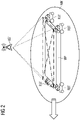
- FIG. 2 shows a schematic representation of a communication amongst the plurality of mobile material handling robots RBT in a wireless network NW operated by at least one base station BS1.
- the mobile material handling robots RBT are connected by a fifth generation or 5G wireless network.
- This 5G wireless network may be a non-public network, either stand-alone or integrated, e.g. as a private slice.
- the preferred communication technology is a 5G network, with 5G wireless communication interfaces supporting a high Quality of Service requirements, e.g. 5G new radio or 5G NR.
- the user endpoints being integrated in each of the mobile material handling robots RBT for maintaining a wireless communication are also referred as UE or User Equipment in the terminology of this 5G communication.
- the base station BS1 also known is also referred to as gNodeB or gNB in the terminology of this 5G communication.
- a direct wireless communication is initiated amongst the user endpoints of each mobile material handling robots RBT.
- the direct wireless communication is initiated during or after the step of gathering the plurality of mobile material handling robots RBT around the work piece WP.
- the direct wireless communication between the robots RBT is symbolized as a respective dotdashed line in FIG. 2 .
- the advantageous provision of direct wireless communications between the robots RBT according to the embodiments is superior for serving the required high communication service availability and ultra-low latency needed for exchanging control command messages and control feedback messages amongst the user endpoints in order to balance the work piece. This requirement is commonly referred to as URLLC or Ultra Reliable Low Latency Communication.
- An authorization control may include an examination, whether a respective user endpoint is for direct wireless communications.
- a working clock domain is initiated amongst the user endpoints for establishing a periodic deterministic communication amongst the user endpoints.
- the exchange of control commands and control feedback is done with periodic deterministic communication and using time-sensitive networking.
- one of the mobile material handling robots RBT assumes a controller functionality and controls the other collaborating mobile material handling robots RBT. This requires 1:N communication between the controlling mobile material handling robot RBT and the other controlled mobile material handling robots RBT.
- a distributed control of the collaborating mobile material handling robots RBT is chosen.
- a distributed control requires N:N communication between all mobile material handling robots RBT.
- the collaborating mobile material handling robots RBT carrying the work piece WP are communicating with direct wireless communication between each other.
- LTE-A Long Term Evolution-Advanced
- ProSe Proximity-based services
- 3GPP TS 23.303 V12.0.0 3GPP 3rd Generation Partnership Project
- LTE Sidelink defined by 3GPP in Release 12 may be applied to enable the direct wireless communication between two mobile material handling robot RBT without involving the base station BS1.
- Direct wireless communication means that the wireless communication between two robots RBT - or more specifically: between the user endpoints of two robots RBT - is effected by one bidirectional wireless link directly between a user endpoint of a first robot RBT and a user endpoint of a second robot RBT, both acting as a device with respect to the device-to-device communication.
- Direct wireless communication particularly means that the wireless communication is not passing the base station BS1 as a communication node for diverting the communication traffic.
- this direct wireless communication requires only one wireless link between two mobile material handling robots RBT in contrast to the traditional wireless communication in a Radio Access Network or RAN, wherein two wireless links between two mobile material handling robots RBT and the base station BS1 are required.
- the direct wireless communication is an assisted direct wireless communication or D2D communication.
- the base station BS1 coordinates resources of the direct wireless communication.
- the user endpoints of the material handling robots RBT need to be in range of the first base station BS1 or another base station for this assisted direct wireless communication.
- a resource coordination for the assisted direct wireless communication is effected by the base station BS1 using a Radio Access Network or RAN mode.
- the direct wireless communication is a non-assisted direct wireless communication or D2D communication.
- the user endpoints of the material handling robots RBT are further responsible for the resource coordination in addition to processing their direct communication.
- the user endpoints of the material handling robots RBT can communicate independently from the availability of a base station.
- the cooperating mobile material handling robots RBT belong to the same working clock domain in order to achieve the necessary time synchronization between each other for the periodic deterministic communication with ultra-low latency.
- the collaborating mobile material handling robots RBT After - or during - initialization of the direct wireless communication amongst the user endpoints, the collaborating mobile material handling robots RBT set up a working clock synchronization domain amongst them. Protocols in this working clock domain provide for a time synchronization between the collaborating mobile material handling robots RBT. Time synchronization is an important pre-requisite for the efficient communication of control traffic and the successful execution of a control application aiming for carrying the work piece WP safely and smoothly to a desired destination.
- Each mobile material handling robot RBT is a separate device that may have its own device-internal communication network apart from the wireless network NW. This device-internal communication network deploys time synchronization and is its own working clock synchronization domain, if the mobile material handling robot RBT is moving independently from any other mobile material handling robot RBT.
- the communication pattern between the collaborating mobile material handling robots RBT is a cyclic communication or periodic-deterministic communication.
- the corresponding traffic flows for the control traffic grant for a high quality of service, especially low latency and high reliability.
- said different working clock domains of the mobile material handling robots RBT are advantageously be merged into the working clock domain for carrying the work piece, which can be a new working clock domain or the working clock domain of a specific mobile material handling robot RBT, for instance the mobile material handling robot RBT being the controlling robot.
- the user endpoints of the mobile material handling robots RBT set up corresponding communication services through a suitable communication service interface.
- the communication services support the high quality of service and the communication pattern.
- the communication services are:
- the mobile material handling robots RBT are carrying the work piece WP in a coordinated way.
- the robots RBT exchange status information, control feedback, and control commands for their drives and movements with each other. This information is exchanged via multicast communication from the source robot RBT to all other collaborating robots RBT.
- the collaborating robots RBT communicate directly with each other over the wireless communication interfaces of their user endpoints.
- a direct wireless communication may fail between every pair of collaborating robots RBT due to the limited radio range of the wireless communication.
- a user endpoint belonging to an intermediate robot RBT - which is located between distant collaborating robots RBT - bidirectionally relays a data exchange - i.e. control command messages and control feedback messages - between distant collaborating robots RBT.
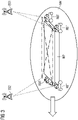
- FIG. 3 shows a schematic representation of a communication amongst the plurality of mobile material handling robots in a wireless network with a resource coordination amongst a first base station BS1 and a second base station BS2.
- the mobile material handling robots RBT are carrying the work piece WP while moving along a factory floor, it may occur that the mobile material handling robots RBT move out of the range of a current coordinating base station BS1 into the range of one or more adjacent base stations, or, as shown in the drawing, into the range of an adjacent second base station BS2.
- the resource coordination for the direct wireless communication will be handed over between these base stations BS1,BS2.
- the resource coordination of the user endpoints of the collaborating mobile material handling robots RBT may be operated by different base stations BS1,BS2 as shown in FIG. 3 .
- the Radio Access Network interconnecting the base stations BS1,BS2 coordinates the resources direct wireless communication over different base stations BS1,BS2 with corresponding functionality.
- FIG. 3 shows a communication amongst the plurality of mobile material handling robots RBT in different wireless networks wherein a resource coordination is preparing a handover of one wireless network NW1 to another wireless network NW2.
- the mobile material handling robots RBT are carrying the work piece WP while moving along a large industrial outdoor site - for instance, if the destination of the work piece is the far end of a large open-air storage yard - it may occur that the mobile material handling robots RBT move out of the range of the first wireless network NW1, which may be a factory network NW1.
- the factory network NW1 may be a private or non-public 5G network which is restricted to a local area and which is not intended for public use.
- a second network NW2 - e.g. a public mobile 5G network also referred to as Public Land Mobile Network or PLMN - is assumed to be available in a vicinity of the factory 5G network NW1 and beyond.
- the public network NW2 takes over the resource coordination of the direct wireless communication of the mobile material handling robots RBT.
- the collaborating mobile material handling robots RBT switch to a non-assisted direct wireless communication mode until they reach back to the coverage area of the factory network NW1.
- the direct wireless communication between the collaborating mobile material handling robots RBT along with its resources and the working clock domain including the collaborating mobile material handling robots RBT are released and torn down.
Landscapes
- Engineering & Computer Science (AREA)
- General Engineering & Computer Science (AREA)
- Manufacturing & Machinery (AREA)
- Quality & Reliability (AREA)
- Physics & Mathematics (AREA)
- General Physics & Mathematics (AREA)
- Automation & Control Theory (AREA)
- Manipulator (AREA)
- Mobile Radio Communication Systems (AREA)
Claims (10)
- Procédé pour faire transporter de manière coopérative une pièce de fabrication par une pluralité de robots de manutention mobiles, dans lequel chacun de la pluralité de robots de manutention mobiles comprend un point d'extrémité utilisateur pour une communication sans fil, chaque point d'extrémité utilisateur étant un équipement utilisateur de cinquième génération ou 5G, le procédé incluant les étapes constituées par :- le regroupement de la pluralité de robots de manutention mobiles autour de la pièce de fabrication, l'initiation d'une communication sans fil directe entre les points d'extrémité utilisateur, la communication sans fil directe étant initiée par une communication de cinquième génération ou 5G directe et la communication sans fil directe étant une communication sans fil directe non assistée qui inclut une coordination de ressources entre des points d'extrémité utilisateur de la pluralité de robots de manutention mobiles ;- l'instauration d'un domaine d'horloge de travail, effectuée par un réseau sensible au temps, entre les points d'extrémité utilisateur pour établir une synchronisation temporelle et une communication déterministe périodique entre les points d'extrémité utilisateur ; et- le transport de la pièce de fabrication par la pluralité de robots de manutention mobiles pendant l'échange de messages de commande de contrôle et de messages de rétroaction de contrôle entre les points d'extrémité utilisateur ;dans lequel un contrôle réparti est effectué par les robots de manutention mobiles.
- Procédé selon la revendication 1, dans lequel la communication sans fil directe est une ou plusieurs communication(s) parmi une communication D2D, une communication ProSe et une communication en liaison latérale.
- Procédé selon l'une quelconque des revendications précédentes, dans lequel seulement les points d'extrémité utilisateur habilités sont autorisés à participer à la communication sans fil directe.
- Procédé selon l'une quelconque des revendications précédentes, dans lequel l'un de la pluralité de robots de manutention mobiles assume une fonctionnalité de contrôleur et ledit un de la pluralité de robots de manutention mobiles est en train de contrôler d'autres robots de manutention mobiles en train de collaborer.
- Procédé selon l'une quelconque des revendications précédentes, dans lequel la communication sans fil directe entre les points d'extrémité utilisateur est une communication sans fil directe assistée qui inclut une coordination de ressources par une station de base.
- Procédé selon la revendication 5, dans lequel la coordination de ressources est transférée d'une première station de base à une seconde station de base.
- Procédé selon la revendication 6, dans lequel la seconde station de base est une station de base d'un réseau mobile public.
- Procédé selon la revendication 4, dans lequel les points d'extrémité utilisateur des robots de manutention mobiles instaurent des services de communication entre ledit robot de manutention mobile qui assume une fonctionnalité de contrôleur et les robots de manutention mobiles en train de collaborer.
- Procédé selon la revendication 4, dans lequel les points d'extrémité utilisateur des robots de manutention mobiles instaurent des services de communication entre la pluralité de robots de manutention mobiles.
- Procédé selon l'une quelconque des revendications précédentes, dans lequel un point d'extrémité utilisateur qui appartient à un robot de manutention mobile intermédiaire relaie de façon bidirectionnelle des messages de commande de contrôle et des messages de rétroaction de contrôle entre des robots de manutention mobiles distants.
Priority Applications (2)
| Application Number | Priority Date | Filing Date | Title |
|---|---|---|---|
| EP19000201.4A EP3731048B1 (fr) | 2019-04-26 | 2019-04-26 | Procédé pour porter une pièce de manière coopérative |
| PCT/EP2020/059187 WO2020216587A1 (fr) | 2019-04-26 | 2020-04-01 | Procédé de transport coopératif d'une pièce |
Applications Claiming Priority (1)
| Application Number | Priority Date | Filing Date | Title |
|---|---|---|---|
| EP19000201.4A EP3731048B1 (fr) | 2019-04-26 | 2019-04-26 | Procédé pour porter une pièce de manière coopérative |
Publications (2)
| Publication Number | Publication Date |
|---|---|
| EP3731048A1 EP3731048A1 (fr) | 2020-10-28 |
| EP3731048B1 true EP3731048B1 (fr) | 2022-09-21 |
Family
ID=66476342
Family Applications (1)
| Application Number | Title | Priority Date | Filing Date |
|---|---|---|---|
| EP19000201.4A Active EP3731048B1 (fr) | 2019-04-26 | 2019-04-26 | Procédé pour porter une pièce de manière coopérative |
Country Status (2)
| Country | Link |
|---|---|
| EP (1) | EP3731048B1 (fr) |
| WO (1) | WO2020216587A1 (fr) |
Families Citing this family (4)
| Publication number | Priority date | Publication date | Assignee | Title |
|---|---|---|---|---|
| CN112141585A (zh) * | 2020-10-10 | 2020-12-29 | 上海应用技术大学 | 一种协同主动感知的同步agv搬运系统及其搬运方法 |
| CN116997442A (zh) * | 2021-03-26 | 2023-11-03 | Abb瑞士股份有限公司 | 具有点对点通信接口以支持机器人之间的协作的工业机器人 |
| EP4440194A1 (fr) | 2023-03-29 | 2024-10-02 | Siemens Aktiengesellschaft | Procédé mis en uvre par ordinateur pour commander le transfert d'au moins un équipement utilisateur sur une entité mobile |
| US20250021100A1 (en) * | 2023-07-14 | 2025-01-16 | International Business Machines Corporation | Cooperative use of autonomous machines |
Family Cites Families (2)
| Publication number | Priority date | Publication date | Assignee | Title |
|---|---|---|---|---|
| KR101682880B1 (ko) * | 2015-03-19 | 2016-12-20 | 현대자동차주식회사 | 차량 및 이를 포함하는 원격 차량 조작 시스템 |
| US11046515B2 (en) * | 2017-08-03 | 2021-06-29 | Swarm Robotix Llc | Multi robot system and method for intermodal container transport |
-
2019
- 2019-04-26 EP EP19000201.4A patent/EP3731048B1/fr active Active
-
2020
- 2020-04-01 WO PCT/EP2020/059187 patent/WO2020216587A1/fr not_active Ceased
Also Published As
| Publication number | Publication date |
|---|---|
| EP3731048A1 (fr) | 2020-10-28 |
| WO2020216587A1 (fr) | 2020-10-29 |
Similar Documents
| Publication | Publication Date | Title |
|---|---|---|
| EP3731048B1 (fr) | Procédé pour porter une pièce de manière coopérative | |
| Angjo et al. | Handover management of drones in future mobile networks: 6G technologies | |
| Aijaz et al. | The tactile internet for industries: A review | |
| CN105515637B (zh) | 无人驾驶移动接入设备的控制方法及装置 | |
| US11405804B2 (en) | Reducing coverage problems via dynamic measurements | |
| Fellan et al. | Enabling communication technologies for automated unmanned vehicles in industry 4.0 | |
| US20240408762A1 (en) | Industrial Robot with A Peer-To-Peer Communication Interface to Support Collaboration Among Robots | |
| CN113377129B (zh) | 一种两个地面站协同控制一架无人机的方法 | |
| CN105722170A (zh) | 一种基于双无线网卡的工业移动网络ap切换方法 | |
| CA2888563A1 (fr) | Procede d'extension de reseau pour un reseau bluetooth | |
| CN103931235A (zh) | WiFi-DECT无线电信网络中的用于改变与终端相关联的无线接入点的方法 | |
| Dietrich et al. | Towards a unified decentralized swarm management and maintenance coordination based on mavlink | |
| EP3570133A1 (fr) | Procédé et système de commande d'un véhicule en mouvement dans un environnement | |
| US20220100203A1 (en) | Method for the control, by a supervising server, of the movement of a fleet of autonomously guided vehicles | |
| EP2865216B1 (fr) | Système et procédé de transfert intercellulaire monoradio | |
| CN107479552B (zh) | 基于Agent的轨道机器人自组织控制系统 | |
| KR102794743B1 (ko) | 지리적 공간에서 목표들의 세트를 달성하기 위한 제1 노드, 제2 노드, 무선 통신 네트워크, 및 이들에 의해 수행되는 방법들 | |
| EP2445258A1 (fr) | Système de radiocommunications | |
| CN109019201A (zh) | 信号传输方法及系统 | |
| JP2025169352A (ja) | 非地上基地局を介した地上基地局の稼働状態の制御 | |
| EP4356646B1 (fr) | Procédé permettant d'effectuer un transfert d'un dispositif de réseau mobile | |
| Grohmann et al. | BakeryRobot: 5G connected robot for SMEs | |
| JP2018092264A (ja) | 制御装置、走行システム、及び、制御方法 | |
| Xiang et al. | Connected Factory | |
| Zannat | 5G Networks in Port Operations: Case Study Pori |
Legal Events
| Date | Code | Title | Description |
|---|---|---|---|
| PUAI | Public reference made under article 153(3) epc to a published international application that has entered the european phase |
Free format text: ORIGINAL CODE: 0009012 |
|
| STAA | Information on the status of an ep patent application or granted ep patent |
Free format text: STATUS: THE APPLICATION HAS BEEN PUBLISHED |
|
| AK | Designated contracting states |
Kind code of ref document: A1 Designated state(s): AL AT BE BG CH CY CZ DE DK EE ES FI FR GB GR HR HU IE IS IT LI LT LU LV MC MK MT NL NO PL PT RO RS SE SI SK SM TR |
|
| AX | Request for extension of the european patent |
Extension state: BA ME |
|
| STAA | Information on the status of an ep patent application or granted ep patent |
Free format text: STATUS: REQUEST FOR EXAMINATION WAS MADE |
|
| 17P | Request for examination filed |
Effective date: 20210203 |
|
| RBV | Designated contracting states (corrected) |
Designated state(s): AL AT BE BG CH CY CZ DE DK EE ES FI FR GB GR HR HU IE IS IT LI LT LU LV MC MK MT NL NO PL PT RO RS SE SI SK SM TR |
|
| GRAP | Despatch of communication of intention to grant a patent |
Free format text: ORIGINAL CODE: EPIDOSNIGR1 |
|
| STAA | Information on the status of an ep patent application or granted ep patent |
Free format text: STATUS: GRANT OF PATENT IS INTENDED |
|
| INTG | Intention to grant announced |
Effective date: 20220523 |
|
| GRAS | Grant fee paid |
Free format text: ORIGINAL CODE: EPIDOSNIGR3 |
|
| GRAA | (expected) grant |
Free format text: ORIGINAL CODE: 0009210 |
|
| STAA | Information on the status of an ep patent application or granted ep patent |
Free format text: STATUS: THE PATENT HAS BEEN GRANTED |
|
| AK | Designated contracting states |
Kind code of ref document: B1 Designated state(s): AL AT BE BG CH CY CZ DE DK EE ES FI FR GB GR HR HU IE IS IT LI LT LU LV MC MK MT NL NO PL PT RO RS SE SI SK SM TR |
|
| REG | Reference to a national code |
Ref country code: GB Ref legal event code: FG4D |
|
| REG | Reference to a national code |
Ref country code: CH Ref legal event code: EP |
|
| REG | Reference to a national code |
Ref country code: IE Ref legal event code: FG4D |
|
| REG | Reference to a national code |
Ref country code: DE Ref legal event code: R096 Ref document number: 602019019696 Country of ref document: DE |
|
| REG | Reference to a national code |
Ref country code: AT Ref legal event code: REF Ref document number: 1520246 Country of ref document: AT Kind code of ref document: T Effective date: 20221015 |
|
| REG | Reference to a national code |
Ref country code: LT Ref legal event code: MG9D |
|
| REG | Reference to a national code |
Ref country code: NL Ref legal event code: MP Effective date: 20220921 |
|
| PG25 | Lapsed in a contracting state [announced via postgrant information from national office to epo] |
Ref country code: SE Free format text: LAPSE BECAUSE OF FAILURE TO SUBMIT A TRANSLATION OF THE DESCRIPTION OR TO PAY THE FEE WITHIN THE PRESCRIBED TIME-LIMIT Effective date: 20220921 Ref country code: RS Free format text: LAPSE BECAUSE OF FAILURE TO SUBMIT A TRANSLATION OF THE DESCRIPTION OR TO PAY THE FEE WITHIN THE PRESCRIBED TIME-LIMIT Effective date: 20220921 Ref country code: NO Free format text: LAPSE BECAUSE OF FAILURE TO SUBMIT A TRANSLATION OF THE DESCRIPTION OR TO PAY THE FEE WITHIN THE PRESCRIBED TIME-LIMIT Effective date: 20221221 Ref country code: LV Free format text: LAPSE BECAUSE OF FAILURE TO SUBMIT A TRANSLATION OF THE DESCRIPTION OR TO PAY THE FEE WITHIN THE PRESCRIBED TIME-LIMIT Effective date: 20220921 Ref country code: LT Free format text: LAPSE BECAUSE OF FAILURE TO SUBMIT A TRANSLATION OF THE DESCRIPTION OR TO PAY THE FEE WITHIN THE PRESCRIBED TIME-LIMIT Effective date: 20220921 Ref country code: FI Free format text: LAPSE BECAUSE OF FAILURE TO SUBMIT A TRANSLATION OF THE DESCRIPTION OR TO PAY THE FEE WITHIN THE PRESCRIBED TIME-LIMIT Effective date: 20220921 |
|
| REG | Reference to a national code |
Ref country code: AT Ref legal event code: MK05 Ref document number: 1520246 Country of ref document: AT Kind code of ref document: T Effective date: 20220921 |
|
| PG25 | Lapsed in a contracting state [announced via postgrant information from national office to epo] |
Ref country code: HR Free format text: LAPSE BECAUSE OF FAILURE TO SUBMIT A TRANSLATION OF THE DESCRIPTION OR TO PAY THE FEE WITHIN THE PRESCRIBED TIME-LIMIT Effective date: 20220921 Ref country code: GR Free format text: LAPSE BECAUSE OF FAILURE TO SUBMIT A TRANSLATION OF THE DESCRIPTION OR TO PAY THE FEE WITHIN THE PRESCRIBED TIME-LIMIT Effective date: 20221222 |
|
| PG25 | Lapsed in a contracting state [announced via postgrant information from national office to epo] |
Ref country code: SM Free format text: LAPSE BECAUSE OF FAILURE TO SUBMIT A TRANSLATION OF THE DESCRIPTION OR TO PAY THE FEE WITHIN THE PRESCRIBED TIME-LIMIT Effective date: 20220921 Ref country code: RO Free format text: LAPSE BECAUSE OF FAILURE TO SUBMIT A TRANSLATION OF THE DESCRIPTION OR TO PAY THE FEE WITHIN THE PRESCRIBED TIME-LIMIT Effective date: 20220921 Ref country code: PT Free format text: LAPSE BECAUSE OF FAILURE TO SUBMIT A TRANSLATION OF THE DESCRIPTION OR TO PAY THE FEE WITHIN THE PRESCRIBED TIME-LIMIT Effective date: 20230123 Ref country code: ES Free format text: LAPSE BECAUSE OF FAILURE TO SUBMIT A TRANSLATION OF THE DESCRIPTION OR TO PAY THE FEE WITHIN THE PRESCRIBED TIME-LIMIT Effective date: 20220921 Ref country code: CZ Free format text: LAPSE BECAUSE OF FAILURE TO SUBMIT A TRANSLATION OF THE DESCRIPTION OR TO PAY THE FEE WITHIN THE PRESCRIBED TIME-LIMIT Effective date: 20220921 Ref country code: AT Free format text: LAPSE BECAUSE OF FAILURE TO SUBMIT A TRANSLATION OF THE DESCRIPTION OR TO PAY THE FEE WITHIN THE PRESCRIBED TIME-LIMIT Effective date: 20220921 |
|
| PG25 | Lapsed in a contracting state [announced via postgrant information from national office to epo] |
Ref country code: SK Free format text: LAPSE BECAUSE OF FAILURE TO SUBMIT A TRANSLATION OF THE DESCRIPTION OR TO PAY THE FEE WITHIN THE PRESCRIBED TIME-LIMIT Effective date: 20220921 Ref country code: PL Free format text: LAPSE BECAUSE OF FAILURE TO SUBMIT A TRANSLATION OF THE DESCRIPTION OR TO PAY THE FEE WITHIN THE PRESCRIBED TIME-LIMIT Effective date: 20220921 Ref country code: IS Free format text: LAPSE BECAUSE OF FAILURE TO SUBMIT A TRANSLATION OF THE DESCRIPTION OR TO PAY THE FEE WITHIN THE PRESCRIBED TIME-LIMIT Effective date: 20230121 Ref country code: EE Free format text: LAPSE BECAUSE OF FAILURE TO SUBMIT A TRANSLATION OF THE DESCRIPTION OR TO PAY THE FEE WITHIN THE PRESCRIBED TIME-LIMIT Effective date: 20220921 |
|
| REG | Reference to a national code |
Ref country code: DE Ref legal event code: R097 Ref document number: 602019019696 Country of ref document: DE |
|
| PG25 | Lapsed in a contracting state [announced via postgrant information from national office to epo] |
Ref country code: NL Free format text: LAPSE BECAUSE OF FAILURE TO SUBMIT A TRANSLATION OF THE DESCRIPTION OR TO PAY THE FEE WITHIN THE PRESCRIBED TIME-LIMIT Effective date: 20220921 Ref country code: AL Free format text: LAPSE BECAUSE OF FAILURE TO SUBMIT A TRANSLATION OF THE DESCRIPTION OR TO PAY THE FEE WITHIN THE PRESCRIBED TIME-LIMIT Effective date: 20220921 |
|
| PLBE | No opposition filed within time limit |
Free format text: ORIGINAL CODE: 0009261 |
|
| STAA | Information on the status of an ep patent application or granted ep patent |
Free format text: STATUS: NO OPPOSITION FILED WITHIN TIME LIMIT |
|
| PG25 | Lapsed in a contracting state [announced via postgrant information from national office to epo] |
Ref country code: DK Free format text: LAPSE BECAUSE OF FAILURE TO SUBMIT A TRANSLATION OF THE DESCRIPTION OR TO PAY THE FEE WITHIN THE PRESCRIBED TIME-LIMIT Effective date: 20220921 |
|
| 26N | No opposition filed |
Effective date: 20230622 |
|
| PG25 | Lapsed in a contracting state [announced via postgrant information from national office to epo] |
Ref country code: SI Free format text: LAPSE BECAUSE OF FAILURE TO SUBMIT A TRANSLATION OF THE DESCRIPTION OR TO PAY THE FEE WITHIN THE PRESCRIBED TIME-LIMIT Effective date: 20220921 |
|
| REG | Reference to a national code |
Ref country code: CH Ref legal event code: PL |
|
| GBPC | Gb: european patent ceased through non-payment of renewal fee |
Effective date: 20230426 |
|
| PG25 | Lapsed in a contracting state [announced via postgrant information from national office to epo] |
Ref country code: LU Free format text: LAPSE BECAUSE OF NON-PAYMENT OF DUE FEES Effective date: 20230426 |
|
| REG | Reference to a national code |
Ref country code: BE Ref legal event code: MM Effective date: 20230430 |
|
| PG25 | Lapsed in a contracting state [announced via postgrant information from national office to epo] |
Ref country code: MC Free format text: LAPSE BECAUSE OF FAILURE TO SUBMIT A TRANSLATION OF THE DESCRIPTION OR TO PAY THE FEE WITHIN THE PRESCRIBED TIME-LIMIT Effective date: 20220921 |
|
| PG25 | Lapsed in a contracting state [announced via postgrant information from national office to epo] |
Ref country code: GB Free format text: LAPSE BECAUSE OF NON-PAYMENT OF DUE FEES Effective date: 20230426 |
|
| PG25 | Lapsed in a contracting state [announced via postgrant information from national office to epo] |
Ref country code: MC Free format text: LAPSE BECAUSE OF FAILURE TO SUBMIT A TRANSLATION OF THE DESCRIPTION OR TO PAY THE FEE WITHIN THE PRESCRIBED TIME-LIMIT Effective date: 20220921 Ref country code: LI Free format text: LAPSE BECAUSE OF NON-PAYMENT OF DUE FEES Effective date: 20230430 Ref country code: GB Free format text: LAPSE BECAUSE OF NON-PAYMENT OF DUE FEES Effective date: 20230426 Ref country code: CH Free format text: LAPSE BECAUSE OF NON-PAYMENT OF DUE FEES Effective date: 20230430 |
|
| REG | Reference to a national code |
Ref country code: IE Ref legal event code: MM4A |
|
| PG25 | Lapsed in a contracting state [announced via postgrant information from national office to epo] |
Ref country code: BE Free format text: LAPSE BECAUSE OF NON-PAYMENT OF DUE FEES Effective date: 20230430 |
|
| PG25 | Lapsed in a contracting state [announced via postgrant information from national office to epo] |
Ref country code: IE Free format text: LAPSE BECAUSE OF NON-PAYMENT OF DUE FEES Effective date: 20230426 |
|
| PG25 | Lapsed in a contracting state [announced via postgrant information from national office to epo] |
Ref country code: IE Free format text: LAPSE BECAUSE OF NON-PAYMENT OF DUE FEES Effective date: 20230426 |
|
| PG25 | Lapsed in a contracting state [announced via postgrant information from national office to epo] |
Ref country code: BG Free format text: LAPSE BECAUSE OF FAILURE TO SUBMIT A TRANSLATION OF THE DESCRIPTION OR TO PAY THE FEE WITHIN THE PRESCRIBED TIME-LIMIT Effective date: 20220921 |
|
| PG25 | Lapsed in a contracting state [announced via postgrant information from national office to epo] |
Ref country code: BG Free format text: LAPSE BECAUSE OF FAILURE TO SUBMIT A TRANSLATION OF THE DESCRIPTION OR TO PAY THE FEE WITHIN THE PRESCRIBED TIME-LIMIT Effective date: 20220921 |
|
| PGFP | Annual fee paid to national office [announced via postgrant information from national office to epo] |
Ref country code: DE Payment date: 20250620 Year of fee payment: 7 |
|
| PGFP | Annual fee paid to national office [announced via postgrant information from national office to epo] |
Ref country code: IT Payment date: 20250417 Year of fee payment: 7 |
|
| PGFP | Annual fee paid to national office [announced via postgrant information from national office to epo] |
Ref country code: FR Payment date: 20250411 Year of fee payment: 7 |
|
| PG25 | Lapsed in a contracting state [announced via postgrant information from national office to epo] |
Ref country code: CY Free format text: LAPSE BECAUSE OF FAILURE TO SUBMIT A TRANSLATION OF THE DESCRIPTION OR TO PAY THE FEE WITHIN THE PRESCRIBED TIME-LIMIT; INVALID AB INITIO Effective date: 20190426 |
|
| PG25 | Lapsed in a contracting state [announced via postgrant information from national office to epo] |
Ref country code: HU Free format text: LAPSE BECAUSE OF FAILURE TO SUBMIT A TRANSLATION OF THE DESCRIPTION OR TO PAY THE FEE WITHIN THE PRESCRIBED TIME-LIMIT; INVALID AB INITIO Effective date: 20190426 |
|
| PG25 | Lapsed in a contracting state [announced via postgrant information from national office to epo] |
Ref country code: TR Free format text: LAPSE BECAUSE OF FAILURE TO SUBMIT A TRANSLATION OF THE DESCRIPTION OR TO PAY THE FEE WITHIN THE PRESCRIBED TIME-LIMIT Effective date: 20220921 |