EP3731202A1 - Method and system for monitoring status and function of an object - Google Patents
Method and system for monitoring status and function of an object Download PDFInfo
- Publication number
- EP3731202A1 EP3731202A1 EP20169499.9A EP20169499A EP3731202A1 EP 3731202 A1 EP3731202 A1 EP 3731202A1 EP 20169499 A EP20169499 A EP 20169499A EP 3731202 A1 EP3731202 A1 EP 3731202A1
- Authority
- EP
- European Patent Office
- Prior art keywords
- item
- patient
- acceleration
- data
- microcontroller
- Prior art date
- Legal status (The legal status is an assumption and is not a legal conclusion. Google has not performed a legal analysis and makes no representation as to the accuracy of the status listed.)
- Granted
Links
Images


Classifications
-
- G—PHYSICS
- G08—SIGNALLING
- G08B—SIGNALLING SYSTEMS, e.g. PERSONAL CALLING SYSTEMS; ORDER TELEGRAPHS; ALARM SYSTEMS
- G08B21/00—Alarms responsive to a single specified undesired or abnormal condition and not otherwise provided for
- G08B21/02—Alarms for ensuring the safety of persons
- G08B21/04—Alarms for ensuring the safety of persons responsive to non-activity, e.g. of elderly persons
- G08B21/0407—Alarms for ensuring the safety of persons responsive to non-activity, e.g. of elderly persons based on behaviour analysis
- G08B21/0423—Alarms for ensuring the safety of persons responsive to non-activity, e.g. of elderly persons based on behaviour analysis detecting deviation from an expected pattern of behaviour or schedule
-
- G—PHYSICS
- G08—SIGNALLING
- G08B—SIGNALLING SYSTEMS, e.g. PERSONAL CALLING SYSTEMS; ORDER TELEGRAPHS; ALARM SYSTEMS
- G08B21/00—Alarms responsive to a single specified undesired or abnormal condition and not otherwise provided for
- G08B21/02—Alarms for ensuring the safety of persons
-
- G—PHYSICS
- G06—COMPUTING OR CALCULATING; COUNTING
- G06N—COMPUTING ARRANGEMENTS BASED ON SPECIFIC COMPUTATIONAL MODELS
- G06N20/00—Machine learning
Definitions
- the invention relates to a method and a system for monitoring state and operation of an object as set out in the preambles of the independent claims below.
- the invention particularly relates to a new way of monitoring an item of a care facility, such as a piece of furniture or a device.
- patent publication US 6819247 B2 presents a portable patient monitoring and alarm device, which has a casing that can be attached to the patient, e.g. to her clothes. Inside the casing there are a processor, wireless transmitter, locating device, and a sensor. The sensor monitors movement, speed, acceleration or orientation of the device. After the sensor has measured a certain type of movement, the processor transmits a signal containing information about possible need for assistance and about the location of the device.
- It is an object of the present invention provide solutions for using opportunities offered by an accelerometer in simple, user friendly and efficient ways.
- a sensor device In a typical method according to the invention for monitoring status and operation of an object, i.e. an item of a care facility, such as a piece of furniture or a device, a sensor device is used, which sensor device comprises an accelerometer, a radio transmitter, a micro controller and a power source that are functionally connected with each other.
- the sensor device may comprise a case, having a storage space where the above-mentioned parts of the sensor device are placed.
- the method comprises at least the following steps:
- a typical system according to the invention for monitoring status and operation of an object i.e. an item of a care facility, such as a piece of furniture or a device, comprises
- the algorithmically performed analysing means computer analysis known as such, utilising e.g. mathematical functions, matrix calculus, neural networks and/or artificial intelligence.
- the acceleration signal produced by the accelerometer may be, for example, analog or digital.
- the acceleration signal is transformed to or it transforms to acceleration data, e.g. when it is saved in a data storage, such as an electronic memory device or when it is analysed and otherwise processed.
- the object to be monitored is an item of a care facility, such as a piece of furniture or a device.
- the care facility can be, for example, a hospital, a health care centre, a nursing home or a rehabilitation institution.
- a device to be monitored can be, for example, a mobility aid, an electronic device or an electronic medical treatment device.
- a monitored item can be e.g.
- a piece of furniture such as a bed, a table, a chair, or a device such as a mobility aid such as a wheelchair, rollator, walking aid, a crutch, or medical treatment device such as an IV stand, or electrical medical treatment device such as a defibrillator or a ventilator, or a medicine storage device such as a pill dispenser or a medicine jar.
- the invention is used to monitor or locate devices, furniture, and other items. For example, a particular item, or the nearest particular item, such as the nearest defibrillator, can be found quickly by means of the invention.
- Examples of items for which it is important to know the movement, the speed of movement and/or the direction of movement are items whose location is of importance, e.g. items that are intended to be moved or immobile in normal use.
- the location of items or patients can be monitored with the location and movement data of objects transferred from one hospital room to another or from one ward to another, such as data terminals, beds or mobility aids such as rollators, walking sticks or wheelchairs.
- Movement data can be used to monitor a patient's treatment, for example, to accurately record trips, directions, and speeds of the patient on a rollator or wheelchair.
- Motion and direction data can be used to open and close doors and passageways in the right direction and at the right time, and to guide a patient or his or her escort in the right direction.
- the invention can be used to warn of the movement of objects intended to be immobile, for example some treatment devices must remain in the same location and sometimes they are not even to be shaken.
- Examples of objects for which acceleration data is important to know are devices and items that are easily damaged. It would be good to immediately notice any inappropriate, careless or too rough handling of many objects, especially medical treatment devices.
- a sensor device attached to a medicine jar and forgotten on a table may give an audio signal.
- the system detects that movement of a monitored item exceeds certain limit values, it can check that the movement of the item is permitted. If it is noted that there is no authorisation for the movement, it is determined that unauthorized movement of the item has taken place, and the event is reported to the item, to surroundings of the item and/or to a party supervising the item. For example, if someone is trying to move without permission a piece of furniture or device, which is meant to be used only in a certain room or department, the staff can be informed of the event or specific doors or passageways may be closed and/or locked.
- Examples of items, the orientation of which is important to know, are devices which work properly only when in a correct orientation and which are at risk of ending up in an incorrect orientation. These include e.g. various medical treatment devices such as IV stands and patient aids such as wheelchairs. Operation of many items may be possible but undesirable in a wrong orientation. For example, pieces of furniture may operate in any position as long as they are horizontal, but e.g. turning or moving beds or a ventilator out of their normal orientation is often highly undesirable. Now, an alarm can be sent of such an event even in real-time, for example to personnel.
- This ability to collect and analyse information enables the invention to be applied to, for example, issuing of alarms and notifications, management of doors and passageways, monitoring of status of items and the management of the risk of transmission of a disease.
- the acceleration data produced by the accelerometer and the signals from the radio transmitter can be used to detect the location and direction of movement of the objects in the care facility, to detect the falling of items or to be able to estimate their speed.
- automatically opening doors can be programmed to open at the right time using the information provided by the invention. For the first time, the right doors can now be opened and locked at just the right moment and in the direction of movement permitted or predicted for the object.
- the alarm that can be issued to an item, a patient and/or a party supervising the item can be e.g. a light or sound signal given to the vicinity of the object or an alarm issued to personnel.
- the notification which may be issued to an item, a patient and/or a party supervising the item can be the sending of acceleration data, or other data, or location of an item, collected according to the invention.
- an alarm and/or notification is not issued on basis of an analysis to an object and/or a party monitoring the object.
- at least one or more of the following operations are performed:
- the invention allows monitoring of movement, speed, acceleration or orientation of an item, piece of furniture or device, i.e. of the monitored object.
- the invention enables the performing of necessary measures or, e.g. the collecting of information about the object automatically and in a form that is easy to process numerically.
- information about a patient can also be obtained. In this way, large amounts of e.g. patient data are automatically saved and obtained for further processing.
- a prompt and automatic alarm can be issued about a fallen or escaping patient or a reminder of a need to turn a patient to reduce bed sores may be sent to staff of a hospital or other care facility or to relatives of the patient.
- the invention enables an easy following of care guidelines and easy maintenance of a patient care register.
- it is easy to register, for example, how many times and when the patient has been washed, visited the bathroom, the canteen or the outside.
- the invention makes it easy e.g. to monitor how often and when a patient has turned or has been turned. One can track how much, where and when the patient has moved and been, walked, stood, sat or slept.
- the components of the sensor device are integrated in the item to be monitored.
- the sensor device may be integrated into a piece of furniture or into a treatment device.
- the sensor device is integrated into an electronic device, such as an electronic medical treatment device, such as a defibrillator or a ventilator.
- the integration is complete in such a way that one cannot notice during normal use of an item, piece of furniture or device that it comprises the sensor device.
- Certain parts of the invention are typically at least partially implemented and executed as a program code.
- Features and elements of the invention implemented as program code include a software maintained in computer memory and arranged to be executed thereon.
- the software comprises program code elements arranged to perform the necessary functions and steps of the invention.
- Computers, software, data storages such as databases, sensors, radio transmitters and receivers, data transmission means between parts of the invention, the use of artificial intelligence and other parts of the invention are known per se and their operation will not be described in more detail in this connection.
- Microcontroller means an integrated circuit, which typically comprises at least one processor and usually at least some memory. Microcontrollers are known per se, and their structure and operation will not be discussed in more detail here.
- the data storage is at least partially in the sensor device, in connection with its microcontroller, for example in the memory of the microcontroller.
- at least part of the acceleration data stored in the data storage is analysed algorithmically the processor of the microcontroller.
- Data sent to the receiver with the radio transmitter can then also comprise results of the analysis made with the microcontroller.
- the data storage is entirely in the sensor device, in connection with the microcontroller, for example in the memory of the microcontroller.
- the analysis of the acceleration data stored in the data storage is performed entirely with the processor of the microcontroller. Analysis by the microcontroller enables faster and distributed analysis of acceleration data.
- the electronic devices used in the invention such as computers, processors, data storages and software, may also be located elsewhere than in the sensor device according to the invention. Acceleration data or part thereof or other data can be transmitted via the receiver to elsewhere, e.g. for saving or for further analysis.
- a sensor device gather information about movement of an object is attached to the object, i.e. to the the monitored item.
- a sensor device comprises a three-axis accelerometer, a microcontroller and a radio transmitter such as a Bluetooth transmitter or BLE transmitter (Bluetooth Low Energy).
- the software of the microcontroller enables monitoring of the movements of the object and the analysis of the acceleration data and wireless transmission of the acceleration data or the results of the analysis to the receiver.
- one part of the acceleration data is analysed in the microcontroller and one part is transmitter elsewhere to be analysed, e.g. for a more detailed analysis.
- the sensor device also has a power supply, e.g. an accumulator or a battery.
- the sensor device reacts to movement of the monitored item, caused by a patient or another monitored object.
- the sensor device may analyse the collected data itself and send the analysis results to the receiver for further processing.
- the sensor device can transmit to a receiver e.g. real-time acceleration data, such as e.g. movement data and orientation data of a wheelchair of a patient.
- the sensor device or e.g. the receiver can store acceleration data or analysis results in a data storage.
- Artificial intelligence or other software analyses the data and creates on basis of what it learns an analysis, e.g. a forecast of the status of the object or the patient using it. This information can be used, for example, to guide care staff.
- the sensor device may observe other things and send the other information it has collected and/or analysed via its transmitter to a receiver, and thereby for processing, e.g. for storing, analysing, or for other possible measures.
- the sensor device may e.g. comprise a temperature sensor and measure temperature of a device, a piece of furniture, a patient or the surroundings with the temperature sensor.
- the sensor device can measure its location e.g. with a satellite positioning device.
- the sensor device may comprise, for collecting information, e.g. a microphone, a camera and/or a moisture sensor.
- the sensor device may be provided with a communication means, such as a loudspeaker or an indicator light, for transmitting messages to the monitored object and its surroundings, for example to the user of an item.
- the sensor device may be provided with a button, such as a physical button e.g. to execute a patient call, or another means of communication, such as a microphone or a camera, to send a message from the object to a party monitoring it.
- a button such as a physical button e.g. to execute a patient call
- another means of communication such as a microphone or a camera
- Other possible means of interaction are, for example, a switch, an indicator light, a display device. In the eyes of its user, the sensor device can be very simple, even without any buttons, switches, indicator lights or other visible interaction means.
- all objects, patients and/or items in a certain area can be found quickly by means of the invention.
- the previous locations of patients and items that pose a risk of transmission can be easily determined. It is easy to monitor which of the patients and items that have been in the area of risk of transmission have already been treated or disinfected and which have not.
- the past and present locations of the items causing a risk of transmission are determined using information previously collected and to be collected into a data storage. In an embodiment, it is monitored which of the items that have been in the area of risk of transmission of a disease have already been treated or disinfected and which have not. In an application, an alarm or notification is issued about objects that have been in the area of risk of transmission of a disease. For example, an audio or light signal may be activated in items that have been in the area of risk of transmission.
- a method and system according to the invention can be used e.g. to find objects, patients and/or items causing a risk of transmission of a disease, to determine past locations of patients or items and/or to monitor which of the patients and/or items that have been in the area of risk of transmission have already been treated or disinfected and which have not.
- the location of an object is reported to the object and/or the party monitoring the object.
- Location data can be used in many ways.
- the invention is used to locate a patient or another object.
- one or more of locks and/or doors or other passageways in the vicinity of the object or in the direction of movement of the object are opened and/or closed.
- one or more doors may be opened, closed, or locked automatically depending on the location or the estimated or known route of an object, device, piece of furniture, or patient.
- the system according to the invention can issue an alarm when an object, a device, a piece of furniture or a patient leaves a certain area.
- the location and route of an object can always be known e.g. during treatments, e.g. when moving from tests to further tests.
- the sensor device used for transmitting, recording or analysing acceleration data or results of analysis performed with the microcontroller only when the accelerometer produces a signal. This avoids unnecessary transmission of messages and conserves the power source.
- the location of the object can be calculated by means of triangulation on the basis of signals received by the receivers.
- the sensor device can also monitor its position in other ways, for example by means of satellite positioning.
- Figure 1 shows a patient 21 in a hospital bed 22. Adjacent to the bed are an IV stand 23 and a table 24. Sensor devices 20 according to the invention are attached or integrated into the bed 22, the IV stand 23 and the table 24. A sensor device 20 of the invention is also attached to the patient's collar with a needle, Velcro strap or other suitable fastener. One sensor device 20 according to the invention is attached to the wrist of the patient 21.
- Figure 2 shows the patient of Figure 1 and schematically beside him his identification code (Patient ID) #01234, with which he is distinguished from other patients in the hospital.
- the figure shows a display device 31 of the care staff.
- the display device shows motion or health information 32 of the patient, which information is collected e.g. with the sensor devices 20 according to the invention.
- All of the sensor devices 20 of the invention or items to which they are attached have unique identifiers of their own corresponding to the patient identification code.
- the sensor devices 20 transmit their own identifiers with their data, and the data storage of the system retains information on where each sensor device 20 is attached. In other words, the system is able to associate each identifier with a certain item or patient. In this way, the status and movement of each item and patient can be monitored separately.
- Figure 3 shows several patients in their beds and a display device 31 of the care staff.
- the display device 31 depicts patients or hospital items with emojis 33 depicting the state of the patient or items in his room. At positions of unproblematic patients and items a smiling emoji is shown.
- the system according to the invention has found that statuses of two of the patients 21 or their items are having some kinds of problems.
- emojis of different degrees of sadness are shown at their positions.
- Figure 4 shows the patients of Figure 3 , but now the nurses 34 have arrived to check up on the problematic patients.
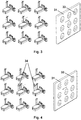
- Figure 5 shows how base stations 35 can be used to determine the location of a patient 21 by triangulation using a radio signal transmitted by sensor devices 20 according to the invention attached to him or to the objects used by him. Similarly, the location of items such as an IV stand or receivers 35 can be determined.
- Figure 6 shows a patient 21 leaving his room.
- a sensor device 20 according to the invention is on the collar of the patient.
- An IV stand 23 and a medicine jar 27 also have the sensor devices 20 of the invention, so also the movement and location of them can be monitored.
- the door 25 has sensor device 20 according to the invention, whereby the movement and orientation of the door can be monitored with a system according to the invention.
- the patient has come close to door 25 and he has moved it.
- the system detects the movement and location of the door 25, the IV stand 23 and the patient 21.
- the system can check, even before the patient 21 has opened the door 25, that the patient 21 has the right to leave the room with his IV stand 23. If the system detects that the patient has this right, the system can automatically open a door lock 26.
- the system can also check whether the patient, when moving in his room and/or when leaving the room, has with him all the necessary items e.g. health-supporting equipment such as IV stand 23 or medicines 27. If the system notices that there is no permission to leave the room or that the patient does not have a necessary item with him, it can e.g. issue an alarm to the personnel, lock the door, give an audio signal.
- necessary items e.g. health-supporting equipment such as IV stand 23 or medicines 27.
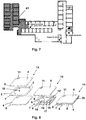
- Figure 7 shows a plan of a care facility, and it marked on it three patients whose position can be monitored e.g. with sensor devices 20 according to the invention attached to the clothes of the patient or to items used by him, such as an IV stand, a wheelchair or crutches.
- Patient #01234 is approaching an area forbidden of him, marked with dashed lines 41. A warning is sent to the staff about the situation. The system could also close and lock doors that the patient is not allowed to pass through.
- Patient #01235 is in the shower, which the system records in his patient records.
- Patient #01236 is in a bathroom, which the system records in his patient records.
- Figure 8 shows a sensor device 20 according to the invention and its plastic housing or case 14 in parts and the assembly of the parts in three stages.
- the case 14 consists of two end components 4 of the same shape and one middle component 5.
- a storage space 10 of the middle component forms in the finished case 14 a storage space 10' with the height of one component 5.
- the storage space 10 is closed on its edges in every direction.
- electrical components have been placed in storage space 10, i.e. a circuit board 16 which has a microcontroller 17, an accelerometer 18 and an accumulator or battery 19 and a radio transmitter (not shown in the figure) attached onto it.
- the inner edge 8 of storage space 10 is formed to be fitted with the circuit board.
- case 14 i.e. an electrical device 20, is shown assembled. Because case 14 comprises end components 4 without openings and a middle component 5 with its edge 5 closed in every direction, the case can be closed, i.e. the components attached to each other, e.g. with double-sided tape, or adhesive, very tightly.
- the invention can be used to detect and record improper and/or rough behaviour and handling of devices, furniture, other items and patients.
- an accelerometer of one of the sensor devices 20 according to the invention produces a value of the acceleration data exceeding a certain limit value, it can be established that improper or rough handling has taken place.
- the event can then be immediately reported to the item, to the patient, to the surroundings of the item or the patient and/or to the party monitoring the item or the patient.
- a sensor device 20 according the invention which is attached to the device, give an audio signal and thus warn its user. If an object such as a mobility aid is monitored with sensor device 20 attached to it, and it is noted, e.g.
- the invention can be used to confine infectious diseases. If e.g. the patient (Patient ID: # 01234) adventuring in Figures 1 , 3 , 6 and 7 were to be determined as a carrier of an infectious disease, could the system quickly provide for information about his routes and items he has used and movements of these items inside the hospital during a certain period of time. These routes and items and other people and items that have been in contact with them would now be easy to identify and find and direct towards further measures, e.g. to be disinfected.
Landscapes
- Physics & Mathematics (AREA)
- Engineering & Computer Science (AREA)
- General Physics & Mathematics (AREA)
- Theoretical Computer Science (AREA)
- Business, Economics & Management (AREA)
- Health & Medical Sciences (AREA)
- Software Systems (AREA)
- Emergency Management (AREA)
- General Engineering & Computer Science (AREA)
- Psychology (AREA)
- Computer Vision & Pattern Recognition (AREA)
- Mathematical Physics (AREA)
- Artificial Intelligence (AREA)
- Computing Systems (AREA)
- Data Mining & Analysis (AREA)
- Medical Informatics (AREA)
- Psychiatry (AREA)
- Evolutionary Computation (AREA)
- Social Psychology (AREA)
- General Health & Medical Sciences (AREA)
- Gerontology & Geriatric Medicine (AREA)
- Measuring And Recording Apparatus For Diagnosis (AREA)
- Alarm Systems (AREA)
- Emergency Alarm Devices (AREA)
- Burglar Alarm Systems (AREA)
Abstract
Description
- The invention relates to a method and a system for monitoring state and operation of an object as set out in the preambles of the independent claims below. The invention particularly relates to a new way of monitoring an item of a care facility, such as a piece of furniture or a device.
- Monitoring devices based on monitoring the movement or location of an object have been developed for a long time. For example, patent publication
US 6819247 B2 presents a portable patient monitoring and alarm device, which has a casing that can be attached to the patient, e.g. to her clothes. Inside the casing there are a processor, wireless transmitter, locating device, and a sensor. The sensor monitors movement, speed, acceleration or orientation of the device. After the sensor has measured a certain type of movement, the processor transmits a signal containing information about possible need for assistance and about the location of the device. - The applications of the prior art are often complex, expensive and difficult to use.
- It is an object of the present invention to reduce or even eliminate the abovementioned problems appearing in prior art.
- It is an object of the present invention provide solutions for using opportunities offered by an accelerometer in simple, user friendly and efficient ways.
- It is an object of the present invention to enhance the control and monitoring of items of a care facility.
- It is an object of the present invention to provide for a new way of controlling risk of transmission of a disease, especially in care facilities such as hospitals.
- Among others, in order to realize the objects mentioned above, method, system and other aspects according to the invention are characterized by what is presented in the enclosed independent claims.
- The embodiments and advantages mentioned in this text relate, where applicable, as well to the method, system as to any other aspect of the invention, even though it is not always specifically mentioned.
- In a typical method according to the invention for monitoring status and operation of an object, i.e. an item of a care facility, such as a piece of furniture or a device, a sensor device is used, which sensor device comprises an accelerometer, a radio transmitter, a micro controller and a power source that are functionally connected with each other. The sensor device may comprise a case, having a storage space where the above-mentioned parts of the sensor device are placed. The method comprises at least the following steps:
- producing acceleration signal with the accelerometer;
- converting the acceleration signal into acceleration data;
- controlling the radio transmitter with the microcontroller so that it transmits acceleration data to a receiver;
- storing the acceleration data in a data storage, such as a database;
- monitoring movement, speed, acceleration and/or orientation of the item on basis of the acceleration data;
- analysing the data stored in the data storage algorithmically and deducing, i.e. drawing conclusions on basis of the analysis about what and/or where has occurred and/or will occur to the item being observed.
- On basis of the analysis:
- alerting and/or notifying the item and/or a party supervising the item.
- A typical system according to the invention for monitoring status and operation of an object, i.e. an item of a care facility, such as a piece of furniture or a device, comprises
- a sensor device, which comprises an accelerometer, a radio transmitter, a micro controller and a power source that are attachable or integrable to the monitored item and functionally connected with each other. The sensor device may comprise a case, having a storage space where the above-mentioned parts of the sensor device are placed. The accelerometer is arranged to produce an acceleration signal, which is converted into acceleration data. The microcontroller is arranged to control the radio transmitter. The radio transmitter is arranged to transmit acceleration data to a receiver;
- a receiver for receiving and saving the acceleration data;
- a data storage, such as the database, in which the acceleration data is stored;
- an analysation module, which is arranged to monitor movement, speed, acceleration and/or orientation of the item on basis of the acceleration data, and to analyse the data stored in the data storage algorithmically, and to deduce, i.e. to draw conclusions, on basis of the analysis about what and/or where has occurred and/or will occur to the item being observed;
- an execution module, which is arranged to perform on basis of the analysis at least the following operation: alerting and/or notifying the item and/or a party supervising the item.
- The algorithmically performed analysing means computer analysis known as such, utilising e.g. mathematical functions, matrix calculus, neural networks and/or artificial intelligence.
- The acceleration signal produced by the accelerometer may be, for example, analog or digital. The acceleration signal is transformed to or it transforms to acceleration data, e.g. when it is saved in a data storage, such as an electronic memory device or when it is analysed and otherwise processed.
- According to the invention, the object to be monitored is an item of a care facility, such as a piece of furniture or a device. The care facility can be, for example, a hospital, a health care centre, a nursing home or a rehabilitation institution. A device to be monitored can be, for example, a mobility aid, an electronic device or an electronic medical treatment device. A monitored item can be e.g. a piece of furniture such as a bed, a table, a chair, or a device such as a mobility aid such as a wheelchair, rollator, walking aid, a crutch, or medical treatment device such as an IV stand, or electrical medical treatment device such as a defibrillator or a ventilator, or a medicine storage device such as a pill dispenser or a medicine jar. In an application, the invention is used to monitor or locate devices, furniture, and other items. For example, a particular item, or the nearest particular item, such as the nearest defibrillator, can be found quickly by means of the invention.
- Particularly care facilities, such as hospitals, have a number of items, furniture and devices whose movement, speed, acceleration or orientation are of great importance, but whose monitoring considering these properties has not previously been satisfactorily arranged.
- Examples of items for which it is important to know the movement, the speed of movement and/or the direction of movement are items whose location is of importance, e.g. items that are intended to be moved or immobile in normal use. The location of items or patients can be monitored with the location and movement data of objects transferred from one hospital room to another or from one ward to another, such as data terminals, beds or mobility aids such as rollators, walking sticks or wheelchairs. Movement data can be used to monitor a patient's treatment, for example, to accurately record trips, directions, and speeds of the patient on a rollator or wheelchair. Motion and direction data can be used to open and close doors and passageways in the right direction and at the right time, and to guide a patient or his or her escort in the right direction.
- On the other hand, the invention can be used to warn of the movement of objects intended to be immobile, for example some treatment devices must remain in the same location and sometimes they are not even to be shaken.
- Examples of objects for which acceleration data is important to know are devices and items that are easily damaged. It would be good to immediately notice any inappropriate, careless or too rough handling of many objects, especially medical treatment devices. In the past, it has not been possible to detect, e.g. a drop of a defibrillator on the floor or a shove of a ventilator. Now, this kind of events can be automatically logged into a system and they may be reported to the appropriate party, e.g. to the maintenance staff. A roughly handled device can be quickly inspected to ensure that it is in good working order.
- It is important to know the location and/or movement of some items in relation to location and/or movement of some other thing, such as the patient. Items that each patient necessarily needs may be registered in the memory of the system. These can be, for example, medical care equipment required by the patient, such as health-sustaining equipment or medicines.
- In an embodiment of the invention, when movement of a patient is observed to exceed certain limit values, e.g. when the patient rises from the bed or when she or he approaches the door, it is verified whether the patient is accompanied by items he or she needs. If the system detects that the patient is moving without an item she/he needs, the event is reported to the item, to the patient, to surroundings of the item and/or to a party supervising the item. For example, a sensor device according to the invention attached to a medicine jar and forgotten on a table may give an audio signal.
- Sometimes it may be necessary to prevent items from locations and/or movement exceeding certain limit values. For example, if the system detects that movement of a monitored item exceeds certain limit values, it can check that the movement of the item is permitted. If it is noted that there is no authorisation for the movement, it is determined that unauthorized movement of the item has taken place, and the event is reported to the item, to surroundings of the item and/or to a party supervising the item. For example, if someone is trying to move without permission a piece of furniture or device, which is meant to be used only in a certain room or department, the staff can be informed of the event or specific doors or passageways may be closed and/or locked.
- Examples of items, the orientation of which is important to know, are devices which work properly only when in a correct orientation and which are at risk of ending up in an incorrect orientation. These include e.g. various medical treatment devices such as IV stands and patient aids such as wheelchairs. Operation of many items may be possible but undesirable in a wrong orientation. For example, pieces of furniture may operate in any position as long as they are horizontal, but e.g. turning or moving beds or a ventilator out of their normal orientation is often highly undesirable. Now, an alarm can be sent of such an event even in real-time, for example to personnel.
- In the past, it has not been realized that it would be advantageous to monitor the status and function of objects in a care facility with a simple sensor device of the invention, which has e.g. placed in a case and its storage space an accelerometer, a radio transmitter, a microcontroller and a power supply. The use of this sensor device, known per se, makes it possible for the first time to monitor the movement, speed, acceleration and/or orientation of an object. In addition, it is now possible on the basis of the collected data, to perform an analysis with artificial intelligence known per se, on the basis of which it can be deduced what and/or where has happened to the monitored object or its user, such as a patient, and, for the first time, what will happen to the object.
- This ability to collect and analyse information enables the invention to be applied to, for example, issuing of alarms and notifications, management of doors and passageways, monitoring of status of items and the management of the risk of transmission of a disease.
- For example, the acceleration data produced by the accelerometer and the signals from the radio transmitter can be used to detect the location and direction of movement of the objects in the care facility, to detect the falling of items or to be able to estimate their speed. For example, automatically opening doors can be programmed to open at the right time using the information provided by the invention. For the first time, the right doors can now be opened and locked at just the right moment and in the direction of movement permitted or predicted for the object.
- With the invention, the possibilities of managing the risk of transmission of a disease are unprecedentedly effective.
- The alarm that can be issued to an item, a patient and/or a party supervising the item can be e.g. a light or sound signal given to the vicinity of the object or an alarm issued to personnel.
- The notification, which may be issued to an item, a patient and/or a party supervising the item can be the sending of acceleration data, or other data, or location of an item, collected according to the invention.
- In one embodiment of the invention an alarm and/or notification is not issued on basis of an analysis to an object and/or a party monitoring the object. In one embodiment of the invention, at least one or more of the following operations are performed:
- issuing an alarm and/or on a notification to an item and/or to a party supervising the item;
- opening, closing and/or locking a door or other passageways in the vicinity of the item;
- recording in a data storage, such as a database, operations performed by or on the item and/or events that have occurred to the item and/or its location at any given time.
- The invention allows monitoring of movement, speed, acceleration or orientation of an item, piece of furniture or device, i.e. of the monitored object. The invention enables the performing of necessary measures or, e.g. the collecting of information about the object automatically and in a form that is easy to process numerically. By monitoring an item, information about a patient can also be obtained. In this way, large amounts of e.g. patient data are automatically saved and obtained for further processing. A prompt and automatic alarm can be issued about a fallen or escaping patient or a reminder of a need to turn a patient to reduce bed sores may be sent to staff of a hospital or other care facility or to relatives of the patient.
- The invention enables an easy following of care guidelines and easy maintenance of a patient care register. With the invention it is easy to register, for example, how many times and when the patient has been washed, visited the bathroom, the canteen or the outside. The invention makes it easy e.g. to monitor how often and when a patient has turned or has been turned. One can track how much, where and when the patient has moved and been, walked, stood, sat or slept.
- In one embodiment of the invention, the components of the sensor device, or at least a part of them, are integrated in the item to be monitored. For example, the sensor device may be integrated into a piece of furniture or into a treatment device. In an embodiment the sensor device is integrated into an electronic device, such as an electronic medical treatment device, such as a defibrillator or a ventilator. In one embodiment the integration is complete in such a way that one cannot notice during normal use of an item, piece of furniture or device that it comprises the sensor device.
- Certain parts of the invention, such as the analysation module and the execution module, are typically at least partially implemented and executed as a program code. Features and elements of the invention implemented as program code include a software maintained in computer memory and arranged to be executed thereon. The software comprises program code elements arranged to perform the necessary functions and steps of the invention. Computers, software, data storages such as databases, sensors, radio transmitters and receivers, data transmission means between parts of the invention, the use of artificial intelligence and other parts of the invention are known per se and their operation will not be described in more detail in this connection.
- Microcontroller means an integrated circuit, which typically comprises at least one processor and usually at least some memory. Microcontrollers are known per se, and their structure and operation will not be discussed in more detail here.
- In one embodiment of the invention, the data storage is at least partially in the sensor device, in connection with its microcontroller, for example in the memory of the microcontroller. In one embodiment, at least part of the acceleration data stored in the data storage is analysed algorithmically the processor of the microcontroller. Data sent to the receiver with the radio transmitter can then also comprise results of the analysis made with the microcontroller. In one embodiment of the invention, the data storage is entirely in the sensor device, in connection with the microcontroller, for example in the memory of the microcontroller. In one application, the analysis of the acceleration data stored in the data storage is performed entirely with the processor of the microcontroller. Analysis by the microcontroller enables faster and distributed analysis of acceleration data.
- The electronic devices used in the invention, such as computers, processors, data storages and software, may also be located elsewhere than in the sensor device according to the invention. Acceleration data or part thereof or other data can be transmitted via the receiver to elsewhere, e.g. for saving or for further analysis.
- In one embodiment of the invention a sensor device according to the invention gathering information about movement of an object is attached to the object, i.e. to the the monitored item. Typically, a sensor device comprises a three-axis accelerometer, a microcontroller and a radio transmitter such as a Bluetooth transmitter or BLE transmitter (Bluetooth Low Energy). The software of the microcontroller enables monitoring of the movements of the object and the analysis of the acceleration data and wireless transmission of the acceleration data or the results of the analysis to the receiver. In one embodiment, one part of the acceleration data is analysed in the microcontroller and one part is transmitter elsewhere to be analysed, e.g. for a more detailed analysis. The sensor device also has a power supply, e.g. an accumulator or a battery. The sensor device reacts to movement of the monitored item, caused by a patient or another monitored object. The sensor device may analyse the collected data itself and send the analysis results to the receiver for further processing. The sensor device can transmit to a receiver e.g. real-time acceleration data, such as e.g. movement data and orientation data of a wheelchair of a patient. The sensor device or e.g. the receiver can store acceleration data or analysis results in a data storage. Artificial intelligence or other software analyses the data and creates on basis of what it learns an analysis, e.g. a forecast of the status of the object or the patient using it. This information can be used, for example, to guide care staff.
- In addition to the acceleration data the sensor device may observe other things and send the other information it has collected and/or analysed via its transmitter to a receiver, and thereby for processing, e.g. for storing, analysing, or for other possible measures. The sensor device may e.g. comprise a temperature sensor and measure temperature of a device, a piece of furniture, a patient or the surroundings with the temperature sensor. The sensor device can measure its location e.g. with a satellite positioning device. The sensor device may comprise, for collecting information, e.g. a microphone, a camera and/or a moisture sensor.
- The sensor device may be provided with a communication means, such as a loudspeaker or an indicator light, for transmitting messages to the monitored object and its surroundings, for example to the user of an item. The sensor device may be provided with a button, such as a physical button e.g. to execute a patient call, or another means of communication, such as a microphone or a camera, to send a message from the object to a party monitoring it. Other possible means of interaction are, for example, a switch, an indicator light, a display device. In the eyes of its user, the sensor device can be very simple, even without any buttons, switches, indicator lights or other visible interaction means.
- In one embodiment of the invention, all objects, patients and/or items in a certain area, e.g. in an area of risk of transmission of a disease, can be found quickly by means of the invention. The previous locations of patients and items that pose a risk of transmission can be easily determined. It is easy to monitor which of the patients and items that have been in the area of risk of transmission have already been treated or disinfected and which have not.
- In an embodiment of the invention, when an area of risk of transmission of a disease has been defined, the past and present locations of the items causing a risk of transmission are determined using information previously collected and to be collected into a data storage. In an embodiment, it is monitored which of the items that have been in the area of risk of transmission of a disease have already been treated or disinfected and which have not. In an application, an alarm or notification is issued about objects that have been in the area of risk of transmission of a disease. For example, an audio or light signal may be activated in items that have been in the area of risk of transmission.
- A method and system according to the invention can be used e.g. to find objects, patients and/or items causing a risk of transmission of a disease, to determine past locations of patients or items and/or to monitor which of the patients and/or items that have been in the area of risk of transmission have already been treated or disinfected and which have not.
- In an embodiment of the invention, the location of an object is reported to the object and/or the party monitoring the object. Location data can be used in many ways. In one embodiment, the invention is used to locate a patient or another object.
- In an embodiment of the invention, when it is found that an object is at a particular location, moving to a particular location and/or in a particular direction or at a certain speed, then one or more of locks and/or doors or other passageways in the vicinity of the object or in the direction of movement of the object are opened and/or closed. For example, in a hospital or other care facility, one or more doors may be opened, closed, or locked automatically depending on the location or the estimated or known route of an object, device, piece of furniture, or patient.
- The system according to the invention can issue an alarm when an object, a device, a piece of furniture or a patient leaves a certain area. The location and route of an object can always be known e.g. during treatments, e.g. when moving from tests to further tests.
- In an embodiment of the invention, the sensor device used for transmitting, recording or analysing acceleration data or results of analysis performed with the microcontroller only when the accelerometer produces a signal. This avoids unnecessary transmission of messages and conserves the power source.
- In an embodiment of the invention, it is determined that something is wrong in at least one of the following situations:
- An item used by a patient or the patient has first moved faster than a certain limit value, and then does not move or moves less than a certain limit value. This may indicate a fall.
- An item used by a patient or the patient has not moved for a certain period of time. The patient's condition should be checked.
- Orientation of an item used by a patient or orientation of the patient has not changed sufficiently over a certain period of time. The patient's condition should be checked. It may be necessary to turn and move the patient periodically, for example to avoid bed sores.
- Various assumptions about the status of an item and the patient using the item may be deduced from acceleration vectors produced by movement of the item. These may include e.g. immobility of the patient, falling down of the patient, restlessness of the patient or that the patient is in pain. This status information of the object may be shown e.g. to the care staff or to relatives, even in real time.
- By using several receivers in various locations, the location of the object can be calculated by means of triangulation on the basis of signals received by the receivers. Of course, the sensor device can also monitor its position in other ways, for example by means of satellite positioning.
- The invention is described in more detail below with reference to the enclosed schematic drawing, in which
- Figure 1
- shows a patient in a bed,
- Figure 2
- shows a patient in a bed and a display device for care staff,
- Figure 3
- shows several patients in their beds and a display device for care staff,
- Figure 4
- shows several patients, nurses and a display device for care staff,
- Figure 5
- shows a patient and an IV stand,
- Figure 6
- shows a patient leaving his room,
- Figure 7
- shows a plan for a care facility, and
- Figure 8
- shows how to assemble a sensor device according to the invention in three stages.
- For the sake of clarity, in different figures and embodiments same reference numerals are used for some parts corresponding to each other.
-
Figure 1 shows a patient 21 in ahospital bed 22. Adjacent to the bed are anIV stand 23 and a table 24.Sensor devices 20 according to the invention are attached or integrated into thebed 22, the IV stand 23 and the table 24. Asensor device 20 of the invention is also attached to the patient's collar with a needle, Velcro strap or other suitable fastener. Onesensor device 20 according to the invention is attached to the wrist of thepatient 21. -
Figure 2 shows the patient ofFigure 1 and schematically beside him his identification code (Patient ID) #01234, with which he is distinguished from other patients in the hospital. In addition, the figure shows adisplay device 31 of the care staff. The display device shows motion orhealth information 32 of the patient, which information is collected e.g. with thesensor devices 20 according to the invention. - All of the
sensor devices 20 of the invention or items to which they are attached, have unique identifiers of their own corresponding to the patient identification code. Thesensor devices 20 transmit their own identifiers with their data, and the data storage of the system retains information on where eachsensor device 20 is attached. In other words, the system is able to associate each identifier with a certain item or patient. In this way, the status and movement of each item and patient can be monitored separately. -
Figure 3 shows several patients in their beds and adisplay device 31 of the care staff. Thedisplay device 31 depicts patients or hospital items withemojis 33 depicting the state of the patient or items in his room. At positions of unproblematic patients and items a smiling emoji is shown. In the situation of the Figure, the system according to the invention has found that statuses of two of thepatients 21 or their items are having some kinds of problems. On thedisplay device 31 emojis of different degrees of sadness are shown at their positions. -
Figure 4 shows the patients ofFigure 3 , but now thenurses 34 have arrived to check up on the problematic patients. -
Figure 5 shows howbase stations 35 can be used to determine the location of a patient 21 by triangulation using a radio signal transmitted bysensor devices 20 according to the invention attached to him or to the objects used by him. Similarly, the location of items such as an IV stand orreceivers 35 can be determined. -
Figure 6 shows a patient 21 leaving his room. Asensor device 20 according to the invention is on the collar of the patient. An IV stand 23 and amedicine jar 27 also have thesensor devices 20 of the invention, so also the movement and location of them can be monitored. Likewise, thedoor 25 hassensor device 20 according to the invention, whereby the movement and orientation of the door can be monitored with a system according to the invention. The patient has come close todoor 25 and he has moved it. The system detects the movement and location of thedoor 25, the IV stand 23 and thepatient 21. The system can check, even before the patient 21 has opened thedoor 25, that thepatient 21 has the right to leave the room with hisIV stand 23. If the system detects that the patient has this right, the system can automatically open adoor lock 26. The system can also check whether the patient, when moving in his room and/or when leaving the room, has with him all the necessary items e.g. health-supporting equipment such as IV stand 23 ormedicines 27. If the system notices that there is no permission to leave the room or that the patient does not have a necessary item with him, it can e.g. issue an alarm to the personnel, lock the door, give an audio signal. -
Figure 7 shows a plan of a care facility, and it marked on it three patients whose position can be monitored e.g. withsensor devices 20 according to the invention attached to the clothes of the patient or to items used by him, such as an IV stand, a wheelchair or crutches.Patient # 01234 is approaching an area forbidden of him, marked with dashedlines 41. A warning is sent to the staff about the situation. The system could also close and lock doors that the patient is not allowed to pass through.Patient # 01235 is in the shower, which the system records in his patient records.Patient # 01236 is in a bathroom, which the system records in his patient records. -
Figure 8 shows asensor device 20 according to the invention and its plastic housing orcase 14 in parts and the assembly of the parts in three stages. Thecase 14 consists of twoend components 4 of the same shape and onemiddle component 5. Astorage space 10 of the middle component forms in the finished case 14 a storage space 10' with the height of onecomponent 5. Thestorage space 10 is closed on its edges in every direction. In the situation of the middle figure electrical components have been placed instorage space 10, i.e. a circuit board 16 which has amicrocontroller 17, an accelerometer 18 and an accumulator orbattery 19 and a radio transmitter (not shown in the figure) attached onto it. As one can see in the figure, theinner edge 8 ofstorage space 10 is formed to be fitted with the circuit board. In the right-hand-side figure thecase 14, i.e. anelectrical device 20, is shown assembled. Becausecase 14 comprisesend components 4 without openings and amiddle component 5 with itsedge 5 closed in every direction, the case can be closed, i.e. the components attached to each other, e.g. with double-sided tape, or adhesive, very tightly. - The invention can be used to detect and record improper and/or rough behaviour and handling of devices, furniture, other items and patients. When it is found that an accelerometer of one of the
sensor devices 20 according to the invention produces a value of the acceleration data exceeding a certain limit value, it can be established that improper or rough handling has taken place. The event can then be immediately reported to the item, to the patient, to the surroundings of the item or the patient and/or to the party monitoring the item or the patient. For example, if a defibrillator is bumped too hard, can asensor device 20 according the invention, which is attached to the device, give an audio signal and thus warn its user. If an object such as a mobility aid is monitored withsensor device 20 attached to it, and it is noted, e.g. that a rollator or a wheelchair turns and moves with a considerable speed and zigzags or falls down, can an alarm be sent to staff. If the system detects an item with an alarm on and a patient moving at the same pace and/or in the same location, it can be deduced that the patient is moving with the item. - The invention can be used to confine infectious diseases. If e.g. the patient (Patient ID: # 01234) adventuring in
Figures 1 ,3 ,6 and7 were to be determined as a carrier of an infectious disease, could the system quickly provide for information about his routes and items he has used and movements of these items inside the hospital during a certain period of time. These routes and items and other people and items that have been in contact with them would now be easy to identify and find and direct towards further measures, e.g. to be disinfected. - The invention is not intended to be limited to the examples given, but the scope of the invention is determined by the independent claims. The dependent claims present some preferred embodiments of the invention.
Claims (15)
- A method for monitoring status and operation of an item (22, 23, 24, 25, 27) of a care facility, such as a piece of furniture or a device, characterized in that the monitoring is performed with a sensor device (20), which comprises an accelerometer (18), a radio transmitter, a micro controller (17) and a power source (19) that are functionally connected with each other, wherein the method comprises at least the following steps:- producing acceleration signal with the accelerometer (18);- converting the acceleration signal into acceleration data;- controlling the radio transmitter with the microcontroller (17) so that it transmits acceleration data to a receiver (35);- storing the acceleration data in a data storage, such as a database;- monitoring movement, speed, acceleration and/or orientation of the item (22, 23, 24, 25, 27) on basis of the acceleration data;- analysing the data stored in the data storage algorithmically;- drawing conclusions on basis of the analysis about what and/or where has occurred and/or will occur to the item being observed;whereby, on basis of the analysis, at least the following operation is performed:- alerting and/or notifying the item (22, 23, 24, 25, 27) and/or a party (34) supervising the item.
- A method according to claim 1, characterised in that the data storage is at least partly in the sensor device (20) in connection with the microcontroller (17), whereby the method comprises the following step of- analysing the data stored in the data storage algorithm ically with a processor of the microcontroller (17), whereby the acceleration data sent with the radio transmitter to the receiver (35) comprises results of the analysis made with the microcontroller (17).
- A method according to claim 2, characterised in that the data storage is in the sensor device (20) in connection with of the microcontroller (17), whereby the method comprises the following step of- performing whole analysis of the acceleration data stored in the data storage with the processor of the microcontroller (17).
- A method according to any previous claim, characterised in that when it is determined that the item (22, 23, 24, 25, 27) is at a particular location, moving to a particular location and/or in a particular direction, then- automatically opening and/or closing one or more of locks (26), doors (25) or other passageways in the vicinity of the item or in the direction of movement of the item.
- A method according to any previous claim, characterised in- using more than one receivers (35) at various locations;- calculating the location of the item (22, 23, 24, 25, 27) with triangulation.
- A method according to any previous claim, characterised in that when movement of a patient (21) is observed to exceed certain thresholds,- verifying that the patient (21) is accompanied by items he or she needs, such as health-sustaining equipment (23) or medicines (27);
and if not,- determining that the patient (21) is moving without an item he or she needs (23, 27); and- reported the event to the item (23, 27), to the patient (21), to surroundings of the item and/or to a party supervising the item. - A method according to any previous claim, characterised in that when movement of an item (22, 23, 24, 25, 27) is observed to exceed certain thresholds,- verifying that the movement of the item (22, 23, 24, 25, 27) is permitted; and in the absence of a permit to the movement,- determining that unauthorized movement of the item has taken place; and- reporting the event to the item (22, 23, 24, 25, 27), to surroundings of the item and/or to a party supervising the item.
- A method according to any previous claim, characterised in that the method is used for detection and recording of unauthorized and/or rough handling of equipment, furniture and other items, whereby, when measured acceleration data of the item (22, 23, 24, 25, 27) is observed to exceed certain threshold defined to the item (22, 23, 24, 25, 27)- determining that unauthorized and/or rough handling of the item has been taken place; and- reporting the event to the item (22, 23, 24, 25, 27), to surroundings of the item and/or to a party supervising the item.
- A method according to any previous claim, characterised in that the method is used for locating equipment, furniture and other items, whereby- reporting the location of the item (22, 23, 24, 25, 27) to the item, to surroundings of the item and/or to a party supervising the item.
- A method according to any previous claim, characterised in that the method is used for control of risk of transmission of a disease, whereby when an area of risk of transmission of a disease has been defined:- determining past locations of the items (22, 23, 24, 25, 27) causing a risk of transmission and reporting the past locations to a party supervising the item.
- A method according claim 10, characterised in that when the area of risk of transmission of a disease has been defined:- monitoring which items (22, 23, 24, 25, 27) previously located in the area of risk of transmission of a disease have already been treated or disinfected and which have not.
- A system for monitoring status and operation of an item (22, 23, 24, 25, 27) of a care facility, such as a piece of furniture or a device, characterised in that the system comprises- a sensor device (20), which comprises an accelerometer (18), a radio transmitter, a micro controller (17) and a power source (19) that are attachable or integrable to the monitored item (22, 23, 24, 25, 27) and functionally connected with each other, which accelerometer is arranged to produce an acceleration signal, which is converted into acceleration data, and the microcontroller is arranged to control the radio transmitter, and the radio transmitter is arranged to transmit acceleration data;- a receiver (35) for receiving the acceleration data;- a data storage, such as the database, in which the acceleration data is stored;- an analysation module, which is arranged to monitor movement, speed, acceleration and/or orientation of the item (22, 23, 24, 25, 27) on basis of the acceleration data, and to analyse the data stored in the data storage algorithmically, and to draw conclusions on basis of the analysis about what and/or where has occurred and/or will occur to the item being observed;- an execution module, which is arranged to perform on basis of the analysis at least the following operation: alerting and/or notifying the item and/or a party supervising the item.
- A system according to claim 12, characterised in that the data storage is at least partly in memory of the microcontroller (17) of the sensor device (20).
- A system according to claim 12 or 13, characterised in that and the analysation module is arranged at least partly in program code elements that are saved in the memory of a processor of the microcontroller (17) of the sensor device (20) and that are arranged to be executed in the memory.
- A use of a system according to any previous claim 12 to 14 to find or to determine past locations of objects, patients and/or items causing a risk of transmission of a disease.
Applications Claiming Priority (1)
| Application Number | Priority Date | Filing Date | Title |
|---|---|---|---|
| FI20197065A FI128454B (en) | 2019-04-12 | 2019-04-12 | Method and system for monitoring status and function of an object |
Publications (3)
| Publication Number | Publication Date |
|---|---|
| EP3731202A1 true EP3731202A1 (en) | 2020-10-28 |
| EP3731202B1 EP3731202B1 (en) | 2025-12-17 |
| EP3731202C0 EP3731202C0 (en) | 2025-12-17 |
Family
ID=70803403
Family Applications (1)
| Application Number | Title | Priority Date | Filing Date |
|---|---|---|---|
| EP20169499.9A Active EP3731202B1 (en) | 2019-04-12 | 2020-04-14 | Method and system for monitoring status and function of an object |
Country Status (2)
| Country | Link |
|---|---|
| EP (1) | EP3731202B1 (en) |
| FI (1) | FI128454B (en) |
Citations (5)
| Publication number | Priority date | Publication date | Assignee | Title |
|---|---|---|---|---|
| US20020116080A1 (en) * | 2001-02-16 | 2002-08-22 | Birnbach Jeffrey M. | Apparatus, method, and system for remote monitoring of need for assistance based on change in velocity |
| US20120242501A1 (en) * | 2006-05-12 | 2012-09-27 | Bao Tran | Health monitoring appliance |
| US20130211291A1 (en) * | 2005-10-16 | 2013-08-15 | Bao Tran | Personal emergency response (per) system |
| US20180082557A1 (en) * | 2016-08-26 | 2018-03-22 | International Business Machines Corporation | Tailgating detection |
| WO2018187557A1 (en) * | 2017-04-05 | 2018-10-11 | Microsensor Labs, LLC | System and method for proximity sensing of movable portions of a premises |
Family Cites Families (2)
| Publication number | Priority date | Publication date | Assignee | Title |
|---|---|---|---|---|
| US9969216B2 (en) * | 2015-08-21 | 2018-05-15 | Tome, Inc. | Intelligent caster system with occupancy detection and optional solar panel for use with a furniture component |
| US10096219B1 (en) * | 2016-12-08 | 2018-10-09 | Alarm.Com Incorporated | Outdoor furniture monitoring |
-
2019
- 2019-04-12 FI FI20197065A patent/FI128454B/en active IP Right Grant
-
2020
- 2020-04-14 EP EP20169499.9A patent/EP3731202B1/en active Active
Patent Citations (6)
| Publication number | Priority date | Publication date | Assignee | Title |
|---|---|---|---|---|
| US20020116080A1 (en) * | 2001-02-16 | 2002-08-22 | Birnbach Jeffrey M. | Apparatus, method, and system for remote monitoring of need for assistance based on change in velocity |
| US6819247B2 (en) | 2001-02-16 | 2004-11-16 | Locast Corporation | Apparatus, method, and system for remote monitoring of need for assistance based on change in velocity |
| US20130211291A1 (en) * | 2005-10-16 | 2013-08-15 | Bao Tran | Personal emergency response (per) system |
| US20120242501A1 (en) * | 2006-05-12 | 2012-09-27 | Bao Tran | Health monitoring appliance |
| US20180082557A1 (en) * | 2016-08-26 | 2018-03-22 | International Business Machines Corporation | Tailgating detection |
| WO2018187557A1 (en) * | 2017-04-05 | 2018-10-11 | Microsensor Labs, LLC | System and method for proximity sensing of movable portions of a premises |
Also Published As
| Publication number | Publication date |
|---|---|
| FI20197065A1 (en) | 2020-05-29 |
| EP3731202B1 (en) | 2025-12-17 |
| FI128454B (en) | 2020-05-29 |
| EP3731202C0 (en) | 2025-12-17 |
Similar Documents
| Publication | Publication Date | Title |
|---|---|---|
| El-Bendary et al. | Fall detection and prevention for the elderly: A review of trends and challenges | |
| US20250160686A1 (en) | Fall detection using sensors in a smart monitoring safety system | |
| CN111383746B (en) | System and method for caregiver availability determination | |
| US20160260310A1 (en) | Remote monitoring system | |
| US8674840B2 (en) | Sanitization compliance monitoring system | |
| JP6739559B2 (en) | Toilet monitoring in medical facilities | |
| CN205541262U (en) | A multifunctional robot for house health monitoring and safety protection | |
| AU2011317168A1 (en) | Infectious disease warning system | |
| CN108937886A (en) | A kind of patient in hospital method for managing security and system | |
| Esch | A survey on ambient intelligence in healthcare | |
| Gjoreski et al. | Using smartwatch as telecare and fall detection device | |
| GB2474317A (en) | System, method and apparatus for management of hygiene | |
| AU2020299778A1 (en) | Emergency responding method, safety confirmation system, management device, space section, and method for controlling management device | |
| CN106846728A (en) | A kind of intelligent guarding system and method for being applied to geriatric nursing home | |
| KR20170000123A (en) | Care system for patient suffering from alzheimer's disease | |
| EP3822984A1 (en) | A system and a procedure for nurse call and managing of health care and nursing | |
| EP3731202B1 (en) | Method and system for monitoring status and function of an object | |
| JP2003233715A (en) | Living information management system and method, and living information processing apparatus | |
| CN116386270A (en) | A security status monitoring system for the elderly based on Internet of Things technology | |
| WO2011058292A1 (en) | System, apparatus and method for management of hand hygiene | |
| KR20050090947A (en) | System for silver-tel | |
| US11361647B2 (en) | System and method of wirelessly tracking a walking assistance tool | |
| JP2002312471A (en) | Hospital risk management system using the ID mouse pendant method | |
| EP4543321A1 (en) | Umbilical cord clamp and wireless tag systems, methods and apparatus | |
| Verma | Futuristic Integrated Assistive System for Elderly Population of India. |
Legal Events
| Date | Code | Title | Description |
|---|---|---|---|
| PUAI | Public reference made under article 153(3) epc to a published international application that has entered the european phase |
Free format text: ORIGINAL CODE: 0009012 |
|
| STAA | Information on the status of an ep patent application or granted ep patent |
Free format text: STATUS: THE APPLICATION HAS BEEN PUBLISHED |
|
| AK | Designated contracting states |
Kind code of ref document: A1 Designated state(s): AL AT BE BG CH CY CZ DE DK EE ES FI FR GB GR HR HU IE IS IT LI LT LU LV MC MK MT NL NO PL PT RO RS SE SI SK SM TR |
|
| AX | Request for extension of the european patent |
Extension state: BA ME |
|
| STAA | Information on the status of an ep patent application or granted ep patent |
Free format text: STATUS: REQUEST FOR EXAMINATION WAS MADE |
|
| 17P | Request for examination filed |
Effective date: 20210428 |
|
| RBV | Designated contracting states (corrected) |
Designated state(s): AL AT BE BG CH CY CZ DE DK EE ES FI FR GB GR HR HU IE IS IT LI LT LU LV MC MK MT NL NO PL PT RO RS SE SI SK SM TR |
|
| STAA | Information on the status of an ep patent application or granted ep patent |
Free format text: STATUS: EXAMINATION IS IN PROGRESS |
|
| 17Q | First examination report despatched |
Effective date: 20230109 |
|
| GRAP | Despatch of communication of intention to grant a patent |
Free format text: ORIGINAL CODE: EPIDOSNIGR1 |
|
| STAA | Information on the status of an ep patent application or granted ep patent |
Free format text: STATUS: GRANT OF PATENT IS INTENDED |
|
| INTG | Intention to grant announced |
Effective date: 20250225 |
|
| GRAJ | Information related to disapproval of communication of intention to grant by the applicant or resumption of examination proceedings by the epo deleted |
Free format text: ORIGINAL CODE: EPIDOSDIGR1 |
|
| STAA | Information on the status of an ep patent application or granted ep patent |
Free format text: STATUS: EXAMINATION IS IN PROGRESS |
|
| GRAP | Despatch of communication of intention to grant a patent |
Free format text: ORIGINAL CODE: EPIDOSNIGR1 |
|
| STAA | Information on the status of an ep patent application or granted ep patent |
Free format text: STATUS: GRANT OF PATENT IS INTENDED |
|
| INTC | Intention to grant announced (deleted) | ||
| INTG | Intention to grant announced |
Effective date: 20250709 |
|
| GRAS | Grant fee paid |
Free format text: ORIGINAL CODE: EPIDOSNIGR3 |
|
| GRAA | (expected) grant |
Free format text: ORIGINAL CODE: 0009210 |
|
| STAA | Information on the status of an ep patent application or granted ep patent |
Free format text: STATUS: THE PATENT HAS BEEN GRANTED |
|
| AK | Designated contracting states |
Kind code of ref document: B1 Designated state(s): AL AT BE BG CH CY CZ DE DK EE ES FI FR GB GR HR HU IE IS IT LI LT LU LV MC MK MT NL NO PL PT RO RS SE SI SK SM TR |
|
| REG | Reference to a national code |
Ref country code: CH Ref legal event code: F10 Free format text: ST27 STATUS EVENT CODE: U-0-0-F10-F00 (AS PROVIDED BY THE NATIONAL OFFICE) Effective date: 20251217 Ref country code: GB Ref legal event code: FG4D |
|
| REG | Reference to a national code |
Ref country code: DE Ref legal event code: R096 Ref document number: 602020063914 Country of ref document: DE |
|
| U01 | Request for unitary effect filed |
Effective date: 20260118 |
|
| U07 | Unitary effect registered |
Designated state(s): AT BE BG DE DK EE FI FR IT LT LU LV MT NL PT RO SE SI Effective date: 20260122 |
|
| PG25 | Lapsed in a contracting state [announced via postgrant information from national office to epo] |
Ref country code: NO Free format text: LAPSE BECAUSE OF FAILURE TO SUBMIT A TRANSLATION OF THE DESCRIPTION OR TO PAY THE FEE WITHIN THE PRESCRIBED TIME-LIMIT Effective date: 20260317 |
|
| PG25 | Lapsed in a contracting state [announced via postgrant information from national office to epo] |
Ref country code: HR Free format text: LAPSE BECAUSE OF FAILURE TO SUBMIT A TRANSLATION OF THE DESCRIPTION OR TO PAY THE FEE WITHIN THE PRESCRIBED TIME-LIMIT Effective date: 20251217 |
|
| PG25 | Lapsed in a contracting state [announced via postgrant information from national office to epo] |
Ref country code: RS Free format text: LAPSE BECAUSE OF FAILURE TO SUBMIT A TRANSLATION OF THE DESCRIPTION OR TO PAY THE FEE WITHIN THE PRESCRIBED TIME-LIMIT Effective date: 20260317 |
|
| REG | Reference to a national code |
Ref country code: CH Ref legal event code: U11 Free format text: ST27 STATUS EVENT CODE: U-0-0-U10-U11 (AS PROVIDED BY THE NATIONAL OFFICE) Effective date: 20260501 |