EP3731497B1 - Procédé de traitement de service et dispositif de réseau - Google Patents
Procédé de traitement de service et dispositif de réseau Download PDFInfo
- Publication number
- EP3731497B1 EP3731497B1 EP20170060.6A EP20170060A EP3731497B1 EP 3731497 B1 EP3731497 B1 EP 3731497B1 EP 20170060 A EP20170060 A EP 20170060A EP 3731497 B1 EP3731497 B1 EP 3731497B1
- Authority
- EP
- European Patent Office
- Prior art keywords
- packet
- cpu
- processing
- feature
- extension header
- Prior art date
- Legal status (The legal status is an assumption and is not a legal conclusion. Google has not performed a legal analysis and makes no representation as to the accuracy of the status listed.)
- Active
Links
Images



Classifications
-
- H—ELECTRICITY
- H04—ELECTRIC COMMUNICATION TECHNIQUE
- H04L—TRANSMISSION OF DIGITAL INFORMATION, e.g. TELEGRAPHIC COMMUNICATION
- H04L67/00—Network arrangements or protocols for supporting network services or applications
- H04L67/01—Protocols
- H04L67/10—Protocols in which an application is distributed across nodes in the network
-
- G—PHYSICS
- G06—COMPUTING OR CALCULATING; COUNTING
- G06F—ELECTRIC DIGITAL DATA PROCESSING
- G06F9/00—Arrangements for program control, e.g. control units
- G06F9/06—Arrangements for program control, e.g. control units using stored programs, i.e. using an internal store of processing equipment to receive or retain programs
- G06F9/46—Multiprogramming arrangements
- G06F9/465—Distributed object oriented systems
-
- H—ELECTRICITY
- H04—ELECTRIC COMMUNICATION TECHNIQUE
- H04L—TRANSMISSION OF DIGITAL INFORMATION, e.g. TELEGRAPHIC COMMUNICATION
- H04L12/00—Data switching networks
- H04L12/28—Data switching networks characterised by path configuration, e.g. LAN [Local Area Networks] or WAN [Wide Area Networks]
- H04L12/46—Interconnection of networks
- H04L12/4633—Interconnection of networks using encapsulation techniques, e.g. tunneling
-
- H—ELECTRICITY
- H04—ELECTRIC COMMUNICATION TECHNIQUE
- H04L—TRANSMISSION OF DIGITAL INFORMATION, e.g. TELEGRAPHIC COMMUNICATION
- H04L12/00—Data switching networks
- H04L12/28—Data switching networks characterised by path configuration, e.g. LAN [Local Area Networks] or WAN [Wide Area Networks]
- H04L12/46—Interconnection of networks
- H04L12/4641—Virtual LANs, VLANs, e.g. virtual private networks [VPN]
-
- H—ELECTRICITY
- H04—ELECTRIC COMMUNICATION TECHNIQUE
- H04L—TRANSMISSION OF DIGITAL INFORMATION, e.g. TELEGRAPHIC COMMUNICATION
- H04L45/00—Routing or path finding of packets in data switching networks
- H04L45/66—Layer 2 routing, e.g. in Ethernet based MAN's
-
- H—ELECTRICITY
- H04—ELECTRIC COMMUNICATION TECHNIQUE
- H04L—TRANSMISSION OF DIGITAL INFORMATION, e.g. TELEGRAPHIC COMMUNICATION
- H04L45/00—Routing or path finding of packets in data switching networks
- H04L45/74—Address processing for routing
-
- H—ELECTRICITY
- H04—ELECTRIC COMMUNICATION TECHNIQUE
- H04L—TRANSMISSION OF DIGITAL INFORMATION, e.g. TELEGRAPHIC COMMUNICATION
- H04L69/00—Network arrangements, protocols or services independent of the application payload and not provided for in the other groups of this subclass
- H04L69/22—Parsing or analysis of headers
Definitions
- This application relates to the field of communications technologies, and in particular, to a service processing method and a network device.
- an edge router plays an important role in a network system.
- the edge router is oriented to transfer a user from a local area network to a wide area network.
- the edge router needs to meet a variety of service requirements of users, for example, from simple networking to a complex multimedia service and a (virtual private network, VPN) service.
- VPN virtual private network
- WO 2019/033964 A1 refers to a method for transmitting a packet, a forwarding device, a controller, and a system.
- the method comprises: a forwarding device receiving, by means of a port, a protocol packet from another forwarding device or a user equipment unit; the forwarding device performing virtual extensible local area network (VXLAN) encapsulation on the protocol packet to generate a first VXLAN packet, the first VXLAN packet comprising the protocol packet and information about the port; and the forwarding device transmitting the first VXLAN packet to a controller.
- VXLAN virtual extensible local area network
- US 2018/0102959 A1 refers to a method for a first network controller that manages a set of logical forwarding elements implemented in several managed forwarding elements.
- the method receives a request to trace a specified packet having a particular source on a logical forwarding element.
- the method generates the packet according to the packet specification.
- the generated packet includes an indicator that the packet is for a trace operation.
- the method sends the packet to a second network controller that manages a managed forwarding element associated with the particular source.
- the method receives a first set of messages regarding operations performed on the packet from a set of network controllers that receives a second set of messages regarding operations performed on the packet from a set of managed forwarding elements that process the packet.
- US 2016/0006655 A1 refers to a control method executed by a packet processing device, the control method includes the steps of receiving, by a first processor, a received packet; identifying first processing execution information corresponding to the received packet, from among a plurality of first processing execution information, by referring to the first memory, based on packet identification information included in the received packet; and transmitting processing specification information included in the identified first processing execution information together with the received packet, to a second processor, when the processing specification information included in the identified first processing execution information specifies processing by the second processor; receiving, by the second processor, the processing specification information included in the identified first processing execution information and the received packet; and executing the processing for the received packet in accordance with second processing execution information specified by the received processing specification information, by referring to the plurality of second processing execution information.
- This application provide a service processing method according to claim 4, a network device according to claim 1 and a readable storage medium according to claim 7, to simplify a process of processing a packet by a CPU in the network device, thereby improving service processing efficiency of the network device.
- At least one in this application refers to one or more, and the term “a plurality of” refers to two or more.
- the term “and/or” describes an association relationship between associated objects and represents that three relationships may exist. For example, A and/or B may represent the following three cases: Only A exists, both A and B exist, and only B exists. A and B may be singular or plural.
- the character “/” generally indicates an “or” relationship between the associated objects.
- “At least one of the following items” or other similar expressions refer to any combination of the items, including any combination of a single item or a plurality of items.
- At least one of a, b, or c may be expressed as: a, b, c, a-b, a-c, b-c, or a-b-c, where a, b, and c may be singular or plural.
- FIG. 1 is a schematic diagram of a communications system according to an embodiment of this application.
- the communications system includes a plurality of network devices. Some network devices are located in a local area network, and some network devices are located in a wide area network, and a packet may be forwarded between the network devices, to be transmitted from a source network device to a target network device. By using the network device, the packet may be forwarded between the local area network and the wide area network.
- Edge network devices among the network devices may use solutions in embodiments of this application. It should be noted that the network device in the embodiments of this application is not limited to the edge network device.
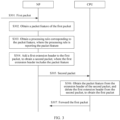
- FIG. 2 is a flowchart of a service processing method according to an embodiment of this application.
- the service processing method is applied to a network device, where the network device includes an NP and a CPU.
- the method of this embodiment may include the following steps.
- the NP receives a first packet.
- the NP obtains a packet feature of the first packet.
- the packet received by the NP may be any packet, the packet herein is referred to as the first packet, and after the first packet is received, the packet feature of the first packet is obtained from the first packet.
- the packet feature may be, for example, at least one of the following: a media access control (media access control, MAC) address, virtual local area network (virtual local area network, VLAN) information, a destination port number, a source port number, a protocol number, an Internet Protocol (Internet Protocol, IP) address and other information.
- the NP may further obtain other information corresponding to the first packet from the first packet, for example, information about a to-be-processed service included in the first packet, routing information of the first packet, and a service configured on an interface that receives the first packet.
- the NP obtains a processing rule corresponding to the packet feature.
- the CPU sends the processing rule to the NP.
- the CPU may actively send the processing rule to the NP, or after receiving a request that is for obtaining the processing rule and that is sent by the NP, the CPU sends the processing rule to the NP.
- the NP processes the received packet based on the processing rule, and a manner in which the NP processes the packet is standardized, thereby improving efficiency of processing the packet by the NP.
- one possible implementation of S203 may include the following:
- the NP may add an extension header to the first packet, to obtain a packet, where the extension header includes first information, and the first information is used to indicate that the NP does not include the processing rule, and then the NP sends the packet to the CPU, to request to obtain the processing rule from the CPU.
- the CPU receives the packet sent by the NP, obtains the first information from the extension header of the packet, and sends the processing rule to the NP based on the first information.
- the NP may alternatively send the packet feature of the first packet to the CPU, and the CPU receives the packet feature of the first packet sent by the NP, and sends the processing rule corresponding to the packet feature of the first packet to the NP based on the packet feature of the first packet.
- the NP receives the processing rule that corresponds to the packet feature of the first packet and that is sent by the CPU; and processes the first packet based on the processing rule, to obtain a second packet.
- the NP in the network device first looks up in the rule table for the processing rule corresponding to the packet feature, and when the rule table does not include the processing rule corresponding to the packet feature, the NP sends the first packet or the packet feature to the CPU, to obtain the processing rule corresponding to the packet feature. In this way, a processing amount of the CPU is reduced, thereby improving processing efficiency of the CPU.
- the method further includes: adding, by the NP, the processing rule to the rule table.
- the NP after receiving the processing rule that corresponds to the packet feature of the first packet and that is sent by the CPU, the NP adds the processing rule corresponding to the packet feature of the first packet to the rule table, so that when subsequently receiving a packet that has a same packet feature as that of the first packet, the NP may directly finds the processing rule corresponding to the packet feature from the rule table, to avoid a case in which processing amounts of the NP and the CPU are increased because the NP needs to obtain the processing rule from the CPU each time the NP receives the packet, and improve efficiency of processing the packet by the CPU, thereby improving service processing efficiency of the network device.
- the NP processes the first packet based on the processing rule, to obtain a second packet.
- the NP after obtaining the packet feature of the first packet, the NP obtains the processing rule corresponding to the packet feature, where the processing rule is content agreed between the NP and the CPU.
- the processing rule may be that the NP obtains the packet feature of the packet received by the NP and sends the packet feature to the CPU, or may be that the NP obtains routing information of the packet received by the NP and sends the routing information to the CPU, or may be that the NP obtains a task configured on an interface that receives the packet, and sends the task to the CPU, where the interface that receives the packet is, for example, a physical interface or a virtual interface on the network device.
- the NP processes the first packet based on the processing rule, to obtain the second packet, and the second packet may include information included in the first packet that is parsed by the NP.
- the NP sends the second packet to the CPU, and correspondingly, the CPU receives the second packet.
- the NP sends the second packet to the CPU, and the CPU receives the second packet. Then the CPU processes the second packet. Because the second packet is obtained after processing by the NP based on the processing rule, the CPU does not need to process the received packet based on the processing rule, to simplify a process of processing the received packet by the CPU.
- the network device includes the NP and the CPU, where the NP receives the first packet; obtains the packet feature of the first packet; obtains the processing rule corresponding to the packet feature; processes the first packet based on the processing rule, to obtain the second packet; and sends the second packet to the CPU; and the CPU receives and processes the second packet.
- the NP processes the first packet, and sends the second packet obtained after processing to the CPU, so that the CPU may directly process the second packet, to simplify the process of processing, by the CPU, the packet received by the CPU, thereby improving service processing efficiency of the network device.
- FIG. 3 is a flowchart of a service processing method according to another embodiment of this application.
- the service processing method is applied to a network device, where the network device includes an NP and a CPU.
- the method in this embodiment is described by using an example in which a processing rule includes reporting a packet feature, and the method in this embodiment may include the following steps.
- the NP receives a first packet.
- the NP obtains a packet feature of the first packet.
- the NP obtains a processing rule corresponding to the packet feature, where the processing rule is reporting the packet feature.
- the NP adds a first extension header to the first packet, to obtain a second packet, where the first extension header includes the packet feature.
- the NP sends the second packet to the CPU, and correspondingly, the CPU receives the second packet.
- the processing rule obtained by the NP may be reporting the packet feature, and the reporting the packet feature is used to instruct the NP to send both the first packet and the packet feature of the first packet to the CPU. Therefore, the NP may add an extension header to the first packet, the extension header herein is referred to as the first extension header, and the first extension header includes the packet feature, to obtain the second packet that includes the packet feature of the first packet and the first packet. The NP sends the second packet obtained after processing based on the reported packet feature to the CPU.
- the CPU obtains the packet feature from the first extension header of the second packet, and deletes the first extension header from the second packet, to obtain the first packet.
- the CPU forwards the first packet based on the packet feature.
- the CPU when the CPU receives the second packet that includes the packet feature of the first packet, because the NP already adds the packet feature of the first packet to the first extension header of the second packet, the CPU directly obtains the packet feature of the first packet from the first extension header of the second packet. Then, the CPU deletes the first extension header of the second packet, to obtain the first packet, and forwards the first packet based on information included in the packet feature of the first packet. For example, the packet feature includes a MAC address, and the CPU forwards the first packet based on the MAC address at which the first packet is received.
- the NP in the network device adds the first extension header that includes the packet feature to the first packet based on the processing rule of reporting the packet feature, to obtain the second packet, and sends the second packet to the CPU, so that the CPU may directly obtain the packet feature of the first packet from the first extension header of the second packet, and does not need to analyze the obtained first packet to obtain the packet feature of the first packet, to simplify a process of processing the packet by the CPU, reduce time of processing the packet by the CPU, and improve efficiency of forwarding and processing the packet by the CPU, thereby improving service processing efficiency of the network device.
- FIG. 4 is a flowchart of a service processing method according to another embodiment of this application.
- the service processing method is applied to a network device, where the network device includes an NP and a CPU.
- the method in this embodiment is described by using an example in which a processing rule includes obtaining routing information, and the method in this embodiment may include the following steps.
- the NP receives a first packet.
- the NP obtains a packet feature of the first packet.
- the NP obtains a processing rule corresponding to the packet feature, where the processing rule is obtaining routing information.
- the NP adds a first extension header to the first packet, to obtain a second packet, where the first extension header includes the routing information.
- the NP sends the second packet to the CPU, and correspondingly, the CPU receives the second packet.
- the processing rule obtained by the NP may be obtaining the routing information, and the obtaining the routing information is that the CPU obtains, from the NP, the routing information of the first packet obtained by the NP, and in this case, the NP needs to send both the first packet and the routing information of the first packet to the CPU. Therefore, the NP may add an extension header to the first packet, the extension header herein is referred to as the first extension header, and the first extension header includes the routing information, to obtain the second packet that includes the routing information of the first packet and the first packet.
- the routing information may include, for example, a route index, where the route index is an identifier of a router entry, and the identifier of the router entry is used to indicate a storage location of the router entry in a routing table.
- the NP sends the second packet obtained after processing based on the processing rule to the CPU.
- the CPU obtains the routing information from the first extension header of the second packet, and deletes the first extension header from the second packet, to obtain the first packet.
- the CPU forwards the first packet based on the routing information.
- the CPU when the CPU receives the second packet that includes the routing information of the first packet, because the NP already adds the routing information of the first packet to the first extension header of the second packet, the CPU directly obtains the routing information of the first packet from the first extension header of the second packet. Then, the CPU deletes the first extension header of the second packet, to obtain the first packet, and forwards the first packet based on the routing information of the first packet. For example, if the routing information includes the route index, after obtaining the route index, the CPU finds the storage location of the router entry in the routing table based on the route index, so that the router entry stored in the storage location indicated by the route index may be obtained.
- the NP in the network device adds the first extension header that includes the routing information to the first packet based on the obtaining the routing information, to obtain the second packet, and sends the second packet to the CPU, so that the CPU may directly obtain the routing information of the first packet from the first extension header of the second packet, and forward the first packet based on the routing information, and does not need to analyze the first packet to obtain the routing information of the first packet, to simplify a process of processing a packet by the CPU, reduce time of processing the packet by the CPU, and improve efficiency of forwarding and processing the packet by the CPU, thereby improving service processing efficiency of the network device.
- the CPU when the CPU forwards the first packet, the CPU may forward the first packet to the NP, so that the CPU may hand over, to the NP, subsequent forwarding in a process required to complete forwarding of the first packet. For example, when forwarding the first packet, the CPU needs to encapsulate the first packet. Currently, the encapsulation of the first packet is completed by the CPU. In this application, the CPU hands over the process of encapsulating the first packet to the NP, to reduce a processing amount of the CPU, and improve forwarding and processing efficiency of the CPU, thereby improving service processing efficiency of the network device, and reducing processing time of the packet.
- FIG. 5 is a flowchart of a service processing method according to another embodiment of this application.
- the service processing method is applied to a network device, where the network device includes an NP and a CPU.
- the method in this embodiment is described by using an example in which a processing rule includes reporting service information, and the method in this embodiment may include the following steps.
- the NP receives a first packet.
- the NP obtains a packet feature of the first packet.
- the NP obtains a processing rule corresponding to the packet feature, where the processing rule is reporting service information.
- the NP obtains a service configured on an interface that receives the first packet, and adds a first extension header to the first packet, to obtain a second packet, where the first extension header includes information about the service.
- the NP sends the second packet to the CPU, and correspondingly, the CPU receives the second packet.
- the processing rule obtained by the NP may be reporting the service information, and the reporting the service information is used to instruct the NP to send both the first packet and the obtained service information of the first packet to the CPU. Therefore, the NP obtains the service configured on the interface that receives the first packet, forms the service information by using the obtained service configured on the interface that receives the first packet, and adds an extension header to the first packet, the extension header herein is referred to as the first extension header, and the first extension header includes the service information, to obtain the second packet that includes the service information of the first packet and the first packet. The NP sends the second packet obtained after processing based on the processing rule to the CPU.
- a service that the NP can process may exist, and a service that the NP cannot process may also exist. Therefore, the NP may add information about the service that the NP cannot process to the first extension header, or the NP may alternatively add information about the at least one service configured on the interface that receives the first packet to the extension header. This is not limited in this embodiment of this application.
- the CPU obtains the information about the service from the first extension header of the second packet, and deletes the first extension header from the second packet, to obtain the first packet.
- the CPU performs the service on the first packet.
- the CPU when the CPU receives the information about the service configured on the interface that receives the first packet, because the NP already adds the information about the service configured on the interface that receives the first packet to the first extension header of the second packet, the CPU directly obtains, from the first extension header of the second packet, the information about the service configured on the interface that receives the first packet. Then, the CPU deletes the first extension header of the second packet, to obtain the first packet. Then, the CPU performs the service based on the service information. For example, if the service that is configured on the interface receiving the first packet and that is obtained by the CPU by using the service information is collecting statistics on traffic, the CPU performs a service of collecting statistics on traffic.
- the NP in the network device adds, based on the processing rule, the service configured on the interface that receives the first packet to the first extension header of the second packet, and sends the service to the CPU, so that the CPU may directly obtain, from the first extension header of the second packet, the information about the service configured on the interface that receives the first packet, to directly process the service, and does not need to analyze the received packet to obtain the information about the service configured on the interface that receives the packet, to reduce time of processing the packet by the CPU, reduce the processing amount of the CPU, and improve efficiency of forwarding and processing the packet by the CPU, thereby improving service processing efficiency of the network device.
- FIG. 6 is a flowchart of a service processing method according to another embodiment of this application. As shown in FIG. 6 , based on the embodiments shown in FIG. 2 to FIG. 5 , the service processing method provided in this application may further include the following steps.
- the CPU sends a third packet to the NP, where the third packet includes a second extension header, and the second extension header includes processing information and a layer 2 header.
- the packet that should have been processed by the CPU may be handed over to the NP for processing, and in this case, when there is such a packet that needs to be processed, the NP may directly process the packet, without occupying processing resources of the CPU.
- an implementation may be that: The CPU sends a third packet to the NP, where the third packet includes a second extension header, and the second extension header includes processing information and a layer 2 header.
- the processing information is used to notify the NP of a manner of processing the packet and information required for processing the packet. For example, the CPU notifies, by using the processing information, the NP of whether to encapsulate the layer 2 header, or whether to change fields in the packet.
- the CPU instructs, by using the processing information, the NP to add a field to the packet, and sends the to-be-added field to the NP by using the processing information, and the layer 2 header includes, for example, a MAC address, or VLAN information.
- the NP obtains the processing information and the layer 2 header in the second extension header.
- the NP deletes the second extension header from the third packet, to obtain a fourth packet.
- the NP processes the fourth packet based on the processing information.
- the NP adds the layer 2 header to the fourth packet, to obtain a fifth packet.
- the NP receives the third packet, and after obtaining the processing information and the layer 2 header from the second extension header of the third packet, the NP deletes the second extension header of the third packet, to obtain the fourth packet. Then, the NP adds the obtained layer 2 header to the fourth packet, to obtain the fifth packet.
- VXLAN virtual extensible local area network
- the CPU configures the layer 2 VXLAN, and sends information related to the layer 2 VXLAN to the NP, so that the NP performs encapsulation and decapsulation of the layer 2 VXLAN on the packet based on the information related to the layer 2 VXLAN.
- the information related to the layer 2 VXLAN may include, for example, any one or more of an instruction of performing encapsulation and decapsulation of VXLAN on the packet, a MAC address, a VLAN identifier, a source IP address used for VXLAN encapsulation, a destination IP address used for VXLAN encapsulation, and a VXLAN network identifier used for VXLAN encapsulation.
- the CPU hands over the packet that should have been processed by the CPU to the NP for processing, to reduce a quantity of packets processed by the CPU, and improve efficiency of forwarding and processing the packet by the CPU, thereby improving service processing efficiency of the network device, and reducing time of forwarding and processing the packet.
- the CPU and the NP may be integrated to collaboratively process the packet, or the packet processed by the CPU may be handed over to the NP for independent processing, so that the NP undertakes a part of work of the CPU, to improve efficiency of forwarding and processing the packet by the CPU, thereby improving service processing efficiency of the network device, and reducing time of processing the packet.
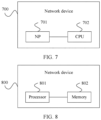
- FIG. 7 is a schematic structural diagram of a network device according to an embodiment of this application.
- the network device 700 provided in this embodiment includes an NP 701 and a CPU 702.
- the NP 701 is configured to: receive a first packet; obtain a packet feature of the first packet; obtain a processing rule corresponding to the packet feature; process the first packet based on the processing rule, to obtain a second packet; and send the second packet to the CPU 702; and the CPU 702 is configured to: receive the second packet, and process the second packet.
- the CPU 702 is further configured to send the processing rule to the NP 701.
- the processing rule is reporting the packet feature, where
- the processing rule is reporting service information.
- the NP 701 is configured to: obtain a service configured on an interface that receives the first packet, and add a first extension header to the first packet, to obtain the second packet, and the first extension header includes information about the service; and the CPU 702 is configured to: obtain the information about the service from the first extension header of the second packet; delete the first extension header from the second packet, to obtain the first packet; and perform the service on the first packet.
- the NP 701 when obtaining the processing rule corresponding to the packet feature, is configured to: look up in a rule table stored on the NP 701 based on the packet feature; obtain the processing rule from the rule table when the rule table includes the processing rule; and when the rule table does not include the processing rule, send the packet or the packet feature to the CPU 702; and receive the processing rule returned by the CPU 702.
- the NP 701 is further configured to add the processing rule to the rule table.
- the CPU 702 is configured to send a third packet to the NP 701, where the third packet includes a second extension header, and the second extension header includes processing information and a layer 2 header.
- the NP 701 is configured to: obtain the processing information and the layer 2 header in the second extension header; delete the second extension header from the third packet, to obtain a fourth packet; process the fourth packet based on the processing information; and add the layer 2 header to the fourth packet, to obtain a fifth packet.
- the network device provided in this embodiment may be configured to perform the technical solutions of the foregoing method embodiments.
- the implementation principles and technical effects are similar, and are not further described herein.
- FIG. 8 is a schematic structural diagram of a network device according to another embodiment of this application.
- the network device 800 of this embodiment may include: at least one processor 801 and a memory 802.
- a network device having one processor is used as an example in FIG. 8 .
- the memory 802 is configured to store a program.
- the program may include program code, and the program code includes a computer-executable instruction.
- the memory 802 may include a high speed random access memory (random access memory, RAM), or may further include a non-volatile memory (non-volatile memory), such as at least one magnetic disk memory.
- the processor 801 is configured to execute the computer-executable instruction stored in the memory 802, to implement the service processing method shown in the foregoing method embodiments and performed in the foregoing embodiments.
- the memory 802 and the processor 801 may be connected to each other by using a bus and complete communication between each other.
- the bus may be an Industry Standard Architecture (Industry Standard Architecture, ISA) bus, a Peripheral Component Interconnect (Peripheral Component Interconnect, PCI) bus or an Extended Industry Standard Architecture (Extended Industry Standard Architecture, EISA) bus, or the like.
- the bus may be categorized as an address bus, a data bus, a control bus, or the like, but this does not mean that there is only one bus or a bus of one type.
- the memory 802 and the processor 801 may complete communication between each other by using an internal interface.
- the network device in this embodiment may be configured to perform the technical solutions of the foregoing method embodiments.
- the implementation principles and technical effects are similar, and are not described herein again.
- the functions When the functions are implemented in the form of a software functional unit and sold or used as an independent product, the functions may be stored in one computer-readable storage medium. Based on such an understanding, the technical solutions of this application essentially, or the part contributing to the prior art, or some of the technical solutions may be implemented in a form of a software product.
- the software product is stored in one storage medium, and includes several instructions for instructing a computer device (which may be a personal computer, a server, a network device, or the like) to perform all or some of the steps of the methods described in the embodiments of this application.
Landscapes
- Engineering & Computer Science (AREA)
- Computer Networks & Wireless Communication (AREA)
- Signal Processing (AREA)
- Software Systems (AREA)
- Theoretical Computer Science (AREA)
- Computer Security & Cryptography (AREA)
- Physics & Mathematics (AREA)
- General Engineering & Computer Science (AREA)
- General Physics & Mathematics (AREA)
- Data Exchanges In Wide-Area Networks (AREA)
- Hardware Redundancy (AREA)
Claims (7)
- Dispositif de réseau (700) comprenant un processeur de réseau, NP (701), et une unité centrale de traitement, CPU (702), dans lequel le dispositif de réseau (700) est un routeur périphérique, dans lequel :• le NP (701) est configuré pour :□ recevoir un premier paquet et obtenir une caractéristique de paquet du premier paquet ;□ obtenir une règle de traitement correspondant à la caractéristique de paquet, dans lequel la règle de traitement signale la caractéristique de paquet au CPU ;□ traiter le premier paquet sur la base de la règle de traitement, pour obtenir un deuxième paquet en ajoutant un premier en-tête d'extension au premier paquet, dans lequel le premier en-tête d'extension comprend la caractéristique de paquet ; et□ envoyer le deuxième paquet au CPU (702) ;• le CPU (702) est configuré pour :□ recevoir le deuxième paquet et traiter le deuxième paquet, dans lequel le traitement du deuxième paquet comprend les étapes suivantes :■ l'obtention de la caractéristique de paquet à partir du premier en-tête d'extension du deuxième paquet ;■ la suppression du premier en-tête d'extension du deuxième paquet, pour obtenir le premier paquet ; et■ la transmission du premier paquet sur la base de la caractéristique de paquet.
- Dispositif de réseau selon la revendication 1, dans lequel, lors de l'obtention de la règle de traitement correspondant à la caractéristique de paquet, le NP est configuré pour :□ rechercher dans une table de règles stockée sur le NP sur la base de la caractéristique de paquet ;□ obtenir la règle de traitement à partir de la table de règles lorsque la table de règles comprend la règle de traitement ; et□ lorsque la table de règles ne comprend pas la règle de traitement, envoyer le premier paquet ou la caractéristique de paquet au CPU et recevoir la règle de traitement renvoyée par le CPU.
- Dispositif de réseau selon l'une quelconque des revendications 1 à 2, dans lequel le CPU est configuré pour :envoyer un troisième paquet au NP, dans lequel le troisième paquet comprend un second en-tête d'extension, et le second en-tête d'extension comprend des informations de traitement et un en-tête de couche 2 ; etle NP est configuré pour : obtenir les informations de traitement et l'en-tête de couche 2 dans le second en-tête d'extension ; supprimer le second en-tête d'extension du troisième paquet, pour obtenir un quatrième paquet ; traiter le quatrième paquet sur la base des informations de traitement ; et ajouter l'en-tête de couche 2 au quatrième paquet, pour obtenir un cinquième paquet.
- Procédé de traitement de service réalisé par un dispositif de réseau (700), le dispositif de réseau (700) étant un routeur périphérique, dans lequel le dispositif de réseau (700) comprend un processeur de réseau, NP (701), et une unité centrale de traitement, CPU (702), et le procédé comprend :• la réception (S 201), par le NP (701), d'un premier paquet, et l'obtention (S 202), par le NP (701), d'une caractéristique de paquet du premier paquet ;• l'obtention (S 203), par le NP (701), d'une règle de traitement correspondant à la caractéristique de paquet, dans lequel la règle de traitement signale la caractéristique de paquet au CPU,• le traitement (S 204), par le NP (701), du premier paquet sur la base de la règle de traitement, pour obtenir un deuxième paquet en ajoutant un premier en-tête d'extension au premier paquet, dans lequel le premier en-tête d'extension comprend la caractéristique de paquet ;• l'envoi (S 205), par le NP (701), du deuxième paquet au CPU ; et• la réception et le traitement (S 206), par le CPU (702), du deuxième paquet, dans lequel le traitement, par le CPU (702), du deuxième paquet comprend :□ l'obtention de la caractéristique de paquet à partir du premier en-tête d'extension du deuxième paquet,□ la suppression du premier en-tête d'extension du deuxième paquet, pour obtenir le premier paquet ; et□ la transmission du premier paquet sur la base de la caractéristique de paquet.
- Procédé selon la revendication 4, dans lequel l'obtention, par le NP, de la règle de traitement correspondant à la caractéristique de paquet comprend :□ la recherche dans une table de règles stockée sur le NP sur la base de la caractéristique de paquet ;□ l'obtention de la règle de traitement à partir de la table de règles lorsque la table de règles comprend la règle de traitement ;□ l'envoi du premier paquet ou de la caractéristique de paquet au CPU lorsque la table de règles ne comprend pas la règle de traitement ; et□ la réception de la règle de traitement renvoyée par le CPU.
- Procédé selon l'une quelconque des revendications 4 et 5, comprenant également :□ l'envoi, par le CPU, d'un troisième paquet au NP, dans lequel le troisième paquet comprend un second en-tête d'extension, et le second en-tête d'extension comprend des informations de traitement et un en-tête de couche 2 ; et□ l'obtention, par le NP, des informations de traitement et de l'en-tête de couche 2 dans le second en-tête d'extension ; la suppression du second en-tête d'extension du troisième paquet, pour obtenir un quatrième paquet ; le traitement du quatrième paquet sur la base des informations de traitement ; et l'ajout de l'en-tête de couche 2 au quatrième paquet, pour obtenir un cinquième paquet.
- Support de stockage lisible, dans lequel le support de stockage lisible stocke un programme informatique, et lorsqu'il est exécuté par un dispositif de réseau (700, 800) étant un routeur périphérique, le programme informatique met en œuvre le procédé de traitement de service selon l'une quelconque des revendications 4 à 6.
Applications Claiming Priority (1)
| Application Number | Priority Date | Filing Date | Title |
|---|---|---|---|
| CN201910320133.XA CN111835642B (zh) | 2019-04-19 | 2019-04-19 | 业务处理方法及网络设备 |
Publications (2)
| Publication Number | Publication Date |
|---|---|
| EP3731497A1 EP3731497A1 (fr) | 2020-10-28 |
| EP3731497B1 true EP3731497B1 (fr) | 2025-06-11 |
Family
ID=70295012
Family Applications (1)
| Application Number | Title | Priority Date | Filing Date |
|---|---|---|---|
| EP20170060.6A Active EP3731497B1 (fr) | 2019-04-19 | 2020-04-17 | Procédé de traitement de service et dispositif de réseau |
Country Status (7)
| Country | Link |
|---|---|
| US (1) | US11502953B2 (fr) |
| EP (1) | EP3731497B1 (fr) |
| JP (1) | JP7044223B2 (fr) |
| CN (1) | CN111835642B (fr) |
| AU (1) | AU2020202599B2 (fr) |
| CA (1) | CA3078090C (fr) |
| MX (1) | MX2020003994A (fr) |
Families Citing this family (3)
| Publication number | Priority date | Publication date | Assignee | Title |
|---|---|---|---|---|
| CN116155913B (zh) * | 2022-12-01 | 2026-01-27 | 中国联合网络通信集团有限公司 | 数据转发方法、装置、设备及存储介质 |
| CN116016713B (zh) * | 2022-12-13 | 2025-01-21 | 苏州盛科通信股份有限公司 | 报文传输方法、装置、网络设备及可读存储介质 |
| GB2636032A (en) * | 2023-06-15 | 2025-06-11 | Nokia Technologies Oy | Methods and apparatus for optimizing configuration of extension headers for protocol data units of a communication system |
Citations (1)
| Publication number | Priority date | Publication date | Assignee | Title |
|---|---|---|---|---|
| US20160006655A1 (en) * | 2014-07-04 | 2016-01-07 | Fujitsu Limited | Control method, packet processing device, and storage medium |
Family Cites Families (18)
| Publication number | Priority date | Publication date | Assignee | Title |
|---|---|---|---|---|
| JP2008085886A (ja) | 2006-09-28 | 2008-04-10 | Oki Electric Ind Co Ltd | パケット処理装置、パケット処理方法及びパケット処理プログラム |
| US8699488B2 (en) * | 2009-12-30 | 2014-04-15 | Verizon Patent And Licensing Inc. | Modification of peer-to-peer based feature network based on changing conditions / session signaling |
| US8326929B2 (en) * | 2009-12-30 | 2012-12-04 | Verizon Patent And Licensing Inc. | Peer-to-peer based feature network |
| WO2012090355A1 (fr) * | 2010-12-28 | 2012-07-05 | Nec Corporation | Système de communication, nœud de retransmission, procédé de traitement de paquets reçus et programme |
| CN103475626B (zh) * | 2012-06-07 | 2017-03-08 | 华为技术有限公司 | 一种用于请求资源的方法、设备及系统 |
| US20140022900A1 (en) * | 2012-07-17 | 2014-01-23 | Cisco Technology, Inc. | System and method for indicating a level of ran congestion for user plane traffic in a network environment |
| US9344349B2 (en) | 2013-07-12 | 2016-05-17 | Nicira, Inc. | Tracing network packets by a cluster of network controllers |
| CN104734998B (zh) * | 2013-12-20 | 2018-11-06 | 华为技术有限公司 | 一种网络设备及信息传输方法 |
| US10116553B1 (en) * | 2015-10-15 | 2018-10-30 | Cisco Technology, Inc. | Application identifier in service function chain metadata |
| US10862796B1 (en) * | 2017-01-18 | 2020-12-08 | Amazon Technologies, Inc. | Flow policies for virtual networks in provider network environments |
| US10560354B2 (en) * | 2017-03-24 | 2020-02-11 | Cisco Technology, Inc. | End-to-end, in situ packet enrichment for network analytics |
| CN109412922B (zh) | 2017-08-15 | 2021-07-20 | 华为技术有限公司 | 一种传输报文的方法、转发设备、控制器及系统 |
| US10616099B2 (en) * | 2017-08-28 | 2020-04-07 | Red Hat, Inc. | Hypervisor support for network functions virtualization |
| US20190306055A1 (en) * | 2018-03-29 | 2019-10-03 | Alibaba Group Holding Limited | Efficient and reliable message channel between a host system and an integrated circuit acceleration system |
| US10855546B2 (en) * | 2018-09-14 | 2020-12-01 | Juniper Networks, Inc. | Systems and methods for non-intrusive network performance monitoring |
| CN110912825B (zh) * | 2018-09-18 | 2022-08-02 | 阿里巴巴集团控股有限公司 | 一种报文的转发方法、装置、设备及系统 |
| WO2020172593A1 (fr) * | 2019-02-22 | 2020-08-27 | Shubharanjan Dasgupta | Réseau de visibilité basé sur un calcul de bord à accès multiple |
| US11356333B2 (en) * | 2020-01-24 | 2022-06-07 | Arista Networks, Inc. | Predicting forwarding destinations for packets |
-
2019
- 2019-04-19 CN CN201910320133.XA patent/CN111835642B/zh active Active
-
2020
- 2020-04-17 EP EP20170060.6A patent/EP3731497B1/fr active Active
- 2020-04-17 AU AU2020202599A patent/AU2020202599B2/en active Active
- 2020-04-17 JP JP2020074407A patent/JP7044223B2/ja active Active
- 2020-04-17 CA CA3078090A patent/CA3078090C/fr active Active
- 2020-04-17 US US16/851,577 patent/US11502953B2/en active Active
- 2020-07-13 MX MX2020003994A patent/MX2020003994A/es unknown
Patent Citations (1)
| Publication number | Priority date | Publication date | Assignee | Title |
|---|---|---|---|---|
| US20160006655A1 (en) * | 2014-07-04 | 2016-01-07 | Fujitsu Limited | Control method, packet processing device, and storage medium |
Also Published As
| Publication number | Publication date |
|---|---|
| AU2020202599B2 (en) | 2023-07-06 |
| US20200336422A1 (en) | 2020-10-22 |
| AU2020202599A1 (en) | 2020-11-05 |
| EP3731497A1 (fr) | 2020-10-28 |
| US11502953B2 (en) | 2022-11-15 |
| JP2020178348A (ja) | 2020-10-29 |
| CN111835642A (zh) | 2020-10-27 |
| CN111835642B (zh) | 2022-07-29 |
| JP7044223B2 (ja) | 2022-03-30 |
| CA3078090A1 (fr) | 2020-10-19 |
| CA3078090C (fr) | 2024-03-19 |
| MX2020003994A (es) | 2020-10-20 |
Similar Documents
| Publication | Publication Date | Title |
|---|---|---|
| US10659342B2 (en) | Flow entry configuration method, apparatus, and system | |
| US10868699B2 (en) | Method for generating forwarding information, controller, and service forwarding entity | |
| CN103428094B (zh) | 开放流OpenFlow系统中的报文转发方法及装置 | |
| US8913613B2 (en) | Method and system for classification and management of inter-blade network traffic in a blade server | |
| EP3720075B1 (fr) | Procédé de transmission de données et commutateur virtuel | |
| EP3731497B1 (fr) | Procédé de traitement de service et dispositif de réseau | |
| CN104488235B (zh) | 报文转发方法和网络设备 | |
| CN103916314A (zh) | 报文转发控制方法和相关装置及物理主机 | |
| CN111294291B (zh) | 一种协议报文的处理方法和装置 | |
| CN107566237A (zh) | 一种数据报文处理方法及装置 | |
| CN113726636B (zh) | 软件转发设备的数据转发方法、系统及电子设备 | |
| CN104796336A (zh) | 一种配置、下发流表项的方法及装置 | |
| EP3589024A1 (fr) | Procédé et appareil de traitement de message | |
| CN112787913A (zh) | 智能网卡组件、物理机、云服务系统以及报文发送方法 | |
| CN109525501A (zh) | 一种调整转发路径的方法和装置 | |
| CN106209554A (zh) | 跨虚拟可扩展局域网的报文转发方法和设备 | |
| CN109218176B (zh) | 一种报文处理的方法及装置 | |
| CN115987912A (zh) | 报文转发控制方法、装置、设备及存储介质 | |
| US10177935B2 (en) | Data transfer system, data transfer server, data transfer method, and program recording medium | |
| CN108156066A (zh) | 报文转发方法和装置 | |
| CN112840623A (zh) | 数据报文传输方法及节点 | |
| CN111050339B (zh) | 一种基于协议无感知转发的高速数据更新系统及方法 | |
| US20150101035A1 (en) | Duplicating packets efficiently within a network security appliance | |
| WO2025118904A1 (fr) | Procédé de transfert de paquets, dispositif de communication de données et support de stockage | |
| WO2024021984A1 (fr) | Procédé de traitement de messages et serveur |
Legal Events
| Date | Code | Title | Description |
|---|---|---|---|
| PUAI | Public reference made under article 153(3) epc to a published international application that has entered the european phase |
Free format text: ORIGINAL CODE: 0009012 |
|
| STAA | Information on the status of an ep patent application or granted ep patent |
Free format text: STATUS: REQUEST FOR EXAMINATION WAS MADE |
|
| 17P | Request for examination filed |
Effective date: 20200417 |
|
| AK | Designated contracting states |
Kind code of ref document: A1 Designated state(s): AL AT BE BG CH CY CZ DE DK EE ES FI FR GB GR HR HU IE IS IT LI LT LU LV MC MK MT NL NO PL PT RO RS SE SI SK SM TR |
|
| AX | Request for extension of the european patent |
Extension state: BA ME |
|
| STAA | Information on the status of an ep patent application or granted ep patent |
Free format text: STATUS: EXAMINATION IS IN PROGRESS |
|
| 17Q | First examination report despatched |
Effective date: 20220316 |
|
| REG | Reference to a national code |
Ref country code: DE Ref legal event code: R079 Free format text: PREVIOUS MAIN CLASS: H04L0029080000 Ipc: H04L0067100000 Ref country code: DE Ref legal event code: R079 Ref document number: 602020052537 Country of ref document: DE Free format text: PREVIOUS MAIN CLASS: H04L0029080000 Ipc: H04L0067100000 |
|
| GRAP | Despatch of communication of intention to grant a patent |
Free format text: ORIGINAL CODE: EPIDOSNIGR1 |
|
| STAA | Information on the status of an ep patent application or granted ep patent |
Free format text: STATUS: GRANT OF PATENT IS INTENDED |
|
| INTG | Intention to grant announced |
Effective date: 20241206 |
|
| RIC1 | Information provided on ipc code assigned before grant |
Ipc: H04L 45/74 20220101ALI20241129BHEP Ipc: H04L 45/00 20220101ALI20241129BHEP Ipc: H04L 67/10 20220101AFI20241129BHEP |
|
| GRAS | Grant fee paid |
Free format text: ORIGINAL CODE: EPIDOSNIGR3 |
|
| GRAA | (expected) grant |
Free format text: ORIGINAL CODE: 0009210 |
|
| STAA | Information on the status of an ep patent application or granted ep patent |
Free format text: STATUS: THE PATENT HAS BEEN GRANTED |
|
| AK | Designated contracting states |
Kind code of ref document: B1 Designated state(s): AL AT BE BG CH CY CZ DE DK EE ES FI FR GB GR HR HU IE IS IT LI LT LU LV MC MK MT NL NO PL PT RO RS SE SI SK SM TR |
|
| REG | Reference to a national code |
Ref country code: GB Ref legal event code: FG4D |
|
| REG | Reference to a national code |
Ref country code: CH Ref legal event code: EP |
|
| REG | Reference to a national code |
Ref country code: IE Ref legal event code: FG4D |
|
| REG | Reference to a national code |
Ref country code: DE Ref legal event code: R096 Ref document number: 602020052537 Country of ref document: DE |
|
| PG25 | Lapsed in a contracting state [announced via postgrant information from national office to epo] |
Ref country code: ES Free format text: LAPSE BECAUSE OF FAILURE TO SUBMIT A TRANSLATION OF THE DESCRIPTION OR TO PAY THE FEE WITHIN THE PRESCRIBED TIME-LIMIT Effective date: 20250611 Ref country code: FI Free format text: LAPSE BECAUSE OF FAILURE TO SUBMIT A TRANSLATION OF THE DESCRIPTION OR TO PAY THE FEE WITHIN THE PRESCRIBED TIME-LIMIT Effective date: 20250611 |
|
| REG | Reference to a national code |
Ref country code: LT Ref legal event code: MG9D |
|
| PG25 | Lapsed in a contracting state [announced via postgrant information from national office to epo] |
Ref country code: NO Free format text: LAPSE BECAUSE OF FAILURE TO SUBMIT A TRANSLATION OF THE DESCRIPTION OR TO PAY THE FEE WITHIN THE PRESCRIBED TIME-LIMIT Effective date: 20250911 Ref country code: GR Free format text: LAPSE BECAUSE OF FAILURE TO SUBMIT A TRANSLATION OF THE DESCRIPTION OR TO PAY THE FEE WITHIN THE PRESCRIBED TIME-LIMIT Effective date: 20250912 |
|
| REG | Reference to a national code |
Ref country code: NL Ref legal event code: MP Effective date: 20250611 |
|
| PG25 | Lapsed in a contracting state [announced via postgrant information from national office to epo] |
Ref country code: BG Free format text: LAPSE BECAUSE OF FAILURE TO SUBMIT A TRANSLATION OF THE DESCRIPTION OR TO PAY THE FEE WITHIN THE PRESCRIBED TIME-LIMIT Effective date: 20250611 |
|
| PG25 | Lapsed in a contracting state [announced via postgrant information from national office to epo] |
Ref country code: HR Free format text: LAPSE BECAUSE OF FAILURE TO SUBMIT A TRANSLATION OF THE DESCRIPTION OR TO PAY THE FEE WITHIN THE PRESCRIBED TIME-LIMIT Effective date: 20250611 |
|
| PG25 | Lapsed in a contracting state [announced via postgrant information from national office to epo] |
Ref country code: RS Free format text: LAPSE BECAUSE OF FAILURE TO SUBMIT A TRANSLATION OF THE DESCRIPTION OR TO PAY THE FEE WITHIN THE PRESCRIBED TIME-LIMIT Effective date: 20250911 |
|
| PG25 | Lapsed in a contracting state [announced via postgrant information from national office to epo] |
Ref country code: LV Free format text: LAPSE BECAUSE OF FAILURE TO SUBMIT A TRANSLATION OF THE DESCRIPTION OR TO PAY THE FEE WITHIN THE PRESCRIBED TIME-LIMIT Effective date: 20250611 |
|
| PG25 | Lapsed in a contracting state [announced via postgrant information from national office to epo] |
Ref country code: NL Free format text: LAPSE BECAUSE OF FAILURE TO SUBMIT A TRANSLATION OF THE DESCRIPTION OR TO PAY THE FEE WITHIN THE PRESCRIBED TIME-LIMIT Effective date: 20250611 |
|
| PG25 | Lapsed in a contracting state [announced via postgrant information from national office to epo] |
Ref country code: PT Free format text: LAPSE BECAUSE OF FAILURE TO SUBMIT A TRANSLATION OF THE DESCRIPTION OR TO PAY THE FEE WITHIN THE PRESCRIBED TIME-LIMIT Effective date: 20251013 |
|
| REG | Reference to a national code |
Ref country code: AT Ref legal event code: MK05 Ref document number: 1803163 Country of ref document: AT Kind code of ref document: T Effective date: 20250611 |
|
| PG25 | Lapsed in a contracting state [announced via postgrant information from national office to epo] |
Ref country code: IS Free format text: LAPSE BECAUSE OF FAILURE TO SUBMIT A TRANSLATION OF THE DESCRIPTION OR TO PAY THE FEE WITHIN THE PRESCRIBED TIME-LIMIT Effective date: 20251011 |
|
| PG25 | Lapsed in a contracting state [announced via postgrant information from national office to epo] |
Ref country code: SM Free format text: LAPSE BECAUSE OF FAILURE TO SUBMIT A TRANSLATION OF THE DESCRIPTION OR TO PAY THE FEE WITHIN THE PRESCRIBED TIME-LIMIT Effective date: 20250611 Ref country code: AT Free format text: LAPSE BECAUSE OF FAILURE TO SUBMIT A TRANSLATION OF THE DESCRIPTION OR TO PAY THE FEE WITHIN THE PRESCRIBED TIME-LIMIT Effective date: 20250611 |
|
| PG25 | Lapsed in a contracting state [announced via postgrant information from national office to epo] |
Ref country code: CZ Free format text: LAPSE BECAUSE OF FAILURE TO SUBMIT A TRANSLATION OF THE DESCRIPTION OR TO PAY THE FEE WITHIN THE PRESCRIBED TIME-LIMIT Effective date: 20250611 |
|
| PG25 | Lapsed in a contracting state [announced via postgrant information from national office to epo] |
Ref country code: PL Free format text: LAPSE BECAUSE OF FAILURE TO SUBMIT A TRANSLATION OF THE DESCRIPTION OR TO PAY THE FEE WITHIN THE PRESCRIBED TIME-LIMIT Effective date: 20250611 |
|
| PG25 | Lapsed in a contracting state [announced via postgrant information from national office to epo] |
Ref country code: EE Free format text: LAPSE BECAUSE OF FAILURE TO SUBMIT A TRANSLATION OF THE DESCRIPTION OR TO PAY THE FEE WITHIN THE PRESCRIBED TIME-LIMIT Effective date: 20250611 |
|
| PG25 | Lapsed in a contracting state [announced via postgrant information from national office to epo] |
Ref country code: SK Free format text: LAPSE BECAUSE OF FAILURE TO SUBMIT A TRANSLATION OF THE DESCRIPTION OR TO PAY THE FEE WITHIN THE PRESCRIBED TIME-LIMIT Effective date: 20250611 Ref country code: RO Free format text: LAPSE BECAUSE OF FAILURE TO SUBMIT A TRANSLATION OF THE DESCRIPTION OR TO PAY THE FEE WITHIN THE PRESCRIBED TIME-LIMIT Effective date: 20250611 |
|
| REG | Reference to a national code |
Ref country code: DE Ref legal event code: R097 Ref document number: 602020052537 Country of ref document: DE |
|
| PG25 | Lapsed in a contracting state [announced via postgrant information from national office to epo] |
Ref country code: DK Free format text: LAPSE BECAUSE OF FAILURE TO SUBMIT A TRANSLATION OF THE DESCRIPTION OR TO PAY THE FEE WITHIN THE PRESCRIBED TIME-LIMIT Effective date: 20250611 |
|
| PG25 | Lapsed in a contracting state [announced via postgrant information from national office to epo] |
Ref country code: IT Free format text: LAPSE BECAUSE OF FAILURE TO SUBMIT A TRANSLATION OF THE DESCRIPTION OR TO PAY THE FEE WITHIN THE PRESCRIBED TIME-LIMIT Effective date: 20250611 |
|
| PLBE | No opposition filed within time limit |
Free format text: ORIGINAL CODE: 0009261 |
|
| STAA | Information on the status of an ep patent application or granted ep patent |
Free format text: STATUS: NO OPPOSITION FILED WITHIN TIME LIMIT |
|
| REG | Reference to a national code |
Ref country code: CH Ref legal event code: L10 Free format text: ST27 STATUS EVENT CODE: U-0-0-L10-L00 (AS PROVIDED BY THE NATIONAL OFFICE) Effective date: 20260423 |