EP3732964A1 - Verfahren zur wirksamen bekämpfung von coccoidea-insektenschädlingen - Google Patents
Verfahren zur wirksamen bekämpfung von coccoidea-insektenschädlingen Download PDFInfo
- Publication number
- EP3732964A1 EP3732964A1 EP18855198.0A EP18855198A EP3732964A1 EP 3732964 A1 EP3732964 A1 EP 3732964A1 EP 18855198 A EP18855198 A EP 18855198A EP 3732964 A1 EP3732964 A1 EP 3732964A1
- Authority
- EP
- European Patent Office
- Prior art keywords
- methyl
- semiochemical
- acetate
- diffusers
- dimethyl
- Prior art date
- Legal status (The legal status is an assumption and is not a legal conclusion. Google has not performed a legal analysis and makes no representation as to the accuracy of the status listed.)
- Granted
Links
- 0 *C(CC1)OC11OC(*)CC1 Chemical compound *C(CC1)OC11OC(*)CC1 0.000 description 1
Images


Classifications
-
- A—HUMAN NECESSITIES
- A01—AGRICULTURE; FORESTRY; ANIMAL HUSBANDRY; HUNTING; TRAPPING; FISHING
- A01N—PRESERVATION OF BODIES OF HUMANS OR ANIMALS OR PLANTS OR PARTS THEREOF; BIOCIDES, e.g. AS DISINFECTANTS, AS PESTICIDES OR AS HERBICIDES; PEST REPELLANTS OR ATTRACTANTS; PLANT GROWTH REGULATORS
- A01N25/00—Biocides, pest repellants or attractants, or plant growth regulators, characterised by their forms, or by their non-active ingredients or by their methods of application, e.g. seed treatment or sequential application; Substances for reducing the noxious effect of the active ingredients to organisms other than pests
- A01N25/18—Vapour or smoke emitting compositions with delayed or sustained release
-
- A—HUMAN NECESSITIES
- A01—AGRICULTURE; FORESTRY; ANIMAL HUSBANDRY; HUNTING; TRAPPING; FISHING
- A01N—PRESERVATION OF BODIES OF HUMANS OR ANIMALS OR PLANTS OR PARTS THEREOF; BIOCIDES, e.g. AS DISINFECTANTS, AS PESTICIDES OR AS HERBICIDES; PEST REPELLANTS OR ATTRACTANTS; PLANT GROWTH REGULATORS
- A01N27/00—Biocides, pest repellants or attractants, or plant growth regulators containing hydrocarbons
-
- A—HUMAN NECESSITIES
- A01—AGRICULTURE; FORESTRY; ANIMAL HUSBANDRY; HUNTING; TRAPPING; FISHING
- A01N—PRESERVATION OF BODIES OF HUMANS OR ANIMALS OR PLANTS OR PARTS THEREOF; BIOCIDES, e.g. AS DISINFECTANTS, AS PESTICIDES OR AS HERBICIDES; PEST REPELLANTS OR ATTRACTANTS; PLANT GROWTH REGULATORS
- A01N49/00—Biocides, pest repellants or attractants, or plant growth regulators, containing compounds containing the group, wherein m+n>=1, both X together may also mean —Y— or a direct carbon-to-carbon bond, and the carbon atoms marked with an asterisk are not part of any ring system other than that which may be formed by the atoms X, the carbon atoms in square brackets being part of any acyclic or cyclic structure, or the group, wherein A means a carbon atom or Y, n>=0, and not more than one of these carbon atoms being a member of the same ring system, e.g. juvenile insect hormones or mimics thereof
Definitions
- the present invention belongs to the technical sector of pest control.
- the present invention relates to the biorational control of coccoid insect pests (Order Hemiptera, Superfamily Coccoidea).
- Coccoid or scale insects are one of the most difficult pests to handle. They are sucking insects that attack a wide range of plant species, including economically important crops. To date, approximately 7,800 scale species distributed in 49 families have been described ( Garc ⁇ a-Morales et al. ScaleNet: Scale insects (Coccoidea) database (http://scalenet.info) 2016 ). However, armored scales (Family Diaspididae), soft scales (Family Coccidae) and cochineals (Family Pseudococcidae) constitute a considerable group of agricultural pests that cause serious problems and high economic loss, even at low infestation densities.
- Growth regulators include substances such as: azadirachtin, buprofezin, phenoxicarb and/or pyriproxiphen, which may have low toxicity for vertebrates, but may be harmful to parasitoid natural enemies ( Rothwangl et al Journal of Economic Entomology 2004, 97, 1239-1244 ) and to beneficial arthropods ( Fourrier et al. PLoS One 2015, 10(7), e0132985 ).
- Biological control agents i.e. parasitoids and coccoid or scale insect predators, are considered the preferred means of defense from an environmental viewpoint.
- this type of method has not been proven to be capable of providing, on its own, an acceptable control of the populations of these insects, or maintaining them below the pest threshold.
- sexual pheromones are chemical compounds emitted, generally, by the female for the purpose of attracting the males to mate. These semiochemicals are specific to each species, are biodegradable, do not affect the beneficial insects and favor natural biological balance.
- the sexual pheromones of only 26 scale insect species have been identified: seven species of the Diaspididae family, three species of the Margarodidae family and 16 species of the Pseudococcidae family ( Zou et al. Natural Product Reports 2015, 32,1067-1113 ; Tabata et al. Journal of Chemical Ecology 2016, 42, 1193-1200 ; Tabata et al. Journal of The Royal Society Interface 2017, 14, 20170027 ).
- sexual pheromones In the particular case of insects of the Coccoidea superfamily, the use of sexual pheromones is aimed mainly at detecting and monitoring populations, and only in the case of two species, Aonidiella aurantii Maskell (Scalebur®, Ecology and Agricultural Protection, Valencia) and Planococcus ficus Signoret (CheckMate® VMB-XL, Suterra, Bend, USA), sexual pheromone diffusers are marketed for control thereof using the sexual confusion technique.
- Aonidiella aurantii Maskell Scalebur®, Ecology and Agricultural Protection, Valencia
- Planococcus ficus Signoret CheckMate® VMB-XL, Suterra, Bend, USA
- the sexual pheromones of these species have more complex chemical structures with defined stereochemistry, which in many cases makes their synthesis complicated, particularly enantioselective synthesis, being its cost unaffordable for treatment using this type of technique ( Bakthavatsalam Mealybugs and their Management in Agricultural and Horticultural crops 2016, pp. 173-198 ). Therefore, the reduced use of sexual pheromones in a biorational treatment of these species is a currently unresolved need.
- optimal flow will be understood to be a semiochemical flow that provides a maximum of male captures within a natural semiochemical matrix.
- Entomologia Experimentalis et Applicata 2011, 139, 250-257 a range comprised between 11-67 ⁇ g/day for Cydia pomonella (L.) (Tortricidae) ( Vacas et al. Environmental Entomology 2013, 42, 1383-1389 ) and 150 ⁇ g/day for Tuta absoluta (Meyrick) (Gelechiidae) ( Vacas et al. Environmental Entomology 2013, 42, 1061-1068 ); Hemiptera - 300 ⁇ g/day for A. aurantii (Diaspididae) ( Vacas et al.
- the application of a possible optimal emission flow obtained within the natural semiochemical matrix for the target pests could represent a starting point for addressing a system for attracting and affecting coccoid insects, also supported by the fact that males of these species mainly trust their olfactory stimuli for their reproduction, since they have a very short life that ranges from 10 hours for diaspidids ( Tashiro et al. Annals of the Entomological Society of America 1968, 61, 1009-1014 ) to a maximum of 100 hours for pseudococcids ( Chong et al. Environmental Entomology 2008, 37, 323-332 ; Waterworth et al.
- the response or behavior of males of the Coccoidea superfamily within the interlinked semiochemical matrix may constitute a complex system with emergent properties ( Ritter-Ortiz et al Globalization 2011, rcci.net/globalizaconstru ), which is conditioned by different stimuli or codes (olfactory response, sensory adaptation, communication mechanism, learning, behavior, longevity of the males, sexual activity of the males, toxicity of different substances, etc.) that may be known or not.
- the present invention solves the problems described in the state of the art through the preparation of an artificial semiochemical matrix, within the complex adaptive systems that form the coccoid insect societies or colonies, that makes it possible to optimize the effective flow rate or at least one semiochemical which implies a significant reduction in the use of sexual pheromones per hectare, thereby applying a biorational control of these economically viable pests. Therefore, in a first aspect, the present invention relates to a method for determining the effective flow rate for effectively controlling at least one coccoid insect pest comprising the following steps:
- effective control is that whose assessment of the damages produced by at least one pest of the Coccoidea superfamily is less than 5% or equivalent to the damage caused by using authorized pesticide treatments.
- effective flow relates to the emission flow of at least one semiochemical that is released at a substantially constant speed, which acts upon the coccoid species and maximizes the captures of males of at least one coccoid species, within an interlinked semiochemical matrix.
- effective number of diffusers relates to the number of diffusers with effective flow which, evenly distributed per unit area (hectare, m 2 , etc.) form the artificial semiochemical matrix that makes it possible to combat the target pest, obtaining effective control.
- effective flow rate herein is understood to be how the product of the combination of the final effective flow and the effective number of diffusers which, expressed in mg/ha/day, indicates the semiochemical requirements per unit area, in this case hectare, for creating and maintaining the artificial semiochemical matrix through which effective control is obtained over at least one coccoid pest.
- the term " natural semiochemical matrix” makes reference to the set of volatile molecules involved in the communication between all the species present in the environment of a certain culture, including the set of semiochemicals emitted by the females of at least one coccoid species, to attract or trigger a copulation response in the males.
- the term “ artificial semiochemical matrix” makes reference to the set of molecules of at least one semiochemical released into the environment artificially , through the use of an insect affectation device with specific emission point density and a substantially constant semiochemical emission flow.
- interlinked semiochemical matrix makes reference to the set formed by the artificial semiochemical matrix and the natural semiochemical matrix in a given culture.
- the diffusers of a least one semiochemical are homogeneously distributed within a semiochemical matrix.
- the semiochemical is a sexual pheromone.
- the semiochemical is selected from the group consisting of:
- Said one or more substitutes are selected independently from the group consisting of optionally substituted alkyl, optionally substituted alkenyl, optionally substituted alkynyl, optionally substituted aryl, optionally substituted heteroaryl, optionally substituted cycloalkyl, optionally substituted heterocycloalkyl or optionally substituted silyl, wherein said one or more optional substitutes in turn are independently selected from the group consisting of alkyl, alkenyl, alkynyl, aryl, heteroaryl, cycloalkyl, heterocycloalkyl, acyl, carboxyl, halide, hydroxyl, ether, nitro, cyano, amide, amine, acylamide, acyloxide, thiol, thioether, sulfoxide, sulfonyl, thioamide, sulfonamide or silyl.
- alkyl group is understood to be any linear or branched-chain monovalent saturated hydrocarbon that may optionally be cyclical or include cyclical groups which may optionally include one or more heteroatoms in its skeleton selected from nitrogen, oxygen or sulfur, and may also be optionally substituted by one or more substitutes selected from halogen, hydroxyl, alcoxyl, carboxyl, carbonyl, cyano, acyl, alcoxycarbonyl, amine, nitro, mercapto and alkylthio.
- alkyl groups include, but not limited to, methyl, ethyl, n -propyl, isopropyl, n -butyl, isobutyl, tert -butyl, n -pentyl, cyclopentyl, cyclohexyl or cycloheptyl.
- aryl group is understood to be an aromatic hydrocarbon that preferably contains a number of carbon atoms comprised between 3 and 12 carbon atoms, more preferably between 6 and 12 carbon atoms, such as for example cyclopropenyl, phenyl, tropyl, indenyl, naphthyl, azulenyl, bifenyl, fluorenyl or anthracenyl.
- This aryl group may be optionally substituted by one or more substitutes selected from alkyl, haloalkyl, aminoalkyl, dialkylamine, hydroxyl, alcoxide, phenyl, mercapto, halogen, nitro, cyano or alcoxycarbonyl.
- said aryl group may include one or more heteroatoms in its skeleton selected from nitrogen, oxygen or sulfur.
- the semiochemical is selected from [( 1S,3S )-2,2-dimethyl-3-(prop-1-en-2-yl)cyclobutyl)]methyl ( R )-2-methylbutanoate as a specific attractor of the species Acutaspis albopicta ; ( 3S,6R )-3-methyl-6-isopropenyl-9-decen-1-yl acetate and ( 3S , 6S )-3-methyl-6-isopropenyl-9-decen-1-yl acetate as specific attractors of the species Aonidiella aurantii ; ( 3S )-( E )-6-isopropyl-3,9-dimethyl-5,8-decadienyl acetate as a specific attractor of the species Aonidilla citrina ; ( 1R,2S )-cis-2-isopropenyl-1-(4'-methyl-4'-penten
- the semiochemical is dispensed dissolved in an inert solvent that makes it possible to achieve an effective flow by dragging of the semiochemical, notwithstanding that the solvent may in turn be a semiochemical.
- the present invention relates to a method for effectively controlling at least one coccoid insect pest that comprises the diffusion of at least one semiochemical, in a device that enables the affectation of insects, with an effective flow rate obtained according to the method of the present invention.
- insect affectation device makes reference to any device having a series of particular characteristics for attracting and/or affecting the males of at least one species of the Coccoidea superfamily, whether color, shape, or any other physical or chemical feature which causes a synergistic effect that increases the attraction of insects of the Coccoidea superfamily.
- the usual colors for attracting insects are blue, red, white and yellow, being yellow the especially preferred color.
- the present invention relates to the use of an effective flow rate comprised between 0.01-250 mg/ha/day of at least one semiochemical for controlling at least one coccoid insect pest.
- the at least one semiochemical is a sexual pheromone. More particularly, the at least one semiochemical is selected from [( 1S,3S )-2,2-dimethyl-3-(prop-1-en-2-yl)cyclobutyl)]methyl ( R )-2-methylbutanoate, ( 3S,6R )-3-methyl-6-isopropenyl-9-decen-1-yl acetate and ( 3S,6S )-3-methyl-6-isopropenyl-9-decen-1-yl acetate, ( 3S )-( E )-6-isopropyl-3,9-dimethyl-5,8-decadienyl acetate, ( 1R,2S )-cis-2-isopropenyl-1-(4'-methyl-4'-penten-1'-yl)-cyclobutane ethanol acetate, ( 5R,6E )-5-isopropyl-8-methyl-6,8
- the at least said semiochemical is combined with at least one toxic substance.
- the substance can be mixed or impregnated or in an adequate carrier on any type of medium containing it.
- toxic substance makes reference to any substance that causes the death of the insect. More particularly, it is a toxic substance for coccoid insects, more particularly, for coccoid insects selected from the group of Diaspididae and Pseudococcidae families. More particularly, the coccoid insects are selected from Aonidiella aurantii, Aspidiotus nerii, Diaspidiotus perniciosus, Planococcus ficus, Planococcus citri, Pseudococcus viburni, Pseudococcus longispinus, Dysmicoccus grasii, Phenacoccus madeirensis and Pseudococcus calceolariae
- the toxic substance is selected from the group consisting of organophosphorated compounds, carbamates, neonicotinoids, diamides, benzoylureas, pyrrols, avermectins, butenolids or any of its mixtures.
- the toxic substance is selected from the group consisting of: insecticides that act on insect growth and development (e.g. juvenile hormone-mimetic insecticides or chitin biosynthesis inhibitors), insecticides that act on the nervous or muscular system of insects (e.g. acetylcholinesterase inhibitors), insecticides that act on the breathing of insects (e.g. mitochondrial ATP-syntase inhibitors), insecticides that act on the digestive system of insects (e.g. microbial disruptors of insect midgut membranes), insecticides with unknown or uncertain mode of action as non-specific inhibitors (i.e. multi-site inhibitors) or any combination thereof.
- insecticides that act on insect growth and development e.g. juvenile hormone-mimetic insecticides or chitin biosynthesis inhibitors
- insecticides that act on the nervous or muscular system of insects e.g. acetylcholinesterase inhibitors
- insecticides that act on the breathing of insects e.g. mitochondrial ATP
- the toxic substance belongs to the family of chemical compounds called pyrethrins and pyrethroids.
- pyrethroid compounds make reference to synthetically obtained chemical compounds, which have a chemical structure similar to that of pyrethrins, which are organic compounds found naturally in certain flowers, e.g. plants of the Genus Chrysantemum , such as Chrysanthemum cinerariaefolium. Being the pyrethroid compounds more toxic than the pyrethrins and having relatively short persistence. In the insect they act on the central nervous system by contact and ingestion, exciting the insect at muscular level and finally causing death by muscular contraction.
- Illustrative examples of known pyrethroid compounds that can be used as said one or more toxic agents include, but are not limited to,
- the at least one semiochemical is diffused with an effective flow rate for a period at least greater than the biological cycle of the coccoid insect pest in question.
- the first copulations preferably for a period greater than one year.
- the effective flow rate for each coccoid species is described in table 1.
- TABLE 1 FAMILY SPECIES EFFECTIVE FLOW RATE (mg/ha/day) Diaspididae Aonidiella aurantii 0.01-150; preferably 0.05-75; more preferably 0.15-20; Diaspididae Aspidiotus nerii 0.01-150; preferably 0.01-75; more preferably 0.01-45; Diaspididae Diaspidiotus perniciosus 0.01-150; preferably 0.015-75; more preferably 0.02-45; Pseudococcid ae Planococcus ficus 0.01-150; preferably 0.2-75; more preferably 0.3-45; Pseudococcid ae Planococcus citri 0.01-150; preferably 0.01-75; more preferably 0.25-45; Pseudococcid ae Pseudococcus viburni 0.01-150;
- the present invention provides surprisingly favorable results in various aspects, since by means of the method of the present invention a very significant reduction in the amount of semiochemicals released into the atmosphere is achieved on experimentally determining their effective flow rate, prior to determining the effective flow within the interlinked semiochemical matrix.
- the obtainment of the effective flow within the complex system that forms the interlinked semiochemical matrix with all the variables involved included in the system, have been traditionally and to date been treated independently (e.g. device, formulation of the semiochemical, color, shape, toxic, etc.).
- Example 1 Obtainment, selection and use of an artificial semiochemical matrix to combat the coccoid pest A. aurantii, in citrus crops.
- An artificial semiochemical matrix 1 was generated therein by arranging 500 diffusers/ha, with a substantially constant initial emission flow-1 of 300 ⁇ g/diffuser/day (optimal flow according to the state of the art) of ( 3S,6RS ) - 3-methyl-6-isopropenyl-9-decen-1-yl acetate.
- the traps were placed in the trees at a height of 1.5 m.
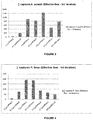
- the traps used were of the 9.5 x 15 cm white sticky sheet type. Diffusers with a substantially constant emission flow were fixed to the center of the sticky sheet. Replacement of the sheets, intra-block rotation of the traps and reading of the male captures was performed on a weekly basis. Upon completing the first rotation of the traps, it was observed that those whose emission corresponded to the flow of 25 ⁇ g/diffuser/day had the highest number of captured males and not the traps with an initial flow-1 of 300 ⁇ g/diffuser/day ( figure 1 ).
- the traps were placed in the trees at a height of 1.5 m.
- the traps used were of the 9.5 x 15 cm white sticky sheet type.
- the diffusers with a substantially constant emission flow were fixed to the center of the sticky sheet. Replacement of the sheets, intra-block rotation of the traps and reading of the male captures was performed on a weekly basis. Upon completing the rotation of the traps it was observed that those whose emission corresponded to the emission flow of 15 ⁇ g/day (effective flow-2) achieved a higher number of captures than those of the diffusers with effective flow-1 (25 ⁇ g/day) ( figure 2 ).
- the traps were placed in the trees at a height of 1.5 m.
- the traps used were of the 9.5 x 15 cm white sticky sheet type.
- the diffusers with a substantially constant emission flow were fixed to the center of the sticky sheet.
- Replacement of the sheets, intra-block rotation of the traps and reading of the male captures was performed on a weekly basis.
- the captures corresponding to the emission flows of 15 ⁇ g/day were slightly higher ( figure 3 ). That is, the final effective flow for combating this pest through the use of an artificial semiochemical matrix is 15 ⁇ g/diffuser/day.
- the results of these assays are shown in table 2.
- MATRIX 2016 NERVA HUELVA ORANGE 25.00 15.00 500 12.50 7,50% 7 EFFECTIVE F.1 + 2ND ITERATION Effective F. IN INTERLINKED SEMIOC.
- the effectiveness of the treatments was evaluated in accordance with the percentage of damaged fruit by means of sampling prior to picking the fruit.
- the number of shields of A. aurantii females per fruit was counted using the following protocol: 20 trees were selected per hectare and 10 fruits were taken from each tree: 8 from the exterior (from all the orientations and randomly) and 2 from the interior (randomly). A fruit with more than 10 shields was considered damaged.
- a surface area equivalent to the other treatments was evaluated.
- aurantii using the sexual confusion technique uses approximately 35 g/ha/year of ( 3S,6RS )-3-methyl-6-isopropenyl-9-decen-1-yl acetate, while it would be advisable, but not limiting, to use 0.7 g/ha/year of the same semiochemical to combat the pest when applying the parameters proposed in this patent application.
- Example 2 Obtainment, selection and use of an artificial semiochemical matrix to combat the Planococcus ficus coccoid pest in table grape crops.
- An artificial semiochemical matrix-1 was generated therein through the installation of 1,000 diffusers/ha, with a substantially constant emission flow of 300 ⁇ g/day of S -lavandulyl senecioate (initial flow-1). The choice of this initial emission flow is based on the average emission of commercial diffusers for controlling this pest.
- the traps were placed in the trees at a height of 2 m.
- the traps used were of the 9.5 x 15 cm white sticky sheet type.
- the diffusers with a substantially constant emission flow were fixed to the center of the sticky sheet.
- Replacement of the sheets, intra-block rotation of the traps and reading of the male captures was performed on a weekly basis. Upon completing the first rotation of the traps it was observed that those whose emission corresponded to the flows of 5 ⁇ g/day and 10 ⁇ g/day had the highest number of male captures ( figure 5 ).
- the final effective flow for combating this pest through the use of an artificial semiochemical matrix is comprised between 5 ⁇ g/diffuser/day and 10 ⁇ g/diffuser/day.
- the valuation of the bunches was estimated in accordance with the values shown in table 4: TABLE 4 DAMAGE LEVEL ITEM 1 Absence of larvae, adults, molasses and fumigines. 2 0-5% of bunches occupied by larvae, adults, molasses and fumigines. 3 5-25% of bunches occupied by larvae, adults, molasses and fumigines. 4 25-50% of bunches occupied by larvae, adults, molasses and fumigines. 5 50-75% of bunches occupied by larvae, adults, molasses and fumigines. 6 More than 75% of bunches occupied by larvae, adults, molasses and fumigines.
- the examples demonstrate that with the method of the present invention, in the coccoid species, upon achieving the effective flow within the interlinked semiochemical matrix, it is significantly lower than that determined within the natural semiochemical matrix using the methods described in the state of the art (optimal flow), but even more surprising is the finding of different combinations in the formation of the artificial semiochemical matrix that make it possible to optimally control the pest.
- This reduction in the semiochemical flow that is observed between the optimal flow and the effective flow, together with the reduction in the effective number of devices constitutes a unique technical and economic combination (effective flow rate) that significantly lowers treatment costs, which enables this technique to be economically competitive compared to other chemical and biological control methods.
- Coccoidea superfamily such as Planococcus citri , Aspidiotus nerii , Diaspidiotus perniciosus, Pseudococcus viburni, Pseudococcus longispinus, Phenacoccus madeirensis, Dysmicoccus grasii, equally led to effective flow rate values that enabled a substantial reduction in costs both in the use of the pheromone and in the number of devices (data not shown).
Landscapes
- Life Sciences & Earth Sciences (AREA)
- General Health & Medical Sciences (AREA)
- Health & Medical Sciences (AREA)
- Plant Pathology (AREA)
- Zoology (AREA)
- Environmental Sciences (AREA)
- Engineering & Computer Science (AREA)
- Dentistry (AREA)
- Agronomy & Crop Science (AREA)
- Wood Science & Technology (AREA)
- Pest Control & Pesticides (AREA)
- Insects & Arthropods (AREA)
- Toxicology (AREA)
- Agricultural Chemicals And Associated Chemicals (AREA)
- Catching Or Destruction (AREA)
- Investigating Or Analysing Biological Materials (AREA)
- Medicines That Contain Protein Lipid Enzymes And Other Medicines (AREA)
Priority Applications (1)
| Application Number | Priority Date | Filing Date | Title |
|---|---|---|---|
| MA51427A MA51427B1 (fr) | 2017-12-27 | 2018-12-21 | Procédé pour lutter efficacement contre des insectes cocoïdes nuisibles |
Applications Claiming Priority (2)
| Application Number | Priority Date | Filing Date | Title |
|---|---|---|---|
| ES201731480A ES2718121B2 (es) | 2017-12-27 | 2017-12-27 | Procedimiento para el control eficaz de plagas de insectos cocoideos |
| PCT/ES2018/070825 WO2019129908A1 (es) | 2017-12-27 | 2018-12-21 | Procedimiento para el control eficaz de plagas de insectos cocoideos |
Publications (2)
| Publication Number | Publication Date |
|---|---|
| EP3732964A1 true EP3732964A1 (de) | 2020-11-04 |
| EP3732964B1 EP3732964B1 (de) | 2025-07-23 |
Family
ID=65729379
Family Applications (1)
| Application Number | Title | Priority Date | Filing Date |
|---|---|---|---|
| EP18855198.0A Active EP3732964B1 (de) | 2017-12-27 | 2018-12-21 | Verfahren zur effektiven bekämpfung von coccoidea-insektenschädlingen |
Country Status (10)
| Country | Link |
|---|---|
| US (1) | US20210059246A1 (de) |
| EP (1) | EP3732964B1 (de) |
| AU (1) | AU2018397349C1 (de) |
| CL (2) | CL2020001704A1 (de) |
| ES (2) | ES2718121B2 (de) |
| MA (1) | MA51427B1 (de) |
| PE (1) | PE20211309A1 (de) |
| PT (1) | PT3732964T (de) |
| WO (1) | WO2019129908A1 (de) |
| ZA (1) | ZA202004182B (de) |
Family Cites Families (3)
| Publication number | Priority date | Publication date | Assignee | Title |
|---|---|---|---|---|
| PT2493842T (pt) | 2009-10-30 | 2018-05-28 | Nz Inst Plant & Food Res Ltd | Derivados de crisantemilo como atratores de cochonilha |
| CN107529747A (zh) | 2015-03-06 | 2018-01-02 | 信息化学和应用神经研究所 | 用于防止吸血双翅目昆虫着地和叮咬动物的化学信息素组合物 |
| EP3213633B1 (de) * | 2016-03-03 | 2019-04-03 | Shin-Etsu Chemical Co., Ltd | Pheromonzubereitung von weinrebenschmierläusen und bekämpfungsverfahren mit verwendung der zubereitung |
-
2017
- 2017-12-27 ES ES201731480A patent/ES2718121B2/es active Active
-
2018
- 2018-12-21 PT PT188551980T patent/PT3732964T/pt unknown
- 2018-12-21 ES ES18855198T patent/ES3041930T3/es active Active
- 2018-12-21 WO PCT/ES2018/070825 patent/WO2019129908A1/es not_active Ceased
- 2018-12-21 AU AU2018397349A patent/AU2018397349C1/en active Active
- 2018-12-21 US US16/957,818 patent/US20210059246A1/en not_active Abandoned
- 2018-12-21 EP EP18855198.0A patent/EP3732964B1/de active Active
- 2018-12-21 PE PE2020000836A patent/PE20211309A1/es unknown
- 2018-12-21 MA MA51427A patent/MA51427B1/fr unknown
-
2020
- 2020-06-22 CL CL2020001704A patent/CL2020001704A1/es unknown
- 2020-07-08 ZA ZA2020/04182A patent/ZA202004182B/en unknown
-
2022
- 2022-03-25 CL CL2022000749A patent/CL2022000749A1/es unknown
Also Published As
| Publication number | Publication date |
|---|---|
| AU2018397349A1 (en) | 2020-07-09 |
| PE20211309A1 (es) | 2021-07-20 |
| EP3732964B1 (de) | 2025-07-23 |
| ES2718121A1 (es) | 2019-06-27 |
| ES2718121B2 (es) | 2020-05-21 |
| ZA202004182B (en) | 2022-01-26 |
| CL2020001704A1 (es) | 2020-12-18 |
| ES3041930T3 (en) | 2025-11-17 |
| AU2018397349C1 (en) | 2025-04-10 |
| MA51427B1 (fr) | 2025-10-31 |
| US20210059246A1 (en) | 2021-03-04 |
| AU2018397349B2 (en) | 2024-10-10 |
| WO2019129908A1 (es) | 2019-07-04 |
| CL2022000749A1 (es) | 2023-01-20 |
| MA51427A (fr) | 2021-04-07 |
| BR112020012967A2 (pt) | 2020-12-01 |
| PT3732964T (pt) | 2025-10-14 |
Similar Documents
| Publication | Publication Date | Title |
|---|---|---|
| Haniotakis | Olive pest control: present status and prospects | |
| Weber et al. | Chemical ecology of Halyomorpha halys: discoveries and applications | |
| DE69530003T2 (de) | Verwendung von koniferylaldehyd und alpha-hexyl cinnamaldehyd zur bekämpfung von insekten und milben | |
| CN102217577A (zh) | 一种蓟马害虫的诱杀装置 | |
| US9936692B2 (en) | Engineered particulate systems for controlled release of pesticides and repellants | |
| EP3768087B1 (de) | Pestizidzusammensetzungen zur schädlingsbekämpfung | |
| Lösel et al. | Laboratory and field experiments towards the development of an attract and kill strategy for the control of the codling moth, Cydia pomonella | |
| Soroker et al. | The role of semiochemicals in date pest management | |
| Birke et al. | Host marking pheromone and GF120TM applied in a push–pull scheme reduce grapefruit infestation by Anastrepha ludens in field-cage studies | |
| RU2710732C2 (ru) | Композиция для борьбы с насекомыми, содержащая альдегид | |
| EP3732964B1 (de) | Verfahren zur effektiven bekämpfung von coccoidea-insektenschädlingen | |
| EP1750512B1 (de) | Verfahren zur bekämpfung von fruchtfliegen | |
| KR101918269B1 (ko) | 갈색날개매미충 방제용 조성물 | |
| BR112020012967B1 (pt) | Método para determinar a taxa de fluxo eficaz para controlar com eficácia uma praga de inseto cocoide, método para controlar com eficácia uma praga de inseto cocoide e uso de uma taxa de fluxo eficaz de um produto semioquímico combinado com uma substância tóxica para controlar uma praga de inseto cocoide | |
| KR101361703B1 (ko) | 복숭아유리나방 유인용 성페로몬 조성물 및 이의 제조방법 | |
| CN104619176A (zh) | 杀虫气雾剂 | |
| ES2718132A1 (es) | Molde para la fabricacion de botellas de vidrio y procedimiento de fabricacion que utiliza el molde | |
| WO2024254558A2 (en) | Thickening oil formulations of fungal entomopathogens | |
| EP3484295A1 (de) | Verfahren zur bekämpfung von insektenschädlingen bei geflügel | |
| RU2531340C1 (ru) | Способ защиты растений от вредителей | |
| JP2006199621A (ja) | カキノヘタムシガの誘引剤 | |
| JP2006249074A (ja) | 農園芸用毒餌剤 | |
| CN110124040A (zh) | 一种防治水产动物寄生虫的复合型制剂 | |
| Ahuja | Eco Friendly Pest Control Growing A Green World | |
| MUREITHI | STRUCTURE-REPELLENCE STUDIES OF δ-OCTALACTONE |
Legal Events
| Date | Code | Title | Description |
|---|---|---|---|
| STAA | Information on the status of an ep patent application or granted ep patent |
Free format text: STATUS: UNKNOWN |
|
| STAA | Information on the status of an ep patent application or granted ep patent |
Free format text: STATUS: THE INTERNATIONAL PUBLICATION HAS BEEN MADE |
|
| PUAI | Public reference made under article 153(3) epc to a published international application that has entered the european phase |
Free format text: ORIGINAL CODE: 0009012 |
|
| STAA | Information on the status of an ep patent application or granted ep patent |
Free format text: STATUS: REQUEST FOR EXAMINATION WAS MADE |
|
| 17P | Request for examination filed |
Effective date: 20200618 |
|
| AK | Designated contracting states |
Kind code of ref document: A1 Designated state(s): AL AT BE BG CH CY CZ DE DK EE ES FI FR GB GR HR HU IE IS IT LI LT LU LV MC MK MT NL NO PL PT RO RS SE SI SK SM TR |
|
| AX | Request for extension of the european patent |
Extension state: BA ME |
|
| DAX | Request for extension of the european patent (deleted) | ||
| RAV | Requested validation state of the european patent: fee paid |
Extension state: TN Effective date: 20200715 Extension state: MA Effective date: 20200715 |
|
| RIC1 | Information provided on ipc code assigned before grant |
Ipc: A01N 27/00 20060101AFI20210728BHEP Ipc: A01N 49/00 20060101ALI20210728BHEP Ipc: A01P 19/00 20060101ALI20210728BHEP |
|
| GRAP | Despatch of communication of intention to grant a patent |
Free format text: ORIGINAL CODE: EPIDOSNIGR1 |
|
| STAA | Information on the status of an ep patent application or granted ep patent |
Free format text: STATUS: GRANT OF PATENT IS INTENDED |
|
| INTG | Intention to grant announced |
Effective date: 20211007 |
|
| 19A | Proceedings stayed before grant |
Effective date: 20211013 |
|
| 19F | Resumption of proceedings before grant (after stay of proceedings) |
Effective date: 20240701 |
|
| TPAC | Observations filed by third parties |
Free format text: ORIGINAL CODE: EPIDOSNTIPA |
|
| GRAJ | Information related to disapproval of communication of intention to grant by the applicant or resumption of examination proceedings by the epo deleted |
Free format text: ORIGINAL CODE: EPIDOSDIGR1 |
|
| GRAP | Despatch of communication of intention to grant a patent |
Free format text: ORIGINAL CODE: EPIDOSNIGR1 |
|
| INTG | Intention to grant announced |
Effective date: 20241011 |
|
| GRAJ | Information related to disapproval of communication of intention to grant by the applicant or resumption of examination proceedings by the epo deleted |
Free format text: ORIGINAL CODE: EPIDOSDIGR1 |
|
| STAA | Information on the status of an ep patent application or granted ep patent |
Free format text: STATUS: REQUEST FOR EXAMINATION WAS MADE |
|
| INTC | Intention to grant announced (deleted) | ||
| GRAP | Despatch of communication of intention to grant a patent |
Free format text: ORIGINAL CODE: EPIDOSNIGR1 |
|
| STAA | Information on the status of an ep patent application or granted ep patent |
Free format text: STATUS: GRANT OF PATENT IS INTENDED |
|
| INTG | Intention to grant announced |
Effective date: 20250221 |
|
| GRAS | Grant fee paid |
Free format text: ORIGINAL CODE: EPIDOSNIGR3 |
|
| GRAA | (expected) grant |
Free format text: ORIGINAL CODE: 0009210 |
|
| STAA | Information on the status of an ep patent application or granted ep patent |
Free format text: STATUS: THE PATENT HAS BEEN GRANTED |
|
| AK | Designated contracting states |
Kind code of ref document: B1 Designated state(s): AL AT BE BG CH CY CZ DE DK EE ES FI FR GB GR HR HU IE IS IT LI LT LU LV MC MK MT NL NO PL PT RO RS SE SI SK SM TR |
|
| REG | Reference to a national code |
Ref country code: GB Ref legal event code: FG4D |
|
| P01 | Opt-out of the competence of the unified patent court (upc) registered |
Free format text: CASE NUMBER: APP_29274/2025 Effective date: 20250619 |
|
| REG | Reference to a national code |
Ref country code: CH Ref legal event code: EP |
|
| REG | Reference to a national code |
Ref country code: DE Ref legal event code: R096 Ref document number: 602018083921 Country of ref document: DE |
|
| REG | Reference to a national code |
Ref country code: IE Ref legal event code: FG4D |
|
| REG | Reference to a national code |
Ref country code: PT Ref legal event code: SC4A Ref document number: 3732964 Country of ref document: PT Date of ref document: 20251014 Kind code of ref document: T Free format text: AVAILABILITY OF NATIONAL TRANSLATION Effective date: 20251008 |
|
| REG | Reference to a national code |
Ref country code: MA Ref legal event code: VAGR Ref document number: 51427 Country of ref document: MA Kind code of ref document: B1 |
|
| REG | Reference to a national code |
Ref country code: ES Ref legal event code: FG2A Ref document number: 3041930 Country of ref document: ES Kind code of ref document: T3 Effective date: 20251117 |
|
| REG | Reference to a national code |
Ref country code: NL Ref legal event code: MP Effective date: 20250723 |
|
| REG | Reference to a national code |
Ref country code: GR Ref legal event code: EP Ref document number: 20250402022 Country of ref document: GR Effective date: 20251112 |
|
| PG25 | Lapsed in a contracting state [announced via postgrant information from national office to epo] |
Ref country code: NL Free format text: LAPSE BECAUSE OF FAILURE TO SUBMIT A TRANSLATION OF THE DESCRIPTION OR TO PAY THE FEE WITHIN THE PRESCRIBED TIME-LIMIT Effective date: 20250723 |
|
| REG | Reference to a national code |
Ref country code: AT Ref legal event code: MK05 Ref document number: 1815415 Country of ref document: AT Kind code of ref document: T Effective date: 20250723 |
|
| PG25 | Lapsed in a contracting state [announced via postgrant information from national office to epo] |
Ref country code: IS Free format text: LAPSE BECAUSE OF FAILURE TO SUBMIT A TRANSLATION OF THE DESCRIPTION OR TO PAY THE FEE WITHIN THE PRESCRIBED TIME-LIMIT Effective date: 20251123 |
|
| PG25 | Lapsed in a contracting state [announced via postgrant information from national office to epo] |
Ref country code: NO Free format text: LAPSE BECAUSE OF FAILURE TO SUBMIT A TRANSLATION OF THE DESCRIPTION OR TO PAY THE FEE WITHIN THE PRESCRIBED TIME-LIMIT Effective date: 20251023 |
|
| REG | Reference to a national code |
Ref country code: LT Ref legal event code: MG9D |
|
| PG25 | Lapsed in a contracting state [announced via postgrant information from national office to epo] |
Ref country code: AT Free format text: LAPSE BECAUSE OF FAILURE TO SUBMIT A TRANSLATION OF THE DESCRIPTION OR TO PAY THE FEE WITHIN THE PRESCRIBED TIME-LIMIT Effective date: 20250723 |
|
| PGFP | Annual fee paid to national office [announced via postgrant information from national office to epo] |
Ref country code: PT Payment date: 20251209 Year of fee payment: 8 |
|
| PG25 | Lapsed in a contracting state [announced via postgrant information from national office to epo] |
Ref country code: FI Free format text: LAPSE BECAUSE OF FAILURE TO SUBMIT A TRANSLATION OF THE DESCRIPTION OR TO PAY THE FEE WITHIN THE PRESCRIBED TIME-LIMIT Effective date: 20250723 |
|
| PGFP | Annual fee paid to national office [announced via postgrant information from national office to epo] |
Ref country code: IT Payment date: 20251219 Year of fee payment: 8 |
|
| PG25 | Lapsed in a contracting state [announced via postgrant information from national office to epo] |
Ref country code: HR Free format text: LAPSE BECAUSE OF FAILURE TO SUBMIT A TRANSLATION OF THE DESCRIPTION OR TO PAY THE FEE WITHIN THE PRESCRIBED TIME-LIMIT Effective date: 20250723 |
|
| PGFP | Annual fee paid to national office [announced via postgrant information from national office to epo] |
Ref country code: GR Payment date: 20251230 Year of fee payment: 8 Ref country code: TR Payment date: 20251216 Year of fee payment: 8 |
|
| PG25 | Lapsed in a contracting state [announced via postgrant information from national office to epo] |
Ref country code: SE Free format text: LAPSE BECAUSE OF FAILURE TO SUBMIT A TRANSLATION OF THE DESCRIPTION OR TO PAY THE FEE WITHIN THE PRESCRIBED TIME-LIMIT Effective date: 20250723 |
|
| PG25 | Lapsed in a contracting state [announced via postgrant information from national office to epo] |
Ref country code: LV Free format text: LAPSE BECAUSE OF FAILURE TO SUBMIT A TRANSLATION OF THE DESCRIPTION OR TO PAY THE FEE WITHIN THE PRESCRIBED TIME-LIMIT Effective date: 20250723 |
|
| PG25 | Lapsed in a contracting state [announced via postgrant information from national office to epo] |
Ref country code: PL Free format text: LAPSE BECAUSE OF FAILURE TO SUBMIT A TRANSLATION OF THE DESCRIPTION OR TO PAY THE FEE WITHIN THE PRESCRIBED TIME-LIMIT Effective date: 20250723 Ref country code: BG Free format text: LAPSE BECAUSE OF FAILURE TO SUBMIT A TRANSLATION OF THE DESCRIPTION OR TO PAY THE FEE WITHIN THE PRESCRIBED TIME-LIMIT Effective date: 20250723 |
|
| PG25 | Lapsed in a contracting state [announced via postgrant information from national office to epo] |
Ref country code: RS Free format text: LAPSE BECAUSE OF FAILURE TO SUBMIT A TRANSLATION OF THE DESCRIPTION OR TO PAY THE FEE WITHIN THE PRESCRIBED TIME-LIMIT Effective date: 20251023 |
|
| VSFP | Annual fee paid to validation state [announced via postgrant information from national office to epo] |
Ref country code: MA Payment date: 20251226 Year of fee payment: 8 |
|
| PG25 | Lapsed in a contracting state [announced via postgrant information from national office to epo] |
Ref country code: RO Free format text: LAPSE BECAUSE OF FAILURE TO SUBMIT A TRANSLATION OF THE DESCRIPTION OR TO PAY THE FEE WITHIN THE PRESCRIBED TIME-LIMIT Effective date: 20250723 |
|
| PG25 | Lapsed in a contracting state [announced via postgrant information from national office to epo] |
Ref country code: SM Free format text: LAPSE BECAUSE OF FAILURE TO SUBMIT A TRANSLATION OF THE DESCRIPTION OR TO PAY THE FEE WITHIN THE PRESCRIBED TIME-LIMIT Effective date: 20250723 |
|
| PGFP | Annual fee paid to national office [announced via postgrant information from national office to epo] |
Ref country code: ES Payment date: 20260119 Year of fee payment: 8 |
|
| PG25 | Lapsed in a contracting state [announced via postgrant information from national office to epo] |
Ref country code: DK Free format text: LAPSE BECAUSE OF FAILURE TO SUBMIT A TRANSLATION OF THE DESCRIPTION OR TO PAY THE FEE WITHIN THE PRESCRIBED TIME-LIMIT Effective date: 20250723 |
|
| PG25 | Lapsed in a contracting state [announced via postgrant information from national office to epo] |
Ref country code: CZ Free format text: LAPSE BECAUSE OF FAILURE TO SUBMIT A TRANSLATION OF THE DESCRIPTION OR TO PAY THE FEE WITHIN THE PRESCRIBED TIME-LIMIT Effective date: 20250723 |
|
| PLBI | Opposition filed |
Free format text: ORIGINAL CODE: 0009260 |
|
| PG25 | Lapsed in a contracting state [announced via postgrant information from national office to epo] |
Ref country code: EE Free format text: LAPSE BECAUSE OF FAILURE TO SUBMIT A TRANSLATION OF THE DESCRIPTION OR TO PAY THE FEE WITHIN THE PRESCRIBED TIME-LIMIT Effective date: 20250723 Ref country code: SK Free format text: LAPSE BECAUSE OF FAILURE TO SUBMIT A TRANSLATION OF THE DESCRIPTION OR TO PAY THE FEE WITHIN THE PRESCRIBED TIME-LIMIT Effective date: 20250723 |
|
| REG | Reference to a national code |
Ref country code: CH Ref legal event code: L10 Free format text: ST27 STATUS EVENT CODE: U-0-0-L10-L00 (AS PROVIDED BY THE NATIONAL OFFICE) Effective date: 20260430 |
|
| PLBI | Opposition filed |
Free format text: ORIGINAL CODE: 0009260 |