EP3733019A1 - Vorrichtung zur unterstützung der korrektur des physischen erscheinungsbildes, verfahren zur unterstützung der korrektur des physischen erscheinungsbildes und computerprogramm - Google Patents
Vorrichtung zur unterstützung der korrektur des physischen erscheinungsbildes, verfahren zur unterstützung der korrektur des physischen erscheinungsbildes und computerprogramm Download PDFInfo
- Publication number
- EP3733019A1 EP3733019A1 EP18895145.3A EP18895145A EP3733019A1 EP 3733019 A1 EP3733019 A1 EP 3733019A1 EP 18895145 A EP18895145 A EP 18895145A EP 3733019 A1 EP3733019 A1 EP 3733019A1
- Authority
- EP
- European Patent Office
- Prior art keywords
- makeup
- image
- sheet
- area
- feature
- Prior art date
- Legal status (The legal status is an assumption and is not a legal conclusion. Google has not performed a legal analysis and makes no representation as to the accuracy of the status listed.)
- Withdrawn
Links
Images








Classifications
-
- A—HUMAN NECESSITIES
- A45—HAND OR TRAVELLING ARTICLES
- A45D—HAIRDRESSING OR SHAVING EQUIPMENT; EQUIPMENT FOR COSMETICS OR COSMETIC TREATMENTS, e.g. FOR MANICURING OR PEDICURING
- A45D44/00—Other cosmetic or toiletry articles, e.g. for hairdressers' rooms
- A45D44/005—Other cosmetic or toiletry articles, e.g. for hairdressers' rooms for selecting or displaying personal cosmetic colours or hairstyle
-
- G—PHYSICS
- G06—COMPUTING OR CALCULATING; COUNTING
- G06F—ELECTRIC DIGITAL DATA PROCESSING
- G06F3/00—Input arrangements for transferring data to be processed into a form capable of being handled by the computer; Output arrangements for transferring data from processing unit to output unit, e.g. interface arrangements
- G06F3/12—Digital output to print unit, e.g. line printer, chain printer
- G06F3/1296—Printer job scheduling or printer resource handling
-
- G—PHYSICS
- G06—COMPUTING OR CALCULATING; COUNTING
- G06T—IMAGE DATA PROCESSING OR GENERATION, IN GENERAL
- G06T11/00—Two-dimensional [2D] image generation
- G06T11/10—Texturing; Colouring; Generation of textures or colours
-
- G—PHYSICS
- G06—COMPUTING OR CALCULATING; COUNTING
- G06V—IMAGE OR VIDEO RECOGNITION OR UNDERSTANDING
- G06V40/00—Recognition of biometric, human-related or animal-related patterns in image or video data
- G06V40/10—Human or animal bodies, e.g. vehicle occupants or pedestrians; Body parts, e.g. hands
-
- G—PHYSICS
- G06—COMPUTING OR CALCULATING; COUNTING
- G06V—IMAGE OR VIDEO RECOGNITION OR UNDERSTANDING
- G06V40/00—Recognition of biometric, human-related or animal-related patterns in image or video data
- G06V40/10—Human or animal bodies, e.g. vehicle occupants or pedestrians; Body parts, e.g. hands
- G06V40/16—Human faces, e.g. facial parts, sketches or expressions
- G06V40/168—Feature extraction; Face representation
- G06V40/171—Local features and components; Facial parts ; Occluding parts, e.g. glasses; Geometrical relationships
-
- G—PHYSICS
- G06—COMPUTING OR CALCULATING; COUNTING
- G06V—IMAGE OR VIDEO RECOGNITION OR UNDERSTANDING
- G06V40/00—Recognition of biometric, human-related or animal-related patterns in image or video data
- G06V40/10—Human or animal bodies, e.g. vehicle occupants or pedestrians; Body parts, e.g. hands
- G06V40/18—Eye characteristics, e.g. of the iris
- G06V40/19—Sensors therefor
-
- A—HUMAN NECESSITIES
- A45—HAND OR TRAVELLING ARTICLES
- A45D—HAIRDRESSING OR SHAVING EQUIPMENT; EQUIPMENT FOR COSMETICS OR COSMETIC TREATMENTS, e.g. FOR MANICURING OR PEDICURING
- A45D44/00—Other cosmetic or toiletry articles, e.g. for hairdressers' rooms
- A45D2044/007—Devices for determining the condition of hair or skin or for selecting the appropriate cosmetic or hair treatment
Definitions
- the present disclosure relates to a body appearance correction support apparatus, a body appearance correction support method, and a computer program.
- Colors used for makeup may differ for each user.
- a technique is known for manufacturing cosmetics with a set of colors customized for each user.
- PTL 1 discloses a technique in which when a user selects a set of ink colors to be used for makeup, a simulation of an appearance obtained when makeup is made using the selected colored ink set, and a simulation result is displayed. The selected set of colors is printed on a base sheet with the colored ink, and the printed base sheet is provided to the user.
- An aspect of the present disclosure provides, in supporting a visual correction of a body appearance using a sheet attachable to the body, an improvement in the customizability of the sheet that is produced and provided to an individual user.
- the present disclosure provides a body appearance correction support apparatus that supports a visual correction of a body appearance using a sheet attachable to a body, including a feature analysis unit that analyzes a feature relating to an appearance shape of the body from a body image obtained by capturing an image of the body based on a skeleton of the body, and generates body feature information indicating the analyzed feature, a makeup determination unit that determines, based on the generated body feature information, a makeup that can provide a visual correction of the appearance shape of the body, and a print information generation unit that generates, based on the determined makeup, print information related to printing of a makeup image on the sheet.
- an improvement is achieved in customizability of the sheet that is produced and provided to each user who receive the support.
- the makeup support apparatus 10 is an example of a body appearance correction support apparatus for supporting a visual correction of a body appearance using a sheet attachable to the body.
- the makeup support apparatus 10 is an apparatus for generating a sheet for making up a body by sticking it on the body (hereinafter, referred to as a "makeup sheet"), or for supporting generating such a makeup sheet.
- the makeup support apparatus 10 prints makeup ink on a thin and transparent sheet (a thin film) thereby generating a makeup sheet.
- a user may stick the makeup sheet to various body parts such as a face, a leg, an arm, a back, a chest, and a nail to change the appearance of the parts, that is, to achieve a visual correction for the parts.
- the user can make the face look small (a small face effect) or make it look three-dimensional by sticking a makeup sheet including low light and highlight makeups printed thereon to the face.
- the user can make a leg look thin by applying a makeup sheet including low light and highlight makeup printed thereon to the leg (slimming effect). That is, the makeup support apparatus 10 generates a makeup sheet that makes the user's face and proportions look more attractive.
- Body features such as a body shape, a skin color, and the like are different for each user. Therefore, to obtain a sufficient visual correction effect, it is necessary to generate a suitable makeup sheet depending on the body features of the user.
- the makeup support apparatus 10 supports the generation of such a makeup sheet.
- the makeup support apparatus 10 includes an image capture control unit 101, a body analysis unit 102, a makeup determination unit 103, a makeup image generation unit 104, a print information generation unit 105, a print control unit 106, and an input reception unit 107, a display control unit 108, and a storage unit 109. Note that the makeup support apparatus 10 may have only some of these functions.
- the image capture control unit 101 controls a camera apparatus 11 to capture an image of a body of a user, and acquires the captured body image 110 from the camera apparatus 11.
- the image capture control unit 101 stores the acquired body image 110 in the storage unit 109 or provides the body image 110 to the body analysis unit 102.
- the image capture control unit 101 may control the position and/or the amount of light of an illumination apparatus 12 in an image capture operation. This allows it to adjust the shadow of the body image 110.
- the image capture control unit 101 may control the camera apparatus 11 to capture either a still image or a moving image. That is, the body image 110 is not limited to a still image, but may be a moving image.
- the body analysis unit 102 analyzes a body feature from the body image 110 and generates body feature information 111 based on the analysis result.
- the body feature information 111 may include, for example, information indicating a body part, information indicating a body unevenness, information indicating a body skeleton shape, information indicating a feature position of a skeleton (hereinafter, referred to as a "skeleton feature point"), and/or information indicating a skin color of the body.
- the body analysis unit 102 stores the generated body feature information 111 in the storage unit 109 or provides the information to the makeup determination unit 103.
- the makeup determination unit 103 determines a makeup suitable for the shape of the body and/or the skin color of the user based on body feature information 111. For example, the makeup determination unit 103 determines areas in which highlight and low light makeup appropriate for the user's skeleton shape are applied (hereinafter, referred to as "makeup areas") and also determines colors of makeup applied to the makeup areas (hereinafter, referred to as "makeup colors"). The makeup determination unit 103 generates makeup information 112 including the determination result, and stores it in the storage unit 109 or provides it to the makeup image generation unit 104.
- the makeup image generation unit 104 generates a makeup image 114, which is an image obtained by applying makeup based on the makeup information 112 to the body image 110.
- the makeup image generation unit 104 may display the generated makeup image 114 on a display apparatus (not shown) such as a display via the display control unit 108. This makes it possible for the user to visually check the appearance of the body which will be achieved when the makeup is applied, that is, the appearance of the body obtained when the makeup sheet is stuck.
- the input reception unit 107 accepts a request for an adjustment of (or a change in) the makeup issued by the user based on the checking of the makeup image 114.
- the input reception unit 107 sends information indicating the requested adjustment to the makeup determination unit 103.
- the makeup determination unit 103 reflects the request for the adjustment in the makeup information 112. This makes it possible to obtain the makeup information 112 adjusted to meet the request issued by the user. That is, it is possible to suppress generation of a makeup sheet that does not meet the request issued by the user.
- the print information generation unit 105 determines how to print the makeup image on a sheet according to the details of the makeup information 112, and generates print information 113 including the result of the determination. For example, the print information generation unit 105 determines a print area on the sheet and an ink respectively corresponding to the makeup area and the makeup color. The print information generation unit 105 stores the generated print information 113 in the storage unit 109 or provides it to the print control unit 106.
- the print control unit 106 controls the printing apparatus 13 such that the makeup ink is printed in the print area on the sheet according to the print information 113 thereby generating the makeup sheet.
- the print control unit 106 may transmit the print information 113 to the printing apparatus 13, and the printing apparatus 13 may produce a makeup sheet based on the received print information 113.
- the print control unit 106 may transmit the print information 113 to a predetermined facility where the printing apparatus 13 is installed, and the producing of the makeup sheet may be performed in the facility. In a case where the makeup sheet has a relatively large size, it may be transported in the form of a roll package. This prevents the makeup sheet from being creased.
- the image capture control unit 101 and the body analysis unit 102 may have one of or a combination of two or more functions (A1) to (A6) described below.
- the makeup determination unit 103 and the makeup image generation unit 104 may have one of or a combination of two or more functions (B1) to (B7) described below.
- the makeup determination unit 103 presents “glossy”, “mat”, “semi-mat”, and the like as options of makeup image keywords related to texture.
- the makeup determination unit 103 presents “sharp”, “adult”, “vivid”, and the like as options of the makeup image keywords regarding the atmosphere.
- the makeup determination unit 103 presents “summer-like”, “Christmas”, and the like as options of makeup image keywords related to the sense of season.
- the makeup determination unit 103 presents "party”, “interview”, and the like as options of the makeup image keywords related to the place.
- the makeup determination unit 103 may determine the makeup color by referring to keyword information in which each makeup image keyword is associated with highlight and lowlight makeup colors.
- keyword information a makeup image keyword may be further associated with a position and a shape or the like of the highlight and low light makeup areas.
- the print information generation unit 105 of the makeup support apparatus 10 may have one of or a combination of two or more functions (C1) to (C5) described below.
- the print information generation unit 105 generates print information 113 for printing personal information (or identification information) indicating a user's name, address and the like using a special ink.
- the print information 113 may include information such as a character, a number, a bar codes and/or a QR code (registered trademark) indicating personal information (or identification information).
- the user can certify his/her identity without having to carry a name tag or a certificate.
- the print control unit 106 may have one of or a combination of two or more functions (D1) to (D4) described below.
- the diameter of the particles of the material mixed in the sheet is preferably 250 ⁇ m or less. In a case where particles larger than 250 ⁇ m in diameter are mixed in the sheet, the sheet is easily broken (that is, the durability is low).
- the sheet may have a structure of a thin film, a highly breathable mesh, or a nonwoven fabric.
- the sheet may be configured such that the sheet (the thin film) is placed on a supporting material (a substrate).
- the supporting material is, for example, paper, a nonwoven fabric, a plastic film having a surface subjected to hydrophilic treatment, a water-absorbing sponge, or the like.
- sheet components include polyesters, polyether, polyamides/polyimides, polysaccharides, silicones, acrylics, olefin resins, polyurethanes, conductive polymers, and other polymers.
- polyesters include polyglycolic acid, polylactic acid, polycaprolactone, polyethylene succinate, polyethylene terephthalate, and the like.
- polyether examples include polyethylene glycol, polypropylene glycol, and the like.
- polyamides /polyimides examples include nylon, polyglutamic acid, polyimide and the like.
- polysaccharides examples include pullulan, cellulose (carboxymethylcellulose, hydroxyethylcellulose, etc.), pectin, arabinoxylan, glycogen, amylose, amylopectin, hyaluron, and the like.
- the polysaccharide may be, for example, starch, chitin, chitosan, alginic acid, corn starch or the like.
- silicones examples include acrylic silicone, trimethylsiloxysilicic acid, dimethicone, and the like.
- acrylic acid includes, acrylic acid/silicone copolymers, alkyl acrylate/amide copolymers, and the like.
- olefin resins examples include polyethylene, polypropylene, and the like.
- Examples of conductive polymer include polyaniline, polythiophene, polypyrrole, and the like.
- Examples of other polymers include polyvinyl alcohol, polycarbonate, polystyrene, Nafion, and the like.
- the ink includes, as composition, water, alcohol, a coloring material, and/or a film-forming agent.
- the ink used for printing the highlight makeup may include a pearl agent, a lame agent, and/or a soft focus agent.
- alcohol examples include ethanol, ethyl alcohol, glycerin, propanediol, and the like.
- coloring materials include an inorganic pigment such as zinc oxide, titanium oxide, aluminum hydroxide, aluminum oxide, zirconium oxide, cyclopentasiloxane, silica, cerium oxide, and the like.
- the coloring material may be an organic pigment, a dye, a phosphor, or the like.
- Examples of the pearl agent, the soft focus agent, or the lame agent are as follows.
- the film agent or film-forming agent examples include acrylates copolymer, (alkyl acrylate/octylacrylamide) copolymer, trricontanil PVP, (eicosene/vinylpyrrolidone) copolymer, (vinylpyrrolidone/hexadecene) copolymer, glyceryl glucoside, glycosyl trehalose, hydrogenated starch hydrolysate (sugar alcohol), emulsion resin, and the like.
- a makeup sheet for applying highlight and low light makeup to a face which is an example of a body, is generated using the makeup support apparatus 10 shown in Fig. 1 .
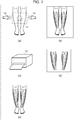
- a user turns his/her face toward the camera apparatus 11 as shown in Fig. 3(a) .
- at least one illumination apparatus 12 is disposed at a position so as to illuminate the face.
- the image capture control unit 101 controls the illumination apparatus 12 to illuminate the face and controls the camera apparatus 11 to capture an image of the face from the front thereby acquiring a face image as an example of the body image 110.
- the body analysis unit 102 analyzes the face image and generates face feature information, which is an example of the body feature information 111.
- the body analysis unit 102 analyzes the skeleton shape of the face using the face image, and extracts skeleton feature points of the face.
- the skeleton feature points may be represented by coordinate points in a three-dimensional space. A method of extracting the skeleton feature points of the face will be described later.
- the makeup determination unit 103 determines the highlight and low light makeup areas and their makeup colors suitable for the user's face based on the skeleton feature points of the face. A method for determining the face makeup areas will be described later.
- the makeup image generation unit 104 generates makeup image 114 representing an image of the face subjected to the highlight and low light makeups using the makeup information 112.
- the makeup image generation unit 104 displays the makeup image 114 on the display apparatus via the display control unit 108, as shown in Fig. 3(b) .
- the user checks the makeup image 114.
- the user inputs the information indicating the desired correction via the input reception unit 107.
- the input reception unit 107 informs the makeup determination unit 103 of the inputted correction.
- the makeup determination unit 103 corrects the makeup information 112 based on the content of the correction, and the makeup image generation unit 104 displays the corrected makeup image 114.
- the user inputs "confirmed” via the input reception unit 107.
- the input reception unit 107 informs the makeup determination unit 103 that the "confirmed” has been input.
- the makeup determination unit 103 finalizes the makeup information 112.
- the print information generation unit 105 generates print information 113 for printing a face makeup sheet based on the finalized makeup information 112.
- the print control unit 106 controls the printing apparatus 13 to print the face makeup sheet based on the print information 113.
- the makeup sheet including the highlight and low light makeup images printed thereon is generated.
- the user sticks the makeup sheet placed on a supporting material to his/her face and peels off the supporting material as shown in Fig. 3(e) .
- the makeup sheet is attached to the user's face, and the highlight makeup and the low light makeup suitable for the user's face are applied to the user's face.
- the skeleton feature points of a face may be extracted by one of or a combination of two or more methods (E1) to (E4) described below.
- the body analysis unit 102 detects a skeleton feature point 311 on an upper part of the zygomatic bone by detecting an area in which the brightness is relatively high (higher than a predetermined threshold value) in the face image illuminated from above and in which the brightness is relatively low (lower a predetermined threshold value) in the face image illuminated from below as shown in Fig. 4 .
- the makeup determination unit 103 determines, as the highlight makeup area, an area in the vicinity of the skeleton feature point 311 on the upper part of the cheekbone.
- the image capture control unit 101 captures an image of a face with a first expression thereby acquiring a first-expression face image. Furthermore, the image capture control unit 101 captures an image of a face with a second expression thereby acquiring a second-expression face image.
- the body analysis unit 102 detects a skeleton feature point by detecting an area in which a change in the image is relatively small (smaller than a predetermined threshold value) between the first-expression face image and the second-expression face image.
- a change in facial expression is generally produced by a movement of facial muscles. Therefore, the skeleton can be extracted, separately from the muscle and the subcutaneous tissue, by detecting a part that does not significantly move in response to a change in the face expression.
- the first expression and the second expression may be a non-expression and a smile, respectively.
- the first expression and the second expression may be a combination of two of followings: an expression with a closed mouth; an expression with a wide open mouth; and an expression with a narrowed mouth.
- the image capture control unit 101 controls the illumination apparatus 12 to illuminate the face and controls the camera apparatus 11 to capture an image of the face thereby acquiring an illuminated face image.
- the body analysis unit 102 detects a contour of the face from the illuminated face image. The body analysis unit 102 then extracts one or more first candidate points from a segment of the detected contour in which a relatively great change (greater than a predetermined threshold value) occurs in the curvature.
- the body analysis unit 102 extracts one or more second candidate points from an area where a relatively large change occurs in shade (a change in brightness greater than or equal to a predetermined threshold value occurs) in the illuminated face image.
- the body analysis unit 102 then sets, as a skeleton feature point, a point common to both the first candidate points and the second candidate points.
- a face makeup area may be determined by one of or a combination of two methods (F1) and (F2) described below.
- the makeup determination unit 103 determines a makeup area as follows.
- the makeup determination unit 103 compares a user's skeleton shape t1 with a reference (ideal) skeleton shape T. Next, the makeup determination unit 103 detects protruding areas X1 and X2 where the user's skeleton shape t1 protrudes from the reference skeleton shape T. Next, the makeup determination unit 103 detects insufficient areas Y1 and Y2 where the user's skeleton shape t1 is insufficient for the reference skeleton shape T. Next, as shown in Fig. 5B , the makeup determination unit 103 determines areas L1 and L2 corresponding to the protruding areas X1 and X2 in the face image as low light makeup areas. Furthermore, as shown in Fig. 5B , the makeup determination unit 103 determines areas H1 and H2 corresponding to the insufficient areas Y1 and Y2 in the face image as highlight makeup areas.
- the makeup determination unit 103 determines a makeup area as follows.
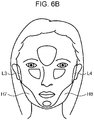
- the makeup determination unit 103 compares a user's skeleton shape t2 with the reference (ideal) skeleton shape T. Next, the makeup determination unit 103 detects protruding areas X3 and X4 where the user's skeleton shape t2 protrudes from the reference skeleton shape T. Next, makeup determination unit 103 detects insufficient areas Y3 and Y4 where the user's skeleton shape t2 is insufficient for the reference skeleton shape T. Next, as shown in Fig. 6B , the makeup determination unit 103 determines areas L3 and L4 corresponding to the protruding areas X3 and X4 in the face image as low light makeup areas. Furthermore, as shown in Fig. 6B , the makeup determination unit 103 determines areas H7 and H8 corresponding to the insufficient areas Y3 and Y4 in the face image as highlight makeup areas.
- the body analysis unit 102 generates face feature information including skeleton feature points from a face image
- the makeup determination unit 103 determines low light and highlight makeup areas in a face and makeup colors thereof based on the skeleton feature points included in the face feature information.
- the skeleton feature points are parts that are greatly different from one user to another and that can be used as reference positions in determining makeup areas or the like. Therefore, the shape of a body of a user is detected based on the skeleton of the user from the captured camera image indicating the appearance of the body of the user, and the highlight and low light makeup areas depending on each user are properly determined according to the detected body shape.
- the skeleton feature points can be determined by a relatively simple method using a camera apparatus for capturing an image of the external appearance of a body without using a large-scale apparatus for directly imaging the skeleton such as a radiation imaging apparatus.
- a description of a technique is given below for a case in which a makeup sheet for applying highlight and low light makeup to a leg is generated using the makeup support apparatus 10 shown in Fig. 1 .
- a description is given also for a case in which a makeup sheet for applying makeup to a body part other than the face and legs is generated.
- a user first turns the front of the leg toward the camera apparatus 11 as shown in Fig. 7(a) .
- at least one illumination apparatus 12 is disposed at a position to illuminate the legs.
- the image capture control unit 101 controls the illumination apparatus 12 to illuminate the leg and controls the camera apparatus 11 to capture an image of the leg from the front thereby acquiring a leg image as an example of the body image 110 from the camera apparatus 11.
- the body analysis unit 102 analyzes the leg image and generates leg feature information, which is an example of the body feature information 111.
- the body analysis unit 102 analyzes the skeleton shape of the leg using the leg image, and extracts skeleton feature points of the leg.
- the makeup determination unit 103 determines highlight and low light makeup areas and their makeup colors suitable for the user's leg based on the skeleton shape and skeleton feature points of the leg. Noe that a method for determining the leg makeup area will be described later.
- the makeup image generation unit 104 generates a makeup image 114, which is an image obtained by applying highlight and low light makeup to the leg based on the makeup information 112.
- the makeup image generation unit 104 displays the makeup image 114 on the display apparatus via the display control unit 108, as shown in Fig. 7(b) .
- the user checks the makeup image 114.
- the user inputs the information indicating the desired correction via the input reception unit 107.
- the input reception unit 107 informs the makeup determination unit 103 of the inputted correction.
- the makeup determination unit 103 corrects the makeup information 112 based on the content of the correction, and the makeup image generation unit 104 displays the corrected makeup image 114.
- the user inputs "confirmed” via the input reception unit 107.
- the input reception unit 107 informs the makeup determination unit 103 that the "confirmed” has been input.
- the makeup determination unit 103 finalizes the makeup information 112.
- the print information generation unit 105 generates print information 113 for printing a leg makeup sheet based on the finalized makeup information 112.
- the print control unit 106 controls the printing apparatus 13 to print the leg makeup sheet based on the print information 113.
- the makeup sheet including the highlight and low light makeup images printed thereon is generated.
- the user attaches the makeup sheet placed on the supporting material to her/his leg such that the makeup sheet is in contact with her/his leg, and peels off the supporting material.
- the makeup sheet is attached to the user's leg, and the highlight makeup and the low light makeup suitable for the user's leg are applied to the user's leg.
- a leg makeup area may be determined by one of or a combination of two or more methods (G1) and (G3) described below.
- the body analysis unit 102 compares the leg image in the first posture and the leg image in the second posture to analyze a change in parts of the legs thereby determining skeleton feature points of the legs. This makes it possible for the body analysis unit 102 to more accurately determine the skeleton feature points of various parts of the legs such as knees, thighs, calve, Achilles tendons, and the like.
- the makeup determination unit 103 determines highlight and low light makeup areas of the legs.
- the image capture control unit 101 captures an image of decollete neck/chest part of a user in a natural state thereby acquiring a decollete neck/chest part image in a first posture. Furthermore, the image capture control unit 101 capture an image of the decollete neck/chest part of the user in a state in which breasts of the user are closely lifted thereby acquiring a decollete neck/chest part image in a second posture.
- the makeup determination unit 103 compares the decollete neck/chest part image in the first posture with the decollete neck/chest part image in the second posture to extract areas where a change in shadow occurs.
- the makeup determination unit 103 determines extracted areas as a highlight makeup area and a lowlight makeup area. For example, as shown in Fig.
- the makeup determination unit 103 determines, as the highlight makeup area, an area 501 where the decollete neck/chest part image in the second posture is changed to have a higher brightness than in the decollete neck/chest part image in the first posture, and, as the low light makeup area, an area 502 where the decollete neck/chest part image in the second posture is changed to have a lower brightness than in the decollete neck/chest part image in the first posture.
- the image capture control unit 101 capture an image of a back of a user in a natural state thereby acquiring a back image in a first posture. Furthermore, the image capture control unit 101 capture an image of the back of the user in a state in which back scapulae of the user are drawn toward each other thereby acquiring a back image in a second posture.
- the makeup determination unit 103 compares the back image in the first posture with the back image in the second posture to extract areas where a change in shadow occurs.
- the makeup determination unit 103 determines extracted areas as a highlight makeup area and a lowlight makeup area.
- the makeup determination unit 103 may determine, as the low light makeup area, an area where the back image in the second posture is changed to have a lower brightness than the brightness of the back image in the first posture, and determines an area in the vicinity of the determined low light makeup area as a highlight makeup area.
- the image capture control unit 101 captures an image of a clavicle in a state where both hands of a user are put down thereby acquiring a clavicle image in a first posture. Furthermore, the image capture control unit 101 captures an image of the clavicle in a state where both hands of the user are raised up thereby acquiring a clavicle image in a second posture.
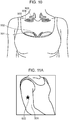
- the makeup determination unit 103 compares the clavicle image in the first posture with the clavicle image in the second posture to extract an area where a change in shadow occurs. Then, for example, as shown in Fig. 10 , the makeup determination unit 103 determines, as a low light makeup area, an area 503 in which the clavicle image in the second posture changes to have a lower brightness than in the clavicle image in the first posture, and determines, as a highlight makeup area, an area 504 in which the clavicle image in the second posture does not have a large change in brightness compared in the clavicle image in the first posture and has a high brightness.
- the image capture control unit 101 captures an image of an upper arm in a state in which the arm of the user is extended thereby acquiring an arm image in a first posture.
- the image capture control unit 101 captures an image of the upper arm in a state in which the arm of the user is bent such that a bicep is formed thereby acquiring an arm image in a second posture.
- the makeup determination unit 103 compares the arm image in the first posture with the arm image in the second posture to extract an area where a change in shadow occurs.
- the makeup determination unit 103 determines, as a low light makeup area, an area in which the arm image in the second posture changes to have a lower brightness than in the arm image in the first posture, and determines, as a highlight makeup area, an area where the arm image in the second posture is changed to have a higher brightness than in the arm image in the first posture.
- a makeup sheet having an arbitrary design printed thereon may be attached to a body thereby achieving an effect similar to that achieved by body painting.
- the makeup determination unit 103 calculates the size of the body based on the body feature information 111 and enlarges or reduces the size of the design (corresponding to the makeup area) according to the calculated size.
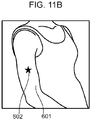
- the makeup determination unit 103 enlarges the size of the design (corresponding to the makeup area) 602. Conversely, as shown in Fig. 11B , in a case where the arm 601 is relatively thin, the makeup determination unit 103 reduces the size of the design (corresponding to the makeup area) 602.
- a makeup sheet that provides a similar visual effect when the makeup sheet is attached regardless of a difference in body feature of the user (for example, a height, a body type, and the like).
- Highlight and low light makeup areas may also be determined using makeup images of other persons (for example, makeup images of models or actresses) having (ideal) appearances the user likes.
- the body analysis unit 102 extracts the body feature information of the other person (which may include the skeleton feature points) from the makeup image of the other person. Furthermore, the body analysis unit 102 extracts highlight and low light makeup areas and makeup colors from the makeup image of the other person.
- the makeup determination unit 103 then converts (for example, enlarges or reduces) the makeup areas extracted from the makeup image of the other person into makeup areas suitable for the body of the user based on the difference between the body feature information of the other person and the body feature information 111 of the user (for example, enlargement or reduction) thereby generating makeup information 112.
- the print information generation unit 105 generates print information 113 from the generated makeup information 112, and the print control unit 106 generates a makeup sheet from the generated print information 113.
- the body analysis unit 102 generates leg feature information including skeleton feature points from a leg image, and the makeup determination unit 103 determines low light and highlight makeup areas in the leg based on the skeleton feature points included in the leg feature information.
- the makeup support apparatus 10 may also determine low light and highlight makeup area for another body part using an image of this body part of the user instead of the leg image in a similar manner as with the case of the leg image.
- a third embodiment is described below for a case in which a makeup sheet having a component for stimulating an acupoint of a body (hereinafter referred to as an "acupoint stimulus component") is produced by using the makeup support apparatus 10 shown in Fig. 1 .
- the acupoint stimulus component may be printed on the sheet together with an ink that provides a visual effect such as that described in the above embodiments.
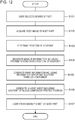
- a user selects at least one desired effect via the input reception unit 107 (S101).
- the user may select at least one effect from among the following: promoting face tenseness, countermeasures against dullness of the face, reducing eye strain, small face, aging care, removing wrinkles, removing slack, removing swelling, increasing appetite, suppressing appetite, countermeasures against cold-sensitive constitution, and relaxing.
- the image capture control unit 101 determines a body part where an acupoint corresponding to the effect selected in S101 exists, and captures an image of the determined body part thereby acquiring the body image 110 (S102). Note that the correspondence between the efficacy and the acupoint may be defined in advance.
- the body analysis unit 102 determines a position of the acupoint from the body image 110 in S102 (S103).
- the makeup determination unit 103 determines the makeup area at the position of the acupoint corresponding to the effect selected in S101, and generates makeup information 112 (S104).
- the print information generation unit 105 generates print information 113 for printing an ink containing an acupoint stimulus component in a print area corresponding to the makeup area (that is, the position of the acupoint) indicated in the makeup information 112 (S105).
- the print control unit 106 prints ink containing an acupoint stimulus component in a print area on the side of the sheet that will come into contact with the skin thereby generating a makeup sheet (S106).
- the user attaches the makeup sheet generated in S106 to the body part determined in S102 (S107).
- the makeup support apparatus 10 operates as follows.
- the image capture control unit 101 instructs the user to capture a face image.
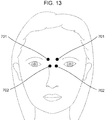
- the body analysis unit 102 determines positions 701 and 702 of the acupoints shown in Fig. 13 from the face image of the user.
- the makeup determination unit 103 determines acupoint positions 701 and 702 shown in Fig. 13 as a makeup area for printing the acupoint stimulus component.
- the print information generation unit 105 generates print information 113 for printing the ink containing the acupoint stimulus component on the print areas corresponding to the makeup areas, that is, the areas that will be in contact with the acupoint positions 701 and 702 when the makeup sheet is attached to the face.
- the makeup support apparatus 10 operates as follows.
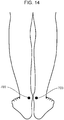
- the image capture control unit 101 instructs the user to capture an image of an inner ankle of a leg.
- the body analysis unit 102 determines an acupoint position 703 shown in Fig. 14 from the image of the inner ankle of the leg of the user.
- the makeup determination unit 103 determines an area at the acupoint position 703 shown in Fig. 14 as a makeup area in which the acupoint stimulus component is to be printed.
- the print information generation unit 105 generates print information 113 for printing the ink containing the acupoint stimulus component on the print area corresponding to the determined makeup area, that is, the area that is to be in contact with the acupoint position 703 when the makeup sheet is attached to the inner ankle part.
- the thickness and the material of the sheet used in the present embodiment are not limited to those described above in the first embodiment.
- the acupoint stimulus component may be a magnetic substance.
- the print information generation unit 105 may generate the print information 113 for printing wiring connected to the print area of the magnetic material.
- a current may be applied to the wiring printed on the makeup sheet such that the magnetic material generates a magnetic field thereby stimulating the acupoint.
- the acupoint stimulus component may be a component that provides a warm stimulus.
- components that provide a warm stimulus include a pepper extract, a capsaicin extract, vanillyl amide nonylate, nicotinic acid ester and the like.
- a thick multilayer of a resin may be printed on the sheet at a position corresponding to the acupoint so as to form a convex shape. This makes it possible to produce a makeup sheet that physically stimulates (presses) the position of the acupoint.
- the makeup support apparatus 10 operates such that the body analysis unit 102 determines the position of the acupoint from the body image 110 of the user, the makeup determination unit 103 determines this position of the acupoint as the makeup area, and the print information generation unit 105 generates print information 113 for printing the ink containing the acupoint stimulus component in the makeup area.
- the technique disclosed in the present embodiment may be incorporated into at least one system of the first and second embodiments thereby achieving the generation of a makeup sheet that provides both a visual correction effect and an effect that actually acts on the body.
- the makeup sheet may be attached to the skin by one of methods (H1) to (H6) described below.
- an eyebrow sheet suitable for a user's face is generated using skeleton feature points of a face image.
- a user turns the front of the user's face toward the camera apparatus 11.
- at least one illumination apparatus 12 is disposed at a position so as to illuminate the face.
- the image capture control unit 101 controls the illumination apparatus 12 so as to illuminate the face and controls the camera apparatus 11 so as to capture an image of the face from the front thereby capturing a face image, which is an example of the body image 110, from the camera apparatus 11. In this process, the user is instructed to look straight at the camera apparatus 11.
- the body analysis unit 102 analyzes the face image and generates face feature information, which is an example of the body feature information 111.
- the body analysis unit 102 analyzes a skeleton shape around a chin and eyebrows using the face image, and extracts skeleton feature points around the chin and eyebrows. Furthermore, the body analysis unit 102 acquires positions and shapes of eyes, a nose, and irises.
- the makeup determination unit 103 determines eyebrow makeup areas suitable for the user's face, using the skeleton feature points around the chin and the eyebrows, the positions and shapes of the eyes, the nose, and irises. Note that a method of determining the eyebrow makeup areas will be described later.
- the storage unit 109 stores a database 202.
- the user selects a preferred eyebrow makeup 203 from the database 202 displayed via the display control unit 108.
- the database 202 stores various types of eyebrow makeups 203 as examples.
- Each eyebrow makeup 203 has a different shape, such as a parallel eyebrow, a mountain-shaped eyebrow, a thick eyebrow, a thin eyebrow, and/ or has a different color. Note that the selection of the eyebrow makeup 203 by the user is not necessarily performed after the image capturing and the body analysis are performed, but may be performed at any stage before this.
- the makeup image generation unit 104 generates a makeup image 114, which is an image obtained by applying the eyebrow makeup to the face image based on the makeup information 112.
- the makeup image generation unit 104 then displays the makeup image 114 on the display apparatus via the display control unit 108.
- the user checks this makeup image 114. If the user wants to correct the makeup, the user inputs information specifying the correction via input accepting section 107.
- the input reception unit 107 informs the makeup determination unit 103 of the inputted correction.
- the makeup determination unit 103 corrects the makeup information 112 based on the content of the correction, and the makeup image generation unit 104 displays the corrected makeup image 114.
- the user inputs "confirmed” via the input reception unit 107.
- the input reception unit 107 informs the makeup determination unit 103 that the "confirmed” has been input.
- the makeup determination unit 103 finalizes the makeup information 112.
- the print information generation unit 105 generates print information 113 for printing an eyebrow makeup sheet based on the finalized makeup information 112.
- the print control unit 106 controls the printing apparatus 13 to print the eyebrow makeup sheet based on the print information 113.
- a makeup sheet on which the eyebrow makeup to be applied to the eyebrows is printed is generated.
- the user attaches the makeup sheet placed on the substrate to the user's eyebrow such that the side of the makeup sheet is in contact with the user's eyebrow, and peels off the substrate.
- the makeup sheet is stuck to the user's eyebrow part, and the eyebrow makeup suitable for the user is applied to the user's eyebrow.
- the eyebrow makeup area is determined using one of or a combination of two methods (11) and (12) described below.
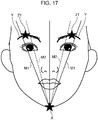
- the makeup determination unit 103 acquires a center point X of a user's jaw based on skeleton feature points of the jaw. Furthermore, the makeup determination unit 103 acquires a curve Y on which the eyebrow makeup is to be put based on the skeleton feature points around the eyebrow. Then, the makeup determination unit 103 determines an intersection of the curve Y with an area formed between two straight line M1 and a straight line M2 wherein the straight line M1 extends from the center point X to an outer end of the iris and the straight line M2 extends from the center point X to an inner end of the iris. This intersection is determined as the position Z1 of the top of the eyebrow.
- the makeup determination unit 103 determines an intersection of the curve Y with a straight line M3 extending from an outer end of a nostril toward an outer corner of the eye, and employed the determined intersection as a position Z2 of an outer corner of the eyebrow.
- the makeup image generation unit 104 adjusts the shape of the eyebrow makeup 203 selected by the user such that the shape fits the position Z1 of the top of the eyebrow and the position Z2 of the outer corner of the eyebrow.
- the makeup image generation unit 104 outputs the result as the makeup image 114.
- the image capture control unit 101 controls the illumination apparatus 12 disposed at least above the face to illuminate the face from above, and controls the camera apparatus 11 to capture an image of the face thereby acquiring a face image.
- an additional illumination apparatus may be disposed below the face and/or at the left and right sides.
- the makeup determination unit 103 acquires, as the curve Y where the eyebrow makeup is to be placed, a boundary area between an area where the brightness around the eyebrows is relatively high (higher than or equal to a predetermined threshold value) and an area where a shadow is formed which causes the brightness around the eyebrow to be low (lower than or equal to a predetermined threshold value) in the face image illuminated by the illumination unit. Then, the makeup determination unit 103 determines an intersection of the curve Y with an area formed between two straight line M1 and a straight line M2 wherein the straight line M1 extends from the center point X to an outer end of the iris and the straight line M2 extends from the center point X to an inner end of the iris. This intersection is determined as the position Z1 of the top of the eyebrow.
- the makeup determination unit 103 determines the intersection of the curve Y with a straight line M3 drawn from the outside of the nose toward the outer corner of the eye as the position Z2 of the outer corner of the eyebrow.
- the makeup image generation unit 104 adjusts the shape of the eyebrow makeup 203 selected by the user so as to match the position Z1 of the top of the eyebrow and the position Z2 of the outer corner of the eyebrow thereby determining the shape of the eyebrow makeup suitable for the user.
- the makeup image generation unit 104 outputs the result as the makeup image 114.
- an eyebrow sheet suitable for the user's face is generated by using skeletal feature points of the face image.
- a user turns the front of the user's face toward the camera apparatus 11.
- at least one illumination apparatus 12 is disposed at a position so as to illuminate the face.
- the image capture control unit 101 controls the illumination apparatus 12 so as to illuminate the face and controls the camera apparatus 11 so as to capture an image of the face from the front thereby capturing a face image, which is an example of the body image 110, from the camera apparatus 11. In this process, the user is instructed to look straight at the camera apparatus 11.
- the body analysis unit 102 analyzes the face image and generates face feature information, which is an example of the body feature information 111.
- the body analysis unit 102 analyzes the skeleton shape of the jaw using the face image, and extracts skeleton feature points of the jaw. Furthermore, the body analysis unit 102 acquires positions and shapes of eyes and a nose.
- the makeup determination unit 103 determines an eye makeup area suitable for the user's face by using the skeleton feature points of the jaw, the positions and shapes of the eyes and nose. Note that a method of determining the eye makeup area will be described later.
- the storage unit 109 stores a database 202.
- the user selects a preferred eye makeup 205 from the database 202 displayed via the display control unit 108.
- the database 202 stores various types of eye makeups 205 as examples.
- Each eye makeup 205 differs in line shape and/or color of, for example, double eyelid lines, eye lines, eye shadows, and the like.
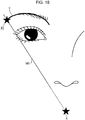
- the eye makeup 205 for a double eyelid line differs in the width L3 of the double eyelid line when the eye is opened, the extension length L1 in the positive and negative directions with respect to the outer corner of the eye, and the shape as shown in Fig. 20 A . As shown in Fig.
- the eye makeup 205 relating to the eye line differs in extension length L2 from the outer corner of the eye and a shape.
- Variations in the shape of the extension length L2 of the eye line from the outer corner of the eye include, for example, a flip-up shape, a sagging eye shape, and the like.
- the selection of the eyebrow makeup 203 by the user is not necessarily performed after the image capturing and the body analysis are performed, but may be performed at any stage before this.
- the makeup image generation unit 104 generates a makeup image 114, which is an image obtained by applying the eye makeup to the face image based on the makeup information 112.
- the makeup image generation unit 104 then displays the makeup image 114 on the display apparatus via the display control unit 108.
- the user checks the makeup image 114.
- the user inputs the information indicating the desired correction via the input reception unit 107.
- the input reception unit 107 informs the makeup determination unit 103 of the inputted correction.
- the makeup determination unit 103 corrects the makeup information 112 based on the content of the correction, and the makeup image generation unit 104 displays the corrected makeup image 114.
- the user inputs "confirmed” via the input reception unit 107.
- the input reception unit 107 informs the makeup determination unit 103 that the "confirmed” has been input.
- the makeup determination unit 103 finalizes the makeup information 112.
- the print information generation unit 105 generates print information 113 for printing an eye makeup sheet based on the finalized makeup information 112.
- the print control unit 106 controls the printing apparatus 13 to print the eye makeup sheet based on the print information 113.
- a makeup sheet on which the eye makeup to be applied to the eye is printed is generated.
- the user sticks the makeup sheet put on the substrate to the side of the user's eye and peels off the substrate.
- the makeup sheet is stuck to the side of the eye of the user, and the makeup suitable for the user is applied to the eye of the user.
- the face of the user may be illuminated by changing the illuminance, the color, and/or the temperature of the illumination unit (not shown) in a state in which the eye makeup determined by the user is displayed such that it is superimposed on the face image of the user. This allows the user to check what color, expression, and impression will be obtained when the eye makeup is actually applied.
- the eye makeup area is determined using one of or a combination of two or more methods (J1) and (J3) described below.
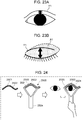
- the makeup determination unit 103 acquires the position and shape of the double eyelid line from an upper eye line when the eyes are opened, and determines the curve Y1 where the double eyelid line is to be put as shown in Fig. 21 .
- the makeup determination unit 103 acquires the center point X of the user's jaw based on the skeletal feature points of the jaw, as shown in Fig. 17 .
- the makeup determination unit 103 determines, as the reference line Y1' of the double eyelid line, a curve extended by L1 along the line of the curve Y1 from an intersection Z3 of the curve Y1 and a straight line M4 drawn from the center point X toward the outside of the corner of the eye.
- the extended length L1 may be in a direction toward the eyebrow (negative L1) or in a direction away from the eyebrow (positive L1).
- the makeup determination unit 103 adjusts the shape of the eye makeup 205 selected by the user so as to fit the curve Y1' thereby determining the shape of the double eyelid line suitable for the user.
- the makeup image generation unit 104 outputs the result as the makeup image 114.
- the makeup determination unit 103 acquires the position and shape of the double eyelid line from the upper line of the eye in the state in when the eye is opened, as shown in Fig. 22B , and determines the shape of the curve Y2 where the eye line is to be placed from the line of the eyelid in when the eye is closed as shown in Fig. 22A .
- the makeup determination unit 103 acquires the center point X of the user's jaw based on the skeleton feature points of the jaw.
- the makeup determination unit 103 determines, as the reference line Y2' of the eye line, a curve extending by a distance L2 along the line of Y2 from an intersection Z4 between the curve Y2 and a line M5 drawn from the center point X toward the outer corner of the eye.
- the makeup determination unit 103 adjusts the shape of the eye makeup 205 selected by the user so as to fit the curve Y2' thereby determining the shape of the eye line suitable for the user.
- the makeup image generation unit 104 outputs the result as the makeup image 114.
- the eye line may have a gradation of a color.
- the eye line may have a gradation that gradually darkens toward the center based on the position information in terms of the outer corner of the eye, the inner corner of the eye, and the center of the eye obtained from the skeleton feature points of the jaw, the positions and the shapes of the eyes and the nose.
- the eye line may have a gradation that gradually darkens toward the outer corner of the eye.
- the makeup determination unit 103 acquires the position and shape of the double eyelid line from an upper eye line when the eyes are opened, and determines the curve Y1 where the double eyelid line is to be put as shown in Fig. 23A . Furthermore, as shown in Fig. 23B , the makeup determination unit 103 determines, from the shape of the eye hole and the position of the curve Y1 in a state in which the eye is closed, a shape obtained by extending the shape of the eye hole up to the curve Y1, and employs the determined shape as an eye shadow area A1.
- the makeup determination unit 103 acquires the center point X of the user's jaw based on the skeleton feature points of the jaw.
- the makeup determination unit 103 adjusts the shape of the eye makeup 205 selected by the user so as to fit the area A1 thereby determining the shape of the eye shadow suitable for the user.
- the makeup image generation unit 104 outputs the result as the makeup image 114.
- the makeup determination unit 103 may calculate the depth of the carving and the depression in the upper part of the eye (in other words, the skeleton feature around the eye). For example, in order to make it easy to detect the skeleton around the eye, the image capture control unit 101 illuminates the user's face at a predetermined angle from above the face, and captures the body image 110. Then, the makeup determination unit 103 analyzes (calculates) the skeleton feature around the eye from the width of a shadow.
- the eye makeup area is a small and long area compared with the makeup applied to cheeks or legs. Therefore, it is difficult to stick the makeup sheet beautifully to a desired position.
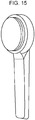
- Fig. 24 shows a makeup sheet 2501 on which an eye line image is printed, a sheet sticking substrate 2502, and a sticking assist apparatus 2503.
- the makeup sheet 2501 is put in contact with one surface of the sheet sticking substrate 2502.
- the sticking assist apparatus 2503 has a grip part 2504 and a support part 2505.
- the support part 2505 has a shape for supporting both ends in the longitudinal direction of the makeup sheet 2501 of the eye line.
- the support part 2505 may be configured to have a shape for supporting the makeup sheet 2501 at two or more points.
- the support part 2505 may have a shape for supporting the makeup sheet 2501 at three points by a three-pronged shape.
- Step 1 The user holds the grip part 2504 by hand, presses the support part 2505 against the other surface of the sheet sticking substate 2502 (a surface with which the makeup sheet 2501 is not in contact), and sticks the sheet sticking mount 2502 including the makeup sheet 2501 to the support part 2505. The user lifts the sticking assist apparatus 2503.
- Step 2 The user presses the support part 2505 against the eye (eye line) while watching her/his own face displayed on the mirror or on the display unit of the image processing apparatus, and sticks only the makeup sheet 2501 on her/his face.
- Step 3 After sticking the makeup sheet 2501, the user removes the sheet sticking substrate 2502 remaining on the support part 2505 (manually) with a finger or the like.
- the sticking assist apparatus 2503 can be repeatedly used.
- the surface of the support part 2505 of the sticking assist apparatus 2503 may be processed into a hook shape.
- an adhesive may be applied to the other surface of the sheet sticking substrate 2502 or the surface of the support part 2505. In either case, in step 1, the sheet sticking substrate 2502 is stuck to the support part 2505.
- Step 1 The user presses the support part 2505 against one surface (a surface with which the makeup sheet 2501 is in contact) of the sheet sticking substrate 2502, and sticks only the makeup sheet 2501 to the support part 2505. The user lifts the sticking assist apparatus 2503.
- Step 2 The user presses the support part 2505 against the eye (eye line) and sticks the makeup sheet 2501 on the face.
- the surface of the support part 2505 may be subjected to hydrophilic processing.
- Fig. 25 is a diagram illustrating a hardware configuration of a computer for realizing the function of the makeup support apparatus 10 by a program.
- the computer 2100 includes an input apparatus 2101 such as a keyboard or a mouse or a touch pad, an output apparatus 2102 such as a display or a speaker, a CPU (Central Processing Unit) 2103, a ROM (Read Only Memory) 2104, a RAM (Random Access Memory) 2105, a storage apparatus 2106 such as a hard disk apparatus or an SSD (Solid State Drive), a reading apparatus 2107 for reading information from a storage medium such as a DVD-ROM (Digital Versatile Disk Read Only Memory) or a USB (Universal Serial Bus) memory, and a transmission/reception apparatus 2108 for performing communication via a network.
- These units are connected via a bus 2109.
- the reading apparatus 2107 reads programs from the storage medium on which the program for realizing the functions of the respective apparatus described above are stored, and stores the programs in the storage apparatus 2106.
- the transmission/reception apparatus 2108 may communicate with a server apparatus connected to a network to download the program for realizing the function of the makeup support apparatus 10, and may store the downloaded program in the storage apparatus 2106.
- the CPU 2103 then copies the program stored in the storage apparatus 2106 into the RAM 2105, and sequentially reads instructions included in the program from the RAM 2105 and executes them thereby realizing the function of the makeup support apparatus 10.
- the body appearance correction support apparatus, the body appearance correction support method, and the computer program according to the present disclosure can support a user to change a body appearance using a sheet attachable to a body.
Landscapes
- Engineering & Computer Science (AREA)
- Theoretical Computer Science (AREA)
- General Physics & Mathematics (AREA)
- Physics & Mathematics (AREA)
- Health & Medical Sciences (AREA)
- Human Computer Interaction (AREA)
- Multimedia (AREA)
- General Health & Medical Sciences (AREA)
- Oral & Maxillofacial Surgery (AREA)
- Ophthalmology & Optometry (AREA)
- Computer Vision & Pattern Recognition (AREA)
- General Engineering & Computer Science (AREA)
- Image Processing (AREA)
- Image Analysis (AREA)
Applications Claiming Priority (2)
| Application Number | Priority Date | Filing Date | Title |
|---|---|---|---|
| JP2017249358 | 2017-12-26 | ||
| PCT/JP2018/043362 WO2019130933A1 (ja) | 2017-12-26 | 2018-11-26 | 身体外観補正支援装置、身体外観補正支援方法、およびコンピュータプログラム |
Publications (2)
| Publication Number | Publication Date |
|---|---|
| EP3733019A1 true EP3733019A1 (de) | 2020-11-04 |
| EP3733019A4 EP3733019A4 (de) | 2021-03-10 |
Family
ID=67063048
Family Applications (1)
| Application Number | Title | Priority Date | Filing Date |
|---|---|---|---|
| EP18895145.3A Withdrawn EP3733019A4 (de) | 2017-12-26 | 2018-11-26 | Vorrichtung zur unterstützung der korrektur des physischen erscheinungsbildes, verfahren zur unterstützung der korrektur des physischen erscheinungsbildes und computerprogramm |
Country Status (6)
| Country | Link |
|---|---|
| US (1) | US20200250404A1 (de) |
| EP (1) | EP3733019A4 (de) |
| JP (1) | JP2019115653A (de) |
| CN (1) | CN111356383A (de) |
| SG (1) | SG11202005625XA (de) |
| WO (1) | WO2019130933A1 (de) |
Families Citing this family (13)
| Publication number | Priority date | Publication date | Assignee | Title |
|---|---|---|---|---|
| JP7413691B2 (ja) * | 2019-09-24 | 2024-01-16 | カシオ計算機株式会社 | 画像処理装置、画像処理方法及びプログラム |
| US20240074563A1 (en) * | 2019-10-11 | 2024-03-07 | Shiseido Company, Ltd. | Automatic makeup machine, method, program, and control device |
| GB2606955B (en) * | 2020-01-06 | 2024-07-24 | Kao Corp | Sheet-providing method and sheet-providing system |
| CN113850708A (zh) * | 2020-06-28 | 2021-12-28 | 华为技术有限公司 | 交互方法、交互装置、智能镜子 |
| JP7396258B2 (ja) * | 2020-12-03 | 2023-12-12 | トヨタ自動車株式会社 | 制御装置、歩行訓練システム、制御方法及び制御プログラム |
| US20240070885A1 (en) * | 2021-02-15 | 2024-02-29 | Shiseido Company, Ltd. | Skeleton estimating method, device, non-transitory computer-readable recording medium storing program, system, trained model generating method, and trained model |
| KR20220145116A (ko) * | 2021-04-21 | 2022-10-28 | 프링커코리아 주식회사 | 사용자 맞춤형 색조 화장용 인쇄 매체 제공 장치 및 방법 |
| US12299874B2 (en) | 2021-12-16 | 2025-05-13 | The Gillette Company Llc | Digital imaging systems and methods of analyzing pixel data of an image of a skin area of a user for determining skin dryness |
| US12243223B2 (en) | 2021-12-16 | 2025-03-04 | The Gillette Company Llc | Digital imaging systems and methods of analyzing pixel data of an image of a skin area of a user for determining skin oiliness |
| US12230062B2 (en) | 2021-12-16 | 2025-02-18 | The Gillette Company Llc | Digital imaging systems and methods of analyzing pixel data of an image of a skin area of a user for determining dark eye circles |
| US12249064B2 (en) | 2021-12-16 | 2025-03-11 | The Gillette Company Llc | Digital imaging systems and methods of analyzing pixel data of an image of a skin area of a user for determining skin puffiness |
| US12524873B2 (en) * | 2021-12-16 | 2026-01-13 | The Gillette Company Llc | Digital imaging systems and methods of analyzing pixel data of an image of a skin area of a user for determining body contour |
| US12322201B2 (en) | 2021-12-16 | 2025-06-03 | The Gillette Company Llc | Digital imaging systems and methods of analyzing pixel data of an image of a skin area of a user for determining skin hyperpigmentation |
Family Cites Families (20)
| Publication number | Priority date | Publication date | Assignee | Title |
|---|---|---|---|---|
| JPS53145910A (en) * | 1977-05-24 | 1978-12-19 | Mutsuhiko Yasuda | Pappu medicine |
| JP3912834B2 (ja) * | 1997-03-06 | 2007-05-09 | 有限会社開発顧問室 | 顔画像の修正方法、化粧シミュレーション方法、化粧方法、化粧サポート装置及びファンデーション転写膜 |
| JP3723349B2 (ja) * | 1998-06-18 | 2005-12-07 | 株式会社資生堂 | 口紅色変換システム |
| JP3779570B2 (ja) * | 2001-07-30 | 2006-05-31 | デジタルファッション株式会社 | 化粧シミュレーション装置、化粧シミュレーション制御方法、化粧シミュレーションプログラムを記録したコンピュータ読み取り可能な記録媒体 |
| JP2005044283A (ja) * | 2003-07-25 | 2005-02-17 | Seiko Epson Corp | 化粧品ガイダンスシステム、サーバ装置、端末装置およびプログラム |
| JP2005074105A (ja) * | 2003-09-02 | 2005-03-24 | Kanebo Ltd | カウンセリングツールおよびその使用方法 |
| CA2618519C (en) * | 2005-08-12 | 2016-09-27 | Rick B. Yeager | System and method for applying a reflectance modifying agent to improve the visual attractiveness of human skin |
| WO2008102440A1 (ja) * | 2007-02-21 | 2008-08-28 | Tadashi Goino | 化粧顔画像生成装置及び方法 |
| JP2013226356A (ja) * | 2012-04-26 | 2013-11-07 | I & I Consulting:Kk | 鼻翼型経鼻カニューレ |
| JP6239345B2 (ja) * | 2012-12-03 | 2017-11-29 | 花王株式会社 | 化粧料塗布装置及びこれを用いた化粧方法 |
| JP2014140097A (ja) * | 2013-01-21 | 2014-07-31 | Sony Corp | 画像表示装置及び画像表示方法 |
| JP6288404B2 (ja) * | 2013-02-28 | 2018-03-07 | パナソニックIpマネジメント株式会社 | メイクアップ支援装置、メイクアップ支援方法、およびメイクアップ支援プログラム |
| JP5372275B1 (ja) * | 2013-03-22 | 2013-12-18 | パナソニック株式会社 | メイクアップ支援装置、メイクアップ支援方法、およびメイクアップ支援プログラム |
| WO2015029372A1 (ja) * | 2013-08-30 | 2015-03-05 | パナソニックIpマネジメント株式会社 | メイクアップ支援装置、メイクアップ支援システム、メイクアップ支援方法、およびメイクアップ支援プログラム |
| US20160128919A1 (en) * | 2014-11-06 | 2016-05-12 | Dagmar Bjork SVEINE | Non-invasive and long lasting skin darkening devices, compositions, and methods of use for body contouring |
| JP6675384B2 (ja) * | 2015-03-27 | 2020-04-01 | 株式会社メガチップス | 化粧支援システム、計測装置、携帯端末装置およびプログラム |
| CN107438420A (zh) * | 2015-04-02 | 2017-12-05 | 詹尼克公司 | 面膜用基底片材以及利用该面膜用基底片材的面膜 |
| JP6637741B2 (ja) * | 2015-11-20 | 2020-01-29 | 日本メナード化粧品株式会社 | 化粧料へ配合するパール剤の選出方法 |
| CN108292423B (zh) * | 2015-12-25 | 2021-07-06 | 松下知识产权经营株式会社 | 局部妆容制作、局部妆容利用装置、方法和记录介质 |
| JP6132248B2 (ja) * | 2016-01-22 | 2017-05-24 | パナソニックIpマネジメント株式会社 | メイクアップ支援装置 |
-
2018
- 2018-05-25 JP JP2018100717A patent/JP2019115653A/ja active Pending
- 2018-11-26 EP EP18895145.3A patent/EP3733019A4/de not_active Withdrawn
- 2018-11-26 CN CN201880073791.7A patent/CN111356383A/zh active Pending
- 2018-11-26 WO PCT/JP2018/043362 patent/WO2019130933A1/ja not_active Ceased
- 2018-11-26 SG SG11202005625XA patent/SG11202005625XA/en unknown
-
2020
- 2020-04-24 US US16/857,770 patent/US20200250404A1/en not_active Abandoned
Also Published As
| Publication number | Publication date |
|---|---|
| JP2019115653A (ja) | 2019-07-18 |
| EP3733019A4 (de) | 2021-03-10 |
| US20200250404A1 (en) | 2020-08-06 |
| CN111356383A (zh) | 2020-06-30 |
| WO2019130933A1 (ja) | 2019-07-04 |
| SG11202005625XA (en) | 2020-11-27 |
Similar Documents
| Publication | Publication Date | Title |
|---|---|---|
| EP3733019A1 (de) | Vorrichtung zur unterstützung der korrektur des physischen erscheinungsbildes, verfahren zur unterstützung der korrektur des physischen erscheinungsbildes und computerprogramm | |
| US10413042B2 (en) | Makeup support device, makeup support method, and makeup support program | |
| EP2820970B1 (de) | Vorrichtung zur hilfe beim auftragen von makeup, verfahren zur hilfe beim auftragen von makeup und programm zur hilfe beim auftragen von makeup | |
| US9713580B2 (en) | Device for applying a cosmetic composition | |
| KR101516465B1 (ko) | 아바타 생성 방법 및 장치 | |
| CN109688868A (zh) | 薄膜和薄膜形成方法 | |
| CN111031847A (zh) | 化妆用片及其制造方法、图像处理装置以及图像处理方法 | |
| TW200819143A (en) | Method of makeup | |
| JP6515459B2 (ja) | トータル美容アドバイス方法 | |
| JP6132248B2 (ja) | メイクアップ支援装置 | |
| CN109965493A (zh) | 一种分屏交互展示方法及装置 | |
| WO2019003649A1 (ja) | シート、画像処理装置、及び、画像処理方法 | |
| CN113163930B (zh) | 图像处理装置、图像处理方法以及片材 | |
| US20140011003A1 (en) | Temporary freckle tattoo | |
| US20200022440A1 (en) | Costume Face Mask Component | |
| KR200425470Y1 (ko) | 얼굴 부위별 색조화장이 가능한 패드 | |
| Draper | 'I'm sorry, you said she was how old?': youthfulness and the fashion model | |
| US20250041167A1 (en) | System and Method for Darkening Skin in Selected Areas on and Around the Face, Neck and Body | |
| CN110035798A (zh) | 定妆化妆品组合物 | |
| McMurray | Self-portraits | |
| JP4080455B2 (ja) | メークアップ用シートセット | |
| US20210030132A1 (en) | Fashion nail covering, covering set and method for covering a nail | |
| Kotake et al. | Make-up Support System Based on the Colors of Favorite Facial Image | |
| TW202613971A (zh) | 資訊處理系統、資訊處理方法及程式 | |
| Bastanfard et al. | Visualization of realistic human facial aging and human skin senility |
Legal Events
| Date | Code | Title | Description |
|---|---|---|---|
| STAA | Information on the status of an ep patent application or granted ep patent |
Free format text: STATUS: THE INTERNATIONAL PUBLICATION HAS BEEN MADE |
|
| PUAI | Public reference made under article 153(3) epc to a published international application that has entered the european phase |
Free format text: ORIGINAL CODE: 0009012 |
|
| STAA | Information on the status of an ep patent application or granted ep patent |
Free format text: STATUS: REQUEST FOR EXAMINATION WAS MADE |
|
| 17P | Request for examination filed |
Effective date: 20200331 |
|
| AK | Designated contracting states |
Kind code of ref document: A1 Designated state(s): AL AT BE BG CH CY CZ DE DK EE ES FI FR GB GR HR HU IE IS IT LI LT LU LV MC MK MT NL NO PL PT RO RS SE SI SK SM TR |
|
| AX | Request for extension of the european patent |
Extension state: BA ME |
|
| A4 | Supplementary search report drawn up and despatched |
Effective date: 20210204 |
|
| RIC1 | Information provided on ipc code assigned before grant |
Ipc: G06K 9/00 20060101ALI20210129BHEP Ipc: A45D 44/00 20060101AFI20210129BHEP |
|
| DAV | Request for validation of the european patent (deleted) | ||
| DAX | Request for extension of the european patent (deleted) | ||
| STAA | Information on the status of an ep patent application or granted ep patent |
Free format text: STATUS: THE APPLICATION HAS BEEN WITHDRAWN |
|
| 18W | Application withdrawn |
Effective date: 20210831 |