EP3733732B1 - Composé de polyphénylène - Google Patents
Composé de polyphénylène Download PDFInfo
- Publication number
- EP3733732B1 EP3733732B1 EP18895067.9A EP18895067A EP3733732B1 EP 3733732 B1 EP3733732 B1 EP 3733732B1 EP 18895067 A EP18895067 A EP 18895067A EP 3733732 B1 EP3733732 B1 EP 3733732B1
- Authority
- EP
- European Patent Office
- Prior art keywords
- formula
- compound
- compound represented
- mentioned
- stirred
- Prior art date
- Legal status (The legal status is an assumption and is not a legal conclusion. Google has not performed a legal analysis and makes no representation as to the accuracy of the status listed.)
- Active
Links
Images

Classifications
-
- C—CHEMISTRY; METALLURGY
- C08—ORGANIC MACROMOLECULAR COMPOUNDS; THEIR PREPARATION OR CHEMICAL WORKING-UP; COMPOSITIONS BASED THEREON
- C08J—WORKING-UP; GENERAL PROCESSES OF COMPOUNDING; AFTER-TREATMENT NOT COVERED BY SUBCLASSES C08B, C08C, C08F, C08G or C08H
- C08J5/00—Manufacture of articles or shaped materials containing macromolecular substances
- C08J5/20—Manufacture of shaped structures of ion-exchange resins
- C08J5/22—Films, membranes or diaphragms
- C08J5/2206—Films, membranes or diaphragms based on organic and/or inorganic macromolecular compounds
- C08J5/2218—Synthetic macromolecular compounds
- C08J5/2256—Synthetic macromolecular compounds based on macromolecular compounds obtained by reactions other than those involving carbon-to-carbon bonds, e.g. obtained by polycondensation
-
- C—CHEMISTRY; METALLURGY
- C08—ORGANIC MACROMOLECULAR COMPOUNDS; THEIR PREPARATION OR CHEMICAL WORKING-UP; COMPOSITIONS BASED THEREON
- C08G—MACROMOLECULAR COMPOUNDS OBTAINED OTHERWISE THAN BY REACTIONS ONLY INVOLVING UNSATURATED CARBON-TO-CARBON BONDS
- C08G61/00—Macromolecular compounds obtained by reactions forming a carbon-to-carbon link in the main chain of the macromolecule
- C08G61/02—Macromolecular compounds containing only carbon atoms in the main chain of the macromolecule, e.g. polyxylylenes
- C08G61/10—Macromolecular compounds containing only carbon atoms in the main chain of the macromolecule, e.g. polyxylylenes only aromatic carbon atoms, e.g. polyphenylenes
-
- H—ELECTRICITY
- H01—ELECTRIC ELEMENTS
- H01B—CABLES; CONDUCTORS; INSULATORS; SELECTION OF MATERIALS FOR THEIR CONDUCTIVE, INSULATING OR DIELECTRIC PROPERTIES
- H01B1/00—Conductors or conductive bodies characterised by the conductive materials; Selection of materials as conductors
- H01B1/06—Conductors or conductive bodies characterised by the conductive materials; Selection of materials as conductors mainly consisting of other non-metallic substances
- H01B1/12—Conductors or conductive bodies characterised by the conductive materials; Selection of materials as conductors mainly consisting of other non-metallic substances organic substances
- H01B1/124—Intrinsically conductive polymers
- H01B1/128—Intrinsically conductive polymers comprising six-membered aromatic rings in the main chain, e.g. polyanilines, polyphenylenes
-
- H—ELECTRICITY
- H01—ELECTRIC ELEMENTS
- H01M—PROCESSES OR MEANS, e.g. BATTERIES, FOR THE DIRECT CONVERSION OF CHEMICAL ENERGY INTO ELECTRICAL ENERGY
- H01M4/00—Electrodes
- H01M4/86—Inert electrodes with catalytic activity, e.g. for fuel cells
-
- H—ELECTRICITY
- H01—ELECTRIC ELEMENTS
- H01M—PROCESSES OR MEANS, e.g. BATTERIES, FOR THE DIRECT CONVERSION OF CHEMICAL ENERGY INTO ELECTRICAL ENERGY
- H01M8/00—Fuel cells; Manufacture thereof
- H01M8/10—Fuel cells with solid electrolytes
- H01M8/1016—Fuel cells with solid electrolytes characterised by the electrolyte material
- H01M8/1018—Polymeric electrolyte materials
- H01M8/102—Polymeric electrolyte materials characterised by the chemical structure of the main chain of the ion-conducting polymer
- H01M8/1023—Polymeric electrolyte materials characterised by the chemical structure of the main chain of the ion-conducting polymer having only carbon, e.g. polyarylenes, polystyrenes or polybutadiene-styrenes
-
- H—ELECTRICITY
- H01—ELECTRIC ELEMENTS
- H01M—PROCESSES OR MEANS, e.g. BATTERIES, FOR THE DIRECT CONVERSION OF CHEMICAL ENERGY INTO ELECTRICAL ENERGY
- H01M8/00—Fuel cells; Manufacture thereof
- H01M8/10—Fuel cells with solid electrolytes
- H01M8/1016—Fuel cells with solid electrolytes characterised by the electrolyte material
- H01M8/1018—Polymeric electrolyte materials
- H01M8/1069—Polymeric electrolyte materials characterised by the manufacturing processes
- H01M8/1072—Polymeric electrolyte materials characterised by the manufacturing processes by chemical reactions, e.g. in situ polymerisation or in situ crosslinking
-
- C—CHEMISTRY; METALLURGY
- C08—ORGANIC MACROMOLECULAR COMPOUNDS; THEIR PREPARATION OR CHEMICAL WORKING-UP; COMPOSITIONS BASED THEREON
- C08G—MACROMOLECULAR COMPOUNDS OBTAINED OTHERWISE THAN BY REACTIONS ONLY INVOLVING UNSATURATED CARBON-TO-CARBON BONDS
- C08G2261/00—Macromolecular compounds obtained by reactions forming a carbon-to-carbon link in the main chain of the macromolecule
- C08G2261/10—Definition of the polymer structure
- C08G2261/11—Homopolymers
-
- C—CHEMISTRY; METALLURGY
- C08—ORGANIC MACROMOLECULAR COMPOUNDS; THEIR PREPARATION OR CHEMICAL WORKING-UP; COMPOSITIONS BASED THEREON
- C08G—MACROMOLECULAR COMPOUNDS OBTAINED OTHERWISE THAN BY REACTIONS ONLY INVOLVING UNSATURATED CARBON-TO-CARBON BONDS
- C08G2261/00—Macromolecular compounds obtained by reactions forming a carbon-to-carbon link in the main chain of the macromolecule
- C08G2261/10—Definition of the polymer structure
- C08G2261/12—Copolymers
- C08G2261/122—Copolymers statistical
-
- C—CHEMISTRY; METALLURGY
- C08—ORGANIC MACROMOLECULAR COMPOUNDS; THEIR PREPARATION OR CHEMICAL WORKING-UP; COMPOSITIONS BASED THEREON
- C08G—MACROMOLECULAR COMPOUNDS OBTAINED OTHERWISE THAN BY REACTIONS ONLY INVOLVING UNSATURATED CARBON-TO-CARBON BONDS
- C08G2261/00—Macromolecular compounds obtained by reactions forming a carbon-to-carbon link in the main chain of the macromolecule
- C08G2261/10—Definition of the polymer structure
- C08G2261/13—Morphological aspects
- C08G2261/133—Rod-like building block
- C08G2261/1332—Non-ladder-type, e.g. polyphenylenes, PPVs or polythiophenes
-
- C—CHEMISTRY; METALLURGY
- C08—ORGANIC MACROMOLECULAR COMPOUNDS; THEIR PREPARATION OR CHEMICAL WORKING-UP; COMPOSITIONS BASED THEREON
- C08G—MACROMOLECULAR COMPOUNDS OBTAINED OTHERWISE THAN BY REACTIONS ONLY INVOLVING UNSATURATED CARBON-TO-CARBON BONDS
- C08G2261/00—Macromolecular compounds obtained by reactions forming a carbon-to-carbon link in the main chain of the macromolecule
- C08G2261/10—Definition of the polymer structure
- C08G2261/14—Side-groups
- C08G2261/145—Side-chains containing sulfur
- C08G2261/1452—Side-chains containing sulfur containing sulfonyl or sulfonate-groups
-
- C—CHEMISTRY; METALLURGY
- C08—ORGANIC MACROMOLECULAR COMPOUNDS; THEIR PREPARATION OR CHEMICAL WORKING-UP; COMPOSITIONS BASED THEREON
- C08G—MACROMOLECULAR COMPOUNDS OBTAINED OTHERWISE THAN BY REACTIONS ONLY INVOLVING UNSATURATED CARBON-TO-CARBON BONDS
- C08G2261/00—Macromolecular compounds obtained by reactions forming a carbon-to-carbon link in the main chain of the macromolecule
- C08G2261/10—Definition of the polymer structure
- C08G2261/14—Side-groups
- C08G2261/148—Side-chains having aromatic units
-
- C—CHEMISTRY; METALLURGY
- C08—ORGANIC MACROMOLECULAR COMPOUNDS; THEIR PREPARATION OR CHEMICAL WORKING-UP; COMPOSITIONS BASED THEREON
- C08G—MACROMOLECULAR COMPOUNDS OBTAINED OTHERWISE THAN BY REACTIONS ONLY INVOLVING UNSATURATED CARBON-TO-CARBON BONDS
- C08G2261/00—Macromolecular compounds obtained by reactions forming a carbon-to-carbon link in the main chain of the macromolecule
- C08G2261/10—Definition of the polymer structure
- C08G2261/18—Definition of the polymer structure conjugated
-
- C—CHEMISTRY; METALLURGY
- C08—ORGANIC MACROMOLECULAR COMPOUNDS; THEIR PREPARATION OR CHEMICAL WORKING-UP; COMPOSITIONS BASED THEREON
- C08G—MACROMOLECULAR COMPOUNDS OBTAINED OTHERWISE THAN BY REACTIONS ONLY INVOLVING UNSATURATED CARBON-TO-CARBON BONDS
- C08G2261/00—Macromolecular compounds obtained by reactions forming a carbon-to-carbon link in the main chain of the macromolecule
- C08G2261/30—Monomer units or repeat units incorporating structural elements in the main chain
- C08G2261/31—Monomer units or repeat units incorporating structural elements in the main chain incorporating aromatic structural elements in the main chain
- C08G2261/312—Non-condensed aromatic systems, e.g. benzene
-
- C—CHEMISTRY; METALLURGY
- C08—ORGANIC MACROMOLECULAR COMPOUNDS; THEIR PREPARATION OR CHEMICAL WORKING-UP; COMPOSITIONS BASED THEREON
- C08G—MACROMOLECULAR COMPOUNDS OBTAINED OTHERWISE THAN BY REACTIONS ONLY INVOLVING UNSATURATED CARBON-TO-CARBON BONDS
- C08G2261/00—Macromolecular compounds obtained by reactions forming a carbon-to-carbon link in the main chain of the macromolecule
- C08G2261/40—Polymerisation processes
- C08G2261/46—Diels-Alder reactions
-
- C—CHEMISTRY; METALLURGY
- C08—ORGANIC MACROMOLECULAR COMPOUNDS; THEIR PREPARATION OR CHEMICAL WORKING-UP; COMPOSITIONS BASED THEREON
- C08G—MACROMOLECULAR COMPOUNDS OBTAINED OTHERWISE THAN BY REACTIONS ONLY INVOLVING UNSATURATED CARBON-TO-CARBON BONDS
- C08G2261/00—Macromolecular compounds obtained by reactions forming a carbon-to-carbon link in the main chain of the macromolecule
- C08G2261/50—Physical properties
- C08G2261/51—Charge transport
- C08G2261/514—Electron transport
-
- C—CHEMISTRY; METALLURGY
- C08—ORGANIC MACROMOLECULAR COMPOUNDS; THEIR PREPARATION OR CHEMICAL WORKING-UP; COMPOSITIONS BASED THEREON
- C08G—MACROMOLECULAR COMPOUNDS OBTAINED OTHERWISE THAN BY REACTIONS ONLY INVOLVING UNSATURATED CARBON-TO-CARBON BONDS
- C08G2261/00—Macromolecular compounds obtained by reactions forming a carbon-to-carbon link in the main chain of the macromolecule
- C08G2261/50—Physical properties
- C08G2261/51—Charge transport
- C08G2261/516—Charge transport ion-conductive
-
- C—CHEMISTRY; METALLURGY
- C08—ORGANIC MACROMOLECULAR COMPOUNDS; THEIR PREPARATION OR CHEMICAL WORKING-UP; COMPOSITIONS BASED THEREON
- C08G—MACROMOLECULAR COMPOUNDS OBTAINED OTHERWISE THAN BY REACTIONS ONLY INVOLVING UNSATURATED CARBON-TO-CARBON BONDS
- C08G2261/00—Macromolecular compounds obtained by reactions forming a carbon-to-carbon link in the main chain of the macromolecule
- C08G2261/50—Physical properties
- C08G2261/59—Stability
-
- C—CHEMISTRY; METALLURGY
- C08—ORGANIC MACROMOLECULAR COMPOUNDS; THEIR PREPARATION OR CHEMICAL WORKING-UP; COMPOSITIONS BASED THEREON
- C08G—MACROMOLECULAR COMPOUNDS OBTAINED OTHERWISE THAN BY REACTIONS ONLY INVOLVING UNSATURATED CARBON-TO-CARBON BONDS
- C08G2261/00—Macromolecular compounds obtained by reactions forming a carbon-to-carbon link in the main chain of the macromolecule
- C08G2261/50—Physical properties
- C08G2261/61—Permeability
- C08G2261/612—Permeability for gases
-
- C—CHEMISTRY; METALLURGY
- C08—ORGANIC MACROMOLECULAR COMPOUNDS; THEIR PREPARATION OR CHEMICAL WORKING-UP; COMPOSITIONS BASED THEREON
- C08G—MACROMOLECULAR COMPOUNDS OBTAINED OTHERWISE THAN BY REACTIONS ONLY INVOLVING UNSATURATED CARBON-TO-CARBON BONDS
- C08G2261/00—Macromolecular compounds obtained by reactions forming a carbon-to-carbon link in the main chain of the macromolecule
- C08G2261/50—Physical properties
- C08G2261/62—Mechanical aspects
-
- C—CHEMISTRY; METALLURGY
- C08—ORGANIC MACROMOLECULAR COMPOUNDS; THEIR PREPARATION OR CHEMICAL WORKING-UP; COMPOSITIONS BASED THEREON
- C08G—MACROMOLECULAR COMPOUNDS OBTAINED OTHERWISE THAN BY REACTIONS ONLY INVOLVING UNSATURATED CARBON-TO-CARBON BONDS
- C08G2261/00—Macromolecular compounds obtained by reactions forming a carbon-to-carbon link in the main chain of the macromolecule
- C08G2261/70—Post-treatment
- C08G2261/72—Derivatisation
- C08G2261/722—Sulfonation
-
- C—CHEMISTRY; METALLURGY
- C08—ORGANIC MACROMOLECULAR COMPOUNDS; THEIR PREPARATION OR CHEMICAL WORKING-UP; COMPOSITIONS BASED THEREON
- C08J—WORKING-UP; GENERAL PROCESSES OF COMPOUNDING; AFTER-TREATMENT NOT COVERED BY SUBCLASSES C08B, C08C, C08F, C08G or C08H
- C08J2365/00—Characterised by the use of macromolecular compounds obtained by reactions forming a carbon-to-carbon link in the main chain; Derivatives of such polymers
-
- H—ELECTRICITY
- H01—ELECTRIC ELEMENTS
- H01M—PROCESSES OR MEANS, e.g. BATTERIES, FOR THE DIRECT CONVERSION OF CHEMICAL ENERGY INTO ELECTRICAL ENERGY
- H01M4/00—Electrodes
- H01M4/86—Inert electrodes with catalytic activity, e.g. for fuel cells
- H01M2004/8678—Inert electrodes with catalytic activity, e.g. for fuel cells characterised by the polarity
- H01M2004/8684—Negative electrodes
-
- H—ELECTRICITY
- H01—ELECTRIC ELEMENTS
- H01M—PROCESSES OR MEANS, e.g. BATTERIES, FOR THE DIRECT CONVERSION OF CHEMICAL ENERGY INTO ELECTRICAL ENERGY
- H01M4/00—Electrodes
- H01M4/86—Inert electrodes with catalytic activity, e.g. for fuel cells
- H01M2004/8678—Inert electrodes with catalytic activity, e.g. for fuel cells characterised by the polarity
- H01M2004/8689—Positive electrodes
-
- H—ELECTRICITY
- H01—ELECTRIC ELEMENTS
- H01M—PROCESSES OR MEANS, e.g. BATTERIES, FOR THE DIRECT CONVERSION OF CHEMICAL ENERGY INTO ELECTRICAL ENERGY
- H01M8/00—Fuel cells; Manufacture thereof
- H01M8/10—Fuel cells with solid electrolytes
- H01M2008/1095—Fuel cells with polymeric electrolytes
-
- H—ELECTRICITY
- H01—ELECTRIC ELEMENTS
- H01M—PROCESSES OR MEANS, e.g. BATTERIES, FOR THE DIRECT CONVERSION OF CHEMICAL ENERGY INTO ELECTRICAL ENERGY
- H01M2300/00—Electrolytes
- H01M2300/0017—Non-aqueous electrolytes
- H01M2300/0065—Solid electrolytes
- H01M2300/0082—Organic polymers
-
- Y—GENERAL TAGGING OF NEW TECHNOLOGICAL DEVELOPMENTS; GENERAL TAGGING OF CROSS-SECTIONAL TECHNOLOGIES SPANNING OVER SEVERAL SECTIONS OF THE IPC; TECHNICAL SUBJECTS COVERED BY FORMER USPC CROSS-REFERENCE ART COLLECTIONS [XRACs] AND DIGESTS
- Y02—TECHNOLOGIES OR APPLICATIONS FOR MITIGATION OR ADAPTATION AGAINST CLIMATE CHANGE
- Y02E—REDUCTION OF GREENHOUSE GAS [GHG] EMISSIONS, RELATED TO ENERGY GENERATION, TRANSMISSION OR DISTRIBUTION
- Y02E60/00—Enabling technologies; Technologies with a potential or indirect contribution to GHG emissions mitigation
- Y02E60/30—Hydrogen technology
- Y02E60/50—Fuel cells
-
- Y—GENERAL TAGGING OF NEW TECHNOLOGICAL DEVELOPMENTS; GENERAL TAGGING OF CROSS-SECTIONAL TECHNOLOGIES SPANNING OVER SEVERAL SECTIONS OF THE IPC; TECHNICAL SUBJECTS COVERED BY FORMER USPC CROSS-REFERENCE ART COLLECTIONS [XRACs] AND DIGESTS
- Y02—TECHNOLOGIES OR APPLICATIONS FOR MITIGATION OR ADAPTATION AGAINST CLIMATE CHANGE
- Y02P—CLIMATE CHANGE MITIGATION TECHNOLOGIES IN THE PRODUCTION OR PROCESSING OF GOODS
- Y02P70/00—Climate change mitigation technologies in the production process for final industrial or consumer products
- Y02P70/50—Manufacturing or production processes characterised by the final manufactured product
Definitions
- the present invention relates to a polyphenylene compound and a fuel cell using the same.
- a polymer electrolytic fuel cell has an anode catalyst layer, a cathode catalyst layer and a solid electrolyte membrane sandwiched by the both catalyst layers.
- the electrolyte used for the solid electrolyte membrane is required to have proton conductivity, gas barrier property, electron insulating property and durability.
- the electrolyte satisfying such characteristics a fluorine-based ionomer has been used.
- the fluorine-based ionomer is high cost and has environmental load so that alternative materials have been studied.
- an electrolyte is also contained in an anode catalyst layer and a cathode catalyst layer.
- the electrolyte the same material as the solid electrolyte membrane is used in some cases, but the electrolyte of the catalyst layer is required to have gas permeability and also electron conductivity in addition to proton conductivity.
- Patent Document 1 and Patent Document 2 disclose, as an alternative material to the fluorine-based ionomer, that a hydrocarbon-based ionomer having an aromatic structure as a skeleton and a sulfone group is introduced to the skeleton is used for a solid electrolyte membrane and an electrolyte of a catalyst layer.
- Patent Document 3 describes sulfonated polyphenylene compositions, polymer electrolyte membranes and nanocomposites formed therefrom for use in fuel cells.
- Patent Document 4 describes functionalized arylene polymers that comprise repeat units from a group consisting of polyarylene, polybenzimidazolene, polybenzimidazole, and poly(arylene-co-cyclohexadiene).
- the compositions are created via Diels-Alder polymerization and the polymers can be used to create polymer electrolyte membranes for use in fuel cells.
- Patent Document 5 describes anionic phenylene oligomers and polymers, and devices including these materials.
- the oligomers and polymers can be used in cation exchange membranes.
- Non-patent Document 2 describes the impact of incorporating additional steric restrictions into highly sterically encumbered sulfonated polyaromatic polymers.
- An object of the invention of the present application is to provide a halogen free compound excellent in proton conductivity, and suitably used for a polymer electrolytic fuel cell.
- the present invention has the following constitution.
- the present invention provides a compound having the structure represented by the following general formula (I).
- B represents a structure represented by the following general formula (VII), the respective structural units are random copolymerized, and at least one benzene ring in the formula (I) has at least one sulfo group.
- the structure represented by A is at least one kind selected from the group consisting of and
- the structure represented by A is:
- the present invention provides a fuel cell comprising the compound according to the first aspect of the present invention.
- the present invention provides an electrolyte of an anode catalyst layer and/or a cathode catalyst layer of a fuel cell, the electrolyte comprising the compound according to the first aspect of the present invention.
- the present invention provides a catalyst layer of a fuel cell which contains the compound according to the first aspect of the present invention.
- the present invention provides a method for producing the compound of the first aspect of the present invention, which comprises Step 1 of reacting a compound represented by the following formula (VIII), a compound represented by the following formula (IX) and optionally a compound represented by the following formula (X) to obtain a compound represented by the following formula (XI),
- the present invention provides a method for producing the compound of the first aspect of the present invention, which comprises the step of reacting a compound having at least one ammonium salt of a sulfonate group in a compound of the following formula (VIII), a compound represented by the following formula (IX) and optionally a compound represented by the following formula (X) to obtain the compound represented by the above-mentioned formula (I):
- the compound of the invention of the present application exhibits excellent proton conductivity when it is used in a catalyst layer of a polymer electrolytic fuel cell.
- Fig. 1 is a schematic drawing showing a constitution of the fuel battery in the embodiment.
- A may be exemplified by the following structures.
- a in the formula (I) is preferably at least one kind selected from the group consisting of and among these, it is more preferably at least one kind of the structure selected from the following group, and and the following structure is further preferred.
- a and B are never adjacent to each other.
- At least one of the benzene rings in the compound represented by the formula (I) has at least one sulfo group.
- the benzene rings contained in A and B are also contained.
- the sulfo group is preferably present at least in the benzene ring at the side chain in the compound represented by the formula (I).
- the number of the sulfo group(s) per total benzene rings forming the side chain and the main chain is preferably 1 to 11, more preferably 2 to 6, and further preferably 4.
- a weight average molecular weight (Mw) of the compound represented by the formula (I) measured by the method described in Examples is preferably 1 ⁇ 10 3 to 1 ⁇ 10 6 , more preferably 5 ⁇ 10 3 to 5 ⁇ 10 5 , and further preferably 1 ⁇ 10 4 to 2 ⁇ 10 5 .
- a proton exchange capacity (IEC) of the compound represented by the formula (I) is preferably 0.5 to 5.0 meq/g, more preferably 0.8 to 3.0 meq/g, and further preferably 0.9 to 2.0 meq/g. Incidentally, this value is a value measured by the method described in Examples.
- the compound represented by the formula (I) can be produced by a method which comprises Step 1 of reacting a compound represented by the following formula (VIII), a compound represented by the following formula (IX) and optionally a compound represented by the following formula (X) to obtain a compound represented by the following formula (XI), (In the above-mentioned general formula (IX) and (XI), "l", “n", A and B have the same meanings as defined in the formula (I). Provided that each benzene ring does not have a sulfo group.) and
- Step 1 the compound represented by the above-mentioned formula (VIII), and the compound represented by the above-mentioned formula (IX) and optionally the compound represented by the above-mentioned formula (X) are subjected to Diels-Alder reaction whereby the five-membered ring of the compound represented by the above-mentioned formula (VIII) and the triple bond(s) of the compound represented by the above-mentioned formula (IX) and optionally the compound represented by the above-mentioned formula (X) are reacted to form a six-membered ring, and also the carbonyl group of the compound represented by the above-mentioned formula (VIII) is eliminated and an irreversible reaction proceeds whereby the compound represented by the formula (XI) can be obtained.
- a reaction temperature is usually 100 to 300°C.
- the compound represented by the above-mentioned formula (IX) and optionally the compound represented by the above-mentioned formula (X) can be obtained by, for example, reacting a halogenated starting material with ethynyltrimethylsilane, and then, removing a trimethylsilyl group.
- Step 2 a sulfo group(s) is/are introduced into one or more benzene rings in the formula (XI).
- reagent to be reacted with the formula (XI) there may be mentioned trimethylsilyl chlorosulfonate, chlorosulfuric acid, fuming sulfuric acid, sulfuric acid, etc., and these reagents are preferably reacted in an amount of 0.5 to 6-fold in terms of an equivalent ratio based on the molecular weight per a unit structure calculated by using the molar fraction in the formula (XI).
- a reaction temperature is usually 0 to 100°C.
- the sulfo group can be also introduced into any benzene ring in the formula (XI) including the benzene rings contained in A and B, and for example, the following compounds may be mentioned as the compound of the formula (I).
- “l” and “n” have the same meanings as in the formula (I), and 0 ⁇ x ⁇ 14.)
- Step 1 a sulfo group(s) is/are introduced into one or more benzene rings in the formula (VIII).
- reagent to be reacted with the formula (VIII) there may be mentioned trimethylsilyl chlorosulfonate, chlorosulfuric acid, fuming sulfuric acid, sulfuric acid, etc., and these reagents are preferably reacted in an amount of 0.5 to 6-fold in terms of an equivalent ratio based on the molecular weight per a unit structure calculated by using the molar fraction in the formula (XI).
- the sulfo group can be also introduced into any benzene ring in the formula (VIII) including the benzene rings contained in A and B, and the number of the sulfo group is not particularly limited and for example, the following compound (XII) may be mentioned.
- Step 2 the sulfo group introduced in Step 1 of the compound of the formula (VIII) is made an amine salt.
- the reagent to be reacted with the compound of the formula (VIII) into which the sulfo group has been introduced may be mentioned triethylamine.
- a reaction temperature is not particularly limited, and the reaction proceeds at room temperature.
- Step 3 the compound of the formula (VIII) into which at least one sulfo group which became an amine salt obtained in Step 2 is introduced, the compound represented by the above-mentioned formula (IX) and optionally the compound represented by the above-mentioned formula (X) are subjected to Diels-Alder reaction to obtain a compound represented by the formula (I).
- the progress of the reaction is the same as mentioned in the producing method of (A).
- a reaction temperature is usually 100 to 300°C.
- Fig. 1 is a sectional view schematically showing the constitution of a fuel cell.
- the fuel cell 100 has an anode catalyst layer 103, a cathode catalyst layer 105 and a solid electrolyte membrane sandwiched by the both catalyst layers 107, and each catalyst layer has a gas diffusion layer (Gas Diffusion Layer, hereinafter also referred to as "GDL”.) 101 outside thereof.
- GDL gas diffusion layer
- MEA Membrane Electrode Assembly
- MEA Membrane Electrode Assembly
- the fuel cell generally comprises the membrane electrode assembly (MEA) sandwiched by separators 109.
- catalyst components of the anode catalyst layer 103 well known catalysts can be used without any particular limitation
- catalyst components of the cathode catalyst layer 105 well known catalysts can be used without any particular limitation.
- a metal such as platinum, gold, silver, ruthenium, iridium, rhodium, palladium, osmium, tungsten, lead, iron, chromium, cobalt, nickel, manganese, vanadium, molybdenum, gallium, aluminum, etc., and an alloy of these metals.
- the above-mentioned compound represented by the formula (I) can coat the catalyst supported on the catalyst carrier with an appropriate thickness, so that gas diffusibility and proton conductivity are good while maintaining the function of the catalyst.
- An amount of the above-mentioned compound represented by the formula (I) based on that of the catalyst is preferably 0.1 to 10-fold by mass.
- perfluorosulfonic acid polymers such as Nafion (Registered Trademark, available from DuPont de Nemours, Inc.), Aquivion (Registered Trademark, available from Solvay S.A.), FLEMION (Registered Trademark, available from AGC Inc.), Aciplex (Registered Trademark, available from Asahi Kasei Corporation), etc., and from the viewpoints of proton conductivity, there may be mentioned the above-mentioned compound represented by the formula (I).
- the gas diffusion layer 101 is not particularly limited and a porous material having conductivity is suitably used, and such a material may be mentioned, for example, carbonaceous paper and nonwoven fabric, felt, nonwoven fabric, etc.
- GPC gel permeation chromatography
- a membrane obtained by the method mentioned below was immersed in a 2M NaCl aqueous solution at room temperature for 24 hours, and the immersed solution was subjected to neutralization titration with a 0.02M NaOH aqueous solution.
- the proton exchange capacity was calculated from an amount of the 0.02M NaOH required for neutralization and a weight of the membrane before immersion.
- the membrane obtained by the method mentioned below was made 42 ⁇ 42 mm, and using the membrane and GTR-10XF manufactured by GTR TEC Corporation, the temperature was set to 80°C and the humidity on both surfaces of the membrane was set to 90% RH, and oxygen permeability was measured.
- the measurement method was carried out in accordance Japanese Industrial Standard JIS K7126-2(GC).
- the filtrate was collected, 65 ml of methylene chloride was added thereto to dissolve the filtrate, then, a solution prepared by dissolving 1.53 g of sodium hydroxide in 30 ml of methanol was added to the solution and the resulting mixture was stirred at room temperature. After 15 minutes, deionized water was added to the reaction mixture and the liquids were separated, the organic phase was washed with saturated saline and filtration by silica gel was carried out. The solvent of the filtrate was removed by distillation under reduced pressure, and the residue was dried to obtain 1.61 g (Yield: 75%) of the objective M-2.
- BP-5 was synthesized in the same manner as in (1) of Example 5.
- Example 1 and Examples 1 and 6 show high proton conductivity whereas they have low ion exchange capacity than that of Comparative Example 1.
- Example 7 into which a specific number of the sulfo groups is introduced, it can be understood that it shows extremely high proton conductivity.
Landscapes
- Chemical & Material Sciences (AREA)
- Chemical Kinetics & Catalysis (AREA)
- Engineering & Computer Science (AREA)
- Manufacturing & Machinery (AREA)
- General Chemical & Material Sciences (AREA)
- Electrochemistry (AREA)
- Life Sciences & Earth Sciences (AREA)
- Sustainable Development (AREA)
- Sustainable Energy (AREA)
- Polymers & Plastics (AREA)
- Health & Medical Sciences (AREA)
- Medicinal Chemistry (AREA)
- Organic Chemistry (AREA)
- Crystallography & Structural Chemistry (AREA)
- Inorganic Chemistry (AREA)
- Spectroscopy & Molecular Physics (AREA)
- Physics & Mathematics (AREA)
- Materials Engineering (AREA)
- Fuel Cell (AREA)
- Conductive Materials (AREA)
- Polyoxymethylene Polymers And Polymers With Carbon-To-Carbon Bonds (AREA)
- Inert Electrodes (AREA)
- Compositions Of Macromolecular Compounds (AREA)
- Organic Low-Molecular-Weight Compounds And Preparation Thereof (AREA)
Claims (8)
- Composé présentant une structure représentée par la formule générale (I) suivante :
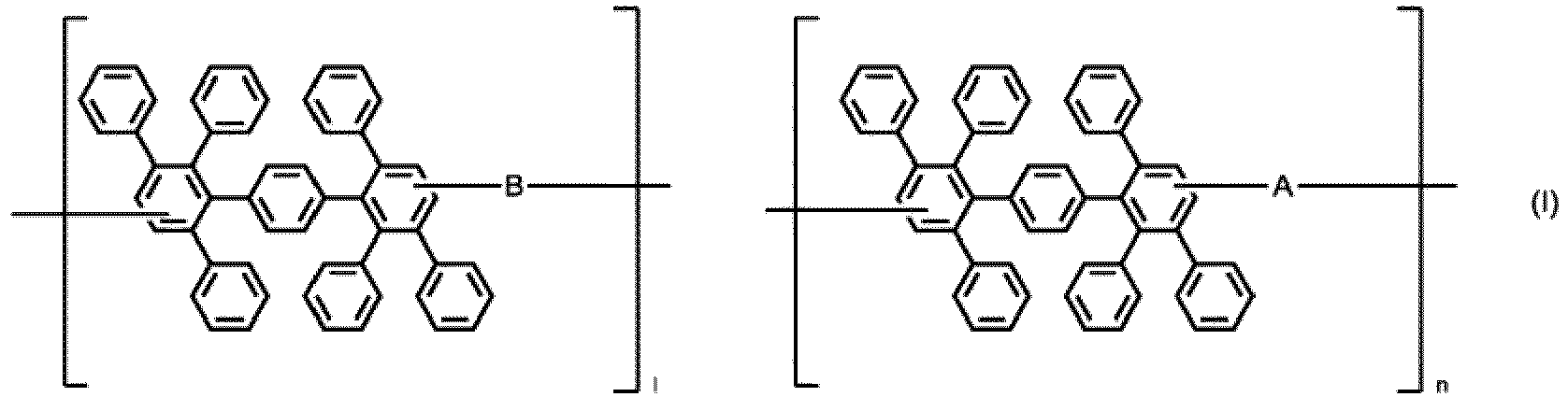 dans la formule générale (I) mentionnée ci-dessus, « I » et « n » sont des fractions molaires lorsque 1+n=1,0, et 0≦l<1, 0 and 0<n≦1,0,la structure représentée par A est au moins une sélectionnée dans le groupe comprenant :

 B représente une structure représentée par la formule générale (VII) suivante,les unités structurelles respectives sont copolymérisées de manière aléatoire, etau moins un cycle benzénique dans la formule (I) présente au moins un groupe sulfo.
- Composé selon la revendication 1, dans lequel, dans la formule générale (I), la structure représentée par A est au moins une sélectionnée dans le groupe comprenant :


- Composé selon la revendication 2, dans lequel, dans la formule générale (I), la structure représentée par A est :

- Pile à combustible comprenant le composé selon l'une quelconque des revendications 1 à 3.
- Électrolyte d'une couche de catalyseur d'anode et/ou d'une couche de catalyseur de cathode d'une pile à combustible, l'électrolyte comprenant le composé selon l'une quelconque des revendications 1 à 3.
- Couche de catalyseur d'une pile à combustible qui contient le composé selon l'une quelconque des revendications 1 à 3.
- Procédé de production du composé selon la revendication 1, qui comprend l'étape 1 consistant à faire réagir un composé représenté par la formule (VIII) suivante, un composé représenté par la formule (IX) suivante, et facultativement un composé représenté par la formule (X) suivante pour obtenir un composé représenté par la formule (XI) suivante,


 dans les formules générales (IX) et (XI), « I », « n », A et B présentent les mêmes significations que celles définies dans la revendication 1, à condition que chaque cycle benzénique ne comporte pas de groupe sulfo, etune étape 2 de sulfonation du composé représenté par la formule (XI) mentionnée ci-dessus pour obtenir le composé représenté par la formule (I).
 - Procédé de production du composé selon la revendication 1, qui comprend une étape consistant à faire réagir un composé présentant au moins un sel d'ammonium d'un groupe sulfonate dans un composé de la formule (VIII) suivante, un composé représenté par la formule (IX) suivante et facultativement un composé représenté par la formule (X) suivante pour obtenir le composé représenté par la formule (I) :


Applications Claiming Priority (2)
| Application Number | Priority Date | Filing Date | Title |
|---|---|---|---|
| JP2017253670 | 2017-12-28 | ||
| PCT/JP2018/048300 WO2019131932A1 (fr) | 2017-12-28 | 2018-12-27 | Composé de polyphénylène |
Publications (3)
| Publication Number | Publication Date |
|---|---|
| EP3733732A1 EP3733732A1 (fr) | 2020-11-04 |
| EP3733732A4 EP3733732A4 (fr) | 2021-02-24 |
| EP3733732B1 true EP3733732B1 (fr) | 2025-03-26 |
Family
ID=67063733
Family Applications (1)
| Application Number | Title | Priority Date | Filing Date |
|---|---|---|---|
| EP18895067.9A Active EP3733732B1 (fr) | 2017-12-28 | 2018-12-27 | Composé de polyphénylène |
Country Status (7)
| Country | Link |
|---|---|
| US (1) | US11312818B2 (fr) |
| EP (1) | EP3733732B1 (fr) |
| JP (1) | JP7173046B2 (fr) |
| KR (1) | KR102629949B1 (fr) |
| CN (1) | CN111527124B (fr) |
| TW (1) | TWI785177B (fr) |
| WO (1) | WO2019131932A1 (fr) |
Families Citing this family (3)
| Publication number | Priority date | Publication date | Assignee | Title |
|---|---|---|---|---|
| JP7845353B2 (ja) * | 2021-03-31 | 2026-04-14 | 日産化学株式会社 | スルホン酸基を有するフッ素含有化合物及び固体高分子形燃料電池 |
| CN114805757B (zh) * | 2022-03-28 | 2023-05-05 | 中国科学院深圳先进技术研究院 | 磺化苯代聚苯基离聚物及其制备方法、质子交换膜 |
| KR20240171932A (ko) * | 2023-05-30 | 2024-12-09 | 아이노머 이노베이션스, 인코포레이티드 | 이오노머 공중합체, 이의 방법, 및 용도 |
Family Cites Families (11)
| Publication number | Priority date | Publication date | Assignee | Title |
|---|---|---|---|---|
| KR100561699B1 (ko) * | 2003-04-22 | 2006-03-17 | 한국과학기술연구원 | 폴리아릴렌계 화합물과 그 중합체 및 이들을 이용한 el소자 |
| EP1653541B1 (fr) | 2003-07-31 | 2011-05-11 | Toyo Boseki Kabushiki Kaisha | Ensemble electrode-membrane electrolytique, pile a combustible mettant en application cet ensemble et procede servant a le fabriquer |
| US7301002B1 (en) * | 2003-10-14 | 2007-11-27 | Sandia Corporation | Sulfonated polyphenylene polymers |
| EP2154173A4 (fr) * | 2007-05-18 | 2013-09-04 | Jsr Corp | Nouveau composé aromatique, et copolymère de polyarylène ayant un noyau hétérocyclique contenant de l'azote contenant un groupe acide sulfonique en chaîne latérale |
| WO2009134227A1 (fr) | 2008-05-02 | 2009-11-05 | Energy Materials Corporation | Polymères de polyarylène résultant d’une réaction de diels-alder |
| JP2010070750A (ja) * | 2008-08-21 | 2010-04-02 | Sumitomo Chemical Co Ltd | ポリマー、高分子電解質及びその用途 |
| US7816482B1 (en) * | 2009-03-26 | 2010-10-19 | Sandia Corporation | Epoxy-crosslinked sulfonated poly (phenylene) copolymer proton exchange membranes |
| US8110636B1 (en) * | 2009-04-17 | 2012-02-07 | Sandia Corporation | Multi-block sulfonated poly(phenylene) copolymer proton exchange membranes |
| US9102789B2 (en) * | 2011-10-28 | 2015-08-11 | Daimler Ag | Sulfonated poly(phenylene) copolymer electrolyte for fuel cells |
| JP6278507B2 (ja) | 2013-11-14 | 2018-02-14 | 学校法人上智学院 | 燃料電池用高分子電解質、これを用いた燃料電池用触媒電極および燃料電池 |
| WO2018187864A1 (fr) * | 2017-04-10 | 2018-10-18 | Simon Fraser University | Polyphénylènes, procédés et utilisations de ceux-ci |
-
2018
- 2018-12-27 EP EP18895067.9A patent/EP3733732B1/fr active Active
- 2018-12-27 US US16/958,509 patent/US11312818B2/en active Active
- 2018-12-27 KR KR1020207021822A patent/KR102629949B1/ko active Active
- 2018-12-27 JP JP2019562196A patent/JP7173046B2/ja active Active
- 2018-12-27 WO PCT/JP2018/048300 patent/WO2019131932A1/fr not_active Ceased
- 2018-12-27 CN CN201880083994.4A patent/CN111527124B/zh active Active
- 2018-12-28 TW TW107147768A patent/TWI785177B/zh active
Also Published As
| Publication number | Publication date |
|---|---|
| TW201936694A (zh) | 2019-09-16 |
| CN111527124A (zh) | 2020-08-11 |
| KR20200103784A (ko) | 2020-09-02 |
| JP7173046B2 (ja) | 2022-11-16 |
| JPWO2019131932A1 (ja) | 2021-01-07 |
| TWI785177B (zh) | 2022-12-01 |
| KR102629949B1 (ko) | 2024-01-29 |
| US11312818B2 (en) | 2022-04-26 |
| EP3733732A4 (fr) | 2021-02-24 |
| CN111527124B (zh) | 2023-03-10 |
| US20210054138A1 (en) | 2021-02-25 |
| EP3733732A1 (fr) | 2020-11-04 |
| WO2019131932A1 (fr) | 2019-07-04 |
Similar Documents
| Publication | Publication Date | Title |
|---|---|---|
| US12472490B2 (en) | Carbazole-based anion exchange material, preparation method therefor, and use thereof | |
| KR101375508B1 (ko) | 고분자 전해질막 및 이를 포함하는 연료전지 | |
| US12552897B2 (en) | Polyfluorene-based ionomer, anion exchange membrane, method for preparing the polyfluorene-based ionomer and method for fabricating the anion exchange membrane | |
| EP1085034B1 (fr) | Polymère conducteur protonique, son procédé de fabrication, électrolyte polymère solide et électrode | |
| EP4667509A1 (fr) | Polymère, matériau d'électrolyte, membrane d'électrolyte, membrane d'électrolyte avec couche de catalyseur, ensemble d'électrode à membrane, pile à combustible à polymère solide et dispositif d'électrolyse d'eau à polymère solide | |
| US9263757B2 (en) | Highly basic ionomers and membranes and anion/hydroxide exchange fuel cells comprising the ionomers and membranes | |
| EP4317242A1 (fr) | Composé contenant du fluor ayant un groupe acide sulfonique et pile à combustible à électrolyte polymère | |
| EP3733732B1 (fr) | Composé de polyphénylène | |
| CN119234011A (zh) | 新型含支化的聚(芳基哌啶鎓)共聚物离聚体、阴离子交换膜及其制备方法 | |
| CN101037506B (zh) | 多嵌段共聚物、其制备方法、由其制备的聚合物电解质膜、膜的制备方法和用膜的燃料电池 | |
| EP2169748A1 (fr) | Ensemble d'électrode à membrane et son procédé de production, et pile à combustible polymère solide | |
| EP1619739B1 (fr) | Assemblage membrane-électrode pour une pile à combustible à électrolyte polymère et pile à combustible à électrolyte polymère | |
| JP4245991B2 (ja) | 固体高分子電解質、それを用いた膜、触媒電極層、膜/電極接合体及び燃料電池 | |
| KR101773245B1 (ko) | 프로톤 주게와 프로톤 받게를 갖는 다면체 올리고머형 실세스퀴옥산을 포함하는 탄화수소계 나노 복합막 및 이의 제조방법 | |
| KR101235738B1 (ko) | 양성자 전도성 공중합체, 이의 제조방법 및 이의 용도 | |
| KR20170107634A (ko) | 프로톤 주게와 프로톤 받게를 갖는 다면체 올리고머형 실세스퀴옥산을 포함하는 불소계 나노 복합막 및 이의 제조방법 | |
| KR20170107633A (ko) | 프로톤 주게와 프로톤 받게를 갖는 다면체 올리고머형 실세스퀴옥산을 포함하는 탄화수소계 나노 복합막 및 이의 제조방법 | |
| KR101773246B1 (ko) | 프로톤 주게와 프로톤 받게를 갖는 다면체 올리고머형 실세스퀴옥산을 포함하는 불소계 나노 복합막 및 이의 제조방법 | |
| JP7823803B1 (ja) | 電解質膜、触媒層付き電解質膜、膜電極接合体、固体高分子形燃料電池及び固体高分子形水電解装置 | |
| CN103030808B (zh) | 质子传导聚合物及其用途 | |
| KR20110117994A (ko) | 다중 페닐기를 포함하는 디히드록시 단량체, 상기 단량체를 이용하여 제조된 양성자 전도성 고분자, 상기 고분자를 포함하는 고분자 전해질막, 및 이를 포함하는 연료전지 | |
| JP2005290318A (ja) | 固体高分子電解質 | |
| JP2009026638A (ja) | 固体高分子電解質 | |
| WO2026054042A1 (fr) | Membrane électrolytique, membrane électrolytique avec couche de catalyseur, ensemble d'électrode à membrane, pile à combustible à polymère solide et dispositif d'électrolyse d'eau à polymère solide |
Legal Events
| Date | Code | Title | Description |
|---|---|---|---|
| STAA | Information on the status of an ep patent application or granted ep patent |
Free format text: STATUS: THE INTERNATIONAL PUBLICATION HAS BEEN MADE |
|
| PUAI | Public reference made under article 153(3) epc to a published international application that has entered the european phase |
Free format text: ORIGINAL CODE: 0009012 |
|
| STAA | Information on the status of an ep patent application or granted ep patent |
Free format text: STATUS: REQUEST FOR EXAMINATION WAS MADE |
|
| 17P | Request for examination filed |
Effective date: 20200702 |
|
| AK | Designated contracting states |
Kind code of ref document: A1 Designated state(s): AL AT BE BG CH CY CZ DE DK EE ES FI FR GB GR HR HU IE IS IT LI LT LU LV MC MK MT NL NO PL PT RO RS SE SI SK SM TR |
|
| AX | Request for extension of the european patent |
Extension state: BA ME |
|
| STAA | Information on the status of an ep patent application or granted ep patent |
Free format text: STATUS: EXAMINATION IS IN PROGRESS |
|
| A4 | Supplementary search report drawn up and despatched |
Effective date: 20210125 |
|
| RIC1 | Information provided on ipc code assigned before grant |
Ipc: H01M 8/10 20160101ALI20210119BHEP Ipc: H01M 8/1023 20160101ALI20210119BHEP Ipc: H01M 4/86 20060101ALI20210119BHEP Ipc: C08G 61/10 20060101AFI20210119BHEP |
|
| 17Q | First examination report despatched |
Effective date: 20210205 |
|
| DAV | Request for validation of the european patent (deleted) | ||
| DAX | Request for extension of the european patent (deleted) | ||
| GRAP | Despatch of communication of intention to grant a patent |
Free format text: ORIGINAL CODE: EPIDOSNIGR1 |
|
| STAA | Information on the status of an ep patent application or granted ep patent |
Free format text: STATUS: GRANT OF PATENT IS INTENDED |
|
| INTG | Intention to grant announced |
Effective date: 20241021 |
|
| GRAS | Grant fee paid |
Free format text: ORIGINAL CODE: EPIDOSNIGR3 |
|
| GRAA | (expected) grant |
Free format text: ORIGINAL CODE: 0009210 |
|
| STAA | Information on the status of an ep patent application or granted ep patent |
Free format text: STATUS: THE PATENT HAS BEEN GRANTED |
|
| AK | Designated contracting states |
Kind code of ref document: B1 Designated state(s): AL AT BE BG CH CY CZ DE DK EE ES FI FR GB GR HR HU IE IS IT LI LT LU LV MC MK MT NL NO PL PT RO RS SE SI SK SM TR |
|
| REG | Reference to a national code |
Ref country code: GB Ref legal event code: FG4D |
|
| REG | Reference to a national code |
Ref country code: CH Ref legal event code: EP |
|
| REG | Reference to a national code |
Ref country code: DE Ref legal event code: R096 Ref document number: 602018080590 Country of ref document: DE |
|
| REG | Reference to a national code |
Ref country code: IE Ref legal event code: FG4D |
|
| PG25 | Lapsed in a contracting state [announced via postgrant information from national office to epo] |
Ref country code: RS Free format text: LAPSE BECAUSE OF FAILURE TO SUBMIT A TRANSLATION OF THE DESCRIPTION OR TO PAY THE FEE WITHIN THE PRESCRIBED TIME-LIMIT Effective date: 20250626 |
|
| PG25 | Lapsed in a contracting state [announced via postgrant information from national office to epo] |
Ref country code: FI Free format text: LAPSE BECAUSE OF FAILURE TO SUBMIT A TRANSLATION OF THE DESCRIPTION OR TO PAY THE FEE WITHIN THE PRESCRIBED TIME-LIMIT Effective date: 20250326 |
|
| REG | Reference to a national code |
Ref country code: LT Ref legal event code: MG9D |
|
| PG25 | Lapsed in a contracting state [announced via postgrant information from national office to epo] |
Ref country code: NO Free format text: LAPSE BECAUSE OF FAILURE TO SUBMIT A TRANSLATION OF THE DESCRIPTION OR TO PAY THE FEE WITHIN THE PRESCRIBED TIME-LIMIT Effective date: 20250626 |
|
| PG25 | Lapsed in a contracting state [announced via postgrant information from national office to epo] |
Ref country code: HR Free format text: LAPSE BECAUSE OF FAILURE TO SUBMIT A TRANSLATION OF THE DESCRIPTION OR TO PAY THE FEE WITHIN THE PRESCRIBED TIME-LIMIT Effective date: 20250326 |
|
| PG25 | Lapsed in a contracting state [announced via postgrant information from national office to epo] |
Ref country code: LV Free format text: LAPSE BECAUSE OF FAILURE TO SUBMIT A TRANSLATION OF THE DESCRIPTION OR TO PAY THE FEE WITHIN THE PRESCRIBED TIME-LIMIT Effective date: 20250326 |
|
| PG25 | Lapsed in a contracting state [announced via postgrant information from national office to epo] |
Ref country code: BG Free format text: LAPSE BECAUSE OF FAILURE TO SUBMIT A TRANSLATION OF THE DESCRIPTION OR TO PAY THE FEE WITHIN THE PRESCRIBED TIME-LIMIT Effective date: 20250326 Ref country code: GR Free format text: LAPSE BECAUSE OF FAILURE TO SUBMIT A TRANSLATION OF THE DESCRIPTION OR TO PAY THE FEE WITHIN THE PRESCRIBED TIME-LIMIT Effective date: 20250627 |
|
| REG | Reference to a national code |
Ref country code: NL Ref legal event code: MP Effective date: 20250326 |
|
| PG25 | Lapsed in a contracting state [announced via postgrant information from national office to epo] |
Ref country code: NL Free format text: LAPSE BECAUSE OF FAILURE TO SUBMIT A TRANSLATION OF THE DESCRIPTION OR TO PAY THE FEE WITHIN THE PRESCRIBED TIME-LIMIT Effective date: 20250326 |
|
| PG25 | Lapsed in a contracting state [announced via postgrant information from national office to epo] |
Ref country code: SE Free format text: LAPSE BECAUSE OF FAILURE TO SUBMIT A TRANSLATION OF THE DESCRIPTION OR TO PAY THE FEE WITHIN THE PRESCRIBED TIME-LIMIT Effective date: 20250326 |
|
| REG | Reference to a national code |
Ref country code: AT Ref legal event code: MK05 Ref document number: 1778968 Country of ref document: AT Kind code of ref document: T Effective date: 20250326 |
|
| PG25 | Lapsed in a contracting state [announced via postgrant information from national office to epo] |
Ref country code: SM Free format text: LAPSE BECAUSE OF FAILURE TO SUBMIT A TRANSLATION OF THE DESCRIPTION OR TO PAY THE FEE WITHIN THE PRESCRIBED TIME-LIMIT Effective date: 20250326 |
|
| PG25 | Lapsed in a contracting state [announced via postgrant information from national office to epo] |
Ref country code: ES Free format text: LAPSE BECAUSE OF FAILURE TO SUBMIT A TRANSLATION OF THE DESCRIPTION OR TO PAY THE FEE WITHIN THE PRESCRIBED TIME-LIMIT Effective date: 20250326 Ref country code: PT Free format text: LAPSE BECAUSE OF FAILURE TO SUBMIT A TRANSLATION OF THE DESCRIPTION OR TO PAY THE FEE WITHIN THE PRESCRIBED TIME-LIMIT Effective date: 20250728 |
|
| PG25 | Lapsed in a contracting state [announced via postgrant information from national office to epo] |
Ref country code: PL Free format text: LAPSE BECAUSE OF FAILURE TO SUBMIT A TRANSLATION OF THE DESCRIPTION OR TO PAY THE FEE WITHIN THE PRESCRIBED TIME-LIMIT Effective date: 20250326 Ref country code: IT Free format text: LAPSE BECAUSE OF FAILURE TO SUBMIT A TRANSLATION OF THE DESCRIPTION OR TO PAY THE FEE WITHIN THE PRESCRIBED TIME-LIMIT Effective date: 20250326 |
|
| PG25 | Lapsed in a contracting state [announced via postgrant information from national office to epo] |
Ref country code: AT Free format text: LAPSE BECAUSE OF FAILURE TO SUBMIT A TRANSLATION OF THE DESCRIPTION OR TO PAY THE FEE WITHIN THE PRESCRIBED TIME-LIMIT Effective date: 20250326 |
|
| PG25 | Lapsed in a contracting state [announced via postgrant information from national office to epo] |
Ref country code: EE Free format text: LAPSE BECAUSE OF FAILURE TO SUBMIT A TRANSLATION OF THE DESCRIPTION OR TO PAY THE FEE WITHIN THE PRESCRIBED TIME-LIMIT Effective date: 20250326 |
|
| PG25 | Lapsed in a contracting state [announced via postgrant information from national office to epo] |
Ref country code: RO Free format text: LAPSE BECAUSE OF FAILURE TO SUBMIT A TRANSLATION OF THE DESCRIPTION OR TO PAY THE FEE WITHIN THE PRESCRIBED TIME-LIMIT Effective date: 20250326 |
|
| PG25 | Lapsed in a contracting state [announced via postgrant information from national office to epo] |
Ref country code: SK Free format text: LAPSE BECAUSE OF FAILURE TO SUBMIT A TRANSLATION OF THE DESCRIPTION OR TO PAY THE FEE WITHIN THE PRESCRIBED TIME-LIMIT Effective date: 20250326 |
|
| PG25 | Lapsed in a contracting state [announced via postgrant information from national office to epo] |
Ref country code: IS Free format text: LAPSE BECAUSE OF FAILURE TO SUBMIT A TRANSLATION OF THE DESCRIPTION OR TO PAY THE FEE WITHIN THE PRESCRIBED TIME-LIMIT Effective date: 20250726 |
|
| REG | Reference to a national code |
Ref country code: DE Ref legal event code: R097 Ref document number: 602018080590 Country of ref document: DE |
|
| PGFP | Annual fee paid to national office [announced via postgrant information from national office to epo] |
Ref country code: DE Payment date: 20251119 Year of fee payment: 8 |
|
| PGFP | Annual fee paid to national office [announced via postgrant information from national office to epo] |
Ref country code: GB Payment date: 20251119 Year of fee payment: 8 |
|
| PG25 | Lapsed in a contracting state [announced via postgrant information from national office to epo] |
Ref country code: DK Free format text: LAPSE BECAUSE OF FAILURE TO SUBMIT A TRANSLATION OF THE DESCRIPTION OR TO PAY THE FEE WITHIN THE PRESCRIBED TIME-LIMIT Effective date: 20250326 |
|
| PG25 | Lapsed in a contracting state [announced via postgrant information from national office to epo] |
Ref country code: CZ Free format text: LAPSE BECAUSE OF FAILURE TO SUBMIT A TRANSLATION OF THE DESCRIPTION OR TO PAY THE FEE WITHIN THE PRESCRIBED TIME-LIMIT Effective date: 20250326 |
|
| PLBE | No opposition filed within time limit |
Free format text: ORIGINAL CODE: 0009261 |
|
| STAA | Information on the status of an ep patent application or granted ep patent |
Free format text: STATUS: NO OPPOSITION FILED WITHIN TIME LIMIT |
|
| REG | Reference to a national code |
Ref country code: CH Ref legal event code: L10 Free format text: ST27 STATUS EVENT CODE: U-0-0-L10-L00 (AS PROVIDED BY THE NATIONAL OFFICE) Effective date: 20260211 |
|
| 26N | No opposition filed |
Effective date: 20260105 |