EP3733806A1 - Elektrische stahlblechklebstoffbeschichtungszusammensetzung, elektrisches stahlblechprodukt und herstellungsverfahren dafür - Google Patents
Elektrische stahlblechklebstoffbeschichtungszusammensetzung, elektrisches stahlblechprodukt und herstellungsverfahren dafür Download PDFInfo
- Publication number
- EP3733806A1 EP3733806A1 EP18894968.9A EP18894968A EP3733806A1 EP 3733806 A1 EP3733806 A1 EP 3733806A1 EP 18894968 A EP18894968 A EP 18894968A EP 3733806 A1 EP3733806 A1 EP 3733806A1
- Authority
- EP
- European Patent Office
- Prior art keywords
- electrical steel
- steel sheet
- metal
- layer
- adhesive layer
- Prior art date
- Legal status (The legal status is an assumption and is not a legal conclusion. Google has not performed a legal analysis and makes no representation as to the accuracy of the status listed.)
- Pending
Links
- 229910000976 Electrical steel Inorganic materials 0.000 title claims abstract description 128
- 239000000853 adhesive Substances 0.000 title claims abstract description 76
- 230000001070 adhesive effect Effects 0.000 title claims abstract description 76
- 239000008199 coating composition Substances 0.000 title claims abstract description 50
- 238000004519 manufacturing process Methods 0.000 title claims description 13
- 239000012790 adhesive layer Substances 0.000 claims abstract description 95
- 229910052751 metal Inorganic materials 0.000 claims abstract description 70
- 239000002184 metal Substances 0.000 claims abstract description 70
- 239000011347 resin Substances 0.000 claims abstract description 65
- 229920005989 resin Polymers 0.000 claims abstract description 65
- NBIIXXVUZAFLBC-UHFFFAOYSA-N Phosphoric acid Chemical compound OP(O)(O)=O NBIIXXVUZAFLBC-UHFFFAOYSA-N 0.000 claims abstract description 43
- 150000003016 phosphoric acids Chemical class 0.000 claims abstract description 32
- 239000002105 nanoparticle Substances 0.000 claims abstract description 27
- 229910052725 zinc Inorganic materials 0.000 claims abstract description 23
- 229910052726 zirconium Inorganic materials 0.000 claims abstract description 23
- 229910052791 calcium Inorganic materials 0.000 claims abstract description 22
- 229910052742 iron Inorganic materials 0.000 claims abstract description 22
- 229910052749 magnesium Inorganic materials 0.000 claims abstract description 22
- 229910052782 aluminium Inorganic materials 0.000 claims abstract description 20
- 229910052710 silicon Inorganic materials 0.000 claims abstract description 20
- 229910000147 aluminium phosphate Inorganic materials 0.000 claims abstract description 18
- 229910052719 titanium Inorganic materials 0.000 claims abstract description 17
- 239000007787 solid Substances 0.000 claims abstract description 16
- 239000002245 particle Substances 0.000 claims abstract description 15
- 229910052757 nitrogen Inorganic materials 0.000 claims abstract description 13
- 229910052698 phosphorus Inorganic materials 0.000 claims abstract description 12
- 229910052799 carbon Inorganic materials 0.000 claims abstract description 11
- 239000010410 layer Substances 0.000 claims description 64
- 239000011148 porous material Substances 0.000 claims description 44
- VYPSYNLAJGMNEJ-UHFFFAOYSA-N Silicium dioxide Chemical compound O=[Si]=O VYPSYNLAJGMNEJ-UHFFFAOYSA-N 0.000 claims description 40
- 230000003647 oxidation Effects 0.000 claims description 40
- 238000007254 oxidation reaction Methods 0.000 claims description 40
- 238000000137 annealing Methods 0.000 claims description 38
- 238000000034 method Methods 0.000 claims description 22
- 229910052681 coesite Inorganic materials 0.000 claims description 19
- 229910052906 cristobalite Inorganic materials 0.000 claims description 19
- 239000000377 silicon dioxide Substances 0.000 claims description 19
- 229910052682 stishovite Inorganic materials 0.000 claims description 19
- 229910052905 tridymite Inorganic materials 0.000 claims description 19
- 239000011248 coating agent Substances 0.000 claims description 17
- 239000011247 coating layer Substances 0.000 claims description 17
- 238000000576 coating method Methods 0.000 claims description 17
- GWEVSGVZZGPLCZ-UHFFFAOYSA-N Titan oxide Chemical compound O=[Ti]=O GWEVSGVZZGPLCZ-UHFFFAOYSA-N 0.000 claims description 10
- 230000000052 comparative effect Effects 0.000 description 32
- XEEYBQQBJWHFJM-UHFFFAOYSA-N Iron Chemical group [Fe] XEEYBQQBJWHFJM-UHFFFAOYSA-N 0.000 description 30
- 239000011701 zinc Substances 0.000 description 24
- 239000011777 magnesium Substances 0.000 description 23
- 239000011575 calcium Substances 0.000 description 18
- 239000004593 Epoxy Substances 0.000 description 16
- 229960004838 phosphoric acid Drugs 0.000 description 16
- 235000011007 phosphoric acid Nutrition 0.000 description 16
- 239000000463 material Substances 0.000 description 10
- 230000004927 fusion Effects 0.000 description 8
- IJGRMHOSHXDMSA-UHFFFAOYSA-N Atomic nitrogen Chemical compound N#N IJGRMHOSHXDMSA-UHFFFAOYSA-N 0.000 description 7
- 239000003795 chemical substances by application Substances 0.000 description 7
- 238000004080 punching Methods 0.000 description 7
- 238000005728 strengthening Methods 0.000 description 7
- 229910019142 PO4 Inorganic materials 0.000 description 6
- 229910004298 SiO 2 Inorganic materials 0.000 description 6
- HEMHJVSKTPXQMS-UHFFFAOYSA-M Sodium hydroxide Chemical compound [OH-].[Na+] HEMHJVSKTPXQMS-UHFFFAOYSA-M 0.000 description 6
- 239000012298 atmosphere Substances 0.000 description 6
- 239000000203 mixture Substances 0.000 description 6
- 229910052760 oxygen Inorganic materials 0.000 description 6
- 229910000565 Non-oriented electrical steel Inorganic materials 0.000 description 5
- 239000007789 gas Substances 0.000 description 5
- 238000003466 welding Methods 0.000 description 5
- OKTJSMMVPCPJKN-UHFFFAOYSA-N Carbon Chemical compound [C] OKTJSMMVPCPJKN-UHFFFAOYSA-N 0.000 description 4
- QPLDLSVMHZLSFG-UHFFFAOYSA-N Copper oxide Chemical compound [Cu]=O QPLDLSVMHZLSFG-UHFFFAOYSA-N 0.000 description 4
- 229910000831 Steel Inorganic materials 0.000 description 4
- 150000004945 aromatic hydrocarbons Chemical class 0.000 description 4
- 239000002041 carbon nanotube Substances 0.000 description 4
- 229910021393 carbon nanotube Inorganic materials 0.000 description 4
- 238000010586 diagram Methods 0.000 description 4
- 239000010959 steel Substances 0.000 description 4
- UHOVQNZJYSORNB-UHFFFAOYSA-N Benzene Chemical compound C1=CC=CC=C1 UHOVQNZJYSORNB-UHFFFAOYSA-N 0.000 description 3
- JOYRKODLDBILNP-UHFFFAOYSA-N Ethyl urethane Chemical compound CCOC(N)=O JOYRKODLDBILNP-UHFFFAOYSA-N 0.000 description 3
- YXFVVABEGXRONW-UHFFFAOYSA-N Toluene Chemical compound CC1=CC=CC=C1 YXFVVABEGXRONW-UHFFFAOYSA-N 0.000 description 3
- -1 acryl Chemical group 0.000 description 3
- 239000007864 aqueous solution Substances 0.000 description 3
- 239000007822 coupling agent Substances 0.000 description 3
- 230000014509 gene expression Effects 0.000 description 3
- 150000004767 nitrides Chemical class 0.000 description 3
- 239000011368 organic material Substances 0.000 description 3
- 230000000630 rising effect Effects 0.000 description 3
- 239000000243 solution Substances 0.000 description 3
- UQSXHKLRYXJYBZ-UHFFFAOYSA-N Iron oxide Chemical compound [Fe]=O UQSXHKLRYXJYBZ-UHFFFAOYSA-N 0.000 description 2
- UFWIBTONFRDIAS-UHFFFAOYSA-N Naphthalene Chemical compound C1=CC=CC2=CC=CC=C21 UFWIBTONFRDIAS-UHFFFAOYSA-N 0.000 description 2
- ISWSIDIOOBJBQZ-UHFFFAOYSA-N Phenol Chemical compound OC1=CC=CC=C1 ISWSIDIOOBJBQZ-UHFFFAOYSA-N 0.000 description 2
- PPBRXRYQALVLMV-UHFFFAOYSA-N Styrene Chemical compound C=CC1=CC=CC=C1 PPBRXRYQALVLMV-UHFFFAOYSA-N 0.000 description 2
- 229910010413 TiO 2 Inorganic materials 0.000 description 2
- 230000002411 adverse Effects 0.000 description 2
- 230000002776 aggregation Effects 0.000 description 2
- MWPLVEDNUUSJAV-UHFFFAOYSA-N anthracene Chemical compound C1=CC=CC2=CC3=CC=CC=C3C=C21 MWPLVEDNUUSJAV-UHFFFAOYSA-N 0.000 description 2
- 230000005540 biological transmission Effects 0.000 description 2
- 239000006229 carbon black Substances 0.000 description 2
- 230000007797 corrosion Effects 0.000 description 2
- 238000005260 corrosion Methods 0.000 description 2
- 229960004643 cupric oxide Drugs 0.000 description 2
- 230000006866 deterioration Effects 0.000 description 2
- 230000002542 deteriorative effect Effects 0.000 description 2
- 239000006185 dispersion Substances 0.000 description 2
- 238000011156 evaluation Methods 0.000 description 2
- XLYOFNOQVPJJNP-UHFFFAOYSA-M hydroxide Chemical compound [OH-] XLYOFNOQVPJJNP-UHFFFAOYSA-M 0.000 description 2
- 238000009413 insulation Methods 0.000 description 2
- 239000003949 liquefied natural gas Substances 0.000 description 2
- VTHJTEIRLNZDEV-UHFFFAOYSA-L magnesium dihydroxide Chemical compound [OH-].[OH-].[Mg+2] VTHJTEIRLNZDEV-UHFFFAOYSA-L 0.000 description 2
- 239000000347 magnesium hydroxide Substances 0.000 description 2
- 229910001862 magnesium hydroxide Inorganic materials 0.000 description 2
- 239000000395 magnesium oxide Substances 0.000 description 2
- CPLXHLVBOLITMK-UHFFFAOYSA-N magnesium oxide Inorganic materials [Mg]=O CPLXHLVBOLITMK-UHFFFAOYSA-N 0.000 description 2
- AXZKOIWUVFPNLO-UHFFFAOYSA-N magnesium;oxygen(2-) Chemical compound [O-2].[Mg+2] AXZKOIWUVFPNLO-UHFFFAOYSA-N 0.000 description 2
- 230000005389 magnetism Effects 0.000 description 2
- 150000002739 metals Chemical class 0.000 description 2
- TWNQGVIAIRXVLR-UHFFFAOYSA-N oxo(oxoalumanyloxy)alumane Chemical compound O=[Al]O[Al]=O TWNQGVIAIRXVLR-UHFFFAOYSA-N 0.000 description 2
- CMPQUABWPXYYSH-UHFFFAOYSA-N phenyl phosphate Chemical compound OP(O)(=O)OC1=CC=CC=C1 CMPQUABWPXYYSH-UHFFFAOYSA-N 0.000 description 2
- 239000000049 pigment Substances 0.000 description 2
- 239000002904 solvent Substances 0.000 description 2
- 239000000126 substance Substances 0.000 description 2
- LDXJRKWFNNFDSA-UHFFFAOYSA-N 2-(2,4,6,7-tetrahydrotriazolo[4,5-c]pyridin-5-yl)-1-[4-[2-[[3-(trifluoromethoxy)phenyl]methylamino]pyrimidin-5-yl]piperazin-1-yl]ethanone Chemical compound C1CN(CC2=NNN=C21)CC(=O)N3CCN(CC3)C4=CN=C(N=C4)NCC5=CC(=CC=C5)OC(F)(F)F LDXJRKWFNNFDSA-UHFFFAOYSA-N 0.000 description 1
- AWFYPPSBLUWMFQ-UHFFFAOYSA-N 2-[5-[2-(2,3-dihydro-1H-inden-2-ylamino)pyrimidin-5-yl]-1,3,4-oxadiazol-2-yl]-1-(1,4,6,7-tetrahydropyrazolo[4,3-c]pyridin-5-yl)ethanone Chemical compound C1C(CC2=CC=CC=C12)NC1=NC=C(C=N1)C1=NN=C(O1)CC(=O)N1CC2=C(CC1)NN=C2 AWFYPPSBLUWMFQ-UHFFFAOYSA-N 0.000 description 1
- PQVHMOLNSYFXIJ-UHFFFAOYSA-N 4-[2-(2,3-dihydro-1H-inden-2-ylamino)pyrimidin-5-yl]-1-[2-oxo-2-(2,4,6,7-tetrahydrotriazolo[4,5-c]pyridin-5-yl)ethyl]pyrazole-3-carboxylic acid Chemical compound C1C(CC2=CC=CC=C12)NC1=NC=C(C=N1)C=1C(=NN(C=1)CC(N1CC2=C(CC1)NN=N2)=O)C(=O)O PQVHMOLNSYFXIJ-UHFFFAOYSA-N 0.000 description 1
- FMMWHPNWAFZXNH-UHFFFAOYSA-N Benz[a]pyrene Chemical compound C1=C2C3=CC=CC=C3C=C(C=C3)C2=C2C3=CC=CC2=C1 FMMWHPNWAFZXNH-UHFFFAOYSA-N 0.000 description 1
- ODINCKMPIJJUCX-UHFFFAOYSA-N Calcium oxide Chemical compound [Ca]=O ODINCKMPIJJUCX-UHFFFAOYSA-N 0.000 description 1
- RYGMFSIKBFXOCR-UHFFFAOYSA-N Copper Chemical compound [Cu] RYGMFSIKBFXOCR-UHFFFAOYSA-N 0.000 description 1
- VGGSQFUCUMXWEO-UHFFFAOYSA-N Ethene Chemical compound C=C VGGSQFUCUMXWEO-UHFFFAOYSA-N 0.000 description 1
- 239000005977 Ethylene Substances 0.000 description 1
- UFHFLCQGNIYNRP-UHFFFAOYSA-N Hydrogen Chemical compound [H][H] UFHFLCQGNIYNRP-UHFFFAOYSA-N 0.000 description 1
- CTQNGGLPUBDAKN-UHFFFAOYSA-N O-Xylene Chemical compound CC1=CC=CC=C1C CTQNGGLPUBDAKN-UHFFFAOYSA-N 0.000 description 1
- OAICVXFJPJFONN-UHFFFAOYSA-N Phosphorus Chemical compound [P] OAICVXFJPJFONN-UHFFFAOYSA-N 0.000 description 1
- KWYUFKZDYYNOTN-UHFFFAOYSA-M Potassium hydroxide Chemical compound [OH-].[K+] KWYUFKZDYYNOTN-UHFFFAOYSA-M 0.000 description 1
- BLRPTPMANUNPDV-UHFFFAOYSA-N Silane Chemical compound [SiH4] BLRPTPMANUNPDV-UHFFFAOYSA-N 0.000 description 1
- WGLPBDUCMAPZCE-UHFFFAOYSA-N Trioxochromium Chemical compound O=[Cr](=O)=O WGLPBDUCMAPZCE-UHFFFAOYSA-N 0.000 description 1
- XLOMVQKBTHCTTD-UHFFFAOYSA-N Zinc monoxide Chemical compound [Zn]=O XLOMVQKBTHCTTD-UHFFFAOYSA-N 0.000 description 1
- MSKSOBAQMWJYTJ-UHFFFAOYSA-N [Mg].OP(O)(O)=O Chemical compound [Mg].OP(O)(O)=O MSKSOBAQMWJYTJ-UHFFFAOYSA-N 0.000 description 1
- 238000005054 agglomeration Methods 0.000 description 1
- 238000004220 aggregation Methods 0.000 description 1
- WNROFYMDJYEPJX-UHFFFAOYSA-K aluminium hydroxide Chemical compound [OH-].[OH-].[OH-].[Al+3] WNROFYMDJYEPJX-UHFFFAOYSA-K 0.000 description 1
- ILRRQNADMUWWFW-UHFFFAOYSA-K aluminium phosphate Chemical compound O1[Al]2OP1(=O)O2 ILRRQNADMUWWFW-UHFFFAOYSA-K 0.000 description 1
- 230000015572 biosynthetic process Effects 0.000 description 1
- KGBXLFKZBHKPEV-UHFFFAOYSA-N boric acid Chemical compound OB(O)O KGBXLFKZBHKPEV-UHFFFAOYSA-N 0.000 description 1
- AXCZMVOFGPJBDE-UHFFFAOYSA-L calcium dihydroxide Chemical compound [OH-].[OH-].[Ca+2] AXCZMVOFGPJBDE-UHFFFAOYSA-L 0.000 description 1
- UUVBYOGFRMMMQL-UHFFFAOYSA-N calcium;phosphoric acid Chemical compound [Ca].OP(O)(O)=O UUVBYOGFRMMMQL-UHFFFAOYSA-N 0.000 description 1
- 238000006243 chemical reaction Methods 0.000 description 1
- REERVHLUKHFRQT-UHFFFAOYSA-N cobalt phosphoric acid Chemical compound [Co].P(O)(O)(O)=O REERVHLUKHFRQT-UHFFFAOYSA-N 0.000 description 1
- 239000008119 colloidal silica Substances 0.000 description 1
- 239000002131 composite material Substances 0.000 description 1
- 238000007796 conventional method Methods 0.000 description 1
- 229910052802 copper Inorganic materials 0.000 description 1
- 239000010949 copper Substances 0.000 description 1
- 238000000354 decomposition reaction Methods 0.000 description 1
- 230000007423 decrease Effects 0.000 description 1
- KPUWHANPEXNPJT-UHFFFAOYSA-N disiloxane Chemical class [SiH3]O[SiH3] KPUWHANPEXNPJT-UHFFFAOYSA-N 0.000 description 1
- 230000000694 effects Effects 0.000 description 1
- 230000004907 flux Effects 0.000 description 1
- 125000000524 functional group Chemical group 0.000 description 1
- 238000009499 grossing Methods 0.000 description 1
- 229910052739 hydrogen Inorganic materials 0.000 description 1
- 239000001257 hydrogen Substances 0.000 description 1
- 229910010272 inorganic material Inorganic materials 0.000 description 1
- 239000011147 inorganic material Substances 0.000 description 1
- JEIPFZHSYJVQDO-UHFFFAOYSA-N iron(III) oxide Inorganic materials O=[Fe]O[Fe]=O JEIPFZHSYJVQDO-UHFFFAOYSA-N 0.000 description 1
- 238000003754 machining Methods 0.000 description 1
- 229910001463 metal phosphate Inorganic materials 0.000 description 1
- 238000002156 mixing Methods 0.000 description 1
- 239000012299 nitrogen atmosphere Substances 0.000 description 1
- 238000002161 passivation Methods 0.000 description 1
- 238000005191 phase separation Methods 0.000 description 1
- OXHXATNDTXVKAU-UHFFFAOYSA-N phosphoric acid zinc Chemical compound [Zn].OP(O)(O)=O OXHXATNDTXVKAU-UHFFFAOYSA-N 0.000 description 1
- 239000011574 phosphorus Substances 0.000 description 1
- IEQIEDJGQAUEQZ-UHFFFAOYSA-N phthalocyanine Chemical compound N1C(N=C2C3=CC=CC=C3C(N=C3C4=CC=CC=C4C(=N4)N3)=N2)=C(C=CC=C2)C2=C1N=C1C2=CC=CC=C2C4=N1 IEQIEDJGQAUEQZ-UHFFFAOYSA-N 0.000 description 1
- 230000000704 physical effect Effects 0.000 description 1
- QVLTXCYWHPZMCA-UHFFFAOYSA-N po4-po4 Chemical compound OP(O)(O)=O.OP(O)(O)=O QVLTXCYWHPZMCA-UHFFFAOYSA-N 0.000 description 1
- 238000001556 precipitation Methods 0.000 description 1
- 238000003825 pressing Methods 0.000 description 1
- 238000005096 rolling process Methods 0.000 description 1
- 238000010008 shearing Methods 0.000 description 1
- 229910000077 silane Inorganic materials 0.000 description 1
- 239000011343 solid material Substances 0.000 description 1
- BPSIOYPQMFLKFR-UHFFFAOYSA-N trimethoxy-[3-(oxiran-2-ylmethoxy)propyl]silane Chemical compound CO[Si](OC)(OC)CCCOCC1CO1 BPSIOYPQMFLKFR-UHFFFAOYSA-N 0.000 description 1
- 125000000391 vinyl group Chemical group [H]C([*])=C([H])[H] 0.000 description 1
- 229920002554 vinyl polymer Polymers 0.000 description 1
- 239000008096 xylene Substances 0.000 description 1
Images


Classifications
-
- C—CHEMISTRY; METALLURGY
- C09—DYES; PAINTS; POLISHES; NATURAL RESINS; ADHESIVES; COMPOSITIONS NOT OTHERWISE PROVIDED FOR; APPLICATIONS OF MATERIALS NOT OTHERWISE PROVIDED FOR
- C09J—ADHESIVES; NON-MECHANICAL ASPECTS OF ADHESIVE PROCESSES IN GENERAL; ADHESIVE PROCESSES NOT PROVIDED FOR ELSEWHERE; USE OF MATERIALS AS ADHESIVES
- C09J1/00—Adhesives based on inorganic constituents
-
- C—CHEMISTRY; METALLURGY
- C09—DYES; PAINTS; POLISHES; NATURAL RESINS; ADHESIVES; COMPOSITIONS NOT OTHERWISE PROVIDED FOR; APPLICATIONS OF MATERIALS NOT OTHERWISE PROVIDED FOR
- C09J—ADHESIVES; NON-MECHANICAL ASPECTS OF ADHESIVE PROCESSES IN GENERAL; ADHESIVE PROCESSES NOT PROVIDED FOR ELSEWHERE; USE OF MATERIALS AS ADHESIVES
- C09J11/00—Features of adhesives not provided for in group C09J9/00, e.g. additives
- C09J11/02—Non-macromolecular additives
- C09J11/04—Non-macromolecular additives inorganic
-
- B—PERFORMING OPERATIONS; TRANSPORTING
- B32—LAYERED PRODUCTS
- B32B—LAYERED PRODUCTS, i.e. PRODUCTS BUILT-UP OF STRATA OF FLAT OR NON-FLAT, e.g. CELLULAR OR HONEYCOMB, FORM
- B32B15/00—Layered products comprising a layer of metal
- B32B15/04—Layered products comprising a layer of metal comprising metal as the main or only constituent of a layer, which is next to another layer of the same or of a different material
- B32B15/043—Layered products comprising a layer of metal comprising metal as the main or only constituent of a layer, which is next to another layer of the same or of a different material of metal
-
- B—PERFORMING OPERATIONS; TRANSPORTING
- B32—LAYERED PRODUCTS
- B32B—LAYERED PRODUCTS, i.e. PRODUCTS BUILT-UP OF STRATA OF FLAT OR NON-FLAT, e.g. CELLULAR OR HONEYCOMB, FORM
- B32B15/00—Layered products comprising a layer of metal
- B32B15/18—Layered products comprising a layer of metal comprising iron or steel
-
- B—PERFORMING OPERATIONS; TRANSPORTING
- B32—LAYERED PRODUCTS
- B32B—LAYERED PRODUCTS, i.e. PRODUCTS BUILT-UP OF STRATA OF FLAT OR NON-FLAT, e.g. CELLULAR OR HONEYCOMB, FORM
- B32B37/00—Methods or apparatus for laminating, e.g. by curing or by ultrasonic bonding
- B32B37/12—Methods or apparatus for laminating, e.g. by curing or by ultrasonic bonding characterised by using adhesives
-
- B—PERFORMING OPERATIONS; TRANSPORTING
- B32—LAYERED PRODUCTS
- B32B—LAYERED PRODUCTS, i.e. PRODUCTS BUILT-UP OF STRATA OF FLAT OR NON-FLAT, e.g. CELLULAR OR HONEYCOMB, FORM
- B32B37/00—Methods or apparatus for laminating, e.g. by curing or by ultrasonic bonding
- B32B37/12—Methods or apparatus for laminating, e.g. by curing or by ultrasonic bonding characterised by using adhesives
- B32B37/1207—Heat-activated adhesive
-
- B—PERFORMING OPERATIONS; TRANSPORTING
- B32—LAYERED PRODUCTS
- B32B—LAYERED PRODUCTS, i.e. PRODUCTS BUILT-UP OF STRATA OF FLAT OR NON-FLAT, e.g. CELLULAR OR HONEYCOMB, FORM
- B32B7/00—Layered products characterised by the relation between layers; Layered products characterised by the relative orientation of features between layers, or by the relative values of a measurable parameter between layers, i.e. products comprising layers having different physical, chemical or physicochemical properties; Layered products characterised by the interconnection of layers
- B32B7/04—Interconnection of layers
- B32B7/12—Interconnection of layers using interposed adhesives or interposed materials with bonding properties
-
- B—PERFORMING OPERATIONS; TRANSPORTING
- B32—LAYERED PRODUCTS
- B32B—LAYERED PRODUCTS, i.e. PRODUCTS BUILT-UP OF STRATA OF FLAT OR NON-FLAT, e.g. CELLULAR OR HONEYCOMB, FORM
- B32B9/00—Layered products comprising a layer of a particular substance not covered by groups B32B11/00 - B32B29/00
- B32B9/04—Layered products comprising a layer of a particular substance not covered by groups B32B11/00 - B32B29/00 comprising such particular substance as the main or only constituent of a layer, which is next to another layer of the same or of a different material
- B32B9/041—Layered products comprising a layer of a particular substance not covered by groups B32B11/00 - B32B29/00 comprising such particular substance as the main or only constituent of a layer, which is next to another layer of the same or of a different material of metal
-
- C—CHEMISTRY; METALLURGY
- C09—DYES; PAINTS; POLISHES; NATURAL RESINS; ADHESIVES; COMPOSITIONS NOT OTHERWISE PROVIDED FOR; APPLICATIONS OF MATERIALS NOT OTHERWISE PROVIDED FOR
- C09J—ADHESIVES; NON-MECHANICAL ASPECTS OF ADHESIVE PROCESSES IN GENERAL; ADHESIVE PROCESSES NOT PROVIDED FOR ELSEWHERE; USE OF MATERIALS AS ADHESIVES
- C09J11/00—Features of adhesives not provided for in group C09J9/00, e.g. additives
- C09J11/08—Macromolecular additives
-
- C—CHEMISTRY; METALLURGY
- C09—DYES; PAINTS; POLISHES; NATURAL RESINS; ADHESIVES; COMPOSITIONS NOT OTHERWISE PROVIDED FOR; APPLICATIONS OF MATERIALS NOT OTHERWISE PROVIDED FOR
- C09J—ADHESIVES; NON-MECHANICAL ASPECTS OF ADHESIVE PROCESSES IN GENERAL; ADHESIVE PROCESSES NOT PROVIDED FOR ELSEWHERE; USE OF MATERIALS AS ADHESIVES
- C09J5/00—Adhesive processes in general; Adhesive processes not provided for elsewhere, e.g. relating to primers
-
- C—CHEMISTRY; METALLURGY
- C09—DYES; PAINTS; POLISHES; NATURAL RESINS; ADHESIVES; COMPOSITIONS NOT OTHERWISE PROVIDED FOR; APPLICATIONS OF MATERIALS NOT OTHERWISE PROVIDED FOR
- C09J—ADHESIVES; NON-MECHANICAL ASPECTS OF ADHESIVE PROCESSES IN GENERAL; ADHESIVE PROCESSES NOT PROVIDED FOR ELSEWHERE; USE OF MATERIALS AS ADHESIVES
- C09J5/00—Adhesive processes in general; Adhesive processes not provided for elsewhere, e.g. relating to primers
- C09J5/06—Adhesive processes in general; Adhesive processes not provided for elsewhere, e.g. relating to primers involving heating of the applied adhesive
-
- B—PERFORMING OPERATIONS; TRANSPORTING
- B32—LAYERED PRODUCTS
- B32B—LAYERED PRODUCTS, i.e. PRODUCTS BUILT-UP OF STRATA OF FLAT OR NON-FLAT, e.g. CELLULAR OR HONEYCOMB, FORM
- B32B37/00—Methods or apparatus for laminating, e.g. by curing or by ultrasonic bonding
- B32B37/12—Methods or apparatus for laminating, e.g. by curing or by ultrasonic bonding characterised by using adhesives
- B32B2037/1253—Methods or apparatus for laminating, e.g. by curing or by ultrasonic bonding characterised by using adhesives curable adhesive
-
- B—PERFORMING OPERATIONS; TRANSPORTING
- B32—LAYERED PRODUCTS
- B32B—LAYERED PRODUCTS, i.e. PRODUCTS BUILT-UP OF STRATA OF FLAT OR NON-FLAT, e.g. CELLULAR OR HONEYCOMB, FORM
- B32B2311/00—Metals, their alloys or their compounds
- B32B2311/30—Iron, e.g. steel
-
- C—CHEMISTRY; METALLURGY
- C08—ORGANIC MACROMOLECULAR COMPOUNDS; THEIR PREPARATION OR CHEMICAL WORKING-UP; COMPOSITIONS BASED THEREON
- C08K—Use of inorganic or non-macromolecular organic substances as compounding ingredients
- C08K3/00—Use of inorganic substances as compounding ingredients
- C08K3/18—Oxygen-containing compounds, e.g. metal carbonyls
- C08K3/20—Oxides; Hydroxides
- C08K3/22—Oxides; Hydroxides of metals
- C08K2003/2237—Oxides; Hydroxides of metals of titanium
- C08K2003/2241—Titanium dioxide
-
- C—CHEMISTRY; METALLURGY
- C08—ORGANIC MACROMOLECULAR COMPOUNDS; THEIR PREPARATION OR CHEMICAL WORKING-UP; COMPOSITIONS BASED THEREON
- C08K—Use of inorganic or non-macromolecular organic substances as compounding ingredients
- C08K3/00—Use of inorganic substances as compounding ingredients
- C08K3/32—Phosphorus-containing compounds
- C08K2003/321—Phosphates
-
- C—CHEMISTRY; METALLURGY
- C08—ORGANIC MACROMOLECULAR COMPOUNDS; THEIR PREPARATION OR CHEMICAL WORKING-UP; COMPOSITIONS BASED THEREON
- C08K—Use of inorganic or non-macromolecular organic substances as compounding ingredients
- C08K3/00—Use of inorganic substances as compounding ingredients
- C08K3/34—Silicon-containing compounds
- C08K3/36—Silica
-
- C—CHEMISTRY; METALLURGY
- C09—DYES; PAINTS; POLISHES; NATURAL RESINS; ADHESIVES; COMPOSITIONS NOT OTHERWISE PROVIDED FOR; APPLICATIONS OF MATERIALS NOT OTHERWISE PROVIDED FOR
- C09J—ADHESIVES; NON-MECHANICAL ASPECTS OF ADHESIVE PROCESSES IN GENERAL; ADHESIVE PROCESSES NOT PROVIDED FOR ELSEWHERE; USE OF MATERIALS AS ADHESIVES
- C09J2203/00—Applications of adhesives in processes or use of adhesives in the form of films or foils
- C09J2203/326—Applications of adhesives in processes or use of adhesives in the form of films or foils for bonding electronic components such as wafers, chips or semiconductors
-
- C—CHEMISTRY; METALLURGY
- C09—DYES; PAINTS; POLISHES; NATURAL RESINS; ADHESIVES; COMPOSITIONS NOT OTHERWISE PROVIDED FOR; APPLICATIONS OF MATERIALS NOT OTHERWISE PROVIDED FOR
- C09J—ADHESIVES; NON-MECHANICAL ASPECTS OF ADHESIVE PROCESSES IN GENERAL; ADHESIVE PROCESSES NOT PROVIDED FOR ELSEWHERE; USE OF MATERIALS AS ADHESIVES
- C09J2400/00—Presence of inorganic and organic materials
- C09J2400/10—Presence of inorganic materials
- C09J2400/12—Ceramic
-
- C—CHEMISTRY; METALLURGY
- C09—DYES; PAINTS; POLISHES; NATURAL RESINS; ADHESIVES; COMPOSITIONS NOT OTHERWISE PROVIDED FOR; APPLICATIONS OF MATERIALS NOT OTHERWISE PROVIDED FOR
- C09J—ADHESIVES; NON-MECHANICAL ASPECTS OF ADHESIVE PROCESSES IN GENERAL; ADHESIVE PROCESSES NOT PROVIDED FOR ELSEWHERE; USE OF MATERIALS AS ADHESIVES
- C09J2400/00—Presence of inorganic and organic materials
- C09J2400/10—Presence of inorganic materials
- C09J2400/16—Metal
- C09J2400/163—Metal in the substrate
-
- C—CHEMISTRY; METALLURGY
- C09—DYES; PAINTS; POLISHES; NATURAL RESINS; ADHESIVES; COMPOSITIONS NOT OTHERWISE PROVIDED FOR; APPLICATIONS OF MATERIALS NOT OTHERWISE PROVIDED FOR
- C09J—ADHESIVES; NON-MECHANICAL ASPECTS OF ADHESIVE PROCESSES IN GENERAL; ADHESIVE PROCESSES NOT PROVIDED FOR ELSEWHERE; USE OF MATERIALS AS ADHESIVES
- C09J2433/00—Presence of (meth)acrylic polymer
-
- C—CHEMISTRY; METALLURGY
- C09—DYES; PAINTS; POLISHES; NATURAL RESINS; ADHESIVES; COMPOSITIONS NOT OTHERWISE PROVIDED FOR; APPLICATIONS OF MATERIALS NOT OTHERWISE PROVIDED FOR
- C09J—ADHESIVES; NON-MECHANICAL ASPECTS OF ADHESIVE PROCESSES IN GENERAL; ADHESIVE PROCESSES NOT PROVIDED FOR ELSEWHERE; USE OF MATERIALS AS ADHESIVES
- C09J2463/00—Presence of epoxy resin
-
- C—CHEMISTRY; METALLURGY
- C09—DYES; PAINTS; POLISHES; NATURAL RESINS; ADHESIVES; COMPOSITIONS NOT OTHERWISE PROVIDED FOR; APPLICATIONS OF MATERIALS NOT OTHERWISE PROVIDED FOR
- C09J—ADHESIVES; NON-MECHANICAL ASPECTS OF ADHESIVE PROCESSES IN GENERAL; ADHESIVE PROCESSES NOT PROVIDED FOR ELSEWHERE; USE OF MATERIALS AS ADHESIVES
- C09J2475/00—Presence of polyurethane
Definitions
- the present disclosure relates to an adhesive coating composition for an electrical steel sheet, an electrical steel sheet product, and a method for manufacturing the same.
- the present disclosure relates to an adhesive coating composition for an electrical steel sheet, an electrical steel sheet product, and a method for manufacturing the same for improving adherence between electrical steel sheets by controlling a component of an electrical steel sheet adhesive coating composition and a component of an adhesive layer between the electrical steel sheets.
- a non-oriented electrical steel sheet is a steel sheet of which a magnetic property thereof is uniform in all directions on a rolling plate, and is widely used for a motor, an iron core of an electric generator, an electric motor, a small transformer, and the like.
- the non-oriented electrical steel sheet may be divided into two types, such as one in which stress-removing annealing (SRA) for improving the magnetic property after punching work should be practiced, and the other in which the SRA is omitted if a cost loss is larger than the effect of the magnetic property by the SRA.
- SRA stress-removing annealing
- An insulation film is a film coated in a finishing manufacturing process of a product such as a motor, an iron core of a generator, an electric motor, a small transformer, etc., and it is usually required to have electrical characteristics that suppress generation of eddy currents.
- continuous punching workability, anti-stickiness, and a surface close contacting property are required.
- the continuous punching workability indicates an ability to suppress the wear of a mold when a plurality of films are stacked into an iron core after a punching process is performed to have a predetermined shape.
- the anti-stickiness indicates an ability of not allowing iron core steel sheets to closely stick to each other after a stress relief annealing process for relieving machining stress of a steel sheet to recover a magnetic characteristic.
- An organic material is partially included based on an inorganic material in the coating composition used in the existing fastening method so as to satisfy a basic surface quality such as an insulating property, workability, corrosion resistance, weather resistance, and heat resistance.
- a basic surface quality such as an insulating property, workability, corrosion resistance, weather resistance, and heat resistance.
- the adhesive coating composition requires thermal fusibility in addition to the basic surface quality mentioned above.
- a composition ratio should be increased in the organic material, and since a fastening force decreases after stress smoothing annealing as the composition ratio of the organic material increases, the adhesive coating composition should be composed of a composition that needs to secure the thermal fusibility and high temperature fastening force.
- an electrical steel sheet adhesive coating composition In an exemplary embodiment of the present invention, an electrical steel sheet adhesive coating composition, an electrical steel sheet product, and a method for manufacturing the same are provided.
- an adhesive coating composition for an electrical steel sheet, an electrical steel sheet product, and a method for manufacturing the same for improving adherence between electrical steel sheets by controlling a component of an electrical steel sheet adhesive coating composition and a component of an adhesive layer between the electrical steel sheets are provided.
- An electrical steel sheet adhesive coating composition includes, based on 100 wt% of the total solids; a resin at 20 to 40 wt% and having an average particle diameter of 10 to 300 nm; inorganic nanoparticles at 10 to 35 wt% bonded with the resin; a metal phosphoric acid salt at 10 to 30 wt%; and phosphoric acid at 10 to 40 wt%.
- the inorganic nanoparticles include one or more kinds among SiO 2 and TiO 2
- the metal phosphoric acid salt includes a metal of one or more kinds among Al, Mg, Ca, Co, Zn, Zr, and Fe.
- the inorganic nanoparticles may include SiO 2 .
- the metal phosphoric acid salt may include Al.
- An electrical steel sheet product includes: a plurality of electrical steel sheets; and an adhesive layer disposed between the plurality of electrical steel sheets, wherein the adhesive layer includes a metal of one or more kinds among Al, Mg, Ca, Co, Zn, Zr, and Fe at 0.5 to 30 wt%, N at 0.1 to 10 wt%, C at 0.1 to 5 wt%, P at 1 to 30 wt%, a metal of one or more kinds among Si and Ti at 10 to 30 wt%, and a balance of O.
- the metal of one or more kinds among Al, Mg, Ca, Co, Zn, Zr, and Fe may be Al.
- the metal of one or more kinds among Si and Ti may be Si.
- a fraction of an area occupied by pores may be 10 to 70 %.
- the thickness of the adhesive layer may be 0.5 to 40 ⁇ m.
- An average diameter of the pores may be 20 % or less of an adhesive layer thickness.
- An oxidation layer disposed between the electrical steel sheet and the adhesive layer may be further included.
- the oxidation layer may include a metal of one or more kinds among Al, Mg, Ca, Co, Zn, Zr, and Fe at 1 to 20 wt%, N at 0.1 to 10 wt%, C at 0.1 wt% or less, P at 10 to 40 wt%, a metal of one or more kinds among Si and Ti at 5 to 30 wt%, and a balance of O.
- a fraction of an area occupied with the pores may be 10 % or less.
- An average diameter of the pores may be 20 % or less of an adhesive layer thickness.
- the thickness of the oxidation layer may be 10 to 500 nm.
- a method for manufacturing an electrical steel sheet product includes: a step of preparing an adhesive coating composition; a step of coating and curing the adhesive coating composition on the surface of an electrical steel sheet to form an adhesive coating layer; a step of stacking and thermal-fusing a plurality of electrical steel sheets including the adhesive coating layer to form a thermal-fusion layer; and performing stress relief annealing to the thermal-fused electrical steel sheet product to form an adhesive layer.
- the adherence between the electrical steel sheets may be improved by controlling the components of the electrical steel sheet adhesive coating composition and the components of the adhesive layer formed between the electrical steel sheets.
- the adherence between the electrical steel sheets may be improved by controlling the pores in the adhesive layer formed between the electrical steel sheets.
- the electrical steel sheet may be adhered without using a conventional fastening method such as welding, clamping, interlocking, etc., so that the magnetic properties of the electrical steel sheet product are much better.
- first, second, third, and the like are used to describe various portions, components, regions, layers, and/or sections, but the present invention is not limited thereto. These terms are used only to distinguish any portion, component, region, layer, or section from other portions, components, regions, layers, or sections. Therefore, a first portion, component, region, layer, or section to be described below may be referred to as a second portion, component, region, layer, or section without departing from the scope of the present invention.
- an electrical steel sheet adhesive coating composition In an exemplary embodiment of the present invention, an electrical steel sheet adhesive coating composition, an electrical steel sheet product, and a method for manufacturing the same are provided.
- An electrical steel sheet adhesive coating composition according to an exemplary embodiment of the present invention, based on 100 wt% of the total solids, includes: a resin at 20 to 40 wt% having an average particle diameter of 10 to 300 nm; inorganic nanoparticles at 10 to 35 wt% bonded to the resin; a metal phosphoric acid salt at 10 to 30 wt%; and phosphoric acid at 10 to 40 wt%.
- the electrical steel sheet adhesive coating composition according to an exemplary embodiment of the present invention enables the electrical steel sheet to be adhered (fastened) without using conventional fastening methods such as welding, clamping, and interlocking. In addition, a bonding force may be maintained even after a stress relief annealing process.
- the electrical steel sheet may be a non-oriented or oriented electrical steel sheet, and in detail, may be a non-oriented electrical steel sheet.
- the resin When a resin is hot-pressed to be described later, the resin forms a hot-pressed layer and is interposed between electrical steel sheets to provide adherence between the electrical steel sheets. If the hot-pressed layer does not adequately impart the adherence between the electrical steel sheets, a plurality of electrical steel sheets that are precisely stacked deviate in subsequent processes. If the stacked positions are shifted, the quality of the final manufactured electrical steel sheet product is adversely affected. By ensuring the adherence after being hot-pressed with the resin, it is possible to prevent the position of the stacked electrical steel sheets from shifting.
- the resin is partly decomposed in the stress relief annealing step to be described later, but partly remains, thereby providing the adherence between the electrical steel sheets.
- the resin containing aromatic hydrocarbons among the resin is not thermally decomposed even at high temperatures, and thus the adherence may be maintained even after the stress relief annealing process, thereby being much better.
- the resin containing aromatic hydrocarbon means a resin containing aromatic hydrocarbon in a main chain and/or a side chain.
- the aromatic hydrocarbon may include one or more kinds selected from benzene, toluene, xylene, naphthalene, anthracene, and benzopyrene.
- the resin may include one or more kinds selected from among an epoxy-based resin, a siloxane-based resin, an acryl-based resin, a phenol-based resin, a styrene-based resin, a vinyl-based resin, an ethylene-based resin, and a urethane-based resin.
- an epoxy-based resin a siloxane-based resin
- an acryl-based resin a phenol-based resin
- a styrene-based resin a vinyl-based resin
- an ethylene-based resin ethylene-based resin
- urethane-based resin urethane-based resin
- the resin may have a weight average molecular weight of 1000 to 100,000 and a number average molecular weight of 1000 to 40,000. With respect to the weight average molecular weight and the number average molecular weight, physical properties of the adhesive coating layer, such as curability and strength, may be deteriorated when it is less than each lower limit value, and phase separation in the resin may occur when it exceeds each upper limit value and compatibility with the metal phosphoric acid salt may be degraded. In detail, the resin may have a weight average molecular weight of 5000 to 30,000.
- a softening point Tg of the resin may be 30 to 150 °C, and a solid fraction (solid content) may be 10 to 50 wt%. If the softening point Tg of the resin exceeds 120 °C, the viscosity of the composition becomes too high so that the coating workability may be deteriorated.
- the resin is included with 20 to 40 wt% based on 100 wt% of the total solids of an adhesive coating material. If too little resin is included, a problem may arise that the adherence of the hot-pressed layer may not be properly secured. If too much of the resin is contained, the resin may be partially thermal-decomposed in the stress relief annealing step and thus a problem in which the adherence of the adhesive layer cannot be properly secured may occur. More specifically, the resin may be included in the amount of 25 to 35 wt% based on 100 wt% of the total solids of the adhesive coating material.
- the average particle diameter of the resin may be 10 to 300 nm.
- the resin is partially thermal-decomposed in the stress relief annealing step and the space occupied by the thermal-decomposed water-soluble resin remains empty, thereby forming pores.
- the content of the resin and the average particle diameter affect the area fraction of pores and the diameter of the pores. Specifically, when the content of the resin is too large and the average particle diameter of the resin is too large, the area fraction of the pores is high and the pores are formed largely, thereby deteriorating the stability of the adhesive layer and deteriorating the adherence.
- the average particle diameter of the resin may be 30 to 100 nm.
- the adhesive coating material includes inorganic nanoparticles.
- the inorganic nanoparticles As described above, since the organic resin is partially thermal-decomposed in the stress relief annealing step, it is difficult to properly secure the adherence of the adhesive layer with the organic resin alone.
- the inorganic nanoparticles combined with the organic resins are included to properly impart the adherence to the adhesive layer.
- the inorganic nanoparticles impart the adherence to the adhesive layer after the stress relief annealing step. In addition, they contribute to preventing precipitation or agglomeration of the metal phosphoric acid salt and the surface characteristics are better expressed after the stress relief annealing.
- the inorganic nanoparticles When the inorganic nanoparticles are not bound to the organic resin and are added alone, the inorganic nanoparticles aggregate and the dispersion does not occur.
- the meaning of being combined to the organic resin means that a functional group of the organic resin is substituted with an inorganic nanoparticle group to be combined.
- the inorganic nanoparticles may include one or more kinds among SiO 2 and TiO 2 . More specifically, it may include SiO 2 .
- the inorganic nanoparticle may have the average particle size of 3 to 50 nm.
- the appropriate dispersion may be secured in the aforementioned range.
- the inorganic nanoparticles may be included in an amount of 10 to 35 wt% based on 100 wt% of the total solids of the adhesive coating material. When the inorganic nanoparticles are not properly included, it may be difficult to properly secure the adherence of the adhesive layer after the stress relief annealing. More specifically, the inorganic nanoparticles may be included at 15 to 30 wt%.
- the adhesive coating material contains the metal phosphoric acid salt.
- the metal phosphoric acid salt used in an exemplary embodiment of the present invention includes a composite metal phosphoric acid salt represented by a chemical formula of M x (H 3 PO 4 ) y and a metal phosphoric acid salt (metal phosphate) represented by a chemical formula of M x (PO 4 ) y .
- the metal phosphoric acid salt includes the metal of one or more kinds among Al, Mg, Ca, Co, Zn, Zr, and Fe.
- Al(H 3 PO 4 ) 3 a first aluminum phosphoric acid
- Co(H 3 PO 4 ) 2 a first cobalt phosphoric acid
- Ca(H 3 PO 4 ) 2 a first calcium phosphoric acid
- Zn(H 3 PO 4 ) 2 a first zinc phosphoric acid
- Mg(H 3 PO 4 ) 2 a first magnesium phosphoric acid
- the metal phosphoric acid salt contributes to high temperature adherence of a thermal-fusion layer by thermal fusion, high temperature oil resistance, and an adhesion characteristic of an adhesive layer after the stress relief annealing. Since it is included together with the aforementioned organic resin and the inorganic nanoparticles, the adhesive coating composition becomes an organic/inorganic mixed composition.
- the metal phosphoric acid salt may be included at 10 to 30 wt% based on 100 wt% of the total solids of the adhesive coating material. If too little metal phosphoric acid salt is included, it may be difficult to properly secure the adherence of the adhesive layer after the stress relief annealing. When too much metal phosphoric acid salt is included, the adherence of the adhesive layer may be rather inferior due to aggregation between the metal phosphoric acid salts. More specifically, the metal phosphoric acid salt may be included in the amount of 15 to 27 wt% based on 100 wt% of the total solids of the adhesive coating material.
- the adhesive coating material includes the phosphoric acid.
- the phosphoric acid contributes to the high temperature adherence of the thermal-fusion layer by the thermal fusion, the high temperature oil resistance, and the adhesion characteristic of the adhesive layer after the stress relief annealing along the above-described metal phosphoric acid salt.
- the phosphoric acid may be included in the amount of 10 to 40 wt% based on 100 wt% of the total solids of the adhesive coating material. If too little phosphoric acid is included, it may be difficult to properly secure the adherence of the adhesive layer after the stress relief annealing. Phosphoric acid has a property of absorbing moisture, and when too much phosphoric acid is contained, it may absorb moisture in the adhesive coating composition and then the adhesive coating composition may be aggregated. Due to this, the adherence of the adhesive layer may be inferior. More specifically, the phosphoric acid may be included in the amount of 15 to 35 wt% based on 100 wt% of the total solids of the adhesive coating material.
- a binding strengthening agent may be further included.
- the binding strengthening agent contributes to maintaining the balance of heat resistance and/or the adherence of the adhesive layer, and particularly to improving the adherence after the stress relief annealing process.
- the binding strengthening agent includes one or more kinds selected among an oxide, a hydroxide, carbon nanotubes (CNT), carbon black, a pigment, and a coupling agent.
- the oxide may be one or more kinds among oxidation copper cupric oxide (CuO), aluminum oxide (Al 2 O 3 ), calcium oxide (CaO), magnesium oxide (MgO), chromium oxide (CrO 3 ), iron oxide (Fe 2 O 3 ), boric acid (H 3 BO 3 ), phosphoric acid (H 3 PO 4 ), zinc oxide (ZnO), and silica (SiO 2 ).
- the silica colloidal silica of which a particle diameter of SiO 2 is 3 to 100 nm may be used. More specifically, the content of SiO 2 in the aqueous solution may be 10 wt% to 50 wt%.
- the hydroxide may be one or more kinds among sodium hydroxide (NaOH), aluminum hydroxide (Al(OH) 2 ), magnesium hydroxide (Mg(OH) 2 ), calcium hydroxide (Ca(OH) 2 ), and potassium hydroxide (KOH).
- NaOH sodium hydroxide
- Al(OH) 2 aluminum hydroxide
- Mg(OH) 2 magnesium hydroxide
- Ca(OH) 2 calcium hydroxide
- KOH potassium hydroxide
- the carbon nanotubes (CNT) may be those having a width direction diameter of 1 to 15 nm and may be included at 1 to 20 wt% in the aqueous solution.
- the carbon black may have a particle diameter of 1 to 20 ⁇ m and may be included at 5 wt% to 40 wt% in an aqueous solution.
- the pigment may be phthalocyanine-based blue and green and may have a particle diameter of 1 to 30 ⁇ m.
- the coupling agent may be a silane-based coupling agent, and more specifically, (3-glycidoxypropyl)trimethoxysilane may be used.
- the binding strengthening agent may be included in an amount of 1 to 15 wt% based on 100 wt% of the total solids of the adhesive coating composition. If the above range is satisfied, the balance of the heat resistance and/or the adherence of the adhesive layer may be maintained, and particularly the adherence may be superbly improved after the stress relief annealing process. If the content of the binding strengthening agent is too small, the adherence may be inferior after the stress relief annealing. When the content of the binding strengthening agent is too large, the adherence may be deteriorated during the thermal fusion. More specifically, the binding strengthening agent may be included in the amount of 3 to 12 wt%.
- the electrical steel sheet adhesive coating composition may include a solvent to facilitate the coating and to disperse the components uniformly.
- the expression of the aforementioned solid refers to the remaining solid, excluding volatilizing components including the solvent.
- the electrical steel sheet product according to an exemplary embodiment of the present invention includes: a plurality of electrical steel sheets; and an adhesive layer disposed between the plurality of electrical steel sheets.
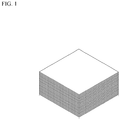
- FIG. 1 is a schematic view of an electrical steel sheet product according to an exemplary embodiment of the present invention. As shown in FIG. 1 , a plurality of electrical steel sheets are stacked.
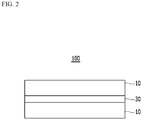
- FIG. 2 is a schematic diagram of a cross-section of an electrical steel sheet product according to an exemplary embodiment of the present invention.
- the electrical steel sheet product 100 according to an exemplary embodiment of the present invention includes: a plurality of electrical steel sheets 10; and an adhesive layer 30 disposed between the plurality of electrical steel sheets.
- the electrical steel sheet product according to an exemplary embodiment of the present invention does not use conventional methods such as welding, clamping, or interlocking, but simply forms the adhesive layer by using the aforementioned adhesive coating composition, thereby thermally fusing the different electrical steel sheets.
- the electrical steel sheet product has excellent high temperature adherence and high temperature oil resistance even after thermal fusion, and although it is a product manufactured through the stress relief annealing, there is a characteristic that the surface characteristics and adhesion characteristics are not deteriorated.
- the electrical steel sheet 10 may be used as a normal non-oriented or oriented electrical steel sheet without limitation.
- the adhesive layer 30 is formed between the plurality of electrical steel sheets 10 to manufacture the electrical steel sheet product 100, thereby the detailed description of the electrical steel sheet 10 is omitted.
- the adhesive layer 30 is formed between a plurality of electrical steel sheets 10, and the adherence is strong enough to be able to adhere the plurality of electrical steel sheets 10 without using conventional fastening methods such as welding, clamping, and interlocking.
- the aforementioned adhesive coating composition is coated on the surface and cured to form the adhesive coating layer, the adhesive coating layer is thermal-fused to form the thermal-fusion layer, and then is subjected to the stress relief annealing, thereby forming the adhesive layer. If the plurality of electrical steel sheets 10 including the adhesive coating layer are stacked and thermal-fused, the resin component in the adhesive coating layer is thermal-fused, thereby forming the thermal-fusion layer. When the stress relief annealing is performed again to the electrical steel sheet product having the thermal-fusion layer, among the adhesive coating composition components, the organic components such as the resin are mostly decomposed into CO 2 or CO and some remains.
- CO 2 or CO produced by the decomposition is not fully gasified but some is recombined in the form of a carbide in the adhesive layer 30.
- O derived from the organic resin and the metal phosphoric acid salt is produced and grown in an oxide form.
- N derived from the stress annealing atmosphere and the atmosphere is produced and grown in the form of a nitride.
- the produced and grown carbide, oxide, and nitride ensure the adherence within the adhesive layer 30.
- the adhesive layer 30 includes a metal of one or more kinds among Al, Mg, Ca, Co, Zn, Zr, and Fe at 0.5 to 30 wt%, N at 0.1 to 10 wt%, C at 0.1 to 5 wt%, P at 1 to 30 wt%, a metal of one or more kinds among Si and Ti of 10 to 30 wt%, and a balance of O.
- the metal of one or more kinds selected from Al, Mg, Ca, Co, Zn, Zr, and Fe may be derived from the metal phosphoric acid salt within the adhesive coating composition.
- the metal of one or more kinds selected from Al, Mg, Ca, Co, Zn, Zr, and Fe may be included at 0.5 to 30 wt%.
- the metal of one or more kinds selected from Al, Mg, Ca, Co, Zn, Zr, and Fe must be included in the above range to ensure proper adherence. More specifically, the metal of one or more kinds selected from Al, Mg, Ca, Co, Zn, Zr, and Fe may be included at 1 to 20 wt%. More specifically, it may be included at 1 to 10 wt%.
- the metal of one or more kinds selected from Al, Mg, Ca, Co, Zn, Zr, and Fe may be Al.
- Phosphorus (P) is derived from the metal phosphoric acid salt and phosphoric acid in the adhesive coating composition. P may be included at 1 to 30 wt% within the adhesive layer. P must be included in an appropriate amount to maintain the adherence. More specifically, P may be included at 3 to 27 wt%.
- the metal of one or more kinds among Si and Ti may be derived from SiO 2 and TiO 2 of the inorganic nanoparticles combined with the resin. More specifically, the metal of one or more kinds among Si and Ti may be Si. The metal of one or more kinds among Si and Ti may be included at 10 to 30 wt%. The metal of one or more kinds among Si and Ti must be included in an appropriate amount to maintain the adherence. More specifically, the metal of one or more kinds among Si and Ti may be included at 15 to 30 wt%.
- C, O, and N are combined with the aforementioned P, Si, Ti, Al, Mg, Ca, Co, Zn, Zr, and Fe to produce and grow a carbide, an oxide, or a nitride, thereby ensuring the adherence in the adhesive layer 30.
- C may be derived from the resin component, and O and N may be derived from the atmosphere.
- N at 0.1 to 10 wt%, C at 0.1 to 5 wt%, and O forming the balance must be included to ensure the adherence. More specifically, it may be included as N at 0.5 to 8 wt%, C at 0.2 to 3 wt%, and O at 40 to 60 wt%.
- the adhesive layer 30 includes pores within the adhesive layer.
- the pores are a part that exists as an empty space without the solid material.
- the fraction of the area occupied by the pores may be 10 to 70 %.
- the average diameter of the pores may be 20 % or less of the thickness of the adhesive layer 30. If the area fraction of the pores is too small or the average diameter of the pores is too small, the resin content is small in the adhesive coating composition, so the thermal fusibility falls and the adherence deterioration occurs even after stress relief annealing. When the area fraction of the pores is too large or the average diameter of the pores is too large, the adherence may be deteriorated due to the stability deterioration of the adhesive layer 30. More specifically, for the cross-sectional area of the adhesive layer 30, the fraction of the area occupied by the pores may be 30 to 65 %.
- the average diameter of the pores may be 0.1 to 0.7 ⁇ m.
- the cross-sectional area of the adhesive layer 30 means a cross-sectional area that includes all thicknesses of the steel sheet, and more specifically, a cross-section (a TD surface) of a rolled vertical direction.
- the thickness of the adhesive layer 30 may be 0.5 to 40 ⁇ m. When this range is satisfied, it may have excellent surface characteristics (e.g., an insulating property, corrosion resistance, a close contacting property, etc.) of the adhesive layer 30.
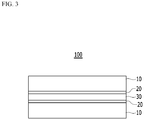
- FIG. 3 is a schematic diagram of a cross-section of an electrical steel sheet product according to another exemplary embodiment of the present invention.
- the electrical steel sheet product 100 according to an exemplary embodiment of the present invention includes: a plurality of electrical steel sheets 10; an adhesive layer 30 disposed between the plurality of electrical steel sheets; and an oxidation layer 20 disposed between the electrical steel sheet 10 and the adhesive layer 30.
- the oxide layers 20 produce a dense passivation layer by a high temperature reaction on the inorganic and metal component provided on the coalescing layer and the oxide provided on a base layer in the stress relief annealing process. As the oxide layer 20 is formed, production of an oxide in the electrical steel sheet 10 may be suppressed, and magnetism of the electrical steel sheet product 100 may be further improved.
- the oxidation layer 20 may include the metal of one or more kinds among Al, Mg, Ca, Co, Zn, Zr, and Fe at 1 to 20 wt%, N at 0.1 to 10 wt%, C at 0.1 wt% or less, P at 10 to 40 wt%, the metal of one or more kinds among Si and Ti at 5 to 30 wt%, and the balance of O.
- P is derived from phosphoric acid and a metal phosphoric acid salt in the adhesive coating composition like the adhesive layer 30.
- the metal of one or more kinds among Al, Mg, Ca, Co, Zn, Zr, and Fe is derived from the metal phosphoric acid salt in the adhesive coating composition.
- the metal of one or more kinds among Si and Ti is derived from the inorganic nanoparticles in the adhesive coating composition.
- the oxidation layer 20 may further include Fe, Si, etc. diffused from the electrical steel sheet 10 during the stress relief annealing.
- the oxidation layer 20 differs from the adhesive layer 30 in that it contains little C.
- the oxidation layer 20 may include the metal of one or more kinds among Al, Mg, Ca, Co, Zn, Zr, and Fe at 5 to 10 wt%, N at 1 to 7 wt%, C at 0.05 wt% or less, P at 20 to 30 wt%, the metal of one or more kinds among Si and Ti at 10 to 20 wt%, and the balance of O.
- the metal phosphoric acid salt and phosphoric acid are preferentially reacted with the electrical steel sheet surface, thereby suppressing the pore formation.
- the fraction of the area occupied by the pores may be 10 % or less.
- the average diameter of the pores may be 20 % or less of the thickness of the oxidation layer 20. If the fraction of the area occupied by the pores is too high or the average diameter of the pores is too large, a problem arises in the stability of the oxidation layer 20 and the adhesive layer 30, and the adherence may be deteriorated. More specifically, for the cross-sectional area of the oxidation layer 20, the fraction of the area occupied by the pores may be 5 % or less. In addition, the average diameter of the pores may be 10 to 50 nm.
- the thickness of the oxidation layer 20 may be 10 to 500 nm. If the thickness of the oxidation layer 20 is too thin, an oxide may be produced in the electrical steel sheet 10, which may adversely affect the magnetism. If the thickness of the oxidation layer 20 is too thick, the close contacting property of the oxidation layer 20 and the adhesive layer 30 is not good, so the bonding strength may be inferior.
- the method for manufacturing the electrical steel sheet product includes: preparing an adhesive coating composition; coating and curing an adhesive coating composition on the surface of the electrical steel sheet to form an adhesive coating layer; stacking and thermal-fusing a plurality of electrical steel sheets on which an adhesive coating layer is formed to form a thermal-fusion layer; and performing stress relief annealing to the thermally-fused electrical steel sheet product to form an adhesive layer.
- the adhesive coating composition is prepared. Since the adhesive coating composition has been described above, the repeated description is omitted.
- the adhesive coating composition is coated on the surface of the electrical steel sheet and then cured to form the adhesive coating layer.
- This step may be performed at a temperature range of 200 to 600 °C for the curing of the adhesive coating composition.
- the plurality of electrical steel sheets having the adhesive coating layer are stacked and thermal-fused to form the thermal-fusion layer.
- the resin components in the adhesive coating layer are thermally fused and the thermal-fusion layer is formed.
- the thermal fusion step may occur at a temperature of 150 to 300 °C, a pressure of 0.5 to 5.0 MPa, and a pressing condition of 0.1 to 120 minutes. Each condition may be satisfied independently, and two or more conditions may be satisfied simultaneously. By controlling the temperature, pressure, and time conditions in the thermal-fusion step, the thermal fusion may be densely performed without gaps or pores between the electrical steel sheets.
- the thermal-fusion step includes a temperature rising step and a fusing step, and a temperature rising speed of the temperature rising step may be 10 °C/min to 1000 °C/min.
- the thermal-fused electrical steel sheet product is subjected to the stress relief annealing to form the adhesive layer.
- the stress relief annealing may be performed for 30 to 180 min at the temperature of 500 to 900 °C.
- the step of forming the adhesive layer may be performed in a modified gas or nitrogen (N 2 ) gas atmosphere.
- the modified gas means a gas containing 10 to 30 vol% of liquefied natural gas (LNG) and 70 to 90 vol% of air.
- the nitrogen atmosphere means an atmosphere including nitrogen. Specifically, it means a gas containing nitrogen at 100 vol% or at 90 to less than 100 vol%, and containing hydrogen at more than 0 to 10 vol%.
- the step of forming the adhesive layer may further produce an oxidation layer between the adhesive layer and the electrical steel sheet. Since the adhesive layer and the oxidation layer have been described above, redundant description is omitted.
- the magnetic properties (specifically, the iron loss, the magnetic flux density, etc.) of the electrical steel sheet itself are not only improved even after stress relief annealing, but also the high temperature adherence and high temperature oil resistance of the adhesive coating layer are excellent, and particularly, the surface characteristic and the adhesion characteristic may not be deteriorated even after stress relief annealing.
- An adhesive coating composition is shown in Table 1 below.
- An average of an inorganic nanoparticle size is 30 nm.
- a non-oriented electrical steel sheet (50 X 50 mm, 0.35 mmt) is prepared as a blank specimen.
- An adhesive coating solution composed of components listed in Table 1 below was coated on the blank specimens each prepared by using a bar coater and a roll coater with a certain thickness (approximately 5.0 ⁇ m) upwardly and downwardly, and they were cured at 200 to 250 °C based on a plate temperature for 20 s and slowly cooled in air to form an adhesive coating layer.
- An electrical steel sheet on which the adhesive coating layer was coated was stacked to a height of 20 mm and pressed by a force of 500 kgf to be thermal-fused at 220 °C for 60 min.
- the electrical steel sheet obtained under the fusion condition was subjected to stress relief annealing in an atmosphere of 780 °C and nitrogen at 100 vol% as a stress relief annealing condition.
- the adherence of the electrical steel sheet thermal-fused for each condition and the adherence for each electrical steel sheet to which the stress relief annealing was performed were measured by a shearing surface tension method.
- the specific evaluation conditions are as follows.
- Adherence the adherence was measured after and before the stress relief annealing by using a device that fixes a sample on upper/lower jigs with a certain force and then pulls at a constant speed to measure a tensile force of a stacked sample. At this time, the measured value was measured at the point where the interface having the minimum adherence separates among the interfaces of the stacked sample.
- Table 2 The measured adherence is summarized and shown in Table 2 below.
- Example 1 to Example 5 which satisfy all the components and component ratios of the present application, it may be confirmed that all adherences of the adhesive layers are excellent.
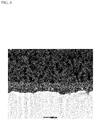
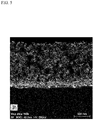
- FIG. 4 is a transmission electron microscope (TEM) photograph of a cross-section of an electrical steel sheet product in Example 1.
- TEM transmission electron microscope
- FIG. 5 to FIG. 7 represent P, Si, and O element analysis results of an electrical steel sheet product, respectively. As shown in FIG. 5 to FIG. 7 , it may be confirmed that P, Si, and O are uniformly distributed except at the pore portion in the adhesive layer and oxidation layer. It may be confirmed that O is formed in a large amount in the oxidation layer compared to the adhesive layer.
- the adhesive coating composition is shown in Table 3 below. Except for the adhesive coating composition, it was carried out in the same manner as in the aforementioned Experimental Example 1.
- Example 6 to Example 9 satisfying both the components and component ratios of the present application, it may be confirmed that all adherences were excellent.
- Comparative Example 7 the content of the phosphoric acid was low in the adhesive coating composition, the content of P in the adhesive layer and the oxidation layer was low, and the adherence was poor.
- Comparative Example 8 the content of the inorganic nanoparticles in the adhesive coating composition was high such that the Si content in the adhesive layer and the oxidation layer was analyzed to be in excess and the adherence was inferior.
Landscapes
- Chemical & Material Sciences (AREA)
- Organic Chemistry (AREA)
- Inorganic Chemistry (AREA)
- Engineering & Computer Science (AREA)
- Ceramic Engineering (AREA)
- Soft Magnetic Materials (AREA)
- Laminated Bodies (AREA)
- Chemical Treatment Of Metals (AREA)
- Adhesives Or Adhesive Processes (AREA)
- Manufacturing Of Steel Electrode Plates (AREA)
Applications Claiming Priority (2)
| Application Number | Priority Date | Filing Date | Title |
|---|---|---|---|
| KR1020170180116A KR102112171B1 (ko) | 2017-12-26 | 2017-12-26 | 전기강판 접착 코팅 조성물, 전기강판 제품, 및 이의 제조 방법 |
| PCT/KR2018/016031 WO2019132355A1 (ko) | 2017-12-26 | 2018-12-17 | 전기강판 접착 코팅 조성물, 전기강판 제품, 및 이의 제조방법 |
Publications (2)
| Publication Number | Publication Date |
|---|---|
| EP3733806A1 true EP3733806A1 (de) | 2020-11-04 |
| EP3733806A4 EP3733806A4 (de) | 2021-06-30 |
Family
ID=67067831
Family Applications (1)
| Application Number | Title | Priority Date | Filing Date |
|---|---|---|---|
| EP18894968.9A Pending EP3733806A4 (de) | 2017-12-26 | 2018-12-17 | Elektrische stahlblechklebstoffbeschichtungszusammensetzung, elektrisches stahlblechprodukt und herstellungsverfahren dafür |
Country Status (6)
| Country | Link |
|---|---|
| US (1) | US11613673B2 (de) |
| EP (1) | EP3733806A4 (de) |
| JP (1) | JP7037658B2 (de) |
| KR (1) | KR102112171B1 (de) |
| CN (1) | CN111542576B (de) |
| WO (1) | WO2019132355A1 (de) |
Cited By (1)
| Publication number | Priority date | Publication date | Assignee | Title |
|---|---|---|---|---|
| EP4265409A4 (de) * | 2020-12-21 | 2024-05-01 | POSCO Co., Ltd | Selbstbindendes elektrisches stahlblech und laminat damit |
Families Citing this family (1)
| Publication number | Priority date | Publication date | Assignee | Title |
|---|---|---|---|---|
| KR102114810B1 (ko) * | 2017-12-26 | 2020-05-25 | 주식회사 포스코 | 전기강판 접착 코팅 조성물, 전기강판 적층체 및 전기강판 제품의 제조 방법 |
Family Cites Families (22)
| Publication number | Priority date | Publication date | Assignee | Title |
|---|---|---|---|---|
| US6159534A (en) * | 1998-11-23 | 2000-12-12 | Nippon Steel Corporation | Method for producing non-oriented electromagnetic steel sheet having insulating film excellent in film properties |
| JP4700286B2 (ja) | 2004-02-27 | 2011-06-15 | 新日本製鐵株式会社 | 絶縁被膜特性の良好な無方向性電磁鋼板 |
| KR100886236B1 (ko) | 2004-10-18 | 2009-03-02 | 신닛뽄세이테쯔 카부시키카이샤 | 내열 접착성 절연 피막 |
| KR101264231B1 (ko) | 2009-12-23 | 2013-05-22 | 주식회사 포스코 | 절연성이 우수한 절연피막 형성용 피복조성물, 이를 이용한 무방향성 전기강판 및 무방향성 전기강판의 절연피막 형성방법 |
| WO2011102328A1 (ja) * | 2010-02-18 | 2011-08-25 | 新日本製鐵株式会社 | 無方向性電磁鋼板及びその製造方法 |
| JP5741190B2 (ja) * | 2010-05-17 | 2015-07-01 | Jfeスチール株式会社 | 半有機絶縁被膜付き電磁鋼板 |
| KR101324260B1 (ko) | 2011-12-28 | 2013-11-01 | 주식회사 포스코 | 무방향성 전기강판의 절연 피막 조성물, 그 제조방법 및 절연 피막조성물이 적용된 무방향성 전기강판 |
| KR20140099923A (ko) | 2011-12-28 | 2014-08-13 | 제이에프이 스틸 가부시키가이샤 | 코팅 부착 방향성 전자 강판 및 그의 제조 방법 |
| KR101481127B1 (ko) * | 2012-11-12 | 2015-01-14 | 주식회사 포스코 | 절연피막 조성물, 이를 이용한 무방향성 전기강판의 절연피막 형성방법 및 무방향성 전기강판 |
| KR101481128B1 (ko) * | 2012-11-12 | 2015-01-21 | 주식회사 포스코 | 절연피막 조성물, 이를 이용한 무방향성 전기강판의 절연피막 형성방법 및 무방향성 전기강판 |
| KR101561280B1 (ko) * | 2013-11-27 | 2015-10-16 | 주식회사 포스코 | 무방향성 전기 강판 코팅 조성물, 무방향성 전기 강판 제품의 제조 방법 및 무방향성 전기 강판 제품 |
| JP6176181B2 (ja) | 2014-04-22 | 2017-08-09 | Jfeスチール株式会社 | 積層電磁鋼板およびその製造方法 |
| KR101797129B1 (ko) * | 2015-12-21 | 2017-11-13 | 주식회사 포스코 | 무방향성 전기강판 접착 코팅 조성물, 무방향성 전기강판 제품, 및 이의 제조 방법 |
| KR101736627B1 (ko) | 2015-12-22 | 2017-05-17 | 주식회사 포스코 | 철손이 낮고 절연특성이 우수한 방향성 전기강판 및 그 제조방법 |
| KR102444224B1 (ko) | 2015-12-23 | 2022-09-16 | 주식회사 포스코 | 무방향성 전기강판 접착 코팅 조성물, 무방향성 전기강판 제품, 및 이의 제조 방법 |
| JP6682892B2 (ja) | 2016-02-08 | 2020-04-15 | 日本製鉄株式会社 | 電磁鋼板及び電磁鋼板の製造方法 |
| JP1571838S (de) | 2016-05-17 | 2017-03-21 | ||
| EP3561014A4 (de) * | 2016-12-23 | 2020-05-27 | Posco | Elektrische stahlblechklebstoffbeschichtungszusammensetzung, elektrisches stahlblechprodukt und herstellungsverfahren dafür |
| KR101904306B1 (ko) | 2016-12-23 | 2018-10-04 | 주식회사 포스코 | 무방향성 전기강판 접착 코팅 조성물 및 무방향성 전기강판 제품의 제조 방법 |
| KR102114810B1 (ko) | 2017-12-26 | 2020-05-25 | 주식회사 포스코 | 전기강판 접착 코팅 조성물, 전기강판 적층체 및 전기강판 제품의 제조 방법 |
| KR102033029B1 (ko) | 2017-12-26 | 2019-10-16 | 주식회사 포스코 | 전기강판 적층체, 및 이의 제조 방법 |
| KR102091123B1 (ko) | 2017-12-26 | 2020-03-19 | 주식회사 포스코 | 전기강판 제품 및 전기강판 제품의 제조 방법 |
-
2017
- 2017-12-26 KR KR1020170180116A patent/KR102112171B1/ko active Active
-
2018
- 2018-12-17 WO PCT/KR2018/016031 patent/WO2019132355A1/ko not_active Ceased
- 2018-12-17 US US16/958,137 patent/US11613673B2/en active Active
- 2018-12-17 EP EP18894968.9A patent/EP3733806A4/de active Pending
- 2018-12-17 JP JP2020536094A patent/JP7037658B2/ja active Active
- 2018-12-17 CN CN201880084867.6A patent/CN111542576B/zh active Active
Cited By (1)
| Publication number | Priority date | Publication date | Assignee | Title |
|---|---|---|---|---|
| EP4265409A4 (de) * | 2020-12-21 | 2024-05-01 | POSCO Co., Ltd | Selbstbindendes elektrisches stahlblech und laminat damit |
Also Published As
| Publication number | Publication date |
|---|---|
| CN111542576A (zh) | 2020-08-14 |
| JP2021510181A (ja) | 2021-04-15 |
| KR20190078282A (ko) | 2019-07-04 |
| US20200362202A1 (en) | 2020-11-19 |
| KR102112171B1 (ko) | 2020-05-18 |
| CN111542576B (zh) | 2021-11-30 |
| JP7037658B2 (ja) | 2022-03-16 |
| WO2019132355A1 (ko) | 2019-07-04 |
| US11613673B2 (en) | 2023-03-28 |
| EP3733806A4 (de) | 2021-06-30 |
Similar Documents
| Publication | Publication Date | Title |
|---|---|---|
| EP3561015A1 (de) | Haftbeschichtungszusammensetzung für nicht orientiertes elektrisches stahlblech und verfahren zur herstellung eines nicht orientierten elektrischen stahlblechs | |
| JP7324183B2 (ja) | 電磁鋼板製品 | |
| KR102033029B1 (ko) | 전기강판 적층체, 및 이의 제조 방법 | |
| KR102444224B1 (ko) | 무방향성 전기강판 접착 코팅 조성물, 무방향성 전기강판 제품, 및 이의 제조 방법 | |
| KR101797129B1 (ko) | 무방향성 전기강판 접착 코팅 조성물, 무방향성 전기강판 제품, 및 이의 제조 방법 | |
| EP2800103B1 (de) | Isolationsbeschichtungszusammensetzung für nichtorientiertes elektrostahlblech, verfahren zu ihrer herstellung und nichtorientiertes elektrostahlblech, auf das die isolationsbeschichtungszusammensetzung aufgebracht ist | |
| US12018181B2 (en) | Adhesive coating composition for electrical steel sheet, electrical steel sheet laminate and method for manufacturing electrical steel sheet product | |
| EP3733806A1 (de) | Elektrische stahlblechklebstoffbeschichtungszusammensetzung, elektrisches stahlblechprodukt und herstellungsverfahren dafür | |
| JP7603759B2 (ja) | 軟磁性粉末及び圧粉磁心 | |
| EP3858602A1 (de) | Elektrostahlblechlaminat | |
| KR102091123B1 (ko) | 전기강판 제품 및 전기강판 제품의 제조 방법 |
Legal Events
| Date | Code | Title | Description |
|---|---|---|---|
| STAA | Information on the status of an ep patent application or granted ep patent |
Free format text: STATUS: THE INTERNATIONAL PUBLICATION HAS BEEN MADE |
|
| PUAI | Public reference made under article 153(3) epc to a published international application that has entered the european phase |
Free format text: ORIGINAL CODE: 0009012 |
|
| STAA | Information on the status of an ep patent application or granted ep patent |
Free format text: STATUS: REQUEST FOR EXAMINATION WAS MADE |
|
| 17P | Request for examination filed |
Effective date: 20200714 |
|
| AK | Designated contracting states |
Kind code of ref document: A1 Designated state(s): AL AT BE BG CH CY CZ DE DK EE ES FI FR GB GR HR HU IE IS IT LI LT LU LV MC MK MT NL NO PL PT RO RS SE SI SK SM TR |
|
| AX | Request for extension of the european patent |
Extension state: BA ME |
|
| RIC1 | Information provided on ipc code assigned before grant |
Ipc: B32B 7/12 20060101ALI20210119BHEP Ipc: C09J 11/04 20060101AFI20210119BHEP |
|
| DAV | Request for validation of the european patent (deleted) | ||
| DAX | Request for extension of the european patent (deleted) | ||
| A4 | Supplementary search report drawn up and despatched |
Effective date: 20210602 |
|
| RIC1 | Information provided on ipc code assigned before grant |
Ipc: C09J 11/04 20060101AFI20210527BHEP Ipc: C09J 5/06 20060101ALI20210527BHEP Ipc: B32B 7/12 20060101ALI20210527BHEP |
|
| RAP3 | Party data changed (applicant data changed or rights of an application transferred) |
Owner name: POSCO HOLDINGS INC. |
|
| RAP1 | Party data changed (applicant data changed or rights of an application transferred) |
Owner name: POSCO CO., LTD |
|
| STAA | Information on the status of an ep patent application or granted ep patent |
Free format text: STATUS: EXAMINATION IS IN PROGRESS |
|
| 17Q | First examination report despatched |
Effective date: 20240202 |