EP3733952A1 - Waschmaschine und verfahren zur steuerung der waschmaschine - Google Patents
Waschmaschine und verfahren zur steuerung der waschmaschine Download PDFInfo
- Publication number
- EP3733952A1 EP3733952A1 EP18897041.2A EP18897041A EP3733952A1 EP 3733952 A1 EP3733952 A1 EP 3733952A1 EP 18897041 A EP18897041 A EP 18897041A EP 3733952 A1 EP3733952 A1 EP 3733952A1
- Authority
- EP
- European Patent Office
- Prior art keywords
- voice
- washing
- laundry
- washing machine
- information
- Prior art date
- Legal status (The legal status is an assumption and is not a legal conclusion. Google has not performed a legal analysis and makes no representation as to the accuracy of the status listed.)
- Granted
Links
Images








Classifications
-
- D—TEXTILES; PAPER
- D06—TREATMENT OF TEXTILES OR THE LIKE; LAUNDERING; FLEXIBLE MATERIALS NOT OTHERWISE PROVIDED FOR
- D06F—LAUNDERING, DRYING, IRONING, PRESSING OR FOLDING TEXTILE ARTICLES
- D06F34/00—Details of control systems for washing machines, washer-dryers or laundry dryers
- D06F34/28—Arrangements for program selection, e.g. control panels therefor; Arrangements for indicating program parameters, e.g. the selected program or its progress
- D06F34/32—Arrangements for program selection, e.g. control panels therefor; Arrangements for indicating program parameters, e.g. the selected program or its progress characterised by graphical features, e.g. touchscreens
-
- D—TEXTILES; PAPER
- D06—TREATMENT OF TEXTILES OR THE LIKE; LAUNDERING; FLEXIBLE MATERIALS NOT OTHERWISE PROVIDED FOR
- D06F—LAUNDERING, DRYING, IRONING, PRESSING OR FOLDING TEXTILE ARTICLES
- D06F33/00—Control of operations performed in washing machines or washer-dryers
- D06F33/30—Control of washing machines characterised by the purpose or target of the control
- D06F33/32—Control of operational steps, e.g. optimisation or improvement of operational steps depending on the condition of the laundry
-
- D—TEXTILES; PAPER
- D06—TREATMENT OF TEXTILES OR THE LIKE; LAUNDERING; FLEXIBLE MATERIALS NOT OTHERWISE PROVIDED FOR
- D06F—LAUNDERING, DRYING, IRONING, PRESSING OR FOLDING TEXTILE ARTICLES
- D06F34/00—Details of control systems for washing machines, washer-dryers or laundry dryers
- D06F34/04—Signal transfer or data transmission arrangements
- D06F34/05—Signal transfer or data transmission arrangements for wireless communication between components, e.g. for remote monitoring or control
-
- D—TEXTILES; PAPER
- D06—TREATMENT OF TEXTILES OR THE LIKE; LAUNDERING; FLEXIBLE MATERIALS NOT OTHERWISE PROVIDED FOR
- D06F—LAUNDERING, DRYING, IRONING, PRESSING OR FOLDING TEXTILE ARTICLES
- D06F34/00—Details of control systems for washing machines, washer-dryers or laundry dryers
- D06F34/14—Arrangements for detecting or measuring specific parameters
- D06F34/18—Condition of the laundry, e.g. nature or weight
-
- D—TEXTILES; PAPER
- D06—TREATMENT OF TEXTILES OR THE LIKE; LAUNDERING; FLEXIBLE MATERIALS NOT OTHERWISE PROVIDED FOR
- D06F—LAUNDERING, DRYING, IRONING, PRESSING OR FOLDING TEXTILE ARTICLES
- D06F34/00—Details of control systems for washing machines, washer-dryers or laundry dryers
- D06F34/14—Arrangements for detecting or measuring specific parameters
- D06F34/20—Parameters relating to constructional components, e.g. door sensors
-
- D—TEXTILES; PAPER
- D06—TREATMENT OF TEXTILES OR THE LIKE; LAUNDERING; FLEXIBLE MATERIALS NOT OTHERWISE PROVIDED FOR
- D06F—LAUNDERING, DRYING, IRONING, PRESSING OR FOLDING TEXTILE ARTICLES
- D06F39/00—Details of washing machines not specific to a single type of machines covered by groups D06F9/00 - D06F27/00
- D06F39/12—Casings; Tubs
- D06F39/14—Doors or covers; Securing means therefor
-
- G—PHYSICS
- G06—COMPUTING OR CALCULATING; COUNTING
- G06F—ELECTRIC DIGITAL DATA PROCESSING
- G06F3/00—Input arrangements for transferring data to be processed into a form capable of being handled by the computer; Output arrangements for transferring data from processing unit to output unit, e.g. interface arrangements
- G06F3/01—Input arrangements or combined input and output arrangements for interaction between user and computer
- G06F3/03—Arrangements for converting the position or the displacement of a member into a coded form
- G06F3/041—Digitisers, e.g. for touch screens or touch pads, characterised by the transducing means
-
- G—PHYSICS
- G06—COMPUTING OR CALCULATING; COUNTING
- G06F—ELECTRIC DIGITAL DATA PROCESSING
- G06F3/00—Input arrangements for transferring data to be processed into a form capable of being handled by the computer; Output arrangements for transferring data from processing unit to output unit, e.g. interface arrangements
- G06F3/01—Input arrangements or combined input and output arrangements for interaction between user and computer
- G06F3/048—Interaction techniques based on graphical user interfaces [GUI]
- G06F3/0487—Interaction techniques based on graphical user interfaces [GUI] using specific features provided by the input device, e.g. functions controlled by the rotation of a mouse with dual sensing arrangements, or of the nature of the input device, e.g. tap gestures based on pressure sensed by a digitiser
- G06F3/0488—Interaction techniques based on graphical user interfaces [GUI] using specific features provided by the input device, e.g. functions controlled by the rotation of a mouse with dual sensing arrangements, or of the nature of the input device, e.g. tap gestures based on pressure sensed by a digitiser using a touch-screen or digitiser, e.g. input of commands through traced gestures
-
- G—PHYSICS
- G10—MUSICAL INSTRUMENTS; ACOUSTICS
- G10L—SPEECH ANALYSIS TECHNIQUES OR SPEECH SYNTHESIS; SPEECH RECOGNITION; SPEECH OR VOICE PROCESSING TECHNIQUES; SPEECH OR AUDIO CODING OR DECODING
- G10L15/00—Speech recognition
- G10L15/22—Procedures used during a speech recognition process, e.g. man-machine dialogue
-
- D—TEXTILES; PAPER
- D06—TREATMENT OF TEXTILES OR THE LIKE; LAUNDERING; FLEXIBLE MATERIALS NOT OTHERWISE PROVIDED FOR
- D06F—LAUNDERING, DRYING, IRONING, PRESSING OR FOLDING TEXTILE ARTICLES
- D06F2101/00—User input for the control of domestic laundry washing machines, washer-dryers or laundry dryers
-
- D—TEXTILES; PAPER
- D06—TREATMENT OF TEXTILES OR THE LIKE; LAUNDERING; FLEXIBLE MATERIALS NOT OTHERWISE PROVIDED FOR
- D06F—LAUNDERING, DRYING, IRONING, PRESSING OR FOLDING TEXTILE ARTICLES
- D06F2101/00—User input for the control of domestic laundry washing machines, washer-dryers or laundry dryers
- D06F2101/02—Characteristics of laundry or load
-
- D—TEXTILES; PAPER
- D06—TREATMENT OF TEXTILES OR THE LIKE; LAUNDERING; FLEXIBLE MATERIALS NOT OTHERWISE PROVIDED FOR
- D06F—LAUNDERING, DRYING, IRONING, PRESSING OR FOLDING TEXTILE ARTICLES
- D06F2101/00—User input for the control of domestic laundry washing machines, washer-dryers or laundry dryers
- D06F2101/02—Characteristics of laundry or load
- D06F2101/06—Type or material
-
- D—TEXTILES; PAPER
- D06—TREATMENT OF TEXTILES OR THE LIKE; LAUNDERING; FLEXIBLE MATERIALS NOT OTHERWISE PROVIDED FOR
- D06F—LAUNDERING, DRYING, IRONING, PRESSING OR FOLDING TEXTILE ARTICLES
- D06F2101/00—User input for the control of domestic laundry washing machines, washer-dryers or laundry dryers
- D06F2101/20—Operation modes, e.g. delicate laundry washing programs, service modes or refreshment cycles
-
- D—TEXTILES; PAPER
- D06—TREATMENT OF TEXTILES OR THE LIKE; LAUNDERING; FLEXIBLE MATERIALS NOT OTHERWISE PROVIDED FOR
- D06F—LAUNDERING, DRYING, IRONING, PRESSING OR FOLDING TEXTILE ARTICLES
- D06F2105/00—Systems or parameters controlled or affected by the control systems of washing machines, washer-dryers or laundry dryers
- D06F2105/52—Changing sequence of operational steps; Carrying out additional operational steps; Modifying operational steps, e.g. by extending duration of steps
-
- D—TEXTILES; PAPER
- D06—TREATMENT OF TEXTILES OR THE LIKE; LAUNDERING; FLEXIBLE MATERIALS NOT OTHERWISE PROVIDED FOR
- D06F—LAUNDERING, DRYING, IRONING, PRESSING OR FOLDING TEXTILE ARTICLES
- D06F2105/00—Systems or parameters controlled or affected by the control systems of washing machines, washer-dryers or laundry dryers
- D06F2105/58—Indications or alarms to the control system or to the user
-
- D—TEXTILES; PAPER
- D06—TREATMENT OF TEXTILES OR THE LIKE; LAUNDERING; FLEXIBLE MATERIALS NOT OTHERWISE PROVIDED FOR
- D06F—LAUNDERING, DRYING, IRONING, PRESSING OR FOLDING TEXTILE ARTICLES
- D06F25/00—Washing machines with receptacles, e.g. perforated, having a rotary movement, e.g. oscillatory movement, the receptacle serving both for washing and for centrifugally separating water from the laundry and having further drying means, e.g. using hot air
-
- D—TEXTILES; PAPER
- D06—TREATMENT OF TEXTILES OR THE LIKE; LAUNDERING; FLEXIBLE MATERIALS NOT OTHERWISE PROVIDED FOR
- D06F—LAUNDERING, DRYING, IRONING, PRESSING OR FOLDING TEXTILE ARTICLES
- D06F34/00—Details of control systems for washing machines, washer-dryers or laundry dryers
- D06F34/28—Arrangements for program selection, e.g. control panels therefor; Arrangements for indicating program parameters, e.g. the selected program or its progress
-
- D—TEXTILES; PAPER
- D06—TREATMENT OF TEXTILES OR THE LIKE; LAUNDERING; FLEXIBLE MATERIALS NOT OTHERWISE PROVIDED FOR
- D06F—LAUNDERING, DRYING, IRONING, PRESSING OR FOLDING TEXTILE ARTICLES
- D06F39/00—Details of washing machines not specific to a single type of machines covered by groups D06F9/00 - D06F27/00
-
- G—PHYSICS
- G10—MUSICAL INSTRUMENTS; ACOUSTICS
- G10L—SPEECH ANALYSIS TECHNIQUES OR SPEECH SYNTHESIS; SPEECH RECOGNITION; SPEECH OR VOICE PROCESSING TECHNIQUES; SPEECH OR AUDIO CODING OR DECODING
- G10L15/00—Speech recognition
- G10L15/22—Procedures used during a speech recognition process, e.g. man-machine dialogue
- G10L2015/225—Feedback of the input speech
Definitions
- the present disclosure relates to a washing machine capable of recognizing a user's voice and a method operating the washing machine.
- a washing machine includes all of a device for washing clothes, a dryer for drying clothes, and a device capable of washing and drying clothes together. Washing of clothes is a process of removing contaminants adhering to laundry through the action of water and detergent, and drying of clothes is a process of removing moisture contained in clothes through, for example, a hot air supply device. Furthermore, in recent years, a refresher for refreshing clothes using hot air or steam other than washing with water has been released, and the refresher may also be referred to as a washing machine. In addition, a dishwasher for washing dishes, but not clothes, may also be referred to as a a washing machine in a broad sense, and a washing machine referred to herein includes all of the foregoing various devices.
- a typical washing machine includes a control unit that displays visual information related to a cycle processed in the washing machine and receives a user's manipulation.
- a control unit is typically provided in a washing machine body, and provided with a plurality of buttons or knobs for simply displaying and manipulating only a predetermined cycle in an on/off manner.
- research has been actively conducted to implement a control unit as a touch screen by focusing on the simple appearance of a washing machine.
- an aspect of the present disclosure is to provide a washing machine capable of performing a voice interaction related to laundry and an operating method thereof while placing laundry therein in consideration of the characteristics of the washing machine in which the laundry must be directly placed by a user.
- Another aspect of the present disclosure is to provide a washing machine and an operation method thereof capable of automatically setting an optimal washing course based on a voice interaction related to laundry.
- Still another aspect of the present disclosure is provide a washing machine and an operation method thereof capable of remembering a user's voice command even when the voice command that is not related to a current laundry course is input, and then automatically executing a function when entering the relevant laundry course or when taking out laundry.
- a washing machine may include a washing tub: a voice receiver configured to receive voice information; a communication unit activated by a starting phrase input to communicate with a server that provides washing-related information; a touch screen that outputs a graphic object corresponding to a washing-related function executable by the washing tub; and a control unit that senses a user's proximity to display a first graphic object on the touch screen, and controls the touch screen to switch the first graphic object to a second graphic object indicating that a voice recognition function is activated in response to the input of the starting phrase, wherein the control unit analyzes the received voice information in response to receiving the voice information related to laundry, and outputs feedback voice related to washing of the relevant laundry based on the analysis result.
- information related to the laundry may include input information or inquiry information on at least one of a type of laundry, a degree of contamination, a washing method, and a decontamination method
- information related to washing of the laundry may include answer information on at least one of whether to be separately washed, a method of washing laundry, a handling precaution, whether to change the cycle according to a degree of contamination, and a decontamination method.
- control unit may analyze the voice of the user who inputs the the starting phrase to generate response voice including matching user information, and switch the second graphic object to a third graphic object corresponding to a washing-related function when the generated response voice is output.
- the voice receiver may be switched to a standby mode while the feedback voice related to washing of laundry is output, and the output of the feedback voice may be stopped to switch the standby mode to an execution mode when voice information is received while the feedback voice is output.
- a type of laundry may be extracted as a keyword in response to receiving voice information including the type of laundry, and the keyword may be displayed in the form of dictation on the touch screen while the extracted keyword is output as voice.
- control unit may receive laundry-related information matching the keyword from the server, and generate feedback information related to washing of the relevant laundry based on the received laundry-related information and the received voice information.
- control unit may determine whether the relevant laundry is laundry to be separately washed based on the analysis of voice information related to laundry received at a first time point and voice information received at a second time point after the elapse of the first time point, and output different voice feedback according to the determination.
- control unit may set individual washing cycles based on the analysis of voice information related to laundry, and output feedback voice for guiding the set individual cycles when a washing start command is input.
- a plurality of icons corresponding to different types of laundry may be displayed on the touch screen, and the control unit may recognize a type of laundry corresponding to a touched icon in response to a touch applied to at least one of the plurality of icons being dragged to a predetermined region of the touch screen, and change the washing cycle including the recognized type of laundry.
- control unit may trigger to capture a laundry image using a camera provided in the washing machine or an external terminal connected thereto, and transmit the acquired laundry image to the server to receive information related to washing of the laundry.
- control unit may determine a degree of contamination of laundry based on the analysis of voice information related to the laundry, and output voice feedback related to a change of the washing cycle based on the determined degree of contamination.
- control unit may generate a washing start command with the changed washing cycle based on a user response to the output voice feedback.
- first voice that guides the set washing cycle and second voice that informs that washing is started with the set washing cycle may be sequentially output based on voice information related to laundry when the closing of the washing machine door is sensed.
- control unit when the closing of the washing machine door is sensed while feedback voice related to washing of laundry is output, the control unit may control to stop outputting the feedback voice and output the first voice.
- the washing machine may further include a memory for storing the input voice memo while washing is in progress, wherein the control unit outputs the stored voice memo in the form of a voice prompt in response to sensing the opening of the washing machine door subsequent to the completion of washing.
- a method of operating a washing machine is a method of operating a washing machine having a touch screen and capable of receiving voice information, and the method may include sensing a user's proximity to display a first graphic object on the touch screen; connecting a server providing washing-related information in a communicable manner by a starting phrase input to display a second graphic object indicating that a voice recognition function is activated on the touch screen; receiving voice information related to laundry; and analyzing the received voice information to output feedback voice related to washing of the relevant laundry.
- a voice interaction related to laundry may be performed while placing the laundry therein, in consideration of the characteristics of the washing machine in which the laundry must be directly placed by a user. Furthermore, an optimal laundry course may be automatically set based on a voice interaction related to laundry to perform the initiation of washing more quickly.
- a washing machine and an operation method thereof capable of remembering a user's voice even when the voice command is input regardless of the progress of a current washing course, and then automatically executing a function when entering the relevant washing course or taking out laundry.
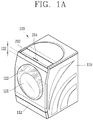
- FIG. 1A is a perspective view showing a washing machine 100 according to an embodiment of the present disclosure
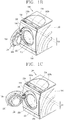
- FIGS. 1B and 1C are conceptual views showing a state in which a door 120 illustrated in FIG. 1A is rotated primarily and secondarily, respectively, to open a laundry inlet port 160a and slide a detergent supply unit 210 in a predetermined direction to be open.
- the washing machine 100 includes a main body 110 and a door 120.
- the main body 110 defines an outer shape of the washing machine 100, and includes a laundry inlet port 165 through which laundry is input.
- the laundry inlet port 165 is disposed on a front surface portion of the main body 110 having a hexahedral shape.
- the laundry accommodating portion for accommodating laundry through the laundry inlet port 165.
- the laundry accommodating portion may be referred to as a "washing tub.”
- the laundry accommodating portion may be configured as a drum 150 rotatably provided inside the main body 110.
- a laundry accommodating portion may include a tub (not shown) provided inside the main body 110 to store wash water and a drum 150 rotatably provided inside the tub to accommodate laundry.
- the main body 110 is provided with a drive unit (not shown) configured to rotate the drum 150.
- the drive unit may include a motor that generates a driving force and a belt that rotates the drum 150 using the driving force.
- the drum 150 is rotated with a rotational force according to the rotation of the motor, for example, when sensing the weight of the laundry, during the washing cycle, during the rinsing cycle, during the dehydration cycle, to wash, rinse and dehydrate laundry accommodated in the drum 150.
- the main body 110 is provided with a water supply device including a water pipe and a water inlet valve to supply water.
- one end of the water pipe is connected to an external water pipe (not shown), and the other end thereof is connected to a washing tub to receive water from the external water pipe and guide laundry detergent accommodated in a storage container of a detergent supply unit together with water into the drum 150.
- the water inlet valve is opened and closed during the washing and rinsing cycles to control the supply of water into the drum 150.
- a touch screen 122 may be provided on an upper front portion of the main body 110. In this case, it may be configured to turn on or off the power of the washing machine 100 through a touch input to the touch screen 122. In this case, a power button is not provided thereon to implement a simpler appearance.
- the touch screen 122 will be described in more detail below.
- a detergent supply unit 210 may be provided on an upper surface of the main body 110 to be slidable in a vertical direction.
- a handle 214 may be provided on the upper surface of the main body 110 to facilitate sliding and movement of the detergent supply unit 210 upward and downward.
- Laundry detergent and softener may be added and stored inside the laundry detergent supply unit 210.
- Laundry detergent includes both liquid and powder forms, and includes all substances that enhance the washing effect of laundry, such as fabric detergent and fabric bleach.
- the detergent supply unit 210 includes a storage container composed of a detergent accommodating unit 212a in which laundry detergent is accommodated and a softener accommodating unit 212b in which liquid softener is accommodated.
- the detergent supply unit 210 may include a laundry detergent supply passage (not shown) configured to supply laundry detergent and liquid softener accommodated in the storage container to the washing tub and a laundry detergent pump (not shown) provided in the laundry detergent supply passage.
- a door 120 is rotatably provided with respect to the main body 110 by a hinge unit 140, and is configured to open and close the laundry inlet port 165.
- the main body 110 may be recessed inward from an outer surface thereof, and may include a door accommodating portion 160 having a laundry inlet port 165 therein. While the door 120 is closed, the door 120 is accommodated in the door accommodating portion 160, and an outer edge portion of the door 120 is disposed to have the same plane as an outer surface of the main body 110 adjacent thereto.
- a hinge unit 140 may have a double hinge structure having two different rotating shafts.
- the hinge unit 140 may be configured such that the door 120 is separated from the door accommodating portion 160 by primary rotation about any one rotating shaft, and then rotated by secondary rotation about the other rotating shaft.
- a locking device for fixing or releasing the door 120 to or from the main body 110 is provided on the other side of the door 120.
- the locking device may be configured in a press type to lock the door 120 when the other side of the door 120 is pressed once, and unlock the door 120 when pressed once again.
- a window 121 is provided on the door 120. Furthermore, a second touch screen (not shown) may be provided in part of the window 121 or a region of the door 120 out of the window 121.
- the window 121 is disposed to correspond to the laundry inlet port 165, and configured to look into the laundry accommodating portion. Accordingly, the user may check the state of laundry accommodated in the laundry accommodating portion through the window 121.
- the touch screen 122 displays (outputs) information processed by the washing machine 100.
- the touch screen 122 may display execution screen information of a cycle (washing, dehydration, drying cycles, etc.) driven by the washing machine 100 or user interface (Ul) or graphic user interface (GUI) information corresponding to the execution screen information.
- execution screen information of a cycle washing, dehydration, drying cycles, etc.
- User user interface
- GUI graphic user interface
- the touch screen 122 is illustrated as being provided on an upper front portion of the main body, but is not limited thereto.
- the touch screen 122 may be provided at any position of a side surface, a lower portion of the main body, or a side surface of the window 121 or the door 120, and may also be provided at a plurality of positions.
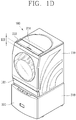
- the washing machine 100 may be configured with a structure including an auxiliary washing device at a lower portion or at one side of the main body 110, as illustrated in FIG. 1D .
- the washing machine 100 of FIG. 1D may include a first cabinet 110 defining an outer shape of a main washing device and a second cabinet 310 defining an outer shape of the auxiliary washing device.
- the first cabinet 110 and the second cabinet 310 may be integrally formed.
- the auxiliary washing device may exist in various forms. For an example, it may be defined of a top-loading type washing device, or may have the same structure or a different structure as or from the main washing device.
- the auxiliary washing device may be configured to be provided such that at least one of the washing capacity, volume, and height is smaller than the main washing device. Accordingly, the user may appropriately and selectively use at least one of the main washing device and the auxiliary washing device according to the amount of laundry. Furthermore, the user may select at least one of the main washing device and the auxiliary washing device according to the type of laundry.
- the auxiliary washing device may include a second cabinet defining an appearance, a drawer housing configured to be drawn into or drawn out of the second cabinet 310, and a second washing tub provided inside the drawer housing.
- the drawer housing may be drawn into the second cabinet 310 or drawn out of the second cabinet 310 through an opening portion disposed in the second cabinet 310 toward a forward direction of the auxiliary washing device or may be withdrawn from the second cabinet 310.
- a cover panel 331 may be provided in front of the drawer housing.
- the cover panel 331 may be integrally formed with the drawer housing.
- a handle for drawing a drawer housing thereinto or out thereof may be disposed on the cover panel 331.
- a control panel for operating the auxiliary washing device may be provided on an upper surface of the cover panel 331.
- the touch screen 122 may function as a user input unit that provides an input interface between the washing machine 100 and the user, and at the same time, provide an output interface between the washing machine 100 and the user. For example, selection and change of an operation mode for performing washing, dehydration, drying cycles, and the like, may be implemented using a user's touch input (or touch) on the touch screen 122.
- the touch screen 122 is provided with a touch sensor to sense a touch input.
- the touch sensor detects a touch input applied to the touch screen 122 using at least one of various touch methods such as a resistive film method, a capacitive method, an infrared method, an ultrasonic method, and a magnetic field method.
- various touch methods such as a resistive film method, a capacitive method, an infrared method, an ultrasonic method, and a magnetic field method.
- the touch sensor may be configured to convert a change in pressure applied to a specific portion of the touch screen 122 or capacitance generated in the specific portion into an electrical input signal.
- the touch sensor may be configured to detect a location, area of a touch object that applies a touch on the touch screen 122 is touched on the touch screen 122, a pressure during the touch, and the like.
- the touch object is an object that applies a touch to the touch screen 122, and may be, for example, a finger, a touch pen or a stylus pen, a pointer, and the like.
- a signal (signals) corresponding thereto is sent to the controller.
- the controller processes the signal(s) and then transmits data thereto to a control unit 180 (see FIG. 3 ).
- the control unit 180 may know which region of the touch screen 122 has been touched.
- the controller may be a separate configuration from the control unit 180, or may be the control unit 180 itself.
- control unit 180 may perform different controls or perform the same control according to the type of the touch object that touches the touch screen 122. Whether to perform different control or the same control according to the type of the touch object may be determined according to an operating state of the washing machine 100 or an application program being executed.
- the touch screen 122 may sense various types of touches, such as a short (or tap) touch, a long touch, a multi touch, a drag touch, a flick touch, a pinch-in touch, a pinch-out touch, a swype touch, a hovering touch, and the like.
- the washing machine may recognize a voice, and execute a voice recognition function that controls the operation of the washing machine based on the recognized voice.
- the voice recognition function is a function capable of controlling the operation of a device, for example, a washing machine, through voice, and may include a natural language analysis function that analyzes natural languages, a question and answer function that provides answers to questions, a voice processing function that converts digital voice signals into a language that can be processed by a computer, an automatic interpretation and translation function that converts voice into multiple languages, and the like.
- the washing machine according to the present disclosure may be set to either one of a standby state or a voice recognition state, depending on whether the voice recognition function is executed.
- the standby state denotes a state of sensing whether voice related to the execution of the voice recognition function is present around the washing machine prior to executing the voice recognition function.
- the control unit 180 of the washing machine 100 may continuously observe (or monitor) whether or not sound above a specific loudness is sensed through a microphone even in the standby state.
- This standby state may also be referred to as a "listening phase".
- the control unit 180 of the washing machine may be switched from the standby state to the voice recognition state when sound above a specific loudness determined in the standby state is sensed.
- the voice recognition state may be switched back to the standby state while the washing machine utters, that is, while the washing machine outputs a feedback voice.
- the user's voice is received (even if it is not a starting phrase), it is immediately switched to the voice recognition state.
- FIG. 2 is a view for explaining an environment in which a washing machine capable of executing a voice recognition function as described above communicates with an external terminal and a server.
- the washing machine 100 may communicate with an external terminal 200 and a server (“artificial intelligence server") 300 that provides washing-related information.
- the washing machine 100 may have a unique device ID, and when registered with the server 300 through a unique device ID, the washing machine 100 may receive various information and services from the server 300.
- the external terminal 200 may include a mobile terminal such as a mobile phone, a smart phone, a laptop, a computer, but is not limited thereto, and may also include a stationary terminal.
- a mobile terminal such as a mobile phone, a smart phone, a laptop, a computer, but is not limited thereto, and may also include a stationary terminal.
- the server 300 performs remote management services for household appliances including a washing machine.
- the server 300 may generate a control command based on washing-related information and transmit it to the washing machine 100 or the external terminal 200 paired with the washing machine 100 to control the operation of the washing machine.
- the washing machine 100 may include a short-range wireless communication module, such as a Wi-Fi communication module, a Zigbee communication module, to communicate with the server 300 and the network network 500.
- a short-range wireless communication module such as a Wi-Fi communication module, a Zigbee communication module
- the washing machine 100 may be applied with a wireless Internet module to communicate with the server 300 through an Internet network 500 through an AP (Access Point).
- AP Access Point
- the received user's voice information of the washing machine 100 may be transmitted to the server 300 through the network 500 and an analysis result may be received from the server 300, and then outputted through the washing machine 100.
- voice feedback described herein may be generated by combining washing-related information received from the server 300 and a voice analysis result of the washing machine 100 itself.
- FIG. 3 is an exemplary block diagram for explaining the detailed configuration of the washing machine 100 according to the embodiment of the present disclosure described above.
- the washing machine 100 may further include a control unit 180 including a voice recognition module, a communication unit 155, an audio output unit 125, a sensing unit 145, a voice receiver 135, a camera 136, and a memory 195 in addition to the touch screen 122 described above.
- a control unit 180 including a voice recognition module, a communication unit 155, an audio output unit 125, a sensing unit 145, a voice receiver 135, a camera 136, and a memory 195 in addition to the touch screen 122 described above.
- the communication unit 155 may support short-range communication using at least one of BluetoothTM, RFID (Radio Frequency Identification), infrared communication (Infrared Data Association; IrDA), UWB (Ultra Wideband), ZigBee, NFC (Near Field Communication), Wi-Fi (Wireless-Fidelity), Wi-Fi Direct, and Wireless Universal Serial Bus (USB) technologies.
- RFID Radio Frequency Identification
- IrDA Infrared Data Association
- UWB Ultra Wideband
- ZigBee Ultra Wideband
- NFC Near Field Communication
- Wi-Fi Wireless-Fidelity
- Wi-Fi Direct Wireless Universal Serial Bus
- USB Wireless Universal Serial Bus
- the user terminal may include, for example, a smart phone, a tablet, a laptop, an ultrabook, a wearable device, a watch type terminal, and the like.
- the control unit 180 controls overall operations related to the driving of the washing machine 100. In addition, the control unit 180 may control the operation of each component provided in the washing machine 100 to process signals generated therefrom.
- the audio output unit 125 may be configured to output a predetermined notification sound or voice when an event related to washing occurs.
- the event related to washing may denote connection to an external device, power on/off, washing course setting, setting/changing of individual cycles such as rinsing, dehydration, drying, etc., initiation of washing, completion of washing, addition of laundry detergent, insufficient amount of laundry detergent, and the like.
- the sensing unit 145 may include one or more sensors for sensing at least one of information in the washing machine 100, surrounding environment information around the washing machine 100, and user information.
- the sensing unit 145 may include a sensor configured to sense the opening and closing of the door 120, and the sensor may be disposed on one side of the door 120 or the hinge unit 140.
- the sensing unit 145 may sense that a user approaches or moves away from the washing machine 100 through a proximity sensor 146.
- the registered user terminal may sense that the terminal approaches or moves away from the washing machine 100.
- the memory 195 may store a program related to washing and information related to operations.
- the memory 195 may include at least one type storage medium among a flash memory type, a hard disk type, an SSD type (Solid State Disk type), an SDD type (Silicon Disk Drive type), and a multimedia card micro type, a card type memory (e.g., SD or XD memory, etc.), a random access memory (RAM), a static random access memory (SRAM), a read-only memory (ROM), an EEPROM (electrically erasable programmable read-only memory), a PROM (programmable read-only memory), a magnetic memory, a magnetic disk, and an optical disk.
- a flash memory type e.g., a hard disk type, an SSD type (Solid State Disk type), an SDD type (Silicon Disk Drive type), and a multimedia card micro type
- a card type memory e.g., SD or XD memory, etc.
- RAM random access memory
- the memory 195 may store user voice received through the voice receiver 135 or information according to the execution of a voice recognition function. In addition, the memory 195 may update setting information related to the cycles of a washing course based on a user input.
- the voice recognition module 182 may analyze voice received through the voice receiver 135 through a natural language processing algorithm. Then, the voice recognition module 182 may convert the analyzed voice information into a computer-processable language.
- the voice recognition module 182 is described as a device built in the control unit 180 or a separate device independent therefrom, but hereinafter, it is disclosed that both perform a voice recognition function through the control unit 180.
- the camera 136 includes at least one of a camera sensor (e.g., CCD, CMOS, etc.), a photo sensor (or image sensor), and a laser sensor.
- the camera 136 and the laser sensor are combined with each other to sense a touch of a sensing object for a 3D stereoscopic image.
- the photo sensor may be stacked on a display element, and the photo sensor is configured to scan the movement of a sensing object in proximity to the touch screen. More specifically, the photo sensor is mounted with photo diodes and TRs (transistors) in rows and columns to scan contents placed on the photo sensor using electrical signals that change according to the amount of light applied to the photo diode.
- the photo sensor performs coordinate calculation of the sensing object according to the change amount of light, and through this, the location information of the sensing object may be acquired.
- an image of laundry is captured through the camera 136, and transmitted to the server 300 or the connected external terminal 200.
- the washing machine 100 when the proximity of a user is sensed, a first graphic object indicating the proximity is displayed on the screen, and the voice recognition function of the washing machine 100 maintains a standby state. Then, when a predetermined starting phrase is input within a predetermined time period, the voice recognition function of the washing machine 100 is switched from the standby state to the execution state, and a second graphic object corresponding to the execution state of the voice recognition function is output on the screen. As a result, the washing machine 100 is controlled based on voice uttered by the user or becomes a state capable of receiving and analyzing voice information related to laundry, which will be described later.
- control unit 180 analyzes the relevant voice information to output feedback voice related to washing of the relevant laundry.
- the information related to laundry may include input information or inquiry information on at least one of a laundry type, a degree of contamination, a washing method, and a decontamination method.
- information related to washing of laundry which is feedback information provided from the washing machine 100, may include answer information on at least one of whether to be separately washed, a method of washing laundry, a handling precaution, whether to change the cycle according to a degree of contamination, and a method of removing contaminants.
- the user may directly utter the type of laundry while placing the laundry therein to allow the washing machine 100 to recognize it, or directly inquire whether specific laundry is water washable.
- the washing machine 100 may automatically set a suitable washing course stroke based on an analysis result of the received voice information and the output feedback voice. For example, when the user utters that "clothes are a bit dirty" while placing laundry therein, the washing machine 100 may increase a level of contamination, and accordingly increase the amount of detergent to be automatically added, increase the washing time, or set the water temperature to be high.
- the washing machine may search for washing-related information from the server 300 to receive a decontamination method associated with the type of the relevant laundry and the decontamination method.
- an appropriate decontamination method may be output as voice from the washing machine 100.
- a customized laundry course may be set correspondingly while recognizing the uttered laundry in order, so as to output it with voice feedback prior to the initiation of washing.
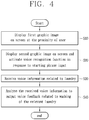
- FIG. 4 is a representative flowchart for explaining the operation of a washing machine according to an embodiment of the present disclosure.
- a first graphic image is displayed on the touch screen 122 in response to sensing that the user approaches the main body of the washing machine within a reference range (S10).
- moving animation images for example, graphic images 501, 502 such as blinking an LED, may be displayed while the touch screen 122 that has been turned off is turned on, as illustrated in FIG. 5A .
- the touch screen 122 may be turned off again while displaying the animation images of FIG. 5A in reverse order.
- the washing machine 100 When the first graphic object is displayed in a power-off state of the washing machine 100, the washing machine 100 is now in a listening state/standby state. In the standby state, the voice receiver 135 of the washing machine 100 continuously monitors whether sound above a specific loudness is sensed through a microphone, for example.
- the washing machine 100 is switched back to the power-off state or sleep mode.
- a voice recognition function is activated to display a second graphic image indicating it on the touch screen 122 (S20). Then, connection to the server 300 (see FIG. 2 ) linked according to the starting phrase input is activated.
- the starting phrase is a control command for starting a voice analysis, and may be set to various words for each device.
- the start phrase may be set as "Hello, washer", and the like., but is not limited thereto, and may be modified in various ways.
- the control unit 180 may start a voice analysis on voice uttered subsequent to such a starting phrase. That is, the voice recognition function of the washing machine 100 is switched to an execution state according to the input of the starting phrase.
- the second graphic image may be an image including information on a registered user as illustrated in FIG. 5B .
- the control unit 180 may analyze the voice of the user who inputs the starting phrase to generate response voice including matching user information. For example, as illustrated in FIG. 5B , text such as "Hello! Esther" may be displayed on the touch screen 122 while at the same time outputting voice.
- the second graphic object when the response voice (e.g., "Hello! Esther") is output, the second graphic object may be converted into a third graphic object corresponding to a washing-related function.
- the third graphic object corresponding to a washing-related function may be an initial washing screen including various menus and time information for setting a washing course.
- the control unit 180 may analyze voice information, using a voice recognition algorithm, for the voice information received after the starting phrase. In addition, the control unit 180 may control the operation of the washing machine 100 according to a voice command corresponding to voice information based on the analysis result. Alternatively, the voice analysis may be performed through the execution of a separate application installed in the external terminal 200 that is paired with or in wireless communication with the washing machine 100.
- voice information related to laundry may be received from the user (S30).
- the voice information related to laundry may be limited to user voice received while the opened state of the washing machine door is maintained or until the closed state of the washing machine door is sensed.
- a search range (“laundry") may be clearly limited, thereby providing more accurate and specific voice feedback.
- it is not meant to ignore voice information being received later, but it should be understood as recognizing it as normal voice information to process the corresponding command.
- the control unit 180 may additionally output text information that is the same as or related to voice feedback through the touch screen 122 while the voice feedback is being output.
- control unit 180 of the washing machine 100 may transmit voice information related to laundry to the aforementioned server or another artificial intelligence server to process the voice information analyzed through an artificial intelligence algorithm.
- the server or the artificial intelligence server denotes a server that provides a function of learning a large amount of information using an artificial intelligence algorithm and deriving optimal result information based on the learned information.
- the control unit 180 of the washing machine 100 may have its own artificial intelligence algorithm and generate feedback information related to washing of laundry based on the stored data.
- the third graphic object may be output while voice information is received from the user, and a fourth graphic object different from the third graphic object may be output while the washing machine 100 outputs feedback voice. Accordingly, it may be possible to visually confirm the subject of the uttered voice.
- dynamic images 604a, 604b repeatedly moving in left and right directions as illustrated in FIG. 6D may be continuously output on the touch screen 122.
- the voice receiver may be switched to the standby mode while the feedback voice related to washing of laundry is output.
- a designated indicator for example, a microphone off display image 510 may be displayed in one region of the touch screen 122.
- the control unit 180 may stop outputting the feedback voice when voice information is received from the user.
- the changed feedback voice may further include query information for requesting confirmation from the user in order to determine that the voice information being input later conforms to the user's intention.
- the indicator 510 illustrated in FIGS. 5B , 6B, and 6C that has been output on the touch screen 122 immediately disappears. Accordingly, it is intuitive that the washing machine has been switched to a state capable of analyzing voice information.
- FIGS. 6A through 6C illustrate a specific example of feedback on voice information related to laundry.
- voice information regarding the type of laundry e.g., "Here are a dark denim and a white sweater”
- the third graphic object 601 indicating that the user's voice is listening may be displayed on the touch screen 122 of the washing machine 100.
- control unit 180 may recognize the laundry by only the predetermined number to output the recognition result through voice as well as to additionally output voice asking to utter by cutting to less than the predetermined number or an intermediate answer (e.g., OK, anything else?').
- a predetermined number e.g., 5
- the control unit 180 may recognize the laundry by only the predetermined number to output the recognition result through voice as well as to additionally output voice asking to utter by cutting to less than the predetermined number or an intermediate answer (e.g., OK, anything else?').
- the control unit 180 In response to receiving the voice information including the type of laundry, the control unit 180 extracts the type of laundry as a keyword ("dark denim” or "white sweater”). Then, while outputting the extracted keywords as voice as illustrated in FIG. 6B (612), the control unit 180 also displays the keywords in the form of dictation on the touch screen 122 (602). As an exception, when a dictation mute function is being executed, extracted keywords may be displayed only on the touch screen 122.
- the voice receiver 135 While the extracted keywords being output, the voice receiver 135 enters a standby state for a while, and the indicator 510 indicating the state appears on the touch screen.
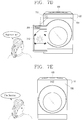
- voice information is additionally received from the user (e.g., "No! It's white cotton T-shirt".) while only some of the keywords are output, the control unit 180 immediately stops dictation and voice output, and when the user's utterance ends, the changed dictation and voice output are subsequently output based on the voice information being input later.
- control unit 180 may also receive laundry-related information matching the extracted keywords from the linked server 300. For example, handling precautions for the "sweater" from the server 300 may be received and combined with voice information uttered by the user to generate feedback information regarding washing of laundry.
- control unit 180 may determine whether the relevant laundry is laundry to be separately washed based on the analysis of voice information related to laundry received at a first time point and voice information received at a second time point after the elapse of the first time point, and output different voice feedback according to the determination.
- the first time point and the second time point may include not only a case where a plurality of voice information are received with a time difference, but also a plurality of time points/sections separated from single voice information.
- a dark denim and a white sweater are included in single voice information, but "dark denim” is uttered at the first time point and “white sweater” is uttered at the second time point.
- the control unit 180 may determine that the "dark denim” that has been input at the first time point and the "white sweater” that has been input at the second time point cannot be washed together and thus must be washed separately. Accordingly, voice feedback such as "Please wash the white sweater separately” may be output.
- a fourth graphic object indicating that the washing machine is uttering may be displayed on the touch screen 122 while outputting the voice feedback.
- control unit 180 may query whether there is no more laundry to be added.
- control unit 180 automatically sets an optimal washing course based on the type and amount of laundry recognized through voice. To this end, the control unit 180 presets the individual cycles of a washing course based on the analysis of voice information related to laundry, and outputs feedback voice informing the set individual cycles in response to the input of a washing start command, and then proceeds washing.
- an optimal laundry course may be automatically set based on voice interactions associated with laundry, and upon receiving a washing start input, washing may be quickly started with the optimal laundry course.
- FIGS. 7A, 7B, 7C , 7D, and 7E an example of a method of registering a washing machine using an external terminal for voice interaction in a washing machine according to an embodiment of the present disclosure will be described in detail.
- the washing machine 100 In order to perform a voice interaction according to the present disclosure, the washing machine 100 must be registered with the server 300, and for this purpose, after installing a specific application on the mobile terminal 200, information on the washing machine 100 must be read and sent to the server 300.
- the information related to the washing machine 100 includes a unique device ID and product characteristic information.
- a user ID and password may be additionally included therein.
- the product characteristic information may include the model information, product code, manufacturing date, serial number, and the like of the washing machine.
- screen information 701 for guiding a predetermined application to be installed on the external terminal 200 to be paired with the washing machine 100 may be displayed together with a predetermined indicator 510 on the touch screen 122.
- the control unit 180 When a specific application is installed in the external terminal 200, the control unit 180 performs a process of displaying screen information 702 for guiding the external terminal 200 to approach the main body or the touch screen 122 of the washing machine 100 as illustrated in FIG. 7B .
- a unique pattern dynamic image 711 including the relevant device ID and product characteristic information may be displayed on the touch screen 122 of the washing machine 100, and the external terminal 200 may capture it to recognize the relevant device ID and product characteristic information by itself based on the captured image 712 or transmit them to the server 300 connected through an application.
- product registration to the server 300 may be finally completed by the user uttering voice such as "Register me” or by applying a predetermined input to the external terminal 200.
- the server 300 authenticates the received information, and then transmits its own ID and location information to the external terminal 200 and the washing machine 100 when registration is possible. From then on, the server 300 may recognize the washing machine related information, AP information, and user information connected to the server 300, and continuously learn by collecting data related to the operation of the washing machine.
- FIG. 7E is an example of a method of additionally registering a user matching the registered washing machine 100.
- the control unit 180 confirms the voice recognition and text name of the received voice information by matching them, and performs registration based on a user response.
- the matched user name may be uttered in response to the input of the starting phrase.
- the user's name may be queried in the form of a conversation (e.g., "What's your name?") and stored with the recognized voice.
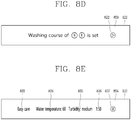
- FIGS. 8A, 8B, 8C , 8D, and 8E show still another exemplary screen of a process of sorting laundry and selecting a laundry course.
- screen information 801 displayed with a plurality of icons 812, 813 corresponding to different types of laundry may be displayed on the touch screen 122.
- the plurality of icons 812, 813 may display information regarding the types and characteristics of laundry, and the control unit 180 recognizes that laundry corresponding to the selected icon between the displayed icons 812, 813 is placed in the washing tub.
- the selected icons 812a, 813a are moved to a predetermined region, for example, a "Make Cycle display region" as illustrated in FIG. 8B .
- the selection of icons may be replaced with or performed in parallel with a touch input in addition to the voice-based operation.
- control unit 180 recognizes the type of laundry corresponding to the touched icon in response to a touch applied to at least one of the plurality of icons being dragged to a predetermined region 811 of the touch screen 122. Next, the control unit 180 changes the individual cycles of the washing course correspondingly, including the recognized type of laundry.
- control unit 180 may drag a touch applied to the icon to the predetermined region 811 to additionally input the type of laundry to be washed.
- screen information 802 and voice information for checking the loaded laundry may be output as shown in FIG. 8C , and the user may additionally recognize the laundry by answering affirmatively or selecting the previous menu 821.
- screen information 803 indicating that a washing course is set according to laundry recognized as being added is displayed.
- a washing start icon 822 is selected from the screen information 803 or a predetermined time period (e.g., 3 seconds) has elapsed
- screen information 804 confirming the set washing course cycle as shown in FIG. 8E is displayed on the touch screen 122.
- washing start may be stopped by touching a washing stop icon 827.
- the control unit 180 may trigger to capture a laundry image using the camera 136 provided in the washing machine 100 or the connected external terminal.
- the trigger may be a guide prompt indicating that capturing is ready.
- control unit 180 may transmit the captured laundry image to the server 300 to obtain information related to washing of the laundry, for example, a type of the captured laundry, a method of removing contamination, and output voice feedback.
- FIG. 9 is an exemplary flowchart for explaining a process of providing a different feedback according to an analysis of received voice information in a washing machine according to an embodiment of the present disclosure and in a washing machine.
- a voice recognition function of the washing machine is activated based on a starting phrase input or a preset type of user input (S901). Then, while placing laundry therein, voice information related to the laundry is received (S902).
- the control unit 180 of the washing machine analyzes the received voice information (S903), and determines whether it is voice information related to the type of laundry (S904). This is to limit the scope of search and provide an accurate and specific response at once.
- voice feedback related to the classification of the laundry is output (S905).
- voice information related to the type of laundry it is further determined whether it is voice information related to a degree of contamination of laundry (S906).
- voice feedback related to the changed cycle of the laundry course is output (S907), and the changed cycle is set based on a subsequent user input (S908).
- step S906 when it is not voice information related to the degree of contamination of laundry in step S906, feedback information is displayed on the touch screen 122 (S909).
- multiple feedback information may be presented to allow the user to select through a touch input.
- control unit 180 sequentially outputs first voice that guides the set washing cycle and second voice that informs that washing is started with the set washing cycle based on voice information related to laundry.
- third voice may be further output to check whether there is no laundry to be additionally placed therein before outputting the first voice.
- the washing machine door may be automatically opened or unlocked to place laundry therein.
- control unit 180 may immediately stop outputting the feedback voice and output the first voice. As a result, a fast washing process suitable for the user's intention is implemented.
- FIGS. 10A through 10C show a method of providing a voice memo subsequent to the completion of washing.
- the washing machine 100 includes a memory 195 for storing the input voice memo while washing is in progress.
- a voice memo function may be executed by uttering predetermined voice (e.g., "memo"). Accordingly, information (e.g., "Add Memo”) 1001 is displayed on the touch screen 122 to guide the activation of a voice memo function and the input of a voice memo.
- predetermined voice e.g., "memo”
- information 1001 is displayed on the touch screen 122 to guide the activation of a voice memo function and the input of a voice memo.
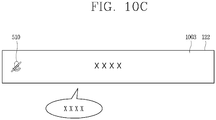
- the control unit 180 may output a voice memo stored in the memory 195 in the form of a voice prompt in response to sensing the opening of the washing machine door as shown in FIG. 10B subsequent to the completion of washing.
- a prompt such as have a voice memo
- the stored voice memo is output while at the same time it is also provided in the form of dictation on the touch screen 122 as shown in FIG. 10C (1003).
- the stored voice memo is output as voice. Accordingly, a more efficient and intelligent washing may be performed.
- the output of the voice memo it is also possible to set the output of the voice memo to be output only when a specific user approaches.
- a voice memo upon an input of a voice memo, it may be implemented to output the voice memo only when the name of the registered user B is uttered together with the voice memo, and the registered user B utters a starting phrase or another voice, and limit the output of the voice memo when another user C opens or closes the door.
- FIG. 11 is an exemplary flowchart for explaining processing when a plurality of voice information having different washing steps is received.
- a voice recognition function of the washing machine is activated based on a starting phrase input or a preset type of user input (S1101).
- a plurality of voice information related to a washing course is received (S1102).
- the step of washing course and the degree of washing progress at a time point when a plurality of voice information are received are not an obstacle.
- the control unit 180 determines whether a command for an upper/lower washing cycle of the current washing course is included therein (S1103). At this time, a case where only part of the plurality of voice information is a command for the upper/lower washing cycle of the current washing course is also included therein.
- voice feedback corresponding to the analysis of the received voice information is output (S1106).
- voice for guiding that other stored feedback information will be output may be additionally output.
- the stored feedback information is output as voice (S1107) to execute a function corresponding thereto. Accordingly, even when a user's voice command related to the current washing course is input, it is remembered to automatically execute a function when entering the relevant washing course or when laundry is taken out.
- a voice interaction related to laundry may be performed while placing the laundry therein, in consideration of the characteristics of the washing machine in which the laundry must be directly placed by a user. Furthermore, an optimal laundry course may be automatically set based on a voice interaction related to laundry to perform the initiation of washing more quickly.
- a washing machine and an operation method thereof capable of remembering a user's voice even when the voice command is input regardless of the progress of a current washing course, and then automatically executing a function when entering the relevant washing course or taking out laundry.
- the foregoing present disclosure may be implemented as codes readable by a computer on a medium written by the program.
- the computer-readable media may include all kinds of recording devices in which data readable by a computer system is stored. Examples of the computer-readable media may include ROM, RAM, CD-ROM, magnetic tape, floppy disk, and optical data storage device, and the like, and also include a device implemented in the form of a carrier wave (for example, transmission via the Internet).
- the computer may include the control unit 180 of the mobile terminal. Accordingly, the detailed description thereof should not be construed as restrictive in all aspects but considered as illustrative. The scope of the invention should be determined by reasonable interpretation of the appended claims and all changes that come within the equivalent scope of the invention are included in the scope of the invention.
Landscapes
- Engineering & Computer Science (AREA)
- Textile Engineering (AREA)
- Physics & Mathematics (AREA)
- Human Computer Interaction (AREA)
- Theoretical Computer Science (AREA)
- General Engineering & Computer Science (AREA)
- Computational Linguistics (AREA)
- Health & Medical Sciences (AREA)
- Audiology, Speech & Language Pathology (AREA)
- Acoustics & Sound (AREA)
- Multimedia (AREA)
- General Physics & Mathematics (AREA)
- Computer Networks & Wireless Communication (AREA)
- Control Of Washing Machine And Dryer (AREA)
Applications Claiming Priority (2)
| Application Number | Priority Date | Filing Date | Title |
|---|---|---|---|
| KR1020170184683A KR102428782B1 (ko) | 2017-12-29 | 2017-12-29 | 세탁기 및 세탁기의 동작방법 |
| PCT/KR2018/015260 WO2019132284A1 (ko) | 2017-12-29 | 2018-12-04 | 세탁기 및 세탁기의 동작방법 |
Publications (3)
| Publication Number | Publication Date |
|---|---|
| EP3733952A1 true EP3733952A1 (de) | 2020-11-04 |
| EP3733952A4 EP3733952A4 (de) | 2021-09-08 |
| EP3733952B1 EP3733952B1 (de) | 2024-02-28 |
Family
ID=67067821
Family Applications (1)
| Application Number | Title | Priority Date | Filing Date |
|---|---|---|---|
| EP18897041.2A Active EP3733952B1 (de) | 2017-12-29 | 2018-12-04 | Waschmaschine |
Country Status (4)
| Country | Link |
|---|---|
| US (1) | US11840790B2 (de) |
| EP (1) | EP3733952B1 (de) |
| KR (1) | KR102428782B1 (de) |
| WO (1) | WO2019132284A1 (de) |
Cited By (2)
| Publication number | Priority date | Publication date | Assignee | Title |
|---|---|---|---|---|
| EP4363655A4 (de) * | 2021-06-30 | 2025-03-19 | LG Electronics Inc. | Schnittstelle und wäschebehandlungsvorrichtung damit |
| EP4575068A4 (de) * | 2022-09-27 | 2025-11-19 | Lg Electronics Inc | Wäschebehandlungsvorrichtung und steuerungsverfahren dafür |
Families Citing this family (22)
| Publication number | Priority date | Publication date | Assignee | Title |
|---|---|---|---|---|
| US20210166698A1 (en) * | 2018-08-10 | 2021-06-03 | Sony Corporation | Information processing apparatus and information processing method |
| US11482215B2 (en) | 2019-03-27 | 2022-10-25 | Samsung Electronics Co., Ltd. | Multi-modal interaction with intelligent assistants in voice command devices |
| US11182123B2 (en) * | 2019-04-30 | 2021-11-23 | Whirlpool Corporation | User-interface system for a laundry appliance |
| US11686032B2 (en) * | 2019-04-30 | 2023-06-27 | Whirlpool Corporation | User-interface system for a laundry appliance |
| KR102170088B1 (ko) * | 2019-07-24 | 2020-10-26 | 네이버 주식회사 | 인공지능 기반 자동 응답 방법 및 시스템 |
| WO2021033785A1 (ko) * | 2019-08-16 | 2021-02-25 | 엘지전자 주식회사 | 사용자의 음성을 통해 가전 기기를 제어할 수 있는 디스플레이 장치 및 인공 지능 서버 |
| WO2021045258A1 (ko) * | 2019-09-04 | 2021-03-11 | 엘지전자 주식회사 | 인공지능 세탁물 처리기기 |
| DE102019213656A1 (de) | 2019-09-09 | 2021-03-11 | BSH Hausgeräte GmbH | Haushaltsgerät, System mit einem Haushaltsgerät und Verfahren zum Betreiben eines Haushaltsgeräts |
| DE102019213655A1 (de) | 2019-09-09 | 2021-03-11 | BSH Hausgeräte GmbH | Haushaltsgerät, System mit einem Haushaltsgerät und Verfahren zum Betreiben eines Haushaltsgeräts |
| DE102019214521B4 (de) * | 2019-09-24 | 2021-04-29 | BSH Hausgeräte GmbH | Hausgerät und Verfahren zur komfortablen und sicheren Bedienung eines Hausgeräts |
| CN111088647B (zh) * | 2020-01-19 | 2024-02-09 | 青岛海尔洗衣机有限公司 | 用于衣物处理设备的自定义控制方法 |
| CN114108229B (zh) * | 2020-08-28 | 2023-11-07 | 青岛海尔洗衣机有限公司 | 衣物处理装置的控制方法及服务器 |
| DE102020131516B4 (de) * | 2020-11-27 | 2025-09-18 | Emz-Hanauer Gmbh & Co. Kgaa | Elektrisches Haushaltsgerät mit Näherungs-Bedienelement mit überlappenden Sensorelektroden |
| CN114756153A (zh) * | 2020-12-29 | 2022-07-15 | 青岛海尔洗衣机有限公司 | 洗涤设备及其交互界面跳转控制方法、控制装置 |
| KR20220102976A (ko) | 2021-01-14 | 2022-07-21 | 삼성전자주식회사 | 서버, 세탁기 및 이를 포함하는 세탁 시스템 |
| CN113046993A (zh) * | 2021-03-19 | 2021-06-29 | 合肥美菱物联科技有限公司 | 一种智能洗衣机及其控制方法 |
| WO2024106845A1 (ko) * | 2022-11-17 | 2024-05-23 | 삼성전자주식회사 | 식기 세척기 및 이의 제어 방법 |
| CA225070S (en) * | 2022-12-27 | 2025-07-21 | Lg Electronics Inc | Display panel with animated graphical user interface |
| CA224687S (en) * | 2022-12-27 | 2025-07-16 | Lg Electronics Inc | Display panel with graphical user interface |
| KR102907503B1 (ko) * | 2023-01-03 | 2026-01-02 | 엘지전자 주식회사 | 세탁물 처리기기 |
| US12534840B2 (en) | 2023-01-17 | 2026-01-27 | Haier Us Appliance Solutions, Inc. | Unlocking laundry appliances with acoustic waves |
| US20250369274A1 (en) * | 2024-05-29 | 2025-12-04 | Haier Us Appliance Solutions, Inc. | Automatic door opening assembly for a washing machine appliance |
Family Cites Families (15)
| Publication number | Priority date | Publication date | Assignee | Title |
|---|---|---|---|---|
| US9103061B2 (en) * | 2006-06-08 | 2015-08-11 | Whirlpool Corporation | Product service system and method |
| WO2012092445A2 (en) * | 2010-12-30 | 2012-07-05 | Electrolux Home Products, Inc. | User control interface for an appliance, and associated method |
| KR101861660B1 (ko) * | 2011-03-03 | 2018-05-28 | 엘지전자 주식회사 | 컨트롤 패널 및 이를 구비하는 세탁장치 및 그 제어방법 |
| KR101994693B1 (ko) | 2012-12-05 | 2019-07-01 | 엘지전자 주식회사 | 세탁기 및 세탁기 제어방법 |
| KR102024086B1 (ko) * | 2012-12-28 | 2019-09-23 | 엘지전자 주식회사 | 세탁기 및 세탁기 제어방법 |
| KR102124932B1 (ko) * | 2013-01-25 | 2020-06-19 | 엘지전자 주식회사 | 세탁기 및 세탁기 제어방법 |
| KR102077563B1 (ko) * | 2013-09-17 | 2020-02-14 | 엘지전자 주식회사 | 홈 어플라이언스 및 그 동작방법 |
| WO2015055239A1 (en) * | 2013-10-16 | 2015-04-23 | Saronikos Trading And Services, Unipessoal Lda | Laundry washing machine with speech recognition and response capabilities and method for operating same |
| KR102220910B1 (ko) * | 2014-01-10 | 2021-02-25 | 엘지전자 주식회사 | 가전제품 및 가전제품 제어방법 |
| KR102217559B1 (ko) * | 2014-03-10 | 2021-02-19 | 엘지전자 주식회사 | 세탁기의 제어 장치 및 그의 방법 |
| EP2977501B1 (de) * | 2014-07-22 | 2017-11-01 | Electrolux Appliances Aktiebolag | Waschmaschine und/oder Trockner mit Notöffnungsmöglichkeit |
| JP6444642B2 (ja) * | 2014-07-24 | 2018-12-26 | シャープ株式会社 | 洗濯機 |
| KR102643351B1 (ko) * | 2016-01-05 | 2024-03-07 | 엘지전자 주식회사 | 의류처리장치 |
| US10304463B2 (en) * | 2016-10-03 | 2019-05-28 | Google Llc | Multi-user personalization at a voice interface device |
| KR102371752B1 (ko) * | 2017-08-31 | 2022-03-07 | 삼성전자주식회사 | 가전 기기 및 그의 제어방법 |
-
2017
- 2017-12-29 KR KR1020170184683A patent/KR102428782B1/ko active Active
-
2018
- 2018-12-04 EP EP18897041.2A patent/EP3733952B1/de active Active
- 2018-12-04 US US16/957,448 patent/US11840790B2/en active Active
- 2018-12-04 WO PCT/KR2018/015260 patent/WO2019132284A1/ko not_active Ceased
Cited By (2)
| Publication number | Priority date | Publication date | Assignee | Title |
|---|---|---|---|---|
| EP4363655A4 (de) * | 2021-06-30 | 2025-03-19 | LG Electronics Inc. | Schnittstelle und wäschebehandlungsvorrichtung damit |
| EP4575068A4 (de) * | 2022-09-27 | 2025-11-19 | Lg Electronics Inc | Wäschebehandlungsvorrichtung und steuerungsverfahren dafür |
Also Published As
| Publication number | Publication date |
|---|---|
| EP3733952A4 (de) | 2021-09-08 |
| EP3733952B1 (de) | 2024-02-28 |
| US11840790B2 (en) | 2023-12-12 |
| KR102428782B1 (ko) | 2022-08-03 |
| US20200362497A1 (en) | 2020-11-19 |
| KR20190081856A (ko) | 2019-07-09 |
| WO2019132284A1 (ko) | 2019-07-04 |
Similar Documents
| Publication | Publication Date | Title |
|---|---|---|
| EP3733952B1 (de) | Waschmaschine | |
| AU2018349213B2 (en) | Washing machine and operating method of washing machine | |
| KR102643351B1 (ko) | 의류처리장치 | |
| KR102442974B1 (ko) | 세탁기 및 세탁기의 동작방법 | |
| EP2430765B1 (de) | Waschmaschinensteuerung mittels mobilgerät, verfahren zum betreiben des mobilgeräts, waschmaschine und verfahren zum betreiben der waschmaschine | |
| KR102448500B1 (ko) | 인공지능 세탁기 및 그 제어 방법 | |
| KR102051370B1 (ko) | 가전기기 및 가전기기 제어방법 | |
| KR102024086B1 (ko) | 세탁기 및 세탁기 제어방법 | |
| KR102647035B1 (ko) | 의류처리장치 | |
| KR102124932B1 (ko) | 세탁기 및 세탁기 제어방법 | |
| CN109074819A (zh) | 基于操作-声音的多模式命令的优选控制方法及应用其的电子设备 | |
| CN104238946B (zh) | 一种触控方法、装置及终端 | |
| CN105242870A (zh) | 具有触摸屏的终端的防误触方法及装置 | |
| CN104932712A (zh) | 文本输入方法和装置 | |
| CN105246045A (zh) | 用户位置变化的确定方法及装置 | |
| CN118979362B (zh) | 一种洗衣设备门体的控制方法、装置、设备及介质 | |
| CN108670150B (zh) | 抽屉式洗碗机的语音控制方法、装置及可读存储介质 | |
| CN105357634A (zh) | 用户位置变化的确定方法及装置 | |
| CN104615457B (zh) | 显示控件的方法及装置 | |
| CN107436718A (zh) | 触控系统及方法 | |
| CN119960595A (zh) | 一种中控设备的控制方法、装置、中控设备和介质 | |
| CN111522488B (zh) | 一种手机端唤起任务面板的交互方法 | |
| CN115110241A (zh) | 洗衣机及其控制方法、装置、设备、介质及程序产品 | |
| CN107436698A (zh) | 触控系统及方法 | |
| CN115679616A (zh) | 衣物处理设备控制方法、装置、设备及存储介质 |
Legal Events
| Date | Code | Title | Description |
|---|---|---|---|
| STAA | Information on the status of an ep patent application or granted ep patent |
Free format text: STATUS: THE INTERNATIONAL PUBLICATION HAS BEEN MADE |
|
| PUAI | Public reference made under article 153(3) epc to a published international application that has entered the european phase |
Free format text: ORIGINAL CODE: 0009012 |
|
| STAA | Information on the status of an ep patent application or granted ep patent |
Free format text: STATUS: REQUEST FOR EXAMINATION WAS MADE |
|
| 17P | Request for examination filed |
Effective date: 20200729 |
|
| AK | Designated contracting states |
Kind code of ref document: A1 Designated state(s): AL AT BE BG CH CY CZ DE DK EE ES FI FR GB GR HR HU IE IS IT LI LT LU LV MC MK MT NL NO PL PT RO RS SE SI SK SM TR |
|
| AX | Request for extension of the european patent |
Extension state: BA ME |
|
| DAV | Request for validation of the european patent (deleted) | ||
| DAX | Request for extension of the european patent (deleted) | ||
| A4 | Supplementary search report drawn up and despatched |
Effective date: 20210805 |
|
| RIC1 | Information provided on ipc code assigned before grant |
Ipc: D06F 34/28 20200101ALN20210730BHEP Ipc: D06F 101/02 20200101ALN20210730BHEP Ipc: D06F 34/32 20200101ALN20210730BHEP Ipc: D06F 34/05 20200101ALN20210730BHEP Ipc: D06F 25/00 20060101ALN20210730BHEP Ipc: D06F 33/32 20200101AFI20210730BHEP |
|
| REG | Reference to a national code |
Ref country code: DE Ref legal event code: R079 Free format text: PREVIOUS MAIN CLASS: D06F0039000000 Ref document number: 602018066036 Country of ref document: DE Ipc: D06F0033320000 |
|
| GRAP | Despatch of communication of intention to grant a patent |
Free format text: ORIGINAL CODE: EPIDOSNIGR1 |
|
| STAA | Information on the status of an ep patent application or granted ep patent |
Free format text: STATUS: GRANT OF PATENT IS INTENDED |
|
| RIC1 | Information provided on ipc code assigned before grant |
Ipc: D06F 34/28 20200101ALN20230920BHEP Ipc: D06F 101/02 20200101ALN20230920BHEP Ipc: D06F 34/32 20200101ALN20230920BHEP Ipc: D06F 34/05 20200101ALN20230920BHEP Ipc: D06F 25/00 20060101ALN20230920BHEP Ipc: D06F 33/32 20200101AFI20230920BHEP |
|
| INTG | Intention to grant announced |
Effective date: 20231013 |
|
| RIC1 | Information provided on ipc code assigned before grant |
Ipc: D06F 34/28 20200101ALN20230929BHEP Ipc: D06F 101/02 20200101ALN20230929BHEP Ipc: D06F 34/32 20200101ALN20230929BHEP Ipc: D06F 34/05 20200101ALN20230929BHEP Ipc: D06F 25/00 20060101ALN20230929BHEP Ipc: D06F 33/32 20200101AFI20230929BHEP |
|
| GRAS | Grant fee paid |
Free format text: ORIGINAL CODE: EPIDOSNIGR3 |
|
| GRAA | (expected) grant |
Free format text: ORIGINAL CODE: 0009210 |
|
| STAA | Information on the status of an ep patent application or granted ep patent |
Free format text: STATUS: THE PATENT HAS BEEN GRANTED |
|
| AK | Designated contracting states |
Kind code of ref document: B1 Designated state(s): AL AT BE BG CH CY CZ DE DK EE ES FI FR GB GR HR HU IE IS IT LI LT LU LV MC MK MT NL NO PL PT RO RS SE SI SK SM TR |
|
| REG | Reference to a national code |
Ref country code: GB Ref legal event code: FG4D |
|
| REG | Reference to a national code |
Ref country code: CH Ref legal event code: EP |
|
| REG | Reference to a national code |
Ref country code: DE Ref legal event code: R096 Ref document number: 602018066036 Country of ref document: DE |
|
| REG | Reference to a national code |
Ref country code: IE Ref legal event code: FG4D |
|
| REG | Reference to a national code |
Ref country code: LT Ref legal event code: MG9D |
|
| PG25 | Lapsed in a contracting state [announced via postgrant information from national office to epo] |
Ref country code: IS Free format text: LAPSE BECAUSE OF FAILURE TO SUBMIT A TRANSLATION OF THE DESCRIPTION OR TO PAY THE FEE WITHIN THE PRESCRIBED TIME-LIMIT Effective date: 20240628 |
|
| REG | Reference to a national code |
Ref country code: NL Ref legal event code: MP Effective date: 20240228 |
|
| PG25 | Lapsed in a contracting state [announced via postgrant information from national office to epo] |
Ref country code: LT Free format text: LAPSE BECAUSE OF FAILURE TO SUBMIT A TRANSLATION OF THE DESCRIPTION OR TO PAY THE FEE WITHIN THE PRESCRIBED TIME-LIMIT Effective date: 20240228 |
|
| PG25 | Lapsed in a contracting state [announced via postgrant information from national office to epo] |
Ref country code: GR Free format text: LAPSE BECAUSE OF FAILURE TO SUBMIT A TRANSLATION OF THE DESCRIPTION OR TO PAY THE FEE WITHIN THE PRESCRIBED TIME-LIMIT Effective date: 20240529 |
|
| PG25 | Lapsed in a contracting state [announced via postgrant information from national office to epo] |
Ref country code: NL Free format text: LAPSE BECAUSE OF FAILURE TO SUBMIT A TRANSLATION OF THE DESCRIPTION OR TO PAY THE FEE WITHIN THE PRESCRIBED TIME-LIMIT Effective date: 20240228 Ref country code: HR Free format text: LAPSE BECAUSE OF FAILURE TO SUBMIT A TRANSLATION OF THE DESCRIPTION OR TO PAY THE FEE WITHIN THE PRESCRIBED TIME-LIMIT Effective date: 20240228 Ref country code: RS Free format text: LAPSE BECAUSE OF FAILURE TO SUBMIT A TRANSLATION OF THE DESCRIPTION OR TO PAY THE FEE WITHIN THE PRESCRIBED TIME-LIMIT Effective date: 20240528 |
|
| PG25 | Lapsed in a contracting state [announced via postgrant information from national office to epo] |
Ref country code: ES Free format text: LAPSE BECAUSE OF FAILURE TO SUBMIT A TRANSLATION OF THE DESCRIPTION OR TO PAY THE FEE WITHIN THE PRESCRIBED TIME-LIMIT Effective date: 20240228 |
|
| PG25 | Lapsed in a contracting state [announced via postgrant information from national office to epo] |
Ref country code: RS Free format text: LAPSE BECAUSE OF FAILURE TO SUBMIT A TRANSLATION OF THE DESCRIPTION OR TO PAY THE FEE WITHIN THE PRESCRIBED TIME-LIMIT Effective date: 20240528 Ref country code: NO Free format text: LAPSE BECAUSE OF FAILURE TO SUBMIT A TRANSLATION OF THE DESCRIPTION OR TO PAY THE FEE WITHIN THE PRESCRIBED TIME-LIMIT Effective date: 20240528 Ref country code: NL Free format text: LAPSE BECAUSE OF FAILURE TO SUBMIT A TRANSLATION OF THE DESCRIPTION OR TO PAY THE FEE WITHIN THE PRESCRIBED TIME-LIMIT Effective date: 20240228 Ref country code: LT Free format text: LAPSE BECAUSE OF FAILURE TO SUBMIT A TRANSLATION OF THE DESCRIPTION OR TO PAY THE FEE WITHIN THE PRESCRIBED TIME-LIMIT Effective date: 20240228 Ref country code: IS Free format text: LAPSE BECAUSE OF FAILURE TO SUBMIT A TRANSLATION OF THE DESCRIPTION OR TO PAY THE FEE WITHIN THE PRESCRIBED TIME-LIMIT Effective date: 20240628 Ref country code: HR Free format text: LAPSE BECAUSE OF FAILURE TO SUBMIT A TRANSLATION OF THE DESCRIPTION OR TO PAY THE FEE WITHIN THE PRESCRIBED TIME-LIMIT Effective date: 20240228 Ref country code: GR Free format text: LAPSE BECAUSE OF FAILURE TO SUBMIT A TRANSLATION OF THE DESCRIPTION OR TO PAY THE FEE WITHIN THE PRESCRIBED TIME-LIMIT Effective date: 20240529 Ref country code: FI Free format text: LAPSE BECAUSE OF FAILURE TO SUBMIT A TRANSLATION OF THE DESCRIPTION OR TO PAY THE FEE WITHIN THE PRESCRIBED TIME-LIMIT Effective date: 20240228 Ref country code: ES Free format text: LAPSE BECAUSE OF FAILURE TO SUBMIT A TRANSLATION OF THE DESCRIPTION OR TO PAY THE FEE WITHIN THE PRESCRIBED TIME-LIMIT Effective date: 20240228 Ref country code: BG Free format text: LAPSE BECAUSE OF FAILURE TO SUBMIT A TRANSLATION OF THE DESCRIPTION OR TO PAY THE FEE WITHIN THE PRESCRIBED TIME-LIMIT Effective date: 20240228 |
|
| PG25 | Lapsed in a contracting state [announced via postgrant information from national office to epo] |
Ref country code: PT Free format text: LAPSE BECAUSE OF FAILURE TO SUBMIT A TRANSLATION OF THE DESCRIPTION OR TO PAY THE FEE WITHIN THE PRESCRIBED TIME-LIMIT Effective date: 20240628 Ref country code: PL Free format text: LAPSE BECAUSE OF FAILURE TO SUBMIT A TRANSLATION OF THE DESCRIPTION OR TO PAY THE FEE WITHIN THE PRESCRIBED TIME-LIMIT Effective date: 20240228 |
|
| REG | Reference to a national code |
Ref country code: AT Ref legal event code: MK05 Ref document number: 1661323 Country of ref document: AT Kind code of ref document: T Effective date: 20240228 |
|
| PG25 | Lapsed in a contracting state [announced via postgrant information from national office to epo] |
Ref country code: SE Free format text: LAPSE BECAUSE OF FAILURE TO SUBMIT A TRANSLATION OF THE DESCRIPTION OR TO PAY THE FEE WITHIN THE PRESCRIBED TIME-LIMIT Effective date: 20240228 Ref country code: PT Free format text: LAPSE BECAUSE OF FAILURE TO SUBMIT A TRANSLATION OF THE DESCRIPTION OR TO PAY THE FEE WITHIN THE PRESCRIBED TIME-LIMIT Effective date: 20240628 Ref country code: PL Free format text: LAPSE BECAUSE OF FAILURE TO SUBMIT A TRANSLATION OF THE DESCRIPTION OR TO PAY THE FEE WITHIN THE PRESCRIBED TIME-LIMIT Effective date: 20240228 Ref country code: LV Free format text: LAPSE BECAUSE OF FAILURE TO SUBMIT A TRANSLATION OF THE DESCRIPTION OR TO PAY THE FEE WITHIN THE PRESCRIBED TIME-LIMIT Effective date: 20240228 |
|
| PG25 | Lapsed in a contracting state [announced via postgrant information from national office to epo] |
Ref country code: DK Free format text: LAPSE BECAUSE OF FAILURE TO SUBMIT A TRANSLATION OF THE DESCRIPTION OR TO PAY THE FEE WITHIN THE PRESCRIBED TIME-LIMIT Effective date: 20240228 |
|
| PG25 | Lapsed in a contracting state [announced via postgrant information from national office to epo] |
Ref country code: SM Free format text: LAPSE BECAUSE OF FAILURE TO SUBMIT A TRANSLATION OF THE DESCRIPTION OR TO PAY THE FEE WITHIN THE PRESCRIBED TIME-LIMIT Effective date: 20240228 |
|
| PG25 | Lapsed in a contracting state [announced via postgrant information from national office to epo] |
Ref country code: CZ Free format text: LAPSE BECAUSE OF FAILURE TO SUBMIT A TRANSLATION OF THE DESCRIPTION OR TO PAY THE FEE WITHIN THE PRESCRIBED TIME-LIMIT Effective date: 20240228 Ref country code: EE Free format text: LAPSE BECAUSE OF FAILURE TO SUBMIT A TRANSLATION OF THE DESCRIPTION OR TO PAY THE FEE WITHIN THE PRESCRIBED TIME-LIMIT Effective date: 20240228 |
|
| PG25 | Lapsed in a contracting state [announced via postgrant information from national office to epo] |
Ref country code: AT Free format text: LAPSE BECAUSE OF FAILURE TO SUBMIT A TRANSLATION OF THE DESCRIPTION OR TO PAY THE FEE WITHIN THE PRESCRIBED TIME-LIMIT Effective date: 20240228 |
|
| PG25 | Lapsed in a contracting state [announced via postgrant information from national office to epo] |
Ref country code: SK Free format text: LAPSE BECAUSE OF FAILURE TO SUBMIT A TRANSLATION OF THE DESCRIPTION OR TO PAY THE FEE WITHIN THE PRESCRIBED TIME-LIMIT Effective date: 20240228 |
|
| PG25 | Lapsed in a contracting state [announced via postgrant information from national office to epo] |
Ref country code: SM Free format text: LAPSE BECAUSE OF FAILURE TO SUBMIT A TRANSLATION OF THE DESCRIPTION OR TO PAY THE FEE WITHIN THE PRESCRIBED TIME-LIMIT Effective date: 20240228 Ref country code: SK Free format text: LAPSE BECAUSE OF FAILURE TO SUBMIT A TRANSLATION OF THE DESCRIPTION OR TO PAY THE FEE WITHIN THE PRESCRIBED TIME-LIMIT Effective date: 20240228 Ref country code: RO Free format text: LAPSE BECAUSE OF FAILURE TO SUBMIT A TRANSLATION OF THE DESCRIPTION OR TO PAY THE FEE WITHIN THE PRESCRIBED TIME-LIMIT Effective date: 20240228 Ref country code: EE Free format text: LAPSE BECAUSE OF FAILURE TO SUBMIT A TRANSLATION OF THE DESCRIPTION OR TO PAY THE FEE WITHIN THE PRESCRIBED TIME-LIMIT Effective date: 20240228 Ref country code: DK Free format text: LAPSE BECAUSE OF FAILURE TO SUBMIT A TRANSLATION OF THE DESCRIPTION OR TO PAY THE FEE WITHIN THE PRESCRIBED TIME-LIMIT Effective date: 20240228 Ref country code: CZ Free format text: LAPSE BECAUSE OF FAILURE TO SUBMIT A TRANSLATION OF THE DESCRIPTION OR TO PAY THE FEE WITHIN THE PRESCRIBED TIME-LIMIT Effective date: 20240228 Ref country code: AT Free format text: LAPSE BECAUSE OF FAILURE TO SUBMIT A TRANSLATION OF THE DESCRIPTION OR TO PAY THE FEE WITHIN THE PRESCRIBED TIME-LIMIT Effective date: 20240228 |
|
| REG | Reference to a national code |
Ref country code: DE Ref legal event code: R097 Ref document number: 602018066036 Country of ref document: DE |
|
| PG25 | Lapsed in a contracting state [announced via postgrant information from national office to epo] |
Ref country code: IT Free format text: LAPSE BECAUSE OF FAILURE TO SUBMIT A TRANSLATION OF THE DESCRIPTION OR TO PAY THE FEE WITHIN THE PRESCRIBED TIME-LIMIT Effective date: 20240228 |
|
| PG25 | Lapsed in a contracting state [announced via postgrant information from national office to epo] |
Ref country code: IT Free format text: LAPSE BECAUSE OF FAILURE TO SUBMIT A TRANSLATION OF THE DESCRIPTION OR TO PAY THE FEE WITHIN THE PRESCRIBED TIME-LIMIT Effective date: 20240228 |
|
| PLBE | No opposition filed within time limit |
Free format text: ORIGINAL CODE: 0009261 |
|
| STAA | Information on the status of an ep patent application or granted ep patent |
Free format text: STATUS: NO OPPOSITION FILED WITHIN TIME LIMIT |
|
| 26N | No opposition filed |
Effective date: 20241129 |
|
| PG25 | Lapsed in a contracting state [announced via postgrant information from national office to epo] |
Ref country code: SI Free format text: LAPSE BECAUSE OF FAILURE TO SUBMIT A TRANSLATION OF THE DESCRIPTION OR TO PAY THE FEE WITHIN THE PRESCRIBED TIME-LIMIT Effective date: 20240228 |
|
| PG25 | Lapsed in a contracting state [announced via postgrant information from national office to epo] |
Ref country code: MC Free format text: LAPSE BECAUSE OF FAILURE TO SUBMIT A TRANSLATION OF THE DESCRIPTION OR TO PAY THE FEE WITHIN THE PRESCRIBED TIME-LIMIT Effective date: 20240228 |
|
| REG | Reference to a national code |
Ref country code: CH Ref legal event code: PL |
|
| PG25 | Lapsed in a contracting state [announced via postgrant information from national office to epo] |
Ref country code: LU Free format text: LAPSE BECAUSE OF NON-PAYMENT OF DUE FEES Effective date: 20241204 |
|
| GBPC | Gb: european patent ceased through non-payment of renewal fee |
Effective date: 20241204 |
|
| REG | Reference to a national code |
Ref country code: BE Ref legal event code: MM Effective date: 20241231 |
|
| PG25 | Lapsed in a contracting state [announced via postgrant information from national office to epo] |
Ref country code: GB Free format text: LAPSE BECAUSE OF NON-PAYMENT OF DUE FEES Effective date: 20241204 Ref country code: BE Free format text: LAPSE BECAUSE OF NON-PAYMENT OF DUE FEES Effective date: 20241231 |
|
| PG25 | Lapsed in a contracting state [announced via postgrant information from national office to epo] |
Ref country code: FR Free format text: LAPSE BECAUSE OF NON-PAYMENT OF DUE FEES Effective date: 20241231 |
|
| PG25 | Lapsed in a contracting state [announced via postgrant information from national office to epo] |
Ref country code: CH Free format text: LAPSE BECAUSE OF NON-PAYMENT OF DUE FEES Effective date: 20241231 |
|
| PG25 | Lapsed in a contracting state [announced via postgrant information from national office to epo] |
Ref country code: IE Free format text: LAPSE BECAUSE OF NON-PAYMENT OF DUE FEES Effective date: 20241204 |
|
| PGFP | Annual fee paid to national office [announced via postgrant information from national office to epo] |
Ref country code: DE Payment date: 20251105 Year of fee payment: 8 |
|
| PG25 | Lapsed in a contracting state [announced via postgrant information from national office to epo] |
Ref country code: CY Free format text: LAPSE BECAUSE OF FAILURE TO SUBMIT A TRANSLATION OF THE DESCRIPTION OR TO PAY THE FEE WITHIN THE PRESCRIBED TIME-LIMIT; INVALID AB INITIO Effective date: 20181204 |