EP3734510A1 - Motif de code composite, dispositif de génération, dispositif de lecture, procédé et programme - Google Patents
Motif de code composite, dispositif de génération, dispositif de lecture, procédé et programme Download PDFInfo
- Publication number
- EP3734510A1 EP3734510A1 EP19733929.4A EP19733929A EP3734510A1 EP 3734510 A1 EP3734510 A1 EP 3734510A1 EP 19733929 A EP19733929 A EP 19733929A EP 3734510 A1 EP3734510 A1 EP 3734510A1
- Authority
- EP
- European Patent Office
- Prior art keywords
- code
- information
- composite
- cells
- cell
- Prior art date
- Legal status (The legal status is an assumption and is not a legal conclusion. Google has not performed a legal analysis and makes no representation as to the accuracy of the status listed.)
- Withdrawn
Links
Images




















Classifications
-
- H—ELECTRICITY
- H04—ELECTRIC COMMUNICATION TECHNIQUE
- H04L—TRANSMISSION OF DIGITAL INFORMATION, e.g. TELEGRAPHIC COMMUNICATION
- H04L9/00—Cryptographic mechanisms or cryptographic arrangements for secret or secure communications; Network security protocols
- H04L9/38—Encryption being effected by mechanical apparatus, e.g. rotating cams, switches, keytape punchers
-
- G—PHYSICS
- G06—COMPUTING OR CALCULATING; COUNTING
- G06K—GRAPHICAL DATA READING; PRESENTATION OF DATA; RECORD CARRIERS; HANDLING RECORD CARRIERS
- G06K19/00—Record carriers for use with machines and with at least a part designed to carry digital markings
- G06K19/06—Record carriers for use with machines and with at least a part designed to carry digital markings characterised by the kind of the digital marking, e.g. shape, nature, code
- G06K19/06009—Record carriers for use with machines and with at least a part designed to carry digital markings characterised by the kind of the digital marking, e.g. shape, nature, code with optically detectable marking
- G06K19/06046—Constructional details
-
- G—PHYSICS
- G06—COMPUTING OR CALCULATING; COUNTING
- G06K—GRAPHICAL DATA READING; PRESENTATION OF DATA; RECORD CARRIERS; HANDLING RECORD CARRIERS
- G06K1/00—Methods or arrangements for marking the record carrier in digital fashion
- G06K1/12—Methods or arrangements for marking the record carrier in digital fashion otherwise than by punching
-
- G—PHYSICS
- G06—COMPUTING OR CALCULATING; COUNTING
- G06K—GRAPHICAL DATA READING; PRESENTATION OF DATA; RECORD CARRIERS; HANDLING RECORD CARRIERS
- G06K1/00—Methods or arrangements for marking the record carrier in digital fashion
- G06K1/12—Methods or arrangements for marking the record carrier in digital fashion otherwise than by punching
- G06K1/121—Methods or arrangements for marking the record carrier in digital fashion otherwise than by punching by printing code marks
-
- G—PHYSICS
- G06—COMPUTING OR CALCULATING; COUNTING
- G06K—GRAPHICAL DATA READING; PRESENTATION OF DATA; RECORD CARRIERS; HANDLING RECORD CARRIERS
- G06K19/00—Record carriers for use with machines and with at least a part designed to carry digital markings
- G06K19/06—Record carriers for use with machines and with at least a part designed to carry digital markings characterised by the kind of the digital marking, e.g. shape, nature, code
- G06K19/06009—Record carriers for use with machines and with at least a part designed to carry digital markings characterised by the kind of the digital marking, e.g. shape, nature, code with optically detectable marking
- G06K19/06037—Record carriers for use with machines and with at least a part designed to carry digital markings characterised by the kind of the digital marking, e.g. shape, nature, code with optically detectable marking multi-dimensional coding
-
- G—PHYSICS
- G06—COMPUTING OR CALCULATING; COUNTING
- G06K—GRAPHICAL DATA READING; PRESENTATION OF DATA; RECORD CARRIERS; HANDLING RECORD CARRIERS
- G06K19/00—Record carriers for use with machines and with at least a part designed to carry digital markings
- G06K19/06—Record carriers for use with machines and with at least a part designed to carry digital markings characterised by the kind of the digital marking, e.g. shape, nature, code
- G06K19/06009—Record carriers for use with machines and with at least a part designed to carry digital markings characterised by the kind of the digital marking, e.g. shape, nature, code with optically detectable marking
- G06K19/06046—Constructional details
- G06K19/06056—Constructional details the marking comprising a further embedded marking, e.g. a 1D bar code with the black bars containing a smaller sized coding
-
- G—PHYSICS
- G06—COMPUTING OR CALCULATING; COUNTING
- G06K—GRAPHICAL DATA READING; PRESENTATION OF DATA; RECORD CARRIERS; HANDLING RECORD CARRIERS
- G06K19/00—Record carriers for use with machines and with at least a part designed to carry digital markings
- G06K19/06—Record carriers for use with machines and with at least a part designed to carry digital markings characterised by the kind of the digital marking, e.g. shape, nature, code
- G06K19/06009—Record carriers for use with machines and with at least a part designed to carry digital markings characterised by the kind of the digital marking, e.g. shape, nature, code with optically detectable marking
- G06K19/06046—Constructional details
- G06K19/06075—Constructional details the marking containing means for error correction
-
- G—PHYSICS
- G06—COMPUTING OR CALCULATING; COUNTING
- G06K—GRAPHICAL DATA READING; PRESENTATION OF DATA; RECORD CARRIERS; HANDLING RECORD CARRIERS
- G06K19/00—Record carriers for use with machines and with at least a part designed to carry digital markings
- G06K19/06—Record carriers for use with machines and with at least a part designed to carry digital markings characterised by the kind of the digital marking, e.g. shape, nature, code
- G06K19/06009—Record carriers for use with machines and with at least a part designed to carry digital markings characterised by the kind of the digital marking, e.g. shape, nature, code with optically detectable marking
- G06K19/06046—Constructional details
- G06K19/06131—Constructional details the marking comprising a target pattern, e.g. for indicating the center of the bar code or for helping a bar code reader to properly orient the scanner or to retrieve the bar code inside of an image
-
- G—PHYSICS
- G06—COMPUTING OR CALCULATING; COUNTING
- G06K—GRAPHICAL DATA READING; PRESENTATION OF DATA; RECORD CARRIERS; HANDLING RECORD CARRIERS
- G06K7/00—Methods or arrangements for sensing record carriers, e.g. for reading patterns
- G06K7/10—Methods or arrangements for sensing record carriers, e.g. for reading patterns by electromagnetic radiation, e.g. optical sensing; by corpuscular radiation
- G06K7/12—Methods or arrangements for sensing record carriers, e.g. for reading patterns by electromagnetic radiation, e.g. optical sensing; by corpuscular radiation using a selected wavelength, e.g. to sense red marks and ignore blue marks
-
- G—PHYSICS
- G06—COMPUTING OR CALCULATING; COUNTING
- G06K—GRAPHICAL DATA READING; PRESENTATION OF DATA; RECORD CARRIERS; HANDLING RECORD CARRIERS
- G06K7/00—Methods or arrangements for sensing record carriers, e.g. for reading patterns
- G06K7/10—Methods or arrangements for sensing record carriers, e.g. for reading patterns by electromagnetic radiation, e.g. optical sensing; by corpuscular radiation
- G06K7/14—Methods or arrangements for sensing record carriers, e.g. for reading patterns by electromagnetic radiation, e.g. optical sensing; by corpuscular radiation using light without selection of wavelength, e.g. sensing reflected white light
-
- G—PHYSICS
- G06—COMPUTING OR CALCULATING; COUNTING
- G06K—GRAPHICAL DATA READING; PRESENTATION OF DATA; RECORD CARRIERS; HANDLING RECORD CARRIERS
- G06K7/00—Methods or arrangements for sensing record carriers, e.g. for reading patterns
- G06K7/10—Methods or arrangements for sensing record carriers, e.g. for reading patterns by electromagnetic radiation, e.g. optical sensing; by corpuscular radiation
- G06K7/14—Methods or arrangements for sensing record carriers, e.g. for reading patterns by electromagnetic radiation, e.g. optical sensing; by corpuscular radiation using light without selection of wavelength, e.g. sensing reflected white light
- G06K7/1404—Methods for optical code recognition
- G06K7/1408—Methods for optical code recognition the method being specifically adapted for the type of code
- G06K7/1417—2D bar codes
-
- H—ELECTRICITY
- H04—ELECTRIC COMMUNICATION TECHNIQUE
- H04L—TRANSMISSION OF DIGITAL INFORMATION, e.g. TELEGRAPHIC COMMUNICATION
- H04L9/00—Cryptographic mechanisms or cryptographic arrangements for secret or secure communications; Network security protocols
- H04L9/06—Cryptographic mechanisms or cryptographic arrangements for secret or secure communications; Network security protocols the encryption apparatus using shift registers or memories for block-wise or stream coding, e.g. DES systems or RC4; Hash functions; Pseudorandom sequence generators
- H04L9/0643—Hash functions, e.g. MD5, SHA, HMAC or f9 MAC
-
- H—ELECTRICITY
- H04—ELECTRIC COMMUNICATION TECHNIQUE
- H04L—TRANSMISSION OF DIGITAL INFORMATION, e.g. TELEGRAPHIC COMMUNICATION
- H04L9/00—Cryptographic mechanisms or cryptographic arrangements for secret or secure communications; Network security protocols
- H04L9/08—Key distribution or management, e.g. generation, sharing or updating, of cryptographic keys or passwords
- H04L9/0816—Key establishment, i.e. cryptographic processes or cryptographic protocols whereby a shared secret becomes available to two or more parties, for subsequent use
- H04L9/0819—Key transport or distribution, i.e. key establishment techniques where one party creates or otherwise obtains a secret value, and securely transfers it to the other(s)
- H04L9/0825—Key transport or distribution, i.e. key establishment techniques where one party creates or otherwise obtains a secret value, and securely transfers it to the other(s) using asymmetric-key encryption or public key infrastructure [PKI], e.g. key signature or public key certificates
-
- H—ELECTRICITY
- H04—ELECTRIC COMMUNICATION TECHNIQUE
- H04L—TRANSMISSION OF DIGITAL INFORMATION, e.g. TELEGRAPHIC COMMUNICATION
- H04L9/00—Cryptographic mechanisms or cryptographic arrangements for secret or secure communications; Network security protocols
- H04L9/08—Key distribution or management, e.g. generation, sharing or updating, of cryptographic keys or passwords
- H04L9/0861—Generation of secret information including derivation or calculation of cryptographic keys or passwords
Definitions
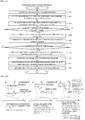
- FIG. 36 is a flowchart exemplifying the details of the analyzing process of the second code in a cell (S23 in FIG. 35 ).
- the following processing is described as being executed by the user device UD.
- the user device UD when the user device UD is the user device UD1, the following processing is executed by the management server MS1.
- the user device UD specifies virtual points with respect to the cell origin (S230). Note that since the process of S230 is repeatedly performed, "next virtual point" is used in FIG. 36 .
- serial number ID(n)s serving as a reference to all of the cells in accordance with a predetermined criterion, and manage the serial number ID(n) serving as identification information assigned to all of the cells and the reading sequence numbers SEQ(k) of the cells in which the second code is set in association with each other.
- the composite code generation means CGM of the management server MS1 or the composite code generation means CG of the content server CS2 that generates the composite code may store the reading sequence numbers SEQ(k) of the cells and the serial number ID(n)s for each cell in association with each other, and pass the information on to the user devices UD1 and UD2 for reading the composite code.
- the relationship between the serial number ID(n)s for each cell and the center coordinates (X i , Y j ) of each cell shall be set by a rule in advance.
- the presence or absence of a dot pattern in each cell is determined, and the second code is decoded.
- the decoding of only the first code may be performed first, and then the cells may be scanned for a second time to restore digital data from the second code.
- the user apparatus UD when the processing of all of the cells is completed and there is no next cell, the user apparatus UD generates information in which the first code is integrated for each character from the bit strings obtained by determination of bright or dark of the first code. (S25). This processing is the same as those in the first and second embodiments. However, the process of S25 may be executed in the process of S20C.
- the colors of the cells of the first code may be limited to colors in which a conventional QR code reader can read the first code
- the colors of the marks of the second code may be of the eight colors of R (red), G (green), B (blue), C (cyan), M (magenta), Y (yellow), B (black), and W (white).
- R red
- G green
- B blue
- C cyan
- M magenta
- Y yellow
- W white
- the color of the print medium may be the same as the color of any of the cells in which the first or second code marks are formed.
- the mark may have any shape such as a substantially circular shape, a rectangular shape, a cross shape, a polygonal shape, and the like. Note that it is needless to say that the dots shown below may be replaced with other marks.
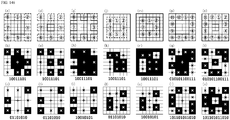
- These eight patterns correspond to cases where only one of the eight candidate dot arrangement positions is arranged with a dot, and note that for the threshold value for determining whether or not there is a dot, the above-described change rate or the like of brightness, ⁇ ⁇ B DA , ⁇ ⁇ B LA , or B DA + ⁇ ⁇ ⁇ B L may be used. If the cell arrangement positions can be recognized with a certain degree of accuracy, the bounding boxes may be set to a size slightly smaller than the size of a cell, and if dots are extracted within the bounding box, the dot is not affected by adjacent cells of the same color making contact.
- a similar dot code can be defined for dark-colored cells by using bright-colored dots.
- a large amount of information can be generated by displaying a plurality of different dot codes at predetermined time intervals.
- a blinking dot code is read by a hybrid QR code reader, high-speed processing can be performed just by reading the QR code only once and then subsequently reading only the dot codes.
- the dot code can be read accurately.
- the amount of information that can be changed about 12 times during one to three seconds an amount of information of about 10 KB can be obtained. If this is reproduced as photographic data, when displayed on a smartphone, it can be viewed as a sufficiently high-quality image, and text information exceeding 70,000 characters can also be transmitted.
- FIG. 48 shows a flowchart exemplifying reading and authenticating processings of a composite QR code.
- the apparatus that executes reading and authenticating processings of a composite QR code is, for example, the user devices UD1, UD2, and the like exemplified in FIG. 32 (hereinafter, simply represented with UD1).
- the management server MS1 applies error correction to the QR code data and the encrypted information 2 as data to generate a QR code (T55). Furthermore, using the dot code data and the encrypted information 1 as data, the management server MS1 applies error correction to the QR code cells to form a dot code (T56).
- FIG. 56 shows a flowchart exemplifying reading and authenticating processings of a composite QR code.
- the user device UD1 reads a composite QR code with a reading apparatus from information acquired from a content server (T101).
- the user device UD1 calculates encoded information (for example, a hash value) by an encoding means (for example, a hash function) using the QR code data and the dot code data as a data string (T102).
- the user device UD1 acquires encoded information (for example, a hash value) from the dot code (T103).
- the user apparatus UD1 determines that authentication for the composite code has failed, and notifies the user of the result (T106).
- a ticket seller sends a composite QR code containing the ticket number of the purchased ticket.
- an application supporting the composite QR code displays dot codes sent from the cloud indicating one-time passwords changing with time, and upon entry, the dot code is read by a composite QR code reader, and only the person who purchased the ticket may be allowed to enter.
- it is possible to prevent the resale of a ticket by acquiring the smartphone ID of the ticket purchaser and sending one time passwords to the smartphone. If one time passwords are embedded in a dot code, since it is difficult to see the change of the dots, it is possible to make the users unaware that passwords are being used.
- An enormous amount of personal information (biometric information such as the face, fingerprints, irises, veins, and the like) is registered in a dot code with the application of error correction.
- An electronic signature is applied to either the QR code or the dot code so that the personal information is not tampered with.
- personal identification can be performed even in an unattended state by having a composite QR code displayed and read, and checking whether or not the biometric information obtained by reading the composite QR and the biometric information obtained from the person on the spot (acquisition of face, fingerprint, iris, vein information, and the like using a camera or sensor) match, and financial settlements, the entry into important facilities, and the operation of important devices can be performed with high security.
- the system When the system identities a person with a license, health insurance card, student ID card, employee ID card, membership card, passport, or the like, even if the person does not present the card, such information may be stored in a dot code and the person may display the corresponding composite QR code on a smartphone.
- the system reads the dot code with a composite QR code reader, displays necessary information for the reading apparatus, has the person tell his/her date of birth, address, and the like, to confirm that the person is himself/herself in person.
- the reading of the composite QR code formed on a print medium, a display, or the like can also be performed by a dedicated application installed on a smartphone.
- the composite QR code improves security. For example, a user can easily transmit and receive a photograph, audio data, text, and the like by using a composite QR code without having to tell the other party a mail address or SNS contact information. For example, if it is a photograph, a high-quality photo for viewing on a smartphone, 10 minutes of audio data, and a text of tens of thousands of characters or more can be stored. In regards with the number of characters in the text, since it has been described above, the description is omitted here.
- an authentication performed by an authentication server may be performed using a secret key.
- the encrypted information of a data string formed of the QR code data and the dot code data is used.
- the processing of processing examples 1 to 3 may be applied for online authentication.
- FIG. 59 shows an example of a processing of encoding encoded information of a QR code and a dot code into a QR code.
- this processing as in the processing example 5, no encryption is performed.
- the processing of T131, T132, and T133 for generating a composite QR code are the same as T91 to T93 in FIG. 55 .
- the generated composite QR code is provided to the user device UD1 via, for example, the management server MS1.
- the authentication server determines that the authentication using the composite code has failed, and notifies the user of the result (T145). That is, in such a case, the authentication server does not allow the user device UD1 or another server on the network accessed by the user device UD1 to perform the processing in T145.
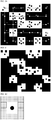
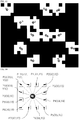
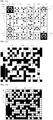
- FIG. 64 is a diagram showing the orientation of a second code (as a rule of the second code, the orientation may be the same as the orientation of the first code) and bounding boxes centered on the virtual points P1 to P8 set by specified distances and directions from the corrected cell center position P0, having the size in the same order as the size of a dot. These virtual points are candidate information dot arrangement positions set in accordance with a rule of the second code.
- a reading apparatus determines whether or not the center coordinate of a dot is included in the bounding box and acquires numerical data.
- the size of a bounding box may be larger than the size of a dot provided that it does not overlap with an adjacent bounding box. Recognition is possible even if the printing accuracy, the photographing environment, or the like are poor, and the accuracy of the center coordinate values of the dots of the captured image are poor. However, the larger the size, the higher the possibility is of being affected by noise (error printing) due to the scattering of ink or the like. Of course, if the accuracy of the acquired center coordinate values of the dot is sufficiently ensured, the size of a bounding box may be smaller than the size of a dot.
- the bright-colored dots can be easily extracted from the continuous dark-colored area around the center coordinate position in a dark-colored cell of which center coordinate values are calculated from the first code. Instead of using the center coordinate values in a dark-colored cell calculated from the first code, a reading apparatus needs only to examine whether or not a bright-colored dot exists in an area where the dark-colored area is continuous.
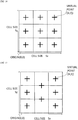
- FIG. 77 shows an example of an image in which the coordinate positions obtained as centers of the cells by the first code are deviated from the original centers of the cells.
- the positions indicated by the crosses are the coordinate positions obtained as the centers of the cells by the first code, and it is apparent that the positions are deviated from the centers of the cells.
- a method for obtaining appropriate center coordinate values of the cells indicated by the mark x from the deviated position is described below.
- a geometrical arrangement relationship (reference pattern) between the cell center position P0 and the virtual points P1 to P8 using a plurality of reference dots in a cell at a predetermined position may be formed and may be recognized.
- the reference pattern can be obtained directly from the image of a composite code captured by a camera, the bounding boxes can be set more accurately, and thus numerical data can be obtained.
- a reference pattern may be formed either in dark-colored cells (bright reference dots) or in both bright and dark-colored cells.
- the first code is a QR code
- reference patterns may be arranged in predetermined cells forming the position detection patterns (finder pattern), the timing patterns, the alignment patterns, and the format information sections.
- the reference pattern may be separated into three or more types to form a pattern over a plurality of cells, or may be arranged in at least one of dark-colored cells (bright reference dots) or bright-colored cells (dark reference dots).
- the plurality of different patterns may be used as independent reference patterns, and for cells in which information dots of different arrangement patterns for each are formed, corresponding bounding boxes may be set, and numerical data may be acquired.
- the QR code may be recorded in a storage medium of a composite code reading apparatus or in software for acquiring numerical data from the second code without forming a reference pattern on the composite code, and correction may be performed by using the geometric arrangement relationship.
- the method of correcting the arrangement of the bounding boxes based on the grid lines may be used in combination with other examples.
- boundaries between bright and dark-colored cells may be detected, and grid lines may be drawn along the boundaries.
- the boundaries of the pixels indicating brightness and darkness become uneven, and thus it is desirable to form the grid lines with smoothing or averaging the boundaries.
- numerical data may be defined in a cell in which a mark indicating a reference point is formed by at least one of the shape, size, color, orientation, and arrangement pattern of the mark indicating it to be a reference point.
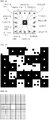
- FIG. 109 shows an example in which direction dots are added above predetermined reference dots of the composite code of FIG. 74 , defining the orientation of the second code.
- the arrangement of a direction dot may be in any direction with respect to the reference dot, provided that the relationship with the direction of the second code is determined in advance.
- a direction dot and a reference dot can be easily distinguished by determining whether or not the dot is located at the center of the cell or whether or not it is located on a grid line formed by connecting the reference dots.
- the direction dots can be arranged in any way, but by arranging them at predetermined intervals, the degree of deformation of a captured QR code can be reflected, the orientation of the cell can be corrected, and accurate numerical data acquisition can be realized.
- a recording medium readable by a computer or the like refers to a recording medium that stores information such as data, programs, and the like by electrical, magnetic, optical, mechanical, or chemical action and can be read by a computer or the like.
- recording media those removable from a computer or the like include, for example, a flexible disk, a magneto-optical disk, a CD-ROM, a CD-R/W, a DVD, a Blu-ray disk, a DAT, an 8 mm tape, memory cards such as a flash memory, and the like.
- recording media fixed to a computer or the like includes a hard disk, a ROM (Read Only Memory), and the like.
- an SSD Solid State Drive
- FIG. 117 shows a method of correcting a reference point detected upon imaging at a position deviated from the original position to the appropriate reference point.
- the positions of the reference points arranged in the bright-colored and dark-colored cells are obtained using, for example, one of the various algorithms described in the fifth and tenth embodiments.
- the reference points are connected vertically and horizontally with virtual straight lines, and the coordinate values of the intersections are determined to be the central coordinate values of the bright and dark-colored cells.
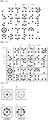
- FIG. 118 is an example showing reference cells 1-1 which are one type of special cell.
- marks 3-0 are not arranged in the cells arranged in predetermined positions, and the predetermined area 2-0 of the cells are surrounded by a predetermined area excluded area 2-1 (an area having a color different from the color distinguishable as the color of the cell).
- the predetermined positions may be stored in a code reader or may be stored in the first code as the data format information of the second code.
- the method of storing position information of the reference cells 1-1 at predetermined positions may be applied to examples 5, 9, 10, and 12 described later.
- FIG. 121(e) shows a diagram in which the calculated center coordinate position of each cell is shown as a black circle in a bright-colored cell and as a white circle in a dark-colored cell for making understanding easy.
- the actual coordinate position is a point and does not have the size of these black circles or white circles. Furthermore, such black circles and white circles are not drawn in the actual composite code.
- FIG. 122 is an enlarged view of a part of the composite code of FIG. 119 and shows a method of correcting the reference point using this.
- the reference points of the reference cells are obtained, the reference points are connected in a grid pattern with virtual lines (broken lines).
- virtual lines broken lines
- internal division points are obtained passing through the centers of each cell in the horizontal rows and vertical columns, and the internal division points in the same row or column are connected by virtual horizontal or vertical lines, respectively. In this way, each grid point of the formed grid line is obtained as a reference point of each cell.
- FIGS. 123 and 124 show more detailed virtual grid line drawing methods.
- the reference points of the reference cells are connected by virtual lines.
- the dotted lines in FIG. 124 internal division points or an external division points are obtained by interpolation or extrapolation of the broken lines, and when these points are connected, virtual grid lines passing through all of the cells can be formed, and with the grid points correction of the reference points of all of the cells is possible.
- the horizontal and vertical grid lines are obtained by evenly dividing in the horizontal direction with a distance of Dw and by evenly dividing in the vertical direction with a distance of D H . Note that, although normally information is not added to the reference cells, it may be added.
- FIG. 126 shows how to draw the grid lines.
- the reference points of the predetermined area of a triangle and the center point of a cell coincide with each other, first, as shown by the broken lines, the reference points of the reference cells are connected by a line.
- grid lines may be formed by interpolation or extrapolation and grid points may be obtained, as shown in FIG. 124 .
- FIG. 127 shows an example of a reference cell 1-2, which is one type of a special cell, in which a reference pattern is arranged, indicating clearly the geometrical relationship between the predetermined area 2-0 and the marks 3-0 in a special cell 1-0.
- All of the marks (reference marks 3-1) are arranged in the predetermined area excluded area 2-1 of a cell arranged at a predetermined position, and the predetermined area 2-0 of the cell is formed surrounded by the predetermined area excluded area 2-1 (an area having a color different from the color distinguishable as that of the cell).
- the predetermined position may be stored in a code reader or may be stored in the first code as data format information of the second code.
- the bright-colored predetermined area 2-00 is surrounded by a dark-colored predetermined area excluded area 2-11 and arranged with bright-colored reference marks 3-10
- the dark-colored predetermined area 2-01 is surrounded by a bright-colored predetermined area excluded area 2-10 and arranged with dark-colored reference marks 3-11.
- each mark 3-0 with respect to a reference point is smaller than the deviation of the coordinate values of the reference point, although it depends on the number of cells that form the composite code, it is sufficient to place the reference patterns 1-1 at intervals of 10 to 25 cells or more.
- the predetermined area 2-0 located with the same shape as the central division is formed with a dark-colored division 2-01 (black) in FIG. 133(c) and with a bright-colored division 2-00 (white) in FIG. 133(d) , and the predetermined area excluded area 2-1 is shown with bright-colored divisions 2-10.
- a square dotted line is shown to clarify the boundary between the predetermined area 2-00 (white) and the predetermined area excluded area 2-10 (white), but this dotted line is not drawn in the actual composite code.
- 133(c) to 133(f) are set within the predetermined areas, the first code is read, and the coordinate values of the reference points of all of the special cells 1-0 are calculated.
- the color of a cell is identified by recognizing the color of the reference point or a small area (at least a part of the predetermined area) including the reference point.
- data of the first code is defined by the two colors of black of the dark-colored predetermined area 2-01 and white of the bright-colored predetermined area 2-00 surrounded by a dotted line.
- the colors of predetermined areas can be identified from each other, it is not necessary to have the colors be white and black.
- the determination of whether the color of a division is of a bright-colored division 3-00(0) or a dark-colored division 3-01(1) is made by recognizing and identifying the color at the ⁇ positions in FIGS.
- the reference points may be obtained using any of the various algorithms described in the fifth and tenth embodiments.
- FIG. 134 shows how to draw the grid lines.
- the reference points in the predetermined area of each special cell are connected by virtual lines.
- virtual grid lines may be interpolated or extrapolated and grid points may be obtained.
- the predetermined area 2-01 of the cells is surrounded by a predetermined area excluded area 2-10, the predetermined area 2-01 can be easily extracted, and accurate coordinate values of reference points can be obtained, and the coordinate values of other reference points can be corrected, as in the case of example 4.
- a dark-colored predetermined area 2-01 is arranged and a dark-colored special cell 1-01 in which marks 3-0 is not arranged is used as a reference cell 1-11.
- the dark-colored special cells 1-01 are not necessarily arranged in a regular manner, there are cases where the reference cells 1-11 are arranged lopsidedly, and there is a possibility that the entire composite code cannot e corrected with evenly arranged reference points.
- Example 10 supplements this shortcoming.
- FIG. 143 shows an example of a reference pattern in which an element of orientation is added to the reference cell 1-2 of the eleventh example to indicate clearly the geometrical relationship with a predetermined area 2-0 and marks 3-0 in a special cell 1-0.
- the predetermined areas 2-0 are of square shape in both the reference cell 1-20 and the reference cell 1-21, and the boundaries with the periphery can be recognized in regards with brightness and darkness, the coordinate values of the reference points can be obtained with accuracy. That is, the boundaries may be recognized by the vertical and horizontal lines, or the method of detecting dots may be used.
- FIG. 146(j) to FIG. 146(l) show examples where the special cell 1-0 is provided with a void area so that the marks 3-01 do not come into contact with other adjacent cells, and the predetermined area 2-0 is formed of 2 ⁇ 2 pixels.
- the marks 3-01 can be clearly distinguished from other cells to prevent misidentification.
- the predetermined area 2-0 is 2 ⁇ 2 pixels and small, there is a possibility that the reference point is not obtained in the predetermined area 2-0, and thus, it is desirable to perform the same correction of the reference points as in the cases of FIGS. 146(d) to 146(f) .
- the predetermined areas 2-0 and the reference points can be recognized with accuracy, the geometrical arrangement relationship with the marks 3-0 becomes clearer, and the recognition rate of the marks 3-0 can be improved.
- Such an identifiable a void area surrounding the predetermined area 2-0 may be applied to FIGS. 146(d) to 146(f) .
- the version of the QR code is determined in accordance with the amount of information to be stored, and a cell array based on the version is generated.
- the error correction level is also determined.
- the error correction level may be changed as needed (U11).
- the cells of the data area (the area excluding the areas of functional patterns essential for QR code correction such as the finder patterns, the separation pattern of the finder patterns, the timing patterns, the alignment patterns, and the like, and format information sections, model number information sections, and the like) are divided into a predetermined number of divisions (U12).
- a predetermined area is set in these cells, and data of the first code is defined (U13).
- an image of a composite code may be photographed to obtain and process only data of the QR code portion, or an image of the composite code may be read by a composite code reader.
- Shown in FIG. 149 is an example of a reading procedure when there is no correction by the second code, that is, when the data of the second code can be acquired by using correction elements of only the original first code as with FIG. 146 , and the processing of the special cells of the second code is performed during the processing of the cells of the first code.
- the predetermined area and the marks of the same color as the predetermined area are separated via an area of the opposite color, and neither the predetermined area nor the marks of the same color as the predetermined area are in contact with the boundary of the cell.
- the predetermined area and the marks of the same color as the predetermined area are separated via an area of the opposite color. Therefore, in both cases, the extraction of the predetermined areas is easy, and the correction of the reference points is also easy from that viewpoint.
- the dot patterns because of the separation, and in the division cells, because the candidate arrangement positions are fixed, the extraction of the marks is also easy. Note that it is desirable to have the predetermined areas of the second code be recognized from the vicinity of the reference points obtained from the first code.
- U26 and U31 may be implemented last together.
- the second code may be processed after the processing of the first code is completed in the same manner as the reading procedure A.
- a personal photo is taken with a smartphone at the time of ticket acquisition, and the personal photo is stored together with the information of the acquired ticket in a composite code.
- the ticket issuer-side reads the composite code displayed on the ticket user's smartphone, and authenticates the acquired ticket information and performs personal identification based on the displayed face photo together, and thus resales and impersonation can be prevented.
- the personal photo may be provided to the third party. Also, when the acquirer is himself/herself, the person can select his own photographed picture.
- the photographing of the face of the ticket user and reading the composite code at the same time using a composite code reader equipped with an ultra-high precision camera, with the smartphone displaying the composite code held in the vicinity of the face of the ticket user it is possible to make an automatic confirmation by performing face authentication of whether or not the face of the ticket user and the face photo stored in the composite code reader are of the same person.
- the photographing of the face of the ticket user and the reading of the face photo stored in a composite code may be performed by different devices. Instead of face collation, the ball of a finger may be photographed and stored in the composite code reader, and fingerprint collation may be performed by reading the ball of the person's finger and the composite code at the same time.
- the data stored in the QR code that is, the first code, can be read by a conventional QR code reader.
- QR code since the specifications of the QR code are disclosed, anyone can issue a QR code, and a third party can issue the same code.
- a mark such as a dot code is formed by a new secret algorithm, unique composite codes can be issued, and it is extremely unlikely that the same code will be issued by a third party, and thus security is extremely high.
- the QR code is easy to copy and imitate, and there is a possibility that the information stored in the QR code is acquired by an unintended third party by shoulder hacking or the like.
- the second code is difficult to view and imitate.
- the present embodiment further includes the following aspects.
Landscapes
- Engineering & Computer Science (AREA)
- Physics & Mathematics (AREA)
- General Physics & Mathematics (AREA)
- Theoretical Computer Science (AREA)
- Computer Security & Cryptography (AREA)
- Signal Processing (AREA)
- Computer Networks & Wireless Communication (AREA)
- Health & Medical Sciences (AREA)
- Artificial Intelligence (AREA)
- Computer Vision & Pattern Recognition (AREA)
- Toxicology (AREA)
- General Health & Medical Sciences (AREA)
- Electromagnetism (AREA)
- Power Engineering (AREA)
- Editing Of Facsimile Originals (AREA)
- Credit Cards Or The Like (AREA)
- Character Input (AREA)
- Image Processing (AREA)
Applications Claiming Priority (6)
| Application Number | Priority Date | Filing Date | Title |
|---|---|---|---|
| JP2017255256 | 2017-12-29 | ||
| JP2018082672 | 2018-04-23 | ||
| US201862681354P | 2018-06-06 | 2018-06-06 | |
| JP2018109090A JP6403085B1 (ja) | 2017-12-29 | 2018-06-06 | 複合コードパターン、生成装置、読み取り装置、方法およびプログラム |
| JP2018206168A JP6473899B1 (ja) | 2017-12-29 | 2018-10-31 | 複合コードパターン、生成装置、読み取り装置、方法およびプログラム |
| PCT/JP2019/000028 WO2019132047A1 (fr) | 2017-12-29 | 2019-01-04 | Motif de code composite, dispositif de génération, dispositif de lecture, procédé et programme |
Publications (2)
| Publication Number | Publication Date |
|---|---|
| EP3734510A1 true EP3734510A1 (fr) | 2020-11-04 |
| EP3734510A4 EP3734510A4 (fr) | 2022-04-20 |
Family
ID=65516908
Family Applications (1)
| Application Number | Title | Priority Date | Filing Date |
|---|---|---|---|
| EP19733929.4A Withdrawn EP3734510A4 (fr) | 2017-12-29 | 2019-01-04 | Motif de code composite, dispositif de génération, dispositif de lecture, procédé et programme |
Country Status (7)
| Country | Link |
|---|---|
| US (1) | US11755867B2 (fr) |
| EP (1) | EP3734510A4 (fr) |
| JP (5) | JP6473899B1 (fr) |
| KR (1) | KR20200106510A (fr) |
| CN (1) | CN112352245A (fr) |
| BR (1) | BR112020013344A2 (fr) |
| WO (1) | WO2019132047A1 (fr) |
Cited By (3)
| Publication number | Priority date | Publication date | Assignee | Title |
|---|---|---|---|---|
| CN113379351A (zh) * | 2021-06-22 | 2021-09-10 | 沙师弟(重庆)网络科技有限公司 | 一种基于区块链的运输订单信息存储方法 |
| CN116700637A (zh) * | 2023-05-17 | 2023-09-05 | 国能龙源催化剂江苏有限公司 | 催化剂产品二维码打印方法、装置和电子设备 |
| EP4258165A4 (fr) * | 2021-01-06 | 2024-05-29 | Beijing Bytedance Network Technology Co., Ltd. | Procédé et appareil d'affichage de code bidimensionnel, dispositif, et support |
Families Citing this family (35)
| Publication number | Priority date | Publication date | Assignee | Title |
|---|---|---|---|---|
| JP7242370B2 (ja) * | 2019-03-26 | 2023-03-20 | 東邦ガスネットワーク株式会社 | 埋設物管理システム |
| JP6624323B1 (ja) * | 2019-03-28 | 2019-12-25 | 株式会社セガゲームス | 生体情報登録システム |
| JP6743245B1 (ja) * | 2019-06-12 | 2020-08-19 | 株式会社バンダイ | 識別コード付き玩具 |
| FR3098757B1 (fr) * | 2019-07-17 | 2021-10-22 | Idemia France | Procédé de fabrication d’un code à barres couleur bidimensionnel et dispositif de sécurité associé |
| KR20220054793A (ko) * | 2019-08-28 | 2022-05-03 | 소니 세미컨덕터 솔루션즈 가부시키가이샤 | 정보 처리 장치, 정보 처리 방법, 및 프로그램 |
| JP6931935B2 (ja) * | 2019-10-11 | 2021-09-08 | 株式会社テララコード研究所 | 二次元シンボル、及び二次元シンボルの読取方法 |
| CA3102514C (fr) * | 2020-01-24 | 2023-09-26 | Jostens, Inc. | Systeme de gestion de l'exploration et de la consommation de contenu numerique en lien avec un article physique |
| JP7380437B2 (ja) * | 2020-06-11 | 2023-11-15 | 株式会社デンソー | 情報コード、情報コード印刷媒体、情報コード生成装置、情報コード生成プログラム、情報コード生成方法、情報コード読取装置、情報コード読取プログラム、及び情報コード読取方法 |
| KR102443688B1 (ko) * | 2020-07-06 | 2022-09-14 | 이종찬 | 매장의 고객 관리 시스템 및 방법 |
| KR20220023752A (ko) * | 2020-08-20 | 2022-03-02 | 네오톤 아이엔씨 | 바코드 및 피어 리뷰의 사용에 의해 공급망을 트래킹 및 트레이싱하는 방법 및 시스템 |
| GB202014378D0 (en) * | 2020-09-13 | 2020-10-28 | Gozcu Emrah | A method to identify and generate extendable identifier code |
| US11734532B2 (en) * | 2020-10-28 | 2023-08-22 | University Of Rochester | Two-dimensional bar codes that are both intensity-modulated and orientation-modulated for transmitting sensitive information along with non-sensitive information |
| US11758476B2 (en) * | 2021-02-05 | 2023-09-12 | Dell Products L.P. | Network and context aware AP and band switching |
| JP2022165792A (ja) * | 2021-04-20 | 2022-11-01 | 日本発條株式会社 | 情報処理システムおよびプログラム |
| JPWO2022224969A1 (fr) * | 2021-04-20 | 2022-10-27 | ||
| KR102471729B1 (ko) * | 2021-05-31 | 2022-11-28 | 주식회사 이노파트너즈 | 로고이미지가 삽입된 큐알코드 및 이의 제작방법 |
| KR20220161941A (ko) * | 2021-05-31 | 2022-12-07 | 주식회사 이노파트너즈 | 큐알코드 및 이의 제작방법 |
| KR102485940B1 (ko) * | 2021-05-31 | 2023-01-10 | 주식회사 이노파트너즈 | 이미지가 삽입된 큐알코드 및 이의 제작방법 |
| JP6999144B1 (ja) * | 2021-06-25 | 2022-01-18 | A・Tコミュニケーションズ株式会社 | データ管理システム |
| JP7253749B2 (ja) * | 2021-08-03 | 2023-04-07 | 学校法人立命館 | 二次元コード、生成装置、読取装置、及び、コンピュータプログラム |
| CN113988244B (zh) * | 2021-10-19 | 2024-05-10 | 艾斯芸防伪科技(福建)有限公司 | 一种防伪点阵生成与校验方法、系统、设备及介质 |
| JPWO2023166636A1 (fr) * | 2022-03-02 | 2023-09-07 | ||
| CN115456125A (zh) * | 2022-09-23 | 2022-12-09 | 深圳市雄帝科技股份有限公司 | 一种智慧码的生成方法及装置 |
| WO2024086047A2 (fr) * | 2022-10-17 | 2024-04-25 | The Board Of Trustees Of Western Michigan University | Dispositif et procédé de communication augmentative/alternative améliorée par un trouble quantitatif |
| KR20240059268A (ko) * | 2022-10-27 | 2024-05-07 | 주식회사 이노프렌즈 | 데이터 감지가 용이한 큐알코드와 그 제조 방법 |
| KR102562146B1 (ko) * | 2022-12-29 | 2023-08-01 | 보이스아이 주식회사 | 컬러코드를 이용하여 입장권한과 신분을 증명하는 방법 |
| US20240346852A1 (en) * | 2023-04-04 | 2024-10-17 | Facetec, Inc. | Method and apparatus for creating encoded data and use of same for identity verification |
| WO2024242620A1 (fr) * | 2023-05-19 | 2024-11-28 | Aires Investment Holdings Private Limited | Code bidimensionnel et procédé et système de génération et de lecture de celui-ci |
| CN121359441A (zh) * | 2023-06-20 | 2026-01-16 | 三星电子株式会社 | 用于生成图案的方法和设备以及用于解码图案的方法和设备 |
| US11934914B1 (en) * | 2023-10-12 | 2024-03-19 | Lifetime Health and Transportation LLC | Methods and systems for fused content generation for a book having pages interspersed with optically readable codes |
| JP7493859B1 (ja) | 2023-12-13 | 2024-06-03 | 株式会社フォリオ | 二次元コード配布システム及び二次元コード配布方法 |
| IN202411000586A (fr) * | 2024-01-03 | 2024-02-02 | ||
| DE102024105533A1 (de) * | 2024-02-27 | 2025-08-28 | Mühlbauer ID Services GmbH | Sicherheitsdokument, verfahren und vorrichtung zum herstellen eines sicherheitsdokuments |
| CN118761430B (zh) * | 2024-05-31 | 2025-06-10 | 南通大学 | 一种多帧矩阵式二维码的编码方法及译码方法 |
| US12602560B1 (en) * | 2025-02-21 | 2026-04-14 | Bank Of America Corporation | QR code verification engine |
Family Cites Families (41)
| Publication number | Priority date | Publication date | Assignee | Title |
|---|---|---|---|---|
| JPH0546743A (ja) * | 1991-08-09 | 1993-02-26 | Matsushita Electric Ind Co Ltd | 個人識別装置 |
| JP2833975B2 (ja) * | 1992-09-28 | 1998-12-09 | オリンパス光学工業株式会社 | ドットコード |
| DE69329120T2 (de) | 1992-09-28 | 2001-03-22 | Olympus Optical Co | Aufzeichnungsmedium für punktcode und informations-aufzeichnungssystem |
| JP2938338B2 (ja) | 1994-03-14 | 1999-08-23 | 株式会社デンソー | 二次元コード |
| US5726435A (en) | 1994-03-14 | 1998-03-10 | Nippondenso Co., Ltd. | Optically readable two-dimensional code and method and apparatus using the same |
| US5682467A (en) | 1994-09-29 | 1997-10-28 | Xerox Corporation | Arbitrating apparatus for controlling selective access of multiple bus masters to a printing system video bus |
| JP3015687B2 (ja) * | 1994-11-01 | 2000-03-06 | 東芝テック株式会社 | Idカード読取装置 |
| JPH10302034A (ja) | 1997-04-24 | 1998-11-13 | N T T Data:Kk | 認証システム、カード発行装置、認証装置、認証用カード及び認証方法 |
| JPH11272816A (ja) | 1998-03-25 | 1999-10-08 | Toshiba Tec Corp | Idカ−ド及び個人認証システム |
| US6267296B1 (en) * | 1998-05-12 | 2001-07-31 | Denso Corporation | Two-dimensional code and method of optically reading the same |
| JP2000076411A (ja) | 1998-09-01 | 2000-03-14 | Toppan Printing Co Ltd | Idカード及びidカード発行装置並びにidカード読取装置 |
| JP2000030016A (ja) * | 1999-04-30 | 2000-01-28 | Olympus Optical Co Ltd | 情報記録媒体及び情報再生システム |
| JP2001052142A (ja) | 1999-08-06 | 2001-02-23 | Toshiba Corp | Idカード、idカード発行装置ならびにidカード認証装置 |
| US6398117B1 (en) * | 2000-01-14 | 2002-06-04 | Hewlett-Packard Co. | Method and system for combining bar codes of different encoding dimensions |
| JP2001256501A (ja) | 2000-03-10 | 2001-09-21 | Matsushita Electric Ind Co Ltd | 個人認証システム |
| JP2002140742A (ja) | 2000-11-06 | 2002-05-17 | Yoshiomi Yamada | チェックシステム及びidカ−ド |
| JP2002281275A (ja) | 2001-03-16 | 2002-09-27 | Fuji Xerox Co Ltd | 証明写真および個人認証媒体 |
| JP4011362B2 (ja) | 2002-02-15 | 2007-11-21 | 浩 近藤 | パスポートの偽造防止情報作成システム、パスポート及び偽造パスポート検出システム |
| JP2004310313A (ja) * | 2003-04-04 | 2004-11-04 | Veritec Iconix Ventures Inc | 二次元コード化した個人生体情報を含む本人認証用カードおよび二次元コード化した個人生体情報を使用した個人認証方法。 |
| US20050016026A1 (en) | 2003-07-21 | 2005-01-27 | Long David William | Interchangeable shoe pieces |
| JP4495935B2 (ja) | 2003-09-22 | 2010-07-07 | 川澄化学工業株式会社 | 指紋照合装置及び指紋照合情報共有システム |
| JP2005204250A (ja) | 2004-01-19 | 2005-07-28 | Ricoh Co Ltd | 証明書確認方法、証明書確認プログラム及び証明書 |
| JP4585202B2 (ja) * | 2004-02-03 | 2010-11-24 | アライ株式会社 | 2次元コード,2次元コードの形成装置及び形成方法並びに2次元コードの読取装置及び読取方法 |
| US7898642B2 (en) | 2004-04-14 | 2011-03-01 | Asml Netherlands B.V. | Lithographic apparatus and device manufacturing method |
| JP2007272320A (ja) | 2006-03-30 | 2007-10-18 | Mitsubishi Electric Corp | 入場管理システム |
| KR100924697B1 (ko) | 2007-07-11 | 2009-11-03 | 삼성전자주식회사 | 수직자기기록헤드 및 그 제조방법 |
| JP5018382B2 (ja) * | 2007-10-03 | 2012-09-05 | 株式会社デンソーウェーブ | 二次元コードおよびその読取装置 |
| JP4998202B2 (ja) | 2007-10-23 | 2012-08-15 | 日本電気株式会社 | 携帯通信端末 |
| AU2007254619B2 (en) * | 2007-12-21 | 2010-10-07 | Canon Kabushiki Kaisha | Barcode removal |
| JP2010067127A (ja) * | 2008-09-12 | 2010-03-25 | Canon Inc | 情報処理装置、情報処理装置の制御方法、記憶媒体、及びプログラム |
| JP5343761B2 (ja) | 2009-08-25 | 2013-11-13 | 株式会社デンソーウェーブ | 光学的情報読取装置、及び光学的情報読取装置を用いた認証システム |
| WO2011040032A1 (fr) * | 2009-09-30 | 2011-04-07 | 株式会社シフト | Code à deux dimensions, lecteur de code à deux dimensions et programme |
| US20120138679A1 (en) * | 2010-12-01 | 2012-06-07 | Yodo Inc. | Secure two dimensional bar codes for authentication |
| JP5433607B2 (ja) | 2011-03-02 | 2014-03-05 | 株式会社大都技研 | 遊技台 |
| US20150235118A1 (en) * | 2012-04-26 | 2015-08-20 | Steven J Simske | Two-Dimensional Barcodes Having A Plurality of Different Regions |
| US8997241B2 (en) * | 2012-10-18 | 2015-03-31 | Dell Products L.P. | Secure information handling system matrix bar code |
| JP6061075B2 (ja) | 2012-10-23 | 2017-01-18 | 株式会社テララコード研究所 | 二次元コード、二次元コードの生成方法、及び二次元コードの読取方法 |
| JP2015052839A (ja) | 2013-09-05 | 2015-03-19 | 大日本印刷株式会社 | 電子透かしコードを付与した情報記録体 |
| RU2681696C2 (ru) | 2013-11-07 | 2019-03-12 | Скантраст Са | Двухмерный штрихкод и способ аутентификации штрихкода |
| JP6375957B2 (ja) | 2015-01-16 | 2018-08-22 | 株式会社デンソー | 充電管理システムおよび読取端末 |
| JP6231233B1 (ja) * | 2017-02-23 | 2017-11-15 | 株式会社マイクロ・テクニカ | コードの画像データを生成する方法、およびコードの真贋判定方法 |
-
2018
- 2018-10-31 JP JP2018206168A patent/JP6473899B1/ja active Active
- 2018-12-28 JP JP2018248346A patent/JP6713610B2/ja not_active Expired - Fee Related
-
2019
- 2019-01-04 WO PCT/JP2019/000028 patent/WO2019132047A1/fr not_active Ceased
- 2019-01-04 BR BR112020013344-2A patent/BR112020013344A2/pt not_active IP Right Cessation
- 2019-01-04 KR KR1020207022146A patent/KR20200106510A/ko not_active Abandoned
- 2019-01-04 EP EP19733929.4A patent/EP3734510A4/fr not_active Withdrawn
- 2019-01-04 CN CN201980015364.8A patent/CN112352245A/zh active Pending
- 2019-01-04 US US16/958,743 patent/US11755867B2/en active Active
-
2020
- 2020-04-09 JP JP2020070501A patent/JP6746158B2/ja not_active Expired - Fee Related
- 2020-06-17 JP JP2020104179A patent/JP2020161172A/ja active Pending
-
2023
- 2023-03-09 JP JP2023036801A patent/JP2023060315A/ja active Pending
Cited By (6)
| Publication number | Priority date | Publication date | Assignee | Title |
|---|---|---|---|---|
| EP4258165A4 (fr) * | 2021-01-06 | 2024-05-29 | Beijing Bytedance Network Technology Co., Ltd. | Procédé et appareil d'affichage de code bidimensionnel, dispositif, et support |
| US12561541B2 (en) | 2021-01-06 | 2026-02-24 | Beijing Bytedance Network Technology Co., Ltd. | Two-dimensional code display method, apparatus, device, and medium |
| CN113379351A (zh) * | 2021-06-22 | 2021-09-10 | 沙师弟(重庆)网络科技有限公司 | 一种基于区块链的运输订单信息存储方法 |
| CN113379351B (zh) * | 2021-06-22 | 2022-10-21 | 沙师弟(重庆)网络科技有限公司 | 一种基于区块链的运输订单信息存储方法 |
| CN116700637A (zh) * | 2023-05-17 | 2023-09-05 | 国能龙源催化剂江苏有限公司 | 催化剂产品二维码打印方法、装置和电子设备 |
| CN116700637B (zh) * | 2023-05-17 | 2024-04-19 | 国能龙源催化剂江苏有限公司 | 催化剂产品二维码打印方法、装置和电子设备 |
Also Published As
| Publication number | Publication date |
|---|---|
| BR112020013344A2 (pt) | 2020-12-01 |
| JP2019192196A (ja) | 2019-10-31 |
| JP2023060315A (ja) | 2023-04-27 |
| JP6713610B2 (ja) | 2020-06-24 |
| JP2020123377A (ja) | 2020-08-13 |
| JP6473899B1 (ja) | 2019-02-27 |
| JP2019192212A (ja) | 2019-10-31 |
| CN112352245A (zh) | 2021-02-09 |
| KR20200106510A (ko) | 2020-09-14 |
| EP3734510A4 (fr) | 2022-04-20 |
| US20210103786A1 (en) | 2021-04-08 |
| US11755867B2 (en) | 2023-09-12 |
| JP2020161172A (ja) | 2020-10-01 |
| WO2019132047A1 (fr) | 2019-07-04 |
| JP6746158B2 (ja) | 2020-08-26 |
Similar Documents
| Publication | Publication Date | Title |
|---|---|---|
| US11755867B2 (en) | Composite code pattern, generating device, reading device, method, and program | |
| JP6403085B1 (ja) | 複合コードパターン、生成装置、読み取り装置、方法およびプログラム | |
| EP2937819B1 (fr) | Système utilisant des codes d'informations | |
| US9946865B2 (en) | Document authentication based on expected wear | |
| US9406010B2 (en) | Producing, capturing and using visual identification tags for moving objects | |
| US7228428B2 (en) | Method and apparatus for embedding encrypted images of signatures and other data on checks | |
| US9898657B2 (en) | Four-dimensional code, image identification system and image identification method based on the four-dimensional code, and retrieval system and retrieval method | |
| US8891812B2 (en) | Secure prescription computer for generating prescriptions that can be authenticated and verified | |
| CN100349168C (zh) | 一种防伪票据、票据防伪方法及系统 | |
| EP3413506B1 (fr) | Factures sécurisées sans papier dans des applications de flux de travail | |
| US9195819B2 (en) | Methods and systems for verifying ownership of a physical work or facilitating access to an electronic resource associated with a physical work | |
| CN102034127A (zh) | 新型大容量二维条码与系统及其编解码方法和应用 | |
| JP7392322B2 (ja) | 画像処理装置、画像処理方法、画像処理装置用プログラム、および、書類管理システム | |
| US20230214616A1 (en) | Methods and systems to identify and generate extendable identifier code | |
| JP3015819B2 (ja) | 印章を自動的に照合する方法と印章自動照合方法 | |
| US20230133702A1 (en) | System, Method, and Computer Program Product for Sensitive Data Obfuscation | |
| Kato | 2D-barcode for Mobile Devices | |
| JP2013097393A (ja) | 手書き文字テキスト化システム |
Legal Events
| Date | Code | Title | Description |
|---|---|---|---|
| STAA | Information on the status of an ep patent application or granted ep patent |
Free format text: STATUS: THE INTERNATIONAL PUBLICATION HAS BEEN MADE |
|
| PUAI | Public reference made under article 153(3) epc to a published international application that has entered the european phase |
Free format text: ORIGINAL CODE: 0009012 |
|
| STAA | Information on the status of an ep patent application or granted ep patent |
Free format text: STATUS: REQUEST FOR EXAMINATION WAS MADE |
|
| 17P | Request for examination filed |
Effective date: 20200729 |
|
| AK | Designated contracting states |
Kind code of ref document: A1 Designated state(s): AL AT BE BG CH CY CZ DE DK EE ES FI FR GB GR HR HU IE IS IT LI LT LU LV MC MK MT NL NO PL PT RO RS SE SI SK SM TR |
|
| AX | Request for extension of the european patent |
Extension state: BA ME |
|
| DAV | Request for validation of the european patent (deleted) | ||
| DAX | Request for extension of the european patent (deleted) | ||
| A4 | Supplementary search report drawn up and despatched |
Effective date: 20220317 |
|
| RIC1 | Information provided on ipc code assigned before grant |
Ipc: H04L 9/08 20060101ALI20220311BHEP Ipc: G06K 1/12 20060101ALI20220311BHEP Ipc: G06K 7/12 20060101ALI20220311BHEP Ipc: G06K 7/14 20060101ALI20220311BHEP Ipc: G06K 19/06 20060101AFI20220311BHEP |
|
| STAA | Information on the status of an ep patent application or granted ep patent |
Free format text: STATUS: EXAMINATION IS IN PROGRESS |
|
| 17Q | First examination report despatched |
Effective date: 20230502 |
|
| STAA | Information on the status of an ep patent application or granted ep patent |
Free format text: STATUS: THE APPLICATION IS DEEMED TO BE WITHDRAWN |
|
| 18D | Application deemed to be withdrawn |
Effective date: 20230913 |