EP3736614A1 - Fusionspassmodul und kommunikationsvorrichtung - Google Patents
Fusionspassmodul und kommunikationsvorrichtung Download PDFInfo
- Publication number
- EP3736614A1 EP3736614A1 EP19906593.9A EP19906593A EP3736614A1 EP 3736614 A1 EP3736614 A1 EP 3736614A1 EP 19906593 A EP19906593 A EP 19906593A EP 3736614 A1 EP3736614 A1 EP 3736614A1
- Authority
- EP
- European Patent Office
- Prior art keywords
- tray
- bracket
- arc
- shaped plate
- splicing
- Prior art date
- Legal status (The legal status is an assumption and is not a legal conclusion. Google has not performed a legal analysis and makes no representation as to the accuracy of the status listed.)
- Granted
Links
Images



Classifications
-
- G—PHYSICS
- G02—OPTICS
- G02B—OPTICAL ELEMENTS, SYSTEMS OR APPARATUS
- G02B6/00—Light guides; Structural details of arrangements comprising light guides and other optical elements, e.g. couplings
- G02B6/44—Mechanical structures for providing tensile strength and external protection for fibres, e.g. optical transmission cables
- G02B6/4439—Auxiliary devices
- G02B6/444—Systems or boxes with surplus lengths
- G02B6/4453—Cassettes
- G02B6/4454—Cassettes with splices
-
- G—PHYSICS
- G02—OPTICS
- G02B—OPTICAL ELEMENTS, SYSTEMS OR APPARATUS
- G02B6/00—Light guides; Structural details of arrangements comprising light guides and other optical elements, e.g. couplings
- G02B6/44—Mechanical structures for providing tensile strength and external protection for fibres, e.g. optical transmission cables
- G02B6/4439—Auxiliary devices
- G02B6/444—Systems or boxes with surplus lengths
- G02B6/44528—Patch-cords; Connector arrangements in the system or in the box
-
- G—PHYSICS
- G02—OPTICS
- G02B—OPTICAL ELEMENTS, SYSTEMS OR APPARATUS
- G02B6/00—Light guides; Structural details of arrangements comprising light guides and other optical elements, e.g. couplings
- G02B6/24—Coupling light guides
- G02B6/36—Mechanical coupling means
- G02B6/38—Mechanical coupling means having fibre to fibre mating means
- G02B6/3807—Dismountable connectors, i.e. comprising plugs
- G02B6/381—Dismountable connectors, i.e. comprising plugs of the ferrule type, e.g. fibre ends embedded in ferrules, connecting a pair of fibres
- G02B6/3825—Dismountable connectors, i.e. comprising plugs of the ferrule type, e.g. fibre ends embedded in ferrules, connecting a pair of fibres with an intermediate part, e.g. adapter, receptacle, linking two plugs
-
- G—PHYSICS
- G02—OPTICS
- G02B—OPTICAL ELEMENTS, SYSTEMS OR APPARATUS
- G02B6/00—Light guides; Structural details of arrangements comprising light guides and other optical elements, e.g. couplings
- G02B6/24—Coupling light guides
- G02B6/36—Mechanical coupling means
- G02B6/38—Mechanical coupling means having fibre to fibre mating means
- G02B6/3807—Dismountable connectors, i.e. comprising plugs
- G02B6/3897—Connectors fixed to housings, casing, frames or circuit boards
Definitions
- This application relates to the field of communications technologies, and in particular, to an integrated splicing and termination module and a communications device.
- an adapter In an optical distribution network, an adapter is configured to implement connection between different nodes of an optical cable. To ensure connection quality of an optical fiber, an end face of a connector that is in the adapter and that is used to connect a connection point needs to be detected and cleaned. According to a conventional method in the market, an end face detection device and an end face cleaning tool are used to directly align with the end face of the adapter for detection and cleaning.
- adapters are fixedly designed in some modules due to functional requirements.
- a conventional device usually interferes with a mechanical part during end face detection and cleaning, and end face detection and cleaning cannot be performed.
- end face detection and cleaning cannot be performed.
- interference is more severe.
- a common method is to customize dedicated conversion adapters, detection devices, and cleaning devices.
- customization is unavoidably costly. Because an internal structure of the conversion adapter is complex and there is an optical device, a customization requirement is high.
- different conversion adapters need to be frequently replaced for different modules and cannot be produced on a large scale, and there is a defect that a device is prone to damage, and the like. Because different detection devices and cleaning devices are customized for modules with different functions, device compatibility is poor.
- This application provides an integrated splicing and termination module and a communications device, to resolve a problem of inconvenient detection and cleaning of an end face of an adapter.
- an example embodiment of this application provides an integrated splicing and termination module.
- the integrated splicing and termination module includes a tray, the tray is configured to carry a plurality of adapters, and the plurality of adapters are mounted on a bracket.
- a manner of mounting the bracket in the tray is changed.
- the bracket in the integrated splicing and termination module is slidably mounted on the tray, so that the bracket may be moved out from the tray to detect and clean the end face of the adapter, and a device for cleaning and detecting the end face of the adapter operates in relatively large space.
- an elastic hook is disposed on the tray, and the elastic hook is clamped to the bracket.
- an operator exerts a force on the elastic hook, so that the elastic hook is away from the bracket, to unlock a sliding action of the bracket relative to the tray, and then moves out the bracket in a direction away from the tray.
- the returned elastic hook cooperates with the tray to support the bracket, and the sliding action of the bracket ends.
- the end face of the adapter may be cleaned and detected.
- the bracket After the end face of the adapter is detected and cleaned, the operator exerts a force on the bracket in a direction towards the tray, the bracket returns to the tray, and the bracket is fastened when the elastic hook is clamped to the bracket.
- the end face of the adapter can be detected and cleaned after the adapter is moved out, without interfering with the structure of the tray, thereby facilitating detection and cleaning of the end face of the adapter.
- the structure of the device for cleaning and detecting the adapter does not need to be changed, thereby reducing costs.
- At least one guide rod is disposed on the tray, a guide groove is disposed on the bracket, the guide rod is disposed in the guide groove, and the guide rod is slidably connected to the guide groove.
- the bracket is slidably connected to the tray by disposing the structural forms of the guide rod and the guide groove.
- the bracket includes a top plate and a bottom plate that are disposed opposite to each other, and a plurality of side plates. Every two of the side plates are connected to the top plate and the bottom plate to form a cavity used to mount the adapter.
- the guide groove is disposed on two side plates located at an edge of the top plate. The guide groove is disposed on the side plates to implement the slidable connection between the bracket and the tray, and a structure is simple.
- the integrated splicing and termination module further includes a spacer plate.
- the spacer plate is disposed on the tray and is configured to separate two brackets, the guide rod is disposed on two opposite side faces of the spacer plate, and one guide rod is slidably connected to the guide groove of one bracket.
- the plurality of brackets are slidably connected to the tray by using the spacer plate.
- two guide rods are disposed on the tray, the two guide rods are disposed opposite to each other in an extension direction parallel to the bracket, and the two guide rods are used as rotation axes to rotate the bracket after the bracket is moved out from the tray. This is more convenient for detection and cleaning of the end face of the adapter.
- the elastic hook is a hook structure and includes a hook body and a hook part. One end of the hook body is connected to the tray, the other end of the hook body is connected to the hook part, and one end that is of the hook part and that is away from the hook body is fastened on an end face that is of the bracket and that is away from the tray.
- a surface that is of the hook part and that is away from the hook body is an inclined surface facing the tray
- a stopper is disposed on the bracket, and when the bracket slides to a specified position, the stopper cooperates with the inclined surface to support the bracket.
- the stopper is disposed, so that the elastic hook and the tray can better support the bracket when the bracket slides to the specified position.
- the guide groove is a slotted hole in the direction away from the tray, and a height of the bottom of the slotted hole is not greater than a height of the stopper.
- the integrated splicing and termination module further includes a splicing card holder.
- the splicing card holder is disposed in the tray and is configured to fasten a pigtail and an optical fiber that are to be spliced, the pigtail is mounted at one end of the adapter, and the optical fiber penetrates into the tray from an opening of the tray.
- the integrated splicing and termination module further includes a guide structure.
- the guide structure is disposed on the tray, and includes a first guide structure configured to guide the pigtail to one side of the splicing card holder, and a second guide structure configured to guide the optical fiber to the other side of the splicing card holder.
- the first guide structure includes a first arc-shaped plate and a second arc-shaped plate that are disposed opposite to each other, and concave directions of the first arc-shaped plate and the second arc-shaped plate are opposite.
- the first arc-shaped plate and the second arc-shaped plate are disposed to form an encircling feature used to guide the pigtail.
- the second guide structure includes a third arc-shaped plate, and a fourth arc-shaped plate and a fifth arc-shaped plate that are disposed opposite to each other.
- the third arc-shaped plate is configured to guide the optical fiber from an opening on one side of the tray to the tray, and concave directions of the fourth arc-shaped plate and the fifth arc-shaped plate are opposite.
- the fourth arc-shaped plate and the fifth arc-shaped plate are disposed to form an encircling feature used to guide the optical fiber.
- the integrated splicing and termination module further includes a baffle plate.
- One end of the baffle plate is connected to the tray, and the other end of the baffle plate extends between the splicing card holder and the adapter to separate the splicing card holder from the adapter.
- a channel for passing the pigtail is disposed between a side face of the baffle plate and the tray, so that the pigtail passes through the channel.
- the guide mechanism further includes a third guide structure configured to guide a fiber patch cord to one side of the adapter.
- the third guide structure includes a sixth arc-shaped plate and at least one seventh arc-shaped plate, and concave directions of the sixth arc-shaped plate and the seventh arc-shaped plate are opposite.
- the sixth arc-shaped plate, the seventh arc-shaped plate, and the side wall of the tray form a channel that is connected to an opening on the other side of the tray and that is configured to accommodate the fiber patch cord, to guide the fiber patch cord to one end of the adapter.
- an example embodiment of this application provides a communications device.
- the communications device includes a cabinet, where a slot is disposed on the cabinet; and further includes a drawer-like module, where the drawer-like module includes the integrated splicing and termination module according to any one of the foregoing implementations that is slidably assembled in the slot.
- the cabinet is connected to the integrated splicing and termination module by using a cable, and the cable is guided into two sides of the adapter by using a guide structure.
- a manner of connecting the bracket and the tray is changed and the elastic hook is added. Therefore, the end face of the adapter can be detected and cleaned after the adapter is moved out, and it is convenient to detect and clean the end face of the adapter. Therefore, the communications device having the integrated splicing and termination module is universally applicable in consideration of manufacturing and using costs.
- FIG. 1 is a schematic structural diagram of the communications device 00 according to an example embodiment of this application.
- the communications device 00 includes a cabinet 01.
- a slot 02 is disposed on the cabinet 01, and a plurality of integrated splicing and termination modules 10 are disposed in the slot 02.
- a plurality of adapters may be disposed in the integrated splicing and termination module 10.
- the adapters are configured to implement connection of different nodes of an optical cable.
- the integrated splicing and termination module 10 is applied in the cabinet 01 of the communications device 00.
- an end face of a connector of the adapter needs to be detected and cleaned.
- the adapter 2 is mounted in a tray 1 by using a bracket 3, space that can be used by a device for detecting and cleaning the end face to operate is relatively small. If the end face is detected and cleaned in the tray, the device for detecting and cleaning the end face interferes with the tray.
- a structure of the integrated splicing and termination module 10 is improved in this embodiment of this application. The following describes in detail the integrated splicing and termination module 10 provided in this embodiment of this application with reference to the accompanying drawings.
- a pull-out direction of the integrated splicing and termination module 10 is an X direction
- a width direction of the tray 1 is a Y direction
- a pull-out direction of the bracket is a Z direction.
- the tray 11 has front and rear sides.
- the tray 11 has left and right sides.
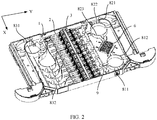
- FIG. 2 shows a structure of an integrated splicing and termination module 10 according to an embodiment of this application.
- the integrated splicing and termination module 10 includes a tray 1.
- the tray 1 is configured to carry a plurality of adapters 2, and the plurality of adapters 2 are mounted on a bracket 3.
- FIG. 3 shows a structure in which the integrated splicing and termination module 10 is pulled out according to an embodiment of this application.
- the bracket 3 includes a top plate 32, a bottom plate 33, and a plurality of side plates.
- the bracket 3 may be produced through integrated forming.
- the top plate 32 and the bottom plate 33 are disposed opposite to each other in the Z direction.
- the plurality of side plates are arranged in the X direction and are separately connected to the top plate 32 and the bottom plate 33 to form a plurality of cavities for accommodating the adapters 2.
- the adapters 2 are fixedly mounted in the cavities.
- the side plates include a first side plate 34 located at an edge of the top plate 32 and the bottom plate 33 and a second side plate 35 located between the top plate 32 and the bottom plate 33.
- the first side plate 34 is connected to the tray 1 to be mounted in the tray 1.
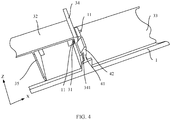
- FIG. 4 shows a specific structure of the bracket 3
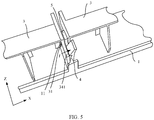
- FIG. 5 shows a structural form of a plurality of brackets 3.
- the integrated splicing and termination module 10 further includes a spacer plate 5.
- the spacer plate 5 is disposed on the tray 1.
- One end of the spacer plate 5 is connected to the tray 1, and the other end of the spacer plate 5 extends in the Z direction to separate the two brackets 3.
- the spacer plate 5 is connected to the first side plate 34 located on each of both sides of the spacer plate 5, so that the plurality of brackets 3 are mounted in the tray 1.
- a splicing operation is performed on a pigtail 71 and an optical fiber 72. Because the splicing operation or another operation performed in the tray 1 may affect cleanness of an end face of the adapter 2, the end face of the adapter needs to be detected and cleaned before the tray 1 is pushed back to the cabinet 01.
- a manner of mounting the bracket 3 in the tray 1 is changed, and a fixed connection between the bracket and the tray in the prior art is changed to a slidable connection between the bracket 3 and the tray 1.
- the bracket 3 is moved out of the tray 1 for operation when necessary, thereby ensuring required operation space.
- the bracket 3 is slidably mounted on the tray 1.
- the bracket 3 can be slidably connected to the tray 1 in a plurality of manners, for example, a slidable connection in which a sliding block cooperates with a sliding rail, and a connection in which a gear cooperates with a rack.
- FIG. 4 shows a connection structure between the bracket 3 and the tray 1.
- An embodiment of this application provides a manner of a guide rod and a guide groove.
- a guide rod 11 is disposed on the tray 1, and the guide rod 11 is fixedly disposed on the tray 1.
- a guide groove 31 matching the guide rod 11 is disposed on the bracket 3, and the guide groove 31 is specifically disposed on the first side plate 34.
- FIG. 5 shows a connection structure between two brackets 3 and the tray 1. To save space and facilitate mounting, guide rods 11 are separately disposed on two side faces of the spacer plate 5 that are opposite to each other in the X direction, and each guide rod 11 is correspondingly slidably connected to the guide groove 31 of the bracket 3.
- a structure of the guide groove 31 may be shown in FIG.
- the guide groove 31 may be provided as a through groove that penetrates through a thickness of the first side plate.
- the guide groove 31 may also be a groove having a specific depth. Different forms may be selected as the structure of the guide groove 31.
- the guide groove 31 is a slotted hole or may be a rectangular hole.
- the guide rod 11 is mounted in the guide groove 31, and a size of the guide rod 11 is smaller than a groove width of the guide groove 31, so that the guide groove 31 can slide relative to the guide rod 11, and the bracket 3 can slide relative to the tray 1 through relative movement between the guide rod 11 and the guide groove 31.
- the adapter 2 is driven to move up from the tray 1 by a distance in the Z direction, and then the end face of the adapter 2 is detected and cleaned, so that the device for cleaning and detecting the end face of the adapter 2 operates in relatively large space.
- an elastic hook 4 is further disposed on the tray 1, as shown in FIG. 4 , FIG. 5 , and FIG. 6 .
- FIG. 4 shows a structure of the elastic hook 4
- FIG. 5 shows a structural change of the elastic hook
- FIG. 6 shows a matching relationship between the elastic hook 4 and the bracket 3.
- One end of the elastic hook 4 is fixed in the tray 1, and the other end of the elastic hook 4 is clamped to the bracket 3.
- different forms may be selected for the elastic hook 4. As shown in FIG.
- the elastic hook 4 is a hook structure and includes a hook body 41 and a hook part 42. One end of the hook body 41 is connected to the tray 1, and the other end of the hook body 41 is connected to the hook part 42. One end that is of the hook part 42 and that is away from the hook body 41 is fastened on an end face 341 that is of the bracket 3 and that is away from the tray 1.
- the elastic hook 4 has elasticity to some extent, and may be prepared by using a plastic material, or may be prepared by using a rubber material. As shown in FIG.
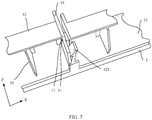
- FIG. 7 shows a position relationship between the bracket 3 and the elastic hook 4.
- the elastic hook 4 returns to an original position, the tray 1 and the elastic hook 4 are in contact, and the elastic hook 4 supports the bracket 3 to prevent the bracket 3 from falling down, that is, the sliding action of the bracket 3 ends.
- the end face of the adapter 2 may be cleaned and detected.
- the bracket 3 moves downward in the reverse direction of the Z direction under the guidance of the guide rod 11, the bracket 3 returns to the tray 1, and the bracket 3 is fastened when the elastic hook 4 is clamped to the bracket 3, as shown in FIG. 6 .
- the end face of the adapter can be detected and cleaned after the adapter 2 is moved to a proper height relative to the tray 1, without interfering with the structure of the tray 1, thereby facilitating detection and cleaning of the end face of the adapter 2.
- the structure of the device for cleaning and detecting the adapter 2 does not need to be changed, thereby reducing costs.
- the adapter 2 may be rotated by an angle on the basis of moving the adapter 2 in the Z direction, so that the adapter 2 is in a better position, where the angle may be 40° to 50°.
- two guide rods 11 may be disposed on the tray 1, and the two guide rods 11 are disposed opposite to each other in an extension direction parallel to the bracket 3.
- two guide rods 11 may be disposed on the tray 1, and two guide rods 11 are disposed on each of two side faces of the spacer plate in the X direction, to ensure that the two guide grooves 31 in each bracket 3 are slidably connected to the guide rod 31.
- the bracket 3 When the bracket 3 is rotated, the two guide rods 11 disposed opposite to each other are used as a rotation axis of rotating the bracket 3, the rotation axis is parallel to the X direction, and the bracket 3 may rotate around the rotation axis by a specific angle relative to the tray 1, which is more convenient for detection and cleaning of the end face of the adapter 2.
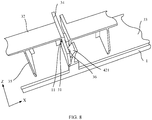
- FIG. 8 shows a position relationship between the bracket 3 and the elastic hook 4 after the sliding of the bracket 3 is completed.
- a surface that is of the hook part 42 and that is away from the hook body 41 is an inclined surface 421 facing the tray 1.
- the stopper 36 is disposed on the bracket 3 and is limited to be in the Z direction. A height of the stopper 36 is not less than a height of the bottom of the guide groove 31.
- the disposing of the stopper 36 can prevent the bracket 3 from falling down, and the stopper 36 cooperates with the inclined surface 421 to support the bracket 3. Therefore, the stopper 36 is disposed, so that when the bracket 3 slides to the specified position, a function of supporting the bracket 3 by the elastic hook 4 and the tray 1 can be better implemented.
- the integrated splicing and termination module 10 further includes a splicing card holder 6.
- FIG. 2 shows a specific structure of the splicing card holder 6
- FIG. 3 shows a connection relationship between the splicing card holder 6 and a cable.
- the splicing card holder 6 is fixedly disposed in the tray 1 to fasten the pigtail 71 and the optical fiber 72 to be spliced.
- One end of the pigtail 71 is mounted on the adapter 2, and the other end of the pigtail 71 enters the splicing card holder 6 for splicing.
- the optical fiber 72 penetrates into the tray 1 from an opening on a right side of the tray 1 and enters the splicing card holder 6 for splicing.
- the pigtail 71 and the optical fiber 72 to be spliced are fastened by using the splicing card holder 6, to facilitate a splicing operation and improve splicing efficiency.
- FIG. 2 shows a specific structure of a baffle plate 9, and FIG. 3 shows a position relationship between the baffle plate 9 and the tray 1.
- the integrated splicing and termination module 10 further includes the baffle plate 9.
- one end of the baffle plate 9 is connected to the tray 1, and the other end of the baffle plate 9 penetrates between the splicing card holder 6 and the adapter 2 and extends in the Z direction, to separate the splicing card holder 6 from the adapter 2.
- contaminants that are generated in a splicing operation and that are attached to the end surface of the adapter 2 can be reduced.
- a length of the baffle plate 9 is limited to be less than a length of the tray 1 in the X direction, to form a channel between a side face of the baffle plate 9 and the tray 1, where the channel is used to pass through the pigtail 71.
- FIG. 2 shows a specific structure of a guide structure 8, and FIG. 3 shows a position relationship between a cable 7 and the guide structure 8.
- the integrated splicing and termination module 10 further includes the guide structure 8, and the guide structure 8 is disposed on the tray 1.
- the guide structure 8 guides the cable 7 in the tray, and a split structure or an integrated structure may be used between the guide structure 8 and the integrated splicing and termination module 10.
- the first guide structure 81 may be fixedly connected to the integrated splicing and termination module 10 by means of bonding, welding, or a connecting piece (a bolt, a screw, or a rivet).
- the integrated splicing and termination module 10 may be produced through integrated forming.
- FIG. 2 shows a specific structure of a first guide structure 81
- FIG. 3 shows a position relationship between a pigtail 71 and the first guide structure 81.
- the guide structure 8 includes the first guide structure 81 configured to guide the pigtail 71 to a front side of the splicing card holder 6.
- the first guide structure 81 includes a first arc-shaped plate 811 and a second arc-shaped plate 812 that are disposed opposite to each other.
- the first arc-shaped plate 811 and the second arc-shaped plate 812 may be an integrated structure.
- the first arc-shaped plate 811 and the second arc-shaped plate 812 are produced through integrated forming.
- the first arc-shaped plate 811 and the second arc-shaped plate 812 may alternatively be separated structures.
- the first arc-shaped plate 811 and the second arc-shaped plate 812 may be connected or may not be connected.
- the first arc-shaped plate 811 and the second arc-shaped plate 812 are fixedly connected to the tray 1 separately, and adjacent ends of the second arc-shaped plate 812 and the first arc-shaped plate 811 may be in direct contact, or may be spaced by a specific gap.
- concave directions of the first arc-shaped plate 811 and the second arc-shaped plate 812 are limited to be opposite.
- An encircling feature used to guide the pigtail 71 is formed by using outer arc faces of the first arc-shaped plate 811 and the second arc-shaped plate 812.
- the pigtail 71 is bent and coiled according to the coiling feature, and then enters the splicing card holder 6 for splicing.
- radiuses of the first arc-shaped plate 811 and the second arc-shaped plate 812 should be greater than a minimum bending radius of the pigtail 71, and the minimum bending radius of the pigtail 71 is a minimum allowed bending radius without damaging the pigtail 71.
- shapes of the first arc-shaped plate 811 and the second arc-shaped plate 812 are not limited to the arc-shaped structures shown in FIG. 2 and FIG. 3 , and another form may be used, for example, an S-shaped structure or a U-shaped structure is used, provided that a bending direction of the pigtail 71 can be limited.
- FIG. 2 shows a specific structure of a second guide structure 82
- FIG. 3 shows a position relationship between the optical fiber 72 and the second guide structure 82.
- the guide structure 8 further includes the second guide structure 82 configured to guide the optical fiber 72 to a rear side of the splicing card holder 6.
- the second guide structure 82 includes a third arc-shaped plate 821, and a fourth arc-shaped plate 822 and a fifth arc-shaped plate 823 that are disposed opposite to each other.
- the third arc-shaped plate 821 is configured to guide the optical fiber 72 from an opening on a right side of the tray 1 to the tray 1.
- the third arc-shaped plate 821, the fourth arc-shaped plate 822, and the fifth arc-shaped plate 823 may be an integrated structure.
- the third arc-shaped plate 821, the fourth arc-shaped plate 822, and the fifth arc-shaped plate 823 are produced through integrated forming.
- the third arc-shaped plate 821, the fourth arc-shaped plate 822, and the fifth arc-shaped plate 823 may alternatively be separated structures. In this case, the third arc-shaped plate 821 and the fourth arc-shaped plate 822 may be connected or may not be connected.
- the third arc-shaped plate 821 and the fourth arc-shaped plate 822 are fixedly connected to the tray 1 separately, and adjacent ends of the third arc-shaped plate 821 and the fourth arc-shaped plate 822 may be in direct contact, or may be spaced by a specific gap.
- the fourth arc-shaped plate 822 and the fifth arc-shaped plate 823 may be connected or may not be connected.
- the fourth arc-shaped plate 822 and the fifth arc-shaped plate 823 are fixedly connected to the tray 1 separately, and adjacent ends of the fourth arc-shaped plate 822 and the fifth arc-shaped plate 823 may be in direct contact, or may be spaced by a specific gap.
- concave directions of the fourth arc-shaped plate 822 and the fifth arc-shaped plate 823 are limited to be opposite.
- An encircling feature used to guide the optical fiber 72 is formed by using outer arc faces of the fourth arc-shaped plate 822 and the fifth arc-shaped plate 823.
- the optical fiber 72 guided into the tray 1 by the third arc-shaped plate 821 is bent and coiled according to the coiling feature, and then enters the splicing card holder 6 for splicing.
- radiuses of the third arc-shaped plate 821, the fourth arc-shaped plate 822, and the fifth arc-shaped plate 823 should be greater than a minimum bending radius of the optical fiber 72.
- the minimum bending radius of the optical fiber 72 is a minimum allowed bending radius without damaging the optical fiber 72.
- shapes of the third arc-shaped plate 821, the fourth arc-shaped plate 822, and the fifth arc-shaped plate 823 are not limited to the arc-shaped structures shown in FIG. 2 and FIG. 3 , and another form may be used, for example, an S-shaped or a U-shaped structure is used, provided that a bending direction of the optical fiber 72 can be limited.
- FIG. 2 shows a specific structure of a third guide structure 83
- FIG. 3 shows a position relationship between a fiber patch cord 73 and the third guide structure 83.
- the guide structure 8 includes the third guide structure 83 configured to guide the fiber patch cord 73 to a side of the adapter 2.
- the third guide structure 83 includes a sixth arc-shaped plate 831 and at least one seventh arc-shaped plate 832.
- the sixth arc-shaped plate 831 and the seventh arc-shaped plate 832 may be an integrated structure.
- the sixth arc-shaped plate 831 and the seventh arc-shaped plate 832 are produced through integrated forming.
- the sixth arc-shaped plate 831 and the seventh arc-shaped plate 832 may alternatively be separated structures.
- the sixth arc-shaped plate 831 and the seventh arc-shaped plate 832 may be connected or may not be connected.
- the sixth arc-shaped plate 831 and the seventh arc-shaped plate 832 are fixedly connected to the tray 1 separately, and adjacent ends of the sixth arc-shaped plate 831 and the seventh arc-shaped plate 832 may be in direct contact, or may be spaced by a specific gap.
- concave directions of the sixth arc-shaped plate 831 and the seventh arc-shaped plate 832 are limited to be opposite.
- a channel is formed between outer arc faces of the sixth arc-shaped plate 831 and the seventh arc-shaped plate 832 and a side wall of the tray 1. The channel is connected to the opening on the left side of the tray 1, and is configured to accommodate the fiber patch cord 73 and guide the fiber patch cord 73 to the left end of the adapter 2.
- radiuses of the sixth arc-shaped plate 831 and the seventh arc-shaped plate 832 should be greater than a minimum bending radius of the fiber patch cord 73, and the minimum bending radius of the fiber patch cord 73 is a minimum allowed bending radius without damaging the fiber patch cord 73.
- shapes of the sixth arc-shaped plate 831 and the seventh arc-shaped plate 832 are not limited to the arc-shaped structures shown in FIG. 2 and FIG. 3 , and another form may be used, for example, an S-shaped structure or a U-shaped structure is used, provided that a bending direction of the fiber patch cord 73 can be limited.
- FIG. 1 is a schematic structural diagram of the communications device 00.
- the communications device 00 includes a cabinet 01, and a slot 02 is disposed on the cabinet 01.
- Each slot 02 is slidably connected to a drawer-like module, and the drawer-like module may be pulled into or pulled out from the slot 02.
- each drawer-like module includes the integrated splicing and termination module 10 according to any one of the foregoing implementations that is slidably assembled in the slot 02.
- the cabinet 01 is connected to the integrated splicing and termination module 10 by using a cable 7.
- two ends of the cable 7 are respectively connected to the cabinet 01 and the adapter 2, and the cable 7 is guided into two sides of the adapter 2 by using the guide structure 8.
- the end face of the adapter 2 can be detected and cleaned after the adapter 2 is moved to a proper height relative to the tray 1, without interfering with the structure of the tray 1, thereby facilitating detection and cleaning of the end face of the adapter 2.
- the structure of the device for cleaning and detecting the adapter 2 does not need to be changed, thereby reducing costs. Therefore, the communications device 00 having the integrated splicing and termination module 10 is universally applicable in consideration of manufacturing and using costs.
Landscapes
- Physics & Mathematics (AREA)
- General Physics & Mathematics (AREA)
- Optics & Photonics (AREA)
- Light Guides In General And Applications Therefor (AREA)
- Mechanical Coupling Of Light Guides (AREA)
Applications Claiming Priority (1)
| Application Number | Priority Date | Filing Date | Title |
|---|---|---|---|
| PCT/CN2019/077712 WO2020181470A1 (zh) | 2019-03-11 | 2019-03-11 | 一种熔配模块及通信设备 |
Publications (3)
| Publication Number | Publication Date |
|---|---|
| EP3736614A1 true EP3736614A1 (de) | 2020-11-11 |
| EP3736614A4 EP3736614A4 (de) | 2021-03-03 |
| EP3736614B1 EP3736614B1 (de) | 2026-01-28 |
Family
ID=72427725
Family Applications (1)
| Application Number | Title | Priority Date | Filing Date |
|---|---|---|---|
| EP19906593.9A Active EP3736614B1 (de) | 2019-03-11 | 2019-03-11 | Fusionspassmodul und kommunikationsvorrichtung |
Country Status (3)
| Country | Link |
|---|---|
| EP (1) | EP3736614B1 (de) |
| CN (1) | CN112005148B (de) |
| WO (1) | WO2020181470A1 (de) |
Cited By (1)
| Publication number | Priority date | Publication date | Assignee | Title |
|---|---|---|---|---|
| US12487427B2 (en) | 2021-03-31 | 2025-12-02 | Afl Telecommunications Llc | Cable mounting clamps |
Families Citing this family (2)
| Publication number | Priority date | Publication date | Assignee | Title |
|---|---|---|---|---|
| CN114609731B (zh) * | 2022-01-30 | 2023-07-18 | 华为技术有限公司 | 熔配模块和通信设备 |
| CN118915256B (zh) * | 2024-10-10 | 2025-03-21 | 杭州华宏通信设备有限公司 | 一种光纤配线架 |
Family Cites Families (16)
| Publication number | Priority date | Publication date | Assignee | Title |
|---|---|---|---|---|
| US7171100B2 (en) * | 2004-11-03 | 2007-01-30 | Adc Telecommunications, Inc. | Optical fiber slack storage tray for distribution cabinet |
| CN201047880Y (zh) * | 2007-06-14 | 2008-04-16 | 常州太平电器有限公司 | 用于光纤配线架上的一体化盘组件 |
| CN101900856B (zh) * | 2009-05-28 | 2012-06-27 | 华为技术有限公司 | 一种光纤插座 |
| CN201518066U (zh) * | 2009-09-24 | 2010-06-30 | 苏州新海宜通信科技股份有限公司 | 一种熔纤盘 |
| CN102043201B (zh) * | 2009-10-19 | 2012-10-03 | 泰科电子(上海)有限公司 | 光纤连接装置 |
| RU2554300C2 (ru) * | 2010-06-18 | 2015-06-27 | Адс Коммьюникейшнз (Шанхай) Ко., Лтд. | Волоконно-оптический терминал распределительной сети и способ разворачивания волоконного распределительного кабеля |
| US9075203B2 (en) * | 2012-01-17 | 2015-07-07 | Adc Telecommunications, Inc. | Fiber optic adapter block |
| EP3100090A4 (de) * | 2014-01-28 | 2017-09-06 | ADC Telecommunications Inc. | Verschiebbares glasfaser-verbindungsmodul mit kabelüberlängenverwaltung |
| WO2016029171A1 (en) * | 2014-08-21 | 2016-02-25 | Adc Telecommunications, Inc. | High density adapter carrier pack |
| HUE054230T2 (hu) * | 2015-12-16 | 2021-08-30 | CommScope Connectivity Belgium BVBA | Távközlési elosztó elemek |
| WO2017103234A1 (en) * | 2015-12-17 | 2017-06-22 | CommScope Connectivity Belgium BVBA | Telecommunications distribution elements |
| CN205715097U (zh) * | 2016-04-21 | 2016-11-23 | 深圳市科信通信技术股份有限公司 | 适配器夹扣 |
| CN206133063U (zh) * | 2016-09-18 | 2017-04-26 | 中兴通讯股份有限公司 | 一种光配纤网络odn熔配盘结构 |
| WO2018058507A1 (zh) * | 2016-09-30 | 2018-04-05 | 华为技术有限公司 | 光纤熔配模块及光纤熔配框 |
| CN110462478B (zh) * | 2017-04-04 | 2021-05-07 | 康普技术有限责任公司 | 光学接头和端接模块 |
| CN207992515U (zh) * | 2018-01-19 | 2018-10-19 | 西安高新科技职业学院 | 光纤配线箱 |
-
2019
- 2019-03-11 EP EP19906593.9A patent/EP3736614B1/de active Active
- 2019-03-11 CN CN201980003407.0A patent/CN112005148B/zh active Active
- 2019-03-11 WO PCT/CN2019/077712 patent/WO2020181470A1/zh not_active Ceased
Cited By (1)
| Publication number | Priority date | Publication date | Assignee | Title |
|---|---|---|---|---|
| US12487427B2 (en) | 2021-03-31 | 2025-12-02 | Afl Telecommunications Llc | Cable mounting clamps |
Also Published As
| Publication number | Publication date |
|---|---|
| EP3736614B1 (de) | 2026-01-28 |
| CN112005148B (zh) | 2022-04-22 |
| CN112005148A (zh) | 2020-11-27 |
| EP3736614A4 (de) | 2021-03-03 |
| WO2020181470A1 (zh) | 2020-09-17 |
Similar Documents
| Publication | Publication Date | Title |
|---|---|---|
| EP3736614A1 (de) | Fusionspassmodul und kommunikationsvorrichtung | |
| US6398149B1 (en) | Cable management system with adjustable cable spools | |
| EP2333597B1 (de) | Glasfasermodulanordnung und entsprechende Verfahren | |
| CN102647877B (zh) | 具有支撑件的通信搁架和在搁架中安装转接器面板的方法 | |
| US20110129186A1 (en) | Fiber Optic Module Assembly and Associated Methods | |
| US9500833B1 (en) | Optical fiber module rack system | |
| CN113534374B (zh) | 光纤配线设备和光纤调度系统 | |
| JP7712404B2 (ja) | 光ファイバ分配装置、光ファイバスケジューリング方法及びシステム | |
| EP4236343B1 (de) | Patch-platte mit hubkassettenentfernung | |
| EP3845943A1 (de) | Schweissmodul und kommunikationsvorrichtung | |
| US10798845B2 (en) | 1U rackmount enclosure and 1U rack | |
| US20230068980A1 (en) | Fiber optic distribution frame | |
| US20100232757A1 (en) | Lc adapter | |
| EP3699658B1 (de) | Herausziehanordnung | |
| JP2014112162A (ja) | 光コネクタ、光コネクタシステム、光バックプレーン装置 | |
| EP2828698A1 (de) | Schwenkbarer stützrahmen für einen glasfaseradapter | |
| JP6005778B2 (ja) | 光接続構造 | |
| WO2016154092A1 (en) | Fiber optic module and chassis with cable slack management | |
| CN219936153U (zh) | 一种易于拆装的光纤配线架 | |
| CN218995722U (zh) | 一种多工位的光纤跳线上料夹具 | |
| CN222850784U (zh) | 一种光纤到户盒子的导轨安装支架 | |
| CN117811667B (zh) | 光纤自动化切换设备及控制方法 | |
| EP4266102A1 (de) | Fasertransportrohrhalter | |
| CN216982022U (zh) | 一种数控机床数据采集网关 | |
| CN214164587U (zh) | 一种绘制平面直角坐标的辅助装置 |
Legal Events
| Date | Code | Title | Description |
|---|---|---|---|
| STAA | Information on the status of an ep patent application or granted ep patent |
Free format text: STATUS: UNKNOWN |
|
| STAA | Information on the status of an ep patent application or granted ep patent |
Free format text: STATUS: THE INTERNATIONAL PUBLICATION HAS BEEN MADE |
|
| PUAI | Public reference made under article 153(3) epc to a published international application that has entered the european phase |
Free format text: ORIGINAL CODE: 0009012 |
|
| STAA | Information on the status of an ep patent application or granted ep patent |
Free format text: STATUS: REQUEST FOR EXAMINATION WAS MADE |
|
| 17P | Request for examination filed |
Effective date: 20200707 |
|
| AK | Designated contracting states |
Kind code of ref document: A1 Designated state(s): AL AT BE BG CH CY CZ DE DK EE ES FI FR GB GR HR HU IE IS IT LI LT LU LV MC MK MT NL NO PL PT RO RS SE SI SK SM TR |
|
| AX | Request for extension of the european patent |
Extension state: BA ME |
|
| A4 | Supplementary search report drawn up and despatched |
Effective date: 20210128 |
|
| RIC1 | Information provided on ipc code assigned before grant |
Ipc: G02B 6/44 20060101ALI20210122BHEP Ipc: G02B 6/255 20060101AFI20210122BHEP |
|
| DAV | Request for validation of the european patent (deleted) | ||
| DAX | Request for extension of the european patent (deleted) | ||
| STAA | Information on the status of an ep patent application or granted ep patent |
Free format text: STATUS: EXAMINATION IS IN PROGRESS |
|
| 17Q | First examination report despatched |
Effective date: 20230627 |
|
| REG | Reference to a national code |
Ref country code: DE Ref legal event code: R079 Ipc: G02B0006440000 Ref country code: DE Ref legal event code: R079 Ref document number: 602019080992 Country of ref document: DE Free format text: PREVIOUS MAIN CLASS: G02B0006255000 Ipc: G02B0006440000 |
|
| GRAP | Despatch of communication of intention to grant a patent |
Free format text: ORIGINAL CODE: EPIDOSNIGR1 |
|
| STAA | Information on the status of an ep patent application or granted ep patent |
Free format text: STATUS: GRANT OF PATENT IS INTENDED |
|
| RIC1 | Information provided on ipc code assigned before grant |
Ipc: G02B 6/44 20060101AFI20250909BHEP |
|
| INTG | Intention to grant announced |
Effective date: 20250925 |
|
| GRAS | Grant fee paid |
Free format text: ORIGINAL CODE: EPIDOSNIGR3 |
|
| GRAA | (expected) grant |
Free format text: ORIGINAL CODE: 0009210 |
|
| STAA | Information on the status of an ep patent application or granted ep patent |
Free format text: STATUS: THE PATENT HAS BEEN GRANTED |
|
| AK | Designated contracting states |
Kind code of ref document: B1 Designated state(s): AL AT BE BG CH CY CZ DE DK EE ES FI FR GB GR HR HU IE IS IT LI LT LU LV MC MK MT NL NO PL PT RO RS SE SI SK SM TR |
|
| REG | Reference to a national code |
Ref country code: CH Ref legal event code: F10 Free format text: ST27 STATUS EVENT CODE: U-0-0-F10-F00 (AS PROVIDED BY THE NATIONAL OFFICE) Effective date: 20260128 Ref country code: GB Ref legal event code: FG4D |
|
| REG | Reference to a national code |
Ref country code: DE Ref legal event code: R096 Ref document number: 602019080992 Country of ref document: DE |
|
| REG | Reference to a national code |
Ref country code: IE Ref legal event code: FG4D |
|
| PGFP | Annual fee paid to national office [announced via postgrant information from national office to epo] |
Ref country code: DE Payment date: 20260211 Year of fee payment: 8 |