EP3736710A1 - Procédé et dispositif pour commander un dispositif technique avec des données - Google Patents
Procédé et dispositif pour commander un dispositif technique avec des données Download PDFInfo
- Publication number
- EP3736710A1 EP3736710A1 EP19173735.2A EP19173735A EP3736710A1 EP 3736710 A1 EP3736710 A1 EP 3736710A1 EP 19173735 A EP19173735 A EP 19173735A EP 3736710 A1 EP3736710 A1 EP 3736710A1
- Authority
- EP
- European Patent Office
- Prior art keywords
- data
- triples
- multiplicity
- graph
- reflection
- Prior art date
- Legal status (The legal status is an assumption and is not a legal conclusion. Google has not performed a legal analysis and makes no representation as to the accuracy of the status listed.)
- Withdrawn
Links
Images


Classifications
-
- G—PHYSICS
- G06—COMPUTING OR CALCULATING; COUNTING
- G06F—ELECTRIC DIGITAL DATA PROCESSING
- G06F16/00—Information retrieval; Database structures therefor; File system structures therefor
- G06F16/90—Details of database functions independent of the retrieved data types
- G06F16/901—Indexing; Data structures therefor; Storage structures
- G06F16/9024—Graphs; Linked lists
-
- G—PHYSICS
- G06—COMPUTING OR CALCULATING; COUNTING
- G06F—ELECTRIC DIGITAL DATA PROCESSING
- G06F16/00—Information retrieval; Database structures therefor; File system structures therefor
- G06F16/20—Information retrieval; Database structures therefor; File system structures therefor of structured data, e.g. relational data
- G06F16/25—Integrating or interfacing systems involving database management systems
- G06F16/254—Extract, transform and load [ETL] procedures, e.g. ETL data flows in data warehouses
Definitions
- the invention relates to a method to control a technical device with data.
- the invention relates also to a control device configured to control a technical device with data.
- PLM Product Lifecycle Management
- the objective of the invention is achieved by a method to control a technical device with data, wherein the data are derived from a multiplicity of data triples by a predetermined data query, which data query defines a relation between at least two data triples of the multiplicity of data triples, which multiplicity of data triples define a hierarchic data structure and represent a knowledge graph with nodes and edges, and each data triple of the multiplicity of data triples is generated by a reflection design pattern mechanism and consists of a data subject, a data predicate and a data object respectively.
- Knowledge graph technologies and their capability to infer knowledge from pre-existing information offer the possibility to run in-place complex queries over huge amounts of data. Semantic based information could leverage production processes, maintenance, services and customer interaction. To operate with, information should be available in the knowledge graph in the first place.
- Huge amounts of data, coming from different projects, and even from different PLM tools, must be put together into knowledge graphs. Obviously, this is a tremendous task that cannot be dealt with manually.
- a knowledge graph is a semantic database where entities are placed in relation to each other, provided with attributes and brought into thematic context or ontologies.
- semantics The most important elements of a semantic structure are entities and ontologies.
- an entity In semantics, an entity is uniquely identified by an identifier and certain properties (attributes/properties). While the identifier, mostly in the form of a series of numbers, is intended for machine identification, living things recognize entities by their properties.
- the graph theory can be used for the visualization of semantic structures.
- Graphs comprise nodes and edges.
- the nodes are the entities and the edges represent the relations of different entities to each other, e.g. a "relationship context”.
- a graph contains all entities involved, regardless of the ontology. Edges, in addition to the mere representation of a relationship between entities, may also be used to evaluate these relationships, e.g. be used in length and thickness. A particularly pronounced relation in terms of the "thickness of the connection" can represent an intense relationship between the two entities. Also, the relationship distance of two entities to each other can be used to represent the proximity to each other. In addition, it is also possible to create a bridge to vector spaces including Euclidean distances. In other words, a graph structure could be derived by statistical methods such as vector space analyzes.
- a named entity is a group of one or more words (a text element) that identifies an entity by name.
- named entities may include persons (such as a person's given name or role), organizations (such as the name of a corporation, institution, association, government or private organization), places (locations, such as a country, state, town, geographic region, a named building, or the like), artifacts (such as names of consumer products, such as cars), temporal expressions, such as specific dates, events, and monetary expressions.
- a further aspect of the invention refers to the reflection design pattern mechanism.
- Reflection or introspection in programming means that a program knows its own structure and may modify it.
- machine code in RAM executed by a microprocessor can be said to be reflexive.
- Such a program can handle its instructions like data and therefore can analyze and change its structure. Reflection is often supported by frameworks or languages that run in a virtual machine, such as Java, .NET or Smalltalk, and many interpretive languages.
- Reflection plays an important role in connection with type-safe programming, but also in questions of persistence (persistent data management of objects and their relationships).
- Reflection allows object-oriented programming to query at runtime for information about classes or their instances, such as in Objective-C (typically called introspection there). For a method, these include their visibility, the data type of the return value, or the type of the transfer parameter.
- the implementation of the query options is language-specific.
- Java and languages for use with the .NET Framework such as C#, Object Pascal, VB.NET or IronPython support the reflection that the .NET Framework provides on its own. All languages that use the .NET Framework must, according to the CLS (Common Language Specification), store the corresponding information as metadata.
- CLS Common Language Specification
- the execution speed of code by reflection is usually less than that of static code. This is, amongst other, due to the string comparisons of the corresponding names of the desired methods, properties, etc. with the entries in the metadata.
- reflection provides very high run-time flexibility, since code can be called dynamically, new instances can be created, or even types and objects can be dynamically restructured.
- the reflection design pattern mechanism is determined based on a depth-first graph traversal algorithm.
- the reflection design pattern mechanism is determined in a very efficient way.
- Depth-first search is an algorithm for traversing or searching tree or graph data structures. The algorithm starts at the root node (selecting some arbitrary node as the root node in the case of a graph) and explores as far as possible along each branch before backtracking.
- the data subject and the data object are respective nodes of the knowledge graph, and the data predicate is an edge of the knowledge graph.
- the hierarchical data structure offers a very efficient data storage and data query performance.
- the hierarchical data structure is determined in a very efficient way.
- the hierarchical data structure is determined in a very efficient way.
- control device which is configured to control a technical device with data, wherein the data are derived by the method according to the invention.
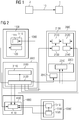
- Fig. 1 shows an embodiment of the invention with a technical device 1 and a control device 2.
- the control device 2 is configured to control a technical device 1 by data 10.
- the data 10 are derived as described below.
- Fig. 2 shows an architecture diagram of an embodiment of a TIA portal connector, which is configured to generate a hierarchic data structure for the use within the invention.
- the TIA portal connector gets data from TIA Portal using the reflection graph traversal algorithm.
- a semantic software connector is the component that takes the data from the TIA Portal Connector, transforms it into triples, and loads the triples into a Knowledge Graph.
- the diagram represents the method according to the invention, wherein the data 10 are derived from a multiplicity of data triples by a predetermined data query, which data query defines a relation between at least two data triples of the multiplicity of data triples, which multiplicity of data triples define a hierarchic data structure and represent a knowledge graph with nodes and edges, and each data triple of the multiplicity of data triples is generated by a reflection design pattern mechanism and consists of a data subject, a data predicate and a data object respectively.
- the data subject and the data object are respective nodes of the knowledge graph, and the data predicate is an edge of the knowledge graph.
- At least two data triples of the multiplicity of data triples are obtained from different data sources and transformed to the hierarchic data structure of the data triples of the multiplicity of data triples.
- At least two data triples of the multiplicity of data triples are received in different data format and transformed into the data format of the data triples of the multiplicity of data triples.
- Fig. 3 and Fig. 4 show an embodiment of a respective pseudo program code as algorithms used in Fig. 2 .
- the connector is configured to translate complex hierarchies of data stored in a typical PLM platform into triples, which can be stored as a Knowledge graph.
- a knowledge graph is both the model and the tool used to store the data in an alternative format, RDF (Resource Description Format), as a property graph.
- RDF Resource Description Format
- Knowledge graphs are schema-free, extendable, triple-based representations of information. They allow complex construction of queries to extract specific information in a more flexible and generic way than with traditional relational databases.
- RDF triples are generated from the PLM data model by automatically using a reflection design pattern.
- the specific PLM software API can be used, and data-access related methods can be selected as candidates for the reflection design pattern.
- the generated RDF triples can be further processed for either their export to RDF files or, they can be pushed to a RDF triple-store, such as RDF4J (http://rdf4j.org) or Blazegraph (https://www.blazegraph.com).
- a "ReflectionTIAv15Algorithm” 3120 of a "TIAComponentConnectorV15.enrichment” module 3100 of a "TIAComponent.ConnectorV15" domain 3000 visits, based on a node instance (usually the project node, that contains all the sub-nodes - devices, sub-devices, lists etc. of the PLM software project), all the children nodes of the project, starting from the project (i.e. the root of the hierarchy).
- the links between the nodes are considered to be the properties that connects a parent node with its children nodes (for example, a project node can have a property named "GetDevices()" that returns a list with its immediate sub-nodes, like project's devices).
- An “IEntityPopulationAlgorithm” 3110 is a functional interface with one method only: "Entity populate(object obj);”.
- the ReflectionTIAv15Algorithm 3120 is the implementer of it.
- the interface has the scope of hiding the implementation details and the dependencies of the ReflectionTIAv15Algorithm 3120 from its user.
- This reflection algorithm can be done via a factory design pattern. This allows the user of the ReflectionTIAv15Algorithm 3120 to be unaware with respect to the PLM software platform dependencies.
- ReflectionTIAv15Algorithm 3120 Dependencies on the Siemens TIA portal, namely the ReflectionTIAv15Algorithm 3120 also uses "PlcBlock” 1111 and "EngineeringAttributeInfo” 1120.
- the reflection-based traversal algorithm can be mixed with the product-specific data structures; but reflection can work also on its own.
- the PlcBlock 1111 is located within the "Siemens.Engineering.SW.Blocks" procedure 1110, which is part of a "Siemens.Engineering” module 1100 of a "Siemens” domain 1000.
- a system 2000 comprises methods "System.Reflection” 2100, “System.Collection.Generic” 2200 and a tuple 2010.
- the ReflectionTIAv15Algorithm 3120 uses the Tuple 2010 ⁇ object, Entity> to represent intermediary information. It serves the purpose of converting the properties of a TIA object structure to a generic entity structure 4110, who is a mere dictionary.
- the first part of the tuple 2010 is the TIA portal (or specific PLM software) object, whereas the second part (entity) is the generic structure which will be filled in based on the first part of the tuple 2010.
- the System.Reflection 2100 includes methods "MethodInfo” 2110, “MethodBase” 2120, “PropertyInfo” 2130 and “MemberInfo” 2140.
- System.Collection.Generic 2200 includes a "LinkedList" 2210.
- the ReflectionTIAv15Algorithm 3120 (graph reflection algorithm makes) use of a stack (implemented as a LinkedList) to traverse the reflection graph. Also, there are several dependencies on the Reflection API which are used: The MemberInfo 2110 is used to get the name of a property, or of a type returned by the "object.GetType()" reflection method.
- object.GetType().GetProperties() returns an array of "PropertyInfo" objects 2130, which describe the member variables with their names and values.
- the MethodBase 2120 is the generic reflection method used for invoking API-specific methods given by their name, along with the MethodInfo 2140 associated structure.
- the entity data structure 4110 of a "TIAProjectModel.Model” 4100 of a "TIAProjectModel” 4000 is a (key, value) dictionary-based structure, that is used to create the graph structure in an API-independent way.
- the graph reflection algorithm walks through the API, reads the object properties and replicates the information grabbed in the form of an intermediary form, a graph with entity nodes.
- a "SemanticTIAConnector.services.export” 5100 of a “SemanticTIAConnector” 5000 includes methods “IEntityExporter” 5110 and "RemoteStore” 5120.
- the entity-based graph is further used to generate triples by the RemoteStore method 5120. Once generated, they are pushed to a triple-store graph via a SPARQL endpoint.
- the IEntityExporter 5110 interface is also a functional interface, and the RemoteStore is one implementation of it. Its dependencies and implementation details are hidden using a factory design pattern that provides IEntityExporter 5110 implementations for RDF storage such as RemoteStore 5120, but it can also write to RDF or TTL files, write to the console etc.
- RDF triples and knowledge graphs open a new perspective when it comes to data integration and discovery. Once the data is within the graph, linking information between data sets can be found, e.g. by the RDF triple relation information, which processes control one technical device?
- Graphs schemas can be created for certain types of processes. Software can be used that interacts with the data matching the schema and the software controls the process.
- a connector can be implemented, that recursively goes through a specific project and creates an equivalent dictionary using a reflection design pattern.
- This dictionary is converted into RDF triples and inserted into a knowledge graph by a subsequent software component "SemanticConnector".
- the RDF triples generator is accomplished by combining the Connector and the SemanticConnector.
- the TiaComponentConnectorV15 builds the dictionary and the SemanticTiaConnector converts the dictionary to RDF triples.
- any data structure can be replicated into an RDF triple format that is accessible via an API, that supports the reflection design pattern, without caring about the API specifics and without the need of calling explicitly the entire data model.
- the invention makes use of the reflection mechanism which is available in modern programming languages like C# and Java. Thus, it can be applied to a various implementation solution, not being dependent of a particular implementation.
- One feature of the graph reflection algorithm is based on the reflection design pattern.
- the project model should be available in a high-level language that offers the reflection mechanism at the language level.
- the API of the PLM software itself should offer such features, that is to access project nodes properties information and relation to sibling nodes.
- This PLM-specific capability can be used instead (if it is generic enough) of or in addition to the reflection mechanism.
- An embodiment of the invention can be used to automatically aggregate a great number of existing projects of PLM software, projects describing products, production processes, related resources and costs; a huge amount of information could thus be aggregated into knowledge-graph stores, in a uniform approach, opening the way for big-data analytic process.
- an aggregation offers the possibility of cross-product, cross-domain leveraging of proprietary information - information which is now tied up to specific PLM platforms and projects and cannot be easily and uniformly exploited in cross-division or cross-products data analysis scenarios.
- the graph reflection algorithm as described before is based on a depth-first graph traversal algorithm (see, for example, R. Mihalcea, D. Radev, "Graph-Based Natural Language Processing and Information Retrieval", Cambridge University Press, 2011 ), on the graph implicitly represented by the PLM software object structure.
Landscapes
- Engineering & Computer Science (AREA)
- Databases & Information Systems (AREA)
- Theoretical Computer Science (AREA)
- Data Mining & Analysis (AREA)
- Physics & Mathematics (AREA)
- General Engineering & Computer Science (AREA)
- General Physics & Mathematics (AREA)
- Software Systems (AREA)
- Information Retrieval, Db Structures And Fs Structures Therefor (AREA)
Priority Applications (2)
| Application Number | Priority Date | Filing Date | Title |
|---|---|---|---|
| EP19173735.2A EP3736710A1 (fr) | 2019-05-10 | 2019-05-10 | Procédé et dispositif pour commander un dispositif technique avec des données |
| PCT/EP2020/061919 WO2020229188A1 (fr) | 2019-05-10 | 2020-04-29 | Procédé et dispositif de commande d'un dispositif technique avec des données |
Applications Claiming Priority (1)
| Application Number | Priority Date | Filing Date | Title |
|---|---|---|---|
| EP19173735.2A EP3736710A1 (fr) | 2019-05-10 | 2019-05-10 | Procédé et dispositif pour commander un dispositif technique avec des données |
Publications (1)
| Publication Number | Publication Date |
|---|---|
| EP3736710A1 true EP3736710A1 (fr) | 2020-11-11 |
Family
ID=66685332
Family Applications (1)
| Application Number | Title | Priority Date | Filing Date |
|---|---|---|---|
| EP19173735.2A Withdrawn EP3736710A1 (fr) | 2019-05-10 | 2019-05-10 | Procédé et dispositif pour commander un dispositif technique avec des données |
Country Status (2)
| Country | Link |
|---|---|
| EP (1) | EP3736710A1 (fr) |
| WO (1) | WO2020229188A1 (fr) |
Citations (1)
| Publication number | Priority date | Publication date | Assignee | Title |
|---|---|---|---|---|
| EP2631817A1 (fr) * | 2012-02-23 | 2013-08-28 | Fujitsu Limited | Base de données, appareil et procédé permettant de stocker les triplets codés |
-
2019
- 2019-05-10 EP EP19173735.2A patent/EP3736710A1/fr not_active Withdrawn
-
2020
- 2020-04-29 WO PCT/EP2020/061919 patent/WO2020229188A1/fr not_active Ceased
Patent Citations (1)
| Publication number | Priority date | Publication date | Assignee | Title |
|---|---|---|---|---|
| EP2631817A1 (fr) * | 2012-02-23 | 2013-08-28 | Fujitsu Limited | Base de données, appareil et procédé permettant de stocker les triplets codés |
Non-Patent Citations (1)
| Title |
|---|
| R. MIHALCEA; D. RADEV: "Graph-Based Natural Language Processing and Information Retrieval", 2011, CAMBRIDGE UNIVERSITY PRESS |
Also Published As
| Publication number | Publication date |
|---|---|
| WO2020229188A1 (fr) | 2020-11-19 |
Similar Documents
| Publication | Publication Date | Title |
|---|---|---|
| Wache et al. | Ontology-based integration of information-a survey of existing approaches. | |
| Neaga et al. | An enterprise modeling and integration framework based on knowledge discovery and data mining | |
| Gómez-Romero et al. | A fuzzy extension of the semantic building information model | |
| Euzenat et al. | Ontology alignments: an ontology management perspective | |
| CN117608656A (zh) | 一种基于ast和llm的混合式前端框架迁移方法 | |
| Scharffe et al. | Correspondence patterns for ontology alignment | |
| Ambrus et al. | Konduit vqb: a visual query builder for sparql on the social semantic desktop | |
| Weigand et al. | Creating virtual knowledge graphs from software-internal data | |
| Lissandrini et al. | Example-Driven Exploratory Analytics over Knowledge Graphs. | |
| CN117891976A (zh) | 一种数据血缘关系确定方法和装置 | |
| Stupnikov et al. | Extensible unifying data model design for data integration in FAIR data infrastructures | |
| Haller et al. | Pharos: Query-driven schema inference for the semantic web | |
| EP3736710A1 (fr) | Procédé et dispositif pour commander un dispositif technique avec des données | |
| RU2605387C2 (ru) | Способ и система для хранения данных графов | |
| Abrosimova et al. | The ontology-based event mining tools for monitoring global processes | |
| Abdelhedi et al. | Conceptual modeling of a document-oriented NoSQL database | |
| Ding et al. | Ontology management: survey, requirements and directions | |
| Khouri et al. | Design life-cycle-driven approach for data warehouse systems configurability | |
| Luttenberger et al. | Standard International Trade Classification: From Spreadsheet to OWL-2 Ontology | |
| Gogineni et al. | Systematic design and implementation of a semantic assistance system for aero-engine design and manufacturing | |
| Kurze et al. | Towards an ontology of multidimensional data structures for analytical purposes | |
| Domínguez et al. | Developing provenance-aware query systems: an occurrence-centric approach | |
| Strmecki et al. | An ontological model for generating complete, form-based, business web applications | |
| SRAI et al. | Integration of the MDA Approach in Document-Oriented NOSQL Databases, Generation of a PSM Model From a PIM Model | |
| Zhu et al. | Querying and reasoning with product engineering ontologies: moving past modeling |
Legal Events
| Date | Code | Title | Description |
|---|---|---|---|
| PUAI | Public reference made under article 153(3) epc to a published international application that has entered the european phase |
Free format text: ORIGINAL CODE: 0009012 |
|
| STAA | Information on the status of an ep patent application or granted ep patent |
Free format text: STATUS: THE APPLICATION HAS BEEN PUBLISHED |
|
| AK | Designated contracting states |
Kind code of ref document: A1 Designated state(s): AL AT BE BG CH CY CZ DE DK EE ES FI FR GB GR HR HU IE IS IT LI LT LU LV MC MK MT NL NO PL PT RO RS SE SI SK SM TR |
|
| AX | Request for extension of the european patent |
Extension state: BA ME |
|
| STAA | Information on the status of an ep patent application or granted ep patent |
Free format text: STATUS: THE APPLICATION IS DEEMED TO BE WITHDRAWN |
|
| 18D | Application deemed to be withdrawn |
Effective date: 20210512 |