EP3736744B1 - Gesichertes klassifizierungsverfahren von eingangsdaten mittels eines neuronalen netzwerkes mit konvolution - Google Patents
Gesichertes klassifizierungsverfahren von eingangsdaten mittels eines neuronalen netzwerkes mit konvolution Download PDFInfo
- Publication number
- EP3736744B1 EP3736744B1 EP20173401.9A EP20173401A EP3736744B1 EP 3736744 B1 EP3736744 B1 EP 3736744B1 EP 20173401 A EP20173401 A EP 20173401A EP 3736744 B1 EP3736744 B1 EP 3736744B1
- Authority
- EP
- European Patent Office
- Prior art keywords
- cnn
- data
- learning
- parameters
- cnns
- Prior art date
- Legal status (The legal status is an assumption and is not a legal conclusion. Google has not performed a legal analysis and makes no representation as to the accuracy of the status listed.)
- Active
Links
Images


Classifications
-
- G—PHYSICS
- G06—COMPUTING OR CALCULATING; COUNTING
- G06N—COMPUTING ARRANGEMENTS BASED ON SPECIFIC COMPUTATIONAL MODELS
- G06N3/00—Computing arrangements based on biological models
- G06N3/02—Neural networks
- G06N3/04—Architecture, e.g. interconnection topology
- G06N3/045—Combinations of networks
-
- G—PHYSICS
- G06—COMPUTING OR CALCULATING; COUNTING
- G06F—ELECTRIC DIGITAL DATA PROCESSING
- G06F16/00—Information retrieval; Database structures therefor; File system structures therefor
- G06F16/50—Information retrieval; Database structures therefor; File system structures therefor of still image data
- G06F16/55—Clustering; Classification
-
- G—PHYSICS
- G06—COMPUTING OR CALCULATING; COUNTING
- G06F—ELECTRIC DIGITAL DATA PROCESSING
- G06F21/00—Security arrangements for protecting computers, components thereof, programs or data against unauthorised activity
- G06F21/30—Authentication, i.e. establishing the identity or authorisation of security principals
- G06F21/31—User authentication
- G06F21/32—User authentication using biometric data, e.g. fingerprints, iris scans or voiceprints
-
- G—PHYSICS
- G06—COMPUTING OR CALCULATING; COUNTING
- G06N—COMPUTING ARRANGEMENTS BASED ON SPECIFIC COMPUTATIONAL MODELS
- G06N3/00—Computing arrangements based on biological models
- G06N3/02—Neural networks
- G06N3/04—Architecture, e.g. interconnection topology
- G06N3/042—Knowledge-based neural networks; Logical representations of neural networks
-
- G—PHYSICS
- G06—COMPUTING OR CALCULATING; COUNTING
- G06N—COMPUTING ARRANGEMENTS BASED ON SPECIFIC COMPUTATIONAL MODELS
- G06N3/00—Computing arrangements based on biological models
- G06N3/02—Neural networks
- G06N3/04—Architecture, e.g. interconnection topology
- G06N3/0464—Convolutional networks [CNN, ConvNet]
-
- G—PHYSICS
- G06—COMPUTING OR CALCULATING; COUNTING
- G06N—COMPUTING ARRANGEMENTS BASED ON SPECIFIC COMPUTATIONAL MODELS
- G06N3/00—Computing arrangements based on biological models
- G06N3/02—Neural networks
- G06N3/08—Learning methods
-
- G—PHYSICS
- G06—COMPUTING OR CALCULATING; COUNTING
- G06N—COMPUTING ARRANGEMENTS BASED ON SPECIFIC COMPUTATIONAL MODELS
- G06N3/00—Computing arrangements based on biological models
- G06N3/02—Neural networks
- G06N3/08—Learning methods
- G06N3/0895—Weakly supervised learning, e.g. semi-supervised or self-supervised learning
-
- G—PHYSICS
- G06—COMPUTING OR CALCULATING; COUNTING
- G06N—COMPUTING ARRANGEMENTS BASED ON SPECIFIC COMPUTATIONAL MODELS
- G06N3/00—Computing arrangements based on biological models
- G06N3/02—Neural networks
- G06N3/08—Learning methods
- G06N3/09—Supervised learning
-
- G—PHYSICS
- G06—COMPUTING OR CALCULATING; COUNTING
- G06N—COMPUTING ARRANGEMENTS BASED ON SPECIFIC COMPUTATIONAL MODELS
- G06N3/00—Computing arrangements based on biological models
- G06N3/02—Neural networks
- G06N3/08—Learning methods
- G06N3/096—Transfer learning
-
- G—PHYSICS
- G06—COMPUTING OR CALCULATING; COUNTING
- G06N—COMPUTING ARRANGEMENTS BASED ON SPECIFIC COMPUTATIONAL MODELS
- G06N3/00—Computing arrangements based on biological models
- G06N3/02—Neural networks
- G06N3/08—Learning methods
- G06N3/098—Distributed learning, e.g. federated learning
Definitions
- the present invention relates to the field of biometrics, and in particular to a method for secure classification of input data using a convolutional neural network, for authentication/identification.
- Neural networks are massively used for data classification.
- a neural network After a phase of machine learning (usually supervised, i.e. on a base of already classified reference data), a neural network “learns” and becomes capable of applying the same classification to unknown data on its own.
- CNNs are a type of neural network in which the connection pattern between neurons is inspired by the visual cortex of animals. They are thus particularly suited to a particular type of classification which is image analysis, they effectively allow the recognition of objects or people in images or videos, particularly in security applications (automatic surveillance, threat detection, etc.).
- CNNs are particularly well-known for their use in the police and anti-terrorist fields. More precisely, police forces have databases of photographs, for example, of the faces of individuals involved in cases. It is then possible to train CNNs to recognize faces in video surveillance data, in particular to detect wanted individuals. Similarly, we can imagine that governments have biometric databases, for example, of fingerprints of passports. It is then possible to train CNNs to recognize the fingerprints of specific individuals.
- YU HUAPENG ET AL: "Transfer Learning for Face Identification with Deep Face Model",2016 7TH INTERNATIONAL CONFERENCE ON CLOUD COMPUTING AND BIG DATA (CCBD), IEEE ,DOI: 10.1109/CCBD.2016.014 describes transfer learning of facial recognition.
- teachers will generate a learning database for the student by classifying raw public data using a teacher "voting" system, possibly noisy to avoid being able to go back to the individual sets of confidential data used for the teachers' learning.
- the invention relates to a computer program product comprising code instructions for executing a method according to the first aspect of learning parameters of a convolutional neural network, CNN, or according to the second aspect of classifying an input data; and a storage means readable by a computer equipment on which a computer program product comprises code instructions for executing a method according to the first aspect of learning parameters of a convolutional neural network, CNN, or according to the second aspect of classifying an input data.
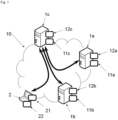
- the server(s) 1a, 1b, 1c are the learning equipment (implementing the first method) and the terminal 2 is a classification equipment (implementing the second method), for example a video surveillance data processing equipment.
- each equipment 1a, 1b, 1c, 2 is typically a remote computer equipment connected to a wide area network 10 such as the Internet network for the exchange of data.
- a wide area network 10 such as the Internet network for the exchange of data.
- Each comprises data processing means 11a, 11b, 11c, 21 of the processor type, and data storage means 12a, 12b, 12c, 22 such as a computer memory, for example a disk.
- a server 1c is a so-called main server that does not have a training database (or at least not a confidential database, but we will see that it has access to at least one first public training database).
- the role of this server 1c can quite easily be accomplished by one or the other of the servers 1a, 1b, but preferably it is a separate server (i.e. partitioned) to avoid any risk of disclosure of the confidential databases of the servers 1a, 1b.
- the terminal 2 could be confused with the main server 1c.
- at least one server 1a, 1b called secondary (or "client") stores a confidential training database, i.e. a set of already classified data (as opposed to the so-called input data that we are trying to classify).
- there are at least two already classified confidential learning databases stored on two separate secondary servers (1a and 1b in the figure 1 ), without interactions: server 1a does not have access to the database of server 1b and vice versa.
- these include databases of national police forces from two states.
- said input or learning data are preferably personal data, i.e. personal data of an individual (for which confidentiality is therefore necessary), and in particular either biometric data (which are by definition personal to their owner), or alphanumeric personal data (typically name, first name, date and place of birth, address, etc.). Note that we will not be limited to these two types of personal data, and that we can, for example, take a signature, a seal, etc.
- the classification of personal data is typically the recognition of the individual concerned, and as such the present method of classifying input personal data may be a method of identifying/authenticating an individual by means of personal data of said individual.
- the present method is not limited to personal data, and the input or training data may be representative of images, sounds, etc. (said classification being recognition of an object, animal, etc.).
- the input or training data are typically again representative of images or even directly images of biometric features (faces, fingerprints, irises, etc.), or directly preprocessed data from the biometric features (for example the position of minutiae in the case of fingerprints).
- biometric features faces, fingerprints, irises, etc.
- directly preprocessed data from the biometric features for example the position of minutiae in the case of fingerprints.
- biometric data are “non-quantifiable” data (in the sense that a face or a fingerprint has no numerical value), for which there is no common space of representation.
- ReLU Rectified Linear Unit
- POOL the most used pooling layer
- the convolution layer denoted CONV
- the fully connected layer denoted FC
- CONV the convolution layer
- FC fully connected layer
- Typical CNN architectures stack a few pairs of CONV ⁇ NL layers then add a POOL layer and repeat this pattern [(CONV ⁇ NL) p ⁇ POOL ] until a sufficiently small output vector is obtained, then finish with two fully connected FC layers.
- each generates an update of a model received on the basis of all or part of its confidential database in the form of a vector, which is "clipped" (i.e. averaged if necessary) so as to bound its norm, and noisy.
- GLM Generalized Linear Model
- the algorithm proposes to initialize a set of k models, and repeatedly, to update on the confidential database a randomly chosen model (by noisy this learning) then to replace a model from the randomly chosen set (not necessarily the same) by the updated model.
- the selection of the model to update is the "draw” and the replacement of a model is the "discard”. After a certain number of iterations, we can aggregate the models.
- This learning method proposes a clever solution to the problem of the non-existence of a common representation space.
- the learning method implemented by the data processing means 11a, 11b, 11c of at least one secondary server 1a, 1b and the main server 1c.
- the learning method begins with a “preparatory” step (a1) of obtaining, by the data processing means 11c of a main server 1c, the parameters of at least one first CNN, preferably a plurality of first CNNs, forming a set of k first CNNs, with k typically between 10 and 30, advantageously around 20.
- the first CNN(s) being able to be taken as is (with parameter values taken arbitrarily and/or chosen randomly) or pre-learned for example on a public learning database (see below).
- All the first CNNs advantageously have the same architecture, and they are preferably CNNs for extracting "features" (i.e. characteristics, i.e. differentiating traits), in particular biometric, and not necessarily classification CNNs. More precisely, the first CNNs are not necessarily capable of returning a classification result of a piece of data, but at least of producing a representation of the "features" of this piece of data in a representation space (called “feature space”). To reformulate further, the first CNNs have as their output not a classification result of an input piece of data, but a vector of characteristics representing (in an abstract manner) the input piece of data in said representation space.
- feature space representation space
- Step (a2) we will implement the "draw". Step (a2) is thus implemented for a first CNN of said set selected randomly if necessary. Naturally, if the set includes only one first CNN, it is automatically selected. It will be understood in this respect that step (a2) (with step (a3) which will be described later) can be repeated a large number of times, in particular several hundred or even several thousand times.
- the parameters of the first CNN should be transmitted to a secondary server 1a, 1b having a database of already classified confidential training databases, for updating.
- each first CNN potentially has its own representation space, so this update is impossible.
- the main server 1c or the secondary server 1a, 1b learns parameters of a final representation block B of a second CNN corresponding to the first selected CNN to which said representation block B has been added.
- step (a2) the sub-step of transforming each selected first CNN into a second CNN is implemented using the same first public learning database already classified so as to learn the parameters of a plurality of second CNNs, all the second CNNs advantageously having again the same architecture.
- the second CNNs correspond to first CNNs each completed with the final block B called the representation block (or IP layer, for "Inner Product"). More precisely, we give the first CNNs a common classification capacity (in said first public database) from their feature extraction capacity. We thus obtain a common space for representing the classifications.
- the representation block B can take many forms, in particular at least one fully connected layer FC, and preferably exactly one final FC layer. Generally speaking, the representation block B "maps" (i.e. establishes a correspondence) the representation space of the first CNN to the classification space.
- This sub-step should be understood as a learning step of only the missing parameters of the second CNNs, i.e. we keep the parameters already learned for the first CNNs and we "re-train” these networks so as to learn the representation block B, and this on the same data, which forces the appearance of the common space.
- this learning is not noisy, because the data is public so it is not necessary.
- the person skilled in the art will know how to use any already classified public database for the implementation of this sub-step (and where appropriate during the initialization of the first CNNs), knowing that by "public” we mean that the data are not confidential and can be shared freely.
- the first public database is different from each of the confidential databases. We can either specifically constitute this first public database, or use an available database.
- IMDB database Internet Movie DataBase
- the IMDB database Internet Movie DataBase
- the learned classification can, rather than a simple binary response, graduate the responses to obtain nuances that can be exploited by also knowing which are the closest classes, see the document Geoffrey Hinton, Oriol Vinyals, Jeff Dean: Distilling the Knowledge in a Neural Network. NIPS 2014 .
- the parameters of the second CNN obtained are transmitted to said secondary server 1a, 1b having a confidential learning database already classified.
- the parameters of the first selected CNN are transmitted upstream to said secondary server 1a, 1b, and it is the data processing means 11a, 11b of this last one which implement the learning of the parameters of the final representation block B of the second CNN.
- step (a2) comprises the relearning by the data processing means 11a, 11b of said secondary server 1a, 1b, from its already classified confidential learning database, of the parameters of the second CNN transmitted.
- the secondary server 1a, 1b having received or learned the second CNN updates it on the basis of its confidential data.
- all or part of its database is used, in particular a batch of chosen size. All or part of the parameters of the second CNN can be locked during this relearning (in particular those of the very first layers) to increase efficiency, but preferably the entire network is relearning, this is what is called fine-tuning.
- the relearning comprises the introduction of noise, so as to avoid being able to go back to the confidential databases of the secondary servers 1a, 1b.
- noise techniques proposed in the document H. Brendan McMahan, Daniel Ramage, Kunal Talwar, Li Zhang Learning Differentially Private Recurrent Language Models or the document Vasyl Pihur, Aleksandra Korolova, Frederick Liu, Subhash Sankuratripati, Moti Yung, Dachuan Huang, Ruogu Zeng. Differentially-Private “Draw and Discard” Machine Learning (and generally implement any other feature of the learning technique described in this document) or any other known “differential privacy” technique.
- the third CNN obtained has exactly the structure of the first CNN selected and corresponds to this first updated CNN. Its space representation has evolved and is now “a little more common” as new data has been taken into account.
- step (a3) the data processing means 11c of the main server 1c replace in said set of first CNNs a first CNN selected randomly if necessary by the third CNN.
- this random drawing of a first CNN is preferably independent of the random drawing of a first CNN in step (a2).
- there is a probability 1/k of replacing the first CNN already selected in step (a2) i.e. of updating it (it is recalled that the third CNN corresponds to the first selected CNN updated), but there is a probability (k-1)/k of replacing another first CNN.
- said set comprises only one first CNN, this is the replaced CNN.
- the third CNN is then considered for the remainder of the method as a first CNN in its own right (i.e. the set of first CNNs is updated), and steps (a2) then (a3) can be repeated as explained on the new set of first CNNs. It is entirely possible that the third CNN is in other occurrences of steps (a2) and (a3) selected for new update or replaced by another third CNN.
- the secondary servers 1a, 1b implement in parallel and independently on their confidential database step (a2): first CNNs are randomly selected for each of these secondary servers 1a, 1b, and third CNNs are received in response for each of them.
- step (a4) said set of first CNNs is aggregated. It is understood that at this stage said set of first CNNs has been updated a very large number of times, so that the probability that there remains an original first CNN is tiny. All the CNNs present have undergone multiple retrainings in accordance with step (a2), so that it can be assumed that their representation spaces have converged (even if in practice they will never be identical).
- aggregation we mean obtaining from said set a single CNN, called a fourth CNN, for use in classification.
- a first simple embodiment of step (a4) may consist in simply taking as a fourth CNN any first CNN of said set. If the set contains only one CNN, this is taken as the fourth CNN.
- another approach will be initially to learn the transformation matrices of the representation spaces of the different first CNNs to ensure that the first k CNNs work in the same space. This will make it possible to have a consolidated feature vector by averaging the outputs of the k networks.
- the first CNNs constitute k teachers who will be able to train a student.
- Step (a4) thus comprises processing data from a second public database that is not yet labeled, by means of said first CNNs (the result being a classification of the input data or simply a vector of characteristics), then learning, from the second public learning database now associated with the result of said processing, i.e. labeled (i.e. classified or associated with a vector of characteristics), the parameters of the fourth CNN.
- the fourth CNN again comprises a final representation block B (in particular an FC layer), and thus preferably has an architecture similar to that of the second CNNs.
- step (a4) preferably comprises, for each data item of said second public database, the processing of this data item independently by each of the first CNNs, and the aggregation of the results of this processing, i.e. the teachers' vote.
- the teachers' vote advantageously consists of taking the average of the k representation vectors obtained.
- this step may include introducing noise into the classification results before aggregation, but this is not mandatory since it is already impossible to go back to the confidential data of the databases of the secondary servers 1a, 1b. Indeed, the entire step (a4) is implemented at the level of the main server 1c which has all the first CNNs, and the secondary servers 1a, 1b are no longer requested.
- the method for classifying an input data item is proposed, implemented by the data processing means 21 of the terminal 2.
- the classification method comprises two steps: in a first step (a) the learning of a fourth CNN as defined above is implemented, and in a second step (b) the data processing means 21 of the terminal 2 classify said input data item, by means of the fourth CNN.
- the invention relates to a computer program product comprising code instructions for the execution (in particular on the data processing means 11a, 11b, 11c, 21 of one or more servers 1a, 1b, 1c or of the terminal 2) of a method according to the first aspect of the invention for learning parameters of a CNN or a method according to the second aspect of the invention for classifying input data, as well as storage means readable by computer equipment (a memory 12a, 12b, 12c, 22 of one or more servers 1a, 1b, 1c or of the terminal 2) on which this computer program product is found.
Landscapes
- Engineering & Computer Science (AREA)
- Theoretical Computer Science (AREA)
- Physics & Mathematics (AREA)
- General Physics & Mathematics (AREA)
- General Engineering & Computer Science (AREA)
- Data Mining & Analysis (AREA)
- Software Systems (AREA)
- General Health & Medical Sciences (AREA)
- Artificial Intelligence (AREA)
- Evolutionary Computation (AREA)
- Biophysics (AREA)
- Molecular Biology (AREA)
- Computing Systems (AREA)
- Biomedical Technology (AREA)
- Computational Linguistics (AREA)
- Mathematical Physics (AREA)
- Life Sciences & Earth Sciences (AREA)
- Health & Medical Sciences (AREA)
- Computer Security & Cryptography (AREA)
- Databases & Information Systems (AREA)
- Computer Hardware Design (AREA)
- Information Retrieval, Db Structures And Fs Structures Therefor (AREA)
- Image Analysis (AREA)
Claims (15)
- Verfahren zum Anlernen von Parametern eines neuronalen Netzes mit Konvolution, CNN, zur Klassifizierung personenbezogener Daten, um eine Einzelperson mittels eines personenbezogenen Datenelements der Einzelperson zu erkennen, wobei das Verfahren die Durchführung folgender Schritte umfasst:(a1) Erhalten, durch Datenverarbeitungsmittel (11c) eines Hauptservers (1c), von Parametern einer Menge von wenigstens einem ersten CNN;(a2) Für ein erstes CNN der Menge:- Anlernen, durch die Datenverarbeitungsmittel (11c) des Hauptservers (1c) oder Datenverarbeitungsmittel (11a, 11b) eines Sekundärservers (1a, 1b), der über eine Datenbank bereits klassifizierter vertraulicher Lerndaten verfügt, anhand einer Datenbank bereits klassifizierter öffentlicher Lerndaten, der Parameter eines finalen Repräsentationsblocks (B) eines zweiten CNN, das dem ersten CNN entspricht, dem der Repräsentationsblock (B) hinzugefügt wurde;- Erneutes Anlernen, durch Datenverarbeitungsmittel (11a, 11b) des Sekundärservers (1a, 1b), anhand von dessen Datenbank bereits klassifizierter vertraulicher Lerndaten, der Parameter des zweiten CNN;- Übertragen der Parameter eines dritten CNN, das dem zweiten CNN ohne finalen Repräsentationsblock (B) entspricht, an den Hauptserver (1c);(a3) Ersetzen, durch die Datenverarbeitungsmittel (11c) des Hauptservers (1c), eines ersten CNN der Menge von ersten CNN durch das dritte CNN;(a4) Aggregation der Menge von wenigstens einem ersten CNN zu einem vierten CNN.
- Verfahren nach Anspruch 1, wobei die personenbezogenen Daten biometrische Daten sind, insbesondere Bilder von Gesichtern.
- Verfahren nach einem der Ansprüche 1 und 2, wobei die Schritte (a2) und anschließend (a3) für eine Mehrzahl von Sekundärservern (1a, 1b) durchgeführt werden, die jeweils über eine Datenbank bereits klassifizierter vertraulicher Lerndaten verfügen.
- Verfahren nach einem der Ansprüche 1 bis 3, wobei die Schritte (a2) und anschließend (a3) eine bestimmte Anzahl von Malen wiederholt werden, um die Menge von ersten CNN zu aktualisieren.
- Verfahren nach einem der Ansprüche 1 bis 4, wobei das erneute Anlernen in Schritt (a2) der übertragenen Parameter des zweiten CNN das Einbringen von Rauschen umfasst.
- Verfahren nach einem der Ansprüche 1 bis 5, wobei die Menge, die in Schritt (a1) erhalten wird, eine Mehrzahl von ersten CNN umfasst, wobei der Schritt (a2) für ein erstes CNN durchgeführt wird, das zufällig aus der Menge auswählt wird, und das erste CNN, das in Schritt (a3) durch das dritte CNN ersetzt wird, zufällig aus der Menge auswählt wird.
- Verfahren nach Anspruch 6, wobei die ersten CNN, die in den Schritten (a2) und (a3) zufällig ausgewählt werden, unabhängig ausgewählt werden.
- Verfahren nach einem der Ansprüche 1 bis 7, wobei der Schritt (a4) das Verarbeiten von Daten einer zweiten Datenbank öffentlicher, noch ungelabelter Daten, unabhängig durch jedes der ersten CNN, und das Aggregieren der Ergebnisse dieser Verarbeitung umfasst; dann das Anlernen, anhand der zweiten Datenbank öffentlicher Lerndaten, die jetzt mit den aggregierten Ergebnissen gelabelt sind, der Parameter des vierten CNN.
- Verfahren nach Anspruch 8, wobei die Ergebnisse der Verarbeitung eines Datenelements einer zweiten Datenbank öffentlicher Daten durch die ersten CNN Merkmalsvektoren sind, wobei das Aggregieren der Ergebnisse dieser Verarbeitung darin besteht, den Mittelwert der erhaltenen Merkmalsvektoren zu bilden.
- Verfahren nach einem der Ansprüche 1 bis 9, wobei der Repräsentationsblock (B) des zweiten CNN eine Entsprechung eines Repräsentationsraums des ersten CNN zu einem Klassifizierungsraum herstellt.
- Verfahren nach einem der Ansprüche 1 bis 10, wobei der Repräsentationsblock (B) aus einer vollständig verbundenen Schicht besteht.
- Verfahren nach einem der Ansprüche 1 bis 11, wobei entweder das Anlernen der Parameter des finalen Repräsentationsblocks (B) des zweiten CNN von den Datenverarbeitungsmitteln (11c) des Hauptservers (1c) durchgeführt wird und der Schritt (a2) das nachfolgende Übertragen der Parameter des zweiten CNN an den Sekundärserver (1a, 1b) umfasst oder das Anlernen der Parameter des finalen Repräsentationsblocks (B) des zweiten CNN von den Datenverarbeitungsmitteln (11a, 11b) des Sekundärservers (1a, 1b) durchgeführt wird und der Schritt (a2) das vorhergehende Übertragen der Parameter des ersten CNN an den Sekundärserver (1a, 1b) umfasst.
- Verfahren zur Klassifizierung eines Eingangsdatenelements, dadurch gekennzeichnet, dass es die Durchführung folgender Schritte umfasst:(a) Anlernen eines vierten CNN entsprechend dem Verfahren nach einem der Ansprüche 1 bis 12;(b) Klassifizieren, durch die Datenverarbeitungsmittel (21) des Endgeräts (2), des Eingangsdatenelements mittels des vierten CNN.
- Computerprogrammprodukt umfassend Code-Anweisungen für die Ausführung eines Verfahrens nach einem der Ansprüche 1 bis 12 zum Anlernen von Parametern eines neuronalen Netzes mit Konvolution, CNN, oder zur Klassifizierung eines Eingangsdatenelements nach Anspruch 13, wenn das Programm von einem Computer ausgeführt wird.
- Speichermittel, das von einer Computereinrichtung gelesen werden kann, auf dem ein Computerprogrammprodukt Code-Anweisungen für die Ausführung eines Verfahrens nach einem der Ansprüche 1 bis 12 zum Anlernen von Parametern eines neuronalen Netzes mit Konvolution, CNN, oder zur Klassifizierung eines Eingangsdatenelements nach Anspruch 13, wenn das Programm von einem Computer ausgeführt wird, umfasst.
Applications Claiming Priority (1)
| Application Number | Priority Date | Filing Date | Title |
|---|---|---|---|
| FR1904778A FR3095880B1 (fr) | 2019-05-07 | 2019-05-07 | Procédé de classification sécurisée d’une donnée d’entrée au moyen d’un réseau de neurones à convolution |
Publications (3)
| Publication Number | Publication Date |
|---|---|
| EP3736744A1 EP3736744A1 (de) | 2020-11-11 |
| EP3736744C0 EP3736744C0 (de) | 2024-11-20 |
| EP3736744B1 true EP3736744B1 (de) | 2024-11-20 |
Family
ID=68424955
Family Applications (1)
| Application Number | Title | Priority Date | Filing Date |
|---|---|---|---|
| EP20173401.9A Active EP3736744B1 (de) | 2019-05-07 | 2020-05-07 | Gesichertes klassifizierungsverfahren von eingangsdaten mittels eines neuronalen netzwerkes mit konvolution |
Country Status (4)
| Country | Link |
|---|---|
| US (1) | US11436474B2 (de) |
| EP (1) | EP3736744B1 (de) |
| AU (1) | AU2020202422B2 (de) |
| FR (1) | FR3095880B1 (de) |
Families Citing this family (7)
| Publication number | Priority date | Publication date | Assignee | Title |
|---|---|---|---|---|
| FR3087028B1 (fr) * | 2018-10-04 | 2021-05-07 | Idemia Identity & Security France | Procede de classification securisee d'une donnee d'entree au moyen d'un reseau de neurones a convolution |
| US11436849B2 (en) * | 2019-08-01 | 2022-09-06 | Anyvision Interactive Technologies Ltd. | Inter-class adaptive threshold structure for object detection |
| JP7297705B2 (ja) * | 2020-03-18 | 2023-06-26 | 株式会社東芝 | 処理装置、処理方法、学習装置およびプログラム |
| DE112020007472T5 (de) * | 2020-07-28 | 2023-05-11 | Mitsubishi Electric Corporation | Lernnutzungssystem, nutzungsvorrichtung, lernvorrichtung, programm und lernnutzungsverfahren |
| CN114927210B (zh) * | 2021-02-02 | 2026-01-09 | 阿里巴巴集团控股有限公司 | 诊断相关分类模型训练方法、装置、设备、介质和程序 |
| CN113627085B (zh) * | 2021-08-20 | 2024-01-09 | 深圳前海微众银行股份有限公司 | 横向联邦学习建模优化方法、设备、介质 |
| CN113837108B (zh) * | 2021-09-26 | 2023-05-23 | 重庆中科云从科技有限公司 | 人脸识别方法、装置及计算机可读存储介质 |
Family Cites Families (3)
| Publication number | Priority date | Publication date | Assignee | Title |
|---|---|---|---|---|
| US20190279082A1 (en) * | 2018-03-07 | 2019-09-12 | Movidius Ltd. | Methods and apparatus to determine weights for use with convolutional neural networks |
| US11222196B2 (en) * | 2018-07-11 | 2022-01-11 | Samsung Electronics Co., Ltd. | Simultaneous recognition of facial attributes and identity in organizing photo albums |
| US11544522B2 (en) * | 2018-12-06 | 2023-01-03 | University Of Tennessee Research Foundation | Methods, systems, and computer readable mediums for determining a system state of a power system using a convolutional neural network |
-
2019
- 2019-05-07 FR FR1904778A patent/FR3095880B1/fr active Active
-
2020
- 2020-04-08 AU AU2020202422A patent/AU2020202422B2/en active Active
- 2020-05-04 US US16/865,694 patent/US11436474B2/en active Active
- 2020-05-07 EP EP20173401.9A patent/EP3736744B1/de active Active
Also Published As
| Publication number | Publication date |
|---|---|
| US11436474B2 (en) | 2022-09-06 |
| AU2020202422B2 (en) | 2024-05-02 |
| AU2020202422A1 (en) | 2020-11-26 |
| FR3095880A1 (fr) | 2020-11-13 |
| EP3736744C0 (de) | 2024-11-20 |
| FR3095880B1 (fr) | 2021-04-09 |
| EP3736744A1 (de) | 2020-11-11 |
| US20200356840A1 (en) | 2020-11-12 |
Similar Documents
| Publication | Publication Date | Title |
|---|---|---|
| EP3736744B1 (de) | Gesichertes klassifizierungsverfahren von eingangsdaten mittels eines neuronalen netzwerkes mit konvolution | |
| EP3543916B1 (de) | Lernverfahren von parametern eines neuronalen netzes mit konvolution, und klassifizierungsverfahren einer eingangsinformation | |
| Zheng et al. | Learning to classify: A flow-based relation network for encrypted traffic classification | |
| EP3640843B1 (de) | Verfahren zur extraktion von merkmalen eines fingerabdrucks, der durch ein eingangsbild dargestellt wird | |
| US12524513B2 (en) | Methods and systems for facilitating secure authentication of user based on known data | |
| EP3633548B1 (de) | Gesichertes klassifizierungsverfahren von eingangsdaten mittels eines neuronalen netzwerkes mit konvolution | |
| EP4099228A1 (de) | Verbessertes maschinelles lernen ohne anmerkungen durch adaptive gruppierungen in offenen klassensätzen | |
| Kumar et al. | A multi-level classification and prediction of unbalanced dataset real and fake faces using hybrid CMNV2 and deep learning methods | |
| EP3966739B1 (de) | Automatisches bildanalyseverfahren zur automatischen erkennung von mindestens einer seltenen eigenschaft | |
| CN113762034A (zh) | 视频分类方法和装置、存储介质及电子设备 | |
| Amrutha et al. | Deep clustering network for steganographer detection using latent features extracted from a novel convolutional autoencoder | |
| EP3929809A1 (de) | Methode zur erkennung von mindestens einem sichtbaren biometrischen merkmal auf einem eingangsbild mittels eines konvolutionales neurales netzwerk | |
| CN117133039A (zh) | 图像鉴伪模型训练方法、图像鉴伪方法、装置及电子设备 | |
| Kavitha et al. | Fuzzy local ternary pattern and skin texture properties based countermeasure against face spoofing in biometric systems | |
| CN109766844A (zh) | 一种基于胸针设备的移动终端身份鉴别与记忆方法 | |
| Borole et al. | A feature-based approach for digital camera identification using photo-response non-uniformity noise | |
| US12548134B1 (en) | Techniques for concurrent object identification | |
| EP4154189A1 (de) | Verfahren zur sicheren verwendung eines ersten neuronalen netzes auf einem eingabedatum und verfahren zum trainieren von parametern eines zweiten neuronalen netzes | |
| US11971900B2 (en) | Rule-based data transformation using edge computing architecture | |
| Wilson | Privacy Preserving for Multiple Computer Vision Tasks | |
| CN119719896B (zh) | 一种面向医疗领域联邦学习域泛化方法 | |
| US20250021640A1 (en) | Using Machine Learning to Detect QrlJacking to Prevent Multichannel Phishing on Applications or IOT Devices | |
| WO2025141279A1 (fr) | Procédé d'apprentissage continu pour réseau de neurones de biométrie par comparaison faciale | |
| Keiteb et al. | Face Recognition Based on Some Statistical Models with a Multi-dimensional Scaling Method | |
| EP4557166A1 (de) | Verfahren und vorrichtung zur bestimmung der zugehörigkeit zu trainingsdaten zum trainieren eines datenklassifizierungsmodells durch maschinelles lernen |
Legal Events
| Date | Code | Title | Description |
|---|---|---|---|
| PUAI | Public reference made under article 153(3) epc to a published international application that has entered the european phase |
Free format text: ORIGINAL CODE: 0009012 |
|
| STAA | Information on the status of an ep patent application or granted ep patent |
Free format text: STATUS: REQUEST FOR EXAMINATION WAS MADE |
|
| 17P | Request for examination filed |
Effective date: 20200507 |
|
| AK | Designated contracting states |
Kind code of ref document: A1 Designated state(s): AL AT BE BG CH CY CZ DE DK EE ES FI FR GB GR HR HU IE IS IT LI LT LU LV MC MK MT NL NO PL PT RO RS SE SI SK SM TR |
|
| AX | Request for extension of the european patent |
Extension state: BA ME |
|
| STAA | Information on the status of an ep patent application or granted ep patent |
Free format text: STATUS: EXAMINATION IS IN PROGRESS |
|
| 17Q | First examination report despatched |
Effective date: 20230502 |
|
| P01 | Opt-out of the competence of the unified patent court (upc) registered |
Effective date: 20230919 |
|
| REG | Reference to a national code |
Ref legal event code: R079 Ref country code: DE Ref legal event code: R079 Ref document number: 602020041544 Country of ref document: DE Free format text: PREVIOUS MAIN CLASS: G06N0003040000 Ipc: G06N0003046400 |
|
| GRAP | Despatch of communication of intention to grant a patent |
Free format text: ORIGINAL CODE: EPIDOSNIGR1 |
|
| STAA | Information on the status of an ep patent application or granted ep patent |
Free format text: STATUS: GRANT OF PATENT IS INTENDED |
|
| INTG | Intention to grant announced |
Effective date: 20240730 |
|
| RIC1 | Information provided on ipc code assigned before grant |
Ipc: G06N 3/045 20230101ALI20240723BHEP Ipc: G06N 3/098 20230101ALI20240723BHEP Ipc: G06N 3/096 20230101ALI20240723BHEP Ipc: G06N 3/0464 20230101AFI20240723BHEP |
|
| GRAS | Grant fee paid |
Free format text: ORIGINAL CODE: EPIDOSNIGR3 |
|
| GRAA | (expected) grant |
Free format text: ORIGINAL CODE: 0009210 |
|
| STAA | Information on the status of an ep patent application or granted ep patent |
Free format text: STATUS: THE PATENT HAS BEEN GRANTED |
|
| AK | Designated contracting states |
Kind code of ref document: B1 Designated state(s): AL AT BE BG CH CY CZ DE DK EE ES FI FR GB GR HR HU IE IS IT LI LT LU LV MC MK MT NL NO PL PT RO RS SE SI SK SM TR |
|
| REG | Reference to a national code |
Ref country code: GB Ref legal event code: FG4D Free format text: NOT ENGLISH |
|
| REG | Reference to a national code |
Ref country code: CH Ref legal event code: EP |
|
| REG | Reference to a national code |
Ref country code: DE Ref legal event code: R096 Ref document number: 602020041544 Country of ref document: DE |
|
| REG | Reference to a national code |
Ref country code: IE Ref legal event code: FG4D Free format text: LANGUAGE OF EP DOCUMENT: FRENCH |
|
| U01 | Request for unitary effect filed |
Effective date: 20241120 |
|
| P04 | Withdrawal of opt-out of the competence of the unified patent court (upc) registered |
Free format text: CASE NUMBER: APP_62748/2024 Effective date: 20241125 |
|
| U07 | Unitary effect registered |
Designated state(s): AT BE BG DE DK EE FI FR IT LT LU LV MT NL PT RO SE SI Effective date: 20241127 |
|
| RAP2 | Party data changed (patent owner data changed or rights of a patent transferred) |
Owner name: IDEMIA PUBLIC SECURITY FRANCE |
|
| U1K | Transfer of rights of the unitary patent after the registration of the unitary effect |
Owner name: IDEMIA PUBLIC SECURITY FRANCE; FR |
|
| U1N | Appointed representative for the unitary patent procedure changed after the registration of the unitary effect |
Representative=s name: IPS; FR |
|
| PG25 | Lapsed in a contracting state [announced via postgrant information from national office to epo] |
Ref country code: HR Free format text: LAPSE BECAUSE OF FAILURE TO SUBMIT A TRANSLATION OF THE DESCRIPTION OR TO PAY THE FEE WITHIN THE PRESCRIBED TIME-LIMIT Effective date: 20241120 Ref country code: IS Free format text: LAPSE BECAUSE OF FAILURE TO SUBMIT A TRANSLATION OF THE DESCRIPTION OR TO PAY THE FEE WITHIN THE PRESCRIBED TIME-LIMIT Effective date: 20250320 |
|
| PG25 | Lapsed in a contracting state [announced via postgrant information from national office to epo] |
Ref country code: ES Free format text: LAPSE BECAUSE OF FAILURE TO SUBMIT A TRANSLATION OF THE DESCRIPTION OR TO PAY THE FEE WITHIN THE PRESCRIBED TIME-LIMIT Effective date: 20241120 |
|
| PG25 | Lapsed in a contracting state [announced via postgrant information from national office to epo] |
Ref country code: NO Free format text: LAPSE BECAUSE OF FAILURE TO SUBMIT A TRANSLATION OF THE DESCRIPTION OR TO PAY THE FEE WITHIN THE PRESCRIBED TIME-LIMIT Effective date: 20250220 |
|
| PG25 | Lapsed in a contracting state [announced via postgrant information from national office to epo] |
Ref country code: GR Free format text: LAPSE BECAUSE OF FAILURE TO SUBMIT A TRANSLATION OF THE DESCRIPTION OR TO PAY THE FEE WITHIN THE PRESCRIBED TIME-LIMIT Effective date: 20250221 |
|
| PG25 | Lapsed in a contracting state [announced via postgrant information from national office to epo] |
Ref country code: PL Free format text: LAPSE BECAUSE OF FAILURE TO SUBMIT A TRANSLATION OF THE DESCRIPTION OR TO PAY THE FEE WITHIN THE PRESCRIBED TIME-LIMIT Effective date: 20241120 |
|
| PG25 | Lapsed in a contracting state [announced via postgrant information from national office to epo] |
Ref country code: RS Free format text: LAPSE BECAUSE OF FAILURE TO SUBMIT A TRANSLATION OF THE DESCRIPTION OR TO PAY THE FEE WITHIN THE PRESCRIBED TIME-LIMIT Effective date: 20250220 |
|
| U20 | Renewal fee for the european patent with unitary effect paid |
Year of fee payment: 6 Effective date: 20250423 |
|
| PG25 | Lapsed in a contracting state [announced via postgrant information from national office to epo] |
Ref country code: SM Free format text: LAPSE BECAUSE OF FAILURE TO SUBMIT A TRANSLATION OF THE DESCRIPTION OR TO PAY THE FEE WITHIN THE PRESCRIBED TIME-LIMIT Effective date: 20241120 |
|
| PG25 | Lapsed in a contracting state [announced via postgrant information from national office to epo] |
Ref country code: SK Free format text: LAPSE BECAUSE OF FAILURE TO SUBMIT A TRANSLATION OF THE DESCRIPTION OR TO PAY THE FEE WITHIN THE PRESCRIBED TIME-LIMIT Effective date: 20241120 |
|
| PG25 | Lapsed in a contracting state [announced via postgrant information from national office to epo] |
Ref country code: CZ Free format text: LAPSE BECAUSE OF FAILURE TO SUBMIT A TRANSLATION OF THE DESCRIPTION OR TO PAY THE FEE WITHIN THE PRESCRIBED TIME-LIMIT Effective date: 20241120 |
|
| PLBE | No opposition filed within time limit |
Free format text: ORIGINAL CODE: 0009261 |
|
| STAA | Information on the status of an ep patent application or granted ep patent |
Free format text: STATUS: NO OPPOSITION FILED WITHIN TIME LIMIT |
|
| 26N | No opposition filed |
Effective date: 20250821 |
|
| REG | Reference to a national code |
Ref country code: CH Ref legal event code: H13 Free format text: ST27 STATUS EVENT CODE: U-0-0-H10-H13 (AS PROVIDED BY THE NATIONAL OFFICE) Effective date: 20251223 |
|
| PG25 | Lapsed in a contracting state [announced via postgrant information from national office to epo] |
Ref country code: CH Free format text: LAPSE BECAUSE OF NON-PAYMENT OF DUE FEES Effective date: 20250531 |
|
| GBPC | Gb: european patent ceased through non-payment of renewal fee |
Effective date: 20250507 |
|
| PG25 | Lapsed in a contracting state [announced via postgrant information from national office to epo] |
Ref country code: MC Free format text: LAPSE BECAUSE OF FAILURE TO SUBMIT A TRANSLATION OF THE DESCRIPTION OR TO PAY THE FEE WITHIN THE PRESCRIBED TIME-LIMIT Effective date: 20241120 |
|
| PG25 | Lapsed in a contracting state [announced via postgrant information from national office to epo] |
Ref country code: GB Free format text: LAPSE BECAUSE OF NON-PAYMENT OF DUE FEES Effective date: 20250507 |
|
| PG25 | Lapsed in a contracting state [announced via postgrant information from national office to epo] |
Ref country code: IE Free format text: LAPSE BECAUSE OF NON-PAYMENT OF DUE FEES Effective date: 20250507 |