EP3740006B1 - Datenübertragungsverfahren, entschlüsselungsverfahren, demodulationsverfahren und vorrichtung - Google Patents
Datenübertragungsverfahren, entschlüsselungsverfahren, demodulationsverfahren und vorrichtung Download PDFInfo
- Publication number
- EP3740006B1 EP3740006B1 EP19738806.9A EP19738806A EP3740006B1 EP 3740006 B1 EP3740006 B1 EP 3740006B1 EP 19738806 A EP19738806 A EP 19738806A EP 3740006 B1 EP3740006 B1 EP 3740006B1
- Authority
- EP
- European Patent Office
- Prior art keywords
- parameters
- init
- scrambling
- scramble
- rnti
- Prior art date
- Legal status (The legal status is an assumption and is not a legal conclusion. Google has not performed a legal analysis and makes no representation as to the accuracy of the status listed.)
- Active
Links
Images


Classifications
-
- H—ELECTRICITY
- H04—ELECTRIC COMMUNICATION TECHNIQUE
- H04L—TRANSMISSION OF DIGITAL INFORMATION, e.g. TELEGRAPHIC COMMUNICATION
- H04L1/00—Arrangements for detecting or preventing errors in the information received
- H04L1/0001—Systems modifying transmission characteristics according to link quality, e.g. power backoff
- H04L1/0023—Systems modifying transmission characteristics according to link quality, e.g. power backoff characterised by the signalling
- H04L1/0027—Scheduling of signalling, e.g. occurrence thereof
-
- H—ELECTRICITY
- H04—ELECTRIC COMMUNICATION TECHNIQUE
- H04W—WIRELESS COMMUNICATION NETWORKS
- H04W72/00—Local resource management
- H04W72/20—Control channels or signalling for resource management
- H04W72/23—Control channels or signalling for resource management in the downlink direction of a wireless link, i.e. towards a terminal
- H04W72/232—Control channels or signalling for resource management in the downlink direction of a wireless link, i.e. towards a terminal the control data signalling from the physical layer, e.g. DCI signalling
-
- H—ELECTRICITY
- H04—ELECTRIC COMMUNICATION TECHNIQUE
- H04L—TRANSMISSION OF DIGITAL INFORMATION, e.g. TELEGRAPHIC COMMUNICATION
- H04L5/00—Arrangements affording multiple use of the transmission path
- H04L5/0001—Arrangements for dividing the transmission path
- H04L5/0003—Two-dimensional division
- H04L5/0005—Time-frequency
- H04L5/0007—Time-frequency the frequencies being orthogonal, e.g. OFDM(A) or DMT
-
- H—ELECTRICITY
- H04—ELECTRIC COMMUNICATION TECHNIQUE
- H04L—TRANSMISSION OF DIGITAL INFORMATION, e.g. TELEGRAPHIC COMMUNICATION
- H04L1/00—Arrangements for detecting or preventing errors in the information received
- H04L1/004—Arrangements for detecting or preventing errors in the information received by using forward error control
- H04L1/0041—Arrangements at the transmitter end
-
- H—ELECTRICITY
- H04—ELECTRIC COMMUNICATION TECHNIQUE
- H04L—TRANSMISSION OF DIGITAL INFORMATION, e.g. TELEGRAPHIC COMMUNICATION
- H04L1/00—Arrangements for detecting or preventing errors in the information received
- H04L1/004—Arrangements for detecting or preventing errors in the information received by using forward error control
- H04L1/0072—Error control for data other than payload data, e.g. control data
-
- H—ELECTRICITY
- H04—ELECTRIC COMMUNICATION TECHNIQUE
- H04L—TRANSMISSION OF DIGITAL INFORMATION, e.g. TELEGRAPHIC COMMUNICATION
- H04L5/00—Arrangements affording multiple use of the transmission path
- H04L5/003—Arrangements for allocating sub-channels of the transmission path
- H04L5/0048—Allocation of pilot signals, i.e. of signals known to the receiver
-
- H—ELECTRICITY
- H04—ELECTRIC COMMUNICATION TECHNIQUE
- H04L—TRANSMISSION OF DIGITAL INFORMATION, e.g. TELEGRAPHIC COMMUNICATION
- H04L5/00—Arrangements affording multiple use of the transmission path
- H04L5/003—Arrangements for allocating sub-channels of the transmission path
- H04L5/0053—Allocation of signalling, i.e. of overhead other than pilot signals
-
- H—ELECTRICITY
- H04—ELECTRIC COMMUNICATION TECHNIQUE
- H04W—WIRELESS COMMUNICATION NETWORKS
- H04W72/00—Local resource management
- H04W72/04—Wireless resource allocation
- H04W72/044—Wireless resource allocation based on the type of the allocated resource
- H04W72/0446—Resources in time domain, e.g. slots or frames
-
- H—ELECTRICITY
- H04—ELECTRIC COMMUNICATION TECHNIQUE
- H04W—WIRELESS COMMUNICATION NETWORKS
- H04W72/00—Local resource management
- H04W72/04—Wireless resource allocation
- H04W72/044—Wireless resource allocation based on the type of the allocated resource
- H04W72/0466—Wireless resource allocation based on the type of the allocated resource the resource being a scrambling code
-
- H—ELECTRICITY
- H04—ELECTRIC COMMUNICATION TECHNIQUE
- H04L—TRANSMISSION OF DIGITAL INFORMATION, e.g. TELEGRAPHIC COMMUNICATION
- H04L25/00—Baseband systems
- H04L25/02—Details ; arrangements for supplying electrical power along data transmission lines
- H04L25/03—Shaping networks in transmitter or receiver, e.g. adaptive shaping networks
- H04L25/03828—Arrangements for spectral shaping; Arrangements for providing signals with specified spectral properties
- H04L25/03866—Arrangements for spectral shaping; Arrangements for providing signals with specified spectral properties using scrambling
-
- H—ELECTRICITY
- H04—ELECTRIC COMMUNICATION TECHNIQUE
- H04W—WIRELESS COMMUNICATION NETWORKS
- H04W72/00—Local resource management
- H04W72/20—Control channels or signalling for resource management
- H04W72/23—Control channels or signalling for resource management in the downlink direction of a wireless link, i.e. towards a terminal
Definitions
- the present disclosure relates to the field of communication technology, in particular to a data transmission method, a descrambling method, a network device, a user equipment, computer-readable storage media, and computer programs.
- Downlink Control Information is carried by a Physical Downlink Control Channel (PDCCH).
- PDCCH Physical Downlink Control Channel
- LTE Long Term Evolution
- the present disclosure provided a data transmission method according to claim 1 and further detailed in the dependent claims referring back to this claim.
- the present disclosure provided a descrambling method according to claim 3 and further detailed in the dependent claims referring back to this claim.
- the present disclosure provided a network device according to claim 5 and further detailed in the dependent claims referring back to this claim.
- the present disclosure provided a user equipment according to claim 7 and further detailed in the dependent claims referring back to this claim.
- the present disclosure provided a computer-readable storage medium according to claim 9 or claim 10.
- the present disclosure provided a computer program according to claim 11 or claim 12.
- GSM Global System of Mobile communication
- CDMA Code Division Multiple Access
- WCDMA Wideband Code Division Multiple Access
- GPRS General Packet Radio Service
- LTE Long Term Evolution
- LTE-A Long Term Evolution-Advanced
- NB-IoT Narrow Band Internet of Things
- MTC Machine-Type Communication
- NR New Radio
- a UE also called as mobile terminal or mobile user equipment, may communicate with one or more core networks via a Radio Access Network (RAN).
- the UE may be a mobile terminal, e.g., mobile phone (or cellular phone), and a computer having a mobile terminal, e.g., portable, pocket-sized, handheld, built-in or vehicle-mounted mobile device, which are capable of exchanging voice and/or data with the RAN.
- a network device may be a device deployed in the RAN and configured to provide a wireless communication function for the UE.
- the network device may be a base station, e.g., a Base Transceiver Station (BTS) in the GSM or the CDMA system, a Node B (NB) in the WCDMA system, an evolved Node B (eNB) in the LTE system, or a gNB in a 5G system.
- BTS Base Transceiver Station
- NB Node B
- eNB evolved Node B
- LTE Long Term Evolution
- 5G 5G
- the present disclosure provides in some embodiments a data transmission method for a network device, which includes the following Steps.
- Step 11 generating a scrambling sequence in accordance with one or more first parameters, the one or more first parameters being determined in accordance with a predefined applied scenario and/or high-layer indication information.
- the one or more first parameters may be one or more parameters for generating the scrambling sequence.
- the one or more first parameters may include, but not limited to, a parameter for generating a binary number.
- the binary number refers to a binary number for initializing a Gold sequence to acquire the scrambling sequence.
- the predefined applied scenario may include any predefined applied scenario capable of being used to determine the one or more first parameters.
- the predefined applied scenario may include at least one of the following scenarios.
- the high-layer indication information may include any high-layer indication information capable of being used to determine the one or more first parameters.
- the high-layer indication information may include at least one of: information about a frequency band license type; information representing whether the scrambling identifier has been configured; information about at least one of the one or more first parameters when the scrambling identifier has been configured; and information about at least one of the one or more first parameters when the scrambling identifier has not been configured.
- the one or more first parameters may include the RNTI and the scrambling identifier in the case that the scrambling identifier has been configured.
- the one or more first parameters may include the RNTI, the scrambling identifier and the other parameters mentioned hereinabove.
- the one or more first parameters may include, e.g., the RNTI, time-domain information about the DCI and the PCI.
- the one or more first parameters may include, e.g., the RNTI and the scrambling identifier.
- the one or more first parameters may include, e.g., the RNTI and the scrambling identifier.
- the one or more first parameters may include, e.g., the RNTI, the scrambling identifier and the other parameters mentioned hereinabove.
- the one or more first parameters may include, e.g., the RNTI and the PCI.
- the one or more first parameters may include the RNTI, the PCI and the other parameters mentioned hereinabove.
- the network device may at first determine the one or more first parameters for the generation of the scrambling sequence in accordance with the predefined applied scenario and/or high-layer indication information.
- the network device may determine the one or more first parameters in accordance with the high-layer indication information preferentially, rather than the predefined applied scenario.
- the high-layer indication information for determining the one or more first parameters may be high-layer indication information received previously.
- the network device may also define the one or more first parameters in accordance with the predefined applied scenario at first.
- the scenario is a scenario in which the one or more first parameters include the scrambling identifier but it is impossible to determine the parameters in the one or more first parameters apart from the scrambling identifier
- the other first parameter, except the scrambling identifier may be further determined in accordance with the high-layer indication information.
- the one or more first parameters when the one or more first parameters is capable of being determined in accordance with the high-layer indication information, the one or more first parameters may meet at least one of the following configuration modes: at least one of the one or more first parameters is configured through the high-layer indication information on the basis of a cell; at least one of the one or more first parameters is configured through the high-layer indication information on the basis of a carrier; at least one of the one or more first parameters is configured through the high-layer indication information on the basis of a bandwidth type; and at least one of the one or more first parameters is configured through the high-layer indication information on the basis of a CORESET.
- the high-layer indication information may be used to indicate at least one of the one or more first parameters for generating the scrambling sequence to the network device when the DCI is transmitted by the UE in one or more cells.
- the high-layer indication information may be used to indicate at least one of the one or more first parameters for generating the scrambling sequence to the network device when the DCI is transmitted using one or more carriers.
- the high-layer indication information may be used to indicate at least one of the one or more first parameters for generating the scrambling sequence to the network device when the DCI is transmitted using one or more bandwidth types.
- the high-layer indication information may be used to indicate at least one of the one or more first parameters for generating the scrambling sequence to the network device when the DCI is transmitted using one or more CORESETs.
- some identifiers representing the predefined applied scenarios may be preset and stored in the network device. For example, when the identifier is 001, it means that the predefined applied scenario is a scenario in which the DCI is to be transmitted on an unlicensed frequency band; and when the identifier is 000, it means that the predefined applied scenario is a scenario in which the DCI is to be transmitted on a licensed frequency band.
- the predefined applied scenario is a scenario in which the one or more first parameters include the scrambling identifier (regardless of whether the frequency band is licensed or unlicensed); and when the identifier is 111, it means that the predefined applied scenario is a scenario in which the one or more first parameters include the other parameters mentioned hereinabove except the scrambling identifier (regardless of whether the frequency band is licensed or unlicensed).
- the network device may generate c init scramble using a scrambling sequence generation mode of c init scramble matching each predefined applied scenario.
- the scrambling sequence generation mode may include the one or more first parameters for generating c init scramble as well as formulae for generating c init scramble .
- calculation formulae of c init scramble matching the predefined applied scenarios may be stored in the network device in association with the identifiers of the predefined applied scenarios, so it is able to determine the calculation formula of the binary number c init scramble in accordance with the identifier of the predefined applied scenario, i.e., determine the calculation formula of the binary number c init scramble in accordance with the predefined applied scenario.
- the high-layer indication information may further include information about the calculation formulae of the binary number c init scramble , so the network device may determine the formula for the calculation of the binary number c init scramble in accordance with the information included in the high-layer indication information.
- the information may be a unique identifier of each formula.
- the network device may store in advance the calculation formulae of c init scramble and the unique identifier of each calculation formula, so as to inquire the calculation formula corresponding to the unique identifier from the stored calculation formulae, and then calculate c init scramble in accordance with the one or more first parameters through the calculation formula.
- the one or more first parameters may include the RNTI.
- the one or more first parameters may include the RNTI and the scrambling identifier.
- the generating the scrambling sequence in accordance with the one or more first parameters may include the following steps.
- the scrambling sequence may be generated in accordance with c init scramble acquired through calculation.
- the scrambling sequence generation mode may be applied to the scenario in which the DCI is to be transmitted through the PDCCH at the unlicensed frequency band.
- the scrambling sequence is generated in accordance with constant time-domain information.
- the above-mentioned scrambling sequence initialization mode may be applied to the data transmission and reception at a Licensed Frequency Band (LFB).
- a Licensed Frequency Band UMB
- UFB Unlicensed Frequency Band
- a transmission time point and a length of a radio frame change dynamically, so it is impossible to predict a subframe/slot for the transmission of the DCI, i.e., n s .
- LBT Listen Before Talk
- the scrambling sequence may be initialized merely after the PDCCH is in the idle state through the LBT detection, so there is a relatively large delay for the data transmission at the UFB.
- the scrambling sequence may be generated in advance independent of the time-domain information about the PDCCH. Once there is an available resource at the UFB through the LBT detection, a scrambling operation may be performed rapidly and then the DCI may be transmitted, i.e., it is unnecessary to generate the scrambling sequence when there is the available resource. As a result, it is able to reduce the delay for the data transmission at the UFB.
- the one or more first parameters may include, apart from the RNTI and the scrambling identifier, at least one of: an identifier of a CORESET where a Physical Uplink Control Channel (PUCCH) resource is located; an identifier of a search space where the DCI is located; an index of a slot for the transmission of the DCI within a radio frame or radio subframe; and an index of an OFDM symbol for the transmission of the DCI.
- PUCCH Physical Uplink Control Channel
- the one or more first parameters may include, apart from the RNTI, time-domain information about the DCI and a PCI of a cell where the UE is located.
- Step 12 scrambling the DCI using the generated scrambling sequence.
- Step 13 transmitting the scrambled DCI to the UE.
- the UE may also determine one or more second parameters in accordance with the predefined applied scenario.
- the predefined applied scenario and the formulae for calculating c init scramble may be stored in the UE.
- the UE may also determine the one or more first parameters in accordance with instruction information.
- the instruction information may be determined by the network device in accordance with the high-layer indication information and/or the predefined application information and then transmitted to the UE.
- the instruction information transmitted by the network device to the UE may include the one or more first parameters as well as the identifiers of the formulae for calculating c init scramble .
- the UE may inquire the formula for calculating c init scramble prestored locally and matching the identifier of the formula in the instruction information from the formulae in accordance with the formulae for calculating c init scramble and the identifiers of the formulae.
- the present disclosure further provides in some embodiments a data transmission method for a network device which, as shown in FIG. 2 , includes the following steps.
- Step 21 generating a DMRS sequence in accordance with one or more second parameters.
- the one or more second parameters may be one or more parameters for the generation of the DMRS sequence, and may be determined in accordance a predefined applied scenario and/or high-layer indication information.
- Modes for determining the one or more second parameters in accordance with the predefined applied scenario and/or the high-layer indication information may be similar to those for determining the one or more first parameters in accordance with the predefined applied scenario and/or the high-layer indication information, so the implementation thereof may refer to that of the modes for determining the one or more first parameters in accordance with the predefined applied scenario and/or the high-layer indication information mentioned hereinabove, which will not be particularly defined herein.
- Step 22 transmitting data to a UE using the generated DMRS sequence.
- the one or more second parameters may include an RNTI.
- the one or more second parameters may further include at least one of: an identifier of a CORESET where a PUCCH resource is located; an identifier of a search space where DCI is located; an index of a slot for the transmission of the DCI within a radio frame or radio subframe; and an index of an OFDM symbol for the transmission of the DCI.
- the one or more second parameters may include a PCI and time-domain information about a DMRS.
- the UE may also determine one or more second parameters in accordance with the predefined applied scenario.
- the predefined applied scenario, the formulae for calculating c init DMRS and identifiers of the formulae may be stored in the UE, like that mentioned hereinabove.
- the UE may also determine the one or more second parameters and the formulae for calculating c init DMRS in accordance with instruction information.
- the instruction information may be determined by the network device in accordance with the high-layer indication information and/or the predefined application information and then transmitted to the UE.
- the instruction information transmitted by the network device to the UE may include the one or more second parameters as well as the formulae for calculating c init DMRS .
- the present disclosure further provides in some embodiments descrambling method for a UE which, as shown in FIG. 3 , includes the following steps.
- Step 31 generating a scrambling sequence in accordance with one or more first parameters.
- the one or more first parameters may be determined in accordance with a predefined applied scenario or indication information from a network device.
- Step 32 descrambling scrambled DCI received from the network device using the generated scrambling sequence.
- the present disclosure further provides in some embodiments a descrambling method for a UE which, as shown in FIG. 4 , includes the following steps.
- Step 41 generating a DMRS sequence in accordance with one or more second parameters.
- the one or more second parameters may be determined in accordance with a predefined applied scenario or indication information from a network device.
- Step 42 demodulating a received data signal using the generated DMRS sequence, so as to acquire scrambled DCI.
- the conventional scrambling sequence initialization mode may be applied to the data transmission and reception at the LFB.
- the transmission time point and the length of the radio frame change dynamically, so it is impossible to predict the subframe/slot for the transmission of the DCI, i.e., n s .
- the scrambling sequence may be initialized merely after the PDCCH is in the idle state through the LBT detection, so there is a relatively large delay for the data transmission at the UFB.
- Second defect it is impossible to select a corresponding sequence generation mode flexibly in accordance with a data transmission scenario.
- the scrambling sequence generation mode is provided on the basis of the constant time-domain information, so c init is calculated always through the formula [3] in the related art, no matter whether the data transmission scenario is a scenario in which the data is transmitted at the UFB or at the LFB, resulting in the above-mentioned first defect.
- the scrambling sequence may be generated in accordance with the one or more first parameters, and the one or more first parameters may be determined in accordance with the predefined applied scenario and/or high-layer indication information.
- the schemes provided by the embodiments of the present disclosure may be flexibly adapted to the predefined applied scenario and/or the high-layer indication information, without any restraint from the scrambling sequence generation mode, so it is able to flexibly meet the requirements on the data transmission in different data transmission scenarios.
- RMSI CORESET for the transmission of Remaining Minimum System Information (RMSI), i.e., RMSI CORESET, has been configured by the network device through a Physical Broadcast Channel (PBCH).
- PBCH Physical Broadcast Channel
- the network device may generate the scrambling sequence and the DMRS sequence as follows.
- c init scramble represents the binary number for initializing the scrambling sequence
- n RNTI represents the RNTI corresponding to
- the network device may initialize a Gold sequence for constructing the scrambling sequence using c init scramble , so as to acquire the scrambling sequence. Because the Gold sequence is initialized using the binary number to acquire the scrambling sequence, a relatively mature technology may be adopted, which will not be particularly defined herein.
- the actually-scheduled data may be RMSI, Open System Interconnection (OSI) or paging.
- OSI Open System Interconnection
- the network device may scramble the DCI to be transmitted through the PDCCH using the scrambling sequence, so as to acquire the scrambled DCI.
- the network device may transmit the scrambled DCI to the UE through the PDCCH. How to descramble the received scrambled DCI by the UE will be described hereinafter.
- the network device may initialize the Gold sequence for constructing the DMRS sequence using c init DMRS , so as to acquire the DMRS sequence. Because the Gold sequence for constructing the DMRS sequence is initialized using the binary number to acquire the DMRS sequence, a relatively mature technology may be adopted, which will not be particularly defined herein.
- the network device may transmit the data to the UE using the generated DMRS sequence. How to generate the DMRS sequence and descramble the data using the DMRS sequence by the UE will be described hereinafter.
- different cells may have different PCIs, and in the case that the DCI is to be transmitted using the configured RMSI CORESET, the DMRS sequences generated using the PCIs of different cells may be different from each other, and the scrambling sequences generated using the PCIs of different cells may be different from each other too. As a result, it is able for the UEs in different cells to differentiate and successfully demodulate the received PDCCHs.
- the UE may calculate c init DMRS using the above-mentioned formulae in accordance with the PCI of the cell where the UE is located and the time-domain information about the DMRS, and then generate the DMRS sequence for the PDCCH in accordance with c init DMRS .
- the UE may demodulate the received scrambled DCI using the DMRS sequence.
- the network device may calculate c init scramble through the above-mentioned formulae in accordance with the RNTI corresponding to the to-be-demodulated data, and then generate the scrambling sequence for the PDCCH in accordance with c init scramble .
- the UE may demodulate the scrambled DCI acquired through successful demodulation using the scrambling sequence.
- the network device may generate the scrambling sequence in accordance with c init scramble acquired through calculation, descramble the DCI using the scrambling sequence, and transmit the scrambled DCI to the UE through the PDCCH.
- the network device may generate the DMRS sequence in accordance with c init DMRS acquired through calculation, and transmit the data to the UE through the DMRS sequence.
- the UE may descramble the scrambled DCI acquired through successful demodulation using the scrambling sequence.
- the scrambling identifier configured with respect to the CORESET is independent of the PCI of the cell, so the neighboring cells having different PCIs may use a same scrambling identifier to generate a same scrambling sequence.
- the network device corresponding to the cell may scramble the DCI using the scrambling sequence, and then transmit the scrambled DCI to the UE through the CORESET.
- the network device corresponding to a cell may transmit the DCI to a network device corresponding to a neighboring cell, so that the network device corresponding to the neighboring cell may scramble the DCI using the scrambling sequence generated in accordance with the scrambling identifier, and transmit the scrambled DCI to the UE through the CORESET.
- the UE may receive two pieces of scrambled DCI, and combine the DCI acquired through descrambling, so as to acquire complete DCI data. As a result, it is able to prevent the occurrence of a relatively low reception success rate of the PDCCH when the UE is at the cell edge.
- the scrambling sequence is generated in accordance with the constant time-domain information.
- the above-mentioned scrambling sequence initialization mode may be applied to the data transmission and reception at the LFB.
- the transmission time point and the length of the radio frame change dynamically, so it is impossible to predict the subframe/slot for the transmission of the DCI, i.e., n s .
- the scrambling sequence may be initialized merely after the PDCCH is in the idle state through the LBT detection, so there is a relatively large delay for the data transmission at the UFB.
- a scrambling operation may be performed rapidly and then the DCI may be transmitted, i.e., it is unnecessary to generate the scrambling sequence when there is the available resource. As a result, it is able to reduce the delay for the data transmission at the UFB.
- the network device for the UE to receive the PDCCH.
- the scrambling identifiers have been configured with respect to the plurality of CORESETs respectively.
- the scrambling identifiers configured for different CORESETs may be different from each other.
- the network device may generate the scrambling sequence as follows.
- c init scramble 2 16 ⁇ n RNTI + n ID mod 2 31 [21].
- the meanings of the parameters in this formula may refer to those mentioned hereinabove, and thus will not be particularly defined herein.
- c init scramble 2 16 ⁇ ⁇ n RNTI / 2 ⁇ + n ID [22].
- the meanings of the parameters in this formula may be the same as those in the above formula, and thus will not be particularly defined herein.
- the network device may initialize the Gold sequence for constructing the scrambling sequence for the PDCCH in accordance with c init scramble acquired through calculation, so as to acquire the scrambling sequence for the PDCCH.
- the network device may scramble the DCI using the acquired scrambling sequence for the PDCCH, so as to acquire the scrambled DCI. Then, the network device may transmit the scrambled DCI to the UE through the PDCCH.
- the UE may calculate the binary number c init scramble for initializing the scrambling sequence through the above formula, and initialize the Gold sequence for constructing the scrambling sequence for the PDCCH in accordance with c init scramble acquired through calculation, so as to acquire the scrambling sequence for the PDCCH.
- the UE may descramble the scrambled DCI transmitted by the network device through the PDCCH using the scrambling sequence for the PDCCH, so as to acquire the DCI.
- the UE and the network device may use a same formula for calculating the binary number c init scramble .
- the scrambling sequence for the PDCCH may be generated in accordance with the scrambling identifier, and the scrambling identifiers configured for different CORESETs may be different from each other, so different scrambling sequences may be adopted for the transmission of the DCI through different CORESETs.
- the UE it is able for the UE to determine the CORESET through which the PDCCH is received, thereby to perform the subsequent operation.
- RNTI 1 an RNTI associated with the PDCCH 1 is marked as RNTI 1.
- the network device may generate the scrambling sequence as follows.
- c init scramble 2 16 ⁇ n RNTI + n ID mod 2 31 [23].
- the meanings of the parameters in this formula may refer to those mentioned hereinabove, and thus will not be particularly defined herein.
- the network device may initialize a Gold sequence for constructing the PDCCH 1 in accordance with c init scramble acquired through calculation, so as to acquire the scrambling sequence for the PDCCH 1.
- the network device may scramble the DCI to be transmitted to the UE through the PDCCH 1 using the scrambling sequence for the PDCCH 1, so as to acquire the scrambled DCI. Then, the network device may transmit the scrambled DCI to the UE through the PDCCH 1.
- the UE may detect the PDCCH 1 in the CORESET for receiving the PDCCH 1 configured by the network device for the UE in a blind manner.
- the UE may detect the PDCCH 1 transmitted to the UE itself.
- the UE may calculate c init scramble in a same mode as that for calculating c init scramble by the network side, i.e., through the formulae mentioned in the third embodiment. Then, the UE may generate the scrambling sequence in accordance with c init scramble acquired through calculation.
- the scrambling sequence generated by the UE may be the same as that for scrambling, by the network device, the DCI to be transmitted through the PDCCH1, so the UE may successfully descramble the scrambled DCI received through the PDCCH 1 using the scrambling sequence generated by the UE itself.
- the UE may, after successfully descrambling the scrambled DCI using the scrambling sequence generated by the UE itself, further perform CRC descrambling on a bit where the CRC 1 included in the descrambled DCI using the RNTI of the UE itself, so as to acquire an original CRC and then validate the CRC.
- CRC validation it means that the UE has received the information for the UE, and otherwise, it means that the UE fails to receive the information.
- the UE may detect the PDCCH 2 transmitted to the other UE, and the UE and the other UE may belong to a same cell.
- an error may probably occur for a part of the CRC 2 transmitted to the UE through the PDCCH 2.
- the UE descrambles the CRC 2 in accordance with the RNTI of the UE itself (i.e., RNTI 1), such a result as "the CRC validation is successful" may probably be acquired.
- the scrambling sequences for the DCI transmitted by the network device to the UE and the other UEs are generated on the basis of a same N ID cell , so the UE may descramble the DCI using the scrambling sequence to acquire the descrambled DCI that should have been transmitted to the other UEs.
- the false detection of the DCI may lead to an increase in a false alarm.
- the scrambling sequence generated by the UE for the PDCCH 1 may be different from the scrambling sequence for the PDCCH 2, so it is impossible for the UE to descramble the DCI transmitted through the PDCCH 2.
- the CRC 2 is descrambled by the UE in accordance with the RNTI 1 of the UE itself to acquire the result "the CRC validation is successful”
- the UE may detect the noise or gibberish from the network device as the PDCCH.
- the network device may not scramble the noise or gibberish.
- the network device may merely scramble the CRC using the RNTI, rather than scrambling the DCI including the data and the CRC as a whole.
- the UE may merely descramble the CRC using the RNTI.
- the network device may not only scramble the CRC using the RNTI but also scramble the DCI including the data and the CRC as a whole using the scrambling sequence, i.e., a double scrambling mode may be adopted.
- the UE may generate the scrambling sequence to descramble the noise or gibberish as a whole.
- the UE may further descramble the CRC using the RNTI.
- the UE may descramble the noise or gibberish as a whole using the scrambling sequence.
- the noise or gibberish is not subjected to any scrambling operation, and the CRC validation on a descrambling result acquired by the UE using the scrambling sequence may not be performed successfully, so it is able to remarkably reduce the probability of false detection.
- the DCI is not scrambled as a whole, and instead, merely the CRC is scrambled.
- the scrambled CRC is located at the last 16 bits of the DCI.
- the scrambling sequence may be generated in accordance with the Gold sequence, and a length of the scrambling sequence may be the same as that of the DCI.
- the information about the RNTI for the CRC located at the last 16 bits of the scrambled DCI may have a same length as the DCI, rather than being located at the last 16 bits of the DCI.
- the information about the RNTI may have number M of bits, i.e., identical to the total number M of bits of the DCI. In this way, it is able to achieve such an effect that the information about the RNTI has number M of bits.
- the bits where a descrambling error occurs may be moved to positions before the last 16 bits, rather than the last 16 bits in the related art.
- the UE may terminate the decoding process before the entire DCI has been decoded.
- one CORESET has been configured by the network device for a UE (i.e., UE 1) to receive the PDCCH (i.e., PDCCH 1).
- UE i.e., UE 1
- PDCCH i.e., PDCCH 1
- an RNTI associated with the PDCCH 1 may be marked as RNTI 1.
- the network device may generate the scrambling sequence as follows.
- c init scramble 2 16 ⁇ n RNTI + n ID mod 2 31 [25].
- the meanings of the parameters in the formula may refer to those mentioned hereinabove, and thus will not be particularly defined herein.
- the network device may initialize the Gold sequence for constructing a scrambling sequence for the PDCCH 1 in accordance with c init scramble acquired through calculation, so as to acquire the scrambling sequence for the PDCCH 1. Then, the network device may scramble DCI (i.e., DCI 1) using the scrambling sequence for the PDCCH 1, and transmit the scrambled DCI 1 to the UE 1.
- DCI i.e., DCI 1
- the CORESET configured by the network device for the UE 1 includes, apart from the PDCCH 1, the other PDCCHs (e.g., a PDCCH 2) for transmitting DCI (i.e., DCI 2 including data 2+CRC 2) to another UE (i.e., UE 2), and the scrambling sequence for the PDCCH 2 is generated through the above formula in accordance with the scrambling identifier and the RNTI 2.
- the other PDCCHs e.g., a PDCCH 2 for transmitting DCI (i.e., DCI 2 including data 2+CRC 2) to another UE (i.e., UE 2)
- the scrambling sequence for the PDCCH 2 is generated through the above formula in accordance with the scrambling identifier and the RNTI 2.
- the UE may generate the scrambling sequence for the PDCCH 1 through the above formula in accordance with the scrambling identifier and the RNTI 1, so as to descramble the scrambled DCI 1 successfully.
- the UE 1 may perform the CRC validation on the DCI 1 acquired through descrambling, and when the CRC validation on the data in the DCI 1 is successful, the entire reception may be completed.
- the RNTI 1 of the UE 1 may be different from the RNTI 2 of the UE 2, so the scrambling sequence generated by the UE 1 may be different from the scrambling sequence for scrambling the DCI 2.
- the UE 1 it is impossible for the UE 1 to descramble the scrambled DCI 2 successfully, and the entire reception may fail.
- the DCI is not scrambled as a whole, and instead, merely the CRC is scrambled.
- the scrambled CRC is located at the last 16 bits of the DCI.
- the scrambling sequence may be generated in accordance with the Gold sequence, and a length of the scrambling sequence may be the same as that of the DCI.
- the information about the RNTI for the CRC located at the last 16 bits of the scrambled DCI may have a same length as the DCI, rather than being located at the last 16 bits of the DCI.
- the information about the RNTI may have number M of bits, i.e., identical to the total number M of bits of the DCI. In this way, it is able to achieve such an effect that the information about the RNTI has number M of bits.
- the bits where a descrambling error occurs may be moved to positions before the last 16 bits, rather than the last 16 bits in the related art.
- the UE may terminate the decoding process before the entire DCI has been decoded.
- the present disclosure further provides in some embodiments a network device 500 which, as shown in FIG. 5 , includes: a sequence generation unit 501 configured to generate a scrambling sequence in accordance with one or more first parameters, the one or more first parameters being determined in accordance with a predefined applied scenario and/or high-layer indication information; a scrambling unit 502 configured to scramble DCI using the generated scrambling sequence; and a transmission unit 503 configured to transmit the scrambled DCI to a UE.
- a sequence generation unit 501 configured to generate a scrambling sequence in accordance with one or more first parameters, the one or more first parameters being determined in accordance with a predefined applied scenario and/or high-layer indication information
- a scrambling unit 502 configured to scramble DCI using the generated scrambling sequence
- a transmission unit 503 configured to transmit the scrambled DCI to a UE.
- the one or more first parameters may include an RNTI.
- the one or more first parameters may further include the scrambling identifier.
- the one or more first parameters may further include at least one of an identifier of a CORESET where a PUCCH is located, an identifier of a search space where the DCI is located, an index of a slot for the transmission of the DCI within a radio frame or radio subframe, and an index of an OFDM symbol for the transmission of the DCI.
- the one or more first parameters may further include time-domain information about the DCI and a PCI of a cell where the UE is located.
- the sequence generation unit 501 is further configured to generate a DMRS sequence in accordance with one or more second parameters, the one or more second parameters may be determined in accordance with the predefined applied scenario and/or high-layer indication information.
- the transmission unit 503 is further configured to transmit data to the UE using the DMRS sequence.
- the one or more second parameters may include the scrambling identifier.
- the one or more second parameters may further include at least one of an identifier of a CORESET where a PUCCH is located, an identifier of a search space where the DCI is located, an index of a slot for the transmission of the DCI within a radio frame or radio subframe, and an index of an OFDM symbol for the transmission of the DCI.
- the one or more second parameters may further include the PCI and time-domain information about a DMRS.
- the transmission unit 503 is further configured to transmit the one or more second parameters to the UE.
- the transmission unit 503 is further configured to transmit first parameter indication information for determining the one or more first parameters to the UE, and the first parameter indication information may be determined in accordance with the predefined applied scenario and/or the high-layer indication information.
- the predefined applied scenario may include at least one of a scenario where the DCI to be transmitted at an LFB, a scenario where the DCI is to be transmitted at a UFB, a scenario where the one or more first parameters include the scrambling identifier, and a scenario where the one or more first parameters do not include the scrambling identifier.
- the high-layer indication information may include at least one of a frequency band license type, whether the scrambling identifier has been configured, at least one of the one or more first parameters when the scrambling identifier has been configured, and at least one of the one or more first parameters when the scrambling identifier has not been configured.
- the one or more first parameters may meet at least one of the following configuration modes: a configuration mode where at least one of the one or more first parameters is configured through the high-layer indication information on the basis of a cell; a configuration mode where at least one of the one or more first parameters is configured through the high-layer indication information on the basis of a carrier; a configuration mode where at least one of the one or more first parameters is configured through the high-layer indication information on the basis of a bandwidth type; and a configuration mode where at least one of the one or more first parameters is configured through the high-layer indication information on the basis of a CORESET.
- the present disclosure further provides in some embodiments a network device 600 which, as shown in FIG. 6 , includes: a sequence generation unit 601 configured to generate a DMRS sequence in accordance with one or more second parameters, the one or more second parameters being determined in accordance with a predefined applied scenario and/or high-layer indication information; and a transmission unit 602 configured to transmit data to a UE using the DMRS sequence.
- a sequence generation unit 601 configured to generate a DMRS sequence in accordance with one or more second parameters, the one or more second parameters being determined in accordance with a predefined applied scenario and/or high-layer indication information
- a transmission unit 602 configured to transmit data to a UE using the DMRS sequence.
- the one or more second parameters may include the scrambling identifier.
- the one or more second parameters may further include at least one of an identifier of a CORESET where a PUCCH is located, an identifier of a search space where the DCI is located, an index of a slot for the transmission of the DCI within a radio frame or radio subframe, and an index of an OFDM symbol for the transmission of the DCI.
- the one or more second parameters may include a PCI and time-domain information about a DMRS.
- the transmission unit 602 is further configured to transmit the one or more second parameters to the UE.
- the predefined applied scenario may include at least one of a scenario where the DCI to be transmitted at an LFB, a scenario where the DCI is to be transmitted at a UFB, a scenario where the one or more first parameters include the scrambling identifier, and a scenario where the one or more first parameters do not include the scrambling identifier.
- the high-layer indication information may include at least one of a frequency band license type, whether the scrambling identifier has been configured, at least one of the one or more first parameters when the scrambling identifier has been configured, and at least one of the one or more first parameters when the scrambling identifier has not been configured.
- the present disclosure further provides in some embodiments a UE 700 which, as shown in FIG. 7 , includes: a sequence generation unit 701 configured to generate a scrambling sequence in accordance with one or more first parameters, the one or more first parameters being determined in accordance with a predefined applied scenario or indication information from a network device; and a descrambling unit 702 configured to descramble scrambled DCI received from the network device using the generated scrambling sequence.
- a sequence generation unit 701 configured to generate a scrambling sequence in accordance with one or more first parameters, the one or more first parameters being determined in accordance with a predefined applied scenario or indication information from a network device
- a descrambling unit 702 configured to descramble scrambled DCI received from the network device using the generated scrambling sequence.
- the one or more first parameters may include an RNTI.
- the one or more first parameters may further include the scrambling identifier.
- the one or more first parameters may further include at least one of an identifier of a CORESET where a PUCCH is located, an identifier of a search space where the DCI is located, an index of a slot for the transmission of the DCI within a radio frame or radio subframe, and an index of an OFDM symbol for the transmission of the DCI.
- the one or more first parameters may further include time-domain information about the DCI and a PCI of a cell where the UE is located.
- the sequence generation unit 701 is further configured to generate a DMRS sequence in accordance with one or more second parameters, the one or more second parameters may be determined in accordance with the predefined applied scenario and/or high-layer indication information.
- the descrambling unit is further configured to demodulate a received data signal using the DMRS sequence, so as to acquire the scrambled DCI.
- the one or more second parameters may include the scrambling identifier.
- the one or more second parameters may further include at least one of an identifier of a CORESET where a PUCCH is located, an identifier of a search space where the DCI is located, an index of a slot for the transmission of the DCI within a radio frame or radio subframe, and an index of an OFDM symbol for the transmission of the DCI.
- the one or more second parameters may further include the PCI and time-domain information about a DMRS.
- the UE when the one or more first parameters are determined in accordance with the indication information from the network device, the UE may further include a reception unit configured to receive indication information including the one or more second parameters from the network device.
- the predefined applied scenario may include at least one of a scenario where the DCI to be transmitted at an LFB, a scenario where the DCI is to be transmitted at a UFB, a scenario where the one or more first parameters include the scrambling identifier, and a scenario where the one or more first parameters do not include the scrambling identifier.
- the one or more first parameters may meet at least one of the following configuration modes: a configuration mode where at least one of the one or more first parameters is configured through the high-layer indication information on the basis of a cell; a configuration mode where at least one of the one or more first parameters is configured through the high-layer indication information on the basis of a carrier; a configuration mode where at least one of the one or more first parameters is configured through the high-layer indication information on the basis of a bandwidth type; and a configuration mode where at least one of the one or more first parameters is configured through the high-layer indication information on the basis of a CORESET.
- the present disclosure further provides in some embodiments a UE 800 which, as shown in FIG. 8 , includes: a sequence generation unit 801 configured to generate a DMRS sequence in accordance with one or more second parameters, the one or more second parameters being determined in accordance with a predefined applied scenario or indication information from a network device; and a demodulation unit 802 configured to demodulate a received data signal using the DMRS sequence, so as to acquire scrambled DCI.
- a sequence generation unit 801 configured to generate a DMRS sequence in accordance with one or more second parameters, the one or more second parameters being determined in accordance with a predefined applied scenario or indication information from a network device
- a demodulation unit 802 configured to demodulate a received data signal using the DMRS sequence, so as to acquire scrambled DCI.
- the one or more second parameters may include the scrambling identifier.
- the one or more second parameters may further include at least one of an identifier of a CORESET where a PUCCH is located, an identifier of a search space where the DCI is located, an index of a slot for the transmission of the DCI within a radio frame or radio subframe, and an index of an OFDM symbol for the transmission of the DCI.
- the one or more second parameters may include a PCI and time-domain information about a DMRS.
- the UE 800 may further include a reception unit configured to, before the sequence generation unit 801 has generated the DMRS sequence in accordance with the one or more second parameters, receive the indication information including the one or more second parameters from the network device.
- the predefined applied scenario may include at least one of a scenario where the DCI to be transmitted at an LFB, a scenario where the DCI is to be transmitted at a UFB, a scenario where the one or more first parameters include the scrambling identifier, and a scenario where the one or more first parameters do not include the scrambling identifier.
- the present disclosure further provides in some embodiments a network device capable of implementing the method in FIG. 2 with a same technical effect.
- the network device 900 may include a processor 901, a transceiver 902, a memory 903, a user interface 904 and a bus interface.
- the network device 900 may further include a computer program stored in the memory 903 and executed by the processor 901.
- the processor 901 is configured to execute the computer program so as to: generate a scrambling sequence in accordance with one or more first parameters, the one or more first parameters being determined in accordance with a predefined applied scenario and/or high-layer indication information; scramble DCI using the generated scrambling sequence; and transmit the scrambled DCI to a UE.
- bus architecture may include a number of buses and bridges connected to each other, so as to connect various circuits for one or more processors 901 and one or more memories 903.
- the bus architecture may be used to connect any other circuits, such as a circuit for a peripheral device, a circuit for a voltage stabilizer and a power management circuit.
- the bus interface may be provided, and the transceiver 902 may consist of a plurality of elements, i.e., a transmitter and a receiver for communication with any other devices over a transmission medium.
- the user interface 904 may also be provided for devices which are to be arranged inside or outside the UE, and these devices may include but not limited to a keypad, a display, a speaker, a microphone and a joystick.
- the processor 901 may take charge of managing the bus architecture as well as general processings.
- the memory 903 may store therein data for the operation of the processor 901.
- the network device 900 is also capable of implementing the procedures that have been implemented by the network device in FIG. 2 , which will not be particularly defined herein.
- the present disclosure further provides in some embodiments a computer-readable storage medium storing therein a computer program.
- the computer program is executed by a processor so as to implement the method in FIG. 2 with a same technical effect, which will not be particularly defined herein.
- the computer-readable storage medium may be a Read-Only Memory (ROM), a Random Access Memory (RAM), a magnetic disk or an optical disk.
- the present disclosure further provides in some embodiments a network device capable of implementing the method in FIG. 2 with a same technical effect.
- the network device 1000 may include a processor 1001, a transceiver 1002, a memory 1003, a user interface 1004 and a bus interface.
- the network device 1000 may further include a computer program stored in the memory 1003 and executed by the processor 1001.
- the processor 1001 is configured to execute the computer program so as to: generate a DMRS sequence in accordance with one or more second parameters, the one or more second parameters being determined in accordance with a predefined applied scenario and/or high-layer indication information; and transmit data to a LTE using the DMRS sequence.
- bus architecture may include a number of buses and bridges connected to each other, so as to connect various circuits for one or more processors 1001 and one or more memories 1003.
- the bus architecture may be used to connect any other circuits, such as a circuit for a peripheral device, a circuit for a voltage stabilizer and a power management circuit.
- the bus interface may be provided, and the transceiver 1002 may consist of a plurality of elements, i.e., a transmitter and a receiver for communication with any other devices over a transmission medium.
- the user interface 1004 may also be provided for devices which are to be arranged inside or outside the UE, and these devices may include but not limited to a keypad, a display, a speaker, a microphone and a joystick.
- the processor 1001 may take charge of managing the bus architecture as well as general processings.
- the memory 1003 may store therein data for the operation of the processor 1001.
- the network device 1000 is also capable of implementing the procedures that have been implemented by the network device in FIG. 2 , which will not be particularly defined herein.
- the present disclosure further provides in some embodiments a computer-readable storage medium storing therein a computer program.
- the computer program is executed by a processor so as to implement the method in FIG. 2 with a same technical effect, which will not be particularly defined herein.
- the computer-readable storage medium may be an ROM, an RAM, a magnetic disk or an optical disk.
- the present disclosure further provides in some embodiments a UE 1100 which, as shown in FIG. 11 , includes at least one processor 1101, a memory 1102, at least one network interface 1104 and a user interface 1103.
- the components of the UE 1100 may be coupled together through a bus system 11011.
- the bus system 11011 is configured to achieve connection and communication among the components.
- the bus system 11011 may further include a power source bus, a control bus and a state signal bus.
- all these buses in FIG. 11 may be collectively called as bus system 11011.
- the user interface 1103 may include a display, a keyboard or a pointing device (e.g., mouse, track ball, touch plate or touch panel).
- a pointing device e.g., mouse, track ball, touch plate or touch panel.
- the memory 1102 may be a volatile memory, a nonvolatile memory or both.
- the nonvolatile memory may be a Read-Only Memory (ROM), a Programmable ROM (PROM), an Erasable PROM (EPROM), an electrically EPROM (EEPROM) or a flash memory.
- the volatile memory may be a Random Access Memory (RAM) which serves as an external high-speed cache.
- the RAM may include Static RAM (SRAM), Dynamic RAM (DRAM), Synchronous DRAM (SDRAM), Double Data Rate SDRAM (DDRSDRAM), Enhanced SDRAM (ESDRAM), Synchronous Link DRAM (SLDRAM) or Direct Rambus RAM (DRRAM).
- SRAM Static RAM
- DRAM Dynamic RAM
- SDRAM Synchronous DRAM
- DDRSDRAM Double Data Rate SDRAM
- ESDRAM Enhanced SDRAM
- SLDRAM Synchronous Link DRAM
- DRRAM Direct Rambus RAM
- the memory 1102 intends to include, but not limited to, the above-ment
- the following elements may be stored in the memory 1102: an executable module or data structure, a subset or an extended set thereof, an operating system 11021 and an application 11022.
- the operating system 11021 may include various system programs, e.g., a framework layer, a core layer and a driving layer, so as to implement various basic services and process hardware-based tasks.
- the application 11022 may include various applications, e.g., Media Player and Browser, so as to implement various application services.
- the programs for implementing the above-mentioned method may be included in the application 11022.
- the UE 1100 may further include a computer program stored in the memory 1102 and executed by the processor 1101.
- the processor 1101 is configured to execute the computer program so as to: generate a scrambling sequence in accordance with one or more first parameters, the one or more first parameters being determined in accordance with a predefined applied scenario or indication information from a network device; and descramble scrambled DCI received from the network device using the generated scrambling sequence.
- the above-mentioned method may be applied to, or implemented by, the processor 1101.
- the processor 1101 may be an integrated circuit (IC) having a signal processing capability. During the implementation, the steps of the above-mentioned method may be completed through an integrated logic circuit of hardware in the processor 1101 or instructions in the form of software.
- the processor 1101 may be a general-purpose processor, a digital signal processor, an application-specific integrated circuit (ASIC), a field programmable gate array (FPGA) or any other programmable logic element, a discrete gate or transistor logic element, or a discrete hardware assembly, which may be used to implement or execute the methods, steps or logic diagrams in the embodiments of the present disclosure.
- the general purpose processor may be a microprocessor or any other conventional processor.
- the steps of the method in the embodiments of the present disclosure may be directly implemented by the processor in the form of hardware, or a combination of hardware and software modules in the processor.
- the software module may be located in a known storage medium such as an RAM, a flash memory, an ROM, a PROM, an EEPROM, or a register.
- the storage medium may be located in the memory 1102, and the processor 1101 may read information stored in the memory 1102 so as to implement the steps of the method in conjunction with the hardware.
- a computer program may be stored in the computer-readable storage medium, and the computer program is executed by the processor 1101 so as to implement the steps of the method in FIG. 3 .
- the embodiments of the present disclosure may be implemented by hardware, software, firmware, middleware, microcode or a combination thereof.
- the processor may include one or more of an ASIC, a DSP, a DSP device (DSPD), a Programmable Logic Device (PLD), an FPGA, a general-purpose processor, a controller, a microcontroller, a microprocessor, any other electronic unit capable of achieving the functions in the present disclosure, or a combination thereof.
- the scheme in the embodiments of the present disclosure may be implemented through modules capable of achieving the functions in the present disclosure (e.g., processes or functions).
- Software codes may be stored in the memory and executed by the processor.
- the memory may be implemented inside or outside the processor.
- the UE 1100 is also capable of implementing the procedures that have been implemented by the UE in FIG. 3 , which will not be particularly defined herein.
- the present disclosure further provides in some embodiments a UE, which includes a processor 1110, a memory 1102, and a computer program stored in the memory 1102 and executed by the processor 1110.
- the processor 1110 is configured to execute the computer program so as to implement the above-mentioned method in FIG. 3 with a same technical effect, which will not be particularly defined herein.
- the present disclosure further provides in some embodiments a computer-readable storage medium storing therein a computer program.
- the computer program is executed by a processor so as to implement the above-mentioned method in FIG. 3 with a same technical effect, which will not be particularly defined herein.
- the computer-readable storage medium may be an ROM, an RAM, a magnetic disk or an optical disk.
- the present disclosure further provides in some embodiments a UE 1100 which, as shown in FIG. 12 , includes at least one processor 1101, a memory 1102, at least one network interface 1104 and a user interface 1003.
- the components of the UE 1100 may be coupled together through a bus system 11011.
- the bus system 11011 is configured to achieve connection and communication among the components.
- the bus system 11011 may further include a power source bus, a control bus and a state signal bus.
- all these buses in FIG. 11 may be collectively called as bus system 11011.
- the user interface 1103 may include a display, a keyboard or a pointing device (e.g., mouse, track ball, touch plate or touch panel).
- a pointing device e.g., mouse, track ball, touch plate or touch panel.
- the memory 1102 may be a volatile memory, a nonvolatile memory or both.
- the nonvolatile memory may be a Read-Only Memory (ROM), a Programmable ROM (PROM), an Erasable PROM (EPROM), an electrically EPROM (EEPROM) or a flash memory.
- the volatile memory may be a Random Access Memory (RAM) which serves as an external high-speed cache.
- the RAM may include Static RAM (SRAM), Dynamic RAM (DRAM), Synchronous DRAM (SDRAM), Double Data Rate SDRAM (DDRSDRAM), Enhanced SDRAM (ESDRAM), Synchronous Link DRAM (SLDRAM) or Direct Rambus RAM (DRRAM).
- SRAM Static RAM
- DRAM Dynamic RAM
- SDRAM Synchronous DRAM
- DDRSDRAM Double Data Rate SDRAM
- ESDRAM Enhanced SDRAM
- SLDRAM Synchronous Link DRAM
- DRRAM Direct Rambus RAM
- the memory 1102 intends to include, but not limited to, the above-ment
- the following elements may be stored in the memory 1102: an executable module or data structure, a subset or an extended set thereof, an operating system 11021 and an application 11022.
- the operating system 11021 may include various system programs, e.g., a framework layer, a core layer and a driving layer, so as to implement various basic services and process hardware-based tasks.
- the application 11022 may include various applications, e.g., Media Player and Browser, so as to implement various application services.
- the programs for implementing the above-mentioned method may be included in the application 11022.
- the UE 1100 may further include a computer program stored in the memory 1102 and executed by the processor 1101.
- the processor 1101 is configured to execute the computer program so as to: generate a DMRS sequence in accordance with one or more second parameters, the one or more second parameters being determined in accordance with a predefined applied scenario or indication information from a network device; and demodulate a received data signal using the DMRS sequence, so as to acquire scrambled DCI.
- the above-mentioned method may be applied to, or implemented by, the processor 1101.
- the processor 1101 may be an integrated circuit (IC) having a signal processing capability. During the implementation, the steps of the above-mentioned method may be completed through an integrated logic circuit of hardware in the processor 1101 or instructions in the form of software.
- the processor 1101 may be a general-purpose processor, a digital signal processor, an ASIC, an FPGA or any other programmable logic element, a discrete gate or transistor logic element, or a discrete hardware assembly, which may be used to implement or execute the methods, steps or logic diagrams in the embodiments of the present disclosure.
- the general purpose processor may be a microprocessor or any other conventional processor.
- the steps of the method in the embodiments of the present disclosure may be directly implemented by the processor in the form of hardware, or a combination of hardware and software modules in the processor.
- the software module may be located in a known storage medium such as an RAM, a flash memory, an ROM, a PROM, an EEPROM, or a register.
- the storage medium may be located in the memory 1102, and the processor 1101 may read information stored in the memory 1102 so as to implement the steps of the method in conjunction with the hardware.
- a computer program may be stored in the computer-readable storage medium, and the processor 1101 is configured to execute the computer program so as to implement the steps of the method in FIG. 4 .
- the embodiments of the present disclosure may be implemented by hardware, software, firmware, middleware, microcode or a combination thereof.
- the processor may include one or more of an ASIC, a DSP, a DSPD, a PLD, an FPGA, a general-purpose processor, a controller, a microcontroller, a microprocessor, any other electronic unit capable of achieving the functions in the present disclosure, or a combination thereof.
- the scheme in the embodiments of the present disclosure may be implemented through modules capable of achieving the functions in the present disclosure (e.g., processes or functions).
- Software codes may be stored in the memory and executed by the processor.
- the memory may be implemented inside or outside the processor.
- the UE 1100 is also capable of implementing the procedures that have been implemented by the UE in FIG. 4 , which will not be particularly defined herein.
- the present disclosure further provides in some embodiments a UE, which includes a processor 1101, a memory 1102, and a computer program stored in the memory 1102 and executed by the processor 1101.
- the processor 1101 is configured to execute the computer program so as to implement the above-mentioned method in FIG. 4 with a same technical effect, which will not be particularly defined herein.
- the present disclosure further provides in some embodiments a computer-readable storage medium storing therein a computer program.
- the computer program is executed by a processor so as to implement the above-mentioned method in FIG. 4 with a same technical effect, which will not be particularly defined herein.
- the computer-readable storage medium may be an ROM, an RAM, a magnetic disk or an optical disk.
- the present disclosure may be implemented by software as well as a necessary common hardware platform, or by hardware, and the former may be better in most cases.
- the technical solutions of the present disclosure partial or full, or parts of the technical solutions of the present disclosure contributing to the related art, may appear in the form of software products, which may be stored in a storage medium (e.g., ROM/RAM, magnetic disk or optical disk) and include several instructions so as to enable a terminal device (mobile phone, computer, server, air conditioner or network device) to execute the method in the embodiments of the present disclosure.
- a storage medium e.g., ROM/RAM, magnetic disk or optical disk
Landscapes
- Engineering & Computer Science (AREA)
- Signal Processing (AREA)
- Computer Networks & Wireless Communication (AREA)
- Physics & Mathematics (AREA)
- Spectroscopy & Molecular Physics (AREA)
- Power Engineering (AREA)
- Quality & Reliability (AREA)
- Mobile Radio Communication Systems (AREA)
- Communication Control (AREA)
- Radar Systems Or Details Thereof (AREA)
Claims (12)
- Datenübertragungsverfahren für eine Netzwerkvorrichtung (500), umfassend:Erzeugen (11) einer Verschlüsselungssequenz gemäß einem oder mehreren ersten Parametern, wobei der eine oder die mehreren ersten Parameter gemäß einem vordefinierten angewandten Szenario und/oder High-Layer-Angabeinformationen bestimmt werden, wobei der eine oder die mehreren ersten Parameter eine Radio Network Temporary Identity, RNTI, umfassen;Verschlüsseln (12) von Downlink-Steuerinformationen (DCI) unter Verwendung der erzeugten Verschlüsselungssequenz; undÜbertragen (13) der verschlüsselten DCI an ein Benutzergerät, UE (700), wobei, wenn ein Verschlüsselungsidentifikator konfiguriert wurde, der eine oder die mehreren ersten Parameter ferner den Verschlüsselungsidentifikator umfassen,wobei das Datenübertragungsverfahren dadurch gekennzeichnet ist, dassdas Erzeugen (11) der Verschlüsselungssequenz gemäß dem einen oder den mehreren ersten Parametern Folgendes umfasst:Berechnen von


 Erzeugen der Verschlüsselungssequenz gemäß

- Datenübertragungsverfahren nach Anspruch 1, das vordefinierte angewandte Szenario umfassend mindestens eines von einem Szenario, bei dem die DCI in einem lizenzierten Frequenzband (LFB) zu übertragen ist, einem Szenario, bei dem die DCI in einem unlizenzierten Frequenzband (UFB) zu übertragen ist, einem Szenario, bei dem der eine oder die mehreren ersten Parameter den Verschlüsselungsidentifikator umfassen, und einem Szenario, bei dem der eine oder die mehreren ersten Parameter den Verschlüsselungsidentifikator nicht umfassen, und
wobei die High-Layer-Angabeinformationen mindestens eines von einem Frequenzband-Lizenztyp, ob der Verschlüsselungsidentifikator konfiguriert wurde, mindestens einen von dem einen oder die mehreren ersten Parameter, wenn die Verschlüsselungsidentifikator konfiguriert wurde, und mindestens einen von dem einen oder den mehreren ersten Parametern, wenn die Verschlüsselungsidentifikator nicht konfiguriert wurde, umfasst. - Entschlüsselungsverfahren für ein Benutzergerät, UE (700), umfassend:Erzeugen (31) einer Verschlüsselungssequenz gemäß einem oder mehreren ersten Parametern, wobei der eine oder die mehreren ersten Parameter gemäß einem vordefinierten angewandten Szenario und/oder Angabeinformationen von einer Netzwerkvorrichtung (500) bestimmt werden, wobei der eine oder die mehreren ersten Parameter eine Radio Network Temporary Identity, RNTI, umfassen; undEntschlüsseln (32) der verschlüsselten Downlink-Steuerinformationen (DCI), die von der Netzwerkvorrichtung (500) empfangen werden, unter Verwendung der erzeugten Verschlüsselungssequenz,wobei, wenn ein Verschlüsselungsidentifikator konfiguriert wurde, der eine oder die mehreren ersten Parameter ferner den Verschlüsselungsidentifikator umfassen,wobei das Entschlüsselungsverfahren dadurch gekennzeichnet ist, dassdas Erzeugen (31) der Verschlüsselungssequenz gemäß dem einen oder den mehreren ersten Parametern Folgendes umfasst:Berechnen von


 erzeugen der Verschlüsselungssequenz gemäß

- Entschlüsselungsverfahren nach Anspruch 3, das vordefinierte angewandte Szenario umfassend mindestens eines von einem Szenario, bei dem die DCI in einem lizenzierten Frequenzband (LFB) zu übertragen ist, einem Szenario, bei dem die DCI in einem unlizenzierten Frequenzband (UFB) zu übertragen ist, einem Szenario, bei dem der eine oder die mehreren ersten Parameter den Verschlüsselungsidentifikator umfassen, und einem Szenario, bei dem der eine oder die mehreren ersten Parameter den Verschlüsselungsidentifikator nicht umfassen, und
wobei die High-Layer-Angabeinformationen mindestens eines von einem Frequenzband-Lizenztyp, ob der Verschlüsselungsidentifikator konfiguriert wurde, mindestens einen von dem einen oder die mehreren ersten Parameter, wenn die Verschlüsselungsidentifikator konfiguriert wurde, und mindestens einen von dem einen oder den mehreren ersten Parametern, wenn die Verschlüsselungsidentifikator nicht konfiguriert wurde, umfasst. - Netzwerkvorrichtung (500), umfassend:eine Sequenzerzeugungseinheit (501), die konfiguriert ist, um eine Verschlüsselungssequenz gemäß einem oder mehreren ersten Parametern zu erzeugen, wobei der eine oder die mehreren ersten Parameter gemäß einem vordefinierten angewandten Szenario und/oder High-Layer-Angabeinformationen bestimmt werden, wobei der eine oder die mehreren ersten Parameter eine Radio Network Temporary Identity, RNTI, umfassen;eine Verschlüsselungseinheit (502), die konfiguriert ist, um Downlink-Steuerinformtionen, DCI, unter Verwendung der erzeugten Verschlüsselungssequenz zu verschlüsseln; undeine Übertragungseinheit (503), die konfiguriert ist, um die verschlüsselten DCI an ein Benutzergerät UE (700) zu übertragen,wobei, wenn ein Verschlüsselungsidentifikator konfiguriert wurde, der eine oder die mehreren ersten Parameter ferner den Verschlüsselungsidentifikator umfassen,Netzwerkvorrichtung (500), die dadurch gekennzeichnet ist, dass die Sequenzerzeugungseinheit (501) ferner zu Folgendem konfiguriert ist:Berechnen von


 Erzeugen der Verschlüsselungssequenz gemäß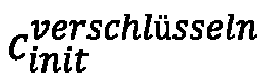

- Netzwerkvorrichtung (500) nach Anspruch 5, das vordefinierte angewandte Szenario umfassend mindestens eines von einem Szenario, bei dem die DCI in einem lizenzierten Frequenzband (LFB) zu übertragen ist, einem Szenario, bei dem die DCI in einem unlizenzierten Frequenzband (UFB) zu übertragen ist, einem Szenario, bei dem der eine oder die mehreren ersten Parameter den Verschlüsselungsidentifikator umfassen, und einem Szenario, bei dem der eine oder die mehreren ersten Parameter den Verschlüsselungsidentifikator nicht umfassen, und
wobei die High-Layer-Angabeinformationen mindestens eines von einem Frequenzband-Lizenztyp, ob der Verschlüsselungsidentifikator konfiguriert wurde, mindestens einen von dem einen oder die mehreren ersten Parameter, wenn die Verschlüsselungsidentifikator konfiguriert wurde, und mindestens einen von dem einen oder den mehreren ersten Parametern, wenn die Verschlüsselungsidentifikator nicht konfiguriert wurde, umfasst. - Benutzergerät, UE (700), umfassend:eine Erzeugungseinheit (701), die konfiguriert ist, um eine Verschlüsselungssequenz gemäß einem oder mehreren ersten Parametern zu erzeugen, wobei der eine oder die mehreren ersten Parameter gemäß einem vordefinierten angewandten Szenario und/oder Angabeinformationen von einer Netzwerkvorrichtung (500) bestimmt werden, wobei der eine oder die mehreren ersten Parameter eine Radio Network Temporary Identity, RNTI, umfassen; undeine Entschlüsselungseinheit (702), die konfiguriert ist, um verschlüsselte Downlink-Steuerinformationen (DCI), die von der Netzwerkvorrichtung (500) empfangen werden, unter Verwendung der erzeugten Verschlüsselungssequenz zu entschlüsseln,wobei, wenn ein Verschlüsselungsidentifikator konfiguriert wurde, der eine oder die mehreren ersten Parameter ferner den Verschlüsselungsidentifikator umfassen,wobei das UE (700) dadurch gekennzeichnet ist, dassdie Erzeugungseinheit (701) ferner zu Folgendem konfiguriert ist:Berechnen von


 Erzeugen der Verschlüsselungssequenz gemäß

- UE (700) nach Anspruch 7, das vordefinierte angewandte Szenario umfassend mindestens eines von einem Szenario, bei dem die DCI in einem lizenzierten Frequenzband (LFB) zu übertragen ist, einem Szenario, bei dem die DCI in einem unlizenzierten Frequenzband (UFB) zu übertragen ist, einem Szenario, bei dem der eine oder die mehreren ersten Parameter den Verschlüsselungsidentifikator umfassen, und einem Szenario, bei dem der eine oder die mehreren ersten Parameter den Verschlüsselungsidentifikator nicht umfassen, und
wobei die High-Layer-Angabeinformationen mindestens eines von einem Frequenzband-Lizenztyp, ob der Verschlüsselungsidentifikator konfiguriert wurde, mindestens einen von dem einen nder die mehreren ersten Parameter, wenn die Verschlüsselungsidentifikator konfiguriert wurde, und mindestens einen von dem einen oder den mehreren ersten Parametern, wenn die Verschlüsselungsidentifikator nicht konfiguriert wurde, umfasst. - Computerlesbares Speichermedium, in dem ein Computerprogramm gespeichert ist, das, wenn es von einem Prozessor einer Netzwerkvorrichtung (500) ausgeführt wird, die Netzwerkvorrichtung (500) veranlasst, die Schritte des Datenübertragungsverfahrens nach Anspruch 1 oder Anspruch 2 auszuführen.
- Computerlesbares Speichermedium, in dem ein Computerprogramm gespeichert ist, das, wenn es von einem Prozessor eines Benutzergeräts UE (700) ausgeführt wird, das UE (700) veranlasst, die Schritte des Entschlüsselungsverfahrens nach Anspruch 3 oder Anspruch 4 auszuführen.
- Computerprogramm, das, wenn es von einem Prozessor einer Netzwerkvorrichtung (500) ausgeführt wird, die Netzwerkvorrichtung (500) veranlasst, die Schritte des Datenübertragungsverfahrens nach Anspruch 1 oder Anspruch 2 auszuführen.
- Computerprogramm, das, wenn es von einem Prozessor eines Benutzergeräts UE (700) ausgeführt wird, das UE (700) veranlasst, die Schritte des Entschlüsselungsverfahrens nach Anspruch 3 oder Anspruch 4 auszuführen.
Applications Claiming Priority (2)
| Application Number | Priority Date | Filing Date | Title |
|---|---|---|---|
| CN201810032423.XA CN110035520B (zh) | 2018-01-12 | 2018-01-12 | 数据传输方法、解扰方法、解调方法及设备 |
| PCT/CN2019/071372 WO2019137480A1 (zh) | 2018-01-12 | 2019-01-11 | 数据传输方法、解扰方法、解调方法及设备 |
Publications (3)
| Publication Number | Publication Date |
|---|---|
| EP3740006A1 EP3740006A1 (de) | 2020-11-18 |
| EP3740006A4 EP3740006A4 (de) | 2021-04-28 |
| EP3740006B1 true EP3740006B1 (de) | 2023-01-25 |
Family
ID=67219297
Family Applications (1)
| Application Number | Title | Priority Date | Filing Date |
|---|---|---|---|
| EP19738806.9A Active EP3740006B1 (de) | 2018-01-12 | 2019-01-11 | Datenübertragungsverfahren, entschlüsselungsverfahren, demodulationsverfahren und vorrichtung |
Country Status (9)
| Country | Link |
|---|---|
| US (1) | US11303410B2 (de) |
| EP (1) | EP3740006B1 (de) |
| JP (1) | JP7133627B2 (de) |
| KR (1) | KR102395898B1 (de) |
| CN (1) | CN110035520B (de) |
| ES (1) | ES2939360T3 (de) |
| HU (1) | HUE061597T2 (de) |
| PT (1) | PT3740006T (de) |
| WO (1) | WO2019137480A1 (de) |
Families Citing this family (12)
| Publication number | Priority date | Publication date | Assignee | Title |
|---|---|---|---|---|
| WO2021035584A1 (en) * | 2019-08-28 | 2021-03-04 | Nokia Shanghai Bell Co., Ltd. | Pdsch scrambling scheme for multi-trp |
| US20210067952A1 (en) * | 2019-09-03 | 2021-03-04 | Nvidia Corporation | Performing scrambling and/or descrambling on parallel computing architectures |
| WO2021092735A1 (zh) * | 2019-11-11 | 2021-05-20 | 小米通讯技术有限公司 | 信号处理方法及装置、通信设备及存储介质 |
| US11743004B2 (en) * | 2019-11-15 | 2023-08-29 | Qualcomm Incorporated | Extended demodulation reference signal scrambling identifier for demodulation reference signal communication |
| US11805453B2 (en) * | 2020-07-02 | 2023-10-31 | Qualcomm Incorporated | Security key in layer 1 (L1) and layer 2 (L2) based mobility |
| CN114374467A (zh) * | 2020-10-14 | 2022-04-19 | 展讯通信(上海)有限公司 | 通信方法及相关产品 |
| WO2022110087A1 (zh) * | 2020-11-28 | 2022-06-02 | 华为技术有限公司 | 一种通信方法、装置及计算机可读存储介质 |
| WO2022151176A1 (zh) * | 2021-01-14 | 2022-07-21 | 华为技术有限公司 | 一种通信方法及装置 |
| US20230397017A1 (en) * | 2022-06-03 | 2023-12-07 | Qualcomm Incorporated | Techniques for energy signal generation and interference cancelation |
| CN118250772A (zh) * | 2022-12-22 | 2024-06-25 | 索尼集团公司 | 用于无线通信的方法和电子设备以及计算机可读存储介质 |
| KR102935108B1 (ko) | 2023-10-17 | 2026-03-05 | 주식회사 카카오 | 프로필 화면을 통해 카운트 오브젝트를 제공하는 방법, 서버 및 사용자 단말 |
| CN120433883A (zh) * | 2024-02-05 | 2025-08-05 | 株式会社Ntt都科摩 | 无线通信网络中的发送设备、接收设备及其方法 |
Family Cites Families (14)
| Publication number | Priority date | Publication date | Assignee | Title |
|---|---|---|---|---|
| CN101772179A (zh) * | 2010-01-08 | 2010-07-07 | 中兴通讯股份有限公司 | 载波聚合场景下系统信息的传输方法及系统 |
| CN102845099B (zh) * | 2010-03-25 | 2016-02-17 | 夏普株式会社 | 通信方法、移动站装置、基站装置及移动通信系统 |
| KR101468767B1 (ko) | 2010-06-08 | 2014-12-08 | 한국전자통신연구원 | 다중 캐리어 무선 통신 시스템에서의 송수신 방법 및 장치 |
| EP3113567B1 (de) | 2011-02-11 | 2018-04-11 | Interdigital Patent Holdings, Inc. | Systeme und verfahren für einen verbesserten steuerkanal |
| EP2805437B1 (de) * | 2012-01-19 | 2020-03-04 | Samsung Electronics Co., Ltd. | Vorrichtung und verfahren zur pilotverschlüsselung für verbesserte pdcc |
| CN103259635B (zh) * | 2012-02-15 | 2016-06-08 | 电信科学技术研究院 | 一种dmrs扰码序列的生成方法及装置 |
| CN103312398B (zh) | 2012-03-16 | 2018-01-19 | 中兴通讯股份有限公司 | 一种增强下行控制信息的传输方法及传输系统及用户设备 |
| CN103427970B (zh) * | 2012-05-23 | 2017-04-26 | 华为技术有限公司 | 传输下行控制信息的方法、用户设备和基站 |
| CN111510992B (zh) | 2014-03-19 | 2022-12-16 | 交互数字专利控股公司 | 无线发射/接收单元的系统信息块获取方法和装置 |
| CN106658720A (zh) * | 2015-10-30 | 2017-05-10 | 中兴通讯股份有限公司 | 一种短传输时间间隔的资源分配方法和装置 |
| CN107241123A (zh) * | 2016-03-28 | 2017-10-10 | 北京信威通信技术股份有限公司 | 协同多点传输系统的数据发射方法、网络设备及无线系统 |
| WO2017170159A1 (ja) * | 2016-03-31 | 2017-10-05 | 京セラ株式会社 | 無線端末及び基地局 |
| CN109495222B (zh) * | 2017-09-11 | 2021-06-15 | 大唐移动通信设备有限公司 | 一种ra-rnti确定方法及装置 |
| CN109802753A (zh) * | 2017-11-17 | 2019-05-24 | 维沃移动通信有限公司 | Csi的传输方法及装置 |
-
2018
- 2018-01-12 CN CN201810032423.XA patent/CN110035520B/zh active Active
-
2019
- 2019-01-11 US US16/959,816 patent/US11303410B2/en active Active
- 2019-01-11 EP EP19738806.9A patent/EP3740006B1/de active Active
- 2019-01-11 JP JP2020537686A patent/JP7133627B2/ja active Active
- 2019-01-11 KR KR1020207019466A patent/KR102395898B1/ko active Active
- 2019-01-11 ES ES19738806T patent/ES2939360T3/es active Active
- 2019-01-11 WO PCT/CN2019/071372 patent/WO2019137480A1/zh not_active Ceased
- 2019-01-11 HU HUE19738806A patent/HUE061597T2/hu unknown
- 2019-01-11 PT PT197388069T patent/PT3740006T/pt unknown
Also Published As
| Publication number | Publication date |
|---|---|
| CN110035520B (zh) | 2021-10-15 |
| JP7133627B2 (ja) | 2022-09-08 |
| US11303410B2 (en) | 2022-04-12 |
| KR102395898B1 (ko) | 2022-05-06 |
| PT3740006T (pt) | 2023-02-21 |
| US20200374072A1 (en) | 2020-11-26 |
| ES2939360T3 (es) | 2023-04-21 |
| EP3740006A1 (de) | 2020-11-18 |
| WO2019137480A1 (zh) | 2019-07-18 |
| HUE061597T2 (hu) | 2023-07-28 |
| KR20200094785A (ko) | 2020-08-07 |
| EP3740006A4 (de) | 2021-04-28 |
| JP2021510258A (ja) | 2021-04-15 |
| CN110035520A (zh) | 2019-07-19 |
Similar Documents
| Publication | Publication Date | Title |
|---|---|---|
| EP3740006B1 (de) | Datenübertragungsverfahren, entschlüsselungsverfahren, demodulationsverfahren und vorrichtung | |
| RU2721359C1 (ru) | Способ передачи информации управления нисходящего канала связи, терминал и сетевое устройство | |
| US20210168759A1 (en) | Paging method, terminal, network device, and computer readable storage medium | |
| US11563518B2 (en) | Method and device of cyclic redundancy check | |
| US12284037B2 (en) | Method and apparatus for PDCCH repetition | |
| US20200092862A1 (en) | Slot Indication Method, Access Network Device, and User Equipment | |
| EP3451781A1 (de) | Datenübertragungsverfahren, netzwerkvorrichtung und benutzergerät | |
| CN111165046B (zh) | 传输信息的方法和设备 | |
| WO2018059070A1 (en) | Sub-channel mapping | |
| CN114342520B (zh) | 系统信息的传输方法和通信装置 | |
| WO2018201401A1 (zh) | 用于非连续接收的方法和设备 | |
| CN108289020B (zh) | 一种被用于无线通信的ue、基站中的方法和装置 | |
| US11799522B2 (en) | Signal transmission method, network device, and terminal device | |
| US12369163B2 (en) | Method and apparatus for enhancing physical downlink control channel (PDCCH) coverage | |
| US20100110917A1 (en) | Method, Apparatus and Computer Program Product For Adaptive Reference Symbol Placement | |
| WO2017193932A1 (zh) | 通信方法及其网络设备、用户设备 | |
| WO2018137234A1 (zh) | 下行控制信息的传输方法、网络设备和终端设备 |
Legal Events
| Date | Code | Title | Description |
|---|---|---|---|
| STAA | Information on the status of an ep patent application or granted ep patent |
Free format text: STATUS: THE INTERNATIONAL PUBLICATION HAS BEEN MADE |
|
| PUAI | Public reference made under article 153(3) epc to a published international application that has entered the european phase |
Free format text: ORIGINAL CODE: 0009012 |
|
| STAA | Information on the status of an ep patent application or granted ep patent |
Free format text: STATUS: REQUEST FOR EXAMINATION WAS MADE |
|
| 17P | Request for examination filed |
Effective date: 20200703 |
|
| AK | Designated contracting states |
Kind code of ref document: A1 Designated state(s): AL AT BE BG CH CY CZ DE DK EE ES FI FR GB GR HR HU IE IS IT LI LT LU LV MC MK MT NL NO PL PT RO RS SE SI SK SM TR |
|
| AX | Request for extension of the european patent |
Extension state: BA ME |
|
| RIC1 | Information provided on ipc code assigned before grant |
Ipc: H04W 72/04 20090101ALI20210128BHEP Ipc: H04L 25/03 20060101ALI20210128BHEP Ipc: H04L 5/00 20060101AFI20210128BHEP |
|
| DAV | Request for validation of the european patent (deleted) | ||
| DAX | Request for extension of the european patent (deleted) | ||
| A4 | Supplementary search report drawn up and despatched |
Effective date: 20210329 |
|
| RIC1 | Information provided on ipc code assigned before grant |
Ipc: H04L 5/00 20060101AFI20210323BHEP Ipc: H04W 72/04 20090101ALI20210323BHEP Ipc: H04L 25/03 20060101ALI20210323BHEP |
|
| REG | Reference to a national code |
Ref country code: DE Ref legal event code: R079 Ref document number: 602019024808 Country of ref document: DE Free format text: PREVIOUS MAIN CLASS: H04W0072040000 Ipc: H04L0005000000 |
|
| GRAP | Despatch of communication of intention to grant a patent |
Free format text: ORIGINAL CODE: EPIDOSNIGR1 |
|
| STAA | Information on the status of an ep patent application or granted ep patent |
Free format text: STATUS: GRANT OF PATENT IS INTENDED |
|
| RIC1 | Information provided on ipc code assigned before grant |
Ipc: H04L 1/00 20060101ALI20220802BHEP Ipc: H04W 72/04 20090101ALI20220802BHEP Ipc: H04L 25/03 20060101ALI20220802BHEP Ipc: H04L 5/00 20060101AFI20220802BHEP |
|
| INTG | Intention to grant announced |
Effective date: 20220823 |
|
| GRAS | Grant fee paid |
Free format text: ORIGINAL CODE: EPIDOSNIGR3 |
|
| GRAA | (expected) grant |
Free format text: ORIGINAL CODE: 0009210 |
|
| STAA | Information on the status of an ep patent application or granted ep patent |
Free format text: STATUS: THE PATENT HAS BEEN GRANTED |
|
| AK | Designated contracting states |
Kind code of ref document: B1 Designated state(s): AL AT BE BG CH CY CZ DE DK EE ES FI FR GB GR HR HU IE IS IT LI LT LU LV MC MK MT NL NO PL PT RO RS SE SI SK SM TR |
|
| REG | Reference to a national code |
Ref country code: GB Ref legal event code: FG4D |
|
| REG | Reference to a national code |
Ref country code: CH Ref legal event code: EP |
|
| REG | Reference to a national code |
Ref country code: DE Ref legal event code: R096 Ref document number: 602019024808 Country of ref document: DE |
|
| REG | Reference to a national code |
Ref country code: NL Ref legal event code: FP Ref country code: AT Ref legal event code: REF Ref document number: 1546536 Country of ref document: AT Kind code of ref document: T Effective date: 20230215 Ref country code: IE Ref legal event code: FG4D |
|
| REG | Reference to a national code |
Ref country code: PT Ref legal event code: SC4A Ref document number: 3740006 Country of ref document: PT Date of ref document: 20230221 Kind code of ref document: T Free format text: AVAILABILITY OF NATIONAL TRANSLATION Effective date: 20230215 |
|
| REG | Reference to a national code |
Ref country code: SK Ref legal event code: T3 Ref document number: E 41248 Country of ref document: SK |
|
| REG | Reference to a national code |
Ref country code: ES Ref legal event code: FG2A Ref document number: 2939360 Country of ref document: ES Kind code of ref document: T3 Effective date: 20230421 |
|
| REG | Reference to a national code |
Ref country code: LT Ref legal event code: MG9D |
|
| REG | Reference to a national code |
Ref country code: AT Ref legal event code: MK05 Ref document number: 1546536 Country of ref document: AT Kind code of ref document: T Effective date: 20230125 |
|
| REG | Reference to a national code |
Ref country code: HU Ref legal event code: AG4A Ref document number: E061597 Country of ref document: HU |
|
| PG25 | Lapsed in a contracting state [announced via postgrant information from national office to epo] |
Ref country code: RS Free format text: LAPSE BECAUSE OF FAILURE TO SUBMIT A TRANSLATION OF THE DESCRIPTION OR TO PAY THE FEE WITHIN THE PRESCRIBED TIME-LIMIT Effective date: 20230125 Ref country code: NO Free format text: LAPSE BECAUSE OF FAILURE TO SUBMIT A TRANSLATION OF THE DESCRIPTION OR TO PAY THE FEE WITHIN THE PRESCRIBED TIME-LIMIT Effective date: 20230425 Ref country code: LV Free format text: LAPSE BECAUSE OF FAILURE TO SUBMIT A TRANSLATION OF THE DESCRIPTION OR TO PAY THE FEE WITHIN THE PRESCRIBED TIME-LIMIT Effective date: 20230125 Ref country code: LT Free format text: LAPSE BECAUSE OF FAILURE TO SUBMIT A TRANSLATION OF THE DESCRIPTION OR TO PAY THE FEE WITHIN THE PRESCRIBED TIME-LIMIT Effective date: 20230125 Ref country code: HR Free format text: LAPSE BECAUSE OF FAILURE TO SUBMIT A TRANSLATION OF THE DESCRIPTION OR TO PAY THE FEE WITHIN THE PRESCRIBED TIME-LIMIT Effective date: 20230125 Ref country code: AT Free format text: LAPSE BECAUSE OF FAILURE TO SUBMIT A TRANSLATION OF THE DESCRIPTION OR TO PAY THE FEE WITHIN THE PRESCRIBED TIME-LIMIT Effective date: 20230125 |
|
| P01 | Opt-out of the competence of the unified patent court (upc) registered |
Effective date: 20230712 |
|
| PG25 | Lapsed in a contracting state [announced via postgrant information from national office to epo] |
Ref country code: SE Free format text: LAPSE BECAUSE OF FAILURE TO SUBMIT A TRANSLATION OF THE DESCRIPTION OR TO PAY THE FEE WITHIN THE PRESCRIBED TIME-LIMIT Effective date: 20230125 Ref country code: PL Free format text: LAPSE BECAUSE OF FAILURE TO SUBMIT A TRANSLATION OF THE DESCRIPTION OR TO PAY THE FEE WITHIN THE PRESCRIBED TIME-LIMIT Effective date: 20230125 Ref country code: IS Free format text: LAPSE BECAUSE OF FAILURE TO SUBMIT A TRANSLATION OF THE DESCRIPTION OR TO PAY THE FEE WITHIN THE PRESCRIBED TIME-LIMIT Effective date: 20230525 Ref country code: GR Free format text: LAPSE BECAUSE OF FAILURE TO SUBMIT A TRANSLATION OF THE DESCRIPTION OR TO PAY THE FEE WITHIN THE PRESCRIBED TIME-LIMIT Effective date: 20230426 Ref country code: FI Free format text: LAPSE BECAUSE OF FAILURE TO SUBMIT A TRANSLATION OF THE DESCRIPTION OR TO PAY THE FEE WITHIN THE PRESCRIBED TIME-LIMIT Effective date: 20230125 |
|
| REG | Reference to a national code |
Ref country code: DE Ref legal event code: R097 Ref document number: 602019024808 Country of ref document: DE |
|
| PG25 | Lapsed in a contracting state [announced via postgrant information from national office to epo] |
Ref country code: SM Free format text: LAPSE BECAUSE OF FAILURE TO SUBMIT A TRANSLATION OF THE DESCRIPTION OR TO PAY THE FEE WITHIN THE PRESCRIBED TIME-LIMIT Effective date: 20230125 Ref country code: RO Free format text: LAPSE BECAUSE OF FAILURE TO SUBMIT A TRANSLATION OF THE DESCRIPTION OR TO PAY THE FEE WITHIN THE PRESCRIBED TIME-LIMIT Effective date: 20230125 Ref country code: EE Free format text: LAPSE BECAUSE OF FAILURE TO SUBMIT A TRANSLATION OF THE DESCRIPTION OR TO PAY THE FEE WITHIN THE PRESCRIBED TIME-LIMIT Effective date: 20230125 Ref country code: DK Free format text: LAPSE BECAUSE OF FAILURE TO SUBMIT A TRANSLATION OF THE DESCRIPTION OR TO PAY THE FEE WITHIN THE PRESCRIBED TIME-LIMIT Effective date: 20230125 Ref country code: CZ Free format text: LAPSE BECAUSE OF FAILURE TO SUBMIT A TRANSLATION OF THE DESCRIPTION OR TO PAY THE FEE WITHIN THE PRESCRIBED TIME-LIMIT Effective date: 20230125 |
|
| PLBE | No opposition filed within time limit |
Free format text: ORIGINAL CODE: 0009261 |
|
| STAA | Information on the status of an ep patent application or granted ep patent |
Free format text: STATUS: NO OPPOSITION FILED WITHIN TIME LIMIT |
|
| 26N | No opposition filed |
Effective date: 20231026 |
|
| PG25 | Lapsed in a contracting state [announced via postgrant information from national office to epo] |
Ref country code: SI Free format text: LAPSE BECAUSE OF FAILURE TO SUBMIT A TRANSLATION OF THE DESCRIPTION OR TO PAY THE FEE WITHIN THE PRESCRIBED TIME-LIMIT Effective date: 20230125 |
|
| PG25 | Lapsed in a contracting state [announced via postgrant information from national office to epo] |
Ref country code: MC Free format text: LAPSE BECAUSE OF FAILURE TO SUBMIT A TRANSLATION OF THE DESCRIPTION OR TO PAY THE FEE WITHIN THE PRESCRIBED TIME-LIMIT Effective date: 20230125 |
|
| PG25 | Lapsed in a contracting state [announced via postgrant information from national office to epo] |
Ref country code: MC Free format text: LAPSE BECAUSE OF FAILURE TO SUBMIT A TRANSLATION OF THE DESCRIPTION OR TO PAY THE FEE WITHIN THE PRESCRIBED TIME-LIMIT Effective date: 20230125 |
|
| PG25 | Lapsed in a contracting state [announced via postgrant information from national office to epo] |
Ref country code: LU Free format text: LAPSE BECAUSE OF NON-PAYMENT OF DUE FEES Effective date: 20240111 |
|
| PG25 | Lapsed in a contracting state [announced via postgrant information from national office to epo] |
Ref country code: LU Free format text: LAPSE BECAUSE OF NON-PAYMENT OF DUE FEES Effective date: 20240111 |
|
| PG25 | Lapsed in a contracting state [announced via postgrant information from national office to epo] |
Ref country code: BE Free format text: LAPSE BECAUSE OF NON-PAYMENT OF DUE FEES Effective date: 20240131 |
|
| PG25 | Lapsed in a contracting state [announced via postgrant information from national office to epo] |
Ref country code: BE Free format text: LAPSE BECAUSE OF NON-PAYMENT OF DUE FEES Effective date: 20240131 |
|
| REG | Reference to a national code |
Ref country code: BE Ref legal event code: MM Effective date: 20240131 |
|
| PG25 | Lapsed in a contracting state [announced via postgrant information from national office to epo] |
Ref country code: BG Free format text: LAPSE BECAUSE OF FAILURE TO SUBMIT A TRANSLATION OF THE DESCRIPTION OR TO PAY THE FEE WITHIN THE PRESCRIBED TIME-LIMIT Effective date: 20230125 |
|
| PG25 | Lapsed in a contracting state [announced via postgrant information from national office to epo] |
Ref country code: BG Free format text: LAPSE BECAUSE OF FAILURE TO SUBMIT A TRANSLATION OF THE DESCRIPTION OR TO PAY THE FEE WITHIN THE PRESCRIBED TIME-LIMIT Effective date: 20230125 |
|
| PGFP | Annual fee paid to national office [announced via postgrant information from national office to epo] |
Ref country code: PT Payment date: 20250102 Year of fee payment: 7 |
|
| PGFP | Annual fee paid to national office [announced via postgrant information from national office to epo] |
Ref country code: CH Payment date: 20250201 Year of fee payment: 7 |
|
| PG25 | Lapsed in a contracting state [announced via postgrant information from national office to epo] |
Ref country code: CY Free format text: LAPSE BECAUSE OF FAILURE TO SUBMIT A TRANSLATION OF THE DESCRIPTION OR TO PAY THE FEE WITHIN THE PRESCRIBED TIME-LIMIT; INVALID AB INITIO Effective date: 20190111 |
|
| PG25 | Lapsed in a contracting state [announced via postgrant information from national office to epo] |
Ref country code: TR Free format text: LAPSE BECAUSE OF FAILURE TO SUBMIT A TRANSLATION OF THE DESCRIPTION OR TO PAY THE FEE WITHIN THE PRESCRIBED TIME-LIMIT Effective date: 20230125 |
|
| PGFP | Annual fee paid to national office [announced via postgrant information from national office to epo] |
Ref country code: GB Payment date: 20251127 Year of fee payment: 8 |
|
| PGFP | Annual fee paid to national office [announced via postgrant information from national office to epo] |
Ref country code: NL Payment date: 20251215 Year of fee payment: 8 Ref country code: FR Payment date: 20251128 Year of fee payment: 8 |
|
| PGFP | Annual fee paid to national office [announced via postgrant information from national office to epo] |
Ref country code: IE Payment date: 20251209 Year of fee payment: 8 |
|
| PGFP | Annual fee paid to national office [announced via postgrant information from national office to epo] |
Ref country code: SK Payment date: 20251212 Year of fee payment: 8 |
|
| REG | Reference to a national code |
Ref country code: CH Ref legal event code: U11 Free format text: ST27 STATUS EVENT CODE: U-0-0-U10-U11 (AS PROVIDED BY THE NATIONAL OFFICE) Effective date: 20260201 |
|
| PGFP | Annual fee paid to national office [announced via postgrant information from national office to epo] |
Ref country code: HU Payment date: 20260112 Year of fee payment: 8 |
|
| PGFP | Annual fee paid to national office [announced via postgrant information from national office to epo] |
Ref country code: ES Payment date: 20260212 Year of fee payment: 8 |
|
| PGFP | Annual fee paid to national office [announced via postgrant information from national office to epo] |
Ref country code: DE Payment date: 20251203 Year of fee payment: 8 |
|
| PGFP | Annual fee paid to national office [announced via postgrant information from national office to epo] |
Ref country code: IT Payment date: 20251219 Year of fee payment: 8 |